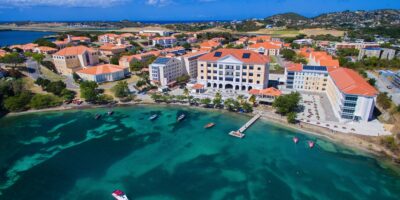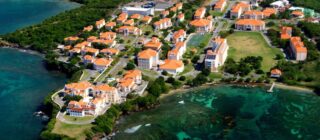

St. George’s University (SGU) School of Medicine is a Caribbean medical school on the island of Grenada in the West Indies. It awards the Doctor of Medicine (MD). The four-year MD is for applicants who already hold a bachelor’s degree, and five-, six- and seven-year tracks add preparatory study for students coming from other education systems or straight from secondary school (the seven-year track is in Grenada only). Basic sciences take place on SGU’s True Blue campus in Grenada or, through a partnership with Northumbria University, in Newcastle, United Kingdom. U.S. applicants must submit an MCAT score; Canadian applicants only need one if they have already taken the MCAT or have a test date, and applicants from outside North America do not need one.
SGU does not publish an official acceptance rate, so figures you see quoted elsewhere are estimates. What it does publish are its requirements, its tuition and its residency placement results. For 2026/27, SGU lists tuition and administrative fees of $389,987 for the full four-year MD, before living costs. Admission is rolling, with 2027 start dates of January 18, April 7 and August 16, and there is no application fee.
St. George’s University has a unique system for its traditional MD program, allowing students to choose between four-year, five-year, six-year and seven-year MD programs, as well as offering dual-degree programs.
The first two years of a student’s time at St. George’s University will include all the basic science courses. Then, students travel for clinical training. Clinical training takes place at affiliated hospitals and clinical centers in the United States and the United Kingdom, with elective options in Canada and clinical centers in Grenada. The university works with more than 85 affiliated hospitals and health systems, creating a program for students with flexible options.
At International Medical Aid, we’re committed to providing you with as many resources as possible to help you succeed on your road to becoming a doctor. That’s why we’ve created a series of definitive guides to help you comb through medical schools to find the ones that fit.
In this article, we’ll help you comb through St. George’s University School of Medicine by discussing the programs it offers, its accreditation, the cost of attendance, admissions requirements, the essay questions on its application (with original examples) and the interview process. Since the university isn’t located in the United States, we’ll include information that’s pertinent to applicants from each country.
Video transcript
You’ve probably seen a number quoted for a medical school: an acceptance rate, a cost, a residency result. Before you rely on it, ask where it came from. This video gives you three questions to ask of any statistic, using St. George’s University School of Medicine, often called SGU, as the example.
Here are the three questions. First, who published it? A school’s own page, an official database and a forum post are not the same kind of source. Second, what year is it from? Costs and results change, so an old number can mislead you. Third, who is included, and who is left out? A figure can describe one group of students and say nothing about the rest.
Now run those questions on SGU. The school publishes its requirements, its tuition and its residency placement results. It does not publish an official acceptance rate. So when you see an acceptance rate quoted for SGU, the first question already gives you the answer. The school didn’t publish it, which makes it an estimate. Treat it that way.
Placement results need the other two questions. They come from the school itself, so they aren’t independent data. Check which year the figure covers. Then check who is counted. Does it include every student who started, or only those who finished and applied for residency? If the school’s page doesn’t say, the number tells you less than it seems.
Now the basics. SGU is a Caribbean medical school on the island of Grenada, in the West Indies. It offers a four-year MD for applicants who already hold a bachelor’s degree. Five, six and seven-year tracks add preparatory study first, for students coming from other education systems or straight from secondary school. The seven-year track is in Grenada only. Your education and test scores decide where you start.
In the four-year MD, the first two years cover the basic sciences. Years three and four are core rotations, sub-internships and electives. Clinical training locations include the Caribbean, the United States and the United Kingdom.
For the four-year MD, you need a bachelor’s degree from an accredited college or university, plus the prerequisites: biology, chemistry, organic chemistry and physics, along with a math or computing course and English. Your major doesn’t have to be science. You’ll also need an MCAT score if you’re applying from the U.S. Canadian applicants need one only if they’ve already taken the test or have a test date. If English isn’t your country’s main language, you’ll need to show you’re proficient.
The process runs in its own order. You submit your applications, which work like primary and secondary applications in the U.S. Then an admissions counselor contacts you. The counselor checks that nothing is missing, tells you when the committee is reviewing your file, and tells you whether you’ll be invited to interview. Interviews are often held online, so set up a quiet, professional space and test your connection.
Cost is another number to check at the source. SGU publishes tuition and administrative fees for the full four-year MD. Living costs aren’t included, because clinical training happens in different places, so research housing, transport and food where you’ll be. Compare the total with the full cost of the U.S. schools on your list, and confirm the dated figures on screen with the school first.
So before you rely on any number, ask who published it, what year it’s from, and who it counts. If you’re still building clinical experience, IMA’s pre-med internships give you supervised direct patient care hours, where you observe, help with triage and scribe alongside the clinical team. For programs, requirements and the interview, read the full St. George’s guide on medicalaid.org.
Key Takeaways
- Degree and location: SGU awards the MD. You begin basic sciences in Grenada or in Newcastle, UK, then complete up to two years of clinical rotations in the United States or the United Kingdom, with electives available in Canada.
- Entry point depends on your education: A bachelor’s degree in the requisite sciences leads to the four-year MD. A-levels, the IB diploma, associate degrees and secondary school credentials lead to the five-, six- or seven-year tracks.
- Rolling admission, three starts a year: The next starts are January 18, April 7 and August 16, 2027. There is no application fee, and you can apply with SGU’s own application or an existing AMCAS, AACOMAS or TMDSAS application.
- Accreditation: The School of Medicine is accredited by the Grenada Medical and Dental Council (GMDC) through 2030. GMDC is recognized by the World Federation for Medical Education (WFME) through 2032, which is what keeps graduates eligible for ECFMG certification and the U.S. residency match.
- Cost is high and federal loans now have caps: Tuition and administrative fees for the full four-year MD are $389,987 at 2026/27 rates, before living costs. New federal borrowers are limited to $50,000 a year and $200,000 in total for a professional degree, so most students will need scholarships, savings or private loans to close the gap.
- Outcomes need context: SGU reports a 95% U.S. residency placement rate for U.S. graduates (2022-2026 average) and 800+ U.S. residencies in 2026. Those rates count graduates who applied to residency. SGU’s graduation rate for students who began in 2018 is 82%, so roughly one in five of that group had not finished the MD as of October 2026.
- Essays are short: SGU’s application asks for a 500-word personal statement on why you want to go to medical school, an optional 100-word statement on academic lapses, and an optional field for the scholarship committee.
- Next step: Compare the full cost and the outcome definitions with the U.S. MD and DO schools on your list, then attend one of SGU’s information sessions with specific questions about clinical placement and financing.
Key Statistics About St. George’s University School of Medicine

| Metric | Value | Cohort or year | Source |
|---|---|---|---|
| School, degree and campuses | St. George’s University School of Medicine; Doctor of Medicine (MD); True Blue campus, Grenada, West Indies, with a basic sciences option at Northumbria University, Newcastle, UK | Current | SGU Doctor of Medicine page |
| Accreditation | Grenada Medical and Dental Council (GMDC) through 2030; GMDC recognized by WFME through 2032 and found comparable by the U.S. NCFMEA | Current | SGU accreditation and approvals page |
| Admission | Rolling; no application fee; starts January 18, April 7 and August 16, 2027 | 2027 entry | SGU admissions and apply pages |
| Class size, median MCAT and GPA | Not published | n/a | SGU does not publish these figures |
| Acceptance rate | Not published | n/a | SGU does not publish an acceptance rate |
| Tuition and administrative fees, four-year MD | $389,987 total ($180,262 basic sciences, $209,725 clinical) | 2026/27 rates, effective June 1, 2026 | SGU tuition and fees page |
| Preclinical tuition (five-, six- and seven-year tracks) | $22,560 per term ($45,120 per year); no administrative fee | 2026/27 rates | SGU tuition and fees page |
| U.S. residency placement rate | 95% for U.S. graduates; 94% for all graduates; 87% for international graduates | Average of 2022-2026, as of October 2026; graduates who applied to a U.S. residency | SGU School of Medicine FAQ, overview and Five-Year Track pages |
| U.S. residencies obtained | 800+ across 43 states and the District of Columbia | 2026 | SGU Match Day 2026 page |
| USMLE Step 2 CK first-time pass rate | 89% for U.S. students; 93% for international students | Academic years 2022-2026 | SGU Doctor of Medicine page and FAQ |
| Graduation rate | 82% | All students who began in 2018, measured October 2026 | SGU School of Medicine FAQ |
| MD graduates | More than 26,000 | 1981-2026 | SGU School of Medicine overview page |
Every outcome in this table is reported by SGU itself, so read the definitions before you compare them with another school. The residency placement rates divide graduates who obtained a U.S. residency by graduates who applied to one. They do not include students who left the program, repeated terms for a long time or never applied. The graduation rate is the best figure SGU publishes for that wider group: 82% of the students who started in 2018 had completed the MD by October 2026. When you weigh SGU against a U.S. school, look at both numbers together rather than the placement rate alone.
SGU also does not publish a median MCAT, median GPA or entering class size. That is a real difference from U.S. MD schools, which report class profiles through the AAMC. If a website quotes an SGU acceptance rate or an average MCAT, it is an estimate.
Mission and Educational Priorities
St. George’s University states its mission this way: “St. George’s University holds to these truths: Our highest purpose is education and there is no better education than one that is truly international. We are committed to developing the intellectual capacity, creativity, and professionalism of our students, immersing them in the rich diversity of human experience and aspiration. As a result, they are prepared to shape the future of our world while adding to the knowledge base of humankind.”
The School of Medicine describes its own purpose in similar terms. It aims to provide “a diverse, multicultural and international environment that empowers students to learn the medical knowledge, clinical skills and professional behaviors to participate in healthcare delivery to people across the world.”
What does that mean for you as an applicant? Three things stand out.
The international setting is the point, not a side effect. SGU has drawn students, alumni and faculty from more than 150 countries. Many students do basic sciences in Grenada, some start in Newcastle, and clinical training happens in the United States, the United Kingdom, Canada and Grenada. If you have lived abroad, worked with people from other cultures or cared for patients who speak another language, those experiences fit the school’s stated priorities. If you have not, think honestly about how you will adapt to living on an island far from home for two years.
The committee looks for specific attributes. SGU lists the strengths it wants to see in a successful applicant: strong academic achievement or potential, empathy and compassion, motivation toward and demonstrated interest in medicine, the ability to learn from mistakes or failures, critical thinking with problem-solving ability, strong communication skills and teamwork, resilience and adaptability, a sense of community responsibility, curiosity and dedication to lifelong learning, and sensitivity and openness to diversity. Use this list when you plan your essays and your interview examples. “Ability to learn from mistakes” is unusual to see stated so plainly, and it connects directly to the optional essay on academic lapses.
The school sees itself as a supplier of U.S. physicians. SGU states that it has been the largest provider of doctors into first-year U.S. residencies for thirteen years in a row. Its curriculum, clinical network and career office are built around the USMLE and the U.S. match. If you plan to practice in the United States or Canada, that focus works in your favor. If you plan to practice elsewhere, confirm how your home country’s licensing body treats an SGU MD before you apply.
A global outlook is also something you can build before medical school. Many applicants gain it through healthcare internships abroad, where they work in clinics that serve communities very different from their own. What matters to a committee is not the trip itself but what you learned from the patients you met.
Accreditation and Institutional Identity
Accreditation matters more for a Caribbean school than for a U.S. one, because it decides whether you can take the USMLE, enter the U.S. residency match and get licensed. Here is SGU’s current status.
- Accreditor: The Grenada Medical and Dental Council (GMDC) accredits SGU School of Medicine, with re-accreditation for the maximum ten-year term through 2030. SGU was previously accredited by the Caribbean Accreditation Authority for Education in Medicine and Other Health Professions (CAAM-HP), starting in 2007; GMDC is its accreditor today.
- WFME recognition: The World Federation for Medical Education recognized GMDC for the maximum ten years, through September 2032.
- NCFMEA: The U.S. Department of Education’s National Committee on Foreign Medical Education and Accreditation determined that GMDC uses standards comparable to U.S. medical accreditation standards. That finding is what allows eligible U.S. citizens and permanent residents to use U.S. federal Direct Loans at SGU.
- ECFMG: Since 2024, physicians applying for ECFMG certification must have graduated from a medical school accredited by an agency recognized by WFME. GMDC’s WFME recognition satisfies that requirement. ECFMG certification is required before an international medical graduate can enter an ACGME-accredited U.S. residency, and SGU is listed in the World Directory of Medical Schools as meeting ECFMG eligibility requirements.
- New York: The New York State Education Department re-approved SGU in January 2023 for the maximum seven years, through 2029, for long-term clinical clerkships in New York.
- Other U.S. approvals: SGU is approved by the New Jersey State Board of Medical Examiners for clinical clerkships at affiliated New Jersey teaching hospitals, approved by the Georgia Composite Medical Board for clinical clerkships, included on the Medical Board of California’s list of recognized medical schools, and licensed by the Florida Commission on Independent Education.
- International approvals: The Bahamas Medical Council, the Bermuda Medical Council, the Sri Lankan Medical Council, the Thailand Medical Council and the Medical Board of Trinidad and Tobago have reviewed and approved the School of Medicine.
- Institution: St. George’s University holds full institutional accreditation from the Grenada National Accreditation Board through 2030. Grenada’s Parliament chartered the university in 1976, and the first class arrived in January 1977. Its Master of Public Health is accredited by the Council on Education for Public Health (CEPH).
Two cautions apply. First, accreditation keeps doors open; it does not guarantee a residency or a license. Each U.S. state medical board sets its own rules for international medical graduates, including how many years of U.S. residency training it requires before licensure, so check the board in the state where you hope to practice. Second, an SGU graduate is an international medical graduate (IMG) in the U.S. match, even if they are a U.S. citizen. That status affects how some residency programs screen applicants, which is why the outcome data later in this guide matter.
You can check a school’s ECFMG status yourself in the World Directory of Medical Schools and read the full list of SGU’s approvals on its accreditation and approvals page.
Medical Programs and Affiliations
- Doctor of Medicine
- Doctor of Medicine / Master of Science (MD/MSc)
- Doctor of Medicine / Master of Public Health (MD/MPH)
- Medical Ph.D. Degree
There are four different Doctor of Medicine (MD) entry points at St. George’s University: the four-year MD program and the five-, six- and seven-year tracks. All of them lead to the same MD. Your highest level of education and your test scores determine where you start.
Four-Year MD Program
St. George’s University School of Medicine offers the traditional, four-year MD program that’s common in the United States. It is designed for students who have completed a bachelor’s degree in the requisite sciences. Students spend their first two years in the basic sciences, either on the 42-acre Grenada campus or through SGU’s partnership with Northumbria University in Newcastle, UK. The two paths use the same curriculum. Students then complete up to two years of clinical rotations in the United States or the United Kingdom, depending on visa policies, with elective options in Canada. The MD is awarded when the program is complete. The basic sciences add up to 86 credits, followed by two clinical years. The full course list appears in the curriculum section below.
Five-Year MD Program
Have you completed advanced-level study, an International Baccalaureate or an associate degree, but not a bachelor’s degree? Maybe the desire to become a doctor didn’t surface until later on. St. George’s University School of Medicine designed this track with you in mind. The first year has you taking preliminary classes to fill in the gaps and to prepare you for the same curriculum that other MD students complete. The rest of the track is the four-year MD.
The track runs this way:
- Year 1: preclinical coursework in Grenada or the UK
- Year 2: basic science coursework in Grenada or the UK
- Year 3: basic science coursework in Grenada
- Years 4-5: clinical training at affiliated hospitals in the United States or the UK
The preclinical year (Preclinical Year 3 in SGU’s numbering) is as follows:
- Genetics
- Molecular Biology and Lab
- Microbiology and Lab
- Physiology and Lab
- Human Anatomy
- Biochemistry and Lab
- Learning Strategies for Preprofessional Programs
- Communication for the Health Professions I and II
- Clinical Cases
- Interpreting Health Science Research
- Intro to Psychopathology
- Social Science and Medicine
To qualify for the five-year track, you need one of the following, among others SGU accepts:
- GCE A Levels: a minimum of 3 subjects with grades A or B in biology, chemistry, and either math or physics. If neither math nor physics was taken at A Level, a strong third non-science subject may be accepted with proof that math or physics was taken at AS Level.
- CAPE Units 1 and 2: a minimum of Grade 2 in Units I and II, including chemistry, biology and one other subject, preferably math or physics.
- Full IB Diploma: a minimum score of 32 points, with 3 HL science subjects and 2 HL subjects, including a minimum grade of 5 in biology and chemistry.
- Associate degree: with a strong biological science background.
- 10+2 India Senior Secondary School Certificate: a minimum average of 80% in biology, chemistry, math, physics and English. A pre-sessional math program may be needed if math has not been completed.
- Approved foundation programs: SGU recognizes various science or medical pathway programs, and the admissions committee assesses each one individually.
Entry qualifications exist for many other countries and examination boards, so work with your admissions officer to confirm which ones apply to you. International applicants to this track do not need to take NEET or the MCAT.
English Language Requirements
If your country is not considered English-speaking under UK Visas and Immigration (UKVI) guidance, you’ll need to prove your competency in English. SGU may grant an exception to students with an undergraduate degree from an English-speaking country, but you must request the waiver. The following scores are accepted.
- IELTS Academic or UKVI: a minimum of 7.0 overall, with 7.0 on each band.
- TOEFL (internet-based): 5 overall, with band scores of Listening 5, Reading 5, Speaking 4.5 and Writing 5.
- Password Skills: scoring is the same as IELTS.
- C1 Advanced (CAE): a minimum of 185 overall, with 185 in each band.
- Duolingo English Test: a minimum of 130 overall, with 130 on each band.
- Kaplan Test of English: a minimum of 510 overall, with 510 on each band.
Accepted tests and minimum scores can change, so confirm them on the SGU admissions page before you book a test.
Successful completion of each preparatory year qualifies students to continue to the next stage of the track.
Six-Year MD Program
The six-year track is designed for students who have Advanced Subsidiary (AS) Levels, the South African or Australian Matric, or similar secondary qualifications. These students generally need to learn more basic science before starting the medical curriculum. The admissions requirements include:
- Secondary School and American High School Diploma: an overall average of 90% or better with strong science performance
- BTEC: a diploma in the appropriate sciences with overall distinctions
- GCE AS Levels: a minimum of 3 subjects with at least a B in biology, chemistry, and math or physics
- Baccalaureate
- South African Matric
- Australian Matric
- Higher School Exam
- Irish Leaving Certificate
- Senior Certificate
The track runs two preclinical years in Grenada or the UK, a year of basic sciences in Grenada or the UK, a year of basic sciences in Grenada, and two clinical years in the United States or the UK. The second preclinical year (Preclinical Year 2) includes:
- Anatomy and Physiology I and II
- Organic Chemistry I and II with Labs
- Public Speaking
- Statistics
- Nutrition
- General Physics for Life Sciences I with Lab
- Health Psychology
- Public Health
Year 2 of the six-year track then matches the preclinical year of the five-year track, and the rest is the traditional MD curriculum.
Seven-Year MD Program
The seven-year track is the equivalent of completing three years of preclinical, college-level science and then the four-year MD. It is offered in Grenada only and is designed for students with secondary school credentials such as an American high school diploma, the GED (a minimum score of 175 in math, science, social studies and humanities), IGCSEs (at least a B in 6 or more subjects, including biology, chemistry, math, physics and English) or the Kenya Certificate of Secondary Education. If you are interested, check with Admissions to see if you qualify for St. George’s University’s Bachelor of Science/Doctor of Medicine dual degree.
The program consists of:
- Preclinical coursework: 3 years, in Grenada
- Basic science coursework: 2 years, in Grenada
- Clinical training in hospitals: 2 years, in the United States or the UK
The first year of the seven-year track (Preclinical Year 1) consists of the following courses.
- General Biology with Lab
- Human Biology with Lab
- General Chemistry I and II with Labs
- Computer Concepts and Applications
- College English
- College Math
- Introduction to Psychology
- Health Education
- An elective
St. George’s University School of Medicine is unusual in the way it offers the MD program to students. It meets you where you are academically and helps you prepare for the rigor of the MD program through preparatory classes. Your highest level of education and test scores determine where you fall on the four-to-seven-year path. If you are a high school student comparing early pathways to medicine, our guide to medical internships for high school students explains how to build patient-facing experience before college.
SGU and University of Waterloo Doctor of Medicine Track
SGU and the University of Waterloo in Ontario run a direct-entry pathway from high school or early university to the MD. Students earn a Bachelor of Medical Science (BMedSci) from Waterloo and an MD from SGU. Applicants are placed in a five-year track (typically after 30-60 university credits with prerequisites met) or a six-year track (from high school), at the discretion of SGU’s Faculty Student Selection Committee. Preclinical study takes place at Waterloo, and MD Year 1 takes place in Grenada or the UK. Once accepted, students do not reapply or retest for the medical school seat. Waterloo preclinical tuition is $23,392 per term. The first class began in fall 2026, and applications are open for September 2027 entry.
MDReady
MDReady is a 14-week, tuition-deferred trial of the first medical term. Students take the same classes and exams as first-term MD students on campus. If they meet all Term 1 academic requirements and choose to continue, they gain full admission to the MD and tuition is charged then; if they leave, no tuition, fees or academic credit are recorded. Living costs, books, travel, housing, food and health insurance during the trial are the student’s responsibility, and U.S. federal loans are not available until the trial is complete.
Now that we’ve covered the differences in the MD program timelines, let’s look at the dual degrees that St. George’s University School of Medicine offers.
Bachelor of Science / Doctor of Medicine Dual Degree
This degree is ideal for students who don’t have an undergraduate education, or, in other terms, don’t have a first degree. If you want to earn your Bachelor of Science degree and your Doctor of Medicine degree at St. George’s University, this is the route to ask about when you apply to the five-, six- or seven-year track.
Students who enter in the first or second preclinical year may earn a bachelor’s degree upon acceptance into, and completion of, the first year of the four-year MD program. Students who enter directly into the third preclinical year (with A Levels or an International Baccalaureate) have to complete additional coursework and are evaluated for transfer credit. Only students enrolled in the BSc/MD degree program receive the bachelor’s degree at the end of the first year of the four-year MD.
For in-depth details and program restrictions, visit this page on the St. George’s University School of Medicine website.
Doctor of Medicine / Master of Public Health Dual Degree
Please note that this degree is separate from the option to earn a bachelor’s degree during a five-year, six-year or seven-year MD track.
St. George’s University offers the Master of Public Health program in conjunction with the Doctor of Medicine (MD) program, so students earn both degrees in tandem. The MPH is accredited by CEPH. On top of the medical curriculum, students take courses in epidemiology, biostatistics, health policy and management, social and behavioral sciences, and environmental health. Every MPH student completes a 120-hour field-based practicum and a Capstone Integrated Learning Experience. MD/MPH students must also complete Basic Principles of Medicine III (8 credits) from the MD curriculum. Years 1-2 take place in Grenada or at Northumbria University, and years 3-4 at hospitals or clinics in the United States, the UK, Canada or Grenada.
To apply, you submit an application to the School of Medicine and include the Graduate Addendum. The admissions committee reviews you for the MD first; after acceptance, a representative of the graduate program interviews you, and the Dean of Graduate Studies and faculty review your request for the dual degree.
To view the timeline and specific courses required for the MD/MPH degree, go here. If population health is what draws you to medicine, a medical internship in Peru is one way to see public health problems in a Spanish-speaking community before you commit to a dual degree.
Doctor of Medicine / Master of Science Dual Degree
If you want to be a doctor and a researcher, you’ll want to look at this dual-degree program. The Master of Science degree allows you to focus on original, thesis-oriented medical research in addition to your profession as a doctor. You’ll be equipped to conduct research in the following areas.
- Anatomy
- Bioethics
- Biomedical Research
- Microbiology
- Neuroscience
- Physiology
- Tropical Medicine
Students in this program add one term and one summer to the basic sciences to complete the Master of Science portion of the curriculum. At least 10 appropriate credits from the MD count toward the 34-credit MSc. Much of the research happens through the Windward Islands Research and Education Foundation (WINDREF) on the True Blue campus, in departmental laboratories, or in approved laboratories at other institutions. A supervisory committee oversees the research, which ends in a thesis, and non-thesis options are also available.
Medical Ph.D. Degree
This dual degree makes you a Doctor of Medicine and a Doctor of Philosophy. St. George’s University School of Medicine offers the following concentrations for the Ph.D. portion of the program.
- Medical Ph.D. in Anatomical Education
- Medical Ph.D. in Anatomical Sciences
- Medical Ph.D. in Microbiology
- Medical Ph.D. in Physiology and Neuroscience
The Ph.D. requires at least 60 credits. To earn it, you’ll need to produce and defend a doctoral thesis, which is sent to an external examiner before a final oral defense. For more information on this dual-degree program, go here.
Curriculum Overview
SGU describes its curriculum as systems-based, with an emphasis on clinical skills instruction and case-based teaching. In the basic sciences, students learn through lectures and laboratory classes supported by small-group sessions and case-based exercises. Clinical years combine bedside teaching with lectures, small-group discussions and directed study. Course descriptions for every module are in SGU’s course catalog, and the program overview is here.
Years One and Two: Basic Sciences
Students spend the first two years at either the Grenada True Blue campus or the Northumbria campus, where they take the following courses.
Year One
- Term 1, Basic Principles of Medicine I (BPM 500)
- Foundation to Medicine (6 weeks)
- Musculoskeletal System (4 weeks)
- Cardiovascular, Pulmonary and Renal Systems (7 weeks)
- Term 2, Basic Principles of Medicine II (BPM 501)
- Endocrine and Reproductive Systems (3 weeks)
- Digestive System and Metabolism (4 weeks)
- Nervous System and Behavioral Sciences (11 weeks)
Year Two
- Term 3, Basic Principles of Medicine III (BPM 502), a 6-week course with four thematic areas:
- Basics of Immunology and Microbiology
- Public Health Assessment Tools
- Culture and Societal Issues / Physician-Patient Relationship
- Ethics, Professionalism and Medical Jurisprudence
- Term 4, Principles of Clinical Medicine I (PCM 500)
- Foundations to Clinical Medicine (4 weeks)
- Neurological, Cardiovascular and Renal Systems (6 weeks)
- Respiratory, Hematopoietic and Pediatric Systems (4 weeks)
- Digestive, Endocrine and Reproductive Systems (6 weeks)
- Term 5, Principles of Clinical Medicine II (PCM 501)
- Musculoskeletal System and Infections (4 weeks)
- Cardiology, Pulmonology, Renal and Hematology (4 weeks)
- Gastroenterology, Obstetrics, Endocrinology and Reproductive (4 weeks)
- Dermatology, Neurology, Psychiatry and Rheumatology (4 weeks)
The first year moves through the body system by system, so you learn normal structure and function and then disease in the same organ system. Term 3 is short and focuses on the foundations every physician needs outside the organ systems: immunology and microbiology, public health tools, culture and the physician-patient relationship, and ethics and law. Terms 4 and 5 shift the emphasis to clinical reasoning, which prepares you for USMLE Step 1. To be certified to take Step 1, students must pass all basic science courses. If you want to know what that exam covers and how it is scored, see our guide to everything you need to know about USMLE Step 1.
Years Three and Four: Clinical Training
Years 3 and 4 are spent in core rotations, sub-internships and electives at affiliated hospitals.
Year 3 core rotations (42 weeks):
- Internal Medicine (12 weeks)
- Surgery (12 weeks)
- Pediatrics (6 weeks)
- Obstetrics / Gynecology (6 weeks)
- Psychiatry (6 weeks)
- Family Medicine (6 weeks; may be taken in Year 4, depending on clinical placement)
Year 4 sub-internships and electives (38 weeks in total), including:
- Medicine Subinternship (4 weeks)
- Medicine Elective (4 weeks)
- Additional Electives (24 weeks)
Students usually take USMLE Step 2 CK after the third-year core rotations. SGU reports an 89% first-time Step 2 CK pass rate for U.S. students in academic years 2022-2026.
How the Tracks Differ
The extended tracks add one to three preclinical years before Term 1. Those years are college-level science and general education. The seven-year track’s first year covers general biology, human biology, general chemistry, math, English, psychology, computing and health education. The six-year track’s second year adds anatomy and physiology, organic chemistry, physics, statistics, nutrition, public speaking, health psychology and public health. The final preclinical year, shared by the five-, six- and seven-year tracks, is closest to medical school: genetics, molecular biology, microbiology, physiology, human anatomy, biochemistry, communication for the health professions, clinical cases, research interpretation, psychopathology and social science. Once students start Term 1, every track follows the same MD curriculum.
Learning Support
SGU’s Department of Educational Services teaches study skills and learning strategies, and the Office of Student Affairs assigns faculty advisors to matriculated students. SGU states that more than 98% of students use the academic and non-academic support it offers. If you know you struggle with high-volume exams, ask during your interview how the Department of Educational Services works with first-term students and how early academic warnings are given.
Admissions Requirements and Application Process
SGU’s committee on admission, the Faculty Student Selection Committee, selects students individually. It considers each applicant’s academic strengths together with their experiences and attributes, and asks how a person might contribute as a medical student and as a future physician.
Candidates from the United States and Canada
To qualify for the four-year MD program, you’ll need a bachelor’s degree from an accredited college or university. While a Bachelor of Science degree isn’t required, the following courses (or their equivalents) are.
- General Biology or Zoology with lab (1 year)
- Inorganic Chemistry, General or Physical, with lab (1 year)
- Organic Chemistry with lab (1 year)
- Physics with lab (1 semester)
- A 100-level college or university mathematics course (1 semester)
- English (1 semester)
For questions about prerequisite equivalencies, speak with your assigned admissions officer or email [email protected].
You’ll also need to know how to use a computer; SGU lists basic computer literacy as a necessary skill for medical students. U.S. applicants must submit an MCAT score. SGU’s MCAT code is 21303. Canadian applicants only need to submit an MCAT score if they have already taken the exam or have a test date. Ask your admissions officer how recent your score must be.
Candidates from Other Countries
If you come from a country other than the United States or Canada, you need a bachelor’s degree with a strong science background for the four-year MD program. While it’s not required to major in science, a strong science background is crucial for success in the program. If you do not have a bachelor’s degree, the five-, six- and seven-year tracks described above are your entry points.
You’ll also need to speak English fluently since the program is taught in English. If your country is not considered English-speaking under UKVI guidance, you’ll need one of the English test scores listed in the English Language Requirements section above, or a waiver based on an undergraduate degree from an English-speaking country.
Applicants from outside North America do not need the MCAT. SGU also states that international applicants are exempt from the University Clinical Aptitude Test (UCAT) and do not apply through UCAS, and applicants to the preclinical tracks from India do not need NEET. One exception: applicants living outside the United States who hold U.S. dual citizenship must submit an MCAT. SGU does not list CASPer or another situational judgment test as a requirement. If you are also applying to U.S. schools, you may still need the CASPer test for those.
International applicants submit their academic records, two letters of recommendation, an English exam result where required, two extracurricular activities, a personal statement and a passport scan.
Technical Standards
SGU has technical standards for admission, continued enrollment and graduation. They cover observation skills, communication skills, motor skills, intellectual and quantitative abilities, behavioral and social attributes, and computer literacy. Students with disabilities are encouraged to register with Student Accessibility and Accommodation Services early, because early communication helps the school arrange reasonable accommodations.
Experience SGU Looks For
SGU does not set a minimum number of clinical or volunteer hours. Its list of attributes, though, includes “motivation towards and demonstrated interest in the profession of medicine,” and its interview guidance asks you to discuss your healthcare experience. The application has a Work and Activities section for work, extracurricular activities and volunteer experience, with an optional resume or CV upload. Patient-facing work is the most direct way to show that interest. Supervised internships for pre-med students, scribing, EMT work, hospital volunteering and research all count, as long as you can explain what you did and what you learned.
Letters of Recommendation
You need two individual letters of recommendation or one health professions committee letter. SGU prefers letters from science faculty, but you may also ask faculty in other disciplines or supervisors who can speak to your abilities. There is no required form. Letters should address your attitude and capability in academic work, sense of community, ability to work in teams and overall suitability for medicine. SGU suggests a maximum of five letters and recommends letters from professors you studied or did research with, or managers you worked for, rather than family friends. SGU accepts letters through Interfolio, Docufied and Virtual Evals.
Application Process
St. George’s University School of Medicine does things a little differently. Here is how the process works.
- Submit your application. Use the online SGU application or an existing AMCAS, AACOMAS or TMDSAS application. There is no application fee. You are assigned a dedicated admissions officer and admissions coordinator as soon as you start.
- Send supporting documents. Official transcripts from every college, university or professional school you attended, your letters, and MCAT scores if you need them. These can follow after you submit.
- Initial review. Your admissions officer reviews your application to make sure you aren’t missing any documents, then sends your file to the Faculty Student Selection Committee. Applicants are usually told within 5 business days of the initial review whether they will be invited to interview. The committee sometimes asks for more information first.
- Interview. You meet with SGU’s professional interview team. We’ll discuss the interview in its own section below.
- Final review and decision. Your admissions officer sends the interview summary and your full file back to the committee, which reviews it holistically and decides. Applicants usually hear within about two weeks after the interview.
Your admissions officer will keep you informed about when the committee is reviewing your application and whether you have been invited to interview.
Application Timeline
| Step | When | Notes |
|---|---|---|
| Application opens | Rolling, year-round | SGU application, or AMCAS, AACOMAS or TMDSAS |
| Supporting documents | Can follow the application | Transcripts, two letters or one committee letter, MCAT for U.S. applicants |
| Interview decision | Usually within 5 business days of initial review | Committee may request more information first |
| Final decision | Usually within about two weeks of the interview | Admit, Admit with Provisions or Not Admit |
| CityDoctors scholarship (August term) | Priority deadlines March 15 and May 15 | Separate scholarship application |
| CityDoctors scholarship (January and April terms) | Priority deadlines August 31 and November 15 | Separate scholarship application |
| New Year, New Career Scholarship | Apply by December 31 | January 2027 term only |
| Term starts | January 18, April 7 and August 16, 2027 | UK start months vary by track; confirm with admissions |
Because admission is rolling, applying early in the window for your preferred term gives you more time to finish documents, apply for scholarships and arrange visas and housing. If you are planning a summer before you apply, pre-med summer internships can add supervised clinical hours that you can then write about in the Work and Activities section.
Tuition, Cost of Attendance and Financial Aid
St. George’s University School of Medicine certainly doesn’t disappoint with the programs it offers. So, just how much does it cost to attend this medical school?
Cost of Attendance at St. George’s University School of Medicine
Here are SGU’s published figures for tuition and administrative fees for the four-year MD in 2026/27 (effective June 1, 2026). All figures are in U.S. dollars.
- Basic sciences (terms 1 to 5): $180,262 ($155,052 tuition plus $25,210 administrative fees)
- Clinical (terms 1 to 5): $209,725 ($41,945 per clinical term)
- Total for all years: $389,987 ($340,862 tuition plus $49,125 administrative fees)
The preclinical years of the five-, six- and seven-year tracks cost $22,560 per term, or $45,120 a year, with no administrative fee. The same tuition rates apply to the MD program and tracks at Northumbria University. Go here for the exact numbers for the program(s) you’re interested in.
SGU bundles most student support services, such as technology, wellness and student life, into the administrative fee. Health insurance is handled separately depending on eligibility and location. Because St. George’s University School of Medicine has students who come from all over the world and because clinical training takes place at hospitals in different locations, living costs vary a great deal. The financial aid office estimates a cost of attendance each year that adds books, transportation, insurance, housing, food and personal expenses to tuition. Our recommendation is to research the area around each site you’ll attend to estimate your housing, transportation and food costs, and to ask the financial aid office for its current cost of attendance estimate in writing.
That is a significant cost, so compare it with the total cost of medical school at the U.S. schools on your list, including living expenses and interest.
U.S. Federal Loans and the New Borrowing Caps
SGU participates in the William D. Ford Federal Direct Loan Program for U.S. citizens and permanent residents in the four-year MD whose basic sciences are in Grenada. Students in the SGU/Northumbria University program have not been eligible for federal Direct Loans since July 1, 2011, so they rely on private loans and other funding.
Federal rules changed on July 1, 2026. For loans disbursed on or after that date:
- Graduate PLUS loans are no longer available to new borrowers.
- Professional students, including MD students, can borrow up to $50,000 per academic year and $200,000 in total in federal Direct Unsubsidized Loans.
- A lifetime federal borrowing cap of $257,500 includes undergraduate loans.
- New borrowers have two repayment plans: a revised standard plan and the Repayment Assistance Plan (RAP), which sets payments at 1% to 10% of adjusted gross income with forgiveness after 30 years.
- Unsubsidized loans first disbursed on or after July 1, 2026 carry an 8.07% interest rate.
Students who borrowed for the four-year MD before July 1, 2026 and stay continuously enrolled can keep the old rules as “legacy borrowers” for up to three academic years or until their expected completion date, whichever is less.
Here is why this matters. Tuition and fees alone for the four-year MD are $389,987. The federal cap for a new borrower is $200,000. Even before you pay rent or buy a plane ticket, that leaves roughly $190,000 to cover with scholarships, savings, family support or private loans. Private loans are credit-based and often need a cosigner. Build this gap into your decision early, not after you are admitted.
SGU’s U.S. Title IV cohort default rate was 0.9% for federal fiscal year 2018, the most recent year it reports. Public Service Loan Forgiveness remains available under current law for borrowers who work full time for a qualifying employer.
Canadian and International Students
Canadian students usually fund their education through professional lines of credit from Canadian banks, SGU scholarships, family contributions and limited SGU institutional loans. SGU states it is approved by the Canadian Ministry of Education, which entitles most students to apply for Canadian federal and provincial loans, and it offers an exchange rate lock on U.S. dollar tuition from entry to graduation. International students are reviewed for scholarships and need-based bursaries and submit a Confidential Financial Statement.
Scholarships
All students admitted to the four-year MD or to the five-, six- or seven-year tracks are automatically reviewed for scholarships at the time of acceptance, with no separate application. Standard awards include:
- Academic Merit Scholarships, based on overall and science GPA and test performance
- Difference-Maker Scholarships, for volunteerism, careers, service initiatives or innovative research
- Connections and Community Scholarships, for which every admitted MD student is reviewed
Some awards require an additional application, including:
- CityDoctors Scholarship: partial, half or full tuition, offered with NYC Health + Hospitals. You must be a first-time incoming SGU student, a U.S. citizen or permanent resident, and meet at least one New York City criterion, such as five or more years of residence in the five boroughs, graduation from a New York City high school, or full-time employment (yours, a parent’s or a grandparent’s) with the City of New York or NYC Health + Hospitals for five or more years.
- CARE and Equity in Medicine scholarships, which SGU groups with CityDoctors as Mission-to-Serve awards.
Other named awards on SGU’s scholarship pages include the SGU Medical Scholar Award, the Chancellor Legacy of Excellence Scholarship, the $65,000 New Year, New Career Scholarship for career changers with a bachelor’s degree entering the January 2027 four-year MD (apply by December 31), the $50,000 50th Anniversary Scholarship and the Global Scholarship for international students. SGU also participates in U.S. Department of Veterans Affairs education programs, including the Post-9/11 GI Bill.
All scholarships are awarded before matriculation and are applied over the full ten terms of the program, so you cannot be reviewed for one after you enroll. For information on these scholarships, click here.
Repeated Coursework
Students in terms 1-5 of the four-year MD are charged full tuition and fees for repeated courses or terms, including repeats after a leave of absence or a credit remediation option. Preclinical track students who repeat a course are also charged the published rate. Ask how many students repeat a term and what that does to total cost, because a repeated basic science term adds about $40,000 at current rates.
Campus Facilities and Student Life
Students begin their basic sciences on the Chancellor Charles Modica campus, which sits on a peninsula in the southwest corner of Grenada. The 42-acre campus has more than 65 buildings that combine Georgian architecture with Caribbean colors, and it includes teaching facilities, laboratories, a library, the WINDREF research institute, an 8,400-square-foot fitness center, a 24-hour medical clinic and round-the-clock private security. Buildings provide both 110- and 220-volt outlets, which helps if you bring U.S. electronics.
Grenada. Grenada is an independent nation in the British Commonwealth, about 22 miles long and 12 miles wide, with average temperatures between 75 and 85 degrees Fahrenheit. English is the national language. Students can hike in Grand Etang National Park, swim at Concord Falls, snorkel over the reefs and the Underwater Sculpture Park, and explore the capital, St. George’s. The national dish, oil down, is worth trying. SGU also publishes hurricane preparedness guidance, which is worth reading before you arrive.
Newcastle, UK. Students who start at Northumbria University live in Newcastle upon Tyne, a compact city with a large student population, good public transport and train connections to London and Scotland. Remember that federal Direct Loans are not available in the SGU/Northumbria program.
Student organizations. SGU lists more than 65 student-led organizations, including clinical interest groups, cultural communities and service groups, along with intramural sports and a fitness and wellness program.
Support services. The Office of Student Affairs provides advising, progress monitoring and a Faculty Advisor Program. University Health Services and the Psychological Services Center serve the whole community, with counseling on the Grenada campus. Student Accessibility and Accommodation Services handles disability accommodations. The Department of Educational Services, which SGU describes as its largest faculty, teaches study skills.
Housing. SGU offers on-campus housing in Grenada, and its charges and refund rules are set by the university. In clinical years you move to wherever your rotations are, which may mean several cities. Budget for deposits, short-term leases and travel between sites.
Living on an island for two years is a real adjustment. Students who do well usually arrive with a plan for studying, exercise and staying connected with family. If you have never lived away from home, or never worked in a setting where you were the outsider, spending time in an unfamiliar clinical environment before you apply can help you test how you adapt. Medical internships for undergraduates in another country are one way to do that while gaining supervised patient care experience.
Clinical Rotations and Research Opportunities
Where Clinical Training Happens
SGU students complete clinical training through affiliated hospitals and clinical centers in the United States, the United Kingdom, Canada (electives) and Grenada. SGU lists more than 85 affiliated hospitals and health systems. U.S. sites are in Arizona, California, Connecticut, Florida, Georgia, Illinois, Louisiana, Maryland, Michigan, New Jersey, New York, Ohio and Wisconsin. Examples include:
- New York: NYC Health + Hospitals sites including Kings County, Metropolitan, Elmhurst, Queens, Lincoln and Woodhull; Maimonides Medical Center; The Brooklyn Hospital Center; BronxCare Health System; Richmond University Medical Center; Northwell Health; and NYU Langone Hospital – Suffolk
- New Jersey: Hackensack University Medical Center, Newark Beth Israel Medical Center, Cooperman Barnabas Medical Center, Atlantic Health System’s Morristown and Overlook Medical Centers, St. Joseph’s University Medical Center and Saint Peter’s University Hospital
- Other states: Cleveland Clinic Hospital in Florida, Nicklaus Children’s Hospital in Miami, Sinai Hospital of Baltimore, the UChicago Medicine AdventHealth hospitals in Illinois, Alameda Health System’s Highland Hospital and Arrowhead Regional Medical Center in California, and Tucson Medical Center in Arizona
- United Kingdom: Norfolk and Norwich University Hospital, North Middlesex University Hospital, Stoke Mandeville Hospital, Watford General Hospital, Royal Hampshire County Hospital and Poole General Hospital, among others
- Grenada: St. George’s General Hospital
- Canada: elective sites in Ontario and British Columbia
SGU distinguishes “major affiliated hospitals,” “limited affiliated hospitals” and “clinical centers,” so ask which sites offer full core rotations and which host only some clerkships or electives. Clinical placement is managed centrally, and students may complete different rotations in different cities or countries. Ask how placements are assigned, how much notice you receive, and whether you can stay at one site for most of your core rotations. Family Medicine may move to Year 4 depending on your placement.
New York’s long-term clerkship approval through 2029 and New Jersey’s clerkship approval matter because so many of SGU’s core sites are in those two states.
Research
The Office of Research supports faculty and student research, and the Medical Student Research Initiative pairs students with faculty for basic, clinical, translational or social science projects. The Windward Islands Research and Education Foundation (WINDREF), founded in 1994 on the True Blue campus, is an independent nonprofit that supports multidisciplinary research in health and the environment. SGU’s location and its combined medical and veterinary schools make One Health research, which links human, animal and ecosystem health, a particular interest. SGU’s Department of Public Health and Preventive Medicine was the first World Health Organization Collaborating Center in the Caribbean, for environmental and occupational health.
Research is optional in the MD. If you want a structured research credential, the MD/MSc and Medical PhD programs are the formal routes.
Career Guidance
The Office of Career Guidance and Student Development (OCGSD) helps students with USMLE preparation, specialty and residency selection, interview skills, CVs and personal statements, and residency applications in the United States, the United Kingdom, Canada and elsewhere. It also acts as SGU’s liaison with ECFMG. Use it early; the residency process for international medical graduates starts long before the application opens. Our guide to residency and fellowship and our Medical School Match Day 2026: The Definitive Guide explain what happens after medical school.
Notable Alumni, Faculty, Leadership and Admissions Staff
These profiles come from SGU’s own leadership pages, faculty biographies and news stories. Titles were current on November 13, 2026.
Leadership
Marios Loukas, MD, PhD, President of St. George’s University and Dean of the School of Medicine. Dr. Loukas became Dean of the School of Medicine in January 2021 and President of SGU on July 1, 2025. He earned his MD from Warsaw University School of Medicine and a PhD in pathology in Warsaw, taught in the Human Body course at Harvard Medical School, and joined SGU in 2005, where he chaired Anatomical Sciences and served as Dean of Research and Dean of Basic Sciences. He is a past president of the American Association of Clinical Anatomists and a former vice chair of CAAM-HP’s executive board, and has co-authored books including the Gray’s Anatomy for Students review book. He has taught Basic Principles of Medicine I and II since 2016 and 2017, so first-term students may meet him in class.
Charles R. Modica, JD, Chancellor. Chancellor Modica is one of the founders who established St. George’s University School of Medicine through an act of Grenada’s Parliament on July 23, 1976. The school opened in January 1977. His long leadership explains much of SGU’s model: an international school in Grenada with clinical training in the United States and the United Kingdom since 1979 and 1980.
Mark T. Clunes, PhD, Provost and Vice President of Academic Affairs; Senior Associate Dean, Basic Sciences. Dr. Clunes joined SGU in 2008 as an associate professor of physiology and neuroscience after working at the Cystic Fibrosis Center at the University of North Carolina at Chapel Hill. His research covers epithelial ion transport and airway physiology. As senior associate dean for the basic sciences, his office oversees the terms you will spend in Grenada or Newcastle.
Admissions and Student Affairs
R. Duncan Kirkby, PhD, Senior Associate Dean, Admissions; Professor. Dr. Kirkby studied behavioral neuroscience in Canada and did postdoctoral work at the Uniformed Services University of the Health Sciences and the National Institutes of Health. He joined SGU in 2009 as a professor of neuroscience and moved to the Dean of Students Office in 2011, where he advised students in the Academic Enhancement Program. Earlier in his career he researched factors that predict USMLE Step 1 performance, a useful perspective for an admissions leader at a school that admits applicants from many academic backgrounds.
John Madden, MD (SGU ’81), Associate Dean of Student Affairs, Clinical Studies (US) and Director of the Office of Career Guidance. Dr. Madden graduated from SGU in 1981 and is a professor of emergency medicine who practices at the Christiana Care Health System, where he is medical director of the LifeNet air medical program. His office runs the residency advising that SGU students rely on during clinical years, which makes him one of the most relevant leaders for an applicant focused on the match.
Faculty
Kazzara Raeburn, MD, MSc, Associate Dean of Basic Sciences; Co-Chair, Anatomical Sciences. Dr. Raeburn earned her MD (cum laude) and an MSc in anatomy at SGU and joined the faculty in 2009. She became Associate Dean of Basic Sciences in 2025 after serving as Assistant Dean for Curriculum, and she is a course director for BPM 500, where she coordinates the musculoskeletal module. Her work focuses on curriculum design, assessment and the use of ultrasound and imaging in anatomy teaching, and she is treasurer of the American Association of Clinical Anatomists. Her path from SGU student to curriculum leader is a good example of how the MD/MSc route can lead to an academic career.
Alumni
Marisa Nimrod, MD (’10), MPH (’23), Executive Director, World Federation for Medical Education. In June 2026, Dr. Nimrod became WFME’s first executive director, the first woman and the first person from the Caribbean in the role. A physician from Trinidad and Tobago, she previously served as president of the Trinidad and Tobago Medical Association and chief executive officer of the Caribbean Association for Oncology and Haematology. She earned her MD at SGU and returned for an MPH in global health. Her story shows how SGU’s MD and MPH programs can lead to health policy and medical education leadership.
Kaitlyn McSurdy, MD (’20), cardiology fellow, UPMC Heart and Vascular Institute. Dr. McSurdy, a former Division I sprinter and first-generation college graduate from Pennsylvania, matched into internal medicine at Temple University Hospital after graduating, served as chief resident, and matched into cardiology fellowship at the University of Pittsburgh in 2024. Her research includes AI detection of atrial fibrillation in hypertrophic cardiomyopathy. She has served on medical school, residency and fellowship admissions committees.
Kyeiwaa Amofa-Boachie, MD (’19), CityDoctors scholar. Dr. Amofa-Boachie received SGU’s CityDoctors Scholarship, offered with NYC Health + Hospitals, and went on to pediatrics residency training at Maimonides Medical Center in Brooklyn. She has described the scholarship as removing a layer of financial stress and bringing her closer to practicing in the communities that shaped her. Her path shows how the CityDoctors program links New York City applicants with service in the city’s hospitals.
These alumni are examples, not a typical outcome. Their stories show what is possible, while the graduation and placement figures in the next section describe the whole class.
Admissions Statistics and Class Profile
SGU does not publish the numbers U.S. applicants are used to seeing for U.S. MD schools: applicants, interviews, acceptances, matriculants, median MCAT, median GPA or class size. It reports its outcomes instead. Here is what is published, with the definitions you need to read each figure correctly.
Residency placement rates (school-reported, as of October 2026).
- 95% for U.S. students and graduates, averaged over 2022-2026
- 94% for all students and graduates, averaged over 2022-2026
- 87% for international (non-U.S., non-Canadian) students and graduates, averaged over 2022-2026
The denominator is students and graduates who applied to a U.S. residency program in a given year. Graduates who did not apply, and students who left before graduating, are not counted.
Residencies obtained. SGU reports more than 800 U.S. residencies in 2026, across 43 states and the District of Columbia, and states that it has placed more graduates into first-year U.S. residencies than any other medical school for thirteen years in a row. That is a count, not a rate. SGU graduates a very large class each year, so a large count is expected.
USMLE. SGU reports first-time USMLE Step 2 CK pass rates of 89% for U.S. students and 93% for international students in academic years 2022-2026, and 90% for U.S. and Canadian students combined. Students must pass every basic science course before SGU certifies them for Step 1, so Step 1 results only include students who reached that point. SGU’s public pages give Step 1 rates for Canadian and international students only.
Graduation rate. 82% of all School of Medicine students who began in 2018 had completed the MD as of October 2026. This is the most useful number for estimating your own risk, because it includes everyone who started. Put simply, about 18 of every 100 students who started in 2018 had not finished more than eight years later.
Graduates. More than 26,000 students completed the SGU MD between 1981 and 2026.
How to Use These Numbers
Ask three questions of each figure: who published it, what year it covers, and who is counted. Then combine them. A placement rate of 95% among graduates who applied, and a graduation rate of 82% among students who started, describe two different groups. Neither tells you the share of a starting class who ended up in a U.S. residency, and SGU does not publish that figure. When you interview or attend an information session, ask for it directly, along with how many students repeat a basic science term.
For context on how Caribbean schools compare with U.S. MD and DO schools on cost, attrition and match outcomes, read our guide to the Pros and Cons of Caribbean Medical Schools.
Tips and Strategies for Admission
Decide why SGU, not just why medicine. Many applicants to SGU also apply to U.S. MD and DO schools. That is reasonable, but be ready to explain what SGU offers you: multiple start dates, the international setting, the Northumbria option, the CityDoctors connection to New York City hospitals, or a specific dual degree. A vague answer suggests you have not compared your options.
Use the attribute list as your outline. SGU names the qualities it looks for, from empathy and teamwork to the ability to learn from mistakes. Before you write anything, list one specific experience for each attribute. You will use the same list in your personal statement, your optional statement, your activities and your interview.
Get real patient contact. SGU asks for “demonstrated interest in the profession of medicine.” The most convincing evidence is time spent with patients, where you took on real responsibility and can describe what you saw. Clinical internships for pre-med students, work as an EMT, medical assistant or scribe, and steady hospital or clinic volunteering all work. Write down patient encounters (without identifying details) as they happen, so you have material for your essays.
Address academic lapses directly. If you have a low semester, a withdrawal or a repeated course, use the optional 100-word statement. SGU explicitly values the ability to learn from mistakes, so a short, specific explanation with a plan is better than silence.
Strengthen your science record if needed. If your science GPA is weak, recent upper-level science courses with strong grades are the best evidence that you can handle BPM 500. Some applicants use a postbaccalaureate year, and others choose pre-med gap year programs that add clinical experience while they finish coursework. SGU’s MDReady trial is another option to ask about if you want to test yourself in the real first term before committing financially.
Career changers should lean in. SGU runs a scholarship specifically for career changers entering in January 2027 and features graduates who were dance instructors, clinical trial coordinators and TV producers before medicine. If you are changing careers, explain what your first career taught you about people, teamwork or pressure, and why medicine now.
Plan the money before you apply. With federal borrowing capped at $200,000 for new borrowers, know how you will fund the remaining tuition and your living costs. Ask about scholarships early, because all awards are made before matriculation.
Prepare for an international medical graduate path. Talk to SGU graduates in the specialty and state you care about. Ask how competitive that specialty is for IMGs and whether the state’s licensing board has extra requirements. Our guide to medical schools that accept international students is useful if you are not a U.S. citizen or permanent resident and are weighing U.S. options too.
Read the broader process. If you are still early, our guide on how to get into medical school covers the full timeline, and our pre-med internships give supervised patient care experience you can draw on in every part of your application.
Secondary Application Questions, Example Responses and Analysis
SGU does not send a separate secondary application. Instead, its own online application includes a Personal Statement page with two writing fields and an Additional Information page with one more. If you apply through AMCAS, AACOMAS or TMDSAS, ask your admissions officer which of these fields you still need to complete. The prompts below are SGU’s exact wording from the application preview on its website. That page is not dated, so check each field and limit when you open your own application. Write to the limits shown here and follow the limit shown in your portal if it differs.
Each example below is an original illustration written for this guide. It is not a real applicant’s essay, and you should not copy it. Use it to see how a response can answer every part of the prompt within the limit.
Personal Statement (required, 500 words)
Personal Statement: Explain why you want to go to Medical school. Please limit your response to 500 words.
What it asks. One question: why medicine. It does not ask why SGU, although a sentence connecting your goals to what SGU offers can help. With only 500 words, you have room for one or two experiences told well and a clear explanation of what they taught you.
How to approach it. Start with a specific moment, not a quote or a definition of medicine. Show what you did, what you noticed and what changed in your thinking. Then explain why a physician’s role, rather than another health profession, is what you want. Close by looking forward. Your “why” should run through the whole statement. You’ll want to make strong statements that truly show why you want to become a doctor. Saying “I want to be a doctor because doctors help save lives” isn’t as strong as describing the exact moment you understood what a doctor could do that you could not.
Illustrative example, not an actual applicant essay
The first time I translated for Mrs. Ortega, she was holding two insulin pens, a bus schedule and a pharmacy receipt she could not read. I was a pharmacy technician at a community health center in New Jersey, and the pharmacist had asked me to explain her new dose in Spanish. Halfway through, she stopped me. She understood the dose. She was skipping it on days she could not afford the bus to pick up refills.
That conversation changed what I thought my job was. I had been proud of counting pills accurately. She needed someone to ask why the numbers in her chart were not improving. I started keeping a notebook of questions patients asked me at the counter that no one had asked them in the exam room. Most were about cost, transportation, side effects and fear.
I want to go to medical school because I want to be the person in the exam room who asks those questions and can act on the answers. As a technician I could flag a problem, but I could not examine a patient, order a test or change a plan. For two years I have volunteered at a free clinic, taking vitals and doing intake under a nurse’s supervision. There I watched a family physician spend five extra minutes asking a patient about food and transportation, then simplify his regimen from four daily doses to one. His blood pressure was controlled at the next visit. That physician did not just know the medicine. He knew which question to ask and had the authority to change the plan.
I have also seen the limits of good intentions. One evening a patient at the clinic left before his visit because the wait was too long and he had a night shift. I could not fix that, but I helped the clinic test a text message system that told patients their expected wait. Small system changes like that made me curious about public health, and I am interested in combining clinical training with an MPH.
Medicine asks for more than curiosity. I have worked thirty hours a week through college, which taught me to manage my time and to ask for help early. I am ready to move to a new country to study, and I want to learn alongside classmates whose patients and health systems are different from mine. The patients I hope to serve come from everywhere, and so should my training.
I want to become a family physician who practices in a community like the one where I grew up. I want my patients to leave a visit with a plan they can actually follow. Mrs. Ortega taught me that a correct prescription is only the start. I want the training to finish the job.
Why this example works.
- It answers the exact question in the first lines of the third paragraph (“I want to go to medical school because…”) and supports that answer with specific scenes before and after.
- It explains why medicine rather than pharmacy or nursing: the writer names what a technician cannot do (examine, order tests, change a plan) and what a physician did that made the difference.
- It shows several of SGU’s listed attributes without naming them: empathy, a sense of community responsibility, problem-solving, teamwork and adaptability.
- It mentions SGU-relevant interests (an MPH and learning alongside international classmates) briefly and accurately, without turning the statement into a brochure.
- It stays under the limit and ends with a clear goal.
Mistakes to avoid. Do not reuse a 5,300-character AMCAS essay without cutting it to 500 words. Do not spend the first paragraph on a childhood dream with no detail. Do not list every activity; the Work and Activities section does that. And do not claim experiences you cannot discuss in depth at the interview.
Optional Statement on Academic Lapses (100 words)
Optional Statement: Please use this space to explain any lapses in achievement in your academic record and your intended strategies for avoiding such setbacks in medical school. Please limit your response to 100 words.
What it asks. Two things: an explanation of the lapse and your strategy for avoiding similar setbacks in medical school. If your record has no lapse, skip it. If it does, use it, because the committee will see the grade either way.
How to approach it. One sentence for what happened, one or two for why, and the rest for what you changed and how you will apply it at SGU. Avoid blaming professors or circumstances, and do not over-explain.
Illustrative example, not an actual applicant essay
I earned a C in Organic Chemistry I while working thirty hours a week. I reviewed notes late at night instead of practicing problems, and I waited too long to ask for help. The next semester I moved my shifts to weekends, joined a weekly study group and did practice problems every day. I earned an A in Organic Chemistry II and in Biochemistry. In medical school I will use the same approach: a fixed weekly schedule, daily active practice, and early use of faculty office hours and academic support services when a topic is not clicking.
Why this example works. It names the lapse plainly, gives the cause without excuses, proves the fix worked with later grades, and answers the second half of the prompt with concrete strategies that match the support SGU offers. It fits within 100 words.
Mistakes to avoid. Do not use this space for a second personal statement, do not explain a single B, and do not promise to “work harder” without saying how.
Additional Information for the Scholarship and Grants Committee (no stated limit)
Please share any additional information about your background or current situation that may be of interest to our Scholarship and Grants Committee. If you have participated in any humanitarian work, please be sure to include that here.
What it asks. Context for scholarship decisions: your background, your current circumstances and any humanitarian work. SGU automatically reviews every applicant for scholarships based on the application, so this field is your chance to add information the rest of the form does not capture. No word limit is shown, so keep it focused; about 150 to 250 words is enough for most applicants.
How to approach it. Give facts the committee can use: financial responsibilities, first-generation status, work history, military service and humanitarian or service work with your role and time commitment. Be honest and specific, and avoid repeating your personal statement.
Illustrative example, not an actual applicant essay
I am the first person in my family to attend college. I have paid for my education by working as a pharmacy technician since I was nineteen, and I help support my younger brother, who is in high school. My parents run a small cleaning business, and I contribute to household expenses. I plan to finance medical school through federal loans and savings, so scholarship support would directly reduce what I need to borrow privately.
My humanitarian work centers on access to care. For two years I have volunteered every Saturday at a free clinic, where I take vitals and complete intake in English and Spanish under a nurse’s supervision for patients who are uninsured. I helped the clinic set up a text message system that tells patients their expected wait, which reduced the number of people who left before being seen. I also organize a free blood pressure screening at my church each month and refer patients with high readings to the clinic.
If admitted, I would like to be considered for awards that recognize service to underserved communities. I hope to practice family medicine in a community like the one I grew up in.
Why this example works. It answers both parts of the prompt: background and current situation in the first paragraph, humanitarian work with specific roles and results in the second. It gives the committee concrete reasons to consider service-based awards and stays short.
Mistakes to avoid. Do not exaggerate financial need or service hours; the admissions team can ask about anything you write. Do not leave this blank if you have meaningful service or financial context, because most SGU scholarships are decided from the application without a separate form.
For a wider view of how other schools word their essay questions, see our collection of medical school secondary essay prompts.
Interview Format and Preparation
Congratulations! A medical school interview is a big deal. Now that you’ve made it through the application and essays, it’s time to let your personality shine through. The admissions committee can only get to know you so well on paper, which is why they want to interview you. It will help them have a more complete picture of you as an individual and as a prospective student.
The interview also allows you to ask questions and learn more about St. George’s University School of Medicine. After all, if you’re going to spend several years of your life attending school and earning your MD (or whichever degree you choose), you’ll probably have some questions for your interviewer.
What SGU Says About the Interview
SGU describes the interview as a dialogue with its professional interview team and your opportunity to show how your journey has prepared you for medical school and a lifelong commitment to medicine. Interviewers want to learn about your motivation, readiness, communication skills, academic background, healthcare experience and understanding of the MD journey. SGU’s own preparation advice is to:
- Review the student selection criteria and think of examples of how your academic preparation, interests and life experiences match those attributes.
- Be ready to discuss what you learned from any academic challenges and the strategies you developed.
- Set aside a quiet space and test your device’s camera and sound so you can start on time.
- Dress professionally, share your strengths and show openness to learning from faculty, peers and patients.
- Contact the admissions team with questions about choosing your interview date and time.
So, What Can You Expect on Your Interview Day?
St. George’s University School of Medicine holds all applicants to high standards. Interviews are often held online, and the school makes it clear that you need to be professional. This includes having a quiet background, dressing professionally and setting up an appropriate backdrop. Make sure your internet connection, microphone and video settings are working properly before the interview begins. During your interview, try to look at the camera as if you’re looking it in the eye. For the interviewer, you will appear to be looking directly at them. Be sure to answer all questions the same way that you would if you were at the interview in person.
SGU does not publish an interview scoring rubric or a fixed question list, and it describes the interview as a dialogue. Questions you should be ready for, based on what SGU says it evaluates, include:
- Why do you want to be a physician, and why now?
- Why SGU, and how do you feel about living in Grenada or Newcastle for the basic sciences?
- Tell me about a mistake or academic setback and what you changed afterward.
- Describe a patient interaction that stayed with you.
- How do you work in a team when there is disagreement?
- How will you pay for medical school, and have you spoken with financial aid?
- What do you understand about the path to residency as an international medical graduate?
Prepare questions of your own too: how clinical placements are assigned, how the school supports students who fail an exam, what share of a starting class reaches residency, and how the Office of Career Guidance works with students in your intended specialty. For a structured practice session, our consulting services include mock interviews.
Admissions Decisions
After your interview, it won’t be long before you find out the committee’s decision. SGU lists three possible outcomes:
- Admit: Congrats! You’re in!
- Admit with Provisions: Your admission letter outlines the specific conditions of your offer. Read the letter carefully and ask your admissions officer what each condition means for your start date, your schedule and your cost.
- Not Admit: Unfortunately, you were not accepted this time.
Those are the decisions the School of Medicine makes for students enrolling in the four-year MD program. Similar decisions are made for students entering the five-year, six-year and seven-year tracks.
If you’re serious about applying for St. George’s University School of Medicine but have questions, we recommend attending a virtual information session with them. SGU runs virtual information sessions, in-person MeetSGU events in U.S. and Canadian cities, one-on-one Coffee and Connect meetings and Doctors on Call panels with graduates.
Frequently Asked Questions
Is St. George’s University School of Medicine accredited?
Yes. The Grenada Medical and Dental Council accredits SGU School of Medicine through 2030, and the World Federation for Medical Education recognizes GMDC through 2032. The U.S. NCFMEA has found GMDC’s standards comparable to U.S. standards. Together, these let eligible students take the USMLE, apply for ECFMG certification, enter the U.S. residency match and, for U.S. citizens and permanent residents, use federal Direct Loans. Accreditation does not guarantee a residency or a license, so check the licensing rules in the state or country where you want to practice.
What is SGU’s acceptance rate?
SGU does not publish an acceptance rate, an applicant count or a median MCAT or GPA. Any acceptance rate you see quoted for SGU is an estimate. What SGU does publish are its requirements, its tuition, its residency placement rates, its USMLE Step 2 CK pass rates and its graduation rate. Judge your chances by whether you meet the requirements and how well you can show the attributes SGU lists, then ask the admissions team about your file.
Do I need the MCAT to apply to SGU?
It depends on where you live. U.S. applicants must submit an MCAT score. Canadian applicants only need one if they have already taken the MCAT or have a test date. Applicants from outside North America do not need the MCAT, except U.S. dual citizens living abroad, who must submit one. SGU does not publish a minimum MCAT score.
How much does SGU cost?
At 2026/27 rates, tuition and administrative fees for the full four-year MD total $389,987: $180,262 for the basic sciences and $209,725 for the clinical terms. Living costs, health insurance, books and travel are extra and depend on where you live during each phase. Preclinical years in the five-, six- and seven-year tracks are $22,560 per term with no administrative fee. Ask the financial aid office for its current cost of attendance estimate for your sites.
Can I use U.S. federal loans at SGU?
U.S. citizens and permanent residents in the four-year MD with basic sciences in Grenada can use federal Direct Unsubsidized Loans. New borrowers since July 1, 2026 are capped at $50,000 a year and $200,000 in total for a professional degree, and Grad PLUS loans are no longer available to new borrowers. Students in the SGU/Northumbria program are not eligible for federal Direct Loans. Plan how you will cover the gap between the cap and the full cost before you accept an offer.
What are SGU’s residency results?
SGU reports a 95% U.S. residency placement rate for U.S. graduates and 94% for all graduates, both averaged over 2022-2026, and more than 800 U.S. residencies in 2026. These rates count students and graduates who applied to a U.S. residency. They do not include students who left the program. Read them together with the 82% graduation rate for students who began in 2018.
What is SGU’s graduation rate?
82% of all School of Medicine students who began in 2018 had completed the MD as of October 2026. That figure includes everyone who started, so it is a better guide to attrition than the residency placement rate. Ask SGU how many students repeat a basic science term, because a repeated term adds time and about $40,000 in tuition and fees at current rates.
Can I start at SGU without a bachelor’s degree?
Yes. The five-, six- and seven-year tracks accept students with A-levels, the IB diploma, associate degrees, AS levels, secondary school diplomas and other national qualifications. The seven-year track is offered in Grenada only. Students on these tracks may be able to earn a Bachelor of Science through the BSc/MD option. Canadian students can also consider the SGU and University of Waterloo Doctor of Medicine Track, which leads to a Waterloo BMedSci and an SGU MD.
Can I do my basic sciences in the UK?
Yes. Through SGU’s partnership with Northumbria University, students can begin the four-year MD, or the five- and six-year tracks, in Newcastle. The curriculum is the same as in Grenada, and tuition rates are the same. The main practical difference for U.S. students is that federal Direct Loans are not available in the SGU/Northumbria program.
What essays does SGU’s application include?
SGU’s online application includes a required personal statement (“Explain why you want to go to Medical school”) limited to 500 words, an optional statement of up to 100 words on any lapses in your academic record and how you will avoid them in medical school, and an optional field for the Scholarship and Grants Committee about your background and humanitarian work. There is no separate secondary application.
How many letters of recommendation does SGU require?
Two individual letters or one committee letter. SGU prefers letters from science faculty, accepts letters from other faculty or supervisors who know your abilities, and suggests a maximum of five. It accepts letters through Interfolio, Docufied and Virtual Evals.
How long does the SGU admissions process take?
Admission is rolling. After your file is complete and has had its initial review, SGU usually tells you within five business days whether you will be invited to interview, and you should hear a final decision within about two weeks after the interview. Applying well before your preferred term (January, April or August) leaves time for scholarships, visas and housing.
Does clinical experience matter for SGU?
Yes. SGU looks for motivation toward and demonstrated interest in medicine, and its interview asks about your healthcare experience. There is no minimum number of hours, but you should be able to describe what you did with patients and what you learned. Supervised pre-health internships, clinical jobs and steady volunteering are all good evidence.
Can I practice medicine in Canada after SGU?
SGU states that its graduates are eligible to apply for licensure in Canada, and its graduates match through CaRMS as well as the U.S. match. The Waterloo track is designed with Canadian residency in mind. Canadian residency positions for international medical graduates are limited and rules vary by province, so check with the licensing authority in your province before you commit.
Related Medical School Guides
We recommend applying to a lot of medical schools to increase your chances of being accepted. Because of this, we’ve created a ton of definitive guides on how to get into different schools. Here are guides that make sense to read alongside this one, with a reason for each.
- Pros and Cons of Caribbean Medical Schools: read this first if you are deciding whether a Caribbean MD is right for you at all.
- George Washington University School of Medicine: a private U.S. MD school with a strong public health focus, useful to compare with SGU’s MD/MPH.
- Vanderbilt University School of Medicine: a research-intensive U.S. school that shows what a highly selective MD application looks like.
- Sidney Kimmel Medical College at Thomas Jefferson University: a large Philadelphia MD program, a natural comparison for Mid-Atlantic applicants.
- Lake Erie College of Osteopathic Medicine in Pennsylvania: a U.S. DO school many applicants weigh against a Caribbean MD on cost and outcomes.
- Western University of Health Sciences in California: another U.S. DO option, relevant if you hope to train in California, where SGU also has clinical sites.
- Wake Forest University School of Medicine: a private Southeastern MD school to include if you are building a broad U.S. list.
- Stritch School of Medicine at Loyola University Chicago: a mission-driven Chicago MD program, useful if service is central to your story.
- Drexel University College of Medicine: a large private MD school that receives many applications from the same applicants who consider SGU.
- Yale School of Medicine: a highly selective research school, worth reading to understand the top of the U.S. range.
- Georgetown University School of Medicine: a Jesuit MD program in Washington, DC with a strong service mission.
- Perelman School of Medicine: the University of Pennsylvania’s research-focused MD program.
- NYU Medical School: a tuition-free New York City MD school, a useful cost comparison for applicants interested in New York, where many SGU clinical sites are.
- UCLA Medical School: a public California MD school for applicants who hope to practice on the West Coast.
- Washington University School of Medicine: a research-intensive MD program in St. Louis.
- Johns Hopkins School of Medicine: one of the most selective U.S. MD programs, with deep research and public health strengths.
- Brown Medical School: a smaller Ivy League MD program with distinctive pathways.
We add to our blog all the time, so be sure to check back frequently to see our latest guides.
How International Medical Aid Can Help
We are here to help you, wherever you are in the medical school application process. If you’re still deciding whether medicine is the right career field for you, consider one of our pre-med internships abroad. Interns work alongside our clinical teams in underserved communities, where they take vitals, do patient intake and triage and help with direct patient care under the supervision of licensed clinicians. That kind of supervised, patient-facing experience is exactly what SGU’s application and interview ask you to reflect on.
International Medical Aid runs medical internships abroad in Kenya and other sites for pre-health students. Our programs are independent of St. George’s University; taking part does not affect your admission to SGU or any other school. What it gives you is real clinical exposure and stories you understand well enough to write and talk about honestly.
We offer consulting services for medical school applicants. We can review your primary and secondary applications, read your essays and provide constructive feedback, conduct a mock interview with you or do a combination of all those things. You can easily schedule an appointment with us on our website.
Good luck with your medical school applications. If you ever need any help, please don’t hesitate to contact us. We’ll keep our fingers crossed for you, that you’re accepted into the school of your dreams!
Final Thoughts and Sources
St. George’s University School of Medicine offers a flexible route to the MD: three start dates a year, entry points for students from many education systems, basic sciences in Grenada or the UK, and clinical training across the United States and the UK. Its accreditation keeps the U.S. residency path open. The trade-offs are cost, a federal loan cap that no longer covers tuition, and the realities of matching as an international medical graduate. Before you apply, compare SGU’s full cost, its 82% graduation rate and its placement definitions with the U.S. MD and DO schools on your list, and go to an information session with your questions written down.
Sources. All figures were checked on November 13, 2026.
- St. George’s University, Tuition and Fees: 2026/27 rates effective June 1, 2026; federal loan changes effective July 1, 2026.
- St. George’s University, School of Medicine FAQ: residency placement (2022-2026 average, as of October 2026), USMLE Step 2 CK (2022-2026), graduation rate (2018 entrants), cohort default rate (FY2018), letters and timing.
- St. George’s University, Doctor of Medicine: curriculum, entry points and outcomes.
- St. George’s University, Match Day 2026: 2026 residency count.
- St. George’s University, Application Preview: essay prompts and limits.
- St. George’s University, School of Medicine admissions and apply pages: requirements, MCAT policy, English tests, process and 2027 start dates.
- St. George’s University, About SGU, history, administration and faculty profile pages; SGU News profiles of Dr. Marisa Nimrod (November 9, 2026) and Dr. Kaitlyn McSurdy (November 12, 2026); CityDoctors scholarship page.
- St. George’s University, affiliated hospitals, Five-, Six- and Seven-Year Track, BSc/MD, MD/MPH, MD/MSc, Medical PhD, Waterloo, MDReady, scholarships, financial aid, research, student life and student support pages.
- World Federation for Medical Education recognition of the Grenada Medical and Dental Council (through September 2032) and the ECFMG medical school accreditation requirement.
See more of our guides in your Google results: add International Medical Aid as a preferred source on Google.