Last updated: October 2026.
The options for international medical students keep shifting heading into the 2026-2027 application cycle, which fills seats for classes starting in 2027. Only some U.S. MD and DO programs accept applicants who are neither U.S. citizens nor U.S. permanent residents, and several schools that once welcomed international applicants have closed that door or narrowed it. Georgetown, UCLA, Pittsburgh, Toledo, South Alabama and Morehouse no longer accept international applicants, and the Medical College of Wisconsin is accepting only U.S. citizens, permanent residents and DACA recipients this cycle. At the same time, schools such as NYU Grossman, Penn, Duke, Emory, Yale, Stanford, WashU and Vanderbilt still review international applicants, and several of them offer scholarships that international students can receive.
The numbers show how competitive this path is. In the 2024-2025 cycle, the last year the AAMC reported applicants by citizenship, 1,852 applicants to U.S. MD-granting schools were neither U.S. citizens nor permanent residents. Of those, 345 were accepted and 293 matriculated. That works out to an acceptance rate of about 18.6% for the group as a whole, but at individual schools the odds are far lower, because most programs admit only a handful of international students in each class.
Canada has also changed. Starting in fall 2026, Ontario requires its medical schools to give at least 95% of undergraduate medical seats to Ontario residents and the other 5% to students from the rest of Canada. That leaves no regular seats for international applicants at the University of Toronto, McMaster, Queen’s, Western, uOttawa, NOSM University or Toronto Metropolitan University. Memorial University of Newfoundland also accepts only Canadian citizens and permanent residents. The four Quebec schools in this guide still set aside a very small number of international places.
Costs continue to climb, which makes financial planning more critical than ever. For the 2025-2026 academic year, average first-year tuition, fees and health insurance came to $68,032 for nonresidents at public U.S. medical schools and $69,789 for nonresidents at private schools. Among graduates who responded to the AAMC’s 2026 Graduation Questionnaire, 67.8% reported education debt, with a median debt of $230,000.
A major federal policy change adds to the pressure. Under the One Big Beautiful Bill Act, starting July 1, 2026, graduate and professional students who do not qualify for an exception can no longer borrow Grad PLUS loans. Professional students, including medical students, can borrow up to $50,000 a year in federal loans, with a $200,000 aggregate limit for professional study and a new $257,500 lifetime limit across federal student loans (Parent PLUS loans excluded). International students are generally ineligible for U.S. federal loans, but these limits are expected to increase competition for the institutional scholarships and private funding sources that some international applicants rely on. Students at any stage of planning should use our student loan repayment calculator to model how different debt loads and interest rates affect long-term finances.
Prospective international applicants should also know that the TOEFL iBT moved to a new 1-to-6 band scale, in half-point steps, on January 21, 2026, replacing the familiar 0-to-120 total score. For two years after January 2026, score reports also show a comparable overall score on the old 0-to-120 scale. Check which format each of your target schools asks for, since some schools have already restated their minimums on the new scale.
With only a few seats set aside for international students at most schools, building a well-researched school list is essential. Our medical school admissions calculator can help you evaluate where your GPA and MCAT scores stand relative to each program’s profile before you apply.
Key Takeaways
- Thirty U.S. MD programs reviewed for this guide accept international applicants outright for the 2026-2027 cycle, including Penn, Duke, Emory, Yale, Stanford, Vanderbilt, WashU, Weill Cornell, Johns Hopkins, NYU Grossman and NYU Long Island. Another 13 admit international students only in limited ways.
- Georgetown, UCLA, Pittsburgh, Toledo, South Alabama and Morehouse do not accept international applicants. The Medical College of Wisconsin accepts only U.S. citizens, permanent residents and DACA recipients for the 2027 cycle.
- Saint Louis University’s traditional MD pathway will accept only U.S. citizens and permanent residents “with the 2028 application cycle,” with exceptions for its Medical Scholars and MSMS guaranteed-interview pathways.
- Most schools that accept international applicants require U.S. or Canadian coursework, from one full year (Penn, Emory, Brown, Stanford, Loma Linda) to three years (Columbia, Feinberg, Geisel) or a full U.S. or Canadian bachelor’s degree (NYU, Jefferson).
- Proof of funds ranges from one year of tuition (Tulane) or one year of expenses (Stanford) to the full program: WashU normally asks for four years in escrow or a letter of credit, and NYMC’s four-year escrow is about $239,000.
- Some schools give international students real aid: NYU Grossman and NYU Long Island give them the Full-Tuition Scholarship, Cleveland Clinic Lerner covers full tuition for every student, and Yale, Vanderbilt and Stanford consider them for need-based institutional aid.
- DACA is a separate category from international status. Many schools that turn away international applicants, such as UC San Diego, UC Irvine, Miami, Rush and Loyola, do accept DACA recipients.
- On the DO side, 24 of 75 osteopathic school listings in the current national DO directory accept international students. LECOM, WesternU, Marian, UNE and Midwestern’s Chicago college are among them.

Do All Med Schools Accept International Students?
No. Receiving an education at a medical school abroad is often difficult for international students. No two med schools are alike, but the reasons why a medical school might turn away an international student are similar across the board and frequently boil down to two main issues: location and money.
The AAMC (Association of American Medical Colleges) reports a shortage of doctors in the United States and projects a shortfall of up to 86,000 physicians in the United States by 2036. Despite the shortage, some medical schools, particularly public med schools, are hesitant to admit international students. Public institutions are partially government funded, meaning a portion of the funding the college receives comes from the state or province where the school is located. This government funding is meant to subsidize the cost of attendance for in-state or in-province students, since these students are more likely to stay within the area to practice medicine. Because of this, medical schools give preference to applicants who are likely to remain in the area after graduating, which in turn helps ease the doctor shortage close to the college. Ontario’s 95% residency rule is an extreme example of the same logic: the province reserves nearly every seat for students it expects to stay.
The other main reason some medical schools have closed admissions to international students is concern about whether a student will be able to pay for medical school and repay any debt. Most medical schools are costly to attend. In 2025-2026, average first-year tuition, fees and health insurance reached $68,032 for nonresidents at public schools and $69,789 for nonresidents at private schools, and median education debt among indebted graduates in the AAMC’s 2026 Graduation Questionnaire was $230,000. It is not unusual for students to apply for medical school scholarships, student loans and bursaries in hopes of covering the financial burden of med school. Because of the high cost of attendance, some universities refuse admission to international applicants for fear that a student cannot finish paying for the degree, or will return to their home country owing money that is hard to collect. IMA’s guide to med school tuition in the U.S. and Canada compares what schools charge.
Some of the funding available to medical students in the U.S. and Canada is only available to citizens and permanent residents, which means international students are often ineligible for financial aid. That is why so many of the schools that do accept international applicants require proof of funds before they issue the I-20 form needed for a student visa, or before they confirm admission. The data snapshot above shows how far those requirements vary, from one year of tuition at Tulane to the full cost of the program at LECOM, Kansas City University and WashU.
Who Counts as an International Applicant?
Medical schools do not all use the same definitions, so check how each school on your list draws the line. In general:
- International applicant. Someone who is neither a U.S. citizen nor a U.S. permanent resident (green card holder) and would need a student visa, usually an F-1, to enroll. Ponce Health Sciences University puts it simply: an international applicant is any individual who is not a U.S. citizen or permanent resident.
- Permanent residents. Green card holders are treated as domestic applicants almost everywhere. Some schools, such as Pittsburgh, Toledo and Miami, require permanent resident status at the time you apply.
- Refugees and asylees. Several schools that exclude most international applicants, including Iowa, Rochester and Utah, accept refugees or asylees.
- DACA recipients. Deferred Action for Childhood Arrivals is its own category. Some schools accept DACA recipients but not international applicants (UC San Diego, UC Irvine, Miami, Rush, Loyola, OHSU, MUSC, Vermont and the Medical College of Wisconsin this cycle). Others reject both (Pittsburgh, Baylor and USF). This guide lists a DACA policy only where the school states one.
- Canadian citizens. Some U.S. schools treat Canadians exactly like other international applicants (Case Western, Emory, Illinois, Pittsburgh), while others carve out a separate path for them. Wayne State, George Washington and New York Medical College accept Canadian citizens even though they exclude most other international applicants, and Mayo Clinic accepts foreign nationals who can show eligibility for Canadian provincial or federal financial aid.
Medical Schools with the Best Financial Aid
Medical schools in both the United States and Canada typically offer a wide array of funding opportunities for students, including need-based institutional aid, federal loans, merit-based med school scholarships and need-based grants. There are also scholarships, grants, subsidies and loans targeted at students who belong to specific communities and groups.
For international students, the question is narrower: which schools will give institutional money to someone who cannot borrow U.S. federal loans? These schools state on their own sites that international students can receive institutional aid:
- NYU Grossman School of Medicine and NYU Grossman Long Island School of Medicine: international and DACA students are not eligible for federal loans but receive the Full-Tuition Scholarship and may apply for the need-based Debt-Free Scholarship.
- Cleveland Clinic Lerner College of Medicine: every Lerner student, including international students, receives a full-tuition scholarship. Living costs are not covered, and private loans need a U.S.-citizen cosigner.
- Yale School of Medicine: international students are evaluated for need-based aid the same way as U.S. citizens and can receive Yale scholarships. Their loan share comes from a Yale Alumni Loan instead of federal loans.
- Vanderbilt University School of Medicine: international students are eligible for merit and need-based scholarships regardless of citizenship.
- Stanford School of Medicine: international students are considered for need-based Stanford grants and loans.
- WashU Medicine: all accepted applicants, including international and DACA applicants, are considered for merit scholarships, which can cover full or partial tuition.
- University of Chicago Pritzker School of Medicine: international students are eligible for non-federal aid, including Pritzker scholarships and loans.
- Johns Hopkins: admitted non-U.S. resident students can receive institutional loans and/or scholarships.
- Geisel School of Medicine at Dartmouth: international students can apply for need-based institutional scholarships and loans.
- Tulane, Emory and USC Keck: international students can be considered for merit-based awards.
- University of Rochester: international applicants are considered through the Levitan Family Endowed Scholarship, which covers demonstrated need for four years.
Other schools say plainly that international students get no institutional aid: Jefferson, Illinois, Weill Cornell, UVA, Stony Brook, UC Davis, Brown (need-based) and Case Western’s University Program (need-based). If funding matters to you, and it does for almost every international applicant, sort your list by this question first. IMA’s list of tuition-free medical schools and our guide to the total cost of medical school show how tuition, fees and living costs add up over four years.
Factors that Determine Financial Aid
- Residency Status
- Private vs Public Medical Schools
- Location
- Percentage of Loans vs Scholarships/Grants
- School Mission and Values
Some medical schools choose not to accept international students because of potential complications with student and work visas. As part of the medical school application process, international applicants must obtain a student visa to study medicine in the country of their choice. Before residency, the same students will then need a visa that allows them to train and work if they are not permanent residents or citizens of the country where they are studying. If complications or delays arise during the visa process, an international medical graduate can be kept from starting residency on time. To avoid these complications, some med schools choose not to admit international students. Columbia gives a concrete example: its three-year PhD-to-MD track cannot accept an applicant with an F-1 visa, because the program is tied to a residency that requires U.S. work authorization.
Challenges to Anticipate When Applying as an International Student
Some of the more common challenges faced by international applicants hoping to attend med school abroad are the cost of education, limited funding opportunities, limited spots available, meeting prerequisites and language barriers.
One concern for students abroad who are looking to attend med school in the United States or Canada is the language barrier. Studying in another language is difficult enough, let alone adding complicated medical terminology and procedures to the mix. For this reason, many med schools in English-speaking countries ask students from countries where English is not the official language for TOEFL (Test of English as a Foreign Language) or similar results, and many require one or more years of college in the U.S. or Canada. Policies vary more than many applicants expect. Ponce asks applicants from non-English-speaking countries for an IELTS score of 7.0 or a TOEFL score in the 94 to 101 range. Emory and Tulane do not require the TOEFL at all. Stanford and Vanderbilt require English fluency without naming a test, and Kansas City University accepts either 30 recent semester hours at a U.S. or English-language Canadian school or a TOEFL iBT score of 79.
However, a student’s proficiency in English is not the only language barrier they may face. Med schools require letters of reference or recommendation in addition to official transcripts. For international students, this may mean having documents officially translated or evaluated. Schools such as Weill Cornell, Icahn Mount Sinai, Illinois and Vanderbilt require a course-by-course evaluation from a service such as WES or another NACES member for coursework completed outside the U.S. and Canada. This is an additional expense that comes out of the student’s pocket, on top of the paperwork and red tape that come with international applications. You must make sure your documents are legible and accepted by the schools you are applying to, and you also have to handle documentation related to housing, student visas and immigration. These complications are part of why students who finish their prerequisites at U.S. or Canadian schools have an advantage: many schools simply require it.
As mentioned above, attending medical school is costly, with average first-year tuition and fees for nonresidents now close to $70,000. The total can easily double for international students once living expenses, airfare and additional fees are counted, and many schools want proof of those funds up front. Funding opportunities for international students are limited because:
- International students do not qualify for U.S. federal loan programs
- Publicly funded schools are more likely to favor and admit in-state or in-province applicants
- Medical schools worry about how or whether a student will be able to pay for the program and repay any debt
Students who plan to work part-time to support their studies need to be mindful of the maximum number of hours their student visas allow. F-1 students in the U.S. may work on campus no more than 20 hours per week while school is in session. On-campus employment covers work on campus or at an off-campus location that is educationally affiliated with the school.
The biggest challenge faced by international applicants is the limited selection of medical schools that accept international students, plus the small number of seats those schools set aside. A few schools publish the numbers. McGill University’s Faculty of Medicine and Health Sciences anticipates one seat for international applicants in fall 2027, and its international category averages about 73 applicants and 8 interviews a year. Northwestern Feinberg’s 2025 entering class included one international student. Hawaii’s John A. Burns School of Medicine accepts international students, but all nonresidents together fill only about 13% of its 77-seat class. Université de Montréal currently has two international places a year and Université Laval can admit one. SUNY Downstate reviews international applications only after U.S. citizens and permanent residents and says its class has been filled before any international applicant was reviewed in each of the last twenty-three years.
It is crucial to ace every step of the application process because of the highly limited number of spots available to international students. Schools such as Boston University of Medicine and Johns Hopkins accept international applicants, but they review them against very large applicant pools. You should also know the best time to start your medical school application and seek the help of medical school admissions consulting if you need further help creating a competitive application. One-on-one professional guidance can help improve your chances of acceptance and bring you closer to your dream of studying medicine at a med school in the United States.
At International Medical Aid, we believe that students can never be too prepared for success. Because of this, we offer a variety of services and resources to help prepare you for medical school, including medical school admissions consulting and international healthcare internships. Our goal is to bridge the gap between a student’s dream and the student’s success and help them get into the medical school of their dreams.
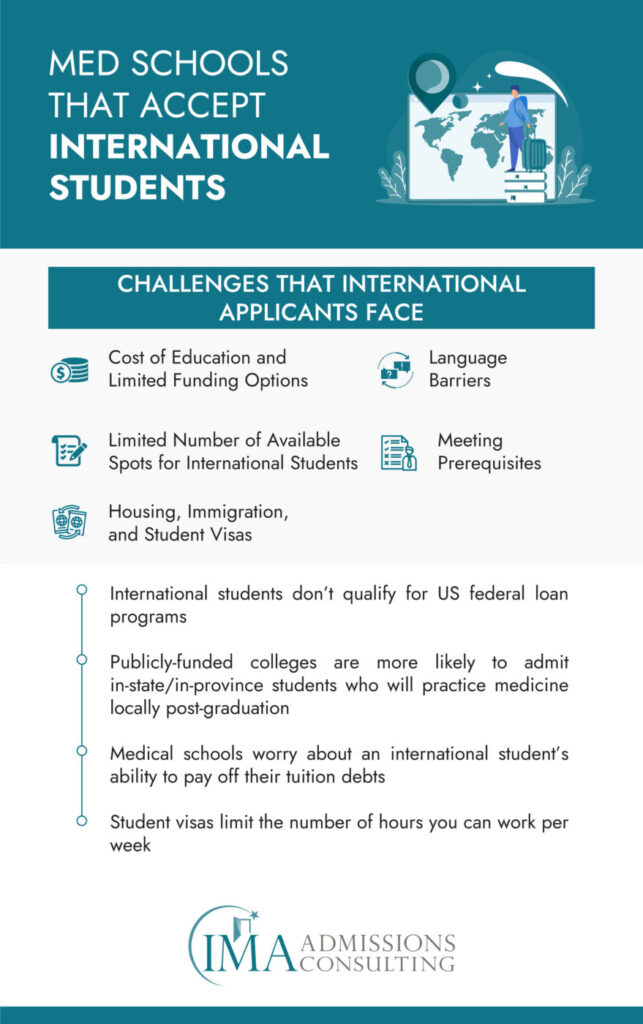
Challenges that International Applicants Face
- Cost of Education and Limited Funding Options
- Language Barriers
- Meeting Prerequisites
- Limited Number of Available Spots for International Students
- Housing, Immigration, and Student Visas
Why funding is harder to find
- International students don’t qualify for U.S. federal loan programs
- Publicly funded colleges are more likely to admit in-state or in-province students who will practice medicine locally after graduation
- Medical schools worry about an international student’s ability to pay for the full program
- Student visas limit the number of hours you can work per week
The Benefits of Attending Med School as an International Student
The idea of attending medical school as an international student may sound like it is all doom and gloom, but there are plenty of benefits that come from the experience. One of the biggest is the quality of the education you receive in the United States or Canada. The two countries are home to some of the world’s most renowned med schools, such as Harvard Medical School, Stanford, Geisel and McGill University. Since fall 2026, Ontario medical schools, including the University of Toronto, reserve their seats for Ontario residents and other Canadians, so international applicants who want to study in Canada should look at McGill and the Quebec schools covered in the list below. With such an impressive list of medical schools, it is no wonder that students around the world hope to study abroad.
In addition to the high quality of education, some of the best medical facilities are located in North America. The United States and Canada are home to cutting-edge research facilities and medical centers such as Johns Hopkins Hospital and the Mayo Clinic.
Despite the large price tag that comes with an education in the U.S. or Canada, students who graduate from med school can expect a strong return on their investment. Physicians are among the most respected and best-paid professionals in both Canada and the United States, although international graduates also have to plan for the visa and residency steps described above.
There are other benefits to attending medical school abroad. While studying in another country, you learn to become self-reliant and build the skill of self-sufficiency. Nothing teaches you to trust your instincts and provide for yourself like moving to an unfamiliar city or country. You will also be exposed to new cultures, experiences and people. Studying medicine in a second language also gives you the chance to practice and grow your conversational language skills.
Studying abroad is also a great way to impress future employers. Your studies abroad will show your independence and academic resilience, and that you are passionate about medicine and willing to go where ambition takes you. Plus, if you come back from studying abroad having learned a new language, you will be an even more valuable member of any care team you join.
Application Tips for International Students
When applying to medical school as an international student, standing out from the crowd is essential. Here are some tips to consider:
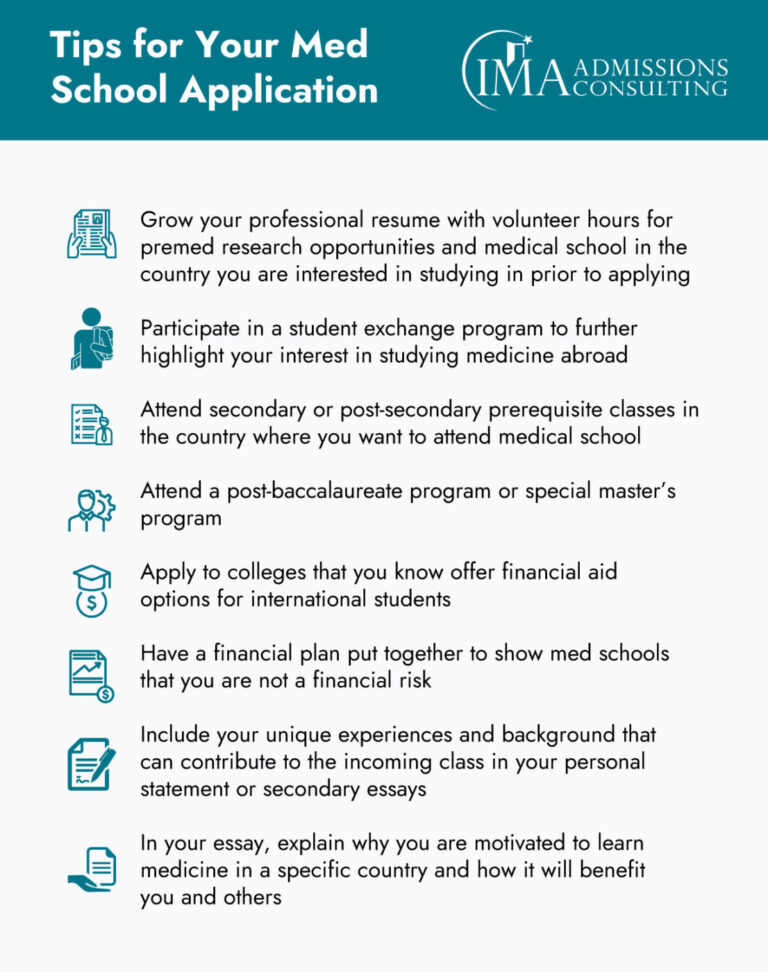
- Grow your professional resume with volunteer hours, premed research opportunities and clinical experience in the country where you want to study before applying. Supervised clinical internships for pre-med students are one way to add hands-on patient care hours.
- Participate in a student exchange program to further highlight your interest in studying medicine abroad
- Attend secondary or post-secondary prerequisite classes in the country where you want to attend medical school. Many schools on the list below require at least one year of U.S. or Canadian coursework, and some require a full bachelor’s degree from a U.S. or Canadian school.
- Attend a post-baccalaureate program or special master’s program
- Apply to colleges that you know offer financial aid options for international students
- Have a financial plan put together to show med schools that you are not a financial risk. Expect to document anywhere from one year of tuition to the full cost of the program.
- Include your unique experiences and background that can contribute to the incoming class in your personal statement or secondary essays
- In your essay, explain why you are motivated to study medicine in a specific country and how it will benefit you and others
Applying to medical school as an international student may seem like a daunting experience, but it is manageable with the right plan, mindset and application. If you plan early, do your research and due diligence so you know how to choose a med school that accepts international students, pay attention to the med school application timeline, put your best foot forward and stay true to yourself and your goals, we are confident you will succeed.
A few practical steps make the biggest difference for international applicants:
- Check the coursework rule before anything else. It is the most common reason an international application is screened out. Columbia, Feinberg and Geisel want about three years at U.S. or Canadian schools, UVA and WashU want 90 semester hours, NYU and Jefferson want a full U.S. or Canadian bachelor’s degree, and Penn, Emory, Brown, Stanford and Loma Linda want at least one year. IMA’s medical school prerequisites checklist covers the courses themselves.
- Plan your funding before you apply. Have a clear answer for how you will cover each year of school. Some schools ask about family finances before an interview (Brown) and others want funds in escrow before you enroll (WashU, NYMC).
- Apply broadly and early. Even at schools that welcome international applicants, the number of seats is small. IMA’s guide to building a medical school list explains how many schools to apply to, and the Medical School Secondary Essay Prompts Database helps you prepare secondaries early.
- Build clinical hours you can describe in detail. Admissions committees want to see that you understand patient care. Students who are still in college can look at medical internships for undergraduates to add supervised clinical experience, and students between degrees can consider pre-med gap year programs while they finish U.S. or Canadian coursework.
- Use your summers. A summer before you apply is often the best time for both MCAT study and clinical work. Pre-med summer internships can fit around a spring MCAT date.
List of Med Schools that Accept International Students
While there are plenty of excellent medical schools out there, only the schools below accept international students, and many of them do so with conditions. This information can change from one application cycle to the next, so always check each school’s own admissions website before you apply. Each school’s policy below comes from its own admissions pages, checked October 17, 2026, and every school name links to IMA’s full admissions guide where one exists.
Important, Ontario policy change: Starting in fall 2026, Ontario requires its medical schools to allocate at least 95% of undergraduate medical seats to Ontario residents and the remaining 5% to students from the rest of Canada. This effectively closes Ontario schools, including the University of Toronto, McMaster, Queen’s, Western, uOttawa, NOSM University and Toronto Metropolitan University, to international applicants. They do not appear on the list below.
U.S. MD Schools That Accept International Applicants
These schools state on their own websites that they accept applications from international students for the MD program in the 2026-2027 cycle. “Not stated” means the school’s admissions pages do not address the item.
| School | State | Coursework or degree rule | Proof of funds | Institutional aid for international students | DACA | Source (checked Oct. 17, 2026) |
|---|---|---|---|---|---|---|
| Boston University Chobanian & Avedisian School of Medicine | MA | Degree from an accredited U.S. or Canadian school, or at least two years of advanced study there including all prerequisites | Not stated | Limited scholarships and aid for non-U.S. citizens | Not stated | BU application process |
| Case Western Reserve University School of Medicine (University Program) | OH | Foreign-degree holders need one or two years of science at an accredited U.S. or Canadian four-year college | Proof of payment for one year up front | No need-based aid; private loans need a U.S.-citizen cosigner | Accepted (not for MSTP) | CWRU MD admissions FAQ |
| Cleveland Clinic Lerner College of Medicine of CWRU | OH | One degree from a U.S. or Canadian school and one to two years living in the U.S. or Canada | Proof of payment for one year up front | Full-tuition scholarship for every student; living costs not covered | Accepted | CWRU MD admissions FAQ |
| Duke University School of Medicine | NC | Accredited U.S. degree, or at least two years (48 credit hours) at a U.S. school; MD/PhD not open to international applicants | Not stated | Limited aid | Accepted | Duke MD admissions FAQ |
| Emory University School of Medicine | GA | Degrees from outside the U.S. or Canada need one full year of science coursework at a U.S. or Canadian college; no TOEFL | Not stated | Merit scholarships and institutional aid possible | Not stated | Emory MD admissions FAQ |
| Geisel School of Medicine at Dartmouth | NH | Three years of study at U.S. and/or Canadian schools | Not stated | Need-based institutional scholarships and loans | Accepted | Geisel admissions FAQ |
| Icahn School of Medicine at Mount Sinai | NY | U.S. or Canadian bachelor’s degree to enroll; foreign degrees need a NACES evaluation | Not stated | Not stated | Accepted | Icahn MD admissions FAQ |
| Johns Hopkins University School of Medicine | MD | Foreign preparation usually supplemented by a year or more of U.S. coursework | Not stated | Institutional loans and/or scholarships | Not stated | JHU e-catalogue 2026-27 |
| Loma Linda University School of Medicine | CA | At least one year of study, including required courses, at a U.S. or Canadian school; English proficiency | First two years before the I-20 | Not stated; same tuition as domestic students | Not stated | LLU international students |
| Northwestern University Feinberg School of Medicine | IL | Three years at a U.S. or Canadian school (British Isles, Australia or New Zealand also accepted) | Not stated | Private loans with a U.S. citizen or permanent resident cosigner | Not stated | Feinberg admissions FAQ |
| NYU Grossman School of Medicine | NY | U.S. or Canadian bachelor’s degree by matriculation, no exceptions | Not stated | Full-Tuition Scholarship; need-based Debt-Free Scholarship | Accepted | NYU how to apply |
| NYU Grossman Long Island School of Medicine | NY | U.S. or Canadian bachelor’s degree by matriculation, no exceptions | Not stated | Full-Tuition Scholarship; need-based Debt-Free Scholarship | Accepted | NYU Long Island how to apply |
| Perelman School of Medicine at the University of Pennsylvania | PA | Degrees from outside the U.S. or Canada need a full-time year of science and math coursework first | Must show ability to pay through school scholarships and/or personal funds | School scholarships | Accepted | Penn admissions FAQ |
| Ponce Health Sciences University School of Medicine | PR | English test (IELTS 7.0 or TOEFL 94-101) for applicants from non-English-speaking countries | Not stated | Not stated | Not stated | PHSU MD program |
| University of Chicago Pritzker School of Medicine | IL | 90 credit hours at a U.S. or Canadian school; foreign bachelor’s holders need a year of full-time coursework there | Not stated | Pritzker scholarships and loans | Not stated | Pritzker admissions process |
| Stony Brook University Renaissance School of Medicine | NY | Non-Canadian international applicants need one year at a U.S. college | Not stated | None (aid for citizens and permanent residents only) | Accepted; no U.S. aid | Stony Brook admissions FAQ |
| Sidney Kimmel Medical College at Thomas Jefferson University | PA | U.S. or Canadian bachelor’s degree; courses outside the U.S. or Canada not accepted | Not stated | No scholarships or loans for international students | Not stated | SKMC admissions FAQ |
| Stanford University School of Medicine | CA | At least one academic year of in-person study in the U.S., Canada or U.K. | One year of expenses before the I-20 | Need-based Stanford grants and loans | Accepted | Stanford MD admissions FAQ |
| Tulane University School of Medicine | LA | Same process as domestic applicants; no coursework evaluation; no TOEFL | Proof of ability to pay one year of tuition before admission | Merit-based aid | Accepted | Tulane MD admissions FAQ |
| UC Davis School of Medicine | CA | Prerequisites at a U.S. accredited college | Must show ability to fully fund the degree (school financial statement) | No U.S. financial aid | Accepted | UC Davis how to apply |
| University of Hawaii John A. Burns School of Medicine | HI | 90 semester credits at a U.S. or Canadian school; about 13% of seats go to all nonresidents | Not stated | Not stated | Accepted | JABSOM admissions FAQ |
| University of Illinois College of Medicine | IL | WES evaluation of foreign degrees; 32 credits from a U.S. school (waived for Canadian bachelor’s holders) | Not stated | No aid or scholarships for international students | Accepted | UI COM international applicants |
| UNC School of Medicine | NC | U.S. or Canadian bachelor’s, or a U.S./Canadian master’s or postbac with 30 BCPM hours; reviewed as out-of-state | Must fund all four years | No federal loans or grants | Not stated | UNC MD admissions FAQ |
| Keck School of Medicine of USC | CA | Degree judged equivalent to a U.S. bachelor’s by USC | Not stated | Merit aid possible; need-based aid for citizens and eligible non-citizens | Accepted | Keck MD admissions |
| University of Virginia School of Medicine | VA | At least 90 semester hours at a U.S. or Canadian school at the time of application | Proof of ability to pay before starting | No federal loans or University aid | Not stated | UVA MD admissions |
| Vanderbilt University School of Medicine | TN | No cap; foreign coursework needs a course-by-course evaluation | F-1/J-1: at least one year’s expenses each year | Merit and need-based scholarships | Not stated | VUSM admissions process |
| Warren Alpert Medical School of Brown University | RI | At least one year of coursework at a U.S. or Canadian school | Family financial information requested before interview | No need-based aid; limited merit funding | Accepted | Alpert admissions FAQ |
| WashU Medicine | MO | 90 credit hours from a U.S. or Canadian school | Escrow or letter of credit for tuition and living costs, normally four years | Merit scholarships; no need-based aid | Accepted under the international policy | WashU MD requirements |
| Weill Cornell Medicine | NY | Citizenship not a factor; WES evaluation required with AMCAS for coursework outside the U.S. and Canada | Not stated | None, including for Canadians | Not stated | WCM admissions FAQ |
| Yale School of Medicine | CT | Prerequisites at an accredited U.S., U.K. or Canadian school | Proof of support for the I-20 | Need-based aid and Yale scholarships; Yale Alumni Loan | Not stated | Yale MD requirements |
The University of Illinois College of Medicine does not yet have its own IMA admissions guide.
U.S. MD Schools That Admit International Students in Limited Ways
These schools do not shut out international applicants completely, but they limit who can apply or how many they take.
| School | State | Who can apply | Conditions and funds | DACA | Source (checked Oct. 17, 2026) |
|---|---|---|---|---|---|
| Columbia University Vagelos College of Physicians and Surgeons | NY | Rarely admits applicants from foreign universities | Premedical training at a U.S. institution plus three years at a U.S. or Canadian college; no federal aid for non-residents | Not stated | Columbia application requirements |
| George Washington University School of Medicine and Health Sciences | DC | Regular MD: U.S. citizens, permanent residents, Canadian citizens and DACA. Others only through the International MD Program | International MD Program requires sponsorship by the home government or a home-country medical institution and a U.S. or Canadian degree | Accepted | GW MD admissions FAQ |
| Howard University College of Medicine | DC | International students accepted on a limited basis | 71 semester hours at a U.S. or Canadian school; financial information due by June 30 after acceptance | Not stated | Howard admissions |
| Mayo Clinic Alix School of Medicine | MN | Other foreign nationals only with proof of FAFSA eligibility or Canadian provincial or federal aid eligibility | U.S. or Canadian bachelor’s degree | Accepted | Mayo prerequisites and requirements |
| New York Medical College | NY | Canadian citizens and DACA recipients; other international applicants not eligible | All undergraduate work in the U.S. or Canada; four years of tuition and fees in escrow (about $239,000), or two years plus a U.S.-citizen guarantor, by July 1 | Accepted | NYMC admissions and aid |
| Saint Louis University School of Medicine | MO | Traditional pathway closes to international students “with the 2028 application cycle”; Medical Scholars and MSMS pathways stay open | 90 semester hours; MSMS route needs an MCAT of 498 or higher within two attempts | Not stated | SLU requirements and standards |
| SUNY Downstate College of Medicine | NY | International files reviewed only after U.S. citizens and permanent residents; class filled first for 23 years | One year at a U.S. college for applicants educated abroad; English proficiency; credential evaluation | Not stated | Downstate admissions FAQ |
| Tufts University School of Medicine | MA | Admits relatively few international students; strong preference for U.S. citizens and permanent residents | U.S. prerequisite coursework preferred; credential evaluation recommended | Not stated | Tufts MD FAQs |
| UConn School of Medicine | CT | Graduates of foreign undergraduate programs on a very limited basis | Foreign transcripts evaluated by a professional service | Not stated | UConn admissions FAQs |
| Jacobs School of Medicine, University at Buffalo | NY | Policy gives preference to U.S. citizens and permanent residents | Two full years or 60 credit hours in the U.S. or Canada | Not stated | Jacobs admissions policy |
| University of Rochester School of Medicine and Dentistry | NY | International applicants only through the Levitan Family Endowed Scholarship (15+ years lived outside the U.S.) | CSS Profile for International Students; scholarship covers demonstrated need for four years | Not stated | Rochester MD apply |
| University of Utah Spencer Fox Eccles School of Medicine | UT | Visa holders only if they qualify under Utah House Bill 118 or graduated from a Utah college | U.S. or Canadian degree; proof of funding may be required | Accepted only with Utah HB 144 eligibility or a Utah degree | Utah MD requirements |
| Wayne State University School of Medicine | MI | Canadian citizens and holders of a Wayne State degree; other international applicants not eligible | Two years of documented funding plus a signed plan for years 3 and 4 | Not stated | Wayne State prerequisites |
UConn does not yet have its own IMA admissions guide.
Saint Louis University’s exact wording. SLU’s requirements page reads: “With the 2028 application cycle, the traditional M.D. pathway will only accept applications from U.S. citizens and permanent residents. Applications from international students will not be considered, except for those in the SLU Medical Scholars Program and SLU Master of Medical Sciences program guaranteed interview pathway.” SLU’s FAQ adds that “international students remain eligible for M.D. admission if they are accepted into the following programs that offer a guaranteed medical school interview: SLU Medical Scholars Program SLU Master of Science in Medical Sciences.” SLU refers to the current cycle as its “2027 admission cycle,” so confirm with SLU admissions which entering class the change first applies to before you plan around it.
Schools That No Longer Accept International Applicants
These schools are often named on lists of schools that accept international students, but their current rules exclude international applicants.
| School | Current rule | DACA | Source (checked Oct. 17, 2026) |
|---|---|---|---|
| Georgetown University School of Medicine | Only U.S. citizens and non-citizens eligible for federal financial aid (such as green card holders, refugees and asylees), for students admitted from fall 2023 on | Accepted | Georgetown MD admissions guide |
| Morehouse School of Medicine | U.S. citizens and permanent residents with a green card only | Not stated | MSM MD FAQs |
| David Geffen School of Medicine at UCLA | Applications from international students will not be considered | Not stated | UCLA preparing to apply |
| University of Pittsburgh School of Medicine | U.S. citizens and permanent residents at the time of AMCAS submission; Canadians count as international | Not accepted | Pitt Med admissions FAQ |
| University of South Alabama Frederick P. Whiddon College of Medicine | International applicants must hold U.S. permanent resident status | Not stated | USA COM future students |
| University of Toledo College of Medicine and Life Sciences | U.S. citizens or permanent residents at the time of application, all pathways | Not stated | UToledo MD FAQ |
The University of Pittsburgh School of Medicine does not yet have its own IMA admissions guide.
Confirm These Policies Directly With the School
These schools are often listed as accepting international applicants, but their current admissions pages do not state a policy for applicants who are not U.S. citizens or permanent residents. Contact the admissions office of each one before you pay an application fee.
- Harvard Medical School: confirm the current international applicant policy with the Harvard MD admissions office.
- Norton College of Medicine at SUNY Upstate Medical University: confirm the current policy with Upstate admissions.
- Rutgers New Jersey Medical School: NJMS’s admissions pages do not mention citizenship or international applicants. Its sister school, Rutgers Robert Wood Johnson Medical School, accepts only U.S. citizens, permanent residents and applicants under adjustment of visa status for the 2027 cycle.
- University of Colorado School of Medicine: CU’s pages say coursework completed abroad can count toward prerequisites if a credential evaluator verifies it, but they do not state a citizenship policy.
- Anne Burnett Marion School of Medicine at TCU (formerly the TCU Burnett School of Medicine): all applicants need at least 90 semester hours at an accredited U.S. or Canadian school, and its cost page lists health insurance for international students, but the admissions pages do not state an international applicant policy.
MCAT, GPA and Deadlines at Schools That Accept International Applicants
Admissions committees hold international applicants to the same academic standard as everyone else. The table below shows the latest class MCAT and GPA each school publishes on its own site, with the class the figure describes, and the 2026-2027 primary application deadline. Several of these deadlines have already passed for this cycle; use them to plan your next one. IMA’s Average GPA and MCAT Score for Every Medical School in the US covers schools that do not publish their own figures.
| Medical School | Class MCAT | Class GPA | Application Deadline (2026-27) |
|---|---|---|---|
| Boston University Chobanian & Avedisian | Not published | Not published | November 1, 2026 |
| Case Western Reserve (all MD programs combined) | 518 mean, entering class of 2026 | 3.87 mean, entering class of 2026 | October 15, 2026 |
| Cleveland Clinic Lerner | 517 median (all CWRU MD programs), entering class of 2026 | 3.87 mean (all CWRU MD programs) | October 15, 2026 |
| Columbia Vagelos | Not published (offer range 508-528) | Not published (offer range 3.53-4.0) | October 15, 2026 |
| Duke | Not published | Not published | October 15, 2026 |
| Emory | 515.1 mean, M1 class entering fall 2026 | 3.83 mean, M1 class entering fall 2026 | October 15, 2026 |
| Geisel at Dartmouth | 515 median, incoming class (year not labeled) | 3.82 median, incoming class | November 2, 2026 |
| George Washington | Not published | Not published | November 2, 2026 |
| Howard | 505 mean, matriculating class (2026-27 Basics) | Not published | December 15, 2026 |
| Icahn Mount Sinai | Not published | Not published | October 1, 2026 |
| Johns Hopkins | Not published | Not published | October 15, 2026 |
| Loma Linda | 510 mean, 2026 entering class | 3.85 mean, 2026 entering class | November 2, 2026 |
| Mayo Clinic Alix | 521 median, entering class 2026 | 3.97 median, entering class 2026 | October 1, 2026 |
| New York Medical College | Not published | 3.6 mean, typical first-year class | December 15, 2026 |
| Northwestern Feinberg | 520 median, 2026 entering class | 3.95 median, 2026 entering class | November 1, 2026 |
| NYU Grossman | 523 median, most recent incoming class | 3.97 median, most recent incoming class | October 15, 2026 |
| NYU Long Island | Not published | Not published | November 1, 2026 |
| Penn Perelman | 522 median, 2026 entering class | 3.98 median, 2026 entering class | October 15, 2026 |
| Ponce Health Sciences | Not published | Not published | December 30, 2026 |
| Pritzker (UChicago) | Not published | Not published | November 15, 2026 |
| Rochester | 517 mean, entering students (year not labeled) | 3.8 mean, entering students | October 15, 2026 |
| Saint Louis University | 514 mean, accepted for July 2026 entry | 3.88 mean, accepted for July 2026 entry | November 15, 2026 |
| Sidney Kimmel (Jefferson) | 514 mean, 2026 entering class | 3.80 mean science GPA, 2026 entering class | November 15, 2026 |
| Stanford | 518 median, 2024 entering class | 3.94 median, 2024 entering class | October 1, 2026 |
| Stony Brook Renaissance | Not published | Not published | November 16, 2026 |
| SUNY Downstate | Not published | Not published | December 1, 2026 |
| Tufts | 514 mean, Class of 2030 | 3.84 mean, Class of 2030 | November 1, 2026 |
| Tulane | 509 mean, Class of 2030 | 3.71 mean, Class of 2030 | October 1, 2026 |
| UC Davis | 511 mean, Class of 2029 | 3.71 mean, Class of 2029 | October 1, 2026 |
| Hawaii (JABSOM) | 513 mean, 2026 entering class | 3.79 mean, 2026 entering class | November 2, 2026 |
| Illinois (UI COM) | Not published | Not published | November 1, 2026 |
| UNC | 512 mean, matriculating class (year not labeled) | 3.79 mean science GPA | October 1, 2026 |
| USC Keck | Not published | Not published | November 1, 2026 |
| UVA | 520 mean, Class of 2030 | 3.91 mean, Class of 2030 | November 1, 2026 |
| Vanderbilt | Not published (ranges only) | Not published (ranges only) | November 1, 2026 |
| Warren Alpert (Brown) | Not published | Not published | October 7, 2026 |
| WashU Medicine | 520 mean, entering class of 2025 | 3.88 mean, entering class of 2025 | October 15, 2026 |
| Wayne State | 82nd percentile, five-year average (Classes of 2026-2030) | 3.79, five-year average | December 15, 2026 |
| Weill Cornell | Not published | Not published | October 15, 2026 |
| Yale | Not published | Not published | October 15, 2026 |
Popular U.S. MD Schools That Do Not Accept International Applicants
Many applicants assume that every private or research-heavy school is open to international students. These schools state on their own sites that they are not, for the 2026-2027 cycle:
- Medical College of Wisconsin: “During the 2027 application cycle, MCW will accept applications from US Citizens, US Permanent Residents, and DACA recipients. We anticipate welcoming international applicants to MCW-Milwaukee in a future application cycle.”
- Baylor College of Medicine: the MD program does not accept international students, although its MD/PhD program does. Baylor does not accept DACA students at this time.
- University of Miami Miller School of Medicine: U.S. citizens, DACA students and green card holders only.
- UC San Diego and UC Irvine: U.S. citizens, permanent residents and DACA recipients only.
- Rush, Loyola Stritch, OHSU and MUSC: no international applicants; each accepts DACA recipients for the MD.
- Drexel, Albany Medical College, Wake Forest, Iowa Carver, Carle Illinois, Western Michigan (WMed), Oakland University William Beaumont, California Northstate, the University of Florida, Quinnipiac’s Frank H. Netter MD School of Medicine and the University of Vermont Larner: no international applicants (Iowa also accepts asylees, and Vermont and Netter accept DACA recipients).
- USF Morsani: no international or DACA applicants, though its FAQ notes that exceptions may be considered case by case.
- Rutgers Robert Wood Johnson Medical School: U.S. citizens, permanent residents and applicants under adjustment of visa status for the 2027 cycle.
U.S. Osteopathic (DO) Schools That Accept International Applicants
The DO route is separate from the MD route: applications go through AACOMAS instead of AMCAS, and graduates earn a Doctor of Osteopathic Medicine degree. Of the 75 osteopathic school listings in the national DO school directory for the current cycle, 24 accept international students, one considers them case by case and 50 do not. Before choosing this route, check whether your home country gives DO graduates a full, unrestricted medical license. Midwestern’s Arizona college, for example, admits a limited number of non-citizens from countries where DOs receive full licensure, and Kansas City University warns Canadian applicants that DO graduates find it harder to obtain residency training in Canada. IMA’s guide to AACOMAS explains the osteopathic application step by step.
| School | Policy | Coursework and English | Proof of funds | Source (checked Oct. 17, 2026) |
|---|---|---|---|---|
| Lake Erie College of Osteopathic Medicine (LECOM) | Accepts F-1 international applicants | 75% of bachelor’s credits at a U.S. or Canadian school; English proficiency | Funds on hand for the full length of the program before the application moves forward | LECOM catalog 2026-2027 |
| Kansas City University College of Osteopathic Medicine | A select number of international students each year | 30 recent semester hours at a U.S. or English-language Canadian school, or TOEFL iBT 79 | Liquid funds for the full program; DO cost of attendance listed as $448,000 for 2026-27 | KCU international students |
| Western University of Health Sciences (COMP Pomona and the Lebanon, Oregon campus) | Accepts international applicants at both campuses | 90 semester units from a U.S. school or the equivalent abroad; foreign coursework evaluated (Canada exempt) | One academic year before the I-20; tuition due 10 days before enrollment | WesternU DO FAQs |
| Midwestern University Chicago College of Osteopathic Medicine | Accepts international applicants under Midwestern’s university rules | 30 semester hours at a U.S. or English-language Canadian school | Prepay full annual tuition 45 days before class; proof of funds for year one | Midwestern catalog |
| Midwestern University Arizona College of Osteopathic Medicine | A limited number of citizens of countries where DOs have full, unrestricted licensure | Same 30-hour rule | Same prepayment rule | Midwestern catalog |
| Marian University Tom and Julie Wood College of Osteopathic Medicine | Enrolls students from outside the U.S. | Foreign coursework evaluated; TOEFL may be required | Financial resources documentation | Marian international students |
| Nova Southeastern University Dr. Kiran C. Patel College of Osteopathic Medicine | Sets admission rules for foreign nationals | TOEFL iBT 79 or IELTS 6.0 for non-native English speakers living abroad; foreign coursework evaluated | Not stated | NSU KPCOM DO admissions |
| Rocky Vista University College of Osteopathic Medicine | May consider international applications | English proficiency at interview; preference for prior study at a U.S. school | Financial proof for the I-20 | RVUCOM admissions |
| University of New England College of Osteopathic Medicine | International applicant track | WES or ECE evaluation to AACOMAS; English proof if English is not the first language | Funding for tuition, room and board, books, insurance and fees for the I-20 | UNE COM admissions |
Nova Southeastern’s osteopathic college, the Arizona College of Osteopathic Medicine and UNE do not yet have their own IMA admissions guides.
Many DO schools do not accept international applicants, including Des Moines University, A.T. Still University’s Kirksville and Arizona colleges, Lincoln Memorial DeBusk, Touro College of Osteopathic Medicine, Touro University Nevada, VCOM, Campbell, Burrell, Ohio University Heritage, PCOM and Kansas Health Science University. Pacific Northwest University accepts U.S. citizens, permanent residents and DACA recipients.
Canadian Medical Schools That Accept International Applicants
Canada’s remaining international seats are concentrated in Quebec, and three of the four Quebec programs below teach in French.
| School | International seats | Key conditions | Deadline for 2027 entry | Source (checked Oct. 17, 2026) |
|---|---|---|---|---|
| McGill University Faculty of Medicine and Health Sciences (MDCM) | 1 seat anticipated for fall 2027; about 73 applicants and 8 interviews on average | Bachelor’s degree by July 31 of the entering year; study permit; proof of funds for the whole program | November 1, 2026 | McGill international residents |
| Université Laval (doctorat en médecine) | The faculty can admit 1 international candidate | No Canadian citizenship or permanent residence at the deadline; home country must recognize the Quebec MD; program in French | November 1, 2026 (university-level applicants); February 1, 2027 (college-level applicants) | Laval doctorat en médecine |
| Université de Montréal (doctorat en médecine) | Currently two places a year | Study permit; French test certificate for candidates who studied outside Quebec | November 1, 2026 (studies outside Quebec) | Montréal admission and requirements |
| Université de Sherbrooke (doctorat en médecine) | International contingent; seat count not stated | Student visa; home country must recognize the Sherbrooke MD; French at the C1 level before August 15 of the entry year | November 1, 2026 | Sherbrooke international contingent |
| Memorial University of Newfoundland | None: Canadian citizens and permanent residents only | International applicants are not accepted because of Canadian residency match (CaRMS) rules | Not open to international applicants | Memorial international applicants |
The Caribbean Route
Caribbean medical schools are a third path, separate from U.S. MD and DO programs. Many of them admit large numbers of international students, and graduates who want to train in the U.S. apply to residency as international medical graduates. If you consider this route, check accreditation first. St. George’s University, for example, tells international applicants that a foreign medical school graduate who wants to take part in the U.S. residency Match must attend a school whose accreditor is recognized by the World Federation for Medical Education (WFME). SGU also restates its TOEFL minimum on the new scale (5 overall). IMA’s guide to the Pros and Cons of Caribbean Medical Schools compares this route with U.S. and Canadian schools.
Make Your Application Count
International applicants compete for a handful of seats at each school, so every part of the application has to work. IMA’s medical school admissions consulting team helps applicants build a school list around eligibility and funding rules, edit personal statements and secondaries, and prepare for interviews.
Clinical experience is where many international applicants can set themselves apart, because it shows admissions committees that you understand patient care in a setting very different from a classroom. IMA’s pre-med internships place students in teaching hospitals in Mombasa, Kenya and Cusco, Peru, where interns take vitals, help with patient intake and triage and assist with direct care under the supervision of local physicians and nurses. They never perform tasks that would require a medical license in the United States. These pre-med internships abroad are open to undergraduates, gap year students and recent graduates, and IMA’s medical internships abroad also include programs for nursing, pre-PA, mental health and other health careers. Students exploring several health careers can start with IMA’s pre-health internships.
Frequently Asked Questions
How many U.S. medical schools accept international students in 2026?
There are 165 LCME-accredited MD programs in the U.S. and Puerto Rico as of October 2026. Of the U.S. MD programs reviewed for this guide, 30 accept international applicants outright for the 2026-2027 cycle and 13 more accept them only in limited ways, such as only Canadians, only through a special pathway or only a very small number. On the osteopathic side, 24 of 75 DO school listings in the national directory accept international students and one more considers them case by case. Because policies change from cycle to cycle, confirm each school’s current rule on its own admissions website before applying.
What is the acceptance rate for international medical school applicants?
In the 2024-2025 cycle, the last year the AAMC reported applicants by citizenship, 1,852 applicants to U.S. MD programs were neither U.S. citizens nor permanent residents, and 345 were accepted, an overall acceptance rate of about 18.6%. Rates at individual schools are much lower than that. Many schools set aside only a few seats: McGill expects one international seat for fall 2027 and averages about 73 international applicants, and Feinberg’s 2025 entering class included one international student. Building a broad application list is strongly recommended.
Can international students still apply to Canadian medical schools?
Options in Canada have narrowed significantly. Starting in fall 2026, Ontario medical schools reserve at least 95% of seats for Ontario residents and the remaining 5% for other Canadians, which effectively excludes international applicants. Memorial University of Newfoundland accepts only Canadian citizens and permanent residents. McGill, Laval, Montréal and Sherbrooke still consider a very small number of international applicants, with one or two seats a year at McGill, Laval and Montréal. Check each school’s admissions page for current-cycle policies.
How much does medical school cost for international students in 2026?
For the 2025-2026 academic year, average first-year tuition, fees and health insurance were $68,032 for nonresidents at public U.S. medical schools and $69,789 at private schools. International students usually pay nonresident rates at public schools. Living costs come on top of that, and some schools ask international students to prove they can cover the full program before they enroll: Kansas City University lists a DO cost of attendance of $448,000 for 2026-27, and New York Medical College’s four-year escrow is about $239,000. Because international students are ineligible for U.S. federal loans, funding often depends on personal savings, home-country loans, private loans with a U.S. cosigner or institutional scholarships.
How does the 2026 federal student loan cap affect medical students?
Starting July 1, 2026, the One Big Beautiful Bill Act ends Grad PLUS loans for graduate and professional borrowers who do not qualify for an exception. Professional students can borrow up to $50,000 a year in federal loans, with a $200,000 aggregate limit for professional study and a new $257,500 lifetime limit across federal student loans (Parent PLUS excluded). Although international students already lack access to federal loans, these caps could change how schools distribute institutional aid across all students, including the scholarships many international applicants depend on.
Has the TOEFL scoring system changed for 2026 medical school applications?
Yes. As of January 21, 2026, TOEFL iBT score reports use a new 1-to-6 scale in half-point increments, aligned with the CEFR framework, instead of the previous 0-to-120 total score. For a two-year transition period after January 2026, score reports also include a comparable overall score on the 0-to-120 scale. Many medical programs historically set minimums on the old scale, and some, such as St. George’s University, have restated them on the new one. Confirm with each school which scoring format it accepts for the current cycle.
If the college I want to attend doesn’t accept international students, can I still apply?
We discourage it. Applying to a medical school that does not accept international applicants wastes time and money that could be better spent applying to schools that do. Some schools say they will not process an application that does not meet their citizenship rules at all.
Are Canadian students considered international students when applying to U.S. medical schools?
It depends on the school. Some U.S. medical schools treat Canadian applicants like any other international applicant: Case Western, Emory, the University of Illinois and Pittsburgh say so directly. Others give Canadians a separate path. Wayne State, George Washington, New York Medical College and Mayo Clinic accept Canadian citizens even though they exclude most other international applicants, and Wayne State treats Canadians as non-residents for admission and tuition. Canadian coursework and degrees count the same as U.S. coursework at most schools, but Canadian citizens usually still cannot use U.S. federal aid.
Do I need to complete prerequisites in the same country where I’m applying to medical school?
Often, yes. Many U.S. schools require some coursework at a U.S. or Canadian school, ranging from one year (Penn, Emory, Brown, Stanford, Loma Linda) to 90 semester hours (UVA, WashU, Hawaii) or a full U.S. or Canadian bachelor’s degree (NYU Grossman, NYU Long Island, Jefferson). Schools without that requirement, such as Weill Cornell and Vanderbilt, still expect all prerequisites to be finished before applying and ask for a course-by-course evaluation of foreign coursework, plus English test results where applicable.
Do I need a student visa and work visa to attend med school as an international student?
You need a student visa to attend medical school abroad, usually an F-1 visa in the U.S., and many schools will not issue the I-20 form needed for that visa until you prove you can pay for at least the first year. Student visas restrict how many hours you can work while enrolled: F-1 students may work on campus no more than 20 hours per week while school is in session. If you have not become a citizen or permanent resident by the time you finish your studies, you will need a visa that allows you to train and work in order to complete residency.
If federal loans aren’t available to international students, are there any funding options?
Yes. While U.S. federal loans are not available to international students, med school scholarships, institutional aid, home-country loan programs and private bank financing remain options. Some schools give international students full or partial tuition support: NYU Grossman and NYU Long Island give them the Full-Tuition Scholarship, Cleveland Clinic Lerner covers tuition for every student, and Yale, Vanderbilt and Stanford consider them for need-based aid. Many private loans for international students require a creditworthy U.S. citizen or permanent resident cosigner.
As an international student, will I pay more for medical school?
It varies. At private medical schools, international tuition is generally the same as what other students pay; Loma Linda, for example, charges international students the same tuition and fees as domestic students. At public schools, international students typically pay the nonresident rate, which averaged $68,032 in first-year tuition, fees and health insurance in 2025-2026, compared with $43,016 for residents. The bigger difference is often the up-front proof of funds many schools require.
What can I do to improve my chances of being accepted as an international student?
Build your resume with clinical and research experience before applying, finish the U.S. or Canadian coursework your target schools require, have a clear funding plan, bring your unique background and perspective into your personal statement and secondaries, and consider working with an admissions advisor at IMA to make sure your application is as strong as possible.
Is DACA the same as international status for medical school admissions?
No. DACA recipients are not U.S. citizens or permanent residents, but many schools treat them differently from international applicants. UC San Diego, UC Irvine, Miami, Rush, Loyola, OHSU, MUSC and the Medical College of Wisconsin accept DACA recipients but not international applicants, while Pittsburgh, Baylor and USF accept neither. At WashU, DACA applicants fall under the same financial documentation policy as international applicants. Always read the school’s own DACA statement.
Which medical schools give international students full scholarships?
NYU Grossman School of Medicine and NYU Grossman Long Island School of Medicine give international students the Full-Tuition Scholarship, and Cleveland Clinic Lerner College of Medicine gives a full-tuition scholarship to every student, including international students. WashU considers all accepted applicants, including international students, for merit scholarships that can cover full or partial tuition, and the University of Rochester considers international applicants through a need-based scholarship that covers demonstrated need for four years.
Do osteopathic (DO) schools accept international students?
Some do. Of 75 DO school listings in the national directory for the current cycle, 24 accept international students and one considers them case by case. LECOM, Western University of Health Sciences, Marian, UNE and Midwestern’s Chicago college accept international applicants, and Kansas City University, Rocky Vista and Midwestern’s Arizona college accept them in limited numbers. Check whether your home country grants DO graduates a full medical license before choosing this route.
How much money do international students need to show before starting medical school?
It depends on the school. Tulane asks for proof of one year of tuition before admission, Stanford asks for one year of expenses before issuing the I-20, Loma Linda asks for the first two years, Wayne State asks for two years plus a written plan for years three and four, and WashU normally requires four years of tuition and living costs in escrow or a letter of credit. LECOM and Kansas City University ask for funds covering the full program, which KCU lists as $448,000 for its DO program in 2026-27.
Can international applicants still apply to Saint Louis University?
SLU’s requirements page states that “with the 2028 application cycle, the traditional M.D. pathway will only accept applications from U.S. citizens and permanent residents,” with exceptions for students in the SLU Medical Scholars Program and the SLU Master of Medical Sciences guaranteed-interview pathway. SLU calls the current cycle its 2027 admission cycle, so contact SLU admissions to confirm which entering class the change first affects.
Do clinical internships abroad help international applicants?
Clinical experience matters for every applicant, and international applicants have to show that they understand patient care and the health care settings they hope to train in. Supervised internships for pre-med students give you patient contact you can describe in your application, alongside shadowing, research and volunteer work closer to home. They do not guarantee admission, but they give you concrete experiences to discuss in essays and interviews.
Sources
Every school policy above was checked on the school’s own admissions website on October 17, 2026; the tables link each one. Other sources:
- AAMC FACTS: Applicants and Matriculants Data (2024 FACTS Table A-12, 2024-2025 non-U.S. citizen and non-permanent resident applicants, acceptees and matriculants; the category may include students with unknown citizenship)
- AAMC Tuition and Student Fees Reports (2025-2026 first-year averages, data as of November 2025)
- AAMC Graduation Questionnaire (2026 All Schools Summary Report)
- AAMC press release, March 21, 2024 (physician shortage projection)
- LCME accredited MD programs (updated October 14, 2026)
- AACOM Choose DO Explorer (international students filter, current cycle)
- U.S. Department of Education, FSA electronic announcement on One Big Beautiful Bill Act loan limits (April 24, 2026, updated May 7, 2026)
- ETS: Understanding TOEFL iBT scores
- DHS Study in the States: Working in the United States
- Ontario government news release, July 30, 2026 (95% Ontario resident seat rule)
- St. George’s University: international students