Howard University College of Medicine (HUCM) is a private medical school in Washington, D.C., and part of Howard University, one of the nation’s leading historically Black colleges and universities (HBCUs). With a history dating back to 1868, Howard Medical School has trained competent, compassionate physicians for more than 150 years, with a special focus on serving the underserved. Its living alumni, more than 4,000 of them, make up a large share of the Black physicians practicing in the United States.
The college offers one Doctor of Medicine (MD) program on its campus at 520 W Street, NW, next to Howard University Hospital, its primary teaching hospital. Students can also enter through Howard’s six-year BS/MD program or combine the MD with a PhD. The entering class has about 130 students, and there is no state residency requirement, so applicants from every state compete for the same seats.
This guide is for students applying in the 2026-2027 AMCAS cycle to start medical school in July 2027. It covers Howard’s mission, its accreditation status, programs and curriculum, the admissions requirements and timeline, 2026-27 tuition and cost of attendance, clinical training and research, notable alumni and faculty, the interview day and all nine current secondary application questions, with illustrative examples and analysis for each. Facts in this guide were checked on October 18, 2026.
Key Takeaways
- Anyone can apply, but the mission matters. Howard has no state residency requirement and accepts international students on a limited basis. It asks applicants to show an interest in solving the problems of health disparities and experience working or volunteering with underserved communities.
- There is a new MCAT floor. Starting with the 2026-2027 cycle, an MCAT of 497 is the minimum Howard considers for interview eligibility. The matriculating class mean is 505. Howard also expects a science (BCPM) GPA of 3.0 or above. For the 2025 entering class, accepted applicants had a median MCAT of 507 and a median GPA of 3.73.
- Know the dates. The AMCAS deadline is December 15, 2026. Secondary invitations go out by email from August to January, the secondary deadline is January 15, and the first acceptances go out on October 15. Applying early helps.
- The secondary costs $75 and Howard does not accept fee waivers. The 2026-2027 secondary has four 250-word essays on underserved communities and additional information, a COVID-19 question, a 2,500-character “Why Howard” essay and several short background fields.
- Tuition is the same for everyone. First-year tuition for 2026-27 is $58,608, with $2,516 in university mandatory fees. The estimated first-year cost of attendance is $99,428, before health insurance.
- Accreditation needs a careful read. The LCME has granted Howard full accreditation with probationary status, which means close monitoring, until its next review in February 2028. Probation does not change Howard’s accreditation or the validity of its degrees.
- Interviews are in person and about 400 applicants are invited each year. For the 2025 entering class, Howard received 8,908 verified applications and interviewed 410 applicants. Expect a full day on campus with at least one 30 to 45 minute interview with a faculty member.
- Next step: check your MCAT and science GPA against Howard’s minimums, then start drafting your answers to the underserved-community questions before your secondary invitation arrives.
Key Statistics About Howard University College of Medicine
The snapshot below collects the figures applicants ask about first. Costs are for the 2026-27 academic year and requirements are for the 2026-2027 application cycle. Howard publishes its class size, its matriculating class mean MCAT and its minimum scores. The median GPA and MCAT, application, interview and matriculant counts are for the 2025 entering class, the most recent class reported. No count of acceptance offers is reported, so the table shows no acceptance rate.

| Metric | Value | Year or cohort | Source and definition |
|---|---|---|---|
| School and degree | Howard University College of Medicine, MD (four years). Dual degrees: BS/MD, MD/PhD, MD/MBA listed | 2027 entry | HUCM Admission and Aid. Private; part of Howard University, an HBCU |
| Founded | 1868 | n/a | HUCM About page |
| Accreditation | LCME full accreditation with probationary status until the February 2028 review; Howard University accredited by MSCHE | 2026 | Howard University statement on College of Medicine accreditation status; Howard IRA accreditation page |
| Entering class size | 130 | 2026-2027 | HUCM Basics |
| Residency and citizenship | No state residency requirement; international students accepted on a limited basis | 2026-2027 | HUCM Basics |
| MCAT minimum | 497 for interview eligibility | From the 2026-2027 cycle | HUCM Basics and Requirements and Procedures |
| Mean MCAT | 505 | Matriculating class (cohort not stated by the school) | HUCM Basics; a mean, not a median or minimum |
| Science GPA | 3.0 or above expected (BCPM) | 2026-2027 | HUCM Basics |
| Median MCAT | 507 (mean 507.5) | 2025 entering class, all accepted applicants | AAMC MSAR; most recent MCAT score |
| Median GPA | 3.73 total; 3.66 science | 2025 entering class, all accepted applicants | AAMC MSAR |
| Verified applications | 8,908 (47 D.C. residents, 8,211 out-of-state, 650 international) | 2025 entering class | AAMC MSAR |
| Applicants interviewed | About 400 a year; 410 for the 2025 entering class | Admission timetable; 2025 entering class | HUCM Dates and Deadlines; AAMC MSAR |
| Matriculants | 128 (2 D.C. residents, 124 out-of-state, 2 international) | 2025 entering class | AAMC MSAR |
| Offers and acceptance rate | Not published | n/a | No count of offers is reported; an acceptance rate needs offers divided by applications for the same cohort |
| First-year tuition | $58,608 (same for all residencies) | 2026-27 | Howard 2026-2027 Estimated Cost of Attendance, MED 1 |
| University mandatory fees | $2,516 a year | 2026-27 | Howard 2026-2027 Estimated Cost of Attendance |
| First-year cost of attendance | $99,428 (excludes health insurance) | 2026-27 | Howard 2026-2027 Estimated Cost of Attendance, MED 1 total |
| AMCAS and secondary deadlines | December 15, 2026 and January 15 | 2026-2027 cycle | HUCM Requirements and Procedures; Dates and Deadlines |
| Secondary fee | $75; no fee waivers | 2026-2027 cycle | HUCM Requirements and Procedures FAQ |
| Living alumni | More than 4,000 | School-stated | HUCM About page |
| Total MD enrollment | 548 | October 2025 | AAMC MSAR; active students, leave of absence excluded |
| Average debt of indebted graduates | $207,024 | 2024-25 | AAMC MSAR (LCME Part I-B) |
Mission and Educational Priorities
Howard University College of Medicine publishes its mission on its About page: “Howard University College of Medicine provides students of high academic potential with a medical education of exceptional quality and prepares physicians and other health care professionals to serve the underserved. Particular focus is on the education of disadvantaged students for careers in medicine. Emphasis is placed on developing skills and habits of life-long learning and producing world leaders in medicine. Special attention is directed to teaching and research activities that address health care disparities.”
The mission continues: “The College also seeks to improve the health of Americans and the global community through public health training programs and initiatives. Our mission also includes the discovery of new knowledge through research. Lastly, the College supports the education and training of postgraduate physicians, other health care providers, and graduate students in the biomedical sciences.”
The college’s vision is to be “a world leader in the training of competent, compassionate physicians and other health professionals for medically underserved communities and populations,” and “an exemplar in eliminating health disparities” in this nation and abroad. Its core values include fidelity to the mission, excellence and integrity, leadership in medical education and health care, “especially for African Americans, other minorities, and the economically disadvantaged,” service through public health programs and health education, life-long learning and a commitment to cultural diversity.
Dean Andrea A. Hayes-Dixon describes the college’s purpose in her welcome message as a four-part mission of education, clinical excellence, research and community, and says the college’s aim is “to educate the next generation of physicians, who will care for our underserved, and underrepresented population.”
What the mission means for applicants
Howard’s mission is not a slogan you can repeat back. It shows up in the admissions requirements themselves:
- Service to the underserved is an expectation. Howard’s admissions facts say applicants “should have experience working or volunteering with underserved communities” and must “demonstrate an interest in solving the problems associated with health disparities.” Three of the four secondary essays ask about underserved communities directly.
- Disadvantaged students are part of the mission. The mission names “the education of disadvantaged students for careers in medicine.” That is why the secondary asks about your background, your work hours during college and whether your community was economically or educationally disadvantaged. These questions give context; they are not traps.
- Leadership and research count. The mission speaks of “producing world leaders in medicine” and of research that addresses health care disparities. Research is not required for admission, but if you have done it, show how it connects to the health of real communities.
- Global health is part of the picture. The mission includes the “global community,” and the first-year Medicine and Society block includes global health. Fourth-year students can arrange international electives.
Founded just three years after the Civil War, the college was built for the “nearly overwhelming health care needs” of newly freed Black Americans who were moving to the nation’s capital. Its founders wanted to train “highly competent, compassionate physicians who would deliver care in communities having a shortage of health personnel.” Applicants who understand that history, and who can show how their own experiences fit it, write stronger secondaries and give stronger interviews.
International experience can help some applicants explain how they came to care about health access. If you have supported patients through medical internships abroad, describe what you actually did and what it taught you about care in low-resource settings, and connect it to the communities you plan to serve in the United States. Howard asks about service at home, so international work should add to that story rather than replace it.
Accreditation and Institutional Identity
Accreditation is essential for maintaining high educational standards and quality in medical education. For an MD program, the accreditor is the Liaison Committee on Medical Education (LCME), which accredits MD programs in the United States and Canada. Graduating from an LCME-accredited school is what allows a graduate to enter residency and pursue licensure in the U.S.
LCME status: full accreditation with probationary status
The LCME has granted the College of Medicine full accreditation, and the college “will remain fully accredited.” The college’s designation “includes probationary status, which means close monitoring, until the next review period in February 2028.” Probation “reflects areas where the LCME has determined additional documentation and information regarding measurable outcomes are required to demonstrate sustained compliance with specific standards” and that “it does not change our accreditation, diminish our authority to educate and graduate physicians, nor does it alter the validity of our students’ degrees.” You can read the full accreditation status statement on the college’s website.
The statement describes the background. At the 2017 LCME survey, two elements were cited as unsatisfactory. Since then, the college has made key faculty and administrative hires, enhanced the curriculum, strengthened student support and upgraded facilities, and it expects to return to full compliance at the 2028 review.
For applicants, the practical points are simple. Howard remains an accredited MD program, and its students graduate with a valid MD degree. Probation is a monitoring status, so it is fair to ask about the college’s progress at your interview, in a respectful way, as you would ask any school about its plans. You can check any school’s current status in the LCME directory of accredited programs.
University accreditation and identity
Howard University as a whole is fully accredited by the Middle States Commission on Higher Education (MSCHE), as stated on the university’s institutional accreditation page. The MSCHE institution record lists Howard’s status. Institutional accreditation covers the university, including the College of Medicine, and confirms that the institution meets recognized standards for delivering quality education.
The residency programs at Howard University Hospital are a separate matter. Graduate medical education is accredited by the Accreditation Council for Graduate Medical Education (ACGME). Howard University Hospital currently lists 9 ACGME-accredited residency programs and 6 ACGME-accredited fellowship programs, including residencies in dermatology, general surgery, internal medicine, psychiatry and obstetrics and gynecology. Those programs train physicians after medical school; they are not part of the MD admissions process.
Howard University is a private research university founded in 1867 and chartered by Congress. It is named in honor of General Oliver Otis Howard, a Civil War Union general, commissioner of the Freedmen’s Bureau and one of the university’s founders. The College of Medicine is one of its schools and colleges and sits in the Howard University Health Sciences Center with the hospital, the College of Dentistry, the College of Pharmacy, the College of Nursing and Allied Health Sciences and the Louis Stokes Health Sciences Library.
Whatever a school’s accreditation status, its admissions committee still decides whom to admit on its own standards. Howard’s requirements ask for experience with underserved communities, so if your hands-on patient contact is thin, pre-med internships and local clinical roles are both ways to build supervised experience before you apply.
Medical Programs and Affiliations
Howard University College of Medicine offers a variety of educational programs designed to meet the evolving demands of the healthcare sector. They range from the MD program to dual degrees, graduate degrees in the biomedical sciences, residency training at Howard University Hospital and continuing medical education. Each one has its own application route, so check which door you are using before you apply.
MD program
Howard’s flagship Doctor of Medicine program is a traditional four-year program. The MD program is “designed to produce physicians who are knowledgeable of the principles of modern medical science and who have mastered the art of critical thinking in the clinical decision-making process.” It combines foundational medical science with clinical skills training from the first year and a patient-centered approach to the diverse communities Howard serves. Applicants apply through AMCAS and complete Howard’s secondary. The MD program page lists the curriculum by year.
BS/MD program
The BS/MD program lets a student complete the requirements for both the BS and the MD in six years instead of the usual eight. It is coordinated by the Howard University College of Arts and Sciences Center for Pre-Professional Education and is by invitation only. Invitations to apply are sent in mid-May to students who have already been accepted to the College of Arts and Sciences as incoming biology or chemistry majors. There are no citizenship requirements for the BS/MD program.
To enter the College of Medicine, BS/MD students need a minimum science GPA of 3.25, a minimum overall GPA of 3.5, a minimum total MCAT of 504, a strong interview and supportive letters of recommendation. Students who meet these standards join the entering MD class alongside traditionally selected students. Wayne A. I. Frederick, Howard’s interim president, is a graduate of this program (B.S. 1992, M.D. 1994). High school students interested in the BS/MD route can build early clinical exposure through medical internships for high school students before they apply to Howard as undergraduates.
MD/PhD program
The College of Medicine and the Graduate School jointly offer an MD/PhD program. Howard’s program page lists eight graduate departments that award the PhD in this program: anatomy, biochemistry and molecular biology, biology, chemistry, genetics and human genetics, microbiology, pharmacology, and physiology and biophysics. The program prepares students “for leadership roles as clinicians, scientists, and scholars.”
MD/PhD students in biomedical sciences, biology, pharmaceutical sciences or chemistry can also join the Howard University and National Cancer Institute Center for Cancer Research (HU-CCR) Cancer Track, which lets Howard doctoral students do all or part of their dissertation research in NCI laboratories on the NIH campuses in Bethesda and Frederick, Maryland. When a student joins an NCI lab for dissertation research, the NCI investigator covers stipend, tuition and health insurance for that period, as described on the HU-CCR Cancer Track page.
MD/MBA
Howard’s Admission and Aid page lists an MD/MBA offered jointly with the School of Business. Howard has not published a separate MD/MBA admissions page or requirements for this cycle, so contact the admissions office before you plan around it. Dr. Frederick earned his MBA from Howard’s School of Business in 2011 while on the faculty.
Graduate degrees
The College of Medicine offers master’s and doctoral training in the biomedical sciences through the Graduate School, with programs in anatomy, genetics and human genetics, microbiology, biochemistry, pharmacology and physiology and biophysics. The interdisciplinary PhD in Biomedical Sciences (IBMS) is a 72-credit, full-time program with a common core in year one and specialization in anatomy, biochemistry, microbiology, pharmacology or physiology in year two. For fall 2027 entry, the IBMS deadlines are November 15, 2026 (early), February 15 (priority) and April 15 (final). These programs suit students seeking careers in medical research or academia.
Health professions programs
Howard trains a broad spectrum of health professionals, but not all of them in the College of Medicine. Nursing and allied health programs belong to the College of Nursing and Allied Health Sciences, and pharmacy and dentistry have their own colleges. All of them share the Health Sciences Center with the College of Medicine, so medical students train near future nurses, pharmacists and dentists. If you are weighing physician assistant or nursing careers alongside medicine, look at those Howard colleges separately.
Residency programs and continuing education
Howard University Hospital, the college’s teaching hospital, sponsors residencies in dermatology, family medicine, general surgery, internal medicine, neurology, obstetrics and gynecology, ophthalmology, pathology and psychiatry, plus dental, oral surgery and pharmacy residencies, and fellowships in cardiology, endocrinology, gastroenterology, addiction medicine, infectious diseases and pulmonary disease. All approved residencies are “under the direct supervision of the faculty of the College of Medicine.” Medical students learn alongside these residents on the wards.
The college’s Continuing Medical Education office, led by Assistant Dean Walter Bland, MD, supports the lifelong learning of practicing physicians through courses, grand rounds and other activities that help them stay current with the latest advances.
Pathway and summer programs
Howard runs several programs that support students before and during medical school:
- Preliminary Academic Reinforcement Program (PARP): a six-week structured summer program for selected incoming students, covering first-year material, learning skills, counseling and tutoring. Participants are selected by the Admissions Committee, and successful performance guarantees admission to the first-year class.
- Behavioral Health Preliminary Academic Reinforcement Program (Be_PARP): a two-phase, six-week mentored research and training program in behavioral health, funded by a Health Careers Opportunity Program grant. If behavioral health draws you, mental health internships abroad are one way to see psychosocial care in another health system before medical school.
- Summer Health Professions Education Program (SHPEP): a summer academic enrichment program at Howard for students from groups that are disadvantaged and underrepresented in the health professions, with participating Howard colleges of medicine, dentistry, nursing and allied health and pharmacy.
Transfers and readmission
Due to several curriculum schedule adjustments, Howard says it may not be able to consider transfer applications for the 2026-2027 academic year and asks applicants to check back in December 2026. When transfers are open, Howard considers only students who have completed the first and second years at an LCME-accredited U.S. or Canadian school and passed USMLE Step 1, and it does not accept transfers into the first, second or fourth year. Petitions for readmission go to the Associate Dean for Student Affairs and Admissions by May 1.
Curriculum Overview
Howard’s MD curriculum is “designed as a program of instruction and training to produce the physician-scientist.” It is a traditional four-year program built around integrated blocks in the first two years and a continuum of clerkships in the last two. Its educational philosophy is competency driven: students build foundational knowledge and practical skills together, with an active, patient-centered and community-oriented approach. Time is set aside for electives so students can explore areas of special interest.
Year one: molecules, structure and Medicine and Society
The first-year integrated curriculum has four instructional blocks:
- Molecules and Cells (first semester): macromolecules and metabolism, molecular and cell biology, tissue histology, nutrition, basic microbiology, genetics and immunology.
- Structure and Function (second semester): bones, muscles and skin; head and neck; limbs; and thorax, abdomen and pelvis.
- Medicine and Society (both semesters): clinical skills development in the first semester, then health services, policy, financing and administration; nutritional determinants of health and disease; biological, psychosocial and cultural influences on behavior, health and disease; and global health.
The Medicine and Society thread is where Howard’s mission becomes coursework. From the first semester, students practice clinical skills while studying how policy, money, culture and nutrition shape health. This is also where applicants’ service experience pays off, because the discussions assume students have seen these forces at work.
Year two: organ systems and physical diagnosis
The second-year integrated curriculum has five instructional blocks: two Organ Systems blocks, a Physical Diagnosis block and two Medicine and Society blocks.
- Organ Systems, first semester: general principles, the hematopoietic and lymphoreticular systems, and the cardiovascular, respiratory and renal and urinary systems.
- Organ Systems, second semester: the gastrointestinal, central nervous, endocrine, reproductive and musculoskeletal systems, skin and related connective tissue, and special topics.
- Medicine and Society: complementary and alternative medicine, environmental and occupational influences on health, measurement sciences, epidemiology and biometrics, and clinical preventive medicine.
- Physical Diagnosis: the history and physical examination skills students need before clerkships.
Students must take and pass USMLE Step 1 before promotion from the second to the third year. The Office of Medical Education offers Step 1 reviews, self-assessment examinations and tutorials for students who need them.
Year three: core clerkships
The third year is an eleven-month continuum of clerkships in internal medicine, surgery, pediatrics, psychiatry, neurology and rehabilitation, obstetrics and gynecology, and family medicine, with examinations in the clinical subjects. All third-year students also take Introduction to Health Care Ethics and Jurisprudence. Elective time is not available in the third-year clerkship schedule.
Year four: acting internships and electives
The fourth year has two required clerkships, internal medicine and general surgery, in which students function as acting interns. The rest of the year includes 24 weeks of electives: at least 20 weeks must be spent in elective courses or research activity, with no more than eight weeks in the same specialty or subspecialty and no more than four weeks in research. An optional four weeks may be taken as vacation.
Senior students can take electives at Howard (described in the “Senior Elective Courses” booklet) or, with approval from the department chair and the Dean or Associate Dean for Academic Affairs, at another U.S. institution. International electives are also possible with additional forms from the Office of the Associate Dean for Academic Affairs. Students who plan senior electives at Howard register with the department in the spring or early summer of the third year.
Early electives
Beginning in the second semester of the first year, each student may enroll in one elective per semester through the second year. Early electives are optional, are not required for promotion and may be lectures, research, seminars or clinical experiences. Clinical electives are not ordinarily open to first- and second-year students, and they should choose electives that strengthen their preclinical preparation.
Grading, promotion and graduation
Howard grades medical students as Honors (H), Satisfactory (S) or Unsatisfactory (U). Students are evaluated through comprehensive examinations and their performance in the laboratory, on the wards, in clinics and on special assignments. A Committee on Promotions and Graduation reviews each student’s academic status during the year. To graduate, students must complete every part of the curriculum, pass the required USMLE examinations and spend their last four semesters at Howard. The academic requirements page explains the rules.
Simulation and clinical skills
The Howard University Health Sciences Simulation and Clinical Skills Center, whose founding medical director is Senior Associate Dean Debra Ford, MD, gives students practice with simulated patient encounters that are recorded and assessed by faculty and standardized patients. Students also begin developing clinical skills, including patient communication and clinical reasoning, in the first-year Medicine and Society block.
Academic support built into the curriculum
Howard’s Office of Medical Education runs support programs alongside the curriculum. Freshman orientation includes workshops on critical thinking, problem solving, time management and exam-taking. MedSTAR (Medical Student Taught Academic Review Sessions) uses trained student leaders to review first- and second-year material in group and individual sessions. Academic mentoring and counseling, a Learning Resource Center and a Summer Directed Study Program for students with no more than two unsatisfactory grades in a year round out the support. For students who learn best with structure, these programs are a real strength of Howard’s curriculum.
Admissions Requirements and Application Process
Howard University College of Medicine maintains a selective and comprehensive admissions process. The college “conducts a holistic review of applications” and looks for candidates who demonstrate academic achievement and potential as well as appropriate intellectual, personal and social traits. The admissions committee considers academic performance, healthcare experience, community service, leadership and personal characteristics. Qualities such as empathy, ethical integrity, adaptability and a strong desire to pursue a career in medicine matter, and so does a demonstrated interest in delivering superior patient care to underserved populations.
Howard is clear that meeting the minimums is only the start: “Meeting the minimum admission requirements does not guarantee an interview, nor admission.” Admission to the regular MD program and to the dual degree programs is highly competitive.
Who can apply
- No state residency requirement. Howard is private and does not reserve seats by state, so residents of every state and of D.C. compete on the same terms.
- International students are accepted on a limited basis. Accepted international students must submit financial information no later than June 30.
- Coursework: applicants must have earned at least 71 semester hours, or the equivalent, at an accredited U.S. or Canadian college or university.
Prerequisite courses
Howard requires the following courses, listed on its Requirements and Procedures page:
| Course | Semester hours |
|---|---|
| Biology with lab | 8 |
| Inorganic chemistry with lab | 8 |
| Organic chemistry with lab | 8 |
| Physics with lab | 8 |
| Math or statistics (any college-level math course) | 6 |
| Biochemistry | 3 |
| English | 6 |
| Humanities (additional English, languages, art, music, history, philosophy, religion and similar) | 6 |
Howard also recommends anatomy and physiology, cell biology, developmental biology and embryology, genetics, neuroscience and microbiology. These are not required, but they map closely onto the first two years of the curriculum.
MCAT and GPA
The MCAT is required of all applicants. You can take it at any time, but no later than January of the year you plan to enter, and Howard considers only scores from the last three years before matriculation. For the 2026-2027 cycle, that means a test taken from about mid-2024 through January 2027 for July 2027 entry.
Beginning with the 2026-2027 application cycle, “an MCAT of 497 or above will be the minimum requirement considered for interview eligibility.” Howard does not consider MCAT scores below 497 for an interview. The matriculating class mean MCAT is 505, and Howard expects a science (BCPM) GPA of 3.0 or above. These are minimums and context, not targets: the mean of 505 tells you where the middle of the class sits, so a score near or above it makes the rest of your application easier to read. For the 2025 entering class, accepted applicants had a median MCAT of 507, with median section scores of 127 in Chemical and Physical Foundations, 126 in CARS, 127 in Biological and Biochemical Foundations and 128 in Psychological, Social and Biological Foundations. Their median total GPA was 3.73 and their median science GPA was 3.66. The admissions committee sees all of your MCAT scores but gives the most weight to the most recent one. If your undergraduate GPA is lower, Howard considers postbaccalaureate and graduate coursework, provided your undergraduate GPA is at least 2.5 and you have completed at least 3 credit hours of that coursework. If you are still deciding when to test, our guide to the MCAT requirements and score calculator explains how scaled scores work.
Experience with underserved communities
Howard’s “Other Admissions Facts” state that applicants “must demonstrate an interest in solving the problems associated with health disparities and should have experience working or volunteering with underserved communities.” This is the most school-specific requirement in the process, and three secondary essays test it. Paid clinical work, free clinics, community health centers, tutoring, food access programs and public health outreach all count when they put you in sustained contact with people who face barriers to care. Shadowing is required: the committee expects you to have spent time in health care settings where you saw health professionals working with patients and support staff.
Clinical experience should be hands-on and supervised. If you are short on patient contact, pre-med summer internships and part-time clinical jobs can be planned around your course schedule well before your application year.
Letters of recommendation
All letters must be submitted through AMCAS. Howard requires either:
- a health professions committee letter of evaluation (composite letter), or a letter packet from your college or university that includes at least two letters written by science faculty, or
- at least two letters written by science faculty (biology, chemistry, physics or math) who taught you and gave you a grade. Research course faculty count.
There is no limit on the number of letters, and letters from research staff or volunteer supervisors are accepted in addition to the two science letters. A letter from a principal investigator can take the place of one science faculty letter if you completed at least one full semester of research with that investigator. Howard strongly suggests using your school’s health professions advising office. Do not send letters directly to the admissions office unless asked; they will not be reviewed.
PREview, Casper and other tests
Howard lists the AAMC PREview professional readiness exam as recommended but not required. Howard does not list Casper among its requirements. If you plan to take PREview for other schools, sending the score to Howard is a reasonable choice.
Technical standards and background checks
Matriculating students must meet the college’s technical standards, with or without accommodation, so that they can function in a broad variety of laboratory and clinical situations. Accepted students are subject to the AAMC-facilitated criminal background check, and a second background check and drug screening must be passed before entry into the third year. Accepted students submit medical forms and any new transcripts by June 30.
AMCAS and the secondary application
All applicants apply through the American Medical College Application Service (AMCAS). For a full walkthrough of the primary, see our guide to applying to medical school with AMCAS. After AMCAS verifies your application, Howard emails you that your primary was received and verified, then invites verified applicants to complete the secondary.
The first secondary invitations are scheduled for on or about August 15 and continue until January 1. In 2026, invitations went out later than usual, starting August 25, so do not worry if your invitation arrives a little after the published date. The secondary fee is $75, and Howard does not accept fee waivers, including AAMC Fee Assistance Program waivers. Howard does not want transcripts sent unless it requests them.
Interviews and decisions
You must be interviewed to be admitted, but Howard cannot interview every applicant. Interviews are by invitation only and run from late September through April. Invitations go out by email about three weeks to a month before the interview date, and you choose the date that works best for you. Please do not call or email to request an interview. Howard reviews applications from July until mid-April, and the first acceptance notifications go out on October 15. Applicants who will not be considered for an interview receive a final email between March 15 and June 30. Howard has no early decision program. Its waitlist typically holds about 125 to 150 applicants, who are reevaluated in early spring, and about 120 acceptance offers go to waitlisted applicants. Requests to defer entry are considered case by case.
Admissions timeline for the 2026-2027 cycle
| Date | What happens |
|---|---|
| May to June 2026 | AMCAS opens and applicants submit. Applying early is encouraged. |
| August 2026 to January 2027 | Secondary invitations emailed to verified applicants (2026 invitations began August 25). |
| Late September 2026 to April 2027 | Interviews, usually on Tuesdays and Wednesdays. |
| October 15, 2026 | First acceptance notifications. |
| December 15, 2026 | AMCAS application deadline. |
| January 15, 2027 | Secondary deadline for applicants who submitted AMCAS on or around December. |
| February 2027 | AMCAS “Plan to Enroll” becomes available (Howard posted February 19 last cycle). |
| March 15 to June 30, 2027 | Final emails to applicants not being considered for an interview. |
| April 15, 2027 | Howard strongly encourages applicants holding more than three offers to narrow to three. |
| April 30, 2027 | “Commit to Enroll” available; last date to hold multiple acceptances. |
| May 1 to mid-June 2027 | Commit to Enroll enforced at Howard; email admissions to confirm your enrollment. |
| June 30, 2027 | Medical forms and any new transcripts due; international students’ financial information due. |
| Mid-July 2027 | Orientation begins, and the alternate list is deactivated. |
Dates marked “last cycle” come from Howard’s posted timetable for 2026; confirm the 2027 dates with Howard as they are updated.
Deposits and holding a seat
After acceptance, a $100 Good Faith Deposit reserves your seat and is applied to tuition when you enroll. It is refundable until April 30. If you have never enrolled at Howard, you also pay a non-refundable $300 Enrollment Fee, due once you commit to enroll and also applied to tuition. The deadlines for both fees get shorter as the cycle goes on: in the posted rules, deposits were due within two weeks of the decision letter before April 30, within five days in May and early June, and within two days after June 8. Howard reserves the right to rescind offers to students who have not confirmed their intentions by email, selected Commit to Enroll and paid both fees by the dates in their decision letter.
Visiting and contacting the admissions office
The Admissions Office hosts a Virtual First Friday Open House on Zoom on the first Friday of each month from August through March, except holidays. A presentation and question-and-answer session starts at 12:00 p.m., and a virtual tour begins about 1:00 p.m. Applicants who attended in 2026 report that current students and Associate Dean David Rose answered questions. Unscheduled visits to the admissions office are not encouraged.
The Office of Admissions is at 520 W Street, NW, Room 2310, Washington, D.C. 20059, phone (202) 806-6279. During interview season, the best times to call are Mondays 9:00 a.m. to 4:30 p.m., Thursdays 2:00 to 4:30 p.m. and Fridays 9:00 a.m. to 4:30 p.m. Eastern. Have your AMCAS number ready.
Tuition, Cost of Attendance and Financial Aid
Howard University publishes the cost of its MD program each year in its estimated cost of attendance. Tuition is the same for every student, regardless of state of residence.
2026-27 cost of attendance by year
| Item (2026-27) | MED 1 | MED 2 | MED 3 | MED 4 |
|---|---|---|---|---|
| Tuition | $58,608 | $58,608 | $59,226 | $58,608 |
| University mandatory fees | $2,516 | $2,516 | $2,516 | $2,516 |
| Housing | $20,157 | $20,157 | $27,463 | $20,157 |
| Food | $6,888 | $6,888 | $8,569 | $6,888 |
| Transportation | $3,355 | $3,355 | $4,262 | $3,355 |
| Personal and miscellaneous | $4,098 | $5,098 | $5,098 | $4,098 |
| Books and supplies | $1,900 | $1,900 | $1,900 | $1,900 |
| Direct Stafford loan fees | $338 | $338 | $338 | $338 |
| Other loan fees | $1,568 | $1,568 | $1,568 | $1,568 |
| Estimated cost of attendance | $99,428 | $100,428 | $110,940 | $99,428 |
The third year costs more because the clerkship year runs eleven months, so housing, food and transportation are budgeted for a longer period. Tuition and mandatory fees together come to $61,124 in the first year. The rest of the budget is the university’s estimate of living costs, not a bill. Students enrolled less than full time pay $2,112 per credit hour. Tuition and fees are subject to change each academic year at the discretion of Howard University and its Board of Trustees.
What is not included
- Health insurance. Howard’s student health insurance is not a typical cost of attendance component. If you cannot get coverage from a provider of your choice, you can ask the Office of Financial Aid for a cost of attendance increase. Information about the university plan is at UnitedHealthcare StudentResources (uhcsr.com/howard), and the Howard University Insurance Plan Hotline is 800-793-0251.
- USMLE fees. The table lists external USMLE board exam fees as not applicable to the budget, so plan for Step 1 and Step 2 costs separately.
- Deposits. The $100 deposit and $300 enrollment fee are applied to tuition, not added to it.
Loans and the end of Grad PLUS for new borrowers
Federal loans are a significant part of how most medical students pay for school. Howard’s cost of attendance includes loan fees because most students borrow. In 2024-25, 88 percent of Howard medical students received financial aid, and graduates who borrowed left with an average of $207,024 in medical school debt. For 2026-27, the Grad PLUS program is eliminated for new borrowers beginning July 1, 2026. Students who borrowed Grad PLUS before that date may continue under the old rules, but new students entering in July 2027 will rely on Direct Unsubsidized loans and other sources. Talk with the Office of Financial Aid early about how the change affects your plan, especially if your budget depends on borrowing the full cost of attendance.
Federal aid requires U.S. citizenship or eligible noncitizen status, enrollment in an eligible program and satisfactory academic progress. The College of Medicine’s financial aid pages cover its Standards for Satisfactory Academic Progress, debt management guidance and a description of the types of loans as well.
Scholarships
Howard offers several routes to reduce borrowing:
- University scholarships and loans. The College of Medicine has funds for university scholarships and loans, most with specific eligibility criteria. Scholarships are awarded on the basis of both need and academic performance, and the Financial Aid Office recommends eligible students who apply for aid, subject to availability.
- National Health Service Corps (NHSC) Scholarship. The NHSC pays tuition and required fees, a monthly stipend and an annual payment for educational expenses. In return, recipients serve one year in a federally designated health professional shortage area for each year of support, with a two-year minimum. Recipients must be U.S. citizens or nationals. Medical students may defer service for residency only in general internal medicine, family practice, general pediatrics or obstetrics and gynecology, and failing to serve carries a penalty of three times the scholarship plus interest.
- Armed Forces Health Professions Scholarship Program (HPSP). The Army, Navy and Air Force pay full tuition, required educational expenses and a monthly living allowance in exchange for active duty service as a physician, one year per year of support. Applicants must be U.S. citizens, and scholarships are most often granted to incoming students.
- Outside scholarships. Howard encourages students to seek scholarships from foundations, medical and professional organizations, churches and religious groups, fraternities and sororities and community agencies.
In 2021, Bloomberg Philanthropies gave $32.8 million to the College of Medicine, the largest gift in its history at the time, for scholarships of up to $100,000 to students with financial need who were enrolled through the 2023-24 academic year. That program covered students already enrolled at the time, so do not count on it for 2027 entry; ask the financial aid office which institutional scholarships are open to your class.
Applying for aid and getting help
Apply for aid through the FAFSA and the College of Medicine’s financial aid process once you are accepted. Accepted international students must submit financial information by June 30. Every student should build a careful budget, because financial aid rarely covers every expense, and Howard advises students not to plan on working during medical school.
The Office of Financial Aid for the College of Medicine is directed by Rozanna J. Aitcheson, Ed.D., and is located at 520 W Street, NW, Washington, D.C. 20059-1021. You can reach it by phone at (202) 806-4338, by fax at (202) 806-6099 or in person from 9:00 a.m. to 6:00 p.m. Reach out early; the office can help you compare loan options, apply for scholarships and plan a budget for each year.
Understanding the financial commitments and available support is an essential part of preparing for a successful education at Howard University College of Medicine.
Campus Facilities and Student Life
Howard University College of Medicine’s campus sits in Northwest Washington, D.C., on the hilltop near Georgia Avenue, blocks from the historic U Street corridor and the Howard Theatre and about two miles from the U.S. Capitol. It is an urban campus with a rich blend of cultural, educational and professional opportunities, and the college can draw on the medical resources of the region, including the National Institutes of Health and the National Library of Medicine.
Buildings and study spaces
The college’s preclinical teaching takes place in the Numa P. G. Adams Building, named for the college’s first Black dean, and the Seeley G. Mudd Building, which opened in 1979. Howard University Hospital, which opened in 1975 on the former grounds of Griffith Stadium, stands just south of the college. The Howard University Cancer Center opened behind the hospital in 1980, and the Louis Stokes Health Sciences Library opened in 2001 to serve the health sciences colleges. The Health Sciences Simulation and Clinical Skills Center gives students supervised practice with simulated patients.
Student support and wellness
The Spiritual Health and Wellness Center serves College of Medicine students directly. Its mission is to “optimize whole-person health, encompassing mental, physical, psychological and spiritual dimensions.” As a supplement to University Counseling Services, the center offers short-term counseling exclusive to medical students, starting with an initial consultation in the Mudd Building. It also hosts wellness events, such as a post-exam “Wellness Wind Down” with the Lifestyle Medicine Interest Group, and has planned renovations and a new location.
The Office of Student Affairs and Admissions, led by Associate Dean David A. Rose, MD, supports students from admission through graduation. The Office of Medical Education runs academic support, MedSTAR review sessions, tutoring, academic mentoring and counseling, the Learning Resource Center and disability services under the Americans with Disabilities Act. Across the university, the Division of Student Affairs supports housing, health and counseling, student media and other services.
Housing realities
Howard’s cost of attendance budgets $20,157 for housing in the first year, which assumes off-campus living. Most medical students rent apartments in the neighborhoods near campus or commute from elsewhere in the D.C. area. The practical advice is simple: build a careful budget and look for ways to reduce costs, such as sharing an apartment.
Student organizations and community service
A fourth-year student quoted on Howard’s interview page describes the culture this way: “We are a family unit that takes our mission to serve the underserved very seriously. Our volunteer missions, community service projects, and research presentations are initiated, organized, managed, and run by student efforts.” Medical students take part in interest groups such as the Lifestyle Medicine Interest Group, research presentations and community service projects.
Beyond the College of Medicine, Howard University has a wide range of university-wide student organizations, including:
- Geographical clubs that celebrate the diverse backgrounds of Howard’s student body.
- Greek letter organizations focused on leadership, community service and brotherhood or sisterhood.
- Honor societies that recognize academic excellence and offer scholarship, networking and professional development.
- International clubs that support international students and promote global awareness.
- School and department clubs focused on specific academic disciplines.
- Sports clubs that promote fitness, teamwork and school spirit.
- Student religious organizations engaged in community service, social functions and spiritual growth.
Student media, including The Hilltop student newspaper, and university traditions such as Homecoming are part of campus life. Most medical students spend their time in the health sciences area, but the wider university is close by.
Howard University: academic units and facilities at a glance
Howard University is made up of 14 schools and colleges, including:
- Cathy Hughes School of Communications (media, journalism, communication)
- Chadwick A. Boseman College of Fine Arts (visual and performing arts)
- College of Arts and Sciences (humanities, sciences, social sciences)
- College of Dentistry
- College of Engineering and Architecture
- College of Medicine
- College of Nursing and Allied Health Sciences
- College of Pharmacy
- Graduate School (advanced degrees across many disciplines)
- School of Business
- School of Divinity (theological education)
- School of Education
- School of Law
- School of Social Work
Campus landmarks include Founders Library, the university’s main library; Andrew Rankin Memorial Chapel, home to university events; and Howard University Hospital, the teaching hospital and a center of community care.
Campus environment
Howard is a diverse and inclusive community that welcomes collaboration and mutual respect. It has been “an interracial and cosmopolitan institution throughout its history, with students, faculty and staff of all races and from many foreign nations,” and about 70 percent of the College of Medicine’s student body has been U.S. underrepresented minorities. Support services include academic advising, mental health services and career counseling, and regular events, social gatherings and community service opportunities round out the experience. Howard University College of Medicine focuses on academic excellence and also on a well-rounded experience for its students.
Clinical Rotations and Research Opportunities
Howard University Hospital
Howard University Hospital (HUH) is the college’s major teaching facility and primary clinical site. It opened in 1975, replacing Freedmen’s Hospital, which dated to 1862 and was led for a time by Dr. Alexander T. Augusta, one of the college’s first faculty members. HUH admits about 12,000 patients a year and records more than 100,000 outpatient visits. Its services include a Cancer Center, a Center for Sickle Cell Disease, a Diabetes Treatment Center, a kidney transplant program, a Perinatal Diagnostic and Ultrasound Center and neonatal care units, and it maintains teaching programs in 18 specialties. Together, Howard University Hospital and the Howard health sciences colleges are responsible for training more than 20 percent of the nation’s African American health professionals, as described on the college’s Howard University Hospital page.
Medical students complete their core clerkships in internal medicine, surgery, pediatrics, psychiatry, neurology and rehabilitation, obstetrics and gynecology and family medicine, and their fourth-year acting internships in internal medicine and general surgery, with the faculty of the College of Medicine. Because the hospital trains residents in nine ACGME specialties and six fellowships, students learn on teams with residents and fellows.
Other clinical sites
Medical students may also serve clerkships at Children’s National Medical Center in Washington, D.C., a nationally recognized pediatric medical center, at the Washington Veterans Affairs Medical Center and at St. Elizabeths Hospital. Howard’s residency programs rotate through Children’s National and the DC Veterans Affairs Medical Center as well. Ask which sites your class will use at your interview, especially if you are interested in pediatrics, psychiatry or veteran health. Fourth-year students can also take approved extramural electives at other U.S. institutions and international electives.
Required training versus options
| Part of training | Required? | Where |
|---|---|---|
| Third-year core clerkships | Required | Howard University Hospital and affiliated sites |
| Fourth-year acting internships (internal medicine, general surgery) | Required | Howard University Hospital and affiliated sites |
| 20 of 24 weeks of fourth-year electives or research | Required (choice of content) | Howard, approved U.S. institutions or international sites |
| First- and second-year electives | Optional | Howard |
| Research | Optional for the MD (up to four weeks may count as fourth-year elective time) | Howard labs and partner programs |
Research centers
Howard’s research enterprise focuses on conditions that weigh heavily on underserved communities, including diabetes, hypertension and cancer. Dean Hayes-Dixon writes that faculty are working on “cures for diabetes, hypertension, and cancer amongst other diagnoses.” Key centers and labs include:
- Howard University Cancer Center, directed since 2015 by Carla Williams, PhD, which focuses on cancer disparities and community-engaged research and partners with Johns Hopkins through the Howard-Hopkins Comprehensive Partnership for Cancer Research.
- Center for Sickle Cell Disease, directed by James Taylor, MD, at Howard University Hospital.
- Human Genome Center, led on an interim basis by Sudha Sharma, PhD.
- Clinical Trials Unit, directed by Celia Maxwell, MD, and the Georgetown-Howard Universities Center for Clinical and Translational Science (GHUCCTS) Clinical Research Unit at the hospital.
- AI in Medicine labs, including the AI/ML Laboratory for Mental Health and Addiction and the AI-Driven Computational Medicine and Smart Health (AICMSH) Lab, which applies machine learning to clinical, genomic and sensor data.
Howard also works with the National Institutes of Health and other federal agencies on research and training. The College of Medicine held $14,319,891 in direct federal research grants and contracts in fiscal year 2024. Research is not required for the MD, but about three quarters of students complete research before graduation, usually in the summers after the first and second years. The HU-CCR Cancer Track with the National Cancer Institute is the clearest example for MD/PhD students.
The Medical Student Research Program
Howard’s Medical Student Research Program (MSRP) organizes research by year, from first-year projects through fourth-year research electives, and posts a regularly updated list of conferences and abstract deadlines. More than 95 percent of the authors on its listed publications are Howard medical students.
A visible part of the program is the ASPIRE Lab (Academic Scholarship, Publication, Inquiry, Research and Education), a student-facing research and academic-support lab led by Miriam Michael, MD. Its 2025 and 2026 publications include student-authored studies in journals such as the Journal of the National Medical Association, Cureus and the British Journal of Clinical Pharmacology, often using large clinical databases on topics from kidney disease to psychiatric outcomes.
First-year students can also apply to the Howard University and Stanford Medicine Summer Research Program, which offers an eight-week summer research placement in a Stanford Medicine lab and an $8,000 stipend. For summer 2026, the application ran from November 1, 2025 to January 2, 2026, and the program ran May 11 to July 3, 2026. Clinical shadowing is not part of that program.
Service and community health
Howard’s mission is carried into the community through clinical care and student-led service. Howard University Hospital provides care to D.C. residents, including through clinics east of the Anacostia River, and the college has worked with the District of Columbia government and local partners on health initiatives and its healthcare network. Students organize their own volunteer missions and community service projects, and the Cancer Center’s community-engaged research brings faculty and students together with community health leaders in the neighborhoods Howard serves.
If you want to build research or clinical experience before medical school, look for roles that let you do real work under supervision. Medical internships for undergraduates in clinical settings, research assistant jobs and community health projects all give you material for Howard’s questions about underserved populations.
Notable Alumni, Faculty, Leadership and Admissions Staff
Howard University College of Medicine takes pride in its accomplished faculty and distinguished alumni, who have made significant contributions to medicine. The profiles below are verified against Howard University pages and, for two historical alumni, published biographies. They show the kinds of careers Howard has produced and the people applicants are likely to hear about. They do not imply that any of these people review applications or offer mentorship to applicants.
School leadership
Andrea A. Hayes-Dixon, MD, FACS, FAAP, Dean of the College of Medicine and Senior Vice President of Health Affairs. Dr. Hayes-Dixon was appointed in 2022 as the first Black woman to serve as dean of the Howard University College of Medicine. She is a pediatric surgeon and surgical oncologist who previously served as Surgeon-in-Chief and Division Chief of Pediatric Surgery at the University of North Carolina Children’s Hospital and as section chief of pediatric surgery at the University of Texas MD Anderson Cancer Center. In 2004 she became the first African American woman in the nation to achieve board certification in pediatric surgery. She signed Howard’s 2026 statement on its LCME status, which lays out the college’s improvement work. Applicants should know her priorities: her welcome message stresses education, clinical excellence, research and community.
Debra Holly Ford, MD, FACS, FASCRS, Senior Associate Dean for Academic Affairs. Dr. Ford is a Howard graduate twice over (BS in zoology, 1982; MD, 1986, as the top-ranking student in her class) and completed general surgery residency at Howard University Hospital in 1991. She is Associate Professor of Surgery, Chief of the Division of Colon and Rectal Surgery and founding Medical Director of the Howard University Health Sciences Simulation and Clinical Skills Center. She is the first African American woman to be board certified in colon and rectal surgery. As the dean who oversees academic affairs, she shapes the curriculum students experience.
Byron D. Ford, PhD, Associate Dean for Research and Graduate Studies. Dr. Ford is the M. Wharton Young Endowed Professor and chair of the Department of Anatomy. A neuroscientist with more than three decades of research experience, he studies how neuregulin-1 protects and repairs the brain after stroke, neuroinflammation and cerebral malaria, with NIH funding that runs into 2029. He joined Howard in 2022 after leadership roles at the University of California, Riverside School of Medicine and Morehouse School of Medicine. He is the dean to know if research is central to your plans or you are considering the MD/PhD.
Marjorie C. Gondré-Lewis, PhD, Associate Dean for Faculty Development and Chief Justice, Equity, Diversity and Inclusion Officer. Dr. Gondré-Lewis is a tenured Professor of Neuroscience in the Department of Anatomy. She leads the Developmental NeuroPsychoPharmacology Laboratory, which studies addiction, brain reward pathways and how early life stress affects later substance use, with clinical translational work on brain health disparities in the African American community. Her lab connects to Howard’s AI/ML Laboratory for Mental Health and Addiction.
Admissions staff
David A. Rose, MD, Associate Dean for Student Affairs and Admissions. Dr. Rose leads the Office of Student Affairs and Admissions and is the contact for petitions for readmission. Applicants in the 2026-2027 cycle report that he takes part in the virtual open house question-and-answer sessions and speaks to applicants on interview days. His office oversees the path from secondary to orientation.
Celia Williams-Fowlkes, M.Ed., Director of Admissions. Mrs. Williams-Fowlkes directs the College of Medicine admissions office. She holds a Master of Education in educational administration and policy from Howard and has worked for many years in Howard’s health sciences, including as academic coordinator for the Health Careers Opportunity Program grant and as a counselor for the Center of Excellence program, and as founding director of student affairs at the University of Maryland Eastern Shore School of Pharmacy. Her background in pipeline programs reflects Howard’s commitment to students from disadvantaged backgrounds.
Faculty
Ginette A. Okoye, MD, Associate Dean for Clinical Affairs and Professor and Chair of Dermatology. Dr. Okoye is a nationally recognized dermatologist whose clinical and research work focuses on hidradenitis suppurativa and health equity in dermatologic care. She has authored more than 100 publications and edited The Fundamentals of Ethnic Hair: The Dermatologist’s Perspective, and she has received several American Academy of Dermatology honors, including the 2023 William James Mentor of the Year Award. She teaches dermatology in the third-year internal medicine clerkship.
Carla Williams, PhD, Director of the Howard University Cancer Center. Dr. Williams has led the Cancer Center since 2015 and is an associate professor of medicine and public health. She earned her PhD in clinical psychology at Howard. Her research addresses cancer disparities, tobacco cessation and community-engaged research, and she directs community engagement for several grant-funded centers, including the Georgetown-Howard Center for Clinical and Translational Science and the Howard-Hopkins Comprehensive Partnership for Cancer Research.
Celia Maxwell, MD, Director of Clinical Trials. Dr. Maxwell directs the Clinical Trials Unit at the College of Medicine, served 12 years as associate dean for research and is a professor of medicine in infectious diseases. She completed her internal medicine residency at Howard University Hospital, served as a special assistant to FDA Commissioner David Kessler and has led international work including an HIV clinical practice project in Zambia.
Dr. Clive O. Callender, MD, transplant surgeon. Dr. Callender is a notable Howard surgeon and transplant specialist. In the early 1970s he began developing the first minority-directed dialysis and transplant center in the country at Howard University Hospital, and in 1991 he founded the National Minority Organ Tissue Transplant Education Program (MOTTEP) to increase organ donation in minority communities. In 2021, when Howard reported the honor, the American Society of Transplant Surgeons gave him its Pioneer Award, its most distinguished individual award. His research and clinical work in organ transplantation have contributed significantly to the field. You can read Howard’s story on Dr. Clive O. Callender.
Notable alumni
Wayne A. I. Frederick, MD, MBA (B.S. 1992, M.D. 1994, MBA 2011). Dr. Frederick completed Howard’s BS/MD program and earned both degrees in six years, trained in surgery at Howard University Hospital under mentors including Dr. LaSalle D. Leffall Jr. and Dr. Callender, and became a surgical oncologist focused on gastrointestinal cancers and disparities in cancer outcomes. He served as Howard’s 17th president, holds the title of president emeritus and was appointed interim president of Howard University in September 2025, as noted on the Office of the President site. He is also the Charles R. Drew Professor of Surgery at the College of Medicine, where he continues to teach and to see patients. For applicants, he is the best-known example of where the BS/MD path can lead.
LaSalle D. Leffall Jr., MD (1930-2019), Class of 1952. Dr. Leffall graduated first in his class at Howard, trained in surgery at Freedmen’s Hospital and became a surgical oncologist. He chaired Howard’s Department of Surgery from 1970 to 1995, held the Charles R. Drew Professorship of Surgery and served briefly as acting dean in 1970. In 1978 he became the first African American president of the American Cancer Society, and in 1995 the first African American president of the American College of Surgeons.
Patricia Bath, MD (1942-2019), Class of 1968. Dr. Bath graduated with honors from Howard University College of Medicine, where she organized fellow students to provide health services to the Poor People’s Campaign in 1968. As an ophthalmologist she showed that blindness was more common among Black Americans, co-founded the American Institute for the Prevention of Blindness in 1976 to advance “community ophthalmology,” and invented the laserphaco probe for cataract surgery. She was the first African American woman physician to receive a patent for a medical purpose.
Miriam Michael, MD. Dr. Michael earned her medical degree at Howard and is now an Associate Professor and attending physician in nephrology, the Internal Medicine Clerkship Director and the leader of the ASPIRE Lab. She has nearly two decades of experience in kidney disease and hypertension and has served as medical director of Howard Dialysis Center. Her students publish across specialties, which makes her work a good example of the research culture Howard students build.
Historic faculty
Many famous physicians have been affiliated with the College of Medicine. Dr. Charles R. Drew, known for his research on banked blood and his leadership of the “Blood for Britain” project in World War II, headed Howard’s Department of Surgery from 1941 until his death in 1950. Dr. W. Montague Cobb chaired the Department of Anatomy from 1947 to 1969 and edited the Journal of the National Medical Association for 28 years. Dr. Daniel Hale Williams, who performed one of the first successful open-heart surgeries, was chief surgeon of Freedmen’s Hospital in the 1890s. These faculty and alumni represent the caliber of education and achievement associated with Howard, and they continue to inspire current students.
Admissions Statistics and Class Profile
Howard University College of Medicine takes pride in its diverse and dynamic student body. The figures below combine Howard’s own admissions figures with the class profile for the 2025 entering class, the most recent class reported. Here is what each number means.
| Figure | Value | Year or cohort | What it measures |
|---|---|---|---|
| Entering class size | 130 | 2026-2027 HUCM Basics | Seats in the first-year MD class |
| Verified applications | 8,908 | 2025 entering class | Completed, verified AMCAS applications |
| Applicants interviewed | About 400 a year; 410 in 2025 | Admission timetable; 2025 entering class | Applicants invited to interview |
| Interviewed / verified applications | 4.6% | 2025 entering class | Interview share, not an acceptance rate |
| Matriculants | 128 | 2025 entering class | Students who enrolled in the first-year class |
| Matriculating class mean MCAT | 505 | Cohort not stated | Average total MCAT of students who enrolled |
| Median MCAT, accepted applicants | 507 (mean 507.5) | 2025 entering class | Middle MCAT score of all accepted applicants |
| Median GPA, accepted applicants | 3.73 total; 3.66 science | 2025 entering class | Middle GPA of all accepted applicants |
| Minimum MCAT for interview | 497 | From the 2026-2027 cycle | Lowest score considered for an interview |
| Science GPA expectation | 3.0 or above | 2026-2027 | Minimum science (BCPM) GPA applicants should meet |
| Offers, acceptance rate | Not published | n/a | Offers divided by applications for one cohort |
| Residency mix | 2 D.C. residents, 124 out-of-state, 2 international | 2025 entering class | Matriculants by residency; Howard has no state residency requirement |
| Total MD enrollment | 548 | October 2025 | Active students in all four years |
Sources: HUCM Admission and Aid (HUCM Basics), Requirements and Procedures and Dates and Deadlines; AAMC MSAR (2025 entering class and October 2025 enrollment), checked October 18, 2026.
How to read these numbers
- About 400 interviews for 130 seats. Howard interviews roughly three applicants for every seat in the class. For the 2025 entering class, 410 of 8,908 verified applicants, about 4.6 percent, were interviewed. That share is not an acceptance rate, because no count of offers is published, and some admitted students enroll elsewhere. It does tell you that the interview matters a great deal once you are invited.
- A mean of 505 is not a cutoff. Half of a class can sit below a mean, so applicants between 497 and 505 are not out of range if the rest of the application is strong. Accepted applicants in the 2025 entering class had a median MCAT of 507, so a score near 507 puts you in the middle of the admitted group. The 497 floor is firm, however: Howard does not consider lower scores for an interview.
- The median GPA is 3.73. Accepted applicants in the 2025 entering class had a median total GPA of 3.73 and a median science GPA of 3.66. Howard’s 3.0 science GPA expectation is a minimum, not the class average. Most admitted students across U.S. MD programs have GPAs well above that, so read our guide to the average GPA and MCAT score for every medical school for national context. A strong upward trend and above-average GPAs in your science courses help.
- Applicant counts vary each year. Howard draws applicants from across the country and internationally: 8,908 verified applications for the 2025 entering class, 8,211 of them from out-of-state applicants and 650 from international applicants. With about 400 interviews, most applicants will not be invited, which is why the secondary carries real weight.
Who is in the class
The 2025 entering class had 128 students: 60 men and 68 women. Two were D.C. residents, 124 came from other states and two were international students, with home addresses in Nigeria and the United Kingdom as well as the United States. Eighteen percent already held a graduate degree, 74 percent had majored in science or math and 27 entered from postbaccalaureate programs. Forty-six percent reported a disadvantaged background, and 28 percent said they grew up in a medically underserved area. Among recent graduates, internal medicine, obstetrics and gynecology and general surgery were the most common specialty choices in the most recent year reported, at 11.9 percent each, followed by psychiatry at 9 percent. In all, 548 students were enrolled in the MD program in October 2025.
Historically, about 70 percent of the student body has been U.S. underrepresented minorities, with a substantial number of students from other countries, and Howard has “the largest concentration of black faculty and student scholars in the country” across the university. The class is diverse in ethnicity, background and life experience, with students from Washington, D.C., the Mid-Atlantic and states across the nation.
Tips and Strategies for Admission
Howard’s requirements tell you what it values: academic readiness, a record of service to underserved communities and an interest in solving the problems behind health disparities. The strategies below translate those priorities into decisions you can make now.
1. Clear the floors first, then build above them
Howard will not consider an MCAT below 497 for an interview, and it expects a science GPA of 3.0 or above. Before you spend money on the application, check both numbers. If your MCAT is close to 497, a retake that moves you toward the class mean of 505 may help more than any essay. If your science GPA is near 3.0, recent upper-level science grades, a postbaccalaureate program or a strong biochemistry grade can show that you are ready for the Molecules and Cells block.
2. Make service the spine of your application
Howard asks applicants to show “experience working or volunteering with underserved communities.” The strongest applications show sustained work, not a list of one-day events. Pick one or two commitments you can continue for a year or more: a community health center, a free clinic, a hospital job that serves a safety-net population, a tutoring program or a public health project. Then write about them with specifics: who you served, what you did, what went wrong and what you learned.
Many applicants also need more direct patient care. Shadowing shows you what physicians do, but it does not show what you can do. Roles such as medical assistant, patient care technician, EMT or scribe, and clinical internships for pre-med students in which you take vitals and help with intake under supervision, give you patient contact that you can describe honestly in Howard’s essays.
3. Connect your story to health disparities
Howard’s mission names health disparities directly. You do not need to have published research on disparities, but you should be able to explain what you have seen and why it matters to you. Good material includes a patient who could not afford a prescription, a neighborhood without a pharmacy, a family member who missed care because of work or a community where few people had seen a doctor who looked like them. Explain the barrier, what you did about it and what you want to do as a physician.
4. Use the background questions to your advantage
The secondary asks about your SAT or ACT scores, whether your childhood home was rural, urban or suburban, and whether you worked at least 20 hours a week during school. These questions give the committee context for your record. Answer them honestly and make sure the rest of your application is consistent. If work hours affected your grades, the additional information question is the place to explain it briefly and show how you adapted.
5. Plan the timeline around Howard’s dates
Howard reviews applications from July through mid-April and makes its first offers on October 15. Submit AMCAS early in the summer, have your secondary answers drafted before the invitation arrives, and submit within about one to two weeks of receiving it. Remember that the secondary costs $75 with no fee waiver, so budget for it.
6. Choose letters that meet Howard’s rule exactly
Howard requires either a committee letter or at least two letters from science faculty who taught and graded you. Ask early, and ask professors who can speak to how you learn, not only your grade. Add a letter from a clinical or service supervisor who has watched you work with patients or community members; Howard accepts these in addition to the science letters.
7. Prepare to talk about Howard specifically
Howard is a historically Black college of medicine with a mission that goes back to 1868. Admissions committees can tell the difference between an applicant who is applying because Howard is a respected school and one who knows its programs. Learn the curriculum’s Medicine and Society thread, Howard University Hospital’s services, the Medical Student Research Program and the support offered through MedSTAR and the Spiritual Health and Wellness Center. Attend a Virtual First Friday Open House and take notes.
8. Reapplicants and gap years
Howard does not publish a separate reapplicant essay, so your updates must show up in your AMCAS application and your secondary answers. If you are taking a year before reapplying, use it to fix the specific weakness in your file: a new MCAT, more coursework or deeper clinical and service experience. Structured pre-med gap year programs and full-time clinical jobs are both ways to add meaningful patient care in a year.
9. Address the accreditation question with maturity
Some applicants worry about Howard’s LCME probationary status. If it comes up in your interview, or if you ask about it, keep the discussion factual and respectful. You can say you read the dean’s statement and ask what the improvements have meant for students. Interviewers will notice applicants who understand the situation and still choose Howard for its mission.
Above all, be honest. Do not invent a commitment to underserved care that your record does not support. Howard’s questions are designed to find applicants whose actions match the mission, and the best way to show that is to do the work and write about it plainly.
Secondary Application Questions, Example Responses and Analysis
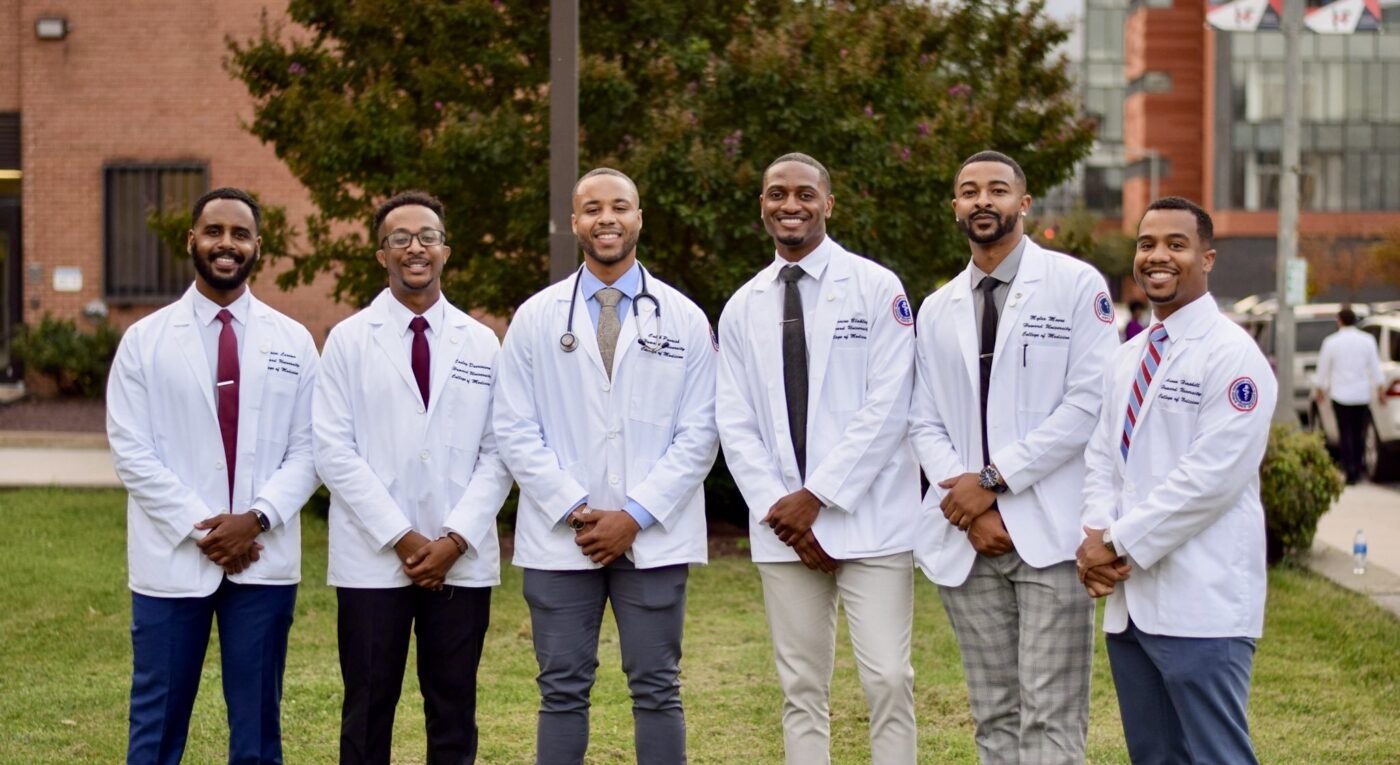
Howard’s secondary application gives you space to show how your experiences fit its mission of serving the underserved. Howard does not publish its prompts in advance, so the questions below are the 2026-2027 secondary questions as reported by applicants who received them in August 2026. Confirm the wording and limits in your own portal before you submit. For prompts from other schools, see our medical school secondary essay prompts database.
What you need to know first
- Nine questions in total. Four 250-word essays on underserved communities and additional information, a 250-word COVID-19 question, a 2,500-character “Why Howard” essay and three short background fields (SAT/ACT scores, the setting of your childhood home and whether you worked 20 or more hours a week). All are for every applicant who receives the secondary.
- Start each 250-word answer with Yes or No. Each essay prompt says “Please indicate, Yes or No and then explain/describe briefly.” Begin with the word, then explain. For the additional information and COVID-19 questions, a simple No (or N/A for COVID-19) is acceptable when nothing applies.
- Write to the stated limit. Applicants report that some text boxes allow 2,000 or 3,000 characters. Write to 250 words anyway, because that is the limit the prompt states.
- The fee is $75 and there are no fee waivers.
- The portal may ask for more. Applicants report a second email with the portal link and a request for a headshot. Expect several short background items as well; complete every field.
- No separate BS/MD, MD/PhD or reapplicant prompts were reported for 2026-2027. If your portal shows a program-specific question, answer it with the same care.
The examples below are original teaching examples written for this guide. Each is labeled “Illustrative example, not an actual applicant essay.” They show structure and depth. Do not copy them; your essays must describe your own experiences.
Question 1: SAT and ACT scores
What were your SAT and/or ACT scores? (Please respond providing your total score on the 400-1600 scale or the 200-800 scale depending on whether you took the old SATs versus the new SATs AND/OR the ACT Composite score on a 1-36 scale) Please indicate below or type N/A if you did not take either.
Limit: no length stated; a short factual field. Who answers: every applicant.
What it asks. Your total SAT score, your ACT composite or both, with N/A for any test you did not take.
Worked response pattern (Illustrative example, not an actual applicant essay):
SAT: 1340 (400-1600 scale). ACT: N/A.
How to use it. This is a data field, not an essay. Give the total score on the scale you took, label which test it is and type N/A for the test you did not take. Do not add commentary or explain a low score here; if a standardized test history matters to your story, use the additional information question instead.
Question 2: Childhood home setting
Was your childhood home located in a rural, urban or suburban area?
Limit: a selection (rural, urban or suburban). Who answers: every applicant.
Worked response pattern (Illustrative example, not an actual applicant essay): Rural
How to use it. Choose the setting where you spent most of your childhood. If you moved, pick the one that best describes where you grew up and use the first essay question to explain the details. Be consistent with the hometown and background you gave in AMCAS.
Question 3: Have you lived in underserved communities?
Have you lived in communities which are medically underserved, or where the majority of the population is economically and/or educationally disadvantaged? (Please indicate, Yes or No and then explain/describe briefly in 250 words or less)
Limit: 250 words. Who answers: every applicant.
What it asks. Two things: whether you have lived in a community that is medically underserved or mostly economically or educationally disadvantaged, and, briefly, what that was like. The word “lived” matters. This question is about where you have lived, not where you volunteered; the next question covers work.
How to approach it. If the answer is Yes, give the reader two or three concrete details about the community and one short personal story, then say what it taught you. If the answer is No, say so honestly and add one or two sentences about the closest relevant experience, such as a family member’s community, without stretching the truth.
Example response (Illustrative example, not an actual applicant essay. 234 words):
Yes. I grew up in a small town where the nearest hospital was a 45-minute drive and the only clinic closed at 5 p.m. Most adults I knew worked hourly jobs without paid sick leave, so a doctor’s visit meant losing a day’s pay. My grandmother, who raised me, managed her diabetes mostly by guessing. She skipped eye exams for years because the specialist was two counties away, and she learned she had diabetic retinopathy only after she could no longer read her church bulletin.
At sixteen I became her driver, her pill organizer and the person who read her discharge papers aloud. I learned that her care depended less on what was prescribed than on whether she could reach the pharmacy, afford the copay and understand the plan. Many neighbors faced the same math. My high school had one counselor for more than 400 students, and no one in my family had gone to college, so I learned about medicine as a career from the nurses who treated my grandmother, not from a class.
Those years shaped how I think about patients. Before I suggest a plan to anyone, I want to know how they will get there, what it will cost them and who is helping at home. I am applying to Howard because its mission is to prepare physicians for communities like mine, and because I intend to return to one.
Why this example works. The answer opens with the required Yes, then proves it with specifics a reader can picture: distance to care, clinic hours, lost wages and one person’s story. It covers both parts of the definition in the prompt, medical underservice and economic and educational disadvantage, without listing statistics. The middle paragraph turns hardship into insight by naming what the writer learned (access, cost and understanding drive care). The close links that insight to Howard’s mission of serving the underserved in one sentence instead of a separate why-us paragraph. Mistakes to avoid: answering No and leaving it there when you have relevant experience, describing a community you only visited as one you lived in, piling on statistics instead of lived detail, and running past 250 words.
Question 4: Have you worked with underserved populations?
Have you worked (volunteer or paid employment) with medically underserved, economically disadvantaged and/or educationally disadvantaged populations? (Please indicate, Yes or No and then explain/describe briefly in 250 words or less)
Limit: 250 words. Who answers: every applicant.
What it asks. Whether you have worked, paid or as a volunteer, with medically underserved, economically disadvantaged or educationally disadvantaged people, and a brief description of that work.
How to approach it. Choose one or two experiences with real depth. State your role, how long you did it and what you did. Then tell one short story that shows what you noticed and how you responded. Finish with what the work taught you about care.
Example response (Illustrative example, not an actual applicant essay. 248 words):
Yes. For two years I have worked 20 hours a week as a patient care technician at a federally qualified health center where most patients are uninsured or covered by Medicaid. I room patients, take vital signs, run point-of-care glucose tests and help new patients through intake. About a third of our patients speak Spanish first, and many arrive after a long bus ride with a list of problems saved up for one visit.
One patient came in every month with a blood pressure above 170. The physician kept adjusting his medication. During intake one day, I asked him how he took his pills. He showed me a sandwich bag of loose tablets that he shared with his wife because they could not afford two prescriptions. I told the physician, and our social worker enrolled him in a discount program that week. At his next visit, his reading was 138.
On Saturdays I tutor two adults in a literacy program as they work toward their GED. Several learners had never been shown how to read a medication label, so we now practice with real ones.
These roles taught me that much of what looks like nonadherence is a problem nobody has asked about yet. I have learned to ask the second question, to admit what I do not know and to bring problems to the people who can solve them. I want to keep doing this work as a physician in the communities Howard was founded to serve.
Why this example works. This prompt asks whether you have worked with underserved, economically disadvantaged or educationally disadvantaged people, and the example touches all three: a safety-net clinic, uninsured patients and adult learners. It names the role, the hours and the duties first, so the reader knows the commitment was real. One short patient story shows judgment rather than claiming it, and the outcome is stated plainly. The last paragraph names the lesson and connects it to Howard in one line. Mistakes to avoid: listing every activity from AMCAS without depth, using a patient’s real name or identifying details, exaggerating your clinical role, and writing about a short service trip as if it were long-term work.
Question 5: Do you plan to practice in an underserved community?
After residency, do you plan to practice medicine in an underserved or disadvantaged community? (Please indicate, Yes or No and then explain/describe briefly in 250 words or less)
Limit: 250 words. Who answers: every applicant.
What it asks. Your plan after residency and whether it includes practice in an underserved or disadvantaged community.
How to approach it. Be honest about what you know and do not know. You do not need to have picked a specialty, but you should describe the kind of community and practice you want and why. The best answers connect the plan to experiences you have already described and to steps you will take to get there.
Example response (Illustrative example, not an actual applicant essay. 217 words):
Yes. I plan to practice internal medicine in a primary care setting that serves a medically underserved area, ideally in the rural South where I grew up, or in a city neighborhood facing the same shortage of physicians.
My reasons are practical as well as personal. I have watched chronic disease go unmanaged for years because the nearest clinic was too far away or too expensive. Primary care is where those problems are caught early, and a physician who stays in one community for decades can change its health.
Good intentions are not a career plan, so I am looking for training that prepares me for this work: early clinical skills training, a family medicine clerkship, coursework on health policy and the social influences on health, and mentors who have built careers in underserved practice. I also plan to apply for the National Health Service Corps Scholarship, which would require me to serve in a federally designated shortage area, and I would welcome that commitment.
After residency, I hope to join a community health center, teach students the way the physicians at my clinic taught me, and stay long enough for patients to trust me with their whole story. Howard’s long record of sending graduates into communities that need them is the path I want to follow.
Why this example works. The example answers Yes and then gets specific: a specialty, a practice setting and a geography. It explains why with experience rather than slogans, then shows the plan is realistic by naming concrete steps, including parts of Howard’s verified curriculum (clinical skills training, the family medicine clerkship and Medicine and Society coursework on health policy and the influences on health) and the National Health Service Corps Scholarship that Howard lists on its aid pages. The final paragraph describes what practice would look like day to day. Mistakes to avoid: promising something you have no record of caring about, answering No without explaining your actual goals, and naming a scholarship or service obligation you are not eligible for (the NHSC scholarship requires US citizenship or nationality).
Question 6: Additional information
Please provide below any additional information you believe is important in evaluating your application (e.g. additional coursework, problems with academic record; disadvantaged, etc.) (Please indicate, Yes or No and then explain/describe briefly in 250 words or less)
Limit: 250 words. Who answers: every applicant answers Yes or No; write only if you answer Yes.
What it asks. Anything the committee should know that is not clear elsewhere, such as extra coursework, a problem in your academic record or a disadvantaged background.
How to approach it. Use this space for context that explains your record, not for a second personal statement. Name the issue, give the cause briefly and spend most of your words on what you changed and the result.
Example response (Illustrative example, not an actual applicant essay. 203 words):
Yes. My transcript shows a C+ in Organic Chemistry I and a 2.9 science GPA for my sophomore year. That fall my mother lost her job, and I increased my hours at a grocery store from 12 to 28 a week to help pay rent. I kept the job, but I did not change how I studied. I crammed late at night after closing shifts and fell behind in the one course that needed steady daily practice.
The next semester I changed three things. I moved my shifts to weekends, scheduled an hour of problem sets every morning before class, and joined a peer study group that met twice a week. I earned an A- in Organic Chemistry II and an A in Biochemistry, and my science GPA over my final four semesters was 3.8 while I still worked about 20 hours a week.
I share this not as an excuse but because it shows how I respond when something is not working: I look for the cause, change the system and keep going. Medical school will test that habit again. I plan to use resources such as Howard’s MedSTAR review sessions and academic mentoring early, before I need them, rather than after.
Why this example works. The example uses the space for exactly what the prompt invites: a problem in the academic record and the context behind it. It states the weak grade plainly, gives a brief cause without blame, and spends most of its words on what changed and the measurable result. The work hours connect to the separate yes/no question about working 20 hours a week, so the application tells one consistent story. The closing names a verified Howard resource (MedSTAR sessions run by the Office of Medical Education) as part of a plan. Mistakes to avoid: repeating your personal statement, listing achievements already in AMCAS, explaining every B, and writing a long hardship narrative with no reflection. If nothing needs explaining, answer No.
Question 7: Did you work 20 or more hours a week?
Did you work at least 20 hours a week for at least one academic year during your undergraduate/graduate program? (Y/N)
Limit: a yes/no field with no explanation box. Who answers: every applicant.
Worked response pattern (Illustrative example, not an actual applicant essay): Y
How to use it. Answer honestly based on the full academic year, not one busy month. If you answer Yes, make sure your AMCAS Work/Activities entries show the job and its hours, and use the additional information question if work affected your grades. There is nowhere to explain here, so the context belongs in your other answers.
Question 8: COVID-19 impact
Did COVID-19 impact you preparing your AMCAS application for fall 2027? (i.e. volunteer/work experience, financially, course registration, MCAT testing, etc.) [Please respond Yes or No and then explain/describe briefly in 250 words or less, indicate N/A if not applicable]
Limit: 250 words. Who answers: every applicant answers Yes, No or N/A; write only if you answer Yes.
What it asks. Whether the pandemic affected how you prepared your AMCAS application, with examples such as volunteer or work experience, finances, course registration or MCAT testing.
How to approach it. For most applicants entering in 2027, the effect is limited to early college years. If it affected your record, explain the specific effect and what you did, in a few sentences. If not, answer No or N/A.
Example response (Illustrative example, not an actual applicant essay. 104 words):
Yes. My first year of college, 2021-2022, began with remote classes, and the hospital where I planned to volunteer paused its volunteer program until the following spring. To keep serving people during that year, I trained as a crisis text line volunteer and completed 120 hours from home. When in-person programs reopened, I started at the hospital’s emergency department volunteer desk in my second year. Because of that delay, my in-person clinical hours are concentrated in my last three years, which is why some activity start dates may look later than expected. The pandemic did not change my course sequence or my MCAT date.
Why this example works. For most applicants entering in fall 2027, the pandemic’s effect is small or over, so a short factual answer is best. The example says Yes, names the specific effects the prompt lists (volunteer experience), shows what the writer did instead, explains how it appears in the application and states what was not affected. It is about 100 words, well under the limit. Mistakes to avoid: stretching a minor inconvenience into a long essay, using the space for a second personal statement, and answering Yes when N/A is true.
Question 9: Why Howard University College of Medicine?
Why Howard University College of Medicine?
Limit: 2,500 characters, including spaces. Who answers: every applicant.
What it asks. Why you want to attend Howard in particular. The best answers show that you know what Howard offers and that its mission matches what you have already done.
How to approach it. Open with the reason that matters most to you and ties to Howard’s mission. Then give two to four specific features of Howard that connect to your goals: the hospital and its patients, a research program, the curriculum, the academic support model or the alumni community. Close by linking back to your other answers. Avoid generic praise of HBCUs or Washington, D.C.
Example response (Illustrative example, not an actual applicant essay. 2,021 characters, including spaces):
I want to train at Howard University College of Medicine because its purpose is the one I have been working toward: preparing physicians to serve the underserved and to study the disparities that make that service necessary.
Three parts of Howard fit my goals. The first is clinical. Howard University Hospital grew out of Freedmen’s Hospital and still serves patients from neighborhoods much like the one where I grew up. Training there means learning medicine with the patients I plan to care for.
The second is research with a purpose. At my health center I saw hypertension, diabetes and kidney disease arrive together again and again. Howard’s Medical Student Research Program, including the student-centered ASPIRE Lab, would let me study those patterns while I train.
The third is support. I have worked through college, and I learn best with structure. Howard’s Office of Medical Education runs MedSTAR peer review sessions, academic mentoring and Step 1 review, and the Spiritual Health and Wellness Center offers short-term counseling for medical students. I would use those resources from the first semester, and I hope to become a MedSTARS leader for the students who come after me.
I also value how Howard teaches health as more than biology. Its Medicine and Society courses cover health policy and financing, nutrition, cultural influences on health and global health, and fourth-year students can arrange international electives. I want to understand how policy shapes my future patients as clearly as I understand their disease.
Howard also carries a history I want to join. Its graduates include LaSalle D. Leffall Jr., who returned to chair Howard’s Department of Surgery, and Debra Ford, who now leads its academic affairs. I want to add to that record by building a primary care practice in a rural community and teaching students the way Howard’s faculty would teach me.
My other answers describe where my interest in health disparities comes from. Howard is where I can turn it into a career.
Why this example works. A strong why-Howard answer connects the applicant’s own record to features that are actually Howard’s. The example names five verified ones: Howard University Hospital and its Freedmen’s Hospital roots, the Medical Student Research Program and its ASPIRE Lab, the Office of Medical Education’s MedSTAR sessions and mentoring, the Spiritual Health and Wellness Center, and the Medicine and Society courses with fourth-year international electives. Each is tied to a specific need or goal the applicant has, not praise. The alumni sentence uses two verified HUCM graduates to show the applicant knows the school’s history, and the closing points the reader back to the other essays instead of repeating them. Mistakes to avoid: generic praise of HBCUs or Washington, D.C., naming programs you have not checked, copying the mission statement, and exceeding 2,500 characters including spaces.
Background items reported in earlier cycles
In the 2025-2026 cycle, the Howard secondary also asked short background questions about parents’ and the applicant’s highest level of education, participation in Howard summer programs such as SHPEP and Be_PARP, acknowledgment of the criminal background check, current work, research, volunteering and coursework plans, family connections to Howard and prior enrollment at Howard. Applicants in 2026-2027 describe the secondary as opening with miscellaneous background questions, so expect similar items. Answer each one factually and consistently with AMCAS.
Interview Format and Preparation
What is confirmed
- By invitation only. Howard interviews about 400 applicants a year. Invitations are sent by email about three weeks to a month before the interview date, and you choose from the dates offered. Do not call or email to request an interview.
- Timing. Interviews usually take place from late September through April, usually on Tuesdays and Wednesdays. Applicants who attended an October 2026 open house report about 10 interviewees per interview day.
- Format. Each interviewee has at least one 30 to 45 minute interview with a member of the faculty. Howard has not described a multiple mini interview (MMI) format.
- A full day on campus. A typical interview day includes presentations on Howard’s history and mission, an overview of the curriculum, tours, a financial aid seminar and lunch with students. Howard wants interviewees to “get to know Howard,” so plan to spend most of the day on campus. Applicants who interviewed in fall 2026 described a full, low-stress day in which the dean of admissions spoke, videos covered Howard’s history and financial aid was explained.
- After the interview. First acceptances go out October 15, offers continue through the spring, and the alternate list stays active until orientation begins in mid-July.
The details above come from Howard’s interviews page and admission timetable; check your invitation for the current schedule.
What to prepare
Howard has not published its interview questions, and you should not expect a script. Faculty interviews usually cover your path to medicine, your experiences and your fit with the school’s mission. Prepare for these areas:
- Your service record. Be ready to discuss each experience you described in the secondary, including what went wrong and what you would do differently.
- Health disparities. Expect to talk about a disparity you have seen and how a physician could address it. Use real examples and avoid broad statements you cannot support.
- Why Howard. Know the mission, the curriculum structure, Howard University Hospital and one or two programs that matter to you, such as the Medical Student Research Program or MedSTAR.
- Your plans. Be honest about your career interests and how they connect to practice in underserved communities.
- Ethics and professionalism. Third-year students take a course in health care ethics and jurisprudence, and interviewers may ask how you would handle a difficult situation with a patient or teammate.
- Questions for them. Ask about student support, clinical sites, research opportunities or how the college’s improvement work has shaped the student experience.
Practice out loud with someone who will give you honest feedback. Our list of the most common medical school interview questions is a good place to start, and our medical school admission consulting team offers mock interviews built around a school’s format and mission.
Interview day logistics
Dress professionally and plan to arrive early. Bring a copy of your AMCAS application and secondary to review. Use the lunch with students to ask about daily life, and be courteous to everyone you meet, from staff to current students. Send a short thank-you note if you wish, but follow any instructions Howard gives about post-interview communication.
Frequently Asked Questions
What is Howard University College of Medicine known for?
Howard University College of Medicine is known for its long commitment to training physicians who serve underserved communities and for producing a significant number of the nation’s Black physicians. Founded in 1868, it is one of two historically Black medical schools that survived the Flexner Report of 1910, and its more than 4,000 living alumni make up a large share of Black physicians in the U.S. It is also known for research on health disparities, including cancer, sickle cell disease, diabetes and hypertension, and for its teaching hospital, Howard University Hospital.
Is it hard to get into Howard Medical School?
Yes. Admission is competitive. For the 2025 entering class, Howard received 8,908 verified applications, interviewed 410 applicants and enrolled 128 students. Howard interviews about 400 applicants a year for a class of about 130, and applicants must meet a 497 MCAT minimum and a 3.0 science GPA just to be considered for an interview. Beyond the numbers, Howard looks for experience with underserved communities, a commitment to addressing health disparities and qualities such as empathy and integrity. Strong applicants combine solid academics with sustained service and clear, honest essays.
What is the average MCAT score for Howard Medical School?
Howard reports a matriculating class mean MCAT of 505. Accepted applicants in the 2025 entering class had a median MCAT of 507 and a mean of 507.5. The minimum score considered for interview eligibility is 497, starting with the 2026-2027 application cycle. A score at or above 505 places you in the middle of the class or higher, but Howard considers the whole application, so a score between 497 and 505 can still be competitive with strong service and essays.
How many people apply to Howard Medical School?
Howard received 8,908 verified applications for the 2025 entering class: 47 from D.C. residents, 8,211 from out-of-state applicants and 650 from international applicants. The number varies each year, but Howard receives far more applications than it can interview. It interviews about 400 applicants a year for an entering class of about 130, so most applicants are not invited to interview. This is why your secondary answers, which show your fit with Howard’s mission, matter so much.
What degree programs are offered at Howard Medical School?
Howard Medical School offers the four-year MD program, a six-year BS/MD program for invited Howard College of Arts and Sciences students, an MD/PhD with the Graduate School and an MD/MBA with the School of Business. The college also offers master’s and doctoral degrees in the biomedical sciences, including the interdisciplinary PhD in Biomedical Sciences. Nursing and allied health programs belong to Howard’s College of Nursing and Allied Health Sciences, not the College of Medicine.
Are there residency programs associated with Howard Medical School?
Yes. Howard University Hospital sponsors residencies supervised by the faculty of the College of Medicine, including dermatology, family medicine, general surgery, internal medicine, neurology, obstetrics and gynecology, ophthalmology, pathology and psychiatry, plus fellowships in cardiology, endocrinology, gastroenterology, addiction medicine, infectious diseases and pulmonary disease. The hospital lists 9 ACGME-accredited residencies and 6 ACGME-accredited fellowships. These programs train physicians after medical school, and Howard medical students learn alongside their residents.
What opportunities are available for clinical training at Howard Medical School?
Students begin clinical skills training in the first-year Medicine and Society block and practice in the Health Sciences Simulation and Clinical Skills Center. The third year is an eleven-month series of core clerkships, and the fourth year includes acting internships in internal medicine and general surgery and 24 weeks of electives, which can include approved extramural and international electives. Most clinical training takes place at Howard University Hospital, which treats a diverse patient population from across Washington, D.C.
What support services are available for students at Howard Medical School?
Howard offers academic support through the Office of Medical Education, including MedSTAR peer review sessions, tutoring, academic mentoring and counseling, the Learning Resource Center, USMLE Step 1 reviews and a Summer Directed Study Program. The Spiritual Health and Wellness Center offers short-term counseling exclusive to medical students as a supplement to University Counseling Services. Students also have access to financial aid counseling, disability services and university career and health services.
How does Howard University College of Medicine prepare students for a career in healthcare?
Howard prepares students through a curriculum that combines foundational medical sciences with clinical practice and a Medicine and Society thread covering health policy, culture, nutrition, epidemiology and preventive medicine. Students must pass USMLE Step 1 to advance and Step 2 to graduate. Clinical training at Howard University Hospital, research through the Medical Student Research Program and service projects prepare graduates to meet the needs of diverse communities.
Is Howard Medical School a good school?
Howard Medical School is a respected, accredited MD program with a distinguished history and a clear mission. It is highly regarded for its commitment to serving underserved communities, its research on health disparities and its role in training Black physicians. It currently holds full LCME accreditation with probationary status until a February 2028 review; probation does not affect the validity of its degrees. Whether it is a good school for you depends on how well its mission, location, curriculum and support match your goals.
Is Howard Medical School a HBCU?
Yes. Howard Medical School is part of Howard University, one of the nation’s leading historically Black colleges and universities (HBCUs). It is one of the country’s historically Black medical schools, and Howard has always welcomed students of all races and nationalities. For other options, see our guide to HBCU medical schools.
What GPA do you need for Howard Medical School?
Howard expects a science (BCPM) GPA of 3.0 or above. Accepted applicants in the 2025 entering class had a median total GPA of 3.73 and a median science GPA of 3.66. A 3.0 is a minimum, not a target: competitive applicants typically have stronger records, especially in recent science courses. Howard’s review is holistic and also weighs community service, leadership, experience with underserved communities and your essays.
Is Howard University College of Medicine on probation?
Howard reports that the LCME granted the college full accreditation, with a designation that includes probationary status, which means close monitoring, until the next review in February 2028. This does not change its accreditation, its authority to graduate physicians or the validity of students’ degrees. The college has described faculty hires, curriculum changes, student support and facilities upgrades as part of its response. Ask about the progress at your interview if it matters to your decision.
Does Howard accept out-of-state and international applicants?
Yes. Howard has no state residency requirement, so out-of-state applicants are considered on the same basis as D.C. residents. International students are accepted on a limited basis and must have earned at least 71 semester hours at an accredited U.S. or Canadian college or university. Accepted international students must submit financial information by June 30. Note that federal loans and scholarships such as the NHSC and the military HPSP require U.S. citizenship or eligible status.
How much does Howard medical school cost?
For 2026-27, first-year tuition is $58,608 for every student, plus $2,516 in university mandatory fees. The estimated first-year cost of attendance, including living costs, books and loan fees, is $99,428, and the third year is higher at $110,940 because of its eleven-month schedule. Health insurance is not included. New borrowers can no longer use Grad PLUS loans as of July 1, 2026, so plan your financing with the Office of Financial Aid early.
Does Howard accept fee waivers for the secondary application?
No. Howard does not accept fee waivers for its secondary application, including AAMC Fee Assistance Program waivers. The secondary fee is $75, which Howard keeps relatively low. Budget for it when you plan your school list.
When does Howard send secondaries and acceptances?
Howard sends secondary invitations by email to verified applicants from about mid-August through January 1 (in 2026, the first invitations went out August 25). The secondary deadline is January 15. The first acceptance notifications go out on October 15, and Howard continues to make offers through the spring. Orientation begins in mid-July.
Does Howard have a BS/MD program?
Yes. Howard’s BS/MD program lets students complete both degrees in six years. It is by invitation only, for students already accepted to Howard’s College of Arts and Sciences as biology or chemistry majors, with invitations sent in mid-May. To enter the College of Medicine, BS/MD students need a science GPA of 3.25, an overall GPA of 3.5, an MCAT of 504, a strong interview and supportive letters.
How much clinical experience do I need for Howard?
Howard does not set a minimum number of clinical hours, but shadowing is required, and it expects applicants to have experience working or volunteering with underserved communities and an interest in health disparities. Aim for sustained, hands-on roles you can describe in detail. Supervised internships for pre-med students, clinical jobs and long-term volunteering at safety-net clinics all count, and depth matters more than the hour total.
What is the Howard interview like?
The interview is an in-person day on campus that includes presentations on Howard’s history and mission, a curriculum overview, tours, a financial aid seminar and lunch with students. Each applicant has at least one 30 to 45 minute interview with a faculty member. Interviews run from late September through April, usually on Tuesdays and Wednesdays.
Does Howard require PREview or Casper?
Howard lists the AAMC PREview exam as recommended but not required. Casper is not among Howard’s listed requirements. If you take PREview for other schools, you can share the score with Howard.
Does Howard accept transfer students?
Howard says it may not be able to consider transfer applications for the 2026-2027 academic year because of curriculum schedule adjustments, and it plans to update applicants in December 2026. When transfers are open, Howard considers only students entering the third year from an LCME-accredited U.S. or Canadian school who have passed USMLE Step 1.
Related Medical School Guides
If you are applying to Howard, these guides cover schools with a useful connection to it. They are not ranked by selectivity, and none of them is a “safety” school. When considering a medical school, evaluate location, research facilities, community service opportunities, clinical rotation sites and mission to find the right fit for your goals.
- Georgetown University School of Medicine: a private MD school in Washington, D.C., known for its commitment to cura personalis, or care for the whole person, and a natural comparison for applicants who want to train in the capital.
- George Washington University School of Medicine and Health Sciences: one of the District’s three MD schools, situated in the heart of the nation’s capital, with a focus on community service and global health.
- Johns Hopkins School of Medicine: a research-intensive MD school in nearby Baltimore that partners with Howard’s Cancer Center through the Howard-Hopkins Comprehensive Partnership for Cancer Research.
- Medical University of South Carolina (MUSC): a public academic health center in Charleston, useful for comparing a state school’s admissions approach with Howard’s residency-blind admissions.
- Texas Tech University Health Sciences Center Paul L. Foster School of Medicine: an MD school in El Paso whose training centers on a border community, worth comparing for applicants who want a mission focused on the population a school serves.
- Baylor College of Medicine: a private MD school in Houston, useful for applicants comparing large private academic medical centers in other regions with Howard.
Howard is one of the nation’s historically Black medical schools. Applicants drawn to its mission often also consider Meharry Medical College, the only other historically Black medical school to survive the Flexner era with Howard, and Morehouse School of Medicine in Atlanta. See our guide to HBCU medical schools for a full comparison. If you are an international applicant, our guide to medical schools that accept international students compares Howard’s policy with other schools’. Washington, D.C., does not have its own state guide; for nearby options, see our guide to medical schools in Virginia.
Other medical schools in the Washington, D.C., area
Several MD programs sit within reach of the capital, each offering unique strengths, community affiliations and educational approaches.
Georgetown University School of Medicine. Located in Washington, D.C., Georgetown is known for its commitment to cura personalis, or care for the whole person, and offers a supportive learning environment, comprehensive clinical training and a strong focus on bioethics and social justice. Visit the school for current admissions details.
George Washington University School of Medicine and Health Sciences. Situated in the heart of the nation’s capital, George Washington University School of Medicine offers medical education with research opportunities and a commitment to community service and global health.
Uniformed Services University of the Health Sciences (USUHS). USUHS in Bethesda, Maryland, trains future military physicians. Students pay no tuition and serve as commissioned officers while they learn, in return for a service commitment. If you have a passion for serving your nation and thrive in a close-knit environment, USUHS deserves a look.
Virginia Commonwealth University School of Medicine (VCU SOM). In Richmond, VCU SOM is a public MD school with diverse patient populations and an emphasis on primary care, social justice and addressing healthcare disparities. It is a strong option for Virginia residents who value affordability.
University of Maryland School of Medicine (UMSOM). In Baltimore, UMSOM’s program offers a wide range of specialties, research facilities and clinical opportunities at a major public research university. If you are drawn to diverse clinical experiences and research near D.C., UMSOM deserves your consideration.
DO programs in Washington, D.C., and surrounding regions
Washington, D.C., and its neighboring regions also offer osteopathic (DO) options for those passionate about a career in osteopathic medicine. If you are open to a DO degree, the list below includes several osteopathic schools in the Mid-Atlantic and beyond, such as the Edward Via College of Osteopathic Medicine (VCOM) and the Philadelphia College of Osteopathic Medicine (PCOM).
Explore beyond the borders: more medical school guides
While the Washington, D.C., area offers robust medical programs, expanding your search beyond the capital can reveal more opportunities that match your career goals. Choosing the right medical school involves more than geography; it is about finding a place where your passion for healthcare, community service and personal growth can flourish. Explore this list of guides to discover the range of medical programs available, each with its own strengths:
- University of Kansas School of Medicine (KUMC)
- Charles R. Drew University of Medicine and Science College of Medicine
- Loma Linda University School of Medicine
- John A. Burns School of Medicine (JABSOM)
- Kansas College of Osteopathic Medicine (KansasCOM)
- UC Irvine School of Medicine
- Nova Southeastern University College of Allopathic Medicine
- Touro University Nevada College of Osteopathic Medicine
- University of Miami Miller School of Medicine
- Arkansas College of Osteopathic Medicine (ARCOM)
- University of Arkansas for Medical Sciences (UAMS)
- Tulane University School of Medicine
- LSU Health New Orleans School of Medicine
- LSU Shreveport Medical School
- Kirk Kerkorian School of Medicine at UNLV
- University of Nevada Reno School of Medicine
- University of Arizona College of Medicine-Tucson
- University of Arizona College of Medicine-Phoenix
- Burrell College of Osteopathic Medicine (BCOM)
- The University of New Mexico School of Medicine
- Alabama College of Osteopathic Medicine (ACOM)
- University of South Alabama College of Medicine
- University of Alabama School of Medicine
- FIU College of Medicine
- UCF College of Medicine
- USF Morsani College of Medicine
- Florida State University College of Medicine
- Morehouse School of Medicine
- Medical College of Georgia at Augusta University
- Mercer University School of Medicine (MUSM)
- Campbell University School of Osteopathic Medicine (CUSOM)
- ECU Brody School of Medicine
- Edward Via College of Osteopathic Medicine (VCOM)
- University of South Carolina Medical School
- Lewis Katz School of Medicine at Temple University
- Philadelphia College of Osteopathic Medicine (PCOM)
- Geisinger Commonwealth School of Medicine (GCSOM)
- Penn State Medical School
- CUNY School of Medicine
- SUNY Downstate Medical School
- NYIT College of Osteopathic Medicine
- NYU Long Island School of Medicine
- Albany Medical College
- TOURO College of Osteopathic Medicine
- Norton College of Medicine at Upstate Medical University
- Jacobs School of Medicine at the University at Buffalo
- Hofstra Zucker School of Medicine
- Weill Medical College of Cornell University
- University of Rochester Medical School
- Icahn School of Medicine at Mount Sinai
- Renaissance School of Medicine at Stony Brook University
- Albert Einstein College of Medicine
- Ohio University Heritage College of Osteopathic Medicine
- Northeast Ohio Medical University (NEOMED)
- University of Cincinnati College of Medicine
- University of Toledo College of Medicine
- Wright State University Boonshoft School of Medicine
- Ohio State University College of Medicine
- Rowan University School of Osteopathic Medicine
- Hackensack Meridian School of Medicine (HMSOM)
- Rutgers New Jersey Medical School (NJMS)
- Rutgers Robert Wood Johnson Medical School
- Cooper Medical School of Rowan University (CMSRU)
- A.T. Still University Kirksville College of Osteopathic Medicine
- Saint Louis University School of Medicine
- University of Missouri Medical School
- Kansas City University (KCU)
- UMKC School of Medicine
- New York Medical College
- University of Pittsburgh School of Medicine
- University of Wisconsin Medical School
- Case Western Medical School
- University of North Carolina Medical School
- University of Florida Medical School
- Emory University School of Medicine
- Boston University College of Medicine
- California University of Science and Medicine
- UC San Diego Medical School
- California Northstate University College of Medicine
- Touro University of California
- CHSU College of Osteopathic Medicine
- UC Davis School of Medicine
- Harvard Medical School
- UC Riverside School of Medicine
- USC Keck School of Medicine
- UT Southwestern Medical School
- Long School of Medicine at UT Health San Antonio
- University of the Incarnate Word School of Osteopathic Medicine
- UT Austin’s Dell Medical School
- UTMB School of Medicine
- McGovern Medical School at UT Health
- Johns Hopkins School of Medicine
- The University of Texas Rio Grande Valley School of Medicine
- UNT Texas College of Osteopathic Medicine
- University of Houston College of Medicine
- Texas A&M College of Medicine
- Baylor College of Medicine
- George Washington University School of Medicine
- Vanderbilt University School of Medicine
- St. George’s University School of Medicine
- Lake Erie College of Osteopathic Medicine (in Pennsylvania)
- Sidney Kimmel Medical College at Thomas Jefferson University
- Wake Forest University School of Medicine
- Western University of Health Sciences (in California)
- Drexel University College of Medicine
- Stritch School of Medicine at Loyola University Chicago
- Georgetown University School of Medicine
- Yale School of Medicine
- Perelman School of Medicine
- UCLA Medical School
- NYU Medical School
- Washington University School of Medicine
- Brown Medical School
How International Medical Aid Can Help
At International Medical Aid (IMA), we help aspiring medical professionals prepare for medical school with practical experience and guidance. Howard’s application asks you to show real work with underserved people and a commitment to addressing health disparities. IMA’s programs and advising can support that preparation, but they are independent of Howard University. They do not affect Howard admissions decisions and are not a substitute for any Howard requirement.
Clinical internships
IMA runs pre-health internships in Kenya and other sites for pre-med and other pre-health students. Interns work in hospitals and clinics where they take vitals, do intake and triage and help with direct patient care under the supervision of local clinicians. That kind of supervised, hands-on work gives you experience to reflect on honestly in essays like Howard’s questions about underserved populations. You can compare pre-med internships abroad by site and season, or browse all of our international healthcare internships.
IMA’s global healthcare initiatives reflect the same concern for health access that runs through Howard’s mission. Global experience works best in a Howard application when it adds to a record of service at home and you can explain what it taught you about care in low-resource settings.
Admissions consulting
A medical school admissions consultant can guide you through each stage of the process and give personalized feedback. Our medical school admissions consulting advisors can help you check your MCAT and science GPA against Howard’s minimums, plan your timeline around Howard’s rolling review, shape your secondary answers while keeping them fully your own and prepare for the faculty interview.
Next step: if your clinical or service experience is thin, plan it now, and start drafting your answers to Howard’s underserved-community questions so they are ready when your secondary arrives.
Final Thoughts and Sources
Final thoughts about Howard University College of Medicine
Howard University College of Medicine offers a medical education built around one clear purpose: training competent, compassionate physicians to serve the underserved. Its four-year curriculum pairs integrated science with a Medicine and Society thread, its students train at Howard University Hospital, and its alumni have shaped American medicine for more than 150 years. To apply well, meet the 497 MCAT and 3.0 science GPA floors, build a record of sustained service with underserved communities, apply early in the cycle and answer the secondary with honest, specific stories. The journey to becoming a physician is challenging but rewarding, and Howard stands as a distinguished institution for those whose goals match its mission.
To gain personalized insight into medical school admissions, consider reaching out to our pre-med advisors or using our admissions consulting services. We wish you success as you move forward in your medical career.
Sources and notes
Facts were checked on October 18, 2026. Costs are for the 2026-27 academic year; requirements and deadlines are for the 2026-2027 application cycle (July 2027 entry). The matriculating class mean MCAT is as posted by the school, which does not state the cohort. Median GPA and MCAT, application, interview and matriculant counts and the class profile are from the AAMC Medical School Admission Requirements (MSAR) profile for the 2025 entering class; enrollment is from October 2025, aid and debt from 2024-25 and specialty choices from the AAMC Graduation Questionnaire. No count of offers is published, so no acceptance rate is given. The secondary questions are the 2026-2027 questions as reported by applicants in August 2026; Howard does not publish them.
- HUCM Admission and Aid: HUCM Basics (class size, MCAT minimum and mean, science GPA, residency and international policy), BS/MD, transfers, open houses.
- HUCM Dates and Deadlines: admission timetable, interviews per year, deposits and enrollment fee.
- HUCM Recommendations and the Requirements and Procedures page: letters, prerequisites, MCAT, AMCAS, secondary fee, PREview, background checks.
- HUCM Application Instructions by Program: MD, BS/MD and MD/PhD; Howard School of Business MBA: MD/MBA.
- Howard University 2026-2027 Estimated Cost of Attendance (Student Financial Services) and the HUCM Financial Aid, University Scholarships and Loans, NHSC and Armed Forces HPSP pages.
- Howard University Statement Regarding College of Medicine Accreditation Status; Howard Institutional Accreditation (MSCHE).
- HUCM Pipeline Programs, the MD Program and Academic Requirements pages, the Spiritual Health and Wellness Center and the Howard and Stanford Summer Research Program.
- HUCM Administration and Leadership, Howard Profiles (profiles.howard.edu) for faculty and staff, the Office of the President and The Dig at Howard University.
- HUCM History (Sterling M. Lloyd Jr., 2006) and the HUCM About page for history, mission, vision and core values; published biographies of LaSalle D. Leffall Jr. and Patricia Bath.
- AAMC Medical School Admission Requirements (MSAR), Howard University College of Medicine profile, 2026 edition (2025 entering class data), accessed October 18, 2026: median MCAT and GPA, applications, interviews, matriculants, enrollment, class profile, waitlist, clerkship sites, research, aid, debt and specialty intentions.
- Secondary prompt wording: 2026-2027 Howard applicant thread on Student Doctor Network (August 25, 2026), cross-checked with prior-cycle prompt lists.