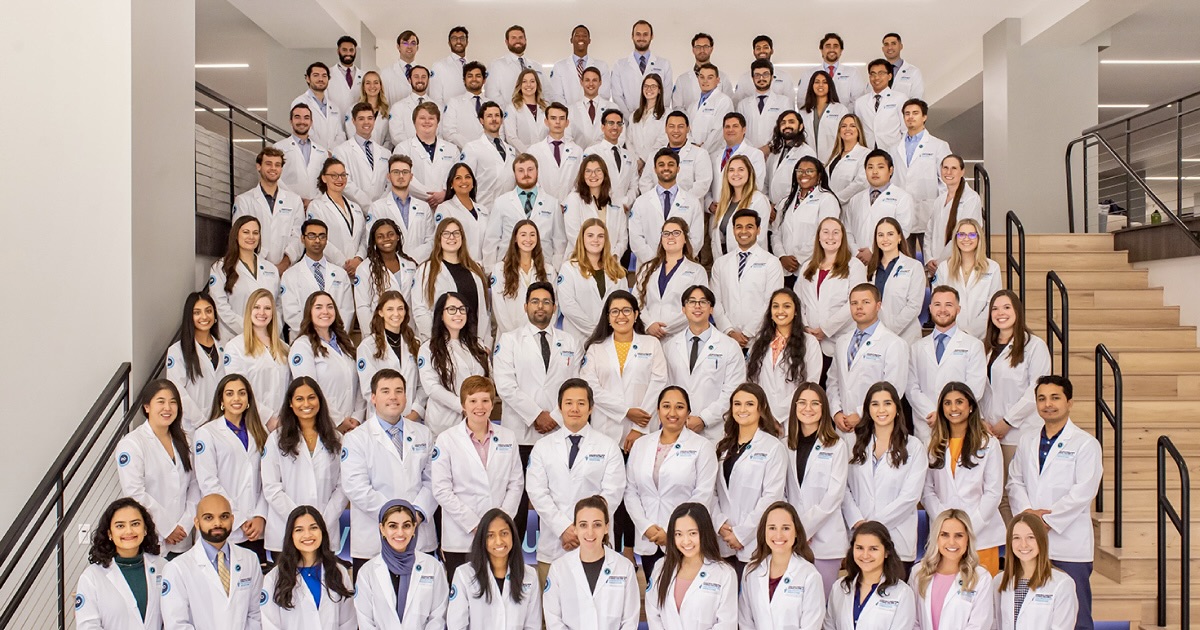
The Kansas College of Osteopathic Medicine (KansasCOM) is the first college of osteopathic medicine in Kansas. It is part of Kansas Health Science University, so its full name is now Kansas Health Science University – Kansas College of Osteopathic Medicine (KHSU-KansasCOM). Before the university name change, the school was known as Kansas Health Science Center (KHSC-KansasCOM). The college grants one degree, the Doctor of Osteopathic Medicine (DO), and it teaches from a 116,000-square-foot building at 217 East Douglas Avenue in downtown Wichita, the state’s largest city.
KansasCOM opened in 2022 with a clear purpose: to help train physicians for underserved communities in Kansas, the Midwest and beyond. Its education is centered on empathy and patient care, and it aims to prepare physicians who can work in many kinds of communities, from rural towns to large cities. The inaugural class graduated in 2026, and 73 of its 75 graduates matched into residency.
This guide covers the 2026-2027 application cycle, for students who want to start medical school in July 2027. It walks through the school’s current accreditation status, its newest admissions statistics, requirements and deadlines, the secondary application, tuition and cost of attendance, the curriculum and clinical years, faculty and leadership, the virtual interview, and a long list of frequently asked questions. Figures were checked on October 28, 2026.
Key Takeaways
- One degree, one campus: KHSU-KansasCOM offers the DO degree only, taught in downtown Wichita. It is a private, nonprofit school and the first osteopathic medical school in Kansas.
- Accreditation: in April 2026, the Commission on Osteopathic College Accreditation (COCA) granted KHSU-KansasCOM Accreditation with Warning. The college remains accredited and authorized to confer the DO degree, and students remain eligible for federal financial aid, residency and licensure.
- Academic profile: the school reports a mean MCAT of 496.9 and a mean cumulative undergraduate GPA of 3.53 in its 2026-2027 profile, without naming the entering class. The first-year class in 2024-2025 had 176 students.
- Minimums: you need a cumulative GPA and a science GPA of at least 3.0. An MCAT of 500 or higher is recommended, not required, and your score must be from January 2024 or later.
- Dates: AACOMAS opened May 4, 2026, and closes April 30, 2027. The secondary is due by May 15, 2027, and the school asks you to return it within 30 days of your invitation. Kansas residents can use the Early Decision Program, due January 15, 2027.
- Cost: 2026-2027 tuition is $61,754 for every student, in-state or out-of-state. With fees and living costs, the estimated cost of attendance is $106,451.
- Outcomes: the Class of 2026 matched at 97.3% (73 of 75) into 13 specialties in 31 states.
- Next step: submit AACOMAS early in the cycle, line up a letter from a physician (DO or MD) and a pre-med adviser or science professor, and plan to finish the secondary within 30 days of the invitation.
Key Statistics About Kansas College of Osteopathic Medicine
The snapshot below collects the numbers applicants ask about most. The MCAT and GPA means are the newest figures the school has reported, but the source does not say which entering class they describe. The class size is for the 2024-2025 academic year. Tuition and cost of attendance are for 2026-2027, and the match rate is for the Class of 2026. KansasCOM does not publish applicant, interview or acceptance counts, so no acceptance rate is shown.

What Are KansasCOM’s Average MCAT and GPA?
KansasCOM’s mean MCAT is 496.9 and its average cumulative undergraduate GPA is 3.53. These figures come from the school’s 2026-2027 profile, which does not say which entering class they describe, so read them as a recent picture rather than a label for one class. They are averages, not cutoffs. About half of the students in the group behind each number scored below it.
The numbers that actually decide whether you get a secondary are simpler. KansasCOM sends a secondary automatically to applicants with a 3.0 or higher overall and science GPA and a 500 or higher MCAT. Applicants below those marks are reviewed one by one before a secondary goes out. If your MCAT is below 500 but your GPA is strong and your clinical record is deep, you can still be invited. If your MCAT is 505 or higher and your science GPA is 3.40 or higher, you also qualify on the numbers for the school’s largest entering scholarship, described in the tuition section below.
| Metric | Value | Year or cohort | Source and definition |
|---|---|---|---|
| School and degree | Kansas Health Science University – Kansas College of Osteopathic Medicine (KHSU-KansasCOM); Doctor of Osteopathic Medicine (DO); Wichita, Kansas | Current | KansasCOM Accreditation page; AACOM Choose DO Explorer. Private, nonprofit; founded 2021; first class entered 2022 |
| Mean MCAT | 496.9 | Cohort not labeled (2026-2027 cycle profile) | AACOM Choose DO Explorer, KHSU-KansasCOM profile, MCAT/GPA Information |
| Average cumulative undergraduate GPA | 3.53 | Cohort not labeled (2026-2027 cycle profile) | AACOM Choose DO Explorer, KHSU-KansasCOM profile |
| First-year matriculants | 176 (25 in-state, 151 out-of-state) | 2024-2025 academic year | AACOM Choose DO Explorer, Student Demographics |
| Total DO enrollment | 399 | 2024-2025 academic year | AACOM Choose DO Explorer, Student Demographics |
| Applicants, interviews and acceptance rate | Not published | Not applicable | Neither the school nor Choose DO publishes these counts |
| Minimum GPA | 3.0 cumulative and 3.0 science | Fall 2027 entry | KansasCOM Admission Requirements |
| MCAT | Required; 500 or higher recommended; oldest accepted January 1, 2024 | Fall 2027 entry | KansasCOM Admission Requirements; Choose DO |
| Tuition | $61,754 per year, all residencies | 2026-2027 | KansasCOM Cost of Attendance page (updated July 23, 2026) |
| Tuition and fees | $64,754 per year | 2026-2027 | Tuition plus $3,000 annual fees |
| Estimated cost of attendance | $106,451 | 2026-2027 | Tuition, fees and $41,697 in estimated indirect costs |
| Residency match rate | 97.3% (73 of 75); 98.67% total placement with post-Match | Class of 2026 (Match 2026) | KansasCOM Residency Match Day Results; Assessment and Outcomes |
| COMLEX Level 1 first-time pass rate | 96.82% (subject to change) | AY 2026-2027 testing cycle | KansasCOM Assessment and Outcomes |
| COCA status | Accreditation with Warning | Granted April 2026 | KansasCOM Accreditation page (updated July 2026) |
Mission and Educational Priorities
KansasCOM’s mission is short and specific: “The Mission of the Kansas College of Osteopathic Medicine is to train the Osteopathic physician of the future to provide effective, empathic, and innovative care to optimize the health of patients and their communities.” The school lists its values as diversity and inclusion, community, humility and integrity, innovation, teamwork and excellence (KansasCOM Mission and Values).
Each part of that mission shows up in the program, and each one gives you something concrete to write about.
Effective care. KansasCOM trains physicians for professional clinical practice and for leadership roles in many health care settings. The curriculum combines rigorous study of the foundational sciences, clinical reasoning, hands-on patient experiences and dedicated board preparation. Students apply classroom knowledge in practical settings early, starting in the first year.
Empathic care. The admissions process looks for academic strength, but grades are not the whole picture. The school looks for applicants who show empathy, patient care and a real understanding of patient needs. Its admissions page names professionalism, empathy and compassion, shown through service and leadership, as marks of a strong applicant. If you have a deep-rooted passion for osteopathic medicine, your file should show it through what you have done with patients, not only what you say.
Innovative care. KansasCOM threads emerging technology, artificial intelligence, ethics, entrepreneurship and diversity principles through its curriculum. The anatomy lab uses augmented reality headsets and virtual dissection platforms alongside plastinated cadaver specimens, and the Simulation Center has a full hospital wing and a 12-room clinical exam suite.
Patients and their communities. This is the part of the mission that shapes the whole school. KansasCOM was founded to help address the shortage of physicians in Kansas. In 2023, the school’s president said that 92 of the 105 counties in Kansas are partially or wholly underserved. Students take part in community service projects across the greater Wichita area, focused on underrepresented populations, starting in the first week of orientation.
What the mission means for your application
KansasCOM’s admissions standards name five factors that show fit with the mission: clear academic success, research experience, leadership experience and skills, community service and involvement, and exposure to the field of medicine. The school also says it recruits students with a variety of backgrounds who show exceptional potential.
A few practical points follow from that:
- Show service that lasts. One-time volunteer events do not show the “community” in the mission. Months of work with the same population, such as a free clinic, a food pantry or a rural health program, show it much better.
- Show where you could practice. Graduates are expected to serve Kansas communities and beyond with cultural competence and compassion. If you grew up in a small town, worked with immigrant families or volunteered in an underserved neighborhood, say so clearly.
- Know what osteopathic care means. The school’s academic aims include believing in the body’s interconnected ability to heal and staying committed to the osteopathic approach. Shadowing a DO and being able to describe osteopathic manipulative medicine (OMM) in your own words both help.
- Show teamwork and humility. The school asks students to keep “the focus on the patient, not themselves” and to support a “culture of care.” Stories where you helped a team succeed are more convincing than stories where you were the hero.
Diversity and inclusion
Diversity is part of KansasCOM’s stated values. The college seeks to build a safe and inclusive environment that welcomes a range of ideas and people, and it prepares students to serve underserved, at-risk, urban and rural populations. The building’s entrance is Chester I. Lewis Reflection Square Park, which honors the Wichita civil rights leader and the Dockum sit-ins. The school presents it as a daily reminder to be brave and to make health care better for every community (KansasCOM Diversity and Inclusion).
Accreditation and Institutional Identity
KHSU-KansasCOM has two kinds of accreditation, and it helps to understand both.
Programmatic accreditation (COCA). The Commission on Osteopathic College Accreditation is the accreditor for every DO program in the United States. In April 2026, as part of the college’s ongoing accreditation process, COCA granted KHSU-KansasCOM Accreditation with Warning. The college describes this status as follows: it remains accredited while it provides documentation and shows progress in specific areas identified in the review. KansasCOM remains authorized to confer the DO degree, and academic operations continue (KansasCOM Accreditation and FAQs, updated July 2026).
The school’s accreditation FAQs answer the three questions applicants usually ask:
- Financial aid: students remain eligible for federal financial aid.
- Residency: the status does not affect students’ eligibility to pursue residency.
- Licensure: graduates are eligible to seek licensure after completing all educational, examination, residency and licensing requirements.
During its first years, the college held pre-accreditation, the status COCA gives a new college before its first class graduates. The inaugural class graduated in 2026, and the April 2026 action is part of the college’s ongoing accreditation process.
Institutional accreditation (WSCUC). Kansas Health Science University has been accredited by the WASC Senior College and University Commission (WSCUC) since June 2026. Institutional accreditation covers the whole university; programmatic accreditation covers the DO program.
Name and ownership. The college was founded in 2021 as part of Kansas Health Science Center (KHSC-KansasCOM). The parent institution is now Kansas Health Science University, and the school’s website moved to kansashsu.org. KansasCOM is private and nonprofit, and it is a member of The Community Solution Education System, a nonprofit network of colleges and universities. It is not a public or state school, and it is not part of the University of Kansas.
How to use this information. Accreditation status is one factor among many, and it can change as COCA completes its reviews. If it matters to your decision, check the school’s accreditation page before you accept a seat and ask the admissions office for an update at your interview. You can compare KansasCOM with other osteopathic medical schools in our DO school guide.
Medical Programs and Affiliations
Doctor of Osteopathic Medicine (DO)
The DO is KansasCOM’s only degree program. It is a four-year program built to develop well-rounded osteopathic physicians. Years one and two cover the foundational and clinical sciences through integrated, case-based courses, along with clinical skills, OMM and health systems science. Years three and four are clinical rotations with physician preceptors in hospitals and clinics. The program places a strong emphasis on osteopathic manipulative medicine, a hands-on approach to diagnosis and treatment that gives students another set of tools for treating the whole patient. The curriculum section below explains each part.
KansasCOM does not list a Master of Science in Biomedical Sciences (MSBS), a DO/MS, a DO/MBA, a DO/MPH or any other dual degree on its current academic pages, and it offers no preparatory or postbaccalaureate program. If you want a dual degree, plan on earning it separately or look at schools that offer one.
Early Decision Program for Kansas residents
KansasCOM’s Early Decision Program (EDP) is for in-state applicants who have decided that KansasCOM is their first choice. For the 2026-2027 cycle:
- EDP application due: January 15, 2027
- EDP supplemental materials due: February 15, 2027
- EDP applicants notified: April 15, 2027
EDP is a commitment. If you are a Kansas resident and KansasCOM is clearly your top school, ask the admissions office how EDP fits with your other applications before you choose it.
The 3+4 Partner Program with regional colleges
KansasCOM has early acceptance agreements, called the 3+4 Partner Program, with regional universities that have strong pre-medical programs. The current partners are:
- Friends University
- Kansas Wesleyan University
- Newman University
- Fort Hays State University
- Southwestern College
- Wichita State University
- Rockhurst University
- Hesston College
Students at these schools apply through their own pre-medical or pre-health committee. The committee interviews eligible students, faculty and advisers recommend candidates to KansasCOM’s Director of Admissions, and selected students are then invited to interview at KansasCOM. Applications come from the student’s pre-health adviser. For 3+4 Partner Program applicants, KansasCOM waives the MCAT requirement.
The structure is the same idea throughout: students begin medical school in what would be their senior undergraduate year. The Southwestern College agreement, announced in June 2023, is a good example. Selected Southwestern students who meet KansasCOM’s admission requirements start medical school as undergraduate seniors, and when they finish their first year at KansasCOM, Southwestern awards their bachelor’s degree. They finish both degrees in seven years instead of eight. The signing brought together Dr. Daniel Miller of Southwestern’s Board of Trustees, Dr. Tamara McEwen, chair of Southwestern’s Division of Natural Sciences, Dr. Richard Winslow of KansasCOM and other leaders. Southwestern President Dr. Elizabeth Frombgen and then-KansasCOM President Dr. Tiffany Masson both described the partnership as a way to bring well-prepared, Kansas-based students into the physician workforce sooner.
If you are a high school senior or first-year college student, this is the time to look at the partner schools. Ask each school’s pre-health office about its 3+4 timeline, GPA expectations and committee process. Many students in these programs also use medical internships for undergraduates during summers to build the clinical hours the committee will ask about.
Rural Immersion Program
Between the first and second years, students may apply for the Rural Immersion Program, a for-credit summer course. It teaches the challenges and the advantages of providing care in rural communities. For an applicant who wants to practice in a small town, this is one of the most school-specific programs to mention in your secondary.
Clinical affiliations
KansasCOM’s third-year clerkships run through affiliated hospitals and clinics in Wichita, across Kansas and at select sites in other states, including Missouri, California, Florida, Illinois, Arizona and Michigan. The school does not publish a full list of named hospital affiliates on its clinical education page, and site assignments can change from year to year. Ask about the current core sites at your interview.
Curriculum Overview
KansasCOM’s curriculum is designed to prepare students for clinical practice and for leadership roles in health care. The program is based on the patient presentation, or case-based, model. Students learn mainly by studying clinical cases built around the symptoms a patient brings in, with the goal of reaching a differential diagnosis efficiently and accurately (KansasCOM Curriculum).
Years one and two: four course families
The preclinical years rest on four types of courses.
Medical Education (MEDE) courses. These are the core science courses. They follow a single-pass, integrated, organ-systems approach. Each system begins with “normal” anatomy, physiology and other foundational sciences, then moves to the “abnormal”: pathology, pharmacology and clinical medicine. Sessions focus on the conditions that most often affect patients. Scientists explain why a problem happens, and clinicians explain how it presents and how it is treated.
Physicianship (PHY) courses. These hands-on courses teach history taking, physical examination, communication and other clinical skills. Much of this work happens in the Simulation Center with standardized patients and manikins.
Osteopathic Manipulative Medicine (OMM) courses. Students learn osteopathic principles and manipulative techniques in the OMM lab. KansasCOM puts a strong focus on OMM, the hands-on approach to diagnosing, treating and preventing illness or injury that gives students a deep understanding of the musculoskeletal system. Inaugural class graduates have described how their OMM and physical exam training gave them confidence on clerkships.
Health Systems Science (HSS) courses. These courses teach how health care is delivered, how professionals work together and how systems can be improved to give better care.
Two themes run through the first two years: serving underserved communities in rural and urban settings, and physician health and wellness to help prevent burnout.
Anatomy and technology
KansasCOM’s anatomy program combines technology with real specimens. The lab uses Microsoft HoloLens augmented reality headsets, the Visible Human Dissector and other virtual anatomy platforms, and high-quality plastinated cadaver specimens. Students also learn point-of-care ultrasound (POCUS) on GE HealthCare machines and Butterfly handheld probes. A 3D printer in the Simulation Center introduces interested students to 3D printing in medicine.
Early clinical exposure
KansasCOM weaves clinical experiences into the first year of study, so students begin working with patients early. Formal clinical rotations begin in the third year.
Years three and four: clerkships
In year three, students complete nine required core clerkships, one elective rotation and a dedicated COMLEX preparation block. Each clerkship starts with a one-week “on-ramp/off-ramp” of teaching and practical learning, followed by a four-week clinical rotation. The on-ramp week is also used for COMAT subject exams and any remediation. The core clerkships listed by the school are:
- Behavioral Health/Psychiatry
- Pediatrics
- Emergency Medicine
- Surgery and Surgery Subspecialty
- Family Medicine
- Internal Medicine and Internal Medicine Subspecialty
- Obstetrics and Gynecology
- Osteopathic Manipulative Medicine
In year four, students take seven electives, two sub-internships and an OMM rotation. Audition rotations at residency programs are arranged through VSLO, the national visiting student system.
Board preparation and outcomes
Several KansasCOM faculty members have written items for the National Board of Osteopathic Medical Examiners (NBOME), and that experience shapes how the school prepares students for the COMLEX-USA exams. The Office of Learning Enhancement offers free tutoring from faculty with PhD, DO and MD degrees and from successful second-year students, plus workshops, course reviews and one-on-one academic counseling.
KansasCOM publishes its COMLEX results. The first-time pass rate on COMLEX Level 1 was 73.73% in 2024-2025, 93.24% in 2025-2026 and 96.82% in 2026-2027 (still subject to change). The first-time pass rate on Level 2-CE was 97.3% for 2025-2026 (KansasCOM Assessment and Outcomes). A rising trend over three cycles is a fair question to ask about at your interview: what changed, and what support is in place now.
Professional development across all four years
The curriculum aims to build core competencies: patient care, medical knowledge and the ability to apply it at the bedside, practice-based learning and reflection, communication with patients and teams, and professionalism. KansasCOM teaches students to be compassionate, ethical and culturally aware physicians who can care for patients from many backgrounds. The school also reinforces physician wellness throughout, because burnout is a real risk in medicine.
Admissions Requirements and Application Process
KansasCOM uses a three-step process: the AACOMAS primary application, the KansasCOM secondary application and a virtual interview. Admission is rolling. The school encourages applicants to begin the process a year before they plan to start medical school (KansasCOM Admission Requirements).
Required to be considered
- GPA: a cumulative GPA of 3.0 or above and a cumulative science GPA of 3.0 or above.
- MCAT: scores are accepted up to three years before entry. For fall 2027 entry, your score must be from January 2024 or later, and the latest score accepted is from March 31, 2027.
- Bachelor’s degree: from a college or university accredited by an agency recognized by the U.S. Department of Education, completed before you start.
- Prerequisite coursework: listed below, each with a grade of C or higher.
- Health care experience: employment, shadowing, volunteer work or similar experience in health care.
- Two letters of recommendation: described below.
- Technical standards: you must meet all of KansasCOM’s technical standards.
Prerequisite courses
| Subject | Semester hours | Notes |
|---|---|---|
| English or Literature | 6 | 9 quarter hours |
| Social or Behavioral Sciences | 6 | 9 quarter hours |
| Biological Sciences | 8 | Including lab |
| General Chemistry | 8 | Including lab |
| Organic Chemistry | 8 | Including lab |
| Biochemistry | 3 | Lab not required |
| Physics | 8 | Including lab |
| Anatomy (human or comparative) | 4 | Including lab |
| Total | 51 | 76.5 quarter hours |
Statistics is not on the required list. Genetics, immunology, histology and embryology are strongly encouraged, and physiology is recommended. KansasCOM accepts online coursework and online labs for prerequisites, and it accepts pass/fail grades for prerequisite courses. In some cases the school allows a substitute for biochemistry if the course covered intermediary metabolism or lipid metabolism. To ask, send the Office of Admissions a faculty letter, the catalog description or the syllabus. You can apply with prerequisites still in progress if you list them as “In Progress” in AACOMAS.
Recommended qualifiers
The school lists these as ways to make your application more competitive:
- An MCAT score of 500 or above
- Extra coursework in genetics, immunology, histology and embryology
- Work experience in health care, such as EMT, nursing, scribing, medical assisting or CNA work
- Volunteer experience, preferably in health care or mission-aligned nonprofit settings
- Extracurricular involvement
- A domestic or international study or mission trip
- Research experience
That list is a useful planning tool. Paid clinical work and volunteer service in health care are named outright, and a domestic or international study or service trip is listed as a qualifier. If you are short on patient contact, clinical internships for pre-med students are one structured way to add supervised hands-on hours.
Shadowing and health care experience
Health care experience is required. KansasCOM accepts either virtual or in-person shadowing. Shadowing a DO is not stated as a requirement, but because one of your two letters must come from a physician, time with a DO or MD who can write about you is close to essential. Plan your pre-med internships, shadowing and clinical jobs so that at least one physician sees your work over time.
Letters of recommendation
KansasCOM requires two letters:
- One from a pre-med adviser or pre-med committee. If your school has no pre-med adviser or committee, you may substitute a letter from a science faculty member.
- One from a physician (DO or MD).
Letters must be dated within two years of your planned start. For fall 2027 entry, letters must be dated January 2025 or later. You may send extra letters through AACOMAS. KansasCOM accepts letters through AACOMAS, through Interfolio, or by email directly from the writer. Letters should be on official letterhead when possible and must include the writer’s signature and credentials. A letter used last cycle can be reused while it is within two years of its date.
Residency, citizenship and other eligibility
KansasCOM does not accept international students or students with Deferred Action for Childhood Arrivals (DACA) status at this time. The school has no published in-state preference apart from the in-state Early Decision Program, and its classes are mostly out-of-state: 151 of 176 first-year students in 2024-2025 came from outside Kansas. The Casper test and PREview are not part of KansasCOM’s listed requirements.
Selection criteria
KansasCOM looks at the whole application. Grades and MCAT scores matter because they are among the best predictors of success in medical school, but the school also reviews the entirety of your academic record and application materials. Beyond the numbers, it weighs:
- Clinical involvement: experience in health care settings through work, shadowing or volunteering, showing that you understand what medicine involves.
- Service to the community: sustained service, which reflects empathy and a desire to help others.
- Leadership experience: leadership in school, activities or work.
- Research experience: listed by the school as both a fit factor and a recommended qualifier.
- Professionalism, empathy and compassion, shown through service and leadership.
Application steps and timeline
- AACOMAS primary application. Create an AACOMAS account and submit your application, transcripts and MCAT scores. Our AACOMAS application guide explains each section. For best consideration, submit at least four weeks before the deadline, and in practice, as early in the summer as you can.
- Secondary invitation. After AACOMAS verifies your coursework and MCAT, KansasCOM reviews your file. Applicants with a 3.0 or higher overall and science GPA and a 500 or higher MCAT receive a secondary automatically; others are reviewed individually first.
- Secondary application. Complete it online in the KansasCOM portal and pay the $50 fee. The school asks for submission within 30 days of the invitation.
- Interview. Qualified applicants are invited by email to a virtual interview day.
- Decision. Decisions are released on a rolling basis by email within four to six weeks of the interview.
If you have a new MCAT date, you do not have to wait. Note the upcoming test in AACOMAS, and KansasCOM can hold your file until the new score arrives.
| Date (2026-2027 cycle) | What happens |
|---|---|
| May 4, 2026 | AACOMAS opens for submission |
| June 1, 2026 | Earliest date to submit the KansasCOM secondary |
| Fall 2026 | Virtual interviews begin |
| January 15, 2027 | Early Decision Program application due (Kansas residents) |
| February 15, 2027 | EDP supplemental materials due |
| March 31, 2027 | Latest MCAT score accepted |
| April 15, 2027 | EDP applicants notified |
| April 30, 2027 | AACOMAS primary application deadline |
| May 15, 2027 | Secondary application deadline |
| May 2027 | Interviews conclude |
| July 19, 2027 | Orientation for the entering class |
Because review is rolling, applying in June or July gives you more interview dates to choose from and more seats still open. If you need one more summer of patient care before you apply, plan pre-med summer internships or clinical work for the summer before your application year.
Deposits, deferrals and matriculation
KansasCOM follows the AACOMAS traffic guidelines for deposits. Applicants accepted before November 15 have until December 14 to respond. Those accepted between November 15 and January 14 have 30 days, and those accepted between January 15 and April 30 have 14 days. Applicants accepted on or after May 1 may be asked for an immediate deposit. The acceptance deposit is $2,000, nonrefundable and applied to tuition. Deferral requests are considered when submitted in writing to the Office of Admissions.
Matriculating students must meet CDC immunization guidelines, including COVID-19, MMR, hepatitis B, Tdap and polio vaccines, a hepatitis B quantitative titer and a tuberculosis test within the last 12 months.
Tuition, Cost of Attendance and Financial Aid
KansasCOM charges the same tuition to every student, whether you live in Kansas or not. The 2026-2027 budget, updated July 23, 2026, is below (KansasCOM Cost of Attendance).
| 2026-2027 cost item | Amount |
|---|---|
| DO program tuition | $61,754 |
| DO program annual fees | $3,000 |
| Tuition and fees | $64,754 |
| Books and supplies | $669 |
| Housing and board | $18,113 |
| Transportation | $13,221 |
| Personal | $6,094 |
| Insurance | $3,600 |
| Estimated indirect costs | $41,697 |
| Estimated cost of attendance | $106,451 |
For comparison, 2025-2026 tuition was $59,955, fees were $3,000 and the cost of attendance was $97,186, so tuition rose about 3% for 2026-2027. Fees cover lab, student services and technology (not a computer). The budget includes $3,600 for insurance; confirm the current student health insurance charge with the Financial Aid Office before you plan your loans.
Costs outside the budget
Some costs are not included in tuition or the cost of attendance, and you should plan for them separately:
- Board exams: COMLEX Level 1 and Level 2-CE cost $745 each in 2026-2027. If you also take the USMLE, Step 1 and Step 2 cost $695 each.
- Rotation travel and housing: third- and fourth-year rotations can be anywhere from Wichita to sites in other states. If your costs go above the budget, you can submit a Cost of Attendance Increase Request.
- Deposit: the $2,000 acceptance deposit is applied to tuition.
Tuition is due by the last day of the first week of each trimester unless financial aid will cover it. Payment plans allow up to three payments per trimester, and late payments are charged $75 per occurrence.
Financial aid
All students are encouraged to complete the FAFSA, regardless of finances. KansasCOM’s FAFSA school code is G43007. Because the college remains accredited by COCA, students remain eligible for federal financial aid. The school’s site also offers a gap analysis calculator and guidance on future federal loan eligibility, including a $257,500 lifetime limit under the federal loan rules that changed on July 1, 2026. Read that guidance early, because a four-year DO budget above $400,000 can exceed what federal loans alone will cover. The school does not currently publish the percentage of students receiving aid or the average award.
KansasCOM scholarships
KansasCOM offers scholarships for admitted and returning students based on academic performance, financial need, community involvement and other merits (KansasCOM Scholarships). The entering-student awards include:
- KansasCOM President’s Scholarship: $60,000 over four years ($15,000 per year) for new students with an MCAT of 505 or higher, a cumulative science GPA of 3.40 or higher and demonstrated leadership.
- KansasCOM Dean’s Scholarship: $40,000 over four years ($10,000 per year) for new students with an MCAT of 500 to 504, a cumulative science GPA of 3.25 to 3.39 and demonstrated leadership.
- KHSU Scholarships: one-year awards of $10,000 or $5,000 for new students who show commitment to the university’s values and vision.
Other named scholarships include the Riverside Health Foundation Scholarship ($25,000), the Wichita Eye Foundation Scholarship ($10,000) for Kansas-based students willing to do rotations in rural Kansas, the Dr. Michael Horowitz/Dr. Jeannie Gutierrez Opportunity Scholarship ($10,000) and the Docking Family Opportunity Scholarship Fund ($10,000) for students who have overcome substantial obstacles. All scholarships count against your cost of attendance, so a large award can reduce your loan eligibility.
What is left after a scholarship. A President’s Scholarship covers about a quarter of tuition. With that award, a student would still owe about $46,754 in tuition plus $3,000 in fees each year before living costs. Most students will borrow for the rest, so compare offers on total four-year cost, not on tuition alone.
Campus Facilities and Student Life
The building
KansasCOM’s campus is one 116,000-square-foot building in the heart of downtown Wichita (KansasCOM Location and Facilities). It includes:
- A two-story main lecture hall and a second lecture hall, built for interactive teaching
- An OMM lab for hands-on osteopathic training
- An anatomy lab with augmented reality headsets, virtual dissection tools and plastinated specimens
- The 22,000-square-foot Simulation Center, with an inpatient wing of hospital-style rooms, an operating and birthing room and an emergency and intensive care room, plus an outpatient wing with 12 exam rooms with audio and video recording for standardized patient encounters
- 27 group study rooms, lounges and collaboration spaces, a podcast studio, a cafe with free coffee and a virtual library
- Research offices and a classroom that connects virtually with partners in the Kansas Education and Research Network
The school is raising funds for a biomedical science research laboratory on campus.
Housing
KansasCOM does not offer campus-owned housing. The Office of Student Affairs and Services helps students find housing in the greater Wichita area, and the school endorses a housing search provider that knows students’ needs. For a self-directed search, the KansasCOM housing page points to Choose Wichita. The school notes that Wichita rents run nearly 30% below the national average. Students live downtown near campus, in nearby neighborhoods or farther out, and the 2026-2027 budget assumes $18,113 for housing and board.
Student support
- Learning Enhancement: free tutoring, workshops, board exam preparation, course reviews, remediation and one-on-one academic counseling.
- Mental health: students can see a licensed professional on campus free of charge from 8 a.m. to 5 p.m., and they can call ComPsych 24 hours a day, seven days a week.
- Career Services: help with specialty selection, CV development, residency applications and interview skills, plus a free subscription to the Careers in Medicine online tool (KansasCOM Career Services).
Student organizations
The Student Government Association (SGA) is elected by the student body and serves as the main link between students and the administration, with officers and representatives from each class. SGA members serve on administration and faculty committees, and a student activity fee funds SGA and its chartered organizations.
KansasCOM has more than 20 student organizations for leadership, career exploration, community service, education, networking and recreation. They are either SGA-chartered organizations or special interest groups. To be chartered, a group needs at least 10 members and must complete at least one community service project each year, so service is built into student life. Students interested in family medicine, pediatrics, surgery, women’s health, primary care, rural health, global health or medical Spanish should ask current students which national-chapter and interest groups are active, since the roster changes as classes grow. Applicants who want to build Spanish before medical school sometimes choose a medical internship in Peru.
Service
Community service starts in the first week of orientation. Students take part in projects across the greater Wichita area focused on underrepresented populations, and volunteer opportunities are organized through the Office of Student Affairs and Services. This matters for your application, because the school expects incoming students to keep serving.
Living in Wichita
Wichita is Kansas’s largest city, with technology and manufacturing industries, an active entertainment scene and rents the school describes as nearly 30% below the national average. KansasCOM sits downtown, close to the city’s hospitals and civic center.
Clinical Rotations and Research Opportunities
Two clinical pathways
KansasCOM lets students choose between two clinical education pathways for the third year (KansasCOM Clinical Education):
- Core Site Pathway. Students stay mainly within a single hospital system for the third year. This builds relationships with physicians, teams and patients, gives continuity and allows deeper exposure to specialties of interest.
- Distributed Clinical Rotation Pathway. Students rotate through several hospitals, clinics and health systems, including rural and underserved communities. It offers broad exposure to different patient populations and practice settings.
Clinical training sites are in Wichita, across Kansas and at select sites in states including Missouri, California, Florida, Illinois, Arizona and Michigan. Some rotations may require travel or temporary housing, and those costs for third- and fourth-year rotations are not in the standard budget. The school also offers clerkships in both urban and rural settings and encourages students to choose both.
Core and elective rotations
Year three includes nine required core clerkships, each with a one-week on-ramp/off-ramp and a four-week rotation, plus an elective and a COMLEX study block. Year four includes electives, two sub-internships (often called audition rotations, where students work at the level of an intern) and an OMM rotation. Students arrange outside rotations through VSLO.
Residency outcomes
KansasCOM’s inaugural class graduated in 2026. On Match Day 2026, 97.3% of the Class of 2026 matched into residency programs, compared with the national average of 93.2% for DO students cited by the school. Including post-Match placement, 74 of 75 graduates (98.67%) were placed in graduate medical education (KansasCOM Match Day Results).
The class matched in 13 specialties:
| Specialty | Graduates |
|---|---|
| Internal Medicine | 19 |
| Emergency Medicine | 19 |
| Family Medicine | 16 |
| Pediatrics | 4 |
| Pathology, Diagnostic Radiology, General Surgery, Psychiatry, Physical Medicine and Rehabilitation, Radiation Oncology | 2 each |
| Child Neurology, Internal Medicine/Pediatrics, Neurology | 1 each |
Seven graduates stayed in Kansas, 24 matched elsewhere in the Midwest and 42 matched in other states. Programs included the University of Kansas School of Medicine in Kansas City and in Wichita, the University of Missouri-Kansas City, the University of Nebraska Medical Center, the Cleveland Clinic, Mayo Clinic in Florida, Northwestern McGaw, Rush University Medical Center, Montefiore/Einstein and UT Southwestern. Five graduates matched into military programs.
Research
KansasCOM does not require a research project, but it treats research as a core physician competency and teaches epidemiology, population health, research methods and statistics so that students can start early (KansasCOM Research). Research routes include:
- The Kansas Education and Research Network (KERN). KERN is a practice-based research network centered on primary care and on issues that affect the health of Kansans and Kansas health care providers. Students can join studies led by physicians across the state.
- Faculty projects. Students can work with faculty on clinical, educational and community health research.
- The annual KansasCOM research forum, where students present posters and papers and connect with community researchers.
- Research electives in the clinical years, with individual mentoring.
- Osteopathic research. The school encourages studies of osteopathic teaching methods and of how osteopathic principles are used in daily patient care.
If you want a competitive specialty, start research in your first year. The school’s own research page says students headed for competitive specialties must plan early.
Service and outreach in Wichita
Students serve underrepresented communities across Wichita from the first week of orientation. Before medical school, applicants can build the same kind of experience through local free clinics or internships for pre-med students that include community health outreach.
Specialty practices in Wichita
Wichita has a large network of independent specialty practices that work alongside the area’s hospitals. One example is Abay Neuroscience Center, a private neurosurgery practice founded by Dr. Eustaquio O. Abay II that treats neck and back pain, nerve conditions such as sciatica and carpal tunnel syndrome, and brain conditions including tumors, stroke and concussion. It operates independently of KansasCOM, and KansasCOM does not list it as a clinical training site. Students interested in neurosurgery or spine care should ask the rotations office which neurology and surgical subspecialty electives are currently available in Wichita.
Notable Alumni, Faculty, Leadership and Admissions Staff
Roles below were checked on KansasCOM’s leadership page and faculty directory on October 28, 2026. These are public professional roles. No profile here implies that any person will mentor you or review your application.
Leadership
Kimberly Long, PhD, President, Kansas Health Science University. Dr. Long leads the university that houses KansasCOM. She has more than 20 years of experience in higher education, with a portfolio that has included academic affairs, accreditation and regulatory compliance, institutional research, student support and strategic planning. She holds a PhD in industrial/organizational psychology, is a ranked full professor in that field and also holds a master’s degree in management. She has served as an accreditation liaison officer, peer reviewer and peer review chair. For applicants, her role matters most for the college’s accreditation work and institutional direction (KHSU-KansasCOM Leadership).
Eric Gish, DO, Dean. Dr. Gish became dean of KansasCOM in November 2025. He was a pharmacist for three years before graduating from the Texas College of Osteopathic Medicine at the University of North Texas Health Science Center in 1998, where he won an award for excellence in OMM. After a family medicine residency at Suncoast Hospital in Largo, Florida, he practiced privately, then served as founding chair of OMM at Rocky Vista University and founding associate dean for clinical affairs at Liberty University’s osteopathic college. Before KansasCOM, he was associate dean for OMM integration at Campbell University School of Osteopathic Medicine and directed its neuromusculoskeletal medicine residency. His background signals an OMM-centered, community-based approach to the curriculum.
Ronnie B. Martin, DO, Vice President of Academic Affairs. Dr. Martin joined in September 2025. A graduate of the Oklahoma College of Osteopathic Medicine and Surgery, he practiced full-scope family medicine in Enid, Oklahoma, for 18 years before moving into medical education. He was founding dean of Rocky Vista University College of Osteopathic Medicine and of Liberty University College of Osteopathic Medicine, and he is a past president of the American College of Osteopathic Family Physicians (ACOFP). Applicants interested in rural family medicine will find his career a close match to the school’s mission.
Admissions and student affairs
Richard Winslow, PhD, Senior Associate Dean for Student Affairs and Strategic Academic Programs. Dr. Winslow oversees the Offices of Admission, Financial Aid, Registrar and Student Affairs at KansasCOM, and he holds an assistant professor appointment. Before KansasCOM, he spent 16 years at William Jewell College, including as vice president for enrollment, financial aid and student affairs, and six years as vice provost of enrollment and student services at Kansas City University. He earned a BA from William Jewell College and an MA and PhD from the University of Missouri-Kansas City. He is the author of “Straight Talk for Medical Students: An Insider’s Guide to Successfully Applying to, Interviewing for, and Surviving the First Year of Medical School,” a useful read before your interview. His work has been covered by Newsweek, TIME, Forbes and U.S. News and World Report.
Faculty and academic leaders
James Joseph, MD, Senior Associate Dean for Clinical Education. Dr. Joseph leads clinical education, the office that builds the third- and fourth-year rotation network. He is a board-certified orthopaedic surgeon with fellowship training in adult reconstruction, specializing in hip and knee disorders and joint replacement, and he has practiced at Kansas Joint and Spine Specialists in Wichita. He earned his MD from the University of Colorado Anschutz School of Medicine in 1984, completed orthopaedic residency through the University of Kansas School of Medicine-Wichita in 1989 and completed an adult reconstruction fellowship in Minneapolis. He also holds a BS from Colorado State University and an MA from Bradley University, and he is a member of the American Academy of Orthopaedic Surgeons and the Mid-America Orthopaedic Association.
Jennifer Dennis, PhD, Associate Dean of Pre-Clinical Education. Dr. Dennis leads strategic planning and evaluation of the first two years. She is a professor of anatomy and a neuro-embryologist with more than 15 years of teaching embryology, neuroanatomy and histology. She earned her PhD in neuroscience through the University of Kansas Medical Center and the Stowers Institute for Medical Research, and she is an associate editor of BMC Medical Education. Her focus on curriculum and student outcomes is directly relevant to anyone weighing how KansasCOM’s preclinical years are taught.
Angela Carrick, DO, Associate Dean of Pre-Clinical Professional Education and Experiences. Dr. Carrick is a Kansas native and an emergency physician. She earned her DO at Kansas City University in 2005, trained in emergency medicine in Oklahoma City and practiced for 12 years at Norman Regional Hospital, where she was associate program director of the emergency medicine residency. She is known for her work on physician wellness and chaired National Physician Suicide Awareness Day for the Council of Residency Directors. She chairs the Women’s Committee of the American College of Osteopathic Emergency Physicians.
Natalie Hyppolite, DO, Department of Osteopathic Manipulative Medicine. Dr. Hyppolite is triple board certified in physical medicine and rehabilitation, osteopathic manipulative medicine and neuromusculoskeletal medicine, and sports medicine. She earned her DO at Rowan School of Osteopathic Medicine in 2013 and completed her sports medicine fellowship at VCOM and Virginia Tech. Before joining KansasCOM, she led an inpatient rehabilitation unit and a sports medicine practice in the Missouri Ozarks, where she used OMT and musculoskeletal ultrasound heavily. She focuses on making OMT concepts approachable for learners.
Saajan Bhakta, PhD, Associate Dean of Research. Dr. Bhakta joined KansasCOM in 2021 and leads its research program. His work centers on neuropsychology and culture, with current projects on the psychiatric effects of melanoma, primary care experiences of Spanish speakers and South Asian parenting and ADHD. He has worked on global public health studies in Peru, India and Ethiopia. He founded the nonprofit PovSolve in 2010, which has supported a school in rural Africa and water wells in Kenya. Applicants with research or global health interests should know his office runs student research.
Alumni
KansasCOM’s first graduates finished in 2026, so its alumni are now first-year residents. Several members of the inaugural Class of 2026 shared reflections when the school announced its Match results:
- Hannah Cruz, Class of 2026, said she traveled all over the country during her four years and that the clinical and OMM skills she learned in the first two years gave her confidence on clerkships.
- Annaka Applequist, Class of 2026, said the osteopathic idea that structure and function are linked was reinforced through hands-on anatomy and OMM training and sharpened her physical exam skills.
- Tyler D. Wilson, Class of 2026, said osteopathic training taught him that good medicine starts with understanding patients, not only their pathology.
Classmates Rajendra Nidal and Sainamitha R. Palnati also shared reflections, praising the faculty, the clinical rotations team and the experience of being in the inaugural class. As later classes graduate and finish residency, KansasCOM’s alumni network will grow, and the first class’s 73 residents across 31 states are its starting point.
Admissions Statistics and Class Profile
KansasCOM’s statistics come from two places: the school’s own pages and the profile the school reports for the 2026-2027 application cycle. The latest profile covers enrollment for the 2024-2025 academic year.
MCAT and GPA
- Mean MCAT: 496.9
- Average cumulative undergraduate GPA: 3.53
Both figures appear in the school’s 2026-2027 cycle profile, which does not name the entering class. Treat them as the school’s most recent reported averages. They are means, not medians or minimums, so applicants above and below them are admitted. For context across the country, IMA keeps a list of GPA and MCAT scores for every medical school.
Class size and enrollment
| Measure | 2024-2025 |
|---|---|
| First-year matriculants | 176 |
| First-year men / women / other | 62 / 114 / 0 |
| First-year in-state / out-of-state | 25 / 151 |
| Total DO enrollment | 399 (189 men, 206 women, 4 other) |
The first-year class is mostly from outside Kansas. Only about 14% of the 2024-2025 entering class were Kansas residents. KansasCOM’s Class of 2026, the inaugural class, had 75 graduates, so class sizes have grown as the school has matured.
Race and ethnicity
Self-reported race and ethnicity in the 2024-2025 profile:
| Group | Share |
|---|---|
| White | 38.1% |
| Asian | 32.4% |
| Hispanic/Latino | 11.9% |
| Black/African American | 8.5% |
| Multiple races | 5.7% |
| Undisclosed | 2.8% |
| American Indian/Alaska Native | 0.6% |
| Native Hawaiian/Pacific Islander | 0% |
Academic backgrounds
Among 2024-2025 first-year matriculants, 81.3% were science majors and 18.8% were non-science majors. 17.0% held a graduate degree. That last number is worth noting: about one in six entering students had already earned a master’s or other graduate degree, so non-traditional and post-graduate applicants are well represented.
Applicants, interviews and acceptance rate
KansasCOM does not publish its number of applicants, interviews or acceptances, so there is no verified acceptance rate. Be careful with rates you see elsewhere online. Dividing the class size by an applicant count gives a matriculation ratio, not an acceptance rate, because schools offer more acceptances than they have seats.
What the class profile tells you
The class has a broad mix of ages and backgrounds, from recent graduates to career changers with graduate degrees. In 2024-2025 the first-year class was about two-thirds women and mostly from outside Kansas. The school’s own minimums (3.0 GPA) and recommendation (500+ MCAT) are clear. For most applicants, the deciding factors will be the strength of clinical experience, service, letters and the interview.
Tips and Strategies for Admission
KansasCOM’s admissions process looks at academic achievement and at personal qualities that fit osteopathic medicine. The strategies below translate the school’s stated priorities into concrete steps.
1. Apply early, and finish the secondary fast
Admission is rolling, and the school asks for secondaries within 30 days of invitation. Submit AACOMAS in May or June, and draft your secondary essays before the invitation arrives (the next section gives practice prompts). An application that is complete in July has far more interview dates available than one completed in January.
2. Clear the screening numbers or explain them
A 3.0 overall and science GPA and a 500 MCAT trigger an automatic secondary. If you are below one of them, use the secondary’s open-ended question to explain the context, show an upward trend and point to post-baccalaureate or graduate work. Remember that a strong MCAT (505+) with a 3.40 science GPA also opens the President’s Scholarship.
3. Build real clinical depth
Health care experience is a requirement, and paid clinical work (EMT, scribe, CNA, medical assistant) is named as a plus. Aim for hands-on roles where you take vitals, room patients or assist with care. For students who cannot find that work at home, pre-med internships abroad through International Medical Aid place interns in clinics and hospitals where they take vitals, do intake and triage, and help with direct patient care under supervision. Whatever you choose, keep a log of specific patients and moments so you can write and talk about them.
4. Show sustained service to underserved communities
Community service is one of the school’s five fit factors, and service is built into student organizations. Long-term commitment to one population, especially rural, low-income or underrepresented communities, will speak directly to the mission. Service abroad also counts; the school lists a domestic or international study or mission trip as a recommended qualifier. IMA’s medical internships abroad combine clinical work with community health outreach in places like Kenya, which can add global health perspective to a service record.
5. Do some research
Research is listed both as a fit factor and as a recommended qualifier. Any research counts: bench, clinical, public health or education. Be ready to explain your question, your role and what you learned.
6. Lead something
Leadership is the third fit factor. Leadership roles in clubs, jobs, teams, churches or community groups all count. In your writing, focus on the problem the group faced and what changed because of your work.
7. Choose and prepare your letter writers carefully
You need a letter from a pre-med adviser or committee (or a science professor) and a letter from a physician. Choose people who have seen your work over time, such as a professor in a small upper-level course, a research mentor, a clinical supervisor or a physician you have shadowed for many shifts. When you ask:
- Give them your CV, transcript and a short summary of why you want to be a DO and why KansasCOM.
- Remind them of specific moments they saw, so the letter has examples rather than general praise.
- Give them a deadline at least four weeks before you need it, send a polite reminder a week before and thank them when it is done.
- Check the status in AACOMAS or Interfolio so a missing letter does not hold up your file.
Encourage writers to describe qualities KansasCOM names: academic success, leadership, service, empathy and professionalism. Make sure the physician letter writer is a DO or MD, and that each letter is dated January 2025 or later for fall 2027 entry.
8. Learn osteopathic medicine before you apply
Shadow a DO, read about OMM and be able to explain the osteopathic tenets in plain language. KansasCOM’s first graduates repeatedly mention OMM and the physical exam as the skills that set them apart, and the dean is an OMM specialist.
9. Know the school’s specifics
Use school-specific details in your secondary and interview: the case-based MEDE curriculum, PHY and OMM courses, the Simulation Center, the Rural Immersion Program, the Core Site and Distributed rotation pathways, KERN research and the 2026 Match results. Specific, accurate details show genuine interest.
10. Be honest about accreditation questions
If the accreditation status matters to you, ask about it respectfully at your interview. Asking how the school is responding shows maturity and research, not doubt.
Secondary Application Questions, Example Responses and Analysis
KansasCOM requires a secondary application for the 2026-2027 cycle. The school has not posted its 2026-2027 essay prompts publicly, and they appear only in the KansasCOM portal after you are invited. Here is what is confirmed for this cycle:
- Who receives it: applicants with a verified AACOMAS application and a valid MCAT. Those with a 3.0 or higher overall and science GPA and a 500 or higher MCAT receive it automatically; others are reviewed individually first.
- When: the earliest submission date is June 1, 2026, and the final deadline is May 15, 2027. For best consideration, submit within 30 days of your invitation.
- Fee: $50, nonrefundable, paid by credit card in the portal. Applicants with an AACOMAS fee waiver receive a secondary fee waiver automatically. If you hold an AAMC Fee Assistance Program waiver, contact the admissions office to request a waiver.
- Portal access: your account is created when you are invited. Log in through the “Forgot Password” option using the email address on your AACOMAS application. The school recommends Google Chrome.
- Letters: your two required letters are part of the secondary file; letters sent through AACOMAS are downloaded to your KansasCOM file.
- Completion: your application is not complete until the fee is paid.
When your invitation arrives, follow the exact prompts and limits shown in your portal. Write each answer to the limit shown there.
Practice with last cycle’s prompts (2025-26)
The four prompts below are from the 2025-2026 cycle, KansasCOM’s most recent published set. Each 2025-26 response was limited to 500 words. They are prior-cycle prompts, shown for practice only. The 2026-2027 prompts may be different, so check your portal before you submit.
Each example below is original and written for teaching. It describes a fictional applicant and uses only programs KansasCOM publicly describes. Do not copy it; your essays must come from your own experiences.
2025-26 Prompt 1: Ideal practice setting
“Describe your ideal setting as a practicing physician. What specialty would you pursue, and what type of setting would you want to practice in (e.g., rural, urban, academic)? What do you hope to achieve in your career, and how do you envision making an impact on your patients?” (2025-26 cycle; 500 words maximum)
What it asks: four things: a specialty, a setting, career goals and how you will affect patients. It is a practical vision question, not a request for certainty. Committees know plans change; they want to see that yours is grounded in experience.
Approach: name a specialty and setting, show what experience led you there, and connect your plan to something specific at KansasCOM. End with the patients, not with yourself.
Illustrative example, not an actual applicant essay (427 words)
I want to be a family physician in a town of a few thousand people in western Kansas, working out of a clinic attached to a small critical access hospital. I want to deliver continuity care, cover the emergency department a few nights a month and know my patients well enough to notice when something is off before the lab work does.
That picture comes from two years as a certified nursing assistant in a 25-bed hospital near my hometown. I learned how much one family doctor carried there. Dr. Reyes, a DO, saw clinic patients in the morning, rounded on our inpatients at lunch and was often the person the ED called at night. When a farmer came in with low back pain after a fall, she examined him with her hands for a long time before ordering anything. She treated him with OMT, explained a home exercise plan and arranged a follow-up that week, because the nearest specialist was two hours away. He walked out more comfortable and less afraid. I realized that in a rural town, one well-trained generalist decides whether people get care close to home or not at all.
In my career, I hope to achieve three things. First, I want to provide full-scope family medicine, including prenatal care, chronic disease management and procedures, so that fewer patients have to drive hours for routine needs. Second, I want to use osteopathic manipulative treatment as a practical tool for the back pain, headaches and injuries that fill rural clinics, so that some patients can avoid long medication courses. Third, I want to teach. Small hospitals keep physicians when students and residents train there and then stay, and I want to host students the way Dr. Reyes hosted me.
KansasCOM’s training fits that plan closely. The Rural Immersion Program between the first and second years would let me learn the realities of rural practice early, while I can still shape my clinical years around them. The Distributed Clinical Rotation Pathway would let me train in several settings, including rural hospitals, instead of one large system. OMM training from the first semester would build the hands-on skills I saw Dr. Reyes use every day.
My impact on patients will be measured in ordinary ways: a diabetic patient whose A1c comes down because we see each other every three months, a teenager whose sports injury is treated in town, a grandmother who can stay home because her physician knows her family. That is the career I want, and it is the kind of physician Kansas needs.
Why this example works:
- Specialty and setting: it names family medicine and a specific type of rural community in the first sentence, so the reader knows the answer immediately.
- Grounded in experience: the CNA job and the scene with Dr. Reyes show where the goal came from, with one specific patient instead of general statements.
- Career goals: the three goals (full-scope care, OMT, teaching) answer “what do you hope to achieve” directly and in order.
- Impact on patients: the final paragraph answers the last part of the prompt with concrete outcomes.
- School fit: it names the Rural Immersion Program, the Distributed Clinical Rotation Pathway and OMM training, all real KansasCOM programs, and ties each to the goal.
- Length: at about 430 words, it stays under the 500-word limit.
Mistakes to avoid: listing several specialties without choosing; describing a setting you have never seen; making claims about a patient you did not actually help; naming KansasCOM programs that do not exist; turning the answer into a résumé.
2025-26 Prompt 2: Why osteopathic medicine and why KansasCOM
“What individuals and experiences have influenced your interest in Osteopathic Medicine, and why are you motivated to apply to Kansas Health Science University – Kansas College of Osteopathic Medicine?” (2025-26 cycle; 500 words maximum)
What it asks: two linked questions. First, which people and experiences led you to osteopathic medicine specifically, not just medicine. Second, why this school.
Approach: choose one or two people and one or two experiences. Explain what you learned about osteopathic care from them. Then give two or three school-specific reasons that connect to what you learned.
Illustrative example, not an actual applicant essay (424 words)
My grandfather had a stroke when I was a junior in college. For months his care was a series of short appointments: a neurologist who reviewed scans, a cardiologist who adjusted medications and a therapist who measured his grip. Each was competent, but no one seemed to be looking at all of him. Then he started seeing Dr. Okafor, a DO in family medicine. At the first visit she asked about his sleep, his diet, his mood and the shoulder pain that made therapy miserable. She examined that shoulder carefully, treated it with gentle manipulation and adjusted his exercise plan. He started going to therapy again. That was my first lesson in osteopathic medicine: the body works as a unit, and treating one part well can unlock the rest.
I asked to shadow Dr. Okafor, and over the next year I spent more than 120 hours in her clinic. I saw her use OMT for headaches and low back pain, but I also saw that the osteopathic approach was more than a technique. She took time with history and touch, and she treated patients’ worries as part of their illness. Later, as a medical scribe in an emergency department, I worked with physicians of both degrees. I learned to value fast, decisive medicine, but I kept noticing which patients left understanding their care. They were usually the ones whose physician had examined them thoroughly and explained the plan. I want to practice that way.
I am applying to KansasCOM for three reasons. First, its curriculum mirrors what I learned from Dr. Okafor. The MEDE courses move from normal function to disease system by system, while the Physicianship and OMM courses build hands-on clinical skills alongside the science. I want my physical exam and my OMT to be as strong as my knowledge.
Second, I want early and real patient contact. KansasCOM brings clinical experiences into the first year, and its Simulation Center, with an inpatient wing and a 12-room standardized patient suite, would let me practice difficult conversations before I have them with real families.
Third, the mission fits the community I come from. I grew up in Hutchinson, and my grandfather’s rehab was slowed by the long drives to specialists. A school founded to train physicians for underserved Kansas communities, with students serving in Wichita from the first week of orientation, is where I want to learn. Dr. Okafor showed me what an osteopathic physician can do for one family. KansasCOM is where I want to learn to do it for a community.
Why this example works:
- Individuals: Dr. Okafor is a specific person whose actions are described, not just praised.
- Experiences: the grandfather’s care, shadowing and scribing show a progression from personal motivation to tested commitment.
- Osteopathic, not just medical: the essay explains what the applicant learned about osteopathic care (treating the whole person, the physical exam, OMT) rather than general reasons to become a doctor.
- Why KansasCOM: three distinct, accurate reasons (the MEDE/PHY/OMM curriculum, early clinical exposure and the Simulation Center, the mission and service) each tied back to the applicant’s experiences.
- Uses the school’s current name: the prompt names Kansas Health Science University; the essay uses “KansasCOM,” which is how the school refers to itself.
- Length: about 420 words.
Mistakes to avoid: saying you chose DO because it is “holistic” without showing what that means; claiming OMM cures conditions it does not; praising the school with general phrases that would fit any college; overstating shadowing hours.
2025-26 Prompt 3: Anything else for the Admissions Committee
“Is there anything you would like the Admissions Committee to know that you didn’t have the chance to explain in your AACOMAS application?” (2025-26 cycle; 500 words maximum)
What it asks: this is an open question. Use it for something important that your primary application could not explain well: a grade drop, a gap, a change in direction, a family responsibility or a new experience since you applied. If nothing needs explaining, a short update on recent activities is fine.
Approach: be brief and factual, take responsibility, show what changed and point to evidence.
Illustrative example, not an actual applicant essay (264 words)
Yes. My transcript shows a difficult spring semester during my sophomore year, when I earned a C in organic chemistry and withdrew from physics. I want to explain what happened and what I did afterward.
That February, my mother was diagnosed with breast cancer. My father works nights, and I am the oldest of three children, so I moved home and drove my mother to chemotherapy twice a week while staying enrolled full time. I underestimated how much the semester would demand. I should have reduced my course load earlier, and I learned to ask for help sooner.
The next fall, after my mother finished treatment, I retook physics and earned an A. Over my last four semesters, my science GPA was 3.72, including A grades in biochemistry, human anatomy with lab and genetics. I also completed a summer immunology course to strengthen my biology background, since KansasCOM encourages it.
That semester also shaped my interest in medicine. Sitting in the infusion center, I watched nurses and physicians explain hard news clearly and kindly. I also learned how much families carry outside the clinic: rides, meals, insurance calls and fear. Since then I have volunteered weekly at a cancer support center, helping with transportation and intake.
My mother has been in remission for three years. I share this not to excuse a grade, but to show how I responded to a hard time and what I learned about managing commitments. I am confident that I can handle KansasCOM’s coursework, and I will use what I learned to support patients’ families as well as patients.
Why this example works:
- Explains a specific issue: the C and the withdrawal are named directly, with a clear cause.
- Takes responsibility: the applicant says what they should have done differently.
- Shows evidence of recovery: an A in the retaken course, a strong recent science GPA and extra coursework the school encourages.
- Connects to medicine without exaggerating: the infusion center observations and ongoing volunteer work show growth.
- Concise: under 300 words. An explanation does not need to fill the limit.
Mistakes to avoid: blaming professors; repeating your personal statement; listing every activity again; writing a second “why medicine” essay when you have nothing new to explain.
2025-26 Prompt 4: Reapplicants
“If you are a re-applicant, please describe what steps you’ve taken to strengthen your application since your previous application cycle.” (2025-26 cycle; 500 words maximum; reapplicants only)
What it asks: what specifically has changed. The committee will compare your files, so it wants concrete improvements, not new wording.
Approach: briefly identify the weaknesses in your last application, then describe each improvement with numbers and dates. End with what the year taught you.
Illustrative example, not an actual applicant essay (320 words)
After my first application cycle, I asked two advisers to review my file and was honest with myself about three weaknesses: an MCAT of 497, limited hands-on patient care and essays that did not explain why I wanted to be an osteopathic physician. I spent the past year working on each one.
First, my MCAT. I built a five-month study plan around full-length practice exams and reviewed every missed question in a written log. My weakest section had been Chemical and Physical Foundations. I retook the exam in March and scored 505, with my largest gain in that section.
Second, clinical experience. My earlier hours were mostly volunteering at a hospital information desk. This year I worked full time as a medical assistant in a family medicine clinic that serves many uninsured and Spanish-speaking patients. I room patients, take vitals, do medication reconciliation and help with point-of-care testing. Over 1,600 hours, I learned how much of primary care is follow-through: calling patients with results, finding affordable medications and making sure referrals actually happen.
Third, osteopathic understanding. I shadowed a DO in sports medicine for 60 hours and watched her use OMT and musculoskeletal ultrasound together to treat injuries. Seeing her combine a careful hands-on exam with imaging changed how I think about the physical exam, and I rewrote my personal statement around what I learned.
I also kept volunteering at a free clinic on Saturdays, where I now train new volunteers in intake.
This year made me a stronger applicant, but it also made me more certain. Working in a busy clinic showed me that I want to practice primary care in a community where patients have few options. KansasCOM’s case-based curriculum, early clinical exposure and focus on underserved communities match what I have seen patients need. I am applying again because I am ready, and because this is the kind of physician I have learned I want to be.
Why this example works:
- Names the weaknesses honestly before describing the fixes.
- Specific improvements: a new MCAT score, a full-time clinical job with hours and duties, and focused DO shadowing.
- Shows reflection: the applicant explains what the year taught them, not just what they did.
- Connects to KansasCOM briefly and accurately in the last paragraph.
- Length: under 350 words.
Mistakes to avoid: claiming improvements without numbers; blaming the previous cycle on bad luck; changing the story of why you want medicine without explaining why. If you need structured clinical time between cycles, pre-med gap year programs are one option among clinical jobs and volunteer roles.
Earlier KansasCOM prompt themes (2024-25 cycle)
In the 2024-25 cycle, KansasCOM used a longer set of 15 shorter prompts, each limited to 2,500 characters. They are not current prompts, but their themes still show what the school cares about, and they make good interview practice. The 2024-25 prompts were:
Personal statement themes – What unique experiences, perspectives, and insights do you bring to the osteopathic medical profession? – How will you contribute to a diverse and inclusive learning environment at Kansas College of Osteopathic Medicine? – Describe a significant challenge you have faced in your life and how you overcame it. What did you learn from this experience that will be valuable to you as an osteopathic physician?
Community service – Describe your most meaningful community service experience. What impact did you have on the community? – How has your involvement in community service shaped your understanding of healthcare disparities and the importance of addressing them? – Share an example of a time when you collaborated with others from diverse backgrounds to achieve a common goal in a community service setting.
Leadership – Describe a time when you demonstrated leadership in a group setting. What were the challenges you faced, and how did you lead your team to overcome them? – What leadership qualities do you possess that would make you an effective osteopathic physician and a valuable member of the Kansas College of Osteopathic Medicine community? – How do you envision yourself leading and collaborating with others in the healthcare field to address complex challenges and improve patient outcomes?
Osteopathic medicine – What is osteopathic manipulative medicine (OMM), and why do you believe it is an integral part of osteopathic medicine? – Describe a specific example of how OMM has been used to effectively treat a patient. How does this example illustrate the unique benefits of OMM? – How do you see yourself integrating OMM into your future practice as an osteopathic physician? What role do you believe OMM can play in addressing the needs of your patients?
Additional questions – What are your career goals after graduating from Kansas College of Osteopathic Medicine? How does attending Kansas College of Osteopathic Medicine align with your long-term aspirations? – What specific aspects of Kansas College of Osteopathic Medicine’s mission and values resonated with you? How will you embody these principles as a student and future osteopathic physician? – What questions do you have for us about Kansas College of Osteopathic Medicine or osteopathic medicine?
How to use these themes: they map closely onto the 2025-26 prompts and onto interview questions. For each theme, prepare one specific story:
- Unique perspective and diversity: a background, language or community experience that changed how you see patients. Show what you will add to a class, not just what you have seen.
- Challenge: one real setback, what you did and what you learned that will help you as a physician. Keep the focus on your response.
- Community service and disparities: your longest service commitment, the people you served, a barrier to care you saw and what you did about it.
- Collaboration and leadership: a team that included people different from you, a problem you faced together and your specific role.
- OMM: a plain-language definition (a hands-on approach to diagnosis and treatment based on the body’s structure and function), a case you saw while shadowing, described accurately, and a realistic view of how you might use it.
- Career goals and mission: a specialty and setting you have seen, tied to the school’s mission and programs.
- Questions for the school: good questions about the Rural Immersion Program, the clinical pathways, KERN research or student support. Avoid questions the website answers.
Interview Format and Preparation
Format
All KansasCOM interviews are virtual. Qualified applicants are invited by email, using the address on their AACOMAS application, to register for an interview day. Each interview day includes:
- Two one-on-one interviews
- A faculty panel
- General information sessions about the school
The school describes its questions as a mix of traditional and multiple mini interview (MMI) style questions. Interviews begin in the fall and run through May. Decisions are emailed within four to six weeks of the interview, depending on holidays, and sometimes sooner (KansasCOM Application Timeline).
What is confirmed and what is general advice
The format above is confirmed by the school. KansasCOM does not publish its scoring rubric or its question bank, so the preparation advice below is general guidance based on the format.
How to prepare
For the one-on-one interviews. Expect traditional questions: why medicine, why osteopathic medicine, why KansasCOM, your experiences, your strengths and weaknesses, and how you handle stress. Review your AACOMAS application and your secondary, because interviewers may ask about anything you wrote. Practice with our list of common medical school interview questions.
For MMI-style questions. These present a scenario, often an ethical or teamwork problem, and ask what you would do. Use a simple structure: restate the situation, identify the people affected and the key issues, discuss options and their tradeoffs, choose a course of action and explain why. Show empathy and judgment rather than looking for a perfect answer.
For the faculty panel. Panels can feel more formal. Speak to the whole panel, keep answers to about one or two minutes and use specific examples. Be ready for a follow-up question that tests whether you understand osteopathic medicine and the school’s mission.
For a virtual day. Test your camera, microphone and internet the day before. Use a quiet, well-lit space with a plain background, and dress professionally. Keep a short note card of your key stories and questions out of the camera’s view. Look at the camera, not the screen, when you answer.
Questions to prepare for KansasCOM specifically
- Why do you want to train in Wichita, and how do you feel about rotations that may be outside Kansas?
- What do you know about osteopathic manipulative medicine, and have you seen it used?
- Tell us about your experience with underserved or rural communities.
- How would you choose between the Core Site and Distributed clinical pathways?
- Describe a time you worked on a team with people very different from you.
Questions you might ask
- What are students saying about the Core Site and Distributed pathways, and how are sites assigned?
- How many students take part in the Rural Immersion Program each summer?
- What changes have supported the rise in COMLEX Level 1 pass rates?
- What steps is the college taking with COCA, and how are students kept informed?
- How do students get involved in KERN research?
If you would like practice before your interview day, IMA’s admissions consultants run mock interviews with traditional and MMI-style questions and give feedback.
Frequently Asked Questions
Is Kansas College of Osteopathic Medicine accredited?
Yes. KHSU-KansasCOM is accredited by the Commission on Osteopathic College Accreditation (COCA), the accreditor for all DO schools. In April 2026, COCA granted the college Accreditation with Warning. That means the college remains accredited while it provides documentation and shows progress in areas identified in its review. KansasCOM remains authorized to confer the DO degree, and the school states that students remain eligible for federal financial aid, residency and licensure. Its parent, Kansas Health Science University, has institutional accreditation from WSCUC as of June 2026. Check the school’s accreditation page for updates before you commit.
What is the average GPA and MCAT score of Kansas College of Osteopathic Medicine?
The school’s 2026-2027 profile reports a mean MCAT of 496.9 and an average cumulative undergraduate GPA of 3.53. The profile does not say which entering class those averages describe, so treat them as the most recent reported figures. Remember that averages are not cutoffs: many students are admitted below them and many above.
What is the average MCAT score for Kansas College of Osteopathic Medicine?
The mean MCAT score is 496.9 in the school’s 2026-2027 profile. KansasCOM recommends a score of 500 or higher to be competitive, and a 500 or higher (with a 3.0 GPA) triggers an automatic secondary invitation. Scores below 500 are reviewed individually.
What GPA and MCAT are required for Kansas College of Osteopathic Medicine?
You need a cumulative GPA of 3.0 or higher and a cumulative science GPA of 3.0 or higher. An MCAT is required, and the school recommends 500 or higher, but it does not set a minimum MCAT score. For fall 2027 entry, your MCAT must be from January 1, 2024, or later. Partner college students in the 3+4 Partner Program have the MCAT requirement waived.
What is KansasCOM’s acceptance rate?
KansasCOM does not publish applicant, interview or acceptance counts, so there is no verified acceptance rate. Be cautious of rates posted elsewhere, especially those calculated by dividing class size by applicants, which gives a matriculation ratio, not an acceptance rate. Focus instead on the school’s published requirements and on applying early.
Does Kansas have a DO school?
Yes. KHSU-KansasCOM in Wichita is the first college of osteopathic medicine in Kansas. It welcomed its first class in 2022 and graduated it in 2026. Kansas residents who want to compare nearby options can also look at Kansas City University, just across the state line in Missouri.
What is the new name of Kansas Health Science Center?
The parent institution is now Kansas Health Science University, so the college’s full name is Kansas Health Science University – Kansas College of Osteopathic Medicine (KHSU-KansasCOM). It was formerly Kansas Health Science Center (KHSC-KansasCOM), and its website moved from kansashsc.org to kansashsu.org. The college itself is still called KansasCOM.
Does KansasCOM require a secondary application?
Yes. The secondary is required for the 2026-2027 cycle. It costs $50, can be submitted starting June 1, 2026, and is due by May 15, 2027, though the school asks for it within 30 days of your invitation. The 2026-2027 essay prompts are shown only in the KansasCOM portal after you are invited. Follow the prompts and word limits in your portal exactly.
How much does KansasCOM cost?
For 2026-2027, tuition is $61,754 for every student, and annual fees are $3,000. With estimated indirect costs of $41,697, the total cost of attendance is $106,451 for the year. Board exam fees and rotation travel are not included, so budget for them separately.
Does KansasCOM accept international or DACA students?
No. KansasCOM does not accept international students or students with DACA status at this time. Applicants must also earn a bachelor’s degree from a U.S.-accredited college or university before they start.
Does KansasCOM prefer Kansas residents?
Only in limited ways. Kansas residents can apply through the in-state Early Decision Program, and some scholarships favor students willing to do rural Kansas rotations. Otherwise, tuition is the same for everyone, and most of the class is from out of state: 151 of 176 first-year students in 2024-2025 were nonresidents.
Is the KansasCOM interview virtual?
Yes. All interviews are virtual. The day includes two one-on-one interviews, a faculty panel and information sessions, with a mix of traditional and MMI-style questions. Interviews run from fall through May, and decisions arrive by email within about four to six weeks.
How did KansasCOM’s first class do in the residency Match?
Very well. In Match 2026, 97.3% of the inaugural Class of 2026 (73 of 75 graduates) matched into residency in 13 specialties and 31 states. Including post-Match placement, 98.67% were placed. Internal medicine, emergency medicine and family medicine were the most common specialties.
Does KansasCOM offer dual degrees or a master’s program?
No. KansasCOM currently offers only the Doctor of Osteopathic Medicine. It does not list an MSBS, DO/MBA, DO/MPH or other dual degree, and it has no preparatory or postbaccalaureate program. Students interested in public health or business would need to pursue those degrees separately.
Does KansasCOM require Casper or shadowing?
Casper and PREview are not listed among KansasCOM’s requirements. Health care experience is required, and the school accepts virtual or in-person shadowing. Because one of your two required letters must come from a DO or MD, time with a physician who knows your work is very important.
Does KU have a Physician Assistant program?
No. The University of Kansas does not offer a physician assistant program. KU’s pre-health advising office does offer a pre-PA track, which helps undergraduates complete the prerequisite courses PA programs commonly require. Students in that track usually apply to PA programs at other universities, including nearby programs in Kansas and Missouri. If you are weighing PA against medicine, compare the training length and scope of each before you choose.
What is unique about the Wichita State University PA Program?
Wichita State University’s physician assistant program is a long-established graduate program in Wichita, the same city as KansasCOM. It reports more than 50 years of PA education and more than 1,800 graduates, and it holds Accreditation-Continued status from the Accreditation Review Commission on Education for the Physician Assistant (ARC-PA). For students who want to train and stay in Kansas, it is one of the best-known PA options in the state. Check the program’s site for current prerequisites and patient care hour expectations.
What are the PA Admission Requirements at UMKC School of Medicine?
The UMKC School of Medicine offers a Master of Medical Science in Physician Assistant degree in Kansas City, and as of 2026 also in Columbia at the MU School of Medicine. The program holds Accreditation-Continued status from ARC-PA. Its admission requirements, including prerequisite courses, GPA and patient care experience, are posted on its admissions page, and they focus on academic preparation and health care experience. Check them each cycle, since PA requirements change.
What Are the Options for PA Schools in Kansas?
Kansas has a small number of PA programs. Wichita State University runs the state’s longest-established program, and Kansas State University in Manhattan has started a newer program. The University of Kansas does not have a PA program, but UMKC’s program is just across the state line in Kansas City, Missouri. Our guide to reputable PA schools explains how to compare programs, and pre-PA internships are one way to build patient care hours.
How Do Kansas PA Schools Stand Out?
Kansas PA schools are known for rigorous academics and hands-on clinical training, and they prepare graduates for a region that needs more health care providers. Wichita State’s program has a long record and more than 1,800 graduates. If you are deciding between PA and DO training, consider how much you want to specialize, how long you want to train and how independent you want your practice to be.
What is the 3+4 Partner Program?
It is KansasCOM’s early acceptance program with eight regional colleges: Friends University, Kansas Wesleyan University, Newman University, Fort Hays State University, Southwestern College, Wichita State University, Rockhurst University and Hesston College. Selected students begin medical school after three years of college and complete both degrees in seven years. The MCAT is waived. Ask your college’s pre-health adviser how to apply.
When should I apply to KansasCOM?
As early as you can. AACOMAS opens in early May, and KansasCOM reviews applications on a rolling basis. Submitting in May or June, then completing the secondary within days rather than weeks, gives you the most interview dates and the most open seats. The primary deadline is April 30, 2027, but waiting that long puts you at a disadvantage.
Does KansasCOM provide housing?
No. KansasCOM does not own student housing. The Office of Student Affairs and Services helps students find housing in the Wichita area and works with a housing search provider. Wichita rents are well below the national average, and the 2026-2027 budget includes $18,113 for housing and board.
Related Medical School Guides
If KansasCOM is on your list, these related guides can help you build a balanced Midwest DO list. Each pairing is based on geography, degree or a shared applicant consideration, not on equal selectivity.
- Kansas City University (KCU): the closest DO school to Kansas, in Kansas City, Missouri, and a natural comparison for Kansas residents who want to stay near home.
- A.T. Still University Kirksville College of Osteopathic Medicine: the founding school of osteopathic medicine, in rural Missouri, for applicants drawn to OMM and small-town training.
- Des Moines University College of Osteopathic Medicine: a long-established Midwest DO school, useful for comparing an older program with KansasCOM’s newer one.
- Chicago College of Osteopathic Medicine at Midwestern University: a large suburban Chicago DO program with a very different class size and clinical setting.
- Marian University College of Osteopathic Medicine: an Indianapolis DO school with a strong primary care and service emphasis, similar in mission to KansasCOM.
- Ohio University Heritage College of Osteopathic Medicine: a public DO school with multiple campuses and a primary care focus, a good comparison for cost and structure.
- The University of Kansas School of Medicine-Kansas City: the state’s public MD school, with a campus in Wichita, for Kansas residents applying to both MD and DO programs.
- UMKC School of Medicine: a Kansas City MD school with a six-year BA/MD option, for students still deciding between pathways.
For a side-by-side look at every program in the state, including KU’s Kansas City, Wichita and Salina campuses, see our guide to medical schools in Kansas.
Other medical schools in Kansas
University of Kansas School of Medicine-Wichita. KU’s Wichita campus is part of the state’s public allopathic (MD) medical school. It shares the University of Kansas School of Medicine’s four-year MD program and is known for its focus on primary care and on serving underserved communities in Kansas. Its residency programs also took KansasCOM graduates in the 2026 Match.
University of Kansas School of Medicine-Kansas City. The Kansas City campus in Kansas City, Kansas, is the main campus of the University of Kansas School of Medicine, the state’s public MD school. It offers a four-year MD program and is known for its research and academic medical center. KansasCOM graduates also matched into KU residency programs in 2026.
More school-by-school guides
IMA has detailed admissions guides for medical schools across the country. If you are building your list beyond the Midwest, start with these:
- UC Irvine School of Medicine
- Nova Southeastern University College of Allopathic Medicine
- Touro University Nevada College of Osteopathic Medicine
- University of Miami Miller School of Medicine
- Arkansas College of Osteopathic Medicine (ARCOM)
- University of Arkansas for Medical Sciences (UAMS)
- Tulane University School of Medicine
- LSU Health New Orleans School of Medicine
- LSU Shreveport Medical School
- Kirk Kerkorian School of Medicine at UNLV
- University of Nevada Reno School of Medicine
- University of Arizona College of Medicine-Tucson
- University of Arizona College of Medicine-Phoenix
- Burrell College of Osteopathic Medicine (BCOM)
- The University of New Mexico School of Medicine
- Alabama College of Osteopathic Medicine (ACOM)
- University of South Alabama College of Medicine
- University of Alabama School of Medicine
- FIU College of Medicine
- UCF College of Medicine
- USF Morsani College of Medicine
- Florida State University College of Medicine
- Morehouse School of Medicine
- Medical College of Georgia at Augusta University
- Mercer University School of Medicine (MUSM)
- Campbell University School of Osteopathic Medicine (CUSOM)
- ECU Brody School of Medicine
- Edward Via College of Osteopathic Medicine (VCOM)
- University of South Carolina Medical School
- Lewis Katz School of Medicine at Temple University
- Philadelphia College of Osteopathic Medicine (PCOM)
- Geisinger Commonwealth School of Medicine (GCSOM)
- Penn State Medical School
- CUNY School of Medicine
- SUNY Downstate Medical School
- NYIT College of Osteopathic Medicine
- NYU Long Island School of Medicine
- Albany Medical College
- TOURO College of Osteopathic Medicine
- Norton College of Medicine at Upstate Medical University
- Jacobs School of Medicine at the University at Buffalo
- Hofstra Zucker School of Medicine
- Weill Medical College of Cornell University
- University of Rochester Medical School
- Icahn School of Medicine at Mount Sinai
- Renaissance School of Medicine at Stony Brook University
- Albert Einstein College of Medicine
- Northeast Ohio Medical University (NEOMED)
- University of Cincinnati College of Medicine
- University of Toledo College of Medicine
- Wright State University Boonshoft School of Medicine
- Ohio State University College of Medicine
- Rowan University School of Osteopathic Medicine
- Hackensack Meridian School of Medicine (HMSOM)
- Rutgers New Jersey Medical School (NJMS)
- Rutgers Robert Wood Johnson Medical School
- Cooper Medical School of Rowan University (CMSRU)
- Saint Louis University School of Medicine
- University of Missouri Medical School
- New York Medical College
- University of Pittsburgh School of Medicine
- University of Wisconsin Medical School
- VCU School of Medicine
- University of Maryland School of Medicine
- Case Western Medical School
- University of North Carolina Medical School
- University of Florida Medical School
- Emory University School of Medicine
- Boston University College of Medicine
- California University of Science and Medicine
- UC San Diego Medical School
- California Northstate University College of Medicine
- Touro University of California
- CHSU College of Osteopathic Medicine
- UC Davis School of Medicine
- Harvard Medical School
- UC Riverside School of Medicine
- USC Keck School of Medicine
- UT Southwestern Medical School
- Long School of Medicine at UT Health San Antonio
- University of the Incarnate Word School of Osteopathic Medicine
- UT Austin’s Dell Medical School
- UTMB School of Medicine
- McGovern Medical School at UT Health
- Johns Hopkins School of Medicine
- The University of Texas Rio Grande Valley School of Medicine
- UNT Texas College of Osteopathic Medicine
- University of Houston College of Medicine
- Texas A&M College of Medicine
- Baylor College of Medicine
- George Washington University School of Medicine
- Vanderbilt University School of Medicine
- St. George’s University School of Medicine
- Lake Erie College of Osteopathic Medicine (in Pennsylvania)
- Sidney Kimmel Medical College at Thomas Jefferson University
- Wake Forest University School of Medicine
- Western University of Health Sciences (in California)
- Drexel University College of Medicine
- Stritch School of Medicine at Loyola University Chicago
- Georgetown University School of Medicine
- Yale School of Medicine
- Perelman School of Medicine
- UCLA Medical School
- NYU Medical School
- Washington University School of Medicine
- Brown Medical School
How International Medical Aid Can Help
International Medical Aid (IMA) helps pre-health students build the experience and application skills that schools like KansasCOM look for.
Admissions consulting
IMA offers medical school admissions consulting for students applying to MD and DO programs. Advisers start by evaluating your academic record, activities and personal experiences, then identify strengths and areas to improve. They help with:
- Essay writing: shaping your AACOMAS personal statement and secondary essays so they tell your story, your motivation and your commitment to osteopathic medicine clearly.
- Interview preparation: mock interviews with traditional and MMI-style questions and feedback on your communication, a good fit for KansasCOM’s virtual format.
- Requirements and planning: making sure your application meets each school’s criteria, including KansasCOM’s letter, MCAT and prerequisite rules.
Clinical internships abroad
IMA runs pre-health internships for students preparing for medical school, with programs in Kenya and other sites. Interns work in clinics and hospitals under the supervision of local physicians and nurses. They take vitals, do patient intake and triage, and help with direct patient care. Interns also join community health outreach and reflect on what they see. IMA’s healthcare internships abroad include medicine, nursing, pre-PA, mental health and other tracks, and upcoming program dates are posted online.
For KansasCOM applicants, this experience lines up with what the school asks for: health care experience, service to underserved communities and the cultural awareness to care for patients from many backgrounds. It also matches a recommended qualifier the school lists by name, a domestic or international study or mission trip. Interns often come home with specific patient stories for secondary essays and interviews.
An IMA internship does not guarantee admission to any school, and IMA is not affiliated with KansasCOM. It is one way to gain supervised clinical experience and a wider view of health care before medical school.
One clear next step
If KansasCOM is on your list, check that your MCAT is from January 2024 or later, ask a physician and your pre-med adviser or a science professor for letters, and plan to submit AACOMAS early in the summer. If you need more patient care hours first, a supervised clinical internship is a practical way to get them.
Final Thoughts and Sources
KansasCOM is a young school with a clear mission: training osteopathic physicians for Kansas and for underserved communities everywhere. Its first class matched at 97.3%, its COMLEX Level 1 pass rate has risen each cycle, and its curriculum combines case-based learning, strong OMM training and a choice of clinical pathways. Its tuition is the same for every student, and its admissions minimums are clear. Applicants should also weigh its current COCA status of Accreditation with Warning and follow the school’s updates.
If KansasCOM fits your goals, apply early, meet the 3.0 GPA requirements, aim for a 500 or higher MCAT, build real clinical and service experience and prepare to answer your secondary within 30 days. For personal help with your application or a pre-med clinical program abroad, book an appointment with International Medical Aid. We wish you success as you move forward in your medical career.
Sources
All figures were checked on October 28, 2026. Cohort and year labels are given with each statistic above.
- KansasCOM, Accreditation and accreditation FAQs (updated July 2026): COCA Accreditation with Warning (April 2026); WSCUC institutional accreditation (June 2026); inaugural class match. kansascom.kansashsu.org/about/accreditation/
- AACOM Choose DO Explorer, Kansas Health Science University-Kansas College of Osteopathic Medicine profile, 2026-2027 cycle: mean MCAT 496.9 and GPA 3.53 (cohort not labeled); 2024-2025 enrollment, demographics and majors; application, secondary, EDP and deposit dates; 2026-2027 tuition; 3+4 Partner Program; curriculum, facilities and clinical pathways. aacom.org
- KansasCOM, Admission Requirements (fall 2027 entry), Application Process, Application Timeline and Admissions FAQs. kansascom.kansashsu.org/admissions/
- KansasCOM, Cost of Attendance, 2026-2027 and 2025-2026 (updated July 23, 2026), and Scholarships. kansascom.kansashsu.org/admissions/financial-resources/
- KansasCOM, Residency Match Day Results (Match 2026) and Assessment and Outcomes (COMLEX pass rates; GME placement). kansascom.kansashsu.org/academics/
- KansasCOM, Mission and Values; About; Academics; Curriculum; Clinical Education; Research; Simulation Center; Location and Facilities; Diversity and Inclusion; Getting Involved; Housing in Wichita; Career Services; Learning Enhancement.
- KHSU-KansasCOM, Leadership page and faculty directory profiles for Eric Gish, Ronnie Martin, Richard Winslow, James Joseph, Jennifer Dennis, Angela Carrick, Natalie Hyppolite and Saajan Bhakta.
- Southwestern College news release, “Southwestern College and KHSC-KansasCOM announce admissions partnership,” June 5, 2023 (3+4 program; underserved county figure).
- KansasCOM Student Handbook and Academic Catalog: current handbook and catalog.
- Wichita State University, About the PA Program (ARC-PA Accreditation-Continued); UMKC School of Medicine, Physician Assistant program overview.
- Secondary prompt wording for the 2025-26 and 2024-25 cycles: Med School Insiders KansasCOM secondary prompts page, checked October 28, 2026 (prior-cycle reference only; 2026-2027 prompts are not publicly posted).