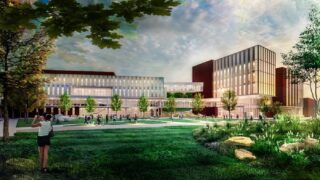

Des Moines University College of Osteopathic Medicine (DMU-COM) trains osteopathic physicians (DO) at Des Moines University Medicine and Health Sciences on its 88-acre campus in West Des Moines, Iowa. Founded in 1898, it is the second-oldest osteopathic medical college in the United States, and it is one of the larger DO programs, with about 225 students in each entering class.
This guide covers the 2026-2027 application cycle, which opened on May 4, 2026, for the class that starts in August 2027. DMU-COM has no secondary application this cycle. Your AACOMAS application, three letters of recommendation and MCAT score make up the written file the admissions committee reviews, and a virtual interview follows for invited applicants.
Inside you will find current class statistics, 2026-27 tuition and cost of attendance, the curriculum year by year, clinical rotation sites, research options, dual degrees, faculty and alumni profiles, a full personal statement example with analysis, interview preparation and answers to the questions applicants ask most. Facts were checked against DMU and its osteopathic admissions profile on October 28, 2026.
DMU-COM looks for applicants who show academic readiness, real patient contact and the personal qualities of a whole-person physician. Its admissions committee reviews applicants holistically, weighing academic achievement, health care experience, leadership and what each person would bring to the class.
Key Takeaways
- No secondary application in 2026-2027. DMU-COM reviews your verified AACOMAS application, three letters submitted through AACOMAS and your official MCAT scores. Invited applicants then complete a required virtual interview.
- Apply early. AACOMAS opened May 4, 2026, and DMU’s deadline is April 30, 2027. Admissions are rolling, so applicants who apply early are more likely to be interviewed.
- Typical admitted DO students present a cumulative GPA around 3.7, a science GPA near 3.6 and an MCAT around 507. The recommended minimums are a 2.8 cumulative and 2.8 science GPA, and all applications are considered.
- Eligibility: U.S. citizens and permanent residents only. International and DACA applicants are not considered, and a pending permanent residency does not qualify.
- Costs for 2026-27: tuition is $68,620 for every DO student regardless of state, and the year-one cost of attendance budget is $102,669.
- Outcomes: 99.5% of the Class of 2026 placed into graduate medical education, and DMU’s first-time COMLEX pass rates were above the national average in every level and cycle shown.
- Distinctive training: four years with two full clinical years, a required four-week underserved rotation (community, rural or international), an optional OMM Scholar year and five dual degree options.
- Next step: line up three strong letters now, including one from a health care supervisor and one from a science professor, and plan meaningful direct patient care before you submit AACOMAS.
Key Statistics About Des Moines University College of Osteopathic Medicine

DMU-COM is a private osteopathic medical school, so Iowa residents and out-of-state students pay the same tuition. It does not publish applicant, interview or offer counts, which means no valid acceptance rate exists for it. The table below brings together the figures DMU publishes, with each figure’s year and group.
| Measure | Value | Year or cohort | Source |
|---|---|---|---|
| School and degree | College of Osteopathic Medicine, Doctor of Osteopathic Medicine (DO), single campus in West Des Moines, Iowa | Current | DMU DO program pages |
| Typical class size | About 225 students from more than 32 states | Admitted DO classes, current profile | DMU DO Admission Requirements |
| Matriculants | 229 (excludes transfer students) | 2025-26 entering class | DMU DO Program Outcomes, July 2026 |
| Average MCAT | About 507 | Admitted DO classes, current profile | DMU DO Admission Requirements |
| Average cumulative GPA | About 3.7 | Admitted DO classes, current profile | DMU DO Admission Requirements |
| Average science GPA | About 3.6 | Admitted DO classes, current profile | DMU DO Admission Requirements |
| Mean MCAT and average cumulative GPA (osteopathic admissions profile) | 507.1 and 3.71 | 2026-27 cycle listing, cohort not labeled | AACOM Choose DO Explorer |
| Acceptance rate | Not published | 2026-27 check | DMU; AACOM Choose DO Explorer |
| Recommended minimum GPA | 2.8 cumulative and 2.8 science | Current | DMU DO Admission Requirements |
| Tuition | $68,620 per year, all DO students | 2026-27 | DMU Tuition and Fees 2026-27 |
| Total cost of attendance, year one | $102,669 (single-student budget) | 2026-27 | DMU DO Cost of Attendance Budget 2026-27 |
| Total cost of attendance, four years at 2026-27 rates | $425,411 | Sum of 2026-27 budgets for years 1 to 4 | DMU DO Cost of Attendance Budget 2026-27 |
| Average graduate indebtedness | $311,123 | Year not labeled | AACOM Choose DO Explorer |
| GME placement | 99.5% (197 of 198) | Class of 2026 | DMU DO Program Outcomes, July 2026 |
| COMLEX Level 1 first-time pass rate | 97.1% (national 90.3%) | 2024-25 testing cycle | DMU DO Program Outcomes, June 2026 |
| Application window | May 4, 2026, to April 30, 2027 (AACOMAS) | 2026-2027 cycle | AACOM Choose DO Explorer; DMU Admissions Process |
| Secondary application | None | 2026-2027 cycle | AACOM Choose DO Explorer; DMU Admissions Process |
| Class start | August 2027 | Entering class 2027 | DMU Admissions Process |
Read these numbers carefully. The MCAT and GPA figures are averages, not cutoffs: they represent overall trends, not minimum requirements. The cost of attendance budget is also the most financial aid a student can receive in a year, so it doubles as your borrowing ceiling. For a wider comparison, IMA keeps a list of the average GPA and MCAT score for every medical school.
Mission and Educational Priorities
DMU’s mission is “To improve lives in our global community by educating diverse groups of highly competent and compassionate health professionals.” The College of Osteopathic Medicine uses the same statement. Through its integrity, excellence and compassion, the college aims to educate osteopathic physicians and health care leaders who serve Iowa, the nation and the wider world.
Four practical priorities follow from that mission, and each one shapes what a strong application looks like.
Whole-person osteopathic care. DMU teaches students “to treat people, not just problems, and understand how every system connects to the whole person.” Osteopathic manual medicine (OMM) runs through all four years, from first-year labs to the OMM IV course in the fourth year, and it is part of everyday care at the Des Moines University Clinic. Applicants who have shadowed a DO, or who can explain what drew them to hands-on, whole-person care, give the committee direct evidence of fit.
Primary care and workforce need. DMU calls itself the nation’s top producer of primary care physicians, and the Class of 2026 bears that out: family medicine (44 matches) and internal medicine were its two largest specialties, and Iowa was its top destination state. The college frames this as a response to physician shortages, especially in rural and underserved communities. If you have served in a rural clinic, a free clinic or a community health setting, that story belongs in your application.
Service and compassion. DMU emphasizes service learning and compassionate care. Its students volunteer at Free Clinics of Iowa, run back-to-school physicals for local children and work with more than 40 community partners. A record of steady service, not one-time events, fits this priority.
Interprofessional teamwork. DO students train alongside future physical therapists, physician assistants, podiatrists and researchers. The admissions committee values teamwork, communication and ethical judgment, which is also why DMU encourages applicants to take the AAMC PREview exam.
DMU’s values are accountability, collaboration, honesty, inclusiveness and wellness. Those words are worth reading before you write your personal statement or prepare for your interview, because they describe what the school says it rewards.
These priorities also connect to clinical experience abroad. International Medical Aid’s healthcare internships abroad place pre-health students in hospitals and clinics where they take vitals, do intake and triage and help with direct patient care under supervision, an experience that can deepen an applicant’s understanding of care in low-resource settings. IMA has no affiliation with DMU, and no outside program guarantees admission.
Accreditation and Institutional Identity
DMU’s College of Osteopathic Medicine is accredited by the Commission on Osteopathic College Accreditation (COCA) of the American Osteopathic Association. Des Moines University Medicine and Health Sciences as a whole is accredited by the Higher Learning Commission. As an accredited college, DMU-COM belongs to the national association of osteopathic medical colleges. Accreditation means the program meets national standards; it is not a ranking.
A long history, not a new school. The college began in 1898 as the Dr. S.S. Still College of Osteopathy, founded by Dr. Summerfield Saunders Still and his wife, Dr. Ella Still, in downtown Des Moines. It went through several names, became the University of Osteopathic Medicine and Health Sciences in 1981 and was renamed Des Moines University in 1999. It now uses the name Des Moines University Medicine and Health Sciences. DMU describes itself as the second-oldest osteopathic medical college in the United States.
A new campus. In June 2023 the university moved from its longtime Grand Avenue site in Des Moines to a new 88-acre campus at 8025 Grand Avenue in West Des Moines. The move is complete; all DO training before rotations now happens there.
Three colleges, one university. DMU has three colleges, and it helps to keep them straight:
- The College of Osteopathic Medicine runs the DO program.
- The College of Podiatric Medicine and Surgery runs the DPM program.
- The College of Health Sciences runs the physician assistant (MSPAS), physical therapy (DPT), occupational therapy (OTD), health care administration (MHA), public health (MPH) and medical science (DMSc) programs.
So the PA program and the public health program are not part of the College of Osteopathic Medicine. They are separate programs in a separate college with their own admissions. DMU also offers master’s degrees in anatomy and biomedical sciences and a PhD in biomedical sciences.
For a broader look at how DO programs compare, see IMA’s overview of osteopathic medical schools.
Medical Programs and Affiliations
Doctor of Osteopathic Medicine (DO)
The DO program is DMU-COM’s core offering: a four-year program that builds osteopathic principles on top of a full medical science foundation. Years one and two are pre-clinical, and years three and four are full-time clinical rotations at hospitals and clinics across the country. Early clinical skills work in DMU’s simulation center, OMM training in every year and a required underserved rotation in the fourth year are built into the program. You apply through AACOMAS. There is one campus and one DO track; DMU-COM does not offer an early decision program.
One rule matters if you are weighing several DMU programs. First-time entering students may apply to only one of DMU’s clinical programs at a time, including the DO, DPM, MSPAS, OTD and DPT programs. DMU will not process multiple applications.
Dual Degree Programs: DO/MPH, DO/MHA, DO/MS Anatomy, DO/MSBS and DO/PhD
DO students can add a second degree. Five options are offered, and in every case you apply after you are accepted into the DO program (the PhD also has a direct-admit route before matriculation). Admitted and current students are told about the options and the application process.
| Dual degree | Format and length | Who it suits |
|---|---|---|
| DO/MPH (Master of Public Health) | Entirely online, 42 credit hours, up to five years to finish; up to 6 credit hours from the clinical program may count | Students interested in population health, epidemiology or health policy |
| DO/MHA (Master of Health Care Administration) | Entirely online, 47 credit hours, up to five years to finish | Future physician leaders and administrators |
| DO/MS in Anatomy | 32.5 credit hours (non-thesis track); adds no time to the four-year DO program | Students who want to teach anatomy or strengthen academic credentials |
| DO/MS in Biomedical Sciences | Research-intensive master’s | Students who want formal research training and publications |
| DO/PhD in Biomedical Sciences | Direct-admit track before matriculation, or apply in the fall of the second year | Future physician-scientists |
DMU does not offer a DO/MBA. The MPH and MHA programs belong to the College of Health Sciences, and DO students take them as dual degree students. DMU offers a tuition discount on secondary degree courses for students enrolled in dual degrees.
The PA Program Is Separate
DMU’s Master of Science in Physician Assistant Studies is a College of Health Sciences program, not part of the College of Osteopathic Medicine. It has its own admissions process, and under DMU’s one-program rule a first-time applicant cannot apply to it in the same cycle as the DO program. If you are still deciding between becoming a PA and a physician, shadow both, and consider pre-PA internships that let you see a PA’s scope of practice up close. DO students do train with PA students, since interprofessional teamwork is part of DMU’s model.
Public Health Opportunities
Public health is open to DO students in two ways: through the online DO/MPH and through public health work in the curriculum, such as the third-year Introduction to Health Systems and Policy course. DMU’s MPH program is accredited by the Council on Education for Public Health, offers concentrations in epidemiology, public health practice, and public health administration and policy, and admits students through SOPHAS. Student groups such as the Infectious Disease and Public Health Club and the Global Health Student Club give DO students further exposure.
Pathways and University Partnerships
DMU has partnered with other colleges and universities so that students can receive a guaranteed interview and/or earn credit toward concurrent degrees. The current partner list for the DO program has 19 institutions:
- Baylor University
- Beloit College
- Benedictine University
- Bryan College of Health Sciences
- Buena Vista University
- Central College
- Central State University
- Chadron State College
- Drake University
- Edgewood University
- Grand View University
- Hastings College
- Mercy College of Health Sciences
- Merrimack College
- Regis University
- Simpson College
- University of Iowa
- University of Northern Iowa
- Voorhees University
Each of DMU’s other programs has its own partner list, and those lists differ. For example, the occupational therapy program also partners with Hawkeye Community College and Indian Hills Community College, and some programs have formal articulation agreements, such as 3+2 arrangements in which credit earned at DMU completes a partner school’s bachelor’s degree. Students must apply to and be admitted to each program separately; applications are not linked. If you attend a partner school, talk with your pre-health advisor early and read the terms on DMU’s university partnerships page.
DMU’s own master’s programs can also lead to the DO program. Students in the MS in Anatomy and MS in Biomedical Sciences programs who meet the required metrics can earn a guaranteed interview and a reserved seat in the DO program. For the reserved seat route through the anatomy program, a student applies the summer after the first year in the MSA program and must meet the DO program’s minimum admission requirements.
Clinical Affiliations
DMU’s Office of Clinical Affairs assigns and manages rotations at hundreds of clinical sites plus a set of year-long sites in Illinois, Iowa, Minnesota and Wisconsin, described in the rotations section below. Major Iowa partners include MercyOne, UnityPoint Health, Broadlawns Medical Center and the VA Central Iowa Medical Center.
Curriculum Overview
DMU’s DO curriculum lasts four years and has two phases: pre-clinical (years one and two) and clinical (years three and four). Learning happens in classrooms, labs, clinics and community settings, and courses in medical humanities and bioethics run throughout. A wide range of electives lets you shape your training, from a healthy cooking elective in DMU’s teaching kitchen to medical Spanish and mentored research.
Year One: Foundational Sciences
The first year is built around three course lines that run through four blocks: Osteopathic Clinical Medicine and Anatomy (I and II), Foundational Sciences (I to III) and Physician as a Professional (A and B). Medical Informatics and professional certification courses round out the year. Each block ends with an assessment week followed by an enrichment week. Anatomy is taught through full-body cadaver dissection made possible by body donation.
Year Two: Integrated Organ Systems
The second year shifts to an integrated organ-system approach that blends basic and clinical sciences in Clinical Sciences I to IV, alongside Clinical Medicine, OMM II, professional certifications and Medical Ethics II and Legal Topics. You take part in simulated patient encounters, lab work and small-group discussions that build clinical reasoning. The year ends with dedicated board preparation, COMSAE Phase 1 and COMLEX Level 1.
Year Three: Core Clinical Rotations
Rotations begin in August after the second year. The third year includes 40 weeks of rotations:
- Family medicine, general surgery, internal medicine, pediatrics, OB/GYN and psychiatry: 28 weeks
- Medical or surgical subspecialties: 4 weeks
- Emergency medicine: 4 weeks
- Selectives: 4 to 8 weeks
Most rotations last four weeks. Longitudinal courses continue during the year: OMM III A and III B (12 weeks each), Introduction to Health Systems and Policy (11 weeks) and two days of NAMI Provider Education in December or January.
Year Four: Assessment, Electives and Underserved Care
The fourth year opens in June and July with a weeklong Clinical Comprehensive Assessment back on campus, COMSAE Phase 2 and COMLEX Level 2. The assessment includes a computer-based, board-style exam, simulated and standardized patient encounters, an OMM patient case, a written OMM exam and a session on the residency match. Then come 40 more weeks of rotations: emergency medicine if not done in year three, a required four-week underserved rotation in community, rural or international medicine and 32 to 36 weeks of electives. OMM IV runs from August through December.
Teaching Methods and Facilities
DMU uses several teaching methods: in-person lectures, case-based exercises, small-group discussion, simulation and hands-on labs. Ultrasound is integrated throughout the curriculum. The simulation center is accredited by the Society for Simulation in Healthcare and includes the Rakowski Surgical Skills Lab, the Wojciechowski Trauma Lab and a Human Simulation Lab with 16 exam rooms equipped with cameras and microphones so faculty can give feedback on your clinical skills. Students also train in a fully equipped operating room and practice EKG reading and team-based simulation.
Board Preparation and Advising
Board-focused material is built into the curriculum and paired with readiness exams and individual and group academic counseling. Every DO student is assigned a faculty advisor. DMU’s results are strong: its four-year average first-time pass rate on COMLEX Level 1 is 97.8% against a national average of 91.6%, and on Level 2-CE it is 97.7% against 93.4%.
Program Objectives
The DO program’s objectives link to DMU’s learning goals and the national osteopathic core competencies. Graduates should show patient-centered care consistent with osteopathic principles, a commitment to the highest professional and ethical standards, broad biomedical and clinical knowledge, respectful communication with patients and teams, and the ability to evaluate evidence and their own biases to give the best care to patients and communities.
Research in the Curriculum
Research is optional but well supported. Students can join the Mentored Student Research Program, take the Mentored Research Elective Course or choose fourth-year research elective rotations. Details are in the research section below.
Admissions Requirements and Application Process
DMU-COM seeks candidates who show the greatest potential to give respectful, compassionate care as future physicians. Meeting the requirements below makes you eligible; it does not make you competitive by itself. The class profile in the statistics section shows what admitted students usually bring.
Degree and Academic Requirements
You need a bachelor’s degree from a regionally accredited college or university in the United States before orientation begins. Any major is acceptable. A cumulative GPA of 2.8 or higher and a science GPA of 2.8 or higher are recommended, and every application is considered.
Prerequisite Courses
You may apply while some coursework is still in progress, but all required courses must be finished before you start at DMU. Each prerequisite needs a grade of C or higher.
| Course | Semester hours | Notes |
|---|---|---|
| Biology/Zoology | 8 | Labs required when available |
| General Chemistry | 8 | Labs required when available |
| Organic Chemistry | 4 | Labs required when available |
| Biochemistry | 3 | |
| Physics | 8 | Labs required when available; up to 3 semester hours of statistics may replace 3 semester hours of physics |
| English, English Composition, Speech or Literature | 6 |
DMU also recommends courses in cell biology, microbiology, immunology, genetics, physiology and anatomy. CLEP credits, AP credits and pass/fail credits cannot be used to meet prerequisite requirements, so if your college gave you AP credit for introductory biology or chemistry, plan to take upper-level courses in that subject. Online coursework and online labs are accepted for prerequisites.
MCAT
All applicants must submit MCAT scores through AACOMAS. DMU accepts only scores from tests taken within three years of matriculation; for the 2026-2027 cycle, that means tests taken from January 1, 2024, through January 1, 2027. DMU reviews each score individually and does not average section scores across attempts. The MCAT is not waived. Take it for the first time no later than September of your application year, and ideally before the cycle opens in the spring, so your application can be reviewed early in the rolling process.
Citizenship and Residency
Only U.S. citizens and legal permanent residents may enroll. Permanent residents must give DMU a notarized copy of their green card before matriculation, and an applicant whose permanent residency is still pending is not eligible. DMU does not accept international students or consider DACA applicants. There is no in-state preference in tuition: as a private school, DMU charges every DO student the same rate.
Clinical Exposure and Shadowing
Clinical exposure is not mandatory, but DMU highly recommends it to confirm your interest in and commitment to osteopathic medicine. It can include shadowing, paid positions or volunteer work, and DMU accepts virtual or in-person shadowing. In practice, successful applicants bring “extensive exposure to the medical field in a role that involves direct patient contact,” and the admitted class profile notes “meaningful patient-care or shadowing experience.” The American Osteopathic Association can help you find a DO to shadow.
That gap between “not mandatory” and “what admitted students have” is where many applicants fall short. If your clinical hours are thin, clinical internships for pre-med students are one way to add supervised, hands-on patient contact, alongside steady local work such as a medical assistant, scribe or EMT role.
Letters of Recommendation
DMU requires three letters, submitted through AACOMAS. Once the admissions office receives three letters, your file goes to the admissions committee, and DMU will not hold your review waiting for more. The school suggests this mix:
- A health care experience letter from a supervisor who knows your shadowing, volunteer or work experience. It should not describe care in which you were the patient. Peer letters are not recommended.
- An academic or advisor letter from a science professor or advisor who can evaluate your academic ability, science performance and overall readiness for medical school.
- A committee letter, if your college has an established pre-health professions committee. It counts as two of your three letters.
A physician letter is not required, though a DO who has supervised your shadowing can write your health care experience letter.
The AAMC PREview Exam (Optional but Encouraged)
DMU encourages applicants to take the AAMC PREview professional readiness exam, which tests non-academic skills such as teamwork, empathy and ethical decision-making. It is given online with remote proctoring, costs $100 (free for those who qualify for the AAMC Fee Assistance Program), and its scores are released to all the programs you apply to. DMU considers the scores as part of its holistic review. It is not required.
Background Checks and Technical Standards
Before matriculation, admitted students complete a criminal background check and drug screen, plus Iowa child and dependent adult abuse registry checks, at their own cost, through DMU’s vendor. You must disclose all past or present charges, convictions, dismissals, deferred judgments and expunged records related to a misdemeanor or felony. DMU students repeat background checks every year. All students must also meet DMU’s technical standards for observation, communication, motor function, integration of knowledge and professional behavior, with accommodations available under DMU’s Accommodations in Education Policy.
Previous Medical Students and Transfers
Graduates of MD, DO or equivalent programs, in the U.S. or abroad, are not eligible for the DO program. Students who withdrew from a medical school in good standing for personal reasons are considered case by case. DMU considers transfer students from COCA- or LCME-accredited schools who rank in the upper 50% of their class, have a supportive letter from their dean, have passed COMLEX Level 1 (or USMLE Step 1 for allopathic students), have a strong reason to transfer and will spend at least two years at DMU. Transfer applicants contact [email protected].
Primary Application: AACOMAS Only
DMU-COM uses the American Association of Colleges of Osteopathic Medicine Application Service (AACOMAS), and you designate Des Moines University as a recipient. Send official transcripts from every U.S. college you attended to AACOMAS, and send official MCAT scores and your three letters there too. IMA’s AACOMAS application guide walks through each section.
Secondary Application: None This Cycle
DMU-COM has no secondary (supplemental) application for 2026-2027, so there is no secondary fee, portal or deadline. Your application is eligible for committee review once the DMU admissions office has processed three items: a verified AACOMAS application, three letters of recommendation submitted through AACOMAS and official MCAT scores. Everything the committee reads about you comes from AACOMAS, so your personal statement, experiences section and letters do the work that secondary essays do at other schools. The secondary section of this guide shows how to make them count.
Interviews and Decisions
Qualified applicants are invited to a required virtual interview. Because of rolling admissions, those who apply early are more likely to be interviewed than those who apply later. After the interview, the admissions committee does a full review, and decisions of “admit,” “alternate” or “release from consideration” go out by email throughout the cycle. Timing varies.
Deposits and Matriculation Steps
If you accept an offer, you pay a nonrefundable seat deposit of $750, and a second nonrefundable deposit of $750 is due by May 1. DMU follows the national AACOMAS traffic guidelines for deposit deadlines:
- Accepted before November 15: you have until December 14.
- Accepted November 15 to January 14: you have 30 days.
- Accepted January 15 to April 30: you have 14 days.
- Accepted on or after May 1: you may be asked for an immediate deposit.
Before orientation you also sign a matriculation agreement, attend a success meeting, send official final transcripts at least 14 days before orientation, complete a medical screening questionnaire and immunization report, show proof of health insurance and work through a two-phase registration checklist on Pulse, DMU’s intranet. Deferred entrance requests are considered.
Application Timeline for the 2026-2027 Cycle
| When | What to do |
|---|---|
| Spring 2026 or earlier | Take the MCAT (first attempt no later than September 2026). Ask for your three letters. |
| May 4, 2026 | AACOMAS opens for submission. Submit as early as you can; rolling review favors early files. |
| Late spring to summer 2026 | Transcripts, MCAT scores and letters reach AACOMAS; take PREview if you plan to. |
| August 2026 to March 2027 | Virtual interviews for invited applicants. |
| Throughout the cycle | Decisions by email: admit, alternate or release from consideration. |
| Within deposit window | $750 seat deposit; second $750 deposit by May 1, 2027. |
| At least 8 weeks before April 30, 2027 | Recommended latest submission for best consideration. |
| April 30, 2027 | AACOMAS deadline for DMU-COM. |
| August 2027 | Class begins (DMU lists August for the entering class). |
The deadline is far later than the date that matters. Since DMU interviews on a rolling basis from August, a complete file in early summer competes for the most interview seats.
Tuition, Cost of Attendance and Financial Aid
DMU charges the same tuition to every DO student, whether from Iowa or another state. The 2026-27 rates and budgets below are DMU’s own and are subject to change.
2026-27 Tuition and Fees
| Item | Amount (2026-27) |
|---|---|
| Tuition, years 1 to 3 | $68,620 per year ($34,310 fall, $34,310 spring) |
| Tuition, year 4 | $68,620 ($13,724 summer, $27,448 fall, $27,448 spring) |
| Background check fee (years 1 to 3) | $60 |
| Drug screen fee (years 1 to 3) | $29 |
| COMSAE retake and remote proctoring fees | $60 and $25, charged only if incurred |
| Student health insurance | Billed by term; waivable with qualifying coverage |
Tuition covers items such as computer, health service, lab, microscope rental, student activities, student services and technology costs. Students who hold a valid AOA membership get a discount on MHA courses, and dual degree students get a discount on the second degree.
Cost of Attendance Budget
The cost of attendance (COA) budget is DMU’s estimate of a single student’s full yearly costs, and it is also the most financial aid you can receive in that year. Federal rules do not let the aid office certify more than the budget, whether from loans, scholarships, NHSC, the military HPSP or other sources.
| 2026-27 budget | Year 1 (Class of 2030) | Year 2 (Class of 2029) | Year 3 (Class of 2028) | Year 4 (Class of 2027) |
|---|---|---|---|---|
| Housing ($1,200/month) | $12,000 | $12,000 | $12,000 | $2,400 + $12,000 |
| Utilities, phone and internet | $1,980 | $1,980 | $1,980 | $396 + $1,980 |
| Food ($444/month) | $4,440 | $4,440 | $4,440 | $888 + $4,440 |
| Personal ($300/month) | $3,000 | $3,000 | $3,000 | $600 + $3,000 |
| Health insurance | $4,104 | $4,104 | $4,104 | $4,104 |
| Transportation and travel home | $3,535 | $3,535 | $3,535 | $673 + $3,364 |
| Books, equipment, boards, rotation, assessment-week travel and residency costs | $4,372 | $2,891 | $5,280 | $1,787 + $5,720 |
| Tuition | $68,620 | $68,620 | $68,620 | $13,724 + $54,896 |
| Fees and estimated loan fees | $618 | $2,990 | $3,091 | $216 + $2,944 |
| Total cost of attendance | $102,669 | $103,560 | $106,050 | $20,684 + $92,448 |
The fourth-year budget has two pieces, a two-month summer budget and a ten-month budget, because fourth-year tuition starts in summer. It also includes travel for the Clinical Comprehensive Assessment week and $2,000 for residency application expenses. Added together, the four 2026-27 budgets come to $425,411. Your real four-year cost will differ, since rates are reviewed each year.
A few costs sit outside the budget. Moving to the Greater Des Moines area happens before the program starts, so it cannot be included; DMU suggests planning $1,250 for a single student and $1,800 or more for a family. The budget is built for a single student. Daycare for dependent children can be added, and a larger budget for added loan funds may need credit approval.
Financial Aid Steps
DMU’s financial aid process follows these steps:
- Plan a realistic budget. Decide how much of the COA budget you truly need. You may request any amount up to the budget for your class.
- Entrance interview. First-time borrowers complete an entrance interview, part of the financial aid packet on Pulse.
- The FAFSA. File it at studentaid.gov every academic year to establish eligibility.
- Student loans. First-time borrowers sign a Direct Unsubsidized Loan Master Promissory Note, and every Direct Unsubsidized borrower submits a DMU Direct Loan Request Form each year. Direct Grad PLUS loans are available to borrowers who meet legacy requirements, with instructions in the Pulse packet. Private loans are arranged with the lender, then confirmed with a DMU request form.
- Federal Work-Study. Limited, need-based awards of $2,000 to $4,000, depending on the employing department. You must file the FAFSA and be hired by an approved department, and the award counts toward your COA budget.
- Award letter. After processing, DMU emails an award letter to your DMU address confirming approved amounts; Grad PLUS or private loans are approved or denied based on credit.
Scholarships and Service Programs
DMU offers its own scholarships, and students also use external scholarships and loan repayment programs. Military scholarship (HPSP) recipients are well represented: between 2.5% and 5.9% of each class from 2020 to 2026 placed through the military match, and the Student Association of Military Osteopathic Physicians and Surgeons supports these students. Service-based programs such as the National Health Service Corps also count toward the COA budget.
What Graduates Owe
Average graduate indebtedness is $311,123 (year not labeled). With tuition alone near $275,000 over four years at current rates, most DO students borrow. Compare each school’s full COA budget, not just tuition, before you decide where to enroll.
Campus Facilities and Student Life
The West Des Moines Campus
DMU opened its 88-acre campus at 8025 Grand Avenue in West Des Moines in June 2023. It was built around team-based learning and interprofessional work: adaptable learning studios, clinical labs, an anatomy lab, a task training lab, an open research laboratory and the simulation center. The Edge of Advancement building houses research space, and the campus has walking trails, a pond, soccer space and gathering spots such as the Council Ring. Summerfield’s Café, a Wellness Center with group fitness classes and intramural basketball, volleyball and pickleball add to daily life. Meditation rooms with massage chairs and foot-washing stations serve students of every faith.
Health and Wellness Support
DMU’s on-campus University Health Clinic provides primary care, from health maintenance exams and lab tests to vaccinations and minor procedures, with an on-call provider after hours. Students in clinical programs receive annual TB tests and flu shots at no cost. The Student Counseling Center offers individual counseling, medication management and crisis support, and Academic Live Care gives 24/7 access to counselors by phone, text or video, including teletherapy, telepsychiatry and nutrition counseling at no cost.
Living in Greater Des Moines
The campus sits just over 10 miles from downtown Des Moines in a metro area of nearly 700,000 people. Greater Des Moines has 12 colleges and universities, more than 130 parks, miles of bike paths and several lakes. It is the third-largest insurance center in the world, which brings jobs for partners and a relatively low cost of housing. DMU’s cost of attendance budget assumes $1,200 a month for housing.
Clubs and Organizations
DMU has more than 50 clubs, student organizations, honorary societies, interfaith groups and student government associations. They are university-wide, so some serve DO students and others serve podiatry, PA, PT or OT students. DO students also have their own College of Osteopathic Medicine Student Government Association.
Clubs most relevant to DO students include:
- American College of Osteopathic Family Physicians (DMU chapter): service, mentoring, preceptor access and a free four-year national membership.
- American College of Osteopathic Surgeons, Medical Student Section: suturing labs, knot-tying sessions, simulation workshops and mentoring.
- American Medical Student Association: advocacy, service and global health.
- Anatomy Ambassadors Program: organ demonstrations for school and college groups.
- Asian Pacific American Medical Student Association: culturally responsive health and wellness work.
- Anesthesiology, Dermatology, Emergency Medicine, Internal Medicine, Neurology, Obstetrics and Gynecology, Pediatrics, Psychiatry, and Physical Medicine and Rehabilitation clubs: speakers, workshops and residency guidance in each specialty. The Emergency Medicine Club adds EMS ride-alongs and procedure workshops.
- Student Association of Radiology, Sports Medicine Club, Oncology Club and Honor Society, and Preventive Medicine Club.
- Student American Academy of Osteopathy: OMM workshops and osteopathic principles.
- Student Osteopathic Medical Association, Student Osteopathic Orthopedic Association and Women’s Medical Alliance.
- Student Association of Military Osteopathic Physicians and Surgeons: support for military scholarship students.
- Geriatrics Club and COATS (Connecting Older Adults with Students): shadowing, the 50 and Better Health Fair and monthly visits with an older adult mentor.
- Global Health Student Club: global health careers and local volunteering, especially with refugee communities.
- Homeless Community Outreach: outreach in Des Moines and volunteering at Free Clinics of Iowa, where students take vitals, gather histories and assist physicians.
- Human Dignity in Medicine and the Medical Humanities Society: bioethics and the human side of medicine.
- Infectious Disease and Public Health Club, Iowa Medical Society, and Medical Students for a Sustainable Future.
- Medical Students for Latino Health, National Arab American Medical Association NextGen, Student National Medical Association, Pride Alliance and Medical Students for Choice.
- Master’s Advisory Group to the Anatomy and Biomedical Sciences and Des Moines University Health Leaders for students in those graduate programs and future health leaders.
Clubs for DMU’s other programs include the American Academy of Podiatric Sports Medicine Club, American Association of Women Podiatrists, American College of Podiatric Medicine, Podiatric Practice Management and Journal Club, Student Chapter of the American College of Foot and Ankle Surgeons, Student National Podiatric Medical Association, Physical Therapy Club, Physician Assistant Club and Student Occupational Therapy Association.
Honorary societies include Sigma Sigma Phi and the Gold Humanism Honor Society, and interfaith groups include the American Muslim Medical Student Association, Christian Medical Association, Jewish Medical Student Association and Novus Medicus.
Service in the Community
DMU works with more than 40 community partners. Students from every program run a free back-to-school physical event for K-12 students each summer, provide recovery care to runners at the IMT Des Moines Marathon, gain clinical experience through Free Clinics of Iowa, lead GEMS (Girls Exploring Medicine and Science) and BROS (Boys Reaching Out in Science) events for younger students and host a virtual Pre-Health Summit for high school and college students. Applicants who already serve their communities will find these familiar.
Clinical Rotations and Research Opportunities
How Rotations Work
Clinical training starts in August after the second year and runs through graduation. DMU’s Office of Clinical Affairs approves every site and manages core and elective rotations, working to build a steady relationship with each student during the clinical years. Clinical clerkships aim to give you broad, practical exposure to patient diagnosis and management in general areas of medicine. You work under physician preceptors in hospitals and clinics, in both outpatient and inpatient care. Questions about rotations, sites or preceptors go to [email protected].
DMU offers hundreds of rotation sites as well as year-long sites, where a student completes much of the third year in one community. Year-long placement shapes your third year: you will likely move to your site, so think about location, cost of living and specialty exposure when sites are offered.
Year-Long Rotation Sites for the Upcoming Clinical Year
The list changes from year to year. DMU’s current year-long sites are:
Illinois – Riverside Medical Center, Kankakee – Southwest Chicago / Zmedi Healthcare, Chicago
Iowa – Central Iowa Cohort (various clinics throughout Iowa and the Midwest), Des Moines – Genesis Medical Center, Davenport – Medical Associates Clinic, Dubuque – MercyOne Medical Center Clinton, Clinton – MercyOne Medical Center Des Moines, Des Moines – MercyOne Medical Center North Iowa, Mason City – UnityPoint Health Allen Hospital, Waterloo/Cedar Falls – UnityPoint Health Des Moines, Des Moines – UnityPoint Health Fort Dodge, Fort Dodge – Broadlawns Medical Center, Des Moines – VA Central Iowa Medical Center, Des Moines
Minnesota – Mayo Clinic Health System, Albert Lea-Austin – Mayo Clinic Health System in Mankato Eastridge, Mankato – Winona Health, Winona
Wisconsin – Aurora Medical Center (North), Oshkosh and Sheboygan – Aurora Medical Center (Central), West Allis, Summit and Grafton – Aurora Medical Center (South), Kenosha and Burlington
This network of sites reflects DMU’s goal of training well-rounded osteopathic physicians ready for many kinds of practice settings.
Fourth-Year Electives and the Underserved Requirement
The fourth year is mostly electives (32 to 36 weeks), chosen to explore specialties and prepare for residency, plus a required four-week rotation in community, rural or international medicine. Global health options range from short service trips to longer international clerkships for credit in the third and fourth years, and several electives support a global health emphasis. If you already have clinical experience abroad, for example through pre-med internships abroad, you will have a head start on choosing an international rotation thoughtfully.
The OMM Scholar Program
For students who want deeper training in osteopathic manual medicine, DMU offers a one-year pre-doctoral OMM Scholar Program led by the OMM section of the Department of Primary Care. It is highly selective, admitting four students a year based on demonstrated OMM skill. Scholars treat patients with musculoskeletal and other concerns, teach in labs, lecture, present locally and nationally and do research on osteopathic principles. They receive a partial tuition waiver and a monthly stipend, and the scholar year adds a fifth year to the DO program.
DMU’s Own Residency Programs
DMU has earned accreditation to launch its own residency programs. The first will be a one-year fellowship in osteopathic neuromusculoskeletal medicine through the DMU Clinic’s osteopathic manual medicine practice.
Where Graduates Match
The Class of 2026 had a 99% match rate, with 196 students matched into residencies in 33 states. Its 2026 match list shows family medicine (44), internal medicine (37), emergency medicine (32), pediatrics (21) and psychiatry (14) as the largest specialties, followed by orthopaedic surgery and obstetrics and gynecology (9 each) and anesthesiology (8). Iowa (30) was the top state, followed by Michigan (20), Wisconsin (19), Minnesota (18) and Illinois (15). Overall GME placement was 99.5% (197 of 198), and the placement rate was 100% in 2022, 2023 and 2024.
Research: The Mentored Student Research Program
Research is not required, but DMU students publish in peer-reviewed journals, present at national meetings and win research awards, fellowships and scholarships. In May 2026 DMU was named a Research Colleges and Universities institution in the Carnegie Classification, one of 24 schools nationally to also hold the medical schools designation.
The Mentored Student Research Program (MSRP) pairs you one-on-one with a DMU faculty mentor in fields such as microbiology, pharmacology, physiology, biochemistry and public health. Most of the work happens in an eight-week stretch between Memorial Day and late July, and it is paid at $15 an hour, for up to 40 hours a week in summer and up to 20 a week during the school year, with up to 240 hours in total. Participants attend faculty research talks and present at a student symposium. To apply, you contact the faculty mentor you want, and the mentor submits your application to the Office of Research.
The Mentored Research Elective Course
The research elective is a semester-long, credit/no credit course in basic or clinical research settings that teaches responsible research conduct. You can enroll starting in the second semester of your first year. You find a mentor, agree on project goals approved by the Office of Research, sign a research agreement and complete the safety and CITI training your mentor’s lab requires. Fourth-year research elective rotations are also available.
The Research Symposium
DMU’s annual Research Symposium is where students present their work. The 2026 symposium runs November 13, with a Young Scientist Program for high school and college students on November 14, and it is open to undergraduates and the public. Pre-medical students who live nearby can attend to meet faculty and see DMU’s research firsthand.
Research Strengths
Faculty and student research at DMU covers public health, disease prevention, forensic science and new therapies, with a focus on translational work in areas such as cardiovascular science, neuroscience and oncology. The goal is to move findings into patient care. Applicants with research interests should read faculty profiles in the Office of Research’s mentor list and mention specific fits in their interview.
Notable Alumni, Faculty, Leadership and Admissions Staff
DMU’s College of Osteopathic Medicine faculty are practicing osteopathic physicians, medical doctors, researchers and community leaders. The college keeps an open-door policy, and every DO student is paired with a faculty advisor. The profiles below cover the college’s leadership, faculty you are likely to meet in the curriculum and graduates whose careers show where a DMU DO can lead. Roles were checked on October 28, 2026.
Leadership
David Connett, DO, FACOFP (dist.), Dean of the College of Osteopathic Medicine. Dr. Connett became dean on July 1, 2024, after a national search. He graduated in 1984 from the College of Osteopathic Medicine of the Pacific at Western University of Health Sciences and completed postgraduate training at the Chicago College of Osteopathic Medicine. He served in the U.S. Air Force as a board-certified family physician and flight surgeon, including as chief of aerospace medicine, and later as chief medical officer of an osteopathic teaching hospital. At Western University he rose from dean of postdoctoral training to vice dean and acting dean. He is a national consultant in residency development, which fits DMU’s move to launch its own residency programs, and a distinguished fellow of the American College of Osteopathic Family Physicians.
Angela L. Walker Franklin, PhD, President and CEO of Des Moines University. Dr. Franklin leads the whole university, including its three colleges. The new West Des Moines campus was built under her leadership, and the Purple and Proud Campaign she oversaw raised $57.1 million, beating its $50 million goal, with priorities that included student resources and the new campus. In May 2026 she described DMU’s new Carnegie research classification as recognition of deliberate investment in research as a core part of the academic mission. For applicants, her focus on research growth and the campus explains much of what you will see on an interview day.
Matthew Henry, PhD, Associate Dean for Academic Programs and Curriculum. Dr. Henry oversees the DO curriculum and also serves as interim chair of the Department of Physiology and Pharmacology. He has said the curriculum’s structure “provides a strong foundation for student success, leading to outstanding board pass rates, strong residency placement rates and graduates who become caring, compassionate physicians.” His role matters to applicants because the curriculum described in this guide, from the block schedule to integrated board preparation, falls under his office.
Jennifer Beaty, MD, Associate Dean for Graduate Medical Education and Designated Institutional Official. Dr. Beaty serves in the Department of Specialty Medicine and holds the designated institutional official role, the position responsible for overseeing an institution’s graduate medical education programs. That makes her office central to DMU’s newly accredited residency programs, beginning with the osteopathic neuromusculoskeletal medicine fellowship.
Maurice Blodgett, DO, CHSE, Assistant Dean of Student Advancement and Simulation. Dr. Blodgett is an associate professor in the Department of Primary Care and a certified healthcare simulation educator. His dual role links two things DO students rely on: the simulation center, where students practice with standardized patients and team-based scenarios, and student advancement toward residency.
Faculty
Sarah Parrott, DO’02, Chair of the Department of Primary Care. A DMU graduate, Dr. Parrott leads the department that houses family medicine teaching and the OMM section, and with it the OMM Scholar Program. Primary care is DMU’s largest output of graduates, so her department shapes the clinical skills of most students.
Adrian Woolley, DO’95, Director of Osteopathic Principles and Practice Education. Dr. Woolley, also a DMU graduate, directs the teaching of osteopathic principles and practice. Applicants who want to understand how OMM is taught across the four years, from first-year labs to OMM IV, should look to his program.
Wayne Wilson, PhD, Assistant Dean of Research and Chair of Biochemistry and Nutrition. Dr. Wilson’s research leadership connects to the programs applicants ask about most, such as the Mentored Student Research Program and the research elective. If you have research experience, his office is part of the reason DMU can offer students paid summer research.
The faculty roster also includes many DMU graduates teaching in primary care and specialty medicine, such as Seth Quam, DO’09, clinical department chair in primary care, and Autumn Brunia, DO’19, assistant professor in behavioral medicine, medical humanities and bioethics. Department chairs include Heather Garvin-Elling, PhD (anatomy, interim), Lisa Streyffeler, PhD (behavioral medicine, medical humanities and bioethics), Andrew Brittingham, PhD (microbiology, immunology and pathology) and Marianka Pille, MD, FAAP (specialty medicine).
Alumni
John T. Pham, DO’00, FACOFP, 2026 College of Osteopathic Medicine Alumnus of the Year. Dr. Pham’s family fled Vietnam in 1975 and rebuilt their lives in Portland, Oregon, where he grew up working at the family’s egg roll stand. A first-generation student whose test scores were not perfect, he credits DMU with giving him the chance to become a physician. After family medicine residency he opened a solo practice serving Portland’s Vietnamese community for about a decade, teaching students along the way. He is now dean of the University of the Incarnate Word School of Osteopathic Medicine in San Antonio, and DMU notes he is the first and only Vietnamese American dean of a U.S. medical school. You can read about his school in IMA’s University of the Incarnate Word School of Osteopathic Medicine guide.
Elizabeth “Libby” Abbas, DO’15, 2026 Rising Star Alumna of the Year. Dr. Abbas grew up on a small sheep farm in northeast Iowa, where the nearest doctor was more than an hour away. After studying biology at the University of Northern Iowa, she toured DMU, saw an OMM demonstration and enrolled. At DMU she was an OMM pre-doctoral fellow and earned a rural medicine scholarship. After residency in Maine, she practiced full-spectrum rural family medicine in Iowa, then taught at the Gundersen Family Medicine Residency in La Crosse, Wisconsin, where she helped build an addiction medicine and OMT service through a mobile clinic for unhoused patients. She is now founding program director of the Franklin Rural Family Medicine Residency in Farmington, Maine, which plans to welcome its first two residents in 2027.
David Kapaska, DO, Class of 1986. Dr. Kapaska served as interim dean of the College of Osteopathic Medicine from February to June 2024, between permanent deans, and DMU announced that he would return to his service on the DMU board of trustees after Dr. Connett arrived. His path shows how closely DMU’s alumni stay involved in the college’s leadership.
Admissions Staff
DMU does not publish the names of its DO admissions staff. The admissions team answers questions at [email protected] and 515-271-1499. For questions about residency placement data, the student advancement and GME coordinator, Shelley Mitchell, can be reached through the contact listed on DMU’s program outcomes page.
These people are worth knowing for a practical reason. In a virtual interview, a faculty member conducts your interview, and knowing the college’s priorities, its curriculum leaders and the careers of its graduates helps you give specific, informed answers when asked why DMU.
Admissions Statistics and Class Profile
Class Size
DMU’s admitted DO classes average about 225 students from more than 32 states. DMU’s program outcomes report 229 matriculants (excluding transfer students) for the 2025-26 entering class, 233 for 2024-25, 230 for 2023-24 and 221 for 2022-23. That makes DMU-COM one of the larger DO programs, which means many interview slots and many seats, but also a large and national applicant pool.
MCAT and GPA
Successful DMU applicants typically present a cumulative GPA around 3.7, a science GPA near 3.6 and an MCAT around 507, along with meaningful patient-care or shadowing experience. The osteopathic admissions profile for the 2026-27 cycle lists a mean MCAT of 507.1 and an average cumulative GPA of 3.71. These are averages, not cutoffs. The recommended GPA minimums are 2.8 cumulative and 2.8 science, and all applications are considered.
What these averages mean in practice: an applicant with a 3.7 GPA and a 507 MCAT sits near the middle of the class. Applicants below those numbers can still be admitted, especially with a rising grade trend, strong recent coursework and deep clinical experience, but they should apply early, when more interview seats are open. For DO school averages nationally, see IMA’s average GPA and MCAT guide and its overview of osteopathic medical schools.
Who Enrolls
For the 2025-2026 first-year class reported to the national osteopathic profile:
| Measure | 2025-2026 first-year students |
|---|---|
| Women | 52% |
| Iowa residents | 16% (84% from out of state) |
| Science majors | 87.2% (non-science majors 12.8%) |
| Students holding a graduate degree | 4.4% |
| Asian | 27.3% |
| White | 57.7% |
| Hispanic/Latino | 4.4% |
| Black/African American | 0.9% |
| American Indian/Alaska Native | 0.4% |
| Multiple races | 4.4% |
| Undisclosed | 4.8% |
The class is mostly from outside Iowa, which reflects the national reach of a private school with one tuition rate. Non-science majors make up about one in eight students, so a non-science major is no barrier if you complete the prerequisites.
Acceptance Rate
DMU does not publish the number of applicants, interviews or offers, so there is no valid acceptance rate for DMU-COM. Be wary of any figure you see elsewhere: dividing matriculants by applicants gives a matriculation ratio, not an acceptance rate, because many admitted applicants enroll elsewhere.
Retention and Graduation
Retention is high. Of the 229 students who entered in 2025-26, 99.1% were still enrolled, with one withdrawal or dismissal and one transfer to another medical school. Earlier entering classes had retention rates of 98.3% (2024-25), 98.7% (2023-24) and 94.6% (2022-23).
Most students finish on time, though not all. Between 81.1% and 88.1% of each class entering from 2019-20 to 2022-23 graduated in four years, and six-year graduation was 95.9% to 96.8%. Reasons for a longer path include illness, academic difficulty, a move to a five-year plan of study and leaves; the OMM Scholar year also adds a year by design.
Board Scores and Placement
| Outcome | DMU | National | Period |
|---|---|---|---|
| COMLEX Level 1 first-time pass rate | 97.1% | 90.3% | 2024-25 |
| COMLEX Level 2-CE first-time pass rate | 97.6% | 91.3% | 2024-25 |
| COMLEX Level 3 first-time pass rate | 99.0% | 97.1% | 2025 |
| COMLEX Level 1, four-year average | 97.8% | 91.6% | 2021-22 to 2024-25 |
| GME placement | 99.5% (197 of 198) | Class of 2026 |
Tips and Strategies for Admission
DMU-COM’s process gives you fewer documents to work with than most schools: no secondary essays, just AACOMAS, three letters, the MCAT, an optional PREview score and a virtual interview. That raises the stakes on each piece. These strategies come from what DMU says it values and how its process works.
1. Submit AACOMAS Early and Complete
DMU states that applicants who apply early are more likely to be interviewed. The best timing is submitting AACOMAS close to its May opening, with your MCAT already taken and letter writers ready to upload in May or June. DMU will review your file as soon as three letters arrive, so do not wait for a fourth. Aim to submit at least eight weeks before the April 30 deadline at the very latest, and much sooner if you can.
2. Build Direct Patient Contact, Not Only Shadowing
DMU’s admissions description asks for “extensive exposure to the medical field in a role that involves direct patient contact.” Shadowing a DO matters, but so does hands-on work: medical assistant, CNA, EMT, scribe, hospice volunteer or free clinic roles where you talk with and help patients. Many students also look at pre-med internships during a semester break to add supervised clinical skills such as vitals and patient intake. Whatever you choose, describe what you did for patients, not just what you watched.
3. Show That You Understand Osteopathic Medicine
DMU’s whole-person philosophy and its OMM teaching run through every year. Shadow at least one DO if you can, ideally one who uses OMT. In your personal statement and interview, explain what you saw and why it fits the kind of physician you want to be. Avoid vague claims that DOs “treat the whole person” without an example.
4. Choose Letter Writers Who Match DMU’s Suggested Mix
Ask a supervisor who has watched you work with patients and a science professor who knows your academic ability. If your college has a pre-health committee, its letter counts as two of three. Give writers your CV, personal statement draft and two or three specific moments they saw, and ask them to submit through AACOMAS early in the cycle.
5. Take PREview Seriously
DMU encourages PREview and considers the scores. Since there are no secondary essays, a solid PREview score is one more way to show teamwork, empathy and ethical judgment. Use the free AAMC prep materials and take it early enough that scores reach DMU with your file.
6. Make Your Experiences Section Do the Work of a Secondary
Without secondary essays, the AACOMAS experiences section is where DMU learns about your service, leadership and clinical work in detail. Write each entry with dates, hours, your actual role, one patient-centered example and what you learned. Highlight any rural, primary care, underserved or community health work, since those match DMU’s mission and its graduates’ career paths.
7. Use Your Summers With Purpose
The summer before you apply is often the last chance to add clinical depth. Look for structured options such as pre-med summer internships, paid clinical jobs or research. If you are a college student in Iowa or nearby, the DMU Research Symposium and Young Scientist Program are open to undergraduates, and DMU’s university partnerships may give you a guaranteed interview.
8. Strengthen a Borderline Academic Record the Right Way
If your GPA or MCAT is below DMU’s typical range, show recent, upward performance: upper-level science courses with strong grades, or a graduate program such as DMU’s MS in Biomedical Sciences or MS in Anatomy, which offer guaranteed interviews and reserved DO seats to students who meet required metrics. Remember that AP, CLEP and pass/fail credits do not satisfy DMU prerequisites.
9. Plan for a Gap Year if You Need One
Many successful DO applicants take one or more gap years. A gap year works best when it adds something real: full-time clinical work, research or structured experiences such as pre-med gap year programs that build patient-care skills. If you are reapplying, change something concrete before you resubmit, whether that is your MCAT, clinical hours, letters or personal statement.
10. Prepare for a Faculty Interview
The interview is with a DMU faculty member and explores integrity, professionalism, compassion, work ethic and motivation. Prepare stories that show each of those qualities. The interview section below explains the format.
11. Get Feedback Before You Submit
A personal statement goes to every school you apply to and cannot be edited after you submit. Have an advisor, a mentor or a service such as IMA’s medical school admissions consulting services review it, along with your experiences section, before you submit.
DMU Secondary Application for 2026-2027: None, So Your AACOMAS Essays Carry the Weight
There Is No DMU Secondary This Cycle
DMU-COM does not use a secondary application for the 2026-2027 cycle. There are no DMU essay prompts, no secondary fee and no secondary deadline. Your file goes to the admissions committee once DMU has processed your verified AACOMAS application, three letters of recommendation submitted through AACOMAS and your official MCAT scores. If you are invited, the next step is the virtual interview.
That makes the AACOMAS personal statement the main essay DMU reads, and the experiences section and your letters the main evidence behind it. This section gives you a full personal statement example with analysis, worked plans for your letters and experiences entries, and the mistakes to avoid. The interview section that follows covers the DMU-specific “why us” preparation that a secondary would normally ask for.
The AACOMAS Personal Statement
Requirement: a personal statement written in the AACOMAS application and “shared with all your osteopathic medicine schools.”
Limit: 5,300 characters, including spaces, carriage returns and punctuation. AACOMAS will not let you save an essay over the limit.
Who writes it: every applicant to DMU-COM.
Rules that matter: AACOMAS gives no specific question. It asks you to keep the topic general, because the same essay goes to every DO school you apply to, and it does not allow edits after you submit. Tabs, italics and multiple spaces are not saved, so separate paragraphs with a double return. Use your own words: plagiarism violates the AACOMAS code of conduct.
What it should do. In practice, every osteopathic personal statement answers one question: why do you want to become an osteopathic physician? A strong one shows the reader a specific moment that led you to medicine, evidence that you have tested that choice through real patient care, an honest look at a challenge and what you learned, and a clear understanding of what makes osteopathic medicine different.
How to approach it for DMU. You cannot name DMU in an essay that goes to every school, so match its priorities instead. DMU looks for direct patient contact, a commitment to compassionate whole-person care and, judging by where its graduates go, a real interest in primary care and underserved communities. A statement built on those themes serves you at DMU and at most DO schools.
Illustrative example, not an actual applicant essay
The first patient I ever weighed at the Marshalltown free clinic stepped off the scale, looked at the number and said, “That’s the drive.” She meant the forty minutes each way to the nearest doctor who took her insurance. Over the next year I heard some version of that sentence dozens of times. It changed what I thought a physician’s job was.
I started volunteering at the clinic as a sophomore because I needed hours for my application. I kept coming back because I liked the work. On Tuesday nights I checked patients in, took vitals and walked each person through an intake form in English or, when I could manage it, in the Spanish I was still learning. Most of our patients worked at the meatpacking plant or on farms. Many came in with back and shoulder pain they had carried for months because missing a shift cost more than the pain did.
One of those patients was a man in his fifties I will call Mr. D. He had lifted boxes on a line for twenty years, and his low back pain had become constant. The volunteer physician that night was a DO. I expected a quick exam and a prescription. Instead she asked him to walk across the room, watched how he bent to untie his boot and asked about his sleep, his job and whether he had anyone to help at home. Then she examined his spine and hips with her hands for several minutes, explained what she found and used osteopathic manipulative treatment. She also taught him two stretches he could do on his break and wrote a note asking his supervisor for a short rotation off the heaviest station.
Mr. D. came back three weeks later. He was not pain free, but he was sleeping through the night, and the rotation had been approved. What stayed with me was not the technique itself. It was that the physician had treated his pain as part of his whole life: his work, his family and the forty-minute drive he would not make twice. That visit is the moment I knew I wanted to become an osteopathic physician.
Since then I have tried to learn what that kind of care requires. I spent a year as a medical assistant in a rural family medicine clinic, rooming patients, taking histories, giving vaccines and calling patients with lab results. I learned that continuity matters. A diabetic patient who trusted our clinic would tell me she had skipped her insulin because she could not afford it, which she would never tell a stranger in an emergency room. I learned that I am good at the slow parts of medicine: explaining a plan twice, noticing when someone is confused, following up.
I also learned my limits. In my first months as a medical assistant, I tried to do everything myself and fell behind on charting. A nurse with twenty years of experience showed me how she grouped tasks and asked for help early. Medicine is a team sport, and the best clinicians I worked with knew exactly when to call on someone else.
My path has not been a straight line. I earned a C in general chemistry during my first semester, when I was working twenty hours a week and did not yet know how to study. I retook the class, changed how I prepared and earned As in organic chemistry and biochemistry. That experience taught me to look honestly at what is not working and to fix it, which I expect to do many times in medical school.
I am drawn to osteopathic medicine because it gives a name and a method to what I saw that night at the clinic. The idea that the body is a unit, that structure and function are connected and that the patient’s life is part of the diagnosis matches the care I want to give. I have shadowed DOs in family medicine and sports medicine, and in both settings I saw physicians use their hands to examine and treat, and their time to listen.
I want to practice primary care in a community like the one I grew up in, where the nearest physician is often too far away. I hope to be the kind of doctor who asks about the drive, the shift and the family, and then builds a plan a patient can actually follow. I am ready for the work it will take to get there.
Length: about 4,000 characters including spaces (747 words), within the 5,300-character limit.
Why this example works.
- It answers the unstated question directly. The reader knows by the fourth paragraph exactly when and why the writer chose osteopathic medicine, and the reason is a specific patient encounter, not a slogan.
- It shows direct patient contact. The writer takes vitals, does intake, rooms patients, takes histories and gives vaccines, the kind of hands-on role DMU says successful applicants bring. The writer’s tasks stay within a volunteer’s and medical assistant’s scope.
- It explains osteopathic medicine with evidence. Instead of saying DOs “treat the whole person,” it shows a DO watching gait, asking about work and home, using OMT and writing a work note. The later paragraph connects that scene to osteopathic principles in plain words.
- It fits DMU’s priorities without naming DMU. Rural access, primary care, community health and continuity of care line up with DMU’s mission and its graduates’ career paths, while the essay stays general enough to send to every DO school.
- It handles a weakness honestly. The general chemistry grade is named, explained in one sentence and answered with a concrete change and results. It does not take over the essay.
- It shows teamwork and self-awareness. The charting story is short and shows the writer learning from a nurse, which speaks to the interprofessional teamwork DMU emphasizes.
- It ends with a goal, not a cliché. The last paragraph returns to the opening image and states a realistic career direction.
Mistakes to avoid.
- Naming one school in the statement. It goes to every DO program, and AACOMAS asks you to keep it general. Save “why DMU” for your interview.
- Overstating your clinical role. Volunteers and medical assistants do not diagnose or treat; describe what you actually did.
- Writing a résumé in paragraph form. Pick two or three experiences and go deep; the experiences section holds the rest.
- Explaining osteopathic medicine with textbook definitions instead of something you saw.
- Sharing identifying patient details. Use initials or general descriptions.
- Going over 5,300 characters, or relying on formatting that AACOMAS will strip out.
- Submitting before a final proofread. You cannot edit the statement after you submit.
Your Three Letters: A Worked Plan
Requirement: “Submit three recommendation letters via AACOMAS.” No length is set. DMU suggests a health care experience letter, an academic or advisor letter, or a pre-health committee letter, which counts as two.
Illustrative example, not an actual applicant essay
Letter 1, health care experience: in March, ask the clinic manager who supervised your year as a rural medical assistant. Remind her of two moments she saw, such as the afternoon you caught a medication error during rooming and the patient education handout you rewrote in plain language. Send your CV and personal statement draft.
Letter 2, academic: ask your biochemistry professor, who saw your A in her course and your work in office hours, to speak to your science preparation. Share your transcript and a short note on how you turned around your first-semester chemistry grade.
Letter 3: if your college has a pre-health committee, request the committee letter (it counts as two, so you are done). If not, ask a DO you shadowed for at least 40 hours, or a second science professor.
Ask all writers to upload to AACOMAS by early June. Check AACOMAS weekly, send a polite reminder two weeks before your target date and thank each writer once the letter arrives.
Why this plan works. It follows DMU’s suggested mix exactly, puts the health care supervisor first because DMU values direct patient contact, avoids a peer letter and gets three letters in early, which matters because DMU sends your file to committee as soon as three arrive. Mistakes to avoid: a letter that describes you as the patient, a letter from someone who barely knows you, waiting for a fourth letter that DMU will not wait for and leaving uploads until late summer.
Your AACOMAS Experiences Section: A Worked Plan
DMU has no “describe your clinical experience” essay, so the experiences section has to show it.
Illustrative example, not an actual applicant essay
Entry 1, Medical assistant, rural family medicine clinic (paid, 12 months, about 1,800 hours): room patients, take vitals and histories, give vaccines, call patients with results. One sentence on a patient whose care you helped follow up, and what it taught you about continuity.
Entry 2, Free clinic volunteer (2 years, about 200 hours): intake, vitals and Spanish-language help with forms for agricultural and plant workers. One sentence on a change you made, such as a bilingual intake checklist.
Entry 3, Physician shadowing (DO in family medicine, 40 hours; DO in sports medicine, 24 hours): what you saw of OMT and whole-person care.
Entry 4, Academic setback and recovery, or research, or leadership, if you have it: dates, hours and one concrete result.
Why this plan works. It puts direct patient contact first, shows long-term commitment with dates and hours, includes DO shadowing to show you understand the profession and points to primary care and underserved communities, which match DMU’s mission. Mistakes to avoid: listing hours with no description, inflating your role, padding with unrelated activities and leaving out supervisor contacts.
The Optional PREview Exam: A Worked Plan
Requirement: “Complete the AAMC PREview Exam™ (Optional But Encouraged).” It is not an essay and has no length; DMU considers the scores as part of its review.
Illustrative example, not an actual applicant essay
Register for a PREview test date in spring of your application year so scores reach DMU with your AACOMAS file. Apply for the AAMC Fee Assistance Program first if you qualify, since it waives the $100 fee. Use the free AAMC prep materials over two to three weeks: read the competency descriptions for teamwork, empathy and ethical responsibility, then work through the official practice exam twice, noting why each best response is best. Test your computer, camera and room for remote proctoring the day before.
Why this plan works. It matches why DMU encourages PREview (to assess teamwork, empathy and ethical decision-making) and its logistics (online, remote proctoring, $100, fee waiver available). With no secondary essays, a PREview score is one more piece of evidence the committee can weigh. Mistakes to avoid: testing too late for scores to accompany an early file, skipping the official prep and treating it as required when it is not.
DMU’s Supplemental Prompts From Earlier Cycles (Not Current)
Prior-cycle note, for practice only. In earlier cycles (most recently listed for 2023-2024), DMU used a supplemental application with two short questions: one asking applicants to describe their exposure to osteopathic medicine, including experiences with physicians in primary care or rural practice, and how those experiences related to their pursuit of osteopathic medical education and DMU’s mission (2,000 characters), and one asking about activities they were pursuing or planned before matriculation (500 characters). Neither question is part of the 2026-2027 application. Their themes are still useful interview preparation.
For more on writing about your path to medicine, IMA’s AACOMAS application guide covers each section of the application.
Interview Format and Preparation
What DMU Confirms About the Interview
The interview is required for admission and is offered only to qualified applicants. It is virtual only and has two parts:
- A virtual dean’s overview, with a presentation about the DO program and a live question-and-answer session with current students. Expect information on the curriculum, clinical rotations, financial aid, student life and student counseling.
- A live virtual interview with a DMU faculty member.
Interviews generally run from August to March of the application year, on a rolling basis. The interview explores your personal characteristics, such as integrity, professionalism, compassion and work ethic, and the motivation it takes to pursue a career in medicine. After the interview, the admissions committee completes a comprehensive review, and DMU emails decisions of admit, alternate or release from consideration throughout the cycle.
DMU does not publish the length of the faculty interview, whether interviewers read your file in advance or a scoring rubric. The advice below is general preparation, not a description of DMU’s scoring.
The Interview Experience
The interview is part of a two-way assessment: DMU is evaluating you, and you are evaluating DMU. Because it is virtual, the dean’s overview and the student Q&A are your best chance to learn about campus culture, the academic program and community involvement. Use them. Ask current students about year-long rotation sites, how the block schedule feels, OMM labs and life in Greater Des Moines. Your questions show interest, and the answers give you material for your conversation with the faculty interviewer.
DMU’s campus tour is not part of the virtual day, so explore DMU’s online virtual map and video tour beforehand. If you can visit West Des Moines, events such as the Research Symposium are open to the public.
Preparing for the Faculty Interview
Know your own application. With no secondary, the faculty member’s picture of you comes from AACOMAS. Reread your personal statement and every experiences entry. Be ready to expand on any of them with a specific story.
Prepare stories for the four named qualities. Write down one real example each for integrity, professionalism, compassion and work ethic, plus one about teamwork and one about a mistake you learned from. Use a simple structure: the situation, what you did, the result and what you learned.
Prepare a specific “Why DMU” answer. A secondary would normally ask why you chose the school. At DMU, that question comes up in the interview. Build your answer from verified features that connect to your experience: the two clinical years with year-long sites in Iowa and the Upper Midwest, the required underserved rotation, OMM in all four years and the OMM Scholar Program, the Mentored Student Research Program, dual degrees, DMU’s primary care record or its free clinic and community service work.
Illustrative example, not an actual applicant essay
“I want to train where primary care is the norm, not the exception. I’ve spent the last year as a medical assistant in a rural clinic in Iowa, and the patients I care about most are the ones who live far from a doctor. DMU’s year-long rotation sites in places like Mason City, Fort Dodge and Waterloo would let me learn in the kinds of communities I want to serve. I’m also drawn to the OMM teaching across all four years. I saw a DO treat a factory worker’s back pain with OMT and a work plan at my free clinic, and I want that skill set. And the required underserved rotation in the fourth year tells me the school takes access to care seriously, which matches why I want to be a physician.”
Why it works. It ties each DMU feature to something the applicant has actually done, names real rotation sites without claiming a guaranteed placement and stays under a minute when spoken. Avoid answers that could describe any school, such as “great reputation” or “beautiful campus,” and do not cite rankings.
Practice common questions. Expect questions such as “Why osteopathic medicine?”, “Tell me about a time you made a mistake,” “How do you handle stress?” and “What would you do if a classmate was cheating?” IMA’s list of medical school interview questions is a good place to practice. If you want structured mock interviews and feedback, IMA’s admissions advisors can help.
Virtual Interview Logistics
- Test your camera, microphone and internet connection the day before, using the same device and room.
- Choose a quiet, well-lit space with a plain background, and put your phone away.
- Dress as you would for an in-person interview.
- Look at the camera, not your own image, when answering.
- Keep a short list of your own questions nearby for the student Q&A.
- Send a brief thank-you note through the admissions office if you wish; it is courteous, though not required.
After the Interview
Decisions come by email and timing varies. If you are placed as an alternate, follow any instructions in DMU’s message and keep your contact information current. If you have meaningful news, such as a new role or a completed degree, a short update through the admissions office is reasonable.
Frequently Asked Questions
Is Des Moines University College of Osteopathic Medicine a good school?
DMU-COM has a strong record on the measures applicants can check. Its first-time COMLEX pass rates were above the national average at every level in every recent cycle shown (for example, 97.1% on Level 1 in 2024-25 against a national 90.3%), 99.5% of the Class of 2026 placed into graduate medical education and retention for the 2025-26 entering class was 99.1%. It is COCA accredited, has trained osteopathic physicians since 1898 and opened a new 88-acre campus in 2023. “Good” also depends on fit: DMU suits applicants who want a large, primary care-focused DO program in the Midwest with year-long rotation sites. Compare its curriculum, cost and rotation model with your goals before you decide.
What is the acceptance rate for Des Moines University College of Osteopathic Medicine?
DMU does not publish how many people apply, interview or receive offers, so there is no reliable acceptance rate for DMU-COM. Figures you may see elsewhere are often matriculants divided by applicants, which is a matriculation ratio, not an acceptance rate. What DMU does publish is more useful for planning: admitted DO classes average about 225 students, with typical GPAs around 3.7 and MCAT scores around 507. Use those figures, apply early in the rolling cycle and build strong clinical experience.
What is the average MCAT score for DMU College of Osteopathic Medicine?
Successful applicants typically present an average MCAT around 507, and the 2026-27 osteopathic admissions listing shows a mean of 507.1. That is an average, not a minimum. DMU has no stated MCAT cutoff, reviews each score individually without averaging sections across tests and accepts only scores from within three years of matriculation (January 1, 2024, through January 1, 2027, for this cycle). If your score is below the average, apply early and make sure your GPA trend, clinical experience and letters are strong.
Can you tell me more about DMU COM’s clinical rotation opportunities?
Rotations fill the third and fourth years. The third year has 40 weeks of rotations starting in August: 28 weeks in family medicine, general surgery, internal medicine, pediatrics, OB/GYN and psychiatry, plus emergency medicine, subspecialties and selectives. The fourth year adds a required four-week underserved rotation (community, rural or international) and 32 to 36 weeks of electives. DMU offers hundreds of rotation sites plus year-long sites at hospitals such as MercyOne, UnityPoint Health, Broadlawns, the VA Central Iowa Medical Center, Mayo Clinic Health System and Aurora Medical Center in Iowa, Illinois, Minnesota and Wisconsin.
What dual degree programs does DMU COM offer?
DO students can add a Master of Public Health (online), a Master of Health Care Administration (online), a Master of Science in Anatomy, a Master of Science in Biomedical Sciences or a PhD in Biomedical Sciences. DMU does not offer a DO/MBA. You apply for a dual degree after you are accepted into the DO program; the PhD also has a direct-admit route before matriculation or an application in the fall of the second year. The MS in Anatomy adds no time to the four-year DO program, while the MPH and MHA allow up to five years to finish.
How does DMU COM support students interested in rural medicine?
Rural medicine shows up in several parts of the program. Every fourth-year student completes a four-week underserved rotation in community, rural or international medicine. Many year-long rotation sites are in smaller Iowa and Upper Midwest cities, such as Mason City, Fort Dodge, Clinton and Winona. Primary care is DMU’s largest output, with family medicine the top specialty for the Class of 2026. DMU alumni such as Dr. Libby Abbas, DO’15, who now directs a new rural family medicine residency in Maine, show where this training can lead. If rural care is your goal, say so in your application and interview.
What makes Des Moines a unique place to study medicine?
DMU’s campus is in West Des Moines, just over 10 miles from downtown Des Moines, in a metro area of nearly 700,000 people. The region offers a mid-sized city with more than 130 parks, bike trails and lakes, 12 colleges and universities, and a relatively low cost of living for a metro area. As the third-largest insurance center in the world, it also offers jobs for partners. Students train with strong regional health systems such as MercyOne, UnityPoint Health and Broadlawns, and they serve local communities through free clinics, school physicals and outreach.
How can I learn more about applying to DMU COM?
Start with DMU’s DO admission requirements and admissions process pages, then contact the admissions office at [email protected] or 515-271-1499. Ask your pre-health advisor whether your college is one of DMU’s 19 DO partner institutions, since that can mean a guaranteed interview. Then submit your AACOMAS application early in the cycle, which opened May 4, 2026. For step-by-step help with AACOMAS, see IMA’s AACOMAS application guide.
What makes DO schools in Iowa unique compared to other medical schools?
DO schools such as DMU-COM teach the full medical curriculum plus osteopathic principles and osteopathic manual medicine, a hands-on approach to diagnosis and treatment that treats the body as a connected unit. At DMU, OMM runs through all four years and is part of everyday care at the Des Moines University Clinic. DMU also has deep roots: it is the second-oldest osteopathic medical college in the country. DO graduates enter the same ACGME residencies as MD graduates. To compare Iowa’s MD and DO options side by side, see IMA’s guide to medical schools in Iowa.
How do medical schools in Iowa prepare students for a diverse range of medical careers?
At DMU, the answer is in the match list. The Class of 2026 matched into more than 15 specialties, from family medicine and internal medicine to orthopaedic surgery, anesthesiology, radiology, neurology and urology, in 33 states. Broad core rotations, fourth-year electives that make up most of the year, dual degrees in public health, administration and research, and the OMM Scholar Program let students explore different paths. The University of Iowa Carver College of Medicine offers an MD route in the state for applicants who prefer an MD program.
Are there advantages to attending Iowa medical schools for students interested in rural medicine?
Yes. Iowa has many rural communities, and training there gives students direct exposure to rural health care. At DMU, year-long rotation sites include regional centers such as Mason City, Fort Dodge and Clinton, and the fourth-year underserved rotation can be completed in rural medicine. Thirty members of DMU’s Class of 2026 matched to residencies in Iowa, its top destination state, and where physicians train often shapes where they practice. If you want rural practice, highlight any rural clinical work in your application.
What opportunities do Des Moines medical school students have for research and hands-on clinical experience?
DMU students can do paid summer research through the Mentored Student Research Program, take a semester-long research elective starting in the second semester of the first year and choose fourth-year research rotations. They present at DMU’s annual Research Symposium, and some publish in peer-reviewed journals. Hands-on clinical training starts early in the simulation center, with standardized patients and surgical and trauma skills labs, and continues through two years of rotations. Many students also volunteer at Free Clinics of Iowa, where they take vitals, gather histories and assist physicians.
How do DO schools in Iowa support students’ professional development and readiness for residency?
At DMU, readiness for residency is built in. Board preparation runs through the curriculum with readiness exams and academic counseling, every student has a faculty advisor and the weeklong Clinical Comprehensive Assessment after the third year checks clinical skills and includes a residency match preparation session. Results follow: 99.5% GME placement for the Class of 2026 and a 99.0% first-time pass rate on COMLEX Level 3 in 2025. DMU’s GME office, led by the associate dean for graduate medical education, also supports the college’s new residency programs.
Does Des Moines University have a secondary application?
No. DMU-COM has no secondary application for the 2026-2027 cycle, so there is no secondary fee, deadline or essay. Your file goes to the admissions committee once DMU has your verified AACOMAS application, three letters of recommendation submitted through AACOMAS and your official MCAT scores. Qualified applicants are then invited to a virtual interview. Because there are no DMU-specific essays, put your best work into your AACOMAS personal statement and experiences section, and prepare a specific “why DMU” answer for the interview.
Is DMU-COM a new medical school?
No. DMU-COM was founded in 1898 as the Dr. S.S. Still College of Osteopathy and is the second-oldest osteopathic medical college in the United States. What is new is the campus: the university moved to an 88-acre campus in West Des Moines in June 2023, with new simulation, anatomy, research and learning spaces. Its long history means a large alumni network across Iowa and the country.
What GPA and MCAT do I need for DMU?
DMU recommends at least a 2.8 cumulative GPA and a 2.8 science GPA, and it considers every application. There is no stated minimum MCAT, but you must take it within three years of matriculation. Typical admitted students present a cumulative GPA around 3.7, a science GPA near 3.6 and an MCAT around 507. Treat the recommended minimums as eligibility, and the averages as the competitive range.
How much does DMU-COM cost?
Tuition for 2026-27 is $68,620 for every DO student, regardless of state residency. DMU’s single-student cost of attendance budget, which adds fees, health insurance, living costs, transportation, books and loan fees, is $102,669 for year one, $103,560 for year two and $106,050 for year three, with a two-part year-four budget. At 2026-27 rates the four years total about $425,000. Average graduate debt is $311,123. Financial aid includes federal loans, DMU scholarships, external scholarships, military scholarships and Federal Work-Study.
Can international or DACA students apply to DMU’s DO program?
No. Only U.S. citizens and legal permanent residents are eligible for DMU’s DO program. Applicants whose permanent residency is pending are not eligible, DACA applicants are not considered and permanent residents must provide a notarized copy of their green card before matriculation. All transcripts must come from regionally accredited U.S. colleges or universities.
Do I need clinical experience or DO shadowing to apply?
Clinical exposure is not mandatory, but DMU highly recommends it, and successful applicants typically bring meaningful patient-care or shadowing experience, ideally in a role with direct patient contact. Shadowing can be virtual or in person. A DO shadowing experience helps you explain why you chose osteopathic medicine. If you need more hands-on experience, consider a medical assistant, scribe or EMT job, or structured internships for pre-med students where you work with patients under supervision.
What is the DMU-COM interview like?
The interview is virtual only and has two parts: a dean’s overview with a program presentation and a live Q&A with current students, followed by a live virtual interview with a DMU faculty member. Interviews generally run from August to March. The conversation explores qualities such as integrity, professionalism, compassion and work ethic, and your motivation for medicine. Prepare a specific example for each, plus a clear answer about why DMU fits you.
Is the PA program part of the College of Osteopathic Medicine?
No. DMU’s physician assistant program (MSPAS) belongs to the College of Health Sciences, along with physical therapy, occupational therapy, public health and health care administration. The College of Osteopathic Medicine runs only the DO program. The two programs have separate admissions, and first-time applicants may apply to only one DMU clinical program at a time.
When does the DMU-COM class start?
The entering class begins in August 2027 for applicants in the 2026-2027 cycle. Before orientation, admitted students complete a background check and drug screen, final transcripts, a medical screening questionnaire, immunization records, proof of health insurance and a two-phase registration checklist that opens about 90 and 60 days before orientation.
Does DMU accept AP, CLEP or pass/fail credit for prerequisites?
No. CLEP credits, AP credits and pass/fail credits cannot be used to meet DMU’s prerequisite requirements. If you used AP credit for introductory biology, chemistry or physics, take additional courses in that subject to meet the semester-hour requirement. Online coursework and online labs are accepted, and every prerequisite needs a grade of C or higher.
Can I apply to DMU’s DO program and another DMU program in the same cycle?
No. First-time entering students may apply to only one DMU clinical program at a time, including the DO, DPM, MSPAS, OTD and DPT programs, and DMU will not process multiple applications. Decide on your path before you apply. If you are deciding between medicine and PA, shadow both professions first.
Related Medical School Guides
These schools are worth comparing with DMU-COM. Each relationship is about geography, degree type or a pathway, not a claim that the schools are equally selective.
- Chicago College of Osteopathic Medicine at Midwestern University: another large, long-established private DO program in the Midwest, useful for comparing cost and clinical training models.
- Kansas College of Osteopathic Medicine (KansasCOM): a newer DO school in Wichita, a contrast with DMU’s 1898 roots.
- Kansas City University College of Osteopathic Medicine: a nearby large DO program with two campuses, a natural comparison for Midwest DO applicants.
- Marian University College of Osteopathic Medicine: a Midwest DO school in Indianapolis for applicants comparing private DO programs in the region.
- Ohio University Heritage College of Osteopathic Medicine: a public, multi-campus DO college in the Midwest, useful for comparing public and private DO costs.
- A.T. Still University Kirksville College of Osteopathic Medicine: the founding school of osteopathic medicine, closely tied to DMU’s own history, since DMU’s founder studied and taught at the American School of Osteopathy in Kirksville.
- University of Iowa Roy J. and Lucille A. Carver College of Medicine: an MD option in Iowa, for applicants applying to both MD and DO schools in the state.
For a side-by-side look at every medical school in the state, see IMA’s guide to medical schools in Iowa.
More Medical School Guides
Exploring other programs helps you build a balanced school list. Each school offers different programs, resources and missions. These guides cover osteopathic and allopathic schools across the country.
Osteopathic (DO) schools
- Alabama College of Osteopathic Medicine (ACOM)
- Arkansas College of Osteopathic Medicine (ARCOM)
- Burrell College of Osteopathic Medicine (BCOM)
- Campbell University School of Osteopathic Medicine (CUSOM)
- CHSU College of Osteopathic Medicine
- Edward Via College of Osteopathic Medicine (VCOM)
- Lake Erie College of Osteopathic Medicine (in Pennsylvania)
- NYIT College of Osteopathic Medicine
- Philadelphia College of Osteopathic Medicine (PCOM)
- Rowan University School of Osteopathic Medicine
- TOURO College of Osteopathic Medicine
- Touro University Nevada College of Osteopathic Medicine
- Touro University of California
- University of the Incarnate Word School of Osteopathic Medicine
- UNT Texas College of Osteopathic Medicine
- Western University of Health Sciences (in California)
Allopathic (MD) schools
- Albany Medical College
- Albert Einstein College of Medicine
- Baylor College of Medicine
- Boston University College of Medicine
- Brown Medical School
- California Northstate University College of Medicine
- California University of Science and Medicine
- Case Western Medical School
- Charles R. Drew University of Medicine and Science College of Medicine
- Cooper Medical School of Rowan University (CMSRU)
- CUNY School of Medicine
- Drexel University College of Medicine
- ECU Brody School of Medicine
- Emory University School of Medicine
- FIU College of Medicine
- Florida State University College of Medicine
- Geisinger Commonwealth School of Medicine (GCSOM)
- George Washington University School of Medicine
- Georgetown University School of Medicine
- Hackensack Meridian School of Medicine (HMSOM)
- Harvard Medical School
- Hofstra Zucker School of Medicine
- Howard University College of Medicine
- Icahn School of Medicine at Mount Sinai
- Jacobs School of Medicine at the University at Buffalo
- John A. Burns School of Medicine (JABSOM)
- Johns Hopkins School of Medicine
- Kirk Kerkorian School of Medicine at UNLV
- Lewis Katz School of Medicine at Temple University
- Loma Linda University School of Medicine
- Long School of Medicine at UT Health San Antonio
- LSU Health New Orleans School of Medicine
- LSU Shreveport Medical School
- McGovern Medical School at UT Health
- Medical College of Georgia at Augusta University
- Meharry Medical College
- Mercer University School of Medicine (MUSM)
- Morehouse School of Medicine
- New York Medical College
- Northeast Ohio Medical University (NEOMED)
- Norton College of Medicine at Upstate Medical University
- Nova Southeastern University College of Allopathic Medicine
- NYU Long Island School of Medicine
- NYU Medical School
- Ohio State University College of Medicine
- Penn State Medical School
- Perelman School of Medicine
- Renaissance School of Medicine at Stony Brook University
- Rutgers New Jersey Medical School (NJMS)
- Rutgers Robert Wood Johnson Medical School
- Saint Louis University School of Medicine
- Sidney Kimmel Medical College at Thomas Jefferson University
- St. George’s University School of Medicine
- Stritch School of Medicine at Loyola University Chicago
- SUNY Downstate Medical School
- Texas A&M College of Medicine
- The University of New Mexico School of Medicine
- The University of Texas Rio Grande Valley School of Medicine
- Tulane University School of Medicine
- UC Davis School of Medicine
- UC Irvine School of Medicine
- UC Riverside School of Medicine
- UC San Diego Medical School
- UCF College of Medicine
- UCLA Medical School
- UMKC School of Medicine
- University of Alabama School of Medicine
- University of Arizona College of Medicine-Phoenix
- University of Arizona College of Medicine-Tucson
- University of Arkansas for Medical Sciences (UAMS)
- University of Cincinnati College of Medicine
- University of Florida Medical School
- University of Houston College of Medicine
- University of Kansas School of Medicine (KUMC)
- University of Maryland School of Medicine
- University of Miami Miller School of Medicine
- University of Missouri Medical School
- University of Nevada Reno School of Medicine
- University of North Carolina Medical School
- University of Pittsburgh School of Medicine
- University of Rochester Medical School
- University of South Alabama College of Medicine
- University of South Carolina Medical School
- University of Toledo College of Medicine
- University of Wisconsin Medical School
- USC Keck School of Medicine
- USF Morsani College of Medicine
- UT Austin’s Dell Medical School
- UT Southwestern Medical School
- UTMB School of Medicine
- Vanderbilt University School of Medicine
- VCU School of Medicine
- Wake Forest University School of Medicine
- Washington University School of Medicine
- Weill Medical College of Cornell University
- Wright State University Boonshoft School of Medicine
- Yale School of Medicine
How International Medical Aid Can Help
International Medical Aid (IMA) helps pre-health students build the clinical experience and application skills that schools like DMU-COM look for. IMA is not affiliated with DMU, and no program can guarantee admission anywhere.
Clinical internships abroad. IMA runs medical internships abroad in Kenya and other countries. Interns work in hospitals and clinics under the supervision of local health professionals, taking vitals, doing patient intake and triage and helping with direct patient care. For students who want hands-on patient contact before applying, IMA’s medical internships for undergraduates offer structured clinical work in settings with limited resources, along with time to reflect on what you learn. These experiences connect naturally to DMU’s mission of improving lives in the global community and to its own global health electives, short service trips and international clerkships.
Programs for every pre-health path. IMA’s pre-health internships serve pre-med students, and its international healthcare internships also include programs for pre-PA, pre-nursing and other health professions students. Students who are still choosing between medicine and the PA profession can compare both up close.
Admissions advising. Because DMU-COM has no secondary application, your AACOMAS personal statement, experiences section and interview carry the full weight of your file. IMA’s medical school admissions consulting services help applicants plan their timeline, choose and present their experiences, revise their personal statements and practice for interviews, including virtual interviews like DMU’s.
Your next step: list your clinical hours and the roles you have held. If you lack direct patient contact, plan how to add it before the next AACOMAS cycle opens in May, and start your personal statement draft now.
Final Thoughts and Sources
Des Moines University College of Osteopathic Medicine pairs one of the oldest names in osteopathic medicine with a new campus, strong board scores and near-complete residency placement. For the 2026-2027 cycle, the process is simple on paper: AACOMAS, three letters, the MCAT and a virtual interview, with no secondary. That simplicity raises the stakes on each piece. Submit early, show real patient contact, explain why osteopathic medicine fits you with specific stories and come to your interview ready to say why DMU, and why primary care, rural care or whole-person care matters to you.
DMU-COM suits applicants who want hands-on osteopathic training, a large and collaborative class, year-long rotation sites across Iowa and the Upper Midwest and a school whose graduates enter primary care in large numbers. Whether you are aiming for primary care, a specialty or research, DMU gives you the foundation to work toward it. Your next action: confirm your three letter writers this month and set a target AACOMAS submission date in May.
Sources
Facts verified October 28, 2026. Class averages are DMU’s current class profile; matriculant counts are for the 2025-26 entering class; tuition and cost of attendance are for 2026-27; outcomes are as of DMU’s June and July 2026 updates.
- Des Moines University: DO Admission Requirements (prerequisites, GPA, MCAT, class averages, citizenship, transfer)
- Des Moines University: DO Admissions Process (AACOMAS, letters, PREview, interviews, decisions, deposits, August start)
- Des Moines University: DO Frequently Asked Questions
- Des Moines University: DO Curriculum
- Des Moines University: Rotations and Residencies, 2026 Residency Match List
- Des Moines University: COM Clinical Affairs, year-long rotation sites
- Des Moines University: DO Program Outcomes (retention and graduation, last updated July 2026; GME placement, July 2026; COMLEX, June 2026)
- Des Moines University: Tuition and Fees 2026-27 and Cost of Attendance Budget 2026-27
- Des Moines University: Financial Aid Process
- Des Moines University: Dual Degree Opportunities and University Partnerships
- Des Moines University: DO Accreditation, Mission, Vision and Values and History
- Des Moines University: DO Faculty and Staff, 2026 Alumni Awards, news on the Class of 2026 match (March 23, 2026) and the new COM dean (April 25, 2024)
- Des Moines University: College of Health Sciences, Clubs and Organizations, Student Research Opportunities and Volunteer Opportunities
- AACOM Choose DO Explorer: DMU-COM profile (2026-2027 application dates, supplemental application status, interview season, 2025-2026 first-year demographics, mean MCAT and GPA, graduate indebtedness)
- AACOMAS Applicant Help Center: Personal Statement (5,300-character limit)
- Prior-cycle DMU supplemental prompts: Med School Insiders secondary prompts database, DMU-COM page (checked October 28, 2026; no supplemental application listed for 2025-2026 or 2026-2027)
Admissions statistics, costs and policies change every year. Confirm details with the DMU admissions office before you apply.