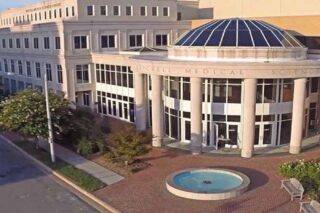

Eastern Virginia Medical School (EVMS) is an MD-granting medical school in Norfolk, Virginia, founded by the Hampton Roads community in 1973 to address a regional physician shortage. On July 1, 2024, EVMS integrated into Old Dominion University (ODU). Its full name is now Macon & Joan Brock Virginia Health Sciences Eastern Virginia Medical School at Old Dominion University. The school itself uses shorter forms such as “VHS-Eastern Virginia Medical School” and, in its secondary essay prompts, “VHS-EVMS at ODU.” Most applicants, students and physicians still call it EVMS, and this guide does too.
The MD program did not pause during the integration. It is the same four-year program on the same Norfolk campus, now part of a larger health sciences unit inside a public university. What changed for applicants is mostly practical: the school website, email addresses and some program names moved to odu.edu, and the secondary prompts now name “VHS-EVMS at ODU.”
This guide is for applicants deciding whether EVMS belongs on their list and how to build a strong application. It covers the school’s mission and identity, its CareForward Curriculum, admissions requirements for the 2026-2027 cycle, current costs, clinical training, people worth knowing, class statistics, every current secondary prompt with an original example response, and the interview.
Key Takeaways
- Eligibility is strict. Only U.S. citizens and U.S. permanent residents can apply. EVMS does not accept international, Canadian or DACA applicants for the 2026-2027 cycle.
- Virginia residents have an edge, but out-of-state applicants are welcome. The school prefers Virginia applicants, especially Hampton Roads residents, and accepts up to 49 percent out-of-state applicants. The 2025 entering class had 76 in-state and 75 out-of-state matriculants.
- Academic context. Accepted applicants for the 2025 entering class had a median MCAT of 513 and a median overall GPA of 3.82. The school uses a 502 MCAT minimum for screening.
- Mission fit matters. The school’s vision is to be “the most community-oriented school of medicine and health professions in the United States.” Service, continuity and work with underserved patients are central, not decoration.
- Key dates for 2026-2027. EDP deadline August 1, 2026. Primary deadline November 1, 2026. Secondary deadline December 31, 2026. Rolling acceptances begin October 15, 2026. Classes begin August 9, 2027.
- Costs. For 2026-27, tuition is $38,016 for Virginia residents and $61,012 for nonresidents. The first-year budget with loan fees is $69,907 in-state and $92,903 out-of-state.
- Distinctive training. EVMS has no hospital of its own, so students train across a Level I trauma center, a children’s hospital, military and community hospitals and more than 150 partner practices. Standardized patient work starts on day one.
- Next step. Check that your MCAT falls in the January 2024 to September 2026 window, line up letters under the September 2026 letter rules, and draft the seven secondary responses early.
Key Statistics About Eastern Virginia Medical School

The table below gathers the key numbers for EVMS. Each row names its cohort and source, because these numbers come from different years and different groups of people.
| Measure | Value | Cohort, population and source |
|---|---|---|
| School and degree | Macon & Joan Brock Virginia Health Sciences Eastern Virginia Medical School at Old Dominion University, MD | Norfolk, Virginia; urban campus; public (part of ODU since July 1, 2024) |
| Founded | 1973 | School “About” page |
| Entering class size | 151 | Matriculants, 2025 entering class (MSAR); about 151 new medical students each year (school) |
| Total MD enrollment | 619 | October 2025 (MSAR) |
| Median MCAT | 513 | All accepted applicants, 2025 entering class (MSAR, data as of October 29, 2025) |
| Median overall GPA | 3.82 | All accepted applicants, 2025 entering class (MSAR) |
| Median science GPA | 3.76 | All accepted applicants, 2025 entering class (MSAR) |
| Verified applications | 7,613 | 2025 entering class: 1,132 in-state, 6,477 out-of-state, 4 international (MSAR) |
| Interviewed | 747 | 2025 entering class: 361 in-state, 386 out-of-state (MSAR) |
| Interviewed / verified applications | 9.8% | 747 of 7,613, 2025 entering class (calculated from MSAR). This is not an acceptance rate. |
| Acceptance rate | Not published | The number of accepted applicants is not published |
| Tuition, 2026-27 | $38,016 in-state; $61,012 out-of-state | All four years, school’s 2026-27 MD cost of attendance page |
| First-year cost of attendance, 2026-27 | $69,907 in-state; $92,903 out-of-state | MD1 budget including loan fees, school’s 2026-27 cost page |
| Tuition and fees, 2025-26 | $40,302 in-state; $62,628 out-of-state | First-year students, AAMC Tuition and Student Fees (TSF) 2025-26 via MSAR |
| Primary application | AMCAS | Deadline November 1, 2026 (school) |
| Eligibility | U.S. citizens and permanent residents only | No international, Canadian or DACA applicants (MSAR) |
Two notes help when reading these numbers. First, the medians describe accepted applicants for the 2025 entering class. Students matriculating in recent years had a mean GPA of 3.70 and a mean MCAT of 513. Those are different groups and different measures. Second, the 2025-26 “tuition and fees” figure is a first-year total that includes fees, while the 2026-27 figure is tuition alone. The full cost breakdown is in the tuition section below.
The school does not publish an acceptance rate. The closest published measures of selectivity are the interview ratio above and the matriculant counts in the class profile section.
Mission and Educational Priorities
After the integration, the mission statement moved to the level of Macon & Joan Brock Virginia Health Sciences at ODU. The school is “an academic health sciences center dedicated to achieving excellence in medical and health professions education, research and patient care,” as set out on its official mission, vision and values page. The mission also says the school values “a diverse and cohesive faculty, professional staff and student body,” will “strive to improve the health of our community,” and uses “continuous assessment processes” to improve programs and student learning. The same statement applies to the MD program under the VHS-EVMS name.
The vision is shorter and more revealing: the school “will be recognized as the most community-oriented school of medicine and health professions in the United States.” Its three core values are Excellence, Collegiality and Integrity.
At the program level, the mission of Eastern Virginia Medical School “is deeply rooted in the education and training of genuinely caring and competent physicians, equipping them with the requisite scientific, academic and humanistic skills most relevant to today’s practice of medicine.” The curriculum’s stated program objective is that graduates become “community-oriented physicians who serve their patients, colleagues, and the broader community with cultural humility and excellence.”
What the mission means for applicants
The school’s history gives this language weight. EVMS was not created by a state legislature or a university system. It is “one of the only schools of medicine and health professions in the nation to be founded by a grassroots effort,” and its graduates provide care for more than one quarter of Virginia’s population as well as neighboring parts of North Carolina. Its mission is “deeply rooted in the education and training of primary care physicians.”
In practice, that shapes what a strong EVMS application looks like:
- Community service is part of the curriculum. The curriculum includes a mandatory service-learning course with a required community activity component. Applicants who already have sustained, local service will find it easier to explain why that requirement appeals to them.
- Continuity counts more than variety. A community-oriented school is looking for people who stay. Two years at one free clinic usually says more than ten one-day events.
- Primary care and underserved care are valued, but not required. EVMS trains surgeons, psychiatrists and subspecialists too. You do not need to promise family medicine. You do need to show that you understand the needs of the patients you have served.
- Regional ties help. The school states a preference for Virginia residents, especially those from Hampton Roads. If you have real ties to the region, say so plainly. If you do not, explain what draws you to a community-focused training model.
These are editorial readings of public mission language, not a hidden scoring rubric. The admissions committee looks at the whole application, and no single activity guarantees an interview.
Accreditation and Institutional Identity
EVMS’s MD program is accredited by the Liaison Committee on Medical Education (LCME), the accrediting body for MD programs in the United States and Canada. The LCME granted the program continued full accreditation in October 2020 for a full eight-year term, and the next full survey visit is scheduled for the 2028-2029 academic year. Details are on the school’s accreditation page.
LCME accreditation matters for practical reasons. It allows graduates to sit for the USMLE, apply to ACGME residencies and pursue licensure in every state. It is a baseline requirement, not a ranking or a guarantee of quality, and every MD school you apply to in the U.S. should have it. Following LCME standards also means the school must keep assessing and improving its curriculum, which is one reason the CareForward Curriculum has been revised.
What changed on July 1, 2024
On July 1, 2024, EVMS integrated into Old Dominion University. The result is a new health sciences unit at ODU. Macon & Joan Brock Virginia Health Sciences at ODU is “rooted in the 50-year legacy of Eastern Virginia Medical School and strengthened by the resources of Old Dominion University.” The unit includes five schools and colleges: Eastern Virginia Medical School, the Ellmer College of Health Sciences, the Ellmer School of Nursing, the EVMS School of Health Professions and the Joint School of Public Health.
For applicants, the key points are:
- The MD program, campus and degree continue. You still apply through AMCAS to the MD program in Norfolk.
- Names and links changed. Old evms.edu pages now redirect to odu.edu. The MD admissions email is [email protected], and the phone number is 757-446-5812.
- The school is now part of a public university. EVMS was previously a state-supported political subdivision. It is now inside ODU, a public university. Calling it a public medical school remains accurate.
- The leadership structure changed. Dr. Alfred Abuhamad, who led EVMS before the integration, is now Executive Vice President for Health Sciences. Dr. Judette Louis became dean of the medical school on September 2, 2025. Both are profiled later in this guide.
When you write your secondaries, you can call the school EVMS or VHS-EVMS at ODU. Matching the name the prompt uses is a small but sensible touch.
Medical Programs and Affiliations
EVMS offers one core MD program, supported by a postbaccalaureate master’s program and early assurance partnerships with selected colleges. It also offers a five-year MD/MPH, and the combined degree options are described below.
Doctor of Medicine (MD) program
The four-year MD program follows the CareForward Curriculum, now in a revised version the school calls CareForward Curriculum 2.0. The MD program homepage highlights three features: students spend their first day working with standardized patients in the Sentara Center for Simulation and Immersive Learning, they begin ultrasound training in the first weeks, and third-year students meet one-on-one with the vice dean for career guidance. Nearly nine out of ten medical students graduate on time in four years.
Clinical training model
EVMS is a medical school without its own hospital. The school presents this as an advantage: students “train in a variety of hospitals, from a level 1 trauma center to a children’s hospital to military and community hospitals, and more than 150 partnering clinical practices in our region.” The central partners are Sentara Norfolk General Hospital, home to the region’s only Level I trauma center, and Children’s Hospital of The King’s Daughters (CHKD), both on the medical campus. Details on rotation sites are in the clinical section below.
Commitment to primary care
Primary care sits at the center of the school’s history, and the mission remains rooted in training primary care physicians. Students who are drawn to family medicine, pediatrics or general internal medicine will find a culture that values those fields. Students headed to other specialties will still spend substantial time in ambulatory and community settings.
Combined degree programs
Students who want a second degree alongside the MD have these options:
- MD/MPH. For students “dually enrolling in the MD program and Public Health master’s program, the course of study extends over five years.” In the first two years, students complete the MPH and the first year of medical school, paying the MD/MPH budget plus one-half of medical school tuition each year. The last three years are years two through four of medical school on the regular MD budget. Public health programs now sit in the Joint School of Public Health. If the MD/MPH interests you, ask MD admissions how and when to apply for the public health side.
- MD/MBA. EVMS and William & Mary’s Mason School of Business launched an MD/MBA in 2014 for students interested in leadership roles in health care administration. As of 2024, the dual degree ran over five years: years one and two in the EVMS curriculum, year three in clerkships, year four in the William & Mary MBA curriculum after the Step 2 exams (48 semester hours over 12 months, July to June, at William & Mary’s Peninsula Center in Newport News and its main campus in Williamsburg, with a joint applied project) and year five back in the EVMS curriculum. Neither school lists the program for the current cycle. If an MBA matters to you, ask MD admissions ([email protected]) about current options.
- MD/PhD, MD/JD and MD/MPP. There is no MD/PhD, MD/JD or MD/MPP program.
The MD/MPH suits students interested in preventive medicine, health policy and community health, and it fits the school’s community mission.
Postbaccalaureate program
The school’s postbaccalaureate option is the Master of Science in Biomedical Sciences – Medical, often called the Medical Master’s. It runs in one-year and two-year tracks, and it “lets participants learn side-by-side with medical school students in the classroom and the lab.” It is designed for students who want to strengthen their academic record before applying to medical school. It is a separate application with its own tuition; for 2026-27, the one-year track costs $16,320 in-state and $18,784 out-of-state, plus a $15,040 program fee. Completing it does not guarantee MD admission. Ten members of the 2025 entering class came from postbaccalaureate programs. You can read more on the program page.
Early Assurance Program and partner colleges
The school runs a Bachelor’s/MD Early Assurance Program with specific undergraduate schools. Students at partner institutions are selected by their advisers in November, apply by March 30 of their sophomore year, interview in May and take the MCAT at the end of junior year. They must be U.S. citizens or permanent residents and keep a cumulative GPA of at least 3.5. Students who leave the program can still apply the usual way. High school students who plan to choose a partner college with this pathway in mind can start building patient-care exposure early; medical internships for high school students are one option, alongside local volunteering.
Partner colleges’ own pages describe arrangements at the Virginia Military Institute (up to 15 cadets can apply in the spring of their third class year), Randolph-Macon College, Norfolk State University (through its DNIMAS program) and Batten University, named Virginia Wesleyan University until July 1, 2026 (an MD early admission track for qualified students who apply in the fall of their sophomore year). Confirm the current partner list with your adviser. The 2025 entering class had zero early assurance matriculants.
Other Virginia Health Sciences programs
The broader health sciences unit also offers a physician assistant program, pathologists’ assistant and surgical assisting programs, art therapy and counseling, and biomedical sciences graduate degrees. These are separate from the MD program. If you see EVMS PA statistics online, do not confuse them with MD admissions. If you are weighing the PA route, pre-PA internships can help you build the hands-on patient care hours PA programs look for.
Continuing medical education
Beyond its degree programs, the institution supports continuing education for practicing clinicians, helping physicians and other professionals in the region keep up with new research and best practices. This is not part of the MD application, but it reflects the school’s role as the region’s academic health center.
Curriculum Overview
EVMS teaches the CareForward Curriculum, revised as CareForward Curriculum 2.0 (CFC-2.0). It is “a modular, fully integrated, organ-systems and case-based curriculum” with longitudinal themes in caring for older adults and people with multiple chronic conditions, cost-conscious care, service learning, and student and physician wellness. The redesign goals, set out on the curriculum page, are an earlier start to clinical clerkships, an accelerated pre-clerkship phase and more dedicated time for USMLE Step 2 preparation, while preserving study time for Step 1.
The program is easiest to understand in three phases: pre-clerkship, clerkship and elective. The older “Years 1 and 2” and “Years 3 and 4” labels still roughly apply, but the pre-clerkship phase is now condensed to about 18 months.
Pre-clerkship phase
The pre-clerkship phase uses integrated blocks rather than separate courses in anatomy, physiology or biochemistry. The current blocks are:
| Block | Length |
|---|---|
| CFC 100 Human Structure | 8 weeks |
| CFC 101 Foundations of Disease | 10 weeks |
| CFC 102 Introduction to Organ Systems | 10 weeks |
| CFC 103 Hormones and Reproductive Health | 9 weeks |
| CFC 200 Heart, Lung, and Kidney | 10 weeks |
| CFC 201 Brain, Mind, and Behavior | 9 weeks |
Each block combines basic sciences with clinical cases so students apply concepts to patients from the start.
Active learning
Instructional methods include didactic lectures, small group sessions and team-centered learning, with online lectures available. Expect a mix of large-group teaching, case discussions and team-based exercises. This rewards students who prepare before class and work well in groups.
Early clinical exposure
Clinical work starts immediately. Students meet standardized patients on their first day at the Sentara Center for Simulation and Immersive Learning, begin ultrasound early, and gain exposure through high-fidelity simulation and physician shadowing, much of it in community-based practices. EVMS “pioneered the use of standardized patients over 20 years ago.”
The Longitudinal Generalist Mentorship Program places first- and second-year students in the office of a practicing primary care physician for at least seven afternoons each semester. If this mentorship matters to you, ask current students on interview day how it fits into the CareForward 2.0 schedule.
Longitudinal themes
Alongside the organ-system blocks, the curriculum carries themes that run through all four years: geriatrics and multiple chronic conditions, cost-conscious care, ethics and professionalism, service learning, and wellness for students and physicians. These themes are why the school’s secondary prompts and interviews often return to how you will handle the realities of practice, not only the science.
Clerkship phase
Clinical clerkships now start earlier than in the older curriculum. The core clerkships listed on the curriculum page are:
| Clerkship | Length |
|---|---|
| FAM301 Family Medicine | 6 weeks |
| INT303 Internal Medicine | 6 weeks |
| OBG301 Obstetrics and Gynecology | 6 weeks |
| PED301 Pediatrics | 6 weeks |
| PSY301 Psychiatry | 6 weeks |
| SUR301 Surgery | 6 weeks |
| ITD301 Career Exploration (includes a FOCUS elective) | 6 weeks |
Third-year clerkships also include exposure to geriatric medicine, addiction medicine and surgical and medical subspecialties.
Clerkships and clinical skills development
Students work in both inpatient and outpatient settings. Rotations are held at Sentara Norfolk General Hospital unless otherwise indicated, with other sites across the region. During clerkships, students take on direct patient care as part of supervised teams, building history, exam, presentation and procedural skills.
The Career Exploration block gives students protected time to try a specialty of interest, or “to participate in research or global health opportunities.” This is a good place to test a career idea before applying to residency.
Elective phase
The elective phase includes 34 weeks of “full-time, scheduled, supervised, and evaluated educational experiences.” It includes an Acting Internship (4 weeks), Ambulatory Medicine (4 weeks), Critical Care (4 weeks), a Community-Engaged Learning Capstone (4 weeks), a Clinical Skills and Ultrasound Capstone (2 weeks), Residency TIPS (2 weeks) and 14 weeks of electives. A maximum of 16 weeks of the elective phase can be completed as away rotations.
Grading system
Grading is Pass/Fail in the first two years and Honors, High Pass, Pass or Fail for all clinical rotations. The school also ranks students. Pass/Fail pre-clerkship grading is meant to support collaboration, while the four-level clinical grades give detailed feedback and are reported in residency applications.
Simulation and clinical skills training
The Sentara Center for Simulation and Immersive Learning is one of the school’s best-known resources. Students practice procedures, communication and clinical decisions with standardized patients and high-fidelity mannequins before and during clerkships. The simulation team also takes part in the weekly interview-day engagement session, which tells you how central the school considers it.
Primary care and community focus in the curriculum
The curriculum’s community focus shows up in several required elements: a service-learning course with a community activity component, the Community-Engaged Learning Capstone in the elective phase and ambulatory medicine requirements. Optional programs such as the HOPES free clinic and Beyond Clinic Walls, described in the student life section, add more. There is no research or thesis requirement for MD students, though research is widely available.
Admissions Requirements and Application Process
EVMS uses a holistic review. The admissions committee “considers the entire academic record, including science (BCPM) and overall GPA, MCAT scores, exposure to the medical field, volunteerism, maturity, character, and motivation,” and the school “seeks individuals with personal and background traits that indicate a high potential for becoming a great clinician passionate about service.” The steps below follow the order an applicant moves through for the 2026-2027 cycle.
Eligibility and residency
- Citizenship. “Only U.S. citizens or permanent residents of the U.S. will be considered for admission into the MD program.” Canadian, international and DACA applicants are not accepted. The full rules are on the school’s admissions criteria page.
- Residency preference. The school “shows a preference for applicants from the Commonwealth of Virginia, especially legal residents of Hampton Roads.” To qualify for in-state tuition, an applicant must have been legally domiciled in Virginia for at least one year before matriculation.
- Out-of-state applicants. EVMS accepts up to 49 percent out-of-state applicants. In the 2025 entering class, 75 of 151 matriculants were from out of state.
- Coursework and degree. Applicants must have taken the MCAT and completed at least 90 semester hours before submitting a primary application, and must earn a bachelor’s degree from an accredited U.S. or Canadian institution by matriculation.
Prerequisite courses
The school requires one year each, with labs, of general biology, general chemistry, organic chemistry and physics. That works out to 8 credit hours of biology, 16 of chemistry (general and organic) and 8 of physics. Biochemistry, psychology and sociology are highly recommended, and anatomy, genetics, histology and physiology are also recommended.
Courses can carry numerical, letter or pass/fail grades, as long as you pass. AP and CLEP credit, online courses and community college courses are accepted. Prerequisite coursework does not expire and must be complete by May 2027 for this cycle.
Primary application via AMCAS
EVMS uses the AMCAS application. For the 2026-2027 cycle, the admissions process begins June 1, 2026, regular applications are submitted through AMCAS between June 1 and November 1, 2026, and application review begins July 1, 2026. Applicants are strongly encouraged to submit all materials as early as possible; the full steps are on the school’s application process page. Applying in June or early July puts you in the review pool as it opens. Applicants reported on the Student Doctor Network that the first 2026-2027 secondaries went out in early July 2026.
MCAT
- Window. “VHS-Eastern Virginia Medical School will accept test scores taken from January 2024 to September 2026, for the 2026-2027 admissions cycle.” The last accepted test date is September 12, 2026.
- Screening minimum. The minimum MCAT for screening is 502. A 502 does not make an application competitive. It only means the application can be screened.
- Multiple scores. The school uses the highest total score, and “the MD Admissions Committee looks at the highest score and the number of times taken.” Retaking is fine, but repeated attempts without improvement will be noticed.
- Fall test dates. If you take the MCAT for the first time in the fall, the school will not review your application until that score arrives.
- Context. Accepted applicants for the 2025 entering class had a median MCAT of 513, and recent matriculants had a mean of 513. See our medical school GPA and MCAT averages to compare EVMS with other schools.
GPA
There is no minimum GPA for screening, but cumulative and science (BCPM) GPAs should be near or above the school’s average to be competitive. Students matriculating in recent years had a mean GPA of 3.70, and accepted applicants for the 2025 entering class had a median overall GPA of 3.82 and a median science GPA of 3.76. The practical takeaway: a GPA near 3.7 or higher keeps you in range, and an upward trend or strong postbaccalaureate work can help offset an earlier dip. Postbaccalaureate and graduate work is considered, and 24 credit hours of it is often considered competitive.
Secondary application
Secondaries are sent selectively. Once your AMCAS application arrives, “MD admissions may request that a secondary application be completed.” The supplemental application goes to “those applicants who receive a favorable initial screening.” The invitation goes to your AMCAS email.
- Fee. $100. The fee is waived if you have an AMCAS fee waiver.
- Deadline. December 31, 2026.
- Prompts. Five required and two optional prompts for 2026-2027, each covered in full later in this guide.
- Veterans. Through the I-SERVED program, matriculants with documented prior military service can be reimbursed for the secondary fee. Submit the request by September 30 of your first year.
Applicants on the Student Doctor Network reported waits of roughly ten days to four weeks between AMCAS verification and a secondary invitation. That is applicant-reported, not an official timeline.
Letters of recommendation (updated September 2026)
The school updated its letter guidance in September 2026, and the AAMC posted the change on September 18. The current rules are:
- All letters must be on letterhead and signed by the writer.
- A committee letter is strongly recommended if your school has a premedical committee. A letter sent through your career services office can serve as a committee letter.
- Without a committee letter, send three individual letters: two from faculty in the natural sciences, neuroscience or research, and one from a non-science faculty member. Mathematics counts as non-science.
- The non-science letter can be replaced by a letter from an employer, mentor, physician or a volunteer or clinical experience.
- Graduate students (current or former) must send an additional fourth letter from their thesis or graduate advisor unless they submit a graduate committee letter. Applicants admitted to a one-year master’s program they have not yet started should send an enrollment verification letter.
- Limits. Send at least three and no more than five AMCAS letters.
- Holds. “Applications are held until all required letters are received.”
Shadowing “is strongly recommended as is a letter from a physician.” Follow the letter list above. Our guide to medical school recommendation letters explains how to ask and when.
Interview invitations
After reviewing primary and secondary applications, the committee invites selected applicants to interview. Interview invitations can go out from August, and interviews run on Wednesdays and Fridays from September through March. In the 2025 entering class, 747 applicants interviewed: 361 from Virginia and 386 from out of state. Applicants on the Student Doctor Network reported the first 2026-2027 invitations on September 8, 2026 for in-state applicants and October 6, 2026 for out-of-state applicants. The interview format is covered in its own section below.
In-state vs. out-of-state
Virginia applicants are a small share of the applicant pool but about half of the class. In the 2025 entering class, 1,132 in-state applicants produced 361 interviews and 76 matriculants, while 6,477 out-of-state applicants produced 386 interviews and 75 matriculants. About half of the MD Class of 2029 is from Virginia, including 19 students from Hampton Roads. Out-of-state applicants do get interviews and seats, but the competition for each one is much stiffer.
Acceptance decisions
General pool applicants are notified on a rolling basis beginning October 15, 2026, and the latest acceptance date is August 6, 2027. The committee considers the full application, including the interview. If you are accepted, you will have two weeks to respond, sign the Conditions of Acceptance and pay the deposit.
The AAMC acceptance protocol dates for this cycle are:
- February 19: “Plan to Enroll” becomes available in the Choose Your Medical School tool.
- April 15: narrow to no more than three acceptances.
- April 30: “Commit to Enroll” becomes available, and you should narrow to one school.
Early Decision Program (EDP)
EVMS participates in the AAMC Early Decision Program. For this cycle, the EDP application period is June 1 to August 1, 2026, and applicants are notified by October 1, 2026. EDP applicants may not apply to other medical schools until they receive a decision. Applicants are “strongly urged” to contact the Office of Admissions before choosing EDP. The 2025 entering class had zero EDP matriculants, so EDP is a narrow path. It suits applicants, often Virginia residents, who are certain EVMS is their first choice and whose application is already strong by early summer.
Selection factors
Academic record
The committee reviews undergraduate and graduate coursework, including science (BCPM) and overall GPA. Performance in the required sciences matters, and so does your trend over time.
Clinical experience
“Exposure to the medical field” is a named selection factor, and shadowing is strongly recommended. Hands-on patient contact, such as work as a medical assistant, EMT, CNA or scribe, shows that you understand what medicine involves. Experience in primary care or with underserved communities fits the school’s mission especially well. Structured programs, including medical internships for undergraduates that involve supervised patient care, can add to that record, as long as you can describe what you did yourself.
Community service
“Volunteerism” is a named selection factor. Long-term, health-related service, particularly with people who face barriers to care, is a strong match for a school whose vision centers on community.
Leadership and research
Leadership in academic, work or community settings is valued as evidence of maturity. Research is not required for admission or for graduation, but it helps applicants interested in academic medicine or public health explain their goals.
Personal attributes
The committee looks for maturity, character and motivation, and interviewers also look for compassion, dedication, preparedness, sensitivity, cultural awareness and interpersonal skills. Your personal statement, letters and interview are where these come through.
Waitlist procedures
The waitlist typically holds about 300 positions, with about 100 offers made to waitlisted applicants in a typical year. “The waitlist remains active until the class matriculates in August. Updates and letters of interest are accepted.” Letters of intent or interest “should come from applicants who are waitlisted.” If you are waitlisted, send one clear update with meaningful new information rather than repeated short notes.
Deposit and matriculation
Accepted students pay a $100 acceptance deposit, which is applied toward tuition and is refundable before May 1, 2027. Conditions of acceptance include a criminal background check, official transcripts, CDC-recommended immunizations, certification that you meet the school’s technical standards and, for applicants born outside the United States, proof of citizenship or permanent residency. Classes for the entering class of 2027 begin August 9, 2027.
Deferral requests
Deferral requests are considered case by case. If you think you may need one, raise it as soon as possible after acceptance and explain the reason clearly.
2026-2027 timeline at a glance
| Date | Step | Source |
|---|---|---|
| June 1, 2026 | Admissions process, application window and EDP period open | School application page |
| July 1, 2026 | Application review begins | MSAR |
| August 1, 2026 | EDP deadline | School |
| August 2026 | Interview invitations may begin | MSAR |
| September 2026 to March 2027 | Interviews (Wednesdays and Fridays, virtual) | School interview page |
| September 12, 2026 | Last MCAT date accepted | MSAR |
| October 1, 2026 | EDP decisions | School |
| October 15, 2026 | Rolling acceptances begin | MSAR |
| November 1, 2026 | AMCAS deadline | School |
| December 31, 2026 | Secondary deadline | MSAR |
| February 19, 2027 | Plan to Enroll available | School application page (AAMC protocol) |
| April 15, 2027 | Hold no more than three acceptances | School application page |
| April 30, 2027 | Commit to Enroll; deposit refundable until May 1 | School |
| August 9, 2027 | Classes begin | MSAR |
The February, April 15 and April 30 protocol dates are published without a year. For this cycle, they fall in 2027.
Tuition, Cost of Attendance and Financial Aid
Medical school is a large investment, and EVMS publishes a detailed budget for each year of the MD program. The figures below are 2026-27 rates, effective from Fall 2026 through Summer 2027 and subject to change. The full budget is on the school’s 2026-27 Doctor of Medicine cost of attendance page, and rates for every program are on the tuition and fees page.
Tuition and fees for 2026-27
| Item (2026-27) | MD1 | MD2 | MD3 | MD4 |
|---|---|---|---|---|
| Tuition, in-state | $38,016 | $38,016 | $38,016 | $38,016 |
| Tuition, out-of-state | $61,012 | $61,012 | $61,012 | $61,012 |
| Mandatory fees | $3,393 | $2,724 | $3,260 | $2,569 |
| Health insurance | $3,341 | $3,341 | $3,341 | $3,341 |
| Budget length | 9 months | 9 months | 10 months | 12 months |
These are 2026-27 figures. For comparison, first-year “tuition and fees” for 2025-26 were $40,302 in-state and $62,628 out-of-state. That figure includes fees, so it is not directly comparable to 2026-27 tuition alone.
Other estimated expenses
The school’s budget also includes living and educational costs. For MD1 in 2026-27: room $14,220, board $4,635, personal $800, transportation $3,574 and books and equipment $1,500. MD2 adds a $695 USMLE allowance. Living costs rise in later years because the budget runs longer: MD4 includes room of $18,960 and transportation of $6,501 over a 12-month budget, reflecting away rotations and residency interviews.
Total estimated cost of attendance
| Total cost of attendance with loan fees (2026-27) | In-state | Out-of-state |
|---|---|---|
| MD1 | $69,907 | $92,903 |
| MD2 | $70,534 | $94,502 |
| MD3 | $73,275 | $97,243 |
| MD4 | $78,796 | $102,764 |
Adding the four years at 2026-27 rates gives a rough total of about $292,500 for a Virginia resident and about $387,400 for a nonresident. Future years will likely cost more. These are budgets that set the most you can borrow, not bills. Your actual spending depends on housing and personal choices.
Health insurance is listed at $3,341 per year in the budget. No waiver policy is published, so ask the financial aid office whether comparable coverage can replace the school plan.
Types of financial aid
About 82 percent of students receive financial aid, and the average graduate indebtedness is $227,380 (academic year 2024-2025). The main sources of aid are federal loans, need-based grants for qualified state residents, institutional scholarships and loans, and HRSA Primary Care Loans and Loans for Disadvantaged Students.
Grants and scholarships
Grants and scholarships are gift aid that does not need to be repaid. EVMS offers need-based grants for qualified Virginia residents and a limited number of institutional scholarships based on merit and need. Ask the financial aid office how to be considered when you are accepted.
Outside programs can cover a large share of costs in exchange for service. The National Health Service Corps (NHSC) Scholarship supports students who commit to practice in health professional shortage areas, and the military Health Professions Scholarship Program (HPSP) covers tuition and a stipend in exchange for service. Hampton Roads has a large military presence, including Naval Medical Center Portsmouth, which is one of the regional training sites.
Federal loans
Most students borrow federal Direct Unsubsidized Loans. Federal student loan rules changed on July 1, 2026, under the One Big Beautiful Bill Act and the Department of Education’s rule that implements it. In a June 2026 announcement, the Department’s Federal Student Aid office said the changes taking effect July 1, 2026 include “the elimination of the Grad PLUS program, the establishment of new annual and aggregate loan limits for graduate and professional students, and the creation of two new repayment plans.” Medicine (M.D.) is on the Department’s list of professional degree programs. The Department’s loan-limit guidance says students in professional programs can borrow up to $50,000 a year, compared with $20,500 for other graduate programs, and that schools may set lower limits for specific programs.
The 2026-27 budget includes a Grad PLUS loan fee for MD2 through MD4 students but marks Grad PLUS as “N/A” for first-year students. Ask the financial aid office how the new rules apply to you. Entering students should expect to fund any gap between federal loan limits and the cost of attendance through scholarships, savings, service programs or private loans. Check current interest rates, fees and limits on StudentAid.gov, since they are set by federal law and change each July.
HRSA Title VII loans
Through the Health Resources and Services Administration (HRSA), eligible students may receive:
- Primary Care Loans (PCL) for students who commit to practicing primary care after residency.
- Loans for Disadvantaged Students (LDS) for students from economically or educationally disadvantaged backgrounds.
These loans typically offer favorable terms, with service or eligibility requirements attached.
Private loans
Private loans can fill remaining gaps, especially now that the school’s first-year budget no longer includes Grad PLUS. They usually lack federal protections such as income-driven repayment and Public Service Loan Forgiveness. Compare terms carefully and use federal and institutional aid first.
Application process for financial aid
- Submit the FAFSA. It is required for federal loans and most need-based aid. Use federal school code 010338, which appears in the FAFSA school search as Eastern Virginia Medical School.
- Complete the school’s financial aid application. Accepted students can complete the EVMS online financial aid application after February 1.
- Complete loan counseling. Federal borrowers complete entrance counseling before funds are disbursed and exit counseling before graduation.
Repayment and loan forgiveness options
Federal repayment plans changed with the same law. The Department of Education lists two new plans taking effect July 1, 2026: the Repayment Assistance Plan (RAP) and the Tiered Standard Repayment Plan. Its July 2025 Dear Colleague letter says payments under RAP count toward Public Service Loan Forgiveness (PSLF). PSLF remains available for qualifying employment at government or nonprofit employers after 120 qualifying payments. The NHSC Loan Repayment Program offers repayment help for clinicians who work in shortage areas. Because these rules are changing, confirm which plans apply to your loans on StudentAid.gov.
Key contacts and resources
The Virginia Health Sciences financial aid office can be reached at [email protected] or 757-446-5804. Check the office’s current page for hours. The weekly interview-day engagement session also includes the Director of Financial Aid, which is a good chance to ask questions before you decide.
Campus Facilities and Student Life
The medical campus sits next to the region’s main hospitals. The campus complex includes Children’s Hospital of The King’s Daughters and Sentara Norfolk General Hospital, which means many clinical experiences are a short walk from class.
Campus facilities
Medical simulation center
The Sentara Center for Simulation and Immersive Learning is where students meet standardized patients on the first day and return throughout training. It includes simulated clinical spaces, high-fidelity mannequins and procedural trainers. Standardized patient encounters, a field EVMS helped pioneer, let students practice communication and examination skills with trained actors and receive feedback before they see real patients.
On-campus housing
Medical Campus Apartments sit across the street from the medical campus, at the corner of Colley Avenue across from Lewis Hall. The complex offers one-bedroom, two-bedroom and one-bedroom loft apartments, with furnished and unfurnished one- and two-bedroom units, and it houses both students and residents. Two-bedroom applicants without a roommate can be matched with someone in their program. Current rents are on the floor plans and rates page; ask the housing office about availability. Many students also rent in nearby Norfolk neighborhoods. A car is not required.
Medical library
The Brickell Medical Sciences Library supports study and research with medical databases, journals and study space. Ask during your interview day how library access works now that the school is part of ODU.
Clinical facilities
Sentara Norfolk General Hospital and CHKD sit next to the academic buildings. Sentara Norfolk General is the region’s only Level I trauma center and burn trauma unit and the primary teaching hospital. CHKD is the region’s children’s hospital. Their proximity gives students early exposure to adult and pediatric care.
Student life and extracurricular activities
Students balance a demanding schedule with a wide range of activities. Students take part in more than 50 organizations.
Student organizations
Organizations include student government, specialty interest groups and groups focused on global health, community service and identity-based support. National groups such as the American Medical Association have student chapters at many medical schools, and EVMS students have historically been active in AMA, Medical Students for Choice and surgery interest groups. For students interested in aging, the geriatric student interest group SAGE is linked to the Beyond Clinic Walls program. Ask current students which groups are most active, since club rosters change every year.
HOPES Free Clinic
The Health Outreach Partnership of EVMS Students (HOPES) is a student-led free clinic founded in 2011. The school describes it as one of the few free clinics in Norfolk and the first student-led free clinic in Virginia. It runs Thursday evening clinics, with specialty care on selected Wednesday evenings, at the Norfolk Department of Public Health building. HOPES serves uninsured and underinsured adults from Hampton Roads cities who earn less than twice the federal poverty level, with separate pediatric care. Services include primary care plus dermatology, ENT, gynecology, mental health, ophthalmology and optometry, and orthopedics.
Students can start in front desk, IT and vitals assistant roles without prior training. Junior clinician and scribe roles are open to medical and PA students in the preclinical phase, with more advanced roles later in training. That progression is one of the most concrete ways to act on the school’s mission from the first semester.
Beyond Clinic Walls
Beyond Clinic Walls began at the EVMS Glennan Center for Geriatrics and Gerontology. Student leaders founded it in 2010 to reduce social isolation among older adults. Through its TIME (Together In Meaningful Engagement) program, teams of medical and health professions students regularly visit older adults at Lake Taylor Transitional Care Hospital. Students can also complete Dementia Friends training and become Dementia Friends Champions who lead information sessions on and off campus. Members can join activities of SAGE (Students for the Advancement of Geriatric Education), receive research mentorship from Glennan Center geriatricians, attend specialty clinics and apply for Glennan Scholarships.
Community service
Service learning is required, and the school’s community-engaged learning office runs programs that focus on health education, prevention and care for underserved residents. Students who want more can join outreach events, health fairs and partner programs across Hampton Roads.
Diversity and inclusion
The school’s mission statement names “a diverse and cohesive faculty, professional staff and student body” as “the surest way to achieve our mission,” and the optional secondary prompt states that VHS-EVMS at ODU “is dedicated to inclusivity and supporting patients and students from diverse backgrounds.” The Safe Zone Program supports lesbian, gay, bisexual, transgender and questioning (LGBTQ) students, staff, faculty and residents through education and training that build a network of identifiable allies. Ask current students and staff which support offices and affinity groups are active and how to get involved.
Student wellness
Wellness is one of the curriculum’s longitudinal themes, and student and physician wellness is built into the program. Students can use counseling, wellness programming and peer support. Ask the Office of Student Affairs about current mental health services, confidential counseling and how the school supports students during exam periods.
Fitness and recreation
Students use local gyms, parks and running routes. Ask whether ODU recreation facilities are open to medical students. Norfolk’s waterfront and nearby beaches make outdoor exercise easy most of the year.
Norfolk and the surrounding area
Norfolk is a coastal city at the center of Hampton Roads, a region that includes Virginia Beach, Chesapeake, Portsmouth, Hampton and Newport News.
Outdoor activities
The Chesapeake Bay, the Elizabeth River and Atlantic beaches are close by, with options for boating, paddling, cycling and running.
Cultural scene
The Chrysler Museum of Art, the Virginia Opera and the Waterside District offer arts, dining and entertainment. The region’s large military community and diverse neighborhoods also shape the patient population students serve.
Support services for students
The Office of Student Affairs supports students with academic advising, career counseling and personal concerns. The Director of Student Affairs is part of the weekly interview-day engagement session.
Academic support
Students can use peer tutoring, study skills workshops and individual academic advising, including preparation for the USMLE Step exams. The CareForward 2.0 redesign specifically protects study time for Step 1 and adds dedicated time for Step 2.
Career advising
Career advising includes specialty exploration, the six-week Career Exploration block in the clerkship phase, one-on-one meetings with the vice dean in the third year and the two-week Residency TIPS course in the elective phase. Together these give students structured support through the residency Match.
Clinical Rotations and Research Opportunities
Clinical rotations
Clinical training is spread across the region rather than concentrated in a single university hospital. That gives students a range of patient populations and practice settings, from trauma surgery to small community practices.
Core clerkships
The clerkship phase includes six-week core clerkships in family medicine, internal medicine, obstetrics and gynecology, pediatrics, psychiatry and surgery, plus a six-week Career Exploration block. Students rotate through inpatient and outpatient care, building diagnostic and patient care skills in each field.
Affiliated hospitals and training sites
Rotations are held at Sentara Norfolk General Hospital unless otherwise indicated. The region’s major teaching partners, shown on the clinical training sites page for the school’s residency programs, include:
- Sentara Norfolk General Hospital, the primary teaching hospital, home to the area’s only Level I trauma center and burn trauma unit and the region’s main heart program
- Children’s Hospital of The King’s Daughters (CHKD)
- Sentara Leigh Hospital, Sentara Princess Anne Hospital and Sentara Virginia Beach General Hospital
- Sentara Ambulatory Care Clinic
- Hampton Veterans Affairs Medical Center
- Naval Medical Center Portsmouth
- Chesapeake Regional Medical Center
- Specialty sites such as Urology of Virginia and Bon Secours Surgery Center at Virginia Beach
That list describes residency training sites. We did not find a separate public list of MD student clerkship sites, so ask during your interview day where clerkships are usually held and how much driving to expect. A car is not required, but students at outlying sites may find one useful.
Community-based clinics
Ambulatory and community practices are central to the model. The school works with more than 150 partner practices in the region. Family medicine, pediatrics and ambulatory medicine rotations often take place in these offices, where students see the continuity of care that the mission emphasizes.
Longitudinal Generalist Mentorship Program
This “very popular” program places first- and second-year students with a practicing primary care physician for at least seven afternoons each semester. It gives students steady contact with one primary care practice early in training, which fits the school’s community mission. Ask current students how it fits into the CareForward 2.0 schedule.
Fourth-year electives
The elective phase includes 34 weeks of supervised work, of which 14 weeks are open electives. Options include subspecialty rotations such as cardiology, oncology and gastroenterology, research electives and away rotations (up to 16 weeks). Required elements are an Acting Internship, Ambulatory Medicine, Critical Care, the Community-Engaged Learning Capstone, the Clinical Skills and Ultrasound Capstone and Residency TIPS. Students interested in global health should ask how international electives fit within current policy.
Grading for clinical rotations
All clinical rotations use Honors, High Pass, Pass or Fail. These grades, together with clerkship evaluations, become part of the residency application.
Preparing for residency
Residency preparation is built in. Third-year students meet one-on-one with the vice dean for career guidance, the Career Exploration block lets students test a specialty, and Residency TIPS prepares students for the transition to internship. Faculty mentors and student affairs staff also help with specialty choice, application strategy and mock interviews.
Research opportunities
Research is available but not required. There is no research or thesis requirement. Students who want research experience can work with faculty on clinical, translational, basic science and community health projects. The Vice Dean of Research is Milton L. Brown, MD, PhD.
Healthcare analytics
From 2017 to 2022, the school’s Research and Infrastructure Service Enterprise (RISE) operated under the Healthcare Analytics and Delivery Science Institute (HADSI), which offered pilot funding for projects led by Brock VHS and Sentara researchers. Students interested in health data, population health and quality improvement can ask during their visit which faculty groups and projects take medical students, and whether that work can count toward the Career Exploration block or an elective.
Faculty-led research
Faculty across clinical departments run projects in areas such as diabetes, maternal and fetal health, cancer, infectious disease and reproductive medicine. Students can join as research assistants, through the Career Exploration block or through electives. Faculty mentors can help with study design, data collection and presentations.
Areas of focus
- Diabetes and endocrinology. The Strelitz Diabetes Center studies links between diabetes and heart disease, ways to regenerate insulin-producing cells and biomarkers for type 1 diabetes, and runs an endocrinology, diabetes and metabolism fellowship.
- Maternal and infant health. The obstetrics and gynecology department has long strength in maternal-fetal medicine and ultrasound, led for many years by Dr. Alfred Abuhamad.
- Cancer research. Faculty work on detection, treatment and survivorship, often with regional health system partners.
- Geriatrics and aging. The Glennan Center and Beyond Clinic Walls connect students with research in geriatrics and care for older adults.
- Global health. The M. Foscue Brock Institute for Community and Global Health, directed by Dr. Cynthia Romero, supports community and global health work. Students interested in opportunities in global health can combine local service with international experiences.
Funding and support
The research office and faculty mentors help students find projects and, in some cases, funding for scholarly work or conference travel. Beyond Clinic Walls members are eligible for Glennan Scholarships. Ask about current student research grants when you visit.
Global health research and clinical experience
In 2025, 9 percent of graduating EVMS seniors reported a global health experience during medical school. The Brock Institute and the Career Exploration block offer routes for students who want global health work, and the Community-Engaged Learning Capstone keeps the focus on local communities as well. Applicants who want global health exposure before medical school can look at pre-med internships abroad, then explain in the secondary how that work connects to service closer to home.
Notable Alumni, Faculty, Leadership and Admissions Staff
EVMS has trained physicians who went on to careers in space flight, state government, surgery and public life, and its faculty includes national leaders in surgery and obstetrics. They are here to help you understand the school’s culture and the people who shape it. They do not imply that any of these people review applications or offer mentorship to applicants.
School leadership
Judette Louis, MD, MPH: Dean, Eastern Virginia Medical School
Dr. Louis became dean of the medical school on September 2, 2025, and is listed with the senior team on the school’s leadership page. She is a maternal-fetal medicine physician and a past president of the Society for Maternal-Fetal Medicine. Before joining EVMS, she was the James M. Ingram Professor and chair of obstetrics and gynecology at the University of South Florida Morsani College of Medicine. She earned her MD at MCP Hahnemann (now Drexel) and her MPH at Johns Hopkins. For applicants, her arrival marks the first full admissions cycle under a new dean after the integration, and her public health training fits the school’s community mission.
Alfred Abuhamad, MD: Executive Vice President for Health Sciences
Dr. Abuhamad joined EVMS in 1992, chaired obstetrics and gynecology for 18 years and later served as the school’s president, provost and dean. Since the integration he has been Executive Vice President for Health Sciences for Macon & Joan Brock Virginia Health Sciences at ODU, and he holds the Mason C. Andrews Chair in Obstetrics and Gynecology. He is an internationally known ultrasound and maternal-fetal medicine expert and a past president of the American Institute of Ultrasound in Medicine, the Society for Maternal-Fetal Medicine and the Society for Ultrasound in Medical Education. His ultrasound work helps explain why EVMS students start ultrasound training so early.
Ronald W. Flenner, MD, FACP: Vice Dean, Academic Affairs
Dr. Flenner is a professor of internal medicine who practices infectious diseases. He directed the internal medicine clerkship from 1995 to 2012, became associate dean for medical education in 2011 and has served as vice dean since 2013. He holds the James E. Etheridge Jr. Distinguished Professorship. As the senior academic affairs leader, he is closely tied to the curriculum students experience.
Milton L. Brown, MD, PhD, FNAI: Vice Dean of Research
Dr. Brown is a professor in the Department of Medicine and the school’s Vice Dean of Research. His office oversees the research environment that students join if they choose to pursue scholarly projects.
Admissions staff
Thomas D. Kimble, MD: Assistant Vice Dean of Admissions and Enrollment
Dr. Kimble is an associate professor of obstetrics and gynecology who joined the school’s CONRAD clinical research center in 2006 and the faculty in 2008. He earned his MD at Howard University College of Medicine and is a past chair of the American Society for Reproductive Medicine’s Contraception Special Interest Group. He presents at the weekly interview-day engagement session, so many interviewees will hear from him directly.
Marsha L. Williams, MSEd: Director of Admissions
Ms. Williams joined EVMS in December 2019 from the Philadelphia College of Osteopathic Medicine. She earned her bachelor’s degree at Hampton University in 1996. She gives the welcome at the weekly interview-day engagement session and leads day-to-day admissions operations.
Faculty
L.D. Britt, MD, MPH, FACS, FCCM: Chair and Professor of Surgery
Dr. Britt is Vice Dean for Clinical Affairs, the Edward J. Brickhouse Chair in Surgery and the Henry Ford Professor of Surgery, and he chairs the Department of Surgery (his department is profiled on the surgery department page). He was elected to the National Academy of Medicine in 2016, received a $2.5 million NIH grant in 2017 to study disparities in surgical care, and has served as president or chair of more than ten surgical societies and associations, including the ACGME Residency Review Committee for Surgery. He was installed as the 91st President of the American College of Surgeons in 2010, and he was the first Black surgeon to hold an endowed chair in surgery at a major American medical school. He is widely recognized for his work in trauma surgery and for his efforts to promote diversity and mentorship in surgery.
Cynthia C. Romero, MD: Director, Brock Institute for Community and Global Health
Dr. Romero, a Hampton Roads native, joined EVMS in 2014. She served as Virginia State Health Commissioner from January 2013 to January 2014. She now directs the M. Foscue Brock Institute for Community and Global Health, which supports the community and global health work described earlier.
Rebecca Britt, MD, FACS: Robert L. Payne Chair in Surgery
Dr. Rebecca Britt is both an alumna and a faculty leader. She earned her MD at EVMS in 1998 and completed surgery residency there in 2004. She holds the Robert L. Payne Chair in Surgery and the Brock VHS-Sentara Endowed Chair for Academic Leadership Advancement, and she helped develop the acute care surgery service line at Sentara Norfolk General Hospital. Her career shows how EVMS graduates often stay in the region and build its clinical programs.
Former faculty: Paul E. Marik, MD
Dr. Marik, a critical care physician, was professor of medicine and chief of pulmonary and critical care medicine at EVMS and became known for a sepsis protocol using hydrocortisone, ascorbic acid (vitamin C) and thiamine, often called “HAT therapy,” which led to clinical trials. He resigned from EVMS in January 2022, during a legal dispute with Sentara over COVID-19 treatment, as WTKR reported. He is not current faculty.
Residency training connection: William P. Magee Jr., DDS, MD
Dr. Magee co-founded Operation Smile in 1982, a nonprofit that provides cleft lip and cleft palate surgery for children around the world, and it has grown into one of the largest medical volunteer organizations. He completed his plastic surgery training at EVMS. His link to the school is through that training, not an MD degree or a faculty role.
Notable alumni
David M. Brown, MD (MD, 1982)
Captain David Brown, a U.S. Navy flight surgeon and naval aviator, earned a biology degree from the College of William and Mary and then earned his doctorate in medicine from Eastern Virginia Medical School in 1982. He became a NASA astronaut and flew as a mission specialist on STS-107. He died with his crewmates when Space Shuttle Columbia broke apart during reentry on February 1, 2003. His career is a reminder that EVMS graduates have served well beyond Hampton Roads.
Ralph Northam, MD
Dr. Northam is an EVMS medical graduate and a pediatric neurologist at Children’s Hospital of The King’s Daughters. He served in the Virginia Senate, as lieutenant governor and as the 73rd governor of Virginia. In October 2026, WHRO reported that he is back in clinical practice and spends part of his time teaching medical students and pediatric residents. Applicants interested in child neurology or health policy may find his career a useful example of combining practice and public service.
Nabeel Qureshi, MD
Nabeel Qureshi earned his MD at Eastern Virginia Medical School in 2009. He became widely known as an author and speaker on religion and faith, reaching an audience far beyond medicine. He died in 2017 at age 34.
Jonathan Byrne, MD
Dr. Byrne earned his master’s degree at EVMS in 2006 and his MD in 2010 and completed emergency medicine residency there in 2013. He was the keynote speaker at the MD Class of 2029 White Coat Ceremony. His path through the master’s program, MD and residency shows one way EVMS training can unfold over many years.
Institutional contributions
The school’s history in reproductive medicine is a large part of its national profile. The Jones Institute for Reproductive Medicine at EVMS played a pivotal role in the development of in vitro fertilization (IVF) in the United States, and the first American child conceived through IVF was born after work by its faculty. Effective June 30, 2021, the Jones Institute moved all patient care to its affiliated partner Shady Grove Fertility, and the institute’s training legacy continues through the school’s Jones Institute for Reproductive Medicine reproductive endocrinology and infertility fellowship.
The Strelitz Diabetes Center, which opened in 1987, is another long-standing strength. In 1997 its researchers discovered the importance of the INGAP (Islet Neogenesis Associated Protein) gene, which stimulates immature pancreatic cells to produce insulin, under the direction of Dr. Aaron Vinik. Today the center studies links between diabetes and heart disease, ways to stop damage and regenerate insulin-producing cells, and new biomarkers for type 1 diabetes.
These people and programs show what the school values: community-rooted care, practical innovation and training that keeps graduates in the region. You do not need to mention any of them in your application, but if one connects to your interests, it can make your “why EVMS” answer more specific.
Admissions Statistics and Class Profile
The class profile below describes the class that entered in 2025, using AAMC data as of October 29, 2025.
Applications, interviews and matriculants (2025 entering class)
| Group | Verified applications | Interviewed | Matriculated |
|---|---|---|---|
| In-state (Virginia) | 1,132 | 361 | 76 |
| Out-of-state | 6,477 | 386 | 75 |
| International | 4 | 0 | 0 |
| Total | 7,613 | 747 | 151 |
What the denominators mean:
- Interviewed / verified applications: 9.8 percent overall (747 of 7,613), 31.9 percent for Virginia applicants (361 of 1,132) and 6.0 percent for out-of-state applicants (386 of 6,477).
- Matriculated / verified applications: about 2.0 percent overall. This is a matriculation ratio, not an acceptance rate, because many accepted applicants enroll elsewhere.
- Acceptance rate: not published. The number of accepted applicants is not reported.
EVMS “receives more than 6,000 applications from which approximately 151 students are selected.” The MD Class of 2029 (entering 2025) was chosen from more than 7,700 applicants and the Class of 2028 (entering 2024) from more than 7,600, with 151 students chosen each year.
MCAT and GPA (all accepted applicants, 2025 entering class)
| Measure | Median | Mean |
|---|---|---|
| Total MCAT | 513 | 513.1 |
| Chemical and Physical Foundations | 128 | 128.3 |
| Critical Analysis and Reasoning Skills | 127 | 127.2 |
| Biological and Biochemical Foundations | 128 | 128.3 |
| Psychological, Social and Biological Foundations | 129 | 129.3 |
| Overall GPA | 3.82 | 3.76 |
| Science GPA | 3.76 | 3.69 |
Students matriculating in recent years had a mean GPA of 3.70 and a mean MCAT of 513. The table above describes a different group: all accepted applicants for the 2025 entering class, including those who enrolled elsewhere.
Other class characteristics (2025 entering class)
- Gender: 70 men, 80 women and 1 student of another gender identity.
- Graduate degrees: 19 percent had a graduate degree.
- Majors: 68 percent were science or math majors.
- Postbaccalaureate: 10 students entered from postbaccalaureate programs.
- Special programs: zero matriculants through EDP or early assurance.
- Regional mix: about half of the Class of 2029 is from Virginia, including 19 from Hampton Roads.
General information
| Item | Value | Source |
|---|---|---|
| Year founded | 1973 | School |
| Total enrollment | 619 | MSAR, October 2025 |
| Campus type | Urban (Norfolk, Virginia) | MSAR |
| Students receiving aid | 82% | MSAR |
| Average graduate indebtedness | $227,380 | MSAR (LCME Part I-B, AY 2024-2025) |
| On-time graduation | Nearly 9 in 10 in four years | School MD homepage |
Specialty choice and match outcomes
In the 2026 Match, 146 members of the MD Class of 2026 applied to take part in the National Resident Matching Program, and 96 percent had secured residency positions by the end of Match Week, above the national average of 93 percent. Thirty-one percent of the class entered primary care specialties. The largest groups were internal medicine (22 students), psychiatry (12), pediatrics (11) and family medicine (10), with others matching into emergency medicine, anesthesiology, orthopaedic surgery, OB/GYN and radiology. Graduates matched into 89 programs across 30 states, and 26.7 percent will continue their training in Virginia. In earlier classes, 41 percent of the Class of 2024 pursued primary care (19 specialties), and 43 percent of the Class of 2023 did (25 specialties). If match outcomes matter to your decision, ask the school during your interview day for its most recent match list and how it compares with your specialty interests.
Tips and Strategies for Admission
EVMS is a mission-driven school with a large applicant pool and a strong regional preference. The advice below turns the school’s stated priorities into practical steps. It reflects our editorial reading of public sources, not inside knowledge of how the committee scores applications.
Understand the mission and values
Align with the school’s mission
The school’s vision is to be the most community-oriented school of medicine and health professions in the country. Strong applications show that you already practice that kind of care. Choose experiences where you served the same community over time, and explain what you learned about the barriers patients face: cost, transportation, language, insurance and trust. Show empathy and leadership through specific moments rather than adjectives.
Show commitment to community engagement
The school requires service learning and runs programs like HOPES and Beyond Clinic Walls. If you have worked with underserved or underrepresented groups, describe what you did, how long you did it and what changed because of your work. A free clinic, food bank, refugee program or senior center role held for a year or more is stronger evidence than a long list of short events.
Craft a compelling personal statement
Tell your own story
Your personal statement should explain why you want to be a physician through your own experiences. Rather than listing achievements, describe a few moments that shaped your path and show how they connect to your values. EVMS readers will be looking for motivation rooted in real patient contact.
Reflect on your experiences
Reflection matters more than drama. Explain what you noticed, what you got wrong, what you would do differently and how the experience changed your goals. Admissions committees want evidence that you learn from experience, because medical training depends on it.
Secure strong letters of recommendation
Choose recommenders who know you well
Under the September 2026 rules, you need either a committee letter or three individual letters, two from natural science, neuroscience or research faculty and one from non-science faculty or a substitute such as a physician, employer or clinical supervisor. A letter from a physician is strongly recommended. Pick writers who have supervised you closely and can describe specific work.
Provide context to your recommenders
Share your CV, personal statement and a short summary of your goals with each writer. Remind them that EVMS requires letters on letterhead and signed, and that your application will be held until all required letters arrive. A brief note about why the school’s community mission appeals to you can help a writer highlight relevant strengths.
Highlight relevant experiences
Clinical experience
Hands-on patient care is valuable. Roles such as scribe, CNA, EMT, medical assistant or clinic volunteer show that you understand daily clinical work. Describe what you did, not only what you watched, and connect it to what you learned about patients. A supervised clinical program, such as IMA’s clinical internships for pre-med students, can add hands-on experience with vitals, intake and patient care, but it supplements rather than replaces sustained local service.
Research involvement
Research is not required for admission or graduation. If you have done it, explain your question, your role and what you learned about evidence, especially if your work relates to patient outcomes or community health.
Community service
Community engagement is central to the school’s identity. Describe service you sustained, particularly with populations that face barriers to care, and explain how it shaped your understanding of health and your goals.
Demonstrate academic readiness
Balance GPA and MCAT
Holistic review does not mean academics are optional. Accepted applicants for the 2025 entering class had a median MCAT of 513 and a median GPA of 3.82, and the school screens at a 502 MCAT minimum. If one metric is lower, make sure the rest of the application is strong, and consider whether another test attempt or more coursework would help. Our GPA calculator can help you see how AMCAS will calculate your GPA.
Address any academic weaknesses
If you have a weak semester or a low grade, address it directly and briefly. Explain what happened, what you changed and what your later record shows. The optional background prompt in the secondary can be a place for this if barriers played a role. The school values resilience, so let your upward trend speak. If you take a gap year to retake the MCAT or finish coursework, keep adding clinical hours too; a patient-care job or one of the pre-med gap year programs that include supervised hands-on work gives a reapplication new experience to describe.
Final tips for a successful application
- Apply early. Review begins July 1, 2026, and acceptances roll from October 15, 2026. Submit your primary in June or early July and return secondaries within about two weeks.
- Plan your summers. The summer before you apply is a good time to add clinical and service hours, through a local job, clinic volunteering or pre-med summer internships, so your activities are current when you submit.
- Respect the eligibility rules. If you are not a U.S. citizen or permanent resident, the school cannot consider you, so plan your list accordingly.
- Be specific about EVMS. Name programs that fit your goals, such as day-one simulation, the HOPES clinic, Beyond Clinic Walls or the Community-Engaged Learning Capstone, and connect each to your experience.
- Prepare for a virtual panel interview. See the interview section below.
- Use expert help where it adds value. If you want feedback on your essays or interview, medical school admissions consulting can help you sharpen your materials without changing your story.
By preparing a thoughtful, mission-aware application, you give the committee a clear picture of how you would contribute to a community-focused school. Consider also comparing other schools with similar values, listed in the related guides section below.
Secondary Application Questions, Example Responses and Analysis
The secondary is where you show EVMS how your experiences fit a community-focused school. For the 2026-2027 cycle, the application has seven prompts: five required and two optional. The prompts appear in the applicant portal after an invitation. The wording below is the 2026-2027 wording. Each response has a 2,000-character limit, with a note under prompt 7. Our medical school secondary essay prompts database covers other schools.
A few things to know before you start:
- Character limits include spaces. 2,000 characters is roughly 300 to 350 words. Draft in a word processor that counts characters, then paste into the portal.
- Optional means optional. Answer prompts 6 and 7 only if you have something genuine to say. If you answer an optional prompt, check your submitted application and contact admissions if anything is missing.
- Program-specific prompts. EVMS has no MD/PhD program. If you are applying through the Early Assurance Program, a partner program or the MD/MPH, ask your adviser or MD admissions whether any additional questions apply.
Every example below is Illustrative example, not an actual applicant essay. Each is written from scratch to show structure and reflection. The experiences in them are invented for teaching. Do not copy them. Your own responses must describe your real experiences.
Prompt 1: “Briefly describe your exposure to medicine.”
Limit: 2,000 characters. Required: yes, for all applicants who receive a secondary.
What it asks. This prompt asks what you have seen and done in clinical settings and what you learned. It overlaps with your AMCAS activities, so the goal is synthesis: show how your experiences fit together and what they taught you about the work.
How to approach it. Choose two or three experiences with real duration. Describe one concrete moment from each. End with what the experiences taught you about medicine as a whole, including its hard parts. If one experience was a structured program, such as one of the internships for pre-med students that include supervised vitals and intake, describe the tasks you did yourself and what you learned from them.
Illustrative example, not an actual applicant essay (1,673 characters):
My exposure to medicine has come from three settings, each lasting more than a year.
For two years I have worked about 20 hours a week as an emergency department scribe. Documenting for physicians taught me how a history becomes a differential, and how often the deciding detail is social: the man with chest pain who had been rationing his blood pressure pills, or the teenager whose asthma flared whenever her family’s heat was shut off. I learned to listen for those details because the physicians I worked with always asked for them.
For 18 months I have volunteered every Tuesday evening at a free clinic in my hometown. I check patients in, take vital signs under a nurse’s supervision and make medication refill calls. One night I watched a volunteer internist spend twenty minutes finding an affordable insulin for a patient who had been splitting doses. Nothing about that visit was dramatic, but it changed my idea of what a good visit looks like.
Last summer I shadowed a family physician for 60 hours. In one afternoon she saw three generations of the same family, and she knew which grandmother needed a ride and which son had quietly stopped his statin. Continuity was the tool she used most.
These experiences showed me parts of medicine that are hard to see from outside: the documentation load, the limits of a short visit, and how cost and transportation shape outcomes as much as diagnosis does. They also showed me what keeps physicians going, which is the patient who comes back better. I want to keep building on this work in medical school, where a student-run clinic like HOPES would let me carry the same habits of listening into a larger role.
Why this example works. It answers the prompt directly in the first sentence and organizes the response by setting, so a reader can follow it quickly. Each experience includes duration and hours, which supports the school’s interest in sustained exposure. Each paragraph has one concrete patient moment instead of a list of duties. The final paragraph turns description into reflection by naming what the writer learned about documentation, time and social barriers, which connects to the school’s community mission. The closing sentence mentions HOPES naturally, without forcing a “why us” answer into this prompt.
Mistakes to avoid. Do not repeat your activities section line by line. Do not exaggerate your role; shadowing is watching, and you should describe it that way. Avoid sweeping claims such as “I have seen every side of medicine.” Do not use patient names or identifying details.
Prompt 2: “What do you think you will like best about being a physician?”
Limit: 2,000 characters. Required: yes.
What it asks. The committee wants to know what will motivate you through a long training path. Strong answers are specific and grounded in something you have actually seen.
How to approach it. Pick one aspect of the work, show it through one patient story and explain why it matters to you. Avoid listing five things you like.
Illustrative example, not an actual applicant essay (1,657 characters):
I think what I will like best is the moment a confusing story finally makes sense to a patient.
At the free clinic where I volunteer, a woman in her fifties came in three times for “dizzy spells.” Each visit she left with reassurance and a handout. On the fourth visit the volunteer physician asked her to bring every pill bottle she owned. The bag held two blood pressure medicines from two different doctors, one of them a duplicate. He sat with her, drew a simple chart of what each pill did, and threw nothing away until she understood why. When she came back a month later, she was not dizzy, and she brought the chart with her, folded into her purse.
That visit showed me what I want from this work. The medicine was not complicated. What mattered was the physician’s willingness to slow down, to treat her confusion as information and to explain things in words she could use at home. I could see the relief on her face when the problem finally had a name and a plan.
I also like that this kind of moment is shared. A nurse noticed she was unsteady at intake, I recorded her vitals, and a pharmacy student checked the interactions. The physician led, but the result came from the whole team.
As a scribe, I see a faster version of the same thing in the emergency department: a physician pausing at the end of a hectic shift to make sure a family understands what happens next. The settings are different, but the satisfaction looks the same. I expect medicine to be hard in many ways. Still, the chance to turn fear and confusion into understanding, again and again, with a team beside me, is the part of being a physician I look forward to most.
Why this example works. It names one clear answer in the first sentence: helping patients understand their own care. The free clinic story shows that answer instead of claiming it, and the details (the bag of pill bottles, the folded chart) make it memorable. The writer’s own role is modest and accurate: recording vitals, not diagnosing. The response also shows an understanding of teamwork, which fits a school that trains across many settings with many partners. The scribe paragraph shows the same value in a different setting, which suggests it is a stable motivation rather than a single moment.
Mistakes to avoid. Avoid answers that focus on prestige, income or “being a leader.” Avoid making yourself the hero of the patient story. Do not claim certainty about a specialty you have barely seen.
Prompt 3: “What do you think you will like least about being a physician?”
Limit: 2,000 characters. Required: yes.
What it asks. This prompt tests maturity. The committee wants to see that you understand real downsides of medicine and have thought about how to handle them.
How to approach it. Name one real constraint, such as administrative burden, emotional strain, uncertainty or difficult outcomes. Show that you have seen it, explain how physicians you admire handle it and describe what you are doing to prepare.
Illustrative example, not an actual applicant essay (1,642 characters):
I expect to like least the moments when the right plan is clear but the system makes it hard to deliver.
As a scribe, I have watched physicians lose time to prior authorizations, duplicate documentation and calls about medications that insurance suddenly stopped covering. One afternoon a physician spent most of her break on hold to get an inhaler approved for a child she had already treated twice that month for the same flare. She got the approval, but she also missed lunch and fell behind for the rest of the shift. I could see the frustration build, and I could see how easily it might spill over into the next patient encounter if she let it.
I do not think I can make this burden disappear, so I have been learning how good physicians manage it. The ones I admire most protect a few minutes of real conversation with every patient, even on bad days. They lean on their teams, they document efficiently, and they speak up when a process keeps failing the same patients. At the free clinic, I helped a nurse build a simple refill tracking sheet after we noticed patients falling through the cracks. It was a small fix, but it showed me that frustration can turn into a better workflow if someone is willing to write the problem down.
I also know that some of the hardest days will involve outcomes I cannot change. I have learned that it helps me to talk honestly with mentors and to keep a life outside of work. Knowing what I will like least does not make me less certain about medicine. It helps me prepare for it with clear eyes, and it reminds me why advocating for better systems is part of the job, not a distraction from it.
Why this example works. It chooses a genuine and well-known frustration, administrative burden, and shows it through one concrete scene. It avoids two common traps: pretending there is nothing to dislike and sounding cynical. The writer describes coping strategies observed in real physicians and gives evidence of acting on the problem with the refill tracking sheet. The brief mention of difficult outcomes and personal support adds depth without turning the essay into a list. The final sentence ties the answer to advocacy, which fits the school’s community focus.
Mistakes to avoid. Do not pick a “weakness” that is really a strength, such as “caring too much.” Do not complain about patients. Do not choose something that suggests you may not be suited to medicine, such as dislike of long hours, without showing how you will manage it.
Prompt 4: “Describe yourself and your medical career as you see it ten years from now.”
Limit: 2,000 characters. Required: yes.
What it asks. Two things: what kind of physician you hope to be and what kind of person you hope to be. Many applicants answer only the first part.
How to approach it. Be specific about setting, population and type of work, while showing openness to change during training. Include teaching, service or leadership if those are real goals, and add a few sentences about yourself as a person.
Illustrative example, not an actual applicant essay (1,598 characters):
Ten years from now, I hope to be finishing my first years as an attending in family medicine, working in a community health center that serves patients who often wait too long for care.
I picture a practice where I see children and grandparents in the same week, manage chronic disease over years instead of visits, and spend part of my time on the problems that kept bringing patients back to the free clinic where I volunteered: medication costs, transportation and gaps in follow-up. I would like to lead one quality project each year, the kind of practical fix that helps a whole panel of patients, such as a refill outreach list or a ride program for diabetic eye exams.
I also see myself teaching. Some of the most useful lessons I learned came from physicians who let a scribe or volunteer ask questions at the end of a long shift. I would like to precept medical students in my clinic and give them real responsibility early, the way a good preceptor once did for me.
As a person, I hope I am still curious and still close to the people who keep me grounded. I want to be the kind of physician patients trust to tell the truth kindly, and the kind of colleague who notices when someone on the team is struggling.
My plans may change during training. Clerkships may introduce me to a field I have not considered, and I am open to that. What I do not expect to change is the setting I want to serve: a community where a steady relationship with one physician can make a real difference. Training in a region with a strong community focus would give me the foundation to build that career.
Why this example works. It is concrete: a specialty, a setting, a population and a type of project. The ideas about refill outreach and ride programs come from problems the writer has already seen, which makes the plan believable. It addresses both parts of the prompt, including a paragraph about the writer as a person and colleague. It also admits that plans may change, which shows maturity, while keeping a stable core goal. The final sentence links the plan to the school’s community-centered training without overpraising it.
Mistakes to avoid. Avoid vague goals like “helping people” with no setting. Avoid listing titles you hope to hold. Do not overpromise, such as curing a disease or reforming the health system.
Prompt 5: “Please indicate your reasons for applying to VHS-EVMS at ODU.”
Limit: 2,000 characters. Required: yes.
What it asks. This is a “why us” essay. The committee wants specific, verified reasons that connect the school’s features to your goals and experience.
How to approach it. Pick three or four features you have confirmed on the school’s current pages. For each, explain why it matters to you, using your own experience. Check any named program on odu.edu before you mention it. Strong choices include:
- The school’s community founding and its vision of being the most community-oriented school in the country
- Training without a school-owned hospital, across a Level I trauma center, a children’s hospital, military and community hospitals and more than 150 practices
- Day-one standardized patients at the Sentara Center for Simulation and Immersive Learning and early ultrasound
- The Community-Engaged Learning Capstone in the elective phase
- HOPES and Beyond Clinic Walls
- Regional ties to Hampton Roads, if you have them
Illustrative example, not an actual applicant essay (1,880 characters):
I am applying to VHS-EVMS at ODU because its training model matches the kind of physician I want to become: one who knows a community well and practices across many settings within it.
First, I value that the school was founded by the Hampton Roads community in 1973 to address a physician shortage, and that its stated vision is to be the most community-oriented school of medicine and health professions in the country. My clinical experience has been in a free clinic and a community emergency department, so a school that treats community health as its core purpose fits the way I already think about care.
Second, the training model appeals to me. Because the school does not own a hospital, students train across a Level I trauma center at Sentara Norfolk General, a children’s hospital, military and community hospitals, and more than 150 partner practices. I want to see how care differs from one setting to the next before I choose where to practice.
Third, the CareForward Curriculum starts clinical skills on day one, with standardized patients at the Sentara Center for Simulation and Immersive Learning and early ultrasound. I learn best by doing, and I would welcome that early practice. I am also drawn to the Community-Engaged Learning Capstone in the elective phase, which would let me finish medical school with a project rooted in local need.
Finally, I hope to join HOPES, the student-led free clinic in Norfolk. I have spent 18 months checking in patients and taking vitals at a free clinic at home, and I would like to keep that work going as a medical student, with more responsibility as my training grows. Programs like Beyond Clinic Walls, which connects students with older adults in long-term care, also fit my interest in continuity and family medicine.
For these reasons, I believe I would both learn well and contribute well at VHS-EVMS at ODU.
Why this example works. Every school feature named in the response is on the school’s current pages: the 1973 community founding, the vision statement, the multi-site training model, day-one simulation and ultrasound, the Community-Engaged Learning Capstone, HOPES and Beyond Clinic Walls. Each feature is paired with a reason from the writer’s own experience, so the essay reads as a match rather than a brochure. The structure (“first,” “second,” “third,” “finally”) makes it easy to scan. It uses the school’s current name, matching the prompt.
Mistakes to avoid. Do not praise the school in general terms such as “excellent reputation” or “innovative curriculum.” Do not name programs you have not verified, or old program names from outdated sources. Do not claim Hampton Roads ties you do not have. If you do have local ties, say so early and specifically.
Prompt 6 (optional): “VHS-EVMS at ODU is dedicated to inclusivity and supporting patients and students from diverse backgrounds. Feel free to share your personal experience or ties to communities from diverse backgrounds. If you wish to respond, please explain in detail. Some examples include but are not limited to race/ethnicity, culture, LGBTQ+, differently-abled/disabled, etc.”
Limit: 2,000 characters. Required: no. Open to all secondary recipients.
What it asks. The prompt invites you to describe your own identity or your real ties to communities with different backgrounds, and to “explain in detail.” It lists examples that include race and ethnicity, culture, LGBTQ+ identity and disability.
How to approach it. Answer only if you have a genuine connection. Explain the connection, what it taught you and how you will bring it to medical school and patient care. Detail and honesty matter more than the type of background.
Illustrative example, not an actual applicant essay (1,701 characters):
I grew up as the hearing child of two Deaf parents, and American Sign Language was my first language. From an early age I interpreted for my parents at the pharmacy, the bank and, most often, the doctor’s office.
Those appointments taught me what it feels like when communication fails. I remember a visit when I was eleven and a physician spoke to me instead of my mother, asking me to explain her biopsy results. I did not have the words, and she did not get the conversation she deserved. Years later, she told me she had left that appointment more frightened than when she arrived. That memory is a large part of why I want to be a physician.
As an adult, I have tried to help close that gap for others. I volunteer with a regional Deaf community center, where I help organize health information nights with certified interpreters, and I have trained free clinic volunteers on simple steps such as facing the patient, booking an interpreter in advance and never relying on a family member, especially a child, for medical news.
These experiences shape how I see diversity. Culture is not only race or language. It also includes how a community communicates, which institutions it trusts and what it has learned to expect from health care. The Deaf community taught me to ask before assuming, and to treat access as part of quality, not an extra.
I hope to bring this perspective to my classmates and patients at VHS-EVMS at ODU. I would like to help classmates practice working with interpreters during simulation sessions, and to serve patients with disabilities in the community clinics where students train. Most of all, I want every patient to leave my office understanding their own care.
Why this example works. It responds to the prompt’s invitation to “explain in detail” with a specific identity tie: growing up as a child of Deaf parents. The early memory shows the stakes clearly and honestly. The writer then shows sustained action, organizing interpreted health nights and training volunteers, rather than stopping at the story. The paragraph on culture shows thoughtful reflection, and the final paragraph names concrete ways to contribute at the school, including simulation practice with interpreters. The prompt’s own examples include disability and culture, so this answer fits squarely within it.
Mistakes to avoid. Do not answer if you have nothing genuine to share; an empty or forced response can hurt you. Do not describe a short trip or a single volunteer day as a “tie to a community.” Do not speak for a community you are not part of. Avoid turning other people’s hardships into a story about your own virtue.
Prompt 7 (optional): “If you would like to discuss how your individual background, perspective, or experience, including any societal or other barriers, have affected your life, through discrimination, inspiration or otherwise, feel free to share your experiences, obstacles overcome, and how this impacted your education and road to applying to medical school.”
Limit: follow the limit shown in your portal; the example is written to 2,000 characters. Required: no. Open to all secondary recipients.
Limit note. The example below is written to 2,000 characters or fewer. Follow the limit shown in your portal. If your portal allows 3,000 characters, use the extra space for more reflection, not more summary.
What it asks. This prompt asks broadly about your background, perspective or experience, including barriers, and how they affected your education and path to medicine. It has three parts: the experience, the obstacles you overcame and the impact on your education and road to medical school.
How to approach it. Describe one or two real barriers or influences, show what you did in response and connect the result to your readiness for medical school. This is also a reasonable place to explain an academic dip, if a barrier caused it.
Illustrative example, not an actual applicant essay (1,800 characters):
I am the first person in my family to attend college, and I paid for most of it by working nights as a certified nursing assistant at a long-term care facility.
Working while studying shaped my education in concrete ways. During my sophomore year, my shift schedule changed with two days’ notice, and I could no longer attend my organic chemistry lab section. I failed the first exam that semester. I was embarrassed and considered dropping the course, but instead I went to the professor’s office hours, explained my situation and asked what was possible. She moved me to a weekend lab section. I studied on my breaks at the facility with flashcards in my scrub pocket, and I finished the year with a B+ in the second semester. That experience taught me to ask for help early, which I had avoided because I thought it would look like weakness.
My job also became the reason I want to practice medicine. On the night shift, I cared for residents whose families could not visit often, and I was frequently the person who noticed small changes first: a resident who stopped eating, a new cough, confusion that came on overnight. Learning to report those changes clearly to nurses, and seeing them acted on, showed me how much patient safety depends on someone paying attention.
Being a first-generation student meant learning the premedical process with little guidance. I did not know what shadowing was until my junior year. I have tried to make that path easier for others by starting a peer advising group for first-generation pre-health students at my university, where we share timelines and practice interviews together.
These barriers slowed parts of my journey, but they also gave me experience with patients, resilience and a habit of asking for help. I bring all three to medical school.
Why this example works. It covers all three parts of the prompt. The background (first-generation, working nights as a CNA) is stated in the first sentence. The obstacle is concrete and honest, including a failed exam, and the response shows what the writer did about it. The impact on education is explicit: a changed habit of asking for help and a grade recovery. The writer also shows how the experience shaped the path to medicine, through patient care on night shifts and a peer advising group. The final sentence names what the writer brings to medical school. The essay explains a weak grade without making excuses.
Mistakes to avoid. Do not list hardships without showing a response. Do not invent or exaggerate barriers. Avoid repeating your personal statement word for word; this prompt should add something new. If you have no meaningful barrier to discuss, skip it.
Final secondary advice
The secondary is one of the most useful parts of the EVMS application because it tells the committee what your activities list cannot. Answer each prompt directly, use your own experiences, connect to verified school features where it helps and proofread carefully. Submit within about two weeks of receiving the invitation, and well before the December 31, 2026 deadline.
Interview Format and Preparation
Confirmed format for 2026-2027
Here is how interview day works for 2026-2027 (full details are on the school’s interview day page):
- All interviews are virtual. “All interviews are held virtually. Our institution uses ZOOM for video conferencing.” You need a working camera.
- Schedule. Interviews are held on Wednesdays and Fridays from September through March.
- Length and times. Interviews last about 30 minutes, beginning at 2:00, 2:45 or 3:30 PM (Eastern).
- Engagement session. Each Wednesday, all of that week’s interviewees, whether they interview Wednesday or Friday, join a Zoom session with the Director of Admissions, the Assistant Vice Dean of Admissions and Enrollment, the Director of Student Affairs, the Director of Financial Aid, the simulation department, the Assistant Director of Admissions and current MD students.
- What interviewers look for. The interview lets interviewers “examine the motivation, sensitivity, cultural awareness, and interpersonal skills of an MD candidate,” and lists compassion, dedication and preparedness.
The format is a panel interview held by video through Zoom, so expect a virtual panel interview of about 30 minutes. The number of people on each panel and the scoring method are not published.
For 2026-2027, all interviews are virtual panels, and there is no multiple mini interview (MMI). Invitations can go out from August, and interviews run September through March. The school does not use AAMC PREview scores and requires no additional assessments.
Preparing for a virtual panel
- Test your setup. Use a stable connection, a quiet room, a neutral background and a camera at eye level. Log in early.
- Know your application. Expect questions about anything in your AMCAS and secondary, especially your clinical and service experiences.
- Prepare for several listeners. In a panel, answer the person who asked, then include the others with your eye contact and tone. Keep answers clear and about one to two minutes.
- Ask good questions. Use the Wednesday session to ask students and staff about clerkship sites, HOPES roles, the Career Exploration block or financial aid. Specific questions show real interest.
Practice ethical and clinical scenarios
Panels often explore how you think through difficult situations. Practice talking through ethical dilemmas, such as patient autonomy, confidentiality and resource limits, with a clear structure: identify the issue, consider each person affected, name your options and explain your choice. Focus on empathy and reasoning rather than a perfect answer.
Develop strong communication skills
The school names interpersonal skills and cultural awareness as interview focus areas. Practice speaking concisely, listening fully before answering and explaining your experiences in plain language. Mock interviews with honest feedback help. Our list of common medical school interview questions is a good place to start.
Questions to be ready for
These are general practice topics, not a list of known EVMS questions:
- Why EVMS, and why Hampton Roads?
- Tell us about a patient or community member who changed your thinking.
- What did you learn from your longest service commitment?
- How have you handled a mistake or conflict on a team?
- What does community-oriented care mean to you?
- How will you take care of yourself during medical school?
If you want structured practice, IMA’s admissions consulting team offers mock interviews with feedback on content and delivery.
After the interview
Rolling acceptances begin October 15, 2026, and decisions continue through the spring. If you are placed on the waitlist, updates and letters of interest are accepted. Send one well-written update with substantive news.
Frequently Asked Questions
What is the acceptance rate for Eastern Virginia Medical School (EVMS)?
EVMS does not publish an acceptance rate or the number of accepted applicants, so any exact rate you see online is an estimate. What is published: for the 2025 entering class, 7,613 verified applicants produced 747 interviews and 151 matriculants. That means about 9.8 percent of applicants were interviewed. The share who enrolled was about 2 percent, but that is a matriculation ratio, not an acceptance rate, because some accepted applicants choose other schools. Virginia applicants were interviewed at a much higher rate (about 32 percent) than out-of-state applicants (about 6 percent). If you are from Virginia, especially Hampton Roads, EVMS deserves a close look. If you are not, apply if your mission fit is strong.
What are the academic requirements for admission to EVMS?
You need U.S. citizenship or permanent residency, at least 90 semester hours and an MCAT score before you submit your primary application, and a bachelor’s degree by matriculation. Required courses are one year each, with labs, of biology, general chemistry, organic chemistry and physics. Biochemistry, psychology and sociology are highly recommended. The school screens at a 502 MCAT minimum and accepts scores from January 2024 to September 2026 for this cycle. There is no GPA minimum, but accepted applicants for the 2025 entering class had a median GPA of 3.82 and a median MCAT of 513. Aim for a GPA near or above 3.7 and an MCAT near 510 or higher to be in range, and use the rest of your application to show mission fit.
What type of curriculum does EVMS offer?
EVMS teaches the CareForward Curriculum 2.0, an integrated, organ-systems and case-based program. The pre-clerkship phase lasts about 18 months and is organized into six blocks, from Human Structure to Brain, Mind, and Behavior. Students meet standardized patients on the first day and begin ultrasound early. Clerkships include six-week rotations in family medicine, internal medicine, OB/GYN, pediatrics, psychiatry and surgery, plus a Career Exploration block. The elective phase includes 34 weeks with capstones in community-engaged learning and clinical skills and ultrasound. Longitudinal themes include care of older adults, cost-conscious care, service learning and wellness. Grading is Pass/Fail in the first two years and Honors, High Pass, Pass or Fail in clinical rotations. A service-learning course is required, but a research thesis is not.
What are the clinical rotation opportunities at EVMS?
Because EVMS does not own a hospital, students train across the region: Sentara Norfolk General Hospital (a Level I trauma center and the primary teaching hospital), Children’s Hospital of The King’s Daughters, other Sentara hospitals, military and VA facilities such as Naval Medical Center Portsmouth and Hampton VA Medical Center, community hospitals and more than 150 partner practices. Rotations default to Sentara Norfolk General unless another site is assigned. The core clerkships are family medicine, internal medicine, OB/GYN, pediatrics, psychiatry and surgery, and the elective phase adds an acting internship, critical care, ambulatory medicine and up to 16 weeks of away rotations. Ask on interview day how often students are placed at outlying sites.
Does EVMS offer combined degree programs?
Yes. EVMS offers a five-year MD/MPH. Students complete the MPH and the first year of medical school during the first two years, then finish years two through four of the MD. EVMS and William & Mary’s Mason School of Business launched an MD/MBA in 2014, but neither school lists it for the current cycle, so ask MD admissions ([email protected]) about current options if an MBA matters to you. There is no MD/PhD program. If the MD/MPH is important to you, email MD admissions and ask how to apply for the public health side. The school also offers a one- or two-year Medical Master’s program for students who want to strengthen their record before applying.
What are the tuition and fees for EVMS?
For 2026-27, tuition is $38,016 per year for Virginia residents and $61,012 for nonresidents, the same in all four years. First-year mandatory fees are $3,393, and health insurance is budgeted at $3,341. The first-year cost of attendance, including living expenses and loan fees, is $69,907 in-state and $92,903 out-of-state, rising to $78,796 and $102,764 in the fourth year because of a longer budget period. Four years at current rates add up to roughly $292,500 in-state or $387,400 out-of-state. These are 2026-27 figures. For comparison, first-year tuition and fees for 2025-26 were $40,302 in-state and $62,628 out-of-state.
What types of financial aid are available to students at EVMS?
About 82 percent of EVMS students receive financial aid. Options include federal Direct Unsubsidized Loans, need-based grants for qualified Virginia residents, institutional scholarships and loans, and HRSA Primary Care Loans and Loans for Disadvantaged Students. Service scholarships such as the National Health Service Corps and the military HPSP can cover tuition in exchange for service. Federal rules changed on July 1, 2026: the Department of Education eliminated the Grad PLUS program and set new loan limits, and the school’s 2026-27 budget shows no Grad PLUS for first-year students, so entering students may face a larger gap between federal loans and the cost of attendance. Submit the FAFSA, complete the school’s aid application after February 1 if accepted and talk with the financial aid office early. The average graduate debt was $227,380 (AY 2024-2025).
What extracurricular activities and student organizations are available at EVMS?
Students take part in more than 50 organizations, including student government, specialty interest groups and service and identity-based groups. The best-known activity is HOPES, the student-led free clinic founded in 2011, and the first student-led free clinic in Virginia. Students can start in front desk, IT or vitals assistant roles and move into clinician roles as training advances. Beyond Clinic Walls connects students with older adults through regular visits to residents of Lake Taylor Transitional Care Hospital and through Dementia Friends training. Students interested in global health can work with the Brock Institute for Community and Global Health. Specialty groups and national organization chapters change from year to year, so ask current students which are most active.
What is the interview format at EVMS?
For 2026-2027, all EVMS interviews are virtual through Zoom. Interviews last about 30 minutes and are held on Wednesdays and Fridays from September through March, starting at 2:00, 2:45 or 3:30 PM. The format is a panel interview. Each Wednesday, that week’s interviewees also join a Zoom session with admissions leaders, student affairs, financial aid, the simulation team and current students. Interviewers look at motivation, sensitivity, cultural awareness and interpersonal skills. There is no MMI, and the school does not use PREview scores. Prepare a reliable video setup and practice answering a small group.
What is the match rate for EVMS graduates?
In the 2026 Match, 96 percent of the 146 MD students who took part secured residency positions by the end of Match Week, above the national average of 93 percent. Nearly nine in ten medical students graduate on time in four years. The curriculum also builds in residency preparation through third-year meetings with the vice dean, a Career Exploration block and a Residency TIPS course. If match outcomes matter to your choice, ask for the most recent match list during your interview day or second look, and compare it with your specialty interests.
What are the primary care placement rates for EVMS graduates?
In the 2026 Match, 31 percent of the MD class entered primary care specialties, compared with 41 percent of the Class of 2024 and 43 percent of the Class of 2023. The school’s mission is rooted in training primary care physicians, and the curriculum emphasizes family medicine, ambulatory care and community practice. EVMS graduates also provide care for more than one quarter of Virginia’s population. That supports a strong regional and primary care identity. In 2026, 26.7 percent of the class stayed in Virginia for residency. If you are committed to primary care, ask the school for its latest match list by specialty.
Why should I choose EVMS over other medical schools?
Choose EVMS if a community-centered, multi-site training model fits your goals. The school was founded by its community, aims to be the most community-oriented school of medicine and health professions in the country and trains students across a Level I trauma center, a children’s hospital, military and community hospitals and more than 150 practices. Students meet standardized patients on day one at a well-known simulation center and can serve at the HOPES free clinic from their first year. In-state tuition is moderate for a medical school. The school also has historical strengths in reproductive medicine, maternal-fetal medicine, ultrasound and diabetes research. It may be a weaker fit if you are not a U.S. citizen or permanent resident, want an MD/PhD or an MD/MBA.
Is EVMS still called EVMS?
Yes, in everyday use. The formal name since the July 1, 2024 integration with Old Dominion University is Macon & Joan Brock Virginia Health Sciences Eastern Virginia Medical School at Old Dominion University. The school still uses “Eastern Virginia Medical School,” “VHS-Eastern Virginia Medical School” and, in its secondary prompts, “VHS-EVMS at ODU.” Using “EVMS” in your application is fine, though matching the prompt’s wording in your “why us” essay is a sensible choice. Remember that the school’s website and admissions email moved to odu.edu.
Does EVMS accept international or Canadian applicants?
No. Only U.S. citizens and U.S. permanent residents can be considered for the MD program. The school does not accept Canadian, international or DACA applicants. Applicants born outside the United States who are admitted must provide proof of citizenship or permanent residency with their acceptance. Check your eligibility before paying for a secondary, and if you are not eligible, focus your list on schools that do accept your status.
What is the median MCAT and GPA at EVMS?
For the 2025 entering class, accepted applicants had a median MCAT of 513 and a median overall GPA of 3.82 (data as of October 29, 2025). The median science GPA was 3.76. Median section scores were 128, 127, 128 and 129. Recent matriculants had a mean GPA of 3.70 and a mean MCAT of 513. An MCAT below 502 will not pass the school’s initial screen.
Does EVMS use AMCAS?
Yes. EVMS uses AMCAS as its primary application service. For the 2026-2027 cycle, applications are submitted between June 1 and November 1, 2026, and review begins July 1, 2026. The secondary deadline is December 31, 2026, and the secondary fee is $100, waived with an AMCAS fee waiver. International Medical Aid can help with your AMCAS and secondaries. Visit our website to book medical school admissions consulting.
What letters of recommendation does EVMS require?
EVMS strongly recommends a committee letter, and a career services letter can count as one. Without a committee letter, send three individual letters: two from faculty in the natural sciences, neuroscience or research and one from a non-science faculty member, with math counting as non-science. The non-science letter can be replaced by a letter from an employer, mentor, physician or a volunteer or clinical supervisor. Graduate students need a fourth letter from a thesis or graduate advisor unless they send a graduate committee letter. All letters must be on letterhead and signed, you can send three to five letters, and your application is held until all required letters arrive.
Related Medical School Guides
EVMS is one of a small group of MD programs in Virginia. These guides are worth comparing, for different reasons:
- University of Virginia School of Medicine: the other major public MD option in Virginia, useful if you want to compare a large research university setting with EVMS’s community-based model.
- VCU School of Medicine: a large public school in Richmond with an academic medical center of its own, a clear contrast with EVMS’s training across partner hospitals. We also have a second Virginia Commonwealth University School of Medicine guide.
- Virginia Tech Carilion School of Medicine: a smaller Virginia MD program in Roanoke with a research focus, useful for Virginia applicants comparing class sizes and curriculum styles.
- Wake Forest University School of Medicine: a private school in neighboring North Carolina, part of the region EVMS graduates already serve.
- Duke School of Medicine: a research-intensive North Carolina school with a one-year basic science curriculum and a dedicated research year, useful for applicants weighing research against community focus.
- George Washington School of Medicine: a private school in nearby Washington, D.C., with a strong public health and health policy profile, often on the same lists as Virginia schools.
For a side-by-side look at every Virginia option, see our guide to medical schools in Virginia.
More medical school guides
If you are building a broader list, these guides cover schools across the country with a range of missions and settings. They are listed for exploration, not as comparisons of selectivity:
- Medical College of Wisconsin
- Washington State University Elson S. Floyd College of Medicine
- Western Michigan University Homer Stryker M.D. School of Medicine
- Perelman School of Medicine at the University of Pennsylvania
- NYU Grossman School of Medicine (NYU Langone Health)
- Cleveland Clinic Lerner College of Medicine
- Uniformed Services University of the Health Sciences (USUHS)
- University of Kentucky College of Medicine
- Creighton University School of Medicine
- University of Nebraska College of Medicine
- Washington University in St. Louis School of Medicine
- Oakland University William Beaumont School of Medicine
- Wayne State University School of Medicine
- NYU Grossman School of Medicine (NYU Manhattan)
- Touro University California College of Osteopathic Medicine
- University of Massachusetts T.H. Chan School of Medicine
- Columbia University Vagelos College of Physicians and Surgeons
- Idaho College of Osteopathic Medicine
- Tufts University School of Medicine
- University of Louisville School of Medicine
- Michigan State University College of Human Medicine
- University of South Dakota Sanford School of Medicine
- University of Chicago Pritzker School of Medicine
- Carle Illinois College of Medicine
- Northwestern University Feinberg School of Medicine
- Chicago Medical School at Rosalind Franklin University
- Southern Illinois University School of Medicine
- Rush Medical College of Rush University Medical Center
- Central Michigan University College of Medicine
- Geisel School of Medicine at Dartmouth
- University of Minnesota Medical School
- Johns Hopkins School of Medicine
- Oklahoma State University College of Osteopathic Medicine
- University of Oklahoma College of Medicine
- Marshall University Joan C. Edwards School of Medicine
- Warren Alpert Medical School of Brown University
- Georgetown University Medical School
- Yale School of Medicine
- Full List of Medical School Guides
How International Medical Aid Can Help
EVMS looks for applicants who have spent real time with patients and communities and who can reflect on what they learned. International Medical Aid (IMA) helps pre-health students build and explain that kind of experience through medical internships abroad, structured reflection and admissions support.
- Clinical internships abroad. IMA runs supervised pre-health internships in Kenya and other sites. Interns work alongside local clinicians and, under supervision, take vital signs, help with patient intake and triage and assist with direct patient care. The experience gives you concrete patient stories and a close look at care in settings with limited resources, which can inform your answers to EVMS prompts about exposure to medicine and diverse communities. Learn more about our pre-med internships and about IMA’s wider global initiatives.
- Structured reflection. Good secondary essays come from reflection, not from the experience alone. IMA encourages interns to record specific patient encounters and what they learned, which makes it easier to write about them honestly later.
- Admissions consulting. IMA’s medical school admissions consulting offers help with school lists, personal statements, secondary essays and mock interviews, including practice for virtual panel interviews like the EVMS format.
An IMA internship is one experience among many and does not replace sustained clinical work or service in your own community. IMA is not affiliated with EVMS or Old Dominion University, and no program guarantees admission. Next step: review your clinical and service hours against the EVMS selection factors, then decide whether an internship, consulting or both would strengthen the gaps you find.
Final Thoughts and Sources
Eastern Virginia Medical School has been part of Old Dominion University since July 1, 2024, and its full name is now Macon & Joan Brock Virginia Health Sciences Eastern Virginia Medical School at Old Dominion University. The integration brought new names, web addresses and leadership, but the MD program’s character is the same: a community-founded school that trains physicians across many hospitals and practices in Hampton Roads and keeps service at the center of its curriculum.
The broader health sciences unit also includes a physician assistant program that many applicants research alongside the MD. Prospective students often ask whether EVMS is good preparation for residency. The school’s emphasis on early clinical skills, its Career Exploration and Residency TIPS courses and its partnerships with a Level I trauma center and a children’s hospital give students a strong foundation, and 96 percent of the Class of 2026 had secured residency positions by the end of Match Week. For applicants, the most important steps are writing strong EVMS secondary essays, meeting the updated letter of recommendation rules and preparing for a virtual panel interview. Forums such as Student Doctor Network (SDN) can be useful for timeline reports from other applicants, but treat posts there as anecdotes and confirm details with the school. Rankings and reviews can help you compare schools, but mission fit and eligibility should drive your decision. For research areas such as immunotherapy or other specialized topics, check current faculty and lab pages, since research programs change over time.
Your next move: confirm your eligibility, check that your MCAT falls in the January 2024 to September 2026 window, request letters that meet the September 2026 rules and draft all seven secondary responses before invitations arrive.
Source notes
All facts were checked on October 17, 2026. Cohort labels follow each source.
- AAMC Medical School Admission Requirements (MSAR), school profile for Macon & Joan Brock Virginia Health Sciences Eastern Virginia Medical School at Old Dominion University, accessed October 17, 2026. Applicant and matriculant data: AAMC Data Warehouse, as of October 29, 2025 (2025 entering class). Cost: AAMC Tuition and Student Fees, AY 2025-2026. Aid and debt: LCME Part I-B, AY 2024-2025. Global health: AAMC Graduation Questionnaire 2025. Cycle dates: 2026 AMCAS cycle.
- School pages (odu.edu): About EVMS; admissions criteria; application process; interview day; conditions of acceptance; Early Assurance Program; CareForward Curriculum; MD program homepage; Virginia Health Sciences mission, accreditation and leadership pages; tuition and fees (Fall 2026 to Summer 2027); 2026-27 MD cost of attendance; GME clinical training sites; surgery department; faculty and staff profiles; HOPES; Beyond Clinic Walls; Strelitz Diabetes Center; OB/GYN fellowship pages; Medical Campus Apartments and floor plans and rates pages; Safe Zone; RISE funded projects (HADSI, 2017 to 2022); MD Class of 2026 Match Day (April 6, 2026), Class of 2024 Match Day (March 15, 2024) and Match Day 2023 (March 17, 2023) news articles; EVMS news on support for Black physicians (October 11, 2022); archived EVMS Dual MD/MBA Program page (January 2024, web.archive.org); and MD Class of 2029 and Class of 2028 White Coat Ceremony news articles.
- Partner and other sources: Virginia Military Institute, Randolph-Macon College, Norfolk State University and Virginia Wesleyan University (Batten) early assurance pages; Batten University graduate dual degrees page; WHRO via WVTF (August 20, 2025) on the Batten University name; William & Mary MD/MBA announcement (2014); Virginia legislative report on the integration (2024); NASA biography of David M. Brown; CHKD profile of Ralph Northam; WHRO (October 5, 2026); Christianity Today; The Gospel Coalition tribute to Nabeel Qureshi (2017); American College of Surgeons release on L.D. Britt’s installation as president (October 4, 2010); WTKR (January 2022); Operation Smile biography of William P. Magee Jr.; AAMC MSAR latest-updates page (September 18 letters entry); U.S. Department of Education Federal Student Aid guidance (Dear Colleague letter of July 18, 2025; loan-limit letter of June 26, 2026; professional-degree announcement of June 29, 2026, updated July 10, 2026; 2026-27 Federal School Code List, August 2026); StudentAid.gov; Department of Medicine history page (Strelitz and INGAP).
- Secondary prompts: 2026-2027 wording confirmed against current-cycle compilations and Student Doctor Network applicant reports (July 2026). The school does not publish its prompts outside the applicant portal.