
The Washington State University Elson S. Floyd College of Medicine (WSU ESFCOM) is a public, community-based medical school headquartered in Spokane, Washington. It grants the Doctor of Medicine (MD) degree. Washington’s governor signed the law authorizing the school in 2015, and it welcomed its first class of 60 medical students in 2017. Today the college enrolls 80 MD students a year, and every one of them is from Washington, either as a state resident or through strong family and childhood ties to the state.
The school was built to solve healthcare problems across Washington, with a focus on rural communities, Tribal Nations and people who have been historically marginalized. Students spend their first two years on the WSU Health Sciences Spokane campus and their last two years in one of four clinical regions: Spokane, Tri-Cities, Vancouver or Everett. There is no university-owned teaching hospital. Instead, students train with practicing physicians in more than 250 partner hospitals and clinics, from rural clinics to urban hospitals.
This guide covers the 2026-2027 application cycle, which fills the class that starts in August 2027 (the Class of 2031). It explains who is eligible, how the GPA and MCAT screen works, what the six secondary essays ask, how the all-virtual interview runs and what medical school costs in Spokane for the 2026-27 academic year. It also covers the curriculum, clinical regions, research, student life, faculty, leadership and alumni. Every statistic carries its year and group, and sources are listed at the end. Facts were checked on October 17, 2026.
Whether you are just starting to plan your application, deciding whether this is the right medical school for you or preparing for your interview, the sections below walk through what you need to know in the order you will need it.
Key Takeaways
- You must be from Washington to be eligible. Applicants need U.S. citizenship or permanent residency plus either 3 of 4 Washington ties (born in Washington, a childhood address in Washington, graduation from a Washington high school, or a parent or guardian who lives in Washington now) or Washington “resident student” status under state law. International applicants are not eligible, and there are no exceptions.
- A GPA and MCAT screen decides who gets a secondary. You must meet one of three combinations: an undergraduate GPA of 3.8 to 4.0 with an MCAT at the 27th percentile or higher, 3.4 to 3.79 with the 43rd percentile or higher, or 2.6 to 3.39 with the 61st percentile or higher. After you return the secondary, your GPA and MCAT are hidden from reviewers for the rest of the process.
- The class is 80 students, and admission is mission-driven. For the Class of 2030 (entering 2026), 1,669 people submitted AMCAS applications, 723 completed a secondary, 350 interviewed, 138 received offers and 80 enrolled. The class had a mean GPA of 3.72 and a mean MCAT of 508.8. For the 2025 entering class, accepted applicants had a median GPA of 3.74 and a median MCAT of 508.
- Prerequisites are short. Only biology, organic chemistry and physics, each with a lab (4 semester credits each), are required, with a C or better, by July 15 of the year you start.
- Key dates: the AMCAS deadline is October 15, 2026 (11:59 p.m. Eastern). The secondary is due December 1, 2026, at 5 p.m. Pacific, with a $50 fee that is waived for AAMC Fee Assistance Program (FAP) recipients. Virtual interviews run August 2026 through February 2027.
- Everyone pays in-state tuition. Tuition for 2026-27 is $44,944, and admitted students with Washington ties receive a waiver of out-of-state charges. The 2026-27 first-year cost of attendance is $78,650.50.
- Training is distributed across Washington. Years 1 and 2 are in Spokane, with Clinical Campus Weeks in your assigned region. Year 3 is a 46-week Longitudinal Integrated Clerkship (LIC), and Year 4 includes a required rural or urban underserved rotation.
- Next step: check the ties and GPA/MCAT rules before you pay the AMCAS fee, line up three letters (or a committee letter) early, and start drafting your Washington connections and community barriers essays now.
Key Statistics About Washington State University Elson S. Floyd College of Medicine

The table below collects the figures applicants ask about most. Each row names the year and group it describes.
| Item | Value | Year and group | Source |
|---|---|---|---|
| School and degree | Washington State University Elson S. Floyd College of Medicine, MD (four years) | Current | WSU ESFCOM |
| Location | Spokane, Washington (Years 1-2); clinical regions in Spokane, Tri-Cities, Vancouver and Everett (Years 3-4) | Current | WSU ESFCOM campus page |
| Founded | Authorized by state law April 1, 2015; first class of 60 enrolled in 2017 | History | WSU ESFCOM history |
| School type | Public, community-based (no university-owned teaching hospital) | Current | WSU ESFCOM community page |
| Accreditation | LCME full accreditation (June 2021); next full survey 2028-2029 | Current | WSU ESFCOM accreditation page |
| Class size | 80 students | Entering August 2027; 80 also matriculated for the Class of 2030 | WSU ESFCOM requirements page; Class of 2030 profile |
| Total enrollment | About 320 MD students | Classes of 2027-2030 | WSU ESFCOM demographics |
| AMCAS applications | 1,669 | Class of 2030 (entered 2026) | Class of 2030 profile |
| Secondaries sent / complete applications | 773 sent / 723 complete | Class of 2030 | Class of 2030 profile |
| Interviewed | 350 | Class of 2030 | Class of 2030 profile |
| Offers of admission | 138 out of 723 complete applications (offers divided by complete applications) | Class of 2030 | Applicant Pool Data for All Cycles |
| Mean overall GPA | 3.72 (range 2.53-4.00) | Class of 2030 matriculants | Class of 2030 profile |
| Mean science (BCPM) GPA | 3.62 (range 2.58-4.00) | Class of 2030 matriculants | Class of 2030 profile |
| Mean MCAT | 508.8 (range 496-524) | Class of 2030 matriculants | Class of 2030 profile |
| Median MCAT | 508 (mean 508.3) | 2025 entering class (Class of 2029), all accepted applicants | AAMC MSAR, 2026 edition |
| Median overall and science GPA | 3.74 overall; 3.63 science | 2025 entering class (Class of 2029), all accepted applicants | AAMC MSAR, 2026 edition |
| Verified applications by residency | 1,574 (807 in-state, 761 out-of-state, 6 international) | 2025 entering class (Class of 2029) | AAMC MSAR, 2026 edition |
| Interviewed by residency | 326 in-state, 24 out-of-state (350 total) | Class of 2030 interview cycle | AAMC MSAR, 2026 edition; Class of 2030 profile |
| Matriculants by residency | 80 in-state, 0 out-of-state; 2 deferred entrants | 2025 entering class (Class of 2029) | AAMC MSAR, 2026 edition |
| Washington residents | 96.3% (87.5% had at least 3 Washington ties) | Class of 2030 matriculants | Class of 2030 profile |
| Tuition | $44,944 (in-state rate charged to all admitted students) | 2026-27 academic year | WSU Budget Office; WSU ESFCOM FAQs |
| First-year cost of attendance | $78,650.50 | 2026-27, Year 1, Spokane | WSU Student Financial Services |
| Prior-year tuition, fees and cost of attendance | $44,622 tuition and fees; $74,688 total cost of attendance | 2025-26, first-year students, in-state | AAMC MSAR, 2026 edition (AAMC Tuition and Student Fees survey) |
| Students receiving financial aid | 83% | 2024-25, all enrolled and graduated students | AAMC MSAR, 2026 edition (LCME Part I-B) |
| Average graduate debt | $217,037 | 2024-25, indebted graduates | AAMC MSAR, 2026 edition (LCME Part I-B) |
| AMCAS deadline | October 15, 2026, 11:59 p.m. Eastern | 2026-2027 cycle | WSU ESFCOM timeline |
| Secondary deadline and fee | December 1, 2026, 5:00 p.m. Pacific; $50 (waived with AAMC FAP) | 2026-2027 cycle | WSU ESFCOM timeline and FAQs |
| Deposit, deferral and Early Decision | No deposit; deferral requests considered case by case; no Early Decision Program | 2026-2027 cycle | WSU ESFCOM timeline; AAMC MSAR, 2026 edition |
| DACA, Canadian and international applicants | Not accepted | 2026-2027 cycle | WSU ESFCOM requirements page; AAMC MSAR, 2026 edition |
| Combined degree programs | No MD dual degree; all MD students earn a leadership certificate | Current | WSU ESFCOM curriculum highlights |
| 2026 Match | 97.4% residency attainment; 29.7% matched in Washington; 51.3% in primary care specialties | Match 2026 graduates | WSU ESFCOM Match Day 2026 |
Three notes help you read this table. First, the offers figure is a fair acceptance measure because it divides offers by complete applications for the same entering class. Dividing the 80 matriculants by 1,669 AMCAS applications would give a much smaller number that is not an acceptance rate, because some admitted applicants enroll elsewhere and many AMCAS applicants never qualify for a secondary. Second, the 508.8 MCAT and 3.72 GPA are means for enrolled Class of 2030 students, while the 508 MCAT and 3.74 GPA are medians for all accepted applicants in the 2025 entering class. None of them is a minimum. The only academic minimums are the three GPA and MCAT combinations described below. Third, the 2026-27 tuition and cost of attendance figures are the newest published. Students entering in August 2027 will be billed 2027-28 rates, which have not been released yet.
Mission and Educational Priorities
The college’s current mission is “To serve Washington and beyond through collaboration and problem-solving in education, research, and healthcare with a focus on rural communities, Tribal Nations, and people who have been historically marginalized.” Its vision is “A healthy, equitable Washington for all.” The college defines health equity as “the assurance of conditions for optimal health for all people,” and says it pursues its mission in service of all communities and peoples of Washington. You can read both statements on the college’s Mission and Vision page.
The mission is not decoration. It drives how the school selects students. Admissions describes its process as mission-aligned: the Admissions Committee reviews your full file “without access to the applicant’s MCAT scores and GPAs” and scores you on life experiences and personal attributes tied to the mission. In practice, that means three things for applicants.
Washington comes first. The school only admits applicants who are from Washington or are Washington residents. It describes the students it wants as people who “want to leave a legacy of improving the health of Washington communities throughout the state.” Your secondary essays and interview need to show a real connection to Washington and a believable plan to practice there.
Service to communities facing barriers is central. The first life experience the school lists is “Experience with Communities Facing Significant Barriers,” meaning personal, voluntary or work experience with communities or people facing such barriers, with an understanding of “the unique challenges and opportunities they face.” This is why one secondary essay asks about exactly that.
Problem-solving and collaboration count. The school says its future students “will relentlessly seek answers to questions that beset Washington’s most challenging healthcare environments” and that “when faced with limited resources, they will innovate.” It also expects them to lead teams across the healthcare spectrum. Leadership, teamwork and resilience are all named attributes.
How the mission shows up in the education
The mission is built into the curriculum and the clinical model. The college’s community-based design places students in partner clinics and hospitals across the state instead of a single academic medical center. Every student completes a four-week rotation in a rural or urban underserved setting in Year 4, and every student volunteers at a community organization of their choice. A leadership curriculum runs through all four years.
The college also delivers care. WSU Health, an interprofessional collaboration of the College of Medicine, College of Nursing and College of Pharmacy and Pharmaceutical Sciences, runs a student clinic, a family clinic, a speech-language pathology clinic and mobile health and outreach services. In 2019, the college’s affiliate nonprofit Range Community Clinic introduced its first William A. Crosetto Mobile Healthcare Unit to bring healthcare to rural and underserved areas of Washington. These programs show applicants what the school means by problem-solving in healthcare.
The learning tools reflect the same goal of equal access. The college runs an all-digital curriculum. Textbooks, handouts, exams and learning applications such as Osmosis, AMBOSS and Complete Anatomy are provided at no cost to students, and each incoming student receives a 10.9-inch iPad with an Apple Pencil and keyboard case. In 2019 the college was named an Apple Distinguished School for its digital curriculum. Anatomy is taught as a core subject in the first year, and the Virtual Clinical Center provides simulation-based training with standardized patients and manikins.
As students approach graduation, they enter the national residency Match, and the college reports where each class goes. Strong letters of recommendation, discussed in the admissions section, are one of the first requirements you meet.
Accreditation and Institutional Identity
The Elson S. Floyd College of Medicine has full accreditation from the Liaison Committee on Medical Education (LCME), the body that accredits MD programs in the United States and Canada. The school moved through each LCME stage on schedule: preliminary accreditation in October 2016, provisional accreditation in June 2019 and full accreditation in June 2021, after a virtual survey visit in October 2020. The next full survey visit is scheduled for 2028-2029, and the college’s new institutional self-study will launch in fall 2027. Status details are on the college’s accreditation page.
LCME accreditation matters in practical ways. It allows graduates to sit for the USMLE, enter ACGME residency programs and seek licensure in every state. It also qualifies students for federal financial aid. Accreditation is a baseline of quality and compliance, not a ranking.
A few facts about the school’s identity help avoid confusion:
- It is part of Washington State University, not the University of Washington. The University of Washington School of Medicine is a separate school. WSU and UW ended their joint WWAMI partnership in 2014 so that each could pursue its own medical education plans, and WSU received authority to create an independently accredited medical school in 2015.
- It is named for Dr. Elson S. Floyd, the WSU president who championed the school. After he died in 2015, the WSU Board of Regents renamed the College of Medical Sciences in his honor.
- It is more than an MD program. The college also offers degrees and certificates in Nutrition and Exercise Physiology, Speech and Hearing Sciences, Healthcare Administration and Leadership and Medical Ethics, along with graduate medical education (three residency programs and a critical care fellowship) and continuing medical education. Those programs are separate from MD admissions.
- Leadership has changed since the school opened. Founding dean Dr. John Tomkowiak stepped down in 2022. Dr. James Record served as interim dean and was appointed dean in 2023.
Medical Programs and Affiliations
The Elson S. Floyd College of Medicine offers one medical degree: the four-year Doctor of Medicine. The MD program is rooted in community-based medical education, which means students complete most of their clinical training in community clinics and hospitals throughout Washington, learning directly from practicing physicians. That includes rural, underserved, tribal and urban settings, which gives students broad exposure to Washington’s patient populations.
Doctor of Medicine (MD) Program
The MD curriculum integrates the basic and clinical sciences and starts clinical exposure in the first year. Years 1 and 2 take place on the main campus at WSU Spokane. Before you arrive, you rank your preferences among the four clinical regions where you will complete your clerkship and most other clinical training: Everett, Spokane, Tri-Cities or Vancouver. In the pre-clerkship years, you visit your assigned region for one Clinical Campus Week per term, and you spend one half day per term in a clinical setting in Spokane. Years 3 and 4 take place in your region, starting with the 46-week Longitudinal Integrated Clerkship. In Year 4, every student completes a four-week rotation in an underserved rural or urban setting as a graduation requirement.
The clinical regions are quite different places to live:
- Everett is a waterfront city less than a 45-minute drive north of Seattle. Third- and fourth-year students there are based in a building at 915 N. Broadway, across the street from Everett Community College.
- Spokane students stay in the University District, next to downtown, the Spokane River and the 37-mile Centennial Trail.
- Tri-Cities students are based in Columbia Basin College’s Health Science Center near Richland. Richland, Kennewick and Pasco together have more than 308,000 residents.
- Vancouver students are based downtown, less than five minutes from Portland, Oregon.
The college has more than 250 clinical partners, clustered around these four regional hubs. You can review the regions on the college’s campus locations page.
Combined Degrees and Certificates
The college does not offer an MD dual-degree program such as an MD/PhD, MD/MPH or MD/MBA. Instead, all MD students earn a certificate in leadership in medicine and healthcare by completing the four-year leadership coursework and a capstone project. Every student also completes a required Scholarship and Discovery project. If you want a formal second degree alongside medicine, you will need to plan for it separately, for example before medical school or during residency.
Special Pathway Programs
The college’s Office for Health Equity runs formal pathway programs for high school and college students interested in medicine. All of them are based in Washington and have their own eligibility rules. Details are on the pathway programs page.
RISE Summer Academy
INMED-Reimagine IndianS into MedicinE (RISE) began with grant funding from the Indian Health Service’s Indians Into Medicine Program (INMED) and the Empire Health Foundation. The RISE Summer Academy is a free two-week program for enrolled members of federally recognized tribes who aspire to be physicians. The 2026 academy ran June 8 to 19 in a hybrid format, with virtual sessions followed by in-person days on the Spokane campus. It included medical school admissions coaching, mock interviews and personal statement feedback, a basic science refresher taught by college faculty, medical student mentors, cultural engagement with WSU’s Native American Health Sciences office and a full Kaplan MCAT course. Applicants should have taken the MCAT or plan to take it within one to six months after the academy.
Nmryaqs Post-Baccalaureate Pathway for Enrolled Tribal Members
Nmryaqs (pronounced en-MURR-ee-Ahks) means “medicine road,” or path to medicine, in the Spokane dialect of Interior Salish. It is the college’s current conditional acceptance program for tribal applicants. This free 10-month program, held September to June on the Spokane campus, selects up to four scholars a year who are enrolled members of federally recognized tribes and meet the residency or ties requirement (or commit to living in Spokane County or surrounding Washington counties). Scholars study foundational biomedical sciences, Indigenous health and wellness, population health, anatomy and MCAT preparation, and they take part in clinical observation and research. Scholars who complete the program receive conditional acceptance to the MD program, provided they meet the stated requirements, including a successful interview during the regular cycle. Eligibility includes a bachelor’s degree, an undergraduate GPA of 2.6 or higher and a prior MCAT score within 7 points of one of the college’s GPA and MCAT thresholds.
WSU Honors College Pathway Program
The Honors College Pathway (HCP) is for highly qualified WSU Honors College students who fit the college’s mission. Applicants must meet the same Washington residency or ties rule, be U.S. citizens or permanent residents and have a WSU cumulative GPA of 3.5 or higher. For the 2026 cohort, applications were due April 1, 2026, with interviews in May. Each year, the college selects a cohort of up to 10% of the MD class size for the cohort’s planned entry year. Pathway students receive mentoring, workshops on the application, research opportunities, individual advising and MCAT preparation. Their eventual acceptance to the MD program depends on meeting the pathway’s requirements and on an application and interview free of red flags.
Dare to Dream and Students of Medicine
Dare to Dream serves students from the Columbia Basin and other eastern and central Washington areas through a partnership with the Office of Superintendent of Public Instruction’s Migrant Education Program. Students of Medicine serves high school students through one- to three-week programs led by an in-person teacher. If you are a high school student thinking about medicine, programs like these, along with medical internships for high school students, are a practical way to test your interest early.
Focus on Rural and Underserved Communities
The college’s distributed model is designed to put students where physicians are scarce. The college notes that physician shortages affect many communities across Washington and that its clinical partnerships let students train in rural or medically underserved settings. Students who build ties to those communities are more likely to return to practice there. Its alumni data supports that design. Among MD alumni from the first three classes who have entered practice, 65.1% practice in Washington and 74.6% practice in a Health Professional Shortage Area.
Interdisciplinary and Collaborative Training
Interprofessional education is part of the curriculum from the start. Students learn the roles of medical assistants, nurses, pharmacists, nutrition and exercise physiologists, therapists, laboratory technologists and others, because the college sees team-based care as essential to good patient outcomes. On the Spokane campus, medical students learn alongside students in nursing, pharmacy, nutrition and exercise physiology and speech and hearing sciences. If you are curious about how nurses train for team-based care, nursing internships abroad show the same collaboration from the nursing side.
Research Opportunities
The college’s primary focus is community-based medical education, but research is required and supported. Every MD student completes a scholarship project through the Foundations of Scholarship and Discovery courses. Faculty research areas include addiction, autism, cancer, community health, educational research, health policy, neuroscience, nutrition and exercise physiology and sleep and human performance. The Student and Resident Research unit helps students find mentors, funding and statistical support. Research is covered in more detail in the clinical rotations and research section below.
Graduate Medical Education
The college sponsors three residency programs: Internal Medicine in Everett (launched 2021), Family Medicine in Pullman with Pullman Regional Hospital (2022) and Pediatrics in Spokane with Providence Sacred Heart Children’s Hospital (2023). In 2025 it launched its first fellowship, the Critical Care Medicine Fellowship in Everett. These programs do not reserve spots for the college’s graduates, but they add physicians and teaching faculty to Washington’s training network.
By offering these programs and pathways, the college aims to prepare physicians who can succeed in their careers and who are committed to improving healthcare for communities across Washington.
Curriculum Overview
The MD curriculum is designed to prepare physicians to meet the healthcare needs of Washington’s diverse and underserved populations. It integrates classroom learning and community-based clinical training from the first year. The program has two phases: the pre-clerkship years (Years 1 and 2) in Spokane and the clerkship years (Years 3 and 4) at your regional campus. The college publishes a detailed schematic on its curriculum by year page; the summary below follows the 2026-2027 schematic.
Years 1 and 2: Foundations of Medical Knowledge and Early Clinical Experience
The first two years focus on the foundational medical sciences, organized by body system. Year 1 begins with an orientation week and a White Coat Ceremony. Coursework then moves through Foundations of Medical Science I to III: human structure and function, hematopoietic and lymphatic systems, renal and urinary, cardiovascular, respiratory, integument and musculoskeletal systems. Year 2 continues with Foundations of Medical Science IV to VI: endocrine, reproductive and digestive systems, behavioral, nervous and immune systems, rheumatology and a four-week block of multisystem complex cases. Threads such as anatomy, pathology, pharmacology, ethics, health equity, population and community health, interprofessional education and service learning run across all of these courses.
Key features of the pre-clerkship years include:
- Case-based learning. Small-group case-based learning runs through the Foundations courses, so students practice applying science to patient problems from the start.
- The Art and Practice of Medicine. This longitudinal element teaches clinical skills, medical ethics, professionalism and health equity, using simulated scenarios and standardized patients in the Virtual Clinical Center.
- Early clinical exposure. Students visit their assigned clinical region for one Clinical Campus Week per term, four weeks in total over the two years, and train with experienced clinicians there. Starting in the second term of Year 1, they also spend one half day per term in a Spokane clinical setting.
- Leadership courses. Each term includes a leadership course, starting with Understanding Yourself as a Physician Leader and Leadership of Teams.
- Scholarship and Discovery. Foundations of Scholarship and Discovery I begins in the second term of Year 1.
- USMLE Step 1 preparation. Near the end of Year 2, the schedule includes eight weeks of dedicated study time for Step 1 before students relocate to their regional campus.
Years 3 and 4: Clinical Rotations and Specialized Training
In the clerkship years, the focus shifts from the classroom to the clinic. Students relocate to their regional campus and work as junior members of outpatient and inpatient teams under the supervision of practicing physicians.
Year 3 is a Longitudinal Integrated Clerkship. Instead of rotating through one specialty at a time, every student completes a 46-week LIC that covers six clinical care domains at the same time across the year:
- Care of the adult ambulatory patient
- Care of the adult hospitalized patient
- Care of the patient with obstetric or gynecologic needs
- Care of the patient with psychiatric needs
- Care of the pediatric patient
- Care of the surgical patient
Students build skills in taking histories, examining patients, forming diagnoses, documenting encounters, writing orders, performing procedures and communicating with patients, families and colleagues. Their weekly schedule also includes protected time for teaching, skills labs and workshops.
Year 4 is individualized. Students complete 12 weeks of required rotations: a four-week sub-internship in family medicine, general surgery, internal medicine, obstetrics and gynecology, pediatrics or psychiatry, a four-week emergency medicine rotation and a four-week rural or urban underserved rotation. They then complete 24 weeks of electives chosen from more than 100 options, including most medical specialties, domestic and international away rotations, research and virtual courses. Students may also design their own rotation with approval. Time is blocked in December for residency preparation and winter break, residency interviews run from mid-November through early February, and a two-week Transition to Residency elective is offered in April before graduation in early May. Students take USMLE Step 2 during Year 4.
Community-Based Medical Education
The defining feature of the curriculum is where it happens. Rather than training in one academic medical center, students learn in hospitals and clinics large and small, urban and rural, across Washington. The college says students in this model report more hands-on experience, frequent feedback and close relationships with their preceptors. Because many preceptors are seasoned community physicians rather than residents, students often get more direct teaching.
Focus on Self-Regulation and Continuous Improvement
The curriculum emphasizes lifelong learning and self-assessment. The Office of Student Learning provides pre-clerkship and clerkship coaching through faculty coaches who partner with students on academic and professional goals. Students also develop competence in practice-based and lifelong learning, professionalism and self-awareness, which are among the program’s stated competencies.
Interdisciplinary Collaboration
Interprofessional education threads through the curriculum, and in the clinical years students work as members of interprofessional care teams. This prepares graduates for team-based settings, where physicians work alongside nurses, pharmacists, therapists and public health professionals.
Student Learning Center
The Office of Student Learning, often called the Student Learning Center, supports students throughout the program. It offers a dedicated learning specialist who builds personalized learning plans, workshops and tutoring programs, support for students with approved accommodations, a virtual library of learning strategies, faculty coaching and USMLE Step preparation guidance “from start to finish through STEP 1.”
Assessment and Grading
The college grades on a satisfactory/no pass basis. Near Honors and Honors are available in the clerkship years.
Commitment to Primary Care and Rural Health
The curriculum puts a strong emphasis on primary care and rural health, and the outcomes reflect it. In the 2026 Match, 51.3% of graduates matched into primary care specialties (family medicine, internal medicine, medicine-pediatrics and OB/GYN, as the school defines them). Clinical experiences in rural and underserved areas run through the program, from Clinical Campus Weeks to the required underserved rotation in Year 4.
Admissions Requirements and Application Process
The admissions process is built to select students who are academically ready and committed to serving Washington communities, especially those that are rural, Tribal Nations or historically marginalized. It has a strict first gate and a holistic second stage. First, an automated check decides whether you receive a secondary application. Then, if you qualify, a mission-aligned review looks at your experiences and attributes with your GPA and MCAT hidden. All information below applies to the 2026-2027 cycle for entry in August 2027, as published on the college’s admissions requirements page.
Eligibility Requirements
To receive a secondary application, you must meet every one of these requirements. The college states plainly that there are no exceptions:
- You are a U.S. citizen or U.S. permanent resident (green card holder).
- You meet 3 of 4 “from Washington” ties, or you meet a definition of Washington “resident student.”
- You meet one of the three undergraduate GPA and MCAT combinations.
- All required letters of recommendation have arrived through AMCAS.
The four Washington ties are:
- Born in Washington
- Childhood address in Washington
- Graduated from a Washington high school
- Parent or guardian currently lives in Washington
The childhood address tie has new rules starting with entering year 2027. After the college receives your AMCAS application, you will be asked to list any childhood home addresses in Washington. To count, they must cover a minimum of six years (not necessarily continuous) between ages 8 and 18.
If you do not meet three ties, you must qualify as a Washington “resident student” under state law (RCW 28B.15.012(2)), usually for at least one year before the first day of your first fall term. The most common routes are being financially independent with a bona fide Washington domicile maintained mainly for reasons other than education, or being financially dependent on a parent or legal guardian who has a bona fide Washington domicile. Other definitions cover active-duty service members, veterans, their spouses and dependents, and state registered domestic partners. Enrolled members of federally recognized tribes whose traditional and customary boundaries include parts of Washington, or whose tribe was granted reserved lands in Washington, and who have a bona fide domicile in Idaho, Montana, Oregon or Washington also count as Washington resident students. The college will email you the documents it needs, such as tax returns, lease agreements, pay stubs, voter registration or a Washington driver’s license, and asks you not to send anything until it requests it.
DACA recipients, Canadian applicants and international applicants are not eligible. The college does not treat resident students and tie-qualified applicants differently in review. Applicants who meet neither rule are not eligible and will not receive a secondary. The college is not accepting transfer students, does not accept WES evaluations of international degrees and considers applicants with criminal histories in line with Washington’s Fair Chance Act rather than denying them automatically.
Degree requirement. You need a bachelor’s degree from a U.S. regionally accredited or Canadian college or university by July 15 of the year you start. Any major is fine. If you entered a doctoral program that did not require a bachelor’s degree, you may apply if you will finish that doctorate by July 15.
Academic Requirements: The GPA and MCAT Combinations
You must meet one of these three combinations of undergraduate cumulative GPA (UGPA) and MCAT percentile rank, as reported by AMCAS. There are no in-between combinations:
| Undergraduate cumulative GPA | Minimum MCAT percentile rank |
|---|---|
| 3.8 to 4.0 | 27th percentile or higher |
| 3.4 to 3.79 | 43rd percentile or higher |
| 2.6 to 3.39 | 61st percentile or higher |
If you do not meet these with your undergraduate GPA, the college may consider your graduate cumulative GPA, case by case, if your graduate work is in medical, clinical or basic sciences (public health, nursing, engineering and non-science graduate work do not count). The graduate combinations are a GPA of 3.7 to 4.0 with the 27th percentile or higher, 3.5 to 3.69 with the 43rd or higher, and 3.2 to 3.49 with the 61st or higher. Starting with entering year 2027, you need at least 18 semester credit hours of graduate science coursework to use this route.
The college explains that these combinations are based on national data about students who have progressed successfully through medical school. Once you meet one, your MCAT and all GPAs are masked when you return the secondary, and they stay masked through the end of the process. Reviewers may still look at grade trends and your performance in prerequisite and science courses.
MCAT Policy
The MCAT is required. The latest test you can use is the last September test date in the year you apply. The oldest is four years before you plan to start, so for entry in fall 2027, the oldest acceptable MCAT is from January 2023. If you have taken the test more than once, the college uses your highest eligible composite percentile rank. You can submit AMCAS before your score is released, but your application will wait until the score arrives.
The college does not use AAMC PREview scores, and it requires no situational judgment test or other added assessment. The MCAT is used only to meet one of the threshold combinations.
Prerequisite Courses
The college requires only three courses, each with a grade of C or better (any level of C), completed by July 15 of the year you enroll:
| Required course | Semester credit hours |
|---|---|
| Biology with lab (preferred focus: genetics or molecular biology) | 4 (3 lecture, 1 lab) |
| Organic chemistry with lab | 4 (3 lecture, 1 lab) |
| Physics with lab | 4 (3 lecture, 1 lab) |
Four semester credit hours equal six quarter hours. Genetics, anatomy or comparative anatomy, and human or mammalian physiology can meet the biology requirement if they include a lab. Coursework does not expire. Online courses, community college courses and AP, CLEP or IB credit accepted by your undergraduate school all count. Pass/fail courses do not count, except prerequisite courses that switched to pass/fail during calendar years 2020, 2021 and 2022 because of COVID-19. Remedial courses and English as a Second Language courses do not count. You do not need to finish prerequisites before applying, but any acceptance is conditional on finishing them.
The college also recommends, but does not require, humanities, college English, mathematics, sociology, human development, ethics, genetics, anatomy, statistics, a foreign language (preferred focus: Spanish, intermediate verbal proficiency), research or data management courses, psychology and physiology. Spanish is the one language the college singles out. Clinical Spanish practice, such as a medical internship in Peru, is one way to build it in a healthcare setting.
Experiences and Attributes the Committee Looks For
The college lists the life experiences and personal attributes it seeks. These are the categories your file is scored on.
Life experiences:
- Experience with communities facing significant barriers: personal, voluntary or work experience with these communities or people, with an understanding of their challenges and opportunities.
- Connection and commitment to Washington: time in Washington, experiences there (childhood, college, volunteering, work) and a commitment to serving Washington as a physician.
- Motivation for medicine: genuine passion for patient care or discovery that betters the lives of people in challenging healthcare environments.
- Service: non-healthcare activities that serve others.
- Clinical exposure: quality of experience, including shadowing, scribing, helping care for family at home or working as an EMT, and amount of exposure. The college sets no minimum number of hours.
- Experience beyond the classroom: cultural experiences, arts, work, a new language, hobbies and entrepreneurship.
Personal attributes: leadership, communication and interpersonal skills, intellectual excellence, ethical responsibility to self and others, teamwork and collaboration, and resilience and adaptability.
There is no clinical hour minimum, but quality matters. If you are still building your clinical background, structured clinical internships for pre-med students, shadowing, scribing, EMT work and caregiving can all count when you can explain what you did and learned.
Application Submission
All applicants apply through the American Medical College Application Service (AMCAS). AMCAS charges $175 for the first school and $47 for each additional school, and the AAMC Fee Assistance Program can reduce costs. The AMCAS deadline is October 15, 2026, at 11:59 p.m. Eastern (8:59 p.m. Pacific), and the college gives no extensions for any reason. Because the college checks secondary eligibility automatically, make sure you qualify before you pay to add it to your AMCAS list. The college’s online questionnaire lets you check. For a full walkthrough of the primary application, see our AMCAS application guide.
Letters of Recommendation
You need three individual letters or one committee letter (also called a Health Professions Advisory Committee packet) submitted through the AMCAS Letters of Evaluation service. The college does not weigh a committee letter more heavily than three individual letters, and it prefers that you send only the number it asks for. It accepts a maximum of four letters. The letters must arrive before you can receive a secondary, so request them early. Follow these rules:
- Choose writers who know you well and can speak to the experiences and attributes listed above.
- If you are recently in school, include at least one faculty member who knows you well. If you have been out of school for some years, consider an employment supervisor.
- Letters from family members or friends are not accepted.
- Letters should be dated in the current application year, written on letterhead and signed.
- Reapplicants may reuse prior letters only if writers update them with a new date rather than forwarding old letters.
Secondary Application
Once AMCAS sends your verified application (transmission began June 26, 2026, for this cycle), the college checks whether you meet the secondary requirements. If you do, it emails you a secondary. Residency verification documents may be requested at this stage. The secondary is due by December 1, 2026, at 5:00 p.m. Pacific, and it carries a nonrefundable $50 fee, waived for applicants approved for the AAMC Fee Assistance Program. Both the application and fee must be submitted to count.
After you pay, your AMCAS application, letters and secondary go to two screeners. They review the full file, with GPA and MCAT masked, and make independent recommendations for interview. Your file stays in review until all interview seats are filled. The essays are covered in full in the secondary section below.
Updates and Letters of Interest
The college does not accept updates such as new grades or experiences. It considers only what arrives through AMCAS or the secondary, to keep the process equal for everyone. The exception is a new criminal conviction or institutional action, which you must report within two weeks. The college also does not consider letters of interest or intent at any point, and they are not shared with the committee. Once you have applied, the admissions team will answer general questions but will not give detailed advising on your file.
Interviews
Invitations go out by email as early as July, and interviews run from August through February on select Mondays and Fridays. All interviews are virtual. The format, Mixed Structured Interviews (MSI), combines two live structured interviews and four recorded scenario or behavioral prompts. It is covered in detail in the interview section below.
Holistic Review Process
After your interview day, two Admissions Committee members review your full file, and it is discussed at a committee meeting. The file includes your AMCAS application (with GPAs and MCAT removed), the secondary, your letters and your six MSI interview assessments. A committee member presents your file, and each member confidentially gives an independent score. Those scores decide who is admitted and in what order, who is waitlisted and who is no longer considered. Decisions are final, and there is no appeal. Committee members must declare any conflicts of interest.
The committee focuses on your experiences and attributes, for example:
- Community service: work in or for rural, underserved or disadvantaged communities is highly valued.
- Clinical exposure: shadowing, scribing or other hands-on patient care experience.
- Leadership and collaboration: leadership in academic, volunteer or work settings, especially roles that emphasize teamwork and service.
- Resilience and adaptability: how you have persevered through challenges and recovered from setbacks.
The college follows federal law that bars considering race or ethnicity in admissions, and it masks race and ethnicity throughout the process. Before 2023 it followed Washington state law (RCW 49.60.400), which bars discrimination or preferential treatment based on race, sex, color, ethnicity or national origin.
Acceptance and Final Steps
The college uses rolling acceptances. The committee meets at several points from September through March, and the regular season of offers runs from November 2026 to March 2027 to fill the initial class of 80. Applicants denied after interview are notified on a rolling basis. Waitlist decisions are communicated in early to mid-March, and waitlisted applicants are notified no later than March 15. From mid-March, the college tells waitlisted applicants their rank on request, and waitlist offers continue from March to August 2027. The college does not require a pre-enrollment deposit and does not offer an Early Decision Program. Acceptance notices for this cycle can go out as late as August 18, 2027. For offers made before April 30, you have two weeks to respond, and the response window gets shorter as matriculation approaches. Requests to defer entrance are considered case by case.
The national AAMC protocols apply. By April 15, 2027, applicants are asked to narrow multiple offers to no more than three. From April 30, 2027, applicants should hold only one acceptance, and the AMCAS “Commit to Enroll” option opens. If you are admitted and decide not to attend, the college asks you to withdraw by emailing [email protected] so it can admit someone else.
If you are not selected, the college offers one application review over Zoom, between October 1 and May 31, with detailed feedback on the strengths and weaknesses of your application. You can receive only one review, even if you apply more than once.
Criminal Background Check
The college complies with Washington’s Fair Chance Act, so it does not automatically or unreasonably deny admission because of criminal history. Its Admissions Criminal Background policy, linked from the requirements page, explains how criminal history is reviewed for admitted students. Accepted applicants complete a criminal background check before matriculation. Read the policy before you accept an offer, and remember that any new conviction or institutional action after you apply must be reported within two weeks.
Preparing for Matriculation
After acceptance, the Office of Student Experience handles onboarding. Accepted applicants rank the four learning communities (clinical regions) in April of the matriculation year and may add a narrative explaining factors they want considered. Assignments arrive before the April 30 national deadline. The college requests official transcripts only from accepted students, in the spring. All prerequisites and the degree must be complete by July 15, 2027. Welcome Week runs August 17 to 21, 2027, and the first day of class is August 24, 2027.
2026-2027 Application Timeline
| Date | What happens |
|---|---|
| Early May 2026 | AMCAS application opens |
| Late May 2026 | AMCAS submission to MD schools begins |
| June 26, 2026 | Verified AMCAS applications start arriving; secondary eligibility checks and secondary emails begin |
| July 2026 | Interview invitations can begin |
| August 2026 to February 2027 | Virtual interview season (select Mondays and Fridays) |
| October 1, 2026 | Deferred applicant deadline (prior-cycle deferrals only); FAFSA opens |
| October 15, 2026, 11:59 p.m. Eastern | AMCAS deadline; no extensions |
| November 2026 to March 2027 | Rolling acceptances to fill the class of 80 |
| December 1, 2026, 5:00 p.m. Pacific | Secondary application and $50 fee due (fee waived with FAP) |
| January 31, 2027 | FAFSA priority date for scholarship consideration |
| January, April and May 2027 | Future CougDoc Visit Days for admitted applicants in Spokane |
| February 19, 2027 | AMCAS “Plan to Enroll” option opens |
| Early to mid-March 2027 | Waitlist decisions sent |
| March to August 2027 | Waitlist offer period |
| April 15, 2027 | Narrow to no more than three offers (AAMC protocols) |
| April 30, 2027 | Hold only one acceptance; “Commit to Enroll” opens |
| July 15, 2027 | Prerequisites and bachelor’s degree must be complete |
| August 17 to 21, 2027 | Welcome Week |
| August 24, 2027 | First day of class |
Pathways and Gap Years
The college says its process “is open to all pathways” and that it has accepted traditional applicants, gap-year applicants, career changers and military veterans. For the Class of 2030, 38.8% of matriculants were 25 or older and the average age was 25. The admissions team encourages applicants to focus less on when they could start medical school and more on gaining experience and growing. If you take time off, the school asks you to be thoughtful about how you spend it, to stay in touch with former professors you may ask for letters, and, if you are changing careers or leaving the military, to show what those roles taught you. Structured pre-med gap year programs are one option for building clinical experience during that time, alongside paid clinical work.
Tuition, Cost of Attendance and Financial Aid
A medical degree is a large investment. The college charges every admitted student the in-state rate, and its scholarships are based on financial need and mission alignment. This section uses the newest published figures, which are for the 2026-27 academic year. Students who start in August 2027 will pay 2027-28 rates, which WSU has not yet released.
Tuition and Fees
All admitted students pay in-state tuition. The college’s FAQ states, “If you are an admitted student with ties to Washington, you will receive a waiver for out-of-state fees. We only charge in-state tuition.” There is no separate out-of-state rate to plan for.
For 2026-27, the WSU Budget Office tuition table lists the College of Medicine resident rate as follows. Tuition is assessed over a three-term academic year.
| Item | 2026-27 annual amount |
|---|---|
| Tuition (building fee $1,334 plus operating fee $43,610) | $44,944 |
| Services and Activities (S&A) fee | $599 |
| Tuition plus S&A | $45,543 |
| Health fee (charged $130 per term in the cost of attendance) | $390 for three terms |
Cost of Attendance Breakdown
WSU Student Financial Services publishes a cost of attendance (COA) for each year of the MD program on its tuition and expenses page. Here is the 2026-27 Year 1 budget for the Spokane campus:
| Year 1 budget item (three terms) | 2026-27 amount |
|---|---|
| Tuition | $44,944 |
| S&A fees | $898.50 |
| Mandatory fees | $241 |
| Health fee | $390 |
| Program fee | $695 |
| Housing | $14,235 |
| Food | $11,811 |
| Books and supplies | $600 |
| Transportation | $2,253 |
| Miscellaneous expenses | $2,583 |
| Loan fees | Vary (added only if you receive loans) |
| Total Year 1 cost of attendance | $78,650.50 |
Costs change by year because of summer terms and program fees:
| Year of the MD program | 2026-27 cost of attendance | Why it differs |
|---|---|---|
| Year 1 | $78,650.50 | Three terms, includes a books line |
| Year 2 | $83,932.50 | Three terms plus summer Term 4 living costs ($5,882) |
| Year 3 | $83,932.50 | Same structure as Year 2 |
| Year 4 | $74,162.50 | Higher program fee ($1,955); third-term living costs prorated |
Added together, the four 2026-27 budgets come to $320,678 before any loan fees. That sum is only a rough guide, because tuition and living costs usually rise each year. Loan fees are added to the budget only if you are offered federal loans. WSU lists an average 2025-26 Direct Loan fee of $1,508 for health profession students. For comparison, the 2025-26 first-year estimate was $44,622 in tuition and fees and $74,688 in total cost of attendance for in-state students. The COA tables do not show a separate health insurance premium, so check coverage requirements with WSU Spokane when you are admitted. Living costs in the clinical years depend on your region. The college notes that housing costs vary across Everett, Spokane, Tri-Cities and Vancouver and encourages accepted applicants to research them.
Financial Aid Options
To apply for any aid, including scholarships, you must file the Free Application for Federal Student Aid (FAFSA) using WSU’s school code, 003800. The FAFSA opens October 1, and the priority date is January 31 of your matriculation year. The college says a FAFSA “is required for any accepted applicant in the incoming class to receive a scholarship award offer.” Enrolled students may submit a FAFSA by November 30 in later years if their situation changes. Parent information is not required but is encouraged when parents are expected to help.
Grants and Scholarships
College of Medicine scholarships are awarded based on financial need and alignment with the college’s mission. The college tries to share scholarship information before the Future CougDoc Visit Days in the spring, and loan packages usually arrive in the summer before you start. In 2025, WSU was selected to receive the Washington State Medical Association’s first full-ride medical student scholarship. Federal Pell Grants do not apply to medical students, and Washington’s main state grant and College Bound programs are undergraduate programs, so most medical students fund school through scholarships and loans.
Student Loans
Federal loan rules changed for the 2026-27 year under the One Big Beautiful Bill Act, signed July 4, 2025. WSU Student Financial Services summarizes the 2026-27 federal aid changes this way:
- Graduate PLUS loans ended for new borrowers on July 1, 2026. These loans used to let graduate students borrow up to the full cost of attendance.
- Professional students, including medical students, can borrow up to $50,000 a year in federal Direct Unsubsidized Loans, with a $200,000 aggregate limit for graduate and professional study combined.
- A $257,500 lifetime limit applies to all federal student loans, not counting Parent PLUS loans.
- A legacy provision lets students who had a federal loan disbursed before July 1, 2026, in a qualifying program, keep borrowing under the old limits for up to three academic years or until they finish that program.
- Loans are prorated by enrollment, so you must be enrolled full time to receive your full loan.
Because the 2026-27 cost of attendance is higher than $50,000 a year, many new medical students will need scholarships, savings or private loans to cover the gap. Private loans usually require a credit check and have different interest rates and protections from federal loans. Talk with WSU Spokane Financial Aid (509-358-7905, [email protected]) early.
Work-Study and Assistantships
The medical curriculum is full time, and the college does not advertise work-study for MD students. Students interested in research can pursue paid or funded opportunities through faculty projects. The college has intramural funds for eligible student research costs, such as conference travel, and helps students find outside grants.
Loan Repayment Options and Financial Planning
The college provides financial education through one-on-one budgeting meetings and group workshops, and it publishes resources on loans, repayment, budgeting, investing and buying a home. A Director for Financial Education on the Student Affairs team meets with students each year to build a debt management plan, so that specialty choices can follow interest rather than debt. The program also runs monthly MedMoney sessions on financial topics, one-on-one sessions on budgeting, credit, loans, repayment and scholarships, and weekly posts with reminders and scholarship deadlines.
Debt is real for most students. In 2024-25, 83% of the college’s enrolled and graduated students received financial aid, and graduates who borrowed left with an average of $217,037 in medical school debt. Common repayment tools for physicians include:
- Service-based loan repayment. Programs such as Public Service Loan Forgiveness (PSLF) and National Health Service Corps (NHSC) Loan Repayment reduce federal debt in exchange for qualifying public service or work in shortage areas. Given that 74.6% of the college’s practicing alumni from its first three classes work in a Health Professional Shortage Area, these programs are relevant to many graduates.
- Income-based repayment. Federal loans offer repayment plans tied to income, which helps during residency. The 2025 law changed the plans available to new borrowers, so confirm current plan options with financial aid.
- Budgeting during school. One-on-one meetings help students plan for the clinical years, when relocation and regional housing costs come into play.
Applying for Financial Aid
- File the FAFSA (school code 003800) after October 1 and by January 31 of your matriculation year.
- Review scholarship information when it is shared before the spring visit days.
- Expect your loan package in the summer before you start.
- If you have questions, contact WSU Spokane Financial Aid.
Campus Facilities and Student Life
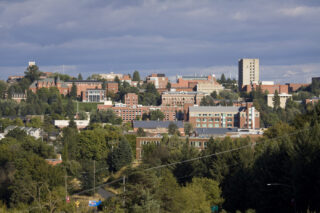
The college’s main campus is WSU Health Sciences Spokane, in Spokane’s University District next to downtown. The campus sits along the Spokane River and the Centennial Trail, which many students use to walk or bike to class. Students spend their first two years here before moving to their clinical region.
Campus Facilities
The WSU Health Sciences Spokane campus brings together medicine, nursing, pharmacy and other health sciences programs, which creates a natural setting for interprofessional learning. Key facilities include:
- The Medicine Building. WSU Spokane renovated the Medicine Building in 2023, providing 113,000 square feet of flexible learning spaces, a student collaboration hub and a testing center.
- The Virtual Clinical Center. This simulation center includes 10 clinical exam rooms, two high-fidelity simulation suites, a skills classroom and a conference room for video debriefing. It supports standardized patients, manikin-based simulation, task trainers and computerized simulation. In 2024 it launched a mobile simulation unit to bring simulation training to learners and providers across the state.
- The Pharmaceutical and Biomedical Sciences Building. Opened in 2013, it provides 125,000 square feet for interprofessional education, clinical simulation and research.
- Anatomy teaching. Anatomy is a core first-year subject and a thread throughout the pre-clerkship years, supported by digital tools such as Complete Anatomy.
- Regional campuses. Third- and fourth-year students in Everett are based in a new building at 915 N. Broadway. The Tri-Cities campus sits in Columbia Basin College’s Health Science Center near Richland, and the Vancouver campus is downtown.
Academic support comes from the Office of Student Learning (also called the Student Learning Center), which offers a learning specialist, tutoring, workshops, accommodations support, faculty coaching and USMLE Step preparation. Every student is assigned a faculty academic coach for all four years and also has a USMLE Step 1 coach. Students needing accommodations work with WSU Spokane Access Services.
Student Life
The college works to create a supportive community. Peer mentoring, student organizations, wellness programs and community events all help students connect.
Housing and Living Arrangements
The college does not provide on-campus housing for medical students, so most students rent in Spokane for the first two years and then find housing in their clinical region. Every student with a WSU email address gets free access to Places4Students, an off-campus housing registry for finding housing, roommates and sublets in Spokane, and Student Affairs runs a Slack community where medical students can find roommates and post housing needs. Housing costs in the clinical years vary by region and by your choices about location and distance. The Year 1 cost of attendance budgets $14,235 for housing. During Clinical Campus Weeks, the Community Hosting and Homestay Program provides free housing in Everett, Tri-Cities and Vancouver with volunteer community hosts, who must offer a private bedroom, kitchen access, internet and a house key within a 40-minute drive of campus. Hosts also introduce students to the community, and the college holds community nights for students and hosts. Students are responsible for their own travel to Clinical Campus Weeks. A driver’s license and a vehicle are recommended, because students also drive to clinical sites in Years 3 and 4 and public transportation does not reach every site.
Student Organizations and Interest Groups
Students can join Student Interest Groups (SIGs), which meet informally with a faculty advisor, and Registered Student Organizations (RSOs), which can host events, invite speakers and request funding. The 2025-2026 RSO list includes:
- Career interest groups: allergy and immunology, anesthesiology, cardiology and preventive medicine, dermatology, emergency medicine, plastic and reconstructive surgery, family medicine, general surgery, hematology and oncology, internal medicine, medical technology, neurology, OB/GYN, ophthalmology, pathology, pediatric diabetes, pediatrics, physical medicine and rehabilitation, psychiatry, radiology, rural medicine, ultrasound and urology.
- Advocacy groups: Community Health, Environmental Justice, Global Health, Harm Reduction Action Team, Health Equity Circle, Health Sciences Student Advocacy Association, Medical Students for Size Inclusivity, Medical Students for Choice and the Child Health Action Team.
- Wellness groups: climbing, crafts, medicinal gardening, outdoor activities, pickleball and winter activities.
The college also has a chapter of the Student National Medical Association (SNMA), which leads the CougDoc Applicant Mock Interview (CAMI) Project for interview invitees. Student interest groups also include the Latino Medical Student Association, Women in Medicine, Military Medicine, Non-Traditional Students and an LGBTQI+ Health interest group. These organizations host events, lectures and service activities that help students build leadership skills and professional networks.
Health equity and tribal health support. The college’s Office for Health Equity runs the pathway programs, an annual conference and community partnerships. WSU’s Native American Health Sciences office partners with the college on the RISE and Nmryaqs pathways and supports Native American students and community engagement. The WSU Health Sciences Spokane Student Diversity Center offers additional resources, including support for gender and sexual minority students.
Student Wellness Programs
The college treats well-being as an ongoing practice and offers a range of options:
- A six-week mindfulness and meditation course on Wednesday evenings, in person and on Zoom
- A peer mentor program that pairs each incoming student with a second-year student
- Therapy dogs on campus during every exam week
- “My MD-to-Be,” an email series that explains each stage of medical school to students’ supporters
- A Student Well-Being Advisory Committee open to student members
The WSU Spokane student health fee covers free, confidential counseling for all medical students, wherever they are assigned, and a crisis line is available after hours. The WSU Health Student Clinic provides primary care and telehealth to students in every region, and each regional campus lists local primary care and counseling options.
Community Engagement and Service Learning
Service is part of student life and the curriculum. Every student volunteers at a community organization of their choice, and service learning is a curriculum thread in the first two years. Students also connect with their clinical communities through homestays, community nights and long-term clinical placements. The college partners with hospitals, clinics, tribal health programs and community organizations across the state, and its affiliated clinics and mobile outreach programs give students and faculty more ways to serve.
Celebrating Milestones and Achievements
The college marks important transitions with shared events. Year 1 begins with a White Coat Ceremony at the end of orientation week, when families and friends join faculty in welcoming students to the profession. Match Day in March celebrates where each graduating class will train, and Commencement takes place in early May. Admitted applicants are also invited to Future CougDoc Visit Days in January, April and May.
Off-Campus Life in Spokane
Spokane offers city amenities without big-city costs, along with quick access to the outdoors:
- Outdoor recreation: the Centennial Trail runs 37 miles from a forested park west of Spokane to the Idaho border, and the region is known for hiking, skiing and river activities.
- Cultural events: the University District borders downtown, which is within walking distance of eastern Washington’s top restaurants and entertainment venues, along with galleries, live music and theater.
- Food and dining: downtown restaurants, cafes and markets are close to campus.
In the clinical years, your region shapes daily life. The Tri-Cities average more than 300 sunny days a year and sit in Washington wine country. Everett is a waterfront city with the largest public marina on the West Coast. Vancouver puts Portland’s attractions minutes away.
Clinical Rotations and Research Opportunities
The college’s clinical program is designed to give students diverse, immersive experience in patient care across a wide range of settings. Clinical training happens in urban and rural environments, so students see different healthcare systems and patient populations. The college also supports research, particularly on challenges that affect rural and underserved communities.
Clinical Rotations
Clinical training starts with Clinical Campus Weeks and Spokane clinic half days in Years 1 and 2 and becomes full time in Years 3 and 4 at your regional campus. In this community-based model, students train in partner hospitals, clinics, tribal health facilities and community settings rather than a university-owned teaching hospital, and they learn mostly from experienced community physicians.
Core Clinical Rotations
The college covers the core disciplines through its Year 3 Longitudinal Integrated Clerkship rather than separate block rotations. Over 46 weeks, students care for patients in all six clinical care domains at once: adult ambulatory care (internal and family medicine), adult hospital care, obstetrics and gynecology, psychiatry, pediatrics and surgery. The LIC is described on the college’s Longitudinal Integrated Clerkship page.
Students work alongside attending physicians and other healthcare professionals in settings that range from small rural clinics to large urban hospitals. Year 4 adds a four-week sub-internship in family medicine, internal medicine, surgery, pediatrics, psychiatry or OB/GYN, with extra responsibility under supervision, and a required four-week emergency medicine rotation.
Rural and Underserved Clinical Rotation
Every student completes a four-week underserved rotation in Year 4, either Rural Underserved Medicine or Urban Underserved Medicine. It can be completed at any time in the fourth year. Students work in rural clinics, tribal health centers or underserved urban settings, caring for people who often face major barriers to healthcare, and they learn how social, economic and cultural factors affect health. Combined with the required community volunteering, this rotation reflects the college’s goal of training physicians who can address health disparities and provide patient-centered care where it is most needed.
Longitudinal Integrated Clerkships (LICs)
All third-year students complete the 46-week LIC at their regional campus: Spokane, Everett, Tri-Cities or Vancouver. In a traditional block clerkship, students focus on one discipline for a few weeks before switching. In the LIC, each discipline is woven into the weekly schedule for the full year. The college lists these benefits:
- Students participate more fully in patient care alongside community providers.
- Continuous practice improves recall and builds clinical skills across specialties.
- Students spend more time with preceptors and build stronger professional networks.
- Following the same patient panel over time builds relationships and empathy.
- Patients benefit from continuity with the same care team.
The college notes that only five accredited U.S. medical schools reported LICs in 2000, and it is one of a growing number that have adopted the model.
Elective Rotations
In Year 4, students complete 24 weeks of electives, chosen from more than 100 options. Electives run two to four weeks and cover most specialties and many healthcare settings. Domestic and international away rotations, research electives and virtual courses are available, and students can design their own rotation with administrative approval. Many students use electives to explore careers and work with mentors in their field of interest before residency applications.
Where Graduates Match
The college has completed six Matches. In the 2026 Match, it reported 97.4% residency attainment, with 29.7% of graduates matching in Washington, 37.8% in the Pacific Northwest (Washington, Oregon, Idaho and Alaska) and 51.3% in primary care specialties. Graduates matched into anesthesiology, diagnostic radiology, emergency medicine, family medicine, general surgery, internal medicine, interventional radiology, OB/GYN, orthopedic surgery, otolaryngology, pathology, pediatrics, physical medicine and rehabilitation, psychiatry and urology. Programs ranged from the University of Washington, Virginia Mason Franciscan Health and OHSU to Mayo Clinic and Brown University. Full results are on the college’s Match Day page.
Research Opportunities
The college is focused on training community-based physicians, but it also offers real research opportunities, especially on healthcare access, health disparities and public health. Its Office of Research reports more than $20.5 million in annual research funding year to date. Direct federal research grants and contracts totaled $14,976,327 in fiscal year 2024.
Focus Areas for Research
College faculty and labs work in several areas that connect to the mission:
- Addiction: the Program of Excellence in Addictions Research (PEAR), the Analytics and PsychoPharmacology Laboratory, PRISM (substance use and mental health) and the Translational Addiction Research Center.
- Community health and health disparities: the Institute for Research and Education to Advance Community Health (IREACH), along with spatial epidemiology work on access to care.
- Autism and neurodevelopment: the Early Social Communication and Language Lab and related programs.
- Cancer, neuroscience and sleep: including sleep and human performance research.
- Nutrition and exercise physiology, health policy, bioethics and diabetes and cognition.
Student Participation in Research
Every MD student completes a Scholarship and Discovery project. Foundations of Scholarship and Discovery I begins in Year 1. Students must finish the second course, MEDSCHLR 520, by the end of Year 3 and the third, MEDSCHLR 540, by the end of Year 4. Projects can be traditional research or creative work in areas such as arts and humanities, medical education, rural health, bioengineering or leadership. Each student has a faculty advisor and chooses a supervisor with relevant expertise. Students can also take a research elective in Year 4 or join extracurricular research at any time. The college encourages students to present at regional, statewide and national conferences and to publish in journals.
Research Mentorship and Support
The Student and Resident Research unit helps students find faculty mentors, identify funding, get support with research design and statistics through WSU’s Center for Interdisciplinary Statistical Education and Research (CISER) and prepare work for presentation and publication. The college publicizes extramural grant opportunities and offers intramural funds for eligible student research expenses.
Global Health and Research
The college’s focus is Washington, but students can look beyond it. Year 4 electives include international away rotations, and students run a Global Health advocacy group. In 2025, 13% of graduating seniors reported a global health experience during medical school. Students interested in low-resource settings can combine these with research on health disparities at home. Before medical school, some students build this interest through pre-med internships abroad or other medical internships abroad that place them in clinical settings with limited resources.
Through its clinical model and research support, the college prepares students to address health disparities and improve access to care in communities across Washington and beyond.
Notable Alumni, Faculty, Leadership and Admissions Staff
The Elson S. Floyd College of Medicine is a young school, but it already has a group of leaders, faculty and alumni whose work shows what the mission looks like in practice. The profiles below use the college’s own directory, leadership and alumni pages. Titles were checked on October 17, 2026. Knowing who these people are will not change how your file is scored, but it helps you understand the school’s priorities and speak about them accurately in essays and interviews.
School Leadership
James M. Record, MD, JD, FACP: Dean
Dr. Record is dean of the Elson S. Floyd College of Medicine. He is an internist who earned his MD at the University of Massachusetts Medical School, completed his internal medicine residency at Brown University/Rhode Island Hospital and also earned a law degree from Rutgers. Before WSU, he served as dean and vice dean of Chicago Medical School at Rosalind Franklin University of Medicine and Science, provost of Ross University School of Medicine and associate dean at New York Medical School. At WSU he first led graduate medical education, continuing medical education and partnerships, then became interim dean in 2022 and dean in 2023. His tenure has included the launch of the college’s pediatric residency and first fellowship. For applicants, his background in both medicine and law is a reminder that the college values leadership and systems thinking, which is reflected in its four-year leadership curriculum.
Jeff Haney, MD: Senior Vice Provost for Health Sciences and Vice Dean for Clinical Affairs
Dr. Haney is a board-certified family physician with deep Washington roots. He earned his bachelor’s degree in biology at Washington State University and his MD at the University of Washington, then trained at the Sutter Santa Rosa/UCSF Family Medicine Residency, where he later served as program director and designated institutional official. At WSU he chairs the Department of Medical Education and Clinical Sciences, served as clinical education director for family medicine and now oversees clinical affairs. His career in family medicine and residency education connects directly to the college’s primary care outcomes.
Radha Nandagopal, MD, FAAP: Vice Dean for Educational and Faculty Affairs
Dr. Nandagopal chaired the college’s Admissions Committee from 2016 to 2024, which means she helped design the admissions process applicants go through today. The college’s timeline page still quotes her, as founding Admissions Committee Chair, explaining that the interview is meant to show “your ability to problem solve and demonstrate critical thinking skills.” She is a pediatric endocrinologist with Providence Medical Group and Sacred Heart Children’s Medical Center in Spokane, earned her MD with honors at the University of Washington and trained at Emory and the National Institutes of Health. She also directed clinical skills education and the Year 2 Art and Practice of Medicine course.
Sterling M. McPherson, PhD: Professor and Vice Dean for Research
Dr. McPherson leads research at the college and directs the Program of Excellence in Addictions Research (PEAR), where he heads the Analytics and PsychoPharmacology Laboratory. He earned his PhD, MS and a postdoctoral fellowship at Washington State University. He has secured more than $35 million in grants and contracts as principal investigator, mostly from the National Institutes of Health, and has published more than 150 peer-reviewed articles. His work focuses on contingency management combined with medications for alcohol, tobacco, methamphetamine and opioid use. For applicants interested in addiction medicine or research, his program is one of the college’s strongest research areas.
Lisa Burch-Windrem, EdD, MEd: Associate Dean for Student Affairs
Dr. Burch-Windrem leads Student Affairs, which supports students’ well-being, learning communities and professional development. She earned her EdD in organizational leadership at the University of Dayton, with a dissertation on compassion fatigue among medical education student affairs professionals, and previously worked in student life and advising roles at nursing and undergraduate institutions. Her office runs the student programs described in the student life section.
Admissions Leadership and Staff
Leila Harrison, PhD, MA, MEd: Vice Dean for Learner Engagement
Dr. Harrison is Vice Dean for Learner Engagement and an associate professor in the college’s Admissions and Recruitment unit. The MD apply page also quotes her as Vice Dean for Admissions, Student Affairs, and Alumni Engagement. Her research focuses on mission-aligned admissions. In 2024 she was lead author of an Academic Medicine study on the impact of masking academic metrics on enrolling a broadly diverse and mission-aligned student body, which describes the very process the college uses. Her published interests also include residency placement for nontraditional students, student resilience and emotional intelligence. If you want to understand why the school hides GPA and MCAT after the secondary, her work is the best place to start.
Keith Klauss, MPA: Senior Director of Admissions
Keith Klauss oversees the application and interview processes. He is also a general medical school advisor and works with the Honors College Pathway program, so he can advise students interested in that pathway. Prospective applicants can schedule Zoom advising appointments with him through the contact page.
Rachel Dryer: Admissions and Career Advising Academic Coordinator
Rachel Dryer is a general medical school advisor who knows the residency and prerequisite rules in detail. If you are unsure whether you meet the ties, resident student or course requirements, she is one of the advisors the college lists for exactly those questions. She also supports first-year students as they begin exploring careers.
Notable Faculty
Dawn Elise DeWitt, MD, MSc, CMedEd, MACP, FRACP: Professor and Director, CIPHERS Education Scholars Program
Dr. DeWitt is an internist and medical educator who has led programs in the United States, Canada and Australia. A Harvard Medical School graduate with an MSc from Cambridge, she served as associate dean for undergraduate medical education at the University of British Columbia and as dean of a rural clinical school at the University of Melbourne. At WSU she was the inaugural vice dean for student and faculty experience, inaugural associate dean for clinical education in Spokane, inaugural Year 4 director and founding director and senior associate dean of CIPHERS (Collaboration for InterProfessional Health Research Education and Scholarship). She now directs the CIPHERS Education Scholars Program and sees patients at the MultiCare Rockwood Endocrinology and Diabetes Education Clinic in Spokane. Her rural education background fits the college’s distributed model.
Ofer Amram, PhD: Associate Professor
Dr. Amram is a spatial epidemiologist in the Department of Nutrition and Exercise Physiology. He earned a joint PhD from Simon Fraser University and Ben Gurion University on the social determinants of pediatric injuries and access to trauma centers, then completed postdoctoral training at the BC Centre for Excellence in HIV/AIDS. His research uses geographic information systems to study how place, environment and access to services affect health outcomes. That is exactly the kind of question rural Washington raises, and it shows students one way to turn the mission into research.
Richard Bruno, MD, MPH, FAAFP, FACPM, AAHIVS: Associate Professor
Dr. Bruno is an associate professor in the Department of Medical Education and Clinical Sciences. He holds a Master of Public Health from Johns Hopkins, a medical doctorate from OHSU and a bachelor’s degree from Princeton. His credentials as a fellow of the American Academy of Family Physicians and the American College of Preventive Medicine and as an HIV specialist reflect a career that joins primary care with public health. His work supports the college’s emphasis on preventive care and community health for underserved populations.
Chris Anderson, MD, FAAP, CEPS-PC: Vice Chair, Pediatrics
Dr. Anderson is vice chair of pediatrics and a pediatric cardiologist who specializes in electrophysiology. He trained in pediatrics at Baylor College of Medicine, in pediatric cardiology at UCLA and in pediatric electrophysiology at Children’s Memorial Hospital in Chicago. He received the college’s Excellence in Teaching Award in 2022 and has published research on reducing fluoroscopy in pediatric catheter ablation. His role helps shape the pediatric training students receive.
Gregory Carter, MD: Professor (Affiliate Faculty)
Dr. Carter is affiliate faculty in Medical Education and Clinical Sciences. He is a physical medicine and rehabilitation physician who trained at UC Davis and completed a neuromuscular disease fellowship and a pain fellowship at the University of Washington, where he was a clinical professor of rehabilitation medicine. His research on neuromuscular disease and rehabilitation has earned national awards, including a Distinguished Researcher Award from the American Association of Neuromuscular and Electrodiagnostic Medicine.
Kimberly Beine, MD: Pre-Clerkship Co-Director
Dr. Beine co-directs the pre-clerkship curriculum. The college quotes her explaining that its required leadership certificate “spans all four years of our program” and that the curriculum is refined regularly, with priority on health justice and advances in technology. If you want to talk about the leadership curriculum in an essay or interview, her description is a good summary of what it is meant to do.
Faculty Research and Clinical Contributions
Faculty research and clinical work connect closely to the mission. Dr. Amram’s spatial epidemiology studies access to care, Dr. McPherson’s addiction research tests treatments for substance use disorders and Dr. Bruno’s work joins primary care with public health. Many faculty, including Dr. DeWitt, Dr. Nandagopal and Dr. Anderson, are practicing clinicians. Every MD student has a faculty advisor for the required Scholarship and Discovery project and chooses a supervisor in their area of interest, so students can work with faculty on questions that matter to Washington communities. Beyond the college’s own faculty, most clinical teaching comes from community physicians at more than 250 partner sites, whom the college recognizes each year at community partner awards ceremonies.
Distinguished Alumni
The college graduated its first class in 2021, so its alumni are early in their careers. Even so, the college reports that 65.1% of practicing alumni from its first three classes (2021, 2022 and 2023) are practicing in Washington, 74.6% are practicing in a Health Professional Shortage Area and 89.7% of those who completed residency in Washington stayed to practice. The college shares where graduates went for residency, fellowship and practice, with their permission, on its MD alumni page.
Dr. Samuel Adams (Class of 2023)
Dr. Adams matched into pediatrics at Spectrum Health/Michigan State University in Grand Rapids, Michigan, and went on to a pediatric nephrology fellowship at Indiana University School of Medicine’s Riley Children’s Hospital. His path shows how graduates use primary care residencies as a base for subspecialty training.
Dr. Danielle Banks (Class of 2023)
Dr. Banks completed family medicine residency at Providence Sacred Heart Medical Center in Spokane and now practices with PeaceHealth in Vancouver, Washington. Her career follows the path the college hopes for: Washington training, Washington residency and Washington practice.
Dr. Brooke Byun (Class of 2023)
Dr. Byun matched into the combined psychiatry and family medicine program at the University of Iowa Hospitals and Clinics. That dual training reflects the growing need for integrated mental and physical healthcare.
Dr. Alexandra Dullea (Class of 2023)
Dr. Dullea matched into urology at the University of Miami School of Medicine, showing that graduates of a primary care-focused school also match into competitive surgical specialties.
Dr. Esmeralda Lopez (Class of 2023)
Dr. Lopez matched into pediatrics at Children’s Hospital Oakland in California.
Dr. Reilly Bealer (Class of 2023)
A Spokane native, Dr. Bealer is an OB/GYN resident at the University of North Carolina at Chapel Hill. In October 2026, the college announced that she matched into a Northwestern University fellowship in complex benign gynecology at McGaw Medical Center in Chicago, starting in July 2027.
Dr. Kalkena Sivanesam (Class of 2023)
As a student, Dr. Sivanesam created the CougDoc Applicant Mock Interview (CAMI) Project, the student-led program that offers free mock interviews to every applicant the college invites to interview. It has run every cycle since 2020-2021. She matched into anesthesiology at the University of Nebraska Medical Center. If you are invited to interview, you will benefit from her work directly.
Dr. Kendall Vignaroli (Class of 2022)
Dr. Vignaroli is chief resident in general surgery at Arrowhead Regional Medical Center/Kaiser Fontana, which serves the medically underserved community of Colton, California. In July 2026, the college announced her match into a Johns Hopkins breast surgical oncology fellowship beginning in August 2027. She plans to return to Washington as a breast cancer surgeon.
Dr. Amber Huang (Class of 2022)
Dr. Huang trained in general surgery at Swedish Medical Center in Seattle, where she served as a surgery chief resident, and matched into a surgical critical care fellowship at Oregon Health and Science University, Oregon’s only academic Level 1 trauma center.
Dr. Brent Conrad (Class of 2021)
Dr. Conrad, a member of the college’s first graduating class, completed family medicine residency at the Spokane Teaching Health Center and Sacred Heart Medical Center and practices with Whitman Hospital and Medical Clinics in Colfax. In August 2026, he cared for wildfire evacuees in Spokane through the Spokane Medical Reserve Corps. He grew up on a small farm in eastern Washington and credits rural rotations during medical school with teaching him to care for patients when resources are limited.
Through its faculty and alumni, the college is building a reputation for community-based medical education, research and clinical care, with a visible impact in rural and underserved Washington.
Admissions Statistics and Class Profile
The college publishes unusually detailed admissions data, including a full funnel for each recent cycle. The figures below come from its Class of 2030 profile and applicant pool data for all cycles.
Application Information
| Item | 2026-2027 cycle |
|---|---|
| Primary application service | AMCAS |
| AMCAS submissions begin | Late May 2026 |
| AMCAS deadline | October 15, 2026, 11:59 p.m. Eastern |
| Secondary deadline | December 1, 2026, 5:00 p.m. Pacific |
| Secondary fee | $50, nonrefundable; waived with AAMC FAP approval |
| Interview invitations | As early as July 2026 |
| Interview format | All virtual: two 10-minute live structured interviews plus four recorded prompts |
| Letters of recommendation | 3 individual letters or 1 committee letter (maximum 4 letters); no family or friends; dated in the current year, on letterhead, signed |
| PREview or situational judgment test | Not used; no added assessments |
| Acceptance notices | Rolling; latest notices by August 18, 2027; two weeks to respond to offers made before April 30 |
| Deferral | Considered case by case |
| Early Decision Program | Not offered |
| Pre-enrollment deposit | Not required |
| DACA, Canadian and international applicants | Not accepted |
| Criminal background check | Required for accepted applicants before matriculation |
Admission Statistics: The Class of 2030 Funnel
For the class that entered in August 2026:
| Stage | Number |
|---|---|
| AMCAS applications | 1,669 |
| Secondary applications sent | 773 |
| Complete applications (secondary submitted) | 723 |
| Interviewed | 350 |
| Accepted (all offers, not final matriculants) | 138 |
| Matriculated | 80 |
A few ratios help put this in context. Fewer than half of AMCAS applicants (773 of 1,669) received a secondary, because many did not meet the ties, citizenship, letters or GPA and MCAT rules. Of the 723 complete applications, 350 were interviewed, a little under half. Offers went to 138 applicants, and the college reports its acceptance rate for this class as 18.4%, which it defines as offers divided by complete applications. The college also reports a yield of 1.77 offers per seat. Dividing the 80 matriculants by all 1,669 AMCAS applicants gives about 4.8%, but that is a matriculation ratio, not an acceptance rate, so it understates your odds if you meet the secondary requirements.
Four-Year Trend
| Entering year (class) | Complete applications | Interviewed | Accepted |
|---|---|---|---|
| 2023 (Class of 2027) | 655 | 304 | 132 |
| 2024 (Class of 2028) | 628 | 298 | 164 |
| 2025 (Class of 2029) | 636 | 318 | 151 |
| 2026 (Class of 2030) | 723 | 350 | 138 |
Complete applications rose about 14% from entering year 2025 to 2026, while the number of offers fell, so the latest cycle was more competitive than the one before.
In-State and Out-of-State Applicants
Applicants who live outside Washington can qualify through family and childhood ties, and many do apply. Few of them reach the interview or enroll, because most out-of-state applicants do not meet the ties rule.
| Stage | In-state | Out-of-state | International | Total | Year and group | Source |
|---|---|---|---|---|---|---|
| Verified applications | 807 | 761 | 6 | 1,574 | 2025 entering class (Class of 2029) | AAMC MSAR, 2026 edition |
| Interviewed | 326 | 24 | 0 | 350 | Class of 2030 interview cycle | AAMC MSAR, 2026 edition |
| Matriculated | 80 | 0 | 0 | 80 | 2025 entering class (Class of 2029) | AAMC MSAR, 2026 edition |
Residency here follows the AAMC’s state-of-residence classification, which can differ from the college’s own ties rule. In the 2025 entering class, about half of verified applicants listed a home state other than Washington, yet every matriculant was classified as in-state, and two admitted applicants deferred entry. In the Class of 2030 interview cycle, 93.1% of interviewees were Washington residents. If you live elsewhere, confirm that you meet 3 of 4 ties before you add this school to your AMCAS list.
Academic Profile
| Measure | Class of 2030 matriculants | Current student body (Classes of 2027-2030) |
|---|---|---|
| Mean overall GPA | 3.72 (range 2.53-4.00) | 3.68 |
| Mean science (BCPM) GPA | 3.62 (range 2.58-4.00) | 3.57 |
| Mean MCAT | 508.8 (range 496-524) | 508.1 |
The college notes that applicants with overall GPAs below 2.6 met a threshold using their graduate GPA. These are means for enrolled students, and they are not minimums.
Medians for all accepted applicants are available for the 2025 entering class:
| Measure | Median | Mean | Year and group | Source |
|---|---|---|---|---|
| Overall GPA | 3.74 | 3.7 | 2025 entering class, all accepted applicants | AAMC MSAR, 2026 edition |
| Science GPA | 3.63 | 3.6 | 2025 entering class, all accepted applicants | AAMC MSAR, 2026 edition |
| MCAT total | 508 | 508.3 | 2025 entering class, all accepted applicants | AAMC MSAR, 2026 edition |
| MCAT sections | 126 Chemical and Physical; 126 CARS; 127 Biological and Biochemical; 128 Psychological and Social | 126.8; 126.1; 127.2; 128.1 | 2025 entering class, all accepted applicants | AAMC MSAR, 2026 edition |
The medians sit close to the Class of 2030 means, so the admitted pool looks similar from one year to the next. Because GPA and MCAT are masked after the secondary, scores well above the thresholds do not earn extra credit in the committee’s review. Meeting a threshold is what matters for getting a secondary.
Class of 2030 Demographics
| Characteristic | Class of 2030 |
|---|---|
| Washington residents | 96.3% (87.5% had at least 3 Washington ties) |
| Grew up in a rural county | 18.8% |
| Washington counties represented | 19 |
| First-generation college graduates | 16.3% |
| Low socioeconomic status (Pell Grant or FAP) | 38.8% |
| Underrepresented in medicine | 12.5% |
| Women | 61.3% |
| Average age (range) | 25 (21-38) |
| Nontraditional (25 and older) | 38.8% |
| Advanced degrees | 11.3% |
| Reapplicants | 20% |
| Multilingual | 80% (20 languages) |
The college marks gender, age, race and ethnicity as characteristics that are not considered in admissions and reports them only to describe the class. The 20% reapplicant share is worth noticing: one in five members of the newest class was admitted after applying before.
Self-reported data for the 2025 entering class adds more background:
| Characteristic | 2025 entering class (Class of 2029) | Source |
|---|---|---|
| Matriculants with a graduate degree | 6% | AAMC MSAR, 2026 edition |
| Science or math majors | 75% | AAMC MSAR, 2026 edition |
| Self-reported disadvantaged status | 45% | AAMC MSAR, 2026 edition |
| Grew up in a medically underserved area | 33% | AAMC MSAR, 2026 edition |
| Gender | 48 women, 32 men | AAMC MSAR, 2026 edition |
| Age at entry | 30 aged 19-23; 41 aged 24-29; 6 aged 30-39; 3 aged 40 or older | AAMC MSAR, 2026 edition |
| Students entering through early assurance | 7 (all in-state); 11 early assurance seats planned out of 80 new entrants | AAMC MSAR, 2026 edition |
General Information
- Founded: authorized by law in 2015; first MD class of 60 in 2017
- Total enrollment: about 320 MD students (Classes of 2027-2030), all with strong Washington ties or residency, from 32 Washington counties
- Campus type: urban main campus in Spokane; clinical regions in Spokane, Tri-Cities, Vancouver and Everett
- Classes begin: August 24, 2027 (Welcome Week August 17-21)
- Tuition and fees: $44,944 tuition plus $599 S&A fee for 2026-27, at the in-state rate for all admitted students
- Total cost of attendance: $78,650.50 for Year 1 in 2026-27
- Financial aid: 83% of enrolled and graduated students received aid in 2024-25
- Average graduate debt: $217,037 for indebted graduates in 2024-25
- Federal research funding: $14,976,327 in direct federal grants and contracts, fiscal year 2024
Residency Match Statistics
| Graduating class | Residency attainment | Matched in Washington | Matched in the Western U.S. | Matched in primary care |
|---|---|---|---|---|
| Class of 2021 | 100% | 39% | 73% | 55.3% |
| Class of 2022 | 100% | 41% | 73% | 51.8% |
| Class of 2023 | 100% | 28% | 60% | 53% |
| Class of 2024 | 100% | 29% | 71% | 51.5% |
| Class of 2026 | 97.4% | 29.7% | Not reported (37.8% Pacific Northwest) | 51.3% |
Residency attainment includes all placements to date. The 2026 Washington figure includes graduates who complete a first-year (PGY-1) position in Washington before moving out of state. Primary care, as the college counts it, includes family medicine, internal medicine, medicine-pediatrics and OB/GYN.
Specialty Training for the Graduating Class
Graduates in the 2026 Match entered 17 specialty categories: anesthesiology, diagnostic radiology, emergency medicine, family medicine, general surgery, preliminary general surgery, internal medicine, preliminary internal medicine, interventional radiology, OB/GYN, orthopedic surgery, otolaryngology, pathology, pediatrics, physical medicine and rehabilitation, psychiatry and urology. Internal medicine was the largest group on the published list (20 of 71 listed matches), followed by general surgery (11) and family medicine (7).
Combined Degree Programs
The college does not offer MD dual-degree programs such as MD/PhD, MD/MPH or MD/MBA. All MD students earn a certificate in leadership in medicine and healthcare.
The college remains focused on healthcare challenges in rural and underserved areas of Washington. Its admissions data shows a process that selects students with strong Washington ties and a desire to serve the state’s communities.
Tips and Strategies for Admission
Applying to the Elson S. Floyd College of Medicine takes a plan that highlights your connection to Washington, your experiences with communities facing barriers and your readiness for a demanding clinical curriculum. These strategies follow the way the college actually reviews files.
Start With the Gate: Confirm You Qualify
Before anything else, confirm the four non-negotiables: citizenship or permanent residency, 3 of 4 Washington ties or resident student status, one GPA and MCAT combination, and letters on file. The college’s online questionnaire checks this. If you are close on residency, read the resident student definitions carefully, because the one-year clock is measured to the first day of your first fall term.
Align with the School’s Mission
The college focuses on solving healthcare problems in Washington, especially in rural communities, Tribal Nations and historically marginalized communities. Your application should show experiences where you served those communities and what you learned from them. Show how your goals connect to improving healthcare in Washington, using specific places and people rather than general statements.
Showcase Commitment to Service and Community Engagement
The college values both healthcare and non-healthcare service. It lists service as “non-healthcare activities that serve others beyond oneself,” separate from clinical exposure. A sustained commitment to one food bank, youth program or tribal community event often says more than a long list of one-time events. Cultural humility and an understanding of healthcare disparities are the qualities the committee is looking for.
Tell Your Unique Story
Your personal statement is your chance to explain your path to medicine. Go beyond listing accomplishments. Connect your personal values to the college’s mission, and share specific experiences that shaped your interest in caring for Washington’s communities. Applicants who grew up in Washington should name the communities that shaped them. Applicants who qualify through residency or family ties should explain their connection clearly.
Reflect on Your Experiences
The committee scores reflection, not just activity. The college’s own guiding questions are a useful checklist: What communities have you served, and what did you learn about them and about yourself? What opportunities broadened your worldview? What adversities have you overcome? What leadership roles challenged you? What values guide your choices? Build each experience description around what happened, what you did and what changed in your thinking.
Practice Ethical and Clinical Scenarios
The interview includes four recorded scenario or behavioral prompts with three minutes each, plus two live structured interviews. Practice talking through ethical dilemmas, rural healthcare tradeoffs, team conflict and situations with limited resources. Use a clear structure: state the issue, name the people affected, weigh options and choose a reasonable action.
Develop Strong Communication Skills
Communication and interpersonal skills are one of the six attributes the college scores. Practice speaking clearly and concisely, especially about rural healthcare and serving underserved communities. Because the recorded prompts have no follow-up questions, you must make your point without help, so practice finishing a complete answer in under three minutes.
Choose Recommenders Who Know You Well
Select writers who can speak to your strengths in clinical, service, research or leadership roles, especially those tied to the college’s attributes. If you are recently in school, include at least one faculty member who knows you well. If you have been out of school for some years, an employment supervisor is a good choice.
Provide Context to Your Recommenders
Make sure your writers understand your goals. Share your personal statement, resume and the college’s list of attributes so they can write letters that reflect your commitment to serving communities and solving healthcare problems. Remind them that letters should be on letterhead, signed and dated in the current year.
Clinical Experience
Emphasize hands-on healthcare experience, especially in rural or underserved settings. The college counts shadowing, scribing, EMT work and caring for family members at home, and it sets no minimum number of hours. Focus on what you learned about patient care in different environments. If you need more depth, pre-med internships with supervised patient contact, local clinic work or volunteer roles can help, especially when you reflect on them well.
Research Involvement
Research is not required for admission, but every MD student completes a Scholarship and Discovery project. If you have research experience, especially in community health, rural medicine or health disparities, describe your role and what you learned. Applicants without research can still show the curiosity and problem-solving the college values through quality improvement work or service projects.
Community Service
Highlight volunteer work in rural and underserved settings and what it taught you about healthcare disparities. Remember that the college values non-healthcare service on its own, so include tutoring, coaching, faith-based service or community organizing if it was meaningful to you.
Use Summers and Gap Years Well
With 38.8% of the Class of 2030 aged 25 or older, gap years are common here. A summer or gap year can fill gaps in clinical exposure, service or leadership. Some students use pre-med summer internships to add patient contact before application season, while others work as medical assistants, scribes or EMTs. Choose what lets you build a real story you can reflect on.
Balance GPA and MCAT
Because GPA and MCAT are masked after the secondary, your goal is to clear one of the three combinations, then put your energy into experiences, reflection and essays. If you are near a threshold, look at the combinations carefully. A higher GPA band needs a lower MCAT percentile, and you need only one combination. Strong academic preparation still matters for medical school itself, and reviewers can see grade trends.
Address Any Academic Weaknesses
If your record has a dip in grades, address it in your personal statement or the resilience essay. Explain what happened, what you changed and how your later performance shows readiness. If you are below the undergraduate thresholds, a graduate degree in medical, clinical or basic sciences with at least 18 semester credits of graduate science coursework can provide another route.
Plan for the Reapplicant Route
If you are not admitted, request the free application review over Zoom (offered October 1 to May 31, once per applicant). With 20% of the newest class being reapplicants, a focused second application is realistic. The reapplicant essay asks what you have done since your last application, so make concrete changes. Many applicants also look for internships for pre-med students or other structured clinical work during the year between applications.
Keep Your Options Open
By following these strategies, you can present yourself as a dedicated, well-rounded candidate who fits the college’s mission. It is also wise to apply to other medical schools that fit your goals and values. Related guides are listed near the end of this article, along with a longer list of medical school guides to help you build a balanced school list.
Secondary Application Questions, Example Responses and Analysis
Completing the secondary is your best chance to show how you fit the college’s mission of serving Washington’s communities. Each essay gives you room to share a part of your story, your commitment to healthcare and your goals as a future physician. For the 2026-2027 cycle, the secondary has five essays for all applicants and one essay for reapplicants. Each essay has a 300-word limit. Write to 300 words and follow the limit shown in your portal.
Here is how the secondary works this cycle:
- Who receives it: only applicants who meet every secondary requirement (citizenship or permanent residency, Washington ties or residency, a GPA and MCAT combination and letters received). It arrives by email.
- Deadline: December 1, 2026, at 5:00 p.m. Pacific. No extensions.
- Fee: $50, nonrefundable, waived for AAMC Fee Assistance Program recipients.
- Review: two screeners read your full file with your GPA and MCAT masked. Your essays carry a lot of weight because the numbers are hidden from this point on.
- Status: check the WSU admissions portal, and add [email protected] to your safe senders list.
The college does not publish an official turnaround time. Because interview seats fill on a rolling basis, returning your secondary within about two weeks is a sensible goal. For prompts from other schools, see our medical school secondary essay prompts database.
The example responses below follow one illustrative applicant from central Washington, so you can see how a single candidate can use different experiences across the set without repeating the same story. Each is labeled “Illustrative example, not an actual applicant essay.” Use them to understand structure and reflection, not as text to copy. Your essays must describe your own experiences.
Address and Washington Residence Questions
Starting with entering year 2027, once the college receives your AMCAS application, it asks you to provide any childhood home addresses in Washington to support the childhood address tie. To count, those addresses must cover at least six years (not necessarily continuous) between ages 8 and 18. Prior cycles also asked for your childhood city, state, ZIP code and county, your high school city, state, ZIP code and county, and the time frames you have lived in Washington (with each time frame at least three consecutive months, not counting college outside Washington). Have all of these ready, and make sure they match what you entered in AMCAS.
Worked response pattern (childhood city, state, ZIP code and county):
Seattle, Washington, 98115, King County
Worked response pattern (high school city, state, ZIP code and county):
Seattle, Washington, 98115, King County
Worked response pattern (time frames lived in Washington):
January 1999 to August 2014; August 2018 to present
Worked response pattern (childhood home addresses in Washington, ages 8 to 18):
1234 Example Street, Moses Lake, WA 98837, Grant County: June 2007 to August 2013 (ages 8 to 14); 5678 Sample Avenue, Moses Lake, WA 98837, Grant County: August 2013 to June 2017 (ages 14 to 18)
Use your real addresses and exact dates. Months and years are usually enough. Keep a record of documents that show where you lived, in case the college asks for proof of residency later.
Prompt 1: Mission and Vision
Prompt: “How will you contribute to the mission and vision of the Elson S. Floyd college of medicine? Support your response with your experiences and/or attributes.” (300 words; all applicants)
What it asks: The prompt has two parts. You must say how you will contribute to the mission and vision, and you must back that up with experiences or attributes. The mission is to serve Washington and beyond through collaboration and problem-solving in education, research and healthcare, with a focus on rural communities, Tribal Nations and people who have been historically marginalized. The vision is “A healthy, equitable Washington for all.”
How to approach it: Read the mission and vision closely and pick one or two parts that match your experience. Open with a concrete moment, then explain what you will do as a student, not only as a future doctor. Connect your plan to real features of the college, such as the Scholarship and Discovery project, the Longitudinal Integrated Clerkship, the clinical regions or the required community volunteering.
Example response (Illustrative example, not an actual applicant essay; 294 words):
Most Saturdays during my last two years at WSU Pullman, I drove home to Moses Lake to help at my aunt’s produce stand and to translate at the free blood pressure screenings our church hosted. I did not think of it as service. It was simply what people in my town did for each other.
Working as a medical assistant at a community health center in Pasco changed how I saw it. I roomed patients in Spanish and English, took vitals and updated medication lists. Many patients had driven past closer clinics that did not take their insurance or had no Spanish-speaking staff. One farmworker had gone four months without his diabetes medication because the pharmacy refill line was English only. The nurse and I wrote out a refill plan with him, and three months later his A1c had dropped by almost two points.
That patient taught me that problem-solving in healthcare is often small and practical: a phone number, a translated label, a follow-up call. The college’s mission asks for collaboration and problem-solving in education, research and healthcare, and I would contribute in three ways. First, I bring clinical Spanish and the habit of explaining a care plan until it makes sense to the person living it. Second, I want to use my Scholarship and Discovery project to study medication access in agricultural counties, a problem I have watched play out across the counter. Third, I would rank the Tri-Cities region first, because I know its clinics and want my Longitudinal Integrated Clerkship to deepen relationships I already have.
The vision of a healthy, equitable Washington for all is not abstract to me. It looks like that waiting room in Pasco, and it is where I plan to return as a family physician.
Analysis: This response answers both parts of the prompt. It names three concrete contributions (clinical Spanish and patient explanation, a Scholarship and Discovery research question, a regional preference for the LIC), and it supports each with experience: translating at screenings, working as a medical assistant and solving a refill problem. It uses the mission’s own language, collaboration and problem-solving, without just repeating it. The closing ties the vision to a specific place and a career goal in Washington. The patient story is short and shows the applicant acting with the care team, not alone.
Mistakes to avoid: Do not quote the mission and then praise it. Do not list every activity you have done. Do not describe only what you will do in 15 years; the prompt asks how you will contribute, which includes your time as a student. Avoid claiming you will fix rural healthcare alone.
Prompt 2: Communities Facing Significant Barriers
Prompt: “What experiences have you had with communities facing significant barriers (eg, social, cultural, access)? What have you learned from these experiences?” (300 words; all applicants)
What it asks: This is a two-part question: your experiences and your lessons. The wording is new for 2026-2027 and matches the first life experience the college lists in its admissions criteria, “Experience with Communities Facing Significant Barriers.” The examples in parentheses (social, cultural, access) suggest the committee wants you to show you understand that barriers come in different forms.
How to approach it: Choose one or two experiences where you spent real time with a community. Describe the barriers you saw in concrete terms. Spend at least half of your words on what you learned and how it changed your behavior. Personal, volunteer and work experiences all count.
Example response (Illustrative example, not an actual applicant essay; 282 words):
For two harvest seasons I volunteered with a mobile health outreach team that set up blood pressure and vaccine tables at orchards near Wenatchee. I joined because I speak Spanish, and I assumed language was the main barrier. My first week proved me wrong. A mother waited at the edge of the line holding her son’s school vaccine form. When I greeted her in Spanish, she answered politely but could not follow my questions. She spoke Mixteco. Spanish was her second language, and the form was in neither.
A coworker of hers stepped in to interpret, but the larger lesson stayed with me: barriers are layered. Social barriers showed up as fear. Some workers would not give a phone number because they worried about who might call. Cultural barriers showed up in how people described illness. One man called his chest pain “tiredness” and almost left before we checked his blood pressure. Access barriers were the most concrete. The nearest clinic closed at five, and most shifts ended at six.
I learned three things. First, ask before assuming. I now start by asking what language a person prefers and who they want in the conversation. Second, trust comes from consistency. Workers began bringing relatives once they saw that we returned to the same orchard every Thursday. Third, access is designed. When our team moved its hours to 6 to 8 p.m., the number of people we screened nearly doubled.
These experiences changed me from someone who wanted to help into someone who asks better questions. I want to carry that habit into my rural or urban underserved rotation and into a career in communities where the barrier is rarely just one thing.
Analysis: The essay covers all three types of barrier named in the prompt (social, cultural and access) with a specific example of each, which shows the applicant read the question closely. It also shows growth: the applicant’s assumption that Spanish was enough was wrong, and the essay admits it. The lessons are concrete and behavioral (ask first, show up consistently, design access), and the third one includes a result. The ending connects the lessons to the required Year 4 underserved rotation without overselling.
Mistakes to avoid: Do not write a “savior” story where you fixed a community’s problems. Do not describe a community only by its hardships; show its strengths and the people you worked with. Do not spend 250 words on the setting and 50 on the lessons. Avoid one-day service trips unless you can show real reflection.
Prompt 3: Connections to Washington
Prompt: “Describe your connections to Washington communities and your interests in practicing medicine in Washington” (300 words; all applicants)
What it asks: Two things: your connections to Washington communities and your interest in practicing medicine in Washington. Connection and commitment to Washington is one of the life experiences the college scores, defined as time in Washington, experiences there (childhood, college, volunteering, work) and a commitment to serving Washington as a physician.
How to approach it: Go beyond restating your ties. Name specific communities and what you did there. Then describe a realistic practice goal: what kind of physician, in what kind of place and why. Show that you know something about healthcare needs in that part of the state. If you qualify through residency rather than childhood ties, explain how your connection formed and why it is lasting.
Example response (Illustrative example, not an actual applicant essay; 296 words):
I was born in Moses Lake, graduated from Moses Lake High School and still call my parents’ house in Grant County home. My father has driven a potato truck for twenty years, and my mother works in a school cafeteria. Growing up, I watched specialists move farther away. When my grandmother needed a cardiologist, my mother took unpaid days off to drive her to Spokane, nearly two hours each way.
My connections to Washington grew wider in college. At WSU Pullman, I tutored chemistry students from the Palouse and the Yakima Valley who, like me, were the first in their families at a university. After graduating, I moved to Pasco to work as a medical assistant at a community health center, where I learned how the Tri-Cities absorb patients from towns with no hospital of their own. Weekends with a mobile outreach team near Wenatchee showed me the same pattern in orchard country.
My interest in practicing in Washington is specific. I want to be a family physician in central Washington who can deliver babies, manage diabetes and stay long enough to care for three generations of one family. The Elson S. Floyd College of Medicine’s model fits that goal. Clinical Campus Weeks would let me build relationships in my clinical region from the first year. A 46-week Longitudinal Integrated Clerkship would let me follow patients the way a rural doctor does. I also know that most of the college’s alumni who have entered practice are working in Washington, and I want to add to that number.
I am not looking for a place to train and leave. I am asking to train in the state that raised me so I can return the favor in a clinic like the one in Pasco, close to home.
Analysis: The response covers both parts of the prompt. It shows connections to several Washington communities (Grant County, the Palouse, the Tri-Cities and the Wenatchee area) through family, school, work and service. The practice interest is specific: family medicine, including obstetrics, in central Washington. It ties that goal to the college’s model (Clinical Campus Weeks and the 46-week LIC) and to the college’s alumni practice data, showing the applicant has done research. The family details explain why access matters to this applicant without turning the essay into a hardship story.
Mistakes to avoid: Do not just list your three or four ties; the college already knows them from your application. Do not talk about Washington’s scenery instead of its communities. Do not promise to practice in a rural town you have never visited. If your connection is recent, do not hide it; explain it honestly.
Prompt 4: Resilience
Prompt: “How have you built your resilience?” (300 words; all applicants)
What it asks: Note the wording: “how have you built,” not “describe a challenge.” The college defines resilience and adaptability as persevering through internal or external challenges, recovering from setbacks and tolerating stressful and changing situations. The prompt asks about the process of building resilience over time.
How to approach it: Choose a real challenge, but keep the description brief. Focus on the specific actions and habits that helped you recover, and show that you still use them. A good essay ends with a clear picture of how you will handle stress in medical school.
Example response (Illustrative example, not an actual applicant essay; 293 words):
The hardest semester of my life was the spring my father was injured. A pallet jack crushed his foot at the packing warehouse, and for four months he could not work. I was a junior at WSU taking organic chemistry and working twenty hours a week in a campus dining hall. Suddenly I was also sending money home and driving back on weekends to help my younger brother with school.
My grades slipped. I earned a C+ on my first organic chemistry exam, the lowest grade I had ever received. I remember sitting in my car outside the chemistry building, convinced I was not built for medicine. What changed was not a burst of motivation. It was a set of small decisions. I told my professor what was happening and asked how to study more efficiently. I traded two dining hall shifts for a tutoring job that paid the same and let me review chemistry while I worked. I made a weekly schedule with one protected evening for sleep and a call home, because I had learned that skipping rest made everything harder.
I finished the course with a B+ and earned an A- in the second semester. More important, I learned how resilience works for me. It is built before a crisis, through habits: asking for help early, being honest about my limits and keeping a few routines that steady me. It is also shared. My family got through those months because each of us carried part of the weight.
I have used those habits since, including on long clinic days in Pasco when the schedule fell apart. Medical school will bring harder semesters. I know what I will do when they come: name the problem, ask for help and keep moving.
Analysis: The essay answers “how” directly with specific habits: telling the professor early, changing jobs to fit study time and protecting rest. It acknowledges a real academic dip (a C+ exam) and shows the recovery in the grades that followed, which is helpful because reviewers may look at grade trends. It also shows that resilience is shared, which fits the college’s emphasis on teamwork. The ending turns the lesson into a plan for medical school.
Mistakes to avoid: Do not spend most of the essay describing the hardship. Do not claim that nothing affects you; the committee looks for self-awareness, not toughness. Avoid generic lines such as “I never give up.” Do not pick a challenge so minor that it reads as a complaint.
Prompt 5: Adding to the Learning Environment
Prompt: “Learning from others is enhanced in educational settings that include individuals from diverse backgrounds and experiences. Please describe your personal characteristics or experiences that would add to the learning environment of your classmates.” (300 words; all applicants)
What it asks: How your characteristics or experiences would help your classmates learn. The focus is on what you give to others in a learning setting, not only on who you are. The college’s case-based small groups and Art and Practice of Medicine sessions are good places to imagine this.
How to approach it: Choose one or two perspectives that come from your life or work, then show concretely how they would change a classroom discussion or a patient case. Include what you hope to learn from others, which shows the humility the college looks for under communication and teamwork.
Example response (Illustrative example, not an actual applicant essay; 279 words):
In my family, I was the person who read the mail. From about age ten, I translated insurance letters, school forms and pharmacy labels for my parents. I did not have the words for it then, but I was learning health literacy from the side of the kitchen table where the confusion lives.
That experience is what I would bring to my classmates. When we practice explaining a diagnosis in the Art and Practice of Medicine sessions, I can offer a view of how it sounds to a family that understands only part of it. I know that “take with food” means little to someone who eats one real meal a day during harvest. I know how a parent can nod politely while understanding very little. I did not learn these things from a textbook. I watched them happen at home and later at the clinic in Pasco, where I helped rewrite our discharge instructions at a sixth-grade reading level.
I also bring the perspective of a first-generation student who worked through college. I can share practical systems for studying while holding a job, and I am comfortable admitting when I do not understand something. I have found that when one person asks the basic question, others feel free to ask theirs.
In return, I expect to learn a great deal from classmates whose paths look nothing like mine: career changers, veterans, people raised in Seattle apartments or on the Olympic Peninsula. Case-based small groups work best when people bring different questions to the same patient. I would bring the questions a family like mine would ask, and I would help make sure we answer them in plain language.
Analysis: The essay identifies a specific perspective (health literacy learned by translating for family) and shows exactly how it would add to a case discussion with concrete examples. It names a real part of the curriculum, the Art and Practice of Medicine, and the case-based small groups. It adds a second contribution (being comfortable asking basic questions) and closes with what the applicant hopes to learn from classmates, which keeps the essay about the learning environment rather than self-promotion.
Mistakes to avoid: Do not just list identities or traits without showing how they help others learn. Do not repeat your Prompt 2 story; this essay should add something new. Avoid claiming to speak for an entire community. Do not use the essay to describe an achievement that has nothing to do with learning with others.
Prompt 6: Reapplicants Only
Prompt: “If you are a reapplicant to WSU, describe what you have done since last applying to strengthen your candidacy for our medical school.” (300 words; reapplicants only)
What it asks: Only reapplicants answer this prompt. It asks for concrete changes since your last application. With 20% of the Class of 2030 made up of reapplicants, the college clearly admits people who apply again with a stronger file.
How to approach it: Start with what you learned about your earlier application, ideally from the college’s free application review. Then describe specific, measurable changes in the areas the college scores: clinical exposure, service, leadership, connection to Washington and reflection. Keep the tone forward-looking.
Example response (Illustrative example, not an actual applicant essay; 285 words):
Since my first application, I have worked on the parts of my file that were thinnest: sustained clinical responsibility, service outside healthcare and a clear plan for practicing in Washington.
My first step was an application review. In a Zoom meeting with a member of the admissions team, I learned that my activities were spread across many short experiences and that my essays described what I did more than what I learned. I took that seriously.
Clinically, I moved from part-time scribing to a full-time medical assistant position at a community health center in Pasco. I now see about twenty patients a day, take vitals, complete intake and reconcile medications. I also joined the clinic’s diabetes quality team. When we found that Spanish-speaking patients missed follow-up visits at twice the rate of other patients, I helped build a reminder call list, and attendance in that group improved over six months.
For service outside healthcare, I committed to one organization instead of several. Every Saturday for the past year I have coached a youth soccer team in Kennewick, and most of my players come from families who work in agriculture. Showing up every week has taught me more about commitment than any single event did.
I also tested my goals. I shadowed a family physician who practices in a small town in Adams County, and I now understand the realities of rural practice, including call schedules, limited specialist access and the reward of continuity.
Finally, I rewrote my essays to focus on reflection rather than lists. I am a stronger applicant because I am more focused, not because I did more, and I hope to bring that focus to the Elson S. Floyd College of Medicine.
Analysis: The response opens with the feedback the applicant received in the college’s application review, which shows initiative and honesty. Every paragraph matches a weakness to a change: deeper clinical responsibility, one sustained service commitment outside healthcare (which the college scores separately as service) and a clearer rural practice goal tested through shadowing. It quantifies where it can (twenty patients a day, six months of improvement) and ends with a mature lesson about focus rather than volume. It does not mention GPA or MCAT changes, which fits a process where those metrics are masked after the secondary.
Mistakes to avoid: Do not repeat your first application with new dates. Do not blame the committee or the process. Do not list new activities without saying what they changed. If you did not apply to WSU before, leave this question blank.
Program-Specific Questions
The college offers one MD track and no MD/PhD or other combined degree program, so there are no separate track essays for this cycle. Pathway programs such as the Honors College Pathway and Nmryaqs have their own applications and deadlines outside the secondary.
Be Authentic
Thoughtful, honest answers that show your clinical, community and personal experiences will make the strongest case. The committee values academic readiness, but it also looks for compassion, resilience and a real commitment to reducing healthcare disparities. Write in your own voice, and make sure your secondary reflects your readiness to serve the communities that need it most.
Interview Format and Preparation
The college uses an all-virtual interview day built around Mixed Structured Interviews (MSI). It is not a Multiple Mini Interview (MMI), and it is not an open-file conversation. Here is what the college describes on its application process and timeline page.
Timing and Logistics
- Invitations: sent by email as early as July. Screeners can extend invitations until the last February interview date, and applicants who will not be interviewed are told as soon as that decision is made.
- Dates: select Mondays and Fridays, August through February.
- Format: all virtual. Attendance at the full day is required.
- Preparation materials: you receive a link to a Virtual Interview Day resource website with recorded presentations and information to review beforehand.
The Two Parts of the MSI
Live structured interviews. You complete two live interviews of 10 minutes each. The questions are more traditional but still structured. One interview is conducted by an Admissions Committee member and the other by another trained interviewer, who may also be a committee member. Both are closed file: interviewers do not review any part of your application beforehand.
Recorded interviews. You respond to four scenario or behavioral prompts, with three minutes for each. A live moderator reads each prompt and records your response, but the moderator does not ask follow-up questions, clarify or score you. Trained raters score the recordings after your interview day.
Together, these give six independent assessments. Everyone involved in the MSI completes implicit bias training, and the Admissions Committee completes bias training every year. The day also includes presentations about the MD program and conversation with current medical students.
After the Interview
Your full file, including the six MSI assessments, goes to two Admissions Committee members for review and then to a committee meeting, where each member scores you independently. GPA and MCAT remain masked.
How to Prepare
The format tells you what matters. Because interviews are closed file, you must introduce your key experiences yourself. Because the recorded prompts have no follow-up, each answer must stand on its own. Practical steps:
- Use CAMI. The college’s SNMA chapter runs the CougDoc Applicant Mock Interview (CAMI) Project, a free, student-led mock interview program for every invited applicant. CAMI leaders consult with admissions leadership on questions and process. You receive contact information with your invitation, and the college strongly encourages applicants to use it.
- Practice three-minute answers. Time yourself on behavioral prompts (“Tell me about a time you…”) and scenarios (ethical dilemmas, team conflict, a patient who cannot afford care). Aim for a clear structure: situation, your reasoning, your action and what you learned.
- Prepare a short, complete story bank. Have five or six experiences ready that show the college’s attributes: leadership, communication, intellectual curiosity, ethics, teamwork and resilience.
- Know Washington. Be ready to explain your connection to Washington, where you hope to practice and what you know about its healthcare needs, including rural access, workforce shortages and tribal health.
- Test your setup. Check your camera, lighting, sound and internet connection in advance, and plan for a full day.
The college describes the goal of the process as looking at “your ability to problem solve and demonstrate critical thinking skills,” along with empathy and professional communication. Its published attributes and the MSI structure are confirmed by the school. Anything beyond that, such as specific question topics, is general practice advice. For common question types, see our guide to the most common medical school interview questions.
Frequently Asked Questions
What is the Elson S. Floyd College of Medicine’s mission?
The mission is “To serve Washington and beyond through collaboration and problem-solving in education, research, and healthcare with a focus on rural communities, Tribal Nations, and people who have been historically marginalized.” The vision is “A healthy, equitable Washington for all.” In practice, the college trains physicians through a community-based model across four Washington clinical regions, requires every student to complete a rural or urban underserved rotation and volunteer with a community organization, and selects students through a mission-aligned review that hides GPA and MCAT after the secondary. Use the mission’s language as a guide when you write your secondary, but support it with your own experiences.
What are the key admissions statistics for the Elson S. Floyd College of Medicine?
For the Class of 2030, which entered in 2026, there were 1,669 AMCAS applications, 773 secondaries sent, 723 complete applications, 350 interviews, 138 offers and 80 matriculants. The class had a mean overall GPA of 3.72, a mean science GPA of 3.62 and a mean MCAT of 508.8. The college reports its acceptance rate for that class as 18.4%, defined as offers divided by complete applications. Of the class, 96.3% were Washington residents. For the 2025 entering class, accepted applicants had a median overall GPA of 3.74, a median science GPA of 3.63 and a median MCAT of 508. These figures describe admitted and enrolled students and are not minimums; the actual academic requirement is one of three GPA and MCAT combinations. Check those combinations before you apply.
What type of applicants does the Elson S. Floyd College of Medicine seek?
The college seeks applicants from Washington who want to improve the health of Washington communities, especially rural communities, Tribal Nations and historically marginalized people. It scores life experiences (experience with communities facing significant barriers, connection and commitment to Washington, motivation for medicine, non-healthcare service, clinical exposure and experience beyond the classroom) and personal attributes (leadership, communication, intellectual excellence, ethical responsibility, teamwork and resilience). It welcomes traditional, gap-year, career-changer and military applicants. To show fit, pick experiences that match these categories and reflect on what they taught you.
What is the tuition at the Elson S. Floyd College of Medicine?
Tuition for the 2026-27 academic year is $44,944, plus a $599 Services and Activities fee, and every admitted student pays this in-state rate. Admitted students with Washington ties receive a waiver of out-of-state charges, so there is no separate nonresident tuition to budget for. The 2026-27 cost of attendance, which adds fees, housing, food, transportation and other costs, is $78,650.50 for Year 1, $83,932.50 for Years 2 and 3 and $74,162.50 for Year 4. Students starting in August 2027 will pay 2027-28 rates, which are not yet published, so plan for some increase.
What financial aid options are available for students?
Aid comes mainly from college scholarships and federal loans. College of Medicine scholarships are based on financial need and mission alignment, and you must file the FAFSA (school code 003800) by January 31 of your matriculation year to receive a scholarship offer. Starting July 1, 2026, Graduate PLUS loans ended for new borrowers, and professional students can borrow up to $50,000 a year in federal Direct Unsubsidized Loans, with a $200,000 aggregate limit. Because the cost of attendance is higher than that annual limit, plan early with WSU Spokane Financial Aid. The college also offers one-on-one budgeting meetings and financial education workshops.
What is the curriculum structure at the Elson S. Floyd College of Medicine?
The curriculum has two phases. Years 1 and 2 in Spokane cover the foundational sciences in system-based Foundations of Medical Science courses, with case-based learning, the Art and Practice of Medicine, leadership courses, four Clinical Campus Weeks in your assigned region and eight weeks of dedicated Step 1 study. Year 3 is a 46-week Longitudinal Integrated Clerkship at your regional campus. Year 4 includes a sub-internship, emergency medicine, a rural or urban underserved rotation and 24 weeks of electives. Every student also completes a Scholarship and Discovery project and earns a leadership certificate. Grading is satisfactory/no pass, with Near Honors and Honors in the clerkship years.
What clinical rotations are available, and where do they take place?
Clinical training takes place in one of four regions: Spokane, Tri-Cities, Vancouver or Everett, through more than 250 partner hospitals and clinics clustered around those hubs. Partner sites tied to the college’s residency programs include Providence Sacred Heart in Spokane, Providence Regional Medical Center Everett and Pullman Regional Hospital. In Year 3, students cover adult ambulatory and hospital care, OB/GYN, psychiatry, pediatrics and surgery at the same time through the LIC. Year 4 adds a sub-internship in family medicine, internal medicine, surgery, pediatrics, psychiatry or OB/GYN, emergency medicine, the underserved rotation and electives that can include away rotations. Rank the regions carefully, because your region shapes where you live for two years.
Does the Elson S. Floyd College of Medicine offer dual degree programs?
No. The college does not offer MD/PhD, MD/MPH, MD/MBA or other MD dual-degree programs. Instead, every MD student earns a certificate in leadership in medicine and healthcare through four years of leadership courses and a capstone project, and every student completes a Scholarship and Discovery project. The college separately offers programs in Healthcare Administration and Leadership and in Medical Ethics, but these are not combined MD degrees. If you want a formal research or public health degree, plan for it before medical school or during residency, or consider schools that offer combined programs.
What is the interview format at the Elson S. Floyd College of Medicine?
The college uses an all-virtual interview day with Mixed Structured Interviews (MSI). You complete two live structured interviews of 10 minutes each, one with an Admissions Committee member and one with another trained interviewer, plus four recorded scenario or behavioral prompts that you answer in three minutes each for a live moderator. Trained raters score the recordings later, for six independent assessments in total. The interviews are closed file. It is not a Multiple Mini Interview (MMI). Invited applicants can practice through the free, student-led CAMI mock interview program, which is the best way to prepare for the format.
What are the opportunities for research at the Elson S. Floyd College of Medicine?
Research is part of the degree. Every student completes a Scholarship and Discovery project with a faculty advisor, finishing the required courses by the end of Years 3 and 4. Students can also take a Year 4 research elective and join extracurricular research at any time. Faculty research areas include addiction, autism, cancer, community health, health policy, neuroscience, nutrition and exercise physiology and sleep. The Student and Resident Research unit helps students find mentors, funding and statistical support, and the college encourages students to present and publish. If research interests you, look through faculty profiles and labs before your interview so you can speak to specific areas.
How does the Elson S. Floyd College of Medicine support student well-being and mental health?
The WSU Spokane student health fee covers free, confidential counseling for all medical students, wherever they are assigned, and a crisis line is available after hours. The WSU Health Student Clinic provides primary care and telehealth in every region. The college’s well-being program includes a six-week mindfulness course, a peer mentor program that pairs each first-year student with a second-year student, therapy dogs during exam weeks, an email series for students’ supporters and a student advisory committee. The Office of Student Learning adds tutoring, coaching and accommodations support. Ask current students on your interview day how they use these resources.
What is the primary care placement rate for graduates of the Elson S. Floyd College of Medicine?
In the 2026 Match, 51.3% of graduates matched into primary care specialties, which the college defines as family medicine, internal medicine, medicine-pediatrics and OB/GYN. Earlier classes were similar: 55.3% for the Class of 2021, 51.8% for 2022, 53% for 2023 and 51.5% for 2024. Among alumni from the first three classes who have entered practice, 74.6% work in a Health Professional Shortage Area. If primary care in Washington is your goal, the college’s results show a strong track record, and you can say so specifically in your essays.
What makes the Elson S. Floyd College of Medicine unique?
Several things set it apart. It admits only applicants from Washington and charges all of them in-state tuition. It hides GPA and MCAT from reviewers once applicants clear one of three threshold combinations. It has no university-owned teaching hospital, so students train with community physicians in more than 250 partner sites across four regions. Every third-year student completes a 46-week Longitudinal Integrated Clerkship, and every student earns a leadership certificate. Homestays during Clinical Campus Weeks connect students with the communities where they will train. If these features match how you want to learn, say so specifically in your secondary.
What residency programs do graduates from the Elson S. Floyd College of Medicine typically pursue?
Graduates match into a wide range of specialties, with a strong showing in primary care. In the 2026 Match, internal medicine was the largest group on the published list, followed by general surgery and family medicine, and graduates also matched into anesthesiology, emergency medicine, OB/GYN, pediatrics, psychiatry, radiology, orthopedic surgery, otolaryngology, pathology, physical medicine and rehabilitation and urology. That year, 29.7% matched in Washington and 37.8% in the Pacific Northwest. Alumni have also gone on to fellowships at programs such as Johns Hopkins, Northwestern and OHSU.
Can out-of-state applicants apply to the Elson S. Floyd College of Medicine?
Only if they have strong Washington ties. The college considers your ties first, regardless of the state of residence listed on AMCAS. If you meet 3 of 4 ties (born in Washington, a childhood address in Washington for at least six years between ages 8 and 18, graduation from a Washington high school, or a parent or guardian who lives in Washington now), you are eligible even if you live elsewhere. If you do not, you must qualify as a Washington resident student under state law, usually for at least one year before your first fall term. Applicants who meet neither do not receive a secondary. Check your ties before paying the AMCAS fee.
Can international students or DACA recipients apply?
The college accepts applications only from U.S. citizens and U.S. permanent residents (green card holders), and they must also meet the Washington ties or residency rule. International students are not eligible, and the college does not accept WES evaluations of international degrees; your bachelor’s degree must come from a U.S. regionally accredited or Canadian school. DACA recipients and Canadian applicants are not eligible either. If your citizenship or residency status is changing, contact the admissions office before you apply.
What prerequisite courses are required?
Only three: biology with lab, organic chemistry with lab and physics with lab, each 4 semester credits (6 quarter credits), with a grade of C or better. They must be finished by July 15 of the year you start, but you can apply before you complete them. Online courses, community college courses and AP, CLEP or IB credit accepted by your school all count, and coursework does not expire. Pass/fail prerequisites are accepted only for calendar years 2020 to 2022. The college strongly recommends more science courses, along with humanities, statistics and Spanish, to prepare for the curriculum.
How old can my MCAT score be?
For entry in fall 2027, the oldest acceptable MCAT is from January 2023, because the college accepts scores up to four years before matriculation. The latest test you can use is the last September test date in the year you apply, which is September 2026 for this cycle. If you have several scores, the college uses your highest eligible composite percentile rank. You can submit AMCAS before your score arrives, but your application will be on hold until it does.
Is there a minimum GPA or MCAT score?
Yes, in the form of three combinations. With an undergraduate GPA of 3.8 to 4.0, you need an MCAT at or above the 27th percentile. With 3.4 to 3.79, you need the 43rd percentile. With 2.6 to 3.39, you need the 61st percentile. Applicants below these may qualify with a graduate science GPA case by case, with at least 18 semester credits of graduate science coursework. Once you meet a combination and submit your secondary, GPA and MCAT are masked for the rest of the process.
Does the college offer Early Decision?
No. The college does not offer an Early Decision Program. It uses rolling admissions, with the committee meeting from September through March and regular-season offers going out from November 2026 through March 2027. It does not require a pre-enrollment deposit, and requests to defer entrance are considered case by case. Because interview seats fill on a rolling basis, submitting AMCAS and your secondary early is still a good idea.
How are clinical regions assigned?
Accepted applicants rank the four learning communities (Everett, Spokane, Tri-Cities and Vancouver) in April of the matriculation year and can add a narrative about factors they want considered. Placement first accounts for documented accommodations and some extenuating circumstances, such as caretaking responsibilities. The college then places others by their rankings, considering those with rankings and narratives first. Placements are not based on specialty interest or prior volunteering. Assignments arrive before the April 30 national deadline. Students can later request a change through the Learning Community Committee.
Does the college accept letters of interest or application updates?
No. The college does not consider letters of interest or intent at any point, and they are not shared with the committee. It also does not accept updates such as new grades or experiences, because it considers only what comes through AMCAS and the secondary. The one exception is a new criminal conviction or institutional action, which you must report within two weeks. Put everything important in your AMCAS and secondary the first time.
How much clinical experience do I need?
The college sets no minimum number of clinical hours. It looks at both the quality and the amount of clinical exposure, and it counts shadowing, scribing, EMT work and helping care for a family member at home. What matters most is what you did and what you learned. Choose experiences where you interact with patients, take on real responsibility and see how care works in different settings, then describe them with reflection in your application.
What happens if I am not accepted?
The college offers detailed feedback to applicants who are not selected. A team member meets with you on Zoom to discuss the strengths and weaknesses of your application, though they will not tell you the reason you were not selected. Reviews are offered only between October 1 and May 31, and you can receive one review in total. Reapplicants are common: 20% of the Class of 2030 had applied before. If you reapply, ask your letter writers to update and redate their letters.
How much debt do graduates of the Elson S. Floyd College of Medicine have?
In 2024-25, graduates who borrowed left with an average of $217,037 in medical school debt, and 83% of enrolled and graduated students received financial aid. Everyone pays the in-state rate, and college scholarships are based on need and mission alignment, which helps. A Director for Financial Education meets with each student every year to plan for debt, and monthly MedMoney sessions cover budgeting, loans and repayment. Because Graduate PLUS loans ended for new borrowers in July 2026, plan early for any gap between federal loan limits and the cost of attendance.
Does the college use PREview or CASPer?
No. The college does not use AAMC PREview scores and requires no situational judgment test or other added assessment. Your file is built from AMCAS, the secondary, your letters and, if invited, the six Mixed Structured Interview assessments. Put your effort into clear, reflective essays and interview practice instead.
Related Medical School Guides
These guides cover public MD schools in the western United States that applicants considering the Elson S. Floyd College of Medicine often look at. Each has its own residency rules and mission, so check eligibility before adding them to your list.
- University of Colorado School of Medicine: a western public MD school worth comparing if you want a larger academic medical center alongside community and rural training options.
- Kirk Kerkorian School of Medicine at UNLV: like WSU, a newer public MD school that opened in the 2010s with a mission tied to its home state’s physician shortage.
- John A. Burns School of Medicine (JABSOM): Hawaii’s public medical school, useful for comparing how a state-focused mission shapes admissions and community training.
- Oregon Health and Science University (OHSU): the Pacific Northwest neighbor across the Columbia River from WSU’s Vancouver region, where several of the college’s 2026 graduates matched for residency.
- University of Utah School of Medicine: another western public school where state residency matters, helpful for applicants with ties to more than one state.
- University of New Mexico School of Medicine: a public school with a long focus on serving its state’s rural and underserved communities, a close match to WSU’s mission.
More Medical School Guides to Explore
As you plan your school list, these guides cover a wide range of MD and DO programs across the country, from research-focused private schools to community-based public schools. Use them to build a balanced list that fits your goals and values.
- Western Michigan University Homer Stryker M.D. School of Medicine
- Perelman School of Medicine at the University of Pennsylvania
- NYU Grossman School of Medicine (NYU Langone Health)
- Cleveland Clinic Lerner College of Medicine
- Uniformed Services University of the Health Sciences (USUHS)
- University of Kentucky College of Medicine
- Creighton University School of Medicine
- University of Nebraska College of Medicine
- Washington University in St. Louis School of Medicine
- Oakland University William Beaumont School of Medicine
- Wayne State University School of Medicine
- NYU Grossman School of Medicine (NYU Manhattan)
- Touro University California College of Osteopathic Medicine
- University of Massachusetts T.H. Chan School of Medicine
- Columbia University Vagelos College of Physicians and Surgeons
- Idaho College of Osteopathic Medicine
- Tufts University School of Medicine
- University of Louisville School of Medicine
- Michigan State University College of Human Medicine
- University of South Dakota Sanford School of Medicine
- University of Chicago Pritzker School of Medicine
- Carle Illinois College of Medicine
- Northwestern University Feinberg School of Medicine
- Chicago Medical School at Rosalind Franklin University
- Southern Illinois University School of Medicine
- Rush Medical College of Rush University Medical Center
- Central Michigan University College of Medicine
- Geisel School of Medicine at Dartmouth
- University of Minnesota Medical School
- Johns Hopkins School of Medicine
- Oklahoma State University College of Osteopathic Medicine
- University of Oklahoma College of Medicine
- Marshall University Joan C. Edwards School of Medicine
- Warren Alpert Medical School of Brown University
- Georgetown University Medical School
- Yale School of Medicine
- Full List of Medical School Guides
If you are comparing schools by numbers, our list of average GPA and MCAT scores by medical school is a useful starting point, as long as you remember that the Elson S. Floyd College of Medicine masks those numbers after the secondary.
How International Medical Aid Can Help
International Medical Aid (IMA) runs supervised clinical internships for pre-health students in Kenya and other sites. Interns work alongside local healthcare teams, taking vitals, doing patient intake and triage and helping with direct care under supervision. These medical internships for undergraduates and recent graduates can add hands-on patient contact and exposure to communities facing access barriers, which are the kinds of experiences the Elson S. Floyd College of Medicine asks about in its secondary.
IMA is not affiliated with Washington State University, and taking part does not give you any admissions advantage. What an internship can give you is material for reflection. The college’s secondary asks what you learned from communities facing social, cultural and access barriers, and its interview asks you to solve problems under pressure. Experiences in low-resource clinics, followed by honest reflection, can help you answer those questions in your own words.
Getting the most from any clinical experience takes some planning. Before you go, decide what you want to learn, such as how triage works when supplies are short or how patients reach care from far away. While you are there, keep brief notes on specific patients and conversations, without identifying details. When you return, connect what you saw to Washington: the same questions about distance, language, cost and trust come up in rural and underserved communities across the state, and they are the questions the college’s essays and interviews are built around.
To compare program sites, specialties and timing, start with IMA’s overview of international healthcare internships. Then pick the experience that best fills the gaps in your own application, whether that is clinical exposure, service or a deeper understanding of care with limited resources.
Final Thoughts and Sources
The Elson S. Floyd College of Medicine is a strong choice if you are from Washington, want to train in community settings across the state and are drawn to primary care, rural health or serving communities that face barriers to care. Its process is clear: meet the citizenship, ties, GPA and MCAT and letter requirements to get a secondary, then win your place through experiences, reflection, essays and a structured virtual interview, with your numbers hidden. Your next step is to confirm eligibility, request letters early and start drafting your Washington connections and community barriers essays well before the December 1, 2026, deadline.
Sources
School sources were checked on October 17, 2026, and the MSAR profile on October 18, 2026. Figures carry the cohort or academic year shown in the text.
- WSU Elson S. Floyd College of Medicine, MD Admissions Requirements (entering year 2027): eligibility, Washington ties, GPA and MCAT combinations, MCAT window, prerequisites, letters, attributes sought, class size.
- WSU Elson S. Floyd College of Medicine, Application Process, Timeline and Pathways (2026-2027 cycle): deadlines, secondary fee and review, interview format, CAMI, offers, waitlist, deposit, calendar.
- WSU Elson S. Floyd College of Medicine, MD Admissions FAQs: tuition policy, international applicants, updates, letters of interest, application reviews, grading.
- WSU Elson S. Floyd College of Medicine, Entering Year 2026 / Class of 2030 profile and Applicant Pool Data for All Cycles (entering years 2023-2026); MD Class Demographics (Classes of 2027-2030).
- WSU Elson S. Floyd College of Medicine, History, Mission and Vision, About, Accreditation and Community pages.
- WSU Elson S. Floyd College of Medicine, Curriculum, Curriculum by Year (2026-2027 schematic), Highlights of the Curriculum and Longitudinal Integrated Clerkship pages.
- WSU Elson S. Floyd College of Medicine, Explore Campus Locations, Learning Communities, Community Hosting and Homestay Program, Student Groups (2025-2026), Student Well-Being, Health and Wellness Services, Office of Student Learning, Career Advising and Clinical Care pages.
- WSU Elson S. Floyd College of Medicine, Office for Health Equity pathway programs: Honors College Pathway, RISE Summer Academy 2026, Nmryaqs, Dare to Dream and Students of Medicine.
- WSU Elson S. Floyd College of Medicine, Match Day 2026; Class of 2021, 2022, 2023 and 2024 residency statistics; MD Alumni page; alumni news stories dated July, August and October 2026.
- WSU Elson S. Floyd College of Medicine, Student and Resident Research page and faculty and staff directory profiles (Record, Haney, Nandagopal, McPherson, Burch-Windrem, Harrison, Klauss, Dryer, DeWitt, Amram, Bruno, Anderson, Carter).
- WSU Budget Office, WSU Spokane Tuition Rates 2026-27 (dated August 13, 2026).
- WSU Student Financial Services, 2026-27 cost of attendance tables for first- through fourth-year medical students (Spokane); Tuition and Expenses; One Big Beautiful Bill Act 2026-27 changes to federal financial aid (November 10, 2025).
- WSU Elson S. Floyd College of Medicine, Financial Aid and Financial Education and Scholarships pages.
- Liaison Committee on Medical Education, accreditation FAQs.
- AAMC Medical School Admission Requirements (MSAR), 2026 edition, Washington State University Elson S. Floyd College of Medicine profile, accessed October 18, 2026: median and mean GPA and MCAT for all accepted applicants and verified applications and matriculants by residency (2025 entering class); interviewed by residency; deposit, deferral, letters maximum, PREview, DACA, background check and acceptance dates (2026-2027 cycle); 2025-26 tuition, fees and cost of attendance; 2024-25 aid and graduate debt; 2025 graduating-senior global health participation; fiscal year 2024 federal research funding; matriculant background; and student support, housing and transportation details.
- Secondary prompt wording for the 2026-2027 cycle: current-cycle compilations of applicant-reported prompts (MedCoach, Med School Insiders), checked against the college’s published admissions criteria.