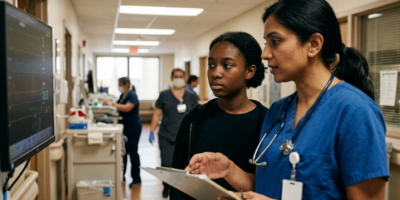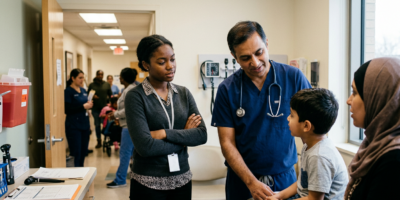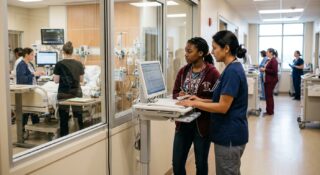
The intensive care unit is one of the most controlled, high-stakes environments in any hospital. For high school students interested in healthcare, the idea of observing inside an ICU can feel like the ultimate early clinical experience. But the reality of ICU exposure for high school students is more nuanced than most families expect. The access is limited, the role is strictly observational, and the emotional weight of what you witness requires genuine maturity. None of that makes it a bad idea. It just means you need to understand what you’re signing up for. If you’ve been searching for paid medical internships for high school students, you’ve probably noticed that most programs for minors emphasize observation and structured learning rather than hands-on clinical work, and ICU settings are no exception.
That distinction matters. Some students and families assume that “ICU exposure” means working alongside doctors, assisting with procedures, or making clinical decisions. It does not. For minors, the role is always observational, always supervised, and always bounded by strict safety and ethical guidelines. The same applies to medical research internships for high school students, where the emphasis falls on learning methodology and understanding clinical questions rather than conducting independent work. The value of these early experiences is not in what you do with your hands. It is in what you begin to understand about how critical care teams function, how decisions are made under pressure, and whether this kind of work genuinely interests you.
What ICU Exposure Actually Looks Like for a Teen
If you picture an ICU from a television drama, set that image aside. Most of what happens in an intensive care unit is careful monitoring, team communication, and incremental decision-making. A high school student observing in an ICU will spend time watching nurses check vital signs, listening to physicians discuss treatment plans during rounds, and learning how equipment like ventilators and cardiac monitors function. The pace can be slow for long stretches, punctuated by moments of urgency.
Students do not touch patients. They do not administer medications. They do not document anything in a patient’s chart. They observe, and they learn from what they observe. In well-structured programs, that observation is paired with debriefing sessions where a supervising clinician or program coordinator helps the student process what they saw and connects it to broader medical concepts.
This might sound less exciting than what you imagined, but it is genuinely educational. Watching an interdisciplinary team manage a critically ill patient teaches you things about communication, hierarchy, and clinical reasoning that no textbook or YouTube video can replicate. You start to see how physicians, nurses, respiratory therapists, and pharmacists coordinate in real time. That is the kind of understanding that matters when you eventually write application essays or sit for interviews.
Why Most Hospitals Restrict ICU Access for Minors
Hospitals have good reasons for limiting who enters an ICU, especially when that person is under 18. Patients in intensive care are among the most vulnerable people in any medical facility. Their immune systems may be compromised, their conditions may be unstable, and the procedures performed around them carry serious risk. Infection control protocols in ICUs are strict, and adding observers increases complexity for the clinical team.
Beyond infection control, there are privacy concerns. ICU patients often cannot give informed consent for a student observer to be present. In the United States, HIPAA regulations apply to everyone in a clinical space, including minors on an observational program. Hospitals and programs that allow student observation must have clear consent processes, identification protocols, and supervision structures.
According to the CDC’s guidelines on infection control in healthcare settings, proper personal protective equipment training and hand hygiene are baseline requirements for anyone entering a clinical area. For high school students, this training needs to happen before they set foot in the unit, and it needs to be reinforced daily.
There is also the emotional dimension. ICU patients sometimes die. Families are often in distress. The atmosphere can be heavy. A responsible program does not simply expose a teenager to these realities and move on. It provides preparation before the experience, real-time supervision during it, and structured reflection afterward.
Emotional Readiness Is Not Optional
This is a point that gets underestimated, especially by motivated students who are eager to prove they can handle anything. The truth is that watching someone struggle to breathe, or seeing a family receive devastating news, affects people differently. There is no shame in finding it difficult. The question is whether you have the support and self-awareness to process what you see in a healthy way.
Parents, this matters for your decision-making too. If your teenager is interested in ICU observation, ask yourself honestly whether they are emotionally ready, not just academically motivated. A student who has never encountered serious illness or death in their personal life may be caught off guard by what an ICU involves. That does not mean they should avoid it entirely, but it does mean the program they participate in should have clear emotional support structures.
Good programs include daily debriefing sessions where students talk through difficult moments with a supervisor. They have protocols for removing a student from a situation that becomes too intense. They pair students with mentors or peers who can offer perspective. If a program does not mention any of this, that is a red flag worth taking seriously.
The AAMC’s guidance on clinical experiences for pre-medical students emphasizes that reflection and self-awareness are central to meaningful clinical exposure. Admissions committees at medical schools are not impressed by students who claim to have been unfazed by critical situations. They are interested in students who can articulate what they observed, how it affected them, and what they took away from the experience.
What Admissions Committees Actually Value from Early Clinical Exposure
There is a common misconception that ICU exposure will dramatically boost a college or medical school application. It can be a meaningful part of your story, but only if you can reflect on it with depth and honesty. Admissions committees have read thousands of essays about students observing in hospitals. What separates strong essays from forgettable ones is specificity and genuine reflection.
A student who writes about watching a code blue and feeling invincible is less compelling than a student who writes about standing quietly in the corner during a routine shift change and noticing how the outgoing nurse communicated critical details to the incoming one. The first student is performing. The second student is paying attention. Medical schools notice the difference.
If you are thinking about how early clinical experiences fit into your broader application, it helps to understand how your story connects to the rest of your profile. The idea that your narrative is one of your strongest application assets holds true here. ICU observation is one data point, not a golden ticket.
It is also worth noting that ICU exposure represents a very narrow slice of medicine. Critical care is one specialty among many, and a student who only observes in high-acuity settings may come away with a skewed impression of what most healthcare work involves. The Bureau of Labor Statistics’ occupational outlook for physicians and surgeons shows that the vast majority of physician careers involve outpatient care, clinic-based practice, or specialty areas that look nothing like an ICU. Broad exposure, including primary care, community health, and preventive medicine, gives you a more realistic foundation for deciding whether healthcare is right for you.
How International ICU Observation Differs from Domestic Shadowing
Some students consider international programs that include ICU observation as part of a broader clinical exposure experience. There are real differences between observing in a U.S. hospital and observing in a resource-limited setting abroad, and understanding those differences helps you set accurate expectations.
In many countries where international health programs operate, ICU capacity is far more limited than in the United States. The WHO’s data on global critical care infrastructure shows stark disparities; some regions in sub-Saharan Africa have fewer than one critical care bed per 100,000 people, compared to 25 or more per 100,000 in developed countries. What you observe in these settings may involve more basic equipment, different staffing models, and conditions you would rarely encounter in a U.S. hospital, such as severe malaria complications or advanced tropical infections.
This can be a genuinely valuable learning context, not because it is dramatic, but because it forces you to think about how clinical teams make decisions when resources are limited. You see problem-solving in its most essential form. You also confront questions about global health equity that are difficult to fully appreciate from a classroom.
For students and parents considering this kind of experience, the critical question is structure. A well-run international program provides clear supervision ratios, pre-departure orientation, on-site coordinators, daily debriefing, and safety protocols that account for the specific risks of the destination. Students are identified as observers. They do not provide care. They follow the lead of local clinical staff and program supervisors at all times.
If your student is still in the early stages of thinking about healthcare as a career, understanding how long training pathways actually take, such as the timeline to become a registered nurse, can help put early exposure experiences into perspective. ICU observation is one step in a very long process of education and professional development.
What Parents Should Ask Before Saying Yes
Parents play a critical role in evaluating whether an ICU observation experience is appropriate for their teenager. Here are the specific questions worth asking any program, domestic or international, before committing.
First, ask about the supervision structure. Who is physically present with your student in the ICU at all times? What is the student-to-supervisor ratio? Is the supervisor a licensed clinician, a program coordinator, or both? In ICU settings, direct oversight is not a nice-to-have. It is essential.
Second, ask about emotional support. What happens if your student witnesses a death or a traumatic event? Is there a counselor or trained staff member available? Are there daily debriefing sessions, or is the student left to process the experience alone?
Third, ask about safety and health protocols. What vaccinations are required? What personal protective equipment is provided? What happens if your student becomes ill or is exposed to an infectious disease? For international programs, ask about emergency evacuation procedures and insurance coverage.
Fourth, ask about the educational structure. Is there a curriculum or learning framework, or is this simply “showing up and watching”? Structured programs have learning objectives, guided reflection, and educational context that turns observation into understanding. Unstructured programs are, at best, a missed opportunity and, at worst, ethically questionable.
Finally, ask about communication. How will you stay in contact with your student and the program staff? What is the check-in schedule? Who do you call if you have concerns?
A strong college application strategy matters, but it should never come at the expense of your teenager’s safety or well-being. The best programs understand that parents need reassurance, and they provide it willingly.
Setting Honest Expectations Before the Experience
Whether your ICU observation happens at a local hospital, a university medical center, or through an international program, the most important thing you can do is go in with honest expectations. You will not save anyone’s life. You will not perform procedures. You will not make diagnoses. You will watch, listen, ask questions when appropriate, and think carefully about what you see.
That is enough. In fact, for a high school student, that is a lot. Most people your age have never been inside an ICU. Most have never seen a ventilator in use or listened to a physician explain a treatment plan to a patient’s family. The simple act of being present in that environment, with proper supervision and reflection, gives you a reference point that very few of your peers will have.
The students who get the most out of ICU observation are the ones who approach it with curiosity rather than ambition. They are not trying to collect a resume line. They are trying to understand something real about how medicine works, what it costs the people who practice it, and whether they want to spend their lives doing this kind of work.
That kind of honest self-assessment is worth more to your future than any single experience, no matter how impressive it sounds on paper.
Frequently Asked Questions
Can high school students actually observe in an ICU?
In some cases, yes, but access is limited and highly structured. Most hospitals restrict ICU access for minors to formal shadowing or observation programs with strict supervision. Students do not provide any patient care. They observe under direct oversight, follow all infection control protocols, and are identified as student observers at all times. Availability varies by hospital, program, and location.
Will ICU observation help my college or medical school application?
It can be a meaningful part of your application if you reflect on it thoughtfully. Admissions committees value honest, specific reflection over impressive-sounding experiences. A student who can articulate what they observed, what surprised them, and how it shaped their thinking will benefit more than a student who simply lists “ICU shadowing” as an activity. It is one component of a broader profile, not a standalone advantage.
How do I know if my teenager is emotionally ready for ICU exposure?
Consider whether your teenager has encountered serious illness, grief, or high-stress situations before and how they responded. Emotional readiness includes the ability to process difficult experiences with support, to ask for help when overwhelmed, and to maintain appropriate boundaries in sensitive settings. If a program includes daily debriefing, on-site emotional support, and clear protocols for stepping back when needed, those are strong indicators that the experience is designed with emotional readiness in mind.