Pediatric oral health in underserved communities is one of the clearest windows into how structural inequality affects the body. For pre-dental students, seeing the gap between what children need and what they can actually access is not an abstraction; it shows up in mouths, in pain levels, in the kinds of treatment that are available or missing entirely. IMA programs give students structured, supervised exposure to these realities in clinical settings abroad, where the conditions are often more advanced and the resources more constrained than anything encountered in a U.S. dental school simulation lab.
This matters right now because dental school admissions committees increasingly value applicants who can demonstrate real awareness of oral health disparities, not just mention them in a personal statement. The ability to describe specific observations, reflect on systemic causes, and connect those experiences to a clear professional direction sets strong applicants apart. But the value goes beyond applications. Spending time in a setting where a dentist treats a seven-year-old’s severe caries with limited materials and no follow-up guarantee forces a kind of professional reckoning that stays with you.
Why Pediatric Dental Conditions Look Different in Low-Resource Settings
The clinical picture of childhood oral disease in underserved communities differs from what most U.S.-based pre-dental students expect. According to the WHO’s global oral health status report, untreated dental caries remains the most common health condition worldwide, and the burden falls heaviest on low- and middle-income populations. Children in these communities often present with caries at more advanced stages, not because the biology of the disease is different, but because preventive care, fluoride exposure, and early intervention are limited or absent.
In many of the settings where IMA students observe, sugar consumption has increased over the past two decades while access to dental professionals has not kept pace. A child may arrive at a clinic with multiple teeth affected by decay that has progressed to the pulp, accompanied by infection or abscess. Extractions may be more common than restorations, not because clinicians prefer them, but because the materials, time, and follow-up infrastructure for restorative work are not always available. This is a fundamentally different treatment calculus than what students learn in U.S.-based preclinical coursework.
Students also observe conditions like enamel hypoplasia linked to nutritional deficiencies, gingivitis that has gone untreated for years, and malocclusion that will likely never be addressed with orthodontics. These are not exotic findings. They are the predictable outcomes of poverty, geographic isolation, and workforce shortages. Recognizing them as systemic rather than individual failures is one of the most important shifts in perspective a pre-dental student can make.
What Pre-Dental Students Actually Observe on IMA Programs
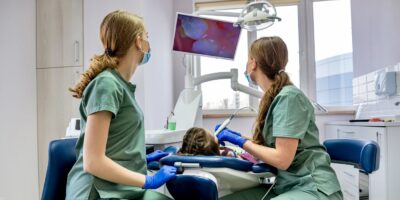
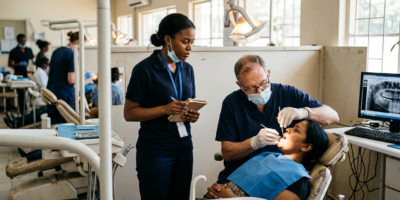
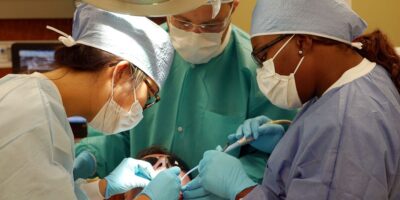
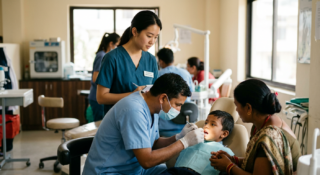
It is important to be precise about what “observation” means in a structured international program. Pre-dental students on IMA programs do not perform procedures. They observe licensed dental professionals, including dentists and, in some countries, dental therapists or clinical officers who are trained and authorized to deliver specific types of care. Students watch examinations, extractions, restorations, scaling, and oral hygiene instruction. They may assist with approved support tasks such as preparing treatment areas, organizing instruments for sterilization, or helping with patient education under direct supervision.
A typical day might begin with shadowing a dentist as they see pediatric patients in a community clinic. Students observe how the clinician assesses a child’s mouth, communicates with the parent or caregiver (often through an interpreter), and makes treatment decisions within the constraints of available materials. In the afternoon, students might participate in outreach activities, such as dental screenings at a local school, where they can see the prevalence of untreated conditions firsthand. These outreach events also illustrate how oral health education is delivered in settings where toothbrushes, fluoride toothpaste, and clean water are not guaranteed.
Evenings often include structured reflection and discussion with program mentors. This is where much of the intellectual work happens. Students process what they saw, ask questions about clinical decisions, and begin connecting individual patient encounters to broader patterns of access, policy, and workforce distribution. For students considering careers in pediatric dentistry or public health dentistry, these conversations can clarify professional goals in ways that reading alone cannot. Students comparing different types of pre-health experiences may find it useful to review how structured study abroad programs build clinical perspective for pre-health students, since many of the principles apply across disciplines.
The Gap Between U.S. Training Environments and Global Realities
Most pre-dental students in the United States train in settings where dental materials are abundant, sterilization equipment is standardized, imaging is digital, and referral networks are well-established. None of that is guaranteed in the communities where IMA programs operate. This gap is not a deficiency to pity; it is a set of conditions that produces different clinical reasoning, different priorities, and different relationships between providers and patients.
In some settings, a single dentist may serve a catchment area of tens of thousands of people. The HRSA data on dental health professional shortage areas shows that even within the United States, significant shortages exist, but in many low- and middle-income countries, the ratios are far more extreme. When one clinician is responsible for a vast population, triage becomes central. Students observe how providers decide which children need immediate intervention, which can wait, and which will require referral to a facility that may be hours away.
This kind of resource-constrained decision-making is rarely taught in early dental education. Watching it happen in real time, with real patients, under the guidance of a professional who does it daily, builds a type of clinical awareness that is difficult to replicate in a simulation. It also raises hard questions about equity, sustainability, and the limits of short-term intervention, questions that IMA’s structured reflection sessions are designed to help students work through honestly.
How Cultural Context Shapes Oral Health Behaviors
Pre-dental students frequently arrive in international settings with assumptions about oral hygiene that are rooted in U.S. norms. In many communities, dental care-seeking behavior is shaped by cultural beliefs, economic realities, and the availability (or absence) of providers. For example, in some settings, extraction is strongly preferred over restoration because a filling is seen as a temporary fix that will require a return visit the family cannot afford. In others, traditional remedies may be the first line of response to dental pain, with clinical care sought only when the condition becomes severe.
Understanding these patterns is not about judging them. It is about recognizing that oral health behaviors are rational responses to the conditions people actually live in. A pre-dental student who can articulate this in an interview or personal statement demonstrates the kind of cultural competence that admissions committees value. More importantly, it builds the foundation for effective patient communication in any future practice, including domestic settings with diverse patient populations.
How This Experience Connects to Dental School Applications
Dental school admissions committees, as outlined by ADEA’s guidance on the dental school application process, look for evidence that applicants understand the profession beyond the procedural. They want to see genuine engagement with questions of access, equity, and service. An experience observing pediatric oral health in an underserved community provides concrete material for addressing these themes, but only if the student reflects on it with specificity and honesty.
The strongest application narratives from international clinical observation tend to share a few characteristics. They describe a specific patient encounter or clinical moment, not a general summary of the trip. They explain what the student noticed, what surprised them, and what it made them reconsider. They connect the experience to a forward-looking professional goal, whether that is working in community health, pursuing pediatric dentistry, advocating for policy change, or simply becoming a more thoughtful clinician.
What admissions committees do not want to see is a story about “saving” anyone. Pre-dental students on IMA programs are observers and learners, not providers. The value of the experience lies in what it teaches the student, not in what the student did for the community. Being honest about that distinction is itself a sign of maturity and ethical awareness. Students interested in building a well-rounded pre-health profile through different types of clinical exposure can also look at how various internship types strengthen applications for pre-med and pre-health students, since many of the same principles of reflection and specificity apply.
What to Watch Out For When Writing About International Experiences
A few common missteps undermine otherwise strong application essays. Avoid framing the community you visited as helpless or hopeless. The clinicians working in these settings are skilled professionals doing complex work under difficult conditions; respect that in your writing. Avoid inflating your role. If you observed, say you observed. Describe what you learned from watching, not what you accomplished. Avoid treating the experience as a single emotional moment rather than a sustained period of learning. Admissions readers can tell the difference between genuine reflection and performed sentimentality.
Ethical Responsibilities Pre-Dental Students Should Understand Before They Go
Any international clinical observation program raises ethical questions that students should think about before departure, not after. The most fundamental is the question of benefit: who benefits from your presence, and how? In a well-structured program, the student benefits through learning, and the host site benefits through support tasks, continuity of partnership, and the longer-term pipeline of professionals who understand global health disparities. But those benefits only materialize if the program is responsibly designed.
On IMA programs, students operate within clearly defined boundaries. They do not perform clinical procedures. They do not interact with patients outside of supervised settings. They follow all local infection control protocols and respect patient confidentiality. These are not bureaucratic formalities; they are the baseline conditions for ethical participation in any clinical environment. Students should also be prepared for the emotional weight of observing suffering they cannot directly alleviate. Structured debriefing and mentorship help, but the discomfort is real and worth taking seriously.
Another ethical dimension involves sustainability. A two-week or four-week presence does not fix systemic oral health problems. Students who understand this from the outset are better positioned to use the experience productively, both in their own development and in their future contributions to the field. The goal is not to leave a community “better” in a measurable way after a short stay. The goal is to leave with a clearer understanding of what better actually requires, and to carry that understanding into a career where it can compound over time. For students evaluating how different programs handle structure, mentorship, and ethics, it helps to consider how real differences between internship and externship models affect what you actually gain.
Preparing for What You Will See and How to Use It
Preparation matters more than most students realize. Before participating in an IMA program with a dental focus, it is worth reviewing basic pediatric oral pathology, common presentations of caries and periodontal disease, and the social determinants of oral health. The CDC’s resources on children’s oral health are a solid starting point for U.S.-based context, and many of the underlying patterns, such as the relationship between poverty and untreated decay, apply globally.
Equally important is preparing yourself for observation as a skill. Watching a clinician work is not passive. Good observation means noticing how the provider positions themselves, how they communicate with a child who is frightened, how they make decisions when materials are limited, how they prioritize. Keeping a daily journal of specific observations, questions, and reflections is one of the most effective ways to convert experience into usable knowledge, both for your own growth and for future application materials.
Finally, plan how you will integrate this experience into your broader pre-dental path. It is one data point, not the whole picture. Pair it with domestic volunteering, academic coursework in public health or health policy, and continued engagement with underserved populations in your own community. The students who get the most out of international clinical observation are the ones who see it as part of a longer arc, not a standalone event.
Frequently Asked Questions
Will I perform any dental procedures during an IMA program?
No. Pre-dental students on IMA programs observe licensed dental professionals and assist with approved support tasks under direct supervision. You will not perform clinical procedures such as extractions, fillings, or scaling. The focus is on structured observation, learning, and reflection, not independent clinical practice.
Can I use this experience in my dental school application?
Yes, structured international clinical observation can strengthen a dental school application when presented with specificity and honest reflection. Focus on what you observed, what you learned about oral health disparities, and how the experience shaped your professional goals. Do not overstate your role or imply that you provided direct patient care.
What kinds of pediatric oral health conditions will I likely observe?
In underserved community settings, you may observe dental caries at various stages, including advanced decay with infection or abscess. Gingivitis, periodontal disease, enamel hypoplasia related to nutritional deficiency, and malocclusion are also commonly seen. The specific conditions depend on the program location and the patient population at the host site.