On January 22, 2026, the United States formally completed its withdrawal from the World Health Organization (WHO), one year after President Trump signed Executive Order 14155, which initiated the process. The decision marks the most significant rupture in U.S.-WHO relations since the organization’s founding in 1948, and it carries consequences that extend well beyond the halls of diplomacy. For pre-health students, nursing applicants, PA candidates, and anyone pursuing a career in global or domestic medicine, the shift redraws the landscape of international clinical training, with effects already being felt on the ground.
This is not a theoretical policy debate. If you are preparing to pursue an international clinical internship, apply to a health profession program, or build a career with any global health component, you need to understand what changed, why it changed, and what it means for your training, your credentials, and your future options. This article breaks it down clearly, separates known facts from interpretation, and offers practical guidance on how to move forward.
The short version is this: the U.S. withdrawal creates real gaps in global health infrastructure, reduces American institutional influence on international health standards, and places a greater burden on individual organizations and students to maintain independent connections to global health networks. It also makes the quality and ethical grounding of your international training more important than ever, because the systems that once provided a shared framework for global clinical education are now more fragmented than at any point in recent history.
What Actually Happened and When
Executive Order 14155 was signed on January 20, 2025, the first day of the second Trump administration. The order directed the State Department to notify the WHO and the United Nations of the United States’ intent to withdraw. Under WHO rules, formal withdrawal requires a one-year notice period and the settlement of any outstanding financial obligations. The U.S. met those procedural requirements, and the withdrawal became official on January 22, 2026.
The administration’s stated rationale centered on several grievances: a belief that the WHO had mishandled the early response to the COVID-19 pandemic, concerns about undue Chinese influence over WHO leadership and decision-making, objections to the financial burden placed on the United States as the organization’s largest single donor, and a broader preference for bilateral health diplomacy over multilateral institutions.
The United States had historically contributed between 12 and 15 percent of the WHO’s total operating budget, a figure that included both assessed contributions (mandatory dues calculated by national income) of approximately $111 million annually, and voluntary contributions of approximately $570 million. The total annual impact of the withdrawal exceeds $681 million in funding that the WHO now must replace or go without. For context, that is enough to fund the WHO’s entire polio eradication program for several years.
The Kaiser Family Foundation has published a detailed breakdown of what the U.S. historically funded within the WHO, including emergency response, infectious disease surveillance, vaccine development, and maternal and child health programs. The scope of those programs helps explain why the withdrawal is viewed with concern by public health experts across the political spectrum.
What the Withdrawal Affects in Practice
Global Disease Surveillance
One of the most concrete operational losses is the U.S. exit from the Global Influenza Surveillance and Response System (GISRS), a WHO-coordinated network of 150 institutions in 127 countries that tracks influenza strains and provides the biological data used to formulate annual flu vaccines. U.S. participation in GISRS had been foundational since the network’s creation. Public health experts have described the exit as scientifically counterproductive, arguing that influenza does not recognize national borders and that weakening the surveillance network increases risk for everyone, including Americans.
Beyond influenza, the WHO plays a central role in detecting outbreaks, coordinating responses, and sharing data on dozens of pathogens. The U.S. Centers for Disease Control and Prevention had deep operational ties to the WHO emergency response teams. While the CDC continues to exist and function, it now operates with reduced formal coordination with the international body responsible for setting global health emergency protocols.
Standardized Clinical Guidelines
The WHO produces clinical guidelines used by healthcare systems in more than 190 countries. These cover everything from essential medicines lists to treatment protocols for tuberculosis, HIV, malaria, maternal care, and nutrition. In high-income settings, clinicians often follow nationally adapted versions of these standards. In lower-income settings, WHO guidelines frequently serve as the primary or only framework for clinical decision-making.
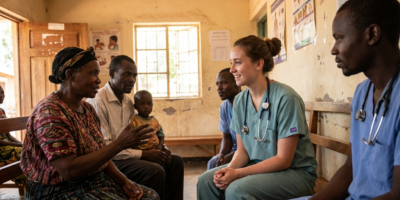
For students doing clinical internships in East Africa, South America, or other global health settings, this matters directly. The hospitals and clinics you observe often follow WHO-developed protocols. Understanding those protocols and understanding the infrastructure behind them is part of what a global health education requires. The withdrawal of U.S. expertise and funding from that process does not eliminate the protocols immediately, but it reduces the United States’ influence over how those guidelines are developed and updated going forward.
Global Health Emergency Preparedness
The WHO’s global health emergency preparedness framework coordinates international response to outbreaks, natural disasters, and complex humanitarian crises. The United States had been one of the largest contributors to emergency response capacity through the WHO. Going forward, the administration has indicated its intent to address global health emergencies through bilateral agreements and direct partnerships with NGOs and the private sector, rather than through the WHO structure.
Whether that approach proves effective remains to be seen. What is clear is that the transition period, where we currently are, involves real uncertainty about which institutions will fill the coordination gaps created by the U.S. departure. For global health practitioners and students, that uncertainty underscores the importance of understanding the landscape as it actually exists in 2026, rather than as it existed five years ago.
What It Means for Global Health Training Specifically
If you are a pre-health student planning an international clinical internship, or a nursing or PA student building a global health component into your training, the WHO withdrawal has a set of concrete implications you should think through carefully.
The Value of Ethical, Structured Programs Increases
In a more fragmented global health environment, the quality of the organization placing you matters more, not less. When shared international frameworks are weaker, the ethical standards, community relationships, and institutional oversight of individual programs become the primary safeguards for both students and the communities they serve. Programs that emphasize supervised observation, genuine partnership with local healthcare systems, and clear scope-of-practice boundaries are now doing more of the heavy lifting that broader institutional frameworks used to help provide.
This is not an argument for staying home. International clinical experience remains one of the most powerful tools available for building the competencies that health professions programs and employers value most, including cultural humility, adaptability, and a grounded understanding of how care is delivered in resource-constrained settings. It is an argument for being discerning about where you go and whom you go with.
You Need to Build Your Own Global Health Literacy
The reduction in U.S. institutional engagement with the WHO means that students cannot assume the information pipelines that once kept global health data flowing freely into U.S. training environments will function as they did before. You will need to be more proactive about staying connected to global health information, following developments through the WHO directly, tracking policy changes through organizations like the Kaiser Family Foundation, and engaging with peer-reviewed global health literature on your own initiative.
The WHO Global Health Observatory remains one of the most comprehensive sources of international health data in the world, covering indicators across 194 member states. Bookmarking it and returning to it regularly is one of the simplest things you can do to stay connected to the global health landscape regardless of what happens at the political level.
Bilateral Relationships Become More Important
The administration has signaled a pivot toward direct, bilateral health partnerships. What this means in practice is that U.S. engagement in specific regions, including East Africa, where organizations like International Medical Aid operate, will increasingly depend on country-specific agreements rather than WHO-coordinated programs. For students doing internships in those regions, understanding the local health system, its funding sources, and its relationship with both domestic and international partners becomes even more important background knowledge.
What Pre-Health Students Should Do Right Now
The policy landscape has shifted, but your ability to build a strong, ethical, globally informed clinical education has not. Here is what the current moment actually calls for.
First, choose international programs with care. Ask organizations directly about their relationships with local healthcare systems, how long those relationships have been in place, and what oversight structures exist for student observers. A program built on genuine, sustained community partnership is more valuable and more defensible in 2026 than a short-term placement that relies on institutional infrastructure that may no longer be as stable. Reading about how to assess whether a global health internship is ethical and structured before committing is time well spent.
Second, document your experiences thoughtfully. In a more fragmented global health environment, your ability to articulate specifically what you observed, what you learned, and how your experience connects to broader public health frameworks becomes a meaningful differentiator. Admissions committees and employers are increasingly sophisticated about global health experiences, and they can tell the difference between a student who engaged seriously with the healthcare system they observed and one who was simply present. Your clinical experience and how you communicate it matter more than your passport stamps.
Third, stay informed. The situation is still evolving. The U.S. exit from the WHO is recent, and the full implications for specific programs, funding streams, and partnerships will continue to unfold throughout 2026 and beyond. Following organizations like the Kaiser Family Foundation, the Council on Foreign Relations, and the WHO itself will help you track those developments without being overwhelmed by political noise.
Common Mistakes Students Make When Responding to Policy Shifts Like This
The most common mistake is treating a policy change like this as either irrelevant or catastrophic. Neither response is accurate nor useful. The WHO withdrawal does not mean that global health training is no longer possible or valuable. It means the landscape is different and that navigating it requires more awareness than before.
A second mistake is assuming that short-term disruption means long-term collapse. The WHO will adapt. Other institutions will step in to fill some of the gaps. Bilateral programs will expand. The global health ecosystem is genuinely resilient, even when individual components are weakened. Students who understand that resilience and who can articulate a nuanced view of how global health systems function will be stronger candidates and stronger practitioners than those who treat the withdrawal as a reason to disengage.
A third mistake is choosing an international clinical program based primarily on price or convenience rather than ethical structure. This was a risk before the withdrawal, and it is even greater now. If you are reading this while weighing your options for a global health internship, prioritize the questions that matter: How long has this organization been operating in this region? Who supervises student observers? What is the scope of what students are and are not allowed to do? What relationships does the organization have with local clinical staff and community leaders? Understanding what makes a pre-med internship worth your investment starts with those questions.
What To Do Next
If you are currently planning a global health internship for 2026, do not delay. Many programs have already adjusted their structures in response to the changing landscape, and early enrollment gives you more options and more time to prepare. Talk directly with your program contact about how the WHO situation affects their operations and what their local partnerships look like.
If you are preparing a health professions application that includes global health experience, think carefully about how you frame it. The WHO withdrawal is a known current event in the admissions world. Demonstrating that you understand its implications and that your international experience was grounded in ethical, supervised observation rather than voluntourism will strengthen your narrative significantly.
If you are a student who has already completed a global health internship, this is a good moment to revisit your documentation of that experience. The ability to connect what you saw in a clinical setting abroad to the broader policy context is a genuine skill, and it is one that distinguishes applicants who read and think broadly from those who simply log hours.
Frequently Asked Questions
Does the U.S. withdrawal from the WHO mean that American students cannot do international clinical internships?
No. The withdrawal affects formal U.S. government participation in WHO-led programs and funding mechanisms, not the ability of private organizations or individuals to engage in global health work. International clinical internships through organizations with established local partnerships continue to operate, and in many cases continue to provide access to the same clinical environments they always have. What changes is the broader institutional context, not your ability to gain meaningful international experience.
Will the withdrawal affect the quality of global health programs students can access?
It may affect some programs that relied on WHO-coordinated infrastructure or U.S. government global health funding. Programs that operate through direct, sustained community partnerships and that are not dependent on WHO administrative structures are generally better insulated from the disruption. This is one reason why the organizational structure of any program you choose matters so much. Programs rooted in long-term local relationships are more stable than those built on short-term access to institutional networks.
How should I address the WHO withdrawal in a medical school personal statement or interview?
If the topic comes up, be honest, specific, and practical rather than political. Committees are not looking for a policy position. They are looking for evidence that you understand the environment in which healthcare is delivered and that you can think clearly about complex systems. If you completed an international internship during or after the withdrawal period, being able to articulate what you observed about how the local healthcare system was functioning, what it relied on, and what challenges it faced will be far more impressive than a general opinion about WHO membership.
Are there alternatives to WHO-affiliated programs for students interested in global health?
Yes. Many global health programs operate through university partnerships, NGOs, and direct community agreements that function independently of WHO membership. Regional health bodies, bilateral government agreements, and established nonprofit organizations all provide pathways for structured global health engagement. The key is to evaluate programs based on their track record, their ethical framework, and the quality of their local relationships rather than their formal affiliation with any particular international institution.
Does the withdrawal change what health professions programs are looking for in applicants with global health experience?
Not fundamentally. Admissions committees have always been more interested in the quality and ethical grounding of global health experiences than in the institutional framework behind them. What they are looking for remains consistent: evidence of supervised observation, cultural humility, a clear understanding of scope of practice, and the ability to reflect meaningfully on what you saw. The withdrawal does not change those criteria, though it may make the evaluation of less structured programs more rigorous, since the institutional guardrails that once provided some baseline of credibility are weaker than before.
Should I reconsider a global health internship given the current uncertainty?
Not on that basis alone. Uncertainty is a feature of the global health environment, not a temporary condition. Students who learn to navigate complexity and ambiguity in their training are better prepared for careers in medicine, nursing, and public health than those who wait for a stable moment that may not come. The more relevant question is whether the specific program you are considering has the ethical structure, local partnerships, and supervisory framework to provide you with a meaningful and responsible experience. If the answer is yes, the broader policy environment is not a reason to withdraw.
What is the best way to stay current on how the WHO situation evolves?
Following the WHO directly through their official website and the WHO Global Health Observatory gives you access to primary data and official statements. The Kaiser Family Foundation publishes regular nonpartisan analyses of U.S. global health policy that are accessible and credible. Academic journals like The Lancet Global Health and PLOS Medicine cover research and policy developments from an international perspective. Setting aside even 15 minutes a week to read in this space will keep you significantly more informed than the average applicant.
How does this affect students who want careers in global health specifically?
Students committed to global health careers should expect a field that looks somewhat different over the next decade than it did in the previous one. The reduction in U.S. multilateral engagement may lead to greater reliance on bilateral partnerships, regional health bodies, and NGO networks. It may also create genuine leadership opportunities for American clinicians and researchers who are willing to engage with international partners on terms that do not depend on government backing. If anything, the withdrawal makes the next generation of globally minded U.S. health professionals more important, not less.