Not every program that describes itself as a clinical internship for high school students meets the standards that students and families should expect. The market for pre-medical high school programs has grown significantly, and with that growth has come variation in quality, ethics, and student safety that families cannot always assess from a website alone. Students applying to hospital internships for high school students deserve transparent information about what program quality looks like, what warning signs indicate a program that is not appropriately structured for minors, and what the difference is between a program that serves a student’s development and one that serves its own enrollment goals.
Here, we take a look at specific red flags that families should take seriously, along with the questions that distinguish well-structured programs from those that prioritize marketing over substance. For a baseline understanding of what appropriate clinical observation for minors looks like, this clinical expectations overview provides the foundational standards against which any program can be evaluated.
Red Flag: The Program Emphasizes Procedures Over Observation
Any program that markets hands-on clinical procedures as a feature for high school students is either professionally inappropriate or misrepresenting.
High school students are not licensed, trained, or legally authorized to perform clinical procedures on patients. A program that advertises that students will perform suturing, assist in surgeries, administer vaccines, or conduct clinical examinations is either placing students in situations that violate patient safety standards and expose the program to serious liability, or it is describing activities in misleading terms to make the program sound more impressive than it is.
The AAMC has documented that medical school admissions officers view participation in invasive procedures by pre-medical students, even when supervised, as a red flag in applications rather than an asset. A student who lists unsupervised suturing or vaccine administration in a low-resource international setting on a medical school application may find that it raises more questions than it answers.
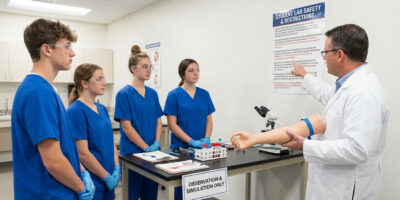
Programs that describe clinical simulation, which involves practicing skills on mannequins or models in a controlled setting, rather than direct patient procedures, are operating appropriately. The distinction between simulation and patient procedures is not a minor detail. It is the line between a safe learning experience and a potential patient safety violation.
Red Flag: Safety Information Is Vague or Inconsistently Available
A program operating in any international location should be able to provide, upon request and without delay, specific written documentation of the following: the identity and qualifications of all staff who will have contact with students, the physical description and security measures of student housing, the written emergency response plan including medical, evacuation, and individual crisis protocols, the insurance coverage carried for student participants including the carrier name and policy details, and the parent communication protocol for both routine updates and emergency situations.
Programs that respond to these requests with general reassurances, that require persistent follow-up before providing written documentation, or that describe safety measures in terms that cannot be verified should be treated with caution. The willingness and ability to provide specific, documented safety information is itself a reliable indicator of program quality. Well-structured programs have this documentation ready because they use it, not because they have prepared it for skeptical parents.
Red Flag: The Program Discourages Questions From Parents
Reputable programs expect parents to ask detailed questions and are prepared to answer them clearly. Programs that characterize parental due diligence as excessive, that respond to specific questions by redirecting to testimonials, that use social proof rather than substantive answers, or that frame the enrollment decision as primarily about the student’s opportunity rather than the parent’s right to make an informed decision are prioritizing their own conversion rate over family interests.
Parents of minors have not only the right but the responsibility to conduct thorough due diligence before enrolling a teenager in any international program. A program that does not welcome this process is not operating in the student’s best interests.
Red Flag: The Clinical Claims Cannot Be Verified
Programs should be able to provide verifiable information about the clinical settings where students observe, the credentials of the clinical supervisors who work with students, and the specific activities students engage in during clinical time. If a program cannot provide the name and type of the clinical facility, the professional credentials of clinical supervisors, and a specific description of what students observe during clinical hours, the clinical component of the program may not be what it is represented to be.
This matters for application purposes as well as safety. A student who lists clinical observation hours at a facility that cannot be verified, or whose experience does not match the description on their application, is at risk of having that experience questioned or disqualified during the admissions review process.
Red Flag: There Is No Structured Curriculum or Reflection Component
Clinical observation without a structured educational component and a mechanism for reflection is less professionally valuable than it appears. Students who spend hours in a clinical setting without understanding what they are seeing, without guidance on how to process it, and without a structured practice for recording and reflecting on their observations will have difficulty articulating what they learned in applications and interviews.
Well-designed programs include a formal educational curriculum, whether lectures, workshops, case discussions, or supervised journaling, that gives students the conceptual framework to make sense of what they observe. They also include regular check-ins with supervisors who provide feedback on professional conduct and guidance on how to reflect constructively on clinical experiences.
Red Flag: The Program Markets Itself Primarily on Application Value
Programs that lead with claims about how participation improves college admissions outcomes, medical school acceptance rates, or application competitiveness are prioritizing the enrollment decision over the student’s actual development. These claims are often unverifiable, frequently misleading, and reflect a fundamental misunderstanding of what admissions committees actually value.
What admissions committees value is a student who can describe a specific experience honestly, reflect on what it taught them, and connect it to a clear and credible sense of professional direction. That kind of application narrative comes from genuine engagement with a substantive program, not from the credential of participation in a program that markets itself on prestige.
Families should treat the enrollment decision for an international medical program with the same thoroughness they would apply to any significant educational investment.
Frequently Asked Questions
What is the most important red flag to look for in a high school medical program?
The most important red flag is a program that markets hands-on clinical procedures on patients as a feature for high school participants. High school students are not licensed or legally authorized to perform clinical procedures. A program that advertises suturing, vaccine administration, surgery assistance, or clinical examinations for teen participants is either misrepresenting what students do, violating patient safety standards, or both. The AAMC has documented that medical school admissions officers view participation in invasive procedures by pre-medical students as a concern rather than an asset. Clinical simulation using mannequins is appropriate. Patient procedures are not.
How can parents verify that a program’s clinical claims are accurate?
Parents can verify clinical claims by requesting the name and type of the clinical facility where students will observe, the professional credentials of the clinical supervisors who work directly with students, and a specific description of what students do during clinical hours. If a program cannot provide verifiable answers to these three questions, the clinical component may not be what it is represented to be. Families can also search independently for the named facility, confirm that it exists and operates in the location described, and ask the program coordinator to connect them with a past participant family for a direct reference.
What should parents do if a program is vague about safety documentation?
If a program cannot provide written documentation of their supervision model, emergency protocols, insurance coverage, and housing security arrangements when asked directly, parents should treat this as a disqualifying factor rather than a minor gap. A program that has these systems in place will have this documentation ready. Vagueness about safety is not a sign of informality. It is a sign that the systems may not exist. Parents should not enroll a minor in any international program without receiving specific, written, verifiable answers to safety questions.
Is it a red flag if a program emphasizes its value for college applications?
Yes, when application value is the primary marketing message rather than the substance of what students learn and do. Programs that lead with claims about improving admissions outcomes are prioritizing the enrollment decision over student development. Admissions committees value specific, reflective, honest descriptions of genuine experience, not the credential of having participated in a program marketed for its prestige. A program that can describe concretely what a student will observe, learn, and develop is more trustworthy than one that sells the outcome rather than the experience.
What does it mean for a program to have inappropriate role expectations for minors?
Inappropriate role expectations means placing students in situations where they are expected to perform, witness, or contribute to clinical activities that exceed what is appropriate for an unlicensed minor observer. This includes performing or assisting with patient procedures, being present without a licensed staff member during patient interactions, taking on responsibilities that create liability for the student or program, and being encouraged to represent their involvement in ways that overstate what they actually did. Any program that creates ambiguity about whether a student’s role is observational or clinical is not defining boundaries appropriately.
Are there red flags specific to international programs that do not apply to domestic ones?
International programs carry additional red flags beyond those applicable to domestic programs. These include the absence of travel insurance documentation, vague descriptions of housing that cannot be independently verified, programs that operate in locations where the described clinical facilities cannot be confirmed to exist, absence of a named local emergency contact with verifiable credentials, and programs that frame parental concern about safety as excessive or unnecessary. The geographic distance involved in international programs means that problems are more difficult to resolve once they arise, which makes thorough pre-enrollment verification more important rather than less.
How should a student respond if they realize mid-program that something is not right?
A student who realizes mid-program that something is not right should communicate this to their supervising staff member and, if the concern is not addressed appropriately, contact their parent or guardian immediately. Students should not remain silent about safety concerns, inappropriate role expectations, or conduct that violates the boundaries established at orientation in order to avoid disrupting the program. Programs that respond to student safety concerns defensively or dismissively rather than responsively are confirming the concern rather than resolving it. Early departure from a program that is not operating appropriately is a responsible decision, not a failure.