
Last updated: July 2026.
If you are a student wondering how to become a dentist in 2026, you are looking at one of the most stable and well-compensated careers in healthcare. Dentistry gives you the chance to improve patients’ oral health, choose from a growing number of specializations, and maintain a flexible lifestyle. But competition for dental school seats is real. The average dental school acceptance rate sits at roughly 16%, according to the 2025–2026 ADEA Official Guide to Dental Schools. That figure alone tells you that preparation matters at every stage.
The good news: knowing the steps, timelines, costs, and requirements makes the process far more manageable. This guide covers everything you need to know about becoming a dentist, including licensing, training, certification requirements, and several major changes that took effect in 2025 and 2026.
What Does an Ordinary Day in the Life of a Dentist Look Like?
A dentist is a trained healthcare professional devoted to restoring, improving, and maintaining oral health. Dentists use their skills, expertise and innovative tools to diagnose, treat and maintain the health of the mouth’s gums, teeth, and surrounding tissues.
As a dentist, you will encounter patients with different oral problems daily, such as root infections, tooth decay, gum disease, sensitive teeth, broken teeth and enamel erosion. To help your patients, you have to perform various procedures such as:
- Teeth whitening
- Sealing teeth
- Filling cavities
- Bonding
- Root canals
- Placing dental bridges
- Installing crowns
- Extractions
- Implant restoration
- Reading x-rays
You will need scalpels, lasers, drills, x-rays, probes and various equipment to carry out these procedures. Depending on your specialization, you will work in a specialized field like pediatric dentistry, periodontics and endodontics or a general field like general community dentistry. You will also work with receptionists, dental assistants, dental hygienists and other healthcare professionals daily.
How Much Does a Dentist Make in 2026?
Dentists remain among the highest-paid healthcare professionals in the United States and worldwide. According to the Bureau of Labor Statistics (BLS), the median annual wage for dentists was $179,210 as of May 2024, with a mean (average) annual wage of approximately $191,350. Salaries range widely, from about $86,250 at the 10th percentile to $319,630 at the 90th percentile. Most dentists fall between $125,710 and $224,040 (the 25th to 75th percentile band).
However, dentist compensation varies significantly based on several factors.
Education and Experience
Dentists’ salaries and benefits are directly proportional to their level of education and experience. According to PayScale, dentists with less than one year of experience earn about $123,332 on average, while general dentists typically start around $150,000 annually. Dentists with more than ten years of experience can earn well above $200,000 per year, and practice owners and partners reported an average income of $320,316 in 2024, according to ADA survey data.
Industry
Dentists’ salaries also depend on the industry in which they are working. Dentists employed by the federal government typically earn more than their counterparts in private practice. According to BLS data, government-employed dentists can earn a median salary exceeding $213,000 per year. On the other hand, dentists working in outpatient care centers and private offices tend to earn closer to the overall median.
Location
Where you practice will also determine how much you can earn as a dentist. Dentists working in large metropolitan areas or states with higher costs of living usually earn more. According to the most recent BLS data, top-paying states include Vermont, Delaware, Minnesota, North Dakota, and Maine, all averaging above $220,000 per year. If you are weighing where to practice against what you will owe in student loans, the IMA Student Loan Repayment Calculator can help you model how location and salary interact with your debt timeline.
Specialty
Salaries also vary with the dentist’s specialty. Here is a breakdown of how dentists’ salaries vary based on specialty, using 2024 BLS and ADA data:
- Oral and maxillofacial surgeons earn $239,200 or more
- Orthodontists earn $239,200 or more
- Prosthodontists earn $239,000 or more
- General dentists earn a median of $179,210
- Specialists overall average $323,780 in net income (ADA, 2023 data)
Many dentists work fewer than 40 hours per week, according to the BLS, though some work considerably more, including evenings and weekends, to accommodate patient schedules.
The Average Dentist Salary by State
As mentioned earlier, geography is a crucial factor in determining dentist salaries. So, it helps to identify the top-paying states if you are about to start your practice.
Based on the most recent BLS Occupational Employment and Wage Statistics (May 2024), the top states where average dentist pay is highest include:
- Vermont
- Delaware
- Minnesota
- North Dakota
- Maine
- Massachusetts
- New York
- Oregon
- Rhode Island
States where dentists tend to earn less relative to the national average include several in the Southeast and Mountain West, though exact rankings shift year to year. Before making a decision based purely on salary, consider the cost of living, patient demand, and whether the area is designated as a dental Health Professional Shortage Area (HPSA). Practicing in a shortage area can also qualify you for federal loan repayment assistance.
How Dentist Salaries Stack Up Against Other Professions
The median wage for dentists in the United States continues to be significantly higher than the median salary across all occupations. Additionally, dentists’ wages are higher than those of other dental team members. Here is how dentists’ salaries compare to related professions, based on BLS May 2024 data:
- Dental Assistant: $47,300 median per year
- Dental Hygienist: $94,260 median per year
- Dental Lab Technician: $48,310 median per year
Comparing these figures to the general dentist median of $179,210 illustrates the significant salary premium that comes with completing dental school. If you are exploring other healthcare career paths alongside dentistry, our guides on becoming an emergency room doctor and the differences between physician assistants and doctors can help you compare training timelines, earning potential, and scope of practice.
Dentist Job Outlook for 2026 and Beyond
To determine if the dental profession is a good fit for you, it is helpful to compare current demand and supply, then consider where the field is headed.
According to the BLS (updated August 2025), overall employment of dentists is projected to grow 4% from 2024 to 2034, which is about as fast as the average for all occupations. Approximately 4,500 job openings for dentists are expected each year over the decade, driven by retirements, career changes, and growing demand.
Several factors are fueling that demand. Baby boomers and older adults continue to need more dental services as they age, and each generation is more likely to retain their natural teeth, which means more ongoing care. The growing popularity of cosmetic dentistry and the increasing complexity of procedures like implants and digital restorations are also contributing to demand. According to HRSA data as of December 2025, 63.7 million Americans live in dental Health Professional Shortage Areas, and an estimated 10,744 additional dentists are needed to eliminate those shortage designations.
On the supply side, dental school enrollment has been climbing. During the 2025–2026 academic year, 28,925 students were enrolled in predoctoral dental education programs, up from 27,920 the prior year, according to ADA Health Policy Institute data. The class of 2025 produced 7,015 graduates, up from 6,872 in 2024. Applicant numbers have also risen sharply; there were 12,491 applicants to U.S. dental schools in 2024, an 11.5% increase over 2023 and the second-highest total since 2000. The average acceptance rate, however, remains competitive at about 16%.
Dentists held about 149,300 jobs in 2024, and the ADA reports that 202,485 dentists were professionally active in the U.S. that year, a density of about 59.5 dentists per 100,000 people (roughly one per 1,681 people). For context, the national unemployment rate stood at 4.2% as of June 2026, while unemployment among healthcare practitioners, including dentists, remains well below that figure.
Another notable trend: about two in three dentists now work in group practices, and affiliation with Dental Service Organizations (DSOs) reached 16.1% in 2024. This shift means new graduates have more employment models to consider, from solo ownership to associateships to DSO-affiliated positions.
How Much Schooling is Required to Be a Licensed Dentist?
One frequently asked question about how to become a certified dentist is how much schooling is involved. It takes a minimum of eight years to become a licensed dentist. You must complete four years of undergraduate education to earn a bachelor’s degree and another four years to earn a DDS (Doctor of Dental Surgery) or DMD (Doctor of Dental Medicine) degree. If you plan to specialize, add two to six additional years of residency training, depending on the specialty.
Step-by-Step Guide to Become a Dentist in 2026
If you have been wondering what schooling requirements you need to become a dentist, this step-by-step guide covers every stage from high school through licensure.
Start Your Journey in High School
It is always advisable to determine your career direction early and take steps throughout your academic journey that support it. If dentistry is your goal, high school is the right time to begin building a foundation.
Focus on math and science courses, since these are prerequisites for the undergraduate coursework dental schools require. Beyond academics, look for opportunities that will support your aspiration. Ask friends and relatives in dental school about their experience. Join mentorship programs and attend career exploration sessions. If possible, have one-on-one conversations with practicing dentists near you to learn what the profession actually looks like day to day. For younger students exploring healthcare broadly, our guide on becoming a successful high school medical intern outlines how to gain early exposure responsibly.
Undergraduate Degree
Whether you started planning in high school or after, one of the core requirements is a bachelor’s degree before entering dental school. Although specific prerequisites vary by institution, most dental schools require coursework in the following areas:
- 8 Hours of Biology With Lab
- 8 Hours of Physics With Lab
- 8 Hours of English
- 8 Hours of Organic Chemistry With Labs
- 8 Hours of General Chemistry With Labs
No particular major is required to apply to dental school. Most dental schools encourage applicants to complete a science-related degree, but what matters most is that you complete the prerequisite courses and earn a strong GPA. Choose a degree you are genuinely interested in. If you are weighing your broader pre-health options, this overview of pre-med requirements can help you understand how dental prerequisites overlap with medical school prerequisites.
Work on the Nonacademic Requirements
Since most dental schools evaluate nonacademic qualities alongside your GPA and test scores, it is best to start building those credentials early. Job shadowing practicing dentists is one of the most effective ways to learn the realities of the profession and demonstrate genuine interest on your application.
You should also join the Student Dental Association to stay current with requirements and connect with peers. Volunteering in clinics or community health settings can strengthen your application. Seek relevant work experience as well; even roles as a dental assistant or front-office staff provide meaningful exposure.
Start Preparing for the Dental Admissions Test (DAT)
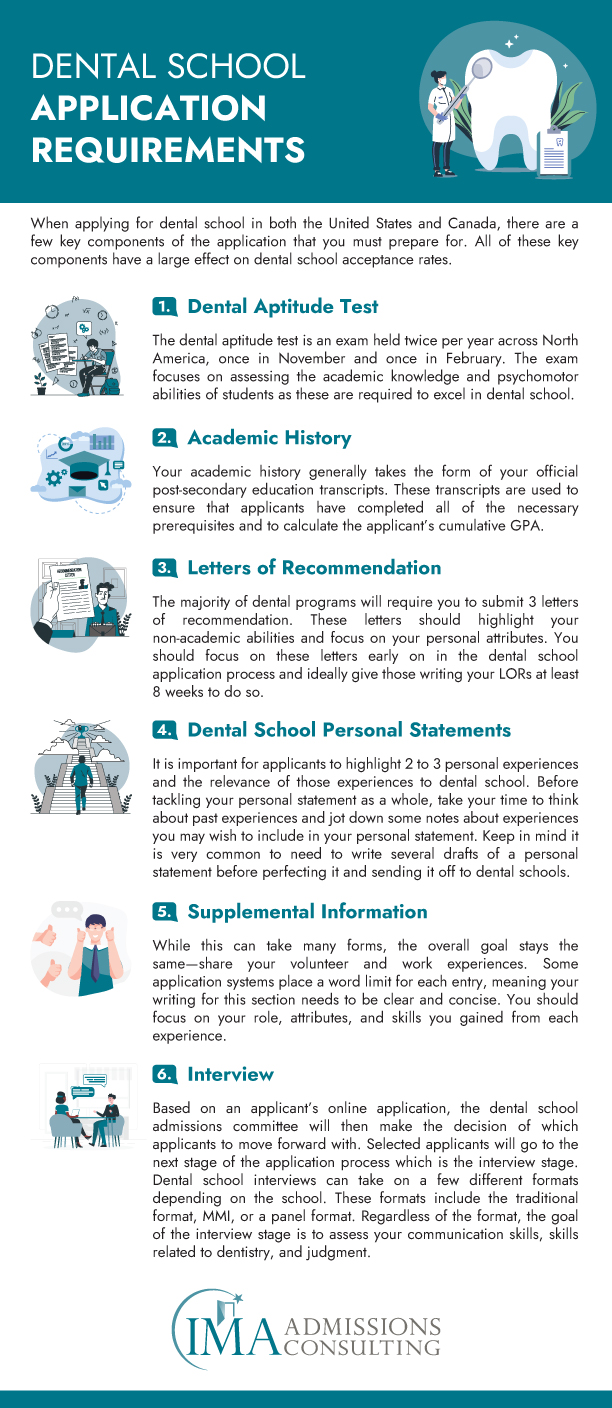
After completing your undergraduate degree, you must take the Dental Admission Test, known as the DAT, to gain admission to dental school. It is best to take the test about one year before you plan to enroll.
Important 2025 change: Beginning March 1, 2025, the ADA implemented a new scoring system for the DAT. The previous two-digit scale (1 to 30) was replaced by a three-digit scale (200 to 600). The content of the exam has not changed, but unofficial score reports are no longer available at the testing center. Official results are now delivered electronically within three to four weeks of your test date. The exam fee is $560.
The DAT consists of four sections:
Survey of Natural Sciences (90 minutes): This section measures your understanding of biology (40 questions), general chemistry (30 questions), and organic chemistry (30 questions), for a total of 100 questions. Note that organic chemistry specifications were updated in April 2026, though the changes primarily involve clearer topic labels and more detailed subtopic listings rather than new content areas.
Perceptual Ability Test (PAT) (60 minutes): This section measures spatial reasoning and visual skills relevant to dental procedures. It includes subsections on view recognition, angle discrimination, apertures, cube counting, 3D form development, and paper folding. You will answer 90 questions.
Reading Comprehension (60 minutes): This section assesses your ability to read, analyze, and understand written passages. It includes 50 questions.
Quantitative Reasoning (45 minutes): This section tests your math skills, including algebra, data analysis and interpretation, probability, and statistics. It includes 40 questions.
To prepare effectively, plan for at least six months of focused study. Use official ADA practice materials and reputable prep resources to build confidence in all four sections.
Submit Your Academic History
You also need to submit your academic credentials when applying. Your official transcripts, letters of recommendation and personal statements are some of the documents you should submit. Dental schools require these documents to ensure applicants have completed the prerequisite courses and to calculate the cumulative GPA.
In most cases, dental schools require applicants to submit at least three letters of recommendation to highlight their nonacademic abilities. Contact your recommenders as early as possible. Your recommenders should be people who know your attributes and strengths well. Ask a university instructor and someone from an internship or volunteer program to write on your behalf.
Some dental schools also require personal statements. When writing your statement, highlight your attributes and two to three relevant experiences. Ask friends, mentors, or advisors to proofread for grammar and spelling. Your personal statement should follow the structure of an academic essay and typically should not exceed 4,500 characters.
Prepare for Your Dental School Interview
After submitting your online application, the admissions committee will review it and decide whether to invite you for an interview. The selection panel will ask questions designed to assess your communication, leadership, confidence, self-awareness, and other skills relevant to dental school and the profession. Interviews may be conducted in panel, traditional one-on-one, or multiple mini-interview (MMI) formats.
To prepare, practice answering common questions such as “Tell me about yourself” and “What do you consider to be your greatest weakness.” Conduct mock interviews with a friend, family member, or advisor. Take time to understand the rationale behind each question and develop thoughtful, specific answers.
If you want to broaden your options, you can apply to multiple dental schools at once through the Associated American Dental Schools Application Service (AADSAS). Fees are $259 for the first school and $112 for each additional school.
Life at a Dental School
If a dental school accepts your application, you will begin an intensive four-year program. In the first two years, you will spend most of your time in classroom-based education studying the basics of dentistry, diagnostics, the structure and function of the body, and the diseases that can affect it. Your dental school will also have procedure-based labs to support learning and help you develop foundational clinical skills.
Some of the classes you will attend include:
- Biochemistry
- Anatomy
- Microbiology
- Dental-Oriented Sciences
- Physiology
- Pharmacology
You will also learn about caring for different patient populations and may begin providing basic oral care to patients under close supervision. Additionally, you will practice procedures on simulation models of mouths and teeth.
In the third and fourth years, you will spend most of your time in clinical rotations, gaining direct experience in the practice of dentistry. You will interact with patients from varied backgrounds and learn how to care for a broad range of populations. Clinical rotations may take place in hospitals, community health centers, or dental school clinics, always under the supervision of licensed faculty.
How to Choose the Best Dental School for You
Life at a dental school is demanding, so choosing the right program matters. As of the 2025–2026 academic year, there are 78 accredited dental schools in the United States and 10 in Canada, according to the ADA. Each school has its own programs, resources, and mission. Here is how to evaluate your options.
Identify Your Aspirations and Preferences
Before applying, do some honest self-assessment. Identify your motivations, expectations, and priorities. Thinking through these questions early will help you find a program that supports your goals.
Think About the Location
The dental school you choose will be your home for four years. Consider whether you want to be close to family or open to relocating. Factor in the patient population, social environment, cost of living, and whether the area offers the clinical exposure you want.
Check the Class Size
Do you prefer smaller classes with more personalized attention, or a larger school with broader networking opportunities? Class size affects your daily experience, your access to faculty, and the pace of clinical rotations.
Determine the Type of Curriculum You Want
Each dental school has its own curriculum and teaching style. Find out whether classes are lecture-based, problem-based, or a combination. Ask when students begin seeing patients, how the school evaluates performance, and whether labs use current technology.
Think About Your Future Plans
The dental school you choose will influence your career trajectory. Look at graduate outcomes. If you plan to specialize, find out how many graduates enter specialty residency programs and what their match rates look like.
Choose a School With Meaningful Opportunities
To build your professional skills, look for programs that offer leadership roles, research opportunities, community outreach, and strong student organizations. These experiences strengthen your resume and help you figure out what kind of dentist you want to be.
How Much Does Dental School Cost in 2026?
Dental school is a significant financial commitment, and the landscape shifted substantially in 2025 and 2026. Understanding the numbers will help you plan responsibly.
According to ADA Health Policy Institute data for the 2025–2026 academic year, average first-year costs (tuition and mandatory fees) break down as follows:
- Public dental school, in-state resident: $46,845
- Public dental school, non-resident: $79,168
- Private dental school: $90,090
Over four years, total costs can exceed $300,000 when you include living expenses, books, and equipment. According to ADEA data, the average educational debt for indebted dental school graduates of the class of 2025 was $297,800.
Major Federal Loan Changes Effective July 2026
If you are planning to start dental school in 2026 or later, you need to know about a major change to federal student lending. The One Big Beautiful Bill Act, signed into law in 2025, eliminates federal Grad PLUS loans for new borrowers as of July 1, 2026. The federal direct loan program will cap borrowing for professional degree students at $50,000 per year and $200,000 in total.
For dental students, who have historically relied on Grad PLUS loans to cover the gap between direct loan limits and actual costs of attendance, this means a larger portion of dental school expenses may need to come from private loans, scholarships, savings, or institutional aid. Private loans typically lack the income-driven repayment options and forgiveness pathways available with federal loans. This change makes it more important than ever to research school-specific financial aid, apply for scholarships early, and model your repayment scenarios carefully. The IMA Student Loan Repayment Calculator can help you estimate monthly payments under different salary and repayment scenarios.
Jumpstarting Your Dental Career
After graduating, you will have many career paths to choose from. But before practicing, you must become licensed in the state where you intend to work. Licensure requirements typically include completing a clinical examination (such as an OSCE or a regional board exam) and a written examination. The clinical exam assesses your readiness to perform dental procedures, while the written exam tests your theoretical knowledge.
From there, you can begin your career as a general dentist, join an established practice, open your own clinic, or enter other sectors such as public health, academics, research, hospital-based care, or international healthcare. You can also choose to specialize.
If you decide to specialize, you will need to complete additional years of residency training after dental school, ranging from two to six years depending on the specialty. Dental residencies are among the most competitive in healthcare. After completing your residency, you will pass an examination specific to your specialty before practicing independently.
The ADA currently recognizes 12 dental specialties:
- Dental Anesthesiology
- Dental Public Health
- Endodontics
- Oral and Maxillofacial Pathology
- Oral and Maxillofacial Radiology
- Oral and Maxillofacial Surgery
- Oral Medicine
- Orofacial Pain
- Orthodontics and Dentofacial Orthopedics
- Pediatric Dentistry
- Periodontics
- Prosthodontics
Working as an associate dentist offers a stable income, mentorship from experienced practitioners, and opportunities for career development. It is also a practical way to begin repaying student loan debt quickly. If you are comparing this path to other healthcare careers, you might find it useful to read about MD vs. MD-PhD training paths or how to become a cardiologist to see how different specialties compare in terms of training length, compensation, and lifestyle.
Starting your own practice gives you complete control, financial independence, and more flexibility. Practice owners and partners reported an average income of $320,316 in 2024, compared to $225,929 for associates, according to ADA survey data. However, starting a practice requires significant capital, business acumen, and the willingness to manage staff, overhead, and marketing alongside patient care. Many new graduates choose to work as associates first, build clinical skills and savings, then transition into ownership or partnership.
Is it Worth it to Become a Dentist?
Dentistry consistently ranks among the most rewarding careers in healthcare. U.S. News and World Report has listed it among the top jobs for multiple consecutive years. Here are concrete reasons why dentistry continues to be worth the investment.
Improve Your Patients’ Oral Health Every Day
Whether you work as an associate dentist or run your own clinic, you will have the opportunity to improve patients’ health on a daily basis. You can provide preventive care to protect against gum disease, cavities, and tooth decay. You can educate patients about effective oral hygiene. And you can perform restorative procedures to repair and replace damaged teeth, restoring both function and confidence.
You Can Start Your Own Practice
While many dentists choose to work as associates, you have the option to open your own practice and be self-employed. Ownership allows you to set your own hours, build a team, and shape the patient experience according to your standards.
Dentistry is a Growing Career
According to the BLS, dentist employment is projected to grow 4% from 2024 to 2034, with about 4,500 openings expected each year. The growing and aging U.S. population, expanding insurance coverage, and rising demand for cosmetic procedures all contribute to sustained demand. HRSA data shows that 63.7 million Americans currently live in dental shortage areas, meaning the need for dentists is far from met.
Technology Continues to Expand What Dentists Can Do
Dental technology is evolving rapidly. FDA-cleared dental AI tools now assist with analyzing intraoral radiographs (cleared in 2022) and 3D CBCT imaging (cleared in 2025). Digital impressions, CAD/CAM restorations, and laser-assisted procedures have made treatments more precise and more comfortable for patients. As a licensed dentist, you will have the opportunity to incorporate these advances into your practice.
Earn a Strong Salary
With a median salary of $179,210 and top earners exceeding $319,000 per year, dentistry offers strong financial returns. Specialists and practice owners can earn significantly more. To assess whether the financial investment in dental school makes sense for your situation, you can use the IMA Pathfinder to evaluate your competitiveness for health professions programs, then model your expected debt and income using the loan repayment calculator.
Become a Respected Member of Your Community
Dentists are trusted healthcare providers. Your team members, patients, and community will look to you for guidance on oral health. You can also contribute through research, public health education, and community outreach programs.
Maintain a Balanced Lifestyle
Dentistry offers more scheduling flexibility than many other healthcare careers. Many dentists work fewer than 40 hours per week. You can control your schedule, choose your practice setting, and adjust your workload to fit your personal priorities.
Choose From Many Career Paths
After dental school, you can work as a general dentist, pursue one of 12 recognized specialties, enter academia or research, work in public health, or practice in military or international settings. The variety of options means you can adjust your career direction as your interests evolve.
What Are the Disadvantages of Being a Dentist?
Like any career, dentistry has real challenges. Understanding them upfront will help you make a more informed decision.
Many Years of School
Becoming a licensed dentist requires at least eight years of post-secondary education: four years of undergraduate study plus four years of dental school. Specializing adds two to six more years. The time commitment is substantial, though the career and financial outcomes reflect that investment.
Significant Student Debt
The average dental school graduate in the class of 2025 carried $297,800 in educational debt, according to ADEA. With the elimination of Grad PLUS loans for new borrowers starting July 1, 2026, future students may face more complex financing arrangements involving private loans. This makes it even more important to understand your repayment options before committing. Average first-year tuition alone ranges from about $46,845 (public, in-state) to $90,090 (private).
Physically and Emotionally Demanding
Dentistry is among the most demanding healthcare careers. Nearly all procedures require precision and fine motor control. You will work in tight spaces, manage anxious patients, and deal with complex clinical situations daily. Physical strain on the hands, neck, and back is common over a long career. Emotional fatigue from managing patient fears and expectations is also a reality worth preparing for.
Workforce Trends Shaping Dentistry in 2026
Several trends are reshaping what it means to practice dentistry, and understanding them now will help you plan a stronger career.
Demographic Shifts in the Profession
The dental workforce is becoming more diverse. In the 2025–2026 academic year, 58.1% of all dental students enrolled in predoctoral programs were female, and 56.4% of class-of-2025 graduates were female, according to the ADA. Among practicing dentists, 38.5% were female in 2024, up from 16% in 2001. The profession is also seeing greater racial and ethnic diversity in entering classes.
Later Retirements and Longer Careers
Among dentists who retired in 2024, the average retirement age was 68.7, up from 64.7 in 2001. The average career span for 2024 retirees was 41.3 years. This means the profession offers a long, productive career, but it also means turnover-driven job openings may come more gradually than in some other fields.
Growth of Group Practices and DSOs
The solo practitioner model is no longer the default. About two-thirds of dentists now work in group practices, and Dental Service Organization (DSO) affiliation reached 16.1% in 2024. For new graduates, DSOs can offer a lower-risk entry point with predictable income, benefits, and administrative support. However, they also typically offer less autonomy than independent ownership. Understanding these models will help you decide what kind of career structure fits your goals.
Frequently Asked Questions
How long does it take to become a dentist?
Plan for at least eight years after high school: four years of undergraduate education followed by four years of dental school. If you choose to specialize, add two to six years of residency training. The total timeline can range from eight to fourteen years depending on your career goals and whether you take any gap years between stages.
What GPA do you need to get into dental school?
Most competitive applicants have a cumulative GPA of 3.4 or higher, though requirements vary by school. Science GPA is weighted heavily. A strong GPA combined with solid DAT scores, clinical exposure, and well-rounded extracurriculars gives you the best chance. The average acceptance rate for U.S. dental schools is about 16%, so academic preparation matters significantly.
How has the DAT changed for 2026 test-takers?
Since March 2025, the DAT uses a new scoring scale of 200 to 600, replacing the previous 1 to 30 scale. The exam content remains the same across four sections: Survey of Natural Sciences, Perceptual Ability, Reading Comprehension, and Quantitative Reasoning. Unofficial scores are no longer available at the testing center; official results arrive electronically within three to four weeks.
Can you still get federal student loans for dental school in 2026?
Federal direct loans remain available, but they are now capped at $50,000 per year and $200,000 total for professional degree students. Grad PLUS loans, which previously covered remaining costs, are closed to new borrowers as of July 1, 2026. Many dental students will need to supplement federal loans with private loans, scholarships, or institutional aid to cover the full cost of attendance.
Is dentistry a good career if you want work-life balance?
Dentistry offers more scheduling flexibility than many healthcare careers. According to the BLS, many dentists work fewer than 40 hours per week, and practice owners can set their own hours. However, the early years of your career may involve longer hours as you build a patient base or repay student loans. Over time, most dentists are able to structure their work around their personal priorities.