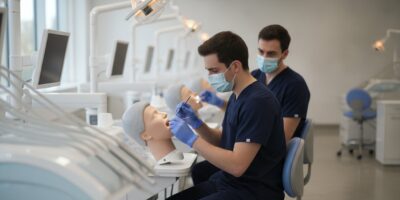

Summer dental internships give pre-dental students supervised time watching dentists work, either close to home or in a hospital dental unit abroad. The best choice depends on your year in school, how much shadowing you already have and what you want to learn, and every option should keep you in an observer’s role.
Summer is often the only stretch long enough for focused clinical exposure, which is why it fills up fast. If you are still deciding what a placement involves day to day, our guide to what to expect from a dental internship walks through a typical week.
Why Summer Works Well for Dental Exposure
Coursework teaches you what dentists know. Watching them work shows you how they use it. A few weeks in a dental setting lets you see the routine of the profession: how a dentist examines a patient, explains a problem, plans treatment and works with the rest of the team. That is hard to fit around a full semester.
Summer also gives you room to reflect. When you are not juggling exams, you can keep a daily log, ask better questions and notice the parts of the work that surprise you. Those notes become the specific examples that make an application or an interview answer convincing.
Finally, summer lets you test your interest before you commit to the dental school path. Some students come away certain. Others realize they are more drawn to hygiene, public health or another field. Both outcomes are useful.
Your Main Options for a Summer Pre-Dental Experience
Most pre-dental summers combine one or more of these options. Each gives you something different:
| Option | What you gain | What to keep in mind |
|---|---|---|
| Shadowing a local dentist | A view of private practice, the U.S. system and long-term patient relationships | Offices set their own rules; ask early and be flexible about days |
| Working as a dental assistant | Daily experience on a dental team | Training rules vary by state |
| Community oral health volunteering | Practice teaching prevention and working with the public | Make sure a licensed professional oversees the clinical side |
| Dental observation abroad | A hospital dental unit, limited-resource care and a different health system | Choose a supervised program with clear limits on your role |
The American Dental Association describes a dental team that includes dentists, dental hygienists, dental assistants, dental office managers and dental laboratory technicians. Whatever option you choose, watching how those roles share the work teaches you as much as watching the dentist alone.
Domestic Alternatives Worth Considering
You do not need to travel to build strong pre-dental experience. Shadowing a dentist near home is the foundation most applicants start with, because it shows you the system you will train and practice in. Ask your own dentist, your college’s pre-health advisor or local community clinics, and be ready to explain what you hope to learn.
Paid work on a dental team is another route. According to the Bureau of Labor Statistics occupational profile for dental assistants, there are several possible paths into the job. Some states require assistants to graduate from an accredited program and pass an exam, while in other states assistants learn through on-the-job training. Check your state’s rules before you apply.
Community work counts too. School-based and community oral health programs give you practice explaining prevention in plain language, a skill dentists use every day. Our guide to dental public health projects offers ideas you can adapt.
Organization Programs: ADA, ASDA and ADEA
Many students search for an internship with a national dental organization before they look anywhere else. These organizations do valuable work for the profession, but their programs are mostly aimed at dental students or run as events rather than summer placements. Here is what each one offers a pre-dental undergraduate.
| Organization | What it offers students | Open to pre-dental undergraduates? |
|---|---|---|
| American Dental Association (ADA) | The professional association for dentists; it does not list an internship program for undergraduates | No internship |
| American Student Dental Association (ASDA) | Externship experiences for dental students, plus predental resources and predental club support | Externships are for dental students; predental resources are open |
| American Dental Education Association (ADEA) | GoDental Jumpstart, a one-day regional event for first- and second-year undergraduates, and the free GoDental Recruitment Event each March | Yes, as events rather than internships |
ADEA’s Jumpstart events are the closest fit for early pre-dental students. Each year ADEA holds one in each of four U.S. regions, hosted by a dental school, with early exposure to the clinical environment and direct contact with admissions representatives and current dental students. The GoDental Recruitment Event brings admissions representatives from U.S. and Canadian dental schools together in one place and is free for prospective students.
One long-running option is no longer available: the Summer Health Professions Education Program, which ADEA supported and which counts more than 2,000 dentists among its alumni, held its last cohort in summer 2026.
What Pre-Dental Students Can Do Instead
Because the national organizations do not run summer internships for undergraduates, most pre-dental students build their summer from the options earlier in this guide: shadowing a general dentist near home, working as a dental assistant and volunteering in community oral health. Add an ADEA event if one is near you, and join your campus predental club for contacts. If you also want time in a hospital dental unit abroad, IMA’s dental internships abroad place pre-dental students beside licensed dentists in Mombasa and Cusco, as described below. IMA is independent of the ADA, ASDA and ADEA.
Summer Dental Internships Abroad
An international placement adds things a local office usually cannot: a hospital dental unit, patients whose care is shaped by limited resources and a health system that works differently from the one at home. You see how dentists adapt their care to the equipment and supplies on hand, and how access to dental care depends on the wider health system.
On IMA’s dental internships abroad, pre-dental students spend most of the day in a hospital dental unit beside a licensed dentist, watching oral exams, preventive care and common treatments such as fillings and extractions. In Mombasa, Kenya, the placement is the Dental Unit at Coast General Teaching and Referral Hospital. In Cusco, Peru, it is the Dentistry Department at Hospital Nacional Adolfo Guevara Velasco. Where the site offers them, you may also see oral surgery, orthodontics, periodontics and preventive care.
Each week, a physician mentor leads a clinical debrief with your group, and the Global Health Lecture Series covers health policy and disparities in the host country. Community work takes you out of the hospital, where you help teach school children how to brush their teeth and prevent common infections.
Eligibility and Timing
IMA’s dental program is open to pre-dental students, dental students and recent dental graduates. Kenya runs year-round for 2 to 12 weeks, so a summer stay can be as long as your break allows. Cusco runs fixed sessions of two to four weeks and requires at least two years of Spanish study, because the dental team works in Spanish.
Summer sessions fill early, so start planning in the fall or winter before. Our guide to planning a pre-med internship abroad covers how far ahead to apply, and the same timeline works for dental placements. Check current program dates against your academic calendar before you commit.
Supervision and What You Can and Cannot Do
Every option on this list should keep you in an observer’s role. The American Dental Education Association’s guidelines for predental students abroad consider preventive oral health education and support for the team appropriate after instruction, but rule out anything that counts as the practice of dentistry.
On IMA programs, pre-dental students observe patient care and do not examine, clean or treat anyone’s teeth. Your active role comes in community sessions, where you help teach oral hygiene. A patient can always decline to have a student present, and you never diagnose, prescribe or stand in for local staff. Our guide to pre-dental intern responsibilities explains the limits in detail, with examples of how to decline a request politely.
Clear limits are not a weaker experience. They let you focus on how dentists think, communicate and work as a team, which is what dental schools want you to understand.
How to Choose the Right Summer Experience
Start with what your record already shows. Then pick the option that fills the biggest gap.
- No shadowing yet: start close to home, so you see U.S. dentistry first.
- Shadowing in one office only: add a different setting, such as a community clinic or a hospital dental unit.
- Plenty of observation, little team experience: look at dental assisting or community oral health work.
- Strong domestic base and interest in global or public health: a supervised placement abroad adds range and specific material for your application.
Whatever you choose, confirm three things before you commit: who supervises you, what you may and may not do, and how your hours are recorded.
Building Skills and Confidence Over the Summer
A summer in a dental setting builds more than hours. You practice professional communication with patients and staff, learn to manage your time on a clinical schedule and see how a team handles a busy day. Those habits carry into dental school and into interviews.
Confidence comes from preparation. Learn basic dental terms before you start, read about the setting you are joining and set two or three goals for the summer. Revisit them each week with your supervisor or mentor.
Turning Your Summer Into Application Material
Dental schools want to see that you understand the profession, and specific observations show that better than a list of hours. Keep a short log each day: the setting, the hours, your supervisor and two or three moments that taught you something, described without identifying patients.
When you reach the application stage, our guide to applying with ADEA AADSAS explains how experiences are entered and described. Describe observation as observation. Committees value an honest, specific account far more than an inflated one.
On IMA programs, hours are logged by date and shift, and IMA’s U.S.-based Medical Director validates the record. Each dental school decides how to count those hours, and every intern who completes the program receives a certificate of completion. Interns who show professionalism and commitment can also request a letter of recommendation.
Frequently Asked Questions
Does the American Dental Association Offer Internships for Undergraduates?
The ADA does not list an internship program for undergraduates. Its student affiliate, ASDA, supports externships for dental students, and ADEA runs GoDental Jumpstart events for first- and second-year undergraduates. Pre-dental students usually build summer experience through shadowing, assisting and supervised programs.
Are Summer Dental Internships Open to Students Who Have Not Started Dental School?
Yes. Most summer dental internships for undergraduates are observation-based. IMA’s dental program is open to pre-dental students, dental students and recent dental graduates, and pre-dental students observe licensed dentists rather than treating patients.
Can I Do Hands-On Dental Work During a Summer Internship?
Not as a pre-dental student. ADEA’s guidelines rule out anything that counts as the practice of dentistry for predental students. On IMA programs, pre-dental students do not examine, clean or treat anyone’s teeth, and their active role is teaching oral hygiene in community sessions.
Should I Shadow at Home or Abroad for My First Summer?
If you have no shadowing yet, start at home so you see U.S. dentistry first. A supervised placement abroad adds the most once you have a domestic base to compare it with.
How Long Should a Summer Dental Internship Be?
Long enough to see a range of patients and settle into the routine. IMA’s Kenya program runs year-round for 2 to 12 weeks, while Cusco offers fixed sessions of two to four weeks for students with at least two years of Spanish.
Do Dental Schools Count Hours From an Internship Abroad?
Each dental school decides how to count them. Describe the experience accurately as observation, keep a verifiable record and check the requirements of the schools you plan to apply to.
When Should I Apply for a Summer Dental Internship?
Start planning in the fall or winter before the summer you want. Sessions fill early, and you need time to arrange travel documents, vaccinations and your academic schedule.