Radiologists are physicians who use medical imaging to diagnose disease, guide treatment decisions, and, in the case of interventional radiologists, perform minimally invasive procedures. If you are a pre-med student wondering what do radiologists do on a daily basis, the short answer is this: they interpret imaging studies such as X-rays, CT scans, MRIs, and ultrasounds; they consult with other physicians about findings; they participate in multidisciplinary care teams; and, depending on their subspecialty, they may spend significant time in procedure suites performing image-guided interventions. Radiology sits at the diagnostic backbone of modern medicine. Nearly every major clinical decision, from cancer staging to emergency trauma management, relies on a radiologist’s interpretation.
Understanding the role matters right now for a specific reason. Radiology is changing. Artificial intelligence tools are increasingly integrated into clinical workflows, and compensation continues to climb as demand for imaging specialists outpaces supply. If you are weighing this specialty against others, you need a clear, honest picture of what the work involves, how the field is evolving, and what the path actually demands. This article covers the day-to-day reality, the major subspecialties, AI’s actual impact as of 2026, and current salary data so you can make an informed decision about whether radiology fits your goals.
What a Radiologist’s Typical Workday Actually Looks Like
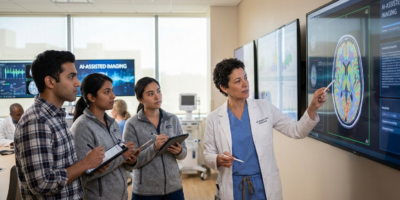
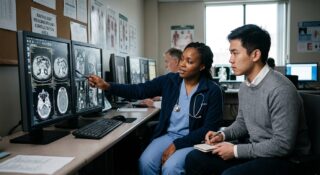
The core of a diagnostic radiologist’s day is spent in the reading room. This is a workstation environment, often dimly lit to optimize screen contrast, where the radiologist reviews imaging studies on high-resolution monitors. A single radiologist might interpret dozens or even hundreds of studies in a shift, ranging from a chest X-ray ordered in urgent care to a complex brain MRI for a patient with neurological symptoms. For each study, the radiologist analyzes the images, correlates findings with the patient’s clinical history, generates a report, and communicates urgent or unexpected findings directly to the referring physician.
But reading studies is not a solitary, disconnected activity. Radiologists spend substantial time on the phone or in direct conversation with other doctors. A surgeon might call to ask which imaging protocol best answers a specific surgical question. An oncologist might need clarification on whether a lesion has grown since the last scan. This consultative role makes radiologists central to patient care, even though patients may never meet them face to face.
Tumor Boards and Multidisciplinary Conferences
One of the most collaborative parts of a radiologist’s week is the tumor board or multidisciplinary conference. These meetings bring together surgeons, medical oncologists, radiation oncologists, pathologists, and radiologists to review complex cases, often cancer patients. The radiologist presents the imaging findings, explains how a tumor relates to surrounding anatomy, and helps the team decide on the best treatment plan. Attending these conferences, even as an observer, is one of the clearest ways to see how radiologists shape patient outcomes.
The Interventional Radiologist’s Day
An interventional radiologist (IR) has a different rhythm. While some time is spent reviewing images and planning procedures, much of the day happens in a procedure suite. IRs perform minimally invasive, image-guided procedures: biopsies of lung, liver, or kidney lesions; draining abscesses; placing central venous ports for chemotherapy; embolizations to stop bleeding or shrink tumors; angioplasty and stenting of blocked vessels; and tumor ablations. These procedures require precision, manual dexterity, and direct patient interaction before, during, and after the intervention. IR physicians often manage their own patients in clinic and on hospital services, making their day closer to what many people picture when they think of a doctor’s schedule.
Both diagnostic and interventional radiologists take call. Overnight and weekend shifts involve interpreting emergency studies, such as CT scans for trauma patients or stroke imaging, and, for IR, performing urgent procedures like embolizations for hemorrhage. Call can be demanding, but many practices rotate it among physicians.
Diagnostic Radiology vs. Interventional Radiology
The distinction between diagnostic and interventional radiology is significant enough that they are now recognized as separate residency tracks, though they share foundational training. Understanding the difference early can help you think about which version of the career appeals to you.
Diagnostic radiologists focus on image interpretation. Their primary tools are pattern recognition, anatomical knowledge, and clinical reasoning. They work across every organ system and every imaging modality. The job is intellectually intense and analytically demanding. It rewards people who are detail-oriented, comfortable with ambiguity, and able to synthesize large amounts of information quickly. Patient interaction exists, particularly in breast imaging and some procedural areas, but it is less central to the daily workflow than in most other specialties.
Interventional radiologists are, in effect, minimally invasive surgeons who use imaging for guidance. Their patient interaction is direct and ongoing. They see patients in clinic, discuss risks and benefits, perform procedures, and manage post-procedural care. The skillset combines diagnostic ability with procedural competence. If you are drawn to both the analytical side of radiology and the hands-on nature of surgery, IR sits at that intersection.
For pre-med students, neither path requires an early commitment. Medical school, clinical rotations, and residency interviews all provide time and information to make the choice. But knowing that the two tracks exist, and what each day looks like, gives you a more honest foundation for deciding whether to pursue radiology at all.
Radiology Subspecialties Worth Knowing About
After completing a diagnostic radiology residency (typically five years), many radiologists pursue a one- to two-year fellowship to subspecialize. Each subspecialty has a distinct patient population, imaging focus, and daily rhythm.
Neuroradiology
Neuroradiologists interpret imaging of the brain, spine, and nervous system. They read MRIs and CTs for stroke, tumors, multiple sclerosis, trauma, and degenerative conditions. Some neuroradiologists also perform interventional procedures, such as thrombectomies to remove blood clots in stroke patients, placing this subspecialty at the intersection of diagnosis and intervention.
Breast Imaging
Breast imagers interpret mammograms, breast ultrasounds, and breast MRIs. They also perform image-guided biopsies and work closely with patients, often delivering results directly. This is one of the more patient-facing diagnostic radiology subspecialties and plays a critical role in cancer screening and early detection.
Musculoskeletal (MSK) Radiology
MSK radiologists focus on bones, joints, muscles, and soft tissues. They interpret MRIs of torn ligaments, fractures, arthritis, and bone tumors. They frequently work alongside orthopedic surgeons and sports medicine physicians, and some perform image-guided injections.
Abdominal Radiology
Also called body imaging, this subspecialty covers the chest, abdomen, and pelvis. Abdominal radiologists read CT scans and MRIs for conditions ranging from appendicitis to liver cancer to kidney stones. They are heavily involved in cancer staging and often participate in tumor boards.
Pediatric Radiology
Pediatric radiologists specialize in imaging children, from neonates to adolescents. The work requires knowledge of developmental anatomy, pediatric diseases, and radiation dose optimization, since minimizing radiation exposure in children is particularly important. The ALARA principle (As Low As Reasonably Achievable) is a constant consideration.
Interventional Radiology
As discussed, IR is both a residency track and a fellowship option. Fellowship-trained IRs typically focus on complex vascular and oncologic interventions, and the field continues to expand as new minimally invasive techniques emerge.
These subspecialties are not exhaustive, but they represent the major areas where radiologists build careers. Each one shapes the daily work, the types of colleagues you interact with, and the patient populations you serve. The AAMC’s data on active physicians by specialty can give you a sense of how the workforce distributes across these areas.
AI in Radiology: What Is Actually Happening in 2026
The question pre-med students ask most often about radiology is whether artificial intelligence will eliminate the specialty. The answer, based on where things stand in 2026, is clearly no. But AI is changing the work, and understanding how will make you a better-informed applicant and, eventually, a better physician.
By 2026, the majority of radiology departments at larger hospitals and academic centers use AI tools in some form. These tools handle specific, well-defined tasks: flagging studies that may contain urgent findings (like a large pulmonary embolism or intracranial hemorrhage) so they move to the top of the worklist; performing quantitative measurements (like tracking tumor size over time with greater consistency); enhancing image quality; and identifying potential lesions for the radiologist to review. In mammography, AI assists with screening by marking areas of concern, which the radiologist then evaluates.
What AI does not do is replace the radiologist’s judgment. It does not integrate clinical context. It does not call a surgeon to discuss an ambiguous finding. It does not sit in a tumor board and explain how a mass relates to a major blood vessel. It does not counsel a patient about a biopsy result. And it does not perform procedures. The radiologist’s role is evolving, with more emphasis on complex interpretation, oversight of AI-generated results, direct clinical consultation, and procedural work. Routine, repetitive tasks are increasingly automated, but the cognitive and interpersonal demands of the job remain firmly human.
The American College of Radiology has been proactive in guiding responsible AI adoption, and their resources on AI in radiology practice provide a useful look at how the profession is managing this shift. For pre-med students, the takeaway is practical: learning to work with AI tools will be part of your training, not a threat to your career.
Radiologist Salary in 2026: What the Numbers Show
Compensation is a legitimate factor in career planning, and radiology is among the highest-paid medical specialties. Based on trends from recent physician compensation surveys and accounting for continued demand and inflation, the projected salary ranges for 2026 are as follows.
Diagnostic radiologists can expect average annual compensation in the range of $500,000 or above, with variation based on subspecialty, geographic region, practice type (academic vs. private), and experience level. Partners in busy private practices or radiologists in underserved regions with high demand often earn significantly more.
Interventional radiologists typically earn more due to the procedural nature of their work. Average annual compensation for IR physicians is projected at $600,000 or above, with experienced physicians or partners in high-volume practices reaching $700,000 to $800,000 or higher.
These figures are projections based on compensation data from recent years and observable market trends. The Bureau of Labor Statistics occupational data for physicians and surgeons provides broader context for physician compensation and job outlook, though it does not break out radiology-specific figures in granular detail.
It is worth emphasizing that these salaries follow a long training period: four years of medical school, five years of residency (for diagnostic radiology; IR residency is also five to six years with the integrated pathway), and often one to two years of fellowship. During residency, compensation is modest relative to the hours worked. The financial rewards are real, but they come at the end of a demanding pipeline.
How Understanding Radiology Strengthens a Medical School Application
You do not need to commit to radiology before medical school. Admissions committees are not looking for pre-med students who have already chosen a specialty. But demonstrating that you understand the breadth of medicine, including specialties like radiology that many applicants overlook, signals genuine intellectual curiosity and clinical awareness.
If you have observed a tumor board, watched a physician review imaging to make a treatment decision, or seen how a basic X-ray changed the management of a patient in a resource-limited setting, those are experiences worth reflecting on in your application. They show that you understand medicine as a collaborative enterprise, not just a series of individual patient encounters. They also demonstrate an appreciation for the analytical and technological dimensions of healthcare.
For students considering clinical observation experiences abroad, the contrast between well-resourced and resource-limited settings can sharpen your understanding of how imaging shapes medical decisions. In many international hospitals, clinicians rely heavily on clinical examination and basic imaging like X-rays and ultrasound because advanced modalities such as CT and MRI may be limited. Observing that dynamic, under proper supervision and within approved boundaries, can inform a thoughtful application essay about diagnostic reasoning and resource allocation.
If you are interested in the training pathway itself, including residency structure and what medical schools expect, the Radiological Society of North America’s student resources page offers helpful information specific to aspiring radiologists.
Deciding Whether Radiology Fits You
Radiology rewards a specific set of strengths: visual-perceptual acuity, analytical thinking, comfort with technology, the ability to focus intensely for long stretches, and strong communication skills for consulting with colleagues. If you enjoy puzzles, pattern recognition, and working at the intersection of technology and medicine, the specialty is worth serious consideration.
It is also honest to acknowledge what the job is not. Diagnostic radiology involves less direct patient contact than most other specialties, though this varies by subspecialty and is evolving. The reading room can be isolating for people who thrive on constant interpersonal interaction. And the training is long and competitive.
The best way to test your interest is through exposure: shadowing a radiologist if your institution allows it, attending radiology-related conferences or case presentations, and talking with radiology residents about what they wish they had known before choosing the field. If you are still early in your pre-med journey, focus on building the foundational skills, including strong academic performance, clinical exposure across multiple specialties, and the capacity to reflect honestly on what you observe. The specialty choice will come later, and it will be better for having a clear understanding of what the work actually involves.
Frequently Asked Questions
Do radiologists interact with patients, or do they only read images?
Diagnostic radiologists interact with patients more than most people assume, particularly in breast imaging, where they often deliver results directly, and in any setting that involves image-guided biopsies or consultations. Interventional radiologists have extensive direct patient contact, including clinic visits, pre-procedure discussions, performing procedures, and post-procedural follow-up. The degree of patient interaction varies by subspecialty, but characterizing radiology as a “no-patient-contact” specialty is inaccurate.
Is radiology a good specialty to pursue given the growth of AI?
AI is an assistive tool in radiology, not a replacement for radiologists. As of 2026, AI handles specific tasks like flagging urgent findings, performing quantitative measurements, and enhancing image quality. It does not replace the radiologist’s clinical judgment, ability to integrate patient context, consultative role with other physicians, or procedural skills. The specialty is adapting, and radiologists who work effectively alongside AI tools are well positioned for the future.
How competitive is radiology as a residency match?
Radiology is a competitive specialty. It typically attracts applicants with strong USMLE/COMLEX scores, solid clinical grades, research experience, and letters of recommendation from radiology faculty. The integrated IR pathway is particularly competitive. While specific match statistics shift year to year, pre-med students should plan on performing well academically and gaining meaningful exposure to the field during medical school to be competitive applicants.