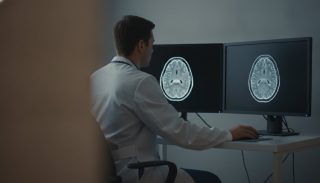

A neuroradiologist is a radiologist who specializes in imaging of the brain, spine, head and neck. To become one, you finish college and an MD or DO degree, complete a clinical year and a four-year diagnostic radiology residency, then a one-year neuroradiology fellowship, and earn American Board of Radiology certification: about 14 years after high school.
Everything up to the end of radiology residency is the same path every diagnostic radiologist follows, and our guide on how to become a radiologist covers those early stages in detail. This page focuses on what is specific to neuroradiology: the fellowship and its case numbers, the ABR neuroradiology subspecialty certificate, the work itself, pay and outlook.
What a Neuroradiologist Does
The 2026 ACGME neuroradiology program requirements define the field as both imaging and invasive procedures related to the brain, spine and spinal cord, head, neck, and organs of special sense (eyes, ears and nose), in adults and children. The imaging side covers CT, MRI, plain films, neurosonography and nuclear radiology. Neuroradiologists interpret those images using their knowledge of the pathology and clinical features of disease in each of those regions.
The American Board of Radiology describes a neuroradiologist as a physician who diagnoses and treats disorders of the brain, sinuses, spine, spinal cord, neck and central nervous system, including diseases of aging, seizure disorders, cancer, stroke, cerebrovascular disease and trauma. A typical workday mixes several kinds of tasks:
- Reading studies: brain and spine MRI, head CT for trauma or stroke, CT and MR angiography of the head and neck vessels
- Consulting: talking through findings with neurologists, neurosurgeons, emergency physicians, oncologists and ear, nose and throat surgeons
- Procedures: image-guided lumbar punctures, myelograms and spine procedures
- Advanced imaging: perfusion imaging, MR spectroscopy, diffusion tensor imaging and functional MRI for surgical planning
For a broader look at the daily work across radiology, see IMA’s explainer on what a radiologist does day to day.
Is a Neuroradiologist the Same as a Neurologist?
No. A neurologist trains in a neurology residency and examines, diagnoses and treats patients with nervous system disorders, largely in clinic and hospital settings. A neuroradiologist trains in radiology and diagnoses those same conditions through imaging. The two work side by side, especially in stroke care. If the clinical side appeals to you more, read our guide on how to become a neurologist.
Where Do Neuroradiologists Work?
The American Society of Neuroradiology has nearly 6,000 physician members and reports where they practice: 60% in academic institutions, 24% in community hospitals, 8% in private practice or freestanding imaging centers, 3% in government or military settings and 5% elsewhere. Asked about their areas of focus, 86% of members listed brain imaging, 58% head and neck, 57% spine, 26% pediatric, 22% functional and 18% interventional work.
Step-by-Step Path to Becoming a Neuroradiologist
Step 1: Finish College and the Pre-Med Requirements
Any major works if you complete the prerequisite sciences and take the MCAT. Physics and neuroscience courses are useful later, since physics is tested throughout the radiology boards. Clinical experience matters as much as grades. IMA’s pre-med internships abroad place students in hospitals and clinics where, under supervision of licensed clinicians, interns take vital signs, help with patient intake and join ward rounds. Time spent near a radiology department also helps; our guide to radiology shadowing for pre-health students explains what to expect.
Step 2: Earn an MD or DO Degree
Medical school takes four years. Use the clinical years for a radiology elective, a neurology or neurosurgery rotation, and ideally a research project involving brain or spine imaging. You apply to radiology residency in the fourth year through ERAS and the NRMP Match; our ERAS residency application guide walks through the timeline.
Step 3: Complete the Clinical Year
The 2026 ACGME diagnostic radiology program requirements set two formats. The 48-month program requires a prerequisite year of direct patient care, with at least 36 weeks of direct patient care, in anesthesiology, emergency medicine, family medicine, internal medicine, neurology, obstetrics and gynecology, pediatrics, surgery, a transitional year, or a combination. The 60-month program builds that clinical year in. Radiology electives during the clinical year cannot exceed two months combined.
Step 4: Finish the Four-Year Diagnostic Radiology Residency
Both formats include 48 months of radiology education (the R1 to R4 years). ACGME lists neurologic imaging as one of 10 required content categories, alongside breast, cardiac, gastrointestinal, musculoskeletal, pediatric, reproductive and endocrine, thoracic, urinary and vascular imaging. Physics teaching runs through all four years. Residents are paid throughout; our breakdown of how much resident doctors make covers resident salaries.
The ABR adds its own rules for diagnostic radiology certification: the residency may include no more than 16 months of research, and, effective July 1, 2026, the four years must be completed within eight years of the residency start date.
Step 5: Complete a Neuroradiology Fellowship
Under the 2026 ACGME requirements, an accredited neuroradiology fellowship is 12 months long, and entry should follow satisfactory completion of an accredited diagnostic radiology residency. Some programs add a second year: the ASNR’s page for neuroradiologists in training refers to one- or two-year neuroradiology fellowships.
What Do Neuroradiology Fellows Have to Complete?
ACGME sets minimum numbers that each fellow must perform or interpret during the fellowship year:
| ACGME requirement (2026) | Minimum per fellow |
|---|---|
| Neuroradiological exams, including CT and MR | 3,000 |
| Of those, neuroradiological MR scans | 1,500 |
| Vascular exams (CTA, CTV, MRA, MRV, Doppler ultrasound, catheter angiography) | 250 |
| Image-guided invasive procedures | 100 |
Fellows must also show competence in image-guided access to the spinal subarachnoid space for myelography, spinal fluid analysis or delivery of therapeutic agents. The curriculum must include pediatric neuroradiology, head and neck radiology, and spine radiology, plus advanced techniques such as CT and MR perfusion, diffusion imaging, MR spectroscopy, functional MRI and PET. Fellows log their invasive cases, and they should take on at least one research project as principal investigator. IMA’s explainer on what a medical fellowship is covers how fellowship applications and contracts work in general.
Step 6: Earn ABR Certification in Diagnostic Radiology
The ABR primary certificate comes first, in two exams:
1. Qualifying (Core) Exam: taken after 36 months of residency. It is a remote, computer-based exam over three days, about five and a half hours per day, offered twice a year (typically late May or early June and November). Neuroradiology is one of its tested domains, and physics questions are embedded throughout. 2. Certifying Exam (2026 and 2027): a one-day, computer-based exam of about seven and a half hours, taken at least 12 months after residency. Candidates choose three clinical practice modules, and neuroradiology is one of the options. 3. Oral Exam (after 2027): replaces the computer-based Certifying Exam. It is seven 25-minute, one-on-one oral exams, one per clinical category, and neuroradiology is one of the seven.
You also need a valid medical license (a training license is acceptable during residency). Board eligibility lasts six full calendar years after you finish residency.
Step 7: Earn the ABR Neuroradiology Subspecialty Certificate
The ABR subspecialty certification page lists the requirements for the neuroradiology certificate:
- An ABR certificate in general radiology, diagnostic radiology, or interventional radiology/diagnostic radiology
- One year of ACGME- or RCPSC-accredited neuroradiology fellowship, documented by the program director
- A current, valid medical license
- One year of practice or additional approved training, with at least one-third of that year spent in neuroradiology
Applications open in myABR from February 1 through April 30 each year. The exam is offered once a year, typically in August, as a one-day remote exam with 180 image-rich questions lasting about four hours. It is scored by content category: failing one category earns a conditional pass and a retake of that portion, while failing two or more means retaking the whole exam. You have six calendar years after training to earn the certificate.
Neuroradiologist Training Timeline
How Long Does It Take to Become a Neuroradiologist?
| Stage | Length |
|---|---|
| College | 4 years |
| Medical school | 4 years |
| Clinical year (PGY-1) | 1 year |
| Diagnostic radiology residency (R1 to R4) | 4 years |
| Neuroradiology fellowship | 1 year (some programs offer 2) |
| Total after high school | About 14 years |
The subspecialty certificate comes a little later, since the ABR requires a year of practice or approved training after the fellowship. Research years or a two-year fellowship add time. Our timeline of how long it takes to become a doctor compares this with other specialties.
What About Neurointerventional Work?
Neuroradiologists who want to treat strokes, aneurysms and vascular malformations from inside the blood vessels need more training. The 2026 ACGME neuroendovascular intervention requirements set a 24-month fellowship. On the diagnostic radiology route, entrants must have completed both a diagnostic radiology residency and a neuroradiology fellowship. The same fellowship is also open to neurosurgeons and neurologists, which is why the field overlaps with the work described in our guide on how to become a neurosurgeon.
Neuroradiologist Salary
BLS has no separate line for neuroradiologists. They are counted under radiologists, and the May 2025 BLS wage data for radiologists covers 26,770 workers:
| May 2025 BLS annual wage | Radiologists |
|---|---|
| 10th percentile | 89,010 |
| 25th percentile | 216,800 |
| Median | 420,860 |
| Mean | 381,530 |
| 75th percentile | 506,010 |
| 90th percentile | 594,410 |
Figures are annual wages in US dollars. They cover all radiologists, not neuroradiologists alone, and pay depends on practice setting, region, call and experience. The radiologist median sits well above the $271,090 median for the broader physicians group in the same May 2025 data. Our list of the highest-paid doctors in the United States puts these figures next to other specialties.
What Is the Job Outlook for Neuroradiologists?
The BLS Occupational Outlook Handbook projects radiologist employment to grow from 28,700 jobs in 2025 to 29,600 in 2035, a 3% increase of about 1,000 jobs. Physicians and surgeons as a group are projected to grow 4% over the same decade, with about 22,100 openings a year. BLS points to a growing number of older adults and rising rates of chronic illness, including cancer and heart disease, as drivers of physician demand. Neuroradiology is not projected separately.
Who Neuroradiology Suits
Neuroradiology tends to fit people who love neuroanatomy, think in three dimensions, and enjoy being the physician other doctors call when a scan is hard to read. The work is mostly interpretive, with a steady share of procedures, and it pairs closely with neurology, neurosurgery and emergency medicine. If that sounds right, build toward it with strong science courses, real patient contact, and a radiology or neuroscience research project during medical school.
Frequently Asked Questions
How many years does it take to become a neuroradiologist?
About 14 years after high school: four years of college, four years of medical school, a clinical year, a four-year diagnostic radiology residency, and a one-year neuroradiology fellowship. A two-year fellowship or research years add time.
Is a neuroradiologist a doctor?
Yes. A neuroradiologist is a physician with an MD or DO degree who completed a diagnostic radiology residency and then a neuroradiology fellowship focused on imaging of the brain, spine, head and neck.
How long is a neuroradiology fellowship?
The 2026 ACGME requirements set an accredited neuroradiology fellowship at 12 months. Some programs offer a second year, and the ASNR refers to one- or two-year fellowships.
What board certifies neuroradiologists?
The American Board of Radiology. Candidates first earn ABR certification in diagnostic radiology, then complete an accredited neuroradiology fellowship and a year of practice or approved training before taking the Neuroradiology Subspecialty Exam.
What is on the ABR neuroradiology subspecialty exam?
It is a one-day remote, computer-based exam with 180 image-rich questions lasting about four hours, offered once a year, typically in August. It is scored by content category, with results of pass, conditional pass or fail.
How much does a neuroradiologist make?
BLS does not publish a separate figure for neuroradiologists. They are counted as radiologists, whose median annual wage was $420,860 in May 2025, with the 75th percentile at $506,010.
Do neuroradiologists perform procedures?
Yes. ACGME requires each neuroradiology fellow to complete at least 100 image-guided invasive procedures, including image-guided access to the spinal canal for myelography or spinal fluid analysis. Treating strokes and aneurysms inside the blood vessels requires a further 24-month neuroendovascular fellowship.
See more of our guides in your Google results: add International Medical Aid as a preferred source on Google.