High school students exploring healthcare careers encounter the same four sets of initials everywhere: CNA, LPN, RN, and MD. They appear on hospital badges, in program descriptions, and across every list of medical internships for high school students. Without context, these titles blur together. Everyone is wearing scrubs, everyone is talking with patients, and the differences are not obvious from the hallway.
With a focus on what matters most for teenagers who are beginning to explore clinical settings. Students who want to understand how nursing roles specifically connect to high school shadowing and early clinical exposure can read our nursing pathway-building guide, which covers supervision structures, age requirements, and how observational clinical experience supports future applications.
Why Modern Healthcare Uses So Many Different Roles
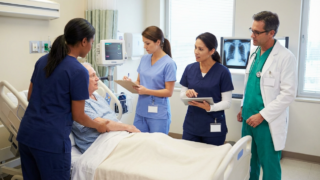
Healthcare is a team discipline. A single patient admitted to a hospital might interact with a certified nursing assistant during morning hygiene care, a licensed practical nurse for certain treatments, a registered nurse who coordinates the overall care plan, and a physician who makes diagnostic and prescribing decisions. Each person has a defined scope of practice, which is the legal boundary of what they are trained and authorized to do independently.
For teens observing a clinical unit for the first time, this team structure raises immediate questions. Who is allowed to give medications? Who decides when a patient can be discharged? Who writes the care plan and who carries it out? Who can perform a procedure and who can only observe it?
These are not trivial questions. They define the professional identity of every person on the floor and shape the preparation required to reach each role. Students who understand the answers are better equipped to evaluate which path fits their interests, their tolerance for academic length, and their preferred type of daily work.
The Four Roles: What Each One Means
Certified Nursing Assistant (CNA)
A CNA is often the team member who spends the most continuous time with a patient. CNAs assist with the activities of daily living: bathing, dressing, grooming, eating, and moving safely between bed and chair. They take and record basic vital signs, observe and report changes in how a patient looks or feels to the supervising nurse, and provide the kind of consistent bedside presence that directly affects patient comfort and dignity.
CNA training is the shortest of the four pathways. Most programs run between four and twelve weeks and are offered through community colleges, vocational schools, or healthcare facilities. After completing the program, candidates pass a state competency exam. CNAs are not licensed in the same way nurses and physicians are, but they must meet state certification standards before working with patients.
For high school students, CNA certification can become a practical option during the later years of high school or shortly after graduation, particularly for students who want direct patient contact and are comfortable entering the workforce on a shorter timeline.
Licensed Practical Nurse (LPN)
An LPN, called a licensed vocational nurse (LVN) in some states, has more clinical training than a CNA and takes on more independent nursing responsibilities. LPNs administer certain medications, perform basic wound care, collect diagnostic samples, and monitor patients with stable conditions. They work under the direction of registered nurses and physicians, following established care plans and reporting changes in patient status.
LPN programs typically run about one year and include coursework in anatomy and physiology, pharmacology, adult and pediatric nursing principles, and supervised clinical rotations in hospital or long-term care settings. Graduates pass the NCLEX-PN, the national licensing examination for practical nurses.
LPNs serve as an important clinical bridge between CNAs and RNs. Some LPNs use their credential as a stepping stone, later completing bridge programs to become registered nurses.
Registered Nurse (RN)
An RN has the broadest education and the widest scope of practice among nursing roles. RNs perform initial patient assessments, write and update nursing care plans, administer most medications and many clinical treatments, coordinate with physicians and allied health professionals, educate patients and families about diagnoses and discharge instructions, and supervise CNAs and LPNs within their unit.
RNs complete either an associate degree in nursing, typically two years, or a bachelor of science in nursing, typically four years. Both paths qualify graduates to sit for the NCLEX-RN, the national licensing exam for registered nurses. Bachelor-prepared nurses generally have more coursework in research, leadership, and community health, and many hospitals now prefer or require a BSN for complex care settings and leadership roles.
Some RNs continue into advanced practice, completing graduate education to become nurse practitioners, certified registered nurse anesthetists, clinical nurse specialists, or certified nurse midwives. Advanced practice nurses have expanded prescribing authority and take on responsibilities that overlap with those of physicians in some clinical contexts.
Physician (MD)
A physician has completed the longest and most academically intensive training of the four roles. MDs diagnose illnesses, order and interpret diagnostic tests and imaging, prescribe medications, perform procedures and surgeries depending on their specialty, and make the complex treatment decisions that govern the direction of a patient’s care.
The physician training pathway begins with an undergraduate degree, typically with a strong foundation in biology, chemistry, and related sciences. Medical school adds four years of clinical and academic training. After graduating, physicians complete a residency in their chosen specialty, which can run from three to seven years or longer. Some physicians complete additional fellowship training for subspecialty work.
For high school students, understanding the physician pathway is not about committing to it immediately. It is about recognizing that the preparation it requires, in terms of academic consistency, clinical exposure, and professional identity formation, begins in high school in a meaningful and measurable way.
Education and Training: Side-by-Side Comparison
| Role | Minimum Training | Credential Exam | Typical Entry Timeline |
|---|---|---|---|
| CNA | 4 to 12 weeks | State competency exam | Late high school or shortly after |
| LPN | Approximately 1 year | NCLEX-PN | Post-high school |
| RN | 2 to 4 years (ADN or BSN) | NCLEX-RN | College degree required |
| MD | 8 to 12+ years (undergrad + medical school + residency) | USMLE Steps 1, 2, 3 | Long-term academic pipeline |
Scope of Practice: What Each Role Is and Is Not Permitted to Do
CNA: Direct support and close observation. CNAs provide essential physical support and serve as the closest observational link between patients and the nursing team. They do not assess patients clinically, write care plans, or administer medications independently. Their authority is focused on comfort, safety, and accurate reporting.
LPN: Practical nursing within defined boundaries. LPNs carry out a defined range of clinical tasks including medication administration for stable patients, basic wound care, and monitoring. They follow established care plans rather than creating them. Their scope varies by state, but they consistently practice under the direction of RNs and physicians.
RN: Clinical assessment, care coordination, and patient education. RNs combine direct patient care with critical thinking, care planning, and team coordination. They are the central point of communication for most patients’ daily hospital experience. Their scope includes initiating care plans, making clinical judgments within their nursing authority, and educating patients and families in ways that LPNs and CNAs are not trained or licensed to do.
MD: Diagnosis, prescribing, and medical decision-making. Physicians operate at the highest level of clinical authority. Their decisions depend on information gathered by the entire care team, but the final responsibility for diagnosis and treatment planning rests with them. They do not work alone. They work at the top of a collaborative structure that requires every other role to function well.
What This Means for High School Students Planning Clinical Experiences
These distinctions are directly relevant to how a high school student should approach early clinical exposure. Students who understand team roles observe more actively, ask more precise questions, and reflect more thoughtfully on what they saw.
A student watching an RN complete a patient assessment should understand that what they are watching is a licensed clinical judgment, not a routine task. A student watching a CNA assist a patient with mobility should understand that this physical presence and attentiveness are professional skill that takes practice. A student watching a physician discuss a care plan with the team should recognize that every person in that room contributes information that the physician could not have without them.
IMA’s global healthcare internships for high school students are structured to expose students to all four roles across multiple clinical departments, giving students the comparative context they need to make informed decisions about their own path. Rather than observing a single role in a single setting, students gain a panoramic view of how a clinical team functions and where they might eventually want to contribute.
For students who want to start closer to home, or who want to understand nursing roles specifically before committing to a longer program, the nursing shadowing pathway is an appropriate first step. IMA’s nursing pathway-building guide covers exactly how that experience is structured for minors, including supervision requirements, age eligibility, and the skills students develop through observational clinical contact.
Frequently Asked Questions: CNA vs LPN vs RN vs MD
What is the main difference between a CNA, LPN, RN, and MD?
The primary differences are training length, legal scope of practice, and level of clinical authority. A CNA completes a short certification program and provides direct patient support such as hygiene assistance, mobility help, and basic vital sign monitoring under licensed nurse supervision. An LPN completes approximately one year of practical nursing training and can administer certain medications and perform basic clinical procedures under RN and physician direction.
An RN completes a two-to-four-year degree and holds the broadest nursing authority, including patient assessment, care planning, medication administration, and team coordination. A physician completes eight to twelve or more years of training and holds the highest level of clinical decision-making authority, including diagnosis, prescribing, and surgical procedures. Each role is legally distinct, and the boundaries between them are defined by state licensing laws.
Which healthcare role is best for a high school student to shadow?
The most useful role to shadow in high school depends on what a student wants to learn. Shadowing a registered nurse gives students the broadest view of clinical coordination, patient communication, and team dynamics, making it the most commonly recommended starting point for students considering pre-nursing or pre-medical paths. Shadowing a CNA offers the most direct patient contact and the clearest view of bedside care and patient dignity. Observing a physician shows high-level diagnostic and decision-making processes but may involve more restricted access in certain departments. Structured high school internship programs, including those offered by IMA, expose students to multiple roles across several departments, which provides more useful comparison than a single shadowing experience in one role.
Can a high school student become a CNA before graduation?
In many states, yes. Some CNA programs accept students who are 16 or older, and a number of states permit high school students to complete CNA certification as part of a career and technical education pathway. Requirements vary by state and by individual program. Students should check state-specific minimum age rules, confirm whether the program is state-approved, and verify that the certification will transfer if they plan to work in a different state. CNA certification can be a practical way for a high school student to gain direct patient contact experience and verify their interest in clinical work before investing in a longer degree program.
How does understanding healthcare roles help with a pre-med application?
Medical school admissions committees evaluate applicants on the AAMC Premed Competency Framework, which includes traits like interpersonal skills, teamwork, and understanding of the healthcare system. A student who can describe the specific roles they observed, explain how the care team collaborated, and reflect on what each professional contributed to a patient’s care tells a more sophisticated and credible story than a student who describes clinical exposure in generic terms. Understanding the distinction between what an RN assesses independently and what requires physician authorization, for example, demonstrates the kind of clinical literacy that admissions officers associate with genuine engagement rather than resume padding.
What is the difference between an LPN and an RN in daily work?
In daily clinical work, the most meaningful difference is scope of assessment and care planning authority. RNs perform the initial and ongoing clinical assessments that establish and update a patient’s nursing care plan. LPNs carry out tasks within that plan but do not write or modify it independently. RNs have a wider medication administration authority and can perform more types of procedures. LPNs often work in long-term care, rehabilitation, or outpatient clinic settings where patient acuity is more stable, while RNs are more commonly found in acute hospital settings where clinical complexity is higher. Both roles require a licensing examination, but the RN exam reflects a significantly broader scope of clinical knowledge and judgment.
Should a high school student interested in medicine start with CNA work or shadowing?
Both are valuable, and the right starting point depends on the student’s readiness and goals. Shadowing is observational and lower-stakes. It gives a student a realistic view of a clinical environment without the responsibility of an active role. CNA work involves direct patient contact and real clinical accountability. For students who are confident, mature, and have completed some orientation to clinical environments, CNA work can accelerate professional development significantly. For students who are still determining whether healthcare is the right direction, shadowing is the more appropriate first step. A well-structured program will be honest about which option fits a student’s current developmental stage rather than placing them in a role before they are ready.
How does an international medical internship compare to local CNA or shadowing experiences?
A local CNA role or shadowing experience typically takes place within a single facility, department, or role type. An international medical internship for high school students, such as those offered by IMA in East Africa or South America, exposes students to multiple clinical roles across different departments, a global health curriculum taught by credentialed professionals, clinical simulation labs for supervised skills practice, and patient populations whose health challenges reflect resource-limited healthcare systems. This breadth of exposure develops the AAMC competencies of Self-Awareness and Understanding Others alongside the clinical literacy that local programs provide. For students building toward competitive pre-medical or pre-nursing applications, the combination of local foundational experience and a structured international program creates a more complete and differentiated professional narrative.