Medication management in hospitals is one of the most critical and least understood parts of patient care. Every pill dispensed, every IV bag prepared, and every dosage checked involves a chain of decisions made by trained professionals working within strict safety systems. For high school students interested in healthcare, particularly those exploring internships for high school students medical programs, watching this process unfold offers a concrete, grounded look at how hospitals actually function. And for parents, understanding what their teen would observe in a pharmacy setting can help answer real questions about safety, supervision, and value.
This article breaks down what medication management hospitals teens might encounter during structured clinical observation programs or a medical internship for high school students. It covers how hospital pharmacies operate, what pharmacists actually do beyond what most people assume, what boundaries exist for student observers, and how this kind of exposure connects to future healthcare education. If your student is considering a clinical experience that includes pharmacy observation, this will help both of you set realistic expectations.
How Hospital Pharmacies Actually Work
Hospital pharmacies are nothing like the retail pharmacies most people picture. There is no drive-through window. There are no greeting cards on the shelf. A hospital pharmacy is a clinical operation that runs around the clock, staffed by pharmacists, pharmacy technicians, and support personnel who manage thousands of medication orders daily.
The process starts with a physician or other prescribing provider entering a medication order. That order flows into the pharmacy’s information system, where it is screened for accuracy, appropriate dosing, drug interactions, allergies, and contraindications. A pharmacist reviews and verifies the order before any medication is prepared or dispensed. In many hospitals, automated dispensing cabinets located on patient floors hold commonly used medications, but even those cabinets are controlled and monitored by the pharmacy team.
Beyond dispensing, hospital pharmacists participate in clinical rounds with medical teams. They consult on drug selection, adjust dosages based on lab values and patient conditions, and counsel patients on their medications during admission and before discharge. According to the WHO’s global patient safety guidelines, proper medication reconciliation at each transition of care can significantly reduce errors. This reconciliation process, where a pharmacist reviews every medication a patient is taking and compares it against new orders, is one of the most important safety checkpoints in a hospital.
The scope of this work surprises most people. Pharmacists are not simply filling prescriptions. They are active clinical decision-makers who catch errors, recommend alternatives, and serve as the last line of defense before a medication reaches a patient.
The Medication Dispensing Process, Step by Step
Understanding the medication dispensing process helps students appreciate why so many safety checks exist. Here is how it typically flows in a hospital setting.
Order Entry and Verification
A provider places a medication order electronically. The pharmacy system flags potential issues: wrong dose for a patient’s weight, dangerous interactions with other medications, or allergies documented in the patient’s chart. A pharmacist reviews the order, resolves any flags, and approves it for dispensing. This step alone prevents a significant portion of medication errors before they happen.
Preparation and Compounding
Some medications are dispensed as manufactured tablets or capsules. Others, particularly IV medications, require sterile compounding. This means a pharmacy technician prepares the medication in a clean room under a laminar flow hood, following strict protocols to prevent contamination. Sterile compounding areas have controlled air quality, specific gowning requirements, and detailed documentation for every step. The FDA’s medication error prevention resources outline how preparation errors contribute to patient harm and why these protocols matter.
Dispensing and Delivery
Once prepared, medications are delivered to the patient care unit, loaded into automated dispensing cabinets, or sent directly to the bedside via pharmacy staff. Nurses retrieve medications from these cabinets using barcode scanning that matches the medication to the specific patient and order. This barcode verification is another critical safety layer.
Administration and Monitoring
The final step belongs to the nursing team. A nurse verifies the patient’s identity, checks the medication against the order one more time, administers it, and documents the administration. Pharmacists may follow up on certain high-risk medications to monitor for side effects or therapeutic levels. The entire chain, from order to administration, involves multiple professionals checking each other’s work.
What Teen Observers Actually See (and What They Do Not Do)
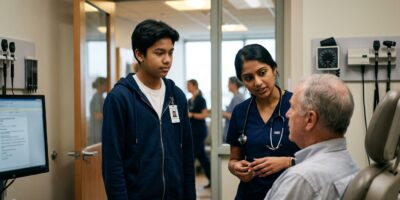
For high school students participating in structured clinical observation programs, the pharmacy workflow for teen observers is entirely observation-based. This is an important point for both students and parents to understand clearly.
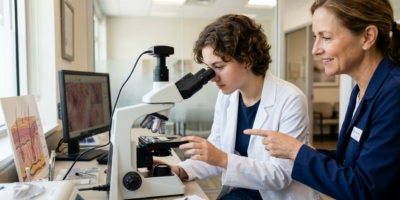
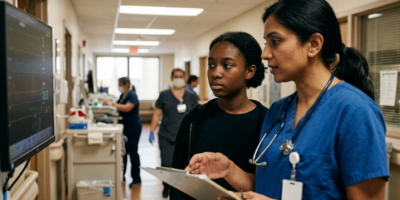
Students observe pharmacists reviewing orders, watch the dispensing process, and listen as pharmacists discuss drug therapy with medical teams. They may see how inventory is managed, how expired medications are handled, and how the pharmacy coordinates with nursing units. In some structured programs, a pharmacist or pharmacy technician may explain what they are doing in real time, turning routine tasks into educational moments.
What students do not do is equally important. Teen observers do not handle medications. They do not enter restricted areas like controlled substance vaults. They do not prepare IV medications or work in sterile compounding rooms, though they may observe these areas through windows or during guided walkthroughs. They do not independently counsel patients or access patient records. These boundaries exist because of licensing laws, patient safety requirements, and basic common sense about what is appropriate for a minor in a clinical setting.
Students interested in structured observation programs can review options like IMA’s high school internship programs, which outline the supervision framework and expectations for minors in clinical environments. The emphasis is always on learning through observation, reflection, and mentored discussion, not on performing clinical tasks.
Why This Matters for Future Healthcare Education
Watching hospital pharmacy operations may not sound dramatic, but it builds a specific kind of understanding that matters later. Students who observe medication management gain early fluency in concepts they will encounter repeatedly in healthcare education: pharmacokinetics, drug interactions, dosage calculations, error prevention systems, and interprofessional collaboration.
For students considering medical school, this exposure demonstrates awareness of patient safety and systematic thinking. The AAMC’s core competencies for entering medical students emphasize scientific reasoning, ethical responsibility, and teamwork, all of which are visible in a well-run hospital pharmacy. For students considering pharmacy school, PA programs, nursing programs, or other health professions, the relevance is even more direct. Understanding how medications move through a hospital system is foundational knowledge for almost every clinical role.
This kind of exposure also corrects misconceptions early. Many students assume pharmacy is primarily about counting pills or that pharmacists simply execute what doctors order. Observing the clinical consultation, error-catching, and patient education roles that pharmacists play gives students a much more accurate picture of the profession. That accuracy matters when making decisions about which career path to pursue.
If your student is thinking about how early clinical experiences fit into a longer timeline, the IMA blog post on summer planning for teen medical experiences provides practical guidance on sequencing these opportunities.
Safety, Supervision, and What Parents Should Know
Parents considering a clinical observation program for their teenager have legitimate questions, and those questions deserve straight answers.
Supervision Structure
In any responsible program, high school students are supervised at all times during clinical observation. They are paired with or assigned to a licensed professional who knows they are present and is responsible for their experience that day. Students wear identification that clearly marks them as observers, not staff. They do not roam the hospital independently.
Controlled Substance Access
Students do not have access to controlled substances, narcotics storage areas, or restricted pharmacy zones. These areas are secured and monitored even for hospital employees. A teen observer would not be placed in proximity to these materials without clear physical and procedural barriers.
Maturity and Readiness
Not every high school student is ready for a hospital environment. Pharmacy observation involves standing for extended periods, following instructions precisely, maintaining confidentiality about patient information, and processing complex information without immediate understanding. Students who do well in these settings tend to be genuinely curious, comfortable with structure, and willing to ask questions rather than pretend they already know everything.
Parents should have an honest conversation with their teen about what hospital observation actually involves. It is not fast-paced medical drama. Much of it is methodical, quiet, and detail-oriented. Students who find that boring may simply not be ready yet, and that is perfectly fine. Students who find it fascinating are getting a real preview of what healthcare work actually demands.
Communication and Transparency
A well-structured program keeps parents informed about where their student will be, what they will observe, and who is supervising them. If a program cannot clearly answer those questions, that is worth noting. The article on what clinical research looks like for minors addresses some of these structural expectations in more detail.
How Medication Management Differs Across Healthcare Settings
One of the most valuable lessons a student can take from pharmacy observation is that medication management looks very different depending on where you are.
In a large U.S. hospital, automated systems handle much of the dispensing workflow. Barcode scanning, electronic order entry, and robotic dispensing cabinets reduce human error at multiple points. The pharmacy team has access to comprehensive drug information databases, and formulary committees meet regularly to evaluate which medications the hospital stocks.
In resource-limited settings, the picture changes. Hospitals may rely on the WHO Essential Medicines List to guide what they stock. Cold chain storage for temperature-sensitive medications like insulin or certain antibiotics may be unreliable. Documentation may be manual rather than electronic. Pharmacists and clinical officers may manage medication decisions with fewer technological supports, relying more heavily on training, judgment, and standardized protocols.
Students who observe pharmacy operations in different contexts begin to understand that patient safety is not just a technology problem. It is a systems problem, a training problem, and sometimes a resource problem. That broader perspective is genuinely useful for anyone planning to work in healthcare, whether they end up in a major academic medical center or a rural clinic.
Turning Observation into Reflection and Growth
Watching a pharmacist verify drug orders for three hours does not automatically become a meaningful experience. What makes it meaningful is the reflection that follows.
Strong clinical observation programs build in time for students to process what they saw, ask questions, and connect their observations to broader concepts. A student who watches a pharmacist catch a dangerous drug interaction and then discusses the systems that made that catch possible is learning something transferable. A student who simply stands in a pharmacy for a morning without context or discussion is checking a box.
For students building toward college applications and healthcare careers, the ability to articulate what you observed, what you understood, and what questions it raised is far more valuable than the number of hours logged. Admissions committees and interviewers can tell the difference between someone who thoughtfully engaged with a clinical setting and someone who was merely present.
If your student is thinking about how to document and reflect on experiences like these, the IMA guide to requesting letters after teen medical internships offers practical advice on building professional relationships that support strong recommendations.
Frequently Asked Questions
Will my teenager handle or prepare medications during a hospital observation?
No. In any properly structured observation program, high school students do not handle, prepare, dispense, or administer medications. Licensing laws and patient safety standards require that only credentialed pharmacy personnel perform these tasks. Teen observers watch, listen, ask questions, and learn from supervised proximity to the process.
Is hospital pharmacy observation useful for students who do not want to become pharmacists?
Yes. Medication management is relevant to nearly every healthcare profession. Medical students, nursing students, PA students, and others all need to understand how medications are prescribed, verified, dispensed, and monitored. Early exposure to pharmacy operations builds foundational knowledge that applies across clinical disciplines and demonstrates awareness of patient safety systems.
How do I know if my high school student is mature enough for a hospital pharmacy observation?
Consider whether your student can follow instructions carefully, maintain confidentiality, stand or sit quietly for extended periods, and process complex information without becoming overwhelmed. Hospital pharmacy work is methodical and detail-oriented. Students who are genuinely curious about how systems work and comfortable asking questions when they do not understand something tend to get the most out of these experiences. If your student is not ready now, that does not close any doors; it just means waiting until the fit is right.