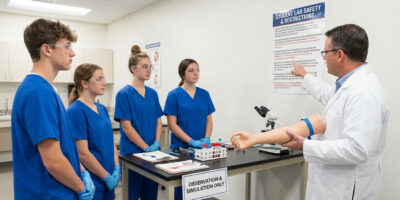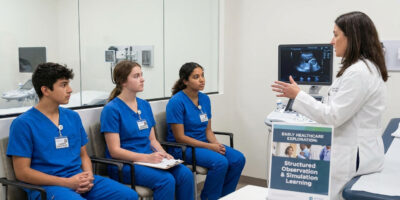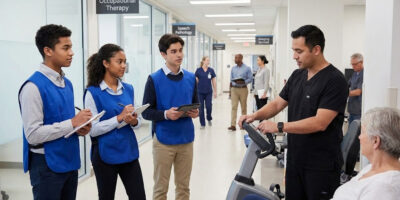
High school students who enter clinical settings for the first time often expect that their learning will come from watching procedures. In reality, much of what shapes a student’s professional development comes from observing something quieter and more consistent: how clinical staff communicate with patients. Participating in high school medical internships means spending significant time in environments where communication is not a soft skill but a clinical one, with direct consequences for patient safety, trust, and outcomes.
The standards that govern how healthcare professionals speak with patients are not informal habits. They are taught, practiced, and evaluated throughout medical and nursing training. For a broader look at how clinical observation in these settings is structured for minors, including what students are permitted to do and how supervision works, this pathway-building guide covers the foundational expectations students should have before their first shift.
For teen interns, the goal is not to replicate what licensed professionals do. It is to observe those patterns closely, understand why they work, and begin developing the instincts that will serve them throughout any healthcare career.
What Patient Communication Actually Looks Like in Clinical Settings
Healthcare communication is not the same as everyday conversation. It is structured, intentional, and adapted constantly to the patient’s condition, comprehension level, emotional state, and cultural background. A nurse explaining a medication schedule to an elderly patient uses different language, pacing, and body positioning than a physician discussing a diagnosis with a family in distress.
Teen interns observing these interactions will notice several consistent patterns across professional communication in clinical environments.
Introductions are always formal and role-specific.
Every clinical professional who enters a patient’s room introduces themselves by name and role. This is not a social courtesy. It establishes consent, orientation, and trust. Patients in hospital settings often interact with many different staff members across a single day, and clarity about who someone is and why they are present directly affects patient comfort and cooperation.
Language is adjusted for the patient, not the setting.
Medical professionals are trained to avoid clinical jargon when speaking with patients and families. The same condition might be described in technical terms during a team handoff and in plain language during a bedside conversation. Teen interns watching this shift should understand that it reflects professional judgment, not simplification.
Nonverbal communication carries significant clinical weight.
Eye contact, proximity, posture, and tone convey information that words alone do not. A nurse who sits down to speak with a patient communicates that the conversation is not rushed. A physician who maintains eye contact while a patient is speaking signals that the patient’s account is being taken seriously. These choices are deliberate.
Privacy, Boundaries, and the Intern’s Role in Patient Interactions
Teen interns are observers, not participants, in patient communication. This distinction is important and non-negotiable in any reputable healthcare internship program for high school students.
Students should not initiate conversations with patients unless specifically instructed by their supervising staff member. If a patient speaks directly to a student, the appropriate response is polite, brief, and does not include any clinical information, reassurance about medical matters, or personal opinions about the patient’s care. The student’s role in that moment is to acknowledge the patient respectfully and, if needed, redirect to the supervising clinician.
This boundary exists for multiple reasons. Patients in clinical settings have a reasonable expectation that the people speaking with them about their care are licensed and trained. A well-meaning comment from a student, even one with good instincts, can create confusion, false reassurance, or unintended distress. Structured programs that include teen clinical experience take these boundaries seriously in their orientation sessions, and students should internalize them before entering any patient-facing area.
The American Academy of Communication in Healthcare provides research and training frameworks used by clinical educators to teach patient communication as a measurable professional skill. Understanding that this is a formalized field helps students appreciate why the standards they observe in clinical settings are as consistent as they are.
Specific Communication Patterns Worth Observing
Teen interns benefit most from structured observation when they know in advance what to look for. The following are specific communication patterns that appear consistently across clinical settings and are worth watching closely during any healthcare internship.
Teach-back method. After explaining a medication, procedure, or discharge instruction, many nurses and physicians ask the patient to repeat the information back in their own words. This is not a test of the patient. It is a verification tool that helps the clinician confirm the patient has understood correctly, and it gives the patient an opportunity to ask questions in a low-pressure way.
Silence as a tool. Experienced clinicians often pause after asking a patient a question, allowing space for the patient to think and respond without interruption. For students accustomed to fast-paced conversation, this deliberate silence can seem uncomfortable at first. It is, in practice, one of the most effective communication skills in clinical settings.
De-escalation language. When patients are anxious, in pain, or upset, clinical staff use specific verbal and tonal strategies to reduce distress without dismissing the patient’s experience. This includes validating what the patient is feeling, using a calm and steady tone, avoiding language that minimizes the concern, and offering concrete next steps rather than vague reassurance.
Handoff communication. The structured verbal handoff between shifts, often following a format such as SBAR (Situation, Background, Assessment, Recommendation), is one of the most formalized communication systems in healthcare. Teen interns who observe these handoffs are seeing a system designed specifically to reduce error and ensure continuity of care across providers. The Agency for Healthcare Research and Quality publishes extensive resources on communication frameworks like SBAR that are used in hospitals across the country.
How This Knowledge Applies to Future Applications and Interviews
Students who have observed clinical communication closely, and who can describe specific patterns and explain why they matter, are at a distinct advantage when writing personal statements or preparing for college and program interviews.
An applicant who can describe watching a nurse use the teach-back method with a post-surgical patient, explain what the method accomplishes, and connect it to broader themes of patient safety and health literacy demonstrates a level of clinical awareness that cannot be fabricated. It is the difference between saying healthcare involves good communication and being able to describe what good communication looks like in practice.
The AAMC Premed Competency Framework identifies interpersonal skills and oral communication as distinct competencies evaluated in medical school applicants. Students who have spent time in clinical environments observing these skills are already building the experience base required to speak to these competencies authentically. Pre-med internships for high school students that include direct observation of patient interactions are specifically valuable for this reason.
What Teen Interns Should Avoid Saying in Clinical Settings
Beyond role-specific limits, there are general communication behaviors that every teen intern should avoid regardless of the clinical setting.
Students should not comment on a patient’s diagnosis, prognosis, or treatment plan in any context, including private conversations with other students or family members. They should not discuss patient cases outside of the clinical setting, including on social media, in school, or at home, even without using names. They should not offer opinions on clinical decisions they have observed, even if asked by a patient’s family member.
These are not arbitrary restrictions. They are the same standards that apply to every licensed professional in the building, and they reflect the ethical baseline that healthcare programs at every level expect students to understand before entering any patient-facing environment.
Frequently Asked Questions
What communication skills do high school students learn from clinical shadowing?
High school students who observe in clinical settings develop several foundational professional communication skills. These include how to introduce oneself by role in a clinical context, how to adjust language and tone for different patient populations, how to use silence productively during patient interactions, and how to observe nonverbal communication as a clinical tool. Students also learn the difference between social conversation and clinical communication, including why certain topics, reassurances, and opinions are outside the scope of a student observer’s appropriate conduct.
Can a high school intern speak directly with patients during a clinical internship?
In most structured programs, high school interns do not initiate conversations with patients. If a patient speaks to a student directly, the appropriate response is brief, polite, and does not include any clinical information or opinions about the patient’s care. The student’s role is observational. Any reputable healthcare internship program for high school students will cover patient interaction boundaries explicitly during orientation before any clinical access begins.
What is the teach-back method and why should teen interns know about it?
The teach-back method is a clinical communication technique in which a provider asks a patient to explain back, in their own words, what they have just been told about their diagnosis, medication, or discharge instructions. It is not a test of the patient. It is a verification tool that helps the provider confirm accurate understanding and gives the patient a low-pressure opportunity to ask clarifying questions. Teen interns who recognize this method during clinical observation are demonstrating the kind of clinical literacy that medical and nursing school admissions committees associate with substantive engagement.
Why is patient communication considered a clinical skill rather than a social one?
Patient communication is classified as a clinical skill because its quality directly affects patient safety, treatment adherence, and health outcomes. Communication errors are among the most common contributors to medical errors in healthcare settings. The AAMC Premed Competency Framework identifies oral communication and interpersonal skills as distinct competencies that medical school admissions committees evaluate. Structured programs that give high school students a framework for observing clinical communication are providing professional preparation, not general social development.
What should a teen intern do if they witness a communication breakdown between a provider and a patient?
A teen intern who observes a situation that appears to be a communication breakdown should not intervene, comment, or attempt to assist in any way during the encounter. The correct response is to remain quiet and observe. If the student believes what they witnessed raised a concern about patient safety or professional conduct, the appropriate channel is a private conversation with their supervising staff member after the encounter, using the reporting pathway the program established during orientation.
How does clinical communication experience strengthen a medical school application?
Clinical communication experience strengthens a medical school application when a student can describe specific interactions they observed, explain the communication technique or principle at work, and connect it to a broader understanding of patient care. Generic statements about good communication skills are common in applications. Specific descriptions of watching a nurse use de-escalation language with a distressed patient, or observing a physician use the teach-back method during discharge education, are rare and credible. The specificity demonstrates genuine engagement rather than passive presence.
What privacy rules apply to a high school student who observes patient interactions?
High school student interns are subject to the same patient confidentiality obligations as licensed clinical staff, regardless of their age or training level. This includes HIPAA in US settings and equivalent privacy laws in international clinical programs. Students may not share, discuss, photograph, or document any information that could identify a patient, including name, condition, appearance, or clinical details, in any format, including social media, personal writing, or conversation. Reputable programs provide formal orientation on these obligations before any clinical access begins and require students to sign written confidentiality agreements.