Public health dentistry internships show pre-dental students why whole communities develop preventable oral disease, not just how one patient is treated. Most clinical exposure happens in private practices and university clinics. A structured global placement adds what those settings rarely show: resource limits, cultural context and the systems that decide who gets care at all.
That exposure in private practices and university clinics still matters. It teaches you how procedures work, how patient flow is managed and how a dental office runs day to day. But it leaves a significant gap. It rarely shows you what happens when the systems designed to prevent and treat oral disease are thin or absent. Our guide to why oral health is a global health issue for pre-dental students covers that bigger picture.
This distinction is worth understanding now, not after you’ve submitted your dental school application. Dental public health is a recognized specialty, and admissions committees at many programs value applicants who can explain how social determinants shape oral health outcomes. The question is not whether a public health perspective matters for dentistry; ADEA’s GoDental resources describe the qualities and experiences dental schools look for, and service and cultural awareness run through them. The question is how you build that perspective in a meaningful way, and why a structured global experience does something that even the best domestic clinic rotation cannot replicate on its own.
Key Points
- Dental public health is one of 12 dental specialties recognized in the United States. It treats the community, not one patient, as the focus of care.
- WHO estimates that oral diseases affect nearly 3.7 billion people, and untreated tooth decay in permanent teeth is the most common health condition in the world.
- A global placement shows you the upstream causes of disease: distance, cost, sugar, fluoride exposure, workforce gaps and health literacy.
- Pre-dental students observe patient care and help teach oral hygiene in the community. They do not examine, clean or treat anyone’s teeth.
- The application value comes from specific, honest reflection, not from the number of weeks or the country you list.
What Dental Public Health Actually Means for Pre-Dental Students
Dental public health is one of the twelve dental specialties currently recognized by the National Commission on Recognition of Dental Specialties and Certifying Boards. The Commission defines it as the science and art of preventing and controlling dental diseases and promoting dental health through organized community efforts, and as the form of dental practice that serves the community as a patient rather than the individual. In practice, that includes epidemiology, health policy, community-based prevention programs, access-to-care analysis and the study of how social and economic conditions influence oral health outcomes.
For pre-dental students, this matters because the profession is increasingly asking its future practitioners to think beyond the operatory. You will treat individual patients, yes. But the oral health challenges facing communities, both in the US and globally, require dentists who understand the upstream causes of disease. Why do oral diseases affect nearly 3.7 billion people, according to the World Health Organization’s oral health fact sheet? Why is untreated decay in permanent teeth the single most common health condition in the Global Burden of Disease 2021 study, and why do severe gum diseases account for more than 1 billion cases worldwide? The answers are structural, not just clinical.
A domestic clinic, even a community health center, operates within a system that has established supply chains, sterilization standards, insurance frameworks (however imperfect) and referral networks. Students who only see dentistry within that context may not recognize how much of their clinical world depends on infrastructure they take for granted. A global internship shifts that frame of reference by putting students in environments where those supports look very different.
What Do the Global Numbers Say?
WHO’s most recent figures give you the scale behind what you will see in a clinic. Use them as context, not as a script for interviews.
| Measure | What WHO reports | Why it matters to a pre-dental student |
|---|---|---|
| People affected by oral diseases | Nearly 3.7 billion | Oral disease is one of the most common health problems on earth, not a niche concern |
| Most common condition | Untreated caries in permanent teeth (Global Burden of Disease 2021) | Prevention fails far more often than treatment succeeds |
| Severe periodontal disease | More than 1 billion cases | Gum disease drives tooth loss and is linked with diabetes |
| Complete tooth loss, age 20 and over | Almost 7% | Losing every tooth is usually the end of a lifelong history of disease |
| Complete tooth loss, age 60 and over | About 23% | Older adults carry the cost of care that never reached them |
The same fact sheet notes that prevention and treatment are expensive and usually not part of national universal health coverage packages, and that most low- and middle-income countries do not have enough services to prevent and treat oral conditions. WHO’s Global Oral Health Status Report, published in November 2022, reaches the same conclusion: the status of global oral health is alarming and needs urgent action.
How Global Settings Expose the Social Determinants of Oral Health
In many low- and middle-income countries, oral diseases are increasing. WHO links that rise to growing urbanization and changing living conditions, inadequate exposure to fluoride in water and toothpaste, cheap and heavily marketed sugary food and drinks, and poor access to oral health care in the community. When you observe dentistry in these settings, you see patterns that textbooks describe in abstract terms but that become concrete and immediate when you watch a clinic operate.
Consider what a typical observation day might look like. A student shadowing a dentist in a busy public clinic may see a disproportionate number of extractions, not because the dentist prefers extraction over restoration, but because patients arrive only when pain becomes unbearable, and by that point the tooth is often beyond saving. The reasons for delayed care are layered: geographic distance, cost, lack of awareness about preventive options, cultural beliefs about dental pain and the absence of a dental workforce in the area. WHO notes that out-of-pocket payment for oral care is among the leading reasons for catastrophic health spending, which pushes families toward poverty. Watching this pattern repeat across dozens of patients in a single week teaches something that no lecture on “barriers to access” can fully convey.
Students in these settings also observe how oral health education is delivered in communities with limited health literacy. They may assist with outreach at schools or community centers, helping to demonstrate brushing technique or explain the connection between diet and decay. WHO recommends twice-daily brushing with fluoride toothpaste of 1,000 to 1,500 ppm, and a hygiene lesson is often where that advice first reaches a family. Our article on advancing health literacy through international medical internships explains why this kind of teaching matters. This kind of community dentistry builds communication skills that transfer directly to practice in underserved areas of the US, where similar barriers exist. The CDC’s oral health data and research documents significant gaps in the United States along racial, ethnic and socioeconomic lines, gaps that share root causes with the global patterns students observe abroad.
Seeing Systems, Not Just Symptoms
One of the most valuable things a global internship teaches is systems thinking. In a domestic clinic, you see the endpoint: a patient in the chair, a treatment plan, a procedure. In a global setting, you see more of the chain that led to that endpoint. You see what happens when there is no school-based screening program, no community water fluoridation, no affordable restorative care and no public health messaging about oral hygiene. You begin to understand oral disease as a systems failure, not just an individual health event.
This kind of thinking is central to dental public health education, and it is difficult to develop without exposure to settings where the systems are visibly different from what you know. It also shapes how you think about your own future practice, whether you end up in private practice, community health, academia or policy.
How Does Global Policy Connect to What You See in Clinic?
The gap between a clinic and a health ministry is smaller than it looks. In 2021 the World Health Assembly passed a resolution on oral health that calls for a shift from the traditional curative approach toward prevention, and for oral health to be included in universal health coverage. WHO’s Global Oral Health Action Plan for 2023 to 2030 followed. When you watch a dentist spend a full morning on extractions, you are seeing the curative model those documents want to move away from. When you help teach a hygiene lesson at a school, you are seeing a small piece of the preventive model they want to build. Noticing that connection is exactly the habit of mind dental public health asks for.
What You Actually Do as a Pre-Dental Intern Abroad
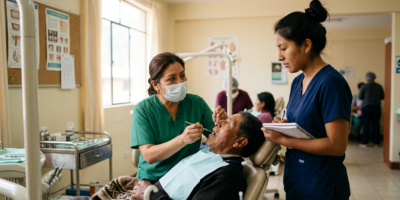
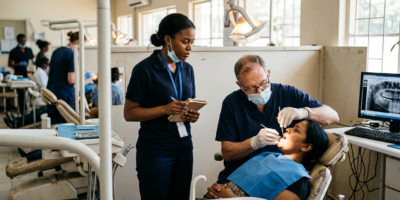
It is important to be honest about what a pre-dental internship involves. You are not performing procedures independently. You are not diagnosing patients. You are observing, assisting within approved and supervised limits, supporting patient education efforts and learning from licensed professionals who work in these settings every day.
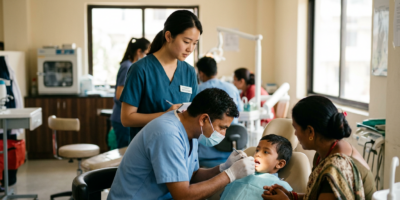
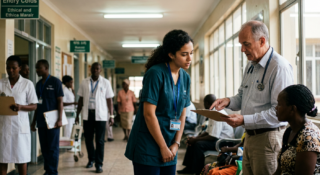
In a structured program, a typical day might include morning time in a clinic, where you watch dentists and dental hygienists perform extractions, fillings, cleanings and basic oral surgery. Where the host site allows, you may help prepare instruments or organize supplies. In the afternoon, you might take part in community outreach, such as an oral health screening event at a school or a presentation on hygiene practices at a community center. Evenings often include guided reflection, case discussions with mentors and time to process what you observed.
What Does a Day Look Like in IMA’s Dental Program?
IMA’s dental internships abroad follow that pattern. According to the live program page, most interns are in the hospital dental unit from about 8 AM to 4 PM, spending six to eight hours with the dental team. You watch exams and treatments and note questions for your mentor. In the afternoon you may attend a lecture, help at a community clinic or teach a hygiene lesson. Stays run from 2 to 12 weeks.
The limits are written plainly. IMA follows the AAMC guidelines for students in clinical settings abroad and ADEA’s guidance for pre-dental students. Pre-dental students observe patient care and do not examine, clean or treat anyone’s teeth; their active role comes in community sessions, where they help teach oral hygiene. Current dental students work only within the limits of their training, under a licensed dentist and the host site’s rules. A patient can always decline to have a student present. Your hours are logged by date and shift, IMA’s U.S.-based Medical Director validates the record, and each dental school decides how to count those hours.
The value is not in accumulating clinical hours as if you were already a dental student. The value is in context. You are building an understanding of how dental care functions under constraints, how providers make decisions when resources are limited, how cultural factors shape patient behavior and how public health infrastructure (or its absence) determines who gets care and who does not. For a fuller list of daily duties, see the responsibilities of a pre-dental intern.
If you are still confirming whether a pre-dental internship abroad is the right fit for your goals, it helps to consider how these programs compare to domestic options. IMA’s overview of what a pre-dentistry internship involves offers a useful starting point for understanding the structure and expectations of these experiences, and our guide to what to expect when completing a dental internship walks through the first days on site.
How This Experience Strengthens a Dental School Application
Dental school admissions committees evaluate applicants across multiple dimensions: academics, DAT scores, clinical exposure, research, service, leadership and personal qualities like empathy and cultural awareness. A global internship does not replace strong grades or a competitive DAT score, and no experience alone guarantees admission. But it can strengthen several parts of your application in ways that are difficult to replicate through domestic experience alone. Our article on how dental schools view international experience goes deeper on how to present it.
Writing About Public Health Perspective in Your Personal Statement
Your personal statement needs specificity. Admissions committees read thousands of essays about “wanting to help people.” What stands out is an applicant who can describe a specific moment, a specific patient interaction (anonymized and observed) or a specific realization that shaped their understanding of dentistry’s role in public health. A global internship gives you those moments.
For example, you might describe watching a dentist explain post-extraction care to a patient through an interpreter, and what that taught you about communication barriers in health care. Or you might write about the contrast between the oral health education resources available in a public clinic abroad and the resources you saw in a US community health center, and what that contrast revealed about structural inequality. These are concrete, reflective observations that demonstrate the kind of thinking dental schools want to see.
Differentiating Yourself in Interviews
In interviews, you will likely be asked about your service experiences, your understanding of health care disparities and your ability to work with diverse populations. A student who has spent time in a global health setting and can speak thoughtfully about what they observed, what surprised them, what challenged their assumptions and what they still want to learn will stand out. The key is reflection, not just recitation of what you did.
Connecting to Broader Career Goals
If you are interested in dental public health, community dentistry or practice in underserved areas, a global internship is a direct and credible way to demonstrate that interest. It shows that you sought out exposure to the realities of oral health in resource-limited settings, not just because it would look good on an application, but because you wanted to understand the field more fully.
Students weighing different types of pre-health experiences may also find it helpful to review how global health programs compare to other structured options. IMA’s breakdown of global health opportunities for aspiring medical professionals discusses how different program structures serve different goals, which is relevant for pre-dental students evaluating their choices.
How Should You Log and Describe These Hours?
Keep a simple record from day one: the date, the setting (dental unit, community clinic or school outreach), the hours, the supervising professional and one line on what you learned. ADEA’s guidance on dental shadowing is a good place to see how schools think about observation. Our guide to planning and documenting dental shadowing hours shows how to log them in a way an application can use. Describe community teaching as community service or outreach, and describe time in the dental unit as shadowing. Do not blur the two, and never describe an activity you did not do.
What Domestic Clinics Do Well, and Where They Fall Short
This article is not an argument against domestic clinical experience. Shadowing in a private practice or volunteering in a community health clinic in the US teaches important things: how to interact with patients professionally, how a dental team communicates, how treatment planning works and how insurance and scheduling shape the patient experience. These are valuable and necessary exposures.
But domestic settings have inherent limitations when it comes to dental public health education. Most US dental offices, even those serving low-income patients, operate within a relatively standardized framework. The equipment is familiar. The sterilization protocols follow established guidelines. The supply chain is reliable. The patients, while diverse, are accessing care within a system that has baseline infrastructure.
A global internship disrupts that baseline. It forces you to notice the infrastructure itself, because the infrastructure is different. You start asking questions you would not have thought to ask in a domestic clinic: What happens when the power cuts out in the middle of an autoclave cycle? How does a dentist prioritize treatment when they know the patient cannot return for a follow-up? What does prevention look like when toothbrushes and fluoride toothpaste are hard to find or hard to afford in the local market?
These are not hypothetical questions. They are the daily realities of dental practice in many parts of the world, and grappling with them builds a kind of clinical awareness that complements what you learn in US settings. The combination of both domestic and global exposure gives you a more complete picture of what dentistry looks like across different contexts. If you are also curious about the hygienist’s side of that team, our post on what pre-dental students can learn during Dental Hygiene Month looks at prevention from the hygienist’s chair.
Ethics, Boundaries, and What Responsible Global Engagement Looks Like
Any discussion of global health internships must address ethics directly. Pre-dental students going abroad are guests in another country’s health care system. They are there to observe and learn, not to practice independently. Responsible programs make this boundary clear from the start and enforce it throughout.
Students should expect to work under direct supervision of licensed dental professionals at all times. They should expect training on informed consent, patient confidentiality and cultural sensitivity before they enter any clinical setting. They should understand that their role is to support, not to lead, and that the goal is mutual respect between the student, the supervising provider and the patient. A simple test from IMA’s own program page is worth remembering: never do anything abroad that you could not do at home.
It is also worth being honest about what a short-term internship can and cannot accomplish. A few weeks of observation and community outreach will not solve a region’s oral health challenges. Sustainable improvement requires long-term investment, local leadership and systemic change. Students who approach a global internship with humility, recognizing both its value and its limits, will get the most from it and will represent themselves more honestly in their applications.
Programs that emphasize structured reflection, mentorship and ethical engagement are worth seeking out. Programs that promise extensive hands-on clinical work for unlicensed students, or that frame the experience primarily as a way to “save” a community, should raise concerns. The difference between a well-run program and a poorly conceived one matters enormously, both for the communities involved and for the student’s own development.
For students comparing different program types and structures, especially those still early in their pre-health path, IMA’s guide to how internships shape future health care careers provides context on what to look for in a structured experience.
What Should You Ask a Program Before You Commit?
- Who supervises pre-dental students, and what are their credentials?
- What exactly may a pre-dental student do in the dental unit, and what is off limits?
- How much time goes to the dental unit, and how much to community outreach and teaching?
- How are hours logged, and who signs or validates the record?
- What training on consent, confidentiality and cultural norms happens before the first shift?
- How does the program work with local clinicians and schools, and who decides what the community needs?
A program that answers these questions clearly, in writing, is far more likely to give you a responsible experience than one that answers with promises about how much you will get to do.
A Simple Reflection Template for Each Week
Reflection is where a placement turns into public health perspective. At the end of each week, write a short entry with four parts:
1. One patient pattern. What did you see more than once? For example, many adults arriving with pain from a single decayed tooth. 2. One upstream cause. Which factor behind that pattern can you name? Distance, cost, diet, fluoride exposure or a missing screening program are common answers. 3. One prevention idea. What would have changed the outcome earlier? Keep it realistic for that community. 4. One question you still have. Write down what you would ask a dental public health specialist if you had ten minutes with one.
Leave out names and identifying details. Twelve weeks of these entries, or even two, give you specific material for essays and interviews that a list of hours never will.
Deciding Whether a Global Dental Public Health Experience Fits Your Path
Not every pre-dental student needs a global internship. If your primary goal is to accumulate clinical observation hours in a US dental office, a domestic experience may be more efficient for that specific purpose. Our article on whether dental students do internships explains how the options differ before and during dental school. But if you want to build a broader understanding of oral health, develop cultural competence and gain perspective on the public health dimensions of dentistry, a structured global internship offers something that domestic shadowing simply does not.
Before committing, ask yourself a few practical questions. Are you prepared to observe and learn in an environment that may be less technologically advanced than what you are used to? Can you approach the experience with genuine curiosity and humility, rather than a checklist mentality? Are you ready to reflect seriously on what you see, including the uncomfortable parts? And can you explain, clearly and specifically, what you hope to gain and how it connects to your long-term goals in dentistry?
The students who benefit most from these experiences are the ones who treat them as opportunities to think differently, not just to add a line to their resume. Public health dentistry is a real and growing field, and the perspective it requires starts with understanding the world as it is, not just the operatory in front of you. A global internship, chosen carefully and approached with the right mindset, is one of the most effective ways to begin building that understanding.
Frequently Asked Questions
Will a Global Dental Internship Count as Clinical Hours for My Dental School Application?
That depends on the dental school. Some programs accept supervised international observation as part of your clinical exposure, while others may categorize it differently. Check with each school’s admissions office to understand how they evaluate international experiences. Do not assume that any program, domestic or global, automatically counts toward a specific hour requirement without verifying directly.
Can Pre-Dental Students Perform Procedures During a Global Internship?
No. Pre-dental students are not licensed to perform dental procedures, and a responsible program will not allow unsupervised or independent clinical work. In IMA’s program, pre-dental students observe patient care and do not examine, clean or treat anyone’s teeth. Your role is to learn from licensed professionals, assist within approved limits, support patient education and help teach oral hygiene in the community. Direct supervision is a non-negotiable standard.
How Is a Global Dental Internship Different From Dental Mission Trips?
A structured internship typically runs for several weeks and includes supervised clinical observation, guided reflection, mentorship and community health components built into a consistent schedule. Mission trips are often shorter and may focus on a single service event. Both can be valuable, but an internship offers more sustained exposure to a health care system and deeper opportunity for learning about public health context, cultural factors and clinical decision-making under resource constraints.
Is Dental Public Health a Recognized Dental Specialty?
Yes. It is one of the 12 dental specialties currently recognized by the National Commission on Recognition of Dental Specialties and Certifying Boards. It focuses on preventing and controlling dental disease through organized community efforts, treating the community rather than the individual as the patient.
Do I Need a Public Health Background to Benefit From a Global Dental Internship?
No. Most pre-dental interns arrive with science coursework and little or no public health training. What helps is curiosity about why patients arrive when they do, a willingness to ask your mentors questions and a habit of writing down what you notice each day.
What Can I Write About If I Only Observed?
Observation gives you plenty to write about when you describe it honestly. Pick one pattern you saw, explain the upstream causes behind it and say what it changed in how you think about dentistry. Specific, accurate reflection is more persuasive than any claim of hands-on work.
How Long Should a Global Dental Public Health Placement Be?
Long enough to see patterns repeat. Two weeks shows you how a dental unit and community sessions run. Longer stays let you follow more patients and outreach events and write fuller reflections. IMA’s dental stays run from 2 to 12 weeks, so choose a length that fits your calendar and your goals.