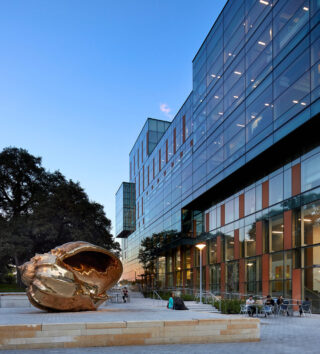
If you want to attend a research-based university that challenges its students at every level, then UT Austin’s Dell Medical School is the place for you. Dell Medical School is one of the newest additions to UT Austin.
UT Austin’s Dell Medical School thrives on the concept of getting people healthy. Indeed, its mission is to “improve health” in the community as a “model for the nation.” Dell Medical School has completely abandoned the traditional, university-style lecture system for a case-study-based approach that makes the students teachers.
If you haven’t already guessed, UT Austin’s Dell Medical School is the school we’re talking about today as part of our definitive series on getting into medical school. Here at International Medical Aid, we believe in the success of our pre-med students. We provide pre-med advising and med school admissions consulting to help prepare you for medical school. We offer global internship opportunities and, here on our blog, we provide the ultimate guides to getting into dozens of different medical schools. UT Austin’s Dell Medical School is one of several Texas medical students that offer state-of-the-art learning environments.
The Curriculum at Dell Medical School
UT Austin’s Dell Medical School doesn’t do “traditional.” The lecture-based system many of us are accustomed to is nonexistent at the school. Instead, students are introduced to the EDGE curriculum. The acronym stands for the following:
- Essentials
- Delivery
- Growth
- Exploration
Dell Medical School offers the traditional, four-year curriculum that many students desire. During your first year in the program, you’ll be taught to use the PILLARS method. Using this method, you’ll learn to be professional, make inquiries, and learn and develop leadership skills through active reasoning and synthesis.”
Students will take the following courses during their first year:
- Cells to Populations
- Medical Neuroscience
- Structure and Function
- Foundations of Disease
- Mechanisms of Disease
- Interprofessional Education
- Developing Outstanding Clinical Skills (DOCS)
- Leadership
Year 2 in the MD program at Dell Medical School transitions students from the exploration phase into the discovery phase. Here, you’ll go through core clerkships that test the knowledge you’ve learned. Applying that knowledge to real-world situations is essential training for your career as a doctor. You’ll go through the following clerkships:
- Primary Care, Family and Community Medicine
- Emergency Medicine
- Internal Medicine
- Neurology / Psychiatry
- Pediatrics
- Surgery
- Women’s Health
Year 3 in the MD program at Dell Medical School is known as the Growth year. Students have two options. You can focus on one of the following categories:
- Clinical Innovation and Design
- Research: Basic, Clinical or Transitional
- Population Health
- Student Entrepreneur in Residence
Your other option is to earn a dual degree in one of the following subjects:
- Master of Arts in Design
- Master of Business Administration
- Master of Education
- Master of Public Affairs
- Master of Public Health
- Master of Science in Biomedical Engineering
- Master of Science in Healthcare Transformation
Each master’s degree is linked to its official page on the UT Austin website.
Year 4 in the MD program at Dell Medical School is known as the Exploration year. Students continue their education while exploring options for Residency. By the time you graduate from UT Austin’s Dell Medical School, you’ll be well on your way to becoming a doctor.
Your residency and fellowship are a huge part of your journey to becoming a doctor. Here are the residency and fellowship options that come with attending Dell Medical School.
Residency
- Child Neurology
- Dermatology
- Emergency Medicine
- Family Medicine
- Internal Medicine
- Neurology
- Obstetrics & Gynecology
- Ophthalmology
- Orthopedic Surgery
- Pathology
- Pediatrics
- Physical Medicine & Rehabilitation
- Psychiatry
- Radiology
- Surgery
- Transitional
Fellowships
- Addiction Psychiatry
- Cardiac Electrophysiology
- Cardiovascular Disease
- Child & Adolescent Psychiatry
- Clinical Fellowship in Orthopedic Surgery
- Clinical Neurophysiology
- Consultation-Liaison Psychiatry
- Craniofacial & Pediatric Plastic Surgery
- Emergency Medical Services (EMS)
- Epilepsy
- Female Pelvic Medicine & Reconstructive Surgery
- Gastroenterology & Hepatology
- Geriatric Psychiatry
- Headache
- Hematology & Medical Oncology
- Hospice & Palliative Medicine
- Hospital Medicine Fellowship in Quality & Patient Safety
- Interventional Cardiology
- Maternal-Fetal Medicine
- Minimally Invasive Gynecologic Surgery
- Neonatal-Perinatal Medicine
- Pediatric Emergency Medicine
- Pediatric Hospital Medicine
- Sports Medicine
- Vascular Neurology
Cost of Attendance
Dell Medical School understands the financial burden that comes with becoming a doctor. That’s why it has provided an online calculator to help you determine your overall cost of attendance. Your overall cost of attendance goes beyond tuition. It also covers fees from the university and the cost of living. You can access the calculator here.
If you’re a Texas resident living with your parents, you’ll pay $15,876 for the semester. The costs are as follows:
- Tuition: $10,336
- Housing: $2,338
- Transportation: $771
- Books & Supplies: $388
- Personal / Miscellaneous: $2,043
If you’re a Texas resident not living at home, your cost of attendance goes up to $21,234. The costs for Texas residents living at home remain the same, but you’ll pay $7,696 in housing costs. If living at home is an option, you’ll have to decide whether living away from home is part of the college experience you want.
Non-Texas residents will pay $28,253 per semester. Tuition goes up from $10,336 to
$17,355. The $10,336 rate is only for Texas residents. International students will pay the same rates as non-Texas residents.
As you can see, living at home while attending medical school is the cheapest route. If this option is available to you, your total cost of medical school would only add up to $127,008. While that’s not the cheapest number you’ll ever find, it’s a lot cheaper than medical schools that start at $100,000 per year.
Prerequisite Courses and Grade Requirements
Admission to UT Austin’s Dell Medical School is contingent on meeting the school’s requirements. The MCAT is required, but the school doesn’t set a minimum score for the test. Your score is only one factor in their consideration.
You must take the following courses:
- Biology: 11 semester hours (9 credit hours, 2 lab hours – genetics recommended)
- Physics: 8 semester hours (6 credit hours, 2 lab hours)
- Chemistry: 12 semester hours (2 credit hours of organic chemistry; 1 credit hour of inorganic chemistry; 9 total hours with 6 credit hours and 3 lab hours)
- Biochemistry: 3 semester hours of biochemistry
- English: 3 semester hours of composition-based English
- Math: 3 semester hours of statistics
These courses must be taken at an undergraduate level. High school courses do not count. The only exception to this is an AP course. To be counted, the course number and credits must be listed on your official transcript. If you are missing any of the required courses, we recommend taking them before you apply to UT Austin’s Dell Medical School. Otherwise, your application will be rejected for not meeting the requirements.
Starting Your Application
Do you want to apply to Dell Medical School? If so, follow these steps:
- Complete the Texas Medical and Dental School Application Service (TMDSAS).
- Dell Medical School will review your application. The school doesn’t automatically send out secondary applications. So, if you don’t receive a link to complete your secondary application, that’s their way of rejecting you, at least for the current admissions cycle. You can always re-apply for the next admissions cycle.
- If you receive the link to your secondary application, fill it out. It will include some forms and a video submission, which we’ll discuss in the next section.
- Submit your secondary application.
- Cross your fingers and hope for an interview.
- Attend your interview if you score one.
- Accept your invitation to attend Dell Medical School if you are accepted.
Secondary Videos
Secondary videos? Don’t we mean secondary essays? In this case, no. Dell Medical School uses a unique format for secondaries. The school asks prospective students to submit videos instead of written essays. You have two minutes to answer each question in a video recording.
If you aren’t comfortable with submitting a video, or if you have a disability or impairment that prevents you from doing so, you can request a written format for your secondary.
The questions that Dell Medical School asks for the secondary videos aren’t readily available online, or we would go through them here. If they are available at a later date, we will update this post.
Interview
If you score an interview with Dell Medical School, you’ll go through the following:
- One traditional interview
- Five Multiple Video Assessment Interview (MVA) stations
- One group exercise
The traditional interview is discussed in detail in this post.
The multiple video assessment interview station is similar to the Multiple Mini Interview (MMI) format. Only, instead of moving from station to station, you’ll answer each question in a video format.
If you have an interview and need help preparing for it, consider us. IMA offers med school admissions consulting for that very purpose. Our hourly consulting and tiered consulting packages both include interview prep. Click here to get started.
Application Review
Dell Medical School reviews applications at each step of the process. Their review process is more in-depth than many other medical schools. They have a first review and a secondary application review that pass through multiple people. The school operates this way to give applicants every chance to succeed. Having multiple people review your application helps prevent bias.
IMA’s med school admissions consulting has a similar review process for the same reason as Dell Medical School. We recommend using med school admissions consulting as part of your medical school application process. Doing so will help you fine-tune your application and impress the admissions committee.
Conclusion
Dell Medical School is a fantastic school to attend. If you’re considering applying but aren’t sure, consider pre-med advising and med school admissions consulting. Through our pre-med advising, IMA can help you grow from uncertainty to confidence regarding where you apply to school.
One of the most important things we can tell you is to apply to multiple schools. Dell Medical School might be the school of your dreams. But if you only apply there, you only have one chance at getting into medical school. By applying to multiple schools, your odds increase. Check out our growing list of medical schools that we’ve covered as part of our definitive series to getting into medical school.
- The University of Texas Rio Grande Valley School of Medicine
- UNT Texas College of Osteopathic Medicine
- University of Houston College of Medicine
- Texas A&M College of Medicine
- Johns Hopkins Medical School
- Baylor College of Medicine
- George Washington University School of Medicine
- Vanderbilt University School of Medicine
- St. George’s University School of Medicine
- Lake Erie College of Osteopathic Medicine (in Pennsylvania)
- Sidney Kimmel Medical College at Thomas Jefferson University
- Wake Forest University School of Medicine
- Western University of Health Sciences (in California)
- Drexel University College of Medicine
- Stritch School of Medicine at Loyola University Chicago
- Georgetown University School of Medicine
- Yale School of Medicine
- Perelman School of Medicine
- UCLA Medical School
- NYU Medical School
- Washington University School of Medicine
- Brown Medical School
We wish you the best of luck as you apply to medical school. Remember that our pre-med advising and med school admissions consulting are here to help every step of the way or at any point on your journey.