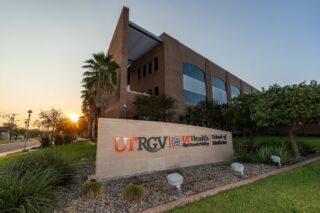

The University of Texas Rio Grande Valley School of Medicine (UTRGV SOM) is a public MD school in Edinburg, Texas, with clinical training spread across Harlingen, McAllen, Brownsville and other Rio Grande Valley communities. The Texas Legislature created UTRGV and its School of Medicine in 2013, and the charter class of 55 medical students arrived in the summer of 2016. Ten years later, the school has graduated more than 300 physicians, holds continued full accreditation and admits about 55 students a year from thousands of applicants.
The 2026-2027 application cycle is for students who will start medical school in July 2027 as the Class of 2031. UTRGV applications go through the Texas Medical and Dental Schools Application Service (TMDSAS), which opened on May 1, 2026, and the TMDSAS submission deadline is October 1, 2026. All facts below were checked on October 23, 2026.
UTRGV was built for one purpose: to train physicians for a border region that has long faced health disparities. That mission shapes everything from the secondary essays to the interview day. Read on for the class profile, prerequisites, minimum GPA and MCAT rules, 2026-27 costs, the curriculum, the in-person group interview, and all four 2026-2027 secondary essays plus the required 90-second video, each with an original example.
Be an Informed Applicant
Each school has different guidelines and expectations for candidates. You might not qualify for some schools, while you might be a stellar applicant at others. Knowing what a school values, and what it requires on paper, helps you decide whether it belongs on your list and how to present yourself once it does.
Nothing beats one-on-one guidance, though. IMA’s medical school admissions consulting and pre-med advising help students build an application strategy, review personal statements and secondary essays, and prepare for interviews.
Key Takeaways
- Texas residents fill nearly every seat. State law caps non-Texas residents at 10% of each admitted class, and international applicants are not admitted. You must be a U.S. citizen or permanent resident.
- Clear minimums, holistic review. UTRGV requires a 3.0 overall GPA, a 3.2 science GPA and an MCAT above the 50th percentile with every section at 122 or higher. MCAT scores below 495 are not considered, and scores older than three years are not valid. Applicants below the GPA or MCAT minimums go to a special sub-committee. Accepted applicants for the 2025 entering class had a median MCAT of 511 and a median GPA of 3.92.
- The mission is the Rio Grande Valley. The school’s mission ends with a promise to “engage with the Rio Grande Valley (RGV) communities to benefit Texas and the world.” The Class of 2030, which entered in July 2026, included 34 students from the Valley out of 56.
- Key dates for 2026-2027. TMDSAS deadline October 1, 2026; letters due October 1; offers begin October 15; interviews run August through January; the TMDSAS Match is February 12, 2027.
- Costs. First-year tuition and fees for 2026-27 are $22,372 for Texas residents and $35,472 for non-residents. The full first-year cost of attendance ranges from $50,372 to $74,717 depending on residency and housing.
- Distinctive training. A 21-month pre-clerkship phase built on problem-based learning, early patient contact at the Student-Run Free Clinic and the UniMóvil mobile clinic, a required research course, and a new Alpha Omega Alpha chapter.
- Special routes. The binding Early Decision Program for Rio Grande Valley applicants, the Vaqueros MD early assurance program for South Texas high school students, JAMP, and dual degrees in public health and bioethics.
- Next step. Submit TMDSAS well before October 1, complete the secondary as soon as you receive it and plan for a half-day in-person group interview in Edinburg.
Key Statistics About UTRGV School of Medicine
The snapshot and table below gather UTRGV’s key numbers. Each figure carries its class, cycle or academic year, because the school’s class profiles, news releases and cost tables each cover different years. UTRGV labels its class profiles by graduation year, so the “Class of 2026” profile describes students who entered in 2022. That is the newest school profile with applicant and interview counts. Newer figures for the 2025 entering class (the Class of 2029) cover applications, interviews, matriculants and median MCAT and GPA. The Class of 2030 entered in July 2026.

| Measure | Value | Cohort, population and source |
|---|---|---|
| School and degree | The University of Texas Rio Grande Valley School of Medicine; Doctor of Medicine (MD) | UTRGV SOM Admissions |
| Main campus | Edinburg Medical Education Building, Edinburg, Texas; clinical skills and simulation sites in Edinburg and Harlingen | UTRGV SOM Clinical Skills Center and Simulation Hospital |
| Accreditation | Continued full LCME accreditation (November 2025); next survey visit February 2028 | UTRGV SOM Accreditation |
| Application service | TMDSAS; deadline October 1, 2026 | UTRGV SOM Entry Year 2027 Application Timeline |
| Entering class size | 56 | Class of 2030, entered July 2026 (UTRGV Newsroom, July 25, 2026) |
| Applicants for the Class of 2030 | More than 5,000 | Class of 2030 (UTRGV Newsroom, July 25, 2026) |
| Applications, interviews, matriculants | 4,738 applications; 510 interviewed; 55 matriculated | Class of 2026, entered 2022 (UTRGV SOM Class of 2026 Statistics) |
| Interviewed out of applications | About 10.8% (510 of 4,738) | Class of 2026; calculated from the school’s class profile. This is an interview share, not an acceptance rate. |
| Verified applications, interviews, matriculants | 4,789 verified applications (3,983 in-state, 778 out-of-state, 28 international); 450 interviewed (400 in-state, 50 out-of-state); 55 matriculated (53 in-state, 2 out-of-state) | 2025 entering class (AAMC MSAR, 2026 edition) |
| Interviewed out of verified applications | About 9.4% (450 of 4,789) | 2025 entering class; calculated from AAMC MSAR. This is an interview share, not an acceptance rate. |
| Residency mix | 53 Texas residents, 2 out of state; 55% from the Rio Grande Valley | Class of 2026 (UTRGV SOM Class of 2026 Statistics) |
| Students from the Rio Grande Valley | 34 of 56 | Class of 2030 (UTRGV Newsroom, August 11, 2026) |
| Median MCAT, accepted applicants | 511 (mean 511.8); section medians 128 Chem/Phys, 127 CARS, 128 Bio/Biochem, 129 Psych/Soc | All accepted applicants, 2025 entering class (AAMC MSAR, 2026 edition) |
| Median GPA, accepted applicants | 3.92 overall (mean 3.88); 3.91 science (mean 3.84) | All accepted applicants, 2025 entering class (AAMC MSAR, 2026 edition) |
| Minimum GPA | 3.0 overall; 3.2 science | UTRGV SOM Requirements |
| MCAT policy | Above the 50th percentile with each section 122 or higher for standard review; below 495 not considered; scores valid for three years | UTRGV SOM Requirements |
| Acceptance rate | Not published (no count of acceptance offers is reported) | UTRGV SOM Admissions pages; AAMC MSAR, 2026 edition; checked October 23, 2026 |
| Secondary application | By invitation; $75 fee, fee waiver available; due November 15, 2026 | 2026-2027 cycle (AAMC MSAR, 2026 edition) |
| Casper, PREview or other assessments | Not required | 2026-2027 cycle (AAMC MSAR, 2026 edition) |
| Deposit and deferral | No deposit; up to 10 business days to answer an offer; deferral requests reviewed case by case | 2026-2027 cycle (AAMC MSAR, 2026 edition) |
| Tuition and fees, first year | $22,372 (Texas resident); $35,472 (non-resident) | MS1, 2026-27 (UTRGV SOM Cost of Attendance) |
| Total cost of attendance, first year | $50,372 to $61,617 (resident); $63,472 to $74,717 (non-resident), depending on housing | MS1, 2026-27 (UTRGV SOM Cost of Attendance) |
| Health insurance | $3,707 in the 2026-27 budget; required unless waived with comparable coverage | UTRGV SOM Cost of Attendance; Health Insurance |
| Tuition and fees, first year, prior year | $21,532 (in-state); $34,632 (out-of-state) | 2025-26 (AAMC MSAR, Tuition and Student Fees survey) |
| Students receiving financial aid | 92% | All students, 2024-25 (AAMC MSAR, LCME Part I-B) |
| Graduate debt | Mean $152,015; median $128,044 | 2025-26 graduates (UTRGV Newsroom, September 21, 2026) |
| 2026 Match | 53 students matched; 31 stayed in Texas, 12 in the Valley | Class of 2026 (UTRGV Newsroom, March 20, 2026) |
What Are UTRGV School of Medicine’s Average MCAT and GPA?
UTRGV School of Medicine sets minimums of a 3.0 overall GPA, a 3.2 science GPA and an MCAT above the 50th percentile, each section 122 or higher (UTRGV SOM Requirements, 2026). Accepted applicants for the 2025 entering class went well past them: a median MCAT of 511 and a median GPA of 3.92, with a 3.91 median science GPA.
The mean MCAT for those accepted applicants was 511.8 and the mean GPA 3.88. Section medians were 128 in Chemical and Physical Foundations, 127 in CARS, 128 in Biological and Biochemical Foundations and 129 in Psychological, Social and Biological Foundations. The Class of 2026 drew 4,738 applications for 55 seats (UTRGV SOM Class of 2026 Statistics, 2022), and the 2025 entering class drew 4,789 verified applications for 55 seats.
Minimums are floors, not targets. With roughly 4,700 to more than 5,000 applicants for about 55 seats, an application that only clears the minimums is unlikely to stand out. MCAT scores below the 50th percentile are not rejected automatically; they go to a special admissions sub-committee. Scores below 495 are not considered at all. The same is true of GPA: if you fall short of 3.0 overall or 3.2 in science, a special evaluation sub-committee decides whether your application merits review.
For context on how other schools compare, see IMA’s list of average GPA and MCAT scores by medical school.
Mission and Educational Priorities
Why UTRGV School of Medicine?
The University of Texas Rio Grande Valley School of Medicine calls its education “forward-thinking.” Its MD program goals describe graduating “physicians dedicated to practicing scientific, evidence based, patient-centered medicine in any setting, but particularly in underserved communities.” The school exists because Valley leaders spent decades pushing for a medical school in a region that “historically has been burdened by health disparities.”
That history matters for applicants. Since 1997, the Texas Legislature, UT Health San Antonio and the UT System built the regional academic health center that became the School of Medicine. In June 2013 the Legislature approved the creation of UTRGV and its School of Medicine. The first 42 residents arrived in 2015, preliminary LCME accreditation followed in October 2015, and the charter class of 55 medical students started in the summer of 2016 (UTRGV SOM Our Story).
The UTRGV SOM mission
The mission is published on the admissions Welcome page (UTRGV SOM Admissions):
“The mission of the University of Texas Rio Grande Valley School of Medicine (UTRGV SOM) is to educate a diverse group of dedicated students who will become physicians that serve across all the disciplines of medicine; bring hope to patients by advancing medical knowledge through research; integrate education and research to advance the quality and accessibility of patient care; and engage with the Rio Grande Valley (RGV) communities to benefit Texas and the world.”
The school also states its mission as five pillars: “Innovative Education,” “Life-Changing Research and Discoveries,” “High Quality Patient-Centered Care,” “Serving our Community” and “Sustainability and a Culture of Entrepreneurship.” Its vision is short: “To transform the health of the Rio Grande Valley and beyond.”
The school’s goals and values
The admissions goals add detail. UTRGV aims to:
- “Leverage UTRGV’s unique geographic location at the border of the United States and Mexico; a place that is enriched by its culture and family traditions but burdened by health disparities.”
- “Instill dedication to research, generation of new knowledge, and public service.”
- “Graduate culturally-aware medical students who will provide exemplary care to the diverse populations in the RGV and the nation.”
- “Increase under-represented minorities in medicine.”
- “Contribute to substantially improving health outcomes in the RGV and beyond.”
- “Educate the physician workforce of the future.”
The curriculum puts these goals into practice through six threads that run across all four years: evidence-based practice and scientific research; community and population-based health care; patient advocacy and cultural awareness; interprofessional collaboration and communication; ethical and professional behavior; and lifelong learning and problem-solving. The school’s catalog describes the graduate it wants as a physician who is a patient advocate, community-focused, culturally aware, a collaborative leader, a problem solver and a lifelong learner.
If you see yourself in those qualities, the school’s priorities may match yours. Read them as a checklist for your evidence, not a list of adjectives to repeat.
What the mission means for your application
- Show sustained service in communities that face barriers to care. The mission names the Rio Grande Valley directly, and the 2026-2027 secondary opens with a question about a health challenge in communities like the RGV. Long-term work with underserved patients, wherever you live, gives you evidence to use.
- Show cultural awareness through action. The school highlights its “rich bicultural experience” on the U.S.-Mexico border. Spanish is not listed as a requirement, but experience serving Spanish-speaking or immigrant patients, or any community different from your own, speaks to this goal. If you want to build that experience, IMA’s medical internship in Peru places pre-health students in clinical settings where Spanish is the language of care.
- Show teamwork and leadership. Teamwork/leadership is one of the interpersonal attributes the admissions committee lists, and a 2026-2027 essay asks directly about collaboration.
- Show reliability and resilience. The committee’s intrapersonal attributes are ethical responsibility, reliability and dependability, resilience and adaptability, and capacity for improvement. A sustained commitment and a difficult decision are both 2026-2027 essay topics.
- Show curiosity. Research is in the mission and in the required curriculum. You do not need publications, but you should show that you ask questions and follow them through.
Accreditation and Institutional Identity
The UTRGV School of Medicine’s MD program is accredited by the Liaison Committee on Medical Education (LCME), the accreditor for MD programs in the United States and Canada. The program received preliminary accreditation in October 2015, provisional accreditation in June 2021 and full accreditation in June 2023. In November 2025, the LCME granted continued full accreditation, and the next survey visit for continued accreditation is scheduled for February 2028 (UTRGV SOM Accreditation).
The university as a whole is accredited by the Southern Association of Colleges and Schools Commission on Colleges (SACSCOC) to award associate, baccalaureate, master’s and doctoral degrees. SACSCOC accredits the university; the LCME accredits the MD program. Graduating from an LCME-accredited program is what state licensing boards require for MD licensure.
One university, many campuses
UTRGV formed when the UT System combined The University of Texas at Brownsville and The University of Texas-Pan American with the regional academic health center. The School of Medicine’s admissions office and Edinburg Medical Education Building are in Edinburg. The clinical skills and simulation hospital is in Harlingen, the South Texas Center of Excellence in Cancer Research is in McAllen, and teaching sites stretch across Rio Grande City, Brownsville and South Padre Island. Its clinical practice is UT Health RGV. UTRGV is also the only university in Texas with schools of medicine, podiatric medicine and optometry.
Leadership in 2026
Dr. Everardo Cobos became dean on February 1, 2026, after serving as interim dean since summer 2025. In October 2026 he was elected a Master of the American College of Physicians. Dr. Michael Hocker, the previous dean, left UTRGV in 2025 for an executive dean role at the University of Tennessee Health Science Center.
Recognition
The school’s most visible recent recognition came in August 2026, when it was granted a chapter of Alpha Omega Alpha (AΩA), the national medical honor society founded in 1902. The university also points to affordability: in 2025, Washington Monthly ranked UTRGV No. 7 nationally and No. 1 in Texas among the Best Colleges for Your Tuition (and Tax) Dollars. That ranking covers the whole university, not the medical school alone.
Medical Programs and Affiliations
Medical Programs at UTRGV School of Medicine
UTRGV offers one entry-level medical degree: the four-year Doctor of Medicine. Every MD applicant applies through TMDSAS. The school offers three early routes into that MD (the Early Decision Program, Vaqueros MD and JAMP) and currently lists two dual degrees for enrolled students: the MD/MPH and the MD/MS in Bioethics.
Doctor of Medicine (MD)
The MD program is designed to be completed in four years: two pre-clerkship years of integrated, organ-based modules and two clinical years of clerkships, sub-internships and electives. Graduation requires 173 credits for the Class of 2030. The curriculum section below covers each phase.
Early Decision Program (EDP)
The Early Decision Program exists to “attract, recruit and enroll applicants from the Rio Grande Valley” (UTRGV SOM Early Decision Program). Key facts for the 2026-2027 cycle:
- Who can apply: applicants who currently reside in, or are originally from, the Rio Grande Valley or UTRGV, including those who left the Valley to study elsewhere.
- It is binding. EDP applicants apply only to UTRGV until released, and an acceptance offer “is a binding contract.”
- Higher academic floors: an MCAT at or above the 60th percentile, a 3.2 overall GPA, a 3.5 science GPA and all grades at C or above. No felony convictions.
- Deadlines: the Entry Year 2027 timeline lists Monday, August 3, 2026, as the EDP application deadline and Friday, August 14, 2026, as the deadline for transcripts, evaluation letters and test scores.
- Timing: interviews run July through September, and EDP decisions are announced by October 1, 2026. Applicants who are not accepted are released to the general pool by October 1 and can apply elsewhere.
- Scholarships: the program states that scholarships “may be provided on the basis of need, merit and/or special qualifications such as research, advanced degree, etc.”
EDP makes sense only if UTRGV is your clear first choice and your numbers meet the higher floors. It also shortens your timeline: everything must be ready by early August.
Vaqueros MD Early Assurance Program
Vaqueros MD is an early assurance program for high-achieving South Texas high school seniors (and juniors with advanced standing). Students enter UTRGV’s Honors College in any major and receive a conditional seat in a future UTRGV School of Medicine entering class if they meet the program’s requirements (UTRGV Vaqueros MD).
- Eligibility: graduation from a South Texas high school, or from an online, home or boarding school outside the region while living in one of 13 South Texas counties: Webb, Zapata, Starr, Hidalgo, Cameron, Willacy, Kenedy, Brooks, Jim Hogg, Kleberg, San Patricio, Aransas and Nueces.
- High school metrics: a score at or above the 90th percentile in one sitting of the SAT or ACT, a top 5% class rank, a 3.8 GPA and a 3.75 science GPA.
- Selection: letters from high school teachers, counselors or administrators, a personal written statement, a video essay and interviews with UTRGV and SOM faculty and staff.
- Medical school requirements for Entry Year 2027: an MCAT at or above the 60th percentile, a TMDSAS primary by August 1 and a secondary by August 15, with transcripts, scores and letters received by August 15.
High school students thinking about Vaqueros MD can build early clinical exposure through medical internships for high school students, which let them test their interest in medicine before college.
Joint Admission Medical Program (JAMP)
UTRGV lists the Joint Admission Medical Program among its early assurance routes. JAMP is a state-funded program for economically disadvantaged Texas undergraduates that provides scholarships, mentoring, summer internships, MCAT preparation and guaranteed admission to one of the participating Texas medical schools for students who complete its requirements. Since 2021, 22 UTRGV JAMP scholars have matriculated into the UTRGV School of Medicine, including three members of the Class of 2030.
Doctor of Medicine / Master of Science in Bioethics Dual Degree
This dual-degree option pairs the MD with UTRGV’s Master of Science in Bioethics. UTRGV School of Medicine MD students are eligible for concurrent enrollment in the MS program, which is 100% online and requires 30 credit hours (UTRGV Graduate Catalog 2026-2027, Bioethics (MS)). Courses include Ethics in Biomedical Research, Philosophy of Medicine, Medical Anthropology, Mexican American Folk Medicine, and Medical History and Bioethics. Admission requires a bachelor’s degree and an undergraduate GPA of at least 3.0. Students in this program are better prepared to think through the ethical questions that arise in caring for their community, from consent and end-of-life care to the cultural beliefs patients bring into the exam room.
Doctor of Medicine / Master of Public Health Dual Degree
The School of Medicine’s program list includes the MD/MPH (UTRGV SOM Programs). Public health training typically covers biostatistics, epidemiology and disease control, environmental and occupational health, health promotion and behavioral sciences, and management, policy and community health. Because the MPH is completed alongside the MD, students interested in it should ask the Office of Student Affairs early about the current partner school, application timing and how credits are shared.
Clinical affiliations and residency programs
UTRGV is the only medical school sponsoring residency programs in the Rio Grande Valley. Its ACGME-accredited residencies include family medicine (including a program at Knapp Medical Center), general surgery at Valley Baptist Medical Center, internal medicine at HCA, at Knapp Medical Center and at Valley Baptist Medical Center, neurology and psychiatry (UTRGV GME Residency Programs). The neurology residency, launched in 2025, works with HCA Healthcare’s Rio Grande Regional Hospital and Valley Regional Medical Center. These hospitals and the faculty practice, UT Health RGV, are where medical students meet residents and attending physicians during clerkships.
Curriculum Overview
The UTRGV School of Medicine calls its curriculum “horizontally and vertically integrated” and “competency-based.” It runs on four tracks at once: organ-based modules, longitudinal courses in clinical skills and health systems science, early clinical exposure, and structured research.
Pre-Clerkship Curriculum
The pre-clerkship curriculum lasts for 21 months. It begins immediately and continues into your second year of training (UTRGV SOM Pre-clerkship Curriculum). You’ll be taught through four methods:
- Problem-based learning. You’ll work in small groups of seven or eight students with a faculty facilitator. The group identifies learning objectives, researches the topics and discusses findings with peers to resolve a clinical case. This method is critical for learning how to reason through a clinical problem.
- Self-directed learning. You’ll use quizzes, online materials with embedded assessment and other resources to find your own learning gaps and review material as needed.
- Team-based learning. You’ll prepare in advance and work through problems with peers and with students from other disciplines, in class, at clinical sites and in community activities.
- Interactive learning. You’ll learn with plastinates, high-fidelity mannequins and standardized patients. The school describes its collection of anatomical plastinates as one of the largest in the United States.
Because pre-clerkship coursework takes 21 months, students have time before the third year to pursue research, take electives, do community service learning or study for USMLE Step 1.
Courses for students entering in 2026 and later
The curriculum changed recently. For the Class of 2030, which began classes on June 29, 2026, Year 1 is built around these courses (UTRGV SOM Catalog 2026-2027):
- Foundations of Medicine (12 credits)
- Hematology and Oncology
- Digestive Health and Nutrition (8 credits)
- Renal
- Cardiovascular (6 credits)
- Respiratory (4 credits)
- Health Systems Science Year 1
- Clinical Skills Year 1 (5 credits)
- Introduction to Medical Research and Discovery Year 1 (3 credits)
Year 2 includes Mind, Brain and Behavior (10 credits); Endocrine and Reproduction (9 credits); Musculoskeletal and Dermatology; Health Systems Science Year 2; Clinical Skills Year 2; Introduction to Medical Research and Discovery Year 2; and a Self-Directed Study block for USMLE Step 1.
Courses for the Class of 2027 and earlier
Students in the Class of 2027 and earlier followed the original module sequence: Molecules to Medicine, Attack and Defense, Cardiovascular and Respiratory, Renal and Male Reproduction, Musculoskeletal and Dermatology, Mind, Brain and Behavior, Digestive Health and Nutrition, and Endocrine and Female Reproduction, alongside longitudinal modules in Health Systems Science, Language of Medicine and Clinical Skills. If you talk with current third- or fourth-year students on interview day, their pre-clerkship experience will sound different from yours.
Clerkships
Once you’ve completed the pre-clerkship phase, you’ll move on to the clerkship year. Year 3 lasts 50 weeks, and clerkships give students “direct patient care in both inpatient and outpatient settings” (UTRGV SOM Clerkships Curriculum). Required Year 3 courses are:
- Clinical Foundations (1 week)
- Family and Community Medicine (4 weeks)
- Internal Medicine (8 weeks)
- Obstetrics and Gynecology (8 weeks)
- Pediatrics (8 weeks)
- Psychiatry (8 weeks)
- Surgery (8 weeks)
- Elective (4 weeks)
- End of Year 3 OSCE: Clinical Performance Exam week
Sub-internships, Electives and Required Courses in Year 4
Your fourth and final year is made up of 10 four-week blocks, or 42 weeks. It includes required sub-internships, Emergency Medicine, Flextime, electives and Readiness for Residency.
- Sub-internships (8 weeks): two four-week sub-internships in any specialty. One must be completed at a UTRGV-affiliated site, and the second can be at home or away. As a sub-intern, you act as an intern in specialties such as pediatrics, family medicine, internal medicine, psychiatry, OB/GYN and surgery.
- Emergency Medicine: a required Year 4 rotation.
- Electives: rotations chosen around your career interests, at UTRGV-affiliated sites or at other institutions as away rotations. The Class of 2027 and earlier have 20 weeks of electives; the Class of 2029 schedule adds a Learning of Self block.
- Flextime (up to 8 weeks): built in for residency interview travel and USMLE Step 2 CK preparation.
- Readiness for Residency (2 weeks): a required course that prepares you for graduate medical education.
- Graduation Week: time to complete all graduation requirements before you go on to residency.
Threads woven through all four years
- Interprofessional education. Students learn alongside nursing, pharmacy, physician assistant, public health, social work, behavioral health and occupational therapy students. UTRGV’s Office of Interprofessional Education works with the College of Health Professions, the School of Nursing, the School of Podiatric Medicine and the School of Social Work.
- Early clinical exposure. In the pre-clerkship years, students see patients through the UTRGV Student-Run Free Clinic, Colonia UniMóvil clinics, Operation Lone Star, health fairs and more (UTRGV SOM MD Program).
- Underserved medicine. Students work in underserved communities and colonias to learn about health disparities and population health.
- Border medicine. The program describes a “rich bicultural experience” where students learn about “the interplay between the cross-cultural, socio-economic and environmental determinants of health.”
- Career advising. The Careers in Medicine program runs across all four years. Each student is assigned a career advisor at the start of medical school.
Assessment and outcomes
The end-of-Year-3 Clinical Performance Exam tests clinical skills with standardized patients. On the 2025 AAMC Graduation Questionnaire, UTRGV met or exceeded national benchmarks in 11 of 14 basic science areas, all seven clerkship measures and all nine measures of residency preparedness, and 84% of responding Class of 2025 graduates were satisfied with their medical education.
Admissions Requirements and Application Process
Requirements to Getting In
Now that you know what programs UTRGV School of Medicine offers, here is what it takes to get in. Every requirement below comes from the school’s Requirements page, FAQ and Entry Year 2027 documents.
Grades and course policies
- Each required course must be completed with a grade of C or better. Courses with a C- or below need to be retaken.
- Pass/Fail or Credit/No Credit courses do not count toward a requirement.
- Advanced placement credit counts only if the school granting it lists the specific course numbers and semester hours on an official transcript. If it isn’t listed, it doesn’t count.
- You need at least 90 semester credit hours (or 135 quarter hours) to apply.
- All prerequisite courses must be taken at an accredited U.S. college or university.
- Online prerequisite coursework is evaluated case by case. The Requirements page says online courses “will not be accepted unless prior special permission is granted,” so ask the admissions office before relying on an online prerequisite.
- You can finish prerequisites during the application cycle, but every prerequisite must be complete with acceptable grades no later than June 1 of the year you would start.
- Community college coursework is accepted.
GPA Requirements
- Minimum overall GPA: 3.0
- Minimum science GPA: 3.2
UTRGV School of Medicine uses a holistic review process. If you don’t meet the minimum requirements, your application goes to an admissions special evaluation sub-committee, which decides whether it merits consideration.
Postbaccalaureate and graduate GPAs are considered for applicants whose undergraduate GPA is lower, as long as the undergraduate GPA is at least 3.2. For the 2025 entering class, accepted applicants had a median overall GPA of 3.92 and a median science GPA of 3.91.
Prerequisite Courses
The prerequisite list below is from the school’s Prerequisites Acknowledgment (UTRGV SOM Prerequisites):
| Subject | Semester hours | Notes |
|---|---|---|
| Biological sciences | 14 (12 lecture, 2 lab) | As required for science majors; 21 quarter hours |
| General (inorganic) chemistry | 8 (6 lecture, 2 lab) | 12 quarter hours |
| Organic chemistry | 8 (6 lecture, 2 lab) | 12 quarter hours |
| Biochemistry | 3 | Cannot be an introductory course; may count toward biology or chemistry; may be taught in biology, biochemistry or chemistry |
| Physics | 8 (6 lecture, 2 lab) | 12 quarter hours |
| Statistics | 3 | Taught in a math or statistics department; calculus does not meet this requirement |
| English | 6 | College English |
Beyond the required list, UTRGV strongly recommends Microbiology (3 semester hours with lab) and Anatomy and Physiology.
MCAT Requirements
The MCAT is required for all MD candidates. UTRGV reads it this way:
- Scores above the 50th percentile, with each section at 122 or higher, are reviewed holistically and assigned for processing.
- Scores below the 50th percentile go to a special admissions sub-committee for evaluation.
- Scores below 495 are not considered for admission. If you score below 495, retake the MCAT before you reapply.
- Scores older than three years are not valid, so check the date of any older score with the admissions office before you apply.
- For the 2026-2027 cycle, the latest MCAT considered is September 30, 2026. The committee uses your highest total score and sees every score you have taken.
Accepted applicants for the 2025 entering class had a median MCAT of 511, well above the minimum rules.
Other Requirements
- Criminal history: applicants with a felony conviction are not considered for admission. Misdemeanor convictions are reviewed by a special sub-committee.
- Background checks: UTRGV runs criminal background and other reference checks on candidates selected for admission, which “may include online research, especially a review of social media.” Review your social media accounts early.
- Technical standards: every applicant should read the school’s Essential Abilities and Technical Standards.
- Citizenship: applicants must be U.S. citizens or permanent residents. International, Canadian and DACA applicants are not admitted.
- Situational judgment tests: Casper, PREview and other added assessments are not required.
- Residency: no more than 10% of each admitted class may be non-Texas residents, under the 2014 Texas General Appropriations Act. TMDSAS decides residency status, and UTRGV does not reassess it.
Letters of Evaluation
You can submit three or four letters of evaluation or a packet from your school’s Health Professions Advisory office. UTRGV prefers letters from professors but also accepts letters from employment supervisors, physicians, other medical personnel or research mentors. TMDSAS authenticates all letters, and the Entry Year 2027 timeline asks for letters by October 1, 2026. Some Texas schools wait for all letters and test scores before extending interviews, so earlier is better.
Shadowing and clinical experience
UTRGV “considers a student’s shadowing experience very valuable” and says it “should be on a continuous basis.” The school does not set a minimum number of hours. A few hours with one physician tells the committee less than regular shadowing over months. Hands-on clinical work matters too: the admissions committee screens for research, clinical and volunteer experiences. Structured pre-med internships are one way to add supervised patient contact, and pre-med summer internships fit well in the summer before you apply, when your coursework is lighter and your TMDSAS application is still open for updates.
What the admissions committee looks for
The school’s Application Process document names the selection criteria: academic accomplishments; research, clinical and volunteer experiences; leadership; cultural competence; essays; and letters of recommendation. It also lists the attributes the committee wants:
- Interpersonal: service orientation, social skills, cultural competence, teamwork and leadership, and oral communication.
- Intrapersonal: ethical responsibility, reliability and dependability, resilience and adaptability, and capacity for improvement.
The document opens by describing what UTRGV seeks: “intelligence, integrity, and personal and emotional maturity.”
Submitting Your Primary and Secondary Applications
For the University of Texas Rio Grande Valley School of Medicine, you’ll submit your MD application through the Texas Medical and Dental School Admissions Service. This is known as your primary application and includes your personal statement. UTRGV will not accept documents or supporting materials directly. Everything goes through TMDSAS.
Once UTRGV School of Medicine has received your primary application, the committee does a preliminary review before deciding whether to send you its secondary application. Secondaries are by invitation only and arrive by email. For more on how the two stages differ, read IMA’s article on primary vs. secondary applications.
The Office of Admissions reviews only complete applications. A complete application has:
- A TMDSAS application with the fee paid
- The UTRGV SOM secondary application with its fee paid (for invited applicants)
- MCAT scores
- Letters of recommendation
- Official transcripts, when accepted
The secondary deadline for the 2026-2027 cycle is November 15, 2026, and the secondary fee is $75. A fee waiver is available. UTRGV asks applicants to submit all materials “as early as possible,” because early completion makes an application eligible for review sooner, so do not wait for the November deadline. Aim to return it within about two weeks.
Entry Year 2027 timeline
| Date | What happens |
|---|---|
| Friday, May 1, 2026 | TMDSAS application opens (8 a.m. Central) |
| Friday, May 15, 2026 | TMDSAS submission opens |
| Monday, August 3, 2026 | Early Decision Program application deadline |
| Friday, August 14, 2026 | EDP transcripts, evaluation letters and test scores due at TMDSAS |
| August 2026 to January 2027 | Interviews |
| Thursday, October 1, 2026 | TMDSAS submission deadline (11:59 p.m. Central); letters of evaluation due; EDP decisions announced |
| Thursday, October 15, 2026 | Texas medical schools begin extending offers; pre-match period runs through January |
| Sunday, November 15, 2026 | UTRGV secondary application deadline |
| Friday, January 29, 2027 | Deadline to rank schools in the TMDSAS Match (5 p.m. Central) |
| Friday, February 12, 2027 | Match results announced; rolling admissions begins |
| Friday, April 30, 2027 | Applicants with multiple offers must choose one and withdraw from the others |
| Saturday, May 15, 2027 | Schools can no longer make offers to Texas residents holding another seat |
| July 2027 | Class of 2031 begins |
Source: UTRGV SOM Entry Year 2027 Application Timeline.
Decisions, the Texas Match and the waitlist
UTRGV offers pre-match acceptances between October 15 and December 31, following TMDSAS rules. Accepted applicants are contacted by phone, email or text, and a contingency form secures the seat as long as it is submitted by the deadline. The contingency form is non-binding. After the February Match, UTRGV follows up with applicants who matched to the school and moves to standard rolling admissions, with waitlist offers from February through July. Rank every school where you interview, because the TMDSAS Match only places you at schools on your rank list.
No deposit is required to hold a UTRGV seat. Accepted applicants have up to 10 business days to respond to an offer, with some flexibility depending on the calendar, and requests to defer entry are reviewed case by case. The waitlist typically holds more than 200 applicants, and 25 acceptance offers have gone to applicants on it. Letters of intent, letters of interest and notices of significant updates are accepted through the ZAP portal, so a real new achievement after your interview is worth sending.
Tuition, Cost of Attendance and Financial Aid
For 2026-27, first-year tuition and fees at UTRGV are $22,372 for Texas residents and $35,472 for non-residents. The School of Medicine’s Financial Aid Office builds a cost of attendance (COA) budget every year, based on tuition and fees set by the UT System Board of Regents (UTRGV SOM Cost of Attendance).
2026-27 first-year (MS1) cost of attendance
| Item | Resident, with family | Resident, on campus | Resident, off campus | Non-resident, with family | Non-resident, on campus | Non-resident, off campus |
|---|---|---|---|---|---|---|
| Tuition and fees | $22,372 | $22,372 | $22,372 | $35,472 | $35,472 | $35,472 |
| Living expenses | $6,857 | $14,711 | $18,102 | $6,857 | $14,711 | $18,102 |
| Books, course materials, supplies and equipment | $6,103 | $6,103 | $6,103 | $6,103 | $6,103 | $6,103 |
| Transportation | $5,173 | $3,131 | $5,173 | $5,173 | $3,131 | $5,173 |
| Miscellaneous | $6,160 | $6,160 | $6,160 | $6,160 | $6,160 | $6,160 |
| Health insurance | $3,707 | $3,707 | $3,707 | $3,707 | $3,707 | $3,707 |
| Total cost of attendance | $50,372 | $56,184 | $61,617 | $63,472 | $69,284 | $74,717 |
Later years
- MS2 (2026-27): tuition and fees stay at $22,372 (resident) and $35,472 (non-resident). Total COA is $43,721 to $53,205 for residents and $56,821 to $66,305 for non-residents.
- MS3 (2026-27): tuition and fees are $21,827 and $34,927. Transportation rises to $11,737 because clerkships move students between sites. Total COA is $53,340 to $64,585 (resident) and $66,440 to $77,685 (non-resident).
- MS4 (2026-27): tuition and fees are $21,827 and $34,927, plus a $4,000 preceptorship expense. Total COA is $52,028 to $61,512 (resident) and $65,128 to $74,612 (non-resident).
These are the 2026-27 budgets. Tuition for a student entering in July 2027 will be set for 2027-28, so expect small changes. For comparison, first-year tuition and fees in 2025-26 were $21,532 in-state and $34,632 out-of-state, so the year-over-year increase was under $1,000.
Health and disability insurance
All medical students must carry health insurance. The Student Health Insurance Plan (SHIP) is required unless you hold comparable coverage and complete the waiver process by the deadline each year. If you do not submit a waiver, or it is not approved, you are enrolled automatically and the cost goes on your student account. The 2026-27 budget lists $3,707 for health insurance. UTRGV also requires long-term disability insurance, provided through a School of Medicine group plan.
Financial aid
UTRGV SOM students can use federal loans, scholarships, grants, veterans’ benefits and private loans. In 2024-25, 92% of UTRGV medical students received financial aid. Complete the FAFSA as soon as possible; UTRGV’s federal school code is 003599. The School of Medicine has a dedicated associate director of financial aid for medical students ([email protected]).
Key points about aid:
- Institutional scholarships need no separate application unless noted. The medical school application itself is used to determine awards, and awards are decided year to year.
- Scholarships are based on need, merit or both. Students must stay in good standing, which covers both academics and professionalism. A student who repeats a year loses scholarship eligibility for that year but can regain it once promoted.
- Outside scholarships. The school points students to the Texas Medical Association, the Star Scholarship Fund, the Texas Academy of Family Physicians and national scholarship search sites.
- Veterans. Texas veterans can use the Hazlewood Act exemption, and the school works with UTRGV’s veterans office on Post-9/11 GI Bill benefits. Military scholarship programs, including the Health Professions Scholarship Program, are also listed.
Debt at graduation
UTRGV’s 2025-26 graduates reported mean educational debt of $152,015 and median debt of $128,044. Nationally, the mean was $227,514, and $210,147 among graduates of public medical schools (UTRGV Newsroom, September 2026). Lower debt gives graduates more freedom to choose primary care or to practice in underserved areas, which matches the school’s mission.
Campus Facilities and Student Life
Where you will study
Pre-clerkship classes are based at the Edinburg Medical Education Building, which also houses the Office of Student Affairs. The Drs. Subram G. and Elizabeth G. Krishnan Clinical Skills Center and Simulation Hospital operates in two places: a clinical skills center in the Edinburg Medical Education Building and a simulation hospital in the Harlingen Clinical Education Building. Its equipment can simulate clinical challenges “from a heart attack to delivering a baby,” and the school’s catalog describes a 15,000-square-foot simulation hospital. Research space includes the 80,000-square-foot Biomedical Research Building in McAllen, home to the South Texas Center of Excellence in Cancer Research.
The Rio Grande Valley
The Valley is a bicultural, largely Hispanic region along the U.S.-Mexico border, made up of cities such as McAllen, Edinburg, Harlingen and Brownsville plus many rural communities and colonias. Daily life involves driving: clinical sites are spread across several cities, and the 2026-27 budget for MS3 students includes $11,737 for transportation. Plan on having a car.
Housing costs vary by living arrangement. The 2026-27 MS1 budget lists living expenses of $6,857 when living with family, $14,711 on campus and $18,102 off campus.
Student support
The Office of Student Affairs handles academic advising and support services (academic advisors, learning and exam skills, peer tutors), career advising, student health and wellness, counseling, student government, elective support for visiting rotations and registrar functions. A dean-on-call line is available to students. The school also runs a student mistreatment policy and reporting process. Each student is assigned a career advisor at the start of medical school, and Careers in Medicine offers CV review, personal statement review, mock interviews and residency application review.
Service and community
Service is part of daily life at UTRGV:
- UTRGV Student-Run Free Clinic. Medical students see patients at the student-run clinic starting in the pre-clerkship years, an early clinical exposure the MD program highlights.
- UniMóvil. The school’s 40-foot mobile clinic, with two exam rooms, a laboratory and diagnostic equipment, has brought primary and preventive care to Valley communities since summer 2016. It also gives medical students and other health professions students community-based training (UTRGV UniMóvil). In 2017, a UTRGV team took UniMóvil to Houston and cared for about 100 people affected by Hurricane Harvey.
- Area Health Education Centers (AHEC). The Office of Community Health Partnerships runs the AHEC program to reduce the shortage of primary care providers in rural and medically underserved Valley communities.
- Operation Lone Star and health fairs. Students take part in community health events across the region.
Honors and organizations
In August 2026, the school was granted an Alpha Omega Alpha chapter, so students, residents, faculty and alumni can now be elected to the national honor society at UTRGV. The Office of Student Affairs also supports student interest groups and a Student Government Association.
If you are still building your clinical background, pre-health internships can give you supervised patient contact that prepares you for the kind of service-heavy environment UTRGV students enter on day one.
Clinical Rotations and Research Opportunities
Where clerkships happen
UTRGV is a community-based medical school. Rather than one large university hospital, students rotate through partner hospitals, UT Health RGV clinics and community sites across the Valley. The school’s GME programs give a picture of the main teaching hospitals: Valley Baptist Medical Center, Knapp Medical Center, and HCA Healthcare’s Rio Grande Regional Hospital and Valley Regional Medical Center, which bring residents to McAllen and Brownsville. UT Health RGV’s Cancer and Surgery Center in McAllen opened in 2025.
Because sites are spread out, travel is part of clerkship life. Students should expect to drive between cities, which is why the MS3 budget includes a large transportation allowance.
Core rotations and electives
Year 3 covers family and community medicine, internal medicine, OB/GYN, pediatrics, psychiatry and surgery, with a four-week elective. Year 4 adds two sub-internships (one at a UTRGV-affiliated site), Emergency Medicine and electives that can be taken at UTRGV sites or away. The school’s Office of Student Affairs helps students arrange extramural and visiting student rotations.
Research requirements and opportunities
Research is built into the UTRGV curriculum:
- Introduction to Medical Research and Discovery runs through Years 1 and 2 for current classes.
- MEDI 8127 Scholarly Activities (Pre-clerkship) is a summer directed-study course after Year 1. Students develop a new project, continue one or complete one under a UTRGV faculty mentor, then deliver a written report or poster and present their data. Applications are due in March (UTRGV SOM MEDI 8127).
- MEDI 9331 and MEDI 9511 give protected, credit-bearing time for faculty-mentored scholarly work in the clinical years.
- Funding and showcases. The school lists funding for student research, a research symposium and a student research colloquium. Students upload their work to UTRGV ScholarWorks.
The school’s rule of thumb is simple: find a UTRGV faculty mentor first, then do regulatory training and contact outside partners only with that mentor’s guidance.
Research centers students can join
- South Texas Center of Excellence in Cancer Research (ST-CECR). Founded in 2019, it studies cancers that affect Hispanic communities in South Texas, including liver, gallbladder, stomach and cervical cancer, and offers training to medical students and residents (UTRGV ST-CECR).
- Maternal Health Research Center. It runs community-engaged studies to address maternal health disparities in the border region.
- Institute of Neuroscience and the Alzheimer’s Disease Resource Center. These support research on neurodegenerative disease in a region where Alzheimer’s rates are high.
Specialty choices of recent graduates
Among 2025 graduates who reported their plans, psychiatry was the most common intended specialty at 16.7%, followed by internal medicine at 14.3% and family medicine at 9.5%. Anesthesiology, obstetrics and gynecology, pediatrics and general surgery each drew 7.1%. The mix leans toward psychiatry and primary care fields.
Service clinics as clinical training
The Student-Run Free Clinic, UniMóvil visits in the colonias and AHEC partnerships give students regular patient contact before clerkships. For applicants, the lesson is clear: UTRGV students see patients early and often, and the school wants people who will be comfortable doing so. If your patient contact so far is thin, clinical internships for pre-med students can help you build it.
Notable Alumni, Faculty, Leadership and Admissions Staff
UTRGV has graduated seven classes since 2020 and more than 300 physicians. The profiles below come from the school’s own news releases, leadership pages and 2026-2027 catalog.
School leadership
Everardo Cobos, MD, FACP, MACP, Dean. Dr. Cobos was appointed dean of the UTRGV School of Medicine effective February 1, 2026, after serving as interim dean since summer 2025. He also chairs the Department of Medicine and Oncology, which he has led since joining UTRGV in April 2023, and directs the cancer service line at UT Health RGV. A board-certified hematologist and oncologist, he earned his MD from the University of Texas Health Science Center at San Antonio and trained at Letterman Army Medical Center in San Francisco. He grew up in an immigrant family in El Paso. In October 2026 he was elected a Master of the American College of Physicians. His stated priorities for the school’s next decade include expanding clinical services, research, graduate medical education and medical student enrollment.
Sambandam Elango, MD, FACS, M Med Ed, Chair of Medical Education. Dr. Elango chairs the Department of Medical Education and directs the Readiness for Residency course that closes Year 4. He is also a contact for the school’s LCME accreditation work. His department is responsible for the curriculum you will follow from the first week.
Admissions and student affairs
Berkley Browne-Holtz, PhD, Senior Associate Dean of Student Affairs and Admissions. Dr. Browne-Holtz leads both admissions and student affairs. Discussing the school’s debt data in September 2026, she said, “Making medical education accessible means understanding the students we serve and the communities they come from.” Her office oversees the interview process, financial aid and student support (UTRGV Newsroom, September 2026).
Mayra Martinez, Director of Admissions. Ms. Martinez directs the admissions office listed in the 2026-2027 School of Medicine catalog. Admissions questions go to [email protected] or 956-296-1600.
Faculty
Kelsey Baker, PhD, Assistant Dean for Pre-clerkships and Director of Medical Student Research. Dr. Baker leads the pre-clerkship phase and co-directs MEDI 8127, the summer research course. She is the person students contact about scholarly activity requirements, which makes her work directly relevant to applicants who want research during medical school.
Subhash C. Chauhan, PhD, Director, South Texas Center of Excellence in Cancer Research. Dr. Chauhan leads ST-CECR, which works to reduce cancer health disparities among Hispanics in South Texas through research on liver, gallbladder, stomach and cervical cancer. The center provides research training to medical students and residents.
Candace Robledo, PhD, MPH, Director, Maternal Health Research Center. Dr. Robledo leads multidisciplinary, community-engaged maternal health research designed to inform culturally appropriate, peer-led interventions in the border region. Applicants interested in OB/GYN, pediatrics or public health will find this center relevant.
Carlos Ayala, MD, Clinical Professor of Surgery. A community faculty member, double board-certified otolaryngologist and facial plastic surgeon and U.S. Air Force veteran, Dr. Ayala led the school’s successful application for an Alpha Omega Alpha chapter and serves as its founding counselor. He gave the keynote at the Class of 2030 White Coat Ceremony, telling students, “Wear your white coat with pride. Wear it with humility.”
Notable alumni
Michael LaPelusa, MD, Class of 2020. A member of the inaugural graduating class, Dr. LaPelusa matched into internal medicine at Vanderbilt University and completed a hematology and oncology fellowship at MD Anderson Cancer Center, where he served as chief fellow. He has said that seeing patients arrive with late-stage cancer during his internal medicine rotation at Valley Baptist Medical Center “is what ultimately led me to oncology.”
Christine Elizabeth Loftis, MD, Class of 2020. Dr. Loftis completed a UTRGV-affiliated internal medicine residency and a rheumatology fellowship at the University of Colorado Anschutz School of Medicine. In fall 2026 she returned as UT Health RGV’s first rheumatologist, with plans to teach students and residents and to build a rheumatology fellowship in South Texas (UTRGV Newsroom, September 2026).
Adriana Saavedra-Simmons, MD, Class of 2022. A Valley native and daughter of Mexican immigrants, Dr. Saavedra-Simmons earned her undergraduate degree at Brown University before returning to Edinburg for medical school. She matched into internal medicine at Massachusetts General Hospital and is now an endocrinology fellow at UT Southwestern, with plans to return to the Valley as an endocrinologist.
Valentine Alia, MD, Class of 2024. A former emergency department nurse at Lyndon B. Johnson Hospital in Houston, Dr. Alia matched into general surgery at Johns Hopkins Hospital. In his second year of residency he was part of the first trauma and acute care surgery team at Hopkins led entirely by Black residents and fellows.
William Reckley, MD, Class of 2025. A McAllen native, Dr. Reckley joined the inaugural class of UTRGV’s neurology residency, launched in 2025 to address the region’s shortage of neurologists.
These stories show what the school was built to do. Alumni reach top residencies across the country, and a growing number return to practice in the Valley.
Admissions Statistics and Class Profile
The Chances of Getting In
UTRGV publishes class profiles for each class from 2020 through 2026, labeled by graduation year. Each profile gives total applications, applicants interviewed and students who matriculated, plus residency, gender, regional and ethnic makeup. None of them includes MCAT or GPA figures.
| Class (year entered) | Applications | Interviewed | Matriculated | Texas residents / out of state | From the Rio Grande Valley |
|---|---|---|---|---|---|
| Class of 2020 (2016) | 2,784 | 276 | 55 | 50 / 5 | 36% |
| Class of 2021 (2017) | 3,927 | 316 | 50 | 45 / 5 | 31% |
| Class of 2022 (2018) | 4,113 | 343 | 54 | 50 / 4 | 28% |
| Class of 2023 (2019) | 6,715 | 389 | 55 | 53 / 2 | 47% |
| Class of 2024 (2020) | 4,439 | 358 | 55 | 53 / 2 | 45% |
| Class of 2025 (2021) | 5,392 | 446 | 54 | 52 / 2 | 46% |
| Class of 2026 (2022) | 4,738 | 510 | 55 | 53 / 2 | 55% |
| Class of 2030 (2026) | More than 5,000 | Not published | 56 | Not published | 34 of 56 students |
Sources: UTRGV SOM Entering Class Profiles (Classes of 2020 to 2026); UTRGV Newsroom, July 25 and August 11, 2026 (Class of 2030).
The 2025 entering class
The newest national data cover the class that entered in 2025 (the Class of 2029).
| Measure | In-state | Out-of-state | International | Total |
|---|---|---|---|---|
| Verified applications | 3,983 | 778 | 28 | 4,789 |
| Interviewed | 400 | 50 | 0 | 450 |
| Matriculated | 53 | 2 | 0 | 55 |
| Deferred | 1 | 0 | 0 | 1 |
| Measure | Median | Mean |
|---|---|---|
| MCAT total | 511 | 511.8 |
| Chemical and Physical Foundations of Biological Systems | 128 | 127.9 |
| Critical Analysis and Reasoning Skills | 127 | 126.7 |
| Biological and Biochemical Foundations of Living Systems | 128 | 128.1 |
| Psychological, Social, and Biological Foundations of Behavior | 129 | 129.1 |
| Overall GPA | 3.92 | 3.88 |
| Science GPA | 3.91 | 3.84 |
Source: AAMC MSAR, 2026 edition (2025 entering class; all accepted applicants for MCAT and GPA).
How to read these numbers
- Interview share. For the Class of 2026, 510 of 4,738 applicants were interviewed, about 10.8%. For the 2025 entering class, 450 of 4,789 verified applicants were interviewed, about 9.4%. Each year, the school invites roughly 450 to 500 applicants to interview. That is the most useful single number for your odds of reaching the next stage.
- Out-of-state odds. In the 2025 entering class, 778 out-of-state applicants produced 50 interviews and 2 matriculants. In-state applicants had 400 interviews from 3,983 applications.
- Acceptance rate. The number of acceptance offers is not published, so a true acceptance rate is not available. Dividing matriculants by applicants (55 of 4,738) gives a figure near 1.2%, but that is a seats-per-applicant ratio, not an acceptance rate. Many accepted applicants choose other schools, so the real acceptance rate is higher.
- Early routes. Of the 55 students who entered in 2025, three came through a baccalaureate/MD route and none through the Early Decision Program.
- The Class of 2021 example. The Class of 2021 had 3,927 applications, 316 interviews and 50 new students. Nearly half (47%) were Hispanic, and Asian/Indian, African American and Caucasian students made up the rest of the class.
- Texas and the Valley. In the published profiles, out-of-state students number five or fewer per class, and only two in each of the last four. The Valley’s share has climbed from 28% (Class of 2022) to 55% (Class of 2026), and the Class of 2030 had the largest Valley cohort in school history.
Diversity
In the Class of 2026, 58% of students were Hispanic, 15% Asian/Indian, 11% Caucasian and 9% African American. The class was 30 men and 25 women. Notable undergraduate schools in recent classes include UTRGV, the University of Texas at Austin, Texas A&M, Baylor, Rice, Emory, Cornell, UC Berkeley, Vanderbilt and Yale. The Class of 2030 included graduates of Harvard, Johns Hopkins, UT Austin, UCLA and UTRGV.
The 2025 entering class had 27 men and 28 women. In that class, 41% reported a disadvantaged background and 45% said they grew up in a medically underserved area. One-third (33%) majored in science or math, and 5% already held a graduate degree. Nearly all had research (95%), physician shadowing (94%) and community service (92%) experience; 84% had clinical volunteering and 66% had paid clinical work.
What this means for you
UTRGV is open to Texas residents from anywhere in the state and to a small number of non-residents. Ties to the Valley clearly matter to the school’s mission, but most seats are not reserved for Valley students, and successful applicants come from across Texas and the country. What all of them need is a believable reason for choosing a community-based school on the border.
Tips and Strategies for Admission
1. Clear the minimums by a margin
The 3.0 and 3.2 GPA floors and the 50th-percentile MCAT rule decide which review track your application enters. Applicants above the floors go straight to holistic review; those below go to a sub-committee. Aim comfortably above the minimums, and if your MCAT has a section under 122, consider whether a retake is worth it before you apply. Accepted applicants for the 2025 entering class had a median MCAT of 511 and a median GPA of 3.92, which is a more realistic target than the floors.
2. Build a real connection to underserved care
UTRGV’s mission, goals and first secondary essay all point to underserved communities. You do not need to be from the Valley, but you do need a track record. Sustained volunteering at a free clinic, work as a medical interpreter, a promotora program or a community health worker role all speak to the mission more than short, scattered activities. Whatever you choose, keep notes on the patients and problems you see, so you can reflect on them in your essays.
3. Show cultural competence with specifics
Cultural competence appears twice in the school’s selection criteria: once as a criterion and once as an attribute. Specific stories work better than general statements. Describe a patient or community member whose beliefs, language or circumstances changed how you approached them.
4. Shadow consistently
The school values shadowing “on a continuous basis.” Spread shadowing across months rather than packing it into one week, and include primary care if you can, since the school’s mission emphasizes care in underserved settings.
5. Show teamwork, reliability and resilience with evidence
The committee lists teamwork and leadership, reliability and dependability, and resilience and adaptability among the attributes it wants. Three of the four 2026-2027 essays ask for exactly these: collaboration, a difficult decision and a sustained commitment. Before you write, list your experiences under each attribute so you do not reuse the same story.
6. Choose letter writers who know you well
Professor letters are preferred, but a supervisor who watched you work with patients can speak to your reliability in ways a lecture-hall professor cannot. If your school has a Health Professions Advisory committee, its packet satisfies the requirement.
7. Use the TMDSAS Match to your advantage
Texas residents applying to several Texas schools should rank every school where they interviewed. UTRGV’s pre-match offers begin October 15, and the school reminds applicants not to forget to rank all schools where they interviewed. A pre-match offer does not end the process; the February Match places everyone else.
8. Prepare for in-person and online interviews
The UTRGV interview has two stages: a half-day group interview in Edinburg and two online interviews. Practice both group activities and one-on-one conversation. If you cannot travel to Edinburg, know that skipping the group interview withdraws your application.
9. Apply broadly
Applying to more than one medical school greatly increases your chances. UTRGV admits about 55 students from roughly 5,000 applicants each year. Pair it with other Texas schools and schools outside the state, and consider all your options, including the guides listed later on this page.
10. If you are reapplying
Fix the weakest part of your file before you reapply. If your MCAT was below 495, retake it. If your clinical experience was thin, add months of consistent patient contact. Pre-med gap year programs can give reapplicants structured clinical work during the year between cycles.
Secondary Application Questions, Example Responses and Analysis
Secondary Essays
UTRGV’s secondary is by invitation, sent by email after the admissions office reviews your TMDSAS application. For the 2026-2027 cycle, it has two parts:
- Part 1: four required essays, each with a limit of 250 words or less.
- Part 2: a required video response of 90 seconds, recorded in the application portal.
The 2026-2027 prompts are new this cycle. They replace earlier questions on the Rio Grande Valley community, interest in UTRGV and core values. Write each essay to the 250-word limit shown in your portal, and do not reuse essays written for other schools without rewriting them for these exact questions. Applicants should complete the secondary as early as possible.
The examples below are original illustrations, each labeled as an illustrative example, not an actual applicant essay. Use them to understand structure and depth, then write from your own experiences.
Secondary Essay #1: A health challenge in communities like the RGV
“The University of Texas Rio Grande Valley (UTRGV) School of Medicine prepares physicians to serve communities in the Rio Grande Valley and other similarly underserved regions. Describe one significant health challenge affecting communities like those in the RGV. Briefly discuss how your experiences or observations have shaped your understanding of this issue, and how training in this environment may influence the kind of physician you hope to become. (250 words or less)”
What it asks. Three things: one significant health challenge in communities like the RGV, how your own experiences or observations shaped your understanding of it, and how training at UTRGV may influence the physician you become. The phrase “communities like those in the RGV” means you do not need to be from the Valley. You can write about a similar underserved community you know.
How to approach it. Pick one challenge you have actually seen, not the one you think sounds most impressive. Show what you observed, then what you learned beyond the textbook explanation, such as access, language, cost or trust. Close with specific UTRGV training (the Student-Run Free Clinic, UniMóvil, colonias work) and the kind of physician you want to be. Keep statistics to a minimum; your observation is the evidence.
Illustrative example, not an actual applicant essay
On Saturdays at the health fair my church hosts in Pharr, I take blood pressures and glucose readings at a folding table. The pattern I see most is type 2 diabetes found late, in people who already have numb feet or blurred vision when they first hear the word.
My grandfather was one of them. He worked in the fields, never had a regular doctor and learned he had diabetes in an emergency room, after a foot wound would not heal. Watching him lose two toes taught me that the gap is rarely knowledge alone. He knew sugar was bad for him. What he lacked was a clinic he could reach after work, a provider who explained things in Spanish without rushing, and follow-up that did not depend on a car.
At the health fair I now ask different questions. Instead of “Do you take your medicine?” I ask “What makes it hard to take it?” The answers are about cost, transportation, shift work and fear of bad news.
Training in the Rio Grande Valley would let me learn medicine where this problem is daily work, not a textbook chapter. I want to see patients at the Student-Run Free Clinic and on UniMóvil visits in the colonias, and learn how faculty build care around real constraints. I hope to become a physician who finds disease early, explains it clearly in two languages and designs follow-up that fits patients’ lives.
Why this example works.
- One challenge, clearly named. The essay chooses late-diagnosed type 2 diabetes and stays with it rather than listing several problems.
- Experiences and observations. It uses two sources of evidence: a family story and repeated observation at a health fair. The grandfather shows the human cost; the health fair shows the pattern.
- Understanding beyond the textbook. The insight that “the gap is rarely knowledge alone” shows reflection. The writer moves from a medical problem to the access problems behind it: clinic hours, language and transportation.
- Specific to UTRGV. It names the Student-Run Free Clinic, UniMóvil and colonias, all part of the school’s verified early clinical exposure.
- The physician to come. The last sentence answers the final part of the prompt directly, with three concrete qualities.
Mistakes to avoid. Writing a research paper with statistics and no personal connection. Choosing a challenge you have only read about. Describing the Valley in a way that sounds like an outsider pitying it. Ending without saying how UTRGV training would shape you.
Secondary Essay #2: Working with others on a challenging problem
“Describe a time when you worked with others to address a challenging problem that affected a group, organization, or community. Please discuss the challenge or situation. What the outcome or impact of your collaboration was. What this experience taught you about collaboration, leadership, and working in healthcare, and how it might influence your future role as a physician. (250 words or less)”
What it asks. Four parts: the challenge, the outcome of the collaboration, what you learned about collaboration, leadership and working in healthcare, and how it may influence your future role as a physician. The problem must affect a group, organization or community, not just you.
How to approach it. Choose a team experience with a measurable result. Spend no more than a third of the essay on the situation. Show your specific role and how you worked with others, including a disagreement if there was one. Then connect the lesson to healthcare teams. UTRGV’s interprofessional education, where medical students learn alongside nursing, pharmacy, PA and social work students, is a natural link.
Illustrative example, not an actual applicant essay
As a sophomore, I joined a five-person student team asked to fix a problem at our campus food pantry: shelves were full of donated food, yet students kept leaving empty-handed because the pantry opened only during class hours.
We disagreed at first. Two of us wanted a social media campaign; the others wanted longer hours. Rather than vote, we surveyed 140 students who used the pantry. The data settled the argument: 61 percent worked afternoon or evening jobs, and many did not know the pantry existed. We needed both changes.
I took on scheduling. I recruited 18 volunteers and built a rotation that added two evening shifts each week. A marketing major ran outreach. Another negotiated with the dean of students for a key card so volunteers could open the room after 5 p.m. Within one semester, monthly visits rose from about 90 to more than 230.
I learned that leadership often means organizing other people’s strengths, not supplying every answer myself. It also taught me to let evidence end a disagreement before it hardens into sides.
Healthcare works the same way. A patient’s plan depends on a nurse, a pharmacist, a social worker and a physician who each see a different part of the problem. In UTRGV’s interprofessional sessions, I want to practice asking teammates what they see before deciding what to do. As a physician, I hope to lead teams that share information first and act together.
Why this example works.
- The challenge. It defines the problem in one sentence with a clear paradox: full shelves, empty-handed students.
- Collaboration, not solo heroics. It shows a real disagreement and how the team resolved it with data, then divides the work by strengths.
- Outcome and impact. Visits rose from about 90 to more than 230 a month. A number makes the result believable.
- Lessons on collaboration, leadership and healthcare. It names two lessons and then applies them to patient care teams.
- Specific to UTRGV. The mention of interprofessional sessions connects to a verified part of the curriculum.
Mistakes to avoid. Describing a group project where you did everything. Skipping the healthcare connection, which the prompt asks for directly. Spending 200 words on background and 50 on reflection.
Secondary Essay #3: A difficult decision
“Describe an experience in which you were required to make a difficult decision. In your response, please discuss • How you approached the decision-making process • The factors you considered • The outcome of your decision • What this experience taught you about responsibility, accountability, or leadership. (250 words or less)”
What it asks. Four bullet points, each of which must be answered: your process, the factors you weighed, the outcome and the lesson about responsibility, accountability or leadership.
How to approach it. Pick a decision with real stakes and competing values, where there was no easy right answer. Show your reasoning step by step. The committee lists ethical responsibility as an attribute, so a decision involving honesty, safety or fairness fits well. Be honest about the cost of your choice.
Illustrative example, not an actual applicant essay
As a medical scribe in an urgent care clinic, I had to decide whether to report a coworker. A fellow scribe, also a close friend, had begun copying the previous visit’s physical exam into new notes to save time. The physicians signed the notes, but some documented findings had never been checked that day.
I did not decide quickly. First I made sure I understood what I had seen: I reviewed three charts with my friend, who admitted she was overwhelmed by the evening volume. Then I weighed the factors: patient safety and the accuracy of a legal record, my friendship, her job, and my own role, since I was not her supervisor.
I told her I could not ignore it and gave her a choice: she could speak to our lead scribe herself within the week, or I would. She chose to go herself, and I went with her. The lead scribe did not fire her. He retrained the whole team, changed the template so old exam findings could not carry forward automatically, and adjusted evening staffing.
The experience taught me that accountability does not mean punishment. It means making sure the problem is fixed and that the person closest to it has a fair chance to fix it. It also taught me that systems create errors, not just individuals. As a physician I will sign many notes, and I want to remember that every signature is a promise that what is written is true.
Why this example works.
- Process. The writer did not act on first impressions. They checked the facts and talked with the person involved first.
- Factors. The essay lists competing values openly: patient safety, legal accuracy, friendship, a job and the limits of the writer’s role.
- Outcome. It explains what happened, including a systems change, which shows maturity.
- Lesson. It defines accountability in the writer’s own words and connects it to signing notes as a physician.
- Fit with UTRGV. Ethical responsibility and reliability are on the school’s list of desired intrapersonal attributes.
Mistakes to avoid. Choosing a “difficult” decision that is really a personal preference, like choosing a college. Skipping one of the four bullets. Making yourself the hero and the other person the villain.
Secondary Essay #4: A sustained commitment
“Describe a commitment you have maintained over time to a community, organization, or cause. This experience may be related to healthcare, but it does not have to be. In your response, please discuss: • What initially motivated your involvement • What sustained your commitment over time • How this experience has shaped your values, perspective, or approach to serving others. What was the impact of your commitment on the organization/community. (250 words or less)”
What it asks. Four things: what motivated you at first, what kept you going, how the experience shaped your values or approach to serving others, and the impact on the organization or community. The commitment does not have to involve healthcare.
How to approach it. Choose your longest-running activity, ideally one with years of involvement and a change in your role over time. Separate the first motivation from what sustained you, because they are often different. Give concrete impact: people served, programs started, others you trained.
Illustrative example, not an actual applicant essay
For six years I have tutored children at a public library branch in Brownsville, first as a high school volunteer and now as coordinator of the Saturday reading program.
I started because my younger brother struggled to read in English after we moved from Matamoros, and a library tutor helped him when my parents could not. I wanted to give another family what that tutor gave mine.
What kept me there was the children. One boy, Mateo, arrived at age seven refusing to read aloud. Two years later, he read a chapter book to the group. When the program lost its librarian sponsor during my first year of college, I stayed and took on scheduling, training and outreach so the doors stayed open.
The commitment changed how I think about service. I learned that showing up every week builds more trust than any single big event, and that families notice who returns. I also learned to adjust my approach to each child instead of using one method for everyone.
The impact is measurable. The program has grown from 8 regular students to 26, and we now train 12 volunteers each semester using a guide I wrote with the branch manager. Three of my former students now volunteer as reading buddies themselves.
I want to practice medicine the same way: by staying, by never letting convenience decide who gets my time, and by earning trust one family at a time.
Why this example works.
- Initial motivation. A brother’s struggle to read gives a personal reason that is believable and specific.
- What sustained it. The child who learned to read and the risk of the program closing show why the writer stayed, which is different from why they started.
- Values and approach. Two lessons, showing up consistently and adjusting to each child, apply directly to patient care.
- Impact. Growth from 8 to 26 students, 12 trained volunteers each semester and former students who now volunteer.
- Mission fit. A non-medical commitment in Brownsville connects naturally to the school’s community focus without forcing a medical angle.
Mistakes to avoid. Choosing an activity you did for one summer. Listing duties without impact. Forcing a healthcare connection the prompt does not require.
Part 2: Required video response (90 seconds)
“In 90 seconds, respond to the following prompt: Describe a time when your perspective changed. Explain what you initially believed, what led you to reconsider, and how your thinking evolved. You may take a moment to gather your thoughts before responding, and please focus on your reasoning and reflection.”
What it asks. Three parts: what you initially believed, what led you to reconsider and how your thinking changed. The prompt says to focus on “reasoning and reflection,” so the story is only the vehicle.
How to approach it. Ninety seconds is about 180 to 230 spoken words. Choose a genuine change in belief, not a change in preference. Practice telling the story out loud without memorizing a script word for word, so you sound natural. Dress as you would for an interview, use a quiet room with a plain background, look at the camera and test your audio and video before recording. Some applicants this cycle reported playback issues in the portal, so check your recording before you submit and contact the admissions office if something goes wrong.
Illustrative example, not an actual applicant essay (a spoken script of about 210 words)
When I started volunteering in a hospice, I believed the most important thing I could do for a dying patient was to keep the conversation positive. I thought silence meant I was failing.
That changed with a patient I will call Mr. Garza. During my third visit, I filled the room with small talk about baseball. His daughter pulled me aside afterward and said, kindly, that her father had wanted to talk about his brother, who died young, and that he had stopped trying because I kept steering away.
I went home and thought about it for a long time. I realized my cheerfulness was mostly for me. It protected me from conversations I did not know how to have.
On my next visit, I asked Mr. Garza an open question and then waited. He talked for twenty minutes about his brother and about being afraid. I said very little. At the end he thanked me for listening.
Now I believe that comfort often means making room for hard feelings, not covering them. My thinking moved from what I wanted to say to what the patient needed to say. That is the kind of listening I want to bring to patients in the Rio Grande Valley and wherever I practice.
Why this example works.
- Initial belief. The opening states the old belief plainly: keep it positive and fill the silence.
- What led to reconsideration. A specific moment, the daughter’s comment, triggered the change.
- How thinking evolved. The speaker shows the reasoning (“my cheerfulness was mostly for me”) and the new belief.
- Reflection over drama. Most of the time goes to what the speaker learned, which is what the prompt asks for.
- Fits the time. At about 210 words, it can be delivered calmly in 90 seconds.
Mistakes to avoid. Reading from a screen. Choosing a change of opinion on a political issue that invites debate. Running long and getting cut off. Spending the whole time on the story and none on reflection.
Questions not published for this cycle
UTRGV did not post separate essay prompts for the Early Decision Program, Vaqueros MD scholars or the dual degrees for 2026-2027. Applicants in those programs should follow the instructions in the UTRGV application portal and the admissions office’s emails. The 2025-2026 secondary included an optional essay on extenuating circumstances; it does not appear in the 2026-2027 secondary, so explain major circumstances in your TMDSAS application instead.
Interview Format and Preparation
Your Interview at UTRGV School of Medicine
The final step to getting into medical school is your interview. It’s important not only to do well, but to show the admissions committee that you are the right fit for UTRGV School of Medicine.
The format for Entry Year 2027
UTRGV uses two interviewing methods for Entry Year 2027 (UTRGV SOM Interview Process):
- An in-person group interview, first. Invitations go by email, only on the recommendation of the Admissions Committee, to the address on your primary application. Group interviews are held on Fridays and occasionally Saturdays at the School of Medicine in Edinburg. Plan for a half-day visit. Along with the group interview, there are presentations on financial aid, the curriculum, the Rio Grande Valley and other opportunities, plus site visits.
- Two online interviews, second. After the group interview, you log in to the UTRGV application portal to schedule your Zoom interviews. The Interview Committee conducts two 30-minute interviews. You choose the date but not the time, and the school tries to schedule both in the same morning or afternoon.
Applicants who do not attend the in-person group interview have their applications withdrawn. Interviews run from August through January, and about 450 to 500 applicants are invited each year.
What applicants reported this cycle
Applicants in the 2026-2027 cycle reported that interview invitations asked them to complete a pre-interview survey before group interview dates appeared, that group interview days were relaxed, and that the invitation asked them to finish all required interviews within 21 days. Treat these as applicant reports, and follow your own invitation.
How to prepare
- For the group interview. Expect group activities as well as conversation. Practice listening, building on others’ ideas and keeping the group moving without dominating. The admissions committee lists teamwork, social skills and oral communication among its desired attributes.
- For the one-on-one interviews. Prepare for traditional questions: why medicine, why UTRGV, your experiences with underserved patients, teamwork, ethical situations and how you handle stress. Know your TMDSAS application and secondary essays well. To learn more about the traditional interview format, read IMA’s guide to the traditional med school interview.
- Know the school. Be ready to talk about the Student-Run Free Clinic, UniMóvil, the research courses, the Early Decision Program if it applies to you, and why a community-based school on the border fits your goals.
- Plan the trip. If you are flying in and out the same day, ask the admissions office ahead of time about timing and where to leave luggage.
There’s no single “right” way to interview. In IMA’s interview with medical school student Mekinzee Elliott, she talked about interviews that went very wrong, and about the interview that got her into the University of Kansas School of Medicine, where she talked about working at Smoothie King. Authentic stories from your own life often land better than rehearsed answers.
If you’re nervous about your interview day, IMA’s admissions consulting includes mock interviews in hourly and tiered packages.
Frequently Asked Questions
Is UTRGV School of Medicine hard to get into?
Yes. The Class of 2030 was selected from more than 5,000 applicants for 56 seats, and the 2025 entering class drew 4,789 verified applications, 450 interviews and 55 matriculants. Accepted applicants in 2025 had a median MCAT of 511 and a median GPA of 3.92. No acceptance rate is published. Your best preparation is to clear the GPA and MCAT minimums by a margin and show a long record of service to underserved communities.
What are the minimum GPA and MCAT for UTRGV?
The school requires a 3.0 overall GPA, a 3.2 science GPA and an MCAT above the 50th percentile with each section at 122 or higher for standard review. MCAT scores below 495 are not considered, and scores older than three years are not valid. Applications below the GPA or MCAT minimums go to a special sub-committee instead of being rejected automatically.
What are the average MCAT and GPA for UTRGV?
For the 2025 entering class, accepted applicants had a median MCAT of 511 (mean 511.8) and a median GPA of 3.92 (mean 3.88). The median science GPA was 3.91. Those numbers sit far above the minimums, so treat them as the realistic target.
Does UTRGV accept out-of-state applicants?
Yes, but only a few. No more than 10% of each admitted class may be non-Texas residents, and recent classes have had just two out-of-state students. In the 2025 entering class, 778 out-of-state applicants produced 50 interviews and 2 matriculants. International, Canadian and DACA applicants are not admitted; you must be a U.S. citizen or permanent resident.
What is the UTRGV application deadline?
TMDSAS applications are due by October 1, 2026, at 11:59 p.m. Central for students entering in 2027. Letters of evaluation are also due October 1. Early Decision Program applicants faced an August 3, 2026, deadline. Apply well before the deadline, because Texas schools review applications as they arrive.
Does UTRGV have a secondary application?
Yes. Secondaries are by invitation only and arrive by email after a preliminary review of your TMDSAS application. For 2026-2027, the secondary has four required 250-word essays and a required 90-second video. The fee is $75, a fee waiver is available and the deadline is November 15, 2026. Return it as early as possible.
Does UTRGV require Casper or PREview?
No. UTRGV does not require Casper, PREview or any other situational judgment test for the 2026-2027 cycle. Check your UTRGV emails during the cycle in case anything changes, since Texas schools set their own policies.
Is the UTRGV interview in person?
Partly. The first stage is a required half-day group interview on the Edinburg campus. The second stage is two 30-minute one-on-one interviews by Zoom on a date you choose. Missing the in-person group interview withdraws your application.
How much does UTRGV medical school cost?
For 2026-27, first-year tuition and fees are $22,372 for Texas residents and $35,472 for non-residents. The total first-year cost of attendance, including living costs, books, transportation and health insurance, ranges from $50,372 to $74,717 depending on residency and housing.
Is UTRGV School of Medicine accredited?
Yes. The MD program has continued full accreditation from the LCME, granted in November 2025, with the next survey visit in February 2028. The university is accredited by SACSCOC.
How many students does UTRGV admit each year?
The school admits about 55 students per entering class. The Class of 2030, which started in July 2026, has 56 students.
What is the UTRGV Early Decision Program?
It is a binding early application for students who live in or are originally from the Rio Grande Valley or UTRGV. It requires an MCAT at or above the 60th percentile, a 3.2 overall GPA and a 3.5 science GPA. Applicants apply only to UTRGV until released, and decisions come by October 1.
Can high school students get into UTRGV’s medical school early?
Yes, through Vaqueros MD. High-achieving seniors from 13 South Texas counties can enter the UTRGV Honors College with a conditional seat in a future School of Medicine class, as long as they meet the program’s college GPA, MCAT and other requirements.
Does UTRGV accept online or community college courses?
Online prerequisite courses are evaluated case by case and need special permission. Community college courses are accepted. Every prerequisite must come from an accredited U.S. college or university, appear on an official transcript and earn a C or better. Pass/Fail courses do not count.
Do I need shadowing to apply to UTRGV?
UTRGV considers shadowing “very valuable” and wants it to be continuous over time. No minimum number of hours is published. Shadowing over several months, including primary care if possible, gives you the most to discuss in essays and interviews.
What kind of clinical experience helps for UTRGV?
Patient-facing work with underserved communities fits the school’s mission best: free clinics, community health work, medical interpreting, scribing, EMT work or supervised medical internships for undergraduates. Consistency matters more than variety. Several months of steady involvement shows the reliability the admissions committee looks for.
When does UTRGV send acceptances?
Pre-match acceptances go out between October 15 and December 31. After the TMDSAS Match on February 12, 2027, the school follows up with matched applicants, and waitlist offers continue from February through July.
Does UTRGV require a deposit, and can I defer?
No deposit is required. You have up to 10 business days to respond to an offer, and requests to defer entry are reviewed case by case. In the 2025 entering class, one admitted applicant deferred.
Do UTRGV graduates stay in the Rio Grande Valley?
Many do. In the 2026 Match, 31 of 53 students stayed in Texas, and 12 stayed in the Valley. Alumni have also matched at Johns Hopkins, Massachusetts General Hospital, Vanderbilt and Stanford, and some, like rheumatologist Christine Loftis, have returned to practice in the region.
Related Medical School Guides
UTRGV is just one of many medical schools. If you are applying through TMDSAS, start with IMA’s guide to getting into Texas medical schools, then compare these schools:
- UTMB School of Medicine: another UT System MD school applied to through TMDSAS, with a long history of training physicians for the Texas Gulf Coast.
- Texas Tech Paul L. Foster School of Medicine: the other Texas MD school on the U.S.-Mexico border, in El Paso, with a similar focus on Hispanic and border health.
- Baylor College of Medicine: a Houston research-intensive school in the TMDSAS system, useful for applicants who want a large academic medical center option.
- Texas A&M School of Medicine: a public Texas MD school with multiple campuses and a strong regional mission, another TMDSAS choice.
- UT Southwestern Medical School: a UT System school in Dallas for applicants who want a highly research-focused Texas option alongside UTRGV.
- TCU Burnett School of Medicine: a newer Fort Worth MD school, like UTRGV, still building its alumni base.
More definitive guides
It’s important to apply to more than one medical school. Check out the other schools IMA has written definitive guides for:
- Johns Hopkins Medical School
- George Washington University School of Medicine
- Vanderbilt University School of Medicine
- St. George’s University School of Medicine
- Lake Erie College of Osteopathic Medicine (in Pennsylvania)
- Sidney Kimmel Medical College at Thomas Jefferson University
- Wake Forest University School of Medicine
- Western University of Health Sciences (in California)
- Drexel University College of Medicine
- Stritch School of Medicine at Loyola University Chicago
- Georgetown University School of Medicine
- Yale School of Medicine
- Perelman School of Medicine
- UCLA Medical School
- NYU Medical School
- Washington University School of Medicine
- Brown Medical School
How International Medical Aid Can Help
UTRGV wants applicants who have cared for underserved patients, worked in teams and reflected on what they saw. International Medical Aid (IMA) offers internships for pre-med students that put that kind of experience within reach. IMA’s pre-med internships abroad place students in clinics and hospitals in Kenya and other sites, where interns take vitals, do intake and triage and help with direct patient care under the supervision of local clinicians.
For students who want to compare programs, IMA’s medical internships abroad and wider range of healthcare internships abroad cover different specialties and locations. Many participants are undergraduates who fit a program into a summer or a gap year. Whatever you choose, write down what you did and learned each day. Those notes become the specific stories UTRGV’s essays and interviews ask for.
IMA programs do not provide an admissions advantage at UTRGV or any medical school. What they provide is supervised clinical experience and material for honest reflection.
IMA also offers medical school admissions consulting for TMDSAS strategy, personal statement and secondary essay review, and mock interviews that include group-interview practice.
Final Thoughts and Sources
Conclusion
Applying to medical school is the first official step toward becoming a doctor. UTRGV School of Medicine is a strong fit if you want an affordable, community-based MD on the U.S.-Mexico border, early patient contact and a mission centered on underserved care. Clear its GPA and MCAT minimums by a margin, submit TMDSAS well before October 1, return the secondary quickly and prepare for both the group and one-on-one interviews. Whether you need someone to review your personal statement, secondary essays or TMDSAS application, IMA’s consulting options can help.
Sources
Facts checked October 23, 2026. Class profiles are labeled by graduation year; the newest school profile with applicant and interview counts is the Class of 2026 (entered 2022). Costs are for academic year 2026-27.
AAMC Medical School Admission Requirements (MSAR), University of Texas Rio Grande Valley School of Medicine profile, 2026 edition (2025 entering class data), accessed October 23, 2026: median and mean MCAT and GPA of accepted applicants; verified applications, interviews, matriculants and deferrals; secondary fee, fee waiver and deadline; assessment, citizenship, MCAT, letter, deposit, deferral and waitlist policies; recommended courses; matriculant experiences and demographics; 2025 graduate specialty intentions; 2025-26 tuition and fees (TSF); 2024-25 share of students receiving aid.
UTRGV School of Medicine Office of Admissions: Requirements, FAQ, Application Process, Entering Class Profiles (Classes of 2020 to 2026).
- UTRGV SOM, Application Process (PDF): selection criteria and desired attributes.
- UTRGV SOM, Entry Year 2027 Application Timeline (PDF), and Prerequisites Acknowledgment (PDF).
- UTRGV SOM, Early Decision Program and Vaqueros MD pages, 2026-2027 cycle.
- UTRGV SOM, Financial Aid, Scholarships, Health Insurance and Cost of Attendance (2026-2027).
- UTRGV SOM, Accreditation; Our Story; MD Program; Pre-clerkship and Clerkships Curriculum; Scholarly Activities; Krishnan Clinical Skills Center and Simulation Hospital; UniMóvil; GME Residency Programs.
- UTRGV 2026-2027 School of Medicine Catalog: About the SOM, School of Medicine Administration, The Four-Year M.D. Program Curriculum, Accreditations; 2026-2027 Graduate Catalog, Bioethics (MS).
- UTRGV Newsroom: dean appointment (February 6, 2026); Match Day 2026 (March 20, 2026); physician alumni (May 7, 2026); Class of 2030 (July 20 and July 25, 2026); JAMP scholars (August 11, 2026); Alpha Omega Alpha chapter (August 21, 2026); graduate debt (September 21, 2026); Christine Loftis (September 24, 2026); dean elected MACP (October 15, 2026); AAMC Graduation Questionnaire (November 26, 2025); neurology residency (November 3, 2025).
- 2026-2027 secondary prompts and applicant interview-day reports: current-cycle compilations from Med School Insiders and the Student Doctor Network 2026-2027 UTRGV thread, which match word for word. Example essays are original.