How teens observe dental procedures is a straightforward question with a surprisingly detailed answer. It is not as simple as pulling up a chair in a dental office. Like paid medical internships for high school students, observation programs involve structured schedules, infection control training, direct supervision by licensed professionals, personal protective equipment, and clear boundaries about what students are allowed to do. For teens considering a future in dentistry, oral health, or healthcare more broadly, this kind of exposure can be genuinely valuable. For parents weighing whether it is appropriate, the details matter more than the idea.
Dental caries remain one of the most common chronic diseases among adolescents, with the CDC reporting that 57% of teens aged 12 to 19 have had caries in their permanent teeth. That statistic alone speaks to the scale of work in oral health. Meanwhile, the Bureau of Labor Statistics projects 8% growth in dentist employment from 2022 to 2032, faster than the average for all occupations. The field is growing alongside opportunities like medical research internships for high school students, the need is real, and students who want a serious look at what dental professionals do every day deserve an honest picture of what observation actually involves.
What Dental Observation Looks Like for a High School Student
When people hear “dental shadowing for teens,” they sometimes picture a student standing silently in the corner of a treatment room. In practice, a well-run observation program is more active than that, though the word “active” does not mean performing procedures.
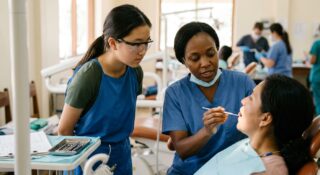
A typical day in a structured dental observation program might begin with a morning safety briefing, followed by observation of patient examinations and cleanings. Students watch preventive care procedures such as fluoride treatments and sealants. They may observe basic restorative work like fillings. They see patient intake, medical history documentation, and sterilization protocols. In the afternoon, they might participate in oral health education sessions, help with non-clinical tasks like organizing supplies, and then close the day with a supervised debrief where they process what they saw and ask questions.
The key distinction, and one that both students and parents should understand clearly, is that high school students observe. They do not perform procedures, handle sharp instruments, manipulate sterile equipment, or provide medical advice. They wear gloves, masks, and eye protection. They follow infection control protocols that are taught before they enter any clinical space. These are not optional extras; they are baseline requirements.
Procedures Teens Commonly Watch During Dental Observation
The range of what teens see at dental clinics depends on the setting. In a general dental practice or community health clinic, the most common observations include basic examinations, prophylactic cleanings, fluoride applications, sealant placement, and simple restorative procedures. Students also observe dental radiography, where X-rays are taken and used to guide treatment decisions.
In settings that serve underserved populations, whether domestically or internationally, students often witness a higher volume of extractions and treatment for advanced caries. This is because patients in resource-limited areas frequently lack access to the preventive and restorative care that would have addressed problems earlier. Seeing this firsthand gives students a concrete understanding of health disparities that no textbook can fully convey.
Students may also observe how dental professionals handle infection control from start to finish: instrument sterilization, operatory turnover, proper disposal of biohazard materials, and hand hygiene between patients. These details may seem mundane, but they represent some of the most important aspects of clinical safety, and admissions committees at dental schools notice when applicants can speak knowledgeably about them. The American Dental Education Association’s guidance on preparing for dental school emphasizes that exposure to clinical environments and understanding of professional conduct are qualities programs value in applicants.
Why Supervision and Structure Are Non-Negotiable
For parents considering whether to support a teen’s interest in dental observation, the structure of the program should be the first thing you evaluate. A reputable program will never place a minor in a clinical setting without direct, continuous supervision by a licensed dental professional. It will require up-to-date vaccinations, including Hepatitis B. It will provide training on universal precautions before the student sets foot in a clinic. And it will have clear protocols for emergencies.
Structure also means the experience has educational scaffolding: learning objectives, reflection time, and mentorship from professionals who can answer questions and provide context. Without these elements, observation becomes passive watching rather than meaningful learning. Students who sit through a day of procedures without understanding what they are seeing or why it matters walk away with very little.
If you are comparing programs, ask specific questions. Who supervises the students? What is the supervisor-to-student ratio? What training happens before clinical observation begins? How are students debriefed after difficult cases? Is there a clear protocol for what students can and cannot do? If a program cannot answer these questions directly, that is a red flag. Students interested in how structured health programs work for their age group can review IMA’s high school internship options to see what a well-organized framework looks like.
What Parents Should Know About Safety and Emotional Readiness
Safety in a dental observation setting involves two categories: physical and emotional.
Physical Safety
The physical risks in a dental clinic primarily involve exposure to bloodborne pathogens and infectious materials. Proper personal protective equipment, including gloves, masks, and eye protection, mitigates these risks significantly. Vaccination against Hepatitis B is standard practice for anyone entering a clinical environment, and reputable programs require proof of vaccination before participation. Hand hygiene protocols, training on universal precautions, and clear rules about what students may and may not touch form the rest of the safety framework.
Parents should confirm that a program has these measures in place. They should also verify that the program has a plan for medical emergencies, both for the students themselves and in the event a patient experiences a complication during a procedure.
Emotional Readiness
This is the part that often gets overlooked. Dental observation, especially in settings where patients present with advanced or untreated disease, can be emotionally difficult. A teen who has only experienced routine dental cleanings at their own dentist’s office may be unprepared for the sight of severe decay, oral infections, or the discomfort patients experience during extractions.
This is not a reason to avoid observation. It is a reason to prepare for it. Good programs address emotional readiness before students enter a clinical space. They talk honestly about what students might see. They provide debriefing sessions where students can process their reactions without judgment. And they assess maturity as part of the application process, not to gatekeep, but to make sure the experience is appropriate for the individual student.
Parents, your instinct to ask “Is my teen ready for this?” is the right instinct. Readiness is not just about interest; it is about the ability to handle discomfort, maintain professional composure, and reflect honestly on difficult experiences. If your teen tends to shut down when things get uncomfortable rather than talk about it, that does not mean they cannot participate, but it does mean you should look for a program with strong support and debriefing structures. An article on what teens should expect before entering clinical settings covers some of the emotional preparation questions worth considering.
How Dental Observation Fits into a Longer Pre-Health Path
Dental observation is not an endpoint. It is one piece of a longer process of career exploration. For students who are seriously considering dentistry, early clinical exposure provides something specific: the ability to speak from experience, not aspiration, when the time comes to apply to dental school.
Dental school admissions are competitive. According to ADEA data, the average accepted student has a science GPA around 3.71, a cumulative GPA around 3.74, and a DAT score around 20.8. Acceptance rates hover near 5%. Numbers matter, but so does the narrative a student builds across their undergraduate years. A student who observed dental procedures in high school, reflected on what they saw, and then continued to pursue dental-related experiences in college tells a coherent story of sustained interest.
The CDC’s oral health data shows that 1 in 4 adults aged 20 to 44 have untreated dental caries, and only about 65% of adults aged 18 to 64 visited a dentist in the past year. These are the kinds of statistics that become personal when you have watched a clinician treat a patient who has not seen a dentist in years. Students who have observed these realities can write about them with specificity and genuine understanding, which is far more compelling in an application essay than abstract statements about wanting to help people.
For teens who are not yet sure whether dentistry is the right fit, observation serves a different but equally important purpose: it helps them find out. Watching someone perform extractions for six hours and realizing it is not what you want to do for a career is valuable information. It saves years of pursuing a path that does not align with your interests or temperament. Students weighing different health career directions might also benefit from reading about how pre-med programs work for high schoolers to compare their options.
Realistic Expectations vs. Common Misconceptions
It is worth being direct about what dental observation will not give you. It will not give you hands-on procedural experience. It will not let you diagnose a patient or offer treatment suggestions. It will not look like what you see on social media, where dental procedures are filmed from dramatic angles with satisfying “before and after” results. Clinical dentistry involves repetition, patience, and a great deal of attention to protocol. Some days are routine. That is a feature, not a bug.
Students sometimes assume that dental observation abroad will be dramatically different from observation at home. In some ways it is: disease patterns differ, available resources may be limited, and cultural factors shape how patients seek and receive care. But the fundamental principle is the same. You are there to watch, to learn, to ask thoughtful questions, and to treat every patient’s privacy and dignity with respect. You are not there to perform care, regardless of the setting.
Parents sometimes worry that international dental observation programs are less safe or less structured than domestic ones. This concern is reasonable and worth investigating on a case-by-case basis. The right question is not “domestic or international?” but “Is this specific program well-supervised, transparent about its limitations, and honest about what my teen will and will not do?” A poorly structured program is a poor choice regardless of geography. A well-structured one provides valuable exposure regardless of location.
Practical Steps for Getting Started
If your teen wants to pursue dental observation, the first step is a conversation, not an application. Talk about what they hope to gain from the experience, what they think it will be like, and what concerns they have. Then talk about what concerns you have as a parent. These conversations do not need to end in agreement; they need to end in clarity.
From there, research programs carefully. Look for clear descriptions of supervision, safety protocols, daily schedules, and student boundaries. Ask for specifics about who will be supervising your teen and what credentials they hold. Find out whether the program includes reflection, mentorship, or educational components beyond passive observation.
Make sure vaccinations are current and that you have documentation ready. Hepatitis B vaccination is standard for clinical environments, and depending on the setting, additional vaccinations may be recommended. Consult with your teen’s physician about what is appropriate.
Finally, help your teen prepare mentally. Read about the kinds of procedures they may observe. Discuss how they might react to seeing patients in discomfort. Encourage them to treat the experience seriously, because the habits they build during observation, professionalism, attentiveness, respect for boundaries, are the same habits that will matter in every clinical setting they enter for the rest of their career.
Frequently Asked Questions
Do high school students perform any dental procedures during observation programs?
No. High school students in dental observation programs watch, learn, and ask questions, but they do not perform procedures, handle sharp instruments, or provide clinical care of any kind. All clinical work is performed by licensed dental professionals while students observe under direct supervision.
What safety measures protect teens during dental observation?
Reputable programs require current vaccinations (including Hepatitis B), provide personal protective equipment such as gloves, masks, and eye protection, and train students on infection control and universal precautions before any clinical exposure. Direct supervision by a licensed dental professional is maintained throughout the experience.
Will dental observation in high school help with dental school applications later?
Early dental observation can support a dental school application by demonstrating sustained interest and providing concrete experiences to reflect on in essays and interviews. However, no observation program guarantees admission to any dental school. What matters most is the quality of reflection and the pattern of continued engagement over time.