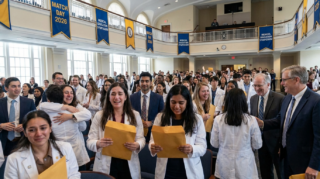
Match Day is the day graduating medical students learn where they will train as residents. For most students it is the end of a long application season that started with ERAS the summer before, and for pre-med students it is the most public look at where a medical school’s graduates actually go. This guide explains how Match Day works, how it connects to ERAS and Match Week, and how to read the match lists that medical schools publish each spring, using real lists from the class of 2026 as examples.
Every school example below comes from the school’s own published match page. National match statistics are published by the National Resident Matching Program (NRMP), which runs the Match; for official dates, rules and national results, go to the NRMP’s website directly.
What Is Match Day?
Match Day is the final day of Match Week, when the results of the Main Residency Match are released. Applicants and residency programs each submit a ranked list, and the Match places applicants into positions based on those lists. On Match Day, students learn the specific program where they will start residency, usually the following July.
Medical schools treat it as a milestone. Many hold a ceremony where students open envelopes at the same moment, often with family and classmates watching. Duke, for example, describes students opening their envelopes together on Friday, March 20, 2026, and the University of Missouri describes the same day as the moment students discovered where they will complete their training.
When Is Match Day?
Match Day falls on a Friday in March. In 2026 it was Friday, March 20, the date reported by schools including Duke, the University of Missouri and UT Southwestern on their Match Day pages. The exact dates for the next Match, including the rank order list deadline and Match Week, are set by the NRMP each year, so check the NRMP’s official calendar rather than relying on last year’s date.
How ERAS and the Match Fit Together
ERAS and the Match are two separate systems that work in sequence:
- ERAS is the AAMC’s application service. Students use it to send applications, letters, transcripts and the MSPE to residency programs in the fall.
- Interviews follow in the fall and winter, set by each program.
- The Match is run by the NRMP. Students register with it separately, then certify a rank order list of the programs where they interviewed. Programs rank applicants too.
- Match Week releases the results in March, ending with Match Day.
Registering with ERAS does not register you for the Match. Some specialties also use other systems: our ERAS residency application guide covers the application side in detail, including timelines and fees, and our guide to the residency match process covers how rank lists work.
Match Week, Step by Step
Match Week has a fixed rhythm, though the exact days and times are published by the NRMP each year:
- Early in the week: applicants learn whether they matched, but not where.
- During the week: applicants who did not match, or matched only partially, can take part in SOAP, the Supplemental Offer and Acceptance Program, which offers unfilled positions in a series of rounds.
- Friday, Match Day: matched applicants learn the program where they will train.
The Match is binding. An applicant who matches is committed to train at that program, and a program that matches an applicant is committed to offer the position. The same standard applies to positions accepted through SOAP.
What Happens on Match Day
Results are released to applicants at the same time nationally. Schools that hold ceremonies usually hand out envelopes or open results together at the release time, and many post a class map or list later that day or in the weeks that follow.
For the student, the result sets the next three to seven years: the specialty, the hospital, the city and, in many cases, whether a separate preliminary or transitional year comes first.
How to Read a Medical School’s Match List
Most medical schools publish a match list after Match Day. These lists are the school’s own data, and they differ in format, so it helps to know what to look for.
What Schools Publish
Some schools list every match by specialty and program. UT Southwestern’s 2026 list groups its graduates by specialty and names the program for each match. Others publish a summary: the University of Nevada, Reno reports that 63 students matched and breaks the results down by state, discipline and institution. UNC’s School of Medicine posts separate lists by state, by specialty and by name, and keeps past years online, so you can compare one class with another.
Who Is Not on the List
A match list is not always the whole class. UT Southwestern notes that its list does not include students who declined publicity, students pursuing alternative careers, or students taking a year off before residency. When a school publishes a match rate, ask how it counts students who did not apply, delayed, or matched through SOAP.
Preliminary and Transitional Years
Some specialties start with a one-year preliminary or transitional position before the main residency. Tufts University School of Medicine lists preliminary medicine, preliminary surgery and transitional year matches in their own group, separate from specialty matches. The University of Nevada, Reno notes that its state map shows where students start their first postgraduate year, which can differ from where the rest of residency happens.
“Potential Primary Care” and Similar Labels
Tufts marks internal medicine, family medicine, pediatrics and medicine-pediatrics matches as potential primary care. The word “potential” matters: many internal medicine and pediatrics residents later train in a subspecialty, so a primary care count describes residency fields, not final careers.
Staying Close to Home
Lists also show how many graduates stay at their own institution or region. Duke’s 2026 highlights list Duke University as its most frequently matched institution and North Carolina as its most matched location. Tufts reports that 40 students matched at Tufts clinical partners. A large home-institution share can reflect strong programs, student preference for the region, or both.
| School | What its 2026 match page shows | What to notice |
|---|---|---|
| UT Southwestern | Every published match, grouped by specialty | Students who declined publicity, chose other careers or took a year off are not listed |
| Tufts | Facts and figures plus a specialty table: 194 students in 23 specialties in 25 states | Preliminary and transitional years listed separately; potential primary care marked |
| Duke | Highlights by specialty, location and institution, plus all matches by specialty | Internal medicine was its most frequently matched specialty |
| University of Nevada, Reno | 63 matches by state, discipline and institution | State data reflects the first postgraduate year |
| UNC | Lists by state, specialty and name, with past years online | Easy to compare classes across several years |
What Match Lists Can and Cannot Tell Pre-Meds
A match list is useful when you are choosing where to apply or which acceptance to take, but it describes one graduating class, not your future. Keep a few limits in mind:
- Students choose specialties. A school with few dermatology matches may simply have had few students who wanted dermatology.
- Class size changes the picture. Ten matches in a specialty means something different in a class of 60 than in a class of 190.
- One year is a snapshot. Compare several years when a school keeps past lists online, as UNC does.
- Definitions differ. A school’s match rate, primary care count or “top program” label is the school’s own calculation, so read the footnotes.
Good questions to ask at interviews or second-look visits: How does the school support students who go unmatched? What advising is available for competitive specialties? How many students match at home, and is that by choice? For specialty-level competitiveness, our guide to the most competitive medical specialties uses AAMC, ACGME and AMA sources.
Before any of this, residency programs and medical schools both want to see how you learned from clinical settings. Our guide to AMCAS most meaningful experiences shows how to write about that, and school-specific guides such as our University of Georgia School of Medicine guide show how admissions factors work at one school.
If You Do Not Match
Not matching is more common than many students expect, and it is not the end of a medical career. SOAP during Match Week is the first step for eligible applicants. After that, options include a research year, additional clinical work, strengthening the application and reapplying in the next ERAS season. Talk with your school’s student affairs office as early as possible; they see these situations every year and can help you build a specific plan.
Frequently Asked Questions
When is Match Day?
Match Day is on a Friday in March, at the end of Match Week. In 2026 it was Friday, March 20. The NRMP sets the exact dates each year, so check its official calendar for the next Match.
What is the difference between Match Day and Match Week?
Match Week is the whole week of results. Early in the week, applicants learn whether they matched, and unmatched applicants can take part in SOAP. Match Day is the Friday when matched applicants learn where they will train.
Is the Match binding?
Yes. When you certify a rank order list, you agree to train at the program where you match, and the program agrees to offer you the position. Positions accepted through SOAP are binding too.
What is SOAP?
SOAP is the Supplemental Offer and Acceptance Program. During Match Week, eligible applicants who did not match, or matched only partially, can apply to unfilled positions and receive offers in a series of rounds.
How do I find a medical school’s match list?
Search the school’s website for its Match Day or match results page. Many schools post a list or summary after Match Day, and some, such as UNC, keep several past years online.
Do match lists include every student?
Not always. Some schools leave out students who declined publicity, chose a different career or delayed residency. UT Southwestern states this on its 2026 list, so read each school’s notes before comparing.
Is Match Day the same as ERAS?
No. ERAS is the AAMC’s application service that sends your application to programs. The Match is a separate system run by the NRMP that places applicants into positions based on rank lists. You register for each separately.
See more of our guides in your Google results: add International Medical Aid as a preferred source on Google.