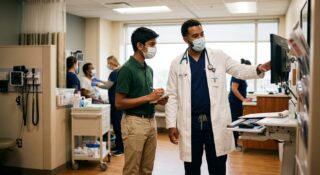
Shadowing PAs in clinics for minors is one of the most practical ways for a high school student to begin understanding what physician assistants actually do, how they interact with patients, and whether the profession fits their long-term goals. But the word “shadowing” can mean very different things depending on the setting, the age of the student, and the structure behind the experience. For families weighing options, the most important thing to know up front is this: when a minor shadows a PA, their role is strictly observational. They are not practicing medicine, assisting with procedures, or making clinical decisions. A well-structured medical internship for high school students will make that boundary explicit from the start, and a responsible program will enforce it consistently throughout.
The growing interest in early clinical exposure reflects a broader trend. The U.S. Bureau of Labor Statistics projects PA employment to grow 27 percent from 2022 to 2032, far outpacing most other professions. More students are considering the PA path earlier, and more parents are asking what that early exploration should look like. Some families search for paid medical internships for high school students, while others simply want to know what their teenager will actually see and do in a clinical setting. Both are reasonable starting points. The key is understanding what appropriate clinical exposure looks like for someone who is still in high school, why boundaries exist, and how this kind of experience can genuinely support a student’s growth without overstepping ethical or safety limits.
What Shadowing a PA Actually Involves for a High School Student
Shadowing, in the clinical sense, means observing a healthcare professional during their workday. For a high school student, this typically includes watching a PA conduct patient histories, perform physical examinations, interpret lab results, explain treatment plans, and collaborate with physicians, nurses, and specialists. The student may be present during outpatient consultations, follow a PA through rounds in a hospital ward, or observe workflow in departments such as general medicine, pediatrics, or urgent care.
What it does not include is any form of direct patient care. A minor shadowing a PA should not be drawing blood, administering medication, suturing wounds, performing assessments, or offering health advice. These activities require training, licensure, and professional accountability that a high school student simply does not have. The line between “observing” and “participating” must be clear, and a quality program will reinforce it daily.
This distinction matters more than many students initially realize. In a well-run shadowing experience, the value comes from watching how a PA thinks through a case, communicates with a patient, or adjusts a plan based on new information. Students who pay close attention to these moments often come away with a far more realistic picture of the profession than any textbook or career website can provide. Understanding clinical ethics in medical settings is part of that education, even at the observation level.
Patient Privacy, Consent, and What Minors Need to Know
One of the most important aspects of clinical shadowing for any student, but especially for minors, is patient privacy. In the United States, HIPAA regulations set strict standards for how patient information is handled, and even observers in a clinical setting are expected to respect those rules. Internationally, similar principles apply, though the specific legal frameworks may differ. Regardless of location, the core expectation is the same: anything a student sees or hears about a patient during shadowing stays in that clinical setting.
This means no photographs of patients, no sharing of patient names or diagnoses on social media, and no casual conversation about cases outside of supervised educational discussions. Students sometimes underestimate how seriously these rules are taken, but violations of patient confidentiality can have real consequences for the clinic, the supervising PA, and the student’s own standing. Programs that work with minors should cover these expectations during orientation and reinforce them throughout the experience. For more on this topic, IMA has published a helpful resource on confidentiality and respect in sensitive clinical settings for teen interns.
Informed consent is another critical piece. Before a student enters an exam room or observes a consultation, the patient should be aware that a student observer is present and should have the opportunity to decline. This is not a formality; it is a fundamental ethical standard. A responsible program ensures that this process happens consistently, not just occasionally.
Supervision, Structure, and What Parents Should Expect
For parents, the question of supervision is often the first and most pressing concern. It should be. A minor in a clinical environment needs consistent, qualified adult oversight. This means the student is accompanied by either a supervising healthcare professional (such as a PA, physician, or clinical officer) or a designated program staff member at all times during clinical hours. There should never be a moment when a high school student is left alone in a patient care area.
Beyond physical supervision, structure matters. A good program does not simply place a student in a clinic and hope for the best. It provides orientation before clinical exposure begins, sets clear expectations for behavior and boundaries, schedules regular debriefing sessions where students can ask questions and process what they have observed, and ensures that the clinical sites are vetted and appropriate for the student’s age group.
Parents should also expect clear communication channels. This includes knowing who is supervising their child on-site, how to reach program staff in case of an emergency, what the daily schedule looks like, and what protocols are in place for medical emergencies involving the student. These are not unreasonable expectations; they are baseline requirements. A parent’s guide to high school medical internships can help families think through the right questions to ask any program before committing.
Housing and transportation are also part of the safety picture. If the program involves travel, parents should know where their child will be staying, who else will be in the housing, what security measures are in place, and how students get to and from clinical sites. These details may seem logistical, but they directly affect a student’s safety and overall experience.
Why Observation Alone Still Has Real Educational Value
Some students worry that “just watching” will not be meaningful enough to matter. That concern is understandable but usually misplaced. Observation, when it is structured and supported by mentorship and reflection, can be one of the most effective ways to build genuine understanding of a profession.
When a student watches a PA explain a diagnosis to a worried parent, manage a complex case with limited resources, or coordinate care with a team of other providers, that student is learning things that cannot be replicated in a classroom. They are seeing how clinical reasoning works in practice. They are noticing how communication style affects patient trust. They are beginning to understand the pace, the emotional weight, and the day-to-day realities of clinical work.
This kind of exposure is particularly valuable for students considering PA programs. The PAEA’s guidance on prerequisites for PA school emphasizes the importance of understanding the PA role before applying. Admissions committees want to see that applicants know what the job actually entails, not just that they find the career appealing in theory. A student who has spent time observing PAs in a clinic can speak with specificity about what drew them to the profession, which cases made them think differently, and which moments confirmed their interest. That specificity is far more compelling in a personal statement or interview than vague enthusiasm.
For students also considering other health professions, early PA shadowing can help clarify the differences between the PA role and careers in medicine, nursing, occupational therapy, or dentistry. Understanding these distinctions early saves time and reduces the risk of applying to programs that are not a good fit. Students interested in a broader look at physician assistant exposure opportunities for high school students will find additional context for planning their path.
Maturity, Readiness, and Honest Self-Assessment
Not every high school student is ready for clinical observation, and that is completely fine. Clinical settings can be emotionally intense. Students may observe patients in pain, families receiving difficult news, or medical situations that are uncomfortable or distressing. A student who is not prepared for that reality may find the experience overwhelming rather than educational.
Maturity, in this context, does not mean being unaffected by what you see. It means being able to maintain composure in a professional setting, follow instructions from supervisors, respect the dignity and privacy of patients, and process difficult observations in a healthy way. It also means being honest with yourself about whether you are ready.
Parents play an important role here. Before a student commits to a shadowing experience, it is worth having a frank conversation about what they might see, how they might feel, and what support is available if they struggle. Programs that serve minors should offer structured debriefing sessions where students can talk through challenging observations with trained staff. This is not a sign of weakness; it is a sign of a program that takes the emotional wellbeing of its participants seriously.
Students who are not yet ready for in-person clinical exposure still have options. Reading about the PA profession, talking to PAs in their community, attending informational events, or starting with less intensive volunteer work can all build a foundation for future shadowing. The AAMC’s guidance on shadowing experiences offers useful principles that apply across health professions and can help students and families evaluate their readiness.
How to Evaluate a Shadowing or Observation Program
If you are a student or parent comparing programs, there are several concrete things to look for. First, ask whether the program explicitly states that minors are observers only. If the marketing language is vague about what students will “do” in clinical settings, that is a concern. Second, ask about supervision ratios and the qualifications of the people overseeing students. Third, ask how the program handles patient consent for student observers.
Look for programs that include educational components beyond passive observation: structured lectures, case discussions, mentorship from practicing clinicians, and guided reflection. These elements turn observation into active learning. A program that simply places a student in a clinic without context or follow-up is missing a significant part of the educational value.
Also consider whether the program addresses safety and logistics transparently. If you cannot get clear answers about housing, transportation, emergency protocols, or daily schedules before enrolling, that is a red flag. Programs that work with minors have a heightened responsibility to be forthcoming about these details.
Finally, consider the program’s ethical posture. Does it position students as learners, or does it imply they will be “helping” patients in ways that are unrealistic for someone without medical training? The former is honest and educational. The latter raises questions about the program’s integrity and the experience it actually delivers.
Frequently Asked Questions
Can a high school student shadow a PA without going through a formal program?
In some cases, yes. A student can reach out to a local PA and ask to shadow them during clinic hours. However, many clinics and hospitals have their own policies about minors in clinical areas, and some require background checks, liability waivers, or formal agreements. A structured program can simplify this process and ensure that the experience is properly supervised and educationally supported.
Will shadowing a PA in high school count toward the clinical hours required for PA school?
It depends on the program you are applying to. Some PA programs accept shadowing hours as part of their healthcare experience requirements, while others distinguish between shadowing and direct patient care hours. Shadowing in high school is best understood as an early exposure experience that helps you confirm your interest and understand the profession, rather than as a way to accumulate required clinical hours for a future application. Check individual PA program prerequisites for specifics.
What should a parent ask a program before allowing their teenager to participate?
Parents should ask about supervision ratios, the qualifications of on-site supervisors, how patient consent for observers is handled, what the daily schedule looks like, where students will be housed, how emergencies are managed, and whether the program includes debriefing or reflection sessions. Clear, specific answers to these questions are a strong indicator that the program takes its responsibilities seriously.