If you are a high school student thinking about dentistry, the work you do now matters more than you might expect. Not because dental schools are reviewing your sophomore transcript, but because a dental-focused activity profile in high school helps you build real understanding of a career before you commit years of education to it. The strongest future applicants are the ones who started early, not with flashy credentials, but with consistent, honest exposure. That might mean shadowing a local dentist, volunteering at a community health fair, or joining a structured program through internships for high school students medical. What counts is that each activity reflects genuine curiosity rather than resume padding.
Parents often wonder whether it is too early for their teenager to begin building a profile around a specific career. The honest answer is that it depends on the student’s maturity and interest, but starting with age-appropriate, well-supervised experiences in high school is one of the most productive things a future dental student can do. Programs like a medical internship for high school students can provide structured clinical observation in a safe, supervised setting, and that kind of exposure gives students something concrete to reflect on when they eventually write application essays. It also helps families have realistic conversations about fit, commitment, and what the dental profession actually involves day to day. The American Dental Education Association encourages prospective applicants to gain early exposure through shadowing and volunteering because it confirms career interest and builds a foundation for informed decision-making.
What a Dental-Focused Activity Profile Actually Looks Like
A dental-focused activity profile is not a list of dental-themed items stacked on a college application. It is a pattern of experiences, interests, and skills that show a student has explored dentistry with intention over time. When dental school admissions committees eventually review an applicant’s history, they want to see quality and reflection, not quantity. They want to know that the applicant understands what dentists do, why oral health matters, and how they arrived at the decision to pursue this career.
For a high school student, that profile will naturally look different from a college junior’s. You are not expected to have hundreds of shadowing hours or published research. You are expected to show that you took initiative, sought out realistic exposure, and thought carefully about what you observed. A student who shadows a general dentist for 20 hours and can articulate exactly what they noticed about the patient-provider relationship is far more compelling than someone who lists 200 hours of vaguely described volunteering.
The profile should also reflect breadth. Dental schools value applicants who are well-rounded, not just narrowly focused on teeth. Community service, leadership, science coursework, and even hobbies that build manual dexterity (art, music, woodworking) all contribute to a strong overall picture. The dental-specific activities sit within that larger context, not apart from it.
Shadowing: The Foundation of Early Dental Exposure
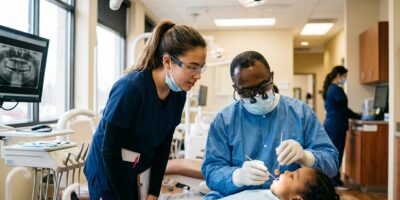
Shadowing a dentist is the single most valuable thing a high school student can do to build dental-focused experience. It is also one of the most accessible. Many general dentists, orthodontists, and oral surgeons are willing to let a motivated student observe during appointments, especially if the student approaches them professionally and explains their interest clearly.
During shadowing, you observe. You do not treat patients, handle instruments used in procedures, or offer advice. You watch how the dentist communicates with patients, how the hygienist performs cleanings, how the front desk manages scheduling, and how the team works together. Pay attention to the pace of the day, the variety of cases, and how the dentist handles difficult conversations about treatment plans or costs. These observations become the raw material for future application essays and interview answers.
A few practical points for students and parents. First, start by asking your own family dentist. Many practitioners are happy to help a young person explore the field, and a personal connection makes the initial conversation easier. Second, keep a simple journal of what you observe. Note the procedures you saw, questions that came up, and anything that surprised you. Third, be realistic about scheduling. Most dentists will offer a few hours at a time, and that is perfectly fine. Consistency matters more than marathon sessions. If you want guidance on how to approach a dentist about shadowing, resources like IMA’s guide to shadowing a doctor in high school offer useful frameworks, even though they focus on physicians; the principles of professionalism and preparation apply directly.
For students who want to see dentistry in a broader context, including how oral healthcare is delivered in settings with fewer resources, structured international observation programs can add a meaningful dimension. Observing dental care in a community clinic abroad, where conditions like advanced decay and oral infections are more prevalent, gives students perspective on global oral health challenges that domestic shadowing alone may not provide. Students and parents considering that option should understand that minors in these programs observe and support under direct supervision; they do not practice dentistry. For a broader look at how early dental exposure fits together, including both domestic and international options, IMA’s overview of pre-dental experiences for high school students lays out the realistic scope of what is available.
Volunteering and Community Service with a Dental Connection
Volunteering is where a dental-focused profile gains depth. While shadowing shows you what dentists do, volunteering shows that you care about the communities dentistry serves. There are several ways to get involved, and most are genuinely accessible to a high school student.
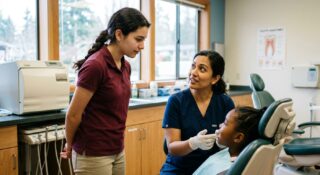
Local dental health fairs are a good starting point. Many community health organizations, churches, and nonprofits host free dental screening events, especially in underserved areas. High school volunteers typically help with registration, hand out oral hygiene supplies, or assist with educational stations where families learn about brushing and flossing. You are not providing clinical care, but you are contributing to a public health effort and interacting with people who may have limited access to dental services.
Another option is organizing oral health education for younger students. If your school has a community service requirement or a health-focused club, consider developing a simple presentation on dental hygiene for an elementary school audience. Teaching kids how to brush properly, explaining why sugar affects teeth, or distributing toothbrushes donated by a local dentist are straightforward projects that demonstrate initiative and communication skills. The WHO reports that oral diseases affect nearly 3.5 billion people globally, with untreated tooth decay being the most common health condition worldwide. Framing your volunteer work within that larger public health context shows awareness that extends well beyond your own community.
For parents evaluating these activities, the key question is whether the experience is structured, supervised, and genuinely educational. A well-run volunteer event at a community clinic is valuable. A loosely organized trip where students have unclear roles or no supervision is not.
Clubs, Coursework, and Skill-Building That Supports a Dental Profile
Not every activity on a dental-focused profile needs to involve a dental office. Admissions committees for dental schools consistently emphasize the importance of manual dexterity, scientific literacy, and interpersonal skills. High school offers plenty of opportunities to develop all three.
Clubs and Organizations
HOSA (Health Occupations Students of America) is one of the most widely recognized pre-health student organizations in U.S. high schools. It offers competitive events, leadership development, and health career exploration. If your school has a HOSA chapter, joining it is a practical way to demonstrate sustained interest in healthcare. If it does not, starting one is a leadership opportunity in itself.
Science Olympiad, robotics teams, and art clubs may seem unrelated to dentistry, but they build relevant competencies. Sculpture, ceramics, and model-building develop fine motor control. Biology and chemistry courses lay the academic foundation. Debate and speech clubs sharpen communication skills that matter in patient care. The point is not to label every activity as “dental” but to recognize how different interests contribute to the profile of someone who would thrive in a clinical, hands-on profession.
Coursework and Academic Preparation
Take the strongest science courses available to you. AP Biology, AP Chemistry, and anatomy courses (if offered) are all directly relevant. Strong performance in these subjects signals to future admissions committees that you are prepared for the academic rigor of a pre-dental and dental school curriculum. If your school offers a health sciences pathway or a Career and Technical Education (CTE) track in healthcare, those programs often include introductory anatomy, medical terminology, and sometimes even supervised clinical rotations at local healthcare facilities.
According to the BLS Occupational Outlook Handbook for dentists, a bachelor’s degree (usually with heavy science coursework) followed by four years of dental school is the standard educational path. Understanding that trajectory now helps you plan your high school and college coursework with intention rather than scrambling to fill prerequisites later.
Manual Dexterity
This deserves its own mention because dental schools specifically look for it. If you play a musical instrument, especially one requiring fine finger coordination like piano, violin, or guitar, keep playing. If you draw, paint, sculpt, sew, or build models, those activities are relevant. Some students take up wire-bending or wax carving as a direct nod to dental school preparation, but admissions committees care more about sustained skill development than about choosing the “right” hobby. Do what genuinely interests you and be prepared to connect it to why you would be a capable dental student.
Structured Programs and Internships for High School Students
Beyond self-directed activities, structured programs offer a level of mentorship, reflection, and professional context that is hard to replicate on your own. These programs range from local hospital-based summer experiences to international clinical observation programs.
When evaluating any program, students and parents should ask clear questions. Who supervises the students? What is the daily structure? What are the boundaries around clinical observation? Is there a reflective or educational component, or is it mostly logistical? How does the organization handle safety, housing, and communication with parents?
For high school students specifically, a well-designed program will make all of the following explicit: minors observe and support clinical teams, they do not practice medicine or dentistry. Supervision is constant and provided by licensed professionals. Housing is secure and supervised. Parents receive clear communication about schedules, safety protocols, and emergency procedures. If a program is vague about any of these points, that is a reason to ask more questions or look elsewhere. IMA’s parent guide to teen medical internships addresses many of these concerns directly and is worth reading before committing to any program.
International observation programs can add a distinctive layer to a dental-focused profile, particularly around global health awareness and cultural competence. Watching how dentists work in settings with limited resources, high patient volume, and a wider range of advanced oral pathology gives students perspective they cannot get from a private practice in their hometown. But the value of that experience comes from reflection, not from the destination itself. A student who can articulate what they learned about healthcare delivery, oral health disparities, or their own assumptions will present a far stronger profile than one who simply lists a country name and a date range.
For students who want to understand how dental internships are structured for their age group, IMA’s guide to dental internships for high school students provides a detailed look at what is realistic and what to expect.
What Admissions Committees Actually Value, and What They Do Not
It is worth addressing this directly because there are common misconceptions about what makes a dental school application strong. Dental school is still several years away for a high school student, but the habits you build now carry forward.
Admissions committees value sustained commitment over one-time events. A student who shadowed the same dentist once a month for a year and can discuss how their understanding of the profession evolved is more credible than a student who did a single week-long program and never followed up. They value reflection. Can you explain what you observed, what surprised you, what challenged your assumptions? They value honesty. If you are still deciding between dentistry and another health profession, that is fine. Saying so shows maturity.
What they do not value is exaggeration. Do not describe yourself as having “assisted with patient care” if you observed procedures from across the room. Do not inflate your role or your hours. Clinical settings require integrity, and your application is the first place you demonstrate it. In the 2023 application cycle, ADEA reported 11,466 applicants competing for approximately 6,367 first-year seats. That level of competition makes authenticity even more important; reviewers can tell the difference between a genuine account and a polished fiction.
They also do not require international experience. It is valuable if you do it well and reflect on it thoughtfully, but it is not a prerequisite. A strong dental-focused profile built entirely through local shadowing, school-based volunteering, and relevant coursework is absolutely competitive.
Putting the Profile Together: A Realistic Timeline for Students and Parents
For students in their freshman or sophomore year, the priority is exploration. Take strong science courses, try activities that interest you, and start paying attention to what dentists actually do. If your family dentist is willing to let you observe for a few hours, take that opportunity.
By junior year, you should have some shadowing experience and at least one or two consistent extracurricular commitments related to healthcare, community service, or skill-building. This is also a good time to consider a structured summer program if it fits your family’s budget and your own readiness. Think carefully about whether you are mature enough to handle a clinical observation environment, especially if the program is international. Discuss it honestly with your parents.
Senior year is about consolidation. Continue activities you have already started. Begin thinking about how you will describe these experiences in college applications, knowing that the same material will eventually inform your dental school personal statement and activity descriptions years later. The goal is not to “finish” your profile but to have built something genuine that you can continue developing in college.
For parents, the most helpful thing you can do is support your student’s exploration without pressuring them toward a specific outcome. Ask them what they observed during shadowing. Encourage them to keep notes. Help them evaluate programs critically. And remind them that confirming interest in dentistry is just as valuable as confirming it is not the right fit; both save time, money, and frustration down the road.
Frequently Asked Questions
Do dental schools care about activities from high school?
Dental schools primarily evaluate your college record, DAT scores, and experiences during your undergraduate years. However, high school activities that show early, sustained interest in dentistry can strengthen your narrative, especially if you continued building on them in college. They provide context for your motivation and demonstrate that your interest is not recent or superficial.
Can a high school student do hands-on dental work during shadowing or internships?
No. High school students observe and, in some structured programs, support clinical teams with non-clinical tasks under direct supervision. Minors do not perform dental procedures, examine patients, or handle instruments used in patient care. Any program that implies otherwise should be questioned carefully.
Is international clinical experience necessary for dental school admission?
It is not necessary. International observation programs can add valuable perspective on global oral health, cultural competence, and healthcare delivery in resource-limited settings. But a strong profile built through domestic shadowing, volunteering, and relevant coursework is fully competitive. What matters most is the quality of your experience and your ability to reflect on what you learned.