
Clinical officers in Kenya are licensed mid-level clinicians who assess patients, diagnose illness, prescribe treatment and refer complex cases, often as the main clinician in county and rural facilities. In 2020 they made up 13% of Kenya’s roughly 190,000 health workers, nearly twice the share of doctors, and they qualify through a diploma or degree plus a one-year internship.
For a pre-PA student, the role is one of the most useful comparisons you can study abroad. Clinical officers do work that looks familiar to anyone who has shadowed a U.S. physician assistant, yet they trained through a different route, answer to a different regulator and practice in a very different health system. IMA’s article on the history and development of physician assistants in Kenya gives more of that background.
The sections below cover the profession’s history, how clinical officers train and get licensed, the policies that shape their work and what you can learn by observing them. The goal is to help you meet Kenyan clinical officers as experienced clinicians and mentors, recognize what their training covers and avoid assuming that the two roles are the same.
Clinical Officers in Kenya at a Glance
- What they do: clinical officers take histories, examine patients, classify and diagnose conditions, prescribe, interpret tests, perform routine procedures and refer patients onward, according to Akinyi and Choge (2021).
- How many there are: Kenya’s 2020 health labour market analysis counted about 25,000 clinical officers, 13% of the health workforce, against about 13,000 doctors at 7% (Okoroafor and colleagues, BMJ Global Health 2022).
- Who regulates them: the Clinical Officers Council, now governed by the Clinical Officers (Training, Registration and Licensing) Act, No. 20 of 2017.
- How they qualify: a three-year diploma or four-year degree in clinical medicine, a Council examination and a one-year internship.
- Specialists: about one in ten clinical officers had specialty training in 2015, most often in anaesthesia, paediatrics, ENT, and lung and skin diseases (Ajayi and colleagues, Wellcome Open Research 2025).
From Colonial Roots to Independence: A Brief History
The idea of a non-physician clinician in Kenya is almost a century old. According to Akinyi and Choge’s 2021 history of the profession, the cadre began in 1928, when the British colonial administration decided to train a select group of Kenyans to practice medicine and care for the local population. There were no Kenyan doctors practicing inside the country at the time, and colonial medical officers were too few to reach most people. The new cadre was created to fill that gap.
Over the following decades the role kept its purpose while its title changed several times. The same history sets out a timeline of three generations of clinicians that ended in the title used today:
| Period | Title | What changed |
|---|---|---|
| 1928 to 1946 | Hospital Assistants | First locally trained clinicians, certificate level |
| 1946 to 1963 | Medical Assistants | Clinical duties expanded under colonial medical officers |
| 1963 to 1969 | Clinical Assistants | Renamed in the years after independence |
| 1969 onward | Certified Clinical Officers | One title for non-physician clinicians trained in clinical medicine |
Recollections from people who worked in the profession sometimes put the name changes in different years, so treat the dates as a guide to the sequence rather than exact milestones. What matters for your understanding is the direction of travel: each change reflected broader clinical responsibility and more formal training.
Independence in 1963 brought a new challenge. The government had to provide care for a growing population with very few physicians. Akinyi and Choge describe how medical education in Kenya moved to a four-year medical school model and how students studied abroad and returned to work in the civil service. Training enough doctors would take years, and the mid-level clinicians who were already practicing became even more central to keeping hospitals and health centers open.
Kenya also invested in educating its own professionals abroad. Akinyi and Choge note that funding from the African American Students Foundation and the Kennedy Airlift helped hundreds of young Kenyans win scholarships to study at American institutions. Many returned to join the civil service of the newly independent country, which shows how closely Kenya’s early health workforce was tied to international exchange.
During the same period a second generation of practitioners began training inside Kenya’s borders at diploma level, with early programs in towns such as Nakuru and Machakos. Certificate-trained clinicians and the newer diploma graduates worked side by side. That overlap raised practical questions about titles, scope and career progression, and it set the stage for regulation of the whole cadre.
How the Profession Was Formalized
Two statutory bodies shaped Kenya’s clinical workforce. The Kenya Medical Practitioners and Dentists Board was set up in 1978 to oversee doctors and dentists, and the Clinical Officers Council followed in 1989 to oversee clinical officers (Akinyi and Choge, 2021). The law behind the Council, the Clinical Officers (Training, Registration and Licensing) Act, known as Cap. 260, commenced on 31 July 1989. It provided for the training, registration and licensing of clinical officers and for regulating their practice.
Cap. 260 also brought the earlier generations into one regulated profession. Its savings clause recognized people already practicing under the titles Hospital Assistant, Medical Assistant, Certified Clinical Officer and Registered Clinical Officer, so experienced clinicians trained under older programs were not shut out when the new system began. That decision helped unify a cadre that had grown up in stages.
Formal regulation brought clearer standards. The diploma became the baseline qualification for new clinical officers, and as the profession matured, higher diplomas in specialty areas such as pediatrics and ophthalmology were created in place of residencies. In 2006 the Bachelor of Science in Clinical Medicine and Surgery was introduced, opening a four-year degree route for school leavers and an upgrade route for diploma holders (Akinyi and Choge, 2021).
In 2017 Parliament passed a new law. The Clinical Officers (Training, Registration and Licensing) Act, No. 20 of 2017 received assent on 21 June 2017 and commenced on 7 July 2017, replacing Cap. 260 as the legal basis for the Council. The Act sets out the Council’s role in approving training institutions, keeping the register and licensing clinical officers, and it governs who may enter private practice.
Growth in Numbers
The profession has grown from a handful of hospital assistants to one of the largest clinical cadres in the country. Akinyi and Choge reported that nearly 35 training programs were producing about 2,000 graduates a year by 2021, and that about 800 clinical officers with a BSc were registered by 2019.
The most detailed national count comes from Kenya’s 2020 health labour market analysis. It found 189,932 health workers across 13 major occupations, including about 25,000 clinical officers and about 13,000 doctors, so clinical officers made up 13% of the workforce against 7% for doctors (Okoroafor and colleagues, 2022). A 2025 review of specialist workforces put the figure at 25,400 clinical officers in 2021, with 62% working in the private sector (Ajayi and colleagues, 2025).
The same analysis shows why the cadre matters for coverage. In 2020 the combined density of doctors, nurses and clinical officers was 30.14 per 10,000 people, about 68% of the Sustainable Development Goal threshold of 44.5 doctors, nurses and midwives per 10,000. Clinical officers are a large part of what makes even that level of coverage possible, particularly outside the major cities.
The Council’s own website gives a current snapshot. In October 2026 its home page listed 71 training institutions, 30,690 registered clinical officers, 4,350 specialized clinical officers and 2,081 clinical officers with a BSc. Counts from different sources measure slightly different things, such as registered versus active practitioners, so compare them by source and year rather than as one series.
Professional Organization
Clinical officers also organize to represent the profession. The Kenya Clinical Officers Association reported more than 7,000 members in 2020, about 3,000 from the public sector and 4,000 from the private sector, with membership open to diploma and degree holders registered with the Council (Akinyi and Choge, 2021). The association and the Kenya Union of Clinical Officers take part in national discussions on workforce policy and working conditions.
In the public sector, a formal scheme of service for clinical personnel sets out grades and promotion steps, so a clinical officer can see a defined career path from entry grade toward senior and supervisory posts.
The Role of Clinical Officers in Kenya’s Modern Health System
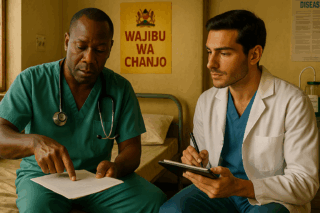
Clinical officers work at every level of Kenya’s health system, from small dispensaries and health centers to county hospitals and national referral facilities. Their presence matters most where doctors are scarce. In many health centers and dispensaries a clinical officer is the most highly trained clinician on site, so patients who come in with an illness are assessed and treated by that clinical officer.
How the role is described depends on who you ask. In a study of Kenyan hospitals, Mbindyo and colleagues (2013) found that respondents described clinical officers in images ranging from a “filter” that sorts patients for doctors to a “primary healthcare physician.” Ministry of Health norms quoted in that study describe clinical officers as the first referral level for outpatients, managing patients referred by nurses. The same study found tensions between formal descriptions of the role and day-to-day practice, including a sense among clinical officers that their primary care work was not fully recognized.
The setting made a difference. Mbindyo and colleagues found that faith-based hospitals tended to define clinical officer roles more clearly than public hospitals. They also noted that while the Council sets standards for training, registration and licensing, day-to-day roles are largely decided by the hospitals where clinical officers work. That is a useful point to remember when you observe: what a clinical officer does in one hospital may differ from what you see in another, even with the same qualification.
Outpatient and Primary Care
Outpatient care is the core of the role. A clinical officer in a busy clinic sees a broad mix of adults and children with acute infections, injuries and chronic conditions. According to Akinyi and Choge, clinical officers classify conditions to reach a provisional or final diagnosis, prescribe treatment, start or stop therapies, interpret medical tests, perform routine medical and surgical procedures and refer patients to other practitioners when a case needs more than the facility can offer.
Prevention and community health are part of the job as well. Clinical officers take part in immunization, maternal and child health clinics and health education, and they often work closely with nurses and community health workers who know the households they serve. Many are from the communities where they practice, which gives them an understanding of local language, beliefs and daily constraints that affects how they explain a diagnosis or plan follow-up.
Hospital Care
In hospitals, clinical officers commonly staff outpatient departments, casualty and emergency areas and wards. They admit and review patients, manage common conditions and refer patients who need a specialist. Specialist clinical officers lead services in their fields: Mbindyo and colleagues describe specialist clinical officers working with greater autonomy in clinics such as ENT and ophthalmology and performing minor surgical procedures, with specialty areas that include anaesthesia, pediatrics, orthopedics, reproductive health, and lung and skin diseases.
This is task sharing in practice. Work that might be done only by doctors elsewhere is shared with a trained, regulated cadre so that more people can be seen. The key point for a visiting student is that it happens inside a legal and training framework: clinical officers are trained, examined, registered and licensed for the work they do.
How Clinical Officers Fit Into the Health Team
Clinical officers rarely work alone, even in small facilities. Understanding who else is on the team helps you read what you see on a ward or in a clinic. Nurses and midwives provide much of the bedside care, triage and maternity care. Community health workers link households to facilities and follow up patients at home. Laboratory staff run tests, pharmacy staff dispense medicines, and medical officers and specialist doctors take on the cases that need their level of training.
Kenya’s health system is organized in levels, from community services and dispensaries at the base, through health centers and sub-county hospitals, up to county and national referral hospitals. Clinical officers work at every level, but their role shifts with the setting. In a dispensary or health center they may be the lead clinician. In a large referral hospital they work alongside medical officers, consultants and specialist clinical officers, and the division of work depends on the department.
When you observe, try to map the flow of a patient through that system. Who saw the patient first, who made the decision to treat or refer, and where will the patient go next? Following one patient’s path, without recording identifying details, teaches you more about how the team works than watching any single consultation.
Hallmark Contributions in Remote and Underserved Areas
One of the profession’s most important contributions is service in places that are hard to staff. In arid counties, small towns and informal settlements, a clinical officer may run a dispensary or health center with a small team and a limited supply of medicines and tests. That clinical officer manages what can be managed on site, stabilizes patients who need more and arranges referral, often across long distances.
That presence changes what care is available. When a health center has a clinical officer, residents can be assessed and treated close to home instead of traveling for a day or more to reach a hospital. Outreach clinics, mobile teams and community programs also rely on clinical officers to bring assessment and treatment to communities that would otherwise go without.
For a student, the lesson is less about any single procedure and more about judgment. Working with limited tests and supplies requires careful history-taking, a thorough examination and clear decisions about who can safely stay and who must go.
Management and Leadership
Experienced clinical officers often lead facilities and programs. Senior clinical officers act as facility in-charges, supervising staff, managing medicine supplies, overseeing health information reporting and running public health programs. A 2025 review notes that specialist clinical officers can be deployed to head sub-county facilities or program units (Ajayi and colleagues, 2025).
Leadership also extends to policy. Through their association and union, clinical officers take part in discussions on workforce planning, scope of practice and programs such as HIV care and universal health coverage. Watching a clinical officer manage a clinic gives you a view of leadership that combines patient care with logistics, staffing and community relationships.
Specialist Clinical Officers
Specialty training is a growing part of the profession. The 2025 review found about 20 specialty areas available to clinical officers. Among specialists, the largest groups were anaesthesia at 29%, paediatrics at 25%, ENT at 12%, and lung and skin diseases at 11%, and around 10% of all clinical officers had specialty training in 2015 (Ajayi and colleagues, 2025). Specialist clinical officers are central to services such as anaesthesia in county hospitals, where they make surgery possible in facilities without enough specialist doctors.
National staffing norms reflect that reliance. The same review reports that Kenya’s 2014 norms called for 24 specialist clinical officers at district-level hospitals, alongside specialist doctors and specialist nurses. In practice, that means a student observing in a county hospital may meet specialist clinical officers running anaesthesia, eye, ENT or chest clinics, each with its own way of assessing patients and deciding who needs referral to a consultant.
If you are interested in a particular field, ask the specialist clinical officers you meet how they chose it, what their higher diploma covered and how they work with doctors in the same department. Those conversations show you how specialization works in a system where much of it happens through additional training after years of general practice.
Training, Curriculum and Licensure
Diploma and Degree Pathways
Students can enter clinical medicine directly after secondary school if they meet the entry requirements. According to Akinyi and Choge, diploma training lasts three years of full-time medical training with supervised clinical practice, while the undergraduate degree takes four years for students selected through Kenya’s government-accredited placement process.
The curriculum resembles a condensed medical program. Students study anatomy, physiology, pharmacology and microbiology alongside internal medicine, pediatrics, surgery, obstetrics and gynecology, and community health. Clinical work starts early. Students rotate through hospital wards and outpatient departments under supervision, and degree programs include junior and senior clerkships in later years. The degree adds more depth in research, health systems and community health, while keeping the same core clinical rotations.
Early clinical exposure is one of the features that stands out to American visitors. By the time they finish training, clinical officers have spent a large share of their education seeing patients under supervision, which builds confidence in history-taking, examination and common treatments.
The Council Examination and Internship
Before practicing independently, graduates must pass a Council examination and complete an internship. The Clinical Officers Council’s registration requirements state that graduates of approved institutions must sit the prescribed Council exams, and successful candidates are posted for a one-year internship. The Council currently runs pre-internship examinations in more than one series each year.
During the internship year, new graduates work under supervision in approved hospitals and rotate through the main clinical areas. They keep an internship logbook. Within three months of finishing, they submit their registration documents, which include their academic certificates, the internship completion letter and the completed logbook.
Registration, Licensing and Continuing Development
After registration, clinical officers need a practicing licence. Under the 2017 Act, a licence is valid from the date it is issued and expires on 31 December of that year, so licences are renewed annually. The Council can refuse to renew, cancel or suspend a licence for professional misconduct or breaches of the Act (Act No. 20 of 2017).
Continuing professional development is part of staying registered. Mbindyo and colleagues note that the Council sets requirements for continuous professional development for continued registration and issues licences for private practice. The Council also accredits CPD providers, and clinical officers keep their knowledge current through courses, workshops and conferences.
How Clinical Officers Keep Their Skills Current
Annual licensing ties continuing education to the right to practice. Clinical officers keep up through accredited courses, workshops, conferences and in-service training, and national programs such as HIV care have trained large numbers of clinical officers in new guidelines as treatment changed. Specialist clinical officers also learn within their departments, from consultants and experienced colleagues.
For a visiting student, this is a good topic for conversation. Asking a clinical officer how they learned about a recent guideline change, or how their department keeps everyone up to date, shows interest in the profession and often leads to useful discussions about teaching and mentorship.
Higher Diplomas and Academic Progression
Many clinical officers continue their education after a few years of practice. According to Akinyi and Choge, diploma graduates can pursue a higher diploma, a program of about 18 months to two years or more in a chosen specialty. Specialty areas include pediatrics and child health, anaesthesia, ophthalmology, ENT, orthopedics, dermatology and reproductive health. Higher diplomas were introduced in place of residencies, and they prepare clinical officers to lead specialty clinics and services.
Academic routes are open too. Diploma holders can upgrade to a BSc, and some go on to master’s and doctoral study in fields such as public health and clinical medicine. Joseph Choge’s own path shows how far that can go. After a three-year diploma and a year of internship, he completed a higher diploma in pediatrics, practiced in that specialty, then earned an undergraduate degree, a master’s and a PhD in parasitology. He went on to head the Department of Clinical Medicine at the University of Kabianga (Akinyi and Choge, 2021).
Career Structure and Private Practice
In the public sector, clinical officers enter at a defined grade and can be promoted to senior and principal grades as they gain experience and training. Senior clinical officers may head departments, programs or facilities. Specialists hold titles that reflect their field, such as anaesthetist or ophthalmic clinical officer, and often supervise others in that area.
Private practice is regulated. Under the 2017 Act, a clinical officer may enter private practice only if registered, holding a valid practicing licence and having practiced under a senior clinical officer or senior medical officer for at least three years (Act No. 20 of 2017). Many experienced clinical officers run private clinics and medical centers that provide affordable care, especially in towns and peri-urban areas, and the large private-sector share in the 2021 figures reflects how important that work has become.
The training pathway is shorter than a U.S. PA’s in calendar years, because Kenyan students enter clinical medicine straight from secondary school. It is not shallow. A diploma graduate has three years of medical training, a supervised internship year and, for anyone entering private practice, at least three more years of supervised work.
Health Policy, Task Sharing and Kenya’s National Health Strategy
Kenya’s health policy has relied on clinical officers for decades because the country does not have enough doctors, nurses and midwives. A 2022 study reported a density of 13.8 health workers per 10,000 people, well below the World Health Organization’s recommendation of at least 44.5 doctors, nurses and midwives per 10,000 (Kinuthia and colleagues, Human Resources for Health 2022).
In response to shortages like this, WHO has recommended task shifting, which it describes as moving tasks to health workers with shorter training and fewer qualifications where appropriate. Task sharing is the related idea that cadres share tasks rather than handing them over entirely. The same study explains that task shifting is intended to make better use of more widely available cadres such as nurses, clinical officers and community health workers.
Kenya’s Task Sharing Policy
Kenya developed national task sharing policy and guidelines for 2017 to 2030, with the Ministry of Health working alongside partners including Emory University, the U.S. Centers for Disease Control and Prevention and PEPFAR. The guidelines list priority tasks that different cadres can share, such as HIV testing and counseling, and they were disseminated to county health facilities (Kinuthia and colleagues, 2022).
The policy also shows how contested scope can be. In June 2017, about a month after the policy was launched, the Association of Kenya Medical Laboratory Scientific Officers asked the High Court to stop its implementation, and the court stopped implementation in a decision in April 2019. The broader direction of using clinical officers and other cadres to widen access has continued through training, deployment and program design, even where the formal guidelines were paused.
Devolution and County Health Services
Kenya’s 2010 Constitution devolved most health services to county governments, a change implemented from 2013. Counties now hire and manage much of the health workforce, including many clinical officers. That gives counties room to staff facilities to match local needs, and it also means conditions and support can differ from one county to another.
Counties rely heavily on clinical officers because they are more affordable to employ than doctors and are often willing to serve in remote posts, many of them in the areas they come from. County health budgets often prioritize recruiting clinical officers to staff local facilities.
For clinical officers, devolution made local workforce decisions more important. Counties decide where to post staff, how to support outreach and how to upgrade facilities. The national Ministry of Health and the Clinical Officers Council still set training and registration standards, so the qualification means the same thing wherever a clinical officer works.
For a visiting student, devolution explains some of what you may notice: differences between facilities in staffing, supplies and how services are organized. Rather than drawing conclusions about the whole country from one hospital, ask local staff how their county organizes services and what has changed in recent years.
Integration Into National Programs
Clinical officers are part of nearly every major health program in Kenya. In HIV care, many work as the main clinicians in comprehensive care clinics, starting and monitoring treatment and managing opportunistic infections. In malaria-endemic areas they lead diagnosis and treatment. In maternal and child health they run antenatal clinics, manage common childhood illnesses and support deliveries in health centers.
Universal health coverage has raised the stakes further. Kenya made universal health coverage a national priority in 2018, and expanding primary care depends on clinical officers because they staff so many of the facilities that patients reach first. Workforce analyses keep pointing to the same need: train and deploy enough clinicians, in the right mix, where people live (Okoroafor and colleagues, 2022). In the universal health coverage pilots, clinical officers, who staff most primary care facilities, treated more patients than ever once financial barriers for patients were removed, and the lessons reinforced that investing in more clinical officers, with supplies and continuing training, is a cost-effective way to expand access.
Retention and Career Development
Keeping trained clinicians in the system is a policy goal in its own right. The 2022 labour market analysis recommends aligning training intakes with population health needs and the country’s ability to employ the health workers it produces, taking into account the potential for emigration. Career ladders, specialty training through higher diplomas and leadership roles for experienced clinical officers all help keep skilled practitioners working in Kenya.
Kenya’s experience is now a reference point for other countries that use non-physician clinicians. For an international observer, the main lesson is that the cadre was built deliberately over decades, through training standards, legislation and professional organization, rather than as a stopgap.
What Pre-PA Students Can Learn From Clinical Officers
Spending time in a Kenyan hospital where clinical officers work can deepen your understanding of what a mid-level clinician does. The learning comes from watching, asking good questions and reflecting, not from taking on clinical tasks. The AAMC guidelines for students in clinical experiences abroad are clear that a student’s role is observation, and that students should not do anything abroad that they would not be allowed to do at home.
Diverse Clinical Exposure
Kenya’s disease burden differs from what most U.S. students see. In a Kenyan hospital you may observe clinicians assessing malaria, tuberculosis, HIV-related illness, typhoid, malnutrition and complications of chronic disease that present later than they usually would in the United States. Watching how a clinical officer works through these presentations shows you how history, examination and a short list of tests can lead to a decision.
Keep notes on the reasoning you hear, not on patients. Write down the question the clinician asked, the finding that changed the plan and how the next step was explained. Those notes are what make an observation useful later, and they keep patient information out of your journal.
Clinical Reasoning With Limited Resources
Many facilities have basic laboratory services, limited imaging and intermittent supplies. Clinical officers adapt. You will see how much depends on careful history-taking and examination when advanced tests are not available, and how clinicians decide which tests are worth ordering when each one has a real cost in time and access.
This is one of the most transferable lessons for a future PA. U.S. practice has far more diagnostic tools, but the habits of thorough assessment and judicious testing still matter. Ask clinicians how they decide when a patient can be treated locally and when referral is necessary.
Cross-Cultural Communication
Clinical officers often explain diagnoses in plain language, sometimes switching between English, Swahili and local languages. Watching how they check understanding, involve family members and plan follow-up can teach you a great deal about communication. If you do not speak the language, IMA’s guide on staying engaged during observation across a language barrier offers practical ways to keep learning.
Many clinical officers are from the communities they serve. Notice how that shapes trust, how they ask about practical barriers such as travel or work, and how they adapt advice to what a family can realistically do. These are lessons in cultural humility that carry over to any setting.
Leadership and Teamwork
A clinical officer in charge of a clinic coordinates nurses, community health workers, pharmacy staff and support staff. You may see decisions about which patients to refer first when transport is limited, how a team handles a sudden influx of patients and how public health activities such as immunization days are organized. Leadership here is practical: keeping the clinic running safely with the people and supplies available.
Learning Goes Both Ways, Within Your Role
Exchange between visiting students and local clinicians can be valuable, but it has limits. As an observer, your contribution is curiosity, respect and reliability: arriving on time, following instructions and asking questions at appropriate moments. You can share what you are learning about the U.S. system when clinicians ask, but you are not there to advise on clinical practice.
The most important attitude is respect. A clinical officer’s training and legal scope are not the same as a U.S. PA’s, and many clinical officers manage situations a student has never seen. Approach them as experienced clinicians and mentors.
What a Day Alongside a Clinical Officer Can Look Like
Every hospital runs differently, so treat this as a general picture rather than a schedule. A morning in an outpatient department often begins with nurses taking vital signs and sorting patients by urgency. Clinical officers then see patients one by one: they take a history, examine, decide whether a test is needed and either treat, admit or refer. Patients move between the consultation room, the laboratory and the pharmacy, and the clinical officer may review results later in the day.
On the wards, a round might involve reviewing patients admitted overnight, adjusting treatment and deciding who is ready to go home. In casualty, the pace changes quickly, and you may see a team stabilize a patient and arrange transfer. In community sessions, the focus shifts to immunization, antenatal visits and health education.
Your job through all of this is to stay close, stay quiet when the clinician is concentrating and save questions for natural pauses. Notice how the clinical officer moves between patients, how decisions are documented and how the team communicates when the clinic is crowded.
Conditions You May See and What to Watch For
You will meet a mix of conditions, some familiar and some rarely seen in U.S. clinics. The table suggests what to pay attention to so that your observation stays focused on reasoning rather than on the disease itself.
| Condition area | What you might observe | Question to reflect on |
|---|---|---|
| Malaria and fever | How fever is assessed and when a test is used | How does the clinician decide what else could cause the fever? |
| Respiratory illness, including tuberculosis | History-taking about cough, weight loss and contacts | What makes the clinician suspect a chronic infection? |
| HIV care | Follow-up visits, adherence conversations and monitoring | How is a long-term relationship with the patient maintained? |
| Diarrheal disease and malnutrition in children | Assessment of hydration and feeding with caregivers | How is advice adapted to what a family can do at home? |
| Hypertension and diabetes | Medication review and lifestyle advice | How are chronic conditions managed with limited follow-up? |
| Injuries | Wound care, splinting and referral decisions | What determines whether a patient is treated here or referred? |
Write your reflections in general terms, without names, ages or details that could identify a patient.
Prepare Before You Go
A little preparation makes observation more useful. Read about Kenya’s health system and the clinical officer role before you arrive, so you can recognize titles and responsibilities on the ward. Learn a few Swahili greetings and courtesy phrases. Review the basics of the conditions in the table above so you can follow the clinician’s reasoning.
Take care of your own health planning early. The CDC’s Kenya traveler page recommends seeing a healthcare provider at least a month before travel and notes that malaria medicine may be advised for certain areas. Bring a small notebook for questions and learning points, and plan how you will keep patient information out of your notes and photos.
Reflection Prompts After Each Week
A short weekly reflection turns scattered observations into learning you can use later. Try answering these at the end of each week:
- What did a clinical officer do this week that surprised you, and why?
- Which decision did you see that depended mostly on history and examination?
- How did the team handle a moment when resources were limited?
- What did you learn about communication with patients and families?
- How does what you saw compare with what you have seen PAs do at home?
- What do you want to watch for or ask about next week?
Keep the answers brief and specific. Over a few weeks they become the raw material for your personal statement and interview answers.
Ethics of Learning in Someone Else’s Health System
Observing in another country carries responsibilities. Patients did not choose to be part of your education, and staff have their own work to do. IMA’s guide to ethical global health internships covers the principles in detail: host-led priorities, supervision, consent, staying within your scope and continuity of care.
In practical terms, that means asking before you join a consultation, accepting a patient’s choice if they prefer you leave, never taking photos of patients and never describing your experience in a way that exaggerates your role. It also means being honest in your applications that you observed. Admissions readers value accurate, thoughtful reflection far more than claims of hands-on care.
Keep Your Role Clear
If you are asked to do something you are not trained or allowed to do, decline politely and explain that you are there to observe. IMA’s guide to pre-health scope of practice abroad includes scripts you can use. Patients can always decline to have a student present, and protecting their privacy means no photos and no identifying details in your notes or social media.
Observing Clinical Officers With IMA
IMA’s pre-PA internships place pre-physician assistant students and PA students in teaching hospitals in Mombasa, Kenya and Cusco, Peru. In Mombasa the main hospital is Coast General Teaching and Referral Hospital. IMA’s program page notes that Kenya relies on clinical officers, mid-level providers who diagnose, treat and prescribe, and that watching them work gives pre-PA students a real point of comparison with the PA role at home.
Here is how the program works, as described on IMA’s pre-PA page in October 2026:
- Structure: orientation first, then rotations of usually one department a week for six to eight hours a weekday. Lectures, simulations and community clinics fill the rest of the week.
- Length: stays from two weeks. Kenya runs year-round for 2 to 12 weeks, and Cusco runs fixed sessions of two to four weeks.
- Language: English in Mombasa, with daily medical Swahili lessons. Cusco requires at least two years of Spanish study.
- Your role: pre-PA students mainly observe. Where a department allows it, they may help with simple, non-invasive tasks such as recording vital signs under supervision. Interns with a certification such as EMT stay within that training.
- Hours: logged by date, department and shift, signed by supervisors and validated by IMA’s U.S.-based Medical Director. Each PA program decides how to count them.
Questions to Bring to a Clinical Officer
A short set of prepared questions turns a day of observation into structured learning. Ask at natural pauses, such as between patients or at the end of a session.
| Topic | Question to ask | What to record afterward |
|---|---|---|
| Training | How did your diploma or degree prepare you for this department? | How training maps to the work you saw |
| Decisions | What tells you a patient can be managed here rather than referred? | The reasoning, without patient details |
| Resources | Which test would you order if it were available, and how do you decide without it? | How clinicians handle limited diagnostics |
| Teamwork | Who do you rely on most during a busy clinic day? | Roles on the team and how work is shared |
| Career | What specialty or further training are you considering, and why? | Career paths within the profession |
| Comparison | What do you think is most different about clinical officers and PAs? | Differences you should not assume away |
Describing the Experience in Your PA Application
When you write about this experience, describe it accurately. CASPA, the application most PA programs use, lists shadowing, healthcare experience and patient care experience as separate categories, and its experience definitions treat observation as shadowing. IMA’s guide to patient care vs healthcare experience for PA school explains the categories in more detail.
The strongest reflections focus on what you learned about the PA role by comparing it with another system. You might describe how watching a clinical officer weigh a referral helped you understand clinical judgment, or how seeing a team work with limited resources changed your view of collaboration. IMA’s article on pre-PA shadowing in a Kenyan hospital offers more on turning observation into learning goals.
Comparing Clinical Officers in Kenya and U.S. Physician Assistants
Clinical officers in Kenya and physician assistants in the United States developed in different health systems, but they share a purpose: extending access to medical care through clinicians trained in the medical model who are not physicians. The table compares the two on the points that matter most to a pre-PA student.
| Aspect | Kenya: clinical officer | United States: physician assistant |
|---|---|---|
| Origins | Training began in 1928 under colonial rule to fill gaps in care | First PA class put together in 1965 at Duke University, drawing on Navy Hospital Corpsmen |
| Entry route | Directly after secondary school | Usually a bachelor’s degree first, with prerequisite courses and patient care experience |
| Core education | Three-year diploma or four-year BSc in clinical medicine | Master’s degree, typically at least two years after the bachelor’s |
| Before full practice | Council examination and one-year supervised internship | Certification examination, then state licensure |
| Regulation | Clinical Officers Council under Act No. 20 of 2017 | State licensing boards in every state and the District of Columbia |
| Licence renewal | Annual licence, with continuing professional development | Continuing education and a recertification exam on a set cycle |
| Independence | Registered and licensed practitioners; private practice allowed after at least three years under a senior clinician | Practice in collaboration with physicians as defined by state law |
| Specialization | Higher diplomas of about 18 months to two years in fields such as anaesthesia and pediatrics | On-the-job specialization and optional postgraduate programs |
| Professional bodies | Kenya Clinical Officers Association and Kenya Union of Clinical Officers | American Academy of Physician Associates and state chapters |
The Kenyan details in the table come from Akinyi and Choge’s history of the profession, the Council’s registration requirements and the 2017 Act, all cited earlier in this guide.
The U.S. details come from the AAPA’s history of the PA profession and the Bureau of Labor Statistics physician assistant profile, which says PAs typically need a master’s degree and must be licensed in every state and the District of Columbia.
What the Comparison Teaches About Scope of Practice
Scope of practice is never only about skill. It is shaped by law, training standards, the number of clinicians available and what a health system needs from them. In Kenya, a shortage of doctors and a long history of mid-level clinicians produced a cadre that often works as the lead clinician in a facility. In the United States, the PA profession grew inside a system with more physicians and more specialty services, and its scope has developed through state laws that define how PAs work with physicians.
Seeing both systems helps you answer a question PA programs care about: why this profession? A thoughtful answer explains what you value in the PA model, such as team-based care, broad medical training and the ability to move between specialties, and shows that you understand the role’s boundaries as well as its strengths. Observing clinical officers gives you a concrete way to talk about those ideas.
Similar Purpose, Different Systems
Both professions diagnose, treat and prescribe, and both were created to widen access to care when physicians were scarce. A patient seen by a clinical officer in a Kenyan clinic and a patient seen by a PA in a U.S. family practice are both cared for by a trained clinician who is not a physician.
The differences matter too. Clinical officers enter training straight from school and often practice with considerable autonomy, especially in facilities without a resident doctor. PAs come to their training with a degree and prior patient care experience, practice within a collaborative framework set by state law and have access to far more technology and subspecialty services.
Avoid Ranking the Roles
It is a mistake to treat one role as lesser. Many clinical officers carry responsibilities, out of necessity, that a new PA would rarely face. PAs, in turn, complete graduate-level education and practice in a system with very different resources. Each profession operates within its own country’s laws and needs.
For a pre-PA student, the value of the comparison is perspective. Seeing how another country built a clinical cadre helps you understand why the PA profession exists, what makes a mid-level clinician effective and how scope of practice is shaped by law, training and health system needs.
Why the Role Matters for a Future PA
Understanding clinical officers is useful well beyond a single internship. If you are interested in global health, the clinical officer model is one of the clearest examples of how non-physician clinicians can expand access to care. Many countries in sub-Saharan Africa use similar cadres under different titles, and organizations working in global health often partner with them. Knowing how the role developed, how it is regulated and where it is contested gives you a grounded starting point for that work.
It also sharpens your understanding of your own profession. The PA role in the United States continues to change as states revise how PAs practice with physicians. Seeing how Kenya defined clinical officer scope through legislation, training standards and policy debates, including the court challenge to its task sharing guidelines, shows that scope is negotiated over time. That perspective helps you talk about the profession’s future with more depth than a list of duties.
If you are still deciding between careers, IMA’s comparison of MD vs PA vs NP career paths sets out how the three roles differ in training and practice, and its look at PA Week and PA workforce data suggests ways to explore the profession at home.
Choosing a Placement Where You Can Observe Clinical Officers
If observing clinical officers is one of your goals, check a few things before you choose a program. Ask whether the host hospital employs clinical officers in the departments you will rotate through, how students are supervised and what students are and are not allowed to do. Confirm the language of the wards and whether lessons are provided. Make sure the program documents your hours and describes your role accurately.
It also helps to think about fit. IMA’s guide to choosing the best country for a medical internship compares destinations on learning goals, language, supervision and support. For observing clinical officers in particular, a teaching hospital in Kenya offers the clearest view of the role, because the cadre is so central to how care is delivered there.
Interview Questions to Prepare For
If you mention this experience in an application, expect interviewers to ask about it. Prepare short, honest answers to questions such as these:
- What did you learn about the PA role by observing clinical officers?
- How did the clinicians you observed handle limited resources, and what did that teach you?
- Describe a moment when you were unsure what your role should be. What did you do?
- How would you explain the difference between a clinical officer and a PA?
- How did the experience change what you want from your own career?
Good answers are specific and modest. Describe one situation, what you noticed and what you took from it, and make clear that you were there to observe and learn.
Mistakes to Avoid When Writing About Clinical Officers
When you write about this experience in an application, a few common mistakes can undercut an otherwise strong reflection:
- Calling clinical officers “Kenyan PAs.” The roles are comparable, not identical. Use the correct title and explain the differences you noticed.
- Overstating your role. Say that you observed. Claims of diagnosing, treating or assisting in procedures raise concerns for admissions readers.
- Telling a patient’s story as your own. Focus on what you learned, and leave out details that could identify anyone.
- Describing the system as lacking. Describe the constraints you saw and how clinicians worked within them, with respect for their skill.
- Listing tasks instead of insight. One specific moment, and what it taught you about the PA role, is worth more than a long list of departments.
A strong reflection names a clinical officer’s decision, explains what you noticed about the reasoning behind it and connects it to the kind of PA you want to become.
Additional Reading
These IMA articles go further into PA training, careers and global health experience:
- How to strengthen your PA school application beyond GRE scores: practical ways to build clinical exposure, strong recommendations and evidence of commitment.
- AAPA salary report: what PAs earn: current PA pay data by specialty and setting.
- History and development of physician assistants in Kenya: how mid-level clinical roles emerged in Kenya and how they compare.
- PA vs doctor: how training and roles differ: a side-by-side look at the two career paths.
- Physician assistant school cost: the definitive guide: the full expense picture of PA education, including tuition, fees and living costs, with advice on scholarships, loans and budgeting.
- Are medical mission trips worth it?: the benefits and ethical questions of short-term global health work.
- What are the benefits of getting a job in healthcare?: growth, learning and the impact of healthcare careers.
- What is a physician assistant internship?: pre-PA experience compared with the clinical rotations inside a PA program.
Final Thoughts
Kenya’s clinical officers show how a country can build its own cadre of skilled clinicians to meet its people’s needs. From hospital assistants trained under colonial rule to a regulated profession with tens of thousands of practitioners, degree and specialty pathways and its own Council, the profession has grown through decades of service, training reform and legislation.
For prospective physician assistants, especially those interested in global health, the story is both inspiring and instructive. Observing clinical officers lets you see a health system where clinical judgment often has to do the work that technology does elsewhere, and where one clinician may move between primary care, emergency assessment and health education in a single day.
The comparison also works in the other direction. Clinical officers who meet visiting students learn about training and practice in the United States, and those conversations, held with respect on both sides, are part of what makes global health exchange worthwhile. The best visitors leave a good impression by being punctual, curious, careful with patient privacy and grateful for the time clinicians give them.
Treat the experience as a chance to learn, not to practice. Watch carefully, ask good questions, record what you learn without identifying anyone and stay within your role. The perspective you gain on mid-level practice, teamwork and resource stewardship will help you explain why you want to be a PA and what kind of clinician you hope to become.
Frequently Asked Questions
What Is a Clinical Officer in Kenya?
A clinical officer is a licensed mid-level clinician who assesses patients, makes diagnoses, prescribes treatment, performs routine procedures and refers complex cases. Clinical officers train through a diploma or degree in clinical medicine and are regulated by the Clinical Officers Council.
How Many Clinical Officers Are There in Kenya?
Kenya’s 2020 health labour market analysis counted about 25,000 clinical officers, 13% of the health workforce. In October 2026 the Clinical Officers Council’s website listed 30,690 registered clinical officers.
How Long Does It Take to Become a Clinical Officer?
Diploma training takes three years and the degree takes four. Graduates then pass a Council examination and complete a one-year internship before registration. Specialty training through a higher diploma takes about 18 months to two years more.
Are Clinical Officers the Same as Physician Assistants?
No. Both diagnose, treat and prescribe, but they train through different routes and practice under different laws. Clinical officers enter training after secondary school, while U.S. PAs usually complete a bachelor’s degree and then a master’s program.
Who Regulates Clinical Officers in Kenya?
The Clinical Officers Council regulates training, registration and licensing under the Clinical Officers (Training, Registration and Licensing) Act, No. 20 of 2017, which replaced the earlier Cap. 260.
Can Clinical Officers Open Private Clinics?
Yes, if they meet the Act’s conditions. A clinical officer must be registered, hold a valid practicing licence and have practiced under a senior clinical officer or senior medical officer for at least three years.
Can Pre-PA Students Work Alongside Clinical Officers During an Internship?
Pre-PA students can observe clinical officers and other clinicians, ask questions and learn from their reasoning. They mainly observe and may help with simple, non-invasive tasks such as recording vital signs only where the department allows it and under supervision.
How Should I Describe Observing Clinical Officers on CASPA?
Describe it accurately as observation. CASPA treats observation as shadowing rather than patient care experience, and each PA program decides how it counts those hours. Focus your reflection on what the comparison taught you about the PA role.