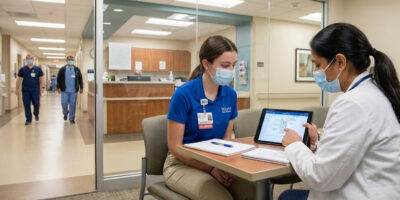
High-school students and parents tend to focus on what teens are allowed to do in clinical settings, but supervision is the bigger factor that determines what an experience will look like day to day. Hospitals are busy, privacy-sensitive environments, so teen programs are built around clear lines of responsibility, scheduled check-ins, and strict boundaries that keep minors in approved spaces. The safest way to evaluate any program is to ask who is accountable for the student at each point in the day and how issues are handled, especially in hospital internships for high school students.
Supervision is not one person following a student everywhere. It is usually a layered system that includes a program coordinator, a unit contact, and licensed staff who control access to patient areas. Students who want early clinical exposure can use an early healthcare exploration guide to compare programs based on the strength of those layers, not just the department names listed in the brochure.
What “Supervision” Means Inside A Hospital
In a hospital, supervision means the student is never allowed to operate independently. A teen may be physically close to clinical activity, but staff determine where the student stands, what the student hears, and when the student must step out. Supervision also includes the behind-the-scenes rules that families do not always notice: who the student reports to, how the student is tracked during shifts, and what happens if a patient declines an observer.
Hospitals typically treat minors as guests in clinical spaces, even when the program uses the word “intern.” That framing matters because it shapes expectations. A teen observer is there to learn without slowing care, without handling protected information, and without increasing risk to patients or staff.
Who Is Responsible For A Teen Intern
Most hospitals use a chain-of-supervision model, meaning there is more than one person responsible for a teen’s experience.
At the program level, a volunteer-services office, education department, or youth-program coordinator is usually responsible for screening, onboarding, and placement rules. This person may not be on the unit all day, but they set the boundaries and remain the escalation point if something goes wrong.
On the unit, there is typically a designated contact such as a charge nurse, unit clerk, or department supervisor. This person knows the teen is present, confirms where the teen is allowed to be, and gives direction on day-to-day tasks or observation opportunities.
Finally, clinical supervision is provided by licensed staff who control access in the moment. A physician, nurse, therapist, or technologist may allow a teen to observe a portion of their work if conditions are appropriate, but that permission is always conditional. If the unit gets busy, if the patient is uncomfortable, or if the situation becomes sensitive, the student may be asked to step out immediately.
How Hospitals Screen And Approve Teen Participants
Before a teen ever enters clinical areas, most hospitals require a structured onboarding process. This is one of the best indicators that the program is legitimate and well-run.
Hospitals commonly require age verification, school information, immunization documentation, and signed agreements. Many also require confidentiality training and acknowledgement forms. Parents should expect this to feel formal. A hospital that puts minors near patient care without training and paperwork is not operating with appropriate safeguards.
Because teen placements are limited, supervised programs can fill quickly once applications open. Local hospital roles may have waiting lists, seasonal limits, or minimum age rules that reduce the number of available slots, especially during the summer when demand spikes.
What A Supervised Day Usually Looks Like
A supervised hospital day for a teen typically follows predictable steps that keep the student visible and accountable.
A teen usually checks in at a central office or with a unit contact, confirms the assignment, and receives instructions for the shift. The student is expected to stay in approved areas and to ask before moving to other locations. Breaks and end-of-shift sign-out are usually controlled, not casual.
In structured programs with longer days, supervision often includes a mid-shift check-in and a debrief. That debrief is not about dramatic stories. It is about whether the student followed rules, stayed out of restricted areas, and handled privacy appropriately.
How Staff Supervise Without Hovering
Parents sometimes picture supervision as a staff member standing next to the teen every second. In practice, hospitals supervise teens through boundaries, visibility, and quick access to staff direction.
A teen may be assigned to a specific zone, such as a nurses’ station, a volunteer desk, or a defined hallway. Staff can see the teen and quickly redirect them. When observation occurs, it is typically short and controlled. A clinician may invite the teen into a room, position the teen where they will not interfere, and end the observation if anything changes.
This kind of supervision protects patients and also protects teens. Hospitals are full of moments where a student could accidentally see something private, misinterpret a situation, or simply be in the wrong place at the wrong time. Clear positioning and quick redirection are part of what makes teen programs safe.
What Supervision Looks Like During Observation
When a teen is allowed to observe a clinical interaction, supervision focuses on three things: consent, placement, and exit timing.
Consent means the patient has the right to decline a student’s presence. Hospitals handle this in different ways, but teens should expect that some encounters will be off-limits without explanation, and they should accept that without pushing for access.
Placement means the student stands where the staff instructs them to stand. In many settings, that means near the door, away from equipment, and away from screens or charts. If the teen cannot see well, the solution is not moving closer without permission. The solution is asking later, in a non-urgent moment, whether another observation opportunity might be available.
Exit timing means leaving promptly when asked, even if the situation seems interesting. A patient may become distressed, a sensitive topic may arise, or the team may need space. A teen who exits immediately without debate is easier to supervise and more likely to be invited back for future observation.
How Hospitals Handle Safety And Privacy For Teens
Hospitals build teen supervision around predictable risk points. The biggest ones are patient privacy, infection control, and unpredictable clinical events.
Privacy rules are reinforced through training and through restrictions. Many hospitals limit teen access to electronic records, prohibit independent handling of paperwork that includes identifiers, and require teens to avoid looking at screens. A supervised observer may still hear personal information in a room, but the expectation is clear: no repeating it, no sharing it, and no discussing cases in public spaces.
Infection control is handled through dress codes, hand hygiene rules, and restricted areas. Teens are typically kept away from isolation rooms, procedure spaces, medication rooms, and other high-risk zones unless there is an exceptional, supervised reason to enter.
Unpredictable events are handled through immediate removal. If a patient deteriorates, if staff need to move quickly, or if the environment becomes chaotic, the teen is expected to step back or leave without needing extra explanation.
What Good Supervision Looks Like In A Teen Program
Families can usually tell whether supervision is strong by how clearly the program describes responsibilities and boundaries.
A well-supervised teen program will be able to explain who the student reports to, how attendance is tracked, what areas are restricted, and how privacy is taught and enforced. It will also describe what staff do if a teen feels uncomfortable, sees something concerning, or is asked by a local staff member to do something outside the teen’s role.
A simple way to evaluate supervision is to ask how the program would handle a realistic scenario. For example, ask what happens if a patient declines an observer or if the unit becomes too busy for teaching. A strong program will respond quickly and calmly because such situations are expected and planned for.
When Supervision Matters Even More
Some hospital settings require higher supervision because the stakes are higher. Procedural areas, surgical spaces, emergency settings, and any environment with a high volume of sensitive conversations tend to increase supervision requirements for minors.
This does not mean teens can never see these environments. It means access is more selective, observation is more limited, and expectations are stricter. If a program implies broad, routine access to high-acuity settings without explaining supervision detail, it is worth asking more questions.
In programs with international clinical exposure, supervision should be even more structured, not less. If local customs differ, teens need mentors who enforce boundaries consistently and step in if a well-meaning clinician offers an inappropriate hands-on task. In our programs, supervision is designed to keep students in an observer role in clinical areas while providing structured learning through guided reflection and defined rotations.
Next Steps For Students And Parents
A teen hospital experience is only as strong as the supervision system behind it. Students should look for programs that clearly describe reporting structure, daily boundaries, and how staff handle consent and privacy. Parents should look for written expectations, formal onboarding, and direct answers about who is responsible for teens during every part of the day.
The most reliable question to ask is simple: who is accountable for the student at all times, and how is that enforced in real clinical settings?