Last updated: May 2026.
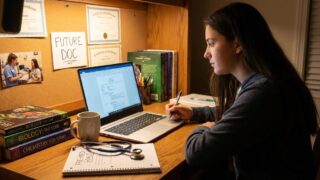
High school students aspiring to careers in medicine often hear they should “start early,” but when it comes time to compile experiences into a resume, it’s not obvious where to begin. A well-crafted pre-med resume in high school helps show not just what you did, but why those experiences matter for a future in healthcare. By organizing your academics, clinical exposure, service work, and leadership roles into a focused document, you can demonstrate a clear, long-term interest in medicine.
Here, we will walk you through building a strong pre-med resume as a high school student in 2026, with tips on what to include, how to format it, examples of experiences (including global health opportunities with International Medical Aid), and common mistakes to avoid.
Why a Pre-Med Resume Matters More Than Ever in 2026
The competition to enter medicine continues to intensify. According to the AAMC, 54,699 people applied to U.S. medical schools in 2025, a 5.3% increase from the prior year. First-time applicants drove that surge, making up 76.5% of all applicants. Total enrollment at U.S. MD-granting medical schools reached 100,723 students in the 2025-26 academic year, crossing the 100,000 mark for the first time. And the 2025-26 entering class set a new record: 23,440 matriculants, up 1.2% year over year.
What does this mean for you as a high school student? It means that the students eventually admitted to medical school have been building strong profiles for years. Matriculants in the most recent cycle had a mean undergraduate GPA of 3.81 and a mean MCAT score of 512.1. Collectively, they logged more than 16.8 million community service hours before starting medical school, an average of 717 hours per student. Those numbers don’t happen overnight. They’re the result of years of deliberate preparation that often begins in high school.
Starting your resume now is not about being “ahead of the game” for the sake of it. It’s about developing the habit of documenting your growth, identifying gaps early, and building a record that tells a coherent story. Whether you plan to apply to a competitive BS/MD program (roughly 50 to 60 exist in the U.S., with acceptance rates between 1% and 10%) or want a strong college application that sets you up well for a pre-med track, a focused resume is one of the best tools you can have.
Core Experiences to Highlight in a Pre-Med Resume
A strong pre-med resume in high school does not require dozens of activities. Instead, it should feature a focused set of experiences that show you can handle academic rigor, show up reliably, and stay engaged with real patients and communities. When planning what to include, think in terms of a few key categories that admissions officers and program directors value:
Academic Achievement
Your educational foundation is the first pillar of a pre-med resume in high school. Colleges (and eventually medical schools) want to see that you can excel in biology, chemistry, math, and related subjects. On your resume, highlight challenging coursework and academic honors such as:
- Advanced classes (Honors, AP, IB, or dual-enrollment in science and math)
- Notable academic awards or honor societies (e.g., National Honor Society)
- Sustained academic enrichment, like science fairs, research programs, or summer science courses
Include your GPA and class rank (if available) in the education section, and any high standardized test scores if they strengthen your profile. For example, a high school resume typically lists the school name, expected graduation date, GPA (weighted), class rank, and even SAT/ACT scores if you’re applying to college.
On that last point, the testing landscape has shifted in 2026. While over 90% of ranked U.S. four-year colleges remain test-optional, eleven of the top fifteen schools (according to U.S. News rankings) have returned to requiring standardized test scores. Schools like MIT, Dartmouth, Brown, Yale, Harvard, Cornell, Penn, and Caltech now mandate the SAT or ACT. Common App data shows that the number of students submitting test scores recently increased by 11%. If you have a strong score, include it on your resume. If not, focus your energy on the coursework and extracurriculars that demonstrate your academic ability.
Dual enrollment is another option worth considering, especially if your high school does not offer many AP or IB courses. Dual enrollment lets you take college-level classes at a local community college or university while still in high school, potentially in subjects like medical ethics, anatomy and physiology, or epidemiology. Listing a completed college course on your resume signals both academic readiness and genuine interest in health sciences.
You don’t need to list every small honor or every 9th-grade science project. Focus on achievements that show you challenge yourself and follow through academically.
Clinical Experience
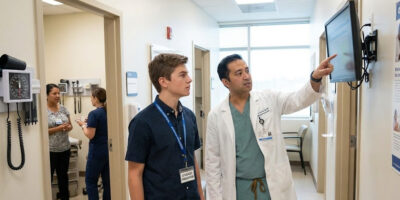
Any real-world exposure to healthcare can set you apart as a serious pre-med student. Early clinical experiences indicate that you have worked in real healthcare settings and still want to move forward on the medical path. As a high schooler, clinical exposure might include volunteering or shadowing in environments that bring you near patients. Strong examples are: hospital or clinic volunteering (especially roles that involve patient contact or assisting staff), shadowing a physician, nurse, or other health professional, and structured medical internships for high school students under supervision.
One practical note: not every hospital accepts high school volunteers. Many have minimum age requirements (typically 16 or older), and some limit teen volunteers to non-clinical tasks like stocking supplies or greeting visitors. If your local hospital does not offer meaningful clinical volunteer roles, consider alternatives. Shadowing a family physician in private practice, volunteering at a free clinic, or participating in a structured program through an organization like HOSA or International Medical Aid can all provide genuine clinical exposure. The key is to seek settings where you can observe patient care and learn how clinical teams function, even if your own role is limited to observation and basic support tasks.
When you describe these experiences, be specific and factual. Admissions readers know what is realistic for a high school volunteer, so don’t overstate your duties. Avoid vague titles like “hospital intern” and instead give a clear one-line description of what you did and for how long. For instance, you might write that you “shadowed an internal medicine physician for 30 hours over one semester, observing outpatient visits and inpatient rounds”. This concrete description is far more informative than something like “helped in hospital,” and it shows commitment by specifying your hours and duties. Always stay honest and precise, as colleges will be impressed by genuine involvement, not by exaggerated claims.
Community Service
Medicine is fundamentally a service profession, so community service and volunteer work are important to include on a pre-med resume. Admissions officers want to see that you can commit to helping others and stay involved over time. Highlight any ongoing volunteer roles you’ve held, whether or not they’re directly medical. For example, volunteering weekly at a food pantry or tutoring underprivileged children demonstrates responsibility and compassion. If you have participated in health-related community projects (such as organizing a school health fair, helping at a blood drive, or joining a teen health advisory board), be sure to include those as well.
The AAMC’s most recent data underscores just how much this matters. Medical school matriculants in the 2025-26 entering class performed an average of 717 community service hours before starting medical school. That is a significant number, and while much of it was accumulated during college, the habit of sustained service typically starts earlier. If you begin consistent volunteering in high school and continue through college, those hours add up naturally.
You do not have to tie every community activity directly to medicine, and it’s okay if some of your service is unrelated to healthcare. The key is to show you devote time to serving others in a meaningful way. Whether you spent summers working at a local soup kitchen or coordinated a neighborhood cleanup, consistent commitment beyond yourself is what matters.
List the organization, your role, dates, and briefly what you did. For example, “Volunteer Tutor, Sunrise After-School Program (2022-2026): Provided weekly math and science tutoring to 4th-5th grade students, totaling 150+ hours” gives a clear sense of your service and impact.
Leadership and Extracurricular Activities
Demonstrating leadership and initiative in your activities is another crucial part of a pre-med resume. Leadership doesn’t necessarily mean you were Student Body President; it can be any role where you took responsibility or drove an effort. On your resume, include positions such as club officer, team captain, committee chair, or initiative founder. Alongside the title, mention what you accomplished or improved in that role. For instance, did you increase your club’s membership, start a new fundraising event, or lead a project? Concrete examples of positive change show that your leadership had an impact.
Quality matters more than quantity here. It’s more impressive to have one or two meaningful leadership roles held over a long period than a long list of titles you held briefly. So if you’ve been the captain of the debate team for two years or the secretary of the Science Club since sophomore year, those sustained roles deserve emphasis. Additionally, if you’ve initiated something new, perhaps launching a Health Careers Club at your school or organizing a community health awareness campaign, that initiative highlights your drive and passion. Be sure to note founding or leading any such projects.
Medical school admissions committees are increasingly vocal about wanting applicants who are “self-aware, mission-driven, emotionally intelligent, community-rooted, and reflective,” according to admissions trend analyses for the 2025-26 cycle. This starts long before you apply to medical school. A leadership role where you solved a real problem, responded to a community need, or built something from scratch tells admissions readers more about your character than a title alone ever could.
Extracurricular activities beyond explicitly “pre-med” pursuits can also find a place on your resume, especially if they show dedication or special skills. For example, involvement in music, sports, or student government can demonstrate time management and teamwork. Just remember to prioritize activities that paint a picture of you as a well-rounded yet focused individual. A couple of deep, sustained involvements will generally serve you better than dozens of superficial ones.
Exploration and Enrichment
Finally, show that you have taken the initiative to explore medicine and science outside of regular school classes. This might include participating in specialized programs or pursuing independent projects that align with your interest in healthcare. For instance, many high school students attend pre-med summer programs offered by universities or academic organizations. These could be summer science camps, medical institute programs, or college-based workshops in biomedical topics. Such programs allow you to learn advanced material, often with hands-on components, and signal your enthusiasm for the field.
You can also mention if you took any college-level courses or MOOCs in relevant subjects, or if you joined any “health careers pipeline” initiatives in your region. Some students engage in research projects or citizen science programs; for example, perhaps you volunteered in a university lab or contributed to a public health data project. These enrichment activities demonstrate intellectual curiosity and a desire to go beyond the high school curriculum.
Involvement in pre-professional organizations can be valuable too. If your school has a HOSA-Future Health Professionals chapter (a club for students interested in healthcare), active membership or leadership in it can be noted. HOSA now has over 260,000 members across the country, offers 82 competitive events, and holds its 2026 International Leadership Conference June 17-20 in Indianapolis. Another newer option is the High School Alliance of Future Physicians (HSAFP), which has chapters at more than 125 schools nationwide and provides resources, college advising, and clinical experience connections specifically for students interested in becoming physicians. Membership is $25 per student for the 2025-26 school year. Science Olympiad and biology clubs are also worth mentioning on a resume if you’ve been active and competitive in them.
Overall, by covering academics, clinical experience, service, leadership, and enrichment, you’ll have enough material to present a balanced, credible picture of yourself, without feeling pressure to “do everything.” Next, we’ll discuss how to package these experiences in a well-organized resume format.

Organizing and Formatting Your High School Pre-Med Resume
Even strong experiences can fall flat if presented poorly. A clear structure and professional formatting will make your resume easy to read and allow your accomplishments to shine. Here are key guidelines for organizing your resume:
- Use Standard Sections: A simple, effective format for a high school pre-med resume typically includes the following sections (in order): Education, Clinical Experience, Service & Volunteering, Leadership & Activities, Awards & Honors, and optionally a brief Skills/Interests section. You might adjust the section names to fit your experiences (for example, you could combine “Clinical Experience” and “Volunteer Work” if some activities overlap, or use a general “Extracurricular Activities” section if it makes sense). The goal is to group similar experiences together, so that the reader can quickly find all your academics in one place, all your healthcare-related experiences in one place, and so on.
- Reverse Chronological Order: Within each section, list your entries from most recent to oldest (by start date or end date). Each entry should ideally include a title/role, the organization or location, and dates. For example, under Education, you’ll list your high school and expected graduation date; under Experience, you might list “Volunteer, XYZ Hospital, Summer 2026” followed by details.
- Be Consistent and Concise: For each experience, include 1 to 3 bullet points describing what you did and what you learned or accomplished. Keep these bullet points concise, one line if possible, two at most. Use a consistent format for all entries: pick one font and stick to it, make headings (like section titles or organization names) stand out in bold or italics uniformly, and use the same date format throughout (e.g., June 2025 to Aug 2025, not sometimes abbreviating or sometimes spelling out months). Consistent formatting makes your resume look polished and easier to follow.
- Focus on Impact and Skills: When describing experiences, emphasize responsibilities, skills, and impact rather than just listing tasks. Wherever appropriate, include numbers to show scale, for example, how many hours you worked, how many people you helped, or any measurable results. Even approximate figures (e.g., “100+ hours”, “raised $500”, “led a team of 5”) help give context. This level of detail transforms a resume from a generic list into a story of your contributions.
- Keep it to One Page (if possible): As a high school student, your resume will usually be one page. You likely don’t have enough highly relevant content to justify a second page, and college admissions officers prefer brevity. In some cases, if you have an unusual amount of significant experience (for instance, several published research projects or many awards), a two-page resume might be acceptable, but generally aim for one page. Quality over quantity is a good rule. Don’t try to fill space with fluff. A succinct, one-page resume that’s packed with substantive activities is far better than two pages of padding.
Sample High School Pre-Med Resume Outline
To visualize how all these pieces come together, here is a simplified example of how a high school student’s pre-med resume might be structured:
Jane Doe
123 Main Street, Hometown, ST 12345
(555) 123-4567 | [email protected]
EDUCATION
Hometown High School, Hometown, ST
Expected Graduation: May 2027
GPA: 3.92/4.00 (Weighted)
Honors: National Honor Society, AP Scholar
CLINICAL EXPERIENCE
Volunteer, City General Hospital, Hometown, ST
June 2025 to Present
- Assist nurses and staff in a pediatric clinic by escorting patients and managing paperwork.
- Hours: 3 hours per week during the school year (100+ hours to date).
- Gained exposure to outpatient clinic operations and appropriate patient interaction.
Physician Shadowing, Dr. Emily Smith (Family Medicine), Hometown, ST
Summer 2026
- Shadowed a family physician for 4 weeks (about 40 hours), observing patient visits and clinical workflow.
- Learned clinical professionalism, patient privacy expectations, and basic doctor-patient communication.
SERVICE AND VOLUNTEERING
Volunteer, Community Health Fair, Hometown, ST
September 2025
- Helped organize a one-day free health screening event by managing sign-in and distributing health brochures.
- Worked with 10 peers and local nurses to support about 200 community members.
Tutor, Sunrise After-School Program, Hometown, ST
2022 to 2026
- Provided weekly math and science tutoring for 4 years (150+ total hours).
- Supported student confidence and consistency through ongoing mentoring.
LEADERSHIP AND ACTIVITIES
President, Science Club, Hometown High School
2025 to Present
- Led a team of 20 students in weekly science discussions and annual science fair projects.
- Created a new Health Careers Night by inviting healthcare professionals to speak with students.
Captain, Varsity Swim Team, Hometown High School
2024 to 2026
- Motivated and coordinated 15 team members and supported practice organization and team meetings.
- Strengthened teamwork and accountability through athletics leadership.
AWARDS AND HONORS
- 1st Place, Regional Science Fair (2026): Project on water quality and public health.
- Academic Excellence Award (2025): Highest GPA in junior class.
- AP Scholar with Distinction (2026): Earned 5s on five AP exams.
SKILLS AND INTERESTS
- Spanish: Fluent (served as a volunteer translator at clinic).
- Microsoft Office and Google Suite.
- Interest in global health and travel (visited 3 countries).
Note: The above is just an example for illustration and every student’s resume will look different. The key elements demonstrated are: clear section headings, roles with organizations and dates, and bullet points highlighting duties, skills, and achievements. Notice how each bullet starts with an action verb (“Assist…”, “Shadowed…”, “Helped organize…”, “Provided…”, “Led…”, etc.) and provides specific detail. This kind of formatting makes it easy for readers to quickly scan and understand your experiences.
Pre-Med Summer Programs and Internships for High School Students
One way to build and strengthen your resume is to take advantage of pre-med summer programs or internships designed for high school students. These programs can provide intensive learning and often hands-on exposure to the medical field, which not only deepens your understanding of medicine but also signals your commitment on a resume or college application. Participating in a reputable summer program can be a highlight of your “Exploration and Enrichment” efforts.
There are many types of programs available, ranging from university-based academic programs to hospital volunteer internships. For example, some highly competitive programs like the Stanford Medical Youth Science Program offer a five-week immersive experience in science and medicine for selected rising seniors.
Students in that program spend weeks on Stanford’s campus attending lectures, doing research projects, and networking with medical professionals. Admission is limited (only about 24 students each summer for Stanford’s program) and often targeted to specific groups (in this case, low-income, first-generation juniors from Northern California). If you are eligible and interested in such programs, being accepted and completing one is a strong asset for a future pre-med.
Many universities offer pre-college summer medical institutes or science academies. For instance, the University of Pennsylvania’s summer academies include a Biomedical Research Academy and a Chemistry Research Academy for high schoolers. These academies run for a few weeks and let students conduct experiments or learn lab techniques under the guidance of university faculty.
Upon completion, students often receive a certificate or even college credit, and more importantly, they gain substantive content to discuss on resumes and in application essays.
For summer 2026 specifically, several notable programs are accepting applications. UCLA’s Pre-Med Summer Scholar Program offers two five-day sessions (June 22-26 and June 29 to July 3, 2026) at a cost of $1,450, with need-based scholarships available. The University of Florida’s Summer Pre-Medical and Pre-Dental Professions Program is an immersive five-day program for rising juniors and seniors, costing $1,200 for 2026. Johns Hopkins University offers more than 20 pre-college summer programs for academically advanced high school students, both online and in-person. And Tufts University’s pre-college programs accepted applications through May 1, 2026 for the current summer.
Other well-known programs across the U.S. include the Georgetown Medical Immersion program, various National Youth Leadership Forum (NYLF) or National Student Leadership Conference (NSLC) medicine programs, and hospital-based internships in cities such as New York and Houston. Some medical schools and hospitals have research internships for teens (for example, the NIH and CDC have offered summer research experiences for high school students in the past).
When listing these on your resume, be sure to include any specific focus or achievement, e.g. “Completed XXX week pre-med institute at University of ___, studying anatomy and earning a completion certificate” or “Researched cancer biology as a summer intern at ___ lab, presenting findings to faculty at the end.”
Keep in mind that formal programs can be highly competitive and sometimes expensive. AP exams alone now cost $99 each for the 2025-26 school year (with a fee reduction to $53 for eligible students), and summer programs can run from $1,200 to several thousand dollars. However, there are also free or scholarship-based options (such as Stanford’s program mentioned above, or other nonprofits’ programs). If you cannot attend a selective program, you can still create your own meaningful summer experience.
Consider volunteering intensively at a local hospital, finding a mentor doctor to shadow, taking a community college biology course, or doing a health-related project in your community. All of these can be included in your resume under the relevant sections (Education, Experience, or Volunteering). In fact, any productive use of your summer that aligns with science or service is worth noting. Admissions officers appreciate seeing that you chose to spend your break time learning or helping others, rather than just relaxing. For more ideas on pre-med summer programs for high school students, we have a separate guide covering additional options.
When you do participate in a summer program or internship, make the most of it and document it. Keep track of what you did (topics covered, skills gained, hours completed) so you can accurately represent it on your resume. For example, if you attend a 2-week medical academy at a university, note the subjects you studied or any project you completed.
This will allow you to write a descriptive bullet point like, “Studied human anatomy and physiology in a college-level course; completed a capstone project on public health policy and received a certificate of excellence.” Such details show initiative and depth of engagement.

Global Health Experience: International Medical Aid’s High School Internships
In addition to local opportunities, gaining global health experience can be a distinctive way to strengthen a pre-med resume. Not every high school student has access to hospital volunteer roles or specialized programs in their hometown, and that’s where organizations like International Medical Aid (IMA) come in.
International Medical Aid offers structured, immersive healthcare internships abroad for high school students (ages 16 and up) that provide both clinical shadowing and community health involvement. IMA currently operates programs across three continents and seven countries, including Kenya, Tanzania, Ecuador, Colombia, Peru, and Haiti. Applications are open for Summer and Winter 2026 programs. These programs allow ambitious students to experience healthcare in an international setting, which can broaden your perspective on medicine and public health.
What does an IMA internship involve?
Participants in our high school programs get to shadow licensed doctors and nurses in partner hospitals overseas, observing patient care firsthand. You might find yourself rotating through departments like pediatrics, surgery, or internal medicine, depending on the site.
In addition to hospital shadowing, IMA interns join supervised community outreach projects. For example, helping run health education workshops or mobile clinics in underserved areas. There are also simulation trainings and seminar sessions, so you can learn basic clinical skills and discuss ethical or cultural aspects of healthcare with mentors. Importantly, the program is designed to be educational and safe: you are not performing procedures (since you’re not qualified), but you are learning by observing and by supporting healthcare staff in appropriate ways, all under supervision. IMA has maintained a 100% safety record for all high school and pre-health interns, and each intern receives $1,000,000 of top-rated travel insurance covering medical expenses, medical evacuation, lost luggage, and trip interruption.
One big advantage of an international internship is that you earn documented hours and a supervisor evaluation, which you can later cite in college or program applications. IMA provides a record of your participation (useful for resumes and application forms) and often a letter of recommendation or evaluation from the medical professionals who mentored you.
This can validate the experience in the eyes of admissions committees. If local opportunities are limited in scope (for instance, maybe your hospital only let you do front-desk work), an IMA internship can provide more substantial clinical exposure than you might get at home, making your experience list stronger and more distinctive.
From an admissions perspective, international experience in healthcare also demonstrates qualities like adaptability, cross-cultural communication, and initiative. You are showing that you stepped out of your comfort zone to learn about medicine in a global context. This is especially relevant given the AAMC’s projected physician shortage of up to 86,000 doctors by 2036 and the fact that over 100 million Americans currently live in federally designated Health Professional Shortage Areas. Understanding healthcare delivery in resource-limited settings gives you perspective that is increasingly valued by medical schools focused on training physicians for underserved populations.
This can be a great talking point in interviews or essays, as well as on your resume. For example, under your “Clinical Experience” section, you might have an entry like:
Intern, International Medical Aid, Hospital Internship (Kenya), Summer 2026
- Shadowed physicians and nurses for 3 weeks in a Kenyan hospital, rotating through Emergency and Maternity departments (120 hours).
- Assisted in community health outreach in local villages, helping to conduct basic health screenings and health education workshops.
- Developed global health insights by observing tropical medicine cases and learning to communicate despite language barriers.
Such an entry would immediately tell a reader about your global health exposure and commitment to understanding healthcare challenges in different settings.
International Medical Aid’s programs are designed for future healthcare professionals. In fact, they are aligned with the AAMC’s Core Competencies for entering medical students (like cultural competence, service orientation, teamwork, etc.) to ensure that you’re developing the attributes medical schools seek.
We are also a partner of HOSA-Future Health Professionals and the largest HOSA-affiliated organization offering pre-clinical experiences abroad. This means the internship experience is recognized as a quality educational experience that complements what you might be doing in a HOSA chapter or other pre-health extracurriculars.
Our global internships are designed to provide a competitive edge on college and pre-medical applications by cultivating real-world clinical observation and community service experience in an international setting.
If you’re interested in such an opportunity, be sure to plan ahead (applications for summer programs often open many months in advance) and discuss it with your family, since it involves international travel. The experience is not only for your resume, but for your personal growth and confirmation of your passion for medicine.
A Note About AI Tools and Resume Writing
In 2026, many students are turning to generative AI tools for help with formatting resumes, brainstorming bullet point phrasing, or practicing interview answers. According to U.S. News, generative AI has seen a rapid rise in healthcare and in the application process. Students report using AI platforms to research medical school expectations, brainstorm personal statements, and generate interview practice questions.
There is nothing wrong with using AI as a starting tool. It can help you structure your sections, clean up grammar, or identify action verbs. However, two important cautions apply. First, admissions offices are increasingly screening for AI-generated content. A resume or essay that reads like it was written by a chatbot rather than a 17-year-old will not help you. Second, your resume needs to reflect your actual voice and your actual experiences. If a phrase sounds polished but doesn’t sound like you, or if it overstates what you did, rewrite it in your own words.
Use AI as a tool for drafting and formatting. Do not use it as a substitute for thinking carefully about what you did, why it mattered, and how to describe it honestly. Your resume should sound like you because, eventually, you will need to talk about everything on it in an interview or essay.
Common Mistakes to Avoid on Your Resume
As you put together your pre-med resume, be mindful to avoid some frequent mistakes that can diminish the impact of your hard work. Here are some common pitfalls for high school resumes, and how to avoid them:
Listing too many old or irrelevant activities: It might be tempting to include everything you’ve ever done since middle school, but college admissions officers don’t need to see activities from elementary or early middle school. Focus on your high school years. An exception can be made for something truly long-term (say you’ve been playing violin since age 9 and won awards in high school; you can mention you’ve played for X years). But as a rule, leave out childhood achievements and short-lived pursuits.
Similarly, if you tried a dozen clubs for a week each in 9th grade, those don’t all need to be listed. Colleges prefer depth of commitment over breadth. Highlight the activities that were most meaningful and that you continued over time, and let go of the rest. Remember, your resume is an advertisement of your strengths, not an autobiography of everything you’ve ever done.
Exaggerating clinical responsibilities: Avoid overstating what you did in your roles, especially in clinical settings. Phrases like “assisted with surgeries” or “provided patient care” will raise red flags if you were just a high school volunteer. Admissions reviewers know what a typical high school student can and cannot do in a hospital.
Stick to the truth: if you observed procedures, say “observed.” If you restocked supplies or transported patients in wheelchairs, say that. It’s far better to be honest and precise about humble tasks than to overinflate your role. Integrity and accuracy are crucial; plus, you may be asked about these experiences in interviews, and you’ll want to be able to speak confidently, knowing you described them accurately. For a clear breakdown of what high school students actually do in hospitals, see our separate guide.
Using vague language instead of specifics: Another common mistake is using generic phrases like “helped doctors,” “learned a lot about leadership,” or “improved communication skills.” These don’t tell the reader much. Always try to replace vague descriptions with concrete actions and results. For example, rather than saying “worked in clinic,” you could say, “Greeted and registered approximately 50 patients per shift at the clinic front desk, ensuring a smooth check-in process.” Instead of “improved leadership,” specify what you did as a leader: “Coordinated a team of 12 volunteers and created weekly schedules to ensure full coverage at the community clinic”.
By being specific, you paint a clearer picture of your role and impact. A good test is to ask, Could someone who wasn’t there understand exactly what I did and why it mattered? If not, revise the line to be more descriptive. Including a brief result or purpose can also help (e.g., “organized a fundraising event that raised $2,000 for cancer research“).
Overloading the resume with too many short activities: We touched on this earlier, but it’s worth repeating: ten one-day activities are far less impressive than a couple of sustained ones. If your resume is starting to look like a laundry list of every single thing, consider consolidation. You can group or omit very minor items.
For instance, if you attended three separate one-day STEM workshops, you might combine them into one entry like “Participation in various one-day STEM enrichment workshops (2025)” rather than listing each as a separate line. You could also include an “Additional Activities” section listing extra items without descriptions, if you feel they round out the picture of you (though for most high school resumes, this isn’t necessary). Prioritize quality over quantity. Colleges would much rather see genuine dedication (like a volunteer job every week for a year) than a scattershot of brief activities.
Ignoring formatting and consistency: Little things like inconsistent formatting can make your resume look unpolished. Pay attention to detail. Use the same font and text size for similar elements (all section headings should look the same, all bullet points should align, etc.). Pick a format for dates (for example, Month Year or MM/YYYY) and use it for every entry. Check spacing, alignment, and indentation so that everything is neat. Also, avoid large blocks of text; bullet points should be relatively short; if you find yourself writing a mini-essay in a bullet, break it up or trim it.
Proofread carefully for spelling and grammar errors, especially in names of organizations, titles, and courses. A misspelling like “pubic health” instead of “public health” is an eye-catcher for the wrong reason, as is writing “M.D. Anderson Hospital” as “Md Anderson.” Sloppy mistakes can undercut an otherwise strong resume, so take the time to review it or have a teacher/counselor review it with you. The goal is a resume that is clean, professional, and easy to read.
Leaving out numbers and results: As mentioned, numbers are your friend on a resume. Many students will simply list “Volunteer at Hospital” and say “learned about healthcare.” That doesn’t show scope. Always include metrics or tangible outcomes when you can. How many hours did you volunteer? How many patients did you interact with? Did you increase the membership of a club by 30% during your presidency? Put that in. Did you achieve something concrete, like “served 300 meals over the summer” at a soup kitchen? Note it.
If you fundraised, how much money? If you tutored, how many students or for how long each week? These details give credibility. Of course, not every bullet will have a number, but try to incorporate them where possible.
Even something like “Maintained a 4.0 GPA while working 15 hours/week part-time” uses numbers to tell a story of time management. The reader gains a better sense of your involvement and impact through these specifics.
By steering clear of these common mistakes and by following the earlier advice on how to showcase your experiences, you will already be ahead of many of your peers. A professional, focused resume signals maturity and preparedness, qualities that admissions committees value.
Keeping Your Resume Up-to-Date
Building a pre-med resume is not a one-time task but an ongoing process throughout high school. Start early and treat it as a living document that you update regularly, rather than something you scramble to put together right before an application deadline. Here are some tips for maintaining and improving your resume as you gain new experiences:
- Update immediately after each significant experience: When you finish a program or project (for example, you complete a summer internship, or you finish a year as club president, or you wrap up a research project), take a few minutes to record the key details while they’re fresh in your mind. Jot down the total hours you spent, the dates, your main responsibilities, and any notable accomplishments or feedback you received. You don’t necessarily have to format it into the resume right then, but save those notes in a “master resume” document. This ensures you won’t forget important specifics when you later refine the resume.
- Fit new entries into the right category: As you add new items, think about where each one belongs on your resume. Did you get a new clinical experience? Put it under Clinical Experience. A new leadership role? Leadership & Activities. Won an award? Awards & Honors. Keeping things categorized will maintain the clarity of your resume. If a new experience is very similar to something already on your resume, you might group them (for instance, multiple hospital volunteer stints can be combined under one heading with multiple bullets, if needed). If the new experience is much stronger or more relevant than an older one, you might remove or shorten the older entry to make room. As you progress through high school, your resume should gradually evolve to showcase your best and most relevant experiences, and it’s okay if that means earlier activities drop off by senior year.
- Keep future applications in mind: It may seem premature, but remember that eventually you will fill out college applications (and later, possibly med school applications). These often ask for descriptions of your activities in a structured way (role, organization, dates, hours, and a short description). By building your resume now with those elements, you’re effectively creating a repository of content you can reuse. You’ll thank yourself later when you can copy-paste or adapt your resume bullet points into application forms and scholarship essays. Moreover, maintaining detail in your resume now helps you have specific stories ready for interviews. If an interviewer asks “Tell me about your volunteer work at the hospital,” you can draw on the hours and tasks you’ve already articulated. This is especially useful if you are applying to BS/MD programs directly from high school, where you may face formal interviews as part of the admissions process.
- Review and reflect periodically: Schedule a regular check-in with yourself, maybe at the end of each school year and after each summer, to review your resume. Look at what you have and see if it still makes sense for where you’re headed. Are your activities aligning more and more with your interest in medicine? Ideally, as you approach senior year, your resume should show a trajectory; perhaps your early years had more general activities, but over time you focused in on healthcare, science, leadership, etc.
If you notice gaps (say, you have a lot of science activities but no service work), you still have time to seek an experience in that area. If you find anything that feels like “filler,” consider whether it needs to be there or if it could be replaced with something more relevant. This periodic pruning and polishing keeps your resume coherent instead of rushed, and by the time you’re applying to colleges or BS/MD programs, you’ll have a well-honed document ready to go.
- Get feedback: Finally, don’t hesitate to ask for feedback on your resume from mentors, teachers, or counselors. They might catch things you overlooked or suggest better ways to phrase an entry. Just ensure you are the one doing the writing; a resume needs to reflect your voice and understanding of your experiences. Use feedback to improve clarity and correctness, but avoid the temptation to let someone else rewrite it for you. And if you use AI tools to help with formatting or phrasing, always rewrite the output in your own words, as we discussed above.
How Your High School Resume Connects to What Comes Next
It’s worth understanding where your high school pre-med resume fits in the longer arc of becoming a doctor, PA, dentist, nurse, or other healthcare professional. The resume you build now is not the same document you’ll submit to medical school. Medical schools use a different format entirely (the AMCAS Work and Activities section, for instance). But the habits you’re building, tracking your hours, writing honest descriptions, reflecting on what you learned, are exactly the habits that will serve you through college and beyond.
For students considering pre-med preparation while still in high school, your resume is one piece of a larger picture. It works alongside your transcript, your personal statement, your letters of recommendation, and your interview performance to communicate who you are. No single item on your resume will make or break your candidacy. What matters is the overall narrative: that you are serious, engaged, honest, and growing.
If you’re a parent reading this, know that a high school pre-med resume is not about putting undue pressure on your child. It’s about helping them organize what they’ve already done and think intentionally about what they want to do next. The process itself, sitting down and cataloging experiences, often helps students realize they’ve accomplished more than they thought, or identify areas they want to strengthen before college.
And if you’re an advisor or counselor, a well-structured resume gives you a concrete document to review with your student. It makes advising conversations more productive because you can see at a glance where a student has depth and where they might benefit from new experiences. For students who are weighing different healthcare paths, such as healthcare careers that don’t require medical school, the resume-building process is equally useful because it forces honest reflection about fit, interest, and commitment.
Putting It All Together
Creating a pre-med resume as a high school student might seem daunting at first, but with a structured approach, it becomes an opportunity to showcase your progress toward a career in healthcare. By focusing on key areas, including strong academics, meaningful clinical exposure, dedicated service, leadership roles, and proactive enrichment experiences, you can craft a resume that tells the story of your commitment to healthcare. Remember to highlight quality over quantity: a few well-chosen activities with depth of involvement will impress far more than a long list of disconnected ventures.
The data from the 2025-26 admissions cycle reinforces this. With 54,699 applicants competing for roughly 23,440 medical school seats, and with those admitted students averaging a 3.81 GPA and 717 hours of community service, the message is clear: sustained, genuine preparation matters. Starting that preparation in high school is not premature. It’s practical.
As you build your resume, pay attention to formatting and details so that your hard-earned accomplishments are presented in a professional, reader-friendly way. Whether you gained experience by volunteering at a local hospital, conducting a science fair project, or attending a structured program through International Medical Aid’s global internship, each piece should fit into the bigger picture of who you are as an aspiring healthcare professional. When assembled thoughtfully, your resume will provide admissions committees and other evaluators a clear and compelling snapshot of your achievements, skills, and direction.
Finally, think of your resume not just as a static requirement for an application, but as a motivator for you to seek out growth opportunities. Each new entry you earn, be it a leadership position or a letter of commendation from a volunteer coordinator, is a step forward on your path. Keep striving for experiences that excite you and reinforce your goals. If you do that, updating your resume will feel satisfying as you watch your story develop.
By the time you apply to college (and one day to medical school), you’ll have a polished resume reflecting years of thoughtful effort and genuine dedication to the field of healthcare. Good luck, and take it one experience at a time.