There is a rich history of medical schools in Missouri, from the founding of osteopathic medicine in Kirksville to the first medical degree awarded west of the Mississippi River in St. Louis. Today Missouri has six medical schools: four that grant the Doctor of Medicine (MD) and two colleges of osteopathic medicine that grant the Doctor of Osteopathic Medicine (DO). Between them they teach on campuses in St. Louis, Kansas City, Columbia, Springfield, St. Joseph, Kirksville and Joplin, and each one has its own mission and approach to medical education.
In this guide, we go over the latest published class statistics, 2026-27 costs and residency rules for each school, and we discuss what it takes to get accepted to each of the medical schools in Missouri. Medical schools in Missouri include:
- A.T. Still University Kirksville College of Osteopathic Medicine (ATSU-KCOM)
- Kansas City University College of Osteopathic Medicine (KCU-COM), with campuses in Kansas City and Joplin
- Saint Louis University School of Medicine (SLU SOM)
- University of Missouri School of Medicine (MU SOM), with campuses in Columbia and Springfield
- University of Missouri-Kansas City School of Medicine (UMKC SOM), with a regional campus in St. Joseph
- Washington University School of Medicine in St. Louis (WashU Medicine)
If you’re looking for medical schools in St. Louis, Saint Louis University School of Medicine and Washington University School of Medicine attract applicants hoping to live in this vibrant and diverse city. If you’re looking for medical schools in Kansas City, you’ll be considering the UMKC School of Medicine on Hospital Hill and Kansas City University’s College of Osteopathic Medicine. Finally, DO schools in Missouri include A.T. Still University Kirksville College of Osteopathic Medicine and Kansas City University College of Osteopathic Medicine, which also teaches the same DO program on a second campus in Joplin.
Key Takeaways
- Missouri has four MD programs (Saint Louis University, the University of Missouri, UMKC and Washington University) and two DO colleges (ATSU-KCOM in Kirksville and KCU-COM in Kansas City and Joplin). All six hold full accreditation, and no new Missouri medical school is in the osteopathic accreditation pipeline.
- WashU Medicine’s Entering Class of 2025 posted a mean MCAT of 520, the highest class average in the state. SLU’s accepted applicants for July 2026 averaged 514, KCU’s 2026 classes averaged 505 on both campuses, and ATSU-KCOM’s five-year average is 503.
- Residency matters most at the two public schools. Around 85% of MU’s accepted students are Missouri residents, and MU’s Early Decision and MD-PhD programs are for Missouri residents only. UMKC selects more than half of each class from Missouri and gives regional applicants from Arkansas, Illinois, Kansas, Nebraska and Oklahoma the next priority.
- The four private schools (SLU, WashU, ATSU-KCOM and KCU-COM) charge one tuition rate to everyone. For 2026-27, tuition is $71,360 at SLU, $68,960 at ATSU-KCOM, $67,968 at WashU and $59,030 at KCU-COM.
- UMKC is the only Missouri school with a six-year B.A./M.D. program for high school seniors, and its four-year M.D. starts classes in January, not August.
- Beginning in 2027-28, MU’s Springfield campus becomes a four-year regional campus with up to 32 seats a year, so students can complete all of medical school in southwest Missouri.

Missouri Medical Schools at a Glance
Here is the full roster for the 2026-27 application cycle. The Liaison Committee on Medical Education (LCME) accredits MD programs, and the Commission on Osteopathic College Accreditation (COCA) accredits DO programs.
| School | Degree and type | Campuses | Accreditation | IMA guide |
|---|---|---|---|---|
| A.T. Still University Kirksville College of Osteopathic Medicine | DO, private | Kirksville (years 1 and 2), with clinical rotations at regional sites across the country | COCA accreditation; established 1892; next visit AY 2030-2031 | ATSU-KCOM guide |
| Kansas City University College of Osteopathic Medicine | DO, private | Kansas City and Joplin (additional location, established 2017) | COCA accreditation; established 1916; next visit AY 2028-2029 | KCU guide |
| Saint Louis University School of Medicine | MD, private (Catholic, Jesuit) | St. Louis | LCME full accreditation; next survey 2032-33 | SLU guide |
| University of Missouri School of Medicine | MD, public | Columbia and Springfield (four-year campus from 2027-28) | LCME full accreditation; next survey 2031-32 | Mizzou guide |
| University of Missouri-Kansas City School of Medicine | MD, public; six-year B.A./M.D. and four-year M.D. | Kansas City (Hospital Hill) and a rural regional campus in St. Joseph | LCME full accreditation; initial accreditation 1971 | UMKC guide |
| Washington University School of Medicine in St. Louis | MD, private | St. Louis | LCME full accreditation; next survey 2030-31 | WashU guide |
No new medical school is about to open in Missouri. The only proposed college of osteopathic medicine in COCA’s candidate-status list, Benedictine College School of Osteopathic Medicine, is in Atchison, Kansas, about an hour from Kansas City. Candidate-status schools may not recruit, accept applications or admit students yet.
What Does It Take To Get into Medical Schools in Missouri?
At International Medical Aid, we work around the clock to provide aspiring physicians with free in-depth resources and support so that they can make the most informed decisions about their medical school applications. Of course, nothing beats one-on-one guidance. Our medical school admissions consulting provides you with expert support through every stage of the application process. Whether it’s crafting impactful personal statements and secondary essays or developing an effective overall application strategy that fits your goals, we’ve got the experience and knowledge to help you get accepted to your dream school. You can schedule an initial consultation at any point in your planning.
A crucial aspect of building a competitive medical school application is gaining meaningful hands-on clinical experience. Our healthcare internships abroad place students in teaching hospitals and community clinics, where they shadow physicians, attend didactic sessions across several specialties and take part in service-learning. IMA’s pre-med internships in Mombasa, Kenya and Cusco, Peru go further than shadowing: interns take vitals, help with patient intake and triage and assist with direct care under the supervision of local physicians and nurses. These internships provide powerful centerpieces for applications and interviews and help us serve some of the most medically underserved communities in the world.
Every Missouri school sets its own screens, and the differences are larger than many applicants expect. Before you build your school list, check these four things for each program.
Citizenship. MU, UMKC and ATSU-KCOM consider only U.S. citizens and permanent residents. WashU compares international applicants with everyone else in one pool and does not consider visa status in admissions decisions, but it requires 90 credit hours from an approved U.S. or Canadian institution. SLU currently accepts international applicants, but beginning with the 2028 application cycle its traditional M.D. pathway will only accept applications from U.S. citizens and permanent residents (SLU’s Medical Scholars and Master of Medical Science guaranteed-interview pathways are the exceptions). KCU accepts a limited number of international students and considers DACA recipients. IMA’s list of medical schools that accept international students covers the national picture.
Minimum scores. Several Missouri schools publish hard floors. MU requires an MCAT of at least 500 and a 3.0 overall and science GPA. UMKC’s four-year M.D. requires a 495 MCAT and a 3.0 cumulative and science (BCPM) GPA, rising to 3.5 for out-of-state applicants. SLU requires a total MCAT of 502 or higher. ATSU-KCOM sends secondary applications to applicants with at least a 2.80 cumulative and science GPA. WashU and KCU publish no GPA floor.
MCAT timing. MU accepts MCAT scores from January 2023 through September 2026 for entry in 2027. KCU accepts scores from May 2024 or later for July 2027 entry. UMKC reviews initial applications with scores through the July MCAT and, for interviewees, through the August MCAT. Check each school’s window before you book a test date.
Situational judgment testing. SLU lists an AAMC PREview exam score among the items a complete application needs, and WashU requires PREview as well. If either school is on your list, plan the exam into your spring or early summer. Our AAMC PREview exam guide explains the format and scoring.
Admissions committees in Missouri also look closely at clinical experience. KCU requires experience in the health care field, such as shadowing, volunteering or work, and accepts virtual shadowing. ATSU-KCOM screens for direct exposure to medicine through DO shadowing. MU reviews health care experiences, research, altruism and leadership alongside academics. Most schools do not publish an hours target, so plan for depth and consistency. Many applicants look for internships for pre-med students that add supervised patient contact to the volunteer and work roles they hold at home, and IMA’s guide to how many clinical hours you need for medical school gives practical targets.
Missouri MCAT and GPA Screens by School
| School | MCAT rule | GPA rule | Source |
|---|---|---|---|
| ATSU-KCOM | No minimum for applicants who will hold a bachelor’s degree; Early Decision requires 502 or higher | 2.80 cumulative and science to receive the secondary; Early Decision 3.50 | ATSU-KCOM application process FAQ |
| KCU-COM | MCAT required; scores from May 2024 or later for July 2027 entry | No published minimum | KCU-COM admission requirements |
| SLU SOM | Total of 502 or higher | No published minimum | SLU Admission Requirements and Standards |
| MU SOM | At least 500; taken January 2023 to September 2026; Early Decision 508 or higher | 3.0 overall and science; Early Decision 3.75; separate out-of-state grid | MU application requirements (entering 2027) |
| UMKC four-year M.D. | At least 495; July MCAT latest for initial review | 3.0 cumulative and BCPM; 3.5 for out-of-state applicants | UMKC M.D. requirements |
| UMKC B.A./M.D. | No MCAT; minimum ACT 24 or SAT 1160 | Admitted students average a 3.9 unweighted high school GPA | UMKC B.A./M.D. admission requirements |
| WashU Medicine | No published minimum on the school’s site; PREview required | No published minimum | WashU How to Apply and Requirements pages |
Minimums are only the first gate. A median or average is not a minimum, and meeting the floor at MU, as the school itself says, is unlikely to result in a successful application unless you are well above it in either the MCAT or GPA. Use the class averages in the profile table below to judge where you stand, and see IMA’s Average GPA and MCAT Score for Every Medical School in the US to compare Missouri programs with schools in other states. Our Medical School GPA Calculator shows your cumulative and BCPM GPA the way AMCAS calculates them.
Which Missouri Medical Schools Admit Nonresidents?
Residency shapes your chances at the two public schools far more than at the four private ones. Here is where each program stands for the 2026-27 cycle.
- University of Missouri School of Medicine: strong preference for Missouri residents. Because MU is state funded, the majority of accepted students, around 85%, have a legal residence in Missouri. In the Class of 2030, 88% of the 136 students are from Missouri. Out-of-state applicants are welcome but must meet a combined MCAT and GPA grid: an MCAT of 500 to 501 requires a GPA of 3.60 or greater, 502 to 505 requires 3.40, 506 to 509 requires 3.20, and 510 to 528 requires 3.00. Early Decision and the MD-PhD program are open to Missouri residents only.
- UMKC School of Medicine: Missouri first, then six regional states. UMKC selects students from three residency categories: in-state, regional (Arkansas, Illinois, Kansas, Nebraska and Oklahoma) and out-of-state. Students from Missouri receive priority, with over half of the class selected from in-state applicants. For the six-year B.A./M.D., UMKC expects to admit 60 to 65 Missouri students, 30 to 35 regional students and 10 to 15 out-of-state students in an incoming class of 105 to 110. Four-year M.D. applicants from outside Missouri and the regional states need at least a 3.5 cumulative and BCPM GPA.
- Saint Louis University School of Medicine: no state preference. SLU seriously considers well-qualified applicants regardless of their state of origin and gives some additional consideration to qualified SLU students and qualified family members of School of Medicine alumni. Tuition is the same for every student.
- Washington University School of Medicine: no state preference. WashU charges one tuition rate. Its Entering Class of 2025 came from 30 states and 9 countries.
- Kansas City University College of Osteopathic Medicine: no seats reserved by state. KCU charges one tuition rate. In the 2024-2025 academic year, 60 of the first-year students on the Kansas City campus were Missouri residents and 364 came from out of state.
- A.T. Still University Kirksville College of Osteopathic Medicine: no state requirement. ATSU-KCOM charges every DO student the same tuition. Missouri, Illinois, Michigan and Iowa are the top four home states of its students.
If you live outside Missouri, your realistic options are the four private schools, with UMKC as a stronger choice if you live in one of its six regional states and MU as a reach unless your numbers clear its out-of-state grid comfortably. If you are a Missouri resident, you can apply to all six, and MU and UMKC were built with you in mind.
Missouri Medical Schools Admissions Profile
Below is an alphabetical list of the medical schools in Missouri. Each link opens IMA’s full guide to that school, with details on the application process, what the school looks for in a candidate, campus life, interviews and secondary essay prompts with sample answers.
- A.T. Still University Kirksville College of Osteopathic Medicine
- Kansas City University College of Osteopathic Medicine (Kansas City and Joplin campuses)
- Saint Louis University School of Medicine
- University of Missouri School of Medicine
- University of Missouri-Kansas City School of Medicine
- Washington University School of Medicine in St. Louis
| School | Average MCAT | Average GPA | Class size | Applications and interviews | Class or cohort | Source |
|---|---|---|---|---|---|---|
| ATSU-KCOM | 503 | 3.68 cumulative; 3.61 science | 172 | More than 4,060 applications (2023) | Five-year average for entering students (2026-27 program sheet) | ATSU-KCOM DO Program Sheet 2026-27; Fast Facts, checked November 13, 2026 |
| KCU-COM, Kansas City | 505 | 3.62 cumulative; 3.62 science | 269 | Not published | Kansas City-COM 2026 class | KCU Student Profile, checked November 13, 2026 |
| KCU-COM, Joplin | 505 | 3.6 cumulative; 3.6 science | 164 | Not published | Joplin-COM 2026 class | KCU Student Profile, checked November 13, 2026 |
| SLU SOM | 514 | 3.88 overall; 3.84 science and math | 182 (Class of 2030) | Not published on the school’s site | Traditional-pathway applicants accepted for July 2026 entry | SLU Admission Requirements and Standards; SLU 2026 White Coat Ceremony news, checked November 13, 2026 |
| MU SOM | Not published | Not published | 136 | More than 2,600 applicants | Class of 2030 (entered 2026) | MU School of Medicine Class of 2030 news, checked November 13, 2026 |
| UMKC four-year M.D. | Not published | Not published | Not published | Not published | Not applicable | UMKC M.D. requirements and timeline pages, checked November 13, 2026 |
| UMKC B.A./M.D. | No MCAT (admits average ACT 32 or SAT 1420) | 3.9 unweighted high school GPA (admits) | 105 to 110 | About 1,500 initial applications; about 1,000 complete; about 350 interviewed | Annual school estimates; averages for admitted students, no year stated | UMKC B.A./M.D. admission requirements and FAQs, checked November 13, 2026 |
| WashU Medicine | 520 (mean) | 3.88 (mean) | 123 | 6,138 applicants; 1,021 interviewed | Entering Class of 2025 (MD and MD/PhD) | WashU “Who Chooses WashU Medicine?”, checked November 13, 2026 |
Missouri Medical Schools Cost and Residency Rules
| School | Tuition | First-year cost of attendance | Who may apply | Source |
|---|---|---|---|---|
| ATSU-KCOM | $68,960 for every student (2026-27) | $102,164 (2026-27, 10 months) | No state requirement; U.S. citizens and permanent residents | ATSU tuition and cost of attendance pages |
| KCU-COM (both campuses) | $59,030 for every student; $63,260 with required fees (2026-27) | $101,758 (2026-27, 10 months) | No seats reserved by state; limited international students; DACA recipients considered | KCU-COM tuition page; KCU 2026-27 year 1 budget guide; Choose DO Explorer |
| SLU SOM | $71,360 for every student (2026-27) | $100,374 off campus; $90,854 living with a parent (2026-27, nine months) | No state preference; international applicants accepted until the 2028 cycle change | SLU 2026-2027 tuition and fees; Admission Requirements and Standards |
| MU SOM | $49,786 tuition and fees for Missouri residents; nonresidents add $47,542 (2025-26, newest posted) | $81,343 residents; $128,885 nonresidents (2025-26) | Around 85% of accepted students are Missouri residents; out-of-state grid; U.S. citizens and permanent residents | MU School of Medicine financial aid; application requirements |
| UMKC four-year M.D. | Years 1-2: $14,935 per semester for residents, $22,234 regional, $29,534 nonresident (Fall 2026 and Spring 2027) | $79,621 residents; $101,339 regional; $123,046 nonresidents (annual M.D. budget, summer through spring) | Missouri priority, then regional states; U.S. citizens and permanent residents | UMKC program rates, Fall 2026 and Spring 2027; UMKC medicine cost estimates |
| UMKC B.A./M.D. | Year 1 tuition and fees: $30,184 residents; $44,122 regional; $58,060 nonresidents (Fall 2025/Spring 2026) | $53,838 residents; $67,776 regional; $81,714 nonresidents (Year 1, Fall 2025/Spring 2026) | 60 to 65 Missouri, 30 to 35 regional and 10 to 15 out-of-state admits per class; U.S. citizens and permanent residents | UMKC medicine cost estimates; B.A./M.D. FAQs |
| WashU Medicine | $67,968 for every student (2026-27), fixed for up to ten years | $103,047 (2026-27, 43 weeks, single student) | No state preference; international applicants in the same pool | WashU cost of education 2026-2027; admissions FAQs |
A few notes on reading these tables. An acceptance rate is the number of applicants offered admission divided by the number who applied, and none of Missouri’s six schools posts both of those numbers on its own site. WashU publishes applicants and interviews: 1,021 interviewed out of 6,138 applicants, about 16.6% of the pool, for the Entering Class of 2025. That is an interview share, not an acceptance rate. UMKC estimates that about 350 of the roughly 1,000 students who complete a B.A./M.D. application are interviewed each year. Dividing class size by applicants understates the real acceptance rate, because some admitted students enroll elsewhere, so treat any acceptance rate you see quoted without an offer count with caution. IMA’s guide to medical school acceptance rates explains the difference, and our guide to the cost of medical school shows how tuition, fees and living costs add up over four years.

A.T. Still University Kirksville College of Osteopathic Medicine (ATSU-KCOM)
ATSU-KCOM is the original osteopathic medical school. Andrew Taylor Still, DO, the founder of osteopathic medicine, founded it in Kirksville in 1892, and it became the first institution of osteopathic education in the world. With more than 130 years of medical education behind it, ATSU-KCOM is committed to educating service-oriented physicians grounded in the philosophy of whole-person health care.
ATSU’s Kirksville College of Osteopathic Medicine offers a four-year DO degree. Students complete years one and two in Kirksville, with a patient-centered, systems-based curriculum, early patient encounters, standardized patient experiences, human patient simulation and training in point-of-care ultrasound. Years three and four are clinical rotations at core regional sites across the country, with dedicated ATSU-KCOM faculty in every clinical region. A.T. Still University itself has campuses in Missouri, Arizona and California as well as online programs, and it offers doctoral and master’s programs in fields such as audiology, dental medicine, occupational therapy, physical therapy, health sciences and physician assistant studies. Students who know they want ATSU-KCOM early can look at its Early Decision Program and its Still Scholars early acceptance program for undergraduates.
ATSU-KCOM School Highlights
A.T. Still University’s Kirksville College of Osteopathic Medicine has a legacy of producing osteopathic physicians committed to practicing in rural and underserved communities. Its 2026-27 program sheet notes that U.S. News and World Report ranks the school for leading the nation in graduates who practice in rural areas and primary care and who serve underserved communities. In the Class of 2025, 56.2% of graduates matched into primary care: family medicine, internal medicine or pediatrics. ATSU-KCOM’s top residency fields are family medicine, emergency medicine, internal medicine and pediatrics.
Outcomes are strong. ATSU-KCOM reports a 99.7% placement rate into graduate medical education for the Class of 2026 and a 99.4% four-year rolling average placement rate for residency and internship positions. More than 23,000 DO physicians have graduated from ATSU-KCOM. The Kirksville campus also houses the Museum of Osteopathic Medicine, the A.T. Still Memorial Library, the Gutensohn Clinic, a human patient simulation lab and an ultrasound lab, and Northeast Regional Medical Center sits on the campus grounds. ATSU-KCOM is a private school.
ATSU-KCOM Selection Factors
ATSU-KCOM’s Admissions Committee seeks applicants who identify with the goals of the university’s and the college’s missions. Applicants are screened for academic achievement, clinical involvement, interpersonal relations, leadership and service, perseverance, maturity, motivation, osteopathic awareness and direct exposure to medicine through DO shadowing. Based on that list, here is what tends to stand out:
- Service-oriented clinical exposure, ideally in rural or underserved settings
- Letters of support from DO physicians and from volunteer or outreach supervisors who saw your work over time
- Demonstrations of academic achievement and time-management skills, especially in a heavy science course load
- An understanding of osteopathic medicine you can explain from experience, such as time spent shadowing a DO
The secondary application asks you not to duplicate essay material from your AACOMAS application or repeat the school’s own literature back to it. Read up on osteopathic medicine and be ready to explain how it relates to you and your professional goals.
How Competitive is A.T. Still Kirksville College of Osteopathic Medicine?
To receive ATSU-KCOM’s secondary application, you need an average cumulative GPA and an average science GPA of at least 2.80. There is no minimum MCAT for applicants who will hold a bachelor’s degree. Early Decision applicants need a cumulative and science GPA of at least 3.50 and an MCAT of 502 or higher, must file AACOMAS by August 1 and must file all secondary materials by September 15.
Here are the latest published figures to give you a better idea of what makes a competitive applicant to ATSU-KCOM:
- Average cumulative GPA: 3.68 (five-year average for entering students)
- Average science GPA: 3.61 (five-year average)
- Average MCAT score: 503 (five-year average)
- Class size: 172
- Applications received: more than 4,060 (2023)
ATSU-KCOM does not publish its number of offers, so there is no verified acceptance rate. The AACOMAS deadline is February 1 and the secondary deadline is March 1, but the school reviews on a rolling basis and applications can be filed beginning June 1, so apply early. Interviews usually begin in October and include three half-hour individual interviews, with a basic science faculty member, a clinician and a member of the admissions team. For an in-depth look at ATSU-KCOM’s ideal applicants, admissions requirements, current secondary questions and more, see our detailed guide. If you are working through the osteopathic application service for the first time, IMA’s AACOMAS application guide walks through each section.

Kansas City University College of Osteopathic Medicine (KCU-COM)
KCU’s College of Osteopathic Medicine has one of the largest enrollments of any medical school in the country and is a major contributor to the region’s physician population. It was founded in 1916, is one of the nation’s founding colleges of osteopathic medicine and is a private medical school. KCU-COM teaches the same DO program on an urban campus in Kansas City and a rural campus in Joplin, which opened in 2017, and you reach both through one application. Its 2026 classes enrolled 269 students in Kansas City and 164 in Joplin.
KCU-COM offers a four-year DO degree and dual degrees that fit inside the same four years: a DO/MA in Bioethics, a DO/MBA in Health Care Leadership with Rockhurst University’s Helzberg School of Management and a DO/MPH with the University of Nebraska Medical Center. Students can also add a Global Health, Military Medicine, Behavioral Medicine or Leadership track.
KCU-COM School Highlights
Kansas City University is the leading producer of physicians in Missouri and the second-leading producer of physicians for Kansas. KCU’s Class of 2018 ranked first in the nation for first-attempt pass rates on COMLEX Level 1, with 98.82% passing on the first attempt. The school also recruits widely: its Kansas City-COM 2026 class includes students from 164 colleges, 37 states and 28 countries, with an average age of 25, and the Joplin-COM 2026 class includes students from 121 colleges and 34 states, with an average age of 26.
Outcomes are strong too. KCU reports that 98.8% of its students were placed in residency programs in 2026, and 204 student doctors placed in internal medicine, pediatrics and family medicine. In the U.S. News 2026 Best Medical Schools edition, which sorts most schools into performance tiers rather than numbered ranks, KCU-COM placed in Tier 3 for primary care and ranked #30 for most graduates practicing in medically underserved areas.
KCU-COM Selection Factors
Beyond completing a bachelor’s degree at an accredited college or university and fulfilling the required coursework, KCU-COM does not list a minimum GPA or MCAT for applicants. A competitive application takes more than meeting minimum requirements, though. The admissions committee at KCU-COM lists these requirements for July 2027 entry:
- A bachelor’s degree from an accredited university or college (waivable for students in KCU-COM partner programs)
- An MCAT score from May 2024 or later
- Biology (12 semester hours), biochemistry (3), general chemistry with lab (8), organic chemistry with lab (8), general physics with lab (8) and English (3)
- Two letters of recommendation dated within two years of matriculation: one from a pre-med advisor or committee (or a science faculty member) and one from a physician, DO or MD
- Experience in the health care field, such as shadowing, volunteering or work
- The school’s health and minimum technical standards
KCU does not publish a minimum number of shadowing or service hours, so aim for depth: physician shadowing that includes a DO, direct patient contact, leadership roles and service you have kept up for more than a year or two. Research experience and service with underserved communities also strengthen a file, because KCU’s holistic review weighs commitment to osteopathic medicine, service and leadership alongside academics and test scores.
How Hard Is It to Get Into Kansas City University College of Osteopathic Medicine?
Here are the key metrics from KCU-COM’s newest class profiles to give you a better idea of where you stand:
- Average MCAT score: 505 on both campuses (2026 classes)
- Average cumulative GPA: 3.62 in Kansas City and 3.6 in Joplin (2026 classes)
- Average science GPA: 3.62 in Kansas City and 3.6 in Joplin (2026 classes)
- Class size: 269 in Kansas City and 164 in Joplin (2026 classes)
KCU does not publish its number of applications or offers, so there is no verified acceptance rate. For the 2026-2027 cycle, KCU’s admissions listing shows no supplemental application, and its application steps go from the AACOMAS application directly to an interview by invitation, so your AACOMAS personal statement, experiences and letters carry the full weight of your written application. Confirm your status with KCU admissions if you receive a secondary request. KCU’s Early Decision option is open to in-state and out-of-state applicants. There’s a lot more about applying to KCU-COM. Our guide, How to Get Into KCU: The Definitive Guide, covers the school’s selection factors, the interview, practice essay prompts and much more.

Saint Louis University School of Medicine (SLU SOM)
Both of the medical schools in St. Louis have long histories, but SLU SOM is the older of the two. Established in 1836, it has the distinction of awarding the first medical degree west of the Mississippi River, and it is the oldest of the private medical schools in Missouri. Its long tradition of medical education attracts in-state students and many applicants from beyond Missouri. Today the school includes 732 medical students and is a leading center of research in infectious disease, liver disease, aging and brain disorders, immunology and neuroscience.
SLU SOM is a private, Catholic, Jesuit school. It offers a four-year MD program and several dual degrees, including an MD/PhD, MD/MPH and MD/MBA. All MD students study on SLU’s health sciences campus, across Grand Boulevard from SSM Health Saint Louis University Hospital and SSM Health Cardinal Glennon Children’s Hospital.
SLU SOM School Highlights
SLU SOM placed in Tier 1 for primary care in the U.S. News 2026 Best Graduate Schools edition, which now groups medical schools into performance tiers. Its Edward A. Doisy Research Center, dedicated in 2007, holds 80 research labs on eight floors and supports SLU’s research in heart and lung disease, cancer, infectious disease and neurological disorders. SLU also developed the Saint Louis University Mental Status (SLUMS) examination, an 11-question screening tool used by physicians to check for cognitive impairment.
The school’s graduates match well. SLU reports a 98.3% residency match rate for 2026, and its graduates match into programs nationwide or stay to build careers in the St. Louis region.
SLU SOM Selection Factors
SLU looks at you as a whole person. Its admission committee considers academics and community engagement, lived experiences such as hobbies and personal interests, and personal attributes such as maturity, character, motivation and commitment to medicine. It looks for applicants with a demonstrated commitment to excellence, leadership and service, and it considers an applicant’s motivation for a career in medicine and understanding of the responsibilities of the profession. Familiarity with research is also weighed favorably.
SLU also requires the AAMC PREview exam because it values empathy, ethics, communication and cultural humility alongside test scores. The committee highly values letters from supervisors of longitudinal, meaningful clinical or service experiences, so a well-rounded record built over months or years matters more than a long list of short activities.
How Competitive is Saint Louis University School of Medicine?
SLU SOM requires a total MCAT score of 502 or higher and does not set a formal minimum GPA. You can look to the average academics of accepted students for an idea of how competitive the application pool is. Traditional-pathway candidates accepted for entry in July 2026 had these averages:
- Average overall GPA: 3.88
- Average science and math GPA: 3.84
- Average MCAT score: 514 (section averages of 129, 127, 129 and 130)
- Entering class: 182 students in the Class of 2030
SLU does not publish its number of offers on its site, so there is no verified acceptance rate. For the 2027 admission cycle, the AMCAS deadline is November 15 and the supplemental application and all supporting materials are due December 15. SLU notifies applicants of their status starting October 15 and releases final decisions by April 30. Strong applicants who are sure about SLU can file through the AMCAS Early Decision Program. We go over SLU’s current secondary questions and what it takes to get in in our definitive application guide.

University of Missouri Columbia School of Medicine (MU SOM)
MU SOM was the first publicly supported medical school west of the Mississippi River, and it has trained physicians since 1872. More Missouri physicians have earned their medical degree at MU than at any other university. The school offers a traditional four-year MD degree and an MD-PhD program, and it is one MD program with two campuses, in Columbia and Springfield.
The Springfield campus serves southwest Missouri through CoxHealth and Mercy. Beginning with the 2027-28 academic year, Springfield becomes a four-year regional campus, so students can complete all four years of medical school in southwest Missouri. Up to 136 students will be admitted each fall at the Columbia campus and up to 32 at the Springfield campus. Both campuses teach a fully integrated, LCME-accredited curriculum.
MU SOM School Highlights
The patient-based learning model employed by MU SOM attracts aspiring medical students who want to learn theory through practice. The curriculum uses real clinical cases to teach students practical applications of academic concepts, and small-group and self-directed learning are emphasized from the first week of medical school. In Columbia, students train mostly within MU Health Care, an academic health system with a Level I Trauma Center, a STEMI center, a new Children’s Hospital and more than 20 primary care clinics.
MU also has a strong commitment to rural Missouri. Its Rural Scholars Program places students at rural training sites, and the Lester Bryant Scholars Pre-Admissions Program gives students from rural Missouri an early pathway into the school. In the Class of 2030, 15% of students are from rural areas and 15 students are Bryant Scholars. Of MU’s 8,315 physician alumni, 4,275 practice in Missouri.
MU SOM Selection Factors
MU takes a holistic approach and evaluates the entire application: academics, Missouri affiliation, personal statement, altruism and leadership experiences, health care experiences, research and the applicant’s experiences that demonstrate an appreciation of the social factors that influence health. Faculty on the Admissions Screening Committee decide whom to invite for interviews, and the MCAT and academic record help them evaluate your aptitude for medical education. Equally important are your personal characteristics and experiences related to health care.
Academic floors are clear. All applicants need an overall cumulative GPA of 3.0 or higher, and the committee will not consider a science or overall GPA below 3.0 unless the applicant has significant post-baccalaureate or graduate work; MU highly recommends at least 15 credit hours of such coursework if your undergraduate GPA is under 3.0. Every applicant needs an MCAT of at least 500. Out-of-state applicants must meet this combined screen:
- MCAT 500-501: GPA of 3.60 or greater
- MCAT 502-505: GPA of 3.40 or greater
- MCAT 506-509: GPA of 3.20 or greater
- MCAT 510-528: GPA of 3.00 or greater
MU notes that a competitive applicant would need to be well above the minimum in either the MCAT or GPA. Early Decision applicants need a cumulative undergraduate GPA of at least 3.75 and an MCAT of at least 508 and must be Missouri residents.
How Competitive is University of Missouri Columbia School of Medicine?
Here is what MU has published about its newest class:
- Entering class: 136 students in the Class of 2030
- Applicants: more than 2,600
- From Missouri: 88% of the class
- From rural areas: 15% of the class
MU does not post a class MCAT or GPA average on its site, and it does not publish offers, so there is no verified acceptance rate. MU receives more than 2,500 applications every year and invites applicants it is seriously considering to interview. For the 2026-27 cycle, MU had to receive your AMCAS application by October 15, 2026 and your secondary materials by November 15, 2026. The secondary application fee is $85, waived for AAMC Fee Assistance Program recipients. Our definitive guide, How to Get Into the University of Missouri School of Medicine, covers the school’s programs, selection factors, current secondary questions and more in great detail.

University of Missouri Kansas City School of Medicine (UMKC)
The University of Missouri-Kansas City School of Medicine is known for its six-year B.A./M.D. program, which admits students straight from high school and graduates them as physicians in six years. Its patient-oriented curriculum and community-based clinical training inspire many UMKC graduates to care for patients in Missouri and in medically underserved areas. UMKC is one of the medical schools in Kansas City: its main campus sits on Hospital Hill in Kansas City, Missouri, and it runs a rural regional campus in St. Joseph with Mosaic Life Care. The school opened in 1971.
UMKC has two front doors. High school seniors apply to the six-year B.A./M.D. program and never take the MCAT. College graduates apply to the four-year M.D. program through AMCAS, and they start medical school coursework in January. A third route, the Medical Scholars program, offers early M.D. admission to students at partner colleges.
UMKC School Highlights
UMKC uses a “docent” system in which small teams of students from different years learn with a teaching physician, the docent, who stays with them through most of their training. Clinical work begins in the first weeks, and clinical training takes place in busy partner hospitals across the region, including University Health Truman Medical Center, Children’s Mercy, Saint Luke’s Hospital of Kansas City and the Kansas City VA Medical Center. UMKC does not run its own hospital.
The St. Joseph campus trains M.D. students for rural practice, and its first class of 14 graduated in December 2025. UMKC also brings in about $23 million a year in research funding. For high school students weighing a combined program, IMA’s guide to BS/MD programs explains how these programs compare, and medical internships for high school students are one way to test an early interest in medicine before you commit to a six-year track.
UMKC Selection Factors
UMKC’s Council on Selection uses a holistic review process to consider all aspects of an applicant’s file. Selection is based on the school’s core competencies, and the Council looks for applicants who can fully develop them:
- Interpersonal and communication skills
- Professional behavior, including moral reasoning and ethical judgment
- Medical knowledge that applies both basic and clinical science
- Practice-based learning, with self-reflection and self-improvement
- Systems-based practice that brings psychological, social, cultural and economic factors into medicine
- The attitudes, knowledge and skills required for patient care
These sit alongside the AAMC’s own core competencies. You do not need to name them in your essays, but you do need experiences that show them. IMA’s article on what pre-med students need to know about the AAMC core competencies explains the full list. Interviewed applicants are reviewed within their residency pool (in-state, regional or out-of-state) under the same criteria.
How Hard Is It to Get Into University of Missouri Kansas City School of Medicine?
The six-year B.A./M.D. program publishes these figures:
- Incoming class: 105 to 110 students (60 to 65 from Missouri, 30 to 35 from regional states, 10 to 15 from out of state)
- Applications: about 1,500 initial applications, about 1,000 completed and about 350 students interviewed
- Average unweighted high school GPA of admitted students: 3.9
- Average test score of admitted students: 32 ACT or 1420 SAT (minimum 24 ACT or 1160 SAT)
- Application deadline: November 1 for fall 2027 entry
The four-year M.D. program does not post class averages on its site. It requires a 495 MCAT, a 3.0 cumulative and BCPM GPA (3.5 for applicants outside Missouri and the regional states), upper-level biochemistry, genetics and cell biology with grades of B or better, and U.S. citizenship or permanent residency. Its deadlines are early: AMCAS by July 1 and the secondary and UMKC application by August 8, for classes that begin the following January. Applicants must also submit UMKC’s general application with its $50 fee. For a more in-depth look at how to get into UMKC, see How to Get Into UMKC Medical School: The Definitive Guide.
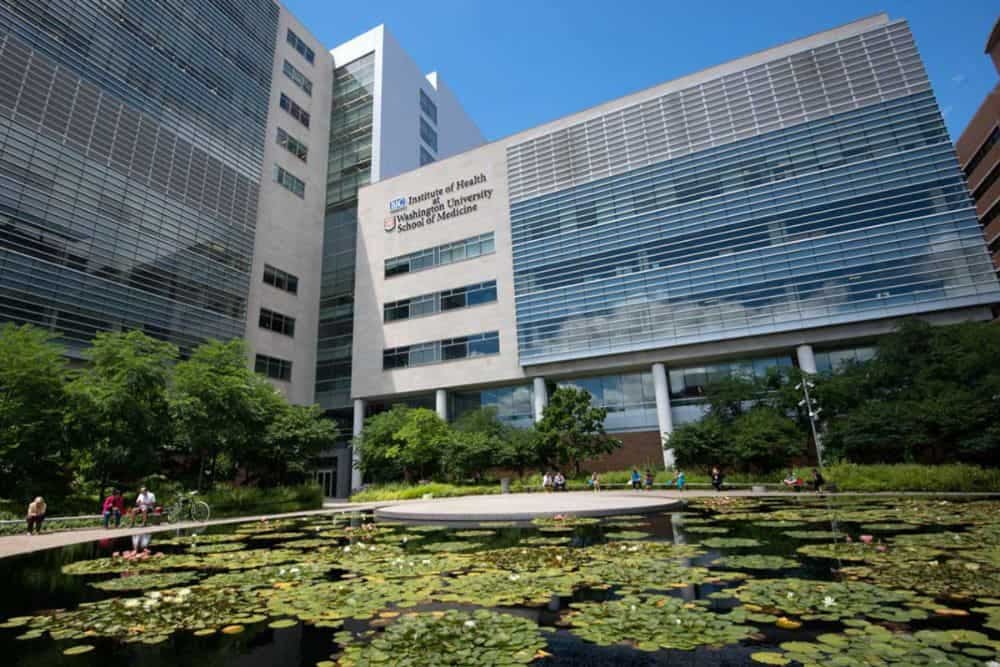
Washington University School of Medicine in St. Louis (WashU Medicine)
Washington University established its medical department in 1891, and in 1899 Missouri Medical College joined it, uniting the two oldest medical schools west of the Mississippi River. WashU Medicine is one of two medical schools in St. Louis and one of the country’s leading research medical schools: 19 Nobel laureates have ties to the school, and more than 95% of its MD students take part in research.
The school offers a four-year MD degree, the Roy Vagelos Medical Scientist Training Program (MD/PhD) and several combined degrees, including the MD/MSCI, MD/MPHS, MD/MPH, MD/MBA and an MD/MS in Biomedical Data Science and AI. Every MD and MD/PhD student is admitted to the Gateway Curriculum.
WashU Medicine School Highlights
WashU Medicine trains students at Washington University Medical Center, a 186-acre campus with 1,893 beds that includes Barnes-Jewish Hospital and St. Louis Children’s Hospital. With strong programs across medical specialties and many clinical training settings, Washington University is a top destination for medical students.
WashU also stands out for cost. Tuition, merit scholarships and need-based scholarships are fixed so that tuition will not increase from year one for up to ten consecutive years, and 71% of the Entering Class of 2025 had full tuition funding. For 2026-27, base tuition is $67,968 and the estimated cost of education for a single Phase 1 student is $103,047 for the 43-week year.
WashU Medicine Selection Factors
The Admissions Committee looks for qualities such as intellectual curiosity, maturity, leadership potential and a commitment to medicine and helping others. WashU says it wants applicants who can make the most of what the school offers and bring something more to the table. Humility and being a team player are key, and the committee looks for applicants who are collaborative, open to feedback and lifelong learning, and who have demonstrated grit and perseverance. The committee also considers an applicant’s academic record and puts special emphasis on letters of recommendation.
International applicants are compared with all other applicants in a single pool, and visa status is not a consideration in admissions decisions. All applicants need 90 credit hours from an approved U.S. or Canadian institution.
How Competitive is Washington University School of Medicine?
WashU Medicine does not list a minimum GPA, but you can look at its admissions statistics for a better idea of how competitive the applicant pool is. For the Entering Class of 2025:
- Enrolled students: 123 (MD and MD/PhD)
- Mean GPA: 3.88
- Mean MCAT score: 520 (97th percentile)
- Applicants: 6,138, of whom 1,021 were interviewed
- Home states and countries: 30 states and 9 countries
For the 2026-27 cycle, MD applicants had to submit AMCAS by October 15, 2026, the supplemental application by October 29, 2026 and letters of recommendation by November 6, 2026. MD/PhD deadlines were earlier, starting September 16, 2026. The supplemental application carries a $100 service fee, waived automatically for AAMC Fee Assistance Program recipients. To prepare for applying to WashU Medicine, make sure to check out Pre-Med Requirements: Everything You Need To Know. IMA has two full guides to the school: How to Get Into Washington University in St. Louis School of Medicine and How to Get Into Washington University School of Medicine, which covers the secondary essays in depth.
Application Timeline for Missouri Medical Schools
Missouri deadlines vary more than in most states. UMKC’s four-year M.D. closes in early August, while ATSU-KCOM accepts AACOMAS applications until February 1. Here are the published 2026-27 dates.
| School | Primary application | Secondary or supplemental | Notes |
|---|---|---|---|
| UMKC four-year M.D. | AMCAS by July 1 (transcripts by July 15) | August 8, with the UMKC general application | Classes start in January |
| UMKC B.A./M.D. | November 1 (application opens August 1) | Transcripts and test scores by November 15 | Deadline to accept an offer: May 1 |
| WashU Medicine | AMCAS by October 15, 2026 | October 29, 2026; letters by November 6, 2026 | MD/PhD: AMCAS September 16, supplemental September 30, letters October 7, 2026 |
| MU SOM | AMCAS received by October 15, 2026 | November 15, 2026 | Early Decision decisions October 1, 2026 |
| SLU SOM | AMCAS by November 15 | December 15 | Status notices from October 15; final decisions by April 30 |
| KCU-COM | AACOMAS by February 1, 2027 (October 1 advised for best consideration) | No supplemental application listed for 2026-27 | Early Decision was due August 1, 2026; class starts July 2027 |
| ATSU-KCOM | AACOMAS by February 1 | March 1 | Early Decision: AACOMAS by August 1, secondary by September 15 |
Most applicants plan their MCAT date and their clinical experience around the same calendar. If you are a year or two from applying, the summer before you submit is often the best window for both: study blocks in the spring, a test date that leaves time for a retake before your schools’ cutoffs, and pre-med summer internships or local clinical work once the exam is behind you. If you are targeting UMKC’s four-year M.D., remember that its July 1 AMCAS deadline means your MCAT, letters and personal statement need to be ready by early summer.
Missouri Medical Schools: Pre-Med Considerations
The medical schools in Missouri are competitive, and planning early is the ideal approach. If you are reading this guide early in your planning, these steps will add to the quality of your application:
- Take the science courses Missouri schools require. KCU lists biology, biochemistry, general and organic chemistry and physics with labs, plus English. UMKC’s four-year M.D. adds upper-level biochemistry, genetics and cell biology, and SLU prefers that you complete at least half of your undergraduate science coursework at a four-year institution.
- Keep your GPA high. Admissions committees take it seriously, and MU’s out-of-state grid and UMKC’s 3.5 floor for out-of-state applicants make it a hard screen at the public schools.
- Prepare thoroughly for the MCAT and plan when you take it. Missouri schools set different score windows and minimums, so check the screens table above before you book a test date.
- Get involved on campus. Admissions committees like to see students who are involved in student government, athletics or service, and clubs related to science or health care are a natural fit.
- Build real clinical experience. Work in a physician’s office in any role, volunteer at a community clinic in an underserved part of Missouri, or shadow a DO if osteopathic schools are on your list. KCU and ATSU-KCOM both look for exposure to osteopathic medicine.
Clinical internships for pre-med students are one way to add structured, supervised hours to the experiences you build at home in Missouri. College students who are still building those hours can also look at medical internships for undergraduates that fit between semesters. IMA’s pre-med internships abroad give students a look at a health care system that works very differently from the one in Missouri, and many come home inspired to serve where medical professionals are in short supply. That kind of experience connects naturally to the rural and underserved missions of ATSU-KCOM, KCU’s Joplin campus, MU’s Rural Scholars Program and UMKC’s St. Joseph campus. To learn more about the communities IMA works with, visit our global health initiatives page.
If you are not admitted on your first attempt, a year between college and medical school can strengthen your application. Pre-med gap year programs that combine supervised clinical work with service are one option, alongside full-time jobs as a scribe, medical assistant or EMT. Students in nursing, physician assistant or other health tracks who are still deciding on medicine can look at pre-health internships as well. IMA’s medical internships abroad are open to students at several stages, from undergraduates to gap year students.
When you choose where to apply, consider every part of each school, including its vision, mission and goals. What is the focus of the program, and does it match your own goals for a career in medicine? In Missouri those missions range from biomedical research at WashU to rural primary care at ATSU-KCOM and MU. IMA’s guide on how many medical schools to apply to can help you decide how many Missouri programs belong on your list next to schools in other states. Our medical school guides cover more than a hundred schools in the same detail.
Frequently Asked Questions About Missouri Medical Schools
How many medical schools are in Missouri?
Missouri has six medical schools. Four grant the MD: Saint Louis University School of Medicine, the University of Missouri School of Medicine, the UMKC School of Medicine and Washington University School of Medicine in St. Louis. Two grant the DO: A.T. Still University Kirksville College of Osteopathic Medicine and Kansas City University College of Osteopathic Medicine, which teaches on two campuses, Kansas City and Joplin.
Is a new medical school opening in Missouri?
Not at this time. All six Missouri schools hold full accreditation, and no Missouri program is listed in COCA’s candidate status for new osteopathic colleges. MU is expanding instead: its Springfield campus becomes a four-year regional campus in 2027-28 with up to 32 seats a year.
What is the easiest medical school to get into in Missouri?
No Missouri school publishes an acceptance rate, so there is no reliable way to rank them by ease. By published class averages, the two DO schools have the lowest MCAT averages: 503 at ATSU-KCOM (five-year average) and 505 at KCU-COM (2026 classes). For Missouri residents, MU and UMKC are worth a close look because they reserve most of their seats for state residents.
Which Missouri medical schools accept out-of-state students?
All six do. SLU, WashU, ATSU-KCOM and KCU-COM have no state preference. UMKC gives priority to Missouri residents, then to residents of Arkansas, Illinois, Kansas, Nebraska and Oklahoma, and requires a 3.5 GPA from applicants outside those states. MU accepts out-of-state applicants who meet its MCAT and GPA grid, but around 85% of its accepted students are Missouri residents.
What MCAT score do I need for medical school in Missouri?
It depends on the school. WashU’s Entering Class of 2025 had a mean MCAT of 520, SLU’s accepted applicants for July 2026 averaged 514, KCU’s 2026 classes averaged 505 and ATSU-KCOM’s five-year average is 503. The published minimums are 502 at SLU, 500 at MU and 495 at UMKC’s four-year M.D. Aim well above any minimum.
What GPA do I need for medical school in Missouri?
Published class averages run from 3.6 at KCU’s Joplin campus to 3.88 at WashU (Entering Class of 2025) and SLU (accepted for July 2026). MU and UMKC require at least a 3.0 cumulative and science GPA, and UMKC requires 3.5 from applicants outside Missouri and its regional states. ATSU-KCOM sends secondaries at 2.80.
Which is the cheapest medical school in Missouri?
For Missouri residents, the public schools cost the least. UMKC’s four-year M.D. charges residents $14,935 per semester for Years 1-2 in Fall 2026 and Spring 2027, with an annual resident cost of attendance of $79,621. MU’s 2025-26 resident tuition and fees were $49,786, with a first-year resident cost of $81,343. Among the private schools, KCU-COM has the lowest 2026-27 tuition at $59,030.
Does UMKC have a BS/MD program?
Yes. UMKC offers a six-year B.A./M.D. program for high school seniors. It admits 105 to 110 students a year, and the application deadline for fall 2027 entry is November 1. Students do not take the MCAT. Admitted students average a 3.9 unweighted high school GPA and a 32 ACT or 1420 SAT.
Is UMKC in Kansas City or Springfield?
UMKC is in Kansas City. Its main campus is on Hospital Hill in Kansas City, Missouri, and it has a rural regional campus in St. Joseph. The medical school campus in Springfield belongs to the University of Missouri School of Medicine, which is based in Columbia.
Is KCU’s Joplin campus a separate school?
No. KCU-COM Joplin is an additional location of the same College of Osteopathic Medicine, with the same DO program, one application and the same tuition. Its 2026 class had 164 students with an average MCAT of 505.
Do Missouri medical schools accept international students?
Some do. WashU reviews international applicants in the same pool as everyone else. SLU accepts international applicants now, but beginning with the 2028 application cycle its traditional M.D. pathway will only accept U.S. citizens and permanent residents. KCU accepts a limited number of international students and considers DACA recipients. MU, UMKC and ATSU-KCOM consider only U.S. citizens and permanent residents.
How much clinical experience do Missouri medical schools want?
Most Missouri schools do not publish an hour count, but every one reads your experiences for evidence that you understand patient care. KCU requires health care experience such as shadowing, volunteering or work, and ATSU-KCOM screens for DO shadowing. Supervised, hands-on roles where you take vitals, room patients or help with intake show more than shadowing alone.
When should I apply to Missouri medical schools?
Apply as early as you can. UMKC’s four-year M.D. requires AMCAS by July 1, and WashU and MU set October 15 AMCAS deadlines. SLU’s AMCAS deadline is November 15. The DO schools run later, with AACOMAS deadlines of February 1, but KCU advises submitting AACOMAS by October 1 for best consideration, and ATSU-KCOM reviews applications on a rolling basis.
Related Guides for Missouri Applicants
Many Missouri applicants also apply to schools in neighboring states, and UMKC’s regional priority covers five of them. These IMA state guides are a good next step:
- Medical schools in Kansas: KU School of Medicine and the newer DO college in Wichita are a short drive from Kansas City.
- Medical schools in Illinois: Illinois sends many applicants to St. Louis and Kirksville, and Illinois residents count as regional at UMKC.
- Medical schools in Arkansas: Arkansas residents also count as regional applicants at UMKC.
- Medical schools in Iowa: Iowa is one of ATSU-KCOM’s top four home states.
- Medical schools in Nebraska: Nebraska is a UMKC regional state, and KCU’s DO/MPH runs with the University of Nebraska Medical Center.
- Medical schools in Oklahoma: Oklahoma residents are regional applicants at UMKC, and KCU’s Joplin campus sits near the Oklahoma line.
For a national view of costs, see IMA’s medical school tuition guide, and for interview preparation at the two DO schools, see our guide to osteopathic medical school interview questions and formats.
Good Luck to You!
We hope this guide to medical schools in Missouri has been helpful. Be sure to explore our more in-depth guides for each school, linked above. Whether your dream school is public, private, allopathic or osteopathic, our medical school admissions consulting has helped thousands of students just like you get into top medical schools across the country. We’re here to help every step of the way, so please reach out at any stage of your journey.
Sources
All pages were checked November 13, 2026.
- Accreditation: LCME Directory of Accredited U.S. Programs (updated November 2, 2026); AOA/COCA directory of colleges of osteopathic medicine (September 2026); COCA candidate status list.
- A.T. Still University Kirksville College of Osteopathic Medicine: DO Program Sheet, academic year 2026-27; Fast Facts; tuition and cost of attendance pages (2026-27); application process FAQ; student outcomes; first institution of osteopathy history page.
- Kansas City University: student profile (Kansas City-COM 2026 and Joplin-COM 2026); COM tuition and fees 2026-2027; year 1 cost of attendance budget guide 2026-2027; COM admission requirements; DO program outcomes; accreditation page; AACOM Choose DO Explorer KCU-COM profile (2026-2027 cycle).
- Saint Louis University School of Medicine: Admission Requirements and Standards; How to Apply; 2026-2027 tuition and fees; 2026 White Coat Ceremony news; About; MD program page.
- University of Missouri School of Medicine: application requirements and application process (entering 2027); Class of 2030 news; campus locations; financial aid (2025-2026 costs).
- UMKC School of Medicine: B.A./M.D. admission requirements, FAQs and timeline; M.D. requirements and timeline; Council on Selection; St. Joseph rural M.D. program; UMKC medicine cost estimates; UMKC graduate and professional program rates for Fall 2026 and Spring 2027.
- Washington University School of Medicine: Who Chooses WashU Medicine? (Entering Class of 2025); cost of education 2026-2027; How to Apply; Important Dates (Entering Class of 2027); MD admissions FAQs; history; Nobel Prize winners.
See more of our guides in your Google results: add International Medical Aid as a preferred source on Google.