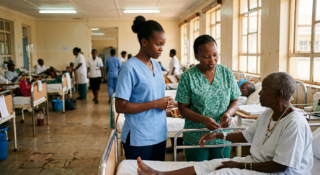
A nursing internship in Kenya places you in a hospital where the disease mix, staffing and resources differ sharply from most U.S. settings. Kenya has about 2.27 nurses and midwives per 1,000 people, compared with 13.38 in the United States, so each nurse carries more patients. Watching how nurses manage that load teaches clinical reasoning that no simulation lab can reproduce.
This guide explains what you observe on the wards, why it matters for a nursing career and what you will and will not do as a student. If you are new to the role, start with our overview of what to expect during a pre-nursing internship.
A Second Reference Point for Your Nursing Education
Pre-nursing students often build shadowing and volunteer hours in well-resourced U.S. hospitals. Those hours are valuable, but they can be narrow. A structured placement in a Kenyan teaching hospital adds a second reference point: a ward where scarcity is routine and nurses are the backbone of frontline care.
That contrast is the point. When you see a nurse assess a child carefully because the lab result will take longer, or teach a family member how to help with comfort care because the ward is busy, you learn what nursing fundamentals look like when the fundamentals are all a nurse has. Understanding what you will see, and how to process it ethically, is essential before you commit to any program.
Where IMA’s Kenya Nursing Program Takes Place
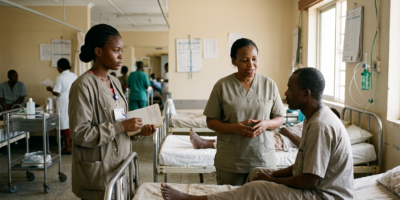
IMA’s Kenya program is based at Coast General Teaching and Referral Hospital in Mombasa, on the Kenyan coast. The hospital has an emergency ward, an ICU, operating theaters and a maternity theater. Nursing areas across IMA’s partner hospitals include medical-surgical nursing, pediatrics, obstetrics, critical care and community health, and you list the units you prefer on your enrollment form.
Orientation comes first. Nurses and other local clinicians explain the health system, hospital routines, safety and infection control. Then rotations begin, usually one unit a week, for six to eight hours a weekday, most days from about 8 AM to 4 PM. An optional night shift once a week may be possible. The Kenya program runs year-round for stays of 2 to 12 weeks, in English, with daily lessons in medical Swahili.
The Conditions You Will Observe in Kenyan Hospitals
The biggest clinical difference between a Kenyan public hospital and a typical U.S. facility is the mix of conditions on the ward. In much of the United States, chronic disease dominates: heart failure, diabetes, COPD and complications of obesity. In Kenya, infectious diseases such as malaria, HIV, tuberculosis, typhoid and pneumonia still account for a large share of admissions, especially in public hospitals serving lower-income communities.
Chronic disease is not absent. Kenya faces what epidemiologists call a double burden, in which rising rates of hypertension and diabetes overlap with the infectious disease load. You may see both on the same ward on the same day. That overlap gives you a real view of epidemiological transition, a concept you will meet in nursing school and public health courses but that is hard to grasp from a textbook.
Maternal and Newborn Care
Maternal and newborn health is an area where Kenyan hospitals show you care that is hard to see at home. The World Bank reports Kenya’s maternal mortality ratio at 149 deaths per 100,000 live births in 2023, compared with 17 in the United States. According to the WHO’s maternal health overview, most maternal deaths happen in low- and middle-income countries, and most are preventable. Watching how nurses and midwives monitor women in labor, recognize warning signs and prepare families for discharge gives you a sobering, instructive contrast with U.S. labor and delivery units.
Pediatric Wards
Pediatric wards look different too. Kenya’s under-five mortality rate was 38.8 deaths per 1,000 live births in 2024, compared with 6.5 in the United States. The conditions behind that gap, including severe malaria, diarrheal disease, pneumonia and malnutrition, are ones you would rarely see on an American pediatric unit. Watching nurses assess hydration, prioritize interventions and communicate with worried parents when labs take longer builds observation skills you will use in any setting.
How Resource Constraints Change What Nursing Looks Like
If you have only seen U.S. hospitals, you are used to a certain baseline: electronic records, single-use supplies, automated medication cabinets and monitors at every bedside. Kenyan public hospitals often work below that baseline. This is not a criticism of Kenyan health care. It is a structural reality shaped by funding and infrastructure, and understanding it is part of becoming a globally aware nurse.
In practice, you may see vital signs taken manually because there are not enough digital monitors, paper charts in place of electronic records and nurses calculating and checking medication doses without automated systems. These are signs of clinicians doing careful work with what is available, not signs of poor care.
What to watch is the problem-solving. Nurses in these settings often rely on strong assessment skills because they cannot default to technology. They prioritize with precision and adapt safely when a supply runs short. For a pre-nursing student, seeing that kind of clinical reasoning is a powerful education.
Staffing is part of the same picture. With about 2.27 nurses and midwives per 1,000 people in Kenya, according to the World Bank workforce data, individual nurses carry heavier patient loads, take on broader responsibilities and are often the main point of continuity for patients who see a doctor only briefly. In the United States, the BLS still projects steady growth in registered nurse jobs, but staffing pressures in Kenya are far more severe. Seeing that expanded role helps you understand the full scope of what nursing can be.
Family Involvement, Culture and Patient Communication
One of the things that most surprises students is how much families take part in daily care in Kenyan hospitals. On many wards, especially in public facilities, relatives bring food, help patients eat, help with comfort and mobility, and stay close to the bedside. This is an established cultural and practical norm in a setting where nurses cannot be at every bedside around the clock.
That raises useful questions about patient-centered care. In U.S. hospitals, family involvement in hands-on care is usually limited. In Kenya it is part of how the ward works. Watch how nurses coordinate with relatives, teach them what to watch for, explain infection control and check that instructions have been understood. You will see a model of care delivery that may shape your own practice later.
Culture also shapes how patients describe symptoms, make decisions and respond to advice. Traditional healers remain influential in many communities, and experienced nurses use communication strategies that respect beliefs while delivering evidence-based care. Observing those conversations is cultural competence in its real form. Our guide to patient communication basics for interns gives you a framework for listening, asking questions and engaging respectfully across cultural lines.
Learning Across a Language Barrier
Mombasa’s program runs in English, and every IMA program includes daily clinical lessons in medical Swahili, so you can greet patients and follow simple exchanges. You will still miss parts of many conversations. Our guide on staying engaged during observation across a language barrier explains how to keep learning when you cannot follow every word.
The Nursing Team and the Role of Clinical Officers
Kenya’s health workforce includes a cadre that does not exist in the United States: the clinical officer. Clinical officers are trained to diagnose and treat common conditions and are especially important where physicians are scarce. Our guide to clinical officers in Kenya explains their training and role in detail.
As a nursing intern, you will see clinical officers and nurses working side by side in ways that can blur the role boundaries you are used to. In the U.S., team roles are relatively fixed. In Kenya, the team adapts to the workforce that is available, and nurses may take on assessment and triage work that a physician would handle in many U.S. hospitals. Watching that flexibility shows you that care delivery is shaped as much by context as by protocol.
It also connects to the global picture. WHO’s State of the World’s Nursing 2025 findings report a global nursing shortage of 5.8 million in 2023, with about 78% of the world’s nurses working in countries that hold just 49% of the global population. Kenya reflects that imbalance every day, and seeing how the system adapts gives you real insight if you later move toward global health, public health or community nursing.
A Sample Observation Week
Here is what one week on a single unit might look like. It is an illustration of the pattern IMA describes, not a fixed timetable; your Program Mentor sets your actual rotation with you.
| Day | Morning on the ward | Afternoon |
|---|---|---|
| Monday | Meet the unit team; watch handover and the first medication round | Global Health Lecture Series session |
| Tuesday | Follow one nurse through admissions and assessments | Simulation session on a scenario you saw that morning |
| Wednesday | Observe patient and family teaching before discharge | Community medical clinic with local practitioners |
| Thursday | Watch how the team prioritizes during a busy period | Health education session in a local school |
| Friday | Review the week’s questions with your supervising nurse | Mentor check-in and reflection notes |
What Interns Do, and What They Do Not Do
Honesty about the intern’s role is essential. A nursing internship in Kenya is an observational, guided learning experience. You are not a licensed practitioner, and you are not a substitute for Kenyan health workers. Your presence should support the learning environment without disrupting care.
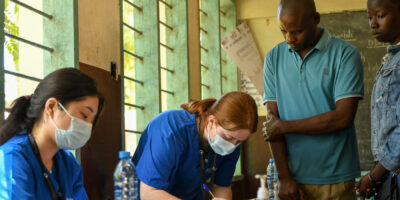
On IMA’s programs, pre-nursing students mainly observe. You shadow nurses as they assess patients, give medications, plan care and teach patients and families. Where the unit allows it, you may help with simple, non-invasive tasks such as recording vital signs, always with a nurse supervising you. Nursing students work only within the scope their own program has trained them for, and for licensed nurses the role is educational and observational.
What you will not do is practice independently, give medications, perform procedures or make clinical decisions. That is not a limitation of the program; it reflects ethical, legal and safety standards that protect patients and students alike. Any program that promises unsupervised clinical work to pre-nursing students should raise serious concerns. Our guide comparing nursing shadowing and clinical placements explains why the line sits where it does.
You are matched with a Program Mentor before you leave home, licensed nurses guide you on the wards and mentor check-ins give you space to talk through what you observe. Reflection is part of the learning cycle, especially after emotionally difficult cases. When you are ready to plan your own placement, see our guide on how to apply for pre-nursing internships.
Ethical Boundaries That Matter
Patient privacy, consent and scope are non-negotiable in every setting. Introduce yourself, accept it gracefully when a patient prefers not to have a student present and keep anything you see on the ward out of your social media. In a resource-limited hospital, ethical questions can feel sharper: a child may not get a medicine that would be routine at home, or a family may decline treatment for cultural or practical reasons. These are not problems for you to solve. They are realities to observe, reflect on and discuss with your supervisor.
The best interns approach these moments with humility. They ask questions rather than make assumptions, follow the lead of local staff and remember that the people who work in this system every day understand it far better than any visitor.
Setting Learning Goals for Your Placement
Arriving with clear goals turns observation into learning. Choose two or three goals tied to nursing skills rather than to the trip itself. Examples include understanding how nurses prioritize on a busy medical ward, learning how families are taught to support recovery at home, or comparing how maternity care is organized with what you have seen in the United States. Our article on nursing internship learning goals offers more ideas.
Keep a short daily log. Record the date, the unit, who supervised you, what you observed and the questions you still have, and leave out anything that could identify a patient. Your hours are logged by date, unit and shift, and IMA’s U.S.-based Medical Director validates the record; each nursing school decides how to count those hours.
How This Experience Connects to Nursing School Applications
An international clinical experience can strengthen a nursing school application, but only if you can explain what you observed and what it taught you. Admissions committees are not impressed by a destination on a resume. They look for cultural awareness, critical thinking, adaptability and ethical reasoning.
When you write about a Kenyan hospital placement, be specific. Describe watching a nurse assess a patient without a pulse oximeter and what that taught you about foundational assessment. Explain how family involvement changed your view of the nurse-patient relationship. Reflect on a moment when scarcity forced the team to prioritize, and what you learned about decision-making under pressure.
Avoid vague statements about gratitude or having your eyes opened. Reviewers read thousands of essays, and the ones that stand out are grounded and self-aware. For context on how structured programs compare with other clinical experience, see our article on reasons to do a medical internship abroad.
Setting Realistic Expectations Before You Go
The most satisfied interns arrive with honest expectations. You are going to observe and learn. You will sometimes be uncomfortable, because the setting is unfamiliar and because some of what you see will weigh on you. You are not going to change outcomes for patients in a system whose challenges are far larger than any one visitor.
That honesty is freeing. When you stop expecting to be a hero, you can focus on being a student, and the education available in a Kenyan teaching hospital is genuinely valuable for anyone serious about nursing.
Before committing, think about your readiness. Are you prepared to work under supervision and follow local clinicians’ instructions? Can you handle emotional difficulty without shutting down? Will you do the preparation, including vaccinations, orientation and reading about Kenya’s health system? If the answer is yes, a placement like this adds real depth to your pre-nursing preparation.
Think about timing too. A placement often works best during a gap year, a summer break or a semester when you can give it your full attention. To compare sites and schedules, explore IMA’s nursing internships abroad.
Frequently Asked Questions
Will I Perform Clinical Procedures During a Nursing Internship in Kenya?
No. Pre-nursing interns observe procedures and, where the unit allows it, may help with simple non-invasive tasks such as recording vital signs under direct supervision. They do not perform procedures, give medications or work independently.
What Conditions Will I See in Kenyan Hospitals?
Common presentations include malaria, HIV, tuberculosis, typhoid, pneumonia, maternal complications and malnutrition-related conditions, alongside chronic conditions such as hypertension and diabetes. What you see depends on the hospital, the unit and the time of year.
Where Does IMA’s Kenya Nursing Program Take Place?
At Coast General Teaching and Referral Hospital in Mombasa, which has an emergency ward, an ICU, operating theaters and a maternity theater. The program runs year-round for stays of 2 to 12 weeks.
Do I Need to Speak Swahili?
No. The Mombasa program runs in English, and every intern receives daily clinical lessons in medical Swahili to help with greetings and simple exchanges with patients and families.
How Does a Kenya Placement Help With Nursing School Applications?
It can show cultural awareness, adaptability and ethical reasoning, but only if you write about it specifically. Describe what you observed, what challenged you and how it changed your understanding of nursing rather than relying on general statements.
Will My Hours Count Toward Nursing School?
IMA logs your hours by date, unit and shift, and its U.S.-based Medical Director validates the record. Each nursing school decides how to count those hours, so check with the programs you plan to apply to.