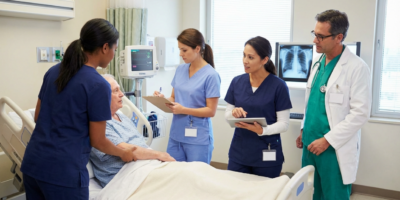
One of the most frequently misunderstood aspects of a clinical observation placement is the question of what you are actually allowed to do. Students arrive expecting to be useful and quickly discover that the boundaries on direct patient interaction are firm and non-negotiable. No touching patients. No taking vitals independently. No clinical tasks without explicit authorization and supervision. For students who want to contribute, this can feel like being handed a front-row seat and told to keep their hands in their laps.
The frustration is understandable, but it rests on a misunderstanding of what contribution looks like in a clinical environment. The most valuable thing a pre-health student can offer nursing staff is not clinical help. It is intelligent, respectful, non-clinical support that reduces the burden on nurses so they can direct their full attention to the patients who need them. That kind of support is substantial, it is genuinely appreciated, and it is entirely consistent with the ethical boundaries of an observational role.
This article covers exactly what that looks like in practice. It is written for students on international clinical placements, but the principles apply equally to domestic shadowing and hospital volunteer roles. Understanding how to be genuinely useful without crossing clinical boundaries is one of the most important professional skills you can develop during the pre-health phase of your training.
Why the Boundaries Exist and Why They Matter
The boundaries on student clinical activity are not bureaucratic obstacles. They exist to protect patients, protect clinical staff, and protect you. A pre-health student who performs a clinical task without adequate training exposes a patient to real risk, creates liability for the supervising clinician, and may inadvertently harm their own application by demonstrating a disregard for ethical boundaries that admissions committees take seriously. The American Nurses Association’s definition of nursing practice and scope makes clear that nursing involves licensed, accountable clinical decision-making that cannot be delegated to untrained observers. Respecting that boundary is not a limitation on your learning. It is evidence that your learning is substantive.
At the same time, the clinical environment is full of legitimate, meaningful contributions that do not require clinical training. Experienced nursing staff in busy international hospitals are managing extraordinary workloads under resource constraints that would be unfamiliar to most students from high-income settings. The time a nurse spends walking across a unit to retrieve a supply, locating a piece of equipment, or managing a non-clinical communication is time not spent with a patient. A student who can reliably handle those tasks creates real value without overstepping.
What Non-Clinical Support Actually Looks Like
Environmental Readiness
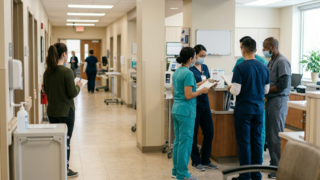
One of the most consistently useful things an observer can do is help maintain the physical readiness of the clinical environment. This means keeping supply areas organized so that nurses can locate what they need quickly, restocking non-sterile supplies under supervision, ensuring that patient areas are clean and properly arranged before and after encounters, and noticing when equipment is out of place or when a space needs attention.
The keyword is “under supervision”. You should never reorganize a clinical supply area on your own without guidance from a staff member. Supplies in clinical environments are organized according to logic that is not always obvious to an outsider, and well-meaning reorganization can create dangerous confusion during urgent situations. Ask before you help, follow instructions exactly, and confirm before you assume a task is complete.
Communication Support
Clinical environments generate a constant flow of non-clinical communications that consume staff time. These include escorting family members to waiting areas, relaying non-clinical messages between units, directing patients to specific rooms or services when requested by staff, and answering basic orientation questions from patients or family members who are confused about where they are or what to expect next.
All of these tasks require judgment and professionalism. They also require you to know the limits of what you should say. You are not a clinical resource. If a family member asks you a clinical question, you do not answer it. Find the appropriate staff member and direct the question to them. Being clear and honest about what you can and cannot help with is not a failure of service. It is exactly the kind of professional integrity that clinical environments require.
Documentation Environment Support
In many international settings, documentation is still heavily paper-based. Nurses maintain patient charts, medication administration records, and handoff notes by hand. An observer who can help ensure that the documentation environment is orderly, that charts are in the correct locations, that pens and clipboards are available, and that forms are properly stocked reduces friction in a system where small administrative inefficiencies add up quickly over the course of a shift.
This is support for the documentation environment, not for documentation itself. You are never writing in a patient chart, never annotating a record, and never handling clinical documentation in a way that could be construed as adding or altering clinical information. The distinction is important, and it is not subtle.
Waiting Area Management
In outpatient and emergency settings, the waiting area is often the most chaotic and least managed space in a facility. Patients and family members arrive anxious, confused, or in pain, and the information they need to manage that experience is often unavailable to them because clinical staff are too busy to provide it. An observer who maintains a calm, professional presence in the waiting area, answers basic orientation questions, alerts staff when a patient’s condition appears to be changing, and helps maintain an orderly and respectful environment is providing genuine value.
Again, this requires you to be clear about your role. You are not a triage nurse. You are not making clinical assessments. If you observe a patient in the waiting area who appears to be in acute distress, your job is to notify a staff member immediately, not to intervene. The intervention is the nurse’s responsibility. Bringing it to the nurse’s attention quickly is your responsibility.
How to Offer Help Without Overstepping
The way you offer help matters as much as the substance of it. Approaching a nurse and saying I want to be helpful. What can I do? is less effective than approaching and saying I noticed the supply cart is low on gauze. Would it be helpful if I restocked it? The first framing puts the burden of figuring out how to use you on the nurse, who is already managing multiple priorities. The second framing demonstrates that you have been paying attention and offers a specific point.
The research on interprofessional collaboration in nursing environments consistently shows that the most effective support comes from team members who understand the priorities of the people they are supporting and who offer specific, targeted assistance rather than general availability. Apply that principle to your observer role. Observe what nurses are doing and what is creating friction for them, then offer to address one specific source of friction at a time.
Timing also matters. Offering help during an acute clinical moment is an intrusion. Offering it during a natural lull, between patients or during a handoff period, is professional. Read the room and learn to recognize when a nurse has bandwidth for a brief interaction and when they do not.
What to Observe While You Are Supporting
Non-clinical support tasks are not just useful to the nursing team. They are also learning opportunities if you approach them with the right mental framework. While you are restocking supplies, observe how the supply system is organized and why. Notice which supplies are used most frequently and what that tells you about the patient population. While you are maintaining the waiting area, watch how nurses and clinical officers conduct initial visual assessments of patients before formal triage. These micro-observations accumulate into a clinical picture that purely passive observation cannot produce.
Students who understand how different kinds of clinical exposure build toward a strong application recognize that non-clinical support roles, when engaged in thoughtfully, generate exactly the kind of specific, reflective learning that admissions committees are looking for. The story you tell about helping a nursing team manage patient flow during a shortage is more compelling than a vague description of hours spent observing.
Cultural Considerations in International Settings
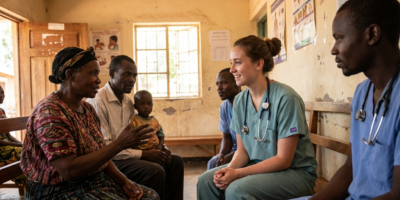
In international clinical placements, the norms around professional support and teamwork may differ significantly from what students expect based on their domestic training or cultural background. In some East African hospital settings, the relationship between observers and clinical staff is shaped by hierarchies that are more formal than those common in North American environments. Observing and adapting to those hierarchies is not just good manners. It is a prerequisite for being genuinely useful.
Watch how other staff members address the nursing team before approaching on your own. Notice whether first names or titles are used. Observe whether support tasks are typically initiated by the observer or specifically requested by staff. In more formal environments, offering help unsolicited can be perceived as presumptuous. Waiting to be asked, or asking permission before taking any initiative, is the more appropriate default until you have a clear sense of the team’s norms.
Building this kind of cultural awareness is one of the most transferable skills an international clinical placement develops. Understanding how allied health professionals and support staff function within clinical teams in different global contexts is preparation not just for the placement itself, but for a career in a healthcare system that is increasingly diverse and globally interconnected.
What Not to Do
Do not perform any clinical task, including taking vitals, assisting with physical examinations, handling medications, or positioning patients, without explicit authorization and direct supervision from a licensed clinician. This is not a gray area. The boundary is clear, and crossing it has consequences for patients, for the clinical team, and for your application.
Do not offer clinical opinions to patients or family members, even if you believe you know the answer. A patient who asks you what their test results mean, whether a symptom is serious, or how a medication should be taken needs a clinician, not an observer. Redirect the question clearly and without hesitation.
Do not take on a non-clinical support task and then abandon it halfway through because something more interesting is happening nearby. Reliability is a professional quality. A nurse who asked you to handle a task needs to know it was completed, not discover mid-shift that it was dropped. Finishing what you start, and confirming with the nurse that it is done, builds the kind of trust that leads to more substantive opportunities over the course of a placement.
Students who want to understand how the distinction between observation and clinical work is understood from the program design perspective will benefit from reading about what virtual and in-person clinical placements are actually designed to provide and how the non-clinical observer role fits within a larger framework of professional development.
What to Do Next
Before your next shift, identify two or three specific non-clinical support tasks that you observed going unaddressed or being handled slowly during previous shifts. Arrive with those tasks in mind and offer to take them on specifically and immediately. At the end of the shift, ask the nurse you worked closest to whether there is anything you could do differently to be more useful. This feedback loop, combined with specific observation of what creates friction for nursing staff, will develop your support skills faster than any general effort to be helpful.
Frequently Asked Questions
What kinds of tasks can I help with during an observation shift without crossing clinical boundaries?
Non-clinical support tasks that are appropriate for observers include maintaining and organizing supply areas under staff direction, managing the waiting area environment, assisting with basic orientation for patients and family members, running non-clinical errands between units, ensuring the physical environment is orderly before and after patient encounters, and helping with documentation logistics such as ensuring charts are in correct locations and forms are available. None of these tasks involve direct patient contact or clinical decision-making.
How do I offer help without seeming intrusive or presumptuous?
Offer specific help rather than general availability. Instead of asking what can I do, identify something specific you noticed and offer to address it. Offer during natural lulls in the clinical workflow rather than during active clinical moments. Read the norms of the specific team you are working with, because appropriate levels of initiative vary by setting and culture. In more formal environments, waiting to be asked is often the right default.
Is it ever appropriate for a pre-health student to assist with clinical tasks?
Only when explicitly authorized and directly supervised by a licensed clinician, and only within the specific scope defined by your program and the clinical facility. In most pre-health observation placements, clinical task assistance is not permitted at all. If you are uncertain about what is permitted, ask your program coordinator before the shift begins, not in the moment. Acting first and asking later in a clinical environment is not acceptable.
How do I handle it if a staff member asks me to do something outside my scope?
Decline respectfully and clearly. You might say, I appreciate you asking, but my placement here is observational and I am not authorized to assist with clinical tasks. Most staff will understand immediately. If you feel ongoing pressure, speak with your program coordinator. This situation is more common than students expect, particularly in very busy facilities where every available body is seen as a potential resource. Your obligation to decline is not negotiable.
What does professional behavior look like in a nursing support role?
Professional behavior in a nursing support role means being reliable, specific, culturally aware, and honest about what you can and cannot do. It means completing tasks you take on, confirming with staff when they are done, and asking for feedback rather than assuming you got it right. It means reading the room before offering help and not offering during critical clinical moments. It means treating every interaction with patients and family members with the same professionalism you would bring to a formal clinical encounter.
Will this kind of non-clinical support actually look good on a medical school application?
Yes, when described correctly. Admissions committees do not value non-clinical support for its own sake. They value what it demonstrates: situational awareness, professionalism, respect for clinical hierarchy, and the ability to contribute meaningfully within defined boundaries. A student who can describe specifically how they supported a nursing team in a resource-limited international setting, what they observed while doing it, and what it taught them about clinical systems thinking, is making a compelling case for readiness to enter medical training.
How do cultural norms in international settings affect what support is appropriate?
Significantly. In more hierarchical clinical cultures, offering help unsolicited can be perceived as presumptuous or disrespectful of role boundaries. Observing how other team members interact before initiating support, asking permission before taking any initiative, and deferring to staff direction at all times are appropriate defaults in international settings until you have a clear sense of the team’s norms. Adapting quickly to cultural context is itself a skill that international placements are designed to develop.
What is the most important professional habit to develop in a nursing support role?
Reliability. Clinical staff develop trust in support personnel over time, and that trust is built almost entirely on whether tasks are completed accurately and on time. A student who takes on a task and completes it fully, then confirms with the staff member that it is done, is demonstrating exactly the kind of dependability that clinical teams value. Small, reliable contributions over many shifts build a professional reputation that creates more substantive opportunities than any single impressive gesture.