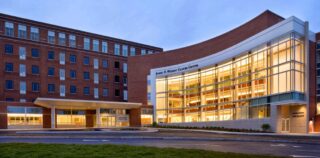

The University of Rochester School of Medicine and Dentistry (URSMD) is the private MD-granting medical school of the University of Rochester in Rochester, New York. It is one of 15 LCME-accredited MD programs in New York and sits on the same campus as Strong Memorial Hospital, an arrangement planned by the school’s first dean, Nobel laureate George Hoyt Whipple, who came to Rochester in 1921. The school is known for several medical innovations, including the work of a Rochester team that helped develop the HPV vaccine, the world’s first vaccine against cancer.
This page covers the 2026-2027 application cycle, which leads to fall 2027 entry with the Class of 2031. It explains the Double Helix Curriculum and the biopsychosocial model, current admissions requirements and deadlines, 2026-27 tuition and cost of attendance, the class profile, both current secondary essay prompts with worked examples, the virtual interview day and the people who lead the school.
Like most medical schools in the United States, Rochester has school-specific requirements and guidelines. Understanding the school’s identity, programs and selection criteria will help you put your best foot forward and build a competitive application. Facts were checked against the school’s own pages in November 2026.
Key Takeaways
- Who can apply: U.S. citizens, permanent residents and asylees apply through AMCAS. International applicants are considered only through the need-based Levitan Family Endowed Scholarship, and the MD/PhD program is open only to U.S. citizens and permanent residents.
- No state preference: Rochester is private and has no preference for New York residents. It values geographic diversity in each class.
- Key dates for 2026-2027: AMCAS deadline October 15, secondary and $100 fee due November 15, letters due November 22. Interviews run from September to mid-March and are all virtual.
- Academic context: The current class profile shows a GPA range of 3.65 to 4.0 and an MCAT range of 511 to 527 for a class of 104. The school’s FAQ lists an average GPA of 3.8 and an average MCAT of 517. For the 2025 entering class, accepted applicants had a median GPA of 3.94 and a median MCAT of 519, and the school interviewed 615 applicants.
- No CASPer or PREview: Rochester requires no situational judgment test.
- Cost: 2026-27 tuition is $74,050 per year. The first-year cost of attendance budget is $100,874.
- Distinctive training: The Double Helix Curriculum weaves basic science and clinical care through all four years, built on the biopsychosocial model. A 31-week longitudinal Primary Care Clerkship, eight elective pathways and the UR Well student clinics shape the experience.
- Next step: Draft both 200-word secondary essays now, submit AMCAS early, and line up a committee letter or three to five individual letters before November 22.
Key Statistics About the University of Rochester School of Medicine and Dentistry

The table below gives the same figures with their cohort, definition and source. Rochester charges one tuition rate to all MD students, so there is no in-state or out-of-state split.
| Metric | Value | Year or cohort | Source |
|---|---|---|---|
| School and degree | University of Rochester School of Medicine and Dentistry, MD (Rochester, NY) | Current | URMC MD Admissions |
| Accreditation | Fully accredited by the LCME | Current | URMC Apply Now page |
| Entering class size | 104 students | Current class profile (cohort not labeled on page) | URMC Our People page |
| GPA range | 3.65 to 4.0 | Current class profile | URMC Our People page |
| MCAT range | 511 to 527 | Current class profile | URMC Our People page |
| Average GPA and MCAT | GPA 3.8 (range 3.0 to 4.0); MCAT 517 (range 503 to 528) | Entering students, year not stated | URMC Apply Now FAQ |
| Median GPA | 3.94 | 2025 entering class, accepted applicants | AAMC MSAR |
| Median MCAT | 519 (mean 518.6) | 2025 entering class, accepted applicants | AAMC MSAR |
| Applications | More than 6,000 | 2026-2027 cycle | URMC Interview Day Details |
| Applicants interviewed | 615 (139 New York residents, 470 from other states, 6 international) | 2025 entering class cycle | AAMC MSAR (school-reported) |
| Waitlist | About 350 waitlist positions; about 30 offers to waitlisted applicants | Typical cycle | AAMC MSAR |
| Acceptance rate | Not published (offers and applications for the same cohort are not reported) | None | URMC; AAMC MSAR |
| Tuition | $74,050 per year (Years 1 to 4) | 2026-27, all students | URMC Cost of Attendance 2026-2027 |
| Total tuition and fees, Year 1 | $78,596 | 2026-27 | URMC Cost of Attendance 2026-2027 |
| Total cost of attendance budget, Year 1 | $100,874 (10 months) | 2026-27, single student | URMC Cost of Attendance 2026-2027 |
| Student health insurance (optional plan) | $4,308 estimate, not yet final | 2026-27 | URMC Cost of Attendance 2026-2027 |
| Average graduate indebtedness | $218,501 (81% receiving aid) | Academic year 2024-2025 | AAMC MSAR (LCME Part I-B) |
| USMLE Step 1 pass rate | 95% | 3-year average, academic years 2022 to 2024 | URMC Your Future page |
| Students involved in research | 92% | All MD students, year not stated | URMC MD Admissions home |
The MCAT and GPA figures above are ranges, averages and medians, not minimums. Rochester publishes no minimum MCAT or GPA and uses no minimum GPA or MCAT screen. A range tells you where admitted students fell; it does not set a floor. No acceptance rate is published, and dividing the class size by applications gives a matriculation ratio, not an acceptance rate. The 615 interviews and the 6,000-plus applications come from different cycles, so they should not be divided either.
Mission and Educational Priorities
Rochester’s MD program states its mission in one sentence: “We improve the health of individuals and populations through an innovative medical education program that emphasizes humility and personal growth.” Its vision is: “We inspire learners to become compassionate leaders in medicine and science by emphasizing collaboration, discovery and excellence.” The program’s values go by the acronym IICARE: Integrity, Inclusion, Compassion, Accountability, Respect and Excellence.
The admissions office frames the same idea in more personal terms: “We prepare you for both the art and the science of your life’s work, guided by the core principle of Meliora, meaning ‘ever better.'” It adds: “Our goal is to be a medical school of the highest order, where individuals can pursue their aspirations without barriers to access, creativity, or participation.” From the start of medical school, students gain early clinical experience in the Double Helix Curriculum, and the biopsychosocial model teaches them to see not only disease but the whole person. The school calls itself the “Liberal Arts School of Medicine,” and it describes a tight-knit, collaborative, humanities-focused culture inside a large research institution, combining evidence-based medical science with the relationship-centered art of clinical practice.
What the mission means for applicants
Three practical points follow from these statements.
First, Rochester describes its students as people with “a strong foundation in science, evidence of curiosity through research/innovation, and demonstration of human connection through clinical experiences, community engagement, and advocacy.” That sentence works as a checklist for your application. Science readiness shows in your grades, MCAT and prerequisite record. Curiosity shows in research or other innovation work, which matters at a school where 92% of students do research during medical school. Human connection shows in patient contact, service and advocacy that you have sustained over time.
Second, the biopsychosocial model is not a slogan here. It runs through the curriculum objectives, the Primary Care Clerkship and the course assessments. Applicants who can describe how a patient’s family, culture, finances or mental health shaped an illness they saw up close are speaking the school’s language. The best evidence comes from real patient contact, where you noticed something beyond the diagnosis.
Third, “humility and personal growth” appear in the mission itself. Reflection matters as much as achievement. When you write about an experience, show what you misread at first and what you changed afterward. The Rochester secondary essay on community, covered below, rewards that kind of honest reflection.
Values the school looks for
The admissions office lists the personal qualities it wants to see: “Evidence of altruism, an accepting attitude, curiosity, empathy, maturity, professionalism, mindfulness, and resilience.” Most U.S. medical schools use a holistic review, meaning the committee looks at the whole application to see who you are as a candidate and as a person. Rochester screens for interviews this way, weighing MCAT, GPA, activities and experiences, letters, personal statements, background, undergraduate institution and mission alignment. The AAMC Core Competencies for Entering Medical Students are a useful guide while you assemble experiences that show those qualities. If you want a second reader for your activity descriptions, IMA offers personalized help with application strategy.
Accreditation and Institutional Identity
The MD program at the University of Rochester School of Medicine and Dentistry is fully accredited by the Liaison Committee on Medical Education (LCME). Because of that accreditation, completing the program meets the medical education requirements for licensure in all 50 states and the District of Columbia. You can confirm the status with the LCME directly.
URSMD is part of the University of Rochester Medical Center (URMC), branded as University of Rochester Medicine. The dean of the School of Medicine and Dentistry also serves as CEO of URMC and as the university’s vice president for health sciences. The school, Strong Memorial Hospital, the School of Nursing and the Eastman Institute for Oral Health share one medical campus. That “one roof” design was George Hoyt Whipple’s plan when he arrived as the first dean in 1921, and it still shapes how students move between classrooms, labs and wards.
A few distinctions help applicants read the name correctly:
- “Dentistry” in the name does not mean a DDS program. The University of Rochester does not grant the DDS. It offers advanced dental training, such as an MD-Oral and Maxillofacial Surgery residency for applicants who already hold a DDS.
- No PA or physical therapy programs. Rochester has neither, so pre-PA applicants should look elsewhere.
- One MD campus. All MD students train in Rochester, with clinical sites across the region.
- No transfers. The school does not accept transfer applications or admission with advanced standing.
How Rochester compares
URMC reports more than $1.3 billion in biomedical research funding over the last five years and more than 3,000 people working in research. The school has about 2,000 faculty members, more than 400 of them in peer-reviewed, funded research across 40 departments and centers. In the school’s nearly 100-year history, five faculty members or alumni have won a Nobel Prize. Rochester cardiologists showed that an implantable defibrillator can sharply reduce death rates, and Rochester neonatologists pioneered lung surfactant for premature infants.
U.S. News & World Report now groups medical schools into tiers for research and primary care instead of publishing numbered ranks, so older numbered rankings for Rochester no longer apply. For how the current lists work, see IMA’s guide to the best medical schools in the US. Rankings are one input. Curriculum, cost and fit with your goals matter more for most applicants.
Medical Programs and Affiliations
Before you apply, research the programs Rochester offers. That research helps you decide whether the school fits you, and it gives you specific material for the secondary and the interview. Rochester offers the traditional four-year MD, several combined degrees, early assurance and linkage routes, and elective pathways that run alongside the core curriculum.
MD program
The four-year MD follows the Double Helix Curriculum: Translations and Transitions. Students learn basic sciences and clinical medicine together from the first year. The curriculum section below describes each phase.
Combined and dual degrees
- MD/PhD (Medical Scientist Training Program). The MSTP trains physician-scientists in both clinical medicine and research. It is funded by an MSTP grant from the National Institutes of Health. The 2026-2027 academic year marks the program’s 68th year of training physician-scientists (established 1958) and 53 years of MSTP funding, and the program reports 240 graduates. Applicants apply through AMCAS, need demonstrable research experience and must be U.S. citizens or permanent residents. MD/PhD interview invitations go out from September to January.
- MD/MBA in Health Care Management. This degree runs with the Simon Business School. Students complete their first year at Simon, then spend four years in the School of Medicine and Dentistry, taking additional electives for credit in both schools.
- MD/MS in Medical Humanities. The Medical Humanities master’s uses perspectives and tools from the humanities and arts to study the human contexts of health care.
- Master’s degrees in the basic biomedical and translational sciences. These are available to medical students by special arrangement.
- MD/MPH. The admissions office lists an MD/MPH program contact at (585) 275-7882. Ask that office about the current structure and timing before you plan around it.
- Tuition-free certificates during a research year. Students on an approved year-out fellowship can earn an advanced certificate without tuition or fees. Options include analytic epidemiology, health services research, clinical research methods, experimental therapeutics research and public health, plus a health professions education program run with the Warner School of Education and the School of Nursing.
Early assurance, linkage and eight-year routes
Rochester has several routes that skip the standard MCAT requirement:
- Rochester Early Medical Scholars (REMS). A BA/BS plus MD program for students who apply as high school seniors to the University of Rochester. The undergraduate admissions office handles REMS questions at (585) 275-3221.
- Early Assurance Program. Open to students at Amherst College, Bowdoin College, Carleton College, Colgate University, Hamilton College, Haverford College, Hunter College (CUNY), Middlebury College, Spelman College, Swarthmore College, Williams College and Xavier University of Louisiana. Your pre-health advisor is the contact.
- Post-bac Linkage Program. Linked with the postbaccalaureate programs at Bryn Mawr College and Columbia University.
Students on these routes often plan clinical experience during the undergraduate years. If you are in one of the partner colleges, medical internships for undergraduates are one way to add supervised patient contact before your linkage review.
Elective pathways
Elective pathways are mentored programs that run with the curriculum. They let students work with like-minded classmates and faculty to address the needs of underserved groups, create curriculum, shape policy or explore entrepreneurship. The current pathways are:
- Deaf Health Pathway, drawing on Rochester’s large Deaf population for language and cultural immersion.
- Global Health Pathway, with lectures, direct experience and an independent project.
- Health and Incarceration Pathway, focused on patients with a history of incarceration or other criminal legal system involvement.
- Health, Equity, and Law Policy (HELP) Pathway, for students who want to shape health policy.
- Health Humanities and Bioethics Pathway.
- Healthcare Innovation and Economics Pathway, run with URMC, the Center for Health + Technology and the Innovation Center at the Simon Business School.
- LatinX Health Pathway, for students with intermediate or advanced Spanish.
- Medical Education Pathway, which prepares students to teach as academic medical educators.
Clinical affiliations
Clinical training centers on Strong Memorial Hospital, URMC’s main teaching hospital, and Highland Hospital, where students complete parts of rotations such as neurology. The emergency medicine rotation takes place in a high-volume Level I Trauma Emergency Department. Clinical options span urban, rural, ambulatory and inpatient settings.
Curriculum Overview
Rochester’s MD curriculum is the Double Helix Curriculum: Translations and Transitions. Like the two strands of a double helix, basic science and clinical medicine run side by side through all four years. The model was first developed in Rochester and has since become a standard approach at many medical schools. Early in the curriculum the basic sciences take the lead; later, the social and informational sciences become more prominent.
Instruction is delivered on an iPad platform. Methods include Problem Based Learning (PBL), Team Based Learning (TBL), and large and small group skills sessions. Standardized patients and simulation give hands-on practice. Every student is assigned one of four Advisory Deans, who meet with students in small groups and one on one for academic and career counseling.
Phase 1: foundations and first patient contact
- Human Structure and Function (14 weeks): gross anatomy, histology, embryology and physiology, starting in August after orientation.
- Introduction to Clinical Medicine (first 18 weeks): the patient interview and physical exam with standardized patients, aligned with the body systems being studied in anatomy and physiology.
- Medical Evidence and Inquiry (3 weeks): biostatistics, epidemiology, translational medicine, research ethics and public health.
- Molecules to Cells (9 weeks): biochemistry, genetics and cell biology in seven theme blocks.
- Foundations of Biopsychosocial Practice (19 weeks): complete histories and exams with patients from infants to older adults in outpatient, inpatient and rehabilitation settings, plus prevention and health behavior counseling.
- Pharmacology (2 weeks) and Host Defense (8 weeks): microbiology, immunology, inflammation and pathology.
- Phase 1 Assessment: a multi-day formative assessment with standardized patient encounters, mock board questions, self-reflection and multi-source feedback that ends with an Individual Development Plan.
Phase 2: disease, therapeutics and the longitudinal clerkship
- Mind/Brain/Behavior (9 weeks): neuroscience, neuropathology and psychopharmacology, with brain dissection labs.
- Primary Care Clerkship (31 weeks): a longitudinal ambulatory clerkship in internal medicine, family medicine or pediatrics practices. Students spend about three afternoons a week in clinic.
- Disease Processes and Therapeutics (17 weeks): systems-based pathology, pathophysiology and pharmacology, including cardiopulmonary-renal interrelationships.
- Women’s Health (2 weeks) with a reproductive justice lens, and Disorders of Childhood (2 weeks).
- Phase 2 Assessment and Transitions to Licensure: six weeks of dedicated study for USMLE Step 1, which students must pass before Phase 3.
Phase 3: core clerkships
Three clinical blocks contain six required clerkships:
- Adult Inpatient Medicine: Internal Medicine (8 weeks) and Surgery (6 weeks), linked to POISE, a course on ICU science and ethics.
- Mind Brain Behavior: Psychiatry (4 weeks) and Neurology (4 weeks, on adult and child services at Strong Memorial Hospital and Highland Hospital).
- Women and Children’s Health: Obstetrics and Gynecology (5 weeks) and Pediatrics (5 weeks), linked to Genes, Ecology and Culture, a course on evolutionary biology, climate and health.
Each block pairs with a one-week Scientific and Social Foundations of Medicine course, so students return to science while on the wards.
Phase 3 or 4 requirements
Emergency Medicine (4 weeks), Family Medicine (4 weeks) and a two-week surgical subspecialty selective can be completed in Phase 3 or Phase 4.
Phase 4: advanced clinical work and the move to residency
- Acting Internship (4 weeks) in family medicine, medicine, surgery, pediatrics, OB/GYN, emergency medicine, neurology or an intensive care setting.
- Critical Care Selective (2 weeks) in an ICU or anesthesia.
- Improving Health Systems (3 weeks): health systems science, value-based care and a group quality improvement plan built around your planned specialty.
- Successful Interning (2 weeks): a capstone course with specialty boot camps before graduation.
Meliora in Medicine and the humanities
Meliora in Medicine is a course in the first two phases and a thread through all four. It covers health systems science and three pillars: Collaborative Practice, Technology in Medicine and Professional Identity Formation. Topics include health policy and economics, the electronic medical record, bioethics, interprofessional teamwork, ultrasound, telehealth, patient safety, social determinants of health and advocacy. Students also take two Health Humanities Selectives in the first two phases, with topics such as literature and narratives in medicine, disability, Latino health and Deaf health.
Assessment and scholarship
Assessment mirrors the biopsychosocial approach. Students receive formative and summative feedback in required courses, clerkships and the multi-day end-of-phase assessments. Individual learning plans, standardized patient feedback, small group feedback and formal peer feedback are part of the system. Research is not a single required thesis, but students can use the summer after Phase 1, elective time and an optional research year. Ample elective time in Phases 3 and 4 supports career exploration.
Admissions Requirements and Application Process
Rochester has specific academic requirements and a clear application sequence. Mandatory requirements are listed first below, followed by the class profile context that is not a requirement.
Degree and prerequisite coursework
You need a bachelor’s degree from an accredited college or university. Rochester prefers that science coursework be completed at a U.S. or Canadian college. You do not need to finish your degree before you apply, but your application is strongest when you submit with grades in hand.
Science coursework:
- One year of biology with laboratory. AP credit cannot satisfy this requirement. If your college granted AP credit, take upper-level biology with lab instead. Biochemistry does not count toward biology.
- One year of physics with laboratory. AP credit can cover one semester.
- One semester of organic chemistry with lab.
- One semester of biochemistry (lab optional).
- One semester of either calculus or statistics. AP credit can satisfy this requirement.
- Genetics and physiology are recommended for a solid foundation in the curriculum.
AP credit must appear on an official transcript.
Non-science coursework:
- 12 credit hours in the humanities and/or the social or behavioral sciences. AP credit does not count.
- One year of expository writing, which English or other non-science courses with substantial expository writing can meet.
All science coursework, both the course and any lab, must now be completed in person; online, pass/fail and AP credit are not accepted for science prerequisites beyond the math and physics exceptions above. Community college coursework is accepted, whether you started at a community college or took supplemental courses there. College credit earned in high school through an accelerated program must be retaken at your undergraduate school or used to advance into upper-level courses. Rochester accepted Pass/Not Pass grades for spring and summer 2020, including online labs, and accepts virtual prerequisite science courses and labs from fall 2020 and spring 2021. It prefers letter grades for prerequisites when a choice was offered. The secondary includes a prerequisite coursework section. If a course does not appear in the list, the portal lets you enter it manually and explain it in a text box.
MCAT
The MCAT is required for all applicants except those in REMS, the Early Assurance Program and the Post-bac Linkage Program. You can submit AMCAS and the secondary before your score posts, but your file is not complete or reviewed until it does. Scores must be no more than four years old at matriculation. The latest MCAT date accepted for this cycle is September 12, 2026. Rochester looks at all of your scores and does not superscore sections from different test dates.
There is no published minimum MCAT or GPA. Aim to be near the current class profile, but remember that a range is not a cutoff. For the 2025 entering class, accepted applicants had a median MCAT of 519 (mean 518.6), with median section scores of 130 in Chemical and Physical Foundations, 128 in Critical Analysis and Reasoning, 130 in Biological and Biochemical Foundations and 131 in Psychological, Social and Biological Foundations. Rochester views undergraduate, postbaccalaureate and graduate GPAs together, and it prefers graduate coursework in the hard sciences when an undergraduate GPA is softer.
Situational judgment tests
Rochester does not require CASPer or the AAMC PREview exam. CASPer is an online test some schools use to assess interpersonal and professional skills, but it plays no part at Rochester.
Residency, citizenship and international applicants
Applicants must be U.S. citizens, permanent residents or asylees. DACA recipients are not eligible to apply. The one exception is the Levitan Family Endowed Scholarship, which is the only route for international applicants and Canadian applicants alike. Rochester gives no preference to New York residents and does not use legacy status or University of Rochester affiliation in screening or decisions; it uses family information from the secondary only to avoid conflicts of interest. Students who are not U.S. citizens or permanent residents are responsible for holding the right visa status when they apply for residency.
Experiences
Rochester wants a strong foundation in science, curiosity shown through research or innovation, and human connection shown through clinical experience, community engagement and advocacy. About 80% of the current class took a year or more off before medical school, so sustained work after college is common. Direct patient contact is the clearest way to show you understand what physicians do. Many applicants build it through local volunteering, scribing or EMT work, and some add pre-med internships with supervised clinical duties. Plan these experiences early. Pre-med summer internships work well in the summer before you apply, when you still have time to reflect on them in your AMCAS activities.
Letters of recommendation
Letters are due November 22 through the AMCAS Letter Service. Rochester accepts a composite or pre-health advisory committee letter, or a minimum of three individual letters (maximum of five). Any three letters are accepted, but the school prefers one science letter and one non-science letter. Science or academic letters can come from a professor who taught you, a pre-health advisor or a research mentor. Personal letters from supervisors and volunteer directors are welcome. Letters should be on official letterhead.
AMCAS primary application
The AMCAS is the primary application for most U.S. MD programs, and the same primary goes to every school on your list. AMCAS opened for submission on May 28, 2026, and Rochester’s AMCAS deadline is October 15. The school recommends applying as early as possible. Rochester reviews applications on a rolling basis, so a complete file in summer gives the committee more time with your application.
Secondary application
Once Rochester receives your verified AMCAS application, it emails instructions for the secondary. The secondary is not screened: it goes to verified applicants, and the decision to interview comes later. Secondaries are school-specific and ask questions the school uses to judge fit. Rochester’s secondary and the $100 non-refundable fee are due through the applicant portal by November 15. A fee waiver is available for the secondary. Rochester has no Early Decision Program. For a refresher on how the two stages differ, read IMA’s article on the differences between the two. The prompts and worked examples appear later in this guide.
Interview selection and decisions
Applicants are chosen for interviews through holistic review, and selected applicants are emailed to schedule. All interviews are virtual. Decisions arrive about six to eight weeks after the interview. Rochester uses rolling admissions, and offers begin in mid-October. All interview decisions are complete by early to mid-March.
Waitlist, updates and deferral
A subcommittee reviews waitlisted applicants by holistic review and overall committee score. Waitlist offers begin at the end of April and continue as seats open. If you are waitlisted, send only substantial updates, such as an award, a new job or volunteer role, or a publication, through the Additional Documents upload in the portal. Accepted applicants may request a one-year deferral for enrichment by email before April 30. Deferrals are not available to applicants admitted from the waitlist or to MSTP applicants, and merit scholarships are not guaranteed after deferral. If a deferred student applies elsewhere during the deferral year, Rochester revokes the offer. In a typical cycle Rochester places about 350 applicants on the waitlist and makes about 30 offers from it. No deposit is required to hold a seat. Transfer applications are not accepted this cycle, and every admitted student completes a criminal background check through Certiphi.
2026-2027 timeline
| Date | Step |
|---|---|
| May 28, 2026 | AMCAS opens for submission |
| Summer 2026 | Secondary emailed after your AMCAS application is verified |
| September 12, 2026 | Latest MCAT test date accepted |
| September to mid-March | Virtual interviews by invitation |
| Mid-October | Rolling offers begin |
| October 15, 2026 | AMCAS deadline |
| November 15, 2026 | Secondary and $100 fee due |
| November 22, 2026 | Letters of recommendation due through AMCAS |
| About 6 to 8 weeks after interview | Committee decision sent through the portal |
| Early to mid-March 2027 | All interview decisions complete; Levitan Scholar decision mid to late March |
| April 15, 2027 | Hold no more than 3 acceptances (AAMC traffic rule) |
| April 30, 2027 | Hold 1 acceptance; select “Plan to Enroll” in AMCAS; deferral requests due |
| Late April to May 1, 2027 | Waitlist activity begins |
| August 2027 | Classes begin |
Technical standards and other questions
All admitted students must meet Rochester’s technical standards. The school does not require COVID-19 vaccination but strongly encourages it, and it lists other immunization requirements for incoming students. For questions, the admissions office asks applicants to email [email protected], since staffing limits individual advising meetings. Applicants who were not accepted can email the same address to ask how to strengthen a future application.
Tuition, Cost of Attendance and Financial Aid
Aside from tuition and fees, Rochester students should budget for living costs, books, supplies and incidentals. The Financial Aid Office publishes a full budget each academic year. The figures below are the 2026-2027 Estimated Cost of Attendance for M.D. Students. Rochester charges every MD student the same tuition, regardless of state residency.
| Item | Year 1 (10 months) | Year 2 (10 months) | Year 3 (12 months) | Year 4 (12 months) |
|---|---|---|---|---|
| Tuition | $74,050 | $74,050 | $74,050 | $74,050 |
| Total tuition and fees | $78,596 | $76,924 | $77,184 | $77,634 |
| Living expenses (housing, food, personal, medical) | $18,500 | $18,500 | $22,200 | $22,200 |
| Travel | $2,750 | $2,750 | $3,660 | $6,660 |
| Other (books, loan fees, board and residency application fees) | $1,028 | $3,375 | $2,975 | $3,530 |
| Total budget | $100,874 | $101,549 | $106,019 | $110,024 |
What the fees include
Year 1 fees of $4,546 include an activity fee ($375), a mandatory health fee ($1,104), infection control ($200), disability insurance ($370), technology ($825), student services ($300) and instruments ($1,372). The living allowance assumes housing at $1,125 per month, food at $450, personal costs at $225 and medical costs at $50. Year 4 adds $3,000 for residency interview travel and $1,500 for residency application fees, while Years 2 and 3 each include $695 for national board exam fees.
A research or enrichment year out has a much smaller budget: $2,140 in tuition, $4,249 in total tuition and fees, and $29,789 in total. Eight semesters of full tuition are required for the MD. Students who spend extra time on independent study or research fellowships pay a reduced rate for each semester beyond the eighth.
Health insurance
All students must carry health insurance, either the University of Rochester Student Health Insurance Plan (serviced by Aetna) or a comparable outside plan. The insurance charge is billed automatically but can be waived with proof of comparable coverage by September 15 each year. For 2026-27 the optional student plan is estimated at $4,308, a figure the school notes is not yet final. It is listed as an additional allowable cost on top of the standard budget.
Budget adjustments
The standard budget covers a single student. Students can request a one-time increase of up to $1,800 for a computer, and they can petition for reasonable childcare costs, uninsured medical or dental costs and unexpected car repairs. The school does not adjust budgets for car purchases, support of family members, repayment of earlier loans, moving costs, furnishing an apartment or board prep courses. Public transportation does not reliably reach every clinical site, and students arrange their own transportation to clinical placements. Students must have a driver’s license and a car before they matriculate, because a placement can be up to 45 minutes from the medical school and city transit or ride share is not enough.
Financial aid and scholarships
Eighty-one percent of Rochester medical students rely on financial help beyond their families, and 71% borrow student loans. About 66% of those who borrow also receive scholarship help from the school. Other students choose service-commitment scholarships, such as those from the Armed Services or the National Health Service Corps.
School scholarships are need-based and depend on family financial strength. Rochester considers the resources of the student, a spouse if married, and parents, regardless of the student’s age, marital status or tax dependency. Divorced parents both provide information. Students cannot qualify for school scholarships without parental information, even when parents do not contribute.
Aid applications follow this sequence:
- Applicants receive aid instructions on interview day.
- Loan-only students file the FAFSA, a university application and verification forms each year.
- Scholarship applicants also file the CSS Profile and parent and student tax returns and W-2s.
- Submit soon after March 1. Admitted students with complete files by April 1 can expect to hear by April 15.
- First-term tuition and fees are due August 10.
Outside scholarships generally do not reduce school scholarship awards unless they exceed $3,000, and even then only by a third of the amount above $3,000. For example, a $4,500 outside award would reduce a school scholarship by $500.
Debt
Average graduate indebtedness for Rochester graduates was $218,501, with 81% receiving aid (academic year 2024-2025). Build your borrowing plan from the full cost of attendance, not tuition alone, and remember that four years of budgets at 2026-27 prices total more than $418,000 before any aid.
The Levitan Family Endowed Scholarship
The Levitan Family Endowed Scholarship supports one student who has lived outside the United States for at least 15 years in total. Established in 2007 by Dr. Alexander Levitan, a 1963 Rochester MD graduate, and his wife Lucy, it meets demonstrated financial need for four years, including tuition, living expenses, health insurance, books and fees. It does not pay for a year-out experience. International applicants must complete the CSS Profile for International Students, which opens October 1, and their application is not complete until that profile is in. U.S. citizens and permanent residents complete the FAFSA and the CSS Profile. Because only one Levitan Scholar is chosen, the decision comes in mid to late March. U.S. applicants who apply for Levitan are also considered in the regular pool.
Campus Facilities and Student Life
The University of Rochester Medical Center campus covers more than 4.4 million square feet. Strong Memorial Hospital alone covers 1.6 million square feet and the School of Medicine 2.1 million. The Center for Experiential Learning has been renovated with flexible space for small group and large interprofessional learning, high-definition projection, video conferencing and simulation. Each incoming class writes its own code of conduct during orientation, which is displayed in the Ryan Case Method Room as a reminder of the values students commit to.
Rochester as a place to live
Rochester is the third-largest city in New York. The city has a strong arts and food scene, many festivals, the Rochester International Jazz Festival and music from the Eastman School of Music. Lake Ontario, the Finger Lakes, hiking, wineries and ski slopes are close by. The budget assumes off-campus housing at $1,125 per month, which is lower than in larger New York cities. Winters are long, so plan for driving in snow, especially in the clinical years.
Student support
Rochester’s support system starts with the Advisory Dean program. Each student is assigned one of four Advisory Deans, who meet with students in small groups and one on one. The Assistant Dean for Student Affairs connects students to career counseling, personal counseling and academic support. The Center for Excellence in Teaching and Learning offers study skills workshops and individual help, along with tutoring and accommodations. A Wellness and Resilience program works alongside the University Counseling Center and University Health Services.
Service and community engagement
The Students of Rochester Outreach (SRO) volunteer program connects medical students with people facing health and wellness disparities. Options include UR Well, a student-run program offering free preventive and health maintenance care to uninsured and underserved adults; an art program for hospitalized children; the Refugee Student Alliance; and tutoring for children in the city. UR Well’s primary site is St. Joseph’s Neighborhood Center, with additional locations at Asbury Church and the Maplewood YMCA. UR Street Outreach, run with the School of Nursing, supports people who are unhoused in Rochester. Through consistent service learning and a faculty-guided project with a community partner, students can earn a Distinction in Community Health at graduation.
Organizations and interest groups
Students take part in student government, national organizations such as the AMA, AAMC, AMWA and AMSA, and many specialty interest groups. A student activities fair each fall introduces the options. The Office of Medical Student Enrichment Programs (OMSEP) coordinates international and community programs, and the Office of Engagement and Enrichment runs pathway programs that bring high school and college students from underrepresented and economically disadvantaged backgrounds into medicine. Medical students often teach and mentor in those programs.
Global experiences
Rochester supports students who want to learn abroad. The school has affiliation agreements in China, Ireland, Peru, Poland and Spain and offers international medicine programs in more than 40 countries. Half of the current class takes part in an international medicine project. If global health interests you, early work abroad can help you test that interest before medical school; pre-med internships abroad give supervised clinical exposure in settings with fewer resources.
Clinical Rotations and Research Opportunities
Clinical training
Rochester students see patients from the first semester. Introduction to Clinical Medicine uses standardized patients from the start, and Foundations of Biopsychosocial Practice moves students into outpatient, inpatient and rehabilitation settings with real patients across the lifespan. The 31-week Primary Care Clerkship in Phase 2 places students in internal medicine, family medicine or pediatrics practices about three afternoons a week, so they follow patients over months rather than days.
Required clinical experiences are:
- Internal Medicine (8 weeks, inpatient, usually across two or three teams or sites)
- Surgery (6 weeks, clinics and operating room)
- Psychiatry (4 weeks; sites include adult, child and adolescent, forensic, geriatric, emergency and consultation services)
- Neurology (4 weeks, adult and child services at Strong Memorial and Highland Hospital)
- Obstetrics and Gynecology (5 weeks)
- Pediatrics (5 weeks, inpatient wards and newborn nursery plus subspecialty and acute ambulatory care)
- Emergency Medicine (4 weeks, Level I Trauma Emergency Department, with simulation and ultrasound)
- Family Medicine (4 weeks)
- A two-week surgical subspecialty selective, a four-week Acting Internship and a two-week Critical Care selective
Clinical options span urban, rural, ambulatory and inpatient settings. Students arrange their own transportation to placements, which matters for rural or suburban sites.
Outcomes
Rochester reports a 3-year average pass rate of 95% on USMLE Step 1, 99% on Step 2 CK and 98% on Step 3 for academic years 2022 to 2024. Its 3-year average match rate is 99%, and 20% to 25% of graduates matched at the University of Rochester over the last five years. On Match Day, March 20, 2026, the Class of 2026 matched into 25 specialties, led by internal medicine, anesthesiology, family medicine, emergency medicine, and child neurology and neurology. The school also reports a 99% completion rate for students who entered the MD, MD/MBA and MD/PhD programs from 2016 to 2018.
Research routes
Ninety-two percent of Rochester students do research during medical school. Research experiences start in the first year. Several funding mechanisms support summer research between the first and second years, and the Academic Research Track (ART) supports a dedicated research year. ART also offers elective sessions that prepare graduates for academic medicine. Students on an approved year-out fellowship, funded by the school or by an outside group such as the Sarnoff Cardiovascular Research Foundation, can earn an advanced certificate with no tuition or fees. The school helps students apply for outside funding and supports basic, clinical, translational and health outcomes research.
Research scale is large. URMC reports more than $1.3 billion in biomedical research funding over the last five years, more than 3,000 people in research and one million square feet of research space. The school also has an Associate Dean for Research Mentorship, and research mentors work across 40 departments and centers.
Service clinics and community-based learning
UR Well and UR Street Outreach give students supervised clinical work with uninsured and unhoused adults in Rochester. In a TEDxRochester talk, two Rochester fourth-year students described how caring for people affected by the criminal legal system inspired the creation of a student-run free clinic. These service settings are optional, but they connect directly to the community secondary essay.
Global health
The Global Health Pathway combines lectures, direct experience and an independent project. Rochester’s international affiliations include Peru and Spain, and the LatinX Health Pathway trains students with Spanish skills to care for Spanish-speaking patients. Students who want to build Spanish-language clinical experience before applying can look at a medical internship in Peru, where interns work under local clinicians.
Notable Alumni, Faculty, Leadership and Admissions Staff
The people below hold verified roles at Rochester or earned their MD there. Titles were checked against official URMC and University of Rochester pages in November 2026. Knowing who leads the school helps you understand its priorities. It does not mean any of them will review your file.
School leadership
David C. Linehan, M.D., Dean of the School of Medicine and Dentistry. Dr. Linehan is dean of the School of Medicine and Dentistry, CEO of the University of Rochester Medical Center and the university’s vice president for health sciences. He came to Rochester in 2014 to chair the Department of Surgery, where he was mentored by the surgeon Seymour Schwartz. In his welcome he describes Rochester as big enough for world-class programs and major NIH funding but small enough for close collaboration and curriculum innovation, and he points to the university’s 2030 strategic plan, which calls for 700,000 new square feet of clinical, teaching and research space on the medical campus. For applicants, his message is about mentorship and access to opportunity.
David R. Lambert, M.D., Senior Associate Dean for Medical Student Education. Dr. Lambert leads the MD program’s educational work and is a professor of medicine in general medicine. He earned his MD at Dartmouth Medical School and trained in internal medicine at what is now Beth Israel Deaconess Medical Center. His stated interests are preventive care and medical education. The Double Helix Curriculum, the end-of-phase assessments and the Advisory Dean structure all sit within his office’s work, so his focus on prevention and teaching mirrors the curriculum’s primary care emphasis.
Flavia Nobay, M.D., Associate Dean for Student Affairs. Dr. Nobay is associate dean for student affairs and a professor of emergency medicine. She joined Rochester in June 2007, has directed the emergency medicine residency, and has also directed the REMS program. She earned her MD at the University of California, San Diego and trained in emergency medicine at Alameda County Medical Center (Highland Hospital) in Oakland. Her interests include medical education, remediation and resident wellness, and she is ultrasound trained. A school video features her advising a student who relocated from Miami to Rochester.
Admissions leadership and staff
Christine Hay, M.D., Associate Dean for Admissions. Dr. Hay leads the MD admissions office. The interview day includes a live orientation that she leads, so many applicants hear directly from her about the school’s priorities. The office directs questions to a dedicated associate dean email, [email protected], and general questions to [email protected]. Treat any message to the office as part of your professional record: be concise, specific and courteous.
Michelle Vogl, Director of Admissions. Michelle Vogl directs the admissions office and its operations, including the applicant portal, scheduling and communications that applicants rely on throughout the cycle. Department coordinator Dave LaBarge and admissions coordinator Marchael Gray complete the listed admissions team. Logistics questions, such as portal errors or interview scheduling, usually go to this team.
Faculty and educators
Anne C. Nofziger, M.D., Associate Dean for Advising. Dr. Nofziger is a professor of family medicine and has been on the family medicine faculty since 2000. She directed the school’s multi-modal phase assessment program until 2011 and then the Primary Care Clerkship until 2020. She now serves as associate dean for advising in the medical school, directs the Dean’s Teaching Fellowship for mid-career faculty and became vice chair of the Department of Family Medicine in July 2025. She earned her MD at Indiana University School of Medicine and completed family medicine residency at Highland Hospital. Her work shows how central advising and longitudinal primary care are at Rochester.
M. Kerry O’Banion, M.D., Ph.D., Director of the Medical Scientist Training Program. Dr. O’Banion directs Rochester’s MSTP, the NIH-funded MD/PhD program. In his welcome to prospective students, he describes the program’s goal as bringing science and medicine together to develop physician-scientists. MD/PhD applicants list up to ten graduate faculty they would like to meet on interview day, so reading the program’s research pages before you apply is time well spent.
Notable alumni
Harvey J. Alter, M.D. (BA 1956, MD 1960). Dr. Alter earned both his undergraduate and medical degrees at Rochester. As an NIH scientist, he shared the 2020 Nobel Prize in Physiology or Medicine for the discovery of the hepatitis C virus, work the Nobel committee said made possible blood tests and new medicines that have saved millions of lives. He received the school’s Distinguished Alumnus Award in 2013. His career is a reminder that the school’s research culture reaches well beyond its own campus.
Donald A. (D.A.) Henderson, M.D. (MD 1954). Dr. Henderson, a 1954 graduate of the School of Medicine and Dentistry, led the World Health Organization’s worldwide initiative to eradicate smallpox and is widely considered one of the most significant figures in modern epidemiology. He received the first Distinguished Alumnus Award in 2003 and died in 2016. For applicants interested in public health or global health, his path shows how far a Rochester MD can reach.
John C. Morris, M.D. (MD 1974). Dr. Morris is the 2026 honoree of the school’s Distinguished Alumnus Award, which recognizes outstanding and widely recognized achievement by a graduate who exemplifies the school’s standards. Honorees give the Distinguished Alumnus Lecture during Meliora Weekend.
Robert J. Cerfolio, M.D. (BA 1984, MD 1988). Dr. Cerfolio earned his undergraduate degree and MD at Rochester and received the Distinguished Alumnus Award in 2021.
Moira A. Szilagyi, M.D., Ph.D. (MD 1983). Dr. Szilagyi earned her MS, PhD and MD at Rochester and completed residency there. She is the 2026 honoree of the school’s Humanitarian Award, which recognizes graduates who have contributed to the betterment of the world through selfless service. Her four Rochester degrees show how often students combine research and clinical training here.
Admissions Statistics and Class Profile
Rochester publishes a class profile on its Our People page and admissions averages in its FAQ. The tables below keep each figure tied to its definition.
| Measure | Value |
|---|---|
| Class size | 104 students |
| Average age | 24 (range 21 to 31) |
| States represented | 27 |
| Colleges and universities represented | 59 |
| Took a year or more off before medical school | About 80% |
| MD/PhD (NIH-funded MSTP) | 3% |
| Take part in an international medicine project | 50% |
| GPA range | 3.65 to 4.0 |
| MCAT range | 511 to 527 |
| Hold advanced degrees (master’s and doctorates) | 7% |
Applications and selectivity
Rochester received more than 6,000 applications in the 2026-2027 cycle for a class of about 104. For the 2025 entering class, Rochester interviewed 615 applicants: 139 New York residents, 470 from other states and 6 international applicants. The number of acceptance offers for that cohort is not published. In a typical cycle about 350 applicants are waitlisted and about 30 receive offers from the waitlist. An acceptance rate needs the number of applicants offered admission, not the number who enrolled, so 104 divided by 6,000 is not an acceptance rate. The ratio of seats to applications does show that most applicants will not be admitted, which is why fit and a complete, early application matter.
GPA and MCAT
There are two sets of figures. The class profile shows a GPA range of 3.65 to 4.0 and an MCAT range of 511 to 527. The admissions FAQ lists an average GPA of 3.8 (range 3.0 to 4.0) and an average MCAT of 517 (range 503 to 528), without stating the year. For the 2025 entering class, accepted applicants had a median GPA of 3.94 and a median MCAT of 519 (mean 518.6). Read the ranges and medians as context, not cutoffs. A 3.6 GPA with an upward trend and strong clinical and research work can still be competitive, while a high MCAT alone will not carry a file with thin experiences.
Residency mix
As a private school, Rochester gives no preference to New York residents and values geographic diversity. The current class comes from 27 states, and the student body as a whole represents 40 states. Of the 615 applicants interviewed for the 2025 entering class, 139 were New York residents and 470 came from other states, so roughly three in four interviewees were from outside New York.
Age, gap years and background
The average age of the current class is 24, and about 80% of students took at least one year off before medical school. Seven percent already hold a master’s or doctoral degree. If you are applying straight from college, you are in the minority, so your application needs to show maturity and clinical exposure that other applicants built in gap years. If you are taking a gap year, use it for sustained work you can describe in detail. Structured pre-med gap year programs can be part of that plan, alongside longer local commitments.
Experiences of the 2025 entering class
| Experience | Share of matriculants |
|---|---|
| Research or lab work | 98% |
| Physician shadowing or clinical observation | 90% |
| Medical or clinical volunteering | 90% |
| Community service or volunteering (non-clinical) | 86% |
| Paid medical or clinical employment | 61% |
| Military service | 1% |
Nearly every matriculant had research experience, and nine in ten had both shadowing and clinical volunteering. Shadowing alone is not enough: Rochester values sustained, in-person clinical work, and applicants with only virtual shadowing should add in-person experience before applying.
Tips and Strategies for Admission
What exactly is Rochester looking for: MCAT scores, internships or grades? All three matter, but the school’s own description of its students is the best guide. It wants a strong science foundation, curiosity shown through research or innovation, and human connection shown through clinical experience, community engagement and advocacy. The strategies below translate those priorities into choices you can make.
1. Build sustained clinical contact, then reflect on it
Rochester teaches the biopsychosocial model from the first week, so the committee wants evidence that you have watched illness affect a whole life. A hundred hours spread across one setting usually teaches more than a few hours in many. Choose roles where you talk with patients: scribing, CNA or EMT work, hospice volunteering, free clinic intake. Clinical internships for pre-med students can add hands-on work such as vitals and intake under supervision. In each experience, write down one moment where the social or psychological side of a case changed the plan. Those notes become secondary and interview material.
2. Show curiosity, not only research hours
Ninety-two percent of Rochester students do research. If you have research, be ready to explain your question, your role and what you would do next. If your research is thin, show curiosity in other ways: a quality improvement project at work, a community survey, a teaching innovation. The Medical Evidence and Inquiry course and the Academic Research Track reward students who ask good questions.
3. Treat community as a central theme
Community involvement is one of the pillars of Rochester’s medical education, and it is the subject of the main secondary essay. Before you write, list the communities you belong to and what you have done in each over time. Then research the Rochester programs that connect to them: UR Well, UR Street Outreach, the Refugee Student Alliance, the Deaf Health Pathway, the LatinX Health Pathway or the Health and Incarceration Pathway. A specific, honest match is stronger than a long list.
4. Prepare for a case-based, collaborative school
Rochester uses Problem Based Learning, and the interview day includes a PBL-style group discussion of an ethical issue. Practice discussing cases with peers: listen, build on others’ points and disagree respectfully. Group work, teaching and team roles in your activities show the committee you will do well in this format.
5. Plan your letters early
Rochester accepts a committee letter or three to five individual letters, and it prefers one science and one non-science letter. Ask a science professor who knows your work, and a supervisor from a clinical or service role who can speak to your empathy and reliability. Letters are due November 22, so ask by late summer.
6. Apply early and complete the secondary quickly
Rochester reviews on a rolling basis and recommends applying as early as possible. Interviews begin in September and offers begin in mid-October. Prewrite both essays before AMCAS opens, and submit the secondary soon after you receive it. Proofread every answer.
7. Use the secondary for new information
Do not repeat your AMCAS application. Use the secondary to add detail you could not fit in the primary or to show a side of yourself the primary missed. Use concrete evidence from your clinical, academic and service experience, answer every part of each prompt and remove filler.
8. Be honest about gap years and reapplication
With about 80% of students taking time off, gap years are normal at Rochester. What matters is how you used them. If you are a reapplicant, show measurable change since your last application. Internships for pre-med students and other structured experiences are worth adding only if you can explain what they taught you and how they changed your plans.
9. Get feedback before you submit
A second reader can catch gaps in your story and weak spots in your essays. Many applicants find the process stressful and overwhelming, and every school has its own process. IMA offers personalized medical school admissions consulting that covers school lists, essays and interview preparation. A consultant works with you through each stage and gives personal feedback, but the experiences and the voice in your application must be your own.
Secondary Application Questions, Example Responses and Analysis

The secondary application is a crucial part of applying to Rochester. It gives you the chance to show your ambitions, character and motivations, and what makes you a good fit for the school. Rochester emails the secondary after your AMCAS application is verified. It is due with the $100 non-refundable fee by November 15, 2026, through the applicant portal.
For the 2026-2027 cycle, Rochester’s MD secondary has two essay prompts, each with a 200-word limit. One is for reapplicants only. The other, about community, applies to every MD applicant. The secondary also includes a prerequisite coursework section and family information questions; Rochester uses family information only to check for conflicts of interest. There is no separate optional essay for special circumstances this cycle. If something unusual affected your record, address it in your AMCAS application or contact the admissions office.
MD/PhD applicants may see additional research questions. Rochester has not published any MD/PhD-specific prompt for this cycle, so check your portal for the exact wording and limit.
General advice for both essays:
- Read each prompt carefully and answer every part of it.
- Use concrete evidence from your clinical, academic and service experience.
- Do not repeat your AMCAS application. Add depth or new information.
- Proofread and edit. Write clearly and remove filler.
- Count your words. Two hundred words is short, so every sentence needs a job.
The examples below are original teaching material. They are not real applicant essays, they were not submitted to Rochester, and you should not copy them. Use them to see how a response can be structured, then write from your own experience.
Prompt 1: Reapplicant update
“If you previously applied to medical school, briefly describe any experiences you have been part of since your previous application.” (200 words)
Who answers: Only applicants who previously applied to medical school, at Rochester or any other school. If you have never applied before, leave it blank. A gap year alone does not make you a reapplicant.
What it asks: The committee wants to know what you have done since your last application. The prompt says “experiences,” so focus on what you did and what changed, not on why you were not admitted.
How to approach it: Name the one or two weaknesses you worked on, then describe the specific experiences that addressed them, with dates and responsibilities. End with what those experiences changed in your thinking. Keep the tone factual and forward-looking.
Example response (Illustrative example, not an actual applicant essay; 179 words):
Since my last application, I focused on two gaps my advisor and I identified: limited direct patient contact and a scattered service record. In July 2025 I started as a certified nursing assistant on a rehabilitation unit, where I now work three twelve-hour shifts a week. I help patients transfer, record vital signs and report changes to the nurses. One patient recovering from a stroke needed extra seconds to find her words, and when I rushed her, she stopped trying. I have slowed down at every bedside since.
I also committed to one organization instead of several. Every Saturday since September 2025 I have volunteered at a free clinic intake desk, and in March I began training new volunteers on the screening form for food and housing needs. To strengthen my science record, I completed upper-level physiology while working full time and earned an A.
These experiences changed how I describe my goals. I no longer say I want to help people in general. I can name what patient-centered care asks of a team, because I have practiced it.
Analysis: The response answers exactly what the prompt asks: experiences since the previous application. It opens by naming the two weaknesses, which shows self-awareness without dwelling on rejection. Each experience has a start date, a frequency and concrete duties, so the committee can judge the commitment. The stroke patient gives one reflective moment that shows growth, which fits the mission’s emphasis on humility and personal growth. The physiology course addresses academics and matches a course Rochester recommends. The last paragraph ties the experiences to a changed understanding of patient care, which links to the biopsychosocial model without naming it.
Mistakes to avoid:
- Spending most of the 200 words on why you think you were rejected.
- Listing activities with no dates or responsibilities.
- Claiming growth without a specific example.
- Repeating experiences from your previous application as if they were new.
- Answering this prompt when you have never applied before.
Prompt 2: Community involvement
“Community involvement is a pillar of medical education at the University of Rochester. Describe a community you identify with, how you are involved in it, and how you will be involved in communities we serve at the University of Rochester School of Medicine.” (200 words)
Who answers: All MD applicants.
What it asks: The prompt has three parts. First, a community you identify with. Second, how you are involved in it now. Third, how you will be involved in the communities Rochester serves. Many applicants answer the first two and treat the third as a closing line. The third part is where you show you have researched Rochester.
How to approach it: Pick one community you genuinely belong to and describe it in a sentence or two. Spend most of the essay on what you do there, with a specific example. Then connect that involvement to a named Rochester program and say what you would do in it. Communities can be defined by identity, place, language, faith, work or shared experience.
Example response (Illustrative example, not an actual applicant essay; 181 words):
The community I identify with most meets every Thursday night in a library basement: the ASL coffee group in my hometown, where Deaf and hearing neighbors practice signing. I joined at sixteen because my grandfather was losing his hearing, and I stayed because the group became my friends.
I am involved in two ways. I help run the sign-in table and welcome new learners, and last year I worked with two Deaf members to organize a health fair with certified interpreters at every station. Watching a member ask a nurse about her blood pressure medicine directly, for the first time without writing notes, showed me how much access shapes health.
At Rochester, I want to keep that work going. Rochester’s large Deaf community and the Deaf Health Pathway would let me build my signing and learn the specific health needs of Deaf patients. I also hope to volunteer with UR Well, where I could help make clinic visits accessible to Deaf and hard-of-hearing adults who lack insurance. I want to be a physician patients do not have to fight to understand.
Analysis: The response answers all three parts in order, with one paragraph for each. The community is specific and described in concrete terms, and the applicant explains both why they joined and why they stayed. The involvement paragraph shows two roles and one result, the health fair, plus a moment that links access to health, which reflects the biopsychosocial model. The final paragraph names two verified Rochester opportunities, the Deaf Health Pathway and UR Well, and says what the applicant would do in each rather than only praising them. It stays under the 200-word limit.
Mistakes to avoid:
- Describing a community in general terms without showing your own role.
- Skipping the third part or ending with “I look forward to serving Rochester.”
- Naming programs without explaining what you would do in them.
- Choosing a community you joined briefly just to sound impressive.
- Writing about medicine’s impact on a community you have never been part of.
Pre-interview materials
If you are invited to interview, the portal asks for your two most significant activities and your gap year experience, if you have one. These are due five business days before your interview, and interviewers see only these pre-interview materials. The interview section below explains how to prepare them.
Interview Format and Preparation
Rochester invites applicants to interview through holistic review. Interviews are required for admission and run from September to mid-March. For the 2026-2027 cycle, every interview day is virtual. You schedule your date in the applicant portal on a first come, first served basis, and a confirmation email gives your schedule before the day.
Before the interview
After you confirm a date, you complete several items in the portal:
- Enter your Social Security number.
- Upload a photo.
- Complete the Virtual Interview Attestation.
- Say where you will be on interview day (state, time zone or international location).
- Fill out your two most significant activities and your gap year experience, if you have one.
Submit these as soon as possible. If they are not in five business days before your interview, the admissions office can withdraw your application without further notice. MD/PhD applicants also list up to ten graduate faculty they would like to interview with, at least ten business days ahead.
A worked response pattern for the two activities. Interviewers see only your pre-interview materials, so these entries do the work your full application usually does. For each activity, give the role and setting, the time span and hours, one specific responsibility, one moment that changed your thinking and what you carry forward. For example: “CNA, rehabilitation unit, July 2025 to present, 36 hours a week. I help patients transfer and record vital signs. A stroke patient taught me that rushing a patient can silence her. I now build extra time into every bedside conversation.” Check the portal for the exact field limits.
The interview day
Times are in Eastern time. Participation in every virtual session is mandatory.
- Welcome and overview (11:15 a.m. to noon): curriculum, facilities, health and wellness and student support services, including a live orientation with the associate dean for admissions.
- Small group discussion (12:15 to 1 p.m.): a Problem Based Learning exercise with other applicants, facilitated by a member of the admissions community. It centers on an ethical issue in medicine, and no preparation is needed.
- Two one-on-one interviews: scheduled between 8 and 11 a.m. or between 1:30 and 6:30 p.m. At least one interviewer is a faculty member; the other may be a medical student. An average interview lasts about 45 minutes.
- Optional pop-up cafes: sessions on housing, life in Rochester, curriculum, pathways, interest groups and UR Well and Street Outreach. They are not recorded and do not affect decisions.
MD/PhD applicants have a two-day schedule with a session with the MSTP directors.
Application-blind interviews
Rochester’s interviews are application blind. Your interviewers see only your pre-interview materials, not your full file. Be ready to introduce yourself, explain why you want to be a physician and walk through your experiences from the start. Do not assume an interviewer knows your MCAT, your research or your essays.
Rules for the virtual interview
The attestation prohibits recording or copying the interview, sharing interview questions or your answers with anyone outside the Rochester admissions office, receiving help or feedback during the interview (including from AI software), and using virtual or blurred backgrounds. Breaking these rules can lead to denial, a rescinded acceptance or a professionalism action after matriculation.
How to prepare
- Test your setup. Use a quiet room, a neutral real background, a stable connection and good lighting.
- Practice conversational answers. Rochester’s interviews are conversational. Practice telling three or four stories from your clinical, service and research work in two minutes each.
- Practice group discussion. In the PBL exercise, listen first, summarize others’ points, add one new angle and invite quieter members in. The goal is collaboration, not winning.
- Know Rochester specifically. Be ready to explain why the biopsychosocial model, the Primary Care Clerkship, a pathway or UR Well fits you.
- Prepare questions. Ask students about the Advisory Dean program, clerkship sites or research funding.
The interview format above comes from the school’s own interview page. Advice on practice and preparation is general guidance, not a description of how interviewers score. For mock interviews and feedback, IMA’s medical school admissions consulting team can help you prepare.
After the interview
Rochester asks for anonymous feedback on your interview day through a survey in the portal, and it welcomes substantial update letters uploaded to your application. Committee decisions arrive about six to eight weeks after the interview. Accepted applicants receive details about guided in-person tours. You may hold three acceptances until April 15, 2027, and must hold only one and select “Plan to Enroll” in AMCAS by April 30, 2027. Waitlist activity begins around May 1, 2027.
Frequently Asked Questions
Does the University of Rochester prefer New York residents?
No. Rochester is a private medical school and has no preference for New York residents. It considers geographic diversity an important part of each class, and the current class comes from 27 states. Everyone pays the same tuition, $74,050 for 2026-27. Your residency does not change your chances or your cost, so focus on fit: the biopsychosocial model, the community focus and the curriculum.
Can international students apply to Rochester’s MD program?
Only through the Levitan Family Endowed Scholarship. Regular applicants must be U.S. citizens, permanent residents or asylees, and DACA recipients are not eligible. The Levitan Scholarship supports one student who has lived outside the United States for at least 15 years, and it meets financial need for four years. International applicants must complete the CSS Profile for International Students, which opens October 1, before their file is complete. The MD/PhD program does not accept international students because it is NIH funded.
What GPA and MCAT do I need for Rochester?
Rochester publishes no minimum. The current class shows a GPA range of 3.65 to 4.0 and an MCAT range of 511 to 527, and the admissions FAQ lists an average GPA of 3.8 and an average MCAT of 517. For the 2025 entering class, accepted applicants had a median GPA of 3.94 and a median MCAT of 519. Rochester looks at every MCAT you have taken and does not superscore. Scores must be no more than four years old at matriculation, and the latest test date accepted this cycle is September 12, 2026. Strong experiences and a clear mission fit matter as much as numbers.
Does Rochester require CASPer or PREview?
No. Rochester requires no situational judgment test, including CASPer and the AAMC PREview. The school evaluates professional qualities through your application, letters, secondary essays and interview instead. That makes the community essay and the interview day’s small group discussion more important, because they are where the committee sees how you think and work with others.
How many secondary essays does Rochester have, and when are they due?
The 2026-2027 MD secondary has two 200-word prompts. The reapplicant prompt applies only if you have applied to medical school before; the community prompt applies to everyone. The secondary and the $100 non-refundable fee are due November 15, 2026, through the applicant portal. Rochester sends the secondary after your AMCAS application is verified, and it reviews on a rolling basis, so submitting within a week or two is a good habit.
What is the Rochester interview like?
All interviews are virtual. The day includes an overview session, a small group Problem Based Learning discussion on an ethical issue in medicine, and two one-on-one interviews of about 45 minutes each. At least one interviewer is a faculty member, and the other may be a medical student. Interviews are application blind: interviewers see only your pre-interview materials, which include your two most significant activities and your gap year experience. Prepare to explain your story from the beginning.
What makes Rochester’s curriculum different?
The Double Helix Curriculum runs basic science and clinical medicine together for all four years, built on the biopsychosocial model, which treats the patient’s psychological and social life as part of care. Students see patients from the first semester, then spend 31 weeks in a longitudinal Primary Care Clerkship in Phase 2. Eight elective pathways, such as Deaf Health and Health and Incarceration, let students go further in an area of interest.
How much clinical experience do I need for Rochester?
Rochester sets no minimum number of hours. It looks for human connection shown through clinical experience, community engagement and advocacy, and about 80% of the current class took at least one year off, often to build that experience. Aim for sustained, hands-on roles where you talk with patients, and be ready to describe specific moments. Pre-health internships and local clinical jobs both count when you can explain what you learned.
Related Medical School Guides
If you are considering other medical schools in New York, these guides cover programs that Rochester applicants often compare. Each has a different structure, cost or focus, so read them for fit rather than as rankings. For an overview of every MD and DO option in the state, see IMA’s guide to New York medical schools.
- NYU Grossman School of Medicine: a New York City research school with a very different tuition model, useful to compare with Rochester’s cost.
- Columbia University Vagelos College of Physicians and Surgeons: another private New York research school, for applicants weighing a Manhattan academic medical center against Rochester’s single-campus setting.
- Icahn School of Medicine at Mount Sinai: a New York City MD program with its own early assurance route, for applicants interested in Rochester’s linkage options.
- NYU Grossman School of Medicine and NYU Long Island: covers both NYU MD campuses, including the primary care focused Long Island program, which pairs with Rochester’s primary care emphasis.
- Weill Cornell Medicine: a New York research school that, like Rochester, offers an MD/PhD program and a strong humanities thread.
- New York Medical College: a private MD program in the Hudson Valley, for applicants comparing private New York schools outside Manhattan.
More school guides
IMA has detailed guides for most U.S. medical schools. Whether you want to know how a school compares with others near you or want to explore guides for other schools, these are a good place to start:
- Renaissance School of Medicine at Stony Brook University
- Albert Einstein College of Medicine
- Ohio University Heritage College of Osteopathic Medicine
- Northeast Ohio Medical University (NEOMED)
- University of Cincinnati College of Medicine
- University of Toledo College of Medicine
- Wright State University Boonshoft School of Medicine
- Ohio State University College of Medicine
- Rowan University School of Osteopathic Medicine
- Hackensack Meridian School of Medicine (HMSOM)
- Rutgers New Jersey Medical School (NJMS)
- Rutgers Robert Wood Johnson Medical School
- Cooper Medical School of Rowan University (CMSRU)
- A.T. Still University Kirksville College of Osteopathic Medicine
- Saint Louis University School of Medicine
- University of Missouri Medical School
- Kansas City University (KCU)
- UMKC School of Medicine
- University of Pittsburgh School of Medicine
- University of Wisconsin Medical School
- VCU School of Medicine
- University of Maryland School of Medicine
- Case Western Medical School
- University of North Carolina Medical School
- University of Florida Medical School
- Emory University School of Medicine
- Boston University College of Medicine
- California University of Science and Medicine
- UC San Diego Medical School
- California Northstate University College of Medicine
- Touro University of California
- CHSU College of Osteopathic Medicine
- UC Davis School of Medicine
- Harvard Medical School
- UC Riverside School of Medicine
- USC Keck School of Medicine
- UT Southwestern Medical School
- Long School of Medicine at UT Health San Antonio
- University of the Incarnate Word School of Osteopathic Medicine
- UT Austin’s Dell Medical School
- UTMB School of Medicine
- McGovern Medical School at UT Health
- Johns Hopkins School of Medicine
- The University of Texas Rio Grande Valley School of Medicine
- UNT Texas College of Osteopathic Medicine
- University of Houston College of Medicine
- Texas A&M College of Medicine
- Baylor College of Medicine
- George Washington University School of Medicine
- Vanderbilt University School of Medicine
- St. George’s University School of Medicine
- Lake Erie College of Osteopathic Medicine (in Pennsylvania)
- Sidney Kimmel Medical College at Thomas Jefferson University
- Wake Forest University School of Medicine
- Western University of Health Sciences (in California)
- Drexel University College of Medicine
- Stritch School of Medicine at Loyola University Chicago
- Georgetown University School of Medicine
- Yale School of Medicine
- Perelman School of Medicine
- UCLA Medical School
- NYU Medical School
- Washington University School of Medicine
- Brown Medical School
How International Medical Aid Can Help
At International Medical Aid (IMA), we aim to give aspiring medical professionals thorough and useful information. Getting into medical school is hard work, and we want you to succeed.
Clinical internships abroad. IMA runs voluntary medical internships abroad for pre-health students in Kenya and other sites. All of our internships are intensive and patient-facing. Interns work in hospital and clinic settings under the supervision of local clinicians, taking vital signs, doing patient intake and triage and helping with direct patient care. IMA’s pre-med programs are built for students preparing for medical school, and the wider set of healthcare internships abroad covers other health careers. These programs serve struggling areas and populations, and they help you develop communication skills, serve the medically underserved and broaden your perspective. They also give you specific patient stories to reflect on for an essay like Rochester’s community prompt. IMA has no affiliation with the University of Rochester, and an internship does not guarantee admission anywhere.
Admissions consulting. One of the best ways to strengthen your application is with expert help. Whether you need guidance on your essays, a school list, your application strategy or interview practice, IMA’s medical school admissions consulting team works with you one on one.
Next step: If you are applying to Rochester this cycle, draft both secondary essays now and schedule a free consultation with IMA to review them before November 15.
Final Thoughts and Sources
The University of Rochester School of Medicine and Dentistry suits applicants who want early clinical contact, a curriculum built around the whole patient, and a collaborative, humanities-minded culture inside a major research center. It has no state preference, one tuition rate and a clear 2026-2027 timeline: AMCAS by October 15, the secondary by November 15 and letters by November 22. Be strategic about your application, take your time and do not hesitate to ask for help. Good luck!
Sources
Facts were checked on November 10, 2026, against the pages below. Class profile figures come from the school’s current Our People page, which does not label the cohort. Tuition and budgets are for the 2026-2027 academic year.
- University of Rochester Medical Center, School of Medicine and Dentistry website: Apply Now: timeline, requirements and FAQ (2026-2027 cycle); Interview Day Details (2026-2027 cycle); Our People class profile; Why Choose Rochester (mission, vision, values).
- University of Rochester Medical Center, Double Helix Curriculum and pathways; Research and Innovation; Outreach; Your Future outcomes data.
- University of Rochester Medical Center Financial Aid Office, Estimated Cost of Attendance for M.D. Students, 2026-2027; Medical Students financial aid page; Levitan Family Endowed Scholarship page.
- University of Rochester Medical Center, Combined Degrees page; MSTP overview, applying and director pages; Dean’s Office Directory; Dean’s Welcome; SMD History; Admissions Staff Directory; faculty profiles for Flavia Nobay, Anne Nofziger and David Lambert; D.A. Henderson news story.
- University of Rochester, School of Medicine and Dentistry alumni awards; news story on Harvey Alter’s 2020 Nobel Prize.
- AAMC, Medical School Admission Requirements (MSAR), University of Rochester School of Medicine and Dentistry profile, 2026 edition (2025 entering class data; interview counts, waitlist, application policies, premedical coursework and experiences, debt from LCME Part I-B academic year 2024-2025), accessed November 10, 2026.
- AAMC, MSAR 2027 public reports: Secondary Application Policies, Interview Procedures, Admission Policies and Information, and Debt Information.
- Secondary prompt wording for 2026-2027: Student Doctor Network 2026-2027 University of Rochester thread (applicant post, July 7, 2026) and Med School Insiders 2026-2027 prompt list. Both give the same wording and limits.
- Liaison Committee on Medical Education, accreditation status. Count of New York MD programs from IMA’s New York medical schools guide.
See more of our guides in your Google results: add International Medical Aid as a preferred source on Google.