Emory University School of Medicine is a private medical school in Atlanta, Georgia, with roots that go back to 1854, when the Georgia General Assembly chartered Atlanta Medical College. The school took its current name in 1915. Its MD program is part of Emory’s Robert W. Woodruff Health Sciences Center, alongside Emory Healthcare, the Nell Hodgson Woodruff School of Nursing, the Rollins School of Public Health and the Winship Cancer Institute. The main campus sits in the historic Druid Hills neighborhood, about six miles from downtown Atlanta, next door to the Centers for Disease Control and Prevention (CDC).
Emory is best known among applicants for four things: clinical training that starts in the first week of medical school, core clerkships at Grady Memorial Hospital (one of the largest public hospitals in the Southeast), a five-month research phase called Discovery that every student completes, and a single tuition rate for every applicant regardless of state residency. It is also one of the most competitive MD programs in the country. For the class that entered in fall 2026, Emory received 13,909 applications, interviewed 627 applicants and offered admission to 253 for a first-year class of 140.
This guide covers the 2026-2027 application cycle, for students who will start medical school in August 2027. It explains what Emory looks for, how its MCAT prescreen works, what the Emory Supplemental Application asks, what the program costs in 2026-27, and how to prepare for its virtual interview day. Everything here was checked against Emory’s own admissions, curriculum and financial aid pages and against current AAMC data in November 2026. If you plan to apply, bookmark this page and return to it as you move from the AMCAS application to the supplemental and the interview.
Be an Informed Applicant
You probably already know how competitive it is to get into medical school, and Emory is no exception: in the fall 2026 cycle, fewer than 2 in 100 applications ended in an offer of admission. Academic numbers matter, but they are only part of the picture. Your personal statement, activities and supplemental essays are read closely, and what you write is often your only chance to show the Admissions Committee who you are before an interview.
The best way to write those essays well is to understand the school first: its mission, its curriculum, its clinical sites and the qualities its committee says it looks for. A clear picture of Emory will help you decide whether it fits you and help you show that fit in specific terms rather than general praise.
Personalized Help
Applying to medical school takes research, organization and attention to detail. International Medical Aid’s medical school admissions consulting gives applicants one-on-one guidance from experienced advisors in medicine and education. We help with application and essay reviews, school lists and interview preparation, and we work with you on an overall strategy that fits your goals.
Key Takeaways
- Emory is open to every applicant pool. It accepts out-of-state, Canadian, international and DACA applicants, and no tie to Georgia is required. Citizenship is not used to decide interviews or acceptances. Applicants whose degree is from outside the U.S. or Canada must complete the science prerequisites at an accredited U.S. or Canadian school.
- You must clear an MCAT prescreen to get the secondary. For the 2026-27 cycle your latest MCAT must be at least 502, with at least 124 on each section, and you may have taken the exam no more than three times. There is no minimum GPA.
- The class profile is strong. The fall 2026 first-year class had a mean MCAT of 515.1 and an average undergraduate GPA of 3.83. Accepted applicants for the 2025 entering class had a median MCAT of 517 and a median GPA of 3.89.
- Deadlines are firm. AMCAS is due October 15 and the Emory Supplemental Application, photo, $120 fee and all letters are due December 1 (11:59 PM Eastern). Emory grants no extensions, and it reviews files in the order they are completed, so apply early.
- The supplemental has five short essays. Each is limited to 200 words: your curriculum plan for 2026-2027, your health-related experiences, why Emory and your chosen degree, your service to under-served communities, and any updates since AMCAS.
- Clinical exposure is expected. Emory says a strong application includes face-to-face experience with patients and physicians. Shadowing is recommended but not required, and 87% of the fall 2026 class were non-traditional students who took at least a year off after college.
- Tuition is the same for everyone. MD tuition for 2026-27 is $62,000, and the estimated 12-month cost of attendance is $116,242. Six entering students each year receive the Woodruff Fellowship, which covers full tuition plus a stipend for four years.
- Interviews are virtual. Every 2026-27 interview day is on Zoom and includes a group interview and a one-on-one interview. Decisions are rolling from October through March, and offers arrive by mail.
Key Statistics About Emory University School of Medicine

The table below brings together the figures applicants ask about most. Each row names its year and source, because different sources report different cohorts.
| Metric | Value | Year or cohort | Source |
|---|---|---|---|
| School and degree | Emory University School of Medicine, MD (private) | Current | Emory School of Medicine |
| Location | Atlanta, Georgia (Druid Hills campus) | Current | Emory School of Medicine |
| Accreditation | Liaison Committee on Medical Education (LCME), fully accredited | March 2024 survey; next visit 2025-26 | Emory LCME Accreditation page |
| Applications received | 13,909 | Fall 2026 entering class | Emory M1 Class Profile |
| Applications completed | 10,430 | Fall 2026 entering class | Emory M1 Class Profile |
| Applicants interviewed | 627 | Fall 2026 entering class | Emory M1 Class Profile |
| Applicants offered admission | 253 | Fall 2026 entering class | Emory M1 Class Profile |
| Offers per application received | About 1.8% (253 of 13,909) | Fall 2026 entering class | Computed from Emory M1 Class Profile |
| First-year class size | 140 (91 women, 49 men; 9 MD/PhD, 10 MD/MPH) | Fall 2026 entering class | Emory M1 Class Profile |
| Mean MCAT, entering class | 515.1 | Fall 2026 entering class | Emory M1 Class Profile |
| Average undergraduate GPA, entering class | 3.83 | Fall 2026 entering class | Emory M1 Class Profile |
| Median MCAT, accepted applicants | 517 (mean 516.4) | 2025 entering class | AAMC MSAR |
| Median GPA, accepted applicants | 3.89 | 2025 entering class | AAMC MSAR |
| MCAT prescreen for the supplemental | 502 total and 124 on each section; three attempts maximum | 2026-2027 cycle | Emory Step 3: MCAT; AAMC MSAR |
| Minimum GPA | None | 2026-2027 cycle | Emory MD Admission FAQ; AAMC MSAR |
| Non-traditional students | 122 of 140 (87%) | Fall 2026 entering class | Emory M1 Class Profile |
| Tuition | $62,000 ($31,000 per semester), all residencies | 2026-27 academic year | Emory Office of Financial Aid; MD Program Costs |
| Mandatory fees | $1,542 (plus a one-time $70 transcript fee) | 2026-27 academic year | Emory Office of Financial Aid; MD Program Costs |
| Student health insurance | $5,588 (waivable with comparable coverage) | 2026-27 academic year | Emory Office of Financial Aid |
| Estimated cost of attendance (12 months) | $116,242 | 2026-27 academic year | Emory MD Program Costs |
| Average indebtedness of graduates | About $223,643 | Class of 2025 | Emory MD Program Costs |
| Supplemental application fee | $120 (waived with an AMCAS fee waiver) | 2026-2027 cycle | Emory Step 6; AAMC MSAR |
| USMLE Step 1 first-time pass rate | 93% | 2024 | Emory Woodruff Health Sciences Center, At a Glance 2025 |
A note on the acceptance figure: Emory does not publish an official acceptance rate. The 1.8% figure is the number of offers divided by the number of applications received for the fall 2026 entering class. Because many applicants never complete the supplemental (only 10,430 of 13,909 applications were completed), the odds for a completed application are higher, about 2.4%. Either way, the numbers make the same point: academic strength gets you considered, and the rest of your file decides the outcome.
Mission and Educational Priorities
Emory School of Medicine states its mission this way on its Vision and Mission page:
“The Emory University School of Medicine is a leading institution with the highest standards in education, biomedical research, and patient care. We are committed to recruiting students who are dedicated to providing care to a diverse patient population and innovative leaders in biomedical science, public health, medical education, and clinical care. We foster a culture that integrates leading edge basic, translational, and clinical research to further the ability to deliver quality health care, to predict illness and treat the sick, and to promote health of our patients and community.”
The school lists five objectives under that mission: to provide outstanding educational programs; to develop clinicians and investigators who are lifelong learners and who “serve the needs of their community and the world in the best traditions of our profession”; to conduct innovative and collaborative research; to advance the early detection, treatment and prevention of disease; and to ensure the highest ethical and professional standards.
The admissions office has its own mission statement. It aims to “recruit and welcome an academically excellent, broadly engaged, and community-focused first-year class of medical students who we believe are committed to improving the health of our world’s communities and will become caring and skilled physicians.”
What the mission means for applicants
Three phrases in those statements translate directly into application advice.
“A diverse patient population.” Emory’s students train at Grady Memorial Hospital, the Atlanta VA Medical Center, Children’s Healthcare of Atlanta and Emory’s own hospitals, so they care for uninsured patients, veterans, children and people who travel long distances for specialty care. Experience with patients whose backgrounds differ from your own is directly relevant, and the supplemental asks about service to under-served communities in so many words.
“Innovative leaders in biomedical science, public health, medical education, and clinical care.” Emory names four kinds of leadership, not one. You do not need to be a researcher to fit the mission, but you should be able to explain which of these directions interests you and what you have done toward it.
“Community-focused.” The admissions committee lists “service and involvement in community activities” and “commitment to community” among its selection factors. Sustained service, where you can describe what you learned and what changed because you showed up, carries more weight than a long list of one-day events.
Why Emory Medical School?
Emory’s alumni include a NASA astronaut, a Georgia Writers Hall of Fame novelist and physicians who hold leadership roles at medical institutions across the country. Emory School of Medicine alumni include about one-fourth of all physicians practicing in Georgia.
Emory is one of the leading research and clinical institutions in the Southeast, and its Facts and Figures page counts 611 medical students, 1,439 residents and fellows and 3,792 full- and part-time faculty. In fiscal year 2024 the School of Medicine reported $415.3 million in direct federal research grants and contracts, and Emory describes its external research funding as more than $1 billion a year. Emory’s Woodruff Health Sciences Center describes the medical school as “best known for its work in infectious disease, brain health, heart disease, cancer, transplantation, orthopaedics, pediatrics, renal disease, ophthalmology, and geriatrics.”
The training network is large. Emory Healthcare includes Emory University Hospital, Emory University Hospital Midtown and other hospitals and clinics across metro Atlanta, and students also rotate at Grady, the Atlanta VA and Children’s Healthcare of Atlanta. Together these sites provide more than 3,000 patient beds in more than half a dozen hospitals.
Emory also invests in student support. The Center for Holistic Student Success offers learning specialists, an expanded tutoring program and connections to mental health care, and every student belongs to a small group and a Society led by practicing physicians for all four years. The school’s Office of Multicultural Affairs and dozens of affinity groups, including the Student National Medical Association, the Latino Medical Student Association, the Asian Pacific American Medical Student Association, First Gen/Low Income in Medicine and the Emory Medical Pride Alliance, support a diverse student body. Atlanta’s civil rights history, home to the Martin Luther King, Jr. National Historic Site, is part of the city students train in.
Finally, Emory’s curriculum is straightforward and flexible. It gives students early patient contact, a full research phase and room to pursue a dual degree or an extra research year. Emory reports that about 25 to 30 percent of each class spends an extra year or more on a dual degree, research fellowship or similar program.
Accreditation and Institutional Identity
Emory’s MD program is accredited by the Liaison Committee on Medical Education (LCME), the body recognized by the U.S. Department of Education for programs leading to the MD degree. After a survey visit in March 2024, the school announced on its LCME accreditation page that the MD program “remains fully accredited by the LCME.” Emory University as a whole is accredited by the Southern Association of Colleges and Schools Commission on Colleges (SACSCOC).
A few identity details are worth knowing before you apply:
- Name and degree. The school is Emory University School of Medicine, and it grants the Doctor of Medicine (MD). It is a private school. Georgia’s other MD programs include the Medical College of Georgia, Morehouse School of Medicine, Mercer University School of Medicine and the University of Georgia School of Medicine.
- One campus. There is a single MD campus in Atlanta. Preclinical teaching takes place in the James B. Williams Medical Education Building on the Druid Hills campus, a 162,000-square-foot building opened in 2007 that incorporates the original 1917 anatomy and physiology buildings.
- History. Atlanta Medical College was chartered in 1854, merged with other Atlanta medical colleges in 1898 and 1913, and became Emory University School of Medicine in 1915. The school joined the AAMC in 1917.
- Part of a health sciences center. The School of Medicine belongs to the Woodruff Health Sciences Center, named for Coca-Cola leader Robert W. Woodruff, whose first gift to Emory in 1937 funded the clinic that became the Winship Cancer Institute.
- Other health professions. The school also trains 532 health professions students in programs such as physician assistant, physical therapy, anesthesiology assistant, genetic counseling and medical imaging. U.S. News & World Report has ranked its Physician Assistant program 8th and its Physical Therapy program 4th. If you are weighing a PA career alongside medicine, our guide to pre-PA internships explains how to build patient care hours for either path.
- Graduate medical education. Emory trains 1,439 residents and fellows in 120 ACGME-accredited programs, which the school describes as more than half of the residency training positions in Georgia.
Rankings and recognition
Rankings change every year and measure different things, so use them carefully. A few distinctions stand out: U.S. News & World Report ranks the biomedical engineering department that Emory shares with Georgia Tech 2nd in the country, its Physician Assistant program 8th and its Physical Therapy program 4th, and Emory describes its nursing school as ranked 4th in the U.S. For medical school rankings, check the current edition yourself, and weigh them less than the factors that will shape your four years: clinical sites, curriculum structure, cost and fit.
Medical Programs and Affiliations
MD Programs at Emory Medical School
Emory offers one MD curriculum and several ways to combine it with a second degree. These are the MD programs currently offered:
- Doctor of Medicine (the traditional four-year MD program)
- MD/PhD (Medical Scientist Training Program)
- MD/MA in Bioethics
- MD/MPH in Public Health
- MD/MBA in Business
- MD/MSCR in Clinical Research
- MD/MS in Robotics, with the Georgia Institute of Technology
Which of these you can apply to at the start matters. Applicants may apply directly to the MD/MPH, MD/MA in Bioethics, MD/MS in Robotics and MD/PhD on the Emory Supplemental Application. Medical students can also apply to the MD/MPH and the MD/MA in Bioethics later in medical school. The MSCR and MBA require separate applications after you enroll, and Emory urges students to state their interest early so their schedules can be planned. Emory also offers a Master of Legal Studies to medical students through a separate application. Emory does not offer a three-year MD pathway, an early decision program or a baccalaureate/MD program.
MD/PhD and Dual Degrees
MD/PhD in Research
Emory’s Medical Scientist Training Program combines the MD with a PhD from Emory’s Laney Graduate School, in fields that range from cancer biology, immunology and neuroscience to epidemiology and sociology. Students can also earn the PhD in biomedical engineering through the department Emory shares with Georgia Tech, and a small number train through the NIH graduate partnership. The program is built for students who want careers as physician-scientists in academic medicine and biomedical research.
The numbers show how selective it is. In the 2024-25 recruitment year, the program received 629 applications, interviewed 58 applicants and matriculated 8, with an average MCAT of 514 and an average undergraduate GPA of 3.92. Students take an average of 8.2 years to finish both degrees, receive a stipend ($42,000 in 2024-25) and have health and dental insurance throughout. The program had 89 students in total. The fall 2026 entering MD class included 9 MD/PhD students.
MD/PhD applicants must meet every MD requirement, including the MCAT prescreen, and the program expects the equivalent of at least two semesters of research; long-term projects of a year or more are preferred over several short ones. Applicants should send letters from every research mentor, and Emory allows as many research letters as needed. You can be considered for both the MD/PhD and the MD-only program, but not at the same time: if you are not admitted to the MD/PhD, you can ask to be moved to the MD pool. The 2026-2027 MD/PhD interview dates are October 29-30, 2026, December 3-4, 2026, and January 21-22, 2027. Learn more on the Emory MD/PhD program page.
MD/MA in Bioethics
Students in the MD/MA in Bioethics study ethical issues as they appear in clinical practice, drawing on medicine, philosophy, public health, law and theology. The program’s alumni have worked at or for the Centers for Disease Control and Prevention, Marcus Autism Center, Emory Hospital and the Georgia Department of Public Health; some now serve as ethicists for organizations such as Grady Memorial Hospital; and others have published in journals such as The American Journal of Bioethics and The Hastings Center Report. Physicians also benefit from this degree by being better equipped to provide ethical care to patients.
The MA year replaces the Discovery phase of the MD program. Most students complete some Translation phase rotations and then step out in the fall after year 3 to begin the MA, so the dual degree takes five years in total. Students can apply up to the fall term of their third year, although Emory encourages applicants who already know they are interested to apply before medical school starts. Gerard Vong, DPhil, directs the MA in Bioethics program.
MD/MPH in Public Health
This dual degree prepares physicians to work in public health, diagnosing health problems and risk factors in individuals and communities. Electives, directed studies, thesis projects, field experiences and fellowships allow students to study around the globe. The public health coursework is taken at Emory’s Rollins School of Public Health.
The MD/MPH is designed to be completed in five years. The public health year follows the clinical block of the MD curriculum and satisfies the Discovery requirement. Students can apply at the time of admission or as late as December of the third year of medical school. Ten members of the fall 2026 first-year class entered as MD/MPH students. Michael Goodman, MD, MPH, professor of epidemiology, directs the program.
MD/MBA in Business
Offered with Emory’s Goizueta Business School, the MD/MBA prepares physicians for leadership roles in health care. It is designed to be completed in five years, four of which are spent mainly in the School of Medicine, and the business school semesters follow the clinical block. Students choose either the two-year full-time MBA (fall start) or the one-year MBA (summer start). They must complete three semesters in residency and 50 credit hours, including two global requirements and a directed study project that bridges business and medicine. One of the program’s early graduates, Richard J. Kim, earned both degrees in 2003 as part of a three-student pilot.
MD/MSCR in Clinical Research
The Master of Science in Clinical Research trains physicians in the analytic methods that clinical and translational research requires: statistical reasoning, decision analysis, analytical epidemiology and informatics, along with evidence-based medicine, implementation science, bioethics, clinical trial design, the rules for human and animal research, and grant writing. The MSCR takes place between the third and fourth years of medical school and requires at least 30 credit hours, including classes, a research thesis and a written grant proposal. Students are encouraged to apply early in their third year, and an established federally funded clinical investigator mentors each student.
MD/MS in Robotics
The newest dual degree pairs the Emory MD with an MS in Robotics from Georgia Tech. Students apply through the standard MD process and indicate interest in the pathway on the supplemental application or at the interview. Selected students spend the first year at Georgia Tech completing the in-person robotics coursework, then complete four years of medical school at Emory, where their Discovery project doubles as the Georgia Tech capstone. Prior engineering training is not required, but interest in innovation, technology, engineering, quantitative problem-solving or interdisciplinary research strengthens fit.
Clinical affiliations
Emory students train across one of the largest academic health systems in the Southeast:
- Grady Memorial Hospital, one of the largest public hospitals in the Southeast, with a Level I trauma center. Emory and Morehouse School of Medicine physicians both practice there, and Emory has a dedicated executive associate dean for its work at Grady.
- Emory University Hospital and Emory University Hospital Midtown, plus other Emory Healthcare hospitals and more than 200 practice locations.
- Children’s Healthcare of Atlanta at Egleston and Hughes Spalding, one of the largest pediatric systems in the country.
- The Atlanta VA Medical Center, which serves veterans of the U.S. military.
- Wesley Woods Center, Emory’s geriatric hospital.
- The Emory Clinic and non-Emory primary care sites around Atlanta.
Emory also partners with the CDC next door, The Carter Center, the Georgia Research Alliance and Morehouse School of Medicine. These partnerships shape research and Discovery projects as much as clinical work. If you want to see what direct patient care looks like before you apply, clinical internships for pre-med students can give you supervised hands-on experience to draw on in Emory’s health-related experiences essay.
Curriculum Overview
Emory’s MD curriculum is built around early patient contact, long-term small groups and a protected research phase. Highlights include a week on the wards before classes begin, a year-long placement in an outpatient clinic, core clerkships that start in the middle of the second year, and a five-month research project. The full curriculum, preclinical and clinical, is graded pass/fail, and students are not ranked.
The program has four phases over four years, laid out on Emory’s Four Phases in Four Years page:
- Foundations of Medicine (18 months)
- Application of Medical Sciences (12 months)
- Discovery (5 months)
- Translation of Medical Sciences (9 months)
Emory runs on a 12-month, year-round academic calendar.
4-Year MD Program
Emory designed its curriculum around the qualities it wants in graduates: superb clinicians with outstanding clinical competency; curious and creative thinkers; lifelong learners; physicians who care about improving the health of local and global communities and who see medicine as a profession that addresses issues of social justice; physicians who understand the social, psychological and economic issues facing patients and families; and future leaders. Students complete all core rotations before they apply to residency.
Year 1: Foundations of Medicine
- Week on the Wards. The first week is a shadowing experience with clinicians and faculty.
- Healthy Human. A four-month course on normal human physiology. Clinical skills training starts at the same time.
- Small groups and the Society system. Students meet twice a week with a small group and a Small Group Advisor, a practicing physician, to discuss professionalism, ethics, communication, cultural competency and other “How to be a Doctor” skills. The four Societies each have four advisors, so every class has 16 physician advisors. Each student keeps the same advisor for all four years, and that advisor hoods the student at Commencement.
- Outpatient Clinical Experience (OPEX). Within the first few months, students begin seeing patients in an outpatient clinic one afternoon every other week for 12 months. Each first-year student is assigned to a primary care practice, and the placement starts in November of the first year.
- Community Learning and Social Medicine (CLSM). This required course combines 12 months of community engagement, with a small group placed alongside a community partner, and 18 months of classroom work on health equity, climate justice and the social determinants of health. First-year students propose a program or project meant to improve the health and social outcomes of their partner community.
- Human Disease. About five months into the curriculum, students begin studying disease in organ system blocks. Anatomy lab takes place during this period, and each of 24 dissection tables has a computer for cross-sectional imaging and study materials.
Year 2: Foundations of Medicine/Application of Medical Sciences
In the first half of year 2, students complete the Foundations phase.
USMLE Step 1. After Foundations ends, students get two months of study time for Step 1 of the United States Medical Licensing Examination. In 2024, 93% of Emory’s first-time takers passed.
Rotations. Midway through the second year, students begin 12 months of required clerkships in:
- Surgery
- Medicine
- Pediatrics
- Psychiatry
- Neurology
- Obstetrics and Gynecology
- Radiology
- Primary Care (adult and pediatric)
- Dermatology
- Ophthalmology
- Palliative Care
- Anesthesiology
Rotations take place in the Atlanta area at Emory and its affiliated facilities:
- Grady Memorial Hospital
- Emory University Hospital
- Emory University Hospital Midtown
- Children’s Healthcare of Atlanta at Egleston
- Children’s Healthcare of Atlanta at Hughes Spalding
- Wesley Woods Center and Geriatric Care Hospital
- Atlanta Veterans Affairs Medical Center
- The Emory Clinic (multiple sites around Atlanta)
- Other primary clinical sites in and around Atlanta
Small group meetings. Students continue to meet with their small groups during clerkships to reflect on their clinical experiences and keep developing their professional identity.
Year 3: Application of Medical Sciences/Discovery
In the first half of year 3, students finish their core clerkships.
Discovery. Students then spend five months, full time, on a hypothesis-driven research project under an Emory faculty mentor. The project must be scientific inquiry based in medicine, but it can draw on other interests such as creative writing, public health, community development, education or health policy, and some students include an international experience. Most students join ongoing faculty research, and some do their projects elsewhere in the U.S. or abroad. Each student writes a final paper in the format of a scientific manuscript, which the Medical Student Research Committee reviews and scores, and every student presents at Medical Student Research Day. Many students publish their Discovery work. Students can extend the research phase by up to 12 months.
Year 4: Translation of Medical Sciences
This phase prepares students for residency. Required senior rotations include:
- Emergency Medicine
- Critical Care Medicine (ICU)
- A sub-internship in Surgery, Medicine or Pediatrics
There is time for electives and away rotations. The program ends with a required month-long Capstone course of lectures, workshops, panel discussions and exercises that prepares students for the practical work of residency.
How the tracks differ
MD/MPH and MD/MA students replace Discovery with their master’s year after the clinical block. MSCR students complete their degree between the third and fourth years. MD/MS Robotics students spend their first year at Georgia Tech, and their Discovery project serves as the robotics capstone. The core four phases stay the same for everyone.
Admissions Requirements and Application Process
Selection Factors: What Emory Looks for in a Candidate
Emory states that competitive applicants “will present a superb level of scholarship and strong MCAT scores.” The committee also considers:
- personal motivation for pursuing a career in medicine
- letters of recommendation
- experience with patients and physicians in a clinical setting
- leadership
- extracurricular activities
- service and involvement in community activities
- potential barriers to resources and support
- alignment with Emory’s mission and the School of Medicine mission
During review and interviews, the committee looks for these personal characteristics: strong communication skills, listening to others, integrity, warmth, compassion and empathy, a positive outlook, logical and critical thinking, maturity, commitment to community and suitability for the profession of medicine.
Clinical experience gets particular emphasis. Emory says a strong application includes exposure to patients and physicians, “for example volunteering at a local hospital, clinical volunteer work abroad, clinical employment and shadowing a physician,” and that the committee “is most interested in applicants who have face-to-face experience with the patient-doctor relationship.” Shadowing is recommended rather than required, but you should be able to speak thoughtfully about your clinical experiences in your application and at your interview. Well-supervised pre-med internships are one way to build that face-to-face experience. A strong application also reflects a variety of extracurricular activities, community involvement and leadership.
Academic Requirements
In many cases, applicants who do not meet the requirements below will not receive Emory’s supplemental application, and exceptions are decided by the Admissions Committee only after your application is complete.
Minimum GPA Requirements at Emory Medical School
There is no minimum GPA to apply to Emory School of Medicine, and Emory does not prescreen on GPA. Strong academic performance is still expected. The fall 2026 entering class had an average undergraduate GPA of 3.83, and the median GPA among accepted applicants for the 2025 entering class was 3.89. Emory says your GPA in the sciences is “carefully considered, although not weighted.”
The committee looks at the trend of your grades. An upward trend looks better than a downward one, though early and later courses both count. Post-baccalaureate courses are calculated with your undergraduate GPA in AMCAS, while graduate program grades are viewed separately. Emory considers postbaccalaureate and graduate coursework for applicants whose undergraduate GPA is lower, and it sets no minimum number of credit hours for that coursework.
MCAT Requirements at Emory Medical School
You must take the MCAT within four years of matriculation and no later than October of the year before you start. For fall 2027 entry, that means a test date between January 2023 and October 31, 2026.
For the 2026-27 cycle Emory prescreens every applicant. To receive the Emory Supplemental Application, your latest MCAT must have:
- a total score of 502 or higher, and
- a score of 124 or higher on each of the four sections.
If you have taken the MCAT more than once, only your latest score is used for the prescreen, but the committee sees every score you have, section by section. Scores are not averaged. Emory considers only your first three attempts: an applicant who has taken the MCAT four or more times does not receive the supplemental. Emory may allow an exception for an applicant with more than three attempts whose latest scores are at or above its mean (a 515 total and 128 to 130 on each section), especially when circumstances changed significantly.
Meeting the prescreen only gets you the supplemental. Emory’s accepted applicants for the 2025 entering class had a median MCAT of 517, with section medians of 129 in Chemical and Physical Foundations, 128 in Critical Analysis and Reasoning, 129 in Biological and Biochemical Foundations and 130 in Psychological, Social and Biological Foundations.
Required Coursework
You must complete at least 90 semester hours (135 quarter hours) at a regionally accredited institution in the United States or a similarly accredited institution in Canada. A completed bachelor’s degree is “highly preferred.”
Required courses:
- Physical Science (physics, geology or astronomy): 8 semester hours, with lab
- Biology: 8 semester hours, with lab
- General (inorganic) Chemistry: 8 semester hours, with lab
- Organic Chemistry: 8 semester hours, with lab
- English: 6 semester hours (a full year of college-level grammar and composition; writing-intensive literature courses count)
- Humanities/Social Sciences: 18 semester hours (six semester-long courses)
Accepted humanities and social science courses include anthropology, art and art history, business, classical studies, economics, education, ethics, foreign languages, history, journalism, law, literature, mathematics, music, performing arts, philosophy, political science, psychology, religion, sociology and theater or film studies. On a quarter system, each science requirement equals three quarters, and the humanities requirement equals nine quarter-long courses.
Policies on how you complete those courses:
- AP and IB credit count if they appear on your college transcript. Emory recommends an upper-level course in any science where you used AP or IB credit.
- Pass/fail and online courses are accepted toward the requirements.
- Community college coursework is accepted.
- Timing. Complete most or all of the science requirements before you apply. Some labs and humanities courses can be finished after you apply, but every requirement must be done before you matriculate (by August 2027 for this cycle). Coursework does not expire.
- Non-science majors are welcome. Emory admits many students with non-science majors each year.
- International degrees. If your degree is from outside the U.S. or Canada, you must complete all 32 semester hours of the required sciences at an accredited U.S. or Canadian institution before applying.
- Exceptions. If you do not meet a requirement, you can explain why on the supplemental. Exceptions “are rare,” and Emory says they go to applicants with very high grades or MCAT scores, published research or similar evidence of strength in the sciences.
Letters of recommendation
Emory accepts one of the following through the AMCAS Letter Service:
- a committee letter or letter packet from your pre-health or pre-medical committee (preferred);
- a packet of letters from a career center or letter-writing service (preferred); or
- three individual letters, two from people who know your work in the sciences.
Emory strongly suggests that two letters come from professors who taught you in the “hard sciences” (biology, chemistry, organic chemistry and physics); it does not count engineering or psychology as hard sciences. If you use individual letters even though your school has a committee, the supplemental asks you to explain why. Emory accepts between one and five letters for the MD program and asks applicants to limit extra letters to a few. MD/PhD applicants should add letters from every research mentor. All letters are due through AMCAS by 11:59 PM Eastern on December 1.
AMCAS Primary Application and Emory Medical School Secondary Application
For almost all U.S. MD programs, including Emory, your primary application goes through the AAMC’s American Medical College Application Service (AMCAS). (Texas public medical schools use TMDSAS instead.) AMCAS opened for submissions on May 28, 2026, and Emory’s deadline is October 15, 2026, at 11:59 PM Eastern. Verification takes about four to eight weeks, and Emory begins reviewing applications in late August.
Once Emory receives your verified application and confirms that your MCAT meets the prescreen, the Office of Admissions emails you access to the Emory Supplemental Application. The supplemental requires:
- five short essays (see the secondary section below);
- a recent headshot photo against a plain background (no cropped or social photos);
- a nonrefundable $120 fee, paid by credit card; if AMCAS granted you a fee waiver, Emory waives its fee automatically, and if AMCAS denied one you may ask Emory directly with a letter from a financial aid officer; and
- acknowledgment of Emory’s technical standards, which are shared in full before interview day.
Your file is complete, and enters review, only when Emory has your verified AMCAS application, the supplemental with fee and photo, your MCAT scores and all letters. If you still have questions, we’re here to help you understand the differences between primary and secondary medical school applications.
Application review, decisions and deposits
All completed applications stay in review until the end of the interview season, and no completed applicant is rejected during the season. The only decision made during that time is whether to invite you to interview, and interviews are largely, though not entirely, offered in the order applications are completed. Emory expects to invite about 750 applicants to interview for its fall 2027 class. A personal interview is required for admission, with no exceptions.
Emory uses rolling admission. The Admissions Committee meets monthly from October to March, and accepted applicants are notified by regular U.S. mail, not by email or phone. If you are interviewed but not selected at the first meeting after your interview, you remain in consideration at every later meeting. After the last meeting in early March, the committee offers Alternate Status to some interviewed applicants; alternates are accepted through the summer as seats open. Some years only a few alternates are accepted, and other years as many as 30. Applicants who are not interviewed are notified in early March, and every completed applicant receives a final decision in March.
If you are accepted, you have two weeks from receipt of your letter to confirm your seat, and no deposit is required. Emory follows the AAMC’s application and acceptance protocols: select Plan to Enroll by June 1 and Commit to Enroll by July 20 in the AMCAS Choose Your Medical School tool. Deferral requests are considered. Before matriculation you will submit final transcripts, medical history, physical examination and immunization forms, a criminal background check and drug screen, any health insurance waiver, required online training and, for Georgia residents only, a notarized Georgia Certificate of Residence. Classes for the fall 2027 entering class begin in August 2027.
2026-2027 application timeline
| Date | Step |
|---|---|
| January 2023 to October 31, 2026 | MCAT window for fall 2027 entry |
| May 28, 2026 | Earliest date to submit the AMCAS application |
| July 2026 | Emory Supplemental Application opens (sent after AMCAS verification and the MCAT prescreen) |
| Late August 2026 | Application review and interview invitations begin |
| October 15, 2026, 11:59 PM Eastern | AMCAS deadline |
| October 16, 2026 | Earliest acceptance notices |
| Fall 2026 to late winter 2027 | Virtual interview season (Zoom) |
| December 1, 2026, 11:59 PM Eastern | Supplemental application, photo, fee and all letters due |
| October to March | Admissions Committee meets monthly; acceptances mailed after each meeting |
| March 1, 2027 | Recommended date to submit FAFSA and CSS PROFILE |
| Early March 2027 | Final committee meeting; Alternate Status offers; final decisions to all completed applicants |
| April 30, 2027 | Decision deadline for applicants accepted to both the MD and MD/PhD; hold only one acceptance after this date |
| June 1, 2027 | Plan to Enroll deadline |
| July 20, 2027 | Commit to Enroll deadline |
| August 2027 | Classes begin |
If you are still in college, use the year before you apply well. Pre-med summer internships and clinical jobs completed before May give you experiences to write about in AMCAS and in Emory’s health-related experiences essay.
Tuition, Cost of Attendance and Financial Aid
Emory Medical School Tuition and Cost of Attendance
Emory’s Board of Trustees sets tuition and fees every February. For the 2026-27 academic year, every MD student pays the same tuition regardless of state residency. Here is the breakdown from Emory’s MD Program Costs page:
| Item | Cost | Period |
|---|---|---|
| Tuition | $31,000 | per semester ($62,000 per year) |
| Activity fee | $106 | per semester |
| Athletic fee | $214 | per semester |
| Immunization/disability fee | $125 | per semester |
| Clinical admin fee | $80 | per semester |
| Health and wellness fee | $156 | per semester |
| Technology fee | $90 | per semester |
| Transcript fee | $70 | first semester only |
That makes the total cost per semester $31,771 in fees and tuition, plus the $70 transcript fee in your first semester.
In addition to tuition and fees, medical students pay for health insurance, housing, food, transportation, books and supplies. Emory’s Office of Financial Aid estimates the full 12-month cost of attendance for 2026-27 this way:
| Cost of attendance item (2026-27) | First-year estimate | Fourth-year estimate |
|---|---|---|
| Tuition | $62,000 | $62,000 |
| Fees | $1,542 | $1,542 |
| Health insurance (waivable with comparable coverage) | $5,588 | $5,588 |
| Living expenses (housing, food, personal) | $40,196 | $30,148 |
| Transportation | $3,002 | $6,452 |
| Books, supplies and equipment | $2,560 | $7,680 |
| Direct Loan fees | $1,354 | $1,354 |
| Estimated total | $116,242 | $114,764 |
The fourth-year budget carries higher travel and supply costs because it includes residency interviews and away rotations. The cost of attendance covers 12 months, so compare it with other schools over the same period.
Scholarships and need-based aid
Your ability to pay is not a factor in admission. Students who document financial need can receive scholarships and loans, and Emory requires parental financial information to award institutional need-based funds.
- About 70 scholarships are awarded through the Office of Financial Aid based on the FAFSA and CSS PROFILE, with no separate application. They include nearly 20 merit scholarships and several based on community service.
- Robert W. Woodruff Fellowships. Six entering students each year receive full tuition plus a stipend for four years. Emory looks for “forceful and unselfish character, intellectual and personal vigor, outstanding academic achievement, motivation for medicine, impressive communication skills, leadership, and creativity.” There is no separate application; students accepted in the initial class (through mid-March) form the pool for finalists.
- Dr. G. Keith Pilling Scholarship. A four-year, full-tuition award given once every four years to a U.S. citizen with outstanding academic merit and financial need.
- DACA and international students are eligible for the same merit scholarships as domestic students. International students are not eligible for federal loans and are expected to secure their own funding, although students with high need may receive some institutional aid. Canadian applicants are treated as international for aid purposes.
- Primary care loan forgiveness. The Kathelen and Dan Amos Medical Student Loan Forgiveness Program offers $40,000 a year, up to $160,000, to Emory students and recent graduates who choose primary care (pediatrics, medicine, family medicine or geriatrics) and commit to practicing in Georgia.
Sixty-six percent of Emory medical students received financial aid in 2024-25. Interviewed applicants who will need aid should file the CSS PROFILE (code 0140) and the FAFSA (code 001564), ideally by March 1, so that aid can be offered promptly after acceptance.
Loans and debt
Federal Direct Unsubsidized Loans are available up to $50,000 per year (8.07% interest for the current year). Emory notes that the federal Grad PLUS loan was eliminated for new graduate and professional borrowers starting July 1, 2026, so students who enter in 2027 will rely more on unsubsidized loans, institutional loans (4.22% to 5.00%, based on need) and, if needed, private loans. Plan your borrowing with this change in mind.
The average indebtedness for students who graduated in 2025 was about $223,643, including dual-degree students. Loan repayment programs through the National Institutes of Health, the military, state health agencies and Public Service Loan Forgiveness can reduce that burden after training. The Emory Payment Plan lets students split each semester’s balance into four monthly payments for a $60 fee.
Campus Facilities and Student Life
The campus and building
Emory School of Medicine sits on the main university campus, 631 acres in Druid Hills, along the Clifton Corridor shared with the CDC, the Rollins School of Public Health, Wesley Woods and Emory University Hospital. The James B. Williams Medical Education Building holds lecture halls, Society classrooms, study rooms, a student lounge with lockers and a fireplace, a café, a kitchen and a music room. On the basement level, the Center for Experiential Learning runs clinical simulation suites where students practice suturing, resuscitation, intubation, IV placement and delivering a baby on mannequins that respond like real patients. The third floor has 16 clinical exam rooms where students examine trained standardized patients while physicians observe and give feedback, with video recordings for review.
Housing and getting around
Most students live close to campus, and Emory describes nearby off-campus rentals as plentiful and affordable. Two graduate housing complexes, Campus Crossings at Briarcliff and The Ridge, are available to medical students, and current students host a Housing Weekend each June to help incoming students find housing and roommates. Many residents and students live in Decatur, Virginia-Highland and Midtown. Emory recommends, but does not require, a driver’s license and a car, which makes sense given that clerkships take place across metro Atlanta.
Wellness and support
Emory pays real attention to student well-being. The Center for Holistic Student Success aims to improve access to mental health and academic support and to build trust and belonging. It offers one-on-one academic coaching, tutoring, USMLE preparation resources and help with accommodations. Mental health resources include confidential sessions with psychiatric and psychological professionals, group sessions, compassion and mindfulness training, and confidential substance use counseling. Students also have Student Health, Counseling and Psychological Services, chaplains and spiritual care across faiths, and their small group advisors. For residents and fellows (not medical students), Emory’s graduate medical education office also covers Lyft rides home when a trainee is too fatigued to drive safely after clinical duty.
Student organizations and activities
Emory has more than 70 student organizations, and students start new ones every year. All are open to every medical student. Examples include:
- Affinity and culture groups: APAMSA, DMSA, Emory Muslim Medical Association, Emory Medical Pride Alliance, Jewish Medical Student Association, LMSA, SNMA, First Gen/Low Income in Medicine, Military Medical Students, Emory Medical Student Parents and the Christian Medical and Dental Association.
- Service and advocacy: Emory Health Against Human Trafficking, Emory Medical Students for Disability Advocacy, Project Medishare, Physicians for Human Rights and Health Students Taking Action Together. Students volunteer at Atlanta-area clinics serving refugees, people experiencing homelessness and the working poor, and take service trips to rural Georgia and international sites.
- Education and humanities: the Ethics Student Council, Medical AI, a medical student journal club, The Styloid Process literary magazine, Medical Humanities, Teddy Bear Hospital and the Global Health Organization of Pediatrics.
- Language groups: Medical Spanish, French and Swahili interest groups help students build language skills for clinical work in Atlanta and abroad. Applicants who want Spanish-language clinical exposure before medical school may find a medical internship in Peru a natural fit.
- Specialty interest groups in anesthesiology, cardiology, dermatology, emergency medicine, family medicine, internal medicine, neuroscience, ob/gyn, oncology, ophthalmology, pediatrics, psychiatry, public health, radiology and surgery, plus WISER, a women in surgery group with its own podcast.
- Mentoring and leadership: Big Sib/Little Sib, the Emory Pipeline Collaborative with Atlanta Public Schools, class officers, the Curriculum Committee and the Admissions Committee, where senior students serve as interview panelists and tour guides.
- Sports and recreation: cycling, tennis, racquetball, intramural basketball, softball and soccer, and the Wilderness Medical Society’s rafting, kayaking, camping and hiking trips.
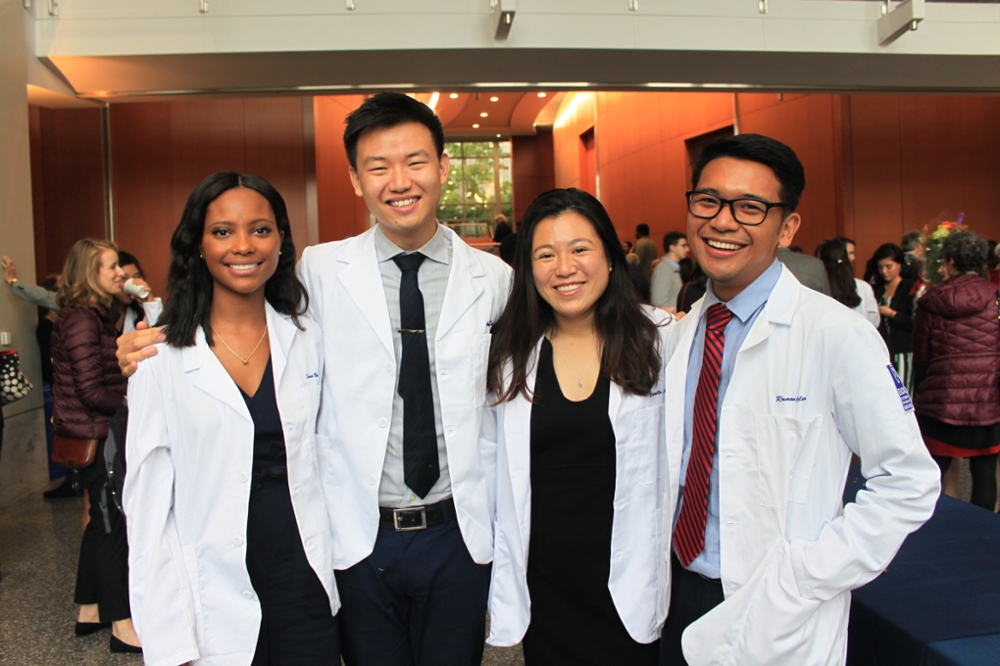
Annual traditions include the White Coat Ceremony, society picnics, a 5K, the Art Gala, the Halloween Ball, the Thanksgiving Potluck, Doctoberfest (the inter-society chili cook-off and field day), Match Day and the Senior Banquet.
Living in Atlanta
Atlanta is a metro area of more than 5 million people with mild winters, a cost of living lower than many major cities, and the world’s busiest airport about 30 minutes from campus. Students have the BeltLine and Piedmont Park, professional sports, the High Museum of Art and the Atlanta Symphony Orchestra, and hiking in the North Georgia mountains. Emory’s neighbors include the CDC, The Carter Center and the world headquarters of CARE, which makes the city an unusually good place to study medicine with a public health or global health focus.
Clinical Rotations and Research Opportunities
Clinical training
Clinical training starts in the first week with Week on the Wards. Within months, students learn histories and physical exams with standardized patients and begin the year-long Outpatient Clinical Experience in a primary care practice. Patients are presented in class from the first month of the Foundations phase. Core clerkships begin midway through the second year and run for 12 months, so students experience 14 or more disciplines in hospital and outpatient settings before they choose a residency. Primary care is built in throughout: every first-year student works in a primary care practice, and every student completes adult and pediatric primary care rotations at sites around Atlanta.
Grady Memorial Hospital is central to the experience. It is one of the largest public hospitals in the Southeast, with a Level I trauma center, and it serves many uninsured and under-insured patients. Students also rotate at Emory University Hospital, Emory Midtown, Children’s Healthcare of Atlanta, the Atlanta VA Medical Center, Wesley Woods and the Emory Clinic. Because sites are spread across the metro area, plan on commuting during clerkships. Students from other medical schools may apply for up to two four-week visiting rotations at Emory.
Research
Every Emory student completes the five-month Discovery phase, and many publish their work. Students can extend Discovery by up to 12 months, take a research fellowship or degree program at another institution, or apply to the MD/MSCR or MD/PhD for more extensive training. About 25 to 30 percent of each class takes an extra year or more for one of these options. Emory’s research strengths include infectious disease, brain health, heart disease, cancer, transplantation and pediatrics, and the school reported $415.3 million in direct federal research grants and contracts in fiscal year 2024. Partnerships with the CDC, Georgia Tech, the Emory National Primate Research Center (formerly Yerkes) and the Winship Cancer Institute add research options that few schools can match.
Global health
Some students include an international experience in their Discovery project, and others travel through student organizations such as Project Medishare. Eight percent of Emory’s 2025 graduating seniors reported a global health experience during medical school. Applicants who want global health exposure before medical school can look at pre-med internships abroad, where interns take vitals, do intake and triage and help with direct care under supervision.
Residencies and Fellowships
Emory is one of the largest medical training institutions in the country, with 1,439 residents and fellows in 120 ACGME-accredited programs. Emory and its affiliates offer residency and fellowship programs that students can apply to after they complete their MD, in these departments and specialty areas:
- Anesthesiology: anesthesiology residency; cardiothoracic anesthesiology; critical care medicine; obstetric anesthesiology; pain medicine; pediatric anesthesiology.
- Dermatology: dermatology residency; micrographic surgery and dermatologic oncology.
- Emergency Medicine: emergency medicine residency; emergency medical services; medical toxicology.
- Family and Preventive Medicine: family medicine residency; preventive medicine residency.
- Human Genetics: medical biochemical genetics; medical genetics and genomics; pediatrics/medical genetics and genomics.
- Medicine: adult congenital heart disease; advanced heart failure and transplant cardiology; cardiovascular disease; clinical cardiac electrophysiology; endocrinology, diabetes and metabolism; gastroenterology; geriatric medicine; hospice and palliative medicine; infectious disease; internal medicine-psychiatry; interventional cardiology; nephrology; pulmonary disease and critical care; rheumatology; sleep medicine; transitional year; hematology and medical oncology.
- Neurosurgery: neurological surgery.
- Neurology: neurology residency; child neurology; clinical neurophysiology; epilepsy; vascular neurology; neuromuscular medicine.
- Gynecology and Obstetrics: obstetrics and gynecology residency; female pelvic medicine and reconstructive surgery; maternal-fetal medicine; reproductive endocrinology and infertility; complex family planning.
- Ophthalmology.
- Orthopaedics: hand surgery; orthopedic sports medicine; orthopedic surgery.
- Otolaryngology: otolaryngology residency; pediatric otolaryngology.
- Pathology and Laboratory Medicine: anatomic and clinical pathology residency; blood banking/transfusion medicine; cytopathology; dermatopathology; forensic pathology; hematopathology; medical microbiology; molecular genetic pathology; neuropathology; pediatric pathology; selective pathology (gastrointestinal, surgical and gynecologic).
- Pediatrics: pediatrics residency; allergy and immunology; pediatric cardiology; child abuse pediatrics; pediatric critical care medicine; pediatric emergency medicine; pediatric endocrinology; pediatric gastroenterology; pediatric hematology/oncology; pediatric infectious diseases; neonatal-perinatal medicine; pediatric nephrology; pediatric pulmonology; pediatric rheumatology; pediatric transplant hepatology; pediatric hospital medicine.
- Psychiatry and Behavioral Sciences: psychiatry residency; addiction psychiatry; child and adolescent psychiatry; consultation-liaison psychiatry; forensic psychiatry; geriatric psychiatry; internal medicine-psychiatry.
- Radiology: diagnostic radiology residency; integrated and independent interventional radiology; neuroradiology; nuclear medicine; nuclear radiology; pediatric radiology.
- Radiation Oncology: radiation oncology residency.
- Rehabilitation Medicine: physical medicine and rehabilitation residency; pediatric rehabilitation medicine; sports medicine; brain injury medicine.
- Surgery: general surgery residency; congenital cardiac surgery; oral and maxillofacial surgery; pediatric surgery; plastic surgery; surgical critical care; thoracic surgery; vascular surgery; colon and rectal surgery; complex general surgical oncology.
- Urology: urology residency; pediatric urology.
Training at an institution with this many programs means Emory students see nearly every specialty up close and can find mentors in almost any field. It does not guarantee a residency spot at Emory; residency selection is a separate national process.
Notable Alumni, Faculty, Leadership and Admissions Staff
The people below hold verified roles at Emory School of Medicine or are verified graduates of its MD program. Knowing who leads the school, who runs admissions and who directs the dual degrees helps you understand the program’s priorities. It does not mean that mentioning a name in an essay will help your application, so do not name people you have not actually worked with.
School leadership
Sandra L. Wong, MD, MS, Dean and Chief Academic Officer of Emory Healthcare. Dr. Wong became dean in March 2024, the first woman to lead Emory School of Medicine. She is a surgical oncologist who treats soft tissue sarcomas, melanoma and other skin cancers, and one of the most widely recognized health services researchers in academic surgery, with more than 250 peer-reviewed studies. Before Emory she chaired the Department of Surgery at Dartmouth Hitchcock Medical Center, where her work on rural health disparities helped launch the federally funded Center for Rural Health Care Delivery Science. She earned her MD at Northwestern University Medical School in 1997. Her background in health care delivery is a useful lens for the school’s emphasis on community health and access.
April O. Buchanan, MD, FAAP, Executive Associate Dean for Medical Education. Dr. Buchanan, a professor of pediatrics, leads medical education, the office responsible for the curriculum, clerkships and student assessment you will experience.
Ravi Rajani, MD, FACS, DFSVS, Executive Associate Dean for Emory at Grady. A professor of vascular surgery, Dr. Rajani leads the school’s work at Grady Memorial Hospital, where Emory students complete much of their clinical training. His role reflects how central Grady is to Emory’s educational mission.
Admissions leadership and staff
Ira K. Schwartz, MD, Dean of Admissions and Chair of the Admissions Committee. Dr. Schwartz leads the committee that decides who is offered a seat.
Martha Ward, MD, Associate Dean for Admissions and Student Affairs. Dr. Ward co-chairs the Admissions Committee and oversees student affairs. She is also the contact for the rare transfer requests Emory considers.
June Eddingfield, Associate Director of Admissions. Interview days open with a welcome session from the dean and associate director of admissions, so applicants who interview are likely to hear from the admissions office’s leadership directly. The admissions team also includes an admissions manager and senior program coordinators who handle applicant questions at [email protected].
Dual degree directors
Michael Goodman, MD, MPH, Director of the MD/MPH Program. A professor of epidemiology at the Rollins School of Public Health, Dr. Goodman directs the MD/MPH. MD/MPH applicants meet a representative of the Rollins School of Public Health on interview day.
Gerard Vong, DPhil, Director of the Master of Arts in Bioethics Program. Dr. Vong, an assistant professor in the School of Medicine, directs the MA that MD/MA students complete in place of Discovery. MD/MA applicants meet a representative of the Emory Center for Ethics on interview day.
Alumni
Manley “Sonny” Carter Jr., MD (Emory BA 1969, MD 1973). Carter completed an internal medicine internship at Grady Memorial Hospital, joined the Navy as a flight surgeon, became a Marine Corps fighter pilot and Navy test pilot, and was selected as a NASA astronaut in 1984. He flew as a mission specialist on the space shuttle mission STS-33 in 1989. He also played professional soccer for the Atlanta Chiefs while in medical school. Carter died on April 5, 1991, while traveling on NASA business. His career shows how far an Emory MD can reach.
Ferrol Sams Jr., MD (Emory MD 1949). After serving in the Army Medical Corps in World War II, Sams returned to Emory to finish medical school, then practiced medicine in his hometown of Fayetteville, Georgia, with his wife, Dr. Helen Fletcher Sams, whom he met at Emory. They founded the Fayette Medical Center in 1987. Sams also became one of Georgia’s best-known novelists, the author of Run with the Horsemen and its sequels, and was inducted into the Georgia Writers Hall of Fame in 2007. He taught creative writing at Emory and at Emory Medical School, and he died in 2013.
John Galloway, MD. Dr. Galloway trained entirely at Emory and has spent his career there. He joined Emory University Hospital’s Nutrition and Metabolic Support Service in 1986, is a professor of surgery in the Division of General and GI Surgery, and co-directs that service. In February 2026 the Emory Medical Alumni Board gave him its Award of Honor, one of the school’s highest alumni distinctions, alongside vascular surgeon William M. McKinnon, MD.
Admissions Statistics and Class Profile
Emory Medical School Acceptance Rate, Class Profile, and More
For the class that entered in fall 2026, Emory reported:
| Fall 2026 entering class | Number |
|---|---|
| Applications received | 13,909 |
| Applications completed (AMCAS plus supplemental) | 10,430 |
| Applicants interviewed | 627 |
| Applicants offered admission | 253 |
| Students in the first-year class | 140 |
| Women / men | 91 / 49 |
| MD/PhD students | 9 |
| MD/MPH students | 10 |
| Average age at matriculation (range) | 24.1 (21 to 39) |
| Undergraduate institutions represented | 49 |
| Undergraduate majors represented | 71 |
| Traditional students | 18 (13%) |
| Non-traditional students | 122 (87%) |
| Mean cumulative MCAT | 515.1 |
| Average undergraduate GPA | 3.83 |
Source: Emory School of Medicine, M1 Class Profile Fall 2026.
What the numbers mean
- Interview odds. 627 interviews from 13,909 applications is about 4.5% of all applications, or about 6% of completed applications. The interview, not the supplemental, is the main gate.
- Offer odds after an interview. 253 offers from 627 interviews means about 40% of interviewed applicants received an offer. Once you are invited, your interview performance and file matter as much as your numbers.
- Offers per application. 253 offers from 13,909 applications is about 1.8%. That is the closest figure to an acceptance rate the school’s data supports. It is offers, not enrolled students, divided by applications received.
- Yield. 140 students enrolled from 253 offers. Many admitted applicants hold several acceptances.
Accepted applicants in the 2025 entering class
| Measure (2025 entering class) | Value | Source |
|---|---|---|
| Median MCAT, all accepted applicants | 517 (mean 516.4, standard deviation 4.5) | AAMC MSAR |
| Median section scores (CPBS / CARS / BBLS / PSBB) | 129 / 128 / 129 / 130 | AAMC MSAR |
| Median GPA, accepted applicants | 3.89 | AAMC MSAR |
| Applicants interviewed | 615 (118 in-state, 464 out-of-state, 33 international) | AAMC MSAR (reported by the school) |
| Offers to waitlisted applicants | 21 | AAMC MSAR |
| Planned entering class, fall 2027 | 138 (128 MD, 10 MD/PhD) | Emory MD Admissions; AAMC MSAR |
Residency mix
Emory has no in-state preference that it publishes, and non-residents need no tie to Georgia. Of the 615 applicants interviewed for the 2025 entering class, 118 were Georgia residents, 464 were from other states and 33 were international. Georgia residents still have reasons to apply: they make up a meaningful share of interviewees, and Emory’s primary care loan forgiveness program targets graduates who stay in Georgia.
Premedical experience of matriculants
Among students who entered in 2025, 96% reported research or lab experience, 91% physician shadowing or clinical observation, 87% medical or clinical community service or volunteering, 84% community service or volunteering, 65% paid clinical employment and 1% military service. Nearly every Emory matriculant arrives with research, clinical service and shadowing. Paid clinical work is common but not universal.
Earlier class profiles
Emory’s application volume has stayed high for years. Emory received 12,880 applications in 2024, more than 12,000 for the class that began in 2025, and 13,909 for the fall 2026 class. Emory expects more than 13,000 applications for its fall 2027 class of 138. The share of non-traditional students has also stayed high: the 2024 entering class was 86% non-traditional, meaning students who were out of college for at least a year.
Tips and Strategies for Admission
1. Clear the prescreen with room to spare
The 502 and 124 prescreen gets you the supplemental, but the class mean is 515.1. If your latest score is near the cutoff, decide whether a retake is worth it, and remember the three-attempt cap. Because the latest score is used for the prescreen, a lower retake can cost you the supplemental entirely.
2. Apply early
Emory reviews files in roughly the order they are completed and grants no deadline extensions. Submit AMCAS in late May or June, return the supplemental within about two weeks of receiving it, and confirm that your letters are in AMCAS well before December 1. An application completed in October competes for far fewer remaining interview spots than one completed in August.
3. Build face-to-face clinical experience
Emory’s committee is “most interested in applicants who have face-to-face experience with the patient-doctor relationship.” Clinical employment (medical assistant, EMT, scribe, patient care tech), clinical volunteering and, in Emory’s words, “clinical volunteer work abroad” all count. Choose roles where you talk with patients, and keep notes so you can describe specific moments later. Structured internships for pre-med students can add supervised patient contact if your local options are limited.
4. Use your time off well
Eighty-seven percent of the fall 2026 class were non-traditional students who took a year or more off after college, and Emory says it does not consider time off a disadvantage. If you plan a gap year, fill it with work, service or research that you can describe in the curriculum plan essay. Pre-med gap year programs with real clinical duties can be one part of that plan.
5. Show sustained service to under-served communities
One of Emory’s five essays asks directly about service to under-served communities, and its curriculum sends every first-year student into a community partnership. Long-term commitment, where you can name what you did and what changed, will serve you better than a long list of short events.
6. Plan your letters around the hard sciences
Two of your letters should come from professors in biology, chemistry or physics, or from a research mentor who knows your scientific work. Emory explicitly does not count engineering or psychology as hard sciences. If your school has a committee and you do not use it, prepare a clear reason, because the supplemental asks.
7. Write specific, school-informed essays
Emory gives you only 200 words per essay, so every sentence must earn its place. Use Emory’s own program names (OPEX, Community Learning and Social Medicine, Discovery, the Society system) only where they connect to your own experience. Try to add new information to your application rather than repeating AMCAS or your personal statement.
8. Keep your file current
Keep your AMCAS contact information current, and let the Office of Admissions know if you will be out of the country or unreachable during interview season. After you submit, report real updates (new grades, publications, awards, roles) through the Application Update tab, which accepts text only, up to 1,000 words in total. Emory does not accept letters of intent.
9. Get perspective
Many applicants benefit from experienced feedback on their school list, essays and interview skills. International Medical Aid’s consultants review applications, help with essays and resumes, and run mock interviews. If you want to build clinical experience abroad, our healthcare internships abroad place pre-health students in supervised clinical settings.
Secondary Application Questions, Example Responses and Analysis
Emory Secondary Application: Essay Prompts, Sample Answers, and Advice
The essays you write for the Emory Supplemental Application should show your promise as a future physician and your understanding of the work it takes to become one. Your goals, intellect and personal history all matter. Without these essays and your personal statement, you are reduced to numbers (MCAT, GPA) and a list of activities. The essays are your chance to show who you are and why Emory, specifically, fits you.
Answer each prompt carefully, and add new information rather than repeating your AMCAS entries or your personal statement. Emory gives you only 200 words per core essay, so short, specific sentences work best.
Emory Secondary Essay Prompts (2026-2027 Cycle)
Emory sends its supplemental only to applicants who pass the MCAT prescreen. For 2026-2027 it contains five essays, each limited to 200 words. Emory does not publish the questions on its website, so the wording below is the version issued to 2026-2027 applicants. Always follow the exact wording and limits in your own portal.
| # | Prompt topic | Limit | Who answers |
|---|---|---|---|
| 1 | Curriculum plan for 2026-2027, or plans for the coming year | 200 words | All supplemental applicants |
| 2 | Health-related experiences | 200 words | All supplemental applicants |
| 3 | Interest in Emory and your selected degree program | 200 words | All supplemental applicants |
| 4 | Service to under-served communities | 200 words | All supplemental applicants |
| 5 | Updates since your AMCAS application | 200 words | Applicants with new information |
The supplemental also includes administrative items: your photo, your fee, the program you are applying to (MD, MD/PhD, MD/MPH, MD/MA in Bioethics or MD/MS in Robotics), and, if your school has a pre-health committee and you are sending individual letters instead, a short explanation of why you are not submitting a committee letter. If you do not meet a course requirement, the supplemental is also where you explain why.
Each example below is original and written for this guide. Use them to understand structure and specificity, not as text to copy.
Prompt 1: Curriculum Plan
List your entire curriculum plan for the 2026-2027 academic year. If you are not in school, please briefly describe your plans for the coming year.
Limit: 200 words. Status: Required. Cycle: 2026-2027. Who answers: All applicants who receive the Emory Supplemental Application (MCAT prescreen of 502 total and 124 per section, three or fewer attempts)
What it asks and how to approach it. This is a logistics question first. If you are in school, list every course you will take in fall 2026 and spring 2027, and flag any Emory requirement still in progress. If you are not in school, describe your job, service, research or other plans for the year with enough detail (role, hours, setting) that the committee can picture your schedule. Use any remaining words to show how the year builds toward medicine.
Example response (Illustrative example, not an actual applicant essay; 193 words):
I graduated in May 2026 and am working full time through the coming year. From January through June 2026 I was a medical assistant at a federally qualified health center in Macon, and I will stay there at 36 hours a week. I room patients, take vital signs, run point-of-care glucose and A1c tests, update medication lists and call patients with normal results the physician has signed off on. Our panel is about 60 percent uninsured, and I have started a small binder of free pharmacy and transportation resources that the front desk now uses.
On Tuesday evenings I will continue as an intake volunteer at a free clinic run by my church, where I help Spanish-speaking patients fill out intake forms. I am taking an online Medical Spanish course this fall so that I can do more than translate paperwork.
I completed all of Emory’s course requirements before graduating, including six semester hours of composition and six humanities and social science courses. I will finish a statistics refresher through a community college in spring 2027, since many Discovery projects rely on quantitative methods and I want to be ready for that work.
Why this example works. Emory asks for the whole year, so the example gives the reader a schedule: a job with hours, a weekly volunteer role, and the coursework already finished. It answers both halves of the prompt in practical terms. Because the applicant is out of school, it says what they will do instead and confirms that Emory’s specific course requirements (six semester hours of English and 18 hours of humanities and social sciences) are complete, which saves the committee a question. The details are specific: tasks, hours, patient population and one small improvement the applicant made. The last sentence ties the planned statistics class to Discovery, Emory’s five-month research phase, without turning the answer into a second “Why Emory” essay.
Mistakes to avoid and tips. If you are still in school, list each fall and spring course by title and note any required course still in progress, then add one sentence on how the load fits your plans. Mistakes to avoid: a bare list with no context, vague plans such as “gain more experience,” and leaving out an unfinished prerequisite. Exceptions to course requirements are granted only by the Admissions Committee, so if you are short a requirement, say so plainly here or in the space the supplemental provides.
Prompt 2: Health-Related Experiences
Briefly describe your health-related experiences. Be sure to include important experiences that are in your AMCAS application, as well as any recent experiences.
Limit: 200 words. Status: Required. Cycle: 2026-2027. Who answers: All applicants who receive the Emory Supplemental Application
What it asks and how to approach it. Emory wants a picture of your clinical and health-related exposure, including experiences already in AMCAS and anything new. With only 200 words, choose two to four experiences, lead with the ones that put you face to face with patients, and give each one a specific lesson rather than a list of duties. Write it as a short narrative with a beginning, a middle and a takeaway.
Example response (Illustrative example, not an actual applicant essay; 198 words):
My most important clinical experience has been two years as a medical assistant at a community health center, where I have roomed more than 3,000 patient visits. Taking a blood pressure is routine; asking a patient why her reading jumped after a month of good control is not. That question once uncovered that she had stopped her medication because her pharmacy changed and the new one was two bus transfers away. I learned that the vital sign was the start of the visit, not the end.
As a volunteer EMT for three years, I learned to give a clear handoff in under a minute and to stay calm when a scene was not. During a summer clinical internship in Kenya I took vitals, did intake and triage in a rural outpatient clinic and helped the clinical officers with wound care under supervision. Working through a translator taught me to check understanding with teach-back instead of assuming it.
I also shadow a palliative care physician monthly. Watching her lead a family meeting showed me how much of medicine is listening. Each setting has pushed me toward the same goal: primary care in a community that is hard to reach.
Why this example works. The prompt asks for health-related experiences, including the important ones already in AMCAS and anything recent. The example covers four settings in 200 words without becoming a list because each one gets a single lesson: the medical assistant role teaches that a vital sign starts a conversation, EMS teaches handoffs, the international internship teaches teach-back, and shadowing teaches listening. It describes duties accurately (vitals, intake, triage and supervised wound care) rather than inflating them, and it ends with a direction that connects the experiences. Emory’s admissions pages say the committee is most interested in face-to-face experience with the patient-doctor relationship, which is why the strongest space goes to direct patient contact.
Mistakes to avoid and tips. Lead with the experiences that put you closest to patients and give one moment that shows judgment. Mistakes to avoid: repeating AMCAS descriptions word for word, listing hours without saying what you learned, describing shadowing as if it were hands-on care, and leaving out a recent experience the committee has not seen.
Prompt 3: Why Emory
Briefly describe your interest in Emory and the Emory degree program you have selected.
Limit: 200 words. Status: Required. Cycle: 2026-2027. Who answers: All applicants who receive the Emory Supplemental Application; name the degree program selected (MD, or a dual degree such as MD/MPH or MD/MA in Bioethics)
What it asks and how to approach it. This is Emory’s “Why us?” question, and it has two parts: why Emory, and why the degree program you selected. Connect your own experiences to specific features of Emory: OPEX, Community Learning and Social Medicine, the Society system, Grady Memorial Hospital, the Discovery phase or a dual degree. Two or three well-explained reasons beat a long list, and using Emory’s own program names shows you have done your research.
Example response (Illustrative example, not an actual applicant essay; 196 words):
I want to learn medicine in a place where I start caring for patients early and keep caring for the same ones over time. Emory’s Outpatient Clinical Experience would put me in a primary care practice every other week for a full year, and Community Learning and Social Medicine would pair my small group with a community partner for the same year. That combination fits what I have learned as a medical assistant: patients trust the person who keeps showing up.
Grady Memorial Hospital matters for the same reason. Many of the patients I see at my health center are uninsured, and I want my core clerkships in a safety-net hospital that serves patients like them.
I am applying to the MD program and am interested in using the five-month Discovery phase for a health services project on medication access, a problem I watched delay care for one of my own patients. Emory’s ties to the Rollins School of Public Health would give me mentors in that field.
Finally, I value the Society system. Keeping the same small group advisor for four years, someone who hoods you at graduation, is the kind of mentorship I want.
Why this example works. The question has two parts: interest in Emory and interest in the degree program the applicant selected. The example names the program (the MD) and gives four Emory-specific reasons, each tied to the applicant’s own history: OPEX and Community Learning and Social Medicine (early, longitudinal patient contact), Grady Memorial Hospital (a safety-net population the applicant already serves), the Discovery phase (a research question drawn from real work) and the Society system (long-term mentorship). Every program named appears on Emory’s curriculum pages, so the essay shows research without reading like a brochure.
Mistakes to avoid and tips. Applicants to the MD/MPH, MD/MA in Bioethics, MD/MS in Robotics or MD/PhD should name that program here and give one concrete reason for it. Mistakes to avoid: praising rankings or reputation, listing programs with no personal link, and naming faculty you have never contacted as if they had agreed to mentor you.
Prompt 4: Service to Under-Served Communities
Emory School of Medicine is committed to recruiting and educating medical students who will help deliver quality health care and will promote the health of our patients. In our community, this includes learning about and addressing the health care needs of our most under-served populations. Please describe any of your activities that have been in service to under-served communities.
Limit: 200 words. Status: Required. Cycle: 2026-2027. Who answers: All applicants who receive the Emory Supplemental Application
What it asks and how to approach it. Read the preamble closely: Emory defines this service as learning about and addressing the health care needs of under-served populations. Describe sustained activities, say what you did and what changed, and show that you understand the community’s needs. Clinical and non-clinical service both count.
Example response (Illustrative example, not an actual applicant essay; 198 words):
For two years I have volunteered with a refugee resettlement agency in Clarkston, Georgia, where families from more than a dozen countries start over. I began by driving families to first medical appointments. I noticed that many arrived without understanding why they were there, so I worked with a nurse volunteer to create a one-page visit guide in Arabic, Dari and Swahili that explains what to bring and what will happen. The agency now gives it to every new family.
At my health center, about 60 percent of patients are uninsured. I keep a list of sliding-scale pharmacies and free transportation options and walk patients through it before they leave. Small fixes like these do not show up as procedures, but they decide whether a care plan works.
I also tutor high school students in chemistry through a free after-school program in southwest Atlanta, because a pipeline into medicine starts long before college.
These experiences taught me that serving under-served communities is mostly about access: getting people to care and making sure they understand it. I want to keep doing that work as a medical student, through Emory’s community partnerships and the Atlanta clinics where students already volunteer.
Why this example works. Emory’s preamble defines what it means: learning about and addressing the health care needs of under-served populations. The example answers with three activities and, more importantly, with what the applicant did inside each one: a visit guide created and adopted, a resource list used with patients, and ongoing tutoring. The closing paragraph names the lesson (access and understanding) and connects it to Emory’s Community Learning and Social Medicine partnerships and to the Atlanta clinics serving refugees and people experiencing homelessness that Emory’s student organization page describes.
Mistakes to avoid and tips. Write about service you sustained, and show the community’s needs, not your own sacrifice. Mistakes to avoid: describing a one-week trip as long-term service, speaking about a community as a backdrop for your growth, and claiming outcomes you cannot support. If your service has been mostly non-clinical, that is fine; the prompt asks about service to under-served communities, not only clinical work.
Prompt 5: Updates Since AMCAS
If you have any updates or new information to report since you have submitted your AMCAS primary application, please briefly describe below.
Limit: 200 words. Status: Answer if you have new information. Cycle: 2026-2027. Who answers: All applicants who receive the Emory Supplemental Application; answer if you have new information
What it asks and how to approach it. Report only new information since you submitted AMCAS: new grades, roles, publications, awards or experiences. Be concrete and brief. If you have nothing new, say so in a sentence.
Example response (Illustrative example, not an actual applicant essay; 129 words):
Since submitting my AMCAS application in June, I have three updates.
First, I was promoted to lead medical assistant at my health center in August. I now train new medical assistants on rooming and vital signs and run our weekly huddle on missed follow-up appointments. In the first eight weeks, our team reduced the list of patients overdue for A1c checks from 140 to 96.
Second, the poster I described in my Research section, on blood pressure control after a pharmacy closure, was accepted for presentation at the Georgia Public Health Association annual meeting in April 2027.
Third, I completed 40 hours of the online Medical Spanish course I mentioned in my curriculum plan and now use it during intake for routine questions, with an interpreter for anything clinical.
Why this example works. This prompt asks only for new information since AMCAS. The example gives three updates, each with a date, a role or result and a number where one exists. It does not repeat earlier essays, and it is careful about scope: the applicant uses Spanish for routine intake questions and an interpreter for clinical content. If nothing has changed, a one-line answer saying there are no updates at this time is better than filler.
Mistakes to avoid and tips. Emory accepts later updates as text only through the “Application Update” tab of the supplemental portal (a 1,000-word box that holds every update). It does not accept letters of intent or expressions of interest. Mistakes to avoid: restating your personal statement, sending attachments, and padding a minor change.
Dual degree essays
In earlier cycles, Emory’s supplemental included optional essays of up to 500 words for applicants interested in the MD/MPH or the MD/MA in Bioethics. The 2026-2027 dual degree questions have not been published, and the 2026-2027 prompt set described above lists only the five core essays. The two earlier prompts are below as practice prompts from the 2025-2026 cycle, with examples within the 500-word limit. Answer only the questions your own portal shows, and if your portal shows different dual degree questions, or questions for the MD/PhD or MD/MS in Robotics, answer those instead. Applicants to these programs meet a representative of the Rollins School of Public Health or the Emory Center for Ethics on interview day, so be ready to discuss the same ideas in conversation.
MD/MPH Practice Prompt: Interest in Public Health
Please describe your interest in public health and how you wish to combine this interest with a career in medicine.
Limit: 500 words. Status: Optional. Cycle: 2025-2026 (practice prompt; not listed for 2026-2027). Who answers: Optional, for applicants interested in the MD/MPH. Listed for 2025-2026 and earlier cycles; not listed in either 2026-2027 compilation.
What it asks and how to approach it. Explain where your interest in public health came from, what you have done about it, what you still need to learn, and how an MPH would change the kind of physician you become. Connect the plan to the MD/MPH’s structure at Emory.
Example response (Illustrative example, not an actual applicant essay; 459 words):
My interest in public health began with a blood pressure cuff. As a medical assistant at a community health center, I take dozens of readings a day, and over two years I noticed a pattern: patients whose blood pressure had been controlled for months would suddenly come back high. When I started asking why, the answers were rarely about the medicine itself. A pharmacy had closed. A bus route had changed. A refill required a phone call during work hours. The problem I kept seeing in one exam room was a population problem.
I asked our medical director whether we could look at this systematically. With her guidance I pulled de-identified data on patients with hypertension before and after a neighborhood pharmacy closed in 2025. Controlled blood pressure among patients who had used that pharmacy fell from 61 percent to 48 percent over six months, while it stayed flat among other patients. That small project taught me two things. First, I need better tools. I could describe a change, but I could not adjust for confounders or say how confident I should be. Second, the most useful fix was not clinical. When our clinic began offering mail-order refills and reminder texts, control started to recover.
That is why I want to combine medicine with an MPH. As a physician, I want to care for individual patients in primary care, and I want the training to see the patterns behind their visits and to design and test solutions that reach the whole panel. Epidemiology and biostatistics would let me ask better questions of the data I already see, and coursework in health policy would help me understand why a pharmacy closure can undo months of good care.
The MD/MPH at Emory fits that plan in specific ways. The year at the Rollins School of Public Health follows the clinical block, so I would bring two years of clerkship experience, including core rotations at Grady Memorial Hospital, into my public health training. The MPH year also satisfies the Discovery phase requirement, which means my research year and my public health degree would be the same project rather than two separate efforts. I would like to study medication access in safety-net settings and test whether simple delivery and refill changes improve control of chronic disease.
Atlanta also matters. Emory’s neighbors include the Centers for Disease Control and Prevention and the Georgia Department of Public Health, and I would value learning from people who run programs at that scale. In ten years I see myself as a primary care physician who also leads quality and population health work for a community health system, using data to find the patients who are falling through the cracks and building the services that bring them back.
Why this example works. This prompt appeared on Emory’s supplemental for MD/MPH candidates in earlier cycles (500 words or less, optional); the 2026-2027 compilations do not list it, so answer it only if your portal shows it. The example works because it shows a progression: an observation at the bedside, a small data project, a clear account of what the applicant could not yet do, and a plan for the MPH that fixes that gap. The Emory details are accurate and useful: the MPH year at the Rollins School of Public Health follows the clinical block and satisfies the Discovery requirement, and students can apply at admission or later. Numbers make the project concrete without overstating it.
Mistakes to avoid and tips. Mistakes to avoid: generic praise of public health, a list of global health trips with no question behind them, and claims of research results you cannot explain at an interview. If you are interested but undecided, say so; Emory lets medical students apply to the MD/MPH up until December of the third year.
MD/MA Practice Prompt: Interest in Bioethics
Please describe your interest in bioethics and how you wish to combine this interest with a career in medicine.
Limit: 500 words. Status: Optional. Cycle: 2025-2026 (practice prompt; not listed for 2026-2027). Who answers: Optional, for applicants interested in the MD/MA in Bioethics. Listed for 2025-2026 and earlier cycles; not listed in either 2026-2027 compilation.
What it asks and how to approach it. Ground your interest in a real ethical tension you have seen, show how you have studied or acted on it, and describe how you would use bioethics training in your career. Connect the plan to the MD/MA’s structure at Emory.
Example response (Illustrative example, not an actual applicant essay; 431 words):
The hardest conversation I have seen in medicine did not involve a diagnosis. It involved a daughter who wanted her father told less than the truth. I was a volunteer at a hospice in Macon, and the patient, a retired machinist, kept asking the nurse whether he was getting better. His daughter asked us not to answer directly. The nurse handled it gently, asking him what he wanted to know and letting him lead. He wanted to know everything. I left that afternoon with a question I still think about: when respect for a patient and loyalty to a family point in different directions, who decides, and how?
I took that question to a philosophy course on medical ethics the next semester, where we read about autonomy, beneficence and the limits of each. I wrote my final paper on truth-telling across cultures and learned how much depends on asking patients, not assuming. The course gave me vocabulary, but it also showed me how much I did not know about how ethics committees actually work and how clinicians make these choices in real time.
Since then I have sought out the practical side. At the health center where I work, I helped our medical director update our process for patients who need an interpreter for consent discussions, after I saw a consent form signed by a patient who clearly had not understood it. That was not a dramatic case, but it showed me that ethics happens in routine moments as well as in crises.
I want to combine bioethics with a career in internal medicine or palliative care. I see three roles for a physician trained in ethics: caring well for patients at the bedside, serving on or leading a hospital ethics committee, and teaching trainees how to handle conflicts between patients, families and teams before they become crises.
The MD/MA in Bioethics at Emory fits that goal. Students replace the Discovery phase with the MA year and step out after the clinical year, so I would study bioethics with real cases from my clerkships in mind. The program’s alumni serve as ethicists at places such as Grady Memorial Hospital and have published in peer-reviewed ethics journals, which shows me the degree leads to practical work, not only theory. I would like to study how family requests for nondisclosure are handled at a large safety-net hospital and whether a structured approach to those conversations helps patients get the information they want.
I am applying to the MD/MA because I believe ethical skill, like clinical skill, improves with formal training and deliberate practice.
Why this example works. This prompt appeared on Emory’s supplemental for dual degree candidates in earlier cycles (500 words or less, optional); the 2026-2027 compilations do not list it, so answer it only if your portal shows it. The example starts with a real ethical tension rather than a definition, follows the applicant’s interest from a bedside question to coursework to a practical change at work, and ends with specific roles and a research question. It uses accurate program facts: the MA year replaces the Discovery phase, the degree takes five years in total, and the program’s alumni work as ethicists at institutions including Grady Memorial Hospital.
Mistakes to avoid and tips. Mistakes to avoid: abstract philosophy with no patient in it, presenting yourself as the person who resolved a case you only watched, and describing confidential details that could identify a patient. Applicants who are drawn to bioethics but unsure can say so; Emory accepts applications to the MD/MA up to the fall term of the third year.
What to do if Emory changes a question
Prompts can change between cycles. In earlier years, for example, the fourth essay asked, “What do you consider to be the role of the physician in the community?” If you see that question, the advice still applies: focus on what physicians owe communities beyond the exam room (education, prevention, ethics, research that protects public health) and then on the role you intend to play. Alan H. Lockwood’s essay on the physician’s role in society in the AMA Journal of Ethics is a useful starting point; it argues that physicians have a responsibility to use their specialized knowledge to protect society as a whole, not just individual patients. If you feel you are reciting truisms, you have not yet given the specific examples and perspective that set your answer apart.
Interview Format and Preparation
Format
All 2026-27 Emory interviews are conducted remotely on Zoom. Each interview day includes:
- a welcome session with the dean and the associate director of admissions;
- two interviews, a group interview and a one-on-one interview;
- opportunities to talk with current medical students, faculty and admissions staff, with a meeting with a current Emory student available on request; and
- for MD/MPH and MD/MA in Bioethics applicants, a meeting with a representative of the Rollins School of Public Health or the Emory Center for Ethics.
Emory does not use the AAMC PREview exam or any other situational judgment test, and it does not use regional interviews. A full list of technical standards is shared with applicants before interview day. Emory has not published the content of its group interview, so prepare for a conversation-based group format rather than assuming a specific exercise.
MD/PhD applicants complete the MD interview process and also meet PhD faculty and recruiters in their programs of interest. MD/PhD interview dates for 2026-2027 are October 29-30, 2026, December 3-4, 2026, and January 21-22, 2027.
Timing
Interview invitations begin in late August or early September and continue until the end of the season, and they go out by email (sometimes by phone), so keep your AMCAS email current. Emory’s note to fall 2027 applicants says interviews run from October to March; other admissions pages describe a September through February season. Plan for interviews any time from early fall through late winter. Senior medical students serve on the Admissions Committee as interview panelists.
How to prepare
Know your file. Your interviewers will have your AMCAS and supplemental. Be ready to expand on every experience you listed, especially your clinical work, because Emory says the committee wants to hear you “speak thoughtfully” about your experiences in a clinical setting.
Prepare for the group interview. A group format tests how you listen, build on others’ ideas and contribute without dominating. Emory’s list of personal characteristics (communication, listening to others, warmth, logical and critical thinking, maturity) is a useful checklist. Practice discussing an ethics or health policy question with two or three other people, and have someone give you feedback on how often you invited others in.
Prepare for the one-on-one. Expect questions about why you want to be a physician, why Emory, a difficult experience, a time you worked on a team, and your understanding of current issues in health care. For “Why Emory,” connect your history to specific features: OPEX, Community Learning and Social Medicine, Grady, Discovery or a dual degree.
Set up your space. Use a quiet room, a neutral background, a reliable internet connection and a laptop at eye level. Test Zoom in advance and keep a phone number handy in case your connection drops.
Follow up correctly. Emory does not accept letters of intent or expressions of interest. If you have a real update after your interview, add it in text through the Application Update tab.
What is confirmed here comes from Emory’s own descriptions of interview day. The preparation advice is general practice for virtual group and one-on-one interviews.
Frequently Asked Questions About Emory School of Medicine
Does Emory use AMCAS?
Yes. Emory uses the AMCAS application for its MD and MD/PhD programs. The AMCAS deadline is October 15, 2026, at 11:59 PM Eastern. After AMCAS verifies your application and Emory confirms that your MCAT meets its prescreen, Emory emails you the Emory Supplemental Application, which is due December 1.
What is the median MCAT and GPA at Emory?
For the 2025 entering class, accepted applicants had a median MCAT of 517 and a median GPA of 3.89. Emory’s fall 2026 first-year class had a mean MCAT of 515.1 and an average undergraduate GPA of 3.83. Treat these as the competitive range, not as minimums: Emory sets no minimum GPA, and its MCAT prescreen is 502 with at least 124 on each section.
How does Emory’s tuition compare to peer private schools?
Emory’s MD tuition for 2026-27 is $62,000 for every student, regardless of residency, and the estimated 12-month cost of attendance is $116,242. Private medical schools do not publish costs in the same way, so compare total cost of attendance over the same 12-month period, and look at scholarship options. At Emory those include about 70 need-based and merit scholarships and six full-tuition Woodruff Fellowships each year. Atlanta’s cost of living is lower than that of many other major cities, which helps keep living expenses manageable.
Does Emory accept international applicants? DACA?
Yes to both. Emory welcomes applications from all persons, regardless of citizenship or visa status, and citizenship is not used to decide interviews or acceptances. International applicants whose degree is from outside the U.S. or Canada must complete all required science courses at an accredited U.S. or Canadian institution. TOEFL scores are not required. DACA and international students are eligible for Emory’s merit scholarships, but international students are not eligible for federal loans and must secure their own funding.
What MCAT score do I need to receive Emory’s secondary application?
For the 2026-27 cycle, your latest MCAT must be at least 502 overall with at least 124 on each of the four sections. If you have more than one score, Emory uses your latest score for the prescreen. You also must have taken the MCAT no more than three times. Meeting the prescreen gets you the supplemental; it does not make you competitive, since the entering class averages about 515.
How many times can I take the MCAT for Emory?
Emory considers only your first three MCAT attempts. An applicant who has taken the MCAT four or more times does not receive the supplemental, although Emory may consider an exception if your latest scores are at or above its mean of about 515 and your circumstances changed significantly. Scores are never averaged; the committee sees every section score from every attempt.
What is Emory’s acceptance rate?
Emory does not publish an official acceptance rate. For the fall 2026 entering class it received 13,909 applications and offered admission to 253 applicants, which works out to about 1.8% of applications received. About 40% of interviewed applicants (253 of 627) received an offer, so the interview is the key step.
Does Emory have a minimum GPA?
No. Emory does not prescreen on GPA and considers postbaccalaureate and graduate coursework for applicants with a lower undergraduate GPA. The committee carefully considers your science GPA and the trend of your grades, and the entering class averages a 3.83 GPA, so a strong record still matters.
Does Emory give preference to Georgia residents?
Emory charges the same tuition to all students and requires no relationship to Georgia for non-residents. Of the 615 applicants interviewed for the 2025 entering class, 118 were Georgia residents, 464 were from other states and 33 were international. Georgia residents should still consider the state’s public schools, and Emory’s primary care loan forgiveness program rewards graduates who practice in Georgia.
Does Emory require shadowing or clinical experience?
Emory recommends shadowing but does not require it. It does expect clinical experience: all applicants must have experience in a clinical setting, and the committee is most interested in face-to-face experience with the patient-doctor relationship, such as hospital volunteering, clinical volunteer work abroad, clinical employment and shadowing. Among students who entered in 2025, 91% reported shadowing or clinical observation and 87% reported clinical volunteering.
How does the Emory interview work?
All 2026-27 interviews take place on Zoom. Each interview day includes a welcome from the dean and associate director of admissions, a group interview, a one-on-one interview, and time to talk with students, faculty and staff. MD/MPH and MD/MA in Bioethics applicants also meet a representative of the Rollins School of Public Health or the Emory Center for Ethics.
When will I hear back from Emory?
Emory uses rolling admission. The Admissions Committee meets monthly from October through March and mails acceptance letters after each meeting; it does not send acceptances by email or phone. If you are interviewed but not accepted right away, you stay in consideration for later meetings. Every completed applicant receives a final decision in March, and Alternate Status offers follow the last meeting.
Does Emory require a deposit, and how long do I have to respond?
No deposit is required. Accepted applicants have two weeks from receipt of the acceptance letter to confirm their seat. After that, Emory follows the AAMC protocols: hold only one acceptance after April 30, select Plan to Enroll by June 1 and Commit to Enroll by July 20.
Can I send letters of intent or updates to Emory?
Emory does not accept letters of intent or expressions of interest. You can report significant updates, such as new grades, publications, awards or roles, as text through the Application Update tab in the supplemental portal. The box holds up to 1,000 words in total, so keep earlier updates and add dated entries. Attachments are not accepted.
What is the Woodruff Fellowship?
The Robert W. Woodruff Fellowship is Emory’s top merit award. Six entering students each year receive full tuition and a stipend for all four years. There is no separate application: applicants accepted in the initial class, through mid-March, are automatically considered. DACA and international students are eligible.
Does Emory accept AP credit, pass/fail courses and community college courses?
Yes. AP and IB credit count if they appear on your college transcript, though Emory recommends an upper-level course in any science where you used AP or IB credit. Pass/fail and online coursework are accepted toward the requirements, and so is community college coursework.
Does Emory accept transfer students?
Rarely. Emory considers a transfer from another accredited U.S. or Canadian MD program only when the dean or education dean of the student’s current school writes to Emory’s Dean of Admissions with a detailed reason. Requests from students themselves are not considered, and decisions are made case by case.
Can I apply to the MD/PhD and the MD at the same time?
You can be considered for both, but not at once. All applications are prescreened by the School of Medicine, and if you choose the MD/PhD you receive the MD/PhD supplemental. If you are not accepted to the MD/PhD, or you withdraw from that pool, you can ask to have your application moved to the MD-only pool.
Related Medical School Guides
These guides cover schools that Emory applicants often consider alongside it:
- Mercer University School of Medicine: another Georgia MD option, with a mission focused on rural and medically underserved Georgia.
- Medical College of Georgia: Georgia’s public MD school, a key option for Georgia residents comparing costs with Emory’s single private tuition.
- University of Georgia School of Medicine: Georgia’s newest public MD program, worth comparing if you want to stay in the state.
- Morehouse School of Medicine: Emory’s Atlanta neighbor and partner, whose physicians also practice at Grady Memorial Hospital.
- Wake Forest University School of Medicine: a private research-focused MD program in the Southeast.
- USF Morsani College of Medicine: a Southeastern MD option with a large academic health system in Tampa.
- Vanderbilt University School of Medicine: a highly selective private research school in the Southeast that many Emory applicants also consider.
For every MD program in the state, see our guide to medical schools in Georgia, and for advice on supplemental essays at every school, see our guide to medical school secondary essay prompts.
More medical school guides
We have many more ultimate medical school guides for you to explore:
- Boston University School of Medicine
- California University of Science and Medicine
- UC San Diego Medical School
- California Northstate University College of Medicine
- Touro University of California
- CHSU College of Osteopathic Medicine
- UC Davis School of Medicine
- Harvard Medical School
- UC Riverside School of Medicine
- USC Keck School of Medicine
- UT Southwestern Medical School
- Long School of Medicine at UT Health San Antonio
- University of the Incarnate Word School of Osteopathic Medicine
- UT Austin’s Dell Medical School
- UTMB School of Medicine
- McGovern Medical School at UT Health
- Johns Hopkins School of Medicine
- The University of Texas Rio Grande Valley School of Medicine
- UNT Texas College of Osteopathic Medicine
- University of Houston College of Medicine
- Texas A&M College of Medicine
- Baylor College of Medicine
- George Washington University School of Medicine
- St. George’s University School of Medicine
- Lake Erie College of Osteopathic Medicine (in Pennsylvania)
- Sidney Kimmel Medical College at Thomas Jefferson University
- Western University of Health Sciences (in California)
- Drexel University College of Medicine
- Stritch School of Medicine at Loyola University Chicago
- Georgetown University School of Medicine
- Yale School of Medicine
- Perelman School of Medicine
- UCLA Medical School
- NYU Medical School
- Washington University School of Medicine
- Brown Medical School
How International Medical Aid Can Help
Admissions Consulting: A Critical Tool for Medical School Applicants
We work hard to keep this website complete and up to date, and it answers most of the questions we receive. Still, nearly every applicant benefits from one-on-one guidance. Our experienced consultants and physicians review applications, answer questions, strengthen essays and resumes, conduct mock interviews and more. Whether you want help with the entire process or feedback on a few key pieces, we can help. You can find more information about our medical school admissions consulting services here.
Voluntary Healthcare Internships Abroad
Emory expects applicants to have face-to-face clinical experience, and top medical schools in general look for it. International Medical Aid runs medical internships abroad in Kenya and other sites for pre-health students. In our pre-health internships, interns work alongside local clinicians: they take vitals, do intake and triage, and help with direct patient care under supervision. Our medical internships for undergraduates also include teaching sessions and community health outreach, so interns see how care reaches people who live far from a hospital.
Our healthcare internships give you a global health perspective, hands-on experience and teamwork skills to write about in Emory’s health-related experiences essay and to discuss at interviews. They are not affiliated with Emory and do not affect admission decisions; their value is the experience itself and what you learn from it. Our interns leave with lasting relationships and a clearer sense of why they want to practice medicine.
Next step: if you are planning your clinical experience for the 2026-27 or 2027-28 cycle, compare our program dates with your MCAT and application timeline, then talk with an advisor about where an internship fits.
Final Thoughts and Sources
Good Luck to You!
Emory looks for academically excellent applicants who have real clinical experience, a record of serving their communities and a clear reason to train in Atlanta. Before you apply, check your latest MCAT against the 502 and 124 prescreen, confirm your science letters, and plan to submit AMCAS early so you can return the supplemental well before December 1. Then write five short essays that each add something new.
We hope this information helps you on your path to medical school, and we wish you the best of luck in your academic and professional career.
Sources and notes
Facts in this guide were checked on November 13, 2026. Cohorts and years are labeled where they appear.
- Emory School of Medicine: MD Admissions, MD Admission FAQ, How to Apply Steps 1-6 and MD Admission Deadlines (2026-2027 cycle).
- Emory School of Medicine: M1 Class Profile Fall 2026 (fall 2026 entering class).
- Emory School of Medicine: MD Program Costs (2026-27) and Types of Financial Aid; Emory Office of Financial Aid, Medicine Cost of Attendance Estimate (Fall 2026-Spring 2027).
- Emory School of Medicine: MD Curriculum, Four Phases in Four Years, Clinical Training, Societies and Small Group Learning, Discovery Phase and LCME Accreditation pages.
- Emory School of Medicine: Educational Programs, MD/PhD program and admissions FAQ (2024-25 recruitment statistics), and MD/MPH, MD/MA in Bioethics, MD/MBA, MD/MSCR and MD/MS in Robotics pages.
- Emory School of Medicine: Vision and Mission, Accreditation, Facts and Figures, Leadership, About the Dean, History, Emory’s Health Ecosystem, Our Building, Living in Atlanta, Center for Holistic Student Success, Student Organizations and Activities, and MD Admissions team pages.
- Emory Woodruff Health Sciences Center, At a Glance 2025 (applications in 2024, Step 1 pass rate in 2024, program counts).
- AAMC Medical School Admission Requirements (MSAR), Emory University School of Medicine profile, 2026 edition (2025 entering class data; 2026-27 cycle policies): accepted applicant MCAT and GPA medians, interview counts, waitlist offers, interview format, letters, premedical experience, aid and research funding.
- 2026-2027 supplemental prompt wording: two current-cycle prompt compilations (Accepted.com, posted July 23, 2026, and Med School Insiders, 2026-2027), which list identical prompts. Dual degree practice prompts: 2025-2026 cycle listings.
- Alumni: NASA astronaut biography of Manley L. “Sonny” Carter Jr.; New Georgia Encyclopedia, Ferrol Sams (1922-2013); Emory Department of Surgery, Galloway and McKinnon Award of Honor (February 2026).
See more of our guides in your Google results: add International Medical Aid as a preferred source on Google.