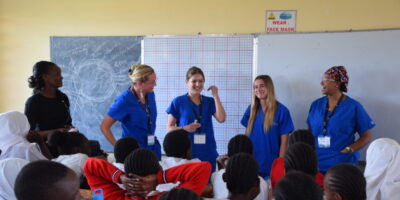
Noorda College of Osteopathic Medicine (Noorda-COM) is a four-year osteopathic medical school in Provo, Utah, that grants the Doctor of Osteopathic Medicine (DO) degree. It sits on a 30-acre campus in south Provo, between Utah Lake and the Wasatch Mountains, about 45 minutes south of Salt Lake City. The school enrolled its first class in 2021, graduated its first class in 2025 and now holds full accreditation from the Commission on Osteopathic College Accreditation.
Noorda-COM is known for a learning model that looks different from most medical schools. There are no scheduled lectures. Students watch short faculty-recorded videos and work through them with a small group of classmates in on-campus study rooms called learning pods, then attend in-person labs, simulations and clinical experiences. The school was founded to train compassionate osteopathic physicians for Utah’s fast-growing population, and it welcomes qualified applicants from every state.
This guide covers the 2026-2027 application cycle for students who will start medical school in July 2027. Noorda-COM takes applications only through the American Association of Colleges of Osteopathic Medicine Application Service (AACOMAS), reviews them on a rolling basis and accepts them until April 30, 2027. If you are planning for a later cycle, the same structure applies with new dates. All facts were checked on October 23, 2026.
So what does it take to get in? What are the average MCAT and GPA, how much does it cost, what does the secondary video ask, and what is the interview like? The sections below answer those questions in the order you will face them, from whether Noorda-COM fits you, to what it requires and costs, to how to present yourself in the secondary and the interview.
Key Takeaways
- Eligibility. Noorda-COM considers only U.S. citizens and permanent residents. It does not accept international or DACA applicants. Residents of every state are welcome; in a recent first-year class of 193 students, 142 came from outside Utah.
- Academic context. The Fall 2026 entering class of 192 students averaged a 503 MCAT, a 3.52 cumulative GPA and a 3.41 science GPA. The school prefers a 500 MCAT with at least 125 in each section and a 3.0 GPA, and it will not consider an MCAT total below 495.
- Mission fit. The mission is to train “competent, confident and compassionate osteopathic physicians” for the communities they serve. Service, teamwork and a clear reason for choosing osteopathic medicine matter in every step of the review.
- Key dates. The AACOMAS application opened in May 2026 and closes April 30, 2027. Secondaries started going out June 15, 2026, and are due April 30, 2027. Review is rolling, so earlier is better.
- The secondary is a video. Invited applicants record a video of up to 8 minutes that answers four questions about who they are, service, teamwork and why Noorda and osteopathic medicine. The fee is $60.
- Costs. Tuition for 2026-2027 is $71,210 for every student, regardless of state. The full first-year cost of attendance is $119,607. Most students pay with private student loans.
- Distinctive training. Learning pods instead of lectures, weekly in-person OMM labs, OSCEs in all four years, required research in all four years, a longitudinal nutrition curriculum and six-week third-year rotations with on-campus prep and assessment weeks.
- Next step. If you are applying this cycle, submit AACOMAS at least four weeks before the deadline, plan your secondary video now and line up a letter from an academic source.
Key Statistics About Noorda College of Osteopathic Medicine
What Are Noorda College of Osteopathic Medicine’s Average MCAT and GPA?
The Fall 2026 entering class at Noorda-COM averaged a 503 MCAT score, a 3.52 cumulative undergraduate GPA and a 3.41 science GPA across 192 matriculants (Noorda-COM Institutional Outcomes, 2026). These are averages, not minimums: the school prefers a 500 MCAT and a 3.0 GPA.
The school’s averages have been steady. Average MCAT scores for the last four entering classes were 503, 502, 502 and 503, while the average cumulative GPA rose from 3.41 for Fall 2023 to 3.52 for Fall 2026. An applicant with a 500 to 505 MCAT and a GPA above 3.4 is inside the range of recent classes, and an applicant below those numbers can still be competitive with a strong upward trend, because the school evaluates your last 60 credit hours as a separate measure.
The graphic and the table below come from the same verified fact record. Each figure names its cohort or academic year, because class data, tuition and outcomes are published on different schedules.

| Measure | Value | Cohort, population and source |
|---|---|---|
| School and degree | Noorda College of Osteopathic Medicine (Noorda-COM), Doctor of Osteopathic Medicine | Noorda-COM About Us |
| Location | Provo, Utah; 30-acre campus; 140,000-square-foot academic building | Noorda-COM FAQs |
| Institution type | Private, for-profit (proprietary); founded 2019; first class 2021 | Choose DO Explorer; COCA directory, September 2026 |
| Accreditation | COCA Accreditation; last visit fall 2024; next visit 2028-2029 | COCA directory, September 2026 |
| Approved class size | 180 per year, with an 8% variance | Noorda-COM FAQs |
| Entering class | 192 matriculants | Fall 2026 entering class (Noorda-COM Institutional Outcomes) |
| Average MCAT | 503 | Fall 2026 entering class, matriculants (Noorda-COM Institutional Outcomes) |
| Average cumulative GPA | 3.52 | Fall 2026 entering class, matriculants (Noorda-COM Institutional Outcomes) |
| Average science GPA | 3.41 | Fall 2026 entering class, matriculants (Noorda-COM Institutional Outcomes) |
| Average age; gender | 25; 49% female, 51% male | Fall 2026 entering class (Noorda-COM Institutional Outcomes) |
| Total enrollment | 577 students | Choose DO Explorer, labeled 2024-2025 academic year |
| In-state and out-of-state first-years | 51 in-state; 142 out-of-state | Choose DO Explorer (first-year total of 193 equals the Fall 2025 class) |
| Acceptance rate | Not published | Neither the school nor Choose DO publishes applicant, interview or acceptance counts |
| Preferred MCAT; minimum | 500 with 125 per section; 495 minimum | Noorda-COM Admissions, 2026-2027 cycle |
| Preferred GPA | 3.0 cumulative and science | Noorda-COM Admissions |
| Citizenship | U.S. citizens and permanent residents only; no international or DACA applicants | Noorda-COM Admissions; Choose DO Explorer |
| Application deadline | April 30, 2027 (AACOMAS and secondary) | Noorda-COM Admissions; Choose DO Explorer |
| Secondary | Video of up to 8 minutes (preferred) or essay; $60 fee, waivable | Noorda-COM Admissions and FAQs; Choose DO Explorer |
| Interview | Traditional format with faculty or staff; virtual or in person | Noorda-COM FAQs; Choose DO Explorer |
| Tuition | $71,210, all residencies | 2026-2027, OMS I (Noorda-COM tuition page; Choose DO Explorer) |
| Student fees; health insurance | $2,635; $6,086 | 2026-2027, OMS I (Noorda-COM tuition page) |
| First-year cost of attendance | $119,607 | 2026-2027, OMS I (Noorda-COM tuition page) |
| Four-year tuition and fees | $318,282 (school estimate) | Noorda-COM tuition page, 2026-2027 |
| Students with financial aid | 87% | Choose DO Explorer |
| Average debt, Class of 2026 borrowers | $244,454 | Noorda-COM Student Debt Ratio, as of June 12, 2026 |
| COMLEX Level 1 first-time pass rate | 89.1% (national 90.2%) | 2025-2026 (Noorda-COM Institutional Outcomes) |
| 2026 Match | 94.7% initial match; 98.3% overall placement; 55% primary care | Class of 2026 (Noorda-COM Institutional Outcomes) |
A note on selectivity: Noorda-COM does not publish how many people apply, interview or receive offers, so no acceptance rate can be calculated from official data. Dividing the class size by an applicant count from an unofficial source would give a matriculation ratio, not an acceptance rate, and it would understate how many applicants receive offers. Use the average MCAT and GPA as your main benchmark, then compare your experiences with the mission priorities described below. Our table of medical school GPA and MCAT averages puts these numbers next to other DO and MD schools.
Mission and Educational Priorities
Noorda-COM’s mission is short and specific. In the school’s words:
“Our mission at Noorda-COM is to empower our students with the essential personal and professional skills needed to be competent, confident and compassionate osteopathic physicians dedicated to meeting the healthcare challenges of the communities in which they serve.”
The vision adds the values the school wants to build: “Our vision is to become a leader in osteopathic medical education through innovative, progressive, and effective curricular offerings. We hope to instill values that embrace change, foster cultural awareness, diversity and ethical leadership, and inspire a servant’s heart towards caring for all people including the underserved.”
The Nine Guiding Principles
The work at Noorda-COM centers on nine guiding principles that shape curricular, teaching and administrative decisions. The school says it hopes “to never lose sight of learning and never confuse profit for growth.” The principles are:
- People matter most; students are at the center of everything the school does.
- Quality academic programs and excellence in teaching are the priorities.
- Strong moral character, ethical decision-making and mutual respect are built into all the school does.
- Diversity is an essential element of the Noorda-COM experience.
- Technology and innovation are used to improve learning and operational efficiency.
- College resources go toward the highest quality in students, faculty and programs.
- Financial decisions balance costs with stabilizing student debt.
- Investment in people takes the form of fair compensation and opportunities for individual growth.
- A culture of service to the community guides relationships.
Commitment to Education, Research and Community Service
The mission shows up in concrete programs. On the education side, the curriculum is built around the student, with self-paced video content, small-group learning pods and frequent feedback. On the research side, every student completes a required Research Foundations sequence in all four years and works on a project in a faculty member’s lab. On the service side, students volunteer at community health events from the second semester of the first year, provide supervised care at the United Way’s Volunteer Care Clinic in Provo in the second year and run free school health screenings through Noorda CARES and the Kaufusi’s Keikis outreach program.
What the Mission Means for Your Application
Three themes in the mission matter most for applicants.
First, the phrase “communities in which they serve” points to service that lasts. The admissions page lists commitment to an organization for more than two years as a non-academic experience the committee looks for, and the secondary video asks directly what service means to you. Long-term service carries more weight than a long list of one-day events.
Second, “competent, confident and compassionate” describes a balance. Competence is your academic record. Confidence comes through in how you communicate, which is one of the interview criteria. Compassion shows in how you talk about patients and the people you have served.
Third, the vision’s “servant’s heart towards caring for all people including the underserved” connects to the school’s founding purpose. Noorda-COM was created to address physician shortages in fast-growing Utah, and it works with the state legislature and hospitals to expand residency training in Utah. Applicants who can explain how they want to serve a community, whether in Utah, a rural area or another underserved setting, fit that purpose. The school does not require Utah residency or a promise to practice in Utah, and most students come from other states.
These priorities also shape the four questions in the secondary video, which ask about who you are, service, teamwork and why you chose Noorda and osteopathic medicine. Read the mission and vision before you plan the video, then show those values through your own examples rather than repeating the school’s words back.
Accreditation and Institutional Identity
Noorda-COM holds full Accreditation from the Commission on Osteopathic College Accreditation (COCA), the accreditor for osteopathic medical schools recognized by the U.S. Department of Education. COCA’s directory of colleges of osteopathic medicine, dated September 2026, lists Noorda-COM as established in 2021 with an accreditation status of “Accreditation,” a last accreditation visit in fall 2024 and the next visit scheduled for the 2028-2029 academic year.
Like every new osteopathic school, Noorda-COM moved through COCA’s stages before it reached full status. It enrolled its first class under pre-accreditation and graduated that class in 2025. The current status means the school has completed the developing-college process and is now on COCA’s regular review cycle.
Main Accreditations
- COCA Accreditation for the DO program, confirmed on the school’s accreditation page and in COCA’s September 2026 directory.
- ACGME sponsoring institution. Noorda-COM is an accredited sponsoring institution with the Accreditation Council for Graduate Medical Education and runs an ACGME-accredited Osteopathic Neuromusculoskeletal Medicine residency (ONMM3) with two positions.
- Regional accreditation. The school plans to apply for institutional accreditation through the Northwest Commission on Colleges and Universities (NWCCU). This is separate from COCA accreditation, which governs the DO degree.
Why Accreditation Matters
COCA accreditation is what allows Noorda-COM graduates to take the COMLEX licensing exams, enter residency programs accredited by the ACGME and apply for a medical license in every U.S. state. Accreditation confirms that a school meets COCA’s standards. It is not a ranking and it does not guarantee any single student’s outcome, so you should still look at a school’s outcomes, cost and fit. Noorda-COM’s published outcomes, such as COMLEX pass rates and match results, are covered in the statistics section below.
Verification Details
You can confirm the current status in the COCA directory on osteopathic.org and on Noorda-COM’s accreditation page, which also explains how to file a complaint about compliance with a COCA standard. Complaints go first to the Dean, and if the outcome is unsatisfactory, to the AOA Department of Accreditation in Chicago.
Institutional Identity
Noorda-COM is a proprietary (for-profit) institution overseen by a board. It qualifies as an IRS-certified Program Related Investment, which allows private foundations to invest in mission-aligned proprietary work, and the Ray and Tye Noorda Family Foundation is its lead investor. The school also has a separate 501(c)(3) foundation that accepts donations for scholarships, research, academic programs and community outreach, including Noorda CARES. The school’s website has moved from noordacom.org to noorda.edu, and old links redirect.
Medical Programs and Affiliations
Noorda-COM offers one medical degree, the Doctor of Osteopathic Medicine, on one campus in Provo. There are no separate campuses, and there is no Early Decision Program. Every student enters the same four-year DO program through AACOMAS, and options such as a second degree or an elective track are added after you enroll.
Doctor of Osteopathic Medicine (DO)
The DO program is a four-year, full-time, in-person program. The first two years combine foundational and systems-based sciences with clinical skills, osteopathic manipulative medicine and research. The third year is built around six core clinical rotations, and the fourth year adds a required emergency medicine rotation, electives and sub-internships. The curriculum section below explains how the learning pods, labs and simulations fit together.
Dual Degrees
Noorda-COM is not the degree-granting institution for its dual degrees. Each is offered through a partner university, and the school states that neither one interferes with the DO program’s maximum length of completion.
- DO/MBA with a Healthcare Leadership Concentration. Offered through Utah Valley University’s Woodbury School of Business. The concentration is aimed at students who want leadership or administrative roles in health systems.
- DO/MPH. Offered through the University of Nebraska Medical Center, fully online. DO students apply for UNMC’s Certificate in Public Health in their first year, with approval from the academic deans, and complete the certificate during the first two years. To continue to the MPH, they apply in the second year by June 1 and graduate with the DO and MPH at the same time.
Associate Dean of Student Affairs Casey Himmelsbach is the contact for both programs.
Elective Tracks
The curriculum includes an elective track with an emphasis in global health, research, rural medicine or military medicine. The research track, which starts the summer after the first year, adds a research internship, journal club and research electives. Military medicine has a strong presence: Noorda-COM is approved by the U.S. Department of Veterans Affairs for education benefits, the chair of clinical sciences also serves as Director of Military Medicine, and in one recent year 56 students held Health Professions Scholarship Program (HPSP) awards with the Army, Navy, Air Force or VA.
Research Collaborations
Research is done in Noorda-COM’s own labs and in collaboration with Brigham Young University, Utah Valley University and Roseman University. Faculty labs cover topics such as chronic migraine and neurotrauma, drugs of abuse and inflammation, pharmacogenomics, DNA and biomarkers, neurodegenerative disease and extended reality, cell adhesion and biologics, and osteopathic manipulative medicine. Noorda-COM also publishes the Intermountain Journal of Translational Medicine and hosts an annual research summit.
Clinical Affiliations
Third-year rotations take place mainly at hospitals and clinics in Utah County and along the Wasatch Front, with additional sites in rural Utah and other states, including an established cohort in Miami, Florida. Listed partners include Intermountain Health hospitals (Utah Valley Hospital, American Fork, Orem Community, Spanish Fork, Riverton and Primary Children’s in Lehi), MountainStar hospitals (Timpanogos Regional, Mountain View in Payson and Lone Peak in Draper), Steward hospitals (Jordan Valley and Mountain Point), and Castleview Hospital in Price, Central Valley Medical Center in Nephi, Provo Canyon Behavioral Hospital, Utah State Hospital and Utah Valley Specialty Hospital. The full list is in the clinical rotations section.
Graduate Medical Education
Noorda-COM helped secure state funding in 2022 for new residency programs in Utah, and it is now an ACGME sponsoring institution with its own Office of Graduate Medical Education led by Dr. Michael Rhodes. Its first residency, the 12-month ONMM3 program, trains physicians who have finished a residency to add certification in neuromusculoskeletal medicine, with clinics on campus. Medical students are not placed in these positions, but the program shows the school’s investment in osteopathic training after graduation.
Global Health and Community Engagement
Students can join the Global Health and Surgery Club, the global health elective track and local service programs. The school has listed participation in domestic or international humanitarian and medical service trips among the non-academic experiences it values in applicants. If you want to build similar experience before medical school, IMA’s international healthcare internships place pre-health students in supervised clinical settings abroad.
Curriculum Overview
Noorda-COM describes its model as “a better way to become a physician.” The core idea is that students learn the content on their own schedule, in small groups, and spend their in-person time on labs, simulations, clinical work and research rather than sitting in a lecture hall.
Learning Pods Instead of Lectures
There are no scheduled lectures and no large classroom lectures. Faculty record short video segments tied to defined learning objectives. Each day, students meet with their “podmates,” a group of 2 to 8 students, in one of the building’s 70 learning pods to review the content together. Each video includes a “pod play,” a quiz or case study that tests understanding. Pods usually meet for 2 to 3 hours a day, and faculty are available in person or online to answer questions. Videos are supplemented by weekly in-person reviews.
Pods have a widescreen TV, whiteboard and glass walls for diagrams, and charging blocks. Students can choose a conference-room setup or a living-room setup with couches. After pod time, students study on their own, attend labs or rotations, or work on research, then watch the next day’s new content.
How pods are used changes by year:
- First year: Foundational biomedical sciences, such as biochemistry, plus clinical courses.
- Second year: Systems-based courses, such as cardiopulmonary, plus clinical courses.
- Third year: A pod dedicated to the specialty of your current rotation.
- Fourth year: Students can reserve a pod to study outside their rotation.
Labs, exams and clinical experiences are always in person. This model suits students who are self-directed and like working in small groups. If you learn best from live lectures, think carefully about whether you would thrive in it, and be ready to explain in your secondary video how you learn.
Anatomy
Anatomy runs in the first semester. Students in groups of three or four attend weekly labs on prosected cadavers. Beside each table is a large wall-mounted touchscreen for 3D anatomy software, lecture content and images. Students can prepare with an augmented reality anatomy program, but all required labs use the in-person cadaver lab. Second-year students can take an Advanced Anatomy Dissection elective, use review labs and join cadaveric research.
Osteopathic Principles and Practice
Every week in all four years, students watch osteopathic manipulative medicine (OMM) lectures at their own pace and then attend an in-person lab, where faculty lead small and large groups through the techniques of the week. OMM is assessed through written exams, practical exams and “practice practicals” that give feedback in a low-stakes setting. Optional resources include weekly faculty-led open labs, peer teaching assistants, an OMM Teaching Assistant elective and an OMT video library. Teaching is grounded in the four tenets of osteopathic medicine, starting with “The body is a unit, the person is a unit of the body, mind, and spirit.”
OSCEs and Simulation
Objective structured clinical examinations (OSCEs) run in all four years in 18 rooms designed like clinic exam rooms. Students in white coats interview and examine a professional patient actor and are assessed by live video on communication, diagnosis and treatment planning, with expectations rising each year. Simulation builds year by year:
- First year: Task trainers in the first semester.
- Second year: More OSCEs, including pelvic, breast and prostate exams on patient actors.
- Third year: The hospital suite in the Simulation Center, with patient simulators of all ages and patient actors.
- Fourth year: Additional hospital simulations.
Nutrition as Medicine
Noorda-COM teaches nutrition across the curriculum rather than in one course. Students study how nutrition affects disease at a mechanistic level, apply dietary guidelines and medical nutrition therapy to conditions such as hypertension, diabetes and heart failure, and practice counseling patients on sustainable change through a Lifestyle Medicine curriculum and electives. The school is expanding work on food insecurity screening, culinary medicine and nutrition across the lifespan.
Research in All Four Years
Research Foundations courses are required in every year, though they lighten during rotations. At the start of the first year, a mentor “match” event pairs students with faculty labs. Required annual events include a case study event and the Noorda-COM Research Symposium. Over four years, students practice literature review, research methods, data collection and analysis, technical writing, abstracts, grant writing and presentation, with the goal of graduating with their names on published work.
Technology and Electives
Elective options include a Butterfly ultrasound class, in which students use handheld ultrasound and Vimedix task trainers that simulate more than 150 pathologies. Students also take Professional Identity Formation coursework, which includes the school’s diversity, equity and inclusion curriculum. The 2026-2027 first-year budget includes $5,141 for instruments such as a medical kit and a Butterfly device.
Assessment and Grading
First- and second-year students receive letter grades for core courses and a cumulative GPA each semester. Clinical years use Honors, High Pass, Pass and Fail. Students answer board-style practice questions every week, each with a full explanation of correct and incorrect answers, and receive data on their performance by topic, organ system and discipline. They can bring that data to a Learning Services Specialist or a free peer tutor.
Early Clinical Experience
Clinical exposure starts before rotations. In the second semester of the first year, students volunteer at community health events, checking vision, hearing, blood glucose and blood pressure, and take graded OSCEs. In the second year, they continue health events, provide care under faculty supervision at the United Way’s Volunteer Care Clinic in Provo, offer health screenings to Provo elementary school children through Kaufusi’s Keikis and Noorda CARES, and join interprofessional events with health students from local colleges.
Years Three and Four
The third year consists of six core rotations of six weeks each: Family Medicine, Internal Medicine, OB-GYN/Women’s Health, Pediatrics, Surgery and Psychiatry/Behavioral Health. The fourth year includes a required emergency medicine rotation, electives and sub-internships in your areas of interest. The clinical rotations section explains how each six-week block is organized.
Admissions Requirements and Application Process
Noorda-COM uses rolling admissions, and verified applications are reviewed as they arrive. The process has four steps.
Step 1: Submit the AACOMAS Primary Application
All applications go through AACOMAS, the centralized application service for U.S. osteopathic schools, run by the American Association of Colleges of Osteopathic Medicine. For the 2026-2027 cycle, the earliest submission date was May 4, 2026, and the deadline is April 30, 2027, at 11:59 p.m. Eastern Time. For best consideration, submit at least four weeks before the deadline. In practice, applicants who submit in May or June hear back much earlier, because seats fill as the cycle goes on. Our AACOMAS application guide walks through each section of the primary.
Step 2: Complete the Noorda-COM Secondary
Applicants who meet the minimum technical standards and fit the school’s mission are invited to complete a secondary in the Noorda-COM applicant portal. Invitations started June 15, 2026. The secondary includes:
- A professional headshot
- A video (preferred) or an essay
- A $60 fee, non-refundable, waived for applicants with an AACOMAS fee waiver or AAMC Fee Assistance Program approval
- A signed Minimum Technical Standards Agreement
The 2026-2027 video asks four questions and has a maximum length of 8 minutes. The secondary section below gives the exact prompt, a complete example and analysis.
Step 3: Submit a Letter of Recommendation
For the 2026-2027 cycle, Noorda-COM requires a letter from someone who can speak to your academic readiness. Additional letters are accepted. Letters must be signed, on letterhead and dated within two years before you submit your application, and letters from family members are not accepted. Letters can be sent through AACOMAS, Interfolio or email. A physician letter is not required, and the school does not require shadowing, though shadowing an osteopathic physician is listed as a preferred experience.
Even though only one letter is required, a letter from a physician you have shadowed (preferably a DO) and a character reference can still strengthen your file, since the committee looks at your fit with osteopathic medicine and service.
Step 4: Interview
Selected applicants are invited to a formal interview, on a rolling basis, and can choose to interview virtually or in person. The interview section covers the format and preparation.
Academic Requirements
- A bachelor’s degree from a regionally accredited college or university, completed by July 15 of the matriculation year.
- Cumulative and science GPAs of 3.0 preferred. The school evaluates your last 60 credit hours as a separate measure of current ability. All course attempts count in the AACOMAS GPA, but the review is holistic.
- A minimum of 60 science credit hours is highly preferred and gives applicants a competitive advantage.
- Prerequisite coursework completed with a C or higher.
- Extracurricular, healthcare, research and/or shadowing experience.
MCAT Policy
The MCAT is required and is not waived. Noorda-COM prefers a total score of 500 with at least 125 in each section, and it does not consider totals of 494 or below. Scores are valid for three years from the test date, the school does not accept exams taken before May 4, 2023, and the exam must be taken no later than March 31 of the year you would start. All attempts are reviewed, and you can take the exam more than once.
Prerequisite Courses
Required courses must be passed with a C or higher, taken for credit at a regionally accredited institution and listed in the Academic History section of AACOMAS. Advanced placement credit counts if your degree-granting school accepts it.
| Course | Required hours | Notes |
|---|---|---|
| Biology with lab | 8 semester / 12 quarter hours | |
| Inorganic chemistry with lab | 8 semester / 12 quarter hours | |
| Organic chemistry with lab | 8 semester / 12 quarter hours | Four semester credits can be biochemistry |
| Physics with lab | 8 semester / 12 quarter hours | |
| Behavioral sciences | 6 semester / 9 quarter hours | Psychology and sociology highly recommended |
| Math/statistics | 3 semester / 6 quarter hours | |
| English composition and/or literature | 3 semester / 6 quarter hours |
Recommended, not required: anatomy, physiology, immunology, histology, embryology, philosophy and medical terminology. Anatomy and physiology are strongly recommended.
Important prerequisite rules:
- Online prerequisite coursework is accepted, but in-person courses and labs are highly preferred.
- Independent study does not count toward required prerequisites.
- Community college prerequisites are acceptable.
- Pass/fail prerequisites are accepted only in certain circumstances.
- You can request a substitution or waiver by sending an Admissions Requirement Substitution/Waiver Request with documentation to the Office of Admissions.
Non-Academic Achievements
Noorda-COM considers non-academic experience and your alignment with its mission and values. The admissions committee looks for experiences including, but not limited to:
- Work experience in the medical field (for example, EMT, nurse, medical assistant or CNA)
- Medical volunteer experience (for example, hospital or hospice volunteer, medical interpreter or Red Cross volunteer)
- Involvement in research
- Leadership roles (for example, club leadership, teaching assistant or tutor)
- Non-healthcare community volunteering or enrichment
- Commitment to an organization for more than two years
- Participation in a domestic or international humanitarian or medical service trip
- Shadowing a physician, osteopathic or allopathic (osteopathic preferred)
Hands-on patient care is the first item on that list. If you need more direct patient contact, clinical internships for pre-med students through IMA let you take vitals, do intake and triage and help with care under supervision.
Residency and Citizenship
Noorda-COM welcomes qualified applicants from every state and does not favor Utah residents in its published policy. At this time, it does not accept international or DACA applicants. Applicants must be U.S. citizens or permanent residents.
Applicant Responsibilities
Applicants are responsible for knowing the requirements, meeting every deadline, updating any changes to their application (address, phone, academic status or state of residence) and responding promptly to interview invitations and offers. Applicants who have decided where they will attend must withdraw from other schools promptly, and applicants may hold only one acceptance after May 1.
Application Timeline
| Date | Milestone |
|---|---|
| May 4, 2026 | Earliest AACOMAS submission for the 2026-2027 cycle |
| June 15, 2026 | Earliest secondary submission; invitations begin |
| Summer to spring | Rolling review; interview invitations sent on a rolling basis |
| Before December 14 | Applicants accepted before November 15 have until December 14 to submit a deposit |
| November 15 to January 14 | Applicants accepted in this window have 30 days to submit a deposit |
| January 15 to April 30 | Applicants accepted in this window have 14 days |
| March 31, 2027 | Latest MCAT test date for fall 2027 entry |
| April 30, 2027 | AACOMAS and secondary deadline |
| May 1, 2027 | Applicants may hold only one acceptance after this date; immediate deposits may be requested |
| July 6, 2027 | Orientation and start date for the entering class |
| July 15, 2027 | Degrees and required coursework must be complete |
Because review is rolling, the dates on this table are outer limits. If you are unsure how much timing affects your chances, read What Does Rolling Admissions Mean for Medical School Applications? before you set your own deadlines.
Matriculation Requirements
To secure a seat, accepted students must:
- Pay the seat deposit: a $400 acceptance fee plus a $200 enrollment fee, credited toward tuition and fees. The deposit is non-refundable after a three-day cooling-off period, for any reason.
- Send final transcripts to [email protected] from every school where coursework or a degree was in progress at the time of application. Acceptance is conditional until transcripts arrive.
- Complete a criminal background check and drug screening through the school’s vendor before matriculation, with repeat screenings before the third and fourth years.
- Meet immunization requirements based on CDC guidelines for health care workers.
- Show proof of personal auto insurance after matriculation, unless you receive an exemption because you have no vehicle.
- Keep health insurance, either the school-sponsored plan through HSA Consulting or proof of other acceptable coverage. The school does not waive this for religious or personal reasons.
Deferred entrance requests are considered.
Transfer Admissions
Students enrolled at a COCA-accredited osteopathic school or an LCME-accredited MD school may be considered for transfer into the start of the second or third year, after completing the equivalent coursework and only if a seat is open. The last two years must be completed at Noorda-COM, LCME transfer students must complete all OMM/OPP competencies, and transfers are at the Dean’s discretion.
Technical Standards and Misrepresentation
All students must meet technical standards in communication; motor function, strength and mobility; observation and sensory skills; intellectual and quantitative abilities; behavioral and social attributes; participation in osteopathic clinical skills labs; and proper dress. Intentional misrepresentation or omission in the application can lead to dismissal, even after matriculation.
Tuition, Cost of Attendance and Financial Aid
Noorda-COM charges the same tuition to every student, regardless of state of residence. The Board of Trustees approves tuition and fees each year, and fees vary by year depending on the curriculum. Tuition and fees are approved by the Board of Trustees and published with a cost of attendance budget for each class.
2026-2027 Cost of Attendance
| Expense | OMS I (DO 2030) | OMS II (DO 2029) |
|---|---|---|
| Tuition | $71,210 | $71,210 |
| Student fees | $2,635 | $2,635 |
| Instruments (medical kit, Butterfly device) | $5,141 | $0 |
| Health insurance | $6,086 | $5,744 |
| Housing and food | $26,532 | $26,532 |
| Personal | $4,862 | $4,862 |
| Transportation | $3,033 | $3,033 |
| Miscellaneous (immunizations, background check, drug screen) | $108 | $206 |
| Exam expenses | $0 | $945 |
| Total cost of attendance | $119,607 | $115,167 |
The school estimates institutional costs (tuition and fees) for the full four-year DO program at $318,282. For comparison, 2025-2026 tuition ranged from $57,500 for the Class of 2026 to $67,495 for the Classes of 2028 and 2029, and the first-year cost of attendance in 2025-2026 was $110,900. Tuition has risen each year, so build an increase into your four-year budget. The school recommends using its Budget Worksheet along with the cost of attendance when you decide how much to borrow.
For context on how these numbers compare across schools, see our overview of Medical School Tuition in the US and Canada.
How Students Pay
This is the most important financial fact about Noorda-COM: students currently fund their education mainly with private student loans. The 2026-2027 budget lists “Private Student Loans, up to $119,607” as the potential aid, and the school states that most students rely on private loans for tuition, fees and living expenses. Its student debt disclosures note that a federal loan default rate cannot be calculated until the school applies for and is approved to participate in federal student loan programs. Federal Direct loans are therefore not part of the aid available to Noorda-COM students at this time.
What that means for you:
- Credit matters. Private lenders review credit. Check your credit report early, and talk with lenders about cosigner requirements before you accept a seat.
- Funding must be confirmed early. Admitted students must apply for a private loan and submit a Funding Statement Form to the Office of Financial Aid at least 90 days before their first semester. The lender then asks the school to certify the amount, which cannot exceed the cost of attendance.
- Repayment terms differ. Private loans do not offer federal income-driven repayment or Public Service Loan Forgiveness. Compare interest rates, deferment during residency and forbearance options carefully. The school points students to ELMSelect, a neutral comparison tool from the nonprofit ELM Resources.
- Refund timing. Loan funds arrive the week before classes, and any refund for living expenses comes during the first two weeks of the semester. Have money set aside for the first month.
Average Debt
As of June 12, 2026, the average private loan debt for Class of 2026 graduates who borrowed was $244,454, and 87.18% of the class borrowed. Averaged across all graduates, including those who did not borrow, it was $213,114. For the Class of 2025, the averages were $256,106 for borrowers and $224,531 across all graduates. Across the school, average graduate indebtedness is $195,969, 87% of enrolled students receive financial aid and the average annual scholarship or grant is $45,651 per student.
Scholarships and Service Programs
- Payment plans for tuition and fees each semester, through the Office of the Bursar.
- Scholarships. The Office of Financial Aid posts opportunities, and the school’s foundation accepts donations for scholarships. External sources listed include AACOM’s Choose DO scholarship page, the American Osteopathic Foundation, the Association of Black Cardiologists and the Northwest Osteopathic Medical Foundation (for Alaska, Idaho, Montana, Oregon and Washington residents).
- Armed Forces HPSP. Full tuition and a living stipend in exchange for military service after training. Noorda-COM has a large HPSP community, and the Office of Financial Aid can connect you with recruiters for each branch and the VA.
- National Health Service Corps scholarships for students committed to working in underserved areas.
- WICHE Professional Student Exchange Program. Noorda-COM is a participating school. Eligible residents of Arizona, the Northern Mariana Islands, Guam, Montana and Wyoming can receive tuition assistance (state participation subject to change). The deadline is October 15 of the year before you plan to start.
- VA education benefits. The school is approved to certify students for GI Bill and other VA benefits.
Financial Aid Office and Support
COCA requires every osteopathic student to attend at least two financial wellness workshops. Noorda-COM offers workshops, webinars and modules on debt management, credit, repayment and forgiveness programs and financial planning, and the Financial Aid Administrator can review cost of attendance adjustments for documented extra expenses through professional judgment.
The office is led by Christina Twelves, MPA, Assistant Dean for Financial Aid and Compliance, who also serves as the school’s VA School Certifying Official. Contact: [email protected], Office of Financial Aid, 2162 South 180 East, Provo, UT 84606.
Campus Facilities and Student Life
Location and Campus Setting
Noorda-COM sits on a 30-acre campus in south Provo, overlooking the Timpanogos Golf Club, Utah Lake and the Wasatch Mountains. It is about 45 minutes south of Salt Lake City and half an hour from Sundance Mountain Resort. Students have easy access to hiking, mountain biking, skiing, kayaking and rock climbing, and the campus is close to restaurants and shopping.
The four-story, 140,000-square-foot academic building includes:
- 70 learning pods
- A Simulation Center with a hospital suite and patient simulators
- 18 OSCE rooms designed like clinic exam rooms
- Custom anatomy and OMM labs
- The Michael D. Elton Library
- Student and faculty lounges, a self-serve micro market, a multi-faith room, private showers and a variety of study spaces
The campus also has an on-campus health clinic, where the ONMM3 residency trains, and the building is available to rent for simulation training.
Housing
Noorda-COM does not offer student housing. Students rent apartments, townhomes and houses in the Provo-Orem area, many within a 15-minute drive and some on public transportation. The school partners with Find My Place to help students search. The 2026-2027 budget includes $26,532 for housing and food.
Student Support
- Mental health: free therapy with 24/7 support by phone, text or video, and free access to the Headspace app.
- Academic support: an Academic Success team for time management and study strategies, Learning Services Specialists and free peer tutors.
- Student Affairs: led by Associate Dean Casey Himmelsbach.
- Office of Humanism in Medicine: cultural events, educational resources, office hours and feedback and grievance forms. The DEI Committee, which includes students, supports its work.
- Family in the learning environment: Moms of Medical School and a culture that supports student parents, as several 2026 graduates described.
Student Organizations
Noorda-COM emphasizes collaboration over competition across and within classes. Organizations include:
National chapters: American Medical Women’s Association; Association of Military Osteopathic Physicians and Surgeons; Global Health and Surgery Club; Latino Medical Student Association; Jewish Student Association; Muslim Student Association; Medical Student Pride Alliance; South Asian Medical Student Association; Student American Academy of Osteopathy; Student Government Association; Student Osteopathic Medical Association; and Student National Medical Association.
Other clubs: Book Club; Business and Personal Finance Club; Chess Club; Green/Environmental Club; Medical Students for Choice; Moms of Medical School; and Ski and Snowboard Club.
Interest groups: Anesthesiology, Cardiology, Dermatology, Emergency Medicine, ENT, Family Medicine, Functional Medicine and Nutrition, Hematology-Oncology, Internal Medicine, Neuro/Psych, Neurosurgery, Obstetrics and Gynecology, Ophthalmology, Pathology, Pediatrics, PM&R, Radiology/Interventional Radiology, Sports Medicine, Surgery, Underserved and Rural Medicine, and Wilderness Medicine.
Events include recreational activities, craft nights and an annual gala.
Service in the Community
Noorda CARES, launched in spring 2024 with the Provo City School District, offers free, opt-in annual health screenings to elementary school children, with vital signs, cardiopulmonary, gastrointestinal, HEENT, musculoskeletal and neurological exams and vision tests. Student doctors run the screenings under faculty physician supervision. Students also volunteer at community centers, schools and health fairs, and second-years provide supervised care at the Volunteer Care Clinic.
Military Medicine Community
The Student Association of Military Osteopathic Physicians and Surgeons (SAMOPS) hosts events such as a Wounded Warrior Project “Carry Forward 5k” in Provo Canyon. Aveline Langmead, a first-year student and SAMOPS vice president at the time, described choosing the Navy HPSP as a way to “play a role in one of the biggest ‘teams’ in the world.” Students on HPSP, VA HPSP and veterans make up a visible part of the class.
Campus Culture: “Get to Gnome Me”
Noorda-COM’s mascot is a gnome named Norm L. G-Nome. In early 2020, faculty member Dr. Michael Rhodes brought a doctor gnome from his garden to campus, the Student Affairs team painted it in school colors, and gnomes soon showed up on tours, desks, cookies and events. The school’s “Get to Gnome Me” blog series profiles students, faculty and staff and their research, service projects and interests, which gives applicants a useful view of daily life. The school colors (copper, alpine white, granite grey, lilac and deep blue) are drawn from Utah’s landscape.
Clinical Rotations and Research Opportunities
How Third-Year Rotations Work
Third-year rotations are six weeks long instead of the more common four, and they cover the six core areas: Family Medicine, Internal Medicine, OB-GYN/Women’s Health, Pediatrics, Surgery and Psychiatry/Behavioral Health.
- Week 1, on campus (or virtual): Noorda-COM faculty prepare students for the specialty using holographic, animated and live patients; electronic medical record documentation; Osteopathic Principles and Practice, including OMM; augmented and virtual reality and manikin-based task trainers; learning objective videos with question bank material; and hands-on skills.
- Weeks 2 to 5, on service: Students work at a clinical partner site. Academic support continues through online, asynchronous content in the same format as the first two years, and Clinical Adjunct Faculty evaluate students on service competencies and milestones.
- Week 6, on campus (or virtual): End-of-service skills assessments, OSCEs and shelf exams, led by Noorda-COM faculty.
This structure means four weeks of patient care per specialty, with a full week of preparation before and a week of assessment after. Students use a pod dedicated to their current specialty during the third year.
If you want hands-on experience in the same specialties before medical school, pre-med internships abroad through IMA let you work alongside physicians in family and internal medicine settings, and the midwifery and women’s health internship focuses on maternal and newborn care.
Fourth Year
The fourth year includes a required Emergency Medicine rotation, electives and sub-internships in your areas of interest. Each student works with an assigned Clinical Education Coordinator to build the schedule from the school’s own database of rotation options and national databases. Students can also work with preceptors they already know. Recent graduates completed electives with NASA at Kennedy Space Center and military sub-internships in Washington, D.C., and Virginia.
Who Arranges Rotations
The Clinical Education Department arranges required third-year rotations with hospitals and clinics in Utah and neighboring states, and it supports students who request out-of-state rotations. Students receive their third-year schedules in the spring of the second year and start rotations the following summer. Many rotations are in Central Utah, rural training is available across the state, and the school has clinical partners nationwide, including an established cohort in Miami, Florida. Students must carry personal auto insurance unless they receive an exemption, and rotation sites range from Provo to rural Utah.
Clinical Partners
The school lists these hospital partners:
- Intermountain Health: Utah Valley Hospital (Provo), American Fork Hospital, Orem Community Hospital, Spanish Fork Hospital, Riverton Hospital and Primary Children’s Hospital Lehi
- MountainStar: Timpanogos Regional Hospital (Orem), Mountain View Hospital (Payson) and Lone Peak Hospital (Draper)
- Steward Health Care: Jordan Valley Medical Center (West Jordan) and Mountain Point Medical Center (Lehi)
- Castleview Hospital (Price)
- Central Valley Medical Center (Nephi)
- Provo Canyon Behavioral Hospital (Orem)
- Utah State Hospital (Provo)
- Utah Valley Specialty Hospital (Provo)
For other sites and out-of-state options, the school asks students to email [email protected].
Clinical Leadership
Third-year rotations are overseen by the Associate Dean of Clinical Affairs, Dr. Andrew Yorgason, with specialty clerkship directors, including Dr. Matthew Checketts (Internal Medicine), Dr. Tyler Smith (Emergency Medicine and Chair of Community Clinical Faculty) and Dr. Christie Porter (OB-GYN).
Rotation Options for Preceptors
Noorda-COM gives community physicians several ways to host students, which affects how your rotations feel day to day:
- Pre-CORE and Post-CORE on-campus weeks: Students spend one week on campus before and after each rotation.
- Staggered weekly starts: Students arrive one week apart, so they overlap and teach each other.
- Simultaneous start: Students start and finish together at the same clinic and learn from each other.
- Final week onboard: Students overlap by a week, and the first student helps orient the next.
- Consecutive rotation: No overlap; the second student starts after the first finishes.
- Any Monday, any month: The four-week service block can start on any Monday of the academic year.
Community physicians who teach students join the Clinical Adjunct Faculty program and can advance through four ranks: Instructor, Assistant Professor, Associate Professor and Professor Clinical Adjunct.
Research Opportunities
Research is part of the required curriculum, not just an extra.
Required in all four years:
- Research Foundations courses covering clinical research basics and board-relevant research skills.
- Research mentorship: Students carry out projects in a faculty lab after a mentor match event at the start of the first year.
- Annual events: A case study event and the Noorda-COM Research Symposium.
Optional:
- Research track: Starting the summer after the first year, with a research internship, journal club and discipline-based research electives.
- Research electives in the third and fourth years for research-track students.
- Journal Club, required for research-track students and open to all.
- External opportunities: Students can join outside research groups and present nationally, with travel funding available through the school’s application process.
Faculty research areas include chronic migraine, traumatic brain injury and opioid-use disorder (Dr. Kyle Bills); drugs of abuse and inflammation (Dr. Victor Jimenez); pharmacogenomics and neurological disorders (Dr. John Kriak); biologics and cell adhesion (Dr. Dario Mizrachi); oxidative stress in inflammation and cancer (Dr. Kota Ramana); DNA and biomarkers, including epigenetics in diabetes and genetics of chronic migraine (Dr. David Sant); neurodegenerative diseases and extended reality (Dr. Kevin Steed); dopamine and addiction electrophysiology (Dr. Scott Steffensen); and several OMM research labs. Noorda-COM has its own Institutional Review Board for human subjects research, and students who present at regional and national meetings can apply for travel funding.
Residency Outcomes
In the 2026 Match, 94.7% of Noorda-COM applicants matched in the initial match, and 98.3% were placed by March 20, 2026. Fifty-five percent matched into primary care and 8% into surgical specialties. The most common specialties were Family Medicine (32), Internal Medicine (20), Emergency Medicine (16), Psychiatry (12) and Pediatrics (10), followed by Transitional Year, Anesthesiology, General Surgery, OB-GYN, PM&R, Dermatology, Diagnostic Radiology and Urology. Graduates matched in 29 states; the top states were Texas (13), Florida (12), Utah (11), California (10) and Arizona (9).
Notable Alumni, Faculty, Leadership and Admissions Staff
Noorda-COM is a young school, with its first graduates finishing in 2025 and its second class in May 2026. Roles below are current as of October 2026.
School Leadership
Lynsey Drew, DO, FAAFP, MBA, Dean and Chief Academic Officer. Dr. Drew became Dean and Chief Academic Officer in August 2024 after serving as Acting Dean and, before that, Assistant Dean for Clinical Education. A Utah native and graduate of Western University of Health Sciences in Pomona, California, she is a board-certified family physician who completed a Faculty Development Fellowship and taught in the Family Practice Residency Program at Utah Valley Regional Medical Center in Provo. She served eight years on Utah’s Osteopathic Medicine Board and on the board of the Utah Academy of Family Physicians. For applicants, her background in family medicine and clinical education reflects the school’s focus on primary care and community-based rotations.
Norman Wright, PhD, President and CEO. Dr. Wright has led Noorda-COM since February 1, 2022. He was dean of the Woodbury School of Business at Utah Valley University for 11 years, the same school that now offers Noorda-COM’s DO/MBA concentration. He holds a PhD in Management from Wharton and degrees from the University of Pennsylvania and Brigham Young University, and he worked in academic administration in the United Arab Emirates, Nigeria and Hawaii. His welcome letter describes a doctor in rural Nigeria who treated his son for malaria, the experience he uses to frame what the school wants its graduates to be.
Andrew Yorgason, DO, MPH, MHPE, Associate Dean of Clinical Affairs. Dr. Yorgason oversees clinical education and trains the community physicians who teach Noorda-COM students. Residency-trained in occupational medicine at West Virginia University, he earned a Master of Health Professions Education alongside his medical degree and has taught at Midwestern University’s Arizona College of Osteopathic Medicine, the University of Otago in New Zealand and West Virginia University. He has been a guest researcher at NIOSH. His role matters to applicants because the quality of third-year teaching depends on the clinical faculty he develops.
Michael Rhodes, MD, Associate Dean of Graduate Medical Education. Dr. Rhodes is the Designated Institutional Official for Noorda-COM’s ACGME programs. He practiced family medicine with Intermountain Healthcare, then spent 17 years as faculty and residency program director at Utah Valley Hospital and served as associate medical director for Utah Valley, Orem Community and American Fork hospitals. He is also the faculty member who brought the first doctor gnome to campus.
Admissions and Student Services
Travis Morgan, MS, Director of Admissions. Morgan leads the Office of Admissions, listed in the school directory along with recruitment and admissions counselors Gregory Diggins, Edward Maiava and Samri Wonnacott. The admissions office is the place to ask about secondary invitations, prerequisite waivers and interview scheduling, at [email protected] or 385-378-5204.
Casey Himmelsbach, MBA, MSML, Associate Dean of Student Affairs. Himmelsbach has more than 15 years of experience supporting student success and grew up in a small rural town in southwest Missouri. She leads Student Affairs and is the contact for the DO/MBA and DO/MPH programs.
Christina Twelves, MPA, Assistant Dean for Financial Aid and Compliance. Twelves previously served as Noorda-COM’s Director of Financial Aid and has more than 25 years in higher education, including the University of Nevada, Las Vegas, Nevada State College, Westminster College, Touro University Nevada and the U.S. Department of Education. Given that students fund their education mainly through private loans, her office is one of the most important contacts for admitted students.
Faculty and Researchers
Kyle Bills, DC, PhD, Vice President of Research, Assessment, and Strategic Initiatives. Dr. Bills leads research strategy and runs a lab on neurohealth and musculoskeletal technology. He holds a PhD in neuroscience from BYU and a Doctor of Chiropractic from Parker University, completed an NIH-funded postdoctoral fellowship at BYU, and focuses on chronic migraine, traumatic brain injury, opioid-use disorder and artificial intelligence. He holds affiliate and adjunct appointments at BYU, Parker University, Roseman University and Rocky Mountain University and has developed courses in physiology, neuroanatomy, neurology and manual medicine. Students interested in neuroscience research can learn about his lab on the school’s research team page.
Nathan Nakken, DO, Chair of Osteopathic Principles and Practice. A Utah native, Dr. Nakken earned his DO at Rocky Vista University, where he held the Harold Ives Magoun Jr. OPP Teaching Fellowship, and completed family medicine residency at Blessing Hospital and the Southern Illinois University Center for Family Medicine. He also holds a BYU master’s degree in physiology and developmental biology and has taught physiology and biology at Utah Valley University and Salt Lake Community College. He leads the OMM labs that every student attends weekly.
Amie Mower, DO, MHA, FAAFP, Chair of Clinical Sciences. Dr. Mower earned her DO from Kansas City University in 2012, completed family medicine residency through the Army at Dwight D. Eisenhower Army Medical Center and served seven years on active duty. She later practiced in a rural Pacific Northwest health system, where she was Medical Director of Integrated Behavioral Health and Chief Wellness Officer, and earned an Executive Master of Health Administration from Cornell. She joined Noorda-COM in 2024 and works closely with military students as Director of Military Medicine.
Kevin Steed, PhD, Chair of Biomedical Sciences. Dr. Steed earned his bachelor’s degree and PhD in neuroscience at BYU, where he founded the Anatomy Academy service-learning program. He was founding faculty at California Health Sciences University College of Osteopathic Medicine before joining Noorda-COM, and his research links Alzheimer’s disease with diet and metabolism and uses extended reality.
M’Lindsey Romero, DO, Core ONMM Residency Faculty. Dr. Romero teaches in the ONMM3 residency and works with medical students on osteopathic care. She credits an early mentor with introducing her to pediatric osteopathy and has described becoming the first student at her medical school to have a child during training, an experience she now uses to mentor student parents.
Alumni: The Class of 2026
Noorda-COM held its second commencement on May 2, 2026. Several graduates from that class show the range of people who succeed here.
Kailee Edwards, DO (Class of 2026). A Kaysville native and Weber State University psychology graduate, Dr. Edwards commuted about 75 miles each way by FrontRunner train, studying on the ride, while raising a young family. She served as a peer tutor, peer mentor and Student Ambassador who welcomed applicants on interview days. She began Family Medicine residency at Utah HealthCare Institute/St. Mark’s Hospital in Salt Lake City.
Hunter Chamberlain, DO (Class of 2026). Dr. Chamberlain grew up in Reno, Nevada, studied exercise science at BYU and was not admitted in his first application cycle. He reapplied only to Noorda-COM, completed military sub-internships during his fourth year and began his internship at Naval Hospital San Diego. His path is a useful example for reapplicants.
Madeleine Karpiuk, DO (Class of 2026). Dr. Karpiuk earned a master’s in art history from the University of Glasgow and curated art in London before completing a post-baccalaureate pre-med program and research at Northwestern on circadian rhythms in Parkinson’s disease. At Noorda-COM she built a project pairing histology slides with classical art to train clinical observation, which was installed in the Elton Library, and completed an elective with NASA at Kennedy Space Center. She began Internal Medicine residency at Legacy Emanuel/Good Samaritan in Portland, Oregon.
Yuna Jensen, DO, and Joshua Jensen, DO (Class of 2026). The Jensens met while serving missions in Okinawa, Japan, studied together at the University of Utah and entered Noorda-COM in the same class. Yuna served as Student Body President, a student member of the Board of Trustees and a representative to the National Osteopathic Council. Joshua was Class Vice President, was active in the Emergency Medicine Interest Group and did research on mental health screening tools for refugee populations. They couples-matched at the same hospital in New Jersey, Yuna in Pediatrics and Joshua in Emergency Medicine.
None of these people make admissions decisions individually, and naming them in your secondary will not help unless you have a real connection to their work. What their profiles do show is the school’s emphasis on family medicine, military medicine, osteopathic teaching and support for students with families.
Admissions Statistics and Class Profile
Noorda-COM publishes a four-year profile of its entering classes. All figures are averages for matriculants, the students who enrolled.
| Measure | Fall 2023 (COM 2027) | Fall 2024 (COM 2028) | Fall 2025 (COM 2029) | Fall 2026 (COM 2030) |
|---|---|---|---|---|
| Matriculants | 190 | 169 | 193 | 192 |
| Average age | 27 | 27 | 26 | 25 |
| Female / male | 43% / 57% | 46% / 54% | 47% / 53% | 49% / 51% |
| Average cumulative GPA | 3.41 | 3.37 | 3.47 | 3.52 |
| Average science GPA | 3.32 | 3.28 | 3.36 | 3.41 |
| Average MCAT | 503 | 502 | 502 | 503 |
| Asian | 21.05% | 20.11% | 26.94% | 30.73% |
| Black or African American | 2.11% | 4.14% | 4.15% | 4.69% |
| Hispanic | 3.68% | 2.37% | 4.15% | 2.08% |
| Native Hawaiian or Pacific Islander | 0.53% | 0% | 1.04% | 0% |
| Two or more races | 14.21% | 13.61% | 15.03% | 10.42% |
| White | 56.84% | 57.40% | 47.66% | 50.52% |
| Unreported | 1.58% | 2.37% | 1.03% | 1.56% |
Source: Noorda-COM Institutional Outcomes, Matriculants. Averages are means, not medians or minimums.
What the Numbers Show
- The class is getting younger and stronger on paper. The average age fell from 27 to 25 between Fall 2023 and Fall 2026, and the average cumulative GPA rose from 3.41 to 3.52. Many students still come to medicine after other careers, and the school’s 2026 graduates included a former art curator and parents of young children.
- MCAT averages are steady at 502 to 503. That is close to the school’s preferred 500, so applicants with scores in the low 500s are well within range.
- Most students are not from Utah. In a recent first-year class of 193 students, 142 (about 74%) were from outside Utah. In that class, 79.8% majored in science, 20.2% majored in other fields and 16.6% held graduate degrees. Total enrollment is 577 students.
- The class size is set by COCA. The school is approved for 180 students a year, with an 8% variance for attrition, which is why classes run around 190.
Applicants, Interviews and Offers
Noorda-COM does not publish how many applications it receives, how many applicants it interviews or how many offers it makes. Without those numbers, there is no valid acceptance rate. Be wary of any figure that divides the class size by the number of applicants: that is a matriculation ratio, not an acceptance rate.
Student Outcomes
| Measure | Result | Period |
|---|---|---|
| COMLEX Level 1 first-time pass rate | 89.1% (national 90.2%) | 2025-2026 |
| COMLEX Level 2-CE first-time pass rate | 96.7% (national 92.5%) | 2025-2026 |
| COMLEX Level 3 first-time pass rate | 100% (national 97.1%) | 2025-2026 |
| Initial match rate; overall placement | 94.7%; 98.3% | 2026 Match |
| First-to-second-year retention | 98% to 100% | Classes entering Fall 2021 to Fall 2025 |
| Four-year graduation rate | 81.11% (93.33% within five years) | Class entering Fall 2021 (COM 2025) |
| Four-year graduation rate | 77.04% | Class entering Fall 2022 (COM 2026) |
Source: Noorda-COM Institutional Outcomes (COMLEX Scores, Residency Placements, Retention Rates, Graduation Rates).
COMLEX Level 1 pass rates have moved: 78.2% in 2023-2024, 92.0% in 2024-2025 and 89.1% in 2025-2026. Level 2-CE improved from 88.0% to 96.7%. The four-year graduation figures show that some students need a fifth year; in the first class, 12.22% graduated in five years. Ask about academic support and board preparation on interview day.
Tips and Strategies for Admission
Align Your Story With the Mission
Noorda-COM’s mission is about competent, confident and compassionate physicians who serve their communities. The strongest applications show all three: an academic record that meets the preferred benchmarks, clear communication, and service that has lasted. Highlight experiences that show commitment to community service, cultural awareness and practical problem-solving, and explain how your goals connect to the people you want to serve.
Show Sustained Service
The admissions page lists commitment to an organization for more than two years. The secondary video asks what service means to you. Plan your experiences so you can point to one or two commitments you have kept for years, with specific moments that changed your thinking. If you need to build clinical service, look for roles with real patient contact, and see How Many Clinical Hours Do I Need for Medical School? for benchmarks.
Get Hands-On Patient Care
Medical field work (EMT, CNA, medical assistant, nurse) is the first item on the school’s list of valued experiences. These roles give you the stories you will need for the “beyond your application” and teamwork questions. Many students also use pre-med summer internships to add supervised clinical work during a break from classes.
Shadow a DO
Shadowing is not required, but osteopathic shadowing is preferred, and the secondary asks why you chose osteopathic medicine. Spend time with a DO who uses OMM if you can, and be ready to describe one patient encounter in which you saw osteopathic principles applied.
Prepare for a Self-Directed Curriculum
The learning pod model works best for students who manage their own time and learn well in small groups. Think about times you taught a classmate, led a study group or learned something on your own. The teamwork question in the secondary is the place to show that you will contribute to a pod.
Use Research Wisely
Research is required in all four years at Noorda-COM, so prior research experience shows you are ready for it, but it is not required to apply. If you have research, explain what you learned about asking questions and working with a team, not just the results.
Submit Early
Noorda-COM’s deadline is April 30, 2027, but review is rolling. Submit AACOMAS in May or June if you can, complete your secondary within about two weeks of the invitation, and send your academic letter early so your file is complete.
Look Past Rankings
Noorda-COM is a newer school without a long ranking history. That says nothing about whether it fits you. Read Why Medical School Ranking Doesn’t Matter and compare schools on the factors that affect your training and your life: curriculum style, rotation locations, outcomes and cost. Our guide to osteopathic medical schools gives a wider comparison.
Plan for the Cost
Because students rely on private loans, your credit and your family’s ability to cosign may affect how you pay. Talk with lenders early, and look into HPSP, NHSC and WICHE before you commit.
Build Resilience and Plan for Reapplying
The road to medical school includes setbacks: a lower MCAT score, a gap in clinical hours or a cycle without an acceptance. Noorda-COM has a 2026 graduate who reapplied only to Noorda-COM after a first cycle that did not work out. If you reapply, show what changed: a retake, new clinical work or a deeper commitment to service. Some applicants use pre-med gap year programs to add clinical experience between cycles.
Secondary Application Questions, Example Responses and Analysis
Noorda-COM’s secondary is different from most. Instead of written essays, invited applicants submit a short video (preferred) or an essay, along with a professional headshot, the signed Minimum Technical Standards Agreement and the $60 fee. Interviewers later see only your personal statement and your secondary video or essay, so the video does real work in your file.
The 2026-2027 Secondary Prompt
The 2026-2027 secondary has one video prompt with four questions:
“Please submit a short video (maximum 8 minutes) to introduce yourself to the Noorda-COM admissions team. Be authentic, reflective, and professional, and have fun sharing your story. Your video should address the following questions: Who are you beyond your application? What does service mean to you? How do you learn, grow, and contribute as part of a team? Why Noorda and osteopathic medicine?”
- Limit: A maximum of 8 minutes of video. Plan for 5 to 8 minutes. There is no word limit, so plan a script of about 700 to 1,000 spoken words.
- Who answers: Every applicant invited to the secondary. The school accepts an essay instead of a video, but the video is preferred; if you choose the essay option, follow the instructions and limit shown in your portal.
- Fee: $60, waived with an AACOMAS fee waiver or AAMC Fee Assistance Program approval.
- Timing: Invitations began June 15, 2026. The secondary deadline is April 30, 2027, but submit within about two weeks of your invitation.
No separate reapplicant, dual degree or track-specific prompts have been published for 2026-2027. If you reapplied, record a new video; your story should show what has changed since last cycle.
What Each Question Asks
Who are you beyond your application? The committee already has your grades, scores and activity list. This question asks for what those do not show: your background, values, interests and what drives you. Pick one or two specific details that reveal character, such as a family responsibility, a job, a hobby that shaped you or a place you come from. The 2024-2025 video asked “What is your passion?”; it is fine to share a passion here, but tie it to who you are.
What does service mean to you? This is a definition question, and the best answers define service through a specific experience. Avoid listing every activity. Choose one long-term commitment and describe a moment that changed how you think about serving people. Connect it to the mission’s focus on communities and the underserved.
How do you learn, grow, and contribute as part of a team? This question maps directly onto Noorda-COM’s learning pods, where you will study with the same small group every day. Describe how you learn (for example, by teaching, by testing yourself, by talking through problems), a time you grew from feedback, and what you bring to a group.
Why Noorda and osteopathic medicine? Answer both halves. For osteopathic medicine, describe what you have seen of whole-person care or OMM. For Noorda, name specific features that matter to you and why: the pod model, weekly OMM labs, the nutrition curriculum, research in all four years, the six-week rotations with on-campus prep weeks, Noorda CARES or the military, rural or global health elective tracks.
Worked Example: Full Video Script
The example below is a complete script for the 2026-2027 video. It runs about 850 words, or roughly 6 to 7 minutes at a natural speaking pace, under the 8-minute maximum.
Illustrative example, not an actual applicant essay
Who are you beyond your application?
Hi, I’m Daniel. My application says I studied biology and worked as a medical assistant for two years at a family practice in Price, Utah. What it doesn’t say is that I’m the oldest of five, that I learned to cook for seven people when I was twelve, and that Sunday dinner at our house still runs on my recipes.
Cooking for my family taught me something I didn’t have words for until I started working in a clinic. My dad was diagnosed with type 2 diabetes when I was sixteen. The doctor told him to change his diet, handed him a pamphlet, and that was it. My dad wanted to change. He just didn’t know how to make it work with a full-time job, a tight budget and a house full of kids. So I started changing the recipes. Less rice, more beans. Grilled instead of fried. We tracked his numbers together on the fridge. It took two years, but his A1c came down, and he still tells people his son is his dietitian.
That’s who I am beyond my application. I’m someone who likes taking big, abstract advice and turning it into something a real family can do on a Tuesday night.
What does service mean to you?
To me, service means showing up for the same people long enough to learn what they actually need.
For three years I’ve volunteered at a food pantry in Carbon County. My first year, I thought service meant handing out boxes as fast as possible. Then I met a woman named Rosa, who came every other Thursday. One week she left her box on the table and only took the bread. When I asked, she told me she didn’t have a working stove. She’d been taking food she couldn’t cook for months because she didn’t want to seem ungrateful.
After that, I helped our team start asking a few simple questions at intake: Do you have a working stove? A fridge? Any diet restrictions? We started setting aside ready-to-eat items for people who needed them. It wasn’t a big program, but the number of people who left food behind went down.
That changed how I think about service. It isn’t what I want to give. It’s listening long enough to understand what someone needs, and then changing the system a little so the next person doesn’t have to ask.
How do you learn, grow, and contribute as part of a team?
I learn best by explaining things out loud. In organic chemistry, I started a study group of four people that met in the library three nights a week. We’d each take a mechanism and teach it to the others. If I couldn’t explain it, I didn’t really know it.
I grew the most from a mistake at work. In my first month as a medical assistant, I rushed a patient’s intake and missed that she had stopped one of her blood pressure medications. The nurse practitioner caught it, but she pulled me aside afterward. She didn’t scold me. She asked me to walk her through how I did intake, and then she showed me how she does a medication review, one bottle at a time. I’ve done it her way ever since, and I’ve trained two new assistants to do it the same way.
On a team, I’m usually the one who notices who’s quiet. In our study group, one member rarely asked questions, and I realized she was falling behind on stereochemistry. So I changed how we ran sessions: everyone had to ask one question before we moved on. It made it normal to not know something. All four of us passed, and she finished with a higher grade than I did.
Why Noorda and osteopathic medicine?
I chose osteopathic medicine because of a DO I shadowed in Price. She treated a farmer with chronic low back pain. She asked about his work, how he lifted hay bales and how he slept. Then she used osteopathic manipulation, and she taught him two stretches he could do in the barn. She treated him as a whole person, not a spine. That’s the kind of doctor I want to be.
I chose Noorda for three reasons. First, the learning pods. I already know I learn best in a small group where we teach each other, and I want that every day, not once a week. Second, nutrition. Noorda teaches nutrition across all four years, including counseling patients on changes they can actually keep. After what I lived through with my dad, I know how much that skill matters, and how rarely patients get it. Third, the community work. Through Noorda CARES and the Volunteer Care Clinic, I could keep doing what I’ve done at the food pantry while I learn: show up, listen and serve the same community over time.
I grew up in rural Utah, and I want to practice family medicine in a town like the one I came from. The rural medicine emphasis in Noorda’s elective track would help me prepare for that.
Thank you for taking the time to get to know me.
Analysis: Why This Example Works
It answers all four questions, in order, with clear transitions. Each question gets its own segment, and the speaker states the question before answering it, which makes the video easy to follow and makes it obvious that nothing was skipped.
“Beyond your application” adds something new. The script opens by naming what the application already shows, then moves to family responsibility and cooking, which are not in an activity list. The diabetes story reveals character (practical problem-solving and care for family) and sets up the later nutrition point without forcing it.
Service is defined through one experience. Instead of listing hours, the script tells one story from a three-year commitment, which matches the school’s interest in commitment to an organization for more than two years. The definition (“showing up for the same people long enough to learn what they actually need”) is stated plainly and supported by a concrete change the applicant helped make.
The teamwork answer covers all three verbs. Learn: teaching mechanisms out loud. Grow: a specific mistake, the feedback received and the lasting change. Contribute: noticing a quiet group member and changing how the group worked. The study group mirrors the pod model, which shows the applicant understands how Noorda-COM teaches without saying so directly.
“Why Noorda” names verified, specific features. The learning pods, the longitudinal nutrition curriculum, Noorda CARES, the Volunteer Care Clinic and the rural emphasis in the elective track are all real parts of the school, and each connects to the applicant’s own experience. “Why osteopathic medicine” is answered with an observed patient encounter that shows whole-person care and OMM.
The length fits. At about 850 words, the script runs roughly 6 to 7 minutes, under the 8-minute maximum, leaving time for pauses.
Mistakes to Avoid
- Reading from a script word for word. Write a script to plan, then practice until you can speak from notes. The school asks you to be “authentic, reflective, and professional.” Reading stiffly works against all three.
- Repeating your personal statement. Interviewers see both. Use the video for new stories.
- Skipping half of a question. “Why Noorda and osteopathic medicine?” has two parts, and the teamwork question has three verbs.
- Generic praise. “Innovative curriculum” and “great community” could describe any school. Name the pods, OMM labs, nutrition curriculum, research, rotations or outreach programs, and say why each matters to you.
- Going over 8 minutes. Time your final recording.
- Poor production basics. Use a quiet room, light from in front of you, a stable camera at eye level, a clear microphone and professional dress. Polish is not required, but distractions hurt.
- Leaving the upload to the last minute. Video files are large. Leave time for uploads and check the file plays before you submit.
Recording Tips
- You can record in one take or edit segments together. Either works, but make sure transitions are clean.
- Answer the questions in order and say each question before you answer it.
- Practice with a timer until you finish in 6 to 7 minutes, which leaves room for natural pauses.
- Watch your recording once with the sound off to check body language, and once without looking to check audio.
- Keep it professional but warm. The prompt invites you to “have fun sharing your story.”
Prior-Cycle Questions
Noorda-COM’s video questions change. The 2024-2025 video asked: “Who are you? What is your passion? What does service mean to you? Tell us about a physician you admire/want to emulate. Why Noorda-COM?” The 2023-2024 version asked about why osteopathic medicine and “something unique or unexpected that you would bring to the class.” Those questions are useful for interview practice, especially the physician you admire, but they are not the 2026-2027 prompt.
Interview Format and Preparation
Format
Noorda-COM uses a traditional interview format, not Multiple Mini Interviews. Selected applicants are invited on a rolling basis and can choose a virtual or in-person interview. Faculty or staff conduct the interviews, and interviewers have access only to your personal statement and your secondary video or essay. That means you can expect questions about what you said in both, and you should be ready to expand on any story you told.
Interview day also includes time with the admissions team, campus leaders and student ambassadors. In-person interviews include a campus tour, which is a good chance to see the learning pods, anatomy lab and simulation center.
What Interviewers Evaluate
Applicants are evaluated on four criteria:
- Communication style
- Professional demeanor
- Ethics, cultural and/or human sensitivity issues
- Interest in Noorda-COM and the osteopathic profession
How to Prepare
Know your own file. Re-read your personal statement and rewatch your video. Have a second example ready for each video question, since interviewers may ask you to go deeper.
Practice ethics and cultural sensitivity questions. Since this is a scored criterion, practice reasoning through scenarios out loud: identify the people affected, the options and how you would decide. Our list of the most common medical school interview questions includes practice prompts.
Show specific interest. Know why the pod model fits you, what you would want to research, and how the six-week rotation structure or the elective tracks fit your goals. Prepare thoughtful questions for your interviewers, for example about board preparation support, how students are assigned to rotation sites or how students arrange private loan funding.
Prepare to talk about a physician who inspires you. The prior-cycle video asked about a physician you admire, and it remains a natural interview topic. Choose someone you have actually worked with or shadowed, and explain what they did, not just what they are like.
Choose your format wisely. If you can travel, an in-person interview lets you see the campus and talk with students. A virtual interview is just as valid; test your camera, lighting and connection the day before.
If you have submitted your secondary and are still waiting, keep your application current and read No Med School Interview Invites? What You Need to Know for steps you can take.
After the interview, final decisions are sent by email, and deposit deadlines follow the AACOMAS traffic guidelines shown in the timeline table above.
Frequently Asked Questions
What is the acceptance rate for Noorda-COM?
Noorda-COM does not publish an acceptance rate or the number of applicants who apply, interview or receive offers. What the school does publish is the profile of each class: the Fall 2026 class had 192 students with an average MCAT of 503 and an average GPA of 3.52. Use those averages to gauge your competitiveness, and treat any acceptance rate you see elsewhere with caution unless it divides offers by applicants for the same cycle.
What are Noorda-COM’s average MCAT and GPA?
For the Fall 2026 entering class, the average MCAT was 503, the average cumulative GPA was 3.52 and the average science GPA was 3.41. The school prefers a 500 MCAT with at least 125 per section and a 3.0 GPA, and it does not consider MCAT totals below 495.
What are the primary academic prerequisites for admission?
You need a bachelor’s degree from a regionally accredited school and these courses with a C or higher: 8 semester hours each of biology, inorganic chemistry, organic chemistry (four credits can be biochemistry) and physics, all with labs; 6 semester hours of behavioral sciences; 3 semester hours of math or statistics; and 3 semester hours of English composition or literature. Anatomy and physiology are strongly recommended, and at least 60 science credit hours is highly preferred.
How does the innovative curriculum at Noorda-COM work?
Students do not attend scheduled lectures. They watch short faculty-recorded videos and meet daily for 2 to 3 hours with a small group in one of 70 learning pods to work through quizzes and cases. Labs, OSCEs, simulations, exams and rotations are in person. Faculty are available in person or online for questions.
What is unique about the secondary application process?
The secondary is a video (preferred) or essay rather than a set of written essays. For 2026-2027, the video can be up to 8 minutes long and answers four questions about who you are beyond your application, what service means to you, how you learn and contribute as part of a team, and why you chose Noorda and osteopathic medicine. You also submit a headshot, a signed technical standards agreement and a $60 fee.
What should be included in the secondary application video?
Answer all four 2026-2027 questions, in order, with specific stories: something about you that your application does not show, a definition of service based on a lasting commitment, how you learn and help a team, and specific reasons for choosing osteopathic medicine and Noorda-COM. Keep it under 8 minutes, dress professionally and record in a quiet, well-lit space.
Is Noorda-COM fully accredited?
Yes. COCA’s September 2026 directory lists Noorda-COM with an accreditation status of “Accreditation,” a last visit in fall 2024 and its next visit in 2028-2029. Graduates are eligible for COMLEX licensing exams and ACGME residencies.
Does Noorda-COM accept out-of-state applicants?
Yes. Noorda-COM accepts qualified applicants from every state, and most students come from outside Utah. In a recent first-year class, 142 of 193 students were out of state. Tuition is the same for all students.
Does Noorda-COM accept international or DACA applicants?
No. At this time, applicants must be U.S. citizens or permanent residents.
How many letters of recommendation do I need?
For the 2026-2027 cycle, Noorda-COM requires one letter from someone who can speak to your academic readiness, and it accepts additional letters. Letters must be signed, on letterhead, dated within two years of your application and not from family members. A letter from a physician you shadowed, ideally a DO, can still help show your interest in osteopathic medicine.
What dual degree programs does Noorda-COM offer?
Two, both through partner universities. The DO/MBA with a Healthcare Leadership Concentration is offered through Utah Valley University’s Woodbury School of Business. The DO/MPH is offered online through the University of Nebraska Medical Center, starting with a public health certificate in the first two years. Neither extends the DO program beyond its maximum length.
How does Noorda-COM support student research?
Research is required in all four years through the Research Foundations sequence and a faculty lab mentorship that starts with a mentor match at the beginning of the first year. Students present at an annual case study event and the Research Symposium. An optional research track, starting the summer after the first year, adds an internship, journal club and research electives, and the school funds travel to present at meetings.
What types of clinical experiences are provided?
Clinical exposure starts in the second semester of the first year with community health events and graded OSCEs. In the second year, students give supervised care at the Volunteer Care Clinic in Provo and run school health screenings through Noorda CARES. The third year has six six-week core rotations, and the fourth year includes emergency medicine, electives and sub-internships.
What is the mission of Noorda-COM?
The mission is to empower students with the essential personal and professional skills to be competent, confident and compassionate osteopathic physicians dedicated to meeting the health care challenges of the communities they serve.
How does Noorda-COM integrate technology into its learning environment?
The curriculum runs on faculty-recorded video content in learning pods with widescreen TVs and whiteboard walls. The anatomy lab pairs each cadaver table with a wall-mounted touchscreen for 3D anatomy software, and students can use an augmented reality anatomy program. The Simulation Center uses patient simulators and task trainers, third-year prep weeks use holographic, animated and virtual reality tools, and the Butterfly ultrasound elective uses handheld ultrasound and Vimedix trainers.
What are the key features of the Noorda-COM campus?
The 30-acre Provo campus has a four-story, 140,000-square-foot academic building with 70 learning pods, a Simulation Center, 18 OSCE rooms, custom anatomy and OMM labs, a library, lounges, a micro market, a multi-faith room and private showers. It also has an on-campus health clinic.
What support services are available to students?
Students have free therapy with 24/7 phone, text or video support, free Headspace access, an Academic Success team, Learning Services Specialists, free peer tutors, Student Affairs, the Office of Humanism in Medicine and an assigned Clinical Education Coordinator for fourth-year scheduling.
How does Noorda-COM address financial concerns?
Tuition is the same for every student, and the school publishes a detailed cost of attendance for each class. Most students fund their education with private student loans, since the school has not yet been approved for federal student loan programs. Students can also use payment plans, scholarships, HPSP, NHSC, WICHE tuition assistance and VA benefits. The financial aid office runs required financial wellness workshops.
How much does Noorda-COM cost?
For 2026-2027, first-year tuition is $71,210, student fees are $2,635 and health insurance is $6,086. The full first-year cost of attendance, including housing, food, transportation, personal costs and a medical kit, is $119,607.
How is diversity and cultural awareness promoted at Noorda-COM?
Diversity is one of the school’s nine guiding principles, and its vision includes fostering cultural awareness. The Office of Humanism in Medicine holds events and office hours, a DEI Committee with student members supports its work, the Professional Identity Formation curriculum includes DEI content, and students run chapters such as the Latino Medical Student Association, Student National Medical Association, South Asian Medical Student Association and Medical Student Pride Alliance.
What extracurricular opportunities are available for students?
Students can join national chapters, more than 20 specialty interest groups and clubs such as the Ski and Snowboard Club, Book Club, Chess Club and Business and Personal Finance Club. They can also volunteer with Noorda CARES and community health events, join research labs and attend the annual gala.
What does the first-year curriculum at Noorda-COM include?
First-year students study foundational biomedical sciences and clinical courses in learning pods, attend weekly anatomy labs in the first semester, take weekly OMM labs, use task trainers in simulation, start graded OSCEs in the second semester, begin Research Foundations with a faculty mentor and volunteer at community health events.
How are clinical rotations structured at Noorda-COM?
Each third-year core rotation lasts six weeks: one week of on-campus or virtual preparation, four weeks on service at a clinical partner, and a final week of on-campus or virtual OSCEs, skills assessments and shelf exams. The six cores are Family Medicine, Internal Medicine, OB-GYN/Women’s Health, Pediatrics, Surgery and Psychiatry/Behavioral Health. The school arranges third-year rotations, mainly in Utah, and students build their fourth-year schedules with a coordinator.
What research opportunities can students pursue?
Students join faculty labs in areas such as chronic migraine and neurotrauma, addiction, pharmacogenomics, epigenetics, cancer and inflammation, neurodegenerative disease, cell adhesion and osteopathic manipulative medicine. Research also happens with BYU, Utah Valley University and Roseman University.
How does Noorda-COM prepare students for residency?
Students take weekly board-style questions with detailed feedback, complete research in every year, train in OSCEs and simulation all four years and complete six-week core rotations with built-in shelf exams. In the 2026 Match, 94.7% matched initially and 98.3% were placed, and the 2025-2026 first-time pass rates were 89.1% for COMLEX Level 1 and 96.7% for Level 2-CE.
Where do Noorda-COM graduates match?
The Class of 2026 matched most often into Family Medicine, Internal Medicine, Emergency Medicine, Psychiatry and Pediatrics, with 55% in primary care. Graduates matched in 29 states, most often Texas, Florida, Utah, California and Arizona.
What is the overall educational philosophy at Noorda-COM?
Noorda-COM aims to put students at the center of their education. It replaces lectures with self-paced video and small-group work, uses technology to support hands-on training and emphasizes service, collaboration over competition and a whole-person osteopathic approach.
Is shadowing required for Noorda-COM?
No. Shadowing is not required, and a physician letter is not required. The admissions committee does list shadowing a physician, with osteopathic physicians preferred, among the experiences it values.
Related Medical School Guides
If you are considering Noorda-COM, these guides cover schools with a related geography, degree or applicant consideration. They are comparison starting points, not claims of equal selectivity.
- Rocky Vista University College of Osteopathic Medicine: The other osteopathic option in Utah, with a campus in southern Utah, and the DO school where Noorda-COM’s OPP chair trained.
- Idaho College of Osteopathic Medicine: A newer DO school in a neighboring state, useful for applicants who want to train in the Intermountain West.
- Burrell College of Osteopathic Medicine: A DO school in Las Cruces, New Mexico, and another Mountain West option to compare on cost, curriculum and rotation sites.
- Western University of Health Sciences COMP: An established West Coast DO school and the alma mater of Noorda-COM’s dean.
- California Health Sciences University College of Osteopathic Medicine: A newer California DO school where Noorda-COM’s chair of biomedical sciences was founding faculty.
- Touro University California College of Osteopathic Medicine: A West Coast DO option for applicants comparing cost and curriculum style.
For a comparison of every medical school in the state, including MD options, see our guide to medical schools in Utah. If you are still deciding between degrees, our explanation of MD vs DO differences covers training, licensing and practice.
How International Medical Aid Can Help
Noorda-COM looks for applicants with real patient care experience, lasting service and a clear reason for choosing osteopathic medicine. International Medical Aid (IMA) helps pre-health students build that kind of experience.
IMA runs pre-med internships in Kenya and other sites where students work with local clinicians. Interns take vitals, do intake and triage, and help with direct patient care under supervision. These internships for pre-med students give you patient care stories and a close look at health care in a different community, the kind of experience the Noorda-COM video asks you to reflect on.
Many applicants complete these medical internships for undergraduates during summer or a gap year. IMA’s pre-health internships are open to students heading toward medicine, PA, nursing and other health careers, and you can learn more about all of IMA’s medical internships abroad on the main site.
When you write about this experience in your application or describe it in your video, focus on what you did, what you learned about patients and how it shaped your idea of service. IMA programs are independent of Noorda-COM and do not provide any admissions advantage; their value is the experience and reflection you bring to your application. Learn more about International Medical Aid and its programs.
Final Thoughts and Sources
Noorda College of Osteopathic Medicine offers a different kind of medical education: no lectures, small-group learning pods, weekly OMM labs, research in all four years and six-week rotations with built-in prep and assessment weeks. It is a strong fit for self-directed students who want to serve communities, especially in primary care, and who are comfortable with a newer school and private loan financing.
For the 2026-2027 cycle, the key steps are clear. Submit AACOMAS early, well before April 30, 2027. Plan an 8-minute video that answers all four questions with specific stories. Secure a letter from an academic source. Prepare for a traditional interview with faculty or staff, and plan your financing early. If Noorda-COM fits your goals, it can be a rewarding path to a fulfilling medical career.
Sources
All sources were checked on October 23, 2026.
- Noorda-COM: Admissions (2026-2027 cycle deadline, requirements, letter, deposit, residency, transfer)
- Noorda-COM: FAQs (interview format, class size, secondary contents and fee waiver, rotations)
- Noorda-COM: Tuition and Financial Aid (2026-2027 estimated cost of attendance by class; aid types)
- Noorda-COM Institutional Outcomes: Matriculants (Fall 2023 to Fall 2026), COMLEX Scores (2025-2026), Residency Placements (2026), Retention Rates, Graduation Rates and Student Debt Ratio (as of June 12, 2026)
- Noorda-COM: About Us (mission, vision and guiding principles) and Accreditation page
- Noorda-COM: Curriculum, Osteopathic Principles, Nutrition and Research pages
- Noorda-COM: Clinical Education and Rotation Options
- Noorda-COM: Additional Degree Programs (MBA and MPH)
- Noorda-COM: Academic Leadership, Executive Leadership, Directory, Graduate Medical Education and ONMM3 Residency pages
- Noorda-COM: Clubs and Community, Noorda CARES, Office of Humanism in Medicine, Student Resources and Find Housing pages
- Noorda-COM: Commencement 2026 Spotlights and Carrying on the Legacy of Veterans
- AACOM: Choose DO Explorer, Noorda College of Osteopathic Medicine (2026-2027 cycle: dates, secondary format, letters, enrollment, aid)
- Commission on Osteopathic College Accreditation: Colleges of Osteopathic Medicine directory, September 2026
- Secondary prompt wording for 2026-2027: applicant-posted portal text on the Student Doctor Network 2026-2027 Noorda-COM thread (July 2, 2026), matching the 2026-2027 entries in the Med School Insiders and MedCoach prompt databases
Cohort labels: class profile figures are for the Fall 2026 entering class unless noted; tuition and cost of attendance are for the 2026-2027 academic year; COMLEX rates are for 2025-2026; match results are for the Class of 2026.