High school students who enter hospitals for the first time often focus on what they will see: patients, procedures, and the daily rhythm of care. Hospitals, however, focus just as much on how students behave. Professional conduct is not optional in a clinical environment. It protects patients, supports staff, and determines whether a teenager is invited back or quietly removed from the schedule. For families looking at structured high school medical internships, understanding what hospitals expect from teen interns makes the entire experience safer and more productive.
Once students transition from interest to actual placement, they discover that professionalism is built from many small habits, including punctuality, confidentiality, dress, communication, and how they conduct themselves when no one is watching. International Medical Aid designs its programs with those expectations in mind and draws on best practice guidance about shadowing, teen volunteers, and short-term global health experiences to create a practical clinical expectations overview for participants.
What follows is a detailed guide to hospital conduct for teen interns, including common policies in North American hospitals, ethical expectations for global health placements, and the specific ways IMA helps high school students meet professional standards abroad.
Why Professional Conduct Matters For Teen Interns
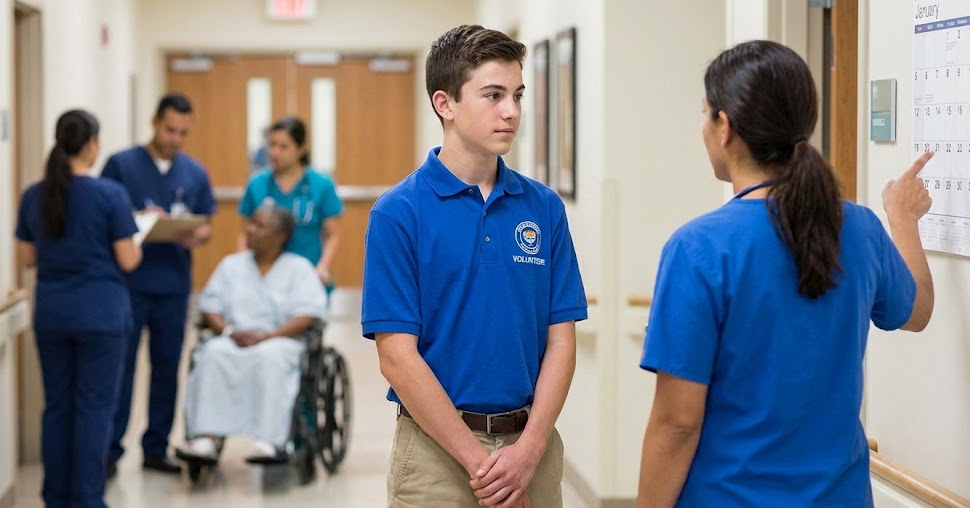
Hospitals are not standard workplaces. They are environments where safety, privacy, and trust are central. Teenagers are treated as part of the team, even if their roles are limited, and that comes with responsibility.
Volunteer manuals and teen code-of-conduct documents from large health systems consistently emphasize that teen volunteers are expected to act as professional members of the healthcare team: show dependability, follow instructions, protect confidentiality, and respect all patients and staff.
Ethical guidelines for shadowing and global health training add similar themes:
- Students are in the hospital to learn, not to provide independent care.
- Patients’ interests always come before student learning.
- Trainees must practice within their level of training and under appropriate supervision.
For teen interns, this means that professional conduct is not about being perfect. It is about consistently choosing actions that:
- Keep patients safe and respected.
- Make staff lives easier, not harder.
- Show that the student can handle more responsibility over time.
International Medical Aid builds these expectations into orientation, daily mentoring, and reflection sessions so that high school participants understand that how they behave is at least as important as what they observe.
Core Principles Of Professional Conduct For Teen Interns
Regardless of location, age, or program, teen hospital roles tend to rest on a few core expectations.
Reliability And Punctuality
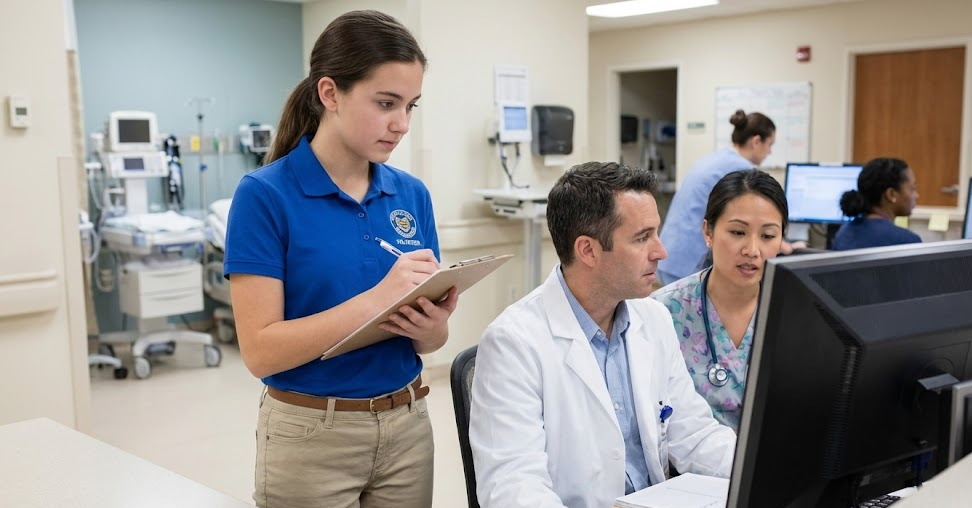
Volunteer codes from hospitals in the United States are blunt: teens are expected to be punctual, conscientious, and committed to showing up for scheduled shifts. Repeated lateness or unexcused absences can lead to dismissal.
For teen interns, reliability looks like:
- Arriving early enough to change, sign in, and reach the unit before the shift starts.
- Calling the assigned department and volunteer office if illness or emergencies make attendance impossible.
- Sticking to the agreed schedule and giving advance notice if long-term changes are needed.
In IMA programs, daily attendance is tracked, and mentors notice quickly when a student is consistently late or missing. Reliable students are more likely to be invited to observe interesting cases or given small responsibilities that deepen their experience.
Confidentiality And Respect For Privacy
Confidentiality is one of the most serious obligations teen interns will encounter. Teen volunteer codes repeatedly state that matters concerning patients or staff must never be discussed outside the hospital and that sharing patient information is both unethical and potentially illegal.
For high school students, practical rules include:
- Do not use patient names, room numbers, or identifiable details in conversations outside the clinical setting.
- Do not discuss cases in elevators, cafeterias, buses, or public spaces.
- Never post about patients, staff, or clinical situations on social media, even if names are omitted.
- Do not look at charts, computer screens, or documents unless a staff member has specifically invited you to see a de-identified example for teaching.
Guidance from organizations such as the AAMC and AMA on shadowing emphasizes that student observers must protect privacy and that any writing or reflection about cases should be carefully de-identified.
IMA reinforces this in orientation and throughout the internship. Students are explicitly told how to change details, combine experiences, or generalize when writing about their internship later so that no individual patient can be recognized.
Professional Communication
Professional conduct is visible in how students speak and listen. Shadowing guides and clinical preceptor documents for pre-med students stress that observers should be respectful, attentive, and engaged, even when mostly quiet.
In practice, teen interns should:
- Introduce themselves by name and role, using short, clear phrases.
- Listen more than they speak during clinical encounters.
- Save questions for private moments away from patients, unless a clinician invites a question in the room.
- Avoid slang, sarcastic jokes, or teasing about patients, staff, or local conditions.
- Acknowledge instructions with simple, clear responses such as “Yes, thank you” or “I understand.”
In cross-cultural settings, IMA mentors model these interactions, including how to greet patients respectfully, how to handle language barriers, and what topics are best left to local professionals.
Dress, Appearance, And Presence On The Unit
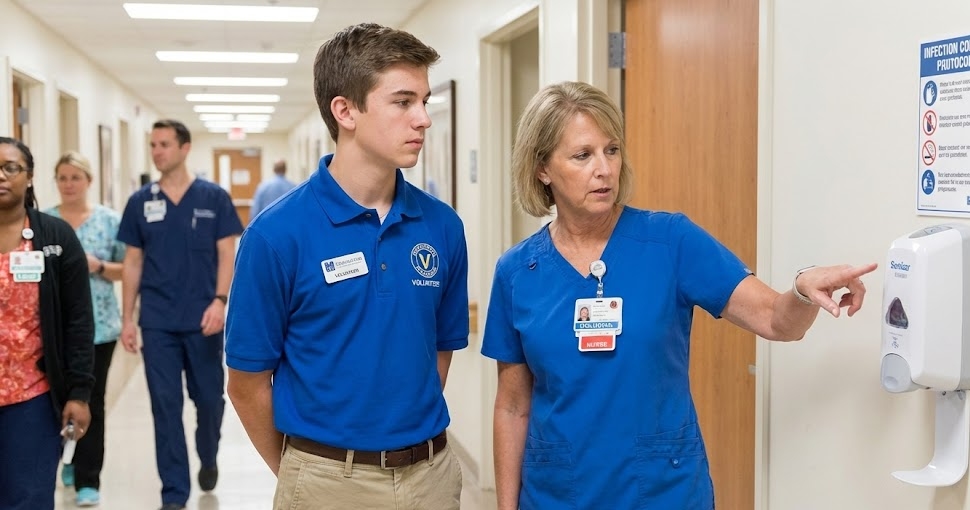
Hospitals are strict about appearance because dress affects safety, hygiene, and patient trust. Teen volunteer handbooks typically specify uniform pieces, prohibit denim and open-toed shoes, and require badges to be visible at all times.
Typical Hospital Dress Expectations
While specifics vary, most hospitals expect:
- Clean, modest clothing that covers shoulders, torso, and most of the leg.
- Closed-toe, rubber-soled shoes suitable for standing and walking.
- A visible identification badge worn at chest level.
- Hair that is clean and secured away from the face during clinical duties.
- Minimal jewelry and no large dangling items that could be caught on equipment.
Strong fragrances, distracting accessories, and clothing that sends confusing messages (for example, graphic slogans) are usually prohibited. Some programs provide vests, jackets, or scrubs to make volunteers easy to recognize.
IMA follows local dress codes in its partner hospitals and gives students clear packing guidance before departure. The goal is for interns to blend in with hospital expectations and to convey respect for local norms rather than personal style.
Phone Use And Digital Behavior
Many teen volunteer codes are explicit: cell phones should not be used during volunteer shifts.
Professional phone behavior includes:
- Keeping phones silenced and out of sight while in clinical areas.
- Avoiding photos and video entirely in or near patient spaces.
- Using phones only in break areas and only when it cannot be misinterpreted as boredom or disengagement.
IMA tells students up front that phone use on wards is restricted to essential communication with staff or mentors and that social media content must never include clinical areas, identifiable staff, or patients.
Physical Presence And Body Language
Professional conduct also shows up in posture and movement:
- Standing or sitting upright rather than leaning against walls or equipment.
- Avoiding chairs or surfaces reserved for staff unless invited to sit.
- Staying out of doorways and hallways where staff need to move quickly.
- Leaving rooms promptly and quietly when asked.
Staff notice when teen interns move with purpose, stay alert, and adjust their position to make room for care teams. Those small signals of awareness are part of being treated like a trusted member of the hospital community.
Working Within Scope: What Teen Interns Do And Do Not Do
Ethics guidance for shadowing and short-term global health experiences is clear that trainees must practice within their level of training and be supervised appropriately.
Appropriate Tasks For Teen Interns
Most hospital programs limit teen roles to observation and non-clinical support. Common tasks include:
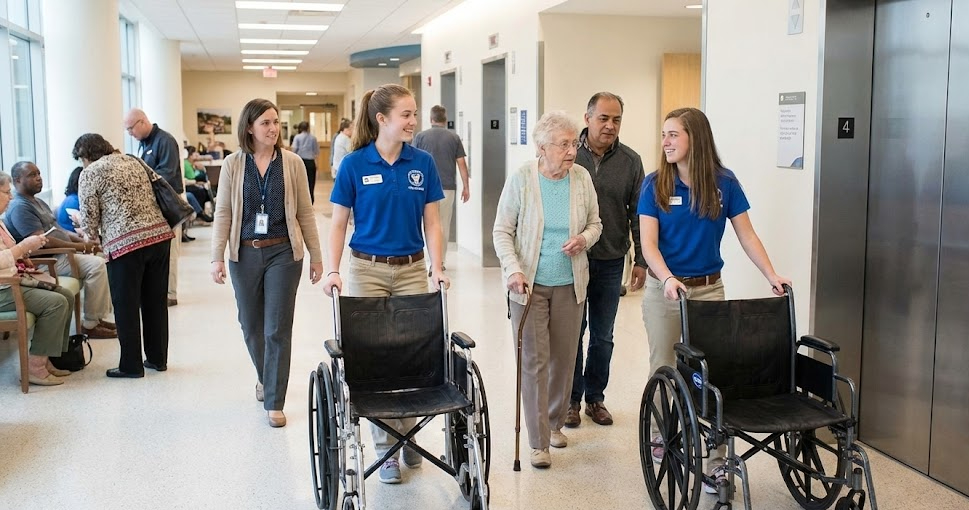
- Escorting patients or families to designated areas when staff request help.
- Delivering mail, lab envelopes, or non-urgent supplies within a unit.
- Restocking items like gloves, gowns, and basic linens.
- Assisting with wayfinding at information desks.
- Helping with basic registration steps, such as guiding patients to complete pre-printed forms.
Some programs allow supervised participation in simple noninvasive tasks, such as helping measure height and weight or observing vital sign checks at close range. In those cases, a staff member remains present and responsible.
IMA’s high school placements align with these norms. Any “hands-on” practice happens in simulation labs on models, not on patients. In real clinical spaces, student involvement stops at noninvasive support and observation, under direct supervision.
Tasks That Are Off Limits
Teen interns do not:
- Perform invasive procedures such as injections, blood draws, suturing, or line placement.
- Administer medications, including oral tablets, intravenous fluids, or vaccines.
- Independently position patients for exams or procedures.
- Interpret diagnostic tests or share opinions with patients about diagnoses or treatment.
- Chart in official records or access electronic health systems on their own accounts.
The AMA’s guidance on shadowing and WHO-aligned ethics documents for global health training both emphasize that trainees should not exceed their competence and that supervision must match the level of training.
IMA explicitly tells students that if a local clinician ever invites them to do something that feels beyond their role, they should decline politely and immediately contact their mentor. This protects both the student and the program’s relationship with partner hospitals.
Professional Conduct In Global And Cross-Cultural Settings
International placements ask even more of teen interns. They must adapt to different health systems, cultural norms, and resource constraints while maintaining professionalism.
Respecting Local Practice And Culture
Ethics position statements on short-term global health experiences stress cultural sensitivity and avoidance of “rescue” narratives. Visiting trainees should respect local practice patterns and understand that they are guests, not experts.
In professional conduct terms, this means:
- Avoid making negative comments about local facilities, equipment, or approaches.
- Asking questions to understand why care is organized a certain way, rather than assuming it is wrong.
- Letting local staff lead clinical encounters and following their instructions, even when practices differ from what students have seen at home.
- Being cautious about comparisons such as “In my country we do it differently,” which can sound critical or dismissive.
IMA prepares students with pre-departure orientation on cultural norms and health systems in host countries, then reinforces these themes in global health seminars onsite.
Handling Ethical Tension Professionally
Trainees in global health programs sometimes report ethical discomfort when they encounter cases shaped by limited resources, social inequality, or legal frameworks that differ from their own expectations.
Professional conduct in those moments includes:
- Observing quietly and noting questions for later discussion with mentors.
- Avoiding arguments in front of patients or families.
- Bringing concerns to IMA staff or clinical supervisors in private.
- Recognizing that ethical reflection is part of training and that not every tension has a quick solution.
IMA’s approach follows global training guidelines that recommend structured debriefing for ethical challenges, not just for clinically difficult days.
Social Media, Storytelling, And Professional Identity
Modern professionalism includes digital behavior. Healthcare organizations increasingly remind staff and volunteers that online actions can affect trust and privacy.
Social Media Boundaries
Teen interns should assume that:
- Sharing photos or video from clinical areas is prohibited.
- Even de-identified case descriptions can be problematic if combined with location, timing, or other clues.
- Jokes, memes, or casual posts about “crazy days at the hospital” risk undermining patient trust.
IMA asks students to treat clinical spaces as offline zones and to focus online content on personal growth, cultural experiences outside the hospital, and general reflections that do not mention specific cases or facilities.
Talking About The Experience Professionally
When it is time to list the internship on a resume or application, professionalism shows in how the experience is described. Admissions-facing guidance suggests that students frame shadowing and internships as educational experiences, not as proof that they have already practiced medicine.
A professional description might look like:
- “Observed clinicians in pediatric and adult wards at a teaching hospital, learning how teams coordinate care and communicate with patients and families.”
- “Assisted with non-clinical tasks such as escorting patients, restocking supplies, and supporting community health outreach days, under staff supervision.”
IMA mentors often help students refine these descriptions so they are accurate, respectful, and consistent with ethical expectations.
How International Medical Aid Teaches And Reinforces Professional Conduct
IMA designs its high school programs so that professional behavior is taught deliberately, not left to chance.
Key elements include:
- Pre-departure guidance on expectations, including dress code, confidentiality, communication norms, and what interns can realistically expect to do.
- Structured orientation on arrival that covers hospital policies, infection control, privacy rules, and emergency procedures, echoing hospital volunteer manuals and global training guidelines.
- Daily clinical mentoring where staff model introductions, explain roles, and quietly correct any missteps in real time.
- Group reflection that lets students talk through challenging situations and receive feedback on how they handled them.
- Documentation and verification that encourage students to keep accurate logs of hours and tasks, reinforcing an honest representation of their role.
The goal is that by the end of an IMA placement, high school students will not only be more informed about healthcare but also more practiced in the professional conduct required in clinical environments.
Practical Checklist For Teen Interns And Families
Before starting a hospital-based internship, teens and parents can use a simple conduct checklist. A strong program and a prepared student should be able to answer “yes” to most of these questions.
Before The Internship
- Has the program clearly explained dress code, confidentiality, and behavior expectations in writing?
- Does the student understand that their primary role will be observation and non-clinical support?
- Have health requirements such as vaccinations and TB testing been addressed?
- Has the student discussed emotional readiness for witnessing illness and stress in real-time?
During The Internship
- Is the student arriving on time, signing in properly, and communicating about absences?
- Are they keeping phones away during clinical hours and respecting hospital rules about devices?
- Are they avoiding patient-identifying details in conversations and any online activity?
- Do they seek guidance when asked to do something they are unsure about?
After The Internship
- Can the student describe what they learned about professionalism, not only what they saw clinically?
- Are their resumes and essays honest about their role, hours, and level of responsibility?
- Do they have at least one mentor or supervisor who would feel comfortable speaking about their conduct if asked?
International Medical Aid frames teen medical internships within this broader understanding of conduct. Exposure to medicine is important, but exposure alone is not enough. The way students show up, follow rules, support staff, and respect patients is what builds a foundation for later clinical roles and, eventually, for trustworthy practice in healthcare careers.