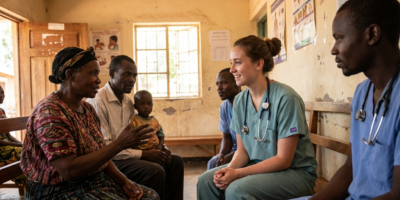
The clinical environment you spent weeks in operated at a pace, intensity, and level of human consequence that most pre-health classrooms do not replicate. You made daily decisions about professional conduct under real conditions. You observed the consequences of disease in people who could not access the same standard of care available in your home country. You navigated cultural unfamiliarity, language barriers, and the emotional demands of clinical work in a resource-limited setting.
Key Highlights
- The transition from an international clinical placement back to a North American classroom is a genuine psychological and intellectual transition, not merely a change of location. Students who treat it as such integrate their experience more effectively than students who expect to simply return to where they left off.
- The most common post-placement failure is allowing the clinical vocabulary, pattern recognition, and professional habits built during the placement to atrophy because they are not actively integrated into coursework.
- The three to five days immediately following your return are the highest-leverage window for consolidating your learning. Completing your reflective journal, finalizing your case log, and identifying the specific coursework connections you want to pursue should happen in this window, not weeks later.
- Re-entry disorientation is a normal and well-documented response to returning from a substantive international experience. Recognizing it as a normal transition rather than a problem to be solved reduces its duration and impact.
- The clinical experience you return with has specific, identifiable academic applications in your pre-clinical coursework, and proactively seeking those connections is the difference between a placement that enhances your application and one that enhances your education.
Why the Transition Is Harder Than It Looks
Returning to a lecture hall where the primary challenge is note-taking requires a significant recalibration. The reverse culture shock that international clinical placement students commonly experience, a feeling that the classroom is abstract, that classmates who have not had similar experiences seem less aware of what is at stake in clinical medicine, that the urgency of academic preparation seems disconnected from the clinical reality you observed, is a well-documented aspect of the post-placement transition.
Research on re-entry transitions after international clinical experiences documents that students who engage in structured reflection on the transition period, not just on the placement itself, integrate their experience more completely and report higher levels of academic engagement in the semesters that follow. PMC research on clinical mentorship and professional identity in pre-health training identifies the period immediately following a substantive clinical experience as a particularly high-leverage window for professional identity consolidation, and notes that students who use this window intentionally are more likely to sustain the engagement that the experience activated.
The First Week Back: What to Do and When
Days One Through Three
Complete your reflective journal. Do not let the final entries from the last days of your placement sit unwritten while you re-acclimate. The clinical details, the emotional responses, and the intellectual questions from your final shifts are as worth documenting as those from your first week, and they will fade faster than you expect. Write them while they are still clear.
Finalize your case log. Review every entry for de-identification compliance and add any presentations from your final days that are not yet documented. Organize the log by presentation type so it is ready to use as interview preparation material.
Do not attempt to immediately apply the clinical experience to your coursework or application materials in the first three days. The integration work is important but it requires cognitive space that the immediate re-entry period does not provide. Give yourself the first three days for consolidation and rest.
Days Four Through Seven
Review your coursework for the upcoming semester and identify the specific connections to your clinical experience. Which course topics correspond to clinical presentations you observed? Where does your case log intersect with lecture content you will encounter? These intersections are where your clinical experience becomes an academic asset rather than a separate memory.
Reach out to one professor or academic advisor who has office hours in the first week of your return. Tell them briefly that you have just returned from an international clinical placement and that you are working to integrate the experience into your academic preparation. Ask for their perspective on the coursework connections you have identified. This conversation serves two purposes: it helps you identify connections you may have missed, and it builds a relationship with a faculty member who now knows something specific about your preparation and your engagement. Understanding how global health experience builds the academic and professional record that matters for medical school admissions includes the academic integration work that follows a substantive placement.
Making the Clinical Vocabulary Stick
The clinical vocabulary you developed during your placement, the names of conditions, the terminology of physical examination, the language of clinical reasoning, will atrophy quickly if it is not actively used. Build a vocabulary review practice into your first month back. Fifteen minutes every few days reviewing your case log entries against your coursework reading is sufficient to maintain the connections you built.
When your coursework covers a condition you observed during your placement, write a brief note in the margin or a separate document connecting the textbook description to your clinical observation. What did the textbook presentation look like in practice? What was consistent with the textbook and what surprised you? This active connection-building is what converts clinical observation into academic understanding rather than allowing the two to remain parallel tracks.
Students who want to connect their clinical vocabulary development to the specific competencies that medical school evaluates should review the AAMC’s learning objectives and what pre-clinical preparation is designed to build as a framework for identifying where their clinical observations fit into the structure of medical education.
Managing the Emotional Dimension of Re-Entry
The emotional dimension of returning from an international clinical placement is real and deserves explicit acknowledgment. You may find yourself impatient with the relative comfort of your domestic environment. You may feel a responsibility toward the patients and communities you observed that does not have an immediate outlet. You may feel that your classmates do not understand what you experienced in ways that make ordinary social interaction feel hollow.
These responses are normal and do not require fixing. They do benefit from being named and processed rather than pushed aside. Your reflective journal is the right place for the most intense of these responses. Conversations with the one or two peers who have had similar experiences, or with a mentor who has worked in resource-limited clinical settings, can help contextualize what you are experiencing. What this period should not become is a source of alienation from your academic community or a basis for judgment of classmates who have not had the same experience.
Students who experienced clinically or emotionally difficult encounters during their placement and who are still processing those experiences should read IMA’s guide to what to do when you witness an upsetting clinical experience and how to write a reflective journal entry about a difficult clinical day.
Translating the Experience Into Application Materials
The first month after returning from your placement is the best time to draft the sections of your application that draw on clinical experience. Your memory of specific encounters is still clear, your emotional responses are accessible, and the professional growth you experienced is still visible to you in ways it may not be after a longer interval.
Draft a paragraph for your personal statement that draws on one or two specific clinical encounters from your placement. Do not try to summarize the entire experience, select the one or two moments that most clearly illustrate your engagement with clinical medicine and your readiness for the training that follows. Use your case log and reflective journal as source material, not your memory alone.
Students who are beginning the formal application process should read about what admissions committees actually look for in clinical experience narratives as a framework for which aspects of your experience to foreground and which to keep in the background.
Frequently Asked Questions
How long does the re-entry transition typically take?
Most students find the acute phase of re-entry, the period of most intense disorientation and adjustment, lasts one to three weeks. The broader integration of the experience into your academic and professional identity is a longer process that continues through the application cycle and into your pre-clinical training.
What if I feel like I do not want to go back to my normal academic routine?
That feeling is common and worth taking seriously without being controlled by it. The clinical experience you had was intense and meaningful, and returning to a less intense environment creates a genuine contrast. Acknowledge the contrast, honor the experience that produced it, and then engage with your academic routine as the essential preparation for the clinical environment you want to return to. The classroom is not separate from clinical medicine. It is the path back to it.
Should I tell my professors about my placement?
Yes, selectively and specifically. Professors whose course content is directly connected to your clinical experience are the most relevant audience. A brief, specific connection, I observed the presentation you described in last week’s lecture and noticed something consistent with what the textbook describes, is more valuable than a general announcement that you did an international placement.
What if I am still processing a difficult clinical encounter from my placement?
Write about it in your reflective journal, speak with a trusted mentor or counselor if the processing is significant, and give yourself the time to work through it rather than suppressing it in order to re-engage with your coursework. Difficult encounters from clinical experience are part of the learning and do not need to be resolved in order to continue. They need to be acknowledged.
How do I maintain the professional habits I built during my placement once I am back in an academic environment?
Identify the specific habits that were most valuable, early arrival, structured preparation, reflective writing, deliberate observation, and build them explicitly into your academic routine in adapted forms. Arriving early to labs and clinical skills sessions, preparing specifically before academic encounters rather than generally, and maintaining a reflective writing practice even in an academic context all preserve the professional habits that the placement built.
Is it normal to feel more confident about pursuing medicine after a placement like this?
Yes, and it is one of the most important outcomes the placement can produce. Confidence based on specific experience, I know what clinical environments feel like, I know how I respond under those conditions, I know that this is what I am preparing for, is qualitatively different from confidence based on abstract aspiration. That specificity is what your application and your interviews will reflect.
What if the placement made me less certain about pursuing medicine?
That outcome is also valuable and worth taking seriously. A placement that reveals genuine uncertainty about clinical medicine is producing important information earlier in your training rather than later. Use the reflective journal and conversations with mentors to examine what specifically generated the uncertainty. Sometimes uncertainty resolves into clarity with reflection. Sometimes it reveals a genuine recalibration that is better to make now than after medical school admission.
How soon after returning should I update my application materials?
Within the first month. Your memory of specific encounters is clearest in this window, your emotional responses are most accessible, and the application drafting process benefits from proximity to the experience itself. Waiting several months risks losing the specificity that makes clinical experience descriptions compelling.