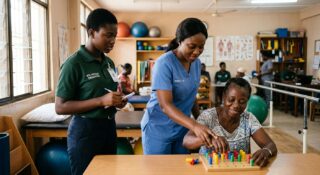
If you are a high school student drawn to rehabilitation and helping people recover, two careers probably come up again and again: occupational therapy (OT) and physical therapy (PT). Both are respected, in-demand healthcare professions. Both involve working closely with patients. And both can be genuinely confusing to tell apart, especially when you are just starting to research your options. Understanding OT vs PT for high school students matters because the differences between the two shape everything from what you study in graduate school to what your average Tuesday at work looks like. Structured internships for high school students medical programs can help you see these differences firsthand, but a strong foundation of knowledge before you observe anything in a clinic will make that experience far more useful.
The confusion between occupational therapy and physical therapy is common, and it is not a sign that you have not done enough research. Even adults working in healthcare sometimes struggle to articulate the distinction clearly. A medical internship for high school students focused on rehabilitation can give you real context, but the short version is this: physical therapists primarily focus on improving movement, strength, and physical function, while occupational therapists focus on helping people perform the meaningful daily activities that matter to their lives. Both professions require graduate-level education, rigorous clinical training, and a genuine commitment to patient well-being. The rest of this article breaks down the specifics so you can decide where your curiosity fits best.
What Occupational Therapists Actually Do
Occupational therapy is built around a concept that sounds simple but runs deep: helping people do the things they need and want to do. The word “occupation” in this context does not mean a job. It means any activity that occupies your time and gives your life meaning. That includes getting dressed in the morning, writing notes in class, cooking a meal, playing with your kids, or returning to work after an injury. When illness, injury, disability, or aging makes those activities difficult, an OT steps in to help a person find a way forward.
In practice, this means OTs work across a wide range of settings and populations. A pediatric OT might help a child with autism develop the sensory processing skills needed to sit comfortably in a classroom. A hospital-based OT might work with a stroke survivor on regaining the fine motor control needed to button a shirt or hold a fork. An OT in a skilled nursing facility might assess whether an older adult needs adaptive equipment at home to stay safe and independent. The American Occupational Therapy Association (AOTA) defines the profession’s scope as centering on participation in everyday life, which is what makes it distinct from other rehabilitation fields.
OTs also work in mental health settings, schools, workplace ergonomics, and community health programs. If you are someone who thinks about function in a broad sense, not just physical ability but cognitive, emotional, and social capacity, occupational therapy may be a strong fit for your interests. For high school students who are curious about how OT connects to early career exploration, reading about occupational therapy experience opportunities for high school students can give you a clearer picture of what is available.
What Physical Therapists Actually Do
Physical therapy centers on movement. PTs diagnose and treat conditions that affect a person’s ability to move, manage pain, and maintain physical function. If you have ever seen someone doing exercises after knee surgery, working on balance after a hip replacement, or relearning how to walk after a spinal cord injury, you have seen the kind of work physical therapists do every day.
PTs use a combination of therapeutic exercise, manual therapy (hands-on techniques to mobilize joints and soft tissue), patient education, and sometimes modalities like heat, cold, or electrical stimulation. Their patients include athletes recovering from ACL tears, office workers dealing with chronic back pain, children with cerebral palsy working on gross motor development, and older adults trying to prevent falls. The American Physical Therapy Association (APTA) outlines the profession’s focus as improving quality of life through prescribed exercise, hands-on care, and patient education.
Physical therapists also play a significant role in prevention. A PT might work with a high school athlete on movement patterns that reduce injury risk, or counsel a patient with diabetes on exercise routines that improve circulation and mobility. The profession’s scope is broad within the world of movement science, and PTs often specialize in areas like orthopedics, neurology, pediatrics, sports, geriatrics, or cardiopulmonary rehabilitation.
Where OT and PT Overlap, and Where They Diverge
It is easy to see why people confuse these two professions. Both OTs and PTs work in hospitals, outpatient clinics, rehabilitation centers, schools, and home health settings. Both work with patients recovering from strokes, surgeries, and injuries. Both require strong communication skills, patience, and a genuine interest in helping people regain independence.
The Core Difference in Focus
The clearest way to think about the distinction is this: a physical therapist asks, “Can you move your arm?” An occupational therapist asks, “Can you use your arm to brush your teeth?” PT tends to focus on the body’s capacity for movement, strength, balance, and pain management. OT tends to focus on what a person can do with that capacity in the context of real life. Both perspectives are essential, and in many clinical settings, OTs and PTs work side by side on the same patient’s care team.
Education Paths
The education requirements are different. Physical therapy now requires a Doctor of Physical Therapy (DPT) degree, which is a three-year doctoral program entered after completing an undergraduate degree with prerequisite coursework. Occupational therapy entry-level education is typically a master’s degree, though many programs now offer a Doctor of Occupational Therapy (OTD). Both paths are competitive and require strong academic preparation, prerequisite science courses, and observation or shadowing hours before you apply.
Job Outlook and Compensation
According to the Bureau of Labor Statistics occupational outlook for physical therapists, PT jobs are projected to grow 15% from 2022 to 2032, with a median salary of $97,720. The BLS outlook for occupational therapists projects 11% growth over the same period, with a median salary of $93,180. Both growth rates are well above the national average for all occupations, driven by an aging population and increased demand for rehabilitation services. The salary difference is relatively small, and both professions offer stable, well-compensated careers.
How High School Students Can Start Building Perspective
You do not need to decide between OT and PT right now. In fact, trying to lock in a career path at 16 or 17 can work against you if it causes you to close off options prematurely. What you can do is start building informed perspective so that when you do make a decision, it is grounded in real observation and honest self-reflection.
Shadowing and Observation
The most direct way to understand either profession is to watch someone do it. Shadowing a physical therapist in an outpatient orthopedic clinic will feel very different from observing an occupational therapist in a pediatric sensory integration clinic. If you can arrange to shadow in both settings, even for a few hours each, you will start to feel which approach resonates with you. For students interested in broader clinical exposure, allied health internships designed for high school students can offer structured observation across multiple rehabilitation disciplines. For the OT side, our guide to occupational therapy shadowing covers how to find a therapist who will host you.
What You Will and Will Not Do as a High School Observer
This is important for both students and parents to understand clearly. As a high school student in any clinical setting, your role is to observe, ask questions at appropriate times, and reflect on what you see. You will not perform therapy, provide patient care, make clinical decisions, or handle medical equipment. This is not a limitation; it is how responsible clinical exposure works. Patient safety and professional boundaries require it. Programs that suggest otherwise should raise serious concerns.
In a well-structured program, you might see a PT guide a patient through post-surgical knee exercises, or watch an OT help someone practice meal preparation using adaptive tools. You might observe how therapists document patient progress, communicate with other members of the care team, or adjust a treatment plan based on a patient’s response. These observations are genuinely valuable because they show you what the work actually looks like, not what a brochure says it looks like.
A Note for Parents
If your teenager is interested in observing OT or PT settings, whether locally or through a structured program abroad, your concerns about safety, supervision, and age-appropriateness are legitimate and worth addressing directly. Any program that involves minors in clinical environments should provide clear information about supervision ratios, housing arrangements, communication protocols, and what your child will and will not be doing. Programs through International Medical Aid, for example, ensure constant supervision by qualified healthcare professionals during clinical hours, secure housing, 24/7 in-country staff support, and structured debriefing sessions to help students process what they observe. If you want a detailed look at what responsible teen programs involve, a parent’s guide to safety and support in high school medical internships covers the practical questions you are likely asking.
Emotional readiness matters too. Watching patients struggle with pain, disability, or recovery can be intense. A good program builds in time for reflection and conversation, so students are not left to process difficult observations alone. Maturity is not just about age; it is about willingness to be respectful, follow rules, and sit with discomfort without shutting down. You know your child better than anyone, and having an honest conversation about readiness before committing to a clinical experience is time well spent.
How OT and PT Experience Shows Up in College and Graduate Applications
Early exposure to rehabilitation professions is valuable on applications, but not in the way many students assume. Admissions committees for OT and PT graduate programs, as well as medical, PA, and nursing programs, are not looking for a long list of hours. They want to see evidence that you thought carefully about what you observed, that you understand what the profession involves, and that your interest is grounded in reality rather than assumption.
A student who shadows a physical therapist for 20 hours and writes a thoughtful, specific reflection about what they learned will stand out more than a student who logs 200 hours but cannot articulate what they saw or why it mattered. When you write about OT or PT observation in a personal statement or activities section, focus on specific moments: a patient interaction that surprised you, a conversation with a therapist that clarified something you had not understood, or a situation that made you reconsider your assumptions about disability or recovery.
For students specifically planning to apply to DPT or OT graduate programs, many schools do require a minimum number of observation hours. Check the prerequisites for programs you are interested in early, because requirements vary. Some programs want hours in multiple settings (inpatient, outpatient, pediatric, geriatric), which is another reason broad early exposure is helpful. Students interested in understanding how different healthcare paths compare can find useful context in a guide to picking the right healthcare career path without med school.
International observation, such as structured programs where you observe therapists working in under-resourced settings, can add a meaningful layer to your application. Seeing how rehabilitation professionals adapt to limited equipment, high patient volumes, and different cultural attitudes toward disability gives you perspective that domestic-only experience may not. But the value is in the reflection and growth, not in the location itself. Admissions committees can tell the difference between a student who engaged deeply and one who treated an international program as a resume line.
Deciding What Fits: Questions Worth Sitting With
Rather than pressuring yourself to choose between OT and PT right now, consider spending time with a few honest questions. Do you find yourself more drawn to helping someone regain the ability to move, or to helping someone figure out how to live fully within their current abilities? Are you more interested in the mechanics of the body, or in the intersection of physical, cognitive, and emotional function? Do you see yourself working primarily with athletes and post-surgical patients, or with children, older adults, or people with complex disabilities affecting multiple areas of life?
There is no wrong answer, and your answer might change as you gain more exposure. That is exactly why early observation matters. It is not about confirming a decision you have already made. It is about gathering the information you need to make a good one later.
If you are a parent reading this alongside your student, one of the most helpful things you can do is encourage curiosity without pressure. Let your teenager explore both options. Support them in seeking out shadowing, structured internships, and conversations with working therapists. And remind them that choosing a career path is a process, not a single moment of certainty.
Frequently Asked Questions
Do I need to decide between OT and PT before I start college?
No. Most students do not apply to OT or PT graduate programs until they have completed an undergraduate degree, so you have several years to explore. In college, you can take prerequisite courses that apply to both fields and continue shadowing in different settings. High school is a time to build awareness and observe, not to commit to a specific path.
Can high school students get observation hours in OT or PT that count toward graduate school requirements?
Some graduate programs accept observation hours completed during high school, but policies vary by school and program. Keep a careful log of your hours, including dates, settings, and the name and credentials of the supervising therapist. When you are ready to apply, check each program’s specific requirements to confirm what they accept.
What is the biggest misconception about the difference between OT and PT?
The most common misconception is that OT is a “lighter” version of PT, or that OT is only about arts and crafts while PT is about exercise. In reality, both professions require demanding graduate education and clinical training. OT focuses on helping people participate in meaningful daily activities across physical, cognitive, and emotional domains. PT focuses on improving movement, managing pain, and restoring physical function. They are complementary, not hierarchical.