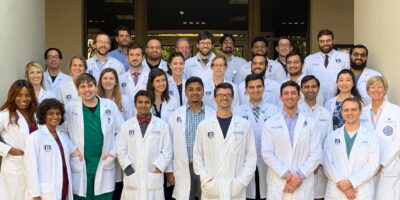
Known for its six-year B.A./M.D. program and its long record of training physicians for Missouri, the University of Missouri-Kansas City (UMKC) School of Medicine draws applicants from across the country. It is a public M.D. school with its main campus on Hospital Hill in Kansas City, Missouri, and a rural regional campus in St. Joseph, Missouri. Students learn medicine through practice from the start: clinical work begins in the first weeks, and small “docent” teams led by teaching physicians stay with students through most of their training.
UMKC is unusual because it has two very different front doors. High school seniors apply to the six-year B.A./M.D. program and never take the MCAT. College graduates apply to the four-year M.D. program through AMCAS, and they start classes in January, not August. A third route, the Medical Scholars program, offers early, guaranteed M.D. admission to college sophomores and juniors at partner schools. Each route has its own requirements, calendar and essays, and this guide keeps them separate from start to finish.
This guide covers the B.A./M.D. application that is open now (August 1 to November 1, 2026, for entry in August 2027) and the M.D. calendar (a May to August application window, interviews in September and a January start). It explains the requirements, costs, curriculum, both campuses, the essays with full illustrative examples and analysis, the interview and the people who lead the school. All facts were checked on October 17 and 18, 2026.
So what does it take to get into UMKC School of Medicine? Start with the route that fits where you are today, then plan backward from its deadlines.
Key Takeaways
- Pick your route first. The six-year B.A./M.D. is for high school seniors and college students with 24 or fewer credit hours earned after high school. The four-year M.D. is for applicants who have, or will soon have, a bachelor’s or higher degree. Medical Scholars is an early-admission route for sophomores and juniors at 15 partner colleges.
- The B.A./M.D. bar is academic and personal. Minimums are an unweighted 3.0 GPA in UMKC’s 17 core high school courses and an ACT of 24 or SAT of 1160. Admitted B.A./M.D. students average an unweighted 3.9 GPA and a 32 ACT or 1420 SAT.
- The M.D. minimums depend on residency. Missouri and regional applicants (Arkansas, Illinois, Kansas, Nebraska and Oklahoma) need a 3.0 cumulative GPA and a 3.0 BCPM GPA. Out-of-state applicants need 3.5 for both. Everyone needs an MCAT of at least 495, earned within three years, plus biochemistry, genetics and cell biology with a B or better. Accepted M.D. applicants for the 2025 entering class had a median MCAT of 509 and a median GPA of 3.87.
- Missouri comes first. UMKC gives priority to Missouri residents and selects over half of each class from in-state applicants.
- Deadlines are early and strict. B.A./M.D.: November 1, 2026, with transcripts and scores by November 15. M.D.: AMCAS by July 1, verified with letters by August 1, and the UMKC supplemental and General Application by August 8. Late or incomplete files are not reviewed.
- The M.D. program starts in January. M.D. students begin in January and join B.A./M.D. students in the spring of the B.A./M.D. program’s second year.
- There is a rural campus. The St. Joseph campus, run with Mosaic Life Care, trains M.D. students for rural practice. Its first class of 14 graduated in December 2025.
- Next step: B.A./M.D. applicants should line up three reference forms and draft the 500-word essay now. M.D. applicants should plan to submit AMCAS in May or June.
Key Statistics About UMKC School of Medicine
The snapshot below pulls together the figures applicants ask about first. Because UMKC admits students through two separate routes, every number is labeled with the program it describes. The B.A./M.D. figures are the school’s own published averages and annual estimates. The M.D. figures cover accepted applicants, applications and interviews for the 2025 entering class, plus the school’s current requirements and cost budget.

| Metric | Value | Program and year | Source and definition |
|---|---|---|---|
| School and degrees | University of Missouri-Kansas City School of Medicine; M.D. through a six-year B.A./M.D. or a four-year M.D.; Kansas City and St. Joseph campuses | Current | UMKC School of Medicine, Our School and Degree Programs pages; public school |
| B.A./M.D. entering class | 105 to 110 students: 60 to 65 from Missouri, 30 to 35 from regional states, 10 to 15 from out of state | B.A./M.D.; annual estimate | UMKC B.A./M.D. FAQ |
| B.A./M.D. applications and interviews | About 1,500 initial applications; about 1,000 complete; about 350 interviewed | B.A./M.D.; annual estimate | UMKC B.A./M.D. FAQ. Interviewed/complete applications is not an acceptance rate |
| B.A./M.D. average GPA | 3.9 unweighted (range of admitted students 3.0 to 4.0) | B.A./M.D. admitted students; no cohort year stated | UMKC B.A./M.D. Admission Requirements; unweighted high school GPA |
| B.A./M.D. average test score | 32 ACT or 1420 SAT | B.A./M.D. admitted students; no cohort year stated | UMKC B.A./M.D. Admission Requirements |
| B.A./M.D. minimums | 3.0 unweighted GPA in 17 core courses; ACT 24 or SAT 1160 | B.A./M.D., current | UMKC B.A./M.D. Admission Requirements |
| M.D. minimum MCAT | 495, earned within three years of the application deadline | M.D., current | UMKC M.D. Admissions Requirements |
| M.D. minimum GPA | 3.0 cumulative and 3.0 BCPM (Missouri and regional); 3.5 and 3.5 (out of state) | M.D., current | UMKC M.D. Admissions Requirements |
| M.D. median MCAT | 509 (mean 508.5) | Accepted M.D. applicants, 2025 entering class | AAMC MSAR, 2026 edition; most recent MCAT score |
| M.D. median GPA | 3.87 total (mean 3.82); 3.82 science (mean 3.75) | Accepted M.D. applicants, 2025 entering class | AAMC MSAR, 2026 edition; AMCAS total and BCPM GPA |
| M.D. applications and interviews | 1,589 verified applications (314 in-state, 1,272 out-of-state, 3 international); 132 interviewed (92 in-state, 40 out-of-state) | M.D., 2025 entering class | AAMC MSAR, 2026 edition. AAMC out-of-state includes regional states. Interviewed/applications is not an acceptance rate |
| M.D. new entrants | About 35 a year | M.D., 2026 application cycle (January 2027 start) | AAMC MSAR, 2026 edition, estimated new entrants |
| Acceptance rate | Not published | Either route | Offer counts are not published by UMKC or in AAMC MSAR |
| M.D. fees and policies | No secondary fee ($50 UMKC General Application fee); no Early Decision Program; deferred entry not offered; $1,000 nonrefundable seat deposit applied to tuition | M.D., 2026 application cycle | UMKC M.D. Application Information; AAMC MSAR, 2026 edition |
| M.D. estimated cost of attendance | $79,621 (Missouri), $101,339 (regional), $123,046 (nonresident) per year | M.D. Years 1-4, summer through spring budget on the current page | UMKC Medicine Estimated Costs; tuition and fees are $47,759, $69,477 and $91,184 |
| B.A./M.D. Year 1 cost of attendance | $53,838 (Missouri), $67,776 (regional), $81,714 (nonresident) | B.A./M.D. Year 1, Fall 2025/Spring 2026 | UMKC Medicine Estimated Costs |
| Accreditation | Full LCME accreditation granted in October 2018 for eight years; next site review April 2026 | Current | UMKC School of Medicine LCME Accreditation page |
| Research funding | $23 million a year in extramural grants and contracts; 22 endowed chairs and professorships | Current school statement | UMKC School of Medicine Mission, Vision and Strategic Plan page |
| Average graduate debt | $188,969; 78% of students received financial aid | Indebted graduates, academic year 2024-2025 | AAMC MSAR, 2026 edition (LCME Part I-B questionnaire) |
Two cautions help you read these numbers. First, the B.A./M.D. averages describe high school students and cannot be compared with M.D. figures or with other medical schools’ MCAT and college GPA data. Second, no acceptance rate appears here because the number of offers is not published for either route. About 350 of roughly 1,000 complete B.A./M.D. applicants are interviewed, which is about 35%, but that is an interview share, not the share admitted. On the M.D. side, 132 of 1,589 verified applicants were interviewed for the 2025 entering class, about 8%, which is also an interview share. Some admitted students choose other schools, and offers to the waitlist continue after May 1, so offers and seats are not the same number.
Mission and Educational Priorities
UMKC School of Medicine states its mission in one sentence: “We educate and support professionals by promoting and teaching science, compassion, and service to meet the healthcare needs of Missouri and the nation.” Its vision is “to be the premier innovative community-based medical school education professionals, providing clinical service to patients and communities, and implementing new therapies and partnerships in the delivery of healthcare.” You can read both, along with the school’s 2018-2028 strategic plan, on the mission, vision and strategic plan page.
The school opened in 1971 after more than a decade of community effort to bring a medical school to Kansas City. Its four mission areas are education, research, service and economic development, and its main campus sits in Kansas City’s urban core. The strategic plan for 2018-2028 is built on four pillars: education, innovation, connection and support.
What does that mean for an applicant? Three things stand out.
Missouri is the first audience. The mission names “the healthcare needs of Missouri and the nation,” and the admissions rules follow that order. Missouri residents get priority, regional applicants from five nearby states come next, and out-of-state applicants face higher minimums for the M.D. route. If you have real ties to Missouri, the region or its underserved communities, make them visible.
Community-based means the school works through partner hospitals. UMKC does not run its own hospital. Students train at affiliates such as University Health Truman Medical Center, Children’s Mercy, Saint Luke’s Hospital of Kansas City and the Kansas City VA Medical Center, and many faculty are practicing physicians at those hospitals. Applicants who can talk about care in busy, mixed-income urban settings, or in small towns, give the Council on Selection something concrete to connect to the mission.
Science, compassion and service are all named. Strong grades matter, but the school’s founding principles also include early and continuous clinical experience, humanities woven through the curriculum and small learning communities built around a physician docent. The school’s own outcome data show where that leads: over the last decade, its M.D. programs produced about 90 graduates a year, about 40% entered primary care fields and roughly 45% stayed in Missouri.
The St. Joseph campus has its own mission inside the larger one: “to train outstanding physicians to aid rural Missouri and the surrounding region, address its critical need for healthcare providers and reduce health disparities.” Applicants who want rural practice should read that sentence closely, because the M.D. supplemental application has asked specific questions about rural interest and the St. Joseph campus.
The core competencies that guide selection
UMKC uses its core competencies both to teach students and to choose them. The Council on Selection’s charge is to identify applicants who can fully develop these six competencies:
- Interpersonal and communication skills.
- Professional behavior, including moral reasoning and ethical judgment.
- Medical knowledge that applies both basic and clinical science.
- Practice-based learning, to diagnose, manage, prevent and provide continuing care, along with self-reflection and self-improvement.
- Systems-based practice that brings psychological, social, cultural and economic factors into medicine.
- The attitudes, knowledge and skills required for patient care.
These are the pillars of a UMKC education. Communication grows through early and ongoing patient contact with people of all ages and backgrounds. Professionalism means integrity, confidentiality and working within the scope of your training. Medical knowledge comes from coursework, active learning and research. Practice-based learning trains students to learn theory through practice and to evaluate medical information in an evidence-based way. Systems-based practice looks at the social, economic and political factors that shape access and outcomes, and at how the whole care team works together. Patient care covers histories, physical exams, tests, procedures, clinical reasoning and patient education across acute, chronic, preventive and rehabilitative care.
You do not need to name the competencies in your essays. You do need experiences that show them: a conversation where you had to explain something clearly, a moment of ethical tension, a time you learned from a mistake, or a time you saw how cost or transportation changed a patient’s care.
Accreditation and Institutional Identity
UMKC School of Medicine is fully accredited by the Liaison Committee on Medical Education (LCME), the national accreditor for M.D. programs in the United States and Canada. In October 2018, the school received full accreditation for eight years. Its next LCME site review was scheduled for April 2026, as described on the school’s LCME accreditation page. Accreditation confirms that a program meets national standards; it is not a ranking or a guarantee of any outcome.
A few points about identity help avoid confusion:
- Institution. The school is part of the University of Missouri-Kansas City, a public research university in the four-campus University of Missouri System. It is a separate medical school from the University of Missouri School of Medicine in Columbia.
- Degree. Every route leads to the M.D. The B.A./M.D. also awards a bachelor’s degree, either a Bachelor of Liberal Arts, a B.A. in Chemistry or a B.A. in Biology.
- Campuses. The main campus is in the UMKC Health Sciences District on Hospital Hill in Kansas City. B.A./M.D. students spend much of their first two years on UMKC’s Volker campus. The St. Joseph regional campus, about 50 miles north, opened in 2021 with Mosaic Life Care and moved into its own $14.5 million education building in August 2025.
- Recent changes. Alexander Norbash, M.D., a 1986 graduate of the B.A./M.D. program, became dean in March 2024. A $145 million Healthcare Delivery and Innovation Building is under way in the Health Sciences District and will include School of Medicine simulation labs.
What about rankings?
Rankings change every year and use methods that may not match what you care about. If you want to see where UMKC sits in the current U.S. News lists, including primary care, research and the share of graduates practicing in underserved or rural areas, check the latest edition directly. For most applicants, the better questions are whether you are eligible, whether your residency helps you and whether the docent model and the January start suit how you learn.
Medical Programs and Affiliations
UMKC offers one M.D. degree with several ways in. The routes have separate applications, eligibility rules and calendars, so choose carefully.
Six-year B.A./M.D. program
The combined B.A./M.D. program admits students straight out of high school. Over six years, students earn a bachelor’s degree and an M.D., two years faster than the usual eight. More than 3,300 people have graduated from the School of Medicine, and most of them earned both degrees in six years.
Key facts:
- Who applies: high school seniors, plus current college students with 24 or fewer credit hours earned after high school graduation. Applicants must be U.S. citizens or permanent residents and fully admissible to UMKC.
- How you apply: the UMKC General Application (or the Common App), plus the School of Medicine Online Supplemental Application with an essay, three short answers, activities, health experiences, technical standards and three reference forms.
- No MCAT, ever. Students admitted to the B.A./M.D. program never take the MCAT and do not reapply to medical school.
- Year-round schedule. Years 1 and 2 follow the UMKC calendar, including summer. About 75% of that time goes to undergraduate courses and 25% to medical courses. Years 3 to 6 follow the medical school calendar of 13 blocks, each about four weeks, with one block of vacation.
- Credit: students may apply up to 45 hours of AP, IB or CLEP test credit, and there is no limit on transfer or dual credit.
The program is demanding. Students usually take 19 to 22 credit hours a semester and must live in UMKC housing for their first fall and spring. If you are a high school student building toward this program, IMA’s medical internships for high school students are one way to see clinical work up close before you apply, alongside shadowing and local volunteering.
Four-year M.D. program (Kansas City)
The M.D. program is for applicants who have earned, or will soon earn, a bachelor’s, master’s or doctoral degree from a regionally accredited U.S. college or university. Applicants submit AMCAS, the UMKC General Application and a supplemental application in the UMKC School of Medicine Portal. The key difference from most medical schools is timing: admitted M.D. students begin coursework in January.
M.D. students join their B.A./M.D. classmates in the spring of the B.A./M.D. program’s second year for the Human Structure Function series, so they enter a class that has already been together for a year and a half. M.D. students also form their own community. One current M.D. student describes being part of both the whole class and a smaller group of M.D.-only students who “started off cycle” and bonded quickly.
The Council on Selection also selects two smaller groups into the M.D. program: dentists completing a combined M.D. and oral surgery residency (the O.S./M.D. program) and transfer students with advanced standing.
Rural M.D. program (St. Joseph regional campus)
M.D. students can also train at the St. Joseph regional campus, a full four-year M.D. program built with Mosaic Life Care. The first two years use the same preclinical curriculum as Kansas City, with lectures streamed from Kansas City and labs and small groups taught in person in St. Joseph. Years 3 and 4 shift to rural medicine, including a longitudinal integrated clerkship at one of five rural partner sites. Details are in the curriculum and rotations sections below.
Medical Scholars: early and guaranteed M.D. admission
The Medical Scholars program offers early and guaranteed admission to the M.D. program for college sophomores and juniors at 15 partner schools: UMKC, Missouri University of Science and Technology, University of Missouri-St. Louis, University of Missouri-Columbia, Avila University, Drury University, Lincoln University, Missouri Western State University, Northwest Missouri State University, Park University, Rockhurst University, Truman State University, University of Illinois Chicago, William Jewell College and Missouri Valley College.
Applicants submit college transcripts, a personal statement, a résumé or CV that highlights healthcare experience and at least three letters of recommendation, including one from a professor. All materials are due August 1. After review, the Council on Selection interviews selected candidates and offers guaranteed admission to those who best qualify. See the Medical Scholars page for the current details.
Pathway programs for future rural physicians
Two programs based at St. Joseph help students prepare for medical school:
- Rural Pathway Program. A one-year program with 11 monthly virtual seminars and a required in-person week of clinical shadowing in northwest Missouri during the summer. It supports about 10 participants a year. Applications are due March 1, and the program starts June 1. Benefits for students in good standing include reimbursement of UMKC primary and secondary application costs and evaluation for an admissions interview. Missouri candidates get selection preference, and applicants do not need to be from a rural town.
- Rural Medical Post-Baccalaureate Program. A one-year, 30-credit-hour Master of Arts in Biology with a Rural Medicine Emphasis, taught in person and remotely at the St. Joseph Medical Education Building, with rolling starts in fall, spring or summer.
Other degrees at the school
The School of Medicine also offers master’s degrees in anesthesia (M.S.), bioinformatics (M.S.), physician assistant studies (M.M.S.) and health professions education, plus the M.A. in Biology with a Rural Medicine Emphasis, a Ph.D. in Biomedical and Health Informatics and graduate certificates in clinical research and health professions education. These programs have their own admissions and are separate from the M.D. If you are weighing the physician assistant route instead, IMA’s pre-PA internships are built for that path.
Clinical affiliations
The school’s primary affiliate hospitals and facilities are the Center for Behavioral Medicine, Children’s Mercy Kansas City, the Kansas City VA Medical Center, Research Medical Center, Mosaic Life Care at St. Joseph Medical Center, Saint Luke’s Hospital of Kansas City, University Health Behavioral Health, University Health Bess Truman Family Medicine Center, University Health Lakewood Medical Center and University Health Truman Medical Center. Other community partners include the Community Blood Center, the Jackson County Medical Examiner’s Office and Midwest Transplant Network. The full list is on the hospital affiliates page.
The school also sponsors more than 40 ACGME-accredited residency and fellowship programs, with almost 500 residents and fellows at six area hospitals.
Curriculum Overview
UMKC’s curriculum was designed around a few founding principles that still hold: early and continuous clinical experience, humanities throughout, small learning communities led by a physician docent, continuous assessment and an emphasis on applying basic science in clinical medicine. The learning environment is meant to de-emphasize competition and reward close work between students and faculty.
The B.A./M.D. and M.D. programs merge in the spring semester of the B.A./M.D. program’s second year. The table below shows how the years line up.
| B.A./M.D. year | M.D. year | Main content |
|---|---|---|
| Year 1 | Not yet enrolled | Mostly undergraduate courses on the Volker campus; Fundamentals of Medicine series; docent team two hours a week at a partner hospital |
| Year 2 (summer, fall) | Not yet enrolled | Undergraduate courses; Fundamentals of Medicine continues; docent experience |
| Year 2 (spring) | Year 1 (starts in January) | Classes merge: Human Structure Function series begins; M.D. students take Fundamentals of Medicine IV |
| Year 3 | Year 1 | Clinical neuroscience, pathology series, medical microbiology, Clinical Practice of Medicine; new docent teams; weekly continuity clinic; senior partner mentor |
| Year 4 | Year 2 | Block schedule; pharmacology, behavioral sciences, The Patient, Physician and Society; docent rotation and family medicine clerkships; USMLE Step 1 |
| Years 5 and 6 | Years 3 and 4 | Core clerkships, electives including critical care, humanities selective, continuity clinic; USMLE Step 2 |
Years 1 and 2 of the B.A./M.D.
B.A./M.D. students enter as college freshmen and spend most of their time on the Volker campus, completing a large share of the bachelor’s degree while starting basic medical science. The Fundamentals of Medicine series (I to IV) teaches communication and patient-centered interviewing, and uses presentations on symptoms and findings to introduce history-taking and differential diagnosis. Docents and specialists also guide students through professional identity formation.
Clinical work starts in the third week. Each student joins a docent team of about 10 to 12 classmates that meets for two hours each week with a docent at a partner hospital in the Kansas City area. Between Years 1 and 2, B.A./M.D. students complete an online interprofessional experience on the roles of other health professionals. A course called Learning Basic Medical Sciences gives first-year students study strategies to prevent academic trouble.
The merge and the first M.D. year
In the spring of Year 2, the January M.D. class arrives from both the Kansas City and St. Joseph campuses. Together the students start the Human Structure Function series, four courses that make up the basic science core. Year 3 B.A./M.D. students (Year 1 M.D.) then complete clinical neuroscience, a pathology series, medical microbiology and the Clinical Practice of Medicine series.
Docent teams and continuity clinic
At this point, Kansas City students join new docent teams of about 12 students that mix years. Each team is led by a docent and also includes a clinical pharmacologist, a clinical medical librarian, an Education Team Coordinator and other health professionals; nurses and social workers also help teach. Docent units are based at the School of Medicine and at Saint Luke’s Hospital of Kansas City, with offices and a shared meeting space.
Two features define the docent years:
- Continuity clinic. One half day every week, students help diagnose and treat patients in an outpatient primary care clinic at an affiliate hospital. Because they see the same clinic for years, students follow patients over time.
- Senior partners. Each new student is paired with a student two years ahead. The pair stays together for two years, and then the junior student becomes the mentor.
The docent team also works together on inpatient internal medicine. Teams join their docent for daily ward rounds, called docent rotation (DoRo), for two four-week blocks a year in each of the final three years.
Year 4 B.A./M.D. and Year 2 M.D.
The schedule switches to 13 four-week blocks. Students finish pharmacology, behavioral sciences and The Patient, Physician and Society series, and they start clerkships, including a two-block docent rotation and family medicine. B.A./M.D. students also finish their undergraduate requirements, usually in one semester of this year. Many students use extra time this year for service learning, quality improvement or research. Students take USMLE Step 1 after finishing the preclinical curriculum.
The final two years
In Kansas City, the core clinical curriculum includes these required clerkships:
- General surgery, 2 blocks
- Internal medicine (docent rotation 2), 2 blocks
- Obstetrics and gynecology, 2 blocks
- Pediatrics, 2 blocks
- Psychiatry, 1 block
- Emergency medicine, 1 block
- Internal medicine (docent rotation 3), 2 blocks
Students also take electives, including a required critical care rotation, and a humanities selective, and they continue in continuity clinic. Step 2 comes after the core clerkships. A required nutrition curriculum runs through all years.
How the St. Joseph curriculum differs
St. Joseph students follow the same preclinical curriculum in Years 1 and 2. Lectures are delivered mainly from Kansas City and watched remotely, while anatomy and cadaver labs, histology, team-based and problem-based learning, clinical skills and workshops happen in person. Instead of the Kansas City continuity clinic, St. Joseph students join a Rural Continuing Care Clinic Clerkship with a docent, which allows more one-on-one relationship building; some students travel to nearby towns for it.
In Year 3, St. Joseph students take a longitudinal integrated clerkship (LIC). They spend three blocks at one of five rural clinical partners, caring for a community of patients across primary care, emergency care, surgery, women’s health and behavioral medicine. Housing is provided in rural communities, depending on location. They also complete focused clerkships in general surgery, internal medicine, pediatrics, psychiatry and obstetrics and gynecology at regional affiliates, and they join Kansas City for family medicine. In Year 4, they complete emergency medicine at Mosaic Life Care, electives and a longitudinal course in rural humanities. The St. Joseph curriculum page lists the differences in full.
Assessment, exams and support
Students must pass USMLE Step 1 and Step 2. A Comprehensive Basic Sciences Exam before Step 1 helps students measure readiness, and national subject exams are required in behavioral science, internal medicine, obstetrics and gynecology, pediatrics and general surgery. Support includes Education Team Coordinators for every student, study groups of three to five students with a trained facilitator in core science courses, senior student tutors and Supplemental Instruction.
What the curriculum means for your application
UMKC’s model rewards students who learn by doing, work well in teams and stay steady over a long, year-round schedule. If you are a high school applicant, think honestly about whether you are ready for a professional program at 18. If you are an M.D. applicant, think about how you will join a class midstream in January and make the most of the docent team. Both are fair topics for your essays and your interview.
Admissions Requirements and Application Process
Medical schools look at many factors, and UMKC is clear about how it weighs them. The Council on Selection, made up of faculty, administrators and students, screens every application, decides who is interviewed and makes all final admission decisions for both routes. This section covers who is eligible, what each route requires and how the calendar runs.
The Council on Selection’s holistic review
UMKC uses a holistic review, which it describes as a flexible and individualized way of assessing applicants. The holistic review approach comes from the AAMC, and UMKC defines it through a few key concepts:
- Selection criteria are broadly based but linked to the school’s mission and goals.
- A balance of experiences, attributes and metrics is used, and it is applied consistently to every applicant.
- The Council gives individualized consideration to how each applicant might affect the medical school community and the profession.
- Both cognitive variables (GPA, strength of curriculum, test scores) and non-cognitive variables (passion for medicine, civic or community service, maturity) count. In the school’s words, no academic accomplishment “constitutes an entitlement to admission.”
The components the Council reviews are your GPA, test scores, curriculum, personal statement, activities and leadership, health experiences, letters or reference forms and the interview. All applications are screened in one pool, and after interviews each applicant is considered within the right residency pool (in-state, regional or out-of-state) under the same criteria. The school states that it does not use quotas. You can read the full policy on the Council on Selection page.
UMKC’s competencies sit alongside the AAMC’s own list of core competencies, which group skills into interpersonal, intrapersonal, thinking and reasoning, and science areas, from service orientation and social skills to quantitative reasoning and knowledge of living systems. For a full explanation, see our article What Pre-Med Students Need to Know about the AAMC Core Competencies. By showing experience with and commitment to these competencies, you make the case that you fit UMKC’s approach and will do well in its program.
Residency status
UMKC selects students from three residency categories:
- In-state: bona fide residents of Missouri under University of Missouri Board of Curators rules.
- Regional: residents of Arkansas, Kansas, Illinois, Nebraska or Oklahoma.
- Out-of-state: residents of any other state.
Missouri residents get priority, with over half of each class selected from in-state applicants. Residency is decided by the UMKC Office of Admissions. For the B.A./M.D. program, the school expects 60 to 65 Missouri students, 30 to 35 regional students and 10 to 15 out-of-state students in a class of 105 to 110.
Citizenship
Only U.S. citizens and permanent residents are eligible for either route. International students are not eligible. For the M.D. program, permanent resident status must be in place by August 1 of the year before the January start; for the B.A./M.D., by November 1 of the year before the fall start. A copy of the permanent resident card must go with the General Application.
Academics and what “fit” looks like
Academic excellence does not mean taking only science courses or choosing one specific major. See our guide to the 10 easiest and hardest college majors if you are weighing options. Your GPA, coursework and test scores will be weighed, but so will your academic path. The Council wants to see intellectual interests and how you pursued them, such as classes in subjects you care about or research projects.
UMKC also looks at how you responded to academic challenges. Not every applicant has a perfect record or took the hardest possible schedule, and the Council looks for evidence of resilience and improvement over time. If you had a rough stretch in college, strong upper-level science courses or postbaccalaureate work can show mastery and raise your GPA. For B.A./M.D. applicants the same idea applies to high school: the school recommends the strongest curriculum your school offers, including AP, IB, dual credit or honors courses where available.
Clinical and health experience
Familiarity with the day-to-day practice of healthcare is a must for any medical school applicant. It shows you whether you will enjoy a medical career, and it builds real clinical skills. There are many ways to gain clinical experience, from hospital or clinic volunteering to work as a certified nursing assistant, scribe or EMT.
UMKC looks for patient-oriented experience. Hospice volunteering, home health work and physician shadowing are good examples, and any chance to work directly with patients is worth taking. The school also values healthcare experiences that build teamwork, communication and critical thinking, such as team-based clinical settings, ethics committees or pre-med organizations.
For B.A./M.D. applicants, the school is specific. It recommends “an early commitment and interest in medicine through continuous involvement in health-related activities,” such as volunteering, shadowing, medical clubs and medically related camps. It also says students should investigate the profession beyond what they hear from parents who work in healthcare, and beyond activities such as lifeguarding, babysitting or working a school blood drive. Continuous involvement over high school matters more than a single summer.
For M.D. applicants, structured programs can help when local options are limited. IMA’s clinical internships for pre-med students place interns in clinics where they take vital signs, do intake and triage and help with direct patient care under the supervision of local clinicians. IMA’s healthcare internships abroad can be scheduled during academic breaks and give you immersion in a new culture alongside patient care and service learning.
B.A./M.D. requirements
Eligibility. Applicants must graduate from a U.S. high school or home school program, a U.S.-accredited high school or earn a GED, be U.S. citizens or permanent residents and be fully admissible to UMKC. Applicants not admitted to UMKC, or offered only trial admission, are not eligible.
Coursework and GPA. Applicants need an unweighted GPA of 3.0 in UMKC’s 17 core high school courses:
- Four units of English
- Four units of mathematics (algebra 1 or higher)
- Three units of science (one unit each of biology and chemistry is recommended)
- Three units of social studies
- Two units of a single foreign language
- One unit of fine arts (visual arts, music, dance or theater)
Admitted B.A./M.D. students average an unweighted high school GPA of 3.9, with a range of 3.0 to 4.0.
ACT or SAT. The minimum is an ACT of 24 or an SAT of 1160. Admitted B.A./M.D. students average a 32 ACT or a 1420 SAT. Key rules:
- The ACT Science section is required. The writing sections of the ACT and SAT are not used, and SAT subject tests are not used.
- UMKC superscores, combining your best section scores.
- The October test date is the latest accepted for initial review. If you are invited to interview, a December score can be used in the final review.
- Scores must be earned within three years of the application deadline.
- UMKC’s ACT code is 2380 and its SAT code is 6872.
Current college students. Students with 24 or fewer credit hours earned after high school graduation may apply. The limit counts credits through the end of the semester in which you apply. You must earn a cumulative 3.0 GPA at the end of your first fall semester, and your college transcript with fall grades must arrive by January 20 before the Council can review the application or offer an interview.
Reference forms, not letters. You need three complete School of Medicine reference forms, requested through the supplemental application. Teachers, counselors, school administrators or others who can speak to your academic ability and character should complete them. Family members and close family friends should not. The form includes several short answers and can take up to an hour, so ask early. Letters of recommendation are not accepted in place of or in addition to the forms, and Common App letters and essays are not used.
Activities and health experiences. You may list up to 10 activities and leadership experiences (school clubs, community service, volunteering, work) and up to 10 health-related activities (hospital, clinic or nursing home volunteering, shadowing, research, health clubs). Each entry asks for dates and hours per week, and the same activity should not appear in both lists.
M.D. requirements
Degree. You must have earned, or soon earn, a bachelor’s, master’s or doctoral degree from a regionally accredited U.S. college or university. You must not have been enrolled before as a medical student at UMKC.
GPA. Missouri and regional applicants need a minimum cumulative undergraduate or graduate GPA of 3.0 and a minimum AMCAS BCPM (biology, chemistry, physics and math) GPA of 3.0. Out-of-state applicants need at least 3.5 for both. Postbaccalaureate or graduate coursework can be considered when your undergraduate GPA is lower, as long as your undergraduate GPA is at least 3.0; for a graduate or doctoral GPA to count in place of your undergraduate GPA, you need at least 30 completed credit hours in the advanced degree.
Prerequisites. UMKC’s medical school prerequisites list is short:
- One semester of biochemistry (upper-level course)
- One semester of genetics
- One semester of cell biology
Each course needs a grade of B or better and must be taken at a regionally accredited U.S. college or university. The school strongly advises taking prerequisites for a grade but will not penalize pass/fail grades from spring or summer 2020. The Council may let you finish one prerequisite in the fall semester before January matriculation, with the offer contingent on finishing it. To check whether a course counts, contact the Office of Admissions.
MCAT. The MCAT is required, with a minimum total score of 495. Scores must be earned within three years of the application deadline. The July MCAT is the latest accepted for initial review; if you are invited to interview, an August MCAT can be used in the final review. UMKC’s MCAT code is 808. See the M.D. admissions requirements page for the full policy.
Letters of recommendation. At least three letters are required, and up to six are accepted, all through the AMCAS Letter Service by August 1. Letters sent directly to the school are not used. Committee letters written by three or more people are accepted. Letters should come from people who can speak to your academic ability and personal qualities; family members and family friends should not write them. Good letters usually come from a science professor, a supervisor in a clinical or research setting and someone who has seen how you work with people.
Technical standards. All applicants complete the School of Medicine technical standards in the portal.
There is no separate early decision program. The early route into the M.D. program is Medical Scholars.
How to apply: B.A./M.D.
- UMKC General Application (opens August 1). Use the UMKC application or the Common App. Choose “2027 Undergraduate,” then “2027 First Time College,” and select “Medicine BA/MD” as your only major. There is no application fee for domestic first-time college students.
- School of Medicine Online Supplemental Application. Complete the 500-word essay, three short answers of up to 250 words, activities, health experiences, technical standards and the reference requests.
- Transcripts and scores. Send official high school transcripts and ACT or SAT scores to the UMKC Office of Admissions by November 15.
- Check status. Watch the portal checklists for missing items.
Applicants with complete applications by November 15 are guaranteed review by the Council on Selection, as long as they meet the minimums. No materials are accepted after the deadlines, and late applicants are not reviewed. The B.A./M.D. application page has the step-by-step instructions.
How to apply: M.D.
- AMCAS (opens May 1). Submit by July 1, with transcripts received by AMCAS by July 15. Your AMCAS application must be verified by August 1, and verification can take two to six weeks, so submit well before the deadline. Our AMCAS application guide walks through each section.
- UMKC General Application. Submit it with the $50 fee by August 8. The supplemental application has no separate fee. Do not wait for the supplemental invitation to file it, because it can take up to a week to be marked complete.
- Supplemental application (UMKC School of Medicine Portal). The invitation arrives only after AMCAS verifies your application. You complete the supplemental questions and technical standards, and you can make the final submission only after your letters, technical standards and General Application are all marked complete. The deadline is August 8 at 11:59 p.m. Central.
Applications that are verified earlier are reviewed first. Late or incomplete applications are not reviewed.
The first step in applying to UMKC (and other M.D. programs) is the primary AMCAS application, which goes to every medical school on your list. Once UMKC verifies that you meet its minimum requirements and your AMCAS is verified, you receive the school-specific supplemental application. For more on how the two fit together, see Primary vs Secondary Applications: Understanding the Difference.
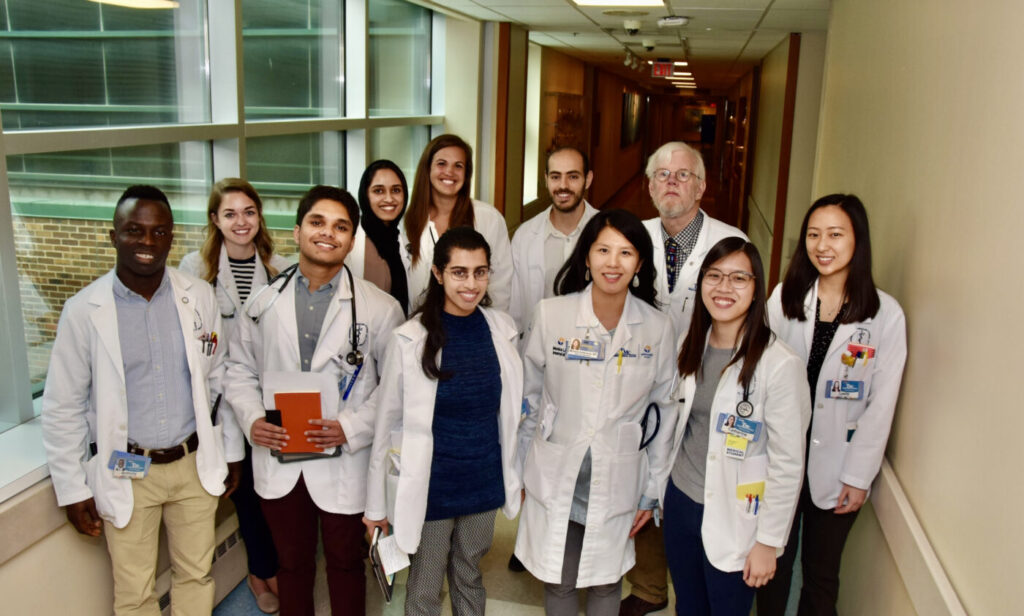
Timeline: six-year B.A./M.D. (entry August 2027)
| Date | What happens |
|---|---|
| August 1, 2026 | UMKC General Application and School of Medicine supplemental open |
| November 1, 2026 (11:00 p.m. CST) | Deadline: General Application, supplemental application and three reference forms |
| November 15, 2026 | Deadline: high school transcripts and official test scores (October test is the latest for initial review) |
| January 20, 2027 | College transcript with fall grades due (current college students only) |
| February 1, 2027 | FAFSA priority date, also required for School of Medicine scholarships |
| Early February 2027 | Interview offers and interview waitlist notices |
| Mid-February 2027 | Interviews, held virtually unless you are told otherwise |
| April 1, 2027 | Admission offers, alternate list and denials sent electronically; scholarship offers may come with admission |
| May 1, 2027 | Deadline to accept an offer |
| After May 1, 2027 | Offers to waitlisted students until the class is full |
| August 2027 | Classes begin |
If a deadline falls on a weekend, it moves to the next business day.
Timeline: four-year M.D. (January start)
| Date | What happens |
|---|---|
| May 1 | AMCAS opens |
| July 1 | AMCAS submission deadline |
| July 15 | AMCAS transcript deadline |
| End of July | Latest MCAT for initial review (August MCAT is considered for interviewees) |
| August 1 | AMCAS verification deadline; letters due through the AMCAS Letter Service |
| August 8 (11:59 p.m. Central) | Supplemental application and UMKC General Application deadline |
| Early September | Interview offers and interview waitlist notices |
| Mid-September | Interviews (virtual for the 2026 cycle) |
| Early October | Admission offers, waitlist and denials by email; $1,000 seat deposit to hold a place |
| January | Classes begin |
Applicants in the 2026 M.D. cycle applied between May and August 2026, interviewed in September and start in January 2027. If you are reading this now and planning an M.D. application, your next window opens May 1, 2027, for a January 2028 start. Confirm those dates on the M.D. admissions timeline when they are posted. If a deadline falls on a weekend, it moves to the next business day.
Decisions, deposits and the waitlist
All decisions are sent electronically, never by phone, and the Council’s decisions are final. B.A./M.D. applicants have until May 1 to accept, after which the school offers seats to waitlisted students until the class is full. M.D. offers go out between October 1 and December 1, and admitted M.D. applicants have up to 14 days to respond. Those who accept pay a $1,000 seat deposit, due by November 1, 2026, for the current cycle; it is nonrefundable and is applied to tuition. Deferred entry is not offered, and the M.D. waitlist typically holds about 35 positions. UMKC does not accept letters of intent, letters of interest or update letters. Once decisions for a cycle are made, no other applications are considered.
Tuition, Cost of Attendance and Financial Aid
UMKC is a public school, so cost depends heavily on residency. It also uses a regional rate for residents of Kansas, Oklahoma, Nebraska, Arkansas and Illinois, which sits between the Missouri and nonresident rates. B.A./M.D. students pay undergraduate-level costs in Years 1 and 2 and professional rates after that.
Cost of attendance
The school’s cost of attendance is a budget that includes tuition and fees, housing and dining, books and supplies, personal costs and transportation. The figures below come from the UMKC Medicine Estimated Costs page.
| Budget | Missouri | Regional | Nonresident |
|---|---|---|---|
| B.A./M.D. Year 1 (Fall 2025/Spring 2026): tuition and fees | $30,184 | $44,122 | $58,060 |
| B.A./M.D. Year 1: total cost of attendance | $53,838 | $67,776 | $81,714 |
| B.A./M.D. Year 2 (Summer 2025, Fall 2025/Spring 2026): tuition and fees | $35,916 | $52,505 | $69,094 |
| B.A./M.D. Year 2: total cost of attendance | $60,120 | $76,709 | $93,298 |
| M.D. Years 1-4 (summer through spring): tuition and fees | $47,759 | $69,477 | $91,184 |
| M.D. Years 1-4: total cost of attendance | $79,621 | $101,339 | $123,046 |
The B.A./M.D. budgets include $14,510 for housing and dining (students must live in university housing on the Volker campus at first), $2,670 to $3,220 for books and supplies, $4,324 for personal costs and $2,150 for transportation. The M.D. budget includes $19,346 for housing and dining, $2,920 for books, $7,446 for personal costs and $2,150 for transportation. The current page does not list a separate health insurance line, so ask the financial aid office how coverage is handled.
2026-27 semester tuition rates
UMKC’s cashier’s office publishes flat-rate tuition per semester for Fall 2026 and Spring 2027, on the graduate and professional program rates page:
| Rate group | Missouri | Regional | Nonresident | Medical simulation fee |
|---|---|---|---|---|
| Doctor of Medicine, Years 1-2 (16 hours) | $14,935.00 | $22,234 | $29,534 | $290.20 |
| Doctor of Medicine, Years 3-6 (18 hours) | $17,557.60 | $26,150 | $34,738 | $541.20 |
These rates do not include other university fees, and the number of billed terms per year depends on your program year, so use the cost of attendance budget above for yearly planning and ask the school how the rate groups apply to your year.
Scholarships
- Incoming B.A./M.D. students. Fifteen students in each incoming class receive $5,000 a semester for their first five semesters, $25,000 in total, based mainly on high financial need. You only need a FAFSA on file by February 1 to be considered, and awards come with the offer of admission.
- B.A./M.D. Years 3 to 6 and M.D. students. The school offers several $5,000 awards. Applications are open each year from October 1 to March 1, and selection weighs financial need, debt level, debt reduction strategies and merit. M.D. students admitted in January can apply by March 1 for the following fall semester.
- Senior awards recognize graduating students without an application.
Federal aid
All students who want need-based aid file the FAFSA. The priority date is February 1. B.A./M.D. students in Years 1 and 2 are undergraduates for aid purposes and must include parent information. M.D. students are graduate-level professional students and are classified as independent, so parent information is not required.
Ways to manage cost
The six-year format is itself a cost saver: B.A./M.D. students finish two years earlier than the usual eight-year path, which means two fewer years of tuition and two more years of physician earnings. Missouri residency is the other big lever, since the Missouri M.D. budget is more than $43,000 a year below the nonresident budget. Rural-focused students should also ask about HRSA-funded scholarship support available through the rural post-baccalaureate master’s program.
For context on borrowing, indebted UMKC medical graduates in 2024-2025 left with an average of $188,969 in medical school debt, and 78% of enrolled and graduating students received financial aid that year.
Campus Facilities and Student Life
The School of Medicine is in Kansas City’s Health Sciences District on Hospital Hill, close to its main teaching hospitals. UMKC’s other health professions schools are part of the same health sciences community, and the school’s Clinical Training Facility runs a Standardized Patient Program that supports all UMKC health professions programs.
Facilities
- Clinical Training Facility. The simulation team trains students at Kansas City and St. Joseph sites. The Kansas City hub at 2429 Charlotte Street houses the Standardized Patient Program, where trained actors portray patients and evaluate students’ communication. Students can join simulation interest groups, open practice hours and a student simulation internship.
- Docent units. Each docent team has offices and a shared meeting space at the School of Medicine or at Saint Luke’s Hospital of Kansas City.
- Healthcare Delivery and Innovation Building. A $145 million, five-story building in the Health Sciences District will include School of Medicine simulation labs, School of Dentistry patient clinics and research centers. Nelson Sabates, M.D., and his family made the largest alumni gift in the school’s history to the project.
- St. Joseph Medical Education Building. The $14.5 million, 22,000-square-foot building opened in August 2025 across the street from Mosaic Life Care. It has classrooms, exam rooms and simulation labs with a cardiopulmonary patient simulator and a 3D anatomy and virtual dissection tool.
Housing and getting around
B.A./M.D. students must live in UMKC residence halls for their first fall and spring semesters. After that they can stay in university housing, including apartments at Oak Place and on the Hospital Hill campus, or move closer to Hospital Hill with roommates. Students manage without a car, and docent team assignments take into account which members have one.
M.D. students arrive as graduates and arrange their own housing. In St. Joseph, a city of about 75,000 people about 50 miles north of Kansas City, students can choose downtown lofts, apartments or houses farther out, and they have access to the gym and intramural sports at nearby Missouri Western State University.
Student organizations
Team building at UMKC extends beyond the docent system. The school has more than 50 student organizations under the Medical Student Advisory Council (MSAC), the student government. Examples include the Society for Bioethics, the Student Research Society, the LGBTQIA+ Health District Alliance, the Wilderness Medicine Interest Group, the Veteran Health Alliance and On-Call Musicians. There is also an MD-Only Student Organization, the Latino Medical Student Association, the Student National Medical Association, GlobeMed, the Gold Humanism Honor Society, Alpha Omega Alpha and the Wellness Council. Students also organize around specialties, with interest groups in internal medicine, obstetrics and gynecology, psychiatry, pathology, public health, family medicine, emergency medicine, surgery and many more. The current list is on the student organizations page.
Service learning
Service is part of the mission, and students run real clinics:
- Sojourner Clinic, a free outpatient clinic developed and managed by medical students.
- Kansas City Free Eye Clinic, also listed among student organizations.
- Stuber Health Center in St. Joseph, which the school describes as the oldest free and charitable clinic in the United States.
Support and wellness
Every student has an Education Team Coordinator for advising. In Years 1 and 2, B.A./M.D. students work with a Volker campus coordinator; from Year 3 on, the coordinator is tied to the docent team. The Office of Student Affairs runs career services, including residency Match advising. A wellness coordinator, mental health resources and free or low-cost medical, psychological and psychiatric services are available to students.
Study abroad and global health
B.A./M.D. students can take part in medically related study abroad experiences through partner schools in Mexico, Austria and China, and some complete their undergraduate degree in Year 4 through study abroad. In 2025, 6% of UMKC graduating seniors reported a global health experience during medical school. If you want global health experience before medical school, IMA’s pre-med internships abroad place students in clinics in Kenya and other sites, which can give you concrete stories about care with limited resources.
Clinical Rotations and Research Opportunities
Where Kansas City students train
Kansas City students rotate through the school’s affiliates, including University Health Truman Medical Center and Lakewood Medical Center, Children’s Mercy Kansas City, Saint Luke’s Hospital of Kansas City, the Kansas City VA Medical Center, Research Medical Center and the Center for Behavioral Medicine. Docent rotation rounds take place at University Health Truman Medical Center or Saint Luke’s Hospital. With help from the Office of Student Affairs, students can also arrange clinical experiences at other hospitals and clinics when appropriate, including visiting electives.
The required clerkships in the final two years are general surgery, internal medicine (two docent rotations), obstetrics and gynecology, pediatrics, psychiatry and emergency medicine, plus family medicine in the year before. Electives include a required critical care rotation.
What makes UMKC different is how much clinical time comes before the clerkships. B.A./M.D. students are in a hospital two hours a week from the third week of Year 1. Kansas City students then spend half a day every week in continuity clinic for three and a half years, often following the same patients. One M.D. student describes the reward of following up with patients “I have seen before and talk with them about their lives.”
Where St. Joseph students train
St. Joseph students train at Mosaic Life Care in St. Joseph, a 352-bed tertiary-care hospital and member of the Mayo Clinic Care Network that averages 50,000 emergency visits, 2,000 births and 400 open-heart surgeries a year. Other major clinical sites include Mosaic Health in Maryville and Albany, Missouri; Hedrick Medical Center in Chillicothe, Missouri; Amberwell Health in Atchison, Kansas; White Cloud Indian Services in White Cloud, Kansas; Carroll County Memorial Hospital in Carrollton, Missouri; and Harrison County Community Hospital in Bethany, Missouri.
The Year 3 longitudinal integrated clerkship places students at one of five rural partners for three blocks, with a core group of primary care physicians as teachers and mentors. Students in an LIC care for the same community of patients across specialties, which is very different from moving between short rotations. Rural sites can be far from St. Joseph, and housing is provided in rural communities depending on location.
The first St. Joseph class of 14 graduated in December 2025 and took part in the campus’s first Match Day in March 2026. A third of the class went into family medicine, and others matched in internal medicine, radiation oncology, psychiatry, emergency medicine, otolaryngology, obstetrics and gynecology, neurology, orthopedic surgery and interventional radiology.
Residency outcomes
UMKC graduates train across the country, with some concentration in Missouri and the Midwest. The school lists internal medicine, pediatrics, family medicine, general surgery, anesthesiology and radiology as the most common specialties over the last seven years, and notes graduates matching in competitive fields such as dermatology, ophthalmology and plastic surgery. Graduating students’ own plans point the same way: internal medicine was the most common specialty intention in each of the last three graduating classes surveyed, at 23.2% in the most recent year, followed by psychiatry (9.8%) and general surgery (8.5%). Recent placements named by the school include Barnes-Jewish Hospital, Cedars-Sinai Medical Center, Children’s Mercy Kansas City, Massachusetts General Hospital, the Mayo School of Graduate Medical Education and the U.S. Air Force.
For graduates who want to stay rural, UMKC’s Family Medicine Residency offers the Maryville Rural Track, a 1+2 program: one year at University Health Lakewood Medical Center in Kansas City, then two years at Mosaic Medical Center in Maryville.
Research
Research is optional for medical students but well supported. Over the past decade it has become a major focus for the school, and extramural funding in grants and contracts is now $23 million a year, about half of it federal. The school has 22 endowed chairs and professorships, more than any other academic division in the University of Missouri System.
Research centers include the NextGen Biomedical Informatics Center, the Shock and Trauma Research Center, the Vision Research Center and the Center of Excellence in the Study of Dental and Musculoskeletal Tissues. Faculty also do research at Children’s Mercy, Saint Luke’s and University Health. Much of the school’s research aims at community health, using large databases for personalized and population-level medicine.
For students:
- You can do research with undergraduate faculty (B.A./M.D.), with basic science or clinical faculty at the school, or at other institutions as a visiting student.
- The Office of Research Administration supports student projects, and funding is available, including the Sarah Morrison Award and the UMKC Rural Research Award for rural health projects.
- Students present at the annual Health Sciences Student Research Summit each spring and at the Vijay Babu Rayudu Quality Improvement and Patient Safety Day.
- The QIPS Scholars program pairs selected students and faculty on quality improvement projects.
The school’s student research page lists current awards and opportunities. The school says B.A./M.D. graduates report the same level of research access as students at traditional medical schools.
Notable Alumni, Faculty, Leadership and Admissions Staff
The people below were checked against UMKC’s current leadership directory and official UMKC news stories on October 17, 2026. They are listed so you understand who shapes the school and what its graduates have done. None of them should be contacted about your individual application unless the school directs you to.
School leadership
Alexander Norbash, M.D., M.S., FACR, Dean. Norbash is a graduate of UMKC’s six-year program (B.A./M.D. 1986) and returned to lead the school in March 2024. Before that he was chair and professor of radiology at the University of California San Diego School of Medicine. He grew up in Platte City, Missouri, where his father was the town surgeon, and he credits a rural medicine elective in Cassville, Missouri, with showing him how independent rural physicians must be. As dean he has spoken about a goal of rural satellite medical schools “in all four corners of the state of Missouri.” For applicants, his story is a reminder that the B.A./M.D. program produces academic leaders as well as community physicians.
Paul Cuddy, Pharm.D., MBA, Vice Dean for Medical Education, Academic Affairs, and Leadership Development. Cuddy is the school’s vice dean and its LCME faculty accreditation lead, the person listed as the contact for accreditation. His role spans the medical education programs that every route feeds into.
Sara Gardner, M.D., Senior Associate Dean (Medical Education). Gardner also chairs the Council on Curriculum, which designs and manages the curriculum described above, including the docent model and the block-based clinical years.
Michael Wacker, Ph.D., Senior Associate Dean (Rural Campus and Pre-Clinical Medical Education). Wacker leads the St. Joseph regional campus and signs its welcome letter. He is also the contact for the rural post-baccalaureate master’s program. In a February 2026 UMKC story he explained the rural need simply: “Almost any disease you can list has a higher prevalence and a worse outcome in a rural area.” If St. Joseph is your goal, his campus’s mission and programs are the ones to study.
Mark T. Steele, M.D., Associate Dean (University Health). Steele is the school’s associate dean for University Health, one of its primary hospital partners, where he also serves as executive chief clinical officer. His dual role shows how closely the school’s clinical training depends on its affiliates.
Robert Riss, M.D., Associate Dean (Student Affairs). Riss leads student affairs, the office that handles advising, career services and visiting clinical experiences.
Admissions leadership
James Shackelford, MPA, Assistant Dean (Admissions and Recruitment). Shackelford leads admissions and recruitment for the School of Medicine. The Office of Admissions (816-235-1870, [email protected]) runs information sessions, consultations and visits for prospective students, and it is the right contact for questions such as whether a course meets a prerequisite.
Bryce Hesse, M.D., Chair, Council on Selection. The Council on Selection is the school’s admissions committee for the B.A./M.D., M.D. and O.S./M.D. programs. As chair, Hesse leads the body that screens applications, chooses interviewees and makes final decisions. The Council includes faculty, administrators and students, and decisions are made by the Council as a whole.
Kathleen Spears, Ph.D., Assistant Dean (Student Affairs). Spears directs the Rural Pathway Program, which supports about 10 rural-focused pre-med students a year, and is the person the school lists for advice on when to apply to it. “The pathway program is designed to find those people who have that passion and give them the support they need to be successful in healthcare,” she said in 2026.
Faculty
Nelson Sabates, M.D., Professor and Chair, Department of Ophthalmology. Sabates earned his B.A. in 1983 and M.D. in 1986 through the six-year program, joined the department his father founded 36 years ago and has chaired it for 20 years. He is president of the UMKC Research Foundation and director of the Vision Research Center, which he helped found in 2007. He received the school’s 2026 E. Grey Dimond, M.D., Take Wing Award, its highest alumni honor, and his family made the largest alumni donation in the school’s history to the Healthcare Delivery and Innovation Building.
Lawrence Dall, M.D., Assistant Dean (Medical Student Research). Dall’s title covers medical student research, the area to ask about if you want a project during medical school. He is also among the affiliated faculty of the school’s Quality Improvement and Patient Safety consortium.
Alumni
Amy K. Patel, M.D. (BLA 2010, M.D. 2011). Patel, a breast radiologist raised in Chillicothe, Missouri, is medical director of The Breast Care Center at Liberty Hospital and UMKC’s 2026 Alumna of the Year. She built Liberty Hospital’s breast imaging program, helped pass Missouri laws on insurance coverage for mammography and chairs the American College of Radiology’s RADPAC. She credits the six-year program with teaching her time management early: “Being in the six-year BA/MD program propelled me to mature faster.”
Stephanie Graff, M.D. (BLA 2003, M.D. 2004). Graff grew up on a farm in rural Missouri and is now director of breast oncology at Brown University Health and an associate professor of medicine at Brown’s Warren Alpert Medical School. She received the 2025 Take Wing Award. In her lecture she said the docent team model inspired the team-based care and mentorship programs she has built, and she urged students to “pull out the golden thread from that failure.”
Nelson Sabates and Alexander Norbash (above) are also B.A./M.D. alumni from the same 1986 class, and the dean has called Sabates “the shining example of a Take Wing awardee.”
These profiles show a pattern worth noting: many of the school’s most visible graduates came through the six-year program, grew up in Missouri and stayed connected to the state. That fits the mission, but it does not mean the school prefers any particular background. Each applicant is reviewed individually.
Admissions Statistics and Class Profile
How competitive is the B.A./M.D. program?
UMKC publishes approximate yearly numbers for the six-year program:
| Stage | Approximate number |
|---|---|
| Initial applications | About 1,500 |
| Complete applications | About 1,000 |
| Interviewed | About 350 |
| Entering class | 105 to 110 |
About 35% of complete applicants are interviewed. The class of 105 to 110 is roughly one seat for every nine or ten complete applications, but that is a seats-to-applications ratio, not an acceptance rate, because UMKC does not publish how many offers it extends. The school makes offers on April 1 and continues offering seats from the waitlist after May 1 until the class is full.
The planned residency mix is 60 to 65 Missouri students, 30 to 35 regional students and 10 to 15 out-of-state students. In other words, Missouri students fill more than half the seats, and out-of-state students compete for roughly one seat in ten.
Admitted B.A./M.D. students average an unweighted high school GPA of 3.9 (range 3.0 to 4.0) and a 32 ACT or 1420 SAT. These averages describe high school applicants. They are not M.D. figures and should not be compared with college GPAs or MCAT scores.
What about the M.D. program?
Accepted M.D. applicants for the 2025 entering class had a median MCAT of 509 (mean 508.5) and a median total GPA of 3.87 (mean 3.82). Their median science GPA was 3.82. Median MCAT section scores were 127 in Chemical and Physical Foundations, 127 in Critical Analysis and Reasoning Skills, 127 in Biological and Biochemical Foundations and 128 in Psychological, Social and Biological Foundations.
| Stage | In-state | Out-of-state | International | Total |
|---|---|---|---|---|
| Verified applications | 314 | 1,272 | 3 | 1,589 |
| Interviewed | 92 | 40 | 0 | 132 |
The M.D. program plans for about 35 new entrants each cycle. In these counts, “out-of-state” means anyone who is not a Missouri resident, so regional applicants from Arkansas, Illinois, Kansas, Nebraska and Oklahoma are included there. About 29% of in-state applicants were interviewed (92 of 314), compared with about 3% of out-of-state applicants (40 of 1,272). Those are interview shares, not acceptance rates, because offer counts are not published.
The school also sets firm minimums:
- MCAT: 495 or higher, within three years.
- GPA: 3.0 cumulative and 3.0 BCPM for Missouri and regional applicants; 3.5 and 3.5 for out-of-state applicants.
A minimum is a floor, not a target. Meeting it gets your file reviewed; the 509 median MCAT and 3.87 median GPA are a better guide to what a typical admitted M.D. student brings.
Residency across the school
For every program, Missouri residents get priority and over half of the class comes from in-state applicants. Out-of-state M.D. applicants face the higher 3.5 GPA floor, and applications from all residency groups are compared within their own pool after interviews.
What the numbers mean for your list
- High school seniors: if your unweighted core GPA and test scores sit near the B.A./M.D. averages and you have steady health experience, UMKC is a realistic reach worth a strong effort. Apply to traditional colleges too. The six-year program is a large commitment, and you should have a good plan if you are not admitted.
- Missouri and regional M.D. applicants: the January start and the regional rate make UMKC worth serious consideration. Apply early in May or June.
- Out-of-state M.D. applicants: check the 3.5 floors first. If you clear them and have a real reason to train in Kansas City or St. Joseph, apply, but build a list that leans on schools with more out-of-state seats.
Tips and Strategies for Admission
1. Choose the route that matches your timeline
The B.A./M.D. program is a decision you make at 17 or 18. The M.D. program is a decision you make as a college graduate. Medical Scholars sits in between. Read the eligibility rules for each and be honest about which one you can apply to with your best record. College students should check the 24-credit-hour B.A./M.D. limit carefully; most applicants who are already in college will belong in the M.D. or Medical Scholars route.
2. Show continuous health experience, not a single summer
For B.A./M.D. applicants, the school asks for continuous involvement in health-related activities and real investigation of the profession. Spread hospital or nursing home volunteering, shadowing, health clubs and medical camps across high school. For college applicants, look at pre-med internships and local roles where you work directly with patients. The aim is the same at either level: be able to describe what doctors and care teams actually do, from your own experience.
3. Plan your summers around clinical work
Summers are when many students get their most concentrated patient contact. Local hospital programs, clinical jobs and structured programs all count. IMA’s pre-med summer internships run during breaks and put interns into clinics where they take vitals, help with intake and triage and assist with care under supervision. Whatever you choose, keep notes on specific patients and moments. UMKC’s essays and interviews reward specific detail.
4. Connect your story to Missouri, the region or underserved care
UMKC’s mission puts Missouri first. If you grew up in Missouri or a regional state, say what that means to you. If you have worked in Kansas City clinics, rural towns or communities with few physicians, make that visible. Out-of-state applicants should explain any real ties to Missouri or Kansas City, and they should not invent them.
5. If rural medicine is your goal, show it in actions
The St. Joseph campus is built for students who want rural practice, and the M.D. supplemental has asked directly about rural interest and campus preference. Evidence counts more than intent: work in a rural clinic or hospital, family ties to a small town, the Rural Pathway Program or the rural post-baccalaureate master’s program. Rural students without nearby hospitals can find shadowing hard to arrange, which is exactly the barrier the Rural Pathway Program was designed to reduce.
6. Write a B.A./M.D. essay that adds something new
The 500-word B.A./M.D. essay asks what motivates you toward medicine and what UMKC should know that is not elsewhere in the application. Your activities and health experiences are listed in other sections, so use the essay for reflection, a turning point or context the lists cannot show. Do not reuse your Common App essay; it is not accepted for this program.
7. Choose references who know you
B.A./M.D. reference forms include several short answers and take up to an hour. Choose teachers, counselors or supervisors who know your work and character, ask at least a month before November 1 and send the request through the portal yourself. M.D. applicants should line up three letters, or a committee letter, early enough to clear the AMCAS Letter Service by August 1.
8. Use a gap year with purpose
Many M.D. applicants take a gap year, and one current UMKC student encourages almost every applicant he meets to “take a gap year and explore the field of medicine,” preferably in clinical roles. A well-used year can add clinical depth, raise your GPA through upper-level coursework or finish a prerequisite. If you are planning one, look at structured pre-med gap year programs alongside paid clinical jobs such as medical assistant, scribe or EMT work.
9. If you are reapplying, change the file
If you applied before and were not admitted, find out what changed since then. A higher MCAT, a stronger BCPM GPA, a finished prerequisite, a year of patient-facing work or a clearer link to Missouri or rural care can all matter. Reapplicants who submit the same file usually get the same result.
10. Submit early and track every component
UMKC reviews earlier-verified M.D. applications first, and it does not review late or incomplete applications for either route. File the UMKC General Application right away, because it can take a week to show as complete, and check both portals until every item is marked received.
11. Get help where it counts
Applicants who need a second reader for essays or interview practice can use IMA’s Medical School Admissions Consulting. Undergraduates still building experience can compare IMA’s medical internships for undergraduates with local options. Neither replaces your own work, and neither guarantees admission.
Secondary Application Questions, Example Responses and Analysis
The Council on Selection uses the supplemental application to judge fit with the school and to learn more than a primary application or a high school transcript can show. It is your chance to share who you are beyond a résumé, including your experiences, personal history, interests and reasons for medicine. Because UMKC has three routes, it also has three different sets of written questions. Make sure you are reading the set for your route.
The questions at a glance
| Route | Question | Limit | Who answers |
|---|---|---|---|
| B.A./M.D. (entry August 2027) | Essay: what motivates you to pursue medicine, and what UMKC should know about you that is not elsewhere in the application | 500 words | All B.A./M.D. applicants |
| B.A./M.D. (entry August 2027) | Three mandatory short answers (questions shown in the supplemental application) | 250 words or less each | All B.A./M.D. applicants |
| Medical Scholars | Personal statement: what has motivated you to study medicine, and why the Medical Scholars program | Follow the limit shown in the application | Medical Scholars applicants at partner schools |
| M.D. (prompts used in 2025-2026) | St. Joseph campus rating explanation | “A few sentences” | Applicants who rate the St. Joseph campus 8 or higher |
| M.D. (prompts used in 2025-2026) | Learning environment: interests, abilities and experiences that prepare you to contribute | 1,000 words | All M.D. applicants who receive the supplemental |
| M.D. (prompts used in 2025-2026) | Interest in rural healthcare | No limit stated | Optional; applicants interested in rural healthcare |
A note on the M.D. questions. UMKC shows its M.D. supplemental questions only inside the School of Medicine Portal after AMCAS verification, and the wording for the next M.D. cycle has not been posted. The three M.D. prompts below are the ones used in the 2025-2026 cycle. They are not confirmed as the questions for 2026-2027 or later. Use them to prepare, then check the portal and answer the exact questions and limits you are given.
B.A./M.D. applicants should also budget time for the activities and health experiences sections (up to 10 entries each), which carry as much weight as the essays. For prompts at other schools on your list, see our medical school secondary essay prompts database.
B.A./M.D. Essay: motivation and what UMKC should know (500 words)
“What motivates you to pursue a career in medicine? What would you like the UMKC School of Medicine to know about you that isn’t available in other parts of the application?”
Limit: 500 words. Who answers: every six-year B.A./M.D. applicant, in the School of Medicine Online Supplemental Application. UMKC describes the essay as “an opportunity for students to distinguish themselves from other applicants.” Common App essays are not accepted.
What it asks. Two questions share one 500-word space. The first is about motivation: why medicine, in your own experience. The second asks for something new: a part of you that your transcript, test scores, activity list and health experiences do not already show. A strong essay answers both, and it does not spend the second half repeating the first.
Approach. Open with one specific moment that shows why medicine pulls you, then explain what you did next to test that interest. Use the second half for something only you can say: how you handle setbacks, a responsibility at home, a value you hold or a way you learn. For a six-year, year-round program, readiness is a fair theme, because the Council is admitting 17- and 18-year-olds into a professional program. End with a short, specific link to how UMKC teaches, such as the early docent team or continuity clinic, without turning the essay into a brochure.
Illustrative example, not an actual applicant essay (489 words)
The summer before my junior year, I volunteered at the front desk of a nursing home in Sedalia, signing in visitors on Tuesday mornings. I took the job for service hours. I kept it because of Mrs. Ortiz.
She visited her father every Tuesday at ten, and every Tuesday she asked me the same question: had the doctor been in? Most weeks the answer was no. One morning she told me her father had stopped eating, and she did not know if it was his illness, a new medicine or something nobody had noticed. I had no answer. I walked her to the charge nurse, who sat with her for twenty minutes and explained exactly what the team was watching. Mrs. Ortiz left calmer, and she thanked me, even though all I had done was find the right person.
That morning is what motivates me to pursue medicine. I want to be the person who can answer the question, and who takes the time to sit down while answering it. Since then I have shadowed a family physician in my town for two summers, and I have seen that her best moments are not dramatic. They are the minutes she spends making sure a patient understands what happens next.
What my application does not show is how I learned to work. In ninth grade I earned a C in Algebra II, the first C of my life. I was embarrassed, and for a few weeks I avoided the subject. Then my teacher showed me how to keep an error log: every missed problem, why I missed it and what I would do differently. I still keep one, now for chemistry and calculus. My grades recovered, but the bigger change was that I stopped seeing a mistake as a verdict and started seeing it as information.
I think that habit matters for the B.A./M.D. program. Six years of year-round study is not something I can get through on enthusiasm alone. I will need to notice when I am falling behind, ask for help and adjust. I am ready to start medicine at eighteen because I have already practiced the part that is less exciting: steady work, honest feedback and fixing what is broken.
I am also drawn to how UMKC teaches. Joining a docent team in the third week means I would learn from a physician and from older students while I am still taking general chemistry. Following the same clinic patients for years sounds like the opposite of the nursing home, where families waited weeks for answers. I want to train in a place where knowing patients over time is built into the schedule.
I hope to practice in Missouri, possibly in a town like mine. Wherever I end up, I want patients and their families to leave my office the way Mrs. Ortiz left the nurses’ station: knowing what is going on, and knowing someone is paying attention.
Analysis.
- It answers the first question with a scene, not a slogan. The nursing home story shows motivation through a real gap in care: a family waiting for answers. The line “I want to be the person who can answer the question” states the motivation plainly.
- It shows the interest was tested. Two summers of shadowing a family physician show the applicant looked past one moment. The observation about “minutes she spends making sure a patient understands” connects back to the opening.
- It answers the second question with something truly new. A C in Algebra II and an error log would not show up in an activities list. The point is not the grade; it is the habit of treating mistakes as information.
- It speaks to readiness for a six-year program. The applicant names the hard part of the B.A./M.D. (six years, year-round) and explains why the habit matters. That reflects a real concern the Council has about young applicants.
- The UMKC link is specific and short. It names the docent team in the third week and following clinic patients over time, both verified parts of the curriculum, and contrasts them with the nursing home.
- The ending returns to the opening. Mrs. Ortiz leaving “knowing what is going on” ties the essay together without a summary paragraph.
- It fits the limit. At 489 words, it uses the space without going over.
Mistakes to avoid.
- Spending all 500 words on motivation and skipping the second question.
- Retelling your activity list. The Council already has it.
- Writing a family story where a parent’s career is the only reason you want medicine. The school asks applicants to investigate the profession beyond what they see at home.
- Praising UMKC in general terms such as “excellent reputation.” Name a real feature, or leave it out.
- Pasting your Common App essay. It is not accepted for this program, and it was written for a different question.
B.A./M.D. Short answers: three mandatory questions (250 words or less each)
“There will be three mandatory short answer questions that each applicant will answer. Short answer responses should be kept to 250 words or less.”
Limit: 250 words or less per answer. Who answers: every B.A./M.D. applicant. Where the questions appear: only in the School of Medicine Online Supplemental Application; UMKC does not publish their wording on its website.
What it asks. UMKC calls the short answers “an additional opportunity to learn more about you.” Because the questions themselves are shown only in the portal, the safest preparation is to build a bank of short, specific stories you can adapt: a challenge you worked through, a time you worked on a team, a health experience that surprised you, a responsibility outside school and a goal you are working toward. Each story should be different from the one in your 500-word essay.
Approach. When you open the portal, copy each question exactly, underline every part and answer the question that is asked, not the one you prepared for. Keep each answer to one example. Write to 250 words or fewer, and follow any other instruction shown in the portal.
Illustrative example, not an actual applicant essay (a worked response pattern, 193 words)
Worked response pattern for one short answer (replace the bracketed parts with your own content and the exact question from your portal):
Sentence 1: Answer the question directly in plain words. [If the question asks about a challenge, name the challenge. If it asks about a goal, name the goal.]
Sentences 2 to 4: Give one specific example with a time, a place and what you did. [For example: “During my sophomore year, I organized a blood pressure screening at my church with our school nurse and screened 46 adults in one afternoon.”]
Sentences 5 to 6: Explain what you learned or how you changed, in one or two sentences. [Focus on a skill such as listening, teamwork, persistence or responsibility.]
Final sentence: Connect the answer to medicine or to how you would learn at UMKC, without repeating your essay. [For example: “That is the kind of teamwork I expect to practice on a docent team.”]
Checks before you submit: stay at or under 250 words; answer every part of the question; use an example that does not appear in your 500-word essay; and read the answer aloud once to catch missing words.
Analysis.
- It answers first. Short answers are read quickly, so the first sentence should do the work.
- One example is enough. A single concrete story with a number or detail is stronger than three activities in a list.
- Reflection is brief. One or two sentences on what you learned show maturity without padding.
- It avoids repetition. Using a different story from your essay gives the Council four separate views of you across the essay and three answers.
Mistakes to avoid.
- Guessing at the questions and pasting prepared answers that do not fit.
- Running over 250 words. The limit is stated as “250 words or less.”
- Repeating the same experience across all three answers.
- Writing in fragments or lists. Write complete sentences.
Medical Scholars personal statement
“Personal statement or essay addressing the following: What has motivated you to study medicine? Why are you interested in the UMKC Medical Scholars program?”
Limit: no length is stated on the program page. Follow any limit shown in the Medical Scholars application; if none appears, a page or so (about 400 to 600 words) is usually enough to answer both parts. Who answers: sophomores and juniors at the 15 partner schools applying for early, guaranteed M.D. admission. Materials are due August 1.
What it asks. Two parts: your motivation for medicine, and why this specific early-admission program. The second part is where many applicants fall short. “Guaranteed admission” is not a reason by itself. Explain what early admission would let you do, and why UMKC’s M.D. program fits you.
Approach. Start with an experience that shows motivation and that your résumé can support. Then give two or three concrete reasons for Medical Scholars, such as staying in Missouri, using your remaining college years with purpose and how the docent model matches how you learn. Close by showing you understand that an early offer comes with responsibility.
Illustrative example, not an actual applicant essay (428 words)
I decided to study medicine on a night shift at a nursing home in Kirksville, where I have worked as a certified nursing assistant since my first semester at Truman State University. Around three in the morning, a resident I will call Mr. Hale pressed his call light for the fourth time. He did not need anything I could chart. He wanted to know whether his daughter had called, and whether the swelling in his legs meant he was getting worse. I could answer the first question. For the second, I could only take his vital signs, write down what I saw and tell the nurse. I remember wishing I understood enough to explain his body to him.
Since then I have tried to close that gap. I chose a biology major with a chemistry minor, and this year I am taking genetics and cell biology while continuing two night shifts a week. My work has taught me things that a classroom cannot: how to turn a resident without hurting them, how to notice when someone is quieter than usual, and how to stay patient at the end of a twelve-hour shift. It has also taught me that physicians in small towns carry a great deal. The physician who rounds at our facility also covers a clinic and the local emergency room.
I am interested in the UMKC Medical Scholars program for three reasons. First, I want to stay in Missouri. I grew up in Macon County, and I want to practice in a part of the state that looks like home. Training at a Missouri school, with Missouri patients, is the most direct way to do that.
Second, early and guaranteed admission would let me plan the rest of college with purpose. I would use my senior year to take upper-level biochemistry, keep working as a CNA and finish a research project on fall prevention that I started with a faculty member, instead of spending it on a broad application cycle.
Third, UMKC’s docent model fits how I learn. I learned to be a CNA by working beside experienced aides who corrected me in real time. A docent team, with weekly continuity clinic and older students as mentors, sounds like that same kind of learning, applied to medicine.
I know a guaranteed seat is a responsibility, not a reward. If I am selected, I intend to arrive in Kansas City ready to work, and to keep the promise I made to myself on that night shift: to understand enough to answer the questions patients are really asking.
Analysis.
- Part one is answered with direct patient care. The night shift as a CNA shows motivation through work the applicant has actually done, and the final line returns to it.
- The progress is concrete. Genetics and cell biology this year and upper-level biochemistry next year match UMKC’s three prerequisites, which shows the applicant read the M.D. requirements.
- Part two has three clear reasons. Missouri roots, a plan for senior year and a learning style that fits the docent model. Each one is specific to UMKC rather than to any early-admission program.
- It treats the guarantee as a responsibility. That tone fits a program where the Council is committing a seat early.
- The partner school is real. Truman State University is on the program’s list of partner schools.
Mistakes to avoid.
- Making “I would not have to apply broadly” your main reason.
- Leaving out the “why Medical Scholars” half.
- Listing healthcare experiences that are not on your résumé or CV.
- Forgetting the letters: at least three, including one from a professor, sent to the school by August 1.
M.D. Prompt 1: St. Joseph campus rating explanation (prompt used in 2025-2026)
“You have highly rated your placement at the Saint Joseph campus as a preferred site. Please help us understand why you assigned your rating. For example, is rural clinical practice your foremost career goal, or do you prefer the Saint Joseph campus because of its location, curriculum, or education pedagogy? In a few sentences, please help us better understand your rating.”
Limit: no word count was stated; the prompt asks for “a few sentences.” Write about 75 words and follow any limit shown in your portal. Who answers: in 2025-2026, M.D. applicants who rated their likelihood of attending the St. Joseph campus at 8 or higher. Cycle: this is the wording used in 2025-2026; check the portal for the current question.
What it asks. The school gives you the categories: rural practice as a career goal, or a preference for St. Joseph’s location, curriculum or teaching approach. Say which one applies and give one fact that backs it up.
Approach. Lead with your main reason, add one personal detail and one program detail, and stop. A few sentences means a few sentences.
Illustrative example, not an actual applicant essay (77 words)
I rated St. Joseph highly because rural family medicine is my career goal. I grew up in Maryville, and my mother drives forty minutes each way to see her cardiologist. I want to train where I hope to practice. The longitudinal integrated clerkship appeals to me because caring for one community across primary care, emergency care and women’s health is what a small-town physician actually does. I also prefer smaller in-person labs and closer relationships with docents.
Analysis.
- It answers in the first sentence, using the prompt’s own category: rural practice as a career goal.
- It gives evidence. Growing up in Maryville, near St. Joseph, and a family member’s long drive for specialty care make the goal believable.
- It names a real curriculum feature. The longitudinal integrated clerkship across primary care, emergency care and women’s health matches the St. Joseph Year 3 design.
- It adds a second reason briefly. In-person labs and closer docent relationships reflect how St. Joseph actually delivers the preclinical years.
- It respects “a few sentences.” Five sentences, about 75 words.
Mistakes to avoid.
- Rating St. Joseph highly only to look flexible, then writing a vague answer.
- Writing a full essay when the prompt asks for a few sentences.
- Saying you prefer St. Joseph because it seems less competitive. Give a reason tied to training or practice.
M.D. Prompt 2: Contributing to the learning environment (1,000 words; prompt used in 2025-2026)
“We educate physicians/healthcare providers to provide care for individuals with various identities, backgrounds, experiences, and perspectives. Describe any interests, abilities and/or experiences that prepare you to participate in and contribute to that learning environment.”
Limit: 1,000 words. Who answers: in 2025-2026, all M.D. applicants who received the supplemental invitation. Cycle: this is the wording used in 2025-2026; check the portal for the current question and limit.
What it asks. Two verbs matter: “participate in” and “contribute to.” The school wants to know what prepares you to learn alongside classmates and patients who differ from you, and what you will add to that learning. It does not ask you to claim an identity. It asks about interests, abilities and experiences, and any applicant can answer it well.
Approach. One thousand words is a lot of space, so give it structure. Use two or three experiences that show how you learned to work across difference, then say plainly what you would bring to classmates and patients. Tie it to how UMKC teaches: docent teams that mix years, continuity clinic and student-run service. Leave room for what you expect to learn, not only what you will teach.
Illustrative example, not an actual applicant essay (857 words)
My older brother, Daniel, has cerebral palsy and speaks through a tablet. When we were children, I learned his device before I learned to ride a bike. I knew which screens he used to tell a joke and which ones he used when he was hurting. By the time I was ten, doctors would sometimes turn to me instead of to him, because I answered faster. Daniel hated that, and he was right. The most important thing I learned growing up was to wait.
Waiting sounds simple, but it is a skill. Daniel needs about a minute to build a sentence on his device. In that minute, most people fill the silence, finish his thought for him or turn to whoever is standing next to him. I learned to keep my eyes on him, to ask one question at a time and to let the pause sit. When I do, he tells me exactly what he means, and it is often funnier or sharper than anything I would have guessed. That habit has shaped how I listen to everyone.
I took that skill into my work. For three summers I was a counselor at a camp for children with physical and developmental disabilities in the Ozarks. I had campers who used wheelchairs, campers who were nonverbal and campers who could talk faster than I could think. My job was not to make everyone the same. It was to figure out what each child needed to take part: a different grip on a canoe paddle, a picture schedule for a camper with autism, or simply more time at the top of the climbing wall. I learned that inclusion is usually a series of small, practical decisions.
In college I found a very different community. I tutored high school students who had resettled in Kansas City as refugees from Afghanistan, the Democratic Republic of the Congo and Burma. Most were learning English while taking chemistry and algebra. I could not rely on my own language, so I used drawings, gestures and the few phrases of Swahili and Dari that my students taught me, usually while laughing at my pronunciation. One student, Grace, was preparing for a biology test on the heart. We built a model out of colored tape on a table. She passed, and then she asked me whether her grandmother’s chest pain could be her heart. I did not know the answer, but I knew how to find her grandmother a clinic with an interpreter. That conversation showed me how often health questions arrive in places that are not clinics.
My clinical work has tested these lessons. For the past year I have worked as an emergency department scribe at a Kansas City hospital. I see patients of every age, income and background, often on the worst day of their year. I have watched physicians who adjust their explanations for each person and physicians who say the same sentence to everyone. The patients notice the difference. I have also seen how often patients with disabilities are spoken about instead of to, just as Daniel was. When a physician kneels to make eye contact with a patient in a wheelchair, or asks a family member to step back so the patient can answer, the whole room changes.
These experiences give me three things I can bring to a UMKC docent team.
The first is patience in communication. On a team that cares for patients from many backgrounds, someone has to be comfortable with silence, interpreters, devices and slow conversations. I am. I can also share practical tools, such as asking a patient how they prefer to communicate before starting a history.
The second is a perspective on disability that comes from family life, not a textbook. I know what it is like to sit in a waiting room for three hours with a person who cannot easily ask for a different chair. I know that accessible care involves parking, doorways and scheduling as much as diagnosis. In discussions about systems of care, I can speak to those barriers from experience.
The third is a habit of learning from the people I am trying to help. My campers taught me how to adapt activities. My students taught me words in their languages. Daniel taught me to wait. I expect my classmates and patients at UMKC to teach me just as much, especially those whose backgrounds are different from mine. I want to learn from classmates who grew up in rural towns, who served in the military or who came to medicine after other careers.
I am especially interested in contributing to the student-run Sojourner Clinic, where many patients face more than one barrier at once, and to student organizations focused on underserved care. I also look forward to continuity clinic, where I could follow patients long enough to learn how they communicate best.
I want to become a physician who looks at the patient first, asks one question at a time and waits for the answer. That is what my brother taught me, and it is what I hope to practice and share with my classmates in Kansas City.
Analysis.
- It answers both verbs. The essay shows how the applicant learned (from Daniel, campers, refugee students and the emergency department) and then lists three concrete contributions.
- The central skill is specific and teachable. “Waiting” for a person using an AAC device is a precise ability, and the applicant shows it working in several settings.
- The experiences cover different kinds of difference: disability, language and culture, and patients in crisis in an urban emergency department. That breadth fits the prompt’s “various identities, backgrounds, experiences, and perspectives.”
- It stays humble. The final contribution is a habit of learning from others, and the applicant names classmates they hope to learn from. That shows they understand a learning environment runs both ways.
- It connects to real UMKC features (docent teams, continuity clinic and the student-run Sojourner Clinic) without overloading the essay with program names.
- It uses the space with purpose. At 857 words, it is well under the limit and still complete.
Mistakes to avoid.
- Treating the prompt as a request to describe your identity without explaining what you learned or would contribute.
- Writing about other people’s hardships in a way that makes you the hero of their story.
- Filling 1,000 words because the space exists. A focused 700 to 900 words often reads better.
- Using broad claims such as “I am passionate about diversity” without any example.
- Reusing your AMCAS personal statement.
M.D. Prompt 3: Interest in rural healthcare (optional; prompt used in 2025-2026)
“If you are interested in rural healthcare or in practicing a specialty that meets the needs of underserved rural communities, please describe your interest in this aspect of healthcare.”
Limit: no limit was stated. Write about 250 to 350 words and follow any limit shown in your portal. Who answers: in 2025-2026, this was optional and for applicants interested in rural healthcare. Cycle: this is the wording used in 2025-2026; check the portal for the current question.
What it asks. Describe your interest in rural healthcare or in a specialty that serves rural communities. “Describe your interest” means where it came from and what you understand about rural care, not only that you have it.
Approach. If you answer, ground it in rural experience: work, family, community or a program such as the Rural Pathway Program. Show you understand rural realities such as distance, broad scope and limited specialists. Then connect to St. Joseph’s training or rural residency options. If you have no real rural interest, it is fine to skip an optional question.
Illustrative example, not an actual applicant essay (293 words)
For two years I have worked as an EMT for an ambulance service that covers a county in northwest Missouri with no hospital of its own. Our nearest emergency department is thirty-five minutes away in good weather. I have learned what that distance means. It means a woman in labor deciding whether to wait. It means a farmer with chest pain driving himself because he does not want to “waste” the ambulance. It means that the family physician in town is often the only doctor a patient sees in a year.
That physician has become my model. She delivers babies, manages diabetes, reads X-rays when the radiologist is backed up and checks in on our crew after a hard call. I want to practice the same kind of broad family medicine, including obstetrics, in a rural community in Missouri or a neighboring state.
My interest is also practical. I have seen patients miss follow-up visits because they could not take a day off for a ninety-mile round trip. I have seen how much difference one clinic with evening hours makes. I want my training to prepare me for that reality: wide scope, limited specialists and patients I will see at the grocery store.
That is why the St. Joseph campus interests me. A longitudinal integrated clerkship at a rural partner site would let me care for one community across primary care, emergency care, surgery, women’s health and behavioral medicine, which is close to the work I hope to do. I am also interested in rural residency paths such as the Maryville Rural Track, which combines a year in Kansas City with two years in a rural hospital. Rural healthcare is not a backup plan for me. It is the reason I am applying.
Analysis.
- It starts with real exposure. EMT work in a county without a hospital is direct, credible evidence of interest.
- It shows understanding, not romance. Distance, missed follow-ups and a physician with a broad scope are accurate pictures of rural care.
- It names a specialty path. Family medicine with obstetrics answers the “specialty that meets the needs” part of the prompt.
- It connects to verified UMKC options: the St. Joseph longitudinal integrated clerkship and the Maryville Rural Track residency.
- The last line commits. “Rural healthcare is not a backup plan for me” leaves no doubt.
Mistakes to avoid.
- Answering an optional rural question with no rural experience to back it up.
- Describing rural communities in stereotypes.
- Copying your St. Joseph rating answer. The two prompts overlap, so use different details.
General advice for every UMKC answer
These points apply to every route and every question:
- Know what is already in your application. Do not spend limited space repeating your activities or AMCAS entries. You can expand on something there, but add new reflection.
- Use your space well. Mix breadth and depth. Avoid résumé-style lists, but do not focus so narrowly that the reader learns only one thing about you.
- Organize answers as stories. A clear opening, supporting detail and an ending help the reader follow you. Plan to show a different side of yourself in each answer.
- Be sincere, professional and concise. Write as if you were talking with a member of the Council on Selection. They want to know who you are.
- Use real experiences to make your points. If you want to show academic curiosity, describe a research question you worked on. If you want to show resilience, describe what you did after a setback.
- Proofread. Check grammar, spelling and punctuation, and have someone else read your answers.
Applications to medical school carry a lot of weight, and the details can feel overwhelming. If you want a fresh perspective on your application strategy or a second reader for these essays, explore IMA’s Medical School Admissions Consulting services.
Interview Format and Preparation
Both routes require an interview, and the interview result is one of the components the Council on Selection weighs in its final review. No single part of the application guarantees an interview or an offer.
What UMKC confirms
| B.A./M.D. | M.D. | |
|---|---|---|
| Interview offers | Early February, by email; some applicants are placed on an interview waitlist | Early September, electronically; some applicants are placed on an interview waitlist |
| Interview dates | Mid-February; you select and confirm a date from the email | Mid-September; you select and confirm a date |
| Format | Virtual unless the school tells you otherwise | 11-station multiple mini interview (MMI), virtual for the 2026 cycle |
| Decisions | April 1 | Early October; offers sent October 1 through December 1 |
| Test scores still accepted | December ACT or SAT | August MCAT |
M.D. candidates who are invited must be present at the date and time of their interview. Medical Scholars candidates are also interviewed after the Council reviews complete applications.
The M.D. interview is an 11-station multiple mini interview (MMI) designed to assess non-cognitive attributes and experiences. Phone interviews are not permitted, and there are no regional interviews. For the B.A./M.D. route, your invitation will explain the format, so read it closely and prepare for both traditional one-on-one questions and short, scenario-based stations.
What the interview is likely to test
Because selection “is based on the core competencies of the School of Medicine,” expect questions and scenarios that touch the six competencies: communication, professionalism and ethics, medical knowledge and curiosity, learning from experience, systems-based thinking and patient care. That is general preparation guidance, not a published scoring rule.
How to prepare
- Know why UMKC, and why your route. B.A./M.D. applicants should be ready to explain why they want a six-year, year-round program at 18, and what they would do if they changed their mind about medicine. M.D. applicants should be ready to talk about the January start, joining a class midstream and the docent model.
- Know the two campuses. If you rated St. Joseph highly, expect to discuss rural practice and the longitudinal integrated clerkship. If you prefer Kansas City, know what continuity clinic and docent rotation involve.
- Practice ethical and teamwork scenarios. Work through situations such as a teammate cutting corners, a patient refusing care or a scarce resource that must be shared. Explain your reasoning, not only your answer.
- Review your own file. Re-read your essay, short answers, activities and health experiences, or your AMCAS and supplemental answers. Interviewers may ask about anything you wrote.
- Rehearse on video. For virtual interviews, test your camera, light and sound, use a quiet room and practice looking at the camera. Have a backup plan if your internet drops.
- Prepare a few questions. Ask about things the website does not answer, such as how students balance continuity clinic with coursework or what the St. Joseph students’ first Match taught the school.
For practice questions, see our list of the most common medical school interview questions. If you want structured practice with feedback, IMA’s medical school admissions consulting includes mock interviews.
After the interview
Decisions arrive by email on April 1 (B.A./M.D.) or in early October (M.D.). If you are placed on the alternate list, keep your contact information current and respond quickly to any message, because B.A./M.D. waitlist offers begin after May 1 and continue until the class is full. If you are admitted to the M.D. program, you have up to 14 days to respond; if you accept, pay the $1,000 nonrefundable seat deposit to hold your place. UMKC does not accept letters of intent or update letters, so put your effort into the interview itself.
Frequently Asked Questions
Is UMKC School of Medicine hard to get into?
Yes. For the six-year B.A./M.D. program, about 1,500 students start an application each year, about 1,000 complete it, about 350 are interviewed and the class has 105 to 110 seats. Admitted students average an unweighted 3.9 GPA and a 32 ACT or 1420 SAT. The M.D. program requires at least a 495 MCAT and a 3.0 GPA (3.5 for out-of-state applicants), but those are floors, not typical scores: accepted M.D. applicants for the 2025 entering class had a median 509 MCAT and 3.87 GPA, and 132 of 1,589 verified M.D. applicants were interviewed. Missouri residents fill over half of each class, so out-of-state applicants face the toughest odds. Apply to UMKC as part of a balanced list.
What is the UMKC School of Medicine acceptance rate?
UMKC does not publish an acceptance rate for either route, because it does not release the number of offers it makes. For the B.A./M.D. program, about 35% of complete applicants are interviewed, and there are about 105 to 110 seats for about 1,000 complete applications. For the M.D. program, 132 of 1,589 verified applicants were interviewed for the 2025 entering class, about 8%, and the program plans for about 35 new entrants. Those ratios are useful for planning, but they are not acceptance rates. Any single “UMKC acceptance rate” you see online is an estimate or a different ratio.
What is the difference between the B.A./M.D. and the M.D. program?
The B.A./M.D. is a six-year program for high school seniors (and college students with 24 or fewer post-high school credit hours) that awards a bachelor’s degree and an M.D. with no MCAT. The M.D. is a four-year program for college graduates who apply through AMCAS, take the MCAT and start in January. The two groups merge in the spring of the B.A./M.D. program’s second year and finish medical school together.
Do UMKC B.A./M.D. students take the MCAT?
No. Students admitted to the B.A./M.D. program never take the MCAT and do not reapply to medical school. They must still pass USMLE Step 1 in Year 4 and Step 2 later in the program, along with national subject exams.
What ACT or SAT score do I need for the UMKC B.A./M.D. program?
The minimum is a 24 ACT or 1160 SAT, and admitted students average a 32 ACT or 1420 SAT. UMKC superscores, requires the ACT Science section and does not use the writing sections. The October test is the latest accepted for initial review; interviewees can use a December score. Scores must be earned within three years.
Can college students apply to the six-year program?
Yes, if they have 24 or fewer credit hours earned after high school graduation, counted through the end of the semester in which they apply. They must earn a 3.0 cumulative GPA in their first fall semester and send that transcript by January 20. Students with more credits should look at the M.D. program or, at a partner school, Medical Scholars.
What MCAT and GPA do I need for the UMKC M.D. program?
The minimum MCAT is 495, earned within three years of the application deadline. Missouri and regional applicants need a 3.0 cumulative GPA and a 3.0 BCPM GPA; out-of-state applicants need 3.5 for both. These are minimums for review. Accepted M.D. applicants for the 2025 entering class had a median MCAT of 509 and a median GPA of 3.87 (3.82 science), so a competitive application usually needs scores near those medians plus strong clinical experience and ties to the school’s mission.
Why does the UMKC M.D. program start in January?
UMKC’s M.D. students begin in January so they can join the B.A./M.D. students in the spring of the B.A./M.D. program’s second year, when the Human Structure Function series starts. From there the two groups share the same curriculum. For you, it means applying from May to August and, if admitted, starting medical school about four months after your October offer.
What are the UMKC M.D. prerequisites?
One semester each of upper-level biochemistry, genetics and cell biology, each with a B or better from a regionally accredited U.S. college or university. Pass/fail grades from spring or summer 2020 are not penalized. The Council may let you finish one course in the fall before you start in January.
Does UMKC prefer Missouri residents?
Yes. UMKC gives priority to Missouri residents and selects over half of each class from in-state applicants. Regional applicants from Arkansas, Illinois, Kansas, Nebraska and Oklahoma come next and also pay a lower regional tuition rate. Out-of-state applicants are welcome but face a 3.5 GPA floor for the M.D. route.
Can international students or DACA recipients apply?
UMKC accepts only U.S. citizens and permanent residents for both routes, and it states that international students are not eligible. Permanent residency must be in place by November 1 (B.A./M.D.) or August 1 (M.D.) of the year before entry. If you have a different status, contact the Office of Admissions before applying.
What are the UMKC secondary essay questions?
B.A./M.D. applicants write a 500-word essay on what motivates them toward medicine and what UMKC should know that is not elsewhere in the application, plus three mandatory short answers of 250 words or less. In 2025-2026, M.D. applicants answered a 1,000-word question about contributing to a learning environment that serves people of many identities and backgrounds, an optional rural healthcare question and, if they rated the St. Joseph campus highly, a short explanation. Always check the portal for the current wording.
What is the St. Joseph campus?
It is UMKC’s rural M.D. campus in St. Joseph, Missouri, about 50 miles north of Kansas City, run with Mosaic Life Care. Students share the preclinical curriculum with Kansas City, then spend Year 3 in a longitudinal integrated clerkship at a rural partner site. The campus opened in 2021, graduated its first class of 14 in December 2025 and moved into a new $14.5 million building in August 2025.
What is the docent system?
A docent is a teaching physician who mentors a small team of students. B.A./M.D. students join a docent team in the third week of Year 1. From Year 3 on (Year 1 for M.D. students), teams of about 12 mix students from different years, spend half a day a week in continuity clinic and do inpatient rounds together for two months a year. Older students serve as senior partners to newer ones.
How much does UMKC School of Medicine cost?
The estimated M.D. cost of attendance is $79,621 a year for Missouri residents, $101,339 for regional residents and $123,046 for nonresidents, including tuition and fees of $47,759, $69,477 and $91,184. B.A./M.D. Year 1 costs (Fall 2025/Spring 2026) are $53,838, $67,776 and $81,714. Indebted graduates in 2024-2025 averaged $188,969 in medical school debt. File the FAFSA by February 1 for priority aid and School of Medicine scholarships.
How much clinical experience do I need for UMKC?
UMKC does not set an hour requirement. For the B.A./M.D. program, it recommends continuous involvement in health-related activities throughout high school, such as volunteering and shadowing. For the M.D. program, it reviews co-curricular and health-related activities as part of holistic review. Aim for steady, patient-facing work you can describe in detail. Structured options such as internships for pre-med students can add hands-on experience if local roles are hard to find.
What is the Medical Scholars program?
Medical Scholars offers early, guaranteed admission to UMKC’s M.D. program for sophomores and juniors at 15 partner colleges, including UMKC, Mizzou, Truman State, Rockhurst and the University of Illinois Chicago. You submit transcripts, a personal statement, a résumé and three letters (one from a professor) by August 1, and selected applicants are interviewed.
What is the UMKC M.D. interview format?
The M.D. interview is an 11-station multiple mini interview (MMI) that assesses non-cognitive attributes and experiences. Interviews for the 2026 cycle are virtual, there are no phone or regional interviews, and invitations go out in early September. B.A./M.D. applicants receive format details with their February invitation.
Does UMKC offer early decision, deferrals or a secondary fee waiver?
No. UMKC has no Early Decision Program and does not offer deferred entry for the M.D. program. The M.D. supplemental application has no separate fee, but the UMKC General Application carries a $50 fee. The early route into the M.D. program is Medical Scholars, for sophomores and juniors at partner colleges.
Does UMKC offer research opportunities?
Yes. Research is optional but supported, with student awards such as the Sarah Morrison Award and the UMKC Rural Research Award, an annual Health Sciences Student Research Summit and a Quality Improvement and Patient Safety Day. Students can work with School of Medicine faculty, affiliate hospital researchers or other institutions as visiting students.
Related Medical School Guides
If UMKC is on your list, these guides cover schools you may want to compare:
- Washington University School of Medicine. Missouri’s private research powerhouse in St. Louis, a very different setting from UMKC’s community-based model in the same state.
- Saint Louis University School of Medicine. A private Catholic M.D. school in St. Louis, useful for Missouri applicants who want a traditional four-year August start.
- University of Missouri Medical School. The other public M.D. school in the University of Missouri System, in Columbia, and a natural comparison for Missouri residents.
- Indiana University School of Medicine. A large Midwest public M.D. program with regional campuses, a good comparison if you like UMKC’s two-campus model.
- Western Michigan University Homer Stryker M.D. School of Medicine. A private, community-based Midwest M.D. school that, like UMKC, trains students through partner hospitals.
- Michigan State University College of Human Medicine. A Midwest public M.D. school that trains students at community campuses across Michigan, worth comparing for applicants who like regional campus training.
For every M.D. and D.O. program in the state, see our guide to medical schools in Missouri. We also have a second guide to Washington University School of Medicine with more detail on WashU’s programs.
More definitive medical school guides
Explore our growing catalog of medical school guides:
- New York Medical College
- University of Pittsburgh School of Medicine
- University of Wisconsin Medical School
- VCU School of Medicine
- University of Maryland School of Medicine
- Case Western Medical School
- University of North Carolina Medical School
- University of Florida Medical School
- Emory University School of Medicine
- Boston University College of Medicine
- California University of Science and Medicine
- UC San Diego Medical School
- California Northstate University College of Medicine
- Touro University of California
- CHSU College of Osteopathic Medicine
- UC Davis School of Medicine
- Harvard Medical School
- UC Riverside School of Medicine
- USC Keck School of Medicine
- UT Southwestern Medical School
- Long School of Medicine at UT Health San Antonio
- University of the Incarnate Word School of Osteopathic Medicine
- UT Austin’s Dell Medical School
- UTMB School of Medicine
- McGovern Medical School at UT Health
- Johns Hopkins School of Medicine
- The University of Texas Rio Grande Valley School of Medicine
- UNT Texas College of Osteopathic Medicine
- University of Houston College of Medicine
- Texas A&M College of Medicine
- Baylor College of Medicine
- George Washington University School of Medicine
- Vanderbilt University School of Medicine
- St. George’s University School of Medicine
- Lake Erie College of Osteopathic Medicine (in Pennsylvania)
- Sidney Kimmel Medical College at Thomas Jefferson University
- Wake Forest University School of Medicine
- Western University of Health Sciences (in California)
- Drexel University College of Medicine
- Stritch School of Medicine at Loyola University Chicago
- Georgetown University School of Medicine
- Yale School of Medicine
- Perelman School of Medicine
- UCLA Medical School
- NYU Medical School
- Brown Medical School
How International Medical Aid Can Help
UMKC looks for applicants who know what patient care involves, can reflect on it honestly and fit a mission centered on Missouri, service and early clinical learning. International Medical Aid (IMA) helps pre-health students with both the experience and the application.
Clinical internships. IMA runs pre-health internships in Kenya and at other sites for students preparing for medicine and other health careers. Interns take vital signs, do patient intake and triage, and help with direct patient care under the supervision of local clinicians. That gives you hands-on clinical skills and specific stories about communication, teamwork and care with limited resources, which is exactly the material UMKC’s essays and interviews ask about. Learn more about IMA’s medical internships abroad and how they fit into a pre-med timeline.
Admissions consulting. IMA’s Medical School Admissions Consulting helps with school lists, personal statements, secondary essays and interview practice. For UMKC that can mean planning a B.A./M.D. essay and short-answer bank, or timing an M.D. application so AMCAS is verified well before August 1.
One clear next step. If you still need meaningful patient contact, start with clinical experience. If you are applying this cycle, start with your essays and interview preparation.
IMA is not affiliated with the UMKC School of Medicine, and no internship or consulting service can guarantee admission to any medical school. What we can do is help you gain real clinical experience and tell your story well.
Final Thoughts and Sources
We hope this guide has given you a clear picture of what it takes to get into UMKC School of Medicine. The admissions process is competitive, but with steady work you can put yourself in a strong position. The most important decision comes first: choose the route that fits you. High school seniors have until November 1, 2026, to submit the B.A./M.D. application, with transcripts and scores by November 15 and three reference forms that take real time to complete. College graduates should plan an AMCAS submission in May or June, verification by August 1 and the UMKC supplemental and General Application by August 8, with a January start. Sophomores and juniors at partner schools should look at Medical Scholars before August 1.
Whichever route you take, show the Council on Selection steady patient-facing experience, honest reflection and a real reason to train in Kansas City or St. Joseph. Remember, we are here to help with anything at all, from hands-on clinical internships to personal admissions consulting. We wish you the best of luck on your journey to becoming a doctor.
Source notes
Facts were checked on October 17 and 18, 2026. Cohort and year labels appear with each figure in the article.
- UMKC School of Medicine, B.A./M.D. Admission Requirements and Eligibility, Admissions Timeline, Application Information, Program Overview and B.A./M.D. FAQs (applicant and class estimates, averages, minimums, curriculum structure, housing, study abroad); applications for 2027 entry.
- UMKC School of Medicine, M.D. Admissions Requirements, Application Information, Admissions Timeline, Program Overview, Prerequisite Course Evaluations and Student Profiles pages (minimum MCAT and GPA, prerequisites, letters, deadlines, January start, seat deposit, virtual interviews for the 2026 cycle).
- UMKC School of Medicine, B.A./M.D. and M.D. Curriculum, St. Joseph curriculum, St. Joseph welcome letter and St. Joseph program pages, and Learning in Docent Teams.
- UMKC School of Medicine, Medical Scholars, Rural Pathway Program and Rural Medical Post-Baccalaureate Program pages.
- UMKC School of Medicine, Mission, Vision and Strategic Plan (mission, vision, graduate outcomes, $23 million research funding, endowed chairs, GME); Council on Selection (core competencies, holistic review, residency); Our School; LCME Accreditation; Leadership directory; Hospital Affiliates; Degree and Certificate Programs; Six Years, Two Degrees.
- UMKC School of Medicine, Student Organizations, Student Research, Research, Clinical Training Facility, Wellness Program and School of Medicine Scholarships pages.
- UMKC Financial Aid, Medicine Estimated Costs (B.A./M.D. Year 1 and Year 2 budgets for 2025-26 and the M.D. Years 1-4 budget), and UMKC Cashier’s Office, Graduate and Professional Program Rates and Fees (Fall 2026 and Spring 2027 semester rates).
- UMKC Today news stories: Five Questions with Dean Alexander Norbash (June 2024); How UMKC Is Building Missouri’s Rural Healthcare Workforce (February 2026); St. Joseph building grand opening (August 2025); Amy K. Patel, 2026 Alumna of the Year (March 2026); Stephanie Graff, 2025 Take Wing Award (July 2025); Nelson Sabates, 2026 Take Wing Award (May 2026).
- M.D. supplemental prompt wording used in 2025-2026: Student Doctor Network 2025-2026 UMKC thread (applicant post, July 2, 2025), with matching wording in the Med School Insiders and MedCoach 2025-2026 listings. UMKC shows M.D. supplemental questions only in its applicant portal. B.A./M.D. and Medical Scholars prompts come from the school’s own application pages.
- AAMC, Medical School Admission Requirements (MSAR), 2026 edition, UMKC School of Medicine profile, accessed October 18, 2026: median and mean MCAT and GPA of accepted applicants, verified applications and interviews by residency, estimated new M.D. entrants (2025 entering class); interview format, offer dates, deposit terms, deferral, waitlist, letters and fee policies (2026 cycle); average graduate debt and share receiving aid (2024-2025); specialty intentions and global health participation (Graduation Questionnaire, 2025).
- AAMC, holistic review resources and AMCAS application instructions.