
What Is Duquesne University’s Nasuti College of Osteopathic Medicine?
Duquesne University’s Nasuti College of Osteopathic Medicine is a new osteopathic medical school in Pittsburgh, Pennsylvania, which welcomed its first class of medical students on July 11, 2024. If you have been searching for it as “Duquesne University College of Osteopathic Medicine” (DUQCOM), you have the right school. In 2025, Jim and Celeste Nasuti made one of the two largest gifts in Duquesne’s history, and the college was named the Nasuti College of Osteopathic Medicine. You will see DUQCOM, DUQ-NCOM and the Nasuti College of Medicine used for the same program.
Applying to a young medical school is a different exercise from applying to an established one. There is no match list to study yet and no alumni network to reference. What there is instead is a Catholic university with a 148-year history in Pittsburgh, a new 100,000-square-foot medical building, a fast-growing class, a first board exam result well above the national average, and a clearly published set of requirements.
This guide covers the 2026-2027 application cycle, for students who want to start medical school in July 2027. It explains DUQCOM’s accreditation status, mission and values, requirements, deadlines, the Early Decision track, all four current secondary prompts with full worked examples, 2026-2027 cost of attendance, the curriculum and clinical partners, the interview and a long list of frequently asked questions. Figures were checked on November 12, 2026. If you are building a wider osteopathic school list alongside it, our DO school rankings are a good place to start.
Be an Informed Applicant
For a college this new, some things have not been published yet, such as applicant counts for recent classes and residency outcomes. Where that is the case, this guide says so rather than filling the gap. Details about new schools change quickly from cycle to cycle, so check anything time-sensitive, such as deadlines and fees, against the college’s admissions pages before you rely on it.
Research makes a real difference in your application. Knowing a school’s mission, curriculum and clinical sites lets you write sharper secondaries and give better interview answers. If you want one-on-one help with your school list, essays or interviews, International Medical Aid (IMA) offers admissions consulting alongside our clinical internships abroad.
Key Takeaways
- New, growing school: DUQCOM’s first class of 85 started in July 2024, its second class of 137 in fall 2025, and its enrollment goal is 170 students per class from 2026. It holds pre-accreditation from the Commission on Osteopathic College Accreditation (COCA).
- Early outcome: The inaugural class posted a 96.6% first-time pass rate on COMLEX-USA Level 1, compared with a 91.5% national average.
- Minimums: A 3.2 science and overall GPA, a 500 MCAT taken within three years of matriculation, U.S. citizenship or permanent residency, and at least 90 credit hours plus the prerequisites when you apply. The college reports a mean MCAT of 505.7 and an average GPA of 3.63.
- Deadlines: AACOMAS opened May 4, 2026, and DUQCOM’s AACOMAS deadline is April 1, 2027. The secondary opens May 15, 2026 and closes April 30, 2027. For best consideration, submit AACOMAS at least four weeks before the deadline.
- Early Decision: AACOMAS by July 1 and the secondary by July 15, with 3.5 science and overall GPAs and a competitive MCAT.
- Secondary: Two required essays plus one of two optional prompts, each 250 to 500 words, and a $65 processing fee.
- Cost: 2026-2027 tuition is $66,698, and the estimated first-year cost of attendance is $99,294. Federal loans are available.
- Interview: In person if you live within a four-hour drive of Pittsburgh; virtual otherwise.
Key Statistics About Duquesne’s Nasuti College of Osteopathic Medicine
The snapshot below collects the numbers applicants ask about first. Class size is for the class that entered in fall 2025. The mean MCAT and GPA are school-reported figures without a cohort label. The COMLEX result is for the inaugural class, and cost figures are for the 2026-2027 academic year.

What MCAT and GPA Do You Need?
DUQCOM publishes hard minimums, which is more than many schools do: a 3.2 science and overall GPA and a 500 MCAT. Its matriculants have a mean MCAT of 505.7 and an average cumulative GPA of 3.63. Treat the minimums as a floor rather than a target. A published minimum tells you who is screened out, not who is admitted. If your numbers sit near the minimums, the rest of your application (clinical experience, service and mission fit) has to do a lot of work.
| Metric | Value | Year or cohort | Source and definition |
|---|---|---|---|
| School and degree | Duquesne University Nasuti College of Osteopathic Medicine; Doctor of Osteopathic Medicine (DO); Pittsburgh, Pennsylvania | Current | Private Catholic university (Spiritan), founded 1878; first DO class July 2024 |
| Inaugural class | 85 students, selected from over 4,300 applicants | Class of 2028, entered July 2024 | DUQCOM DO program page; Duquesne Times, 2024 |
| Second class | 137 students | Entered fall 2025 | DUQCOM DO program and Admissions pages |
| Enrollment goal | 170 per class (170 or more from 2027) | Fall 2026 onward | DUQCOM DO program and Admissions pages |
| Mean MCAT | 505.7 | Cohort not stated (2026-2027 profile) | AACOM Choose DO Explorer, DUQ-NCOM profile (school-reported) |
| Average cumulative GPA | 3.63 | Cohort not stated (2026-2027 profile) | AACOM Choose DO Explorer, DUQ-NCOM profile (school-reported) |
| Minimum GPA and MCAT | 3.2 science and overall; MCAT 500 | 2026-2027 cycle | DUQCOM Admissions page |
| COMLEX-USA Level 1 first-time pass rate | 96.6% (national average 91.5%) | Inaugural class | DUQCOM Outcomes page |
| Acceptance rate | Not published | n/a | Offer counts are not published |
| Tuition | $66,698 | 2026-2027 | DUQCOM Admissions page, DO 2026/2027 cost of attendance |
| First-year cost of attendance | $99,294 | 2026-2027, MS1 | DUQCOM Admissions page, DO 2026/2027 cost of attendance |
| Accreditation | COCA pre-accreditation | Current | DUQCOM DO program and Program Accreditation pages |
| Residency match | Not yet available | First class graduates in 2028 | DUQCOM Outcomes page |
Mission and Educational Priorities
Mission, Values, and Why They Matter for Your Application
Duquesne is a Catholic university in the Spiritan tradition, and the college’s mission statement says so plainly:
The Mission of the Duquesne University Nasuti College of Osteopathic Medicine is to provide excellence in medical education. The Nasuti College of Medicine will train physicians who will serve God, in the Spiritan tradition, by caring for all people in all communities, including in underserved urban and rural communities of Western Pennsylvania, the nation, and the world, addressing health care disparities among these communities. The Nasuti College of Medicine will graduate physician leaders in all medical specialties with a focus on primary care.
Read that carefully rather than skimming it, because two things in it carry weight for applicants. The first is underserved urban and rural Western Pennsylvania: a specific region, not a generic gesture at service. The second is primary care. A college that names primary care in its mission is telling you something about the applicants it wants, and an application that presents you as a future subspecialist with no interest in primary care is swimming against that current. The college describes its students as being trained in family medicine, internal medicine, obstetrics and gynecology, pediatrics and disciplines that support primary care.
The college’s vision is “to create a culture of servant leaders who are dedicated to treating the whole person, mind, body and spirit.” It also publishes a values framework called LEADER:
- Love and Mercy
- Ethics and Morality
- Advancement and Personal Development
- Diversity and Social Justice
- Excellence
- Responsibility to Profession and Community
- Servant Leadership
Values frameworks tend to reappear as interview questions and as the scaffolding behind secondary prompts, and DUQCOM’s are a clear example: the four current secondary prompts ask about mission fit, adversity, social determinants of health and altruism. If you can point to something you have actually done that maps onto servant leadership or addressing health care disparities, bring that material, not the phrase repeated back.
You Do Not Need to Be Catholic
The faith-based mission is real, but it does not mean the college admits only Catholic students. It means the college expects its graduates to serve people in need with compassion and ethics. Applicants of any background can speak honestly about their own values and service. Do not claim beliefs you do not hold; describe what you have done and why.
Curriculum Emphasis
The mission shows up in the curriculum: biomedical science is taught in a clinically relevant way with a focus on primary care disciplines, social determinants of health and health equity are central themes, and every student completes a four-week rural, underserved or international rotation in the third year. The college also runs centers for integrative health and for fertility awareness education and research.
Accreditation and Institutional Identity
What Pre-Accreditation Status Means for You
This is the first thing most applicants want to understand. The Nasuti College of Osteopathic Medicine holds pre-accreditation status from the Commission on Osteopathic College Accreditation (COCA), the accrediting body for all osteopathic medical schools in the United States. That status means the university “can recruit and admit students to the medical college and is approved to teach the curriculum for the Doctor of Osteopathic Medicine (DO) degree.”
Pre-accreditation is the stage a new college occupies before its students are far enough along to be assessed on outcomes. Schools typically progress from pre-accreditation to provisional accreditation and then to full accreditation as their first cohorts move through the program. Duquesne has not published a timeline for those steps. Because accreditation status changes and matters for licensure and residency, check the college’s current standing directly with COCA before you apply. Any applicant to a young school should do that as a matter of course. The college publishes its COCA policy documents, including admission policies, technical standards and the public link for future match data, on its Program Accreditation page.
Institutional Identity
- University: Duquesne University, a private Catholic university founded in 1878 by the Congregation of the Holy Spirit (the Spiritans), with about 8,500 students and established schools of nursing, pharmacy and health sciences.
- College: the Nasuti College of Osteopathic Medicine, which opened its doors to students in July 2024 and was renamed for the Nasuti family after their gift. A significant portion of the gift funds scholarships and faculty development.
- Building: a newly constructed 100,000-square-foot medical school building at 1305 Forbes Avenue in Pittsburgh’s Uptown neighborhood, near the main campus.
- Leadership: founding dean John M. Kauffman Jr., DO; university president David J. Dausey, PhD, who as provost led the creation of the medical college.
- Size: 85 students in the inaugural class, 137 in the second class, and a goal of 170 per class from 2026.
Medical Programs and Affiliations
The DO Program
The four-year Doctor of Osteopathic Medicine is completed over eight semesters. To graduate, students must pass every required course within six calendar years of matriculation, pass COMLEX-USA Level 1 and Level 2-CE within the allowed attempts, and meet professional conduct standards.
Two Other Routes In: Early Assurance and the Master’s in Biomedical Sciences
Early Assurance Program (EAP), undergraduate. The Nasuti College admits a select number of first-year Duquesne undergraduates into its Early Assurance Program. Eligible students must have been admitted to Duquesne’s Pre-Medical and Health Professions Program (PMHPP) or to selected programs in the School of Pharmacy (Pharmaceutical Sciences BS), the Rangos School of Health Sciences (Health Sciences BSHS and Public Health BS) or the School of Science and Engineering (all programs except civil and mechanical engineering). The program prepares students for the MCAT and the medical school application, and EAP applications are due by January 1. If you are a high school senior who already knows you want to stay in Pittsburgh for medicine, it is worth a close look; medical internships for high school students can help you test that interest early.
Master’s in Biomedical Sciences (MBS), graduate. A 32-credit, ten-month residential program over two consecutive semesters for students who have completed a life sciences degree. It covers much of the first semester of the medical school curriculum: human anatomy and physiology (with virtual anatomy technology), cell and molecular biology, medical immunology and microbiology, pharmacology, pathologic basis of disease, evidence-based medicine and two medical applications courses. Graduation requires passing all 32 credits with at least a 2.0 GPA. The MBS is designed to show you can handle medical school coursework. Before committing a year to it, ask the admissions office how many MBS students applied to and matriculated at the Nasuti College in recent cycles.
The Early Decision Track
DUQCOM offers an Early Decision Admissions Track (EDT) for applicants who identify Duquesne as their first and only choice and hold all other medical school applications until they hear from the college. EDT candidates need 3.5 science and overall GPAs and an MCAT that is competitive with other applicants in the same cycle. The timeline:
- July 1: AACOMAS application and all supporting documents, including official transcripts, an official MCAT transcript dated within three years of matriculation, and a letter of intent to the Office of Admissions stating that Duquesne is your first choice and requesting EDT review.
- July 15: secondary application with the EDT designation, the $65 fee and all required letters.
- July to November: interviews, in person or virtual.
- November: decisions.
- December 1: $1,500 non-refundable deposit due to secure your seat.
If You Are Applying Early Decision
Early Decision makes sense only if Duquesne is genuinely your first choice and your application is complete and competitive in early summer. The primary is due July 1 and the secondary July 15, a two-week turnaround, so draft your secondary essays before you submit your primary. Remember that you cannot apply elsewhere until you have your decision; if you are not admitted in November, you will be applying to other schools late in the cycle.
Clinical Affiliations
Duquesne has agreements with hospitals and health systems across western and northwestern Pennsylvania and neighboring states. Allegheny Health Network (AHN) serves as a regional clinical campus, with students beginning clinical training at AHN’s Pittsburgh-area hospitals and outpatient clinics in summer 2026. Details are in the clinical rotations section below.
Curriculum Overview
Curriculum and Clinical Training
DUQCOM’s curriculum integrates scientific and clinical learning across all four years and meets COCA guidelines. In the first two years you train in patient care areas including family medicine, pediatrics, internal medicine and surgery. Learning methods include independent study, lectures, and team-based and case-based group work. Distinctive features include:
- Anatomy: intensive cadaver-based dissection early in year 1, plus clinically oriented anatomy with virtual anatomy technology, ultrasound and diagnostic radiography imaging.
- Simulation: hands-on skills development in a simulation hospital and standardized patient center.
- Board preparation: an intensive four-week board preparation program in year 2 for COMLEX-USA Level 1 and USMLE Step 1.
- Research: Foundations of Medical Research courses in years 1 and 2.
Course Sequence
MS1: Cell and Molecular Biology, Biochemistry and Genetics; Clinical Skills; Dermatology; Foundations of Immunology, Microbiology, Pharmacology and Pathology; Foundations of Medical Research; Human Anatomy; Musculoskeletal Medicine; Neurology 1 and 2; Osteopathic Manipulative Medicine; Physiology; Professional Medical Practice; Psychiatry.
MS2: Cardiology; Clinical Skills; Endocrine System; Foundations of Medical Research; Gastroenterology; Hematology and Immunology; Medical Knowledge Integration (the COMLEX-USA Level 1 and USMLE Step 1 preparation program); Nephrology; Osteopathic Manipulative Medicine; Professional Medical Practice; Pulmonary; Reproductive Health and Urology.
MS3 (core rotations marked): Family Medicine (4 weeks, core); Internal Medicine 1 and 2 (8 weeks, core); Obstetrics and Gynecology (4 weeks, core); Pediatrics (4 weeks, core); Psychiatry (4 weeks, core); Surgery (4 weeks, core); Rural/Underserved/International (4 weeks, core); Med-Surg Selective and Medical Selective (4 weeks each); Simulation (4 weeks); Professional Medical Practice 5 and 6.
MS4: Emergency Medicine (4 weeks, core); Geriatrics (4 weeks, core); Medicine Selective 1 and 2 (8 weeks); Primary Care Selective (4 weeks); Surgical Selective (4 weeks); four electives (16 weeks), one of which should be a sub-internship in your intended specialty; Transition to Residency 1 and 2.
Grading and Attendance
Most courses use an A to F scale, with 70% as passing; several courses are pass/fail. Clinical rotations are graded honors, high pass and pass. First- and second-year students must attend at least 80% of lectures in each course and 100% of labs, team-based and group learning sessions, clinical skills sessions, simulations and exams. Third- and fourth-year students attend all clinical rotation activities. If you prefer a fully pass/fail preclinical program or flexible lecture attendance, factor this in.
Osteopathic Manipulative Medicine at Duquesne
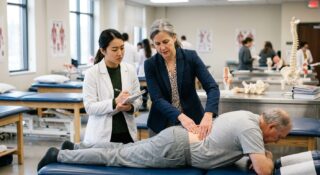
Osteopathic manipulative medicine (OMM) runs through the first two years, with hands-on learning beginning in your first year in a dedicated OMM and clinical skills lab. If you are choosing between DO and MD programs, understanding osteopathic manipulative treatment properly is the clearest practical difference between them, and being asked why you want to be a DO without having a substantive answer is a common and avoidable stumble. Our article on explaining osteopathic manipulative medicine to skeptics is a good primer.
Admissions Requirements and Application Process
Selection Factors, GPA, and MCAT Requirements
To be considered, you must apply through AACOMAS and meet these primary application requirements:
- U.S. citizenship or permanent U.S. residency.
- The ability to earn a baccalaureate degree before matriculation.
- At least 90 credit hours, or three-quarters of the credits required for your degree, completed when you apply, along with the required prerequisites.
- A minimum 3.2 GPA for both science and overall coursework on a 4.0 scale.
- A minimum MCAT score of 500.
- An official MCAT transcript with a test date within three years of your intended matriculation date.
- Affirmation that you meet the Nasuti College’s Health and Technical Standards.
- Proficiency with data entry for time-specific assignments and assessments.
Beyond the numbers, selection is based primarily on demonstrated academic achievement, standardized test performance, community service, leadership, and clinical shadowing and health care experience as shown in your AACOMAS application, as well as mission fit.
The three-year MCAT window deserves its own flag. It is tighter than the policy at a number of schools, so if you took the exam early in a gap year or two, check the date against your intended start before you assume it counts. For July 2027 entry, the college lists July 30, 2024 as the oldest MCAT date it considers.
The secondary is sent only to screened applicants: those with a 3.20 GPA or higher (cumulative, science and non-science), an MCAT of at least 500, and no prior attendance at another medical school.
Prerequisite Coursework
- Biological Sciences: 8 credit hours
- Physics: 8 credit hours
- General and/or Inorganic Chemistry: 8 credit hours
- Organic Chemistry: 8 credit hours (Biochemistry may substitute for 4 credit hours)
- English and/or Composition: 6 credit hours
- Recommended: at least 6 additional biomedical science credit hours at the 200 level or above, in subjects such as anatomy, physiology, biochemistry, immunology, microbiology, virology and genetics.
The biochemistry substitution is useful flexibility if your undergraduate sequence went that way, and the recommended upper-level biomedical hours are worth taking seriously. At a school without years of admissions data to lean on, demonstrated readiness for graduate-level science does real work in your file. DUQCOM accepts online coursework and online labs, but it does not accept pass/fail grades for prerequisite courses.
The AACOMAS Primary and Duquesne’s Secondary Application
- Submit AACOMAS. Apply through AACOMAS between May 4, 2026 and April 1, 2027. For best consideration, submit at least four weeks before the deadline; earlier is better under rolling review.
- Screening. Candidates who meet all primary requirements and submit all materials may be invited to the secondary.
- Secondary. Submit the Nasuti College Secondary Application between May 15, 2026 and April 30, 2027, with the $65 non-refundable processing fee (waived if you received an AACOMAS fee waiver) and a statement of whether you waive your right to view your letters.
- Letters. Submit the required letters (below).
- Interview. Candidates who meet primary and secondary requirements are reviewed for interview eligibility, and invitations are sent by email.
- Decision and deposit. Accepted applicants pay a $1,500 non-refundable deposit on the schedule below.
Letters of Recommendation
Your letter requirement depends on whether your undergraduate institution has a pre-health committee:
- With a committee (2 letters): one pre-health committee letter, which compiles multiple faculty evaluations into one comprehensive letter, and one physician letter from a licensed DO or MD who can speak to your exposure to medicine, professionalism and suitability for a career in medicine.
- Without a committee (3 letters): one letter from a faculty member who taught you in a natural science course (such as biology, chemistry, physics or biochemistry); one additional academic or professional letter from a second natural science faculty member, a research supervisor, or a supervisor in a health care or clinical setting; and one physician letter from a licensed DO or MD.
A physician letter is required either way, so plan early to work with a DO or MD who knows you well. DUQCOM accepts letters through AACOMAS, Interfolio, paper or email.
Your Application Timeline, Month by Month
| When | What to do |
|---|---|
| Before May 2026 | Take the MCAT (no earlier than July 30, 2024 for July 2027 entry); ask your physician and faculty or committee letter writers |
| May 4, 2026 | AACOMAS opens |
| May 15, 2026 | Secondary opens |
| July 1, 2026 | Early Decision: AACOMAS and letter of intent due |
| July 15, 2026 | Early Decision: secondary and letters due |
| July to November 2026 | Early Decision interviews; regular interviews begin on a rolling basis |
| November 2026 | Early Decision decisions |
| December 1, 2026 | Early Decision deposit due |
| About March 1, 2027 | Target date to submit AACOMAS for best consideration (four weeks before the deadline) |
| April 1, 2027 | AACOMAS deadline |
| April 30, 2027 | Secondary deadline |
| July 15, 2027 | Orientation and start |
Medical school classes start every July, beginning with a two-day orientation.
Deposit Deadlines
Accepted applicants submit a $1,500 non-refundable deposit to secure a seat:
- Accepted July 26 to September 1: deposit due by October 1.
- Accepted September 2 to December 1: 30 days from acceptance.
- Accepted December 2 to February 1: 14 days from acceptance.
- Accepted after February 2: deposit due immediately.
Early Decision admits pay their deposit by December 1. Deferred entrance requests are considered case by case.
Tuition, Cost of Attendance and Financial Aid
Cost of Attendance
Tuition is the same for Pennsylvania residents and out-of-state students. The college’s 2026/2027 cost of attendance:
| Item | MS1 (Class of 2030) | MS2 (Class of 2029) | MS3 (Class of 2028) |
|---|---|---|---|
| Tuition | $66,698 | $66,698 | $66,698 |
| Fees | $1,500 | $1,575 | $1,575 |
| Food | $8,406 | $8,224 | $8,224 |
| Housing | $16,752 | $16,752 | $16,752 |
| Books | $1,440 | $1,440 | $1,440 |
| Personal | $3,366 | $3,366 | $3,366 |
| Transportation | $1,132 | $1,018 | $4,000 |
| Loan fees | $2,624 | $2,800 | $2,800 |
| Test prep | $0 | $0 | $2,500 |
| Total | $99,294 | $101,873 | $107,280 |
Source: DUQCOM Admissions page, DO 2026/2027 cost of attendance. Tuition and fees are set each year by the Board of Trustees, so expect the 2027-2028 rates for July 2027 entrants to be posted later in the cycle and plan for annual increases. Tuition was $61,000 for fall 2024, the college’s first year. Note the jump in transportation costs in the third year, when rotations take you across the region.
Paying for It, and Planning Realistically
Federal loans. Unlike some new schools, Duquesne participates in federal student aid. You file the FAFSA each year (Duquesne’s FAFSA school code is 003258). Federal loan rules for new borrowers in professional programs have changed: Direct Unsubsidized Loans are available up to $50,000 per academic year with a $200,000 aggregate limit for professional students, Graduate PLUS Loans are no longer available to new borrowers subject to the new limits, and the lifetime maximum for federal student loans is $257,500. Students who qualify for the federal interim exception may keep the previous limits, including the $224,000 health professions aggregate and access to Graduate PLUS. Because a four-year cost of attendance approaches $400,000, many students will need private loans to cover the gap. Meet with financial aid early to plan.
Scholarships. The college offers institutional scholarships (the Dean’s Scholarship, Presidential Scholarship and Spiritan Scholarship) and a long list of endowed scholarships, including funds such as the Knapp Caruso Endowed Scholarship in the College of Medicine, the John A. Staley IV and Patricia Staley Endowed Scholarship for Osteopathic Medicine and the Western Allegheny Physicians’ Fund. A significant portion of the Nasuti gift is dedicated to scholarships. To be considered for endowed scholarships, complete the Endowed Scholarship Application and the CSS Profile (school code 2223).
Service programs. Military Health Professions Scholarship Programs, the National Health Service Corps and state loan repayment programs reward service in shortage areas, which aligns with the mission’s primary care focus.
Campus Facilities and Student Life
Studying in Pittsburgh
Pittsburgh is one of the country’s major medical cities, with large health systems, a dense network of hospitals and residency programs, and a cost of living below many East Coast cities. The college sits on Forbes Avenue near Duquesne’s bluff-top campus overlooking downtown and the rivers, close to the city’s medical hubs. On-campus housing is available, and private off-campus housing is nearby. The 2026/2027 budget assumes $16,752 for housing and $8,406 for food in the first year.
The region served by the mission stretches well beyond the city: rural counties of western and northwestern Pennsylvania and neighboring parts of Ohio and West Virginia, where many communities have too few physicians.
Facilities, Technology and Clinical Skills
- New medical school building: a 100,000-square-foot building with classrooms, team learning spaces and student areas, opened with a ribbon cutting in January 2024.
- Simulation Hospital and Standardized Patient Center: a realistic simulation hospital with spaces such as a labor and delivery suite, operating room, intensive care unit and emergency department, plus an outpatient clinic where standardized patient actors help you build communication and clinical skills.
- HoloAnatomy lab and technology: virtual anatomy alongside cadaver dissection, ultrasound and imaging.
- OMM and Clinical Skills Lab: hands-on osteopathic training from year 1.
- Health sciences library and Center for Student Wellbeing: renovated space supporting students.
Student Life
The inaugural class began with a two-day orientation and a Gateway Clipper riverboat trip to preview the communities and clinical partners students would serve. Students are encouraged to take part in community service locally and internationally, and the college hosts events such as an integrative health summit and a disability conference. Duquesne’s university-wide resources, including student organizations, recreation, counseling and campus ministry, are available to medical students.
Clinical Rotations and Research Opportunities
Where You Will Train
Third- and fourth-year rotations take place at urban and rural clinical partners across Pennsylvania, Ohio and West Virginia, with international medical service trips and rotations available. The college lists agreements with hospitals and health systems in western and northwestern Pennsylvania including:
- University of Pittsburgh Medical Center (UPMC)
- Armstrong County Memorial Hospital
- Butler Health System
- Conemaugh Memorial Medical Center
- Excela Health System
- Heritage Valley
- Indiana Regional Medical Center
- Meadville Medical Center
- Punxsutawney Area Hospital
- Sharon Regional Medical Center
- St. Clair Hospital
- Trinity Health System
- Weirton Medical Center
- eight regional federally qualified health centers
Allegheny Health Network Clinical Campus
Allegheny Health Network (AHN) serves as a clinical campus. Many of the inaugural class’s third- and fourth-year students began clinical training at AHN’s Pittsburgh-area hospitals and outpatient clinics in summer 2026. AHN planned to welcome about 20 students initially and grow to about 40 third-year and 40 fourth-year students over three years. Rotations at AHN include emergency medicine, family medicine, pediatrics, geriatric medicine, internal medicine, obstetrics and gynecology, psychiatry and surgery, with electives across more than 50 accredited medical and surgical programs and subspecialties. Students also work alongside nearly 600 residents and fellows in AHN’s graduate medical education programs, which helps with residency preparation.
What to Ask About Rotations
With classes growing from 85 to 170, ask at your interview how sites are assigned, how many students go to AHN versus regional hospitals, how far students typically travel, and whether housing is offered at distant rural sites. The third-year transportation budget of $4,000 reflects that travel.
Research Opportunities
Faculty encourage students to join biomedical, clinical and translational research, and the Foundations of Medical Research courses in years 1 and 2 build the basics. Research strengthens your residency application, especially if you are aiming for a competitive specialty. The Associate Dean of Research leads these efforts, and the college’s centers for integrative health and for fertility awareness education and research offer additional projects.
Notable Alumni, Faculty, Leadership and Admissions Staff
DUQCOM has no alumni yet; its first class graduates in 2028. The leaders and faculty below shape the program you would join.
Leadership
John M. Kauffman Jr., DO, FACOI, FACP. Founding Dean and Professor of Medicine. Dr. Kauffman was founding dean and chief academic officer of Campbell University’s Jerry M. Wallace School of Osteopathic Medicine from 2011 until he was named dean emeritus in 2019, leading that school through its launch and accreditation. Before that, at the Edward Via College of Osteopathic Medicine, he served as associate dean and then vice dean for postgraduate affairs, where residency positions grew from 40 to 280. He earlier built osteopathic residencies at University Hospitals of Cleveland. He earned his DO at the Philadelphia College of Osteopathic Medicine, completed internal medicine residency at Lehigh Valley Hospital Center, and received the American Osteopathic Foundation’s Educator of the Year award in 2014. His experience launching a new school and growing residency programs is directly relevant to applicants weighing a young college.
David J. Dausey, PhD. Fourteenth President of Duquesne University, installed in July 2026. As provost for eight years, he founded and advanced new schools, including the Nasuti College of Osteopathic Medicine, described as the university’s boldest initiative.
Amber Fedin, DO. Associate Dean for Clinical Affairs and Professor of Family Medicine. She leads clinical affairs, including the rotation network that opened for the inaugural class in 2026.
M. Renee Prater, DVM, PhD. Associate Dean of Academic Affairs and Professor of Biomedical Sciences. She has emphasized that students will be heavily involved in local and international community service.
Faculty
Yunbo Li, MD, MPH, PhD. Associate Dean of Research and Professor of Pharmacology.
Jason Wells, PhD. Associate Dean of Biomedical Affairs and Professor of Anatomy, overseeing the biomedical sciences, including cadaver-based and virtual anatomy.
Admissions
Michael Rice, EdD. Assistant Dean of Admissions and the main admissions contact, reachable at (412) 396-5559 or [email protected].
Admissions Statistics and Class Profile
Class Profile and How Fast the College Is Growing
The size of the class you would join depends heavily on which cycle you apply in:
- Inaugural class, 2024: 85 students, selected from over 4,300 applicants.
- Second class, fall 2025: 137 students.
- Fall 2026 goal: 170 students.
- Fall 2027 onward: 170 or more students per class.
About two-thirds of the inaugural class came from Pennsylvania, and 43% earned their degrees at a Pennsylvania institution, including Duquesne. More than 30% were minorities or from underrepresented populations (32% and 19%, respectively).
The doubling of the class between 2024 and 2026 cuts both ways. More seats can mean better odds. But it also means faculty, clinical sites and student support are scaling quickly, which is exactly what you should ask about on interview day.
Acceptance Rate
DUQCOM does not publish offer counts, so there is no verified acceptance rate. The inaugural figures (over 4,300 applicants for 85 seats) show demand, but some admitted students choose other schools, so dividing seats by applicants understates your odds.
Mean MCAT and GPA
Matriculants have a mean MCAT of 505.7 and an average cumulative GPA of 3.63, with no cohort stated. Those are comfortably above the 500 and 3.2 minimums, so a typical admitted student is well above the floor.
What Duquesne Does Not Have Yet
- A residency match record. The first class graduates in 2028. The college has a public page reserved for future match rates, specialties and geography.
- Graduate outcomes and alumni.
- Full accreditation. The college is in pre-accreditation.
What it does have is an early academic signal: a 96.6% first-time pass rate on COMLEX-USA Level 1 for its inaugural class, against a 91.5% national average.
Tips and Strategies for Admission
Why Osteopathic Medicine, and Why That Question Matters Here
Every DO school asks some version of “Why osteopathic medicine?” At DUQCOM, where OMM starts in year 1 and the mission emphasizes treating the whole person, mind, body and spirit, your answer needs substance: time with a DO, OMT you have seen or received, and how osteopathic training fits the primary care physician you want to be. Our guide to DO vs MD and what the difference means for your application can help you frame the answer without dismissing either path.
Show Service and Servant Leadership
The secondary prompts ask about altruism and social determinants of health, and the LEADER values put servant leadership front and center. Long-term service, especially with underserved people in cities or rural areas, carries weight. A single day of volunteering does not.
Get Strong Clinical and Physician Exposure
A physician letter is required, and selection weighs clinical shadowing and health care experience. Build sustained experience: scribing, medical assisting, EMT work, patient care technician roles or clinical internships for pre-med students where you take vitals, help with intake and triage, and assist with patient care under supervision. Plan your summers around it; pre-med summer internships and summer clinical jobs are the easiest way to add concentrated hours.
Use the Rural, Underserved or International Rotation as a Talking Point
Every third-year student completes a four-week rural, underserved or international rotation. If you have experience in those settings, connect it to this requirement in your secondary and interview. Students who have completed pre-med internships abroad can speak concretely about practicing with limited resources and across cultures.
Apply Early, Even Without Early Decision
DUQCOM reviews on a rolling basis, and some applicants this cycle received secondaries and interview invitations within a few weeks of submitting AACOMAS. Submit AACOMAS in May or June, return the secondary within two weeks, and make sure your physician letter is in.
If You Are Not Competitive Yet
If your GPA or MCAT is near the minimums, the most efficient fixes are:
- Retake the MCAT within the three-year window with a structured plan.
- Add upper-level science, especially the recommended 200-level-and-above biomedical courses, or complete a master’s program such as Duquesne’s MBS.
- Build sustained clinical and service experience through a full-time clinical job or pre-med gap year programs.
- Strengthen your letters, especially the physician letter.
Secondary Application Questions, Example Responses and Analysis
Writing Secondaries for a Mission-Driven School
DUQCOM’s 2026-2027 secondary has four prompts. Questions 1 and 2 are required, and you choose either question 3 or question 4. Each essay should be 250 to 500 words. The secondary also includes the $65 processing fee and a statement about whether you waive your right to see your letters. The wording below is current for this cycle and matches the prior cycle.
Because the college is mission-driven, the best answers connect your actual experiences to its stated values: primary care, underserved urban and rural Western Pennsylvania, social determinants of health, service and servant leadership. Use specific stories, avoid repeating your personal statement, and stay within 500 words.
Question 1: Why Medicine and Fit With DUQCOM’s Mission (250-500 words, required)
Why do you want to become a physician, and how are you a good fit for DUQCOM’s mission?
How to approach it: answer both halves. Use one or two experiences for “why physician,” then connect specific actions of yours to the mission’s key phrases. Mention real DUQCOM features, such as the rural, underserved or international rotation, rather than generic praise.
Worked example (illustrative example, not an actual applicant essay):
The first patient I ever helped feel better was not in a hospital. She was Mrs. Kowalski, an 81-year-old widow in my parish in McKees Rocks who called the church office every Tuesday because she could not read the labels on her pill bottles. I was sixteen, and the volunteer coordinator asked me to visit. For two years I sorted her medications into a weekly organizer, wrote large-print schedules, and called her pharmacist when something looked wrong. When her doctor finally adjusted a blood pressure dose that had been making her dizzy, she stopped falling. That was when I understood that good medicine depends on someone noticing the small things and caring enough to act.
Since then I have tested that interest in harder settings. I spent two years as a patient care technician on a medical-surgical floor in Pittsburgh, taking vitals, helping patients walk after surgery and learning how much a physician’s ten minutes at the bedside shapes a patient’s whole day. I watched a family medicine DO spend an extra half hour explaining heart failure to a steelworker who had never been told why his legs swelled. I want to be that kind of physician: one who sees the person, explains clearly and stays involved.
DUQCOM’s mission asks its physicians to care for all people in all communities, especially underserved urban and rural Western Pennsylvania, with a focus on primary care. That describes where I come from and where I want to work. I grew up between the city and the river towns, and I have seen how distance, cost and confusing systems keep people like Mrs. Kowalski from care. I plan to pursue family medicine and practice in the region.
I also connect with the college’s spirit of service. The Spiritan tradition’s emphasis on serving people on the margins matches the work I have chosen: tutoring adult learners for their GED, volunteering at a free clinic in the Hill District, and continuing my weekly visits with homebound seniors. At DUQCOM, I would use the required rural, underserved or international rotation to train where needs are greatest, and I would bring the habit of noticing small things to every patient I meet.
(364 words.)
Why it works: It answers both parts. A clinical moment shows why medicine, and concrete actions link to the mission’s key phrases: caring for all people, underserved urban and rural Western Pennsylvania, primary care and service. It names a real curricular feature and respects the faith-based mission without claiming beliefs.
Mistakes to avoid: answering only the “why medicine” half, copying the mission statement, overclaiming religious commitment you do not hold, and exceeding 500 words.
Question 2: Adversity (250-500 words, required)
Can you describe an experience where you faced and overcame adversity?
How to approach it: spend a sentence or two on the hardship and most of the essay on what you did, what changed and what you will carry into medicine.
Worked example (illustrative example, not an actual applicant essay):
In the fall of my junior year, my mother lost her job and my parents separated within the same month. I moved home to help with my two younger brothers and began commuting ninety minutes each way to campus while working twenty hours a week at a pharmacy. That semester I failed my first exam in physical chemistry, a course I needed for my major. For the first time, I wondered whether I could keep going.
I decided to treat the problem the way I would treat any complicated case: by breaking it into parts. First, I mapped my week hour by hour and found that my commute could be study time if I switched to the early train and used recorded lectures. Second, I asked for help, something I had always avoided. I went to my professor’s office hours every week, joined a study group, and told my academic advisor what was happening at home. She helped me move one course to the summer so my load was manageable. Third, I protected sleep and set a hard stop at eleven every night, even when it meant leaving work unfinished.
The changes worked slowly. I passed the next exam with a C and the final with an A-minus, and I finished the course with a B. The following semester I earned a 3.8 while keeping my job and helping my brothers with homework every evening. My mother found new work that spring, and our family settled into a new routine.
What I learned was not simply that I could work hard. I already knew that. I learned that asking for help early is a strength, that a plan beats panic, and that people under stress need practical support more than advice. I see the same pattern now at the pharmacy, where an overwhelmed caregiver often needs someone to write down the medication schedule rather than explain it again. As a physician, I expect to face long hours, difficult outcomes and my own mistakes. When that happens, I will rely on the same approach: break the problem down, ask for help, take care of myself and keep moving forward for the people who depend on me.
(365 words.)
Why it works: It names the obstacle plainly, shows specific steps, gives a measurable result and reflects on what the applicant will bring to patient care.
Mistakes to avoid: graphic detail without reflection, choosing a minor inconvenience, blaming others and ending without growth.
Question 3: Social Determinants of Health (250-500 words, choose 3 or 4)
How have your experiences and understanding of social determinants of health influenced your perspective on patient care and your approach to practicing medicine?
How to approach it: name specific determinants you have seen, tie them to a real experience, and describe how they will change the way you practice.
Worked example (illustrative example, not an actual applicant essay):
I learned what social determinants of health mean while sitting in a parked car. As a volunteer driver for a rural health program in Armstrong County, I drove patients to appointments forty minutes away because there was no bus. One regular rider, a man in his sixties with type 2 diabetes, told me during our drives that he skipped meals near the end of each month when his money ran out and that he worked overnight shifts that made his medication schedule impossible. His A1C was high, and in clinic notes he was labeled noncompliant. In the car, he was simply a man with no grocery store nearby, an irregular schedule and no one who had asked about either.
That experience changed how I see a patient’s chart. A missed appointment can mean no ride. A high blood sugar can mean an empty refrigerator. A confused patient may have never been given instructions in plain language. Later, while helping at a free clinic’s intake desk, I began asking every patient two screening questions about transportation and food, and I connected several families with a food pantry and a medical transportation benefit they did not know they had.
These experiences have shaped the physician I want to become. I plan to ask about patients’ circumstances as routinely as I ask about symptoms, to write care plans that fit real schedules and budgets, and to build working relationships with social workers, community health workers and pharmacists. I also want to measure what works. In college I helped analyze a small quality-improvement project that found patients who received a reminder call and a ride offer were more likely to keep follow-up appointments.
DUQCOM builds its curriculum around the social determinants of health and asks students to complete a rural, underserved or international rotation. I want to train in that environment because the patients I care most about live in places like Armstrong County and Pittsburgh’s underserved neighborhoods, where the most important part of the story often happens outside the exam room.
(338 words.)
Why it works: It names concrete determinants (transportation, food access, work schedules, health literacy), links them to lived experience and turns them into specific practice habits.
Mistakes to avoid: defining social determinants like a textbook, listing statistics without a personal link, and describing patients without dignity.
Question 4: Altruistic Experience (250-500 words, choose 3 or 4)
Can you share an example of an altruistic experience you’ve had and explain how it influenced your desire to pursue a career in medicine?
How to approach it: choose sustained service with no personal payoff, show what it cost you, and draw a clear line to medicine.
Worked example (illustrative example, not an actual applicant essay):
For three winters I spent Thursday nights at a warming center in a church basement in Erie. It was not glamorous work. I set up cots, served soup, folded donated coats and sat with whoever wanted to talk. Nobody gave me hours for a résumé, and for the first year I did not tell my friends where I went. I kept going because the same faces came back each week, and I wanted them to find someone they knew.
One of those faces belonged to Dale, a former roofer in his fifties with a chronic leg wound he kept covered with grocery bags. He refused to go to the emergency department, where he said people treated him like a problem. Over several weeks I listened, brought clean socks, and eventually asked whether he would see the nurse practitioner who volunteered at the center once a month. He agreed only if I sat with him. I watched her clean the wound, explain each step and arrange a clinic follow-up with transportation. Two months later Dale walked in wearing boots and told me his leg had finally healed.
That night changed what I wanted to do with my life. I had been a biology major considering research, but I saw that the most meaningful help I had given Dale was trust, and that a clinician could turn that trust into healing. I began shadowing a family physician, became a certified nursing assistant and took a job on a long-term care unit, where I learned how much dignity matters in daily care.
Altruism, for me, has never been about grand gestures. It is showing up when it is inconvenient, giving time without expecting anything back and treating people as people. Medicine offers a way to do that with skill as well as care. I want to become a physician who builds the kind of trust that brings patients like Dale through the door, and I want to keep serving in places like that basement long after I earn my degree.
(337 words.)
Why it works: It describes sustained, uncredited service, shows real cost and draws a clear line to the decision to pursue medicine, fitting the servant-leadership value without naming it repeatedly.
Mistakes to avoid: picking an activity that mainly benefited you, presenting one day of service as life-changing, and making yourself the hero of someone else’s hardship.
Choosing Between Questions 3 and 4
Pick the prompt where you have the stronger, more specific story. If your experience is mainly with access to care, insurance, transportation or food insecurity, choose question 3. If you have a sustained service commitment that shaped your decision to pursue medicine, choose question 4. Do not try to answer both in one essay.
Interview Format and Preparation
Interview Format and How to Prepare
Candidates who meet primary and secondary requirements are reviewed for interview eligibility with the DUQCOM admissions team and faculty, and invitations are sent by email. The format depends on where you live:
- In-person interview: for applicants within a four-hour drive of Duquesne’s campus in Pittsburgh.
- Virtual interview: by phone or Zoom/Teams for applicants beyond a four-hour drive.
Expect a traditional, conversational interview rather than a multiple mini interview.
Preparing for the Interview in Detail
- Know the mission and LEADER values. Prepare one real example for at least two values, such as servant leadership and diversity and social justice.
- Know your “why DO” answer. Expect a question about osteopathic medicine and OMM.
- Expect primary care questions. Be ready to say honestly how primary care fits your plans.
- Know the curriculum and clinical partners. Mention the rural, underserved or international rotation, AHN and regional hospitals, cadaver and virtual anatomy, and the simulation hospital.
- Prepare ethics and teamwork scenarios. Traditional interviews often include them.
- Ask good questions. For example: how are rotation sites assigned as classes grow to 170? What is the timeline toward provisional accreditation? How does the college support residency applications for its first graduating class?
- For in-person interviews, plan your route and parking in Pittsburgh’s Uptown. For virtual interviews, test your setup.
If you want structured practice, IMA’s admissions consulting includes mock interviews.
Frequently Asked Questions About Duquesne’s Nasuti College of Osteopathic Medicine
Is Duquesne’s medical school accredited?
The Nasuti College of Osteopathic Medicine holds pre-accreditation from COCA, which allows it to recruit and admit students and teach the DO curriculum. Schools typically move to provisional and then full accreditation as their first classes advance. Check the current status with COCA before you apply.
What GPA and MCAT do I need for Duquesne’s College of Osteopathic Medicine?
The minimums are a 3.2 science and overall GPA and a 500 MCAT. Matriculants have a mean MCAT of 505.7 and an average GPA of 3.63, so aim above the minimums. Early Decision requires 3.5 science and overall GPAs.
How old can my MCAT score be?
Your MCAT must be dated within three years of your intended matriculation date. For July 2027 entry, the oldest accepted test date is July 30, 2024.
Does Duquesne use AACOMAS?
Yes. You apply through AACOMAS, which opened May 4, 2026; DUQCOM’s deadline is April 1, 2027. Submit at least four weeks early for best consideration.
Does Duquesne interview in person or virtually?
Both. Applicants within a four-hour drive of the Pittsburgh campus interview in person; those farther away interview virtually by phone or Zoom/Teams.
Does Duquesne accept international applicants?
No. Applicants must be U.S. citizens or permanent residents, and DACA applicants are not considered.
How big is the class?
The inaugural class had 85 students, the second class 137, and the college’s goal is 170 students per class from 2026 onward.
Is Duquesne’s medical school a DO or an MD program?
It is a DO program. Graduates earn the Doctor of Osteopathic Medicine and take the COMLEX-USA licensing exams, and the curriculum also prepares students for USMLE Step 1.
Where is the Nasuti College of Osteopathic Medicine located?
In a new medical school building at 1305 Forbes Avenue in Pittsburgh, Pennsylvania, near Duquesne University’s main campus.
What prerequisite courses does Duquesne require?
Eight credit hours each of biological sciences, physics, general or inorganic chemistry and organic chemistry (biochemistry may replace 4 hours of organic chemistry), plus 6 hours of English or composition. At least 6 additional upper-level biomedical science hours are recommended. Pass/fail grades are not accepted for prerequisites.
How much does Duquesne’s DO program cost?
For 2026-2027, tuition is $66,698, and the estimated first-year cost of attendance is $99,294, including fees, food, housing, books, personal costs, transportation and loan fees.
Does Duquesne have an Early Decision option?
Yes. The Early Decision Admissions Track requires 3.5 science and overall GPAs and a competitive MCAT. The primary application is due July 1 and the secondary July 15, a two-week turnaround, so draft your essays before you submit your primary.
When do classes start at Duquesne’s College of Osteopathic Medicine?
Every July, with a two-day orientation. The inaugural class began on July 11, 2024, and the July 2027 class starts on July 15, 2027.
Where do Duquesne medical students complete clinical rotations?
At partner facilities across Pennsylvania, Ohio and West Virginia, including Allegheny Health Network, which serves as a clinical campus starting in summer 2026, and regional hospitals and federally qualified health centers. International rotations are also offered.
Who is the dean of the Nasuti College of Osteopathic Medicine?
John M. Kauffman Jr., DO, FACOI, FACP, Founding Dean and Professor of Medicine, who previously founded Campbell University’s osteopathic school.
What is the LEADER framework?
The college’s values: Love and Mercy, Ethics and Morality, Advancement and Personal Development, Diversity and Social Justice, Excellence, Responsibility to Profession and Community, and Servant Leadership. Values frameworks at mission-driven schools tend to resurface as interview questions and secondary prompts, so be ready to show two of them with your own experience.
Does Duquesne offer a master’s pathway into the medical school?
Yes. Duquesne’s ten-month Master’s in Biomedical Sciences covers much of the first semester of the medical curriculum and is designed for students preparing for medical school. Ask the admissions office how many MBS students applied to and matriculated at the Nasuti College in the last two cycles before committing a year to it. Duquesne undergraduates can also apply to the Early Assurance Program.
Does Duquesne teach osteopathic manipulative treatment?
Yes. OMM is taught in years 1 and 2 in a dedicated lab, and you develop hands-on skills from your first year. Understanding OMT is the clearest practical difference between DO and MD training, and you should be able to discuss it.
How competitive is admission to Duquesne’s College of Osteopathic Medicine?
The inaugural class of 85 was selected from more than 4,300 applicants. Classes have grown since, to 137 in fall 2025 with a goal of 170, so the number of seats is rising. The published GPA and MCAT minimums are screening floors, not admitted-student averages.
What is Duquesne’s match rate?
There isn’t one yet. The first class matriculated in July 2024 and graduates in 2028, so no residency match data or graduate outcomes exist. The first published outcome is a 96.6% first-time pass rate on COMLEX-USA Level 1 for the inaugural class.
What secondary essays does Duquesne require?
Two required essays (why you want to become a physician and how you fit DUQCOM’s mission; an experience overcoming adversity) and one of two others (social determinants of health or an altruistic experience), each 250 to 500 words, with a $65 fee.
Related Medical School Guides
Exploring Other Schools
Duquesne should not be the only osteopathic program on your list, and a list built entirely of new colleges carries more risk than most applicants realize. These guides are natural comparisons:
- Lake Erie College of Osteopathic Medicine (PA): Pennsylvania’s large, established DO school in Erie, with a long track record.
- Philadelphia College of Osteopathic Medicine (PCOM): the other major in-state DO option, and Dean Kauffman’s medical school.
- Rowan University School of Osteopathic Medicine: a nearby public DO school in New Jersey.
- NYIT College of Osteopathic Medicine: an established Northeast DO school.
- Touro College of Osteopathic Medicine: another Northeast DO program with a service mission.
- Campbell University School of Osteopathic Medicine (CUSOM): the school Dean Kauffman founded, useful for seeing how a young school matures.
Other osteopathic programs and Pennsylvania medical schools:
- Drexel University College of Medicine
- Penn State College of Medicine
- Geisinger Commonwealth School of Medicine
- West Virginia School of Osteopathic Medicine
- Edward Via College of Osteopathic Medicine (VCOM), where Dean Kauffman led postgraduate affairs
- Ohio University Heritage College of Osteopathic Medicine
- Marian University College of Osteopathic Medicine
- Des Moines University College of Osteopathic Medicine
- Kentucky College of Osteopathic Medicine (KYCOM)
- A.T. Still University Kirksville College of Osteopathic Medicine
- Rocky Vista University College of Osteopathic Medicine
- Idaho College of Osteopathic Medicine
- Lewis Katz School of Medicine at Temple University
- University of Pittsburgh School of Medicine, the city’s MD school
How International Medical Aid Can Help
Admissions Consulting and Healthcare Internships
DUQCOM weighs clinical experience, community service and mission fit, and it requires a physician letter. International Medical Aid helps applicants build and explain all of these.
- Supervised clinical experience: our pre-med internships place students in hospitals and clinics in East Africa, South America and other regions, where interns take vitals, help with patient intake and triage, and assist with direct patient care under the supervision of local clinicians. We offer internships for pre-med students at every stage, including medical internships for undergraduates during school breaks.
- Global and underserved perspective: DUQCOM’s mission reaches “the nation, and the world,” and its third year includes a rural, underserved or international rotation. Medical internships abroad show how social determinants of health shape care, which you can draw on for secondary question 3. Learn more about our healthcare internships abroad or broader pre-health internships.
- Admissions consulting: school lists that balance new and established DO schools, AACOMAS personal statement review, DUQCOM’s four secondary prompts and mock interviews.
IMA programs do not create any affiliation with Duquesne or an admissions advantage. They give you real experience you can describe honestly. Your next step: choose an internship session that finishes before you submit AACOMAS.
Final Thoughts and Sources
Duquesne’s Nasuti College of Osteopathic Medicine pairs a young DO program with an old university’s service mission, a new building in a major medical city, a strong first board result and a clinical network anchored by Allegheny Health Network and regional hospitals. It is growing fast, it is still in pre-accreditation, and it has no match history yet. If primary care, service and Western Pennsylvania fit your goals, it belongs on your list.
Next steps: confirm your MCAT date falls within the three-year window, line up a physician letter and a committee or faculty letters, submit AACOMAS early, return the secondary within two weeks, and prepare stories that show service and resilience.
Sources
Figures in this guide were checked on November 12, 2026, against these sources:
- DUQCOM Admissions Process and Requirements: 2026-2027 dates, minimums, prerequisites, secondary, letters, interviews, deposits, Early Decision and the DO 2026/2027 cost of attendance.
- DUQCOM Doctor of Osteopathic Medicine page: pre-accreditation, enrollment, curriculum, pathways and program FAQs.
- DUQCOM Outcomes, Program Accreditation, Facilities and Dean’s Welcome pages; Duquesne 2026-2027 Graduate Catalog.
- Duquesne news: inaugural class (2024), Allegheny Health Network partnership, Nasuti gift, Nasuti naming ceremony (April 27, 2026) and the university president’s profile.
- AACOM Choose DO Explorer, DUQ-NCOM profile: school-reported mean MCAT and GPA, cycle dates and clinical partners (data submitted by the college).
- Current-cycle (2026-2027) secondary prompt wording as posted by applicants and prompt databases; the prompts appear in your DUQCOM secondary.
Statistics are labeled with their class or academic year throughout. Where the college has not published a figure, such as offer counts or match results, the guide says so rather than estimating it.
See more of our guides in your Google results: add International Medical Aid as a preferred source on Google.