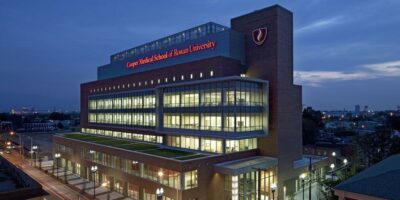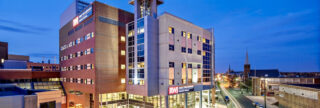

Rutgers Robert Wood Johnson Medical School (RWJMS) is a public, community-oriented MD school in New Brunswick and Piscataway, New Jersey. Its students train with the Rutgers Cancer Institute, the state’s only NCI-designated Comprehensive Cancer Center, and at Robert Wood Johnson University Hospital, the school’s principal teaching hospital and a Level 1 trauma center. In July 2026 the school moved into a brand-new home at the HELIX in downtown New Brunswick. It’s no wonder that aspiring physicians in the Northeast hear about RWJMS when they ask, “what are good medical schools near me?” But what does it take to get into RWJMS?
This guide covers the 2026-2027 application cycle for students who plan to start medical school in summer 2027. The AMCAS deadline for this cycle is December 1, 2026, the MCAT must be taken no later than October 2026, and offers of admission go out in late December and mid-March. All facts in this guide were checked on October 21, 2026.
RWJMS is also in the middle of a major change. Rutgers is combining Robert Wood Johnson Medical School and New Jersey Medical School into a single Rutgers School of Medicine, pending accreditation, with the earliest accreditation decision expected in June 2027. We explain what that means for you, along with the class profile, prerequisites, the 5 Cs curriculum, the three-year primary care track, dual degrees, 2026-27 tuition, the seven-station virtual MMI and all seven 2026-2027 secondary essays with original examples.
Be an Informed Applicant
Many things stand out to every medical school admissions committee: a high GPA, excellent MCAT scores, compelling pre-med experiences and more. But medical school applications are not one-size-fits-all. Each medical school has a distinct institutional identity, selection factors and admissions guidelines. This article organizes key information and insights about Robert Wood Johnson Medical School to help you focus your application and make an impactful case for your candidacy.
However, nothing beats one-on-one guidance. Our medical school admissions consulting has helped thousands of diverse students get into medical schools across the country. Whether you need help with an overall application strategy, assistance with your application materials or have unique circumstances you can’t find advice about elsewhere, IMA’s admissions consulting can help.
Key Takeaways
- New Jersey residents have preference, but out-of-state applicants are welcome. RWJMS gives preference to New Jersey residents and encourages out-of-state applicants with outstanding credentials. In the Class of 2029, 26% of students came from out of state.
- Academic context. Students in the Class of 2029 (entered 2025) averaged a 513 MCAT and a 3.76 GPA. Among all accepted applicants for the 2025 entering class, the median MCAT was 515 and the median GPA was 3.87. These are class figures, not cutoffs, and there is no minimum score for screening.
- Who can apply. For the 2027 cycle, RWJMS accepts applicants who are U.S. citizens, permanent residents or under adjustment of visa status. You need at least 90 semester hours to apply and a bachelor’s degree by matriculation. Transfer applications are not being considered.
- Key dates. Submit AMCAS by December 1, 2026, return the secondary by January 15, 2027 (earlier is strongly encouraged), take the MCAT no later than October 2026 and take Casper or PREview. Interview invitations start in September, and offers go out in late December and mid-March. RWJMS interviewed 508 applicants for the 2025 entering class.
- Costs. For 2026-27, tuition is $48,080 for New Jersey residents and $77,125 for non-residents, before fees and health insurance.
- Distinctive training. The 5 Cs Curriculum builds 18 months of pre-clerkship learning around 33 Core Clinical Conditions, puts students in clinical settings from the first year and adds community service through HIPHOP, the student-run Promise Clinic and the school-owned Eric B. Chandler Health Center.
- Special routes. A three-year primary care track, MD/PhD with Rutgers and Princeton, MD/MPH, MD/MBA, MD/MSCTS, ten Distinction Programs and Accelerated Application linkages with post-baccalaureate programs.
- Next step. If you are applying now, submit AMCAS well before December 1, return your secondary quickly and prepare for a virtual MMI. If you are planning for 2027-2028, note that the first class of the new Rutgers School of Medicine is scheduled to be admitted in that cycle.
Key Statistics About Rutgers Robert Wood Johnson Medical School
The snapshot and table below gather RWJMS’s key numbers. Each figure carries its cohort or academic year, because the class profile, the tuition schedule and the match results each cover a different year. The newest class profile with academic averages is for the Class of 2029, the students who started in 2025. The school’s Class of 2030 entered in July 2026 with 165 students, but its averages have not been published yet. Median scores for accepted applicants and interview counts cover the 2025 entering class.

| Measure | Value | Cohort, population and source |
|---|---|---|
| School and degree | Rutgers Robert Wood Johnson Medical School; Doctor of Medicine (MD) | RWJMS Admissions |
| Campuses | New Brunswick (HELIX and 125 Paterson Street) and Piscataway (675 Hoes Lane West) | RWJMS About Us; The HELIX |
| Accreditation | Full LCME accreditation; next full survey visit 2026-2027 | RWJMS About Us |
| Class size | 165 | Class of 2030, entered July 2026 (Rutgers Today) |
| Class size | 165 | Class of 2029, entered 2025 (RWJMS At A Glance 2025-2026) |
| Average MCAT | 513 | Class of 2029, entering students (RWJMS At A Glance 2025-2026) |
| Average GPA | 3.76 | Class of 2029, entering students (RWJMS At A Glance 2025-2026) |
| Out-of-state students | 26% | Class of 2029 (RWJMS At A Glance 2025-2026) |
| Median MCAT | 515 (mean 514.5) | All accepted applicants, 2025 entering class (AAMC MSAR, 2026 edition) |
| Median MCAT section scores | 129 Chem/Phys, 128 CARS, 129 Bio/Biochem, 130 Psych/Soc | All accepted applicants, 2025 entering class (AAMC MSAR, 2026 edition) |
| Median GPA | 3.87 | Accepted applicants, 2025 entering class (AAMC MSAR, 2026 edition) |
| Applicants interviewed | 508 (365 in-state, 143 out-of-state, 0 international) | 2025 entering class cycle, reported by the school (AAMC MSAR, 2026 edition) |
| Applications and acceptance offers | Not published | RWJMS Admissions pages and AAMC MSAR, checked October 21, 2026 |
| Acceptance rate | Not published | RWJMS Admissions pages, checked October 21, 2026 |
| Minimum GPA or MCAT | None published; no minimum for screening. Applicants are encouraged to have an MCAT above 504 with every section above 123 | RWJMS How to Apply; AAMC MSAR, 2026-2027 cycle |
| Estimated new entrants | 165 (122 MD, 24 early assurance, 9 BA/MD, 6 MD/PhD, 1 Early Decision, 3 other special programs) | 2027 entering class estimate (AAMC MSAR, 2026 edition) |
| Secondary deadline | January 15, 2027; early submission strongly encouraged | 2026-2027 cycle (AAMC MSAR) |
| Resident tuition | $48,080 per year | 2026-27, New Jersey residents (Rutgers RWJMS Tuition and Fee Rates 2026-2027) |
| Non-resident tuition | $77,125 per year | 2026-27, non-residents (Rutgers RWJMS Tuition and Fee Rates 2026-2027) |
| First-year fees and insurance | $577 campus fee, $1,875 first-year school fee, $3,286 health insurance (waivable) | 2026-27 (Rutgers RWJMS Tuition and Fee Rates 2026-2027) |
| Secondary fee | $80; waived for AAMC Fee Assistance Program recipients | RWJMS How to Apply |
| 2026 Match rate | 96% (national rate 93.5%) | Graduating students who participated in the 2026 Match (RWJMS Admissions) |
| Enrollment | 729 MD students and 47 MD/PhD students | 2025-2026 (RWJMS At A Glance 2025-2026) |
| Students receiving financial aid | 71% | All enrolled and graduated students, 2024-2025 (AAMC MSAR, LCME Part I-B) |
| Average debt of indebted graduates | $215,294 | 2024-2025 (AAMC MSAR, LCME Part I-B) |
What Are Rutgers Robert Wood Johnson Medical School’s Average MCAT and GPA?
The RWJMS Class of 2029, which entered in 2025, averaged a 513 MCAT and a 3.76 GPA (RWJMS At A Glance, 2025-2026). These are class averages, not minimums. The school publishes no GPA or MCAT cutoff and reviews every application holistically.
Medians for the 2025 entering class tell a similar story. Across all accepted applicants, the median MCAT was 515 (mean 514.5), with section medians of 129 in Chemical and Physical Foundations, 128 in CARS, 129 in Biological and Biochemical Foundations and 130 in Psychological, Social and Biological Foundations. The median GPA of accepted applicants was 3.87. There is no minimum GPA or MCAT for screening, and the admissions committee encourages applicants to have an MCAT above 504 with every section above 123. Accepted-applicant medians and enrolled-class averages describe different groups, so expect them to differ by a point or two.
A 513 average means most admitted students are strong test takers. But an average also means many students scored below it. If your numbers sit a few points under the class average, the rest of your file matters even more: sustained service, a clear reason for choosing New Jersey and evidence of the personal competencies RWJMS lists. For a comparison with other schools, see our list of average GPA and MCAT scores by medical school.
Mission and Educational Priorities
Why Robert Wood Johnson Medical School?
The Robert Wood Johnson Medical School excels in many important areas of medical education. The school offers abundant research opportunities, is closely tied to the Rutgers Cancer Institute and weaves community and global health into its curricular and extracurricular offerings. Its 5 Cs Curriculum, launched in 2021, attracts applicants looking for a contemporary patient- and community-oriented medical education. And its new home at the HELIX gives students a modern building in the center of New Brunswick, across from the train station.
The RWJMS mission
The school’s mission is stated as follows on its About Us page:
“Robert Wood Johnson Medical School is dedicated to transforming care through innovation and excellence in education and research and by addressing the health of our diverse community. As one of the nation’s leading comprehensive medical schools, Robert Wood Johnson Medical School is dedicated to the pursuit of excellence in these mission areas: education, research, healthcare delivery, and the promotion of community and global health.”
The vision is equally direct: “As the state’s first and largest academic high-value health care system, Robert Wood Johnson Medical School will become the academic engine driving a new health care paradigm in New Jersey.”
The school’s values spell out the letters of its name:
“R – Respect, dignity, and humanism for the diverse population we serve W – Wellness and resilience J – Joining learners hand-in-hand with care delivery M – Making patients first with safe, compassionate, high-quality care S – Science to advance human health”
These values are not decoration. The first 2026-2027 secondary essay asks you to choose one of them and show how you built a foundation for it.
The MD program mission
The MD program has its own education mission, published on the How to Apply page. It describes physicians who are “resilient and adaptable,” who “provide high value, ethical and appropriate healthcare in an ever changing system,” who “communicate respectfully and effectively in a patient- and family-centered fashion” and who “collaborate with other health care professionals to devise treatment plans and strategies for adherence and self-care, tailored to the needs and preferences of the patient.” It ends by naming discovery, service and leadership, and by preparing “educational leaders to teach, mentor and disseminate educational innovation, discovery, and methodology.”
What the mission means for your application
Read together, the mission, vision and values point to four things RWJMS looks for:
- Commitment to New Jersey’s diverse communities. The mission names “the health of our diverse community,” and the school runs an owned community health center, a student-run free clinic and more than 40 HIPHOP outreach programs each year. Service in a diverse, underserved setting, ideally sustained over time, speaks directly to this.
- Resilience and wellness. “Wellness and resilience” is one of five values, and the 2026-2027 secondary added an essay on how you manage stress. Be ready to describe real habits, not slogans.
- Teamwork and patient-centered care. The MD mission stresses family-centered communication and collaboration with other health professionals. Experiences in which you worked inside a care team, or translated for patients and families, fit well.
- Curiosity and discovery. Science is the “S” in the values, and research starts in the first year through a required course. You don’t need publications, but you should show that you ask questions and follow them.
RWJMS strives to produce adaptable, practical physicians who work through an ever-changing health care landscape with ethical, patient-centered practice. Every part of your application, from the AMCAS activities to the MMI, is a chance to show those qualities with evidence.
Accreditation and Institutional Identity
Rutgers Robert Wood Johnson Medical School has full accreditation status from the Liaison Committee on Medical Education (LCME), the accreditor for MD programs in the United States and Canada. The school states that its next full survey visit will occur in 2026-2027 (RWJMS About Us).
The school was founded in 1961 with a grant from the Kellogg Foundation. Today it is part of Rutgers Health, Rutgers University’s academic health center, with campuses in New Brunswick and Piscataway. Its principal teaching hospital is Robert Wood Johnson University Hospital (RWJUH) in New Brunswick, part of RWJBarnabas Health.
The future Rutgers School of Medicine
The biggest institutional change for applicants is the planned integration of RWJMS and Rutgers New Jersey Medical School (NJMS) in Newark. The Rutgers Board of Governors approved a plan to seek a single, combined accreditation for the two schools as the Rutgers School of Medicine, described as “one school, with two co-equal campuses.” Here is the published timeline (Rutgers Health, Future Rutgers School of Medicine):
- Late 2026: Rutgers submits its accreditation application as a unified medical school.
- January 11-13, 2027: LCME on-site survey visit.
- June 2027: earliest date for possible accreditation.
- 2027-2028: the first incoming class of the new school is admitted.
- Summer 2028: students in the first class of the Rutgers School of Medicine begin their studies.
- Spring 2032: the inaugural class graduates.
In July 2024, Rutgers named RWJMS Dean Amy P. Murtha, MD, the Founding Dean of the future school, because the LCME requires oversight of the new school by a single dean. Both deans continue to lead their own schools during the process, and Rutgers plans a national search for the dean of the fully accredited school after accreditation. At the June 2026 Integration Summit, leaders reported that admissions and curriculum have already been aligned across the two campuses.
What this means for you. If you apply in the 2026-2027 cycle, you are applying to Robert Wood Johnson Medical School for a class that starts in summer 2027, before the first Rutgers School of Medicine class begins. Applicants in the 2027-2028 cycle are in the first planned admissions cycle of the new school. Because the integration may affect your class’s experience, ask about it at your information session or MMI day. Keep the two schools’ facts separate when you research: RWJMS and NJMS still publish their own admissions pages, class profiles and tuition rates.
Robert Wood Johnson Medical School Ranking
U.S. News & World Report now groups medical schools into tiers instead of numbered ranks. In the 2026 Best Medical Schools list, Rutgers Robert Wood Johnson Medical School was placed in Tier 2 for research, which covers the 50th to 84th percentile of ranked schools (NJ ACTS, June 2026). Rutgers NJMS was also placed in Tier 2 for research.
Rankings measure a narrow set of inputs, mostly research activity. They say little about the things that will shape your four years: the curriculum, the clinical sites, the community programs and how well the school supports its students. Use them as one data point, not a decision.
Medical Programs and Affiliations
There are many routes into and through medical education at RWJMS in addition to the four-year MD program. Here is how they fit together, and which ones need a separate application.
Four-Year MD Program
The four-year MD is the main program. It is competency-based and organized around the eight schoolwide competencies the school adopted from the ACGME framework: professionalism and humanism, patient care and procedural skills, medical knowledge, practice-based learning and improvement, interpersonal and communication skills, systems-based practice, social justice and health equity, and discovery and dissemination. You apply through AMCAS and complete the RWJMS secondary. The full structure is explained in the Curriculum Overview below.
3-Year Primary Care Accelerated Program
RWJMS offers a three-year accelerated track for students who know they want to be primary care physicians in family medicine or pediatrics (RWJMS 3-Year Accelerated Program). Students in the track:
- begin seeing patients with family medicine or pediatrics residents and faculty during their first year;
- complete a five-week clinical program in the summer between the first and second years;
- take the same required clerkships as traditional third-year students, with a shortened surgery clerkship, an integrated physical medicine and rehabilitation experience and all required fourth-year experiences (sub-internship, critical care and Transitions to Residency), with no electives;
- can follow individual patients for one to two years;
- can return to the four-year curriculum at any time.
After completing the three-year curriculum and meeting academic and professionalism requirements, students are in position to match into one of the school’s affiliated family medicine (New Brunswick or Somerset) or pediatrics residency programs.
How to apply: note your interest in the RWJMS secondary application. The school states that interest, or lack of it, does not affect the holistic review of your application. Accepted applicants who are interested can apply to the program in the spring and hear a decision before the plan-to-enroll date. The school describes the ideal candidate as someone who wants comprehensive, continuous, community-focused care, has a passion for community health, would prefer to finish in three years without fourth-year electives and is a self-directed learner.
Seats and timeline for 2026-2027. The track has seven places a year: three for students committed to pediatrics and four for family medicine. The application opens to accepted students in early March, and the deadline is March 26, 2027. A subcommittee reviews your AMCAS application and the short essays from your secondary, and selected applicants interview with two faculty members, one resident in the chosen specialty and the program director. Decisions come before the April 30 commit-to-enroll date. Students in the MD/PhD program or planning a dual degree are not eligible. Every member of the most recent three-year graduating class had medical school debt, averaging $120,000.
Dual Degrees
Robert Wood Johnson Medical School encourages students to develop specialized interests by combining the MD with another degree (RWJMS Dual Degree Programs). Its joint programs are run with Rutgers Business School-New Brunswick, the Rutgers School of Public Health, the Rutgers School of Graduate Studies and Princeton University.
- MD/PhD: This program trains physician-scientists. RWJMS, the Rutgers School of Graduate Studies and Princeton University offer the combined program with fellowships and tuition support for outstanding students. You can apply to the MD/PhD program directly with your RWJMS application, and enrolled medical students may also apply to join. The usual schedule is two medical years (ending with USMLE Step 1), four graduate years and then the third and fourth medical years. PhD research areas include biochemistry and molecular biology, biomedical engineering, cell and developmental biology, cellular and molecular pharmacology, molecular genetics, microbiology and immunology, physiology and neurobiology, and toxicology. By arrangement, PhD studies can also be done in public health. Continuing in the program requires good academic standing (a “B” average or equivalent) in both the graduate and medical components. The school had 47 MD/PhD students in 2025-2026.
- MD/MPH: This program awards an MD and a Master of Public Health from the Rutgers School of Public Health. Most students start MPH coursework in their first and second years, usually one evening class a week. The 45 MPH credits can be completed with a concentrated year of public health between the second and third or third and fourth years, by spreading courses through the flexible curriculum, or largely within four years by using a summer and fourth-year elective time.
- MD/MBA: This five-year program, with Rutgers Business School-New Brunswick, is for students who want a career in medicine with a business or management focus. You apply to the business school during your first year of medical school, take six credits of management courses the following summer, study full time in the business school in the second year and then return to medical school while completing three more business credits. The 60-credit MBA includes 30 credits of core courses in accounting, economics, finance, decision analysis, marketing strategy, statistics, information technology systems, business law and management strategies.
- MD/MSCTS: The Master of Science in Clinical and Translational Science trains clinicians in clinical research methods, protocol development, data analysis and grant writing, with a mentored master’s thesis. It can be completed in one full-time year plus time for the thesis, or extended part time.
Distinction Programs
MD students can pursue a Distinction in ten areas (RWJMS Distinction Programs):
- Bioethics
- Climate Health and Environmental Sustainability
- Global Health
- Inclusive Medical Practices Advancing Community Transformation (IMPACT)
- Leadership in Academic Healthcare
- Medical Education
- Medical Humanities
- Medical Innovation and Entrepreneurship
- Research
- Service to the Community
These rigorous programs support and recognize students who show exceptional involvement, accomplishment and scholarship in a specific area of medicine. Students express interest by the spring of their first year, work with faculty mentors and complete a capstone project. They present a live summary at the Annual Distinction Symposium, and finishing by August 1 of the graduating year earns recognition in the Medical Student Performance Evaluation and on the diploma. Past projects have included reducing waste in the operating room, helping faculty address microaggressions, studying whether pediatric patients benefit from representation in literature and developing a mitral valve sizing device.
Other Admissions Programs
RWJMS also offers admissions routes that begin before medical school (RWJMS Other Admissions Programs):
- Joint Bachelor/Medical Degree Program: The Rutgers University/Robert Wood Johnson Medical School Joint Program integrates basic medical sciences into the undergraduate curriculum. Rutgers students apply in their fourth semester, and selected students earn both degrees in seven years. The Rutgers Health Professions Office supports Rutgers-New Brunswick students interested in this route.
- Joint PharmD/MD Program: This highly selective program, described by the school as the first of its kind in the U.S., trains practitioners skilled in both pharmacy and medicine for leadership in collaborative clinical practice, academic research, public policy and the pharmaceutical industry. Only students currently enrolled in the PharmD program at the Ernest Mario School of Pharmacy can apply. Successful applicants are admitted to RWJMS after completing the PharmD and are not required to take the MCAT.
- Linkages with Post-Baccalaureate and Master’s Programs: RWJMS has Accelerated Application programs with post-baccalaureate or MBS/MS programs at Bryn Mawr College, Columbia University, Drexel University, Fordham University, Georgetown University, George Washington University, Johns Hopkins University, La Salle University, New York University, the Rutgers School of Graduate Studies and the University of Pennsylvania. General requirements include a post-baccalaureate or master’s GPA of 3.7, the medical school prerequisites, relevant experiences and an MCAT taken no later than the spring of the year of matriculation. Contact the admissions office and your program advisor for details.
Pre-med Programs
The Biomedical Careers Program (BCP), sponsored by RWJMS, Rutgers University-New Brunswick and the New Jersey Educational Opportunity Fund, has served undergraduates since 1978. It is an intensive six-week summer academic enrichment program in the sciences and health care, designed to help students prepare for medical and other health professional schools. BCP offers science courses, laboratory, research and clinical experiences, cognitive skills seminars and MCAT preparation, plus career counseling and seminars on applying and interviewing, financial aid, cultural competency, professionalism and stress management (Rutgers ODASIS). If you are an undergraduate looking for more structured clinical exposure before you apply, our medical internships for undergraduates are another option to consider alongside programs like BCP.
Clinical Affiliations
RWJMS students train at RWJBarnabas Health facilities, including RWJUH New Brunswick, RWJUH Somerset and Monmouth Medical Center, as well as Saint Peter’s University Hospital, JFK Johnson Rehabilitation Institute and Penn Medicine Princeton Health. Two institutions anchor the New Brunswick campus.
Rutgers Cancer Institute of New Jersey
A research and cancer treatment institution, the Rutgers Cancer Institute is the state’s only NCI-designated Comprehensive Cancer Center. In the past year, its new home, the 12-story Jack & Sheryl Morris Cancer Center, opened as the state’s first and only freestanding cancer hospital, with inpatient and outpatient cancer services and research laboratories. Medical students can take electives there, including clinical oncology and surgical oncology rotations.
Robert Wood Johnson University Hospital
Robert Wood Johnson University Hospital in New Brunswick is the principal teaching hospital of RWJMS. It is a Level 1 trauma center and was the first pediatric trauma center in the state. It also houses the Bristol-Myers Squibb Children’s Hospital, part of an academic children’s health campus that includes the medical school’s Child Health Institute of New Jersey and Children’s Specialized Hospital. The RWJUH Ambulatory Medical Pavilion recently opened for outpatient services in more than a dozen specialties.
Curriculum Overview
In 2021, RWJMS launched its new MD curriculum, the “5 Cs” Curriculum. The five Cs are Curiosity, Critical Thinking, Clinical Skills, Competence and Compassion (RWJMS MD Program). The curriculum places foundational knowledge in the context of the practice of medicine and the school’s 33 Core Clinical Conditions. Three themes run through all four years:
- Patient- and Family-Centered Care in the Community Context
- Evidence-Based Medicine
- Health Systems Science
The school has been a member of the American Medical Association’s Accelerating Change in Medical Education Consortium (now the ChangeMedEd Consortium) since 2015. Students learn through patient and physician experiences, case-based large group question sessions and dedicated time for physician skills, and they are on campus at least three days a week for small-group discussions, case-based sessions and team-based clinical exercises. The curriculum has three phases: an 18-month pre-clerkship phase, a clerkship phase and an advanced clinical experiences phase.
Pre-clerkship phase (first 18 months)
Clinical cases are threaded through all 18 months, and clinical experiences plus time for reflection and independent study anchor the courses (RWJMS MD Program Curriculum). Clinical training uses standardized patients, Objective Structured Clinical Examinations (OSCEs), simulation and individual observation and feedback from more than 2,400 full-time and volunteer faculty.
- Patient Centered Medicine and Health Equity (PCM-HE): This course runs across the entire pre-clerkship phase. It opens the first year with a concentrated block and then continues every week, with experiences in the hospital, outpatient clinics and community settings. It covers professionalism, ethics, humanism, patient-centered care, social determinants of health, health disparities and equity, clinical interviewing and examination, clinical reasoning, evidence-based medicine and health systems science.
- Foundational Sciences: Cells to Structure (genetics, molecular and cellular biology, histology and anatomy, including cadaveric dissection of the back, extremities, thorax and abdomen); Concepts of Biomedical Sciences (pharmacology, immunity and infectious disease); and Medical Evidence Discovery and Dissemination.
- Medical Evidence Discovery and Dissemination: a one-week course in the first year on biostatistics, epidemiology and evidence-based medicine, followed by longitudinal small-group research under faculty mentors. Students define a research question, write a protocol, learn research ethics and practice sharing science with peers and patients.
- Community Engaged Service Learning I and II: structured guidance for meaningful, sustainable service projects that meet the needs of communities around the campuses, building skills in cultural competency, health education, patient advocacy and community-engaged research.
- Organ systems, year one: Musculoskeletal, Skin and Hematologic Systems; Cardiovascular Systems; Pulmonary and Renal Systems.
- Organ systems, year two: Gastrointestinal Systems; Endocrine and Reproductive Systems; Clinical Neuroscience; Behavioral Science.
Students can also join or create non-credit electives. The current list runs to dozens of options, from Medical Spanish, Medical Mandarin and Medical Arabic to the HIPHOP Promise Clinic Student Interpreter elective, Global Surgery, Mind-Body Medicine, Ultrasound Interest Group and Introduction to Narrative Medicine. The school reports more than 148 electives in all.
Clerkship phase (third year)
After the pre-clerkship phase, students take the two-week Bridge to Clinical Practice course (hospital orientation, a procedure workshop, venipuncture training, safety and more) and then enter eight clerkships:
- Internal Medicine (8 weeks)
- Surgery (8 weeks)
- Obstetrics and Gynecology (6 weeks)
- Pediatrics (6 weeks)
- Emergency Medicine (4 weeks)
- Neurology (4 weeks)
- Family Medicine (4 weeks, about 25 hours a week in a family medicine office with a preceptor, plus service learning and home visits)
- Psychiatry (4 weeks)
Blocks can be scheduled in any order, and third-year students have six weeks of elective time to explore or confirm career paths. After the core clerkships, students have time to study for and take USMLE Step 2.
Advanced clinical phase (fourth year)
The fourth year is a capstone with required experiences:
- Critical care selective in an adult or pediatric ICU, at sites including RWJUH New Brunswick, Hamilton and Somerset and Monmouth Medical Center.
- Physical Medicine and Rehabilitation, a two-week selective on caring for people with disabilities.
- A four-week sub-internship in emergency medicine, family medicine, medicine, obstetrics and gynecology, pediatrics or surgery, with students serving as true acting interns.
- Summative OSCE, a seven-station examination of history taking, documentation and key EKG and radiology findings.
- Transition to Residency, a specialty-specific course that prepares students for internship.
Across the third and fourth years, students complete 20 weeks of electives.
Support built into the curriculum
The school supports students with wellness programs, educational psychologists, peer tutoring and other resources. The THRIVE (Togetherness for Health, Resilience, Inclusivity, Vitality and Equity) curriculum runs across all years with sessions on well-being, career advising and equity.
Key 2026-2027 calendar dates
For the class that started in 2026, the first-year academic year began July 20, 2026, with winter break December 21, 2026 to January 1, 2027, and ends May 28, 2027. Second-year students started July 27, 2026 and finish April 23, 2027. The 2027-2028 calendar has not been posted, but students in the 2026-2027 cycle should expect a July start.
Admissions Requirements and Application Process
Selection Factors: What Robert Wood Johnson Medical School Looks for in a Candidate
The admissions committee at Robert Wood Johnson Medical School conducts a comprehensive, holistic review of each candidate. This means they look at your entire application to get a sense of who you are, what you will contribute to the RWJMS community and how successful you will be as a future physician.
Students are selected based on their unique life experiences, meaningful engagement in diverse activities, academic pursuits and the following personal competencies:
- Integrity and ethics
- Reliability and responsibility
- Sensitivity to diversity and cultural competence
- Desire to learn and capacity to learn
- Orientation to service
- Resilience and adaptability
- Social/interpersonal and team skills
The school adds that admitted students have “strong interpersonal and communication skills, and demonstrate resilience, compassion, ethics, and cultural competence and humility.” When applying to RWJMS and making a case that you possess these competencies, provide evidence and examples. This is where your personal statement, secondary essays and letters of recommendation come in. Let’s look briefly at each competency.
Social/Interpersonal and Team Skills. The committee wants to see that you work well with others. Discuss a time when you worked with others toward a common goal or handled a difficult interpersonal situation. Experiences on a team, especially a clinical or service team, are strong evidence.
Resilience and Adaptability. The committee wants to see that you can handle the rigors of medical school and the challenges of a career in medicine. Discuss a time you overcame a difficult situation, handled change or coped with adversity, and what you learned. The 2026-2027 secondary now asks two questions in this area: how you manage stress and how you handled a difficult situation.
Orientation to Service. The committee wants to see a real commitment to serving others. Highlight volunteering, work with underserved populations and community service, especially sustained involvement.
Desire to Learn and Capacity to Learn. Successful physicians keep learning. Highlight experiences where you had to learn new information or skills, such as research projects, coursework or extracurricular activities, how you handled the challenges and what you found rewarding.
Sensitivity to Diversity and Cultural Competence. Medical students must understand the diverse needs of patients and families and provide care that fits each patient’s background. Discuss your experiences working with people from diverse backgrounds, such as volunteering in a health care setting that serves a diverse population or taking part in a study abroad program like our international healthcare internships.
Reliability and Responsibility. The committee wants to know you follow through on commitments. Leadership positions, part-time jobs and caring for family members can all show this, as can times when your decisions affected others.
Integrity and Ethics. Discuss the values that have guided your decisions and any experience that challenged your ethics, such as a difficult moment in a clinical or research setting.
In addition to the personal competencies, RWJMS lists the factors on which admission is determined:
- Academic achievement in a balanced undergraduate education
- Results of the MCAT
- Pre-professional committee evaluations
- Extracurricular involvement
- Motivation
- Character
- Interview
- Letters of recommendation
Degree, MCAT and residency requirements
The MCAT and at least three years of college, 90 semester hours (not counting military and physical education credits), are required to apply. You must complete your bachelor’s degree by matriculation. The MCAT must be taken within the three years before you apply and no later than October of the application year. For the 2026-2027 cycle, that means no later than October 2026, and the oldest MCAT considered is from May 2023. All of your scores are visible to the committee, and reviewers value your latest score most. Prerequisite coursework must be finished by May 2027. There is no cut-off for older coursework, but the school generally recommends prerequisites no older than eight years.
RWJMS places a high value on a balanced undergraduate education and expects coursework in the humanities, behavioral sciences and liberal arts as well as premedical sciences. It encourages applications from people with diverse backgrounds and careers in other disciplines. Preference for admission goes to New Jersey residents, but the school recognizes the importance of geographic diversity and encourages out-of-state applicants with outstanding credentials.
Citizenship. For the 2027 cycle, RWJMS will only accept applicants who are U.S. citizens, have permanent residency status or are under adjustment of visa status. Applicants with bachelor’s degrees from outside the U.S. or Canada must complete, before applying, at least one year of graded science coursework (about 30 credit hours) at a U.S.-chartered college or university whose grades AMCAS can verify. RWJMS does not accept applications from international, Canadian or DACA status applicants in the 2026-2027 cycle. Out-of-state U.S. applicants are welcome, and non-residents may be able to change their residency status one year after matriculation by applying through the registrar.
Transfers. RWJMS is not currently considering transfer applications.
Background check. All accepted students must authorize a criminal background check as a condition of admission and matriculation.
GPA and MCAT Score
RWJMS does not publish a minimum GPA or MCAT score. The Class of 2029 averaged a 3.76 GPA and a 513 MCAT. Plan to be competitive with those averages, and remember that the committee “will always review your application as a whole and never focus on grades exclusively.”
For the 2025 entering class, accepted applicants had a median MCAT of 515 and a median GPA of 3.87, and enrolled students had a median MCAT of 514 and a median cumulative undergraduate GPA of 3.8. There is no minimum for screening; applicants are encouraged to have an MCAT above 504 with every section above 123. If your undergraduate GPA is lower, postbaccalaureate and graduate grades count. Applicants in a science postbacc or science master’s program need at least 15 credit hours of that coursework showing on AMCAS, and the school encourages finishing a year of a master’s program before applying. There is no credit-hour minimum for a non-science master’s such as an MBA.
Required Coursework
Applicants must have completed the following (RWJMS How to Apply):
- Biology or Zoology (with laboratory): 2 courses
- Organic Chemistry (with laboratory): 1 course
- Biochemistry: 1 course
- Physics (with laboratory): 1 course
- College Mathematics: 1 course (many types of mathematics count, including a statistics or biostatistics course)
- English or writing-intensive coursework: 2 courses, including one semester of a college writing course. College-approved writing-intensive courses may substitute for English.
RWJMS allows AP credit and community college coursework to fulfill prerequisites. It accepts pass/fail grades for courses taken during the COVID pandemic, though ideally you will have letter grades for most science courses, and it accepts online courses from that period while preferring mainly in-person coursework and labs.
The following coursework is not required but is recommended by admissions:
- Courses that explore the cultural and social factors influencing well-being
- Anatomy and physiology
- Cell and molecular biology
- Biostatistics
- Spanish
The Admissions Committee reserves the right to waive or impose specific requirements at its discretion.
Letters of Recommendation
RWJMS requires a pre-medical advisory committee evaluation or three letters of recommendation, and it allows up to 10 letters. The three letters should be academic or professional. The school encourages a mix of letters and recommends that at least one come from a science faculty member. Letters should give the committee a sense of your professional and personal competencies. If you have been out of school for some time, the school acknowledges that recent academic letters may be hard to get and welcomes alternative relevant letters.
Letters and MCAT scores must be in before the committee reviews your application, so line them up early. A good letter is written by someone who knows you well and can describe specific examples of your skills and character. Letters are submitted through the AMCAS Letter Service.
Does RWJMS Require CASPer?
Yes, or PREview. RWJMS requires one of two situational judgment tests:
- Casper by Acuity, “Medicine (CSP-10111).” Select the U.S., the 2026-2027 admissions cycle and “Allopathic Medicine” when you search test dates. RWJMS does not require or receive Snapshot or Duet results.
- AAMC PREview Professional Readiness Exam. Register through the AAMC PREview portal and select Robert Wood Johnson Medical School to receive scores before you receive the school’s welcome letter and secondary instructions.
You need only one score for a complete application. You can take either test before or after you submit AMCAS, and if you submit both, RWJMS uses the higher score. Choose one and book an early date so your score reaches the school without delay. Our guide to medical schools that require CASPer explains how the test works and how to prepare.
Clinical Experience
Robert Wood Johnson does not publish a minimum number of clinical hours, and “Shadowing is not and has not been required.” The committee says it is “looking for evidence of your exploration of the medical profession, passion for the profession, and service orientation,” and that this evidence can take many forms. Virtual experiences are permitted, but the school expects in-person experiences as well.
We recommend at least 100-150 hours of clinical experience for medical school applicants, and more is better when it is sustained and patient-facing. Strong options include work as a medical assistant, scribe, EMT or patient care technician, hospital or clinic volunteering, interpreting for patients and structured clinical internships for pre-med students. International Medical Aid’s pre-med internships place you in hospitals and clinics where, under supervision, you take vitals, do patient intake and triage and help with direct patient care for medically underserved communities. Whatever you choose, reflect on what you saw and learned, because RWJMS’s essays and MMI stations reward reflection more than hours.
AMCAS Primary Application and RWJMS Secondary Application
The first step to apply to Robert Wood Johnson Medical School is to complete and submit your primary application through the American Medical College Application Service (AMCAS). RWJMS participates in AMCAS and the AMCAS Letter Service. Your primary application goes to all the medical schools you choose. After RWJMS receives your completed AMCAS application, you will receive an email directing you to complete a secondary application and pay an $80 fee. The secondary fee is waived for applicants approved for the AAMC Fee Assistance Program. For more details on how the two steps differ, see our article on the subject: Primary vs. Secondary Applications: Understanding the Difference.
The AMCAS submission deadline for the current cycle is December 1, but the school strongly encourages early submission and completion. Because offers are made at two points in the cycle, late December and mid-March, an application completed in summer or early fall is reviewed in time for the first round. Every applicant with a verified AMCAS application receives the secondary, which is sent and submitted through the RWJMS admissions portal. The secondary deadline is January 15, 2027, but the school strongly encourages early submission, ideally before October, so return it as soon as you can.
Early Decision. RWJMS participates in the AAMC Early Decision Program (EDP). Under AAMC rules, EDP applicants apply to only one school by August 1 and hear a decision by October 1. RWJMS asks applicants considering EDP to email the admissions office about its typical timeline before applying. EDP is open to both in-state and out-of-state applicants, and Early Decision applicants go through the same review as regular MD applicants. For the 2026-2027 cycle, the EDP window has closed; keep it in mind if you are planning for 2027-2028 and RWJMS is clearly your first choice.
3-Year track interest. Mark your interest in the 3-Year Primary Care Accelerated Program in the secondary if it applies. It does not affect your review.
Interviews, decisions and visits
Interview invitations start in September. RWJMS interviews by live video conference using a seven-station multiple mini interview (MMI); details are in the Interview section below. Offers of admission are made in late December and mid-March. For this cycle, the earliest acceptance notices go out on December 21, 2026, and the latest can go out as late as July 16, 2027.
After an offer. RWJMS requires no deposit. It asks for a non-binding response within two weeks and invites you to call the admissions office if you need to discuss timing. Deferred entrance requests are considered. In the 2026 cycle, the plan-to-enroll deadline was April 30 and the commit-to-enroll deadline was June 29; dates are similar each year.
Waitlist and updates. After interviews, RWJMS keeps a high-priority group and an alternate list, and in most cycles it offers places to applicants on the alternate list: 30 offers went to waitlisted applicants in the most recent reported cycle. Alternate-list offers start no earlier than May 1 and can continue through July. Letters of intent or interest are not considered in review. Brief notices of significant updates or achievements are welcome, generally no more than two per cycle: upload them to the application portal and email the admissions office that you did. Interviewed applicants in the high-priority group may send one further update or letter of interest in March or April.
The admissions office also hosts Virtual Visits for Prospective Students, with sessions on October 21, November 24 and December 16, 2026 and January 20, 2027, from 5:00 to 6:30 p.m. For general questions, email [email protected].
2026-2027 timeline
| When | What happens | Notes |
|---|---|---|
| Spring to summer 2026 | Take Casper (CSP-10111) or PREview | Select RWJMS to receive PREview scores |
| August 1, 2026 | AMCAS Early Decision deadline (closed) | EDP decisions by October 1, 2026 |
| After AMCAS verification | Secondary invitation by email to every applicant; $80 fee or FAP waiver | Return it promptly; early submission strongly encouraged |
| September 2026 onward | Interview invitations | Seven-station live video MMI, plus a virtual information session |
| No later than October 2026 | Last MCAT for this cycle | Taken within the three years before applying |
| October 21, November 24, December 16, 2026; January 20, 2027 | Virtual Visits for Prospective Students | 5:00-6:30 p.m. |
| December 1, 2026 | AMCAS submission deadline | Early submission strongly encouraged |
| Late December 2026 | First round of offers | Earliest acceptance notices December 21, 2026 |
| January 15, 2027 | Secondary application deadline | Submit well before this date |
| Early March to March 26, 2027 | Accepted students apply to the 3-Year Primary Care Accelerated Program | Decision before the commit-to-enroll date |
| Mid-March 2027 | Second round of offers | |
| Around April 30, 2027 | Plan-to-enroll deadline | April 30 in the 2026 cycle; no deposit required |
| May 1, 2027 onward | Offers from the alternate list | Can continue through July |
| Around June 29, 2027 | Commit-to-enroll deadline | June 29 in the 2026 cycle |
| July 16, 2027 | Latest acceptance notices | |
| July 19, 2027 | First-year classes begin | The 2026 first-year start was July 20, 2026 |
If you are planning ahead for 2027-2028, the most useful thing you can do now is build sustained clinical and service experience. Many applicants use the summer before they apply for pre-med summer internships, research or a full-time clinical job, then submit AMCAS early in the cycle.
Tuition, Cost of Attendance and Financial Aid
Tuition and fees for 2026-27
Rutgers publishes RWJMS tuition and fee rates each year. The 2026-2027 rates are below (Rutgers, RWJMS Academic Year 2026-2027 Tuition and Fee Rates). Rutgers notes that rates are voted on annually by the Board of Governors and should be used as estimates.
| Item | New Jersey resident | Non-resident |
|---|---|---|
| Tuition, fall semester | $24,040.00 | $38,562.50 |
| Tuition, spring semester | $24,040.00 | $38,562.50 |
| Tuition, annual total | $48,080.00 | $77,125.00 |
| Campus fee (all years) | $577.00 | $577.00 |
| Health insurance, annual premium (waivable with your own insurance) | $3,286.00 | $3,286.00 |
| School fee, first year | $1,875.00 | $1,875.00 |
| School fee, second year | $1,509.00 | $1,509.00 |
| School fee, third year | $1,817.00 | $1,817.00 |
| School fee, fourth year | $955.00 | $955.00 |
For a first-year student in 2026-27 who keeps the school health insurance, tuition, the campus fee, the first-year school fee and insurance add up to $53,818 for a New Jersey resident and $82,863 for a non-resident. That is before housing, food, books and transportation.
The gap between resident and non-resident tuition is $29,045 a year, or more than $116,000 over four years at current rates. If you are not a New Jersey resident, weigh that difference against what draws you to RWJMS, and ask the financial aid office how residency is determined for tuition purposes. A change to New Jersey residency status is possible one year after matriculation; enrolled students apply through the registrar.
Cost of attendance
Rutgers posts cost of attendance (COA) budgets on Scarlet Hub. The newest RWJMS budgets are for 2025-2026; 2026-2027 budgets are not yet posted (Rutgers Scarlet Hub, Rutgers Health Students Cost of Attendance).
| Item | On-campus | Commuter | Off-campus |
|---|---|---|---|
| Tuition (in-state) | $47,137 | $47,137 | $47,137 |
| Tuition (out-of-state) | $75,613 | $75,613 | $75,613 |
| Fees (fall only) | $2,379 | $2,379 | $2,379 |
| Room and board | $20,922 | $7,118 | $23,420 |
| Personal and miscellaneous | $5,776 | $5,776 | $12,882 |
| Transportation | $9,142 | $9,142 | $9,142 |
| Books and supplies | $3,198 | $3,198 | $3,198 |
| Loan fees | $476 | $476 | $476 |
Added together, the 2025-26 off-campus first-year budget comes to $98,634 for a New Jersey resident and $127,110 for a non-resident. Later years use different lengths (9 months in the second year and 12 months in the third and fourth years), so the four-year total is not simply four times the first year. Accepted and continuing students can see their actual costs by logging in to my.rutgers.edu.
Applying for financial aid
To receive financial aid, complete the Free Application for Federal Student Aid (FAFSA) and the Rutgers Biomedical and Health Sciences (RBHS) Financial Aid Application (RWJMS Financial Aid). Submit financial information as soon as possible. You can apply for additional aid up to the full cost of attendance, decline loans or reduce the amount awarded, and tuition can be paid in installments through Rutgers payment plans. The RBHS Office of Financial Aid can be reached at [email protected] or 732-235-4689. At the 2026 Integration Summit, Rutgers reported improvements in student support across both medical school campuses, including financial aid and the timing of tuition decisions.
Aid and debt at a glance
In 2024-2025, 71% of all enrolled and graduated RWJMS students received financial aid, and graduates who borrowed left with an average of $215,294 in medical school debt. The school awards scholarships to incoming and continuing students based on academic merit and financial need, and aid packages combine loans and grants when funds are available. Financial counseling is available before matriculation, and financial wellness programming continues through all four years.
Scholarships and loan repayment
- Rising Stars Program: a loan forgiveness program for medical students who commit to residency or fellowship and later employment at Rutgers or RWJBarnabas Health. It recognizes excellence in academics, discovery, innovation and entrepreneurship and community commitment, and funding continues for up to 10 years of employment by Rutgers or RWJBarnabas Health.
- New Jersey’s Primary Care Practitioner Loan Redemption Program: a state program for primary care clinicians who serve in designated areas, listed by RWJMS as an outside source of aid.
- AAMC guidance on paying for medical school and other loan repayment programs, which the financial aid page also points to.
If primary care is your goal, the 3-Year Primary Care Accelerated Program also removes one year of tuition and living costs from your path to residency.
Campus Facilities and Student Life
A new home at the HELIX
For most of its history, RWJMS students took pre-clerkship courses for two years in Piscataway and then did clinical rotations in New Brunswick. That changed in July 2026, when the first tower (H-1) of the Health + Life Science Exchange (HELIX) opened in downtown New Brunswick as the medical school’s new home (RWJMS, The HELIX). The Class of 2030 was the first class to hold orientation there.
The HELIX is New Jersey’s first “innovation district,” a public-private partnership across from the New Brunswick train station. The medical school occupies a 165,000-square-foot space on four floors of the first building, which includes classrooms with interactive technology, seminar rooms, a high-tech simulation lab, gross anatomy and clinical skills labs, a medical library, a student lounge, a meditation space, Rutgers translational research labs and study spaces of many sizes. The ground floor has a coffee shop, a restaurant, meeting spaces and a makerspace with 3D printers and shops for building prototypes. A translational research facility will support 80 research teams, and an innovation hub supports entrepreneurship.
The Piscataway campus (675 Hoes Lane West) and the New Brunswick campus (125 Paterson Street) remain part of the school, and RWJUH is a short walk from downtown New Brunswick.
Housing and getting around
Rutgers’ cost of attendance budgets include on-campus, commuter and off-campus options, and the off-campus room-and-board estimate for the first year was $23,420 in 2025-26. The transportation budget is $9,142 for the first year, which reflects travel to clinical sites across central New Jersey. Plan for a car by your clinical years, and ask current students about housing near the HELIX and the train station at your information session.
Student support
- Office for Student Affairs: Student Affairs deans offer academic and career counseling by appointment, walk-in, virtual visit, email or phone. The office supports more than 50 student groups, funds student travel to present research, oversees the flexible curriculum and manages leaves of absence.
- College Advising Program (CAP): since 2011, students have belonged to one of three learning communities named after influential faculty (Pamela C. Champe, PhD; Robert L. Trelstad, MD; and Parvin Saidi, MD). Each college gives students peer mentors, alumni, a Student Affairs dean and at least five faculty members as advisors.
- Peer Mentors: first-year students are placed in small groups led by second-year Peer Mentors from orientation onward.
- Advising in Medical Specialties (AiMS): built on the AAMC Careers in Medicine framework, with faculty champions, specialty advisors, career fairs, mentorship and clinical shadowing to help with specialty choice.
- THRIVE: regular sessions on well-being, career advising and equity, including CV and personal statement workshops, peer sessions on impostor syndrome and the move to clinical years, and financial literacy.
- Office of Multicultural Affairs: established in 1996 to help students become culturally aware physicians, with educational and cultural programs and pathway programs for high school and undergraduate students.
- Academic support: peer tutoring, faculty mentoring and educational psychologists.
Student organizations
The Student Government Association oversees all student interest groups and serves as the link between students and administration, and students can be elected to curriculum and admissions committees. Organizations include specialty interest groups (from emergency medicine and pediatrics to radiation oncology and AI in Medicine), multicultural groups such as the Latino Medical Student Association, the Student National Medical Association and the Asian Pacific American Medical Student Association, and groups such as Medical Students for a Sustainable Future, Reach Out and Read, Culinary Medicine, the Wilderness Medicine Interest Group and the Ultrasounds a cappella group. Students are encouraged to start their own organizations.
Humanism and professionalism
RWJMS introduced the Arnold P. Gold Humanism Honor Society in 2002, completing a set of programs designed to teach humanistic care. The White Coat Ceremony, which ends with the Physician’s Oath, marks the first milestone of medical school; the Class of 2030 received its white coats at the State Theater in New Brunswick in July 2026.
Community Health Initiatives
The RWJMS community health programs emphasize health across entire communities and families, with resources for students to work with underserved populations throughout New Jersey (RWJMS Community and Global Health Experiences). They include:
- The Homeless and Indigent Population Health Outreach Project (HIPHOP): a student-directed initiative supervised by faculty and staff, now in its 33rd year, that hosts or partners on more than 40 outreach programs each year, from food banks to mentoring and preventive health education.
- HIPHOP Promise Clinic: a student-run clinic, faculty advised and integrated through all four years, where student-doctors provide free primary care to clients of Elijah’s Promise Soup Kitchen in New Brunswick, many of whom are uninsured and live with chronic conditions such as hypertension and diabetes.
- HIPHOP Asylum Clinic: volunteer clinicians and student scribes help with medical evaluations and documentation for asylum seekers.
- HIPHOP Garden Initiative and Health Career Collaborative: a garden program with the Ozanam Family Shelter, and a partnership started in 2025 with New Brunswick Health Sciences Technology High School that introduces 10th and 11th graders to emergency medicine and the health professions.
- Eric B. Chandler Health Center: a federally qualified community health center owned by the medical school and run jointly with a community board, where students train alongside faculty in more than 49,500 medical and dental encounters for the New Brunswick community.
Clinical Rotations and Research Opportunities
Where students train
In conjunction with the primary teaching hospital, RWJUH New Brunswick, students rotate through RWJBarnabas Health facilities (including RWJUH Somerset and Monmouth Medical Center), Saint Peter’s University Hospital, JFK Johnson Rehabilitation Institute and Penn Medicine Princeton Health. Third-year electives also list sites such as St. Francis Medical Center and Vineland, and the fourth-year critical care selective uses ICUs at RWJUH New Brunswick, Hamilton and Somerset and Monmouth Medical Center. Clerkships use eight-, six- and four-week blocks that can be scheduled in any order.
Fourth-year electives cover nearly every specialty, many of them at RWJUH, the Rutgers Cancer Institute and the Bristol-Myers Squibb Children’s Hospital, with options such as clinical oncology, pediatric emergency medicine, trauma surgery, kidney transplant, transgender and gender-affirming care, a student vaccine clinic and A Global Health Experience.
Research for MD students
Medical students in all years can do research with more than 200 internationally recognized physicians and scientists in areas such as addiction, cancer, cardiovascular disease, child health disorders including autism, the microbiome, metabolic disorders, neurological disease, respiratory disease, reproductive health and women’s health. Research is built into the curriculum through Medical Evidence Discovery and Dissemination in the pre-clerkship phase.
MD students have many opportunities to gain experience in and contribute to medical research at RWJMS. These research programs build on the MD curriculum and strengthen scientific reasoning and laboratory skills.
- Summer Research Program: a seven-week program for first- and second-year students from mid-June to mid-August, with weekly lectures and a closing symposium where every student presents. Students with a chosen mentor apply for the Summer Student Research Fellowship; students without a mentor can join Summer Student Research Training.
- Distinction in Research: a longitudinal mentored project recognized on the diploma.
- Physician-scientist development: RWJMS appointed Alison Morris, MD, MS, as its inaugural senior associate dean for physician-scientist development, and MD/PhD students train with Rutgers and Princeton.
Students who continue their projects through medical school have presented at national conferences and co-authored peer-reviewed articles. Research is not a graduation requirement, but 95% of the 2025 entering class came in with research or lab experience. The school held $54.6 million in direct federal research grants and contracts in fiscal year 2024, and students can also take a year-long research experience as Student Scholars.
Global health
The Office of Global Health supports international health travel, medical language courses, a global health elective and student groups (RWJMS Global Health Programs). More than one-third of RWJMS students have said they want to do a rotation abroad, and study-abroad options have included Africa, Asia, Europe and South America. One recent student completed a three-week rotation in the Division of Disaster and Emergency Medicine at Kobe University in Japan. On the 2025 AAMC Graduation Questionnaire, 9% of RWJMS graduating seniors reported a global health experience during medical school, as an elective or as a volunteer. Locally, the school ties global health to New Jersey’s diverse communities through the Chandler Health Center, HIPHOP, the Promise Clinic and the South Asian Total Health Initiative. If global health interests you before medical school, pre-med internships abroad can give you supervised clinical experience in a different health system, which pairs well with service in your own community.
Residency match
In 2026, 96% of RWJMS graduating students who took part in the Match matched, above the national rate of 93.5%. In 2025, graduates matched in 21 states and 23 specialties and subspecialties, and 12% stayed at RWJMS for residency. Graduates have matched at programs including Brown University, Children’s Hospital-Boston, Children’s Hospital of Pennsylvania, Cleveland Clinic, Cornell, Harvard Medical School, the Hospital of the University of Pennsylvania, Johns Hopkins Hospital, Massachusetts General Hospital, NewYork-Presbyterian/Columbia and Yale-New Haven Hospital.
Notable Alumni, Faculty, Leadership and Admissions Staff
The people below hold verified roles at RWJMS or graduated from the school. Their work shows what the school values and the kind of mentors you may meet.
Leadership
Amy P. Murtha, MD, Dean. Dr. Murtha is dean of Rutgers Robert Wood Johnson Medical School and the founding dean of the future Rutgers School of Medicine (RWJMS profile). She is a nationally recognized maternal-fetal medicine specialist whose research centers on complicated pregnancies, especially preterm birth. Before Rutgers, she was professor and chair of obstetrics, gynecology and reproductive sciences and chief medical officer of women’s health at UCSF, after two decades in senior roles at Duke University. For applicants, she is the face of the school’s two biggest changes: the move to the HELIX and the integration with NJMS.
Carol A. Terregino, MD, Senior Associate Dean for Education and Academic Affairs. Dr. Terregino is also faculty lead for the LCME accreditation site visit and founding director of the Institute for Excellence in Education (RWJMS profile). An RWJMS graduate (1986), she trained in internal medicine and emergency medicine at the Hospital of the University of Pennsylvania. She has led curricular reform and the adoption of new admissions selection processes and patient-centered medicine, served as an LCME field secretary and received the RWJMS Distinguished Alumnus Award in 2019 and an AMA Accelerating Change in Medical Education Innovation Award in 2025. She co-leads the integration self-study with NJMS.
Keith Lewis, RPh, MD, Vice Dean. Dr. Lewis is vice dean of the medical school and chair and professor of anesthesiology and perioperative medicine. His pharmacy and medical training reflect the interprofessional emphasis behind programs such as the joint PharmD/MD.
Admissions and student affairs
H. Liesel Copeland, PhD, Admissions. Dr. Copeland is listed under Admissions, together with Dr. Terregino, on the school’s August 2025 administration organizational chart (RWJMS Organizational Chart, August 2025). The admissions office runs the secondary process, the Casper or PREview requirement and the seven-station virtual MMI described in this guide. Direct general questions to the office at [email protected] rather than to individual staff.
Daniel J. Mehan Jr., PhD, Assistant Dean for Student Affairs. Dr. Mehan is the medical school contact for the MD/MBA program and is listed under Student Affairs on the organizational chart. Student Affairs deans counsel students on academics and careers and oversee the flexible curriculum that makes dual degrees possible.
Faculty
Alison Morris, MD, MS. Dr. Morris is the school’s inaugural senior associate dean for physician-scientist development, Henry Rutgers Professor of Pulmonary Microbiology and associate director of the Rutgers University Microbiome Program (RWJMS profile). She previously led the Division of Pulmonary, Allergy, Critical Care and Sleep Medicine at the University of Pittsburgh and has more than 200 peer-reviewed articles with sustained NIH funding. Her role matters to applicants considering the MD/PhD or a research-heavy path.
Céline Gélinas, PhD. Dr. Gélinas is senior associate dean for research and chair of biochemistry and molecular biology, and a resident faculty member of the Center for Advanced Biotechnology and Medicine. She joined the faculty in 1988 after postdoctoral work with Nobel laureate Howard M. Temin, and her research covers signaling pathways and therapeutic targets in cancer and HIV latency.
Shawna Hudson, PhD, FSBM. Dr. Hudson is senior associate dean for population health research, Henry Rutgers Chair of Family Medicine and Community Health and director of the Center Advancing Research and Evaluation for Person-Centered Care (CARE-PC). A medical sociologist, she also serves as vice chancellor for dissemination and implementation science at Rutgers Health and associate director of the NJ Alliance for Clinical and Translational Science. Her work is a model for applicants interested in primary care and population health research.
Soko Setoguchi, MD, DrPH, FISPE. Dr. Setoguchi is professor of medicine and epidemiology and director of clinical research education in the Department of Medicine. She is the contact for the MD/MSCTS dual degree, the route for students who want formal training in clinical and translational research.
Alumni
Carol A. Terregino, MD (RWJMS 1986). Profiled above, Dr. Terregino is an example of an alumna who returned to lead the school’s education mission.
Alfred F. Tallia, MD, MPH. Dr. Tallia earned his MD at RWJMS and is professor and chair of the Department of Family Medicine and Community Health (NJ ACTS profile). A university-designated Master Educator, he helped build the department’s research division into a national center for the study of health system change in primary care. His department runs the family medicine clerkship and residencies that receive graduates of the three-year primary care track.
Clifton R. Lacy, MD (RWJMS 1979). Dr. Lacy earned his MD and completed training in internal medicine and cardiovascular diseases at the school. He served as New Jersey’s Commissioner of Health and Senior Services from 2002 to 2004, was president and CEO of RWJ University Hospital and later directed the Institute for Disaster and Terror Medicine (Rutgers Hall of Distinguished Alumni). His career shows how far an RWJMS degree can reach into state public health leadership.
Gloria A. Bachmann (RWJMS 1972). Dr. Bachmann earned her master’s in medical science at RWJMS and was among the first women to complete a four-year obstetrics and gynecology residency at the University of Pennsylvania. A Rutgers faculty member since 1978, she is an associate dean and co-director of the school’s Women’s Health Institute, received the RWJMS Meritorious Service Award in 2018 and was inducted into the Rutgers Hall of Distinguished Alumni in 2026.
Admissions Statistics and Class Profile
RWJMS Admission Statistics
The most recent class profile from RWJMS describes the Class of 2029, which started in 2025 (RWJMS At A Glance, 2025-2026). The Class of 2030 entered in July 2026 with 165 students; its full profile has not been released.
| Measure | Class of 2029 (entered 2025) |
|---|---|
| New students | 165 |
| Average GPA | 3.76 |
| Average MCAT | 513 |
| Average age of first-year students | 23 |
| Women | 58% |
| Out of state | 26% |
| First-generation college | 19% |
| Speak a second language at an advanced or native level | 44% |
| Undergraduate schools represented | 54 |
| Took 1-10 years between undergraduate and graduate degree | 70% |
| Majored in a field other than natural or physical science | 14% |
| Double majors | 14% |
The school adds that matriculated students applied with a breadth of experiences and that all had medical experiences, which can include paid employment, volunteering or personal caregiving. Their interests ranged from volunteering, research, teaching, athletics and leadership to hobbies like kickboxing, podcasting and 3D printing.
| Measure | Value | Population and source |
|---|---|---|
| Median MCAT | 515 (mean 514.5, standard deviation 5.2) | All accepted applicants (AAMC MSAR, 2026 edition) |
| Median MCAT sections | Chem/Phys 129, CARS 128, Bio/Biochem 129, Psych/Soc 130 | All accepted applicants (AAMC MSAR, 2026 edition) |
| Median GPA | 3.87 | Accepted applicants (AAMC MSAR, 2026 edition) |
| Median MCAT and GPA of enrolled students | 514 (sections 127-128); 3.8 cumulative undergraduate GPA | Matriculants, last cycle (school statement in AAMC MSAR) |
| Applicants interviewed | 508: 365 in-state, 143 out-of-state, 0 international | 2025 entering class cycle, reported by the school (AAMC MSAR, 2026 edition) |
| Research or lab experience | 95% | Matriculants, 2025 (AAMC MSAR, AMCAS experiences) |
| Physician shadowing or clinical observation | 85% | Matriculants, 2025 (AAMC MSAR, AMCAS experiences) |
| Medical or clinical volunteer work | 85% | Matriculants, 2025 (AAMC MSAR, AMCAS experiences) |
| Community service or volunteer work (non-clinical) | 76% | Matriculants, 2025 (AAMC MSAR, AMCAS experiences) |
| Medical or clinical paid employment | 65% | Matriculants, 2025 (AAMC MSAR, AMCAS experiences) |
| Military service | 1% | Matriculants, 2025 (AAMC MSAR, AMCAS experiences) |
For the class entering in 2027, RWJMS estimates 165 new students: 122 through the regular MD program, 24 through early assurance, 9 through the BA/MD program, 6 MD/PhD students, 1 through Early Decision and 3 through other special programs.
How to read these numbers
- Averages, not medians or minimums. The 513 and 3.76 are averages for students who enrolled. Half the class can sit below an average, and the school publishes no minimum. The 515 and 3.87 are medians for every applicant who received an offer, including people who enrolled elsewhere, so they run a little higher.
- Clinical exposure and research are nearly universal. In the 2025 entering class, 95% had research experience and 85% had clinical volunteer work, even though neither research nor shadowing is required.
- Gap years are normal. Seventy percent of the class took one to ten years between college and medical school. A year or more of full-time clinical work, research or service is common, and pre-med gap year programs are one way to build the hands-on clinical experience that RWJMS expects.
- New Jersey dominates, but not entirely. About three in four students are New Jersey residents. Out-of-state applicants are encouraged, but they need a clear reason for choosing RWJMS.
- Language skills stand out. Forty-four percent of the class speaks a second language at an advanced or native level, which fits a school that offers Medical Spanish, Mandarin and Arabic and runs a Community Interpreter Program.
Robert Wood Johnson Medical School Acceptance Rate
RWJMS does not publish its number of applications or acceptance offers, so no acceptance rate can be calculated. What is reported is the interview count: 508 applicants interviewed for the 2025 entering class, 365 from New Jersey and 143 from out of state, for a class of 165. Interview places are limited, and selection for interviews rests on a full review of your experiences, achievements and personal qualities, so the secondary essays carry real weight. Be cautious with acceptance rates you see online. A figure built by dividing enrolled students by applicants is a matriculation ratio, not an acceptance rate, because many admitted applicants enroll elsewhere. What the school does publish (class size, averages and residency mix) is the better guide to where you stand.
Tips and Strategies for Admission
The secondary application, MMI and letters give RWJMS a lot of information beyond your numbers. Here is how to use them.
1. Make your New Jersey connection, or your reason for RWJMS, clear
Preference goes to New Jersey residents. If you are a resident, show your ties to the communities the school serves. If you are not, the 2026-2027 secondary has no dedicated “connection to New Jersey” question, so use the optional additional-information space to explain real ties (family, schooling, work or service in the state) or a specific, concrete reason RWJMS fits your goals. Name things you can actually explain, such as the Promise Clinic, the 3-Year Primary Care Accelerated Program or a Distinction Program.
2. Build sustained, in-person service
The mission’s focus on “the health of our diverse community,” HIPHOP’s 40-plus outreach programs and a required service-learning course all point the same way. Long-term involvement in one or two settings that serve people with limited access to care is stronger than many brief activities. RWJMS also expects in-person experiences, even though virtual ones are allowed.
3. Get patient-facing clinical experience
RWJMS does not require shadowing, but it wants evidence that you have explored medicine. Patient contact gives you material for the core-value essay and the MMI. Paid clinical jobs, clinic volunteering, interpreting and internships for pre-med students all count when you can describe what you did and what you learned.
4. Make the seven competencies visible
Map each major activity to one or two of RWJMS’s personal competencies before you write. Your secondary essays then become evidence for specific competencies rather than a repeat of your AMCAS. For example, a long-term job can show reliability, a research setback can show resilience and interpreting for families can show cultural competence and humility.
5. Prepare for the wellness and feedback questions
The 2026-2027 secondary asks how you manage stress and how you handled feedback you did not agree with. These questions test self-awareness. Before you write, think of specific habits you actually use and a real piece of criticism you received. Applicants who write about coping only in general terms, or who describe feedback they were simply right about, miss the point.
6. Choose your test and letters early
Casper or PREview is required, and letters and MCAT scores must be in before review. Ask for a science faculty letter, book your situational judgment test early and confirm your letters have posted in AMCAS.
7. Use language skills and cultural experience
With 44% of the class speaking a second language at an advanced or native level, language skills are common but valuable. If you speak another language, show how you have used it in a health or service setting.
8. Think about the integration
The school is changing quickly. Read about the future Rutgers School of Medicine and the HELIX, and prepare a thoughtful question about how the integration will affect students. It shows genuine interest and helps you make an informed choice.
9. If you are reapplying
Identify what was missing the first time, often clinical depth, a clear reason for RWJMS or the timing of your application, and fix it before you reapply. Submit early in the cycle so your file is complete for the first round of offers.
Secondary Application Questions, Example Responses and Analysis
RWJMS Secondary Application: Essay Prompts, Sample Answers and Advice
The secondary application is a crucial opportunity to present your candidacy in your own words and tell the admissions committee what you’re passionate about, what experiences have shaped you and why Robert Wood Johnson is the right place for you.
The RWJMS secondary at a glance:
- Who receives it: every applicant, by email, once RWJMS receives the verified AMCAS application. There is no screening before the secondary.
- Fee: $80, waived for AAMC Fee Assistance Program recipients.
- Deadline: January 15, 2027. The school strongly encourages early submission, so return it as early as you can.
- Essays for 2026-2027: five required essays (one of two paragraphs or less, two of 250 words or less and two “under 250 words”) and two optional, unlimited spaces for grades or MCAT and for additional information.
- Also in the secondary: a place to note interest in the 3-Year Primary Care Accelerated Program. If you are applying to the MD/PhD program, follow the MD/PhD instructions in your application; the MD/PhD questions for this cycle are not published.
The secondary instructions also say: “Please note that it is possible some questions may not apply to you. When this is the case, please indicate as such with NA.” That applies to the optional questions.
Compared with last cycle, the 2026-2027 secondary adds a stress-management essay and a question about feedback you did not agree with, and the difficult-situation essay now asks what you learned rather than which skills and support people you used.
There are a few things to keep in mind as you approach your secondary essays:
- Be genuine. Admissions committees can spot a generic essay from a mile away. They want to know who you are and what motivates you.
- Be concise. You have a limited word count, so make every word count. Concise writing leaves a clearer impression.
- Be specific. Generalities and platitudes won’t stick with the committee. Use concrete examples and personal anecdotes.
- Return it quickly. RWJMS strongly encourages early completion, and offers begin in late December.
Every example below is an Illustrative example, not an actual applicant essay. Each was written from scratch to show structure and reflection, and the applicant details are invented for teaching. Do not copy them; your answers must describe your own experiences. Whether you need help with one question or the whole secondary, essay review is part of our medical school admissions consulting. If you are writing several secondaries at once, our medical school secondary essay prompts database collects prompts from other schools.
Essay #1: Core value
“RWJMS has identified the core values below as critical to our mission and vision. We strive to matriculate learners who embody these values. R – Respect, dignity and humanism for the diverse population we serve W – Wellness and resilience J – Joining learners hand in hand with care delivery M – Making patients first with safe, compassionate, high-quality care S – Science to advance human health In two paragraphs or less, identify which value you selected and reflect on one of your experiences to discuss how you have built a foundation for this value.”
Limit: two paragraphs or less (no word count stated). Who answers: all applicants.
What it asks. Three things: name one value, describe one experience and explain how that experience built a foundation for the value. The word “foundation” matters. The committee is not asking you to prove you have mastered the value; it wants to see where it started in you and how you will build on it.
How to approach it. Pick the value your strongest experience actually shows, not the one you think sounds best. Use the first paragraph for the experience, told as a specific scene, and the second for reflection and the link to medicine and RWJMS. Two paragraphs with no word limit can tempt you to write 600 words; aim for roughly 250 to 350.
Illustrative example, not an actual applicant essay (292 words):
I selected R: respect, dignity and humanism for the diverse population we serve. For two years I volunteered as a Spanish-English interpreter at a free clinic in Perth Amboy. One evening a man in his sixties came in with a swollen foot. The resident asked whether he checked his feet every day, and he answered yes. When I interpreted his answer, I noticed he was looking at the floor. After the visit he told me, quietly, that he could not bend far enough to see his feet and had been too embarrassed to say so. I asked whether I could share that with the resident. She came back, apologized for not asking a better question, and showed him and his daughter how to use a hand mirror. A small detail had been hidden by pride, and it took trust, not just translation, to bring it out.
That evening taught me that respect is more than politeness. It means making it safe for a patient to tell the truth, and it means noticing when the words and the person do not match. Since then I have tried to build that habit: I ask patients how they prefer to be addressed, I wait through silences instead of filling them and I tell the clinician when I sense something is unsaid. I know my foundation is only a start. At RWJMS I hope to strengthen it through the Patient Centered Medicine and Health Equity course and by volunteering with the HIPHOP Promise Clinic, where student-doctors care for patients who, like the man in Perth Amboy, often carry chronic illness without stable insurance. I want to become a physician who earns the kind of trust that lets a patient admit he cannot see his own feet.
Why it works. It names the value in the first sentence, then tells one specific scene with a clear turn (the patient’s hidden problem). The second paragraph reflects on what respect means, describes habits built since then (evidence of a “foundation”) and connects to verified RWJMS programs: the PCM-HE course and the HIPHOP Promise Clinic. It stays within two paragraphs and about 300 words, and its New Jersey setting quietly supports fit.
Mistakes to avoid. Writing about several values at once. Defining the value abstractly without a real experience. Picking a value and then telling a story that shows a different one. Writing four or five paragraphs; the prompt says two or less.
Essay #2: Contribution to the learning environment
“RWJMS strives to matriculate a student body that supports and enriches each other and the learning environment. Please share a life experience, personal attribute, and/or perspective that will help contribute to this learning environment.”
Limit: 250 words or less. Who answers: all applicants.
What it asks. This is a contribution question. The committee wants to know what you will add for your classmates, not only what you have overcome. “Supports and enriches each other” signals that they care about how you help peers learn.
How to approach it. Choose one experience, attribute or perspective. Show it briefly in action, then spend at least a third of the essay on how it would help classmates in a specific RWJMS setting, such as small-group case sessions, peer tutoring or a student organization.
Illustrative example, not an actual applicant essay (230 words):
Before college, I spent three years as a certified nursing assistant on the night shift of a nursing home in Edison. I learned how to lift a patient safely, how to change a bed without waking someone and how to tell a nurse that a resident “just seems off” in a way she would take seriously. I also learned that the people who do the most hands-on work in a building are often the least consulted.
That perspective is what I would bring to RWJMS. Many of my future classmates will know more biochemistry than I do. Fewer will have spent two hundred nights alone with patients at 3 a.m. In small-group case sessions, I can describe what a care plan looks like when it reaches the bedside: which instructions get followed, which ones confuse families and why a patient who refuses a shower may be afraid of falling. I also want to be the classmate who reminds a team to ask the aide or the nurse what they noticed.
In return, I will need my classmates. I started college two years after high school and had to rebuild my study habits, so I know how much peer tutoring helps. I hope to become a Peer Mentor for first-year students, because I know what it feels like to be the person in the room who arrived by a different road.
Why it works. It offers one clear perspective (frontline caregiving) with concrete details, then explains exactly how it would help classmates in case-based learning and on teams. It closes by showing reciprocity and naming a verified RWJMS role, Peer Mentor, which fits “supports and enriches each other.”
Mistakes to avoid. Listing traits without evidence. Writing a hardship story with no contribution. Claiming a perspective is unique when it is common, instead of explaining how you will use it. Exceeding 250 words.
Essay #3: Stress and well-being
“Medical training can be stressful. What strategies have you developed to manage stress and maintain your well-being? How have these strategies evolved over time?”
Limit: 250 words or less. Who answers: all applicants. This prompt is new for 2026-2027.
What it asks. Two parts: the strategies you use now, and how they changed. The second part is the one most applicants miss. The committee wants self-awareness and growth, matching “Wellness and resilience” in the school’s values.
How to approach it. Describe an earlier approach that did not work well, what prompted a change and the specific habits you use now. Concrete details (times, routines, people) make it believable. Show that you ask for help when you need it.
Illustrative example, not an actual applicant essay (219 words):
In my first year of college, my stress strategy was to work harder. I studied until 2 a.m., skipped meals during exam weeks and treated sleep as optional. It worked until it didn’t: in my second semester I got the flu during organic chemistry finals and sat for an exam with a fever because I had never learned to ask for an extension.
That semester forced me to treat well-being as a skill. My first change was structural. I set a hard stop at 11 p.m. and moved my hardest studying to the morning, when I think most clearly. My second change was physical. I joined a running club that meets three mornings a week, partly for the exercise and partly because people notice when you are missing. My third change took the longest: asking for help early. When my grandmother was hospitalized during my junior year, I emailed my professors before I fell behind instead of after.
My strategies keep evolving. Working as an emergency department scribe, I learned to debrief after a hard shift with a coworker instead of carrying it home. I know medical school will test these habits, so I am glad RWJMS builds wellness into the THRIVE curriculum and its advising colleges. I plan to use those supports early, not as a last resort.
Why it works. It answers both parts: current strategies (schedule, exercise, early help-seeking, debriefing) and how they evolved from an unhealthy starting point. The details are specific and believable, and the ending ties to verified RWJMS supports (THRIVE and the College Advising Program) without flattery.
Mistakes to avoid. Listing hobbies without explaining how they help. Claiming you never feel stress. Ignoring the “evolved over time” part. Describing a crisis without showing what you do differently now.
Essay #4: A difficult or challenging situation
“Discuss a difficult or challenging situation you have encountered and how you dealt with it. What did you learn from this situation?”
Limit: under 250 words. Who answers: all applicants.
What it asks. Three parts: the situation, how you dealt with it and what you learned. Because the limit says “under 250 words,” keep your answer at 249 words or fewer.
How to approach it. Pick a situation where your actions mattered and the outcome was not guaranteed. Spend about a third on the situation, a third on your actions and a third on the lesson. Avoid choosing a problem that was mostly someone else’s fault.
Illustrative example, not an actual applicant essay (220 words):
During my gap year I coordinated volunteers for a food pantry in New Brunswick. Two weeks before Thanksgiving, our largest donor canceled a delivery of 400 turkeys because of a warehouse problem. More than 300 families had signed up for holiday boxes, and I was the one who had confirmed their pickups.
My first instinct was to fix it alone. I spent a night calling grocery stores and got nowhere. The next morning I did what I should have done first: I told our director and the volunteer leads exactly where we stood. We split the problem. One lead contacted local congregations, another asked a supermarket chain about gift cards and I rewrote the pickup plan so families could choose a turkey or a grocery card. We filled 287 boxes with turkeys and gave cards to the rest. Three families who could not travel received deliveries from volunteers.
I learned two things. First, sharing bad news early is not a failure; it is how a team gets time to solve a problem. Second, a good plan offers people choices instead of a single fallback. I expect to face versions of this in medicine, from a canceled procedure to a missing test result, and I want to be the team member who speaks up early and keeps the patient’s options open.
Why it works. It covers all three parts in proportion, shows a change in approach (from working alone to involving the team) and gives a concrete result. The lesson is specific and transfers naturally to clinical teamwork, which links to the competencies RWJMS lists.
Mistakes to avoid. Choosing a situation with no real stakes. Blaming others. Spending most of the essay on the problem and one sentence on the lesson. Going to 250 words or more.
Essay #5: Feedback you did not agree with
“Describe a time when you received feedback that you did not agree with. How did you handle this situation? What did you learn from this experience?”
Limit: under 250 words. Who answers: all applicants.
What it asks. How you respond to criticism you initially reject. The committee wants professionalism: listening, checking whether the feedback had merit, responding respectfully and learning something, even if you still disagree with part of it.
How to approach it. Choose real feedback from a supervisor, mentor or instructor. Describe your first reaction honestly, then what you did (asked questions, sought evidence, tried the suggestion), and end with what you learned about yourself or about giving and receiving feedback.
Illustrative example, not an actual applicant essay (216 words):
In my second year working in a biochemistry lab, my principal investigator told me my poster was “too busy” and asked me to cut half the data. I disagreed. I had spent eight months on those experiments, and I thought every panel showed something important.
I almost argued in the moment. Instead, I asked her what she wanted a visitor to remember after two minutes. She said one finding. I still thought she was underestimating our audience, so I proposed a test: I would make both versions and ask three graduate students which one they could explain back to me. Two of them could explain the simpler poster. Only one could explain mine, and he had helped run the experiments.
I used the simpler version, and a faculty judge stopped to ask about the finding I had almost buried. I did not agree with all of her feedback; I kept one panel she wanted removed because it answered the question most people asked. But I learned that disagreement is useful when it leads to evidence instead of defensiveness. I also learned that my effort and my audience’s needs are different things. In medicine, I expect feedback I won’t like from attendings and patients, and I want to respond by asking what they see that I don’t.
Why it works. It is honest about the initial disagreement, shows a respectful and evidence-based response, and includes a mature nuance: the applicant accepted most of the feedback but kept one point for a reason. The lesson about separating effort from the audience’s needs is specific and applies to patient communication.
Mistakes to avoid. Picking feedback you were entirely right to ignore. Describing the person who gave it negatively. Pretending you agreed all along. Ending without a lesson. Exceeding the limit.
Essay #6: Grades, GPA trends or MCAT scores (optional)
“Please feel free to comment on any course grades, GPA trends, or MCAT scores and what you have learned about yourself.”
Limit: no limit stated. Who answers: optional; enter NA if it does not apply.
What it asks. This space lets you address a concern in your academic record, such as a low grade, a downward trend or multiple MCAT attempts, and what you learned about yourself. If there is nothing to explain, answer NA; you do not need to fill it.
How to approach it. Be brief, factual and forward-looking. State what happened, take responsibility, show what changed and point to evidence that the change worked (later grades, a retake, a post-baccalaureate record). This space is best used to say something about yourself beyond the numbers, so tie your answer to one of RWJMS’s competencies, such as resilience and adaptability or desire to learn and capacity to learn.
Illustrative example, not an actual applicant essay (173 words):
My GPA dropped in the spring of my sophomore year, when I earned a C in physics and a C+ in organic chemistry. That semester I was working 25 hours a week at a pharmacy to help my family after my father’s hours were cut, and I kept a full course load because I did not want to fall behind. I underestimated how much those two courses would demand.
I learned that I needed to plan my capacity honestly instead of hoping to push through. The next year, I reduced my work hours to 15, met with my advisor to space out my science courses and joined a weekly study group. I earned A grades in biochemistry, cell biology and statistics, and my science GPA rose in each of my last four semesters.
That semester taught me to ask for help before a problem becomes a crisis and to be realistic about my limits. Both lessons will matter in medical school, where the workload will be heavier and the stakes will be higher.
Why it works. It explains the dip without excuses, takes responsibility, shows specific changes and gives evidence of improvement. It reflects on what the applicant learned and links it to the demands of medical school.
Mistakes to avoid. Writing an essay when there is nothing to explain. Blaming professors. Using this space to list accomplishments. Writing at great length because there is no limit; a clear 150 to 250 words is enough.
Essay #7: Additional information (optional)
“Please use this space if you would like to provide additional information to the admissions committee.”
Limit: no limit stated. Who answers: optional.
What it asks. Anything the committee should know that is not elsewhere in your application. Common uses: an update since AMCAS (new job, publication, completed course), what you will do between applying and enrolling, a New Jersey connection that is not obvious, or context for an unusual path. If you have nothing new, you can leave it blank or answer NA.
How to approach it. Without repeating your primary application, choose one or two points and make them count. Because the 2026-2027 secondary has no “connection to New Jersey” question, out-of-state applicants with real ties to the state can explain them here. Keep it focused.
Illustrative example, not an actual applicant essay (165 words):
Since submitting my AMCAS application, I have started a full-time position as a medical assistant at a federally qualified health center in Trenton, where I take vitals, do medication reconciliation and help Spanish-speaking patients complete intake forms. I work in the adult medicine clinic, and many of our patients manage diabetes and hypertension while juggling two jobs. I will continue in this role until I begin medical school.
I also want to share my connection to New Jersey, which is not obvious from my Pennsylvania address. My mother’s family lives in Hamilton, and I spent most summers there growing up. After my grandfather’s stroke three years ago, I drove in every weekend for four months to help with his care and his appointments at a local rehabilitation center. Those weekends are when I first understood how much a family depends on a care team’s communication. I would like to train in the state where my family lives and, eventually, to practice in central New Jersey.
Why it works. It adds two new pieces of information: a current clinical role with specific duties, and a concrete, verifiable New Jersey connection for an out-of-state applicant. It is brief and does not repeat AMCAS.
Mistakes to avoid. Repeating your personal statement. Adding a generic “why RWJMS” paragraph full of praise. Including information that is better placed elsewhere. Writing at length just because there is no limit.
Writing tips for the whole secondary
- Keep the essays distinct. Essays 3, 4 and 5 all touch on resilience. Use a different experience for each so the committee sees range.
- Count your words. Two prompts say “250 words or less” and two say “under 250 words.” Stay at or under 250 for the first pair and at 249 or fewer for the second.
- Tie to RWJMS only where it fits. Not every essay needs a program name. Use school details where they answer the question, as in Essays 1 and 2.
- Use NA honestly. The school explicitly allows NA for questions that do not apply.
- Turn it around fast. Aim to return the secondary within about two weeks of receiving it.
Interview Format and Preparation
The format
Robert Wood Johnson Medical School uses live video conference interviews (RWJMS How to Apply). All applicants invited to interview complete a seven-station live video conference multiple mini interview (MMI) hosted by the Admissions Committee. The school calls itself “a strong advocate for the strengths of the MMI” because it lets you interact with several faculty members while focusing on your responses across multiple scenarios.
Two features make the RWJMS MMI distinctive:
- Interviewers do not see your application. The committee members who run MMI stations do not have access to your primary or secondary applications during the session.
- The scenarios are the focus. You can discuss your background and experiences, but the stations and scenarios are the focal point.
Interviewed applicants are also invited to a student-hosted virtual information session on a different day. It includes meeting Admissions Ambassadors, a virtual school tour, a question-and-answer session and a review of the curriculum, student life, organizations and enrichment opportunities. Campus tours are offered later in the cycle. Interview invitations start in September. RWJMS interviewed 508 applicants for the 2025 entering class.
The interview day itself opens with an introduction to the MMI format and the admissions process from the admissions officers. It includes a 45-minute question-and-answer session with an education dean, and the seven-station MMI lasts about one hour and ten minutes. RWJMS does not offer regional interviews.
Extra interview for some tracks. MD/PhD, BA/MD and approved early assurance applicants also complete a one-on-one interview in addition to the MMI. Starting with the 2028 cycle, every applicant will complete both formats.
How to prepare
The following is general MMI practice guidance, not a description of RWJMS’s specific stations, which the school does not publish.
- Practice the structure. In a typical MMI you read a short prompt, have a minute or two to think and then discuss it with an interviewer for several minutes. Practice with a timer and a partner.
- Expect ethical, interpersonal and teamwork scenarios. Common station types ask how you would handle a conflict, a patient or colleague in a difficult position, an ethical dilemma or a collaborative task. Think aloud: identify the people involved, the key issues, the options and your reasoning.
- Bring your experiences into the scenario. Because interviewers have not read your file, a brief, relevant example from your own experience can strengthen an answer. Keep it short and tied to the station.
- Know the competencies. RWJMS’s seven personal competencies are a good checklist for what stations are likely testing: integrity, reliability, cultural competence, desire to learn, service orientation, resilience and teamwork.
- Set up your video space. Test your camera, microphone and internet connection, use a quiet room with good lighting and look at the camera when you speak.
- Recover between stations. Each station is a fresh start. If one goes poorly, let it go before the next prompt.
- Use the information session. Prepare questions about the HELIX, the Rutgers School of Medicine integration, the 3-Year Primary Care Accelerated Program or the Distinction Programs. Your questions show genuine interest.
Our admissions consulting team runs mock MMIs if you want timed practice with feedback.
Frequently Asked Questions
Is Rutgers Robert Wood Johnson Medical School a good medical school?
Yes. RWJMS is a fully accredited public MD school with its principal teaching hospital, RWJUH, a Level 1 trauma center, and close ties to the state’s only NCI-designated Comprehensive Cancer Center. In 2026, 96% of its graduating students who took part in the Match matched, compared with 93.5% nationally. It is in Tier 2 for research in the 2026 U.S. News list. Whether it is good for you depends on fit: its strengths are community health, primary care routes, a modern curriculum and a new building at the HELIX.
What GPA and MCAT do I need for RWJMS?
There is no published minimum GPA or MCAT score. The Class of 2029 averaged a 3.76 GPA and a 513 MCAT. For the 2025 entering class, accepted applicants had a median GPA of 3.87 and a median MCAT of 515, and the committee encourages an MCAT above 504 with every section above 123. Aim to be competitive with those figures, and remember that the school reviews your entire application. If your scores are below the averages, strengthen the rest of your file with sustained clinical and service experience, strong letters and thoughtful secondary essays.
What is the RWJMS acceptance rate?
RWJMS does not publish its number of applications or acceptance offers, so there is no official acceptance rate. It interviewed 508 applicants for the 2025 entering class (365 in-state and 143 out-of-state) for 165 seats. Rates you see online are often calculated by dividing enrolled students by applicants, which is a matriculation ratio, not an acceptance rate. Use the class profile (165 students, 513 average MCAT, 3.76 average GPA, 26% out of state) to judge your fit instead.
Is RWJMS hard to get into for out-of-state applicants?
It is more competitive, because RWJMS gives preference to New Jersey residents. Still, 26% of the Class of 2029 came from out of state, and the school encourages out-of-state applicants with outstanding credentials. If you live outside New Jersey, explain any real ties to the state or a specific reason for RWJMS in the optional additional-information space of the secondary, and remember that non-resident tuition is $77,125 a year in 2026-27.
Does RWJMS require Casper?
RWJMS requires either Casper (Medicine, CSP-10111) or the AAMC PREview exam. You choose one. If you take PREview, select Robert Wood Johnson Medical School so it receives your score before your secondary instructions arrive. RWJMS does not require or receive Snapshot or Duet. Book your test early in the cycle so your score is not the last piece missing from your application.
Can international students or DACA recipients apply?
For the 2027 cycle, RWJMS will only accept applicants who are U.S. citizens, permanent residents or under adjustment of visa status. International, Canadian and DACA status applicants are not accepted in the 2026-2027 cycle. If your status is unusual, contact the admissions office at [email protected] before you apply. Applicants with degrees from outside the U.S. or Canada also need at least one year of graded science coursework at a U.S.-chartered college before applying.
How old can my MCAT score be?
Your MCAT must have been taken within the three years before you apply and no later than October of your application year. For the 2026-2027 cycle, the oldest score considered is from May 2023, and the latest test must be taken no later than October 2026. The committee sees all of your scores but values the most recent one most. If your score is older, plan to retake the exam before you apply.
What prerequisites does RWJMS require?
Two biology or zoology courses with lab, one organic chemistry with lab, one biochemistry, one physics with lab, one college mathematics course (statistics or biostatistics counts) and two English or writing-intensive courses, including a college writing course. AP and community college credit can fulfill prerequisites. Recommended extras include anatomy and physiology, cell and molecular biology, biostatistics, Spanish and courses on social and cultural factors in health.
Does RWJMS require shadowing or clinical hours?
No. The school states that shadowing “is not and has not been required,” and it publishes no minimum clinical hours. It wants evidence that you have explored medicine, care about the profession and are oriented to service, and it expects in-person experiences. We recommend at least 100-150 hours of patient-facing clinical experience, and sustained work in a clinical setting, such as a medical assistant or scribe job or a supervised clinical internship, gives you more to write about.
What is the RWJMS interview like?
RWJMS uses a seven-station multiple mini interview held by live video conference. Interviewers do not see your primary or secondary application, and the scenarios are the focus of each station. Invited applicants also attend a student-hosted virtual information session on a separate day, and campus tours are offered later in the cycle. Invitations start in September.
What is the 3-Year Primary Care Accelerated Program?
It is a three-year MD track for students committed to family medicine or pediatrics. Students see patients from their first year, complete a five-week summer clinical program, skip fourth-year electives and can match into an affiliated RWJMS family medicine or pediatrics residency. You note interest in the secondary, which does not affect your review, and accepted students apply in the spring, by March 26 in 2027. There are seven places a year, three in pediatrics and four in family medicine. You can return to the four-year curriculum at any time.
Does RWJMS offer an MD/PhD program?
Yes. RWJMS, the Rutgers School of Graduate Studies and Princeton University offer a combined MD/PhD program with fellowships and tuition support for outstanding students. You can apply directly with your RWJMS application. The usual schedule is two medical years, four graduate years and then the final two medical years. Other dual degrees include the MD/MPH, a five-year MD/MBA and the MD/MSCTS.
How much is tuition at RWJMS?
For 2026-27, annual tuition is $48,080 for New Jersey residents and $77,125 for non-residents. First-year students also pay a $577 campus fee and a $1,875 school fee, and the annual health insurance premium is $3,286 unless you waive it with your own coverage. The 2025-26 first-year cost of attendance budget, including living costs, was about $98,634 for an off-campus New Jersey resident.
What is the Rutgers School of Medicine, and how does it affect applicants?
Rutgers is combining RWJMS and New Jersey Medical School into one Rutgers School of Medicine with two campuses, pending LCME accreditation. The site visit is scheduled for January 2027, with the earliest accreditation date in June 2027. The first class of the new school is scheduled to be admitted in 2027-2028 and to start in summer 2028. If you apply in 2026-2027, you are applying to RWJMS for a 2027 start; ask the school how the transition will affect your class.
Does RWJMS have Early Decision?
Yes, RWJMS participates in the AAMC Early Decision Program. EDP applicants apply to only one school by August 1 and hear a decision by October 1, so the window for the 2026-2027 cycle has closed. If RWJMS is clearly your first choice for 2027-2028, email the admissions office about its typical timeline before you apply.
When does RWJMS send acceptances?
Offers of admission are made at two points in the cycle: late December and mid-March. For 2026-2027, the earliest acceptance notices go out December 21, 2026, and offers can continue until July 16, 2027, with alternate-list offers starting no earlier than May 1. Submitting AMCAS and your secondary early, and taking Casper or PREview early, makes it more likely that your file is complete in time for the first round.
When is the RWJMS secondary due?
The 2026-2027 secondary deadline is January 15, 2027. Every applicant receives the secondary by email after RWJMS receives the verified AMCAS application, and the school strongly encourages early submission. Your application is complete only when the secondary, the $80 fee or FAP waiver, your letters and your Casper or PREview result are all in, so a late secondary can push you past the first round of offers.
Does RWJMS require a deposit, and can I defer?
No deposit is required. RWJMS asks accepted applicants for a non-binding response within two weeks and is open to a phone call if you need more time to decide. Deferred entrance requests are considered. In the 2026 cycle, the plan-to-enroll deadline was April 30 and the commit-to-enroll deadline was June 29.
Does RWJMS accept letters of intent or update letters?
Letters of intent or interest are not considered in review. Notices of significant updates, such as a publication, an honor or major new clinical or service work, are welcome, generally no more than two per cycle. Upload them to the application portal and email the admissions office to say you have done so. Interviewed applicants in the high-priority group may send one more update or letter of interest in March or April.
How much debt do RWJMS graduates have?
For 2024-2025, RWJMS graduates who borrowed had an average of $215,294 in medical school debt, and 71% of enrolled and graduated students received financial aid. The Rising Stars Program and New Jersey’s Primary Care Practitioner Loan Redemption Program can reduce debt for graduates who meet their service terms.
Does RWJMS accept transfer students?
Not at present. The admissions committee decides each year whether to consider advanced standing applications, and it is currently not considering transfers. When transfers have been considered, applicants needed to attend an LCME-accredited or accredited osteopathic medical school and to have passed USMLE Step 1 on the first attempt.
Where is RWJMS located, and where will I take classes?
RWJMS has campuses in New Brunswick and Piscataway, New Jersey. Since July 2026, the school’s home is the HELIX building in downtown New Brunswick, across from the train station, and first-year students hold orientation and much of their learning there. The principal teaching hospital, Robert Wood Johnson University Hospital, is also in New Brunswick, and clinical rotations use hospitals across central New Jersey.
Related Medical School Guides
Robert Wood Johnson Medical School is a strong school. But with 165 seats and a preference for New Jersey residents, there’s no guarantee, so apply to a balanced list. These guides are good places to start:
- Rutgers New Jersey Medical School: the Newark campus of the future Rutgers School of Medicine, a natural comparison for New Jersey applicants; keep its admissions facts separate from RWJMS until the integration is complete.
- Hackensack Meridian School of Medicine: a private New Jersey MD school in Nutley with a strong community health focus, another in-state option.
- Cooper Medical School of Rowan University (CMSRU): a South Jersey MD school in Camden with a service-learning emphasis, useful for applicants drawn to RWJMS’s community programs.
- Geisel School of Medicine at Dartmouth: a smaller Northeast MD school with a rural and population health focus, a contrast to RWJMS’s urban and suburban New Jersey setting.
- Yale School of Medicine: a research-intensive Northeast school for applicants weighing RWJMS’s MD/PhD and research options.
- Harvard Medical School: a Northeast research school often on the same lists as RWJMS for applicants with strong academic records.
For a side-by-side look at every MD and DO option in the state, see our guide to medical schools in New Jersey. If you are deciding how many highly selective schools to include, read should you apply to the hardest medical schools to get into?
More medical school guides
We have a large catalog of medical school guides just like this one. If you’re wondering, “are there more guides on medical schools near me?” then check out the lists below.
Northeast and Mid-Atlantic
- New York Medical College
- NYU Medical School
- Perelman School of Medicine
- Sidney Kimmel Medical College at Thomas Jefferson University
- Drexel University College of Medicine
- Lake Erie College of Osteopathic Medicine (in Pennsylvania)
- University of Pittsburgh School of Medicine
- Boston University College of Medicine
- Brown Medical School
- Johns Hopkins School of Medicine
- University of Maryland School of Medicine
- George Washington University School of Medicine
- Georgetown University School of Medicine
South
- VCU School of Medicine
- University of North Carolina Medical School
- Wake Forest University School of Medicine
- Emory University School of Medicine
- University of Florida Medical School
- Vanderbilt University School of Medicine
Midwest
- Case Western Medical School
- University of Wisconsin Medical School
- Stritch School of Medicine at Loyola University Chicago
- Washington University School of Medicine
- Saint Louis University School of Medicine
- University of Missouri Medical School
- UMKC School of Medicine
- Kansas City University (KCU)
- A.T. Still University Kirksville College of Osteopathic Medicine
Texas
- UT Southwestern Medical School
- Long School of Medicine at UT Health San Antonio
- University of the Incarnate Word School of Osteopathic Medicine
- UT Austin’s Dell Medical School
- UTMB School of Medicine
- McGovern Medical School at UT Health
- The University of Texas Rio Grande Valley School of Medicine
- UNT Texas College of Osteopathic Medicine
- University of Houston College of Medicine
- Texas A&M College of Medicine
- Baylor College of Medicine
California
- UCLA Medical School
- USC Keck School of Medicine
- UC San Diego Medical School
- UC Davis School of Medicine
- UC Riverside School of Medicine
- California University of Science and Medicine
- California Northstate University College of Medicine
- Touro University of California
- CHSU College of Osteopathic Medicine
- Western University of Health Sciences (in California)
Caribbean
How International Medical Aid Can Help
It’s easy to get overwhelmed with medical school applications. Each school has its own process, and RWJMS alone asks for five required essays, a situational judgment test and a virtual MMI. International Medical Aid (IMA) supports pre-health students in two ways that fit what RWJMS looks for: hands-on clinical experience and admissions advising. IMA is an independent organization. It is not affiliated with Rutgers or RWJMS, and taking part in an IMA program does not affect admission decisions at RWJMS or any other school.
Clinical experience. IMA runs medical internships abroad for pre-health students in Kenya and other sites. In our programs, interns work in hospitals and clinics under supervision: they take vitals, do patient intake and triage and help with direct patient care for communities with limited access to care. Our pre-health internships fit a summer or a gap year, and you can compare all of our healthcare internships abroad on one page. Our alumni have gone on to medical schools across the country, in part because of the experience and perspective these programs provide.
RWJMS’s values put respect and humanism for a diverse population first, and its essays ask what you learned, not just what you did. The strongest applications pair sustained clinical and service work close to home, ideally in New Jersey, with any experience abroad, then reflect on what each taught you about access to care.
Admissions consulting. Writing thousands of words for multiple applications is exhausting. A medical school admissions consultant can guide you through every stage: your personal statement, RWJMS’s core-value, contribution, stress, challenge and feedback essays, and timed MMI practice. If you’re like most applicants, you’ll benefit from personalized medical school admissions consulting. Please reach out to us with any questions, big or small.
Final Thoughts and Sources
Good Luck to You!
Rutgers Robert Wood Johnson Medical School is a strong choice if you want a community-focused public MD program in New Jersey with early clinical exposure, a student-run free clinic, a three-year primary care option, Princeton-linked MD/PhD training and a brand-new building at the HELIX. It is also a school in transition: the planned Rutgers School of Medicine could change how the next classes are admitted and taught, so follow the integration as you apply.
Your next step depends on where you are. If you are in the 2026-2027 cycle, submit AMCAS well before December 1, return your secondary quickly, take Casper or PREview and practice for a seven-station virtual MMI. If you are planning for 2027-2028, build sustained patient-facing and service experience, plan your MCAT within the three-year window and watch for the first Rutgers School of Medicine admissions cycle. The admissions process is long and competitive, but if you stay focused and work hard, you’ll be one step closer to becoming a physician. Thank you for reading, and good luck on your journey.
Sources
Facts in this guide were checked against these sources on October 21, 2026. Cohort and academic year labels appear with each figure above.
- RWJMS Admissions: Admissions (2026 Match, virtual visits), How to Apply (requirements, application process, interview, selection process, transfers), 3-Year Accelerated Program, Other Admissions Programs and Financial Aid.
- RWJMS, At A Glance 2025-2026 brochure (Class of 2029 profile, enrollment, clinical training, Rising Stars, research and the HELIX).
- RWJMS MD Program: MD Program (competencies and 5 Cs), MD Program Curriculum (pre-clerkship, third year and fourth year), Dual Degree Programs, Distinction Programs, Community and Global Health Experiences, Student Experience, Humanism and Professionalism Programs and the 2026-2027 Academic Calendar.
- RWJMS, About: About Us (mission, vision, values, accreditation, campuses, history), Office of the Dean, Leadership and Administration, The HELIX, Administration Organizational Chart (August 2025) and faculty profiles for Amy P. Murtha, Carol A. Terregino, Keith Lewis, Alison Morris, Céline Gélinas and Shawna Hudson.
- RWJMS Community and Research: HIPHOP, Global Health Programs, Eric B. Chandler Health Center and Research Training.
- Rutgers, RWJMS Academic Year 2026-2027 Tuition and Fee Rates.
- Rutgers Scarlet Hub, Rutgers Health Students Cost of Attendance (2025-2026 budgets).
- Rutgers Health, Future Rutgers School of Medicine: Building the Rutgers School of Medicine, The Process and Timeline, “Spotlighting the 2026 Integration Summit” (July 7, 2026) and “Rutgers School of Medicine Founding Dean Appointment” (July 9, 2024).
- Rutgers Today, “White Coat Ceremony Welcomes Future Physicians Dedicated to Compassion and Service” (July 27, 2026), Class of 2030.
- Rutgers Hall of Distinguished Alumni (Clifton R. Lacy; Gloria A. Bachmann); NJ ACTS profile of Alfred F. Tallia; NJ ACTS news, June 15, 2026 (U.S. News 2026 tiers).
- Rutgers ODASIS, Biomedical Careers Program.
- AAMC, Early Decision Program rules.
- AAMC, Medical School Admission Requirements (MSAR), Rutgers Robert Wood Johnson Medical School profile, 2026 edition (2025 entering class data; 2026-2027 cycle dates, interview counts, accepted-applicant medians, premedical experiences, LCME Part I-B 2024-2025 aid and debt, and 2025 Graduation Questionnaire).
- Secondary prompts: 2026-2027 wording as shown in the RWJMS secondary application, checked October 21, 2026.