


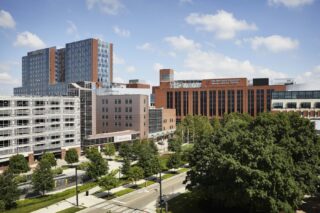

Have you been searching for a large, modern medical school in Ohio with a close-knit culture? Or do you find yourself typing “what are the best medical schools near me?” into a search bar? Then the Ohio State Medical School belongs on your list. The Ohio State University College of Medicine is a public MD-granting school in Columbus, Ohio. Leaders at Ohio State opened the college in 1914 to bring medical education together with research and science-based patient care, and more than 20,000 medical alumni have trained there since. Today the college is part of the Ohio State Wexner Medical Center, one of the country’s largest academic medical centers.
This guide covers the 2026-2027 application cycle, which fills the class that begins medical school in summer 2027. It explains each MD route the college offers, including the new Community Medicine MD Track in Lima and the Three-Year Primary Care Track. It also covers the current requirements, deadlines, costs, secondary essays and interview format. Every statistic carries its year and group, and sources are listed at the end. Facts were checked on October 17 and 18, 2026.
Like every medical school, Ohio State has its own requirements and guidelines. Understanding the college’s identity, its selection criteria and its programs will help you focus your application and put your best foot forward. If you are considering applying to The Ohio State University College of Medicine, bookmark this page so you can come back to it as each deadline approaches.
Key Takeaways
- Ohio State is very selective. For the 2026 entering class, the college made 406 acceptances out of 10,116 applications and enrolled 214 new students. The class GPA was 3.86 and the MCAT composite was 513. For the 2025 entering class, accepted applicants had a median GPA of 3.92 and a median MCAT of 516.
- Out-of-state applicants are welcome. Non-residents made up 44% of the 2026 entering class, and about half of each incoming class comes from outside Ohio. Non-residents can apply for Ohio residency after the first year.
- There are four ways to earn the MD. You can apply to the Regular four-year MD, the Community Medicine MD Track (CMT), the Three-Year Primary Care Track (PCT) or the MD/PhD Medical Scientist Training Program (MSTP). CMT and PCT require an extra Specialty Track Selection form before you submit the secondary.
- Your MCAT must be recent. For the 2027 entering class, scores from tests taken January 1, 2023 through September 30, 2026 are accepted, and a valid score is required before you can receive a secondary.
- The secondary is short and screened. Invitations start in early July. Everyone writes two 250-word essays; CMT applicants add one and PCT applicants add two. The fee is $80.
- Key dates: the primary (AMCAS) deadline is November 2, 2026 for Regular MD, PCT and CMT, and October 1, 2026 for MSTP. Secondary deadlines are December 1, 2026 (Regular MD and CMT), November 16, 2026 (PCT) and October 1, 2026 (MSTP). Decisions began October 15, 2026 and come out about every two weeks.
- Costs for 2026-27: tuition is charged per credit hour. First- and second-year medical students pay a $2,007 instructional fee per credit hour, plus a $1,557.50 per-credit surcharge for non-residents. Student health insurance is $4,108 for the year unless you waive it. The full first-year cost of attendance for 2025-26 was $61,508 in-state and $87,056 out-of-state.
- Next step: finish your prerequisites with in-person labs, line up a science professor’s letter, and draft both general essays before July so you can return the secondary quickly.
Key Statistics About The Ohio State University College of Medicine

The table below collects the figures applicants ask about most. Each row names the year and group it describes.
| Item | Value | Year and group | Source |
|---|---|---|---|
| School and degree | The Ohio State University College of Medicine, MD; public; Columbus, Ohio | Current | Ohio State College of Medicine |
| Accreditation | LCME, full accreditation; next survey 2029-30 | Current | LCME directory |
| Applications | 10,116 (1,265 Ohio residents; 8,851 non-residents) | 2026 entering class | Entering Class Profile |
| Applicants interviewed | 675 | 2026 entering class | Entering Class Profile |
| Acceptances | 406 of 10,116 applicants (about 4.0%) | 2026 entering class | Entering Class Profile |
| New entrants | 214 | 2026 entering class, all tracks | Entering Class Profile |
| Class GPA | 3.86 | 2026 entering class | Entering Class Profile |
| Class science GPA | 3.81 | 2026 entering class | Entering Class Profile |
| MCAT composite | 513 | 2026 entering class | Entering Class Profile |
| Median MCAT, accepted applicants | 516 (mean 515.3) | 2025 entering class, all accepted applicants | AAMC MSAR |
| Median GPA, accepted applicants | 3.92 overall (mean 3.86); 3.89 science (mean 3.82) | 2025 entering class, all accepted applicants | AAMC MSAR |
| Share of verified applicants interviewed, by residency | About 23% of in-state applicants; about 5.2% of out-of-state applicants | 2025 entering class | AAMC MSAR (interviewed divided by verified applications) |
| Residency mix | 56% Ohio residents; 44% non-residents | 2026 entering class | Entering Class Profile |
| Track enrollment | CMT 15; MSTP 11; PCT 4; MedPath 9 | 2026 entering class | Entering Class Profile |
| Instructional fee | $2,007.00 per credit hour (Ranks 1 and 2); $1,987.50 (Ranks 3 and 4) | 2026-27, Ohio residents | University Registrar |
| Non-resident surcharge | $1,557.50 per credit hour (Ranks 1 and 2); $416.63 (Ranks 3 and 4) | 2026-27, non-residents | University Registrar |
| Estimated annual tuition and fees | About $33,185 (Ohio resident) and about $58,105 (non-resident), Ranks 1 and 2 | 2026-27, IMA estimate from per-credit rates | University Registrar (calculation by IMA) |
| Student health insurance | $4,108 per year, student only (waivable) | 2026-27 plan year | OSU Student Health Insurance |
| Total cost of attendance, first year | $61,508 in-state; $87,056 out-of-state (tuition and fees $32,202 / $57,122) | 2025-26, first-year students | AAMC MSAR (Tuition and Student Fees survey) |
| Students receiving financial aid | 88% | 2024-25, all enrolled and graduated students | AAMC MSAR (LCME Part I-B) |
| Average debt of indebted graduates | $182,316 | 2024-25 | AAMC MSAR (LCME Part I-B) |
| Secondary fee | $80 (fee waiver available) | 2026-2027 cycle | How to Apply; AAMC MSAR (waiver) |
| Early decision, deposit and deferral | No Early Decision Program; $25 deposit, not refundable and not applied to tuition; deferral requests considered case by case | 2026-2027 cycle | AAMC MSAR; Selection Process |
| MCAT window | Tests taken 1/1/2023 to 9/30/2026 | 2027 entering class | Dates and Deadlines |
| USMLE Step 1 first-time pass rate | 96% (national 92%) | Calendar year 2023 | USMLE Pass Rates page |
Three notes will help you read this table. First, the acceptance figure is offers divided by applications for the same entering class, which is the fair way to describe selectivity. Dividing new entrants by applications would give a much smaller number, but that is a matriculation ratio, not an acceptance rate, because many admitted applicants enroll somewhere else. Second, the class GPA and MCAT figures describe the enrolled 2026 class, while the medians describe everyone accepted for the 2025 entering class, a different group and year. None of them is a minimum, and the college publishes no minimum score. Third, the college does not publish an annual tuition total. The registrar sets fees per credit hour, so the 2026-27 annual figure above is IMA’s estimate: eight credit hours (the per-credit cap) times the per-credit fees, plus flat semester fees, for two semesters. It leaves out course fees, the $66 Learning Technology Fee, any summer term and insurance. The total cost of attendance row is the 2025-26 first-year budget, which adds living expenses and insurance to tuition.
Mission and Educational Priorities
Ohio State describes its mission in a few complementary ways, and each one tells you something about the applicant it wants.
The college’s secondary application quotes the core mission directly: to “improve people’s lives” through innovation in research, medical education and patient care. The MD program adds its own statement: “Our mission is to train the most compassionate and brightest physicians that are thoroughly prepared to serve the diverse and changing needs of patients and communities.” The college’s strategic plan sets a long-term ambition: “To be a leading college of medicine that transforms the health of all communities through innovative education, discovery and care.” It rests on six pillars: Talent, Discovery, Education, Care, Health Access and Engagement, and Resource Stewardship.
A history of research, care and education together
In 1914, The Ohio State University opened the doors of its College of Medicine. The college’s own history credits leaders who saw the value of integrating medical education with innovative research and science-based care. William Means, MD, served as the first dean, and in 1915 Mabel Roe Codding Clovis became the first woman to graduate. Since 1914, more than 20,000 medical alumni have trained at Ohio State, and more than 18,000 living medical alumni now practice and teach around the world.
The college is still highly committed to research. Its research enterprise reports $406 million in total funding and 2,141 active research studies and clinical trials. Direct federal research grants and contracts alone came to about $269 million in fiscal year 2024, and the college ranked No. 35 in the Blue Ridge NIH ranking for fiscal year 2026. Numerous opportunities are open to medical students: about 92% of MD students take part in faculty-mentored research.
Investing in the future is a driving factor for the college. It has made a $3 billion investment in its strategic plan, a multi-part approach to growth in research, education and culture that includes renewing Hamilton Hall and building a new inpatient tower.
What the mission means for applicants
Read the mission as a description of the student Ohio State wants to admit. Three practical points follow.
Show two of the three mission areas with evidence. The first required secondary essay asks you to pick two of research, medical education and patient care and show your potential in each. Applicants who have only clinical hours or only lab work will find this essay harder. Plan your experiences so you can tell two real stories.
Service to communities is part of the job. The culture on campus is diverse, and the college focuses on community service at home and around the globe. Medical students manage the Columbus Free Clinic and volunteer at clinics for specific populations, covered in the campus life section below. The second required essay asks about health inequities you have seen in the United States. If your service has put you close to patients who struggle to get care, you have material for both essays.
The college is building for smaller communities too. The Community Medicine MD Track exists to prepare physicians “to practice in smaller cities and rural communities with the goal of improving health and well-being in Ohio and beyond.” The Three-Year Primary Care Track answers a projected primary care shortage. If you see yourself in either mission, the college gives you a direct route to say so.
None of this is an admissions formula. Associate Dean for Admissions Demicha Rankin, MD, describes holistic review as a way to evaluate communication, leadership, critical reasoning, orientation for service and academic rigor together, and she calls the belief that grades alone predict success “outdated.” Your job is to show those qualities through what you have actually done.
Accreditation and Institutional Identity
The Ohio State University College of Medicine is accredited by the Liaison Committee on Medical Education (LCME), the accreditor for MD programs in the United States and Canada. The LCME directory lists the program with full accreditation, initial accreditation on or before 1942, and a next full survey in 2029-30. The college’s most recent site visit took place in March 2022. Accreditation means the program meets national standards; it is not a ranking.
The college is one of seven health sciences colleges at The Ohio State University, a public land-grant university in Columbus. It sits inside the Ohio State Wexner Medical Center, which in fiscal year 2026 counted 24,000+ employees, 3,077 faculty, 1,503 residents and fellows, 20 clinical departments and 25 research centers and institutes. The medical school also houses the School of Health and Rehabilitation Sciences, which runs separate degrees in physical therapy, occupational therapy, radiologic sciences, medical laboratory science and other fields. Those are not MD programs, and they use their own applications.
Recognition the college reports
The college highlights a few rankings on its own pages. U.S. News and World Report places the college in Tier 1 for research, and ranks the School of Health and Rehabilitation Sciences No. 4 for the physical therapy doctorate and No. 13 for the occupational therapy doctorate. The Ohio State Wexner Medical Center has been named one of America’s “Best Hospitals” for 30 consecutive years, and Nationwide Children’s Hospital, home of the college’s Department of Pediatrics, is ranked No. 6 among children’s hospitals. The college also describes itself as one of the most affordable of the nation’s top medical schools.
Rankings change every year and measure different things. Use them as one input, then weigh the training routes, cost and clinical sites described below.
Medical Programs and Affiliations
Before applying, research each program the Ohio State University College of Medicine offers. That research will show which route fits you and help you focus your application. Ohio State offers the traditional four-year MD, two specialized MD tracks, an MD/PhD program and several dual degrees. In its own words, the college offers “the accelerated 3-year Primary Care Track (PCT), Community Medicine MD Track and 7 dual degrees, including MD/PhD (MSTP).”
On AMCAS, Regular MD, CMT and PCT applicants all designate The Ohio State University and select “Regular MD” as the application type. CMT and PCT applicants then submit a Specialty Track Selection form. MSTP applicants select “Combined Medical Degree/PhD.” This matters, because your application type cannot be changed once you submit the secondary.
Four-Year MD Program (Regular MD)
The Regular MD is the largest route. Students complete the Lead.Serve.Inspire. (LSI) curriculum over four years in Columbus, with clinical training across the Wexner Medical Center and Nationwide Children’s Hospital. Most of the 214 students in the 2026 entering class are in this track. The curriculum is described in detail in the next section.
Community Medicine MD Track (CMT)
The Community Medicine MD Track is an MD program for students who have a firm commitment to practicing in rural or small communities. Students train with Mercy Health sites in Springfield and Lima. CMT does not limit students to one specialty. The college expects graduates to enter fields such as surgery, emergency medicine, internal medicine, family medicine, neurology, psychiatry and obstetrics and gynecology.
How the track works:
- Years one and two in Columbus. CMT students complete LSI Part 1 on the Columbus campus with everyone else. Their longitudinal practice, the weekly clinical experience with a single faculty preceptor, takes place with faculty and clinical sites of Mercy Health – Springfield, about 45 minutes from Columbus.
- Years three and four in Lima. Students move to The Ohio State University at Lima and complete all required clerkships and fourth-year requirements at Mercy Health – St. Rita’s. A medical education center that opened on the St. Rita’s campus in summer 2021 has 48,000 square feet of space, including simulation labs, clinical skills labs, a 240-seat lecture hall and a virtual library.
- Interprofessional training. The Lima site adds a longitudinal Interprofessional Practice and Education curriculum in which medical students work in teams with nursing, pharmacy and other health science learners.
- Same degree, same objectives. CMT students meet the same objectives as all Ohio State students and receive the same MD. They can take electives in Columbus.
- No switching. Once admitted to CMT, a student cannot transfer into the standard track.
The admissions requirements are identical to the Regular MD, but CMT applicants are reviewed separately. The review gives additional weight to commitment to community-based medicine and to completing clinical training in a rural area of Ohio, and CMT interviewers are trained to assess that commitment. The 2026 entering class included 15 CMT students, and the first CMT cohort has now reached clinical training. CMT holds virtual information sessions; the 2026 dates ran from July through October.
Three-Year Primary Care Track (PCT)
The Three-Year Primary Care Track (OSU-PCT) is an accelerated MD for students who want to become family physicians. The program is similar in curriculum to the four-year program, with core objectives identical to LSI, but it is a fast track. It prepares students to be successful physicians in family medicine through faculty mentorship, advising, early-and-often clinical experience in family medicine offices and a cultivated learning community. Those clinical experiences take place in family medicine practices because that is the setting these future doctors will practice in after graduation.
What sets the PCT apart:
- An early start. The track begins in mid-July with “Primed for Practice,” an orientation about three weeks ahead of regular orientation. Students are paired with a family physician in the first week and stay in the same clinic with the same preceptor throughout medical school.
- A compressed calendar. PCT students spend the summer between years one and two on campus to move through Part 1 faster, take Step 1 about halfway through year two, and finish Part 2 and Part 3 in year three, with graduation in May.
- Lower cost. The track includes a tuition scholarship covering up to 50% of in-state tuition for all three years, and finishing in three years saves a year of tuition and adds a year of earnings.
- A residency pathway. Students who meet all requirements and choose to stay are positioned to match into the Ohio State Family and Community Medicine Residency Program, completing medical school and residency in six years.
- Limits. You cannot apply to both the PCT and the four-year MD in the same cycle, and dual degrees are not available in the PCT. Students who change their minds may request a transfer to the four-year program, but approval is not guaranteed.
The college looks for a strong motivation to enter family medicine, the maturity to succeed in an accelerated program and an academic record that predicts success in it. The 2026 entering class included four PCT students, so expect a small, personal cohort.
Medical Scientist Training Program (MD/PhD)
The Medical Scientist Training Program prepares physician-scientists. Students complete both degrees in an average of eight years, with a stipend and paid tuition and fees (general and instructional fees). The three core PhD programs are biomedical sciences, neuroscience and biomedical engineering, with many affiliate programs and a pediatric research fellowship with Nationwide Children’s Hospital. About 400 candidates apply each year and 9 to 12 matriculate; the 2026 entering class included 11 MSTP students. The program is open only to U.S. citizens and permanent residents. MSTP has its own earlier deadlines and letter rules, covered in the admissions section.
Dual Degrees and Concentrations
In addition to the standard MD, Ohio State offers these combined programs. Each master’s degree requires a separate application during medical school.
- MD/MBA: prepares future physicians for business and financial issues in medicine, with the MBA from Ohio State’s Fisher College of Business. It can be completed within five years. Students apply to the MBA in the fall of the second year; the third year is full-time MBA study.
- MD/MHA: prepares future physicians for a rapidly changing health care system. It typically takes five years, one more than the MD alone, and the college calls it the first program of its kind in Ohio. Students apply before February 15 of the second year.
- MD/MPH: combines the practice of medicine in the traditional patient setting with the broader population health context. It can be completed within five years, and the MPH meets the academic phase requirement for a preventive medicine pathway.
- MD/JD: prepares future doctors to handle legal issues in physician offices, hospitals, medical centers and the health care industry, with the Moritz College of Law. It takes six years.
- MSTP (MD/PhD): described above.
The School of Health and Rehabilitation Sciences also offers a DPT/PhD in physical therapy and an MOT/PhD in occupational therapy. These combine a clinical degree with a doctorate, but they are not MD programs. The 2026 class profile also counts nine MedPath students.
Clinical affiliations
Students train in the hospitals of the Ohio State Wexner Medical Center, at Nationwide Children’s Hospital and, for CMT, at Mercy Health sites in Springfield and Lima. The clinical rotations section lists each hospital.
Curriculum Overview
Ohio State uses its Lead.Serve.Inspire. (LSI) curriculum. This curriculum is a three-part, four-year program that integrates basic science learning in the classroom with clinical science applied in a clinical environment. It is competency-based, which means students must show they can perform specific tasks before moving on. Overall, the goal is to prepare students for their residency programs and, ultimately, their practices and specialties.
Key features of the curriculum, as the college lists them:
- A three-part curriculum that takes four years to complete
- Fully integrated basic and clinical sciences
- Early longitudinal practice-based clinical service that lets students apply classroom knowledge to real patients
- Self-directed learning with multiple assessment methods
- Coaching with faculty to support strong clinical skills
- Project work requiring critical thinking and synthesis
- Clinic-based problem solving in a team environment
Part 1: foundations and early patient care (years one and two)
In the first year to year and a half, students learn about body system disorders, including bone and muscle, neurological, cardiopulmonary, gastrointestinal, renal, endocrine and reproductive disorders. Anatomy is integrated throughout, so students learn regional anatomy alongside the science it supports. Case discussions in small learning groups tie the science to clinical reasoning and patient management.
At the same time, every student takes part in longitudinal practice (LP): a regular ambulatory clinic experience with a single faculty preceptor. LP is where you practice history taking, physical examination and procedures on real patients while the classroom material is still fresh. CMT students do LP in Springfield, and PCT students do it with a family physician from their first week.
Part 1 also includes three dedicated LSI Professional Development weeks, which cover study skills, personal and financial wellness, and specialty exploration with faculty from across the medical center.
Longitudinal projects
Throughout the curriculum, students work in groups of four to six on projects at a clinical site, guided by practicing physicians. Teams assess the needs of their patients, carry out an intervention and measure the outcome, then present a poster at the college’s annual Community Health Day. Past topics include community health education, patient safety, health systems and interdisciplinary problem-solving.
Part 2: clinical clerkships
Part 2 is the core clinical phase. Students rotate through the major specialties and learn to care for patients with specialized medical, reproductive and surgical needs, as well as patients in vulnerable situations such as abuse, addiction, poverty and low literacy.
Part 3: advanced competencies and electives
One major component of LSI is the opportunity to take Advanced Competencies and Electives. Students choose from a variety of advanced competencies and clinical electives related to their intended specialty. Advanced clinical rotations prepare students for the transition to internship. One option is the LSI Research Advanced Competency, described in the research section.
Assessment, coaching and the ePortfolio
At the end of each major section, an assessment week gives students feedback on their cumulative performance across six core competency domains. Patient care and communication are tested through Objective Structured Clinical Examinations (OSCEs) and lab practical stations; medical knowledge is tested through board-style exams. Each student keeps a web-based ePortfolio of written reflections and meets with a faculty portfolio coach to set goals for improvement. This reflective habit is worth practicing now, because Ohio State’s secondary essays ask what you learned, not only what you did.
Simulation training takes place in the Clinical Skills Education and Assessment Center (CSEAC), a dedicated center that simulates real patient care.
Grading is Pass/Fail in years one and two. In years three and four, grades are Honors, Letter of Commendation or Satisfactory. Students are grouped into quartiles rather than ranked one by one. Lecture attendance is not mandatory, and lectures are available online. Before the first year, accepted students can apply for an optional six-week pre-entry program in gross anatomy, immunology and biochemistry taught by medical school faculty; seats are limited.
Graduation requirements and outcomes
To earn the MD, students must pass Parts 1, 2 and 3, pass USMLE Step 1 and Step 2 CK, and meet all professional standards. Ohio State students have posted Step 1 and Step 2 pass rates equal to or above the national average since 2002. In calendar year 2023, 96% of Ohio State students (199 students) passed Step 1 on the first try, against 92% nationally. In the 2023-2024 academic year, 100% (217 students) passed Step 2 CK on the first try, against 98% nationally. The college reports an average residency match rate of over 95% each year and helps students through four matches: the NRMP, the San Francisco Match, the American Urological Association match and the Military Match. Internal medicine has been the most common specialty choice among graduates, at 15.0% to 22.1% of respondents in each of the three most recently reported Graduation Questionnaire years, followed by fields such as pediatrics, anesthesiology and emergency medicine.
How the tracks differ
| Track | Length | Where you train | What is different |
|---|---|---|---|
| Regular MD | 4 years | Columbus | Standard LSI sequence; dual degrees available |
| Community Medicine MD Track | 4 years | Columbus (years 1-2, LP in Springfield); Lima (years 3-4) | Clerkships at Mercy Health – St. Rita’s; interprofessional curriculum; cannot transfer to standard track |
| Three-Year Primary Care Track | 3 years | Columbus, family medicine clinics | Starts mid-July; same preceptor throughout; tuition scholarship up to 50% of in-state tuition; no dual degrees |
| MSTP (MD/PhD) | About 8 years on average | Columbus | LSI adapted for MSTP plus PhD research; stipend and tuition and fees paid |
Admissions Requirements and Application Process
The Ohio State University College of Medicine has specific academic criteria and admission requirements that applicants must meet to be considered. The college screens applicants before sending secondaries, so not meeting a requirement can mean you never receive a secondary invitation.
Who can apply
You may major in any subject. You need a bachelor’s degree before your first day of enrollment, verified by a final official transcript. You must show spoken, auditory, reading and writing proficiency in English; applicants who list English as a second language, or whom the committee recommends for assessment after the interview, may be given a one-year deferred admission to build competency through English coursework.
About half of each incoming class comes from outside Ohio. The MD program does not accept international applicants who are not visa holders or permanent residents, and it does not accept Canadian applicants. Permanent residents, refugees, asylees, DACA recipients and applicants in Adjustment of Status are eligible to apply. The MSTP is limited to U.S. citizens and permanent residents, and transfer students must be U.S. citizens, permanent residents or political asylees. If your status is not clearly covered, contact the Office of Admissions at [email protected] before you apply.
Required Coursework for Ohio State Medical School
The following required premedical coursework must be completed at an accredited institution with a grade of C- or higher, within the ten years leading up to your enrollment date. You do not have to finish every course before you apply, but all required courses must be done by the Commit to Enroll deadline. PCT applicants must finish all prerequisites by the first week of July before their program starts.
- Biology: two semesters or three quarters
- General Chemistry: two semesters or three quarters, including laboratory work with quantitative and qualitative analysis
- Biochemistry: one semester or quarter
- Organic Chemistry: two semesters or three quarters, including one year of lab experience or equivalent
- Physics: two semesters or three quarters with a laboratory experience
The college prefers classroom courses. It will accept online coursework for lecture courses only; laboratory components must be completed in person. Even so, a strong application takes precedence over an early one, and it is wise to have grades for most required courses in hand when you apply. For a broader view of how these requirements compare with other schools, see our medical school prerequisites checklist.
Additional Recommended Premedical Coursework
These courses are recommended but not required:
- Anatomy: one semester or quarter
- Writing/Speech: courses that emphasize written and verbal communication
- Social Sciences: psychology, sociology, anthropology and economics
- Humanities: art, music, drama, literature and languages
- Cultural Studies: courses on the culture, history or current state of various populations
- Ethics: courses on morality and moral behavior, including meta-ethics, normative ethics, applied ethics and moral psychology
Cultural studies and social sciences coursework pays off directly in the health inequities essay, and ethics coursework helps in interviews, which explore your understanding of medical ethics.
GPA and MCAT Requirements for OSU College of Medicine
Ohio State does not publish a minimum GPA or MCAT. It compares your numbers with the most recent class, in the context of the rigor of your major, and weighs them with your experiences, interests and letters. For the 2026 entering class, the class GPA was 3.86, the class science GPA was 3.81 and the MCAT composite was 513. Keep in mind these are class figures, so scores above and below them are accepted.
Medians for accepted applicants give a second view. For the 2025 entering class, everyone Ohio State accepted had a median overall GPA of 3.92 (mean 3.86), a median science GPA of 3.89 (mean 3.82) and a median MCAT of 516 (mean 515.3). The section medians were 129 in Chemical and Physical Foundations, 128 in Critical Analysis and Reasoning, 129 in Biological and Biochemical Foundations and 130 in Psychological, Social and Biological Foundations. Accepted applicants run a little higher than the enrolled class because many of the strongest admits enroll elsewhere.
Three screening rules matter here. There is no minimum GPA screen, and postbaccalaureate and graduate GPAs are considered with your undergraduate GPA to form a complete academic picture. There is a minimum MCAT for receiving a secondary, but the number is not published. If you have taken the MCAT more than once, the committee considers your highest total score.
The MCAT must be no more than three years old. For the class entering in 2027, scores from tests taken January 1, 2023 through September 30, 2026 are accepted, and September 2026 is the last test date accepted. A valid MCAT score is required before the college will send you a secondary, so if you apply before testing, the committee will not review your application until your score arrives.
Volunteer Service and Clinical Experience
The OSU College of Medicine values clinical experience, volunteer service, research and leadership, and it explains what it means by each:
- Clinical experience: spend enough time in a clinical setting to understand the challenges and demands of a physician’s life. Patient exposure can come from volunteering or working at hospitals, emergency rooms, homeless clinics and extended-care facilities.
- Community and volunteer service: the profession is strongly oriented to serving the community, so show sustained commitment through service and volunteer work.
- Research: the college considers research an important part of preparation. It may be in any discipline and performed at any site, including course-based research or a senior thesis. Be ready to describe your project, the question it asked and your role.
- Leadership: dedication, decision-making, communication, teamwork and a willingness to contribute to others’ welfare. Leadership can come from work, church, community or school organizations.
- Extracurricular activities: how you handle demands outside the classroom is a strong indicator of how you will handle responsibility and stress in medical school.
Every member of the 2026 entering class had participated in research, which tells you how common it is among admitted students. Clinical hours matter just as much, because the mission essay and the interview both ask what you learned from patients. If your clinical exposure is thin, clinical internships for pre-med students are one way to add sustained, hands-on patient contact before you apply.
Ohio State University College of Medicine Letters of Recommendation
Being a competitive applicant includes strong letters. They should come from people who trust you and can describe your integrity, interest in medicine, academic ability, interpersonal skills and resilience. Ohio State’s current rules:
- A minimum of two letters is required, and the college encourages more. There is no maximum.
- At least one letter must come from a professor who taught you and assigned you a grade for credit in a BCPM course (biology, chemistry, physics or math). Additional letters from other professors are also accepted.
- A premedical committee composite letter satisfies the requirement.
- Letters from outside the classroom are strongly recommended: supervisors, managers, people you worked with in the community, a volunteer service or a clinical or research setting.
- All letters come through the AMCAS Letter Service.
- MSTP applicants need four letters: two that address research experience and potential, and two from teachers or professors who taught and graded them.
- Reapplicants must resubmit letters each year, and one or two new letters are expected.
Technical standards
Every candidate must also meet the college’s technical standards for admission, retention and graduation, with or without reasonable accommodation. These are not selection factors, but they describe abilities every student needs:
- Intellectual, conceptual, integrative and quantitative abilities: observe, measure, calculate and use information to think critically and solve problems, including under pressure.
- Stamina: the physical and mental stamina to take part fully in the curriculum, including clinical rotations and irregular shifts.
- Observation: use visual information to observe patients and interpret tests such as EKGs, radiographs and histology slides.
- Communication: communicate independently with peers and the health care team, including in writing.
- Motor: independently perform a physical exam and perform or direct life-saving measures such as BLS, ACLS and direct pressure to stop bleeding.
- Professional interactions: the emotional stability to act with integrity, respect, compassion and tolerance, including under stress.
Holistic review and the AAMC competencies
What exactly is Ohio State looking for: MCAT scores, grades or experiences? Like most medical schools, it uses holistic review, which means the committee looks at your entire application to understand who you are as a candidate and as a person. The AAMC Core Competencies for Entering Medical Students are a useful guide to the qualities that review looks for: service orientation, teamwork, ethical responsibility, reliability, resilience and the rest. If you want to be accepted, show these qualities through specific experiences rather than claiming them.
Does the Ohio State University College of Medicine Require the CASPer Exam?
The CASPer exam is an online situational judgment test required by some medical schools. It assesses a candidate’s non-cognitive and interpersonal skills, complementing grades and test scores. For the 2026-2027 cycle, Ohio State’s admissions requirements do not include CASPer, PREview or any other situational judgment test. Your required pieces are the AMCAS application, MCAT, letters, secondary and interview.
AMCAS Primary Application and OSU College of Medicine Secondary Application
The AMCAS is the primary application for almost every MD school, and the same primary goes to every MD school you apply to. AMCAS has nine sections; in the seventh you designate The Ohio State University College of Medicine. Our AMCAS application guide walks through each section.
After you submit AMCAS, Ohio State reviews your application to decide whether to invite you to the secondary. Invitations are sent starting in early July, and only once the college has your verified AMCAS application and a valid MCAT score. The college does not send a secondary to every applicant. If you do not hear back right away, do not be discouraged: the college notes that review takes time and that there may be periods without updates. You can track your status in the applicant portal at applymedicine.osu.edu.
All secondary applications are school specific, with questions the school uses to judge fit. Ohio State’s secondary is completed in its own portal, costs $80 and includes the essays covered later in this guide. A fee waiver is available, so check your eligibility before you pay. Secondaries go to AMCAS-verified applicants who broadly meet the college’s holistic admissions criteria and its unpublished minimum MCAT. Ohio State has no Early Decision Program. If you would like more clarification, check out our article on understanding the difference between a primary and a secondary application.
Three rules are easy to miss:
- CMT and PCT applicants must wait for confirmation. Submit the Specialty Track Selection form, wait for the email confirming eligibility (five to seven business days), and only then submit the secondary. Your application type cannot change after you submit the secondary.
- Updates are not accepted unless you are invited to interview, when you will have a chance to submit one.
- Professional conduct counts from the interview invitation onward. The college’s admissions statement on professionalism expects honest representation of yourself and your experiences, and conduct that falls short can lead to a withdrawn offer.
Application timeline, 2026-2027 cycle
| Step | Regular MD | CMT | PCT | MSTP |
|---|---|---|---|---|
| Secondary invitations begin | Early July 2026 | Early July 2026 | Early July 2026 | Early July 2026 |
| AMCAS deadline | November 2, 2026 | November 2, 2026 | November 2, 2026 | October 1, 2026 |
| Secondary and all materials deadline | December 1, 2026 | December 1, 2026 | November 16, 2026 | October 1, 2026 |
| Interviews | August 2026 to March 2027 | September to March | September to January | Virtual sessions, fall |
| Decisions | From October 15, about every two weeks | Separate CMT timeline | Separate PCT timeline | MSTP and admissions office |
| Commit to Enroll deadline | June 25, 2027, 5:00 pm ET | June 25, 2027, 5:00 pm ET | June 4, 2027, 5:00 pm ET | April 15, 2027, 5:00 pm ET |
| Alternate list closes | August 6, 2027 | August 6, 2027 | July 16, 2027 | May 7, 2027 |
The MSTP also asks for a current CV, a one-page personal statement about the graduate program you select, transcripts sent to the Graduate School, and an early application, because interview slots fill quickly. All dates come from the college’s Dates and Deadlines page and its How to Apply page.
Decisions, deposits and the alternate list
Ohio State uses rolling admission. Beginning October 15, interviewed applicants are accepted, deferred or rejected, with new decisions about every two weeks. A deferred applicant stays in consideration at every committee meeting until April; the deferred list becomes a wait list after April 30, and candidates remain active until orientation. The wait list typically holds 250 to 300 applicants, and in the most recent reported cycle 55 waitlisted applicants received offers. Waitlisted candidates are evaluated on an overall score that combines experiences, attributes, academic metrics and interview performance. Letters of intent are not considered in admissions decisions.
Accepted students can select “Plan to Enroll” from February 19, 2027. If Ohio State is your first choice, the college requires you to say so through Plan to Enroll by April 30. By April 15, accepted students should hold no more than three acceptances. Once you make your final decision, you pay a $25 fee to secure your seat and select Commit to Enroll by your track’s deadline. The $25 deposit is not refundable and is not applied to tuition. If you are holding a seat and receive another offer after April 30, you must notify the college within 24 hours. A criminal background check and drug test follow acceptance, before matriculation, and accepted students may request a one-year deferral with the approval of the associate dean of admissions. Deferral requests are considered case by case.
Tuition, Cost of Attendance and Financial Aid
In addition to tuition and fees, Ohio State medical students should budget for incidentals, textbooks, supplies, health insurance and living costs. Here is what the college and university publish for the 2026-27 academic year.
How tuition is charged
Ohio State charges professional tuition per credit hour, with per-credit fees capped at the cost of eight credit hours per term. The University Registrar’s 2026-2027 professional fee table lists these medicine rates:
| Fee (per credit hour) | Medicine Ranks 1 and 2 (years one and two) | Medicine Ranks 3 and 4 (years three and four) |
|---|---|---|
| Instructional fee | $2,007.00 | $1,987.50 |
| General fee | $33.94 | $33.94 |
| Student union fee | $9.30 | $9.30 |
| Non-resident surcharge | $1,557.50 | $416.63 |
Medicine students also pay a $66 Learning Technology Fee, prorated by credit hour, and flat per-semester fees: a $39.50 student activity fee, a $137.50 recreation fee and a $13.50 COTA bus fee.
What that adds up to (IMA estimate)
The college does not publish an annual tuition total, so the figures below are IMA’s estimate, not school figures. They assume eight credit hours (the cap) in each of two semesters, add the flat semester fees, and leave out the Learning Technology Fee, course fees, any summer term and insurance.
| Year | Ohio resident (estimate) | Non-resident (estimate) |
|---|---|---|
| Years one and two (Ranks 1-2) | About $33,185 per year | About $58,105 per year |
| Years three and four (Ranks 3-4) | About $32,873 per year | About $39,539 per year |
Two points stand out. First, the non-resident surcharge drops sharply in years three and four, which the college designed to lower student debt for students who keep out-of-state status. Second, out-of-state students can apply for Ohio residency reclassification after the first year; if approved, they pay in-state tuition for the rest of medical school. Residency decisions are made by the University Registrar, and the main factors are physical presence in Ohio, contribution to Ohio taxes and eligibility to remain in the United States permanently. Accelerated tracks with summer terms, such as the PCT, will have a different calendar, so ask the Office of Student Financial Aid for a track-specific estimate.
Health insurance and other costs
All students need health coverage. The university’s Student Health Benefits Plan costs $2,054 per semester, or $4,108 for the 2026-27 plan year (August 18, 2026 to August 16, 2027) for student-only coverage. You can waive it with comparable coverage.
The most recent full first-year budget is for 2025-26:
| First-year cost, 2025-26 | In-state | Out-of-state |
|---|---|---|
| Tuition and fees | $32,202 | $57,122 |
| Other expenses (living costs, books, equipment) | $25,388 | $26,016 |
| Health insurance (can be waived) | $3,918 | $3,918 |
| Total cost of attendance | $61,508 | $87,056 |
The 2025-26 tuition and fees line sits close to the 2026-27 per-credit estimate above, which is a useful check on that estimate. Plan for housing, food, transportation, books, equipment and board exam fees on top of tuition, and ask the Office of Student Financial Aid ([email protected], 614-292-8771) for the 2026-27 medical student budget. Rent near campus ranges from about $400 to $2,000 a month, Victorian Village and Grandview Heights are popular with medical students, and on-campus housing for professional students is available. A driver’s license and a car are recommended, because students need transportation to clinical sites; within Columbus, students ride COTA buses with their student ID. Columbus helps here: it is the 14th largest U.S. city, and its cost of living is about 8% below the national average.
Scholarships
Ohio State is in the top 30% of U.S. medical schools for scholarship and grant funding, and its average debt load is lower than at most public schools. The main sources are:
- Merit scholarships. All accepted applicants are automatically considered for merit-based scholarships worth up to full tuition. No separate application is needed. Students who do not receive one at admission can become eligible later based on achievement, leadership, professionalism, research and need. In 2022, 82% of medical students received some form of aid, and in 2024-25, 88% of enrolled and graduated students received financial aid. Need-based grants use the information you report on the FAFSA.
- University scholarships. The university has its own scholarship application, which opens early in the spring; the college advises completing it by mid-February.
- Alumni scholarships. More than 100 alumni-funded scholarship funds support students based on need, merit or donor criteria.
- Research scholarships. Extramural programs such as the Sarnoff Fellowship, the NIH Medical Research Scholars Program and the Doris Duke International Clinical Research Fellowship support year-long or summer research.
- Track-specific support. PCT students receive a tuition scholarship of up to 50% of in-state tuition for all three years. MSTP students receive a stipend and paid tuition and fees.
Loans
Most students borrow federal loans by filing the FAFSA (Ohio State’s federal code is 003090). Medical students follow the university’s graduate and professional aid timeline. Federal loan rules for graduate and professional borrowers changed for the 2026-27 award year, so confirm current annual and lifetime limits with the Office of Student Financial Aid before you plan your budget. For the 2024-25 graduating year, the average medical school debt of Ohio State graduates who borrowed was $182,316.
Campus Facilities and Student Life
Where you will study
The College of Medicine’s home is the Interdisciplinary Health Sciences Center (IHSC) at a renewed Hamilton Hall, designed for team learning across Ohio State’s seven health sciences colleges. It has 36 classrooms, three stories of anatomy and surgical labs, six large dissection rooms with ultrasound and high-tech microscopes, a 6,000-square-foot student forum with lounges, and a 125-seat reading room for quiet study. The building is steps from University Hospital and The James Cancer Hospital, so you can walk from class to clinic. Simulation and standardized patient training take place in the Clinical Skills Education and Assessment Center.
Student support
The Office of Student Life supports students with mental health and wellness services, learning support and academic counseling, career advising and professional development, and a process for reporting and resolving mistreatment. It also runs the signature events of medical school, from orientation and the White Coat Ceremony to Match Day, along with the Humanism and the Arts in Medicine program. PCT students also have a dedicated learning community and a peer tutor throughout Part 1.
Service: free clinics run by students
Community service is one of the most distinctive parts of student life at Ohio State. Many students volunteer at the Columbus Free Clinic, a free primary and urgent care walk-in clinic that Ohio State medical students have managed under volunteer physicians for more than 20 years. It serves more than 1,200 underserved patients each year with primary care, chronic disease care, immunizations, testing, dental and prenatal care, and it now offers services for the LGBTQ+ community.
Students also volunteer at clinics that serve specific communities:
- Asian Health Initiative Free Clinic, serving the Asian community
- La Clinica Latina, a full-service clinic for Spanish-speaking patients
- Noor Community Clinic, serving the Muslim community
- Physician Care Connection Free Clinic, offering hands-on clinical experience under physician mentors
- Rainbow Clinic, providing LGBTQIA-affirming care
In fiscal year 2026, the medical center reported 1,232 patients seen across 2,738 free clinic visits. Students also take part in the Wexner Medical Center’s Healthy Community Day and in student organizations ranging from clinical interest groups to outreach and advocacy. If you volunteer in clinics now, the transition to these student-run clinics will feel familiar.
Global health
The college’s Office of Global Health Education provides funding and course credit for international clinical and public health rotations. Students have completed electives in places such as Argentina, Eswatini, Malawi, Thailand and Vietnam, and in Kenya’s Narok South District. These are electives for enrolled medical students, and 32% of the 2025 graduating seniors reported a global health experience during medical school. Before medical school, applicants interested in global health can build relevant experience through supervised pre-med internships abroad, as long as the work is ethical, supervised and patient-centered.
Life in Columbus
Columbus is a large, growing city with a low cost of living and four major health systems: the Ohio State Wexner Medical Center, Nationwide Children’s Hospital, OhioHealth and Mount Carmel. About half of Ohio State medical students come from out of state, so many classmates will be new to the city with you. The university’s Off-Campus and Commuter Student Services office helps students find housing near campus. CMT students should plan for a move to Lima for years three and four.
Clinical Rotations and Research Opportunities
Where students train
Students work side by side with other health professionals in the hospitals of central Columbus. The Wexner Medical Center manages more than 2 million patient visits each year, so trainees see a wide range of complex and sometimes rare conditions. Training sites include:
- University Hospital: the flagship hospital, with a Level I Trauma Center, a Level III neonatal intensive care unit and a Center for Neuromodulation. Walking distance from Hamilton Hall.
- The James Cancer Hospital: the Arthur G. James Cancer Hospital and Richard J. Solove Research Institute, an NCI-designated comprehensive cancer center and one of the largest cancer hospitals in the country.
- Ross Heart Hospital: care for every type of heart and vascular disease.
- University Hospital – Pavilion: neurology and neurosurgery, including stroke, neurotrauma, spinal cord injury, epilepsy and rehabilitation units.
- Ohio State East Hospital: a 190-bed community-based academic hospital on Columbus’s east side with a Level III Trauma Center and a full range of services, including family medicine.
- Ohio State Harding Hospital: behavioral health care for adults, older adults, children and adolescents.
- Dodd Rehabilitation Hospital: inpatient rehabilitation.
- Nationwide Children’s Hospital: home of the college’s Department of Pediatrics and the site of pediatric training, about 15 minutes away by car, with a shuttle.
A new 1.9-million-square-foot inpatient tower with up to 820 private-room beds, the largest facilities project in Ohio State’s history, is opening on the medical campus in 2026. CMT students complete their third- and fourth-year clinical training at Mercy Health – St. Rita’s in Lima, and PCT students train longitudinally in family medicine clinics.
Required clerkships come in Part 2, and electives and advanced competencies come in Part 3. Many electives can be taken in Columbus or with community partners. Applicants drawn to psychiatry or behavioral health will notice Harding Hospital’s range of services; if that is your interest, supervised mental health internships abroad are one way to test it before medical school.
Research routes for medical students
Research is a large part of the Ohio State experience. About 92% of MD students do faculty-mentored research, and the college runs a research openings database and volunteer research listings to help students find mentors. Common routes:
- Summer and part-time projects in years one and two. Many students begin with a summer project after the first year or part-time work during Part 1.
- The LSI Research Advanced Competency. In Part 3, students can complete a hypothesis-driven research project under the direct supervision of an Ohio State faculty mentor, with at least one primary and one secondary learning objective. Students are expected to have built basic research skills first, and applications are due the first week of May after prior approval from the program manager.
- Scholarships. Intramural awards, including the College of Medicine Medical Student Research Scholarship, and extramural programs fund deeper research time.
- MSTP. For students committed to a research career, the MD/PhD adds full PhD training.
Research is not limited to biomedical labs. For applicants, Ohio State accepts research in any discipline, and PCT students complete a quality improvement project before graduation.
Mentorship and advising
Each student has a faculty portfolio coach throughout medical school. LSI Professional Development weeks introduce specialty options in Part 1, and the college prepares each student’s Medical Student Performance Evaluation (MSPE) for residency applications. PCT students meet each block with PCT program directors, and CMT students receive the same career advising as Columbus students.
Notable Alumni, Faculty, Leadership and Admissions Staff
The people below hold verified roles at the college or are documented medical alumni. Their work shows the range of careers an Ohio State MD supports. None of this implies that any of them will mentor or evaluate a particular applicant.
School leadership
Amy M. Moore, MD, Interim Dean. Dr. Moore was appointed interim dean of the College of Medicine and interim vice president of Health Sciences at the Wexner Medical Center in January 2026. She is an internationally recognized surgeon-scientist in peripheral nerve surgery and military medicine and has chaired Ohio State’s Department of Plastic and Reconstructive Surgery since 2019. For applicants, her appointment means the college is in a leadership transition during this cycle; the admissions office, requirements and deadlines described here remain in place.
Jennifer Gold, MD, FAAP, Vice Dean for Education. Dr. Gold oversees the college’s educational mission, from medical education to continuing and graduate education, and chairs the Department of Biomedical Education and Anatomy. She joined Ohio State from Baylor College of Medicine, where she was senior dean of the School of Medicine and School of Health Professions. A board-certified pediatrician, she earned her bachelor’s degree at Ohio State and her MD at the University of Toledo, and her work focuses on curriculum renewal and accreditation. Her office shapes the LSI curriculum you will learn in.
Jennifer McCallister, MD, Associate Dean for Medical Education. Dr. McCallister leads the office responsible for the MD curriculum’s day-to-day operation.
Dana McTigue, PhD, Vice Dean for Research. Dr. McTigue is an internationally recognized neuroscientist whose work changed how the field views spinal cord injury, from a local trauma to a whole-body condition. She directs research for the Belford Center for Spinal Cord Injury and holds the Belford Family Endowed Chair in Spinal Cord Injury. Research-minded applicants should know that the research enterprise she leads is the one most students join.
Admissions leadership
Demicha Rankin, MD, Associate Dean for Admissions. Dr. Rankin leads all activities of the Office of Admissions. She is a true Buckeye: she completed her medical degree, anesthesiology residency and neuroanesthesiology fellowship at Ohio State. On faculty since 2010, she served as associate director of the Anesthesiology Residency Program and was the department’s first African American female residency program director. She has said her goal is to recruit future physician leaders prepared for current and future health care challenges, and she describes holistic review as the way to evaluate communication, leadership, critical reasoning, service and academic rigor together. Her recorded reapplicant advice, which reframes “no” as “not yet,” is worth watching if you are applying again.
Program leaders and faculty
Ginny Bumgardner, MD, PhD, and Rama Mallampalli, MD, MSTP co-directors. Dr. Bumgardner, associate dean for physician scientist education and training, works in immunobiology and translational science. Dr. Mallampalli, chair of the Department of Internal Medicine, works in biochemistry, small molecule discovery and drug commercialization. Both have overseen large NIH-funded training programs.
Alan Harzman, MD, Assistant Dean, Community Medicine MD Track. A board-certified colorectal surgeon at Ohio State since 2007 and professor of surgery, Dr. Harzman has served as general surgery program director and clerkship director. He helped implement the LSI curriculum from 2010 to 2017 and led the LSI Revitalization Task Force in 2023-2024.
Emily Barbee, MD, FACEP, CMT Academic Program Director. Dr. Barbee is a board-certified emergency physician and a native of rural northwest Ohio, with more than 20 years of clinical practice, much of it in rural communities.
Bryce Ringwald, MD, CMT program director. Dr. Ringwald is a board-certified family physician who practices in his hometown of Spencerville, near Lima. He serves as associate academic program director for CMT and chairs interprofessional continuing education for Bon Secours Mercy Health.
Lori Scott Martensen, MS, CMT Program Administrator. Ms. Martensen runs CMT’s daily operations. Her past work includes a rural family medicine residency, a three-year medical school track and two undergraduate rural medical education programs.
Aaron Clark, DO, Chair, Department of Family and Community Medicine. The department Dr. Clark chairs is the academic home of the Three-Year Primary Care Track and the family medicine residency PCT students can enter.
For CMT applicants, these leaders matter in a practical way: the track’s separate review is designed by people with long rural and community practice, so your essay and interview should show the same commitment they describe.
Notable alumni
George Weiner, MD, class of 1981. After earning his MD at Ohio State, Dr. Weiner trained in internal medicine at the Medical College of Ohio and in oncology and hematology at the University of Michigan. At the University of Iowa he directed the Holden Comprehensive Cancer Center for 23 years, leading it to NCI comprehensive designation, and served as president of the Association of American Cancer Institutes. He has sat on the Ohio State Comprehensive Cancer Center External Advisory Board since 2010 and received the college’s Alumni Achievement Award.
Pankti Reid, MD, MPH, class of 2013. Dr. Reid was class president all four years at Ohio State. She is now a rheumatologist and clinical immunologist at the University of Chicago, where she founded and directs one of the nation’s first multidisciplinary clinics for immune-related side effects of cancer immunotherapy. She serves on the NCCN guidelines committee for immunotherapy toxicity and received the college’s Early Career Achievement award.
Maame Dankwah, MD, MPH, class of 2004. Dr. Dankwah is a neurologist and community advocate who works to improve stroke education and prevention in underserved neighborhoods in the Greater Bridgeport, Connecticut, area and in Ghana. She received the college’s Community Practice Alumni Award.
Demicha Rankin, MD, profiled above, is also an Ohio State medical alumna.
These careers show three paths an Ohio State MD supports: academic research leadership, clinical research that changes national guidelines, and community-focused practice.
Admissions Statistics and Class Profile
Ohio State publishes a detailed profile of each entering class. Here are the figures for the 2026 entering class, the most recent class to enroll.
Applications, interviews and acceptances
- Applications: 10,116 total, including 1,265 from Ohio residents and 8,851 from non-residents
- Applicants interviewed: 675
- Acceptances: 406
- New entrants: 214
That means 406 acceptances out of 10,116 applicants, about 4.0% for the 2026 entering class, and 675 interviews out of 10,116 applicants, about 6.7%. These are two different measures. The first is the share of applicants who received an offer. The second is the share of applicants interviewed. About 60% of interviewed applicants received an offer that cycle, which shows how much the interview stage matters once you reach it. The number of new entrants is lower than acceptances because many admitted students enroll elsewhere; dividing entrants by applicants describes matriculation, not acceptance.
Academic profile
- Class GPA: 3.86
- Class science GPA: 3.81
- MCAT composite: 513
The college does not label these as means or medians and does not publish ranges or minimums. Treat them as the center of a class that includes students above and below each number.
For the 2025 entering class, all accepted applicants had a median overall GPA of 3.92, a median science GPA of 3.89 and a median MCAT of 516. Those medians cover every admitted applicant, including those who enrolled elsewhere, so they sit slightly above the enrolled class figures.
Interviews by residency
Residency changes the odds at the interview stage. For the 2025 entering class, about 23% of verified Ohio-resident applicants were interviewed (277 of 1,191), compared with about 5.2% of verified out-of-state applicants (385 of 7,469). These are interview shares, not acceptance rates. Ohio residents then made up 122 of the 211 students who enrolled that year, about 58%. If you live outside Ohio, your application needs a clear reason for Ohio State, such as the LSI curriculum, a specific research group or the CMT’s community focus.
Who is in the class
- Residency: 56% Ohio residents, 44% non-residents
- Gender: 54% women, 45.8% men
- Growth years: 35% took at least two years between college and medical school
- First-generation college students: 17%
- Physician parent: 20%
- Research participation: 100%
- Graduate degrees: 12 master of science, 5 master of arts, 10 other master’s and 2 PhD holders
- Ages: most students were 22 to 24 (56 were 22, 69 were 23 and 39 were 24), with students as young as 21 and as old as 39
- Tracks: 15 CMT, 11 MSTP, 4 PCT and 9 MedPath students
In the 2025 entering class, 9% of students already held a graduate degree, 76% had majored in science or math, 10 entered from postbaccalaureate programs and 28% reported disadvantaged status. In October 2025, the college had 920 actively enrolled medical students.
The class came from dozens of colleges across the country, from Ohio State and other Ohio schools to Ivy League and large public universities. Majors ranged from biology and engineering to music, linguistics and social work, and students listed experiences such as EMT, medical scribe, patient care nursing assistant, hospice companion, crisis counselor and teacher.
How the 2026 class compares with the 2025 class
| Measure | 2025 entering class | 2026 entering class |
|---|---|---|
| Applications | 8,731 | 10,116 |
| Applicants interviewed | 699 | 675 |
| Acceptances | 393 | 406 |
| New entrants | 211 | 214 |
| Class GPA | 3.83 | 3.86 |
| Class science GPA | 3.79 | 3.81 |
| MCAT composite | 514 | 513 |
| Ohio residents in class | 58% | 56% |
Applications rose by about 1,400 in one year while interview numbers fell slightly, so competition for an interview increased. The one-point MCAT change is small and does not signal a lower bar.
What the numbers mean for you
Two lessons stand out. First, 35% of the class took at least two growth years, so a gap year or two is normal here, not a weakness. Second, every student had research experience, and Ohio State’s secondary asks about research directly. If you are applying straight from college, make sure your activities show depth in at least two of the mission areas. For applicants still building experience, medical internships for undergraduates can add structured patient contact during college breaks.
Tips and Strategies for Admission
Plan your experiences around the mission
Ohio State’s first required essay asks you to show potential in two of three areas: research, medical education and patient care. Look at your activities list now. If you have strong patient care and research but no teaching, that is fine; you only need two. If you have only one, add depth to a second area before you apply. Tutoring, peer mentoring, teaching assistant roles and health education outreach all count as education. A sustained research project counts more than several short ones.
Build clinical depth, not just hours
The college wants you to understand “the challenges and demands of the lifestyle you will encounter as a physician.” That comes from repeated, hands-on time with patients: work as a medical assistant, EMT, scribe or patient care assistant, or long-term volunteering in a clinic. Ohio State’s interviewers explore your understanding of the medical profession, so you need stories from real clinical settings. Students who plan ahead often use pre-med summer internships between college years to add concentrated clinical time without losing a semester.
Use a gap year with purpose
With 35% of the 2026 class taking at least two growth years, a gap year will not hurt you at Ohio State if you use it well. Full-time clinical work, research or service gives you more to write about and stronger letters. Applicants who need a year of clinical immersion before applying sometimes look at pre-med gap year programs that combine supervised patient care with time to reflect and plan.
Prepare for the inequities essay through real service
The health inequities essay asks for an experience, not an opinion. Service in free clinics, community health work and settings that serve people with limited access to care will give you a real story. Write down specific barriers you see patients face, such as transportation, cost, language, housing and work schedules, while the details are fresh.
Choose your track early
CMT and PCT are not boxes you check on the secondary. They require the Specialty Track Selection form, a waiting period and track-specific essays, and the PCT has an earlier deadline. Decide before July whether you are applying to the Regular MD, CMT or PCT. Remember you cannot apply to both the PCT and the four-year MD, and CMT students cannot transfer into the standard track.
Secure the right letters
At least one letter must come from a BCPM professor who graded you. Ask that professor early, and ask a clinical or research supervisor for a non-academic letter, which the college strongly recommends. MSTP applicants need two research letters and two academic letters.
Apply early and turn the secondary around quickly
Ohio State reviews on a rolling basis and starts sending secondaries in early July. Ohio State posts its current essay questions on its How to Apply page, so pre-write both general essays early and submit within about two weeks of your invitation. An early, complete application gives you access to the full interview season.
If you are reapplying
Ohio State expects reapplicants to make significant changes in more than one area and to update their personal statement. The college recommends meeting with a counselor in the Office of Admissions to review the strengths and weaknesses of your earlier application. You must submit new letters each year, with one or two new letters expected, and you may apply in up to three consecutive years.
Get help where you need it
Many applicants feel overwhelmed by the medical school application process, and every school has its own rules. An admissions consultant can review your activities, essays and school list and give you specific feedback on where to improve. IMA’s advisors work independently of Ohio State and cannot influence its decisions.
Secondary Application Questions, Example Responses and Analysis

Completing your secondary application is a critical part of applying to Ohio State. In the secondary, you can express your character, ambitions and motivations, and show what makes you a strong fit for the college. Ohio State lists its essay questions for the 2027 admission cycle on its How to Apply page:
- All candidates answer two required essays (250 words or less each).
- CMT applicants answer one additional required essay (250 words or less).
- PCT applicants answer two additional required essays (250 words or less each).
There are no optional essays and no separate reapplicant essay on the 2026-2027 list. MSTP applicants answer the two essays for all candidates; the MSTP’s extra writing is the one-page graduate program statement described in the admissions section, and the college does not publish separate MSTP essay prompts. The secondary costs $80 and is due December 1, 2026 for Regular MD and CMT, November 16, 2026 for PCT and October 1, 2026 for MSTP.
Here are a few tips for writing a strong Ohio State secondary:
- Read each prompt closely and answer every question in it. Most of Ohio State’s prompts have two or three parts.
- Support your answers with concrete evidence from your academic, professional and extracurricular experiences.
- Do not simply repeat your AMCAS. Use the secondary to explain experiences you could not cover in depth on the primary.
- Write clearly and concisely. Cut filler and stay on topic; 250 words goes fast.
- Proofread and edit everything before you submit.
The examples below are original teaching material written for this guide. Each one is labeled as illustrative, stays within the 250-word limit, and is followed by an analysis. Use them to see structure and reasoning, then write your own from your real experiences. For more schools’ prompts, see our medical school secondary essay prompts database.
Essay 1 (all candidates): Health inequities
Describe an experience that shaped your understanding of health inequities in the United States. What factors were involved, and how did this experience influence your perspective or actions? (250 words or less)
Who answers: all candidates (Regular MD, MSTP, CMT and PCT). Limit: 250 words.
What it asks: one experience, the factors behind the inequity you saw, and how the experience changed what you think or do. The prompt specifies the United States, so a story from abroad will not answer it.
Approach: choose a single encounter you saw up close. Name two to four concrete factors and show how they interacted. Then describe a real change in your behavior or thinking. Keep the focus on the patient’s situation and your learning, not on rescuing anyone.
Illustrative example, not an actual applicant essay
Mr. D. came into the free clinic where I volunteer as an intake assistant with a blood sugar of 310 and a bag of insulin pens he had stopped using. He had not run out of insulin. He had run out of refrigerator. After an eviction, he was sleeping in his car during a hot July, and the pens had spoiled in the heat.
I had studied social determinants of health in a sociology course, but that afternoon showed me how they stack. Mr. D. worked nights at a warehouse, so daytime appointments cost him wages. The nearest pharmacy that took his insurance was two bus transfers away. His meter instructions were printed in English, his second language. No single factor was dramatic. Together they made a manageable disease dangerous.
The supervising physician switched him to a regimen that tolerated room temperature better, and a social worker connected him with a housing program. My part was smaller. I revised our intake form so it asked about refrigeration, work hours and transportation before the visit began, not after a crisis. Over the next six months, our volunteers used those questions to flag patients with one of these barriers and refer them earlier.
The experience changed how I listen. I now ask patients what gets in the way, not only what they take. As a physician, I want to keep asking that question early, and to treat housing, work schedules and language as part of the care plan rather than as background.
Why this example works: the opening paragraph delivers a single, concrete experience in the first sentence. The second paragraph answers “what factors were involved” with four specific barriers (housing, work hours, pharmacy access and language) and shows how they combined, which demonstrates understanding rather than a list. The third paragraph answers “actions” with a modest, believable change the writer made, while the physician and social worker stay in charge of care. The closing answers “perspective” and ties it to the kind of physician the writer wants to be.
Mistakes to avoid: writing an abstract essay about inequity with no experience; listing national statistics instead of factors you saw; casting yourself as the hero; including details that could identify a patient; or using an experience outside the United States.
Essay 2 (all candidates): Mission, two of three areas
The mission statement of The Ohio State University College of Medicine is to “improve people’s lives” through innovation in research, medical education, and patient care. Describe experiences that best demonstrate your potential to contribute meaningfully to two of these areas. What did you learn through these experiences, and how do they shape your goals as a future physician? (250 words or less)
Who answers: all candidates. Limit: 250 words.
What it asks: pick two of the three mission areas, show experiences that demonstrate your potential in each, explain what you learned and connect it to your goals.
Approach: name your two areas in the first sentence. Give each a short paragraph with growth over time and a result someone used. Then state what the two experiences taught you and how that lesson shapes your plans. A brief, accurate link to Ohio State’s curriculum shows you know the school.
Illustrative example, not an actual applicant essay
My experiences point most clearly to two areas: research and medical education.
In my second year of college, I joined a lab studying why heart failure readmissions vary across our county. My job began as data cleaning. By senior year, I was running the analysis for a poster showing that patients discharged on Fridays were readmitted more often than those discharged midweek. The finding was modest, but chasing it taught me that a good research question often starts with an ordinary observation, and that a result matters only if someone can act on it. Our team shared the poster with the discharge nurses, who changed how they scheduled weekend follow-up calls.
Teaching came through a different door. For three years I led a peer study group for general chemistry, first for six students and later for forty. I learned that explaining a concept twice the same way rarely works. The students who struggled most needed a new picture, not a louder version of the old one. I began asking them to teach the last problem back to me, which showed me exactly where their reasoning broke.
Both experiences taught me the same lesson: improvement comes from watching closely and adjusting. That is part of why Ohio State’s Lead.Serve.Inspire. curriculum appeals to me, with longitudinal practice from the first year and regular reflection with a faculty coach. As a physician, I want to ask questions that come from real patients, and to teach the people who will carry the answers forward.
Why this example works: the first sentence tells the reader the structure. Each middle paragraph shows growth (from data cleaning to analysis; from six students to forty) and an outcome other people used, which is what “potential to contribute” means in practice. The fourth paragraph answers “what did you learn” with one shared lesson and connects it to real features of the LSI curriculum: longitudinal practice from the first year and reflection with a faculty coach. The last sentence answers “how do they shape your goals.”
Mistakes to avoid: covering all three areas thinly; describing tasks without results; skipping the “what did you learn” question; claiming research innovation you did not produce; or praising Ohio State in general terms without naming anything specific.
Essay 3 (CMT applicants only): Training in a smaller city
What interests you about training in a smaller city in a rural setting? Have you ever lived in a similar setting? How do you hope this environment will shape your development as a physician? (250 words or less)
Who answers: Community Medicine MD Track applicants only, in addition to Essays 1 and 2. Limit: 250 words.
What it asks: three questions: your interest in smaller-city, rural training; whether you have lived in a similar setting; and how you expect the environment to shape you.
Approach: answer all three questions, in whatever order reads best. If you grew up in a rural area, show it with one specific detail. If you did not, say so plainly and explain your real connection, such as work, family or service in a rural community. Then connect your interest to how CMT actually works: longitudinal practice with Mercy Health – Springfield in years one and two, then clerkships at Mercy Health – St. Rita’s in Lima.
Illustrative example, not an actual applicant essay
I grew up in a village of about 2,000 people in Mercer County, where the closest hospital with a labor and delivery unit was forty minutes away. My mother drove that road in a snowstorm when my youngest brother was born. I did not see it as a health care story until I joined our volunteer squad as an EMT and learned how much rural medicine happens before a patient reaches a doctor.
That is what interests me about training in a smaller city in a rural setting. In a place like Lima, a physician often sees the whole arc of a problem: the farmer with a crush injury, his follow-up visit, and his wife at the next appointment asking about her own blood pressure. I want to learn medicine where continuity is not a special program but the normal way of working.
The structure of the Community Medicine MD Track fits that goal. I would build clinical skills in longitudinal practice with Mercy Health – Springfield during my first two years, then complete my clerkships at Mercy Health – St. Rita’s, alongside nursing and pharmacy learners. I expect that environment to make me resourceful, because a specialist will not always be down the hall, and accountable, because my patients may also be my neighbors.
I have not chosen between emergency and internal medicine. I am sure I want to practice in a community like the one that raised me, and Lima can prepare me to do it well.
Why this example works: it answers “have you lived in a similar setting” first, with a specific county and a family story about distance to care. The second paragraph answers “what interests you” with a reason rooted in rural practice: continuity across a family. The third paragraph answers “how will this environment shape you” using real CMT structure (Springfield, St. Rita’s and interprofessional learners) and names two traits the writer expects to build. The close shows the writer understands that CMT does not limit specialty choice.
Mistakes to avoid: romanticizing rural life; claiming a rural background you do not have; ignoring one of the three questions; or treating CMT as an easier route into Ohio State. CMT students cannot transfer into the standard track, and reviewers are trained to look for genuine commitment to community-based practice.
Essay 4 (PCT applicants only): Interest in family medicine
What has influenced your interest in family medicine at this stage of your training? Describe experiences that have helped you understand the scope and values of family medicine, and how these experiences inform your goal of becoming a future family physician. (250 words or less)
Who answers: Three-Year Primary Care Track applicants only, in addition to Essays 1 and 2. Limit: 250 words.
What it asks: what has influenced your interest so far, which experiences taught you the scope and values of family medicine, and how those experiences inform your goal.
Approach: the PCT looks for “strong motivation to enter a career in family medicine,” so show sustained exposure. Separate scope (who and what family physicians treat) from values (continuity, access, whole-person care) and show each with an example. End with a specific goal.
Illustrative example, not an actual applicant essay
My interest in family medicine started in a waiting room. For two years I worked as a medical assistant in a family practice in Zanesville, rooming patients for a physician who saw a newborn, a farmer with chest pain and a grandmother with dementia in the same morning. At first the variety seemed like the whole appeal. Then I noticed something else. She knew which patients would skip a medication when the price went up, which ones needed a ride, and which teenager would talk only after his mother left the room.
That is the scope I now associate with family medicine. It covers every age and organ system, but it also covers the family, the job and the neighborhood around each patient. I saw its values in small decisions. She held open a few same-day slots every afternoon so patients would not end up in the emergency department. She spent ten minutes helping a patient with an insurance form because he could not afford to lose his coverage. She treated continuity as a clinical tool, not a courtesy.
I also volunteered at a free clinic, where I saw the cost of not having that relationship. Patients arrived with problems a regular doctor might have caught months earlier.
These experiences have made my goal specific. I want to be the physician a family calls first, for decades. I want to manage chronic disease well, catch problems early and know my patients well enough to notice what a chart cannot show.
Why this example works: the influence is sustained work in one practice, not a single shadowing day. The second paragraph defines scope (every age and organ system, plus family and community context) and then shows values through three small, believable decisions. The free clinic paragraph adds contrast that sharpens the point about continuity. The final paragraph states a concrete goal that matches what family medicine is.
Mistakes to avoid: defining family medicine only as “variety”; writing about primary care in general without family medicine specifics; repeating your personal statement; or naming a physician or patient in a way that could identify them.
Essay 5 (PCT applicants only): The accelerated curriculum
What factors have influenced your interest in an accelerated curriculum in preparation for a career in family medicine? How does this training model align with your learning style, professional goals, and approach to patient care? (250 words or less)
Who answers: Three-Year Primary Care Track applicants only, in addition to Essays 1 and 2. Limit: 250 words.
What it asks: the factors behind your interest in a three-year path, and how that model fits three specific things: your learning style, your professional goals and your approach to patient care.
Approach: name your factors clearly, then make sure each of the three alignment points gets at least one sentence. Use real PCT features: the mid-July Primed for Practice start, the same preceptor and clinic throughout, and the path into the Ohio State family medicine residency. Show that you are ready for the pace, not only attracted to the savings.
Illustrative example, not an actual applicant essay
Three factors drew me to an accelerated path to family medicine: certainty, cost and continuity.
The first is certainty. I worked in a family practice for two years before applying, and I know the specialty I want. A three-year track lets me build the skills that specialty needs instead of repeating a search I have finished.
The second is cost. Finishing in three years saves a year of tuition and adds a year of practice. I want to practice in southeast Ohio, and lower debt will make it easier to choose the community that needs a physician over the job that pays the most.
The third factor matters most. In the Primary Care Track, students meet their family physician preceptor during Primed for Practice and stay in the same clinic with the same preceptor throughout medical school. I learn best through repetition in a real setting. I remember a diagnosis when I have seen it in a patient and followed what happened next. Three years with the same patient panel would teach me how chronic disease changes over time, which is the core of family medicine.
The model also fits how I want to care for patients. An accelerated curriculum asks for discipline and early responsibility, and I am ready for both. I worked full time while finishing my prerequisites, so I can manage a demanding schedule. I want my training to look like the career I am preparing for: steady, relationship-based care that starts early and continues.
Why this example works: it names three factors in the first line and gives each its own paragraph. Cost is tied to a professional goal (practicing in an underserved region). Continuity uses a verified PCT feature, the same preceptor and clinic from Primed for Practice onward, and connects it to the writer’s learning style. The final paragraph addresses readiness for the pace and approach to patient care, so all three alignment points are covered.
Mistakes to avoid: making cost the only reason; implying you want to rush through medicine; skipping learning style, goals or patient care; or forgetting that PCT applicants cannot also be considered for the four-year program.
Before you submit
Check that each essay answers every question in its prompt, stays within 250 words and does not repeat your personal statement. CMT and PCT applicants should confirm their track change is approved before submitting. Then submit, pay the $80 fee and watch the applicant portal.
Interview Format and Preparation
The format
Regular MD applicants have two one-on-one interviews: one with a faculty member and one with a current medical student or resident. The interviews are traditional conversations, not multiple mini interviews, and they are held virtually. Both interviewers sit on the admissions committee, and the interviews are blinded to your academic record, so your interviewers do not see your MCAT or grades. Information sessions run in the morning and the two interviews in the afternoon. Invited applicants can also join an optional in-person tour, offered monthly. The college’s interview guidance is written for video interviews and asks candidates to close background applications, noting that AI tools and note-taking apps are not permitted during virtual interviews. The interview season runs from August 2026 through March 2027.
The college states the purpose of the interviews plainly: to identify people who will deal compassionately and effectively with patients. Interviewers explore your motivation for medicine, your understanding of the medical profession and of medical ethics, and your problem-solving and interpersonal skills.
After each interview day, interviewed applicants are presented to the Admissions Committee, made up of Ohio State faculty, community physicians, physician trainees and medical students, for a vote. Decisions arrive through your status page.
Track-specific interviews
- CMT: virtual interviews from September to March, completed in one day, with interviewers trained to assess commitment to community-based practice.
- PCT: a two-part virtual interview from September to January: one day with the College of Medicine MD program and one day with the OSU-PCT and family medicine residency representatives.
- MSTP: a virtual interview day with two faculty interviews (one College of Medicine interview and one with your chosen PhD program), two current student interviews, a student question-and-answer session and a brief interview with the MSTP faculty directors on a separate day. Accepted MSTP applicants are invited to Second Look Weekend.
How to prepare
These suggestions are general practice guidance, not Ohio State’s scoring rules.
- Know your file. Your interviewers may have read your AMCAS and secondary. Be ready to expand on any experience you listed, especially your research and your inequities essay.
- Prepare for ethics questions. Ohio State interviewers explore medical ethics. Practice reasoning through a case aloud: name the stakeholders, the principles in tension and what you would do, with the patient’s best interests at the center.
- Expect “why medicine” and “why Ohio State.” Have specific reasons tied to the LSI curriculum, longitudinal practice, the free clinics or your track.
- Practice virtual basics. Choose a quiet, well-lit space with a neutral background, test your internet and audio, dress as you would in person and look into the camera.
- Ask informed questions. Research what is new at the college, such as the inpatient tower or the CMT’s first clinical cohort, and ask about it.
- Bring your update. If invited, you can submit an update at that time, so have new grades, publications or roles ready.
For practice, review our lists of medical school interview questions and our guide to the traditional medical school interview. If you want structured mock interviews and feedback, IMA’s medical school admissions consulting includes interview preparation.
Frequently Asked Questions
What is the acceptance rate at Ohio State College of Medicine?
For the 2026 entering class, Ohio State made 406 acceptances out of 10,116 applications, which is about 4.0%. That figure counts offers, not enrolled students. The college enrolled 214 new students that year, and the difference reflects admitted students who chose other schools. Because Ohio State reviews on a rolling basis, applying early and completing your secondary quickly gives you the best chance at an interview slot.
What GPA and MCAT do I need for Ohio State medical school?
There is no published minimum. The 2026 entering class had a class GPA of 3.86, a science GPA of 3.81 and an MCAT composite of 513. Those are class figures, so students above and below them are admitted. For the 2025 entering class, accepted applicants had a median GPA of 3.92 and a median MCAT of 516. There is no minimum GPA screen; there is a minimum MCAT for receiving a secondary, but the college does not publish it. The college weighs grades in the context of your major’s rigor and alongside your experiences and letters. You do need a valid MCAT from a test taken between January 1, 2023 and September 30, 2026 to receive a secondary.
How many secondary essays does Ohio State require?
Every applicant writes two required essays of 250 words or less: one on an experience that shaped your understanding of health inequities in the United States, and one on two of the mission areas of research, medical education and patient care. Community Medicine MD Track applicants write one more essay, and Three-Year Primary Care Track applicants write two more. There are no optional essays on the 2026-2027 list. The secondary fee is $80, and a fee waiver is available.
When are secondaries sent and when are they due?
Invitations start in early July and are sent only after the college receives your verified AMCAS application and a valid MCAT score. Not every applicant receives one, because the college screens for eligibility first. The deadline is December 1, 2026 for Regular MD and CMT applicants, November 16, 2026 for PCT applicants and October 1, 2026 for MSTP applicants. Pre-writing the two general essays lets you return the secondary within a couple of weeks.
Does Ohio State accept out-of-state students?
Yes. About half of each incoming class comes from outside Ohio, and non-residents made up 44% of the 2026 entering class. The interview stage is tighter for non-residents: for the 2025 entering class, about 5.2% of out-of-state applicants were interviewed, compared with about 23% of Ohio residents. Out-of-state students can apply for Ohio residency after their first year, and if approved they pay in-state tuition for the rest of medical school. Students who keep non-resident status pay a much lower non-resident surcharge in years three and four than in years one and two.
Does Ohio State require CASPer or PREview?
No. For the 2026-2027 cycle, the college’s admissions requirements do not include CASPer, PREview or any other situational judgment test. Your application consists of AMCAS, the MCAT, letters of recommendation, the secondary and, if invited, the interview. Put the time you would spend on those tests into your secondary essays and interview preparation instead.
What is the Ohio State interview like?
Regular MD applicants have two traditional one-on-one virtual interviews: one with a faculty member and one with a medical student or resident. There is no MMI. Interviewers explore your motivation, your understanding of medicine and medical ethics, and your problem-solving and interpersonal skills. The committee votes at the end of each interview day. PCT applicants have a two-part virtual interview, CMT applicants interview virtually in one day, and MSTP applicants have a full virtual day with faculty and student interviews.
What is the Community Medicine MD Track?
CMT is a four-year MD for students committed to practicing in smaller cities and rural communities. Students spend years one and two in Columbus, with longitudinal practice at Mercy Health – Springfield, and years three and four at The Ohio State University at Lima and Mercy Health – St. Rita’s. CMT does not limit your specialty. Applicants are reviewed separately, write an extra essay and cannot transfer into the standard track after admission. The 2026 entering class included 15 CMT students.
What is the Three-Year Primary Care Track, and does it cost less?
The PCT is an accelerated MD that prepares students for family medicine in three years. It starts in mid-July with Primed for Practice, pairs each student with one family physician preceptor for all of medical school and positions graduates to match into Ohio State’s family medicine residency. It includes a tuition scholarship covering up to 50% of in-state tuition for all three years, and finishing a year early saves a year of tuition. You cannot apply to the PCT and the four-year MD in the same cycle.
Can I apply to both the PCT and the regular MD program?
No. Applicants choose one track at the time of application, and PCT applicants are considered only for the PCT. If you are unsure about family medicine, apply to the Regular MD. Once enrolled, a PCT student may request a transfer to the four-year program, but approval is not guaranteed.
Who should write my letters of recommendation?
You need at least two letters, and at least one must come from a professor who taught you and gave you a grade in a biology, chemistry, physics or math course. A premedical committee letter satisfies this rule. The college strongly recommends adding letters from supervisors in clinical, research, service or work settings, and there is no maximum. All letters go through the AMCAS Letter Service. MSTP applicants need four letters, including two about research.
Can I take prerequisites online?
Partly. Ohio State prefers classroom courses but accepts online coursework for lecture courses only. Labs must be completed in person. All required courses must be finished with a C- or better, within ten years of your enrollment date, by the Commit to Enroll deadline. PCT applicants must finish prerequisites by the first week of July before the program starts.
How much does Ohio State medical school cost?
For 2026-27, first- and second-year students pay a $2,007 instructional fee per credit hour, plus general and union fees, with per-credit fees capped at eight credit hours a term. Non-residents add $1,557.50 per credit hour in those years. IMA estimates annual tuition and fees at about $33,185 for Ohio residents and about $58,105 for non-residents in years one and two. Health insurance adds $4,108 a year unless waived. Including living expenses, the 2025-26 first-year cost of attendance was $61,508 in-state and $87,056 out-of-state. All accepted applicants are considered for merit scholarships up to full tuition, and graduates who borrowed in 2024-25 left with an average medical school debt of $182,316.
How much clinical experience do I need for Ohio State?
The college does not set a minimum number of hours. It expects enough time in clinical settings to understand the demands of a physician’s life, through volunteering or work in hospitals, emergency rooms, clinics or extended-care facilities. Depth and reflection matter more than a total, because the secondary and interview ask what you learned from patients. If you need more hands-on experience, supervised internships for pre-med students can add patient-facing time before you apply.
Do letters of intent help at Ohio State?
No. Letters of intent are not considered in admissions decisions. Candidates on the alternate list may upload one through the applicant portal, but it will not influence the final decision. If Ohio State is your first choice and you are accepted, the step that matters is selecting Plan to Enroll by April 30 and then Commit to Enroll by your track’s deadline.
Can I reapply to Ohio State?
Yes. You may apply in up to three consecutive years. Reapplicants should make significant changes in more than one area, update their personal statement and submit new letters, because letters do not carry over between cycles. The college strongly recommends meeting with an Office of Admissions counselor to review your earlier application. Applicants dismissed from, on probation at or suspended from another medical school are not considered.
Does Ohio State accept transfer students?
Rarely. Because the LSI curriculum is integrated, Ohio State does not routinely accept advanced standing transfers. It considers them only in compelling circumstances, such as separation from children or a spouse, or caring for family, and only into the third year for students at an LCME-accredited U.S. school with similar coursework. Transfer applicants must be U.S. citizens, permanent residents or political asylees, and space must be available.
Does Ohio State accept international or DACA applicants?
International applicants who are not visa holders or permanent residents are not eligible for the MD program, and Canadian applicants are not accepted. Permanent residents, refugees, asylees, DACA recipients and applicants in Adjustment of Status are eligible. The MD/PhD program is limited to U.S. citizens and permanent residents. If your situation is unusual, email the Office of Admissions before you apply.
Does Ohio State have early decision?
No. Ohio State does not offer an Early Decision Program. Everyone applies through the regular AMCAS cycle, and because review is rolling, an early, complete application is the closest thing to an advantage. If Ohio State is your first choice after you are accepted, show it by selecting Plan to Enroll by April 30.
How big is the Ohio State wait list?
The wait list typically holds 250 to 300 applicants, and in the most recent reported cycle 55 waitlisted applicants received offers. Deferred applicants stay in consideration at each committee meeting until April, the deferred list becomes the wait list after April 30, and candidates remain active until orientation. Letters of intent do not change the outcome.
Do Ohio State interviewers see my MCAT and GPA?
No. The two Regular MD interviews are blinded to your academic record, so the faculty and student interviewers do not see your MCAT or grades. They focus on your experiences, motivation, ethics and interpersonal skills, so prepare to talk about what you learned rather than your numbers.
Related Medical School Guides
If you are applying in Ohio or comparing Ohio State with nearby schools, these guides are a good next step. Each has a different reason to be on your list. For an overview of every school in the state, see our guide to medical schools in Ohio.
- University of Cincinnati College of Medicine: Ohio’s other large public academic medical center, often on the same list as Ohio State for research-minded applicants.
- Northeast Ohio Medical University (NEOMED): a public MD school in Rootstown in northeast Ohio, useful for Ohio residents comparing in-state public options.
- Wright State University Boonshoft School of Medicine: a public MD school in Dayton, about an hour west of Columbus, for applicants who want to train in another Ohio city.
- University of Toledo College of Medicine: a public MD school in northwest Ohio, the region Ohio State’s Lima-based CMT also serves.
- Case Western Medical School: a private research-intensive MD school in Cleveland for applicants who want another strong MD/PhD option in Ohio.
- Cleveland Clinic Lerner College of Medicine: a small five-year research-focused MD program, a very different model from Ohio State’s large class.
More medical school guides
If you are considering medical schools in Ohio or any other state, we have guides for most medical schools on our site. If you have been asking how this school stacks up to other medical schools near you, check out our other school guides:
- Rowan University School of Osteopathic Medicine
- Hackensack Meridian School of Medicine (HMSOM)
- Rutgers New Jersey Medical School (NJMS)
- Rutgers Robert Wood Johnson Medical School
- Cooper Medical School of Rowan University (CMSRU)
- A.T. Still University Kirksville College of Osteopathic Medicine
- Saint Louis University School of Medicine
- University of Missouri Medical School
- Kansas City University (KCU)
- UMKC School of Medicine
- New York Medical College
- University of Pittsburgh School of Medicine
- University of Wisconsin Medical School
- VCU School of Medicine
- University of Maryland School of Medicine
- Case Western Medical School
- University of North Carolina Medical School
- University of Florida Medical School
- Emory University School of Medicine
- Boston University College of Medicine
- California University of Science and Medicine
- UC San Diego Medical School
- California Northstate University College of Medicine
- Touro University of California
- CHSU College of Osteopathic Medicine
- UC Davis School of Medicine
- Harvard Medical School
- UC Riverside School of Medicine
- USC Keck School of Medicine
- UT Southwestern Medical School
- Long School of Medicine at UT Health San Antonio
- University of the Incarnate Word School of Osteopathic Medicine
- UT Austin’s Dell Medical School
- UTMB School of Medicine
- McGovern Medical School at UT Health
- Johns Hopkins School of Medicine
- The University of Texas Rio Grande Valley School of Medicine
- UNT Texas College of Osteopathic Medicine
- University of Houston College of Medicine
- Texas A&M College of Medicine
- Baylor College of Medicine
- George Washington University School of Medicine
- Vanderbilt University School of Medicine
- St. George’s University School of Medicine
- Lake Erie College of Osteopathic Medicine (in Pennsylvania)
- Sidney Kimmel Medical College at Thomas Jefferson University
- Wake Forest University School of Medicine
- Western University of Health Sciences (in California)
- Drexel University College of Medicine
- Stritch School of Medicine at Loyola University Chicago
- Georgetown University School of Medicine
- Yale School of Medicine
- Perelman School of Medicine
- UCLA Medical School
- NYU Medical School
- Washington University School of Medicine
- Brown Medical School
How International Medical Aid Can Help
We know that getting into medical school is hard work, and many students feel overwhelmed by everything involved. Each school has its own process, and Ohio State’s track forms, screened secondaries and early deadlines are no exception. Here is how International Medical Aid (IMA) can help. IMA is independent of Ohio State and has no role in its admissions decisions.
Hands-on clinical experience. IMA runs medical internships abroad for students preparing for health careers. These pre-health internships are patient-facing and intensive: interns work alongside local clinicians, take vitals, do patient intake and triage and help with direct care under supervision in clinics and hospitals that serve medically underserved communities. Programs run in Kenya and other locations; you can compare all of IMA’s healthcare internships abroad on one page. Through interning, you can build clinical skills, broaden your view of health care and gain experiences that give your Ohio State essays real substance. Students interested in team-based care, which Ohio State builds into its Lima curriculum, can also look at nursing internships abroad.
Reflection that turns into strong writing. Clinical hours matter most when you can explain what you learned. Keep a short journal during any clinical role, at home or abroad, and note the barriers patients face. Those notes become the raw material for Ohio State’s health inequities and mission essays.
Personalized help. A medical school admissions consultant can guide you through every stage of the process with personalized feedback, from your school list and activities to your secondary essays and interviews. If you are like many applicants, you will benefit from IMA’s personalized medical school admissions consulting. Whether you need help writing essays, planning your application strategy or preparing for interviews, our consultants can help, and you can schedule a free consultation to learn more.
Next step: if your clinical experience is thin, plan a supervised clinical program for the summer before you apply, and draft your two general Ohio State essays before invitations start in early July.
Final Thoughts and Sources
The Ohio State University College of Medicine combines a large research enterprise, a competency-based curriculum with early clinical practice, student-run free clinics and four distinct ways to earn an MD. It is very selective, but it welcomes out-of-state applicants and rewards applicants who show real depth in research, teaching or patient care. Decide on your track early, meet the MCAT and prerequisite rules, secure a BCPM professor’s letter and pre-write your secondary essays so you can respond in July.
We wish you the best of luck with your application. Take your time, be strategic, and do not hesitate to ask for help if the process starts to feel overwhelming.
Sources
School and university sources were checked on October 17, 2026, and the AAMC MSAR profile on October 18, 2026. Class statistics are for the 2026 entering class unless another year is named; tuition and insurance are for the 2026-27 academic year.
AAMC Medical School Admission Requirements (MSAR), 2026 edition, The Ohio State University College of Medicine profile (subscription): median GPA and MCAT of accepted applicants, applications, interviews and matriculants by residency and matriculant background (2025 entering class); fee waiver, early decision, deposit, deferral, wait list, citizenship eligibility, MCAT and GPA screening and interview format (2026-2027 cycle); 2025-26 cost of attendance (Tuition and Student Fees survey); 2024-25 aid and graduate debt (LCME Part I-B); fiscal year 2024 direct federal research grants; graduate specialty intentions and global health participation (Graduation Questionnaire); grading, pre-entry program, housing and transportation.
Ohio State College of Medicine, Entering Class Profile, 2026 class and Previous Class Profile, 2025 class: applications, interviews, acceptances, entrants, GPA, MCAT and class composition.
- Ohio State College of Medicine, How to Apply: 2027 admission cycle secondary essays, $80 fee, invitation timing, CMT and PCT application steps.
- Ohio State College of Medicine, Dates and Deadlines, 2026-2027 cycle: primary and secondary deadlines, MCAT window, decisions, Commit to Enroll and alternate list dates.
- Ohio State College of Medicine, Admission Requirements: prerequisites, online course policy, letters and experience guidance; technical standards for admission, retention and graduation (PDF linked from that page).
- Ohio State College of Medicine, Selection Process: interviews, rolling decisions, deferral, reapplicants and transfers.
- Ohio State College of Medicine, Community Medicine MD Track and Three-Year Primary Care Track.
- Ohio State College of Medicine, MD Curriculum, LSI Curriculum Framework, LSI Research Advanced Competency and USMLE Pass Rates and Residency Match.
- Ohio State College of Medicine, Dual Degree Programs and the MSTP application, requirements and interview pages.
- Ohio State College of Medicine, Cost and Financial Aid; Ohio State University Registrar, Professional Tuition and Fees 2026-2027 (linked in the tuition section); Ohio State Student Health Insurance 2026-27 rates. Annual tuition totals in this guide are IMA estimates from the registrar’s per-credit rates.
- Ohio State College of Medicine, Fast Facts, fiscal year 2026, research overview, history, Hamilton Hall, community service and global health pages.
- Ohio State College of Medicine, Deans and Leaders, leadership profiles and Alumni Award Winners.
- Liaison Committee on Medical Education, Directory of Accredited U.S. Programs (linked in the accreditation section).











