Do All Med Schools Accept International Students?
Last updated: July 2026.
The landscape for international medical students has shifted considerably heading into the 2026-2027 academic year. According to the latest AAMC data, 41 U.S. MD programs and 24 DO campuses now accept international applicants, representing less than 36% of all medical programs nationwide. In the 2025 application cycle, 3,404 foreign applicants applied to U.S. MD-granting programs, with only 845 accepted and 755 ultimately matriculating. Meanwhile, Ontario has effectively banned international students from its medical schools starting Fall 2026, reserving 95% of seats for provincial residents and 5% for other Canadians. This policy change is particularly relevant for students who previously considered schools like the University of Toronto as viable options.
Costs continue to climb, making financial planning more critical than ever. The average annual cost of medical school reached $61,110 in the 2025-2026 academic year, and the AAMC reports that 70% of the Class of 2025 graduated with an average educational debt of $223,130. A major federal policy change compounds these challenges: the One Big Beautiful Bill Act, effective July 1, 2026, eliminates the Grad PLUS Loan program for new borrowers and caps federal borrowing for medical and other professional students at $50,000 per year, with a $200,000 aggregate limit for graduate and professional study. Combined with undergraduate borrowing, the total federal student loan lifetime limit is now $257,500 per borrower (Parent PLUS loans excluded). While international students are generally ineligible for U.S. federal loans, this legislation is expected to increase competition for institutional scholarships and private funding sources that some international applicants rely on. Students at any stage of planning should use our student loan repayment calculator to model how different debt loads and interest rates affect long-term finances.
Prospective international applicants should also be aware that the TOEFL exam adopted a new 1-to-6 band scoring scale as of January 2026, replacing the familiar 0-to-120 total score. Score reports issued during 2026-2028 will display both scales, but applicants should verify which format their target schools require. With acceptance rates for international students at even top programs hovering between 1% and 3%, building a well-researched school list is essential. Our medical school admissions calculator can help you evaluate where your GPA and MCAT scores stand relative to each program’s profile before you apply.
Receiving an education at a medical school abroad is often difficult for international students. No two med schools are alike, but the reasons why a medical school might turn away an international student are similar across the board and frequently boil down to two main issues, location and money.
According to the AAMC (Association of American Medical Colleges), there is a shortage of doctors and this shortage is expected to grow to a staggering statistic of a shortfall of up to 86,000 physicians in the United States by 2036. Despite the current shortage, some medical schools, particularly public med schools, are apprehensive to admit international students. Public institutions are partially government funded, meaning a portion of the funding the college receives comes from the state or province where the school is located. This government funding is meant to subsidize the cost of attendance for in-state/in-province students since these students are more likely to stay within the area to practice medicine. Due to this, medical schools give preference to applicants who are likely to remain within the area after graduating. This, in turn, would help assuage the doctor shortage within the area local to the college.
The other main reason why some medical schools have closed admissions to international students is due to the schools’ concerns regarding whether a student will be able to pay off their med school debt. Most medical schools are costly to attend. The average cost of med school tuition in the United States reached $61,110 in the 2025-2026 academic year, and the AAMC reports that 70% of the Class of 2025 graduated with an average educational debt of $223,130. Due to the high cost of yearly tuition, it is not unusual for students to apply for medical school scholarships, student loans, and bursaries in hopes of covering the financial burden associated with attending med school. Because of the hefty cost that comes with attending college, some universities may choose to refuse admission to international applicants for fear of them being unable to pay off their debts, earning their degree, returning to their home country, and skipping out on paying any remaining debt owed.
Some of the funding available to medical school students in the US and Canada may only be available to local applicants, meaning that international students may be ineligible for financial aid.
Medical Schools with the Best Financial Aid
Medical schools in both the United States and Canada typically offer a wide array of funding opportunities for students, including need-based institutional aid, federal loans, meritorious med school scholarships, and need-based grants. There are also scholarships, grants, subsidies, and loans targeted at students who belong to specific communities and groups.
Factors that Determine Financial Aid
- Residency Status
- Private vs Public Medical Schools
- Location
- Percentage of Loans vs Scholarships/Grants
- School Mission and Values
Some medical schools choose not to accept international students due to potential complications related to student and work visas. As part of the medical school application process, international applicants are required to obtain a student visa in order to study medicine in the country of their choice. After they begin their residency, the same international students will then need to apply for a work visa if they are not permanent residents or citizens of the country where they are attending college. If any complications or delays arise during the visa application process, an international medical school graduate can be barred from participating in residency. To prevent any complications that could arise during the visa application process, some med schools choose to refuse international students.
Challenges to Anticipate When Applying as an International Student
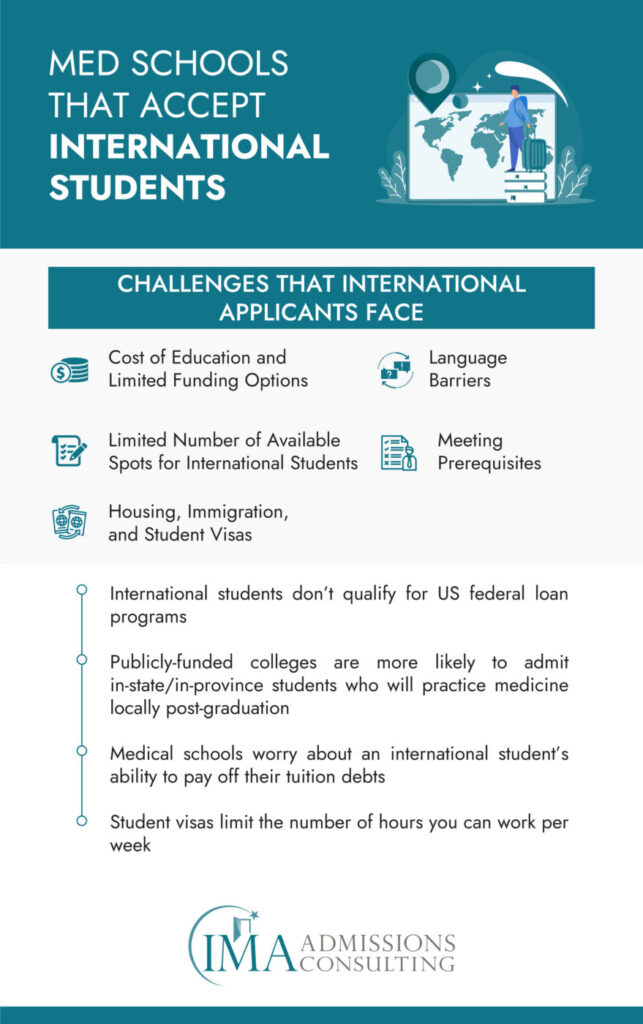
Some of the more common challenges faced by international applicants hoping to attend med school abroad are the cost of education, limited funding opportunities, limited spots available, meeting prerequisites, and language barriers.
One concern for students abroad who are looking to attend med school in the United States or Canada is the language barrier. Studying in another language is difficult enough, let alone trying to incorporate complicated medical terminology and procedures into the mix. These complicated terms add a new layer of difficulty to an already impressive challenge. For this reason, the majority of med schools in English-speaking countries require students that come from countries where English is not the official language to include their TOEFL (Test of English as a Foreign Language) results as part of their application and may even request that students complete one to two years of college in the US or Canada.
However, a student’s proficiency in the English language isn’t the only language barrier they may face. Med schools require letters of reference/recommendation in addition to official transcripts upon application. For international students, this may mean that they need to have their documents officially translated or accredited. This is an additional expense that will come out of the student’s pocket. Not to mention the tremendous amount of paperwork and red tape that is to be expected with international applications. You must make sure that your documents are legible and accepted by the schools you are applying to, applicants also must concern themselves with documentation related to housing, student visas, and immigration. The many potential complications that may arise from international applications are why students who finish their prerequisites at local schools are favored over international applicants.
As previously mentioned, attending medical school is a costly endeavor with average annual costs now exceeding $61,000. This amount can easily double for international students when taking into account the cost of living expenses, airfare, and additional fees imposed by academic institutions. Funding opportunities for international students are limited because:
- International students do not qualify for US federal loan programs
- Publicly-funded schools are more likely to favor and admit in-state/in-province applicants
- Medical schools worry about how/if a student will have the ability to pay off the tuition debt they accrue
Students who are looking to work part-time to help supplement their income and support their studies need to be mindful of the maximum amount of hours their student visas allow them to work each week. For reference, students who want to study in the US are allowed to work a max of twenty hours per week during a school semester as long as the job is on campus or affiliated with the institution.
The biggest challenge faced by hopeful international students is the limited selection of medical schools that accept international students, plus the lower medical school acceptance rates for international students.
According to the AAMC’s matriculation data for McGill University Faculty of Medicine and Health Sciences, McGill recently had a total of 204 students enrolled in their medical school. Of those enrolled in the program, ten were from out of province and one was an international student (out of a total of 88 international applicants). This correlates to an acceptance rate of one percent. Unfortunately for international students, the acceptance rate of international applicants is similar across the board. Per AAMC’s data, Boston University of Medicine had only two international students register for their medical program out of 628 international students who applied. Johns Hopkins had four out of 367 international applicants join their program, and Yale had seven of 431 international applicants join theirs.
It is crucial to ace every step of the application process due to the highly limited number of spots available to international students. You should also know the best time to start your medical school application and seek the help of medical school admissions consulting if you need further help creating a competitive application. Utilizing one-on-one professional guidance during this process can help improve your chances of acceptance and bring you closer to fulfilling your dream of studying medicine abroad. At International Medical Aid, we believe that students can never be too prepared for success. Because of this, we offer a variety of services and resources to help prepare you for medical school, including medical school admission consulting and pre-med shadowing study abroad programs. Our goal is to bridge the gap between a student’s dream and the student’s success and help them get into the medical school of their dreams.
Challenges that International Applicants Face
- Cost of Education and Limited Funding Options
- Language Barriers
- Meeting Prerequisites
- Limited Number of Available Spots for International Students
- Housing, Immigration, and Student Visas
- International students don’t qualify for US federal loan programs
- Publicly-funded colleges are more likely to admit in-state/in-province students who will practice medicine locally post-graduation
- Medical schools worry about an international student’s ability to pay off their tuition debts
- Student visas limit the number of hours you can work per week
The Benefits of Attending Med School as an International Student
The idea of attending medical school as an international student may sound like it’s all doom and gloom, but there are plenty of benefits that come from the experience. One of the biggest and best benefits that comes with attending a medical school in the United States or Canada is the quality of the education you receive. Canada and the US are home to some of the most world-renowned med schools, such as Harvard Medical School, Stanford, Geisel, and McGill University. As of Fall 2026, Ontario medical schools, including the University of Toronto, no longer admit international students; see the school list below. With such an impressive list of medical schools, it is no wonder that students around the world hope to study abroad.
In addition to the high quality of education, some of the best medical facilities are located in North America. The United States and Canada are home to cutting-edge research facilities and medical facilities like Johns Hopkins Hospital and the Mayo Clinic.
Despite the large price tag that comes with receiving an education in the US or Canada, students who graduate from med school can expect to see a great return on their investment. Physicians are among the most respected and well-earning professionals in both Canada and the United States. According to the Medscape Physician Compensation Report 2026, primary care physicians average roughly $298,000 per year, while specialists average about $417,000 per year.
There are other benefits to attending medical school abroad. While studying in another country, you learn to become self-reliant and hone the skill of self-sufficiency. Nothing teaches you how to trust your instincts and provide for yourself like moving to an unfamiliar city or country. You will also be exposed to new cultures, experiences, and people. Additionally, studying medicine in a second language gives you the chance to practice and grow your conversational language skills.
Studying abroad is also a great way for you to impress future employers. Your studies abroad will showcase your independence and resiliency academically and that you are passionate about medicine and willing to go where ambition takes you. Plus, if you come back from studying abroad having learned a new language, this will make you an even more invaluable asset to any care team you are a part of.
Application Tips for International Students
When applying to a medical school as an international student, standing out from the crowd is essential. Here are some tips to consider:
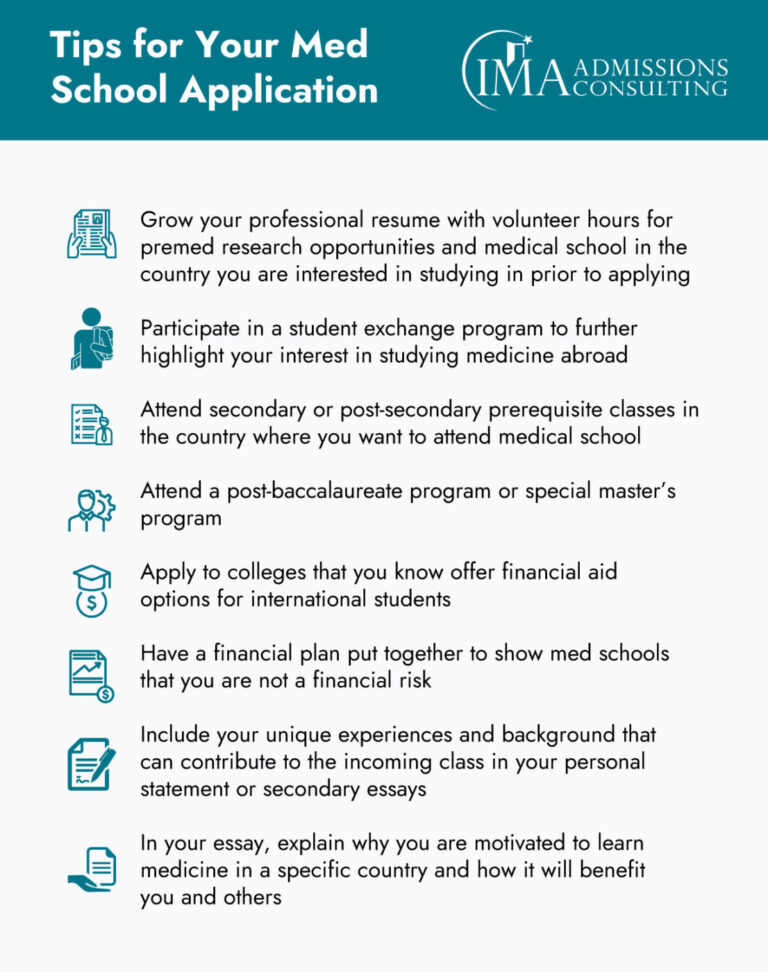
- Grow your professional resume with volunteer hours for premed research opportunities and medical school in the country you are interested in studying in prior to applying
- Participate in a student exchange program to further highlight your interest in studying medicine abroad
- Attend secondary or post-secondary prerequisite classes in the country where you want to attend medical school
- Attend a post-baccalaureate program or special master’s program
- Apply to colleges that you know offer financial aid options for international students
- Have a financial plan put together to show med schools that you are not a financial risk
- Include your unique experiences and background that can contribute to the incoming class in your personal statement or secondary essays
- In your essay, explain why you are motivated to learn medicine in a specific country and how it will benefit you and others
Applying to medical school as an international student may seem like a daunting experience, but it is manageable with the right plan, mindset, and application. If you plan early, conduct your research and due diligence so you know how to choose a med school that accepts international students, pay attention to the med school application timeline, put your best foot forward, and keep true to yourself and your goals, we are confident you will succeed and nothing can stop you.
List of Med Schools that Accept International Students
While there are plenty of excellent medical schools out there, only the following colleges currently accept international students. We want to remind you that this information and list can change from one application cycle to the next, so always check the colleges’ official websites or the MSAR database for admissions info like what is included below.
Important, Ontario policy change: Beginning Fall 2026, Ontario requires its medical schools to reserve at least 95% of seats for Ontario residents and the remaining 5% for other Canadian students. This effectively closes Ontario schools, including the University of Toronto, McMaster, Queen’s, Western, uOttawa, NOSM, and Toronto Metropolitan University, to international applicants. They have been removed from the list below. Always verify each school’s current policy in the AAMC MSAR database before applying.
| Medical School | Median MCAT | Median GPA | Application Deadline |
|---|---|---|---|
| Boston University College of Medicine | 519 | 3.86 | November 1 |
| Case Western Medical School | 518 | 3.86 | November 1 |
| Columbia Medical School | 521 | 3.93 | October 15 |
| Duke University School of Medicine | 519 | 3.90 | October 15 |
| Emory University School of Medicine | 515 | 3.80 | October 15 |
| Faculty of Medicine Universite Lava | N/A | N/A | November 1 |
| Geisel School of Medicine at Dartmouth | 516 | 3.80 | November 1 |
| Georgetown University School of Medicine | 513 | 3.78 | November 4 |
| Harvard Medical School | 520 | 3.95 | October 15 |
| Howard University College of Medicine | 507 | 3.61 | December 15 |
| Icahn School of Medicine at Mount Sinai | 518 | 3.86 | October 3 |
| Johns Hopkins Medical School | 522 | 3.95 | October 15 |
| McGill University | 512 | 3.89 | November 1 |
| Memorial University | 510 | 85% | September 1 |
| Morehouse School of Medicine | 506 | 3.68 | December 1 |
| Northwestern University Feinberg School of Medicine | 520 | 3.92 | November 1 |
| Perelman School of Medicine | 522 | 3.95 | October 15 |
| Renaissance School of Medicine | 516 | 3.86 | December 1 |
| Rutgers New Jersey Medical School (NJMS) | 516 | 3.82 | December 1 |
| Saint Louis University School of Medicine | 515 | 3.91 | November 15 |
| Sidney Kimmel Medical College | 514 | 3.82 | November 15 |
| Stanford Medical School | 518 | 3.89 | October 3 |
| State University of New York | 514 | 3.79 | October 15 |
| Burnett School of Medicine at TCU | 510 | 3.67 | November 15 |
| Brown Medical School | 516 | 3.83 | November 1 |
| Tufts University School Of Medicine | 515 | 3.80 | November 1 |
| Tulane University School of Medicine | 510 | 3.65 | October 15 |
| University of Montreal | N/A | N/A | March 1 |
| UC Davis School of Medicine | 511 | 3.63 | October 1 |
| UCLA Medical School | 516 | 3.81 | September 30 |
| University of Chicago Pritzker School of Medicine | 521 | 3.93 | November 15 |
| University of Colorado School of Medicine | 515 | 3.82 | October 15 |
| UConn School of Medicine | 513 | 3.82 | November 15 |
| John A. Burns School of Medicine | 514 | 3.83 | November 1 |
| University of Illinois College of Medicine | 511 | 3.70 | November 1 |
| University of North Carolina Medical School | 515 | 3.80 | October 1 |
| University of Pittsburgh School of Medicine | 517 | 3.86 | October 15 |
| Frederick P. Whiddon College of Medicine | 510 | 3.83 | November 1 |
| University of Toledo College of Medicine | 511 | 3.76 | November 15 |
| University of Utah School of Medicine | 514 | 3.87 | October 1 |
| University of Virginia School of Medicine | 520 | 3.94 | November 1 |
| Université de Sherbrooke | N/A | N/A | November 1 |
| Vanderbilt University School of Medicine | 521 | 3.95 | November 1 |
| Washington University School of Medicine | 521 | 3.93 | November 30 |
| Wayne State School of Medicine | 513 | 3.81 | December 31 |
| Weill Medical College | 520 | 3.93 | October 17 |
| Yale School of Medicine | 521 | 3.93 | October 15 |
Frequently Asked Questions
How many U.S. medical schools accept international students in 2026?
As of the 2026 to 2027 admissions cycle, 41 out of approximately 160 LCME-accredited MD programs accept applications from international students. An additional 24 osteopathic (DO) campuses also consider international applicants. Combined, fewer than 70 U.S. medical schools welcome foreign applicants, roughly a third of all allopathic and osteopathic programs in the country. Students should verify each school’s current policy through the AAMC’s MSAR database before applying.
What is the acceptance rate for international medical school applicants?
In the 2025 application cycle, 3,404 international applicants applied to U.S. MD programs and 845 were accepted, an overall acceptance rate of roughly 25%. Individual school rates are far lower. In the 2024 to 2025 cycle, the University of Pennsylvania accepted about 2.17% of its international applicants, Harvard accepted 2.01%, and Yale accepted 1.84%. Building a broad application list is strongly recommended.
Can international students still apply to Canadian medical schools?
Options in Canada have narrowed significantly. Beginning Fall 2026, Ontario medical schools reserve at least 95% of seats for Ontario residents and 5% for other Canadians, effectively excluding international applicants. Outside Ontario, a small number of schools, such as McGill University, Memorial University, and Quebec’s francophone programs, still consider limited numbers of international applicants, though acceptance rates hover near 1%. Check each school’s admissions page for current-cycle policies.
How much does medical school cost for international students in 2026?
The average annual cost of U.S. medical school reached $61,110 in the 2025 to 2026 academic year. International students typically pay out-of-state rates at public schools, averaging $63,590 per year, while private school tuition averages $69,558. Over four years, total costs can exceed $400,000 at private institutions. Because international students are ineligible for U.S. federal loans, funding often depends on personal savings, home-country loans, or institutional scholarships.
How does the 2026 federal student loan cap affect medical students?
Starting July 1, 2026, the One Big Beautiful Bill Act caps federal borrowing for professional students at $50,000 per year, with a $200,000 aggregate limit for graduate and professional study and a $257,500 total lifetime limit across all federal student loans (Parent PLUS excluded). It also eliminates the Grad PLUS Loan program for new borrowers. Although international students already lack access to federal loans, these caps could reshape how schools distribute institutional financial aid across all students, including the scholarships many international applicants depend on.
Has the TOEFL scoring system changed for 2026 medical school applications?
Yes. As of January 21, 2026, the TOEFL exam uses a new 1-to-6 band scoring scale (in half-point increments) instead of the previous 0-to-120 total score, aligning with the CEFR framework. During the transition period from 2026 through 2028, score reports display both scales. Most medical programs historically required scores between 100 and 110 on the old scale. Confirm with each school which scoring format it accepts for the current cycle.
If the college I want to attend doesn’t accept international students, can I still apply?
We discourage it. Applying to a medical school that does not accept international applicants wastes time and money that could be better spent applying to schools that do.
Are Canadian students considered international students when applying to U.S. medical schools?
Some U.S. medical schools treat Canadian applicants as out-of-state rather than international. At these Canadian-friendly schools, Canadian students face better odds of admission and pay out-of-state tuition rates rather than international rates.
Do I need to complete prerequisites in the same country where I’m applying to medical school?
Sometimes. Some schools require international applicants to complete one to two years of prerequisite coursework in the state or province where the school is located. Schools without that requirement still expect all prerequisites completed before applying, plus TOEFL results where applicable.
Do I need a student visa and work visa to attend med school as an international student?
You need a student visa to attend medical school abroad, and student visas restrict how many hours you can work while enrolled. If you have not become a citizen or permanent resident by the time you finish your studies, you will need a valid work visa to complete residency.
If federal loans aren’t available to international students, are there any funding options?
Yes. While U.S. federal loans are not accessible to international students, med school scholarships, institutional aid, home-country loan programs, and private bank financing remain available. Some schools also offer need-based institutional aid to admitted international students.
As an international student, will I pay more for medical school?
It varies. At private medical schools, international tuition is generally similar to what other students pay. At public schools, international students typically pay significantly more than in-state or in-province students.
What can I do to improve my chances of being accepted as an international student?
Build your resume with clinical and research experience before applying, bring your unique background and perspective into your personal statement and secondaries, and consider working with an admissions advisor at IMA to ensure your application is as strong as possible.