
CUNY School of Medicine is the medical school of The City University of New York, and it sits in Harlem on the campus of The City College of New York. Its main door for future doctors is a seven-year BS/MD program for high school seniors, offered through the Sophie Davis School of Biomedical Education. Students earn a Bachelor of Science in Biomedical Sciences in three years and then move into the school’s four-year Doctor of Medicine (MD) program, with no MCAT.
That makes CUNY different from almost every other school in our medical school series. You do not apply through AMCAS after college. You apply as a high school senior, through the school’s own online application, with your high school record, three personal essays and five letters of recommendation. For students who want to start in fall 2027, the application is due December 1, 2026.
Like all medical schools, CUNY has its own requirements, guidelines and identity, and understanding them helps you focus your application and put your best foot forward. This guide explains who the program is for, what it requires, what the seven years look like, what they cost, how the essays and interviews work and how to prepare. Every figure carries its year or cohort, and the sources are listed at the end.
Key Takeaways
- Who applies: High school seniors who will graduate by June 30 before fall entry and who have a cumulative average of at least 85 across the first three years of high school. Students with no more than one semester of college can apply as transfers if they hold a 3.5 college GPA and took a lab science that semester.
- No MCAT: CUNY School of Medicine is the only medical school in New York that does not require the MCAT. SAT and ACT scores are optional through Spring 2027, with no penalty for leaving them out.
- What you submit: The school’s own online application, three personal essays (the prompts appear inside the application portal) and five letters of recommendation. Finish every step by December 1, 2026.
- Selectivity: 123 of 1,349 applicants were accepted for the entering Class of 2023, an acceptance rate of 9.1 percent. For the 2025 entering class, 245 applicants were interviewed. The school recruits about 100 high school seniors each year.
- Mission: The review focuses on a demonstrated commitment to primary care and to working where there are not enough health care providers. Service in your own community matters.
- Staying on track: Admission is to a seven-year path, but students must earn their way into the MD years. BS students graduating in 2026-2027 and later need a 3.5 cumulative GPA and a 3.3 science GPA to progress.
- Costs: The three BS years are billed at CUNY senior college tuition ($3,465 per semester for full-time New York residents). MD tuition is $41,600 a year for New York residents and $69,260 for non-residents, and the first MD year’s full cost of attendance is $71,644 or $99,304.
- Outcomes: The MD program earned full LCME accreditation in June 2023. In Match 2026, 98 percent of the 50 graduating students matched, and 60 percent entered primary care fields.
- Interviews and decisions: Interview invitations go out from mid-January. Each invited applicant has three on-campus interviews, and acceptance notices for fall 2027 go out between March 29 and April 1, 2027.
- Next action: Register for the November 19, 2026 open house, line up your five recommenders this week and submit well before December 1.
Key Statistics About CUNY School of Medicine
The snapshot and the table come from the same fact record as every number in this guide. Because applicants come straight from high school, there are no MCAT or college GPA averages to report. The acceptance figure is a true acceptance rate: accepted applicants divided by all applicants, for the entering Class of 2023, which is the newest cohort the school has released. The interview count is for the 2025 entering class and counts interviews, not acceptances. Costs are the school’s current MD-year budget.

| Metric | Value | Year and group | Source |
|---|---|---|---|
| School and degrees | CUNY School of Medicine: BS in Biomedical Sciences (City College) and MD (CUNY School of Medicine) | Sophie Davis School of Biomedical Education, City College campus, Harlem | CUNY SOM BS/MD pathway page |
| Program length | 7 years: 3-year BS, then 4-year MD | Current | CUNY SOM BS/MD Program Overview |
| Applicants and acceptances | 1,349 applicants; 123 accepted | Entering Class of 2023, 7-year BS/MD | CUNY SOM Facts & Figures |
| Acceptance rate | 9.1% | Entering Class of 2023, 7-year BS/MD | CUNY SOM Facts & Figures |
| Applicants interviewed | 245 (213 New York residents, 31 out of state, 1 international) | 2025 entering class, BS/MD high school applicants | AAMC MSAR 2026 |
| First-year MD class | 59 students (58 New York residents, 1 out of state; 39 women, 20 men) | 2025 entering class | AAMC MSAR 2026 |
| Students recruited each year | About 100 high school seniors | 2026 school description | CUNY SOM Match Day 2026 release |
| Minimum high school average | 85, first three years of high school | Fall 2027 application | CUNY SOM BS/MD Requirements |
| SAT or ACT | Optional through Spring 2027; no penalty | Fall 2027 application | CUNY SOM BS/MD Requirements |
| MCAT | Not required at any point | Current | CUNY SOM Greetings from the Dean |
| Median MCAT and GPA | Not reported (high school entry, no MCAT); no MCAT or college GPA medians exist for this program | 2025 entering class data | CUNY SOM admissions pages; AAMC MSAR 2026 |
| Application deadline | December 1, 2026 | Fall 2027 entry | CUNY SOM Admissions page |
| Interviews | Three on-campus interviews (a student, an Admissions Committee member, a faculty member or administrator); invitations from mid-January | 2026-2027 cycle | AAMC MSAR 2026 |
| Acceptance notices and deposit | Notices March 29 to April 1, 2027; reply and $100 nonrefundable deposit (applied to tuition) by May 1, 2027 | Fall 2027 entry | AAMC MSAR 2026 |
| Waitlist | About 45 positions in a typical cycle; waitlist offers by May 15 | Typical cycle | AAMC MSAR 2026 |
| Early decision and secondary fee | No early decision program; no separate secondary fee | 2026-2027 cycle | AAMC MSAR 2026 |
| BS-year tuition | $3,465 per semester (full-time NY resident); $620 per credit (non-resident) | CUNY senior college rates, posted October 2026 | CUNY Tuition and College Costs |
| MD-year tuition | $41,600 resident; $69,260 non-resident, each year | Current MD budget (page updated August 2026) | CUNY SOM BS/MD Tuition |
| First MD year cost of attendance | $71,644 resident; $99,304 non-resident | Current MD budget, M1 | CUNY SOM BS/MD Tuition |
| Students receiving financial aid | 86% | 2024-2025, all students | AAMC MSAR 2026 (LCME Part I-B) |
| Average graduate medical school debt | $218,695 | 2024-2025 graduates | AAMC MSAR 2026 (LCME Part I-B) |
| Accreditation | Full LCME accreditation | Granted June 2023 | CUNY SOM LCME Accreditation page |
| Residency Match | 98% of 50 students matched; 60% into primary care fields | Match 2026, MD Class of 2026 | CUNY SOM Match Day 2026 release |
| Where students live | Queens 26%, Long Island 24%, Brooklyn 14%, Bronx 11%, Manhattan 9%, Upstate 8%, Staten Island 6%, out of state 2% | Entering Class of 2023 panel, 7-year BS/MD | CUNY SOM Facts & Figures |
| First-generation college students | 29% (12% at medical schools nationally) | Fall 2023, students in all years | CUNY SOM Facts & Figures |
| One useful distinction | Only public medical school in Manhattan, and the only New York medical school with no MCAT requirement | Current | CUNY SOM Greetings from the Dean |
Two cautions help you read these numbers. First, 9.1 percent describes the BS/MD program, not City College as a whole and not a typical four-year medical school. Second, an acceptance is not the same as a medical school seat for life. Accepted students still have to complete the BS, meet the progression GPA and pass into the MD years.
If you are also comparing traditional MD programs for later, IMA keeps a table of average GPA and MCAT scores by medical school. Keep in mind that CUNY’s BS/MD route sits outside that comparison, because it uses neither the MCAT nor a college GPA at entry.
Mission and Educational Priorities
The mission of CUNY School of Medicine is to produce “broadly educated, highly skilled, compassionate, empathetic, and culturally competent medical professionals to provide high quality healthcare services to historically underserved communities, with a special emphasis on primary care.” It commits the school to recruiting students “of limited financial resources, and of all backgrounds who have been traditionally underserved and historically underrepresented in the medical profession,” and to research on the diseases that affect its own community. The school describes this as a four-part mission: education, clinical care, research and a social mission.
Why the CUNY School of Medicine?
CUNY School of Medicine has trained physicians for New York for more than 50 years, first as the Sophie Davis School of Biomedical Education and, since 2016, as a full medical school. It shares City College’s original mission of an affordable education for a broad student population, and it describes itself as true to “its legacy of access, opportunity, and community transformation.” Dean Carmen Renée Green, MD, calls it “New York City’s medical school,” producing “the doctors that New York needs, and New Yorkers want to see.” Students learn to see themselves as Healers, Leaders and Scholars, the phrase the school uses for its graduates.
The numbers behind that mission are stark. About 2.1 million New Yorkers, roughly one in four, live in a federally designated Health Professional Shortage Area (HPSA). Fifty-two percent of New York City’s population is Black or Hispanic, while only 16 percent of the city’s physicians are. Nationally, more than 75 percent of medical students come from the highest-income households and only 5 percent from the lowest-income families.
CUNY’s own students look very different from that national picture. In Fall 2023, across all years of the program:
- 59 percent were second-generation immigrants born in the United States
- 58 percent identified as Black or Hispanic
- 86 percent were eligible for need-based financial aid such as New York State TAP or federal Pell grants
- 29 percent were the first in their family to attend college, compared with 12 percent at medical schools nationally
In her welcome message, Dean Green puts it plainly: “representation matters.” The school removed the MCAT as a barrier to entry, built mission-aligned admissions and created the Brothers, M.D. Initiative, part of CUNY’s Black Male Initiative. Its curriculum still draws on the work of founding faculty member Dr. H. Jack Geiger, a pioneer in the study of how social conditions shape health, who helped develop Physicians for Human Rights.
What this means for applicants
- Primary care is the center, not a side note. The “primary focus” of the admissions review is your “demonstrated commitment to primary care practice and to working in areas experiencing provider shortages.” Applicants who want a research-only career or a single narrow specialty should think hard about fit.
- Your neighborhood is part of your application. The school recruits students from the communities it wants to serve, and most students are New Yorkers. Service you have done where you live, such as a food pantry, a tenant association, a church health fair or translating for relatives at clinic visits, speaks directly to this mission.
- Show, do not announce. A sentence saying you care about underserved communities carries little weight on its own. Specific, sustained work over time, and what you learned from it, carries much more.
- Expect to study health beyond the body. Population health, epidemiology and community-oriented primary care start in the first year. If those subjects bore you, the program will feel long.
Accreditation and Institutional Identity
The MD program at CUNY School of Medicine holds full accreditation from the Liaison Committee on Medical Education (LCME), granted in June 2023. The LCME accredits MD programs in the United States and Canada and is sponsored by the Association of American Medical Colleges and the American Medical Association. Full accreditation means the school’s graduates are MD graduates of an accredited US medical school, eligible for the USMLE and the residency Match like graduates of any other LCME school.
The school’s identity has changed over five decades, and the names can be confusing:
- 1973: City College founded the Center for Biomedical Education, an accelerated five-year program. Successful students moved on to partner medical schools for clinical training and their MD degree.
- 1978: The center was renamed the Sophie Davis School of Biomedical Education.
- 2016: Sophie Davis became a full medical school, the CUNY School of Medicine. Students now complete the MD at CUNY instead of transferring.
- Today: The school is an independent college, the 26th in the CUNY system. It is the only public medical school in Manhattan and the first medical school founded in New York City since 1865.
Since the program began, about 2,500 students have graduated from the BS/MD, and 97 percent of them received the MD degree, as the school’s history records. Many older alumni, including some current faculty, earned their MD at partner schools such as SUNY Downstate during the Sophie Davis era.
Two names still describe the same program. “Sophie Davis” is the undergraduate school and the brand of the BS/MD; “CUNY School of Medicine” or “CUNY Medicine” is the medical school. The BS degree is granted by The City College of New York, and the MD degree is conferred by CUNY School of Medicine. The school’s Office of Admissions is in Harris Hall, Room H-101, 160 Convent Avenue, on the City College campus.
The school also runs a Physician Assistant (PA) program, one of the oldest in the country. It is a separate program with its own accreditor, ARC-PA, and it currently holds Accreditation-Probation status. That status applies to the PA program only and does not affect the MD program’s LCME accreditation.
Medical Programs and Affiliations
Before applying, research the different programs offered by the CUNY School of Medicine. Each has its own application, timing and eligibility, and knowing which one fits you will focus your application.
The 7-Year BS/MD Program (Sophie Davis Biomedical Education Program)
This is the main route into the MD and the subject of most of this guide. In the BS/MD pathway, students earn a BS in Biomedical Sciences in an integrated three-year curriculum, then “transition directly into the MD program.” There is no separate medical school application and no MCAT. The program is designed for high-achieving high school graduates who want careers in primary care and in communities with provider shortages.
Because the BS is compressed into three years, the program is more structured than a typical college experience. Students begin with a required summer program right after high school, follow a set course sequence and need approval to take courses outside the prescribed curriculum. The MD years then run four years, for seven in total, one year shorter than the usual four years of college plus four years of medical school.
CUNY’s model is a combined undergraduate and medical degree, similar to the UMKC School of Medicine BA/MD Program in Kansas City. Both admit students out of high school into a single, accelerated track, which is why neither uses the usual AMCAS process for these students.
Master of Professional Studies in Healthcare Sciences (MPS-HS)
The MPS-HS is the school’s newer route for college graduates. It is a postbaccalaureate master’s program in biomedical sciences and public health that begins each fall. Its inaugural students joined the MD Class of 2030 alongside Sophie Davis BS graduates in July 2026.
Under the MPS-HS requirements, applicants need a four-year bachelor’s degree by June of the year they enroll. A 3.5 cumulative GPA and a 3.3 science GPA are considered competitive. Applicants also need a B or better, within five years, in a year each of general biology, general chemistry, organic chemistry and physics (or one semester of medical physics), plus biochemistry and a year of math including calculus. The MCAT and other standardized tests are not required. Applicants submit three letters, one of which must document community or health care service. That last requirement is one reason college students considering this route look for structured patient contact, such as clinical internships for pre-med students, well before they apply.
Applications for the 2026-2027 year are closed, and applications for 2027-2028 open in spring 2027. Tuition for 2026-2027 is $5,545 per semester in state and $855 per credit out of state, plus $155.95 in fees.
Brooklyn College Partnership
The school lists an eight-year BA/BS partnership with Brooklyn College among its programs. It does not publish details about it on its admissions pages, so contact the Office of Admissions if this route interests you.
Physician Assistant Program
The MS in Physician Assistant Studies is a 28-month, full-time program: a 12-month didactic phase, a 4-month research phase and a 12-month clinical phase. It began in 1970 at Harlem Hospital and joined Sophie Davis in 1978. PA applicants apply through CASPA, not the BS/MD portal, with a December 1 verification deadline, and interviews are held in person on campus from late January to mid-March. For the Class of 2024, 31 of 1,416 PA applicants were accepted. As noted above, the PA program is on ARC-PA Accreditation-Probation.
Programs for Younger High School Students
The school runs two pathway programs for high school students who are not yet applying.
- Health Professions Recruitment and Exposure Program (HPREP): For high school sophomores, juniors and seniors. It offers mentorship from medical students and faculty, anatomy lab sessions with cadavers, clinical skills sessions such as blood pressure measurement, problem-based learning and lectures. The 2026 application deadline is Tuesday, November 24, 2026, at 5:00 p.m. Eastern.
- Health Professions Mentorship Program (HPMP): An 18-month program for rising high school juniors, with two four-week summer sessions after sophomore and junior years and monthly Saturday seminars. Its core is a community project in which students study an actual New York City public health problem and propose solutions.
These programs use the same application portal as the BS/MD. The portal warns that the “Start New Application” button is for the BS/MD application only, so HPREP and HPMP applicants must use their own program links.
Clinical Affiliates
The school’s clinical affiliates include NYC Health + Hospitals/Harlem, Saint Barnabas Hospital in the Bronx and Staten Island University Hospital, along with Jacobi/North Central Bronx and Kings County. The 2026 Match list also marks BronxCare Health System, the Institute for Family Health, NYC Health + Hospitals/Jacobi and Kings County, and several Zucker School of Medicine at Northwell Health hospitals (Danbury, North Shore/Long Island Jewish, Putnam, Staten Island University Hospital and South Shore) as affiliates. The school says every student rotates through public hospitals and federally qualified health centers across the city.
Curriculum Overview
The seven years run in two phases: the three-year Sophie Davis BS in Biomedical Sciences (years U1 to U3) and the four-year MD (M1 to M4). Every phase carries the same thread: strong science, taught alongside population health and community medicine.
Before Year One: The Required Summer Pre-Matriculation Program
The BS starts the summer after high school. The six-week Summer Pre-Matriculation Program, held in July and August, is required for every incoming student and includes coursework in biology, chemistry and physics, Learning Success Seminars and mentoring from upper-class peer tutors. Students also tour Harlem Hospital, attend lectures on differences in health outcomes and earn BLS/CPR certification.
Its centerpiece is the Photovoice research project. Student teams, mentored by faculty, design and carry out research on community health problems in New York City and nearby areas, then present posters at a daylong showcase that runs like an academic conference. Past topics have included diabetes and fast-food consumption, redlining and health care affordability, and food deserts. In summer 2026, 18 teams presented on topics such as accessibility in subway stations, food access across the boroughs and neighborhood air quality, and a project on food insecurity in the Bronx won first place. Students can revise their posters for the school’s Student Research Day in November.
The BS Years (U1 to U3)
Each year of the accelerated BS in Biomedical Science has its own focus:
- U1, Introduction to Community-Focused Pre-Medical Training: Biology and general chemistry, a Freshman Inquiry Writing Seminar, Writing for the Sciences and a math placement test (students who place below precalculus take a math course first). Students also take Introduction to Population Health and Community-Oriented Primary Care and a professional foundations course, with attention to narrative medicine and global health.
- U2, Bridging Science and Society: Human genetics, the psychology of health care, epidemiology and biostatistics, and bio-organic chemistry and medical biochemistry. During the summer, students get their first hands-on experience in community settings around New York City.
- U3, Integrating Science, Ethics and Practice: Functional histology and cell biology, physiology, pharmacology, clinical anatomy, the Fundamentals of Organ Systems courses, the US health care system and policy, and biomedical ethics.
The 2026-2027 curriculum map lays out the exact course sequence. MED courses must be taken in the prescribed order and semester, and dropping or postponing one requires written approval from the associate dean.
The BS also requires 21 credits of free electives, at least 2 of them in liberal arts and sciences. Electives can come from City College courses, CUNY e-Permit courses at other campuses, approved AP or IB credit, transfer credit, or up to 8 credits of independent study under CUNY School of Medicine faculty. City College awards AP credit for scores of 3, 4 or 5 in subjects such as Physics, Psychology, English Literature and Composition, US or World History, and Government and Politics. Strong AP scores can free up room in a crowded schedule.
Moving From the BS Into the MD
Admission to the BS/MD does not guarantee the MD years. The school’s Student Academic Progress Committee decides each student’s progression after the spring semester of U3. Under the 2026-2027 progression policy, students graduating from the BS in 2026-2027 and later need a cumulative GPA of 3.5 or higher and a science GPA of 3.3 or higher to enter the MD program. The science GPA draws on named courses, starting with Biological Foundation and General Chemistry. Students who meet the GPA standard but earn a B- or below in two or more of four key courses (Molecules to Cells 1 and 2, and Fundamentals of Organ Systems 1 and 2) must complete a summer course called Bridge to M1 before starting medical school.
This is the most important practical fact about the program for a high school senior. You trade the MCAT and a second round of applications for three years of sustained, high-level grades. Students who thrive in a structured, fast-moving program do well; students who need time to adjust to college should plan for that adjustment from day one.
The MD Years (M1 to M4)
The four MD years are organized this way:
- M1 and M2, pre-clerkship: An integrated curriculum of basic and clinical sciences and population health, taught in large and small groups and through self-directed learning. The organ-system courses cover areas such as musculoskeletal, gastroenterology, cardiovascular, endocrine, pulmonary, renal and reproductive medicine, alongside the Practice of Medicine clinical skills course, Evidence-Based Medicine and Selectives in Population Health. Students learn clinical skills in classrooms and in hospitals and clinics, and the M2 year ends with a study period for USMLE Step 1.
- M3, clerkships: Six core clinical rotations, each six weeks long, in internal medicine, surgery, pediatrics, psychiatry, family medicine and obstetrics and gynecology, at affiliated hospitals and clinics across New York City. Students choose their clerkship order and sites through a lottery.
- M4, advanced clinical practice: Three more core clerkships at affiliated sites, plus electives that can be done at those sites or at health centers across the country, and preparation for residency applications.
The 2026-2027 Step 1 policy requires students to sit for Step 1 by a deadline set in the M2 curriculum. Students who score below a readiness level on a required practice exam (the CBSE) enroll in a support course called Bridge to Clerkship, and students have a maximum of three attempts to pass.
What the School Expects Graduates to Be Able to Do
The school’s educational program objectives apply to both phases and cover seven domains: patient care, medical knowledge, lifelong learning, interpersonal skills and communication, professionalism, systems-based practice, and population health and community-oriented primary care. The last domain is unusual. It asks graduates to use epidemiology and surveillance data, understand how social hierarchies affect care, design and present research and combine clinical care with population-level approaches. Two student milestones mark the journey: the white coat ceremony for entering MD students each July, and the Student Clinician White Coat Ceremony each June that marks the start of third-year clinical training.
Admissions Requirements and Application Process
CUNY School of Medicine has specific academic criteria and admission requirements. The process is short on paper and demanding in practice. Here is what the school asks for and how each piece works.
Who Is Eligible
First-year applicants must meet four BS/MD requirements:
- Be a high school graduate by June 30 before you start the program in the fall.
- Have a minimum cumulative average of 85 across the first three years of high school.
- Submit three personal essays.
- Submit five letters of recommendation.
Confirm the exact graduation date for fall 2027 entry with the Office of Admissions when you apply.
Transfer students who have completed no more than one semester of college-level coursework may also apply. They need a minimum college GPA of 3.5 and must be enrolled in at least one laboratory science course during their first college semester. College credits earned before high school graduation, such as dual-enrollment courses, do not count toward that one-semester limit, but if you want credit for them you must include an official college transcript with your application.
GPA and MCAT Requirements
CUNY School of Medicine does not require the MCAT, and applicants need a minimum average of 85 through the first three years of high school. The MCAT is not required because the BS/MD program combines an undergraduate and a medical degree. Students enter directly from high school, earn their BS and move into the MD years “without taking the MCAT as a barrier to entry.” CUNY is the only medical school in New York that does not require it. For other programs that skip the MCAT, see our comprehensive list.
SAT and ACT scores are optional. Under CUNY policy, submitting scores is optional through Spring 2027, and there is no penalty for leaving them out. If your scores are strong and consistent with your grades, they can add context; if they are not, you can apply on your record, essays and letters.
The 85 is a floor, not a target. The school does not publish the average of admitted students, and with an acceptance rate of 9.1 percent, most admitted students are well above the minimum, especially in science and math.
Required Coursework
The BS/MD admissions pages do not list required high school courses. The program looks for “strong academic performance in high school, especially in science, math, and communication.” A sensible plan, and the one most medical programs expect, is four years of English, biology, chemistry and physics, social sciences and math through at least precalculus, at the most demanding level your school offers. AP or IB science and math courses show you can handle the pace of a three-year BS, and qualifying AP scores can count toward BS electives.
Volunteer and Clinical Experience
CUNY School of Medicine does not set a minimum number of service or volunteer hours. Its mission and its selection qualities make these experiences central anyway: the program seeks students who “show a commitment to community service and interest in primary care.” Adding sustained experiences to your record will make your application more competitive.
What counts, adjusted for a high school applicant:
- Clinical exposure: Volunteering at a hospital, nursing home, clinic or community health fair, shadowing a physician, or structured programs such as HPREP. Some students also join supervised medical internships for high school students, which place students 16 and older (17 at some sites) in hospitals in Kenya and Peru to shadow clinicians, join community health outreach and attend global health lectures.
- Volunteer and community service: Work that shows your involvement in your own community, such as food pantries, tutoring, tenant or neighborhood organizations, religious community programs or caring for family members.
- Research: Not required, but science fairs, summer research programs or community health projects give you material for essays and interviews. Be ready to describe the question, your role and what you found.
- Leadership: Leadership can come from school, work, your community or your place of worship. Starting or running something counts more than holding a title.
- Extracurricular activities and work: List the activities you balance. A part-time job that helps your family is a real commitment and shows how you handle responsibility and stress.
Letters of Recommendation
Being a competitive applicant includes strong letters of recommendation, and CUNY asks for five. Letters should come from people who know you well and can describe your integrity, your interest in medicine, your academic ability, your interpersonal skills and your resilience.
Because applicants are high school students, the usual college advice does not apply. You will not use the AMCAS Letters Service, and you will not have a pre-health advisory committee. You start each letter request inside the online application. Your counselor and recommenders then receive an email with a link and instructions, and they should submit only after that email arrives. Individual letters are accepted. A balanced set of five for a high school senior might include:
- Two teachers from science or math, ideally from junior or senior year
- One teacher from English, history or another writing-heavy subject
- Your school counselor
- A supervisor from your most important service, clinical or work experience
Ask early, in September or October, and give each writer a short summary of your activities and your reasons for choosing CUNY.
Does CUNY School of Medicine Require the CASPer Exam?
No. The current BS/MD requirements list includes no Casper, PREview or other situational judgment test. The school’s application requirements are the high school record, three essays and five letters, with optional SAT or ACT scores.
How to Apply
CUNY School of Medicine has its own admissions process. Applicants do not complete the AMCAS primary application, and there is no AMCAS-style secondary. Instead, you create an account in the school’s online application portal and use the “Start New Application” button, which is for the BS/MD application only. The school’s admissions page links to step-by-step instructions for completing it. If the application carries a fee, the portal shows it when you start. There is no separate secondary application fee and no early decision program.
Plan to submit:
- The online BS/MD application
- Your high school transcript showing at least three years of grades
- Three personal essays
- Five letters of recommendation
- SAT or ACT scores, only if you choose to send them
- An official college transcript, if you are a transfer applicant or want credit for college courses
Complete all application steps early to finish by the December 1 deadline; the sooner your application is complete, the earlier review can begin. The review is holistic and aligned with AAMC standards, considering academic achievement, personal attributes and life experiences.
Holistic Review: What CUNY Looks For
Like many medical programs, CUNY uses holistic review, evaluating your whole application to understand who you are as a candidate and as a person. The qualities the program seeks are specific. The BS/MD seeks students who:
- Show strong high school performance, especially in science, math and communication
- Show maturity, compassion and a deep motivation to become a physician
- Show a commitment to community service and an interest in primary care
- Fit its holistic model, which weighs academic metrics alongside life experiences and personal attributes
The AAMC’s premed competencies, such as service orientation, cultural awareness, teamwork and reliability, are a helpful way to think about which qualities your essays and letters should show.
Technical Standards
All BS/MD students must meet the school’s technical standards for the study and practice of medicine, with or without reasonable accommodations. They cover observation, communication in spoken and written English, motor function for examinations and procedures, intellectual and cognitive abilities, and behavioral and emotional maturity. Students who need accommodations request them through the AccessAbility Center at City College.
Residency, Citizenship and International Applicants
The BS/MD considers out-of-state, Canadian, international and DACA applicants, and non-residents need no particular tie to New York or to the school. Out-of-state students are offered admission, though the program is overwhelmingly New York based: 2 percent of BS/MD students in the latest published panel came from out of state, and 213 of the 245 applicants interviewed for the 2025 entering class were New York residents. MD tuition differs for New York residents and non-residents. The school’s scholarship page links to scholarship lists for DACA and undocumented students. If you are an international, DACA or undocumented applicant, or you live outside New York, ask the Office of Admissions about visas, aid and residency for tuition before you apply.
Timeline for Fall 2027 Entry
| When | What happens |
|---|---|
| Junior year of high school | Build your grades (85 minimum, much higher is typical); deepen service and clinical exposure; consider HPREP or HPMP if you are younger |
| Summer before senior year | Draft essay ideas; decide whether to take the SAT or ACT; plan your five recommenders |
| September to October 2026 | Open your application in the portal; ask recommenders; read the three essay prompts in the portal |
| Thursday, November 19, 2026, 12:00 to 4:00 p.m. | BS/MD open house at Shepard Hall, 160 Convent Avenue (registration required for every attendee; up to two parents or guests per student) |
| November 24, 2026 | HPREP application deadline (for younger high school students, not BS/MD applicants) |
| December 1, 2026 | BS/MD deadline: every application step must be complete |
| From mid-January 2027 | Interview invitations for selected applicants: three on-campus interviews with a student, an Admissions Committee member and a faculty member or administrator |
| March 29 to April 1, 2027 | Acceptance notices sent |
| May 1, 2027 | Reply to your offer and pay the $100 nonrefundable deposit, which is applied to tuition |
| By May 15, 2027 | Waitlisted applicants are notified of any offer |
| By June 30, 2027 | High school graduation; BS/MD orientation on June 30, 2027 |
| July and August 2027 | Required six-week Summer Pre-Matriculation Program, including Photovoice research and BLS/CPR |
| August 27, 2027 | U1 classes begin |
| Spring of U3 (2030) | Progression decision for the MD (3.5 cumulative, 3.3 science GPA) |
| Summer 2030 | M1 begins, followed by the M3 clerkship lottery, M4 electives and the residency Match |
You can register for the open house through the school’s open house registration page.
Tuition, Cost of Attendance and Financial Aid
In addition to tuition and fees, CUNY School of Medicine students should budget for living costs, transportation, books, equipment and exam fees. The seven years are billed in two different ways, so it helps to separate them.
The BS Years
During the three BS years, students pay City College undergraduate tuition. CUNY’s tuition and college costs page lists senior college tuition of $3,465 per semester for full-time New York State residents and $620 per credit for non-residents (rates effective Spring 2023 and still posted in October 2026). College fees, books and living costs are extra, and the school does not publish a separate BS-year budget for the program. Many New York students also qualify for state and federal aid; the school notes that students may receive TAP, Pell and Excelsior awards.
Two undergraduate scholarships are offered for 2026-2027: the Jack and Libby Sonkin Scholarship ($7,000, U1), for a student with financial need and evidence of scholarship and leadership, and the Abraham and Miriam Mazur Endowment Scholarship ($2,200, U2 and U3), for exceptional promise in science.
The MD Years
Here is the current MD-year cost of attendance, updated in August 2026. No academic year is printed with the budget.
| Item | M1 | M2 | M3 | M4 |
|---|---|---|---|---|
| Tuition, New York resident | $41,600 | $41,600 | $41,600 | $41,600 |
| Tuition, non-resident | $69,260 | $69,260 | $69,260 | $69,260 |
| Fees | $2,311 | $311 | $311 | $311 |
| Living expenses | $24,750 | $24,750 | $27,500 | $30,250 |
| Transportation | $1,143 | $1,143 | $1,270 | $1,397 |
| Books and equipment | $1,800 | $1,800 | $1,800 | $1,800 |
| Miscellaneous (mask fit, disability insurance or USMLE exam fees) | $40 | $879 | $735 | $0 |
| Total cost of attendance, resident | $71,644 | $70,483 | $73,216 | $75,358 |
| Total cost of attendance, non-resident | $99,304 | $98,143 | $100,876 | $103,018 |
Adding the four columns of the current budget gives about $290,700 for a New York resident and about $401,300 for a non-resident across the MD years. Actual costs will be higher if tuition or living costs rise. Health insurance does not appear as a line in the table, so ask the financial aid office how coverage is handled. For context on how these figures compare with other schools, see IMA’s breakdown of the total cost of medical school.
Two features keep CUNY affordable relative to most programs. The BS years cost far less than four years at a private college, and the seven-year path removes a year of tuition and living costs. New York residents also pay much less than non-residents for the MD years.
Scholarships and Grants for MD Students
The school’s 2026-2027 scholarships are open to students in the BS/MD program, with applications due in September. Scholarships apply to tuition only, and students who receive full or partial federal or state aid may not receive all scholarship funds, because the school cannot over-award aid. MD awards include:
- Primary Care Award: $20,000 for M4 students applying only to primary care residencies
- Dr. Robert Carras and Irmgard Carras, PhD, Endowed Fund Award: $15,000, M1 to M4, based on economic need and achievement
- Efim and Mila Popovitz Scholarship: $6,000, for third- and fourth-year students with strong academics and financial need
- Sunita Babbar Singh Memorial Scholarship: $5,100, M1 to M4, for female-identifying students with financial need and a commitment to under-resourced communities
- Maestro Cares Award: $4,000, M1, for high-need students committed to community service
- Bernard and Susan Mendik Award: $3,200, M1 and M2, for students with financial need who work during medical school, with preference for students from the Bronx
- 40th Anniversary Biomedical Endowed Fund Scholarship: $2,600, M1 to M3
- Dean’s Humanism Award: $1,000, M1 to M4
In October 2026, the school received a five-year, $3.25 million grant from the federal Health Resources and Services Administration (HRSA) through its Scholarships for Disadvantaged Students program. Each year it will provide about half-tuition support for 28 low-income third- and fourth-year students. In 2024-2025, 86 percent of students received financial aid, and the average medical school debt of graduates was $218,695. Students can also turn to outside sources such as the National Health Service Corps, which offers scholarships and loan repayment for service at NHSC sites, and National Medical Fellowships.
Campus Facilities and Student Life
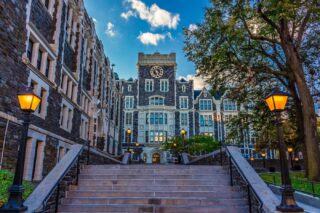
CUNY School of Medicine has called Harlem home since its start as the Sophie Davis School. Students study on the City College campus on Convent Avenue, where the admissions office sits in Harris Hall and events such as the open house take place in Shepard Hall. Match Day 2026 filled the Great Hall with roughly 400 family members, alumni, friends, faculty and staff.
A Commuter School in a Big City
Most students are New Yorkers. In the latest published panel, BS/MD students came from Queens (26 percent), Long Island (24 percent), Brooklyn (14 percent), the Bronx (11 percent), Manhattan (9 percent), upstate New York (8 percent) and Staten Island (6 percent), with 2 percent from out of state. Many students live at home and commute. Many students face real pressures, including housing and food insecurity, long commutes and the need to work while in school. If you are applying from Long Island or Staten Island, map your commute before you commit, and look at the living expense lines in the cost table to plan your budget.
Support and Community
- Learning support: Upper-class peer tutors mentor students from the summer program onward, and the school runs remediation and bridge programs, Bridge to M1 and Bridge to Clerkship, for students who need extra preparation at key points.
- Brothers, M.D. Initiative and the Black Male Initiative: A program that supports Black male students. Two alumni recently wrote about how it fosters academic achievement, mentorship, belonging and mental wellness.
- Gold Humanism Honor Society: In June 2026 the chapter inducted 11 students, 6 residents and 4 faculty members.
- Alumni Association: Led by Akeem Marsh, MD, Sophie Davis Class of 2007, the association connects students with graduates across the city.
- Anatomy and the Cadaver Donor Tribute: BS/MD and PA students together produced a publication and virtual event with artwork, poetry and essays honoring the people who donated their bodies to medical education.
- Accessibility: Accommodations are arranged through City College’s AccessAbility Center.
Service in Harlem and Beyond
Community service is built into student life, not added on. The school’s Community Engagement Core held a summer 2026 health fair in Harlem with preventive screenings and family activities, and runs the Hype Hair series in salons across the city on beauty, health and environmental justice. Students also organize their own efforts. In 2026, two third-year students held a 5K fundraiser on Staten Island for children with cleft lip and palate, and a second-year Sophie Davis student invited entrepreneur Mark Cuban to speak with students about trust, transparency and health care access.
The MD Class of 2030, which received white coats in July 2026, speaks more than 30 languages, and 64 percent are the first in their family to attend medical school. Many students share the backgrounds of the patients they will serve, which shapes conversations in class and on the wards.
Clinical Rotations and Research Opportunities
Clinical Training
Clinical learning starts early. BS students tour Harlem Hospital in the summer program and gain hands-on experience in community settings in the summer of U2. In the M1 and M2 years, students learn clinical skills in hospitals and clinics through the Practice of Medicine course.
In M3, students complete six core clerkships of six weeks each, in internal medicine, surgery, pediatrics, psychiatry, family medicine and obstetrics and gynecology, at affiliated hospitals and clinics across New York City. Order and sites are set by lottery, so expect to travel across boroughs. Named sites include NYC Health + Hospitals/Harlem, Saint Barnabas Hospital in the Bronx, Staten Island University Hospital, Jacobi/North Central Bronx and Kings County. In M4, students complete three more core clerkships and choose electives at affiliated sites or at health centers across the country.
Residency Match 2026
On March 20, 2026, the school’s seventh Match Day, 50 students from the Class of 2026 took part in the National Resident Matching Program. Here are the Match 2026 results:
- 98 percent matched, five points above the national average of 93 percent
- Graduates matched into 15 specialties, and 60 percent entered primary care fields: 15 in internal medicine, 7 in pediatrics, 5 in obstetrics and gynecology and 3 in family medicine
- Other matches included general surgery (4), emergency medicine (3), psychiatry (3), anesthesiology (2), ophthalmology (2), and one each in neurology, neurosurgery, otolaryngology and urology, plus the school’s first matches in interventional radiology and plastic surgery
- Half of the class stayed in New York City and 70 percent in New York State, with others training in New Jersey, Pennsylvania, Connecticut, Massachusetts, New Hampshire, Washington, D.C., and Hawaii
Residency programs on the 2026 list include hospitals tied to several medical schools IMA covers, such as Montefiore Medical Center/Albert Einstein College of Medicine, NewYork-Presbyterian/Weill Cornell, NYU Grossman Long Island School of Medicine, Rutgers New Jersey Medical School, Rutgers Robert Wood Johnson Medical School, Cooper University Hospital/CMSRU, Thomas Jefferson University (Sidney Kimmel Medical College) and UPMC (University of Pittsburgh School of Medicine). Others include SUNY Downstate, Stony Brook, NewYork-Presbyterian/Columbia, Maimonides, Mount Sinai Morningside-West, Children’s National in Washington, D.C., UConn and the University of Hawaii.
Across the three graduating classes after the school became CUNY School of Medicine, 99 percent matched to residency programs.
Research
Research is part of the program from the first summer, when Photovoice teams investigate community health questions. In the MD years, students can join the school’s research enterprise in basic, behavioral, clinical or translational science. The school’s research profile has grown: it received the largest NIH grant in CUNY history and has climbed 20 spots in NIH funding among its peers, and it now leads the Night onCall research consortium of 10 medical schools, which studies ways to prepare students for residency. In fiscal year 2024, the school held $1,153,593 in direct federal research grants and contracts.
Routes for students include:
- Research Selectives: A required population health research course in the curriculum, directed by Nancy Sohler, PhD.
- Independent study: Up to 8 credits during the BS, supervised by CUNY School of Medicine faculty (projects with hospital staff need a CUNY co-sponsor).
- Student Research Day: Held each November, where students present posters, including revised Photovoice projects.
- MD with Honors in Research Track of Distinction: Graduating MD students can earn this recognition through one of three routes, within the Track of Distinction in Research. Track A is a single longitudinal project from M1 to M4 ending in a manuscript submitted for publication. Track B is a set of projects in one health area ending in a capstone at the Spring Research Symposium. Track C is for students who publish at least five peer-reviewed papers and present a poster.
Recent student work shows the range. A third-year student won a Fulbright-Fogarty Fellowship in Public Health for 2026-2027 and is working in Kathmandu, Nepal, on community-based dengue fever prevention with 200 high school students. A Class of 2026 graduate presented orthopedic surgery research at the National Medical Association conference, and a student mentored by a Sophie Davis alumna presented two posters through the Triological Society’s ELEVATE-ENT program.
Notable Alumni, Faculty, Leadership and Admissions Staff
The people below hold current roles at CUNY School of Medicine or are graduates of its programs. Roles are current as of October 2026. Their work tells you a lot about the school’s priorities, but none of them speak for the admissions committee’s decisions.
School Leadership
Carmen Renée Green, MD, Dean and Medical Professor. Dr. Green leads education, research and clinical operations at the school. Before CUNY, she was a tenured professor of anesthesiology, obstetrics and gynecology, and health management and policy at the University of Michigan, where she was also the health system’s inaugural associate vice president and associate dean for health equity and inclusion. Her research on pain and on the social determinants of health and of medical education includes the most cited review in the history of the journal Pain Medicine. She brought narrative medicine and photovoice methods to the Pre-Matriculation Program, so her influence starts in a new student’s first summer. City & State New York named her a 2026 Trailblazer in Higher Education. Her full biography lists her national board and advisory roles.
Linnie Golightly, MD, Provost and Senior Associate Dean of Academic Affairs. Dr. Golightly is the school’s senior academic officer under the dean. Her office oversees the BS and MD curricula, including the academic standards that govern progression from one phase to the next.
Daniel Richter, MD, Associate Dean for Undergraduate Programs and Chief Transformation Officer. Undergraduate programs here means the three-year Sophie Davis BS, the phase every BS/MD student enters first, which makes this office the one most closely tied to a new student’s first three years.
Danielle Pritchett, MD, Associate Dean for Undergraduate Medical Education. In medical school terms, undergraduate medical education is the four-year MD curriculum, from the M1 organ-system courses through the clerkships. All three associate deans sit in the Office of the Provost.
Maria Lima, PhD, Associate Dean for Research and Chief Research Officer. Dr. Lima leads the school’s research enterprise. She won the 2026 grand prize in the MD/DO category of Elsevier’s Raise the Line Faculty Award and facilitated a showcase for early-stage investigators at the 2026 RCMI Consortium conference.
Admissions Staff
The Office of Admissions team includes the following leaders, among others. The office can be reached at 212-650-7718 or [email protected].
Elizabeth Wilson-Anstey, Senior Associate Dean for Opportunity, Engagement and Financial Aid. Her role joins outreach and admissions with financial aid, a natural pairing at a school where most students qualify for need-based aid.
Jerrold Erves, Director of Admissions and Enrichment Programs. His title covers both BS/MD admissions and the HPREP and HPMP programs for younger high school students, so he is a good contact for families with questions about either.
Karl Ramos, MA, Senior Admissions Advisor. Admissions advisers in his unit answer applicant questions about requirements, documents and deadlines.
Allison Smith, BA, MA, Director of Admissions, Postbaccalaureate and Special Pathway Programs. Her office handles routes such as the MPS-HS master’s for college graduates. Students who missed the BS/MD window should know this office exists.
Faculty
Adina Kalet, MD, MPH, Chair of the Department of Medical Education. Dr. Kalet is a 1982 graduate of the Sophie Davis School of Biomedical Education and a national leader in medical education research. Her work covers clinical skills assessment, remediation and professional identity formation, and she co-edited Remediation in Medical Education (second edition, 2024). In 2023 she received both the NBME John P. Hubbard Award and the AAMC Award for Excellence in Medical Education, and in 2026 she delivered a Harvard Medical School medical education grand rounds lecture on remediation. Her presence explains much of the school’s investment in helping students who struggle get back on track.
John Raffalli, MD, Clinical Professor and Chair of the Clinical Medicine Department. Dr. Raffalli directs internal medicine education, overseeing the third-year internal medicine clerkship and the fourth-year sub-internship, and lectures in the Practice of Medicine course. He also interviews undergraduate applicants for the Admissions Committee. He is a 1987 Sophie Davis graduate who earned his MD at SUNY Downstate, trained in internal medicine at NYU/VA and in infectious diseases at Memorial Sloan-Kettering, and practiced primary care and infectious diseases medicine. As a student, he edited the yearbook, newspaper and literary magazine.
Nancy Sohler, PhD, Associate Medical Professor. Dr. Sohler is vice-chair for curriculum in the Department of Community Health and Social Medicine, directs the Research Selectives course and co-directs Epidemiology. She also interviews undergraduate applicants for the Sophie Davis Admissions Committee. Her research with clinicians addresses care for New Yorkers living with HIV, serious psychiatric illness and substance use, and she directs research for the Haiti Medical Education Project. She won Elsevier’s 2026 Raise the Line Faculty Award in the health equity category.
Elizabeth Cohn, RN, PhD, FAAN, Professor of Community Health and Social Medicine. Dr. Cohn’s research builds community engagement into precision medicine and translational science. She chairs the Science Committee of the NIH All of Us Research Program and is the author of the current NIH-CDC-DHHS Principles of Community Engagement. At the school she leads community programs such as Hype Hair, and she administered the White Coat Oath at the June 2026 Student Clinician White Coat Ceremony. In 2026 she was elected vice chair of a National Cancer Institute workgroup on implementation science and community engagement.
Alumni
Akeem Marsh, MD, Sophie Davis Class of 2007. Dr. Marsh is president of the school’s Alumni Association and a Gold Humanism Honor Society member who administered the oath at the 2026 induction. He co-wrote a chapter in the anthology Black College Men’s Mental Health Matters on how the school’s Black Male Initiative supports achievement, mentorship and belonging.
Brian Hodge, MD, MD Class of 2021. Dr. Hodge belongs to one of the first classes to earn the MD at CUNY School of Medicine itself. He co-authored the Black Male Initiative chapter with Dr. Marsh.
Edouard Augustin, MD, MD Class of 2026. Dr. Augustin presented a study on workers’ compensation and prolonged care after carpal tunnel release at the 2026 National Medical Association conference, with a current third-year student as co-author.
Sujana Chandrasekhar, MD, Sophie Davis alumna. Dr. Chandrasekhar is a nationally recognized otolaryngologist and surgeon at ENT and Allergy Associates. In 2026 she mentored a CUNY Medicine student through the Triological Society’s ELEVATE-ENT program.
Drs. Kalet and Raffalli, listed with the faculty above, are also Sophie Davis graduates, a sign of how often alumni return to teach.
Admissions Statistics and Class Profile
Entrance into the CUNY School of Medicine BS/MD is highly competitive. Here is what the school publishes, and how to read it.
Applicants, Acceptances and Class Size
For the entering Class of 2023, the newest cohort the school has released, 1,349 students applied to the 7-year BS/MD program and 123 were accepted, an acceptance rate of 9.1 percent. That is a genuine acceptance rate, because it divides accepted applicants by all applicants. The school says it recruits about 100 high school seniors each year, so not every accepted student enrolls.
For the 2025 entering class, 245 applicants were interviewed: 213 New York residents, 31 from out of state and 1 international applicant. Reaching the interview is a real achievement, and every interviewed applicant is then reviewed by the Admissions Committee.
The 2025 first-year MD class had 59 students: 58 New York residents and 1 from out of state, with 39 women and 20 men. These are students moving from the BS years into M1, not the high school seniors who start U1. There are no MCAT or GPA medians for this program, since students enter from high school without the MCAT.
The school does not publish the average high school average of admitted students or SAT and ACT ranges. Because the program is SAT- and ACT-optional through Spring 2027, a reported test range would describe only the students who chose to submit scores anyway.
For comparison, the PA program accepted 31 of 1,416 applicants for its Class of 2024, about 2.2 percent. PA admissions are a separate process.
Who Enrolls
The school’s latest BS/MD panel reports this mix:
| Measure | Share |
|---|---|
| African American | 39% |
| Hispanic | 22% |
| Asian | 20% |
| White | 19% |
| From Queens | 26% |
| From Long Island | 24% |
| From Brooklyn | 14% |
| From the Bronx | 11% |
| From Manhattan | 9% |
| From upstate New York | 8% |
| From Staten Island | 6% |
| From out of state | 2% |
Across all years in Fall 2023, 59 percent of students were second-generation immigrants, 58 percent identified as Black or Hispanic, 86 percent were eligible for need-based aid and 29 percent were first-generation college students.
Two newer snapshots describe MD classes. The Class of 2026, which graduated in May 2026, is more than 80 percent first-generation American; nearly a fifth were the first in their families to attend college; one in 10 are immigrants; and nearly two-thirds are bilingual or trilingual, speaking 17 languages among them. The MD Class of 2030, which began in July 2026, includes the first MPS-HS graduates; more than a third are first-generation college students, 64 percent are the first in their families to attend medical school and the class speaks more than 30 languages.
What These Numbers Mean for You
The minimum average is 85, but the acceptance rate tells you most admitted students bring far more than the minimum. Because grades are only one part of holistic review, the profile also tells you what else the school values: New York roots, community ties, language skills and experience with the communities its graduates serve. If you meet the academic bar and have that kind of sustained commitment, CUNY is a realistic target, not a long shot reserved for one kind of student. If you have strong grades but little connection to service or primary care, use the months before December to deepen what you already do rather than adding new activities in a rush.
To build clinical experience during the BS years or before a later application, many students look at pre-med internships that place them in hospitals under supervision.
Tips and Strategies for Admission
These strategies come from the school’s stated priorities and from how a seven-year program actually works. They are editorial advice, not knowledge of a private scoring rubric.
1. Treat your grades as a three-year record, not a number
The 85 minimum covers the first three years of high school, so your junior-year grades carry weight when you apply in the fall of senior year. A rising trend, especially in science and math, tells reviewers you can handle the jump to a three-year BS. Because the school also names communication, take writing seriously in English and history.
2. Show commitment to primary care with your actions
A “demonstrated commitment to primary care practice” is the primary focus of the admissions review. At 17, nobody expects you to have chosen a specialty. What you can show is sustained work that puts you close to people’s everyday health: helping at a community health fair, volunteering at a clinic front desk, tutoring children whose families you get to know, translating for relatives. Two or three activities done for years usually say more than ten done for a month.
3. Connect your story to New York’s communities
The school exists to serve communities in New York with too few doctors. If you are from one of those communities, say what you have seen. If you are not, show that you have spent real time listening to people whose lives differ from yours. Either way, be specific about neighborhoods, people and problems rather than general about “the underserved.”
4. Pick your five recommenders as a team
Five letters is a lot for a high school senior, which gives you room to show several sides of yourself. Choose writers who, together, cover your science ability, your writing, your character and your service. Give each one a short summary so they do not all describe the same accomplishment.
5. Plan three distinct essays early
The three essay prompts appear only in the portal, so open your application early and read them in September. Map each one to a different story so the three together show different strengths. More guidance and worked practice examples are in the next section.
6. Prepare for the pace
A three-year BS with a progression GPA of 3.5 overall and 3.3 in science is not a guaranteed route to an MD. The required summer program starts right after high school graduation. In your essays and interview, show that you understand this and have habits that will carry you: how you study, how you ask for help and how you manage work or family responsibilities.
7. Use the school’s own events
Register for the November 19, 2026 open house and bring your questions about progression, commuting and clinical sites. If you are a younger student reading this, HPREP and HPMP let you learn from CUNY medical students and faculty directly. These programs are learning experiences; the school does not describe them as a route to admission.
8. Use your summers well
The summers before and after junior year are your best chance to add depth. Hospital volunteer programs, community health projects, research programs for high school students and part-time work all count. In high school, the right choice is usually a structured, age-appropriate program close to home or abroad. Once you are in college, pre-med summer internships can add supervised, hands-on clinical experience during breaks.
9. Keep a parallel plan
With a 9.1 percent acceptance rate, every applicant should also apply to strong four-year colleges. If you start a traditional pre-med path, you can still reach medical school, including CUNY’s MPS-HS route after college or a standard MD application through AMCAS. IMA’s AMCAS application guide explains that process when you get there. Many students on that path also build experience through internships for pre-med students during college.
10. Ask for feedback before you submit
Ask a teacher, counselor or mentor to read your essays for clarity, not to rewrite them. Read every essay aloud once. Submit well before December 1 so that a late letter or a portal problem does not cost you a complete file.
Secondary Application Questions, Example Responses and Analysis

CUNY’s BS/MD has no AMCAS secondary application. Its essays are part of the school’s own application: every applicant submits three personal essays. The prompts and any length limits appear only inside the application portal and are not published on the school’s website, so open your application early and read all three before you start writing. Write to the limit shown in the portal for each essay.
In your essays you can express your character, your motivations and your goals. This is your chance to show what makes you a strong fit for the CUNY School of Medicine program.
How to Approach the Three Essays
- Read each prompt closely and answer every part of it. Many prompts ask two or three things at once. Underline each question and check that your draft answers all of them.
- Give each essay its own job. Use three different stories, so the committee meets three different sides of you: why medicine, how you serve, how you handle difficulty, or whatever the prompts ask.
- Use concrete evidence. Support each claim with something you did, saw or decided. Reviewers remember a single specific moment longer than a list of traits.
- Connect to CUNY specifically, when the prompt allows. Mention what you actually know about the program: the three-year BS, the population health courses in U1, the Photovoice research, clinical training in public hospitals, the focus on primary care.
- Write like yourself. You are a high school senior, and the committee knows it. Clear, honest writing in your own voice is better than vocabulary borrowed from a thesaurus.
- Edit hard. Cut filler, repetition and sentences that do not move the essay forward. Then proofread twice, once on screen and once aloud.
- Get feedback, not ghostwriting. A teacher or counselor can tell you where an essay is unclear. The words and the experiences must be yours.
Practice Examples
Because CUNY does not publish its essay prompts, the examples below answer plain practice questions. They are not CUNY’s wording and are not predictions of the portal prompts. Use them to see how a strong essay is built, then apply the same approach to the actual prompts. Each example runs about 350 to 400 words; your real essays must follow the limits shown in the portal.
Practice Question 1: Why Medicine, and Why New York’s Communities
Practice question (not CUNY’s wording): Why do you want to become a physician serving New York’s communities?
What it practices: Motivation for medicine, connection to a community and understanding of primary care, the three themes the school names most often.
Approach: Start with one real scene, show what you learned from it, connect it to the kind of doctor you want to be and end with why this program fits that goal.
Illustrative example, not an actual applicant essay
Every third Saturday, my grandmother and I take the bus to her clinic in Corona. She speaks Spanish and a little English. Her doctor speaks English and a little Spanish. Since I was twelve, I have been the bridge between them.
At first I translated words. Over time I started translating worries. When the doctor said her blood pressure was “a little high,” my grandmother heard that she was about to have a stroke. When my grandmother said she was “taking the pills,” she meant she took them on days she felt dizzy.
The doctor I admire most is the one who noticed that gap. Dr. M. put down her clipboard and asked me to ask my grandmother what a normal day looked like. It turned out my grandmother skipped breakfast to save money, so the medication upset her stomach, so she stopped taking it. One conversation solved a problem that three prescriptions had not.
That is the kind of physician I want to be: one who has time to ask the second question and knows a neighborhood well enough to know which questions matter. In my part of Queens, many families wait weeks for an appointment, and many adults I know only see a doctor in an emergency. I want to practice primary care in a place like Corona, where a doctor who understands the language, the bus routes and the price of groceries can change how a whole family manages illness.
Since tenth grade I have volunteered at a weekend food pantry run by my church. I now help run the sign-in table and keep track of which families need low-sodium items. The pantry taught me that health problems show up in a family’s kitchen long before they show up in a clinic.
The seven-year BS/MD program fits what I already know about myself. I want to start learning population health and community-oriented primary care in my first year, not four years from now, and I want my clinical training to happen in public hospitals that serve families like mine. I know the pace will be demanding. I also know why I would keep going: so that someday another grandmother can tell her doctor exactly how she is doing and be understood.
Analysis: The essay answers both halves of the question. “Why medicine” comes through a specific scene in which a physician’s question changed a patient’s care, and “why New York’s communities” comes through a named neighborhood, real barriers (language, cost, appointment waits) and a clear interest in primary care. The food pantry paragraph adds sustained service and shows that the writer understands health outside the clinic, which matches the school’s population health focus. The closing paragraph names verified features of the program, the U1 population health course and training in public hospitals, without flattery, and acknowledges the program’s pace. Throughout, the writer shows growth: from translating words to understanding worries.
Mistakes to avoid:
- Opening with a definition of medicine or a famous quote instead of your own experience
- Writing about “the underserved” in general without naming a place, a person or a problem
- Making the doctor or the grandmother the hero and leaving out what you did and learned
- Praising CUNY with general phrases (“prestigious,” “world-class”) instead of naming specific features
- Promising a specialty you know little about; showing interest in primary care is enough
Practice Question 2: Service and What It Taught You
Practice question (not CUNY’s wording): Describe a time you served your community. What did it teach you about health?
What it practices: Commitment to community service, reflection and an understanding of the social conditions that shape health, which runs through the school’s whole curriculum.
Approach: Describe the service briefly, focus on one person or moment that changed your thinking, explain what you did in response and say what you now understand that you did not before.
Illustrative example, not an actual applicant essay
For two years, I have tutored fourth graders three afternoons a week at an after-school program in Mott Haven, a few blocks from my building. Most of my work is reading and fractions. One student taught me the most important lesson I have learned there, and it had nothing to do with either.
Jaylen was one of my brightest students, but he missed about one session in three. I assumed he was losing interest, so I started bringing word games to keep him engaged. Then his mother picked him up early one day and apologized for his absences. Jaylen has asthma, she told me, and their apartment had a leak that kept coming back, with mold behind the bathroom wall. On bad weeks he was too tired after a night of coughing to come.
I had been trying to fix his attention. The problem was his air.
I could not repair a building. What I could do was smaller. With the program director’s permission, I spent a month gathering information: the city’s 311 process for reporting mold, tenant rights groups in the South Bronx, and a list of nearby clinics with asthma education programs. I put it on a one-page sheet in English and Spanish, and the director now gives it to every new family. I also started sending Jaylen home with the week’s worksheets so he could keep up on bad days. By spring, his reading level had caught up with his class.
Before Jaylen, I thought of health as something that happened in a doctor’s office. Now I know that a child’s grades can depend on the walls of his apartment, and that a doctor treating his asthma without asking about his home is treating half the problem.
That is why the Photovoice research in CUNY’s summer program excites me. I want to study the kind of question Jaylen’s mother answered for me, how neighborhood conditions like air quality affect health, with faculty who can teach me to measure it. I want to become a physician who asks about home, school and work as naturally as about symptoms.
Analysis: The essay describes service that is sustained (two years, three afternoons a week) and local, which fits the school’s mission. Its strength is the turn in the middle: the writer admits a wrong assumption, learns the real cause and responds with action that is realistic for a high school student. The reflection names a specific insight about health, that housing conditions shape illness, which is the core idea of the school’s population health curriculum. The final paragraph connects to a verified part of the program, the Photovoice research, and to a real 2026 Photovoice topic area (neighborhood air quality) without claiming any insider knowledge. Results are modest and believable.
Mistakes to avoid:
- Listing hours and tasks without a moment of learning
- Presenting yourself as rescuing people or solving a problem far beyond your role
- Sharing a child’s or family’s private details without changing names or removing identifying information
- Ending with a general statement (“I learned that service is important”) instead of a specific insight
- Turning a service essay into a second “why medicine” essay; keep the focus on what the service taught you
Practice Question 3: A Challenge and How It Prepared You
Practice question (not CUNY’s wording): Tell us about a challenge you have faced and how it prepared you for a demanding academic program.
What it practices: Maturity, resilience and readiness for an accelerated program with a progression GPA, which the school tests through its structure.
Approach: Describe the challenge honestly and briefly, spend most of the essay on what you did about it and end by connecting the habits you built to the program’s demands.
Illustrative example, not an actual applicant essay
In the fall of my junior year, my father hurt his back and could not work at our family’s laundromat on Staten Island for four months. My mother could not run it alone, so I started working there from 3:30 to 8:00 every weekday and all day Saturday. I folded laundry, handled the register and fixed whatever machine had jammed.
My grades held up in most classes. Chemistry was different. I got a 68 on my first unit test, my lowest grade ever, and finished the first quarter with a 76. I was doing my homework at the folding table between customers, and it showed.
At first I was embarrassed and tried to handle it alone by staying up later. That made it worse. In November, I made three changes. I asked my chemistry teacher if I could come to her room during lunch twice a week, which she agreed to. I started a study group with two classmates on Sunday mornings, when the laundromat was quiet and my uncle could cover. And I made a written weekly schedule that blocked out work, school and sleep, so I could see where my time actually went.
By the end of the year, I had a 91 in chemistry. More important, I learned that asking for help early is a skill, not a weakness. My teacher later told me that most students who come to lunch help are the ones who do not need it. I want to be one of the ones who goes before it is too late.
I know CUNY’s program moves fast. The BS is three years instead of four, and I will need strong grades every semester to move into the MD. I do not expect it to be easy. But I have already learned how to manage a heavy load: plan the week, protect sleep, use office hours and lean on classmates. I am also glad the program pairs students with peer tutors from the first summer, because I now know how much a good study partner can change a semester.
My father is back at work, and I still help on Saturdays. The laundromat taught me responsibility. Chemistry taught me how to recover.
Analysis: The essay names a real challenge and a real weakness (a 68 and a 76) without excuses or self-pity, then spends most of its length on specific actions: lunch help, a study group and a written schedule. The improvement is measurable and believable. The writer draws a usable lesson, asking for help early, and applies it directly to verified program features: the three-year BS, the progression GPA and peer tutoring in the summer program. That shows the committee the applicant understands the program’s demands, which matters for an accelerated track. Family responsibility appears as context and as evidence of maturity, not as the whole story.
Mistakes to avoid:
- Choosing a “challenge” that is really a strength in disguise, such as working too hard
- Spending most of the essay on the problem and very little on what you did
- Blaming teachers, schools or family for setbacks
- Sharing traumatic details you are not comfortable discussing in an interview; choose a story you can talk about calmly
- Leaving out the connection to the program; the point is to show you are ready for it
Other Fields in the Application
Beyond the essays, you will fill in factual sections such as your activities, honors and work history. Treat them as part of the same story. Describe each activity with what you did and for how long, not just a title. For example, “Food pantry volunteer, St. Leo’s, 10th to 12th grade, about 4 hours a week: run the sign-in table, track dietary needs for 60 families” tells a reviewer far more than “Volunteer.”
If you are applying to traditional MD programs later, IMA’s database of medical school secondary essay prompts covers the AMCAS secondary process, which works differently from CUNY’s BS/MD application.
Interview Format and Preparation
What Is Confirmed
Invited applicants have three interviews: one with a current student, one with a member of the Admissions Committee and one with a faculty member or administrator. All three take place face to face on campus, and the full session lasts about three hours. There are no regional or video interviews. Invitations go out beginning in mid-January, and the Admissions Committee reviews every interviewed applicant before offers go out between March 29 and April 1. For the 2025 entering class, 245 applicants were interviewed.
Faculty members interview undergraduate applicants for the Sophie Davis Admissions Committee. Among them are Dr. Raffalli, chair of the Clinical Medicine Department, and Dr. Sohler, vice-chair for curriculum in Community Health and Social Medicine. Watch your email and the application portal after you submit, and reply quickly to any invitation.
After the interview, do not send a letter of intent or update letter: the school does not accept them. Put everything you want the committee to know into your application and your interview.
The PA program’s in-person interview schedule from late January to mid-March applies to PA applicants only. Do not plan your BS/MD calendar around it.
What to Expect in General
Medical program interviews for high school students usually focus on motivation, maturity and fit. Based on the school’s stated priorities, prepare to talk about:
- Why medicine, and why now. Why you want to commit to medicine at 17 or 18, and how you know.
- Why CUNY and a seven-year program. What you know about the three-year BS, the population health focus and the progression standards.
- Primary care and community. What draws you to primary care and to communities with too few doctors, with examples from your own life.
- Your activities. Expect follow-up questions about anything in your application. Be ready to describe what you did, what went wrong and what you learned.
- Readiness for the pace. How you study, manage your time and ask for help.
- Ethical and personal questions. A scenario about honesty, confidentiality or treating a patient whose views differ from yours, answered with clear reasoning.
How to Prepare
- Reread your application. Your interviewer may have read every word of it. Know your essays and activities well enough to expand on any of them.
- Practice out loud. Ask a teacher, counselor or family member to run mock interviews using common medical school interview questions. Many questions for BS/MD applicants are simpler versions of those.
- Prepare two or three questions of your own. Good ones show you have done your homework: how students prepare for the progression GPA, what the M3 clerkship lottery is like or how students balance commuting and study. Keep a question ready for the student interviewer too, since one of your three interviews is with a current student.
- Plan logistics. Interviews are on campus, so plan the trip to 160 Convent Avenue, arrive early and set aside about three hours. Bring water and a snack, and pace yourself across three conversations. If an invitation ever lists an online option, test your camera, sound and internet connection, and choose a quiet, well-lit space.
- Dress simply and professionally. Neat, comfortable clothes are fine; you do not need a new suit.
- Be yourself. Interviewers meet many polished applicants. Honest, specific answers and real curiosity stand out more than rehearsed speeches.
If you would like structured practice, IMA’s medical school admissions consulting team offers mock interviews and feedback. No adviser can promise an outcome.
Frequently Asked Questions
Does CUNY School of Medicine require the MCAT?
No. CUNY School of Medicine is the only medical school in New York that does not require the MCAT. BS/MD students earn their BS in three years and move into the MD program without taking it. They still have to meet the progression standards: a 3.5 cumulative GPA and a 3.3 science GPA for students graduating the BS in 2026-2027 and later. Students will take the USMLE licensing exams during medical school, like all MD students.
What is the CUNY School of Medicine acceptance rate?
For the entering Class of 2023, the BS/MD program accepted 123 of 1,349 applicants, an acceptance rate of 9.1 percent. For the 2025 entering class, 245 applicants were interviewed. The 9.1 percent figure is the newest acceptance rate the school has published, and it applies only to the seven-year BS/MD. City College’s overall admission rate and the PA program’s rate (31 of 1,416 for the Class of 2024) are different numbers. Because the school recruits about 100 students a year, not every accepted student enrolls.
Does CUNY School of Medicine require the CASPer exam?
No. The current BS/MD requirements are a high school graduation date, a minimum 85 average across the first three years of high school, three personal essays and five letters of recommendation, with SAT and ACT scores optional. No Casper, PREview or other situational judgment test is on the list. If that changes, the requirements page and the application portal will show it, so check both when you apply.
Why choose the CUNY School of Medicine?
Choose CUNY if you are sure about medicine, want to serve New York’s communities and want an affordable, accelerated path. The program saves a year, removes the MCAT and a second round of applications, charges CUNY undergraduate tuition for the BS years and trains students in public hospitals and health centers across the city. In Match 2026, 98 percent of the Class of 2026 matched, and 60 percent entered primary care fields. The trade-off is a fast, structured program with GPA standards you must meet to stay on track.
What high school average do I need to apply?
You need a minimum cumulative average of 85 across the first three years of high school. That is the eligibility floor. Admitted students usually stand well above it, given the 9.1 percent acceptance rate, especially in science and math. The school weighs grades alongside your essays, letters, service and personal qualities, so a strong 90 with deep community involvement can compete well. If your school uses a 4.0 scale, check with your counselor or the Office of Admissions about how your grades will be read.
Are SAT or ACT scores required?
No. Under CUNY policy, SAT and ACT scores are optional through Spring 2027, and there is no penalty for leaving them out. Send scores if they are strong and support your grades. If they are weaker than your transcript, you can apply without them and let your record, essays and letters carry your application.
When is the CUNY BS/MD application deadline?
Every application step must be complete by December 1, 2026, for fall 2027 entry. That includes your essays and all five letters. The school says the sooner your application is complete, the sooner it can begin reviewing it, so aim to submit in November and use the remaining weeks to make sure your letters arrive. The BS/MD open house on November 19, 2026, is a good final check for your questions.
How many essays and letters do I need?
You need three personal essays and five letters of recommendation. The essay prompts appear only inside the application portal, so open your application early and read them. For letters, plan on a mix of science and math teachers, a humanities teacher, your counselor and a supervisor from your most important service or work experience. Follow the letter instructions in the portal; the AMCAS Letters Service is not used.
Do BS/MD students automatically move into the MD program?
No. Students must meet the progression standards, decided after the spring of the third BS year. Students graduating from the BS in 2026-2027 and later need a cumulative GPA of at least 3.5 and a science GPA of at least 3.3. Students who meet the GPA but earn a B- or below in two or more of four key courses must complete a summer Bridge to M1 course first. Treat every semester as part of your medical school application.
How much does CUNY School of Medicine cost?
During the BS years, students pay CUNY senior college tuition, $3,465 per semester for full-time New York residents. In the MD years, tuition is $41,600 a year for residents and $69,260 for non-residents. The full first-year MD cost of attendance, including fees, living expenses, transportation and books, is $71,644 for residents and $99,304 for non-residents. Scholarships, state and federal aid and a new federal grant for low-income third- and fourth-year students can reduce what families pay.
Can I apply to CUNY School of Medicine after college?
Not to the BS/MD. It admits high school seniors and transfer students with no more than one semester of college. College graduates can look at the school’s Master of Professional Studies in Healthcare Sciences (MPS-HS), a postbaccalaureate master’s whose first students joined the MD Class of 2030. Applications for 2027-2028 open in spring 2027, and the MCAT is not required. Requirements include a bachelor’s degree and the standard premedical science courses with grades of B or better.
What if I am not admitted to the BS/MD?
Many future doctors take the traditional route: four years of college, then medical school. You can still become a physician, apply to CUNY’s MPS-HS after college or apply to MD programs nationwide through AMCAS. Use college to build strong grades and real clinical experience. Some students also take a structured year between college and medical school through pre-med gap year programs that add supervised patient contact before applying.
Can out-of-state or international students apply?
Yes. The BS/MD considers out-of-state, Canadian, international and DACA applicants, and out-of-state students are offered admission. Most students are New Yorkers, though: the latest published panel shows 2 percent of BS/MD students came from out of state, and 213 of 245 applicants interviewed for the 2025 entering class were New York residents. MD tuition is higher for non-residents ($69,260 versus $41,600 a year). If you are an international, DACA or undocumented student, or you live outside New York, contact the Office of Admissions at 212-650-7718 or [email protected] before you apply to ask about visas, aid and tuition residency.
Is the Sophie Davis program the same as CUNY School of Medicine?
They are two parts of one program. The Sophie Davis School of Biomedical Education, founded in 1973 and named in 1978, runs the three-year BS. In 2016, Sophie Davis became a full medical school, the CUNY School of Medicine, so students now complete the MD there instead of transferring to partner schools. The BS is granted by City College, and the MD is conferred by CUNY School of Medicine.
Is CUNY School of Medicine accredited?
Yes. The MD program received full accreditation from the Liaison Committee on Medical Education (LCME) in June 2023. Graduates earn an MD from an accredited US medical school and enter the residency Match like graduates of any LCME-accredited school. The school’s separate PA program has its own accreditor, ARC-PA, and is currently on Accreditation-Probation; that status does not apply to the MD.
Where do CUNY medical students do clinical rotations?
Third-year students rotate through six core clerkships of six weeks each at affiliated hospitals and clinics across New York City, with order and sites chosen by lottery. Sites include NYC Health + Hospitals/Harlem, Saint Barnabas Hospital in the Bronx, Staten Island University Hospital, Jacobi/North Central Bronx and Kings County. Every student rotates through public hospitals and federally qualified health centers. Fourth-year electives can be taken at affiliated sites or at health centers across the country.
How can a high school student get clinical experience?
Start close to home: hospital and nursing home volunteer programs, community health fairs, shadowing a family doctor, or CUNY’s own HPREP and HPMP programs if you are younger. Check the minimum age for hospital volunteer programs near you, since most set one. Keep a simple log of dates, hours and what you did, because you will need it for your application. During college, students who want hands-on roles often look for medical internships for undergraduates, where interns work under supervision with patients.
Does CUNY School of Medicine have a PA program?
Yes. The school offers a 28-month MS in Physician Assistant Studies, one of the oldest PA programs in the country, founded at Harlem Hospital. Applicants apply through CASPA with a December 1 verification deadline, separate from the BS/MD application. The program is currently on ARC-PA Accreditation-Probation, and for the Class of 2024 it accepted 31 of 1,416 applicants.
What is the CUNY BS/MD interview like?
Invited applicants have three interviews in one on-campus session of about three hours: one with a current student, one with a member of the Admissions Committee and one with a faculty member or administrator. Invitations go out beginning in mid-January, and there are no regional or video interviews. For the 2025 entering class, 245 applicants were interviewed. Prepare to talk about why you want medicine, why a seven-year program and why primary care and New York’s communities matter to you.
When does CUNY send BS/MD decisions?
For fall 2027 entry, acceptance notices go out between March 29 and April 1, 2027. Accepted students have until May 1, 2027 to respond and pay a $100 deposit, which is not refundable and is applied to tuition. The waitlist typically holds about 45 applicants, and waitlisted students hear about any offer by May 15.
Does CUNY School of Medicine offer early decision?
No. There is no early decision program for the BS/MD, and there is no separate secondary application fee. Every applicant works toward the same December 1, 2026 deadline. The school does not accept letters of intent or update letters, so make your application complete when you submit it.
How much debt do CUNY medical graduates have?
The average medical school debt of graduates was $218,695 in 2024-2025, and 86 percent of students received financial aid that year. Low BS-year tuition at CUNY rates and the seven-year timeline help keep total borrowing down. Scholarships for MD students and the federal grant for low-income third- and fourth-year students can lower it further.
Where did CUNY graduates match in 2026?
Half of the Class of 2026 stayed in New York City and 70 percent in New York State. Residency programs include Montefiore/Einstein, NewYork-Presbyterian/Columbia and Weill Cornell, NYU Grossman Long Island, SUNY Downstate, Stony Brook, Maimonides, Mount Sinai Morningside-West, Rutgers New Jersey Medical School and Robert Wood Johnson, Children’s National, UPMC, UConn and the University of Hawaii, along with the school’s affiliates.
Related Medical School Guides
If you are considering CUNY, these guides cover other New York MD programs worth comparing. Each relationship is about geography or applicant considerations, not a claim of equal selectivity. For the full picture, start with IMA’s guide to medical schools in New York.
- SUNY Downstate Medical School: Brooklyn’s public medical school, where many Sophie Davis students once completed their MD, and a 2026 residency destination for CUNY graduates.
- Hofstra Zucker School of Medicine: A Long Island MD program whose Northwell Health hospitals, including Staten Island University Hospital, serve as CUNY clinical affiliates.
- Columbia Vagelos College of Physicians and Surgeons: Columbia’s medical school sits a short distance north in Upper Manhattan, and NewYork-Presbyterian/Columbia took CUNY graduates in Match 2026; compare a traditional research-heavy MD with CUNY’s primary care focus.
- Renaissance School of Medicine at Stony Brook University: A SUNY public MD on Long Island, home to about a quarter of CUNY’s BS/MD students, for applicants who want a public option after a four-year degree.
- Jacobs School of Medicine at the University at Buffalo: Another SUNY public medical school, useful for New York residents comparing public tuition outside the city.
- Albany Medical College: A private upstate MD program, for students weighing a traditional application route in New York’s capital region.
More IMA Medical School Guides
We have definitive guides for most medical schools. Whether you want to compare medical schools near you or check out guides for schools in other states, here are more to explore.
New York: NYIT College of Osteopathic Medicine, TOURO College of Osteopathic Medicine, Norton College of Medicine at Upstate Medical University, University of Rochester Medical School, Icahn School of Medicine at Mount Sinai, New York Medical College, NYU Medical School.
New Jersey and Pennsylvania: Rowan University School of Osteopathic Medicine, Hackensack Meridian School of Medicine (HMSOM), Lake Erie College of Osteopathic Medicine (in Pennsylvania), Drexel University College of Medicine, Perelman School of Medicine.
Ohio: Ohio University Heritage College of Osteopathic Medicine, Northeast Ohio Medical University (NEOMED), University of Cincinnati College of Medicine, University of Toledo College of Medicine, Wright State University Boonshoft School of Medicine, Ohio State University College of Medicine, Case Western Medical School.
Missouri and Kansas City: A.T. Still University Kirksville College of Osteopathic Medicine, Saint Louis University School of Medicine, University of Missouri Medical School, Kansas City University (KCU), Washington University School of Medicine.
Mid-Atlantic and South: VCU School of Medicine, University of Maryland School of Medicine, Johns Hopkins School of Medicine, George Washington University School of Medicine, Georgetown University School of Medicine, University of North Carolina Medical School, Wake Forest University School of Medicine, Vanderbilt University School of Medicine, Emory University School of Medicine, University of Florida Medical School.
New England and the Midwest: Harvard Medical School, Boston University College of Medicine, Yale School of Medicine, Brown Medical School, University of Wisconsin Medical School, Stritch School of Medicine at Loyola University Chicago.
California: California University of Science and Medicine, UC San Diego Medical School, California Northstate University College of Medicine, Touro University of California, CHSU College of Osteopathic Medicine, UC Davis School of Medicine, UC Riverside School of Medicine, USC Keck School of Medicine, UCLA Medical School, Western University of Health Sciences (in California).
Texas: UT Southwestern Medical School, Long School of Medicine at UT Health San Antonio, University of the Incarnate Word School of Osteopathic Medicine, UT Austin’s Dell Medical School, UTMB School of Medicine, McGovern Medical School at UT Health, The University of Texas Rio Grande Valley School of Medicine, UNT Texas College of Osteopathic Medicine, University of Houston College of Medicine, Texas A&M College of Medicine, Baylor College of Medicine.
Caribbean: St. George’s University School of Medicine.
How International Medical Aid Can Help
At International Medical Aid (IMA), we want aspiring medical professionals to succeed. We can help in two ways. Neither is affiliated with CUNY School of Medicine, and neither affects how the school reviews an application.
Clinical Internships Abroad
IMA runs pre-med internships abroad in Kenya and at other international sites. Interns work in hospitals and clinics alongside local medical staff, taking vitals, doing patient intake and triage, and helping with direct patient care under supervision. These programs are intensive and patient-facing. They serve communities with limited access to care, and interns practice communicating across language and cultural differences, the same skills CUNY asks of physicians serving New York’s neighborhoods. IMA also offers pre-health internships for students heading toward other health professions, and you can compare every program in IMA’s list of healthcare internships abroad.
For high school students, IMA’s high school program is a separate, age-appropriate option in which students shadow clinicians in hospitals, as described under Volunteer and Clinical Experience. College students, including CUNY BS students thinking about a future break or students on a four-year pre-med path, can learn more about medical internships abroad on IMA’s main site.
The value for a CUNY applicant is in what you do with the experience. CUNY’s essays and interview reward specific reflection on how people’s lives shape their health. Describe your responsibilities accurately, and focus on what you learned.
Admissions Consulting
Many students find medical school applications overwhelming, and every program has its own process. IMA’s medical school admissions consulting offers one-on-one help with application strategy, essays and interview practice, with personalized feedback that highlights your strengths. For CUNY, that can mean feedback on whether your three essays tell three distinct stories and whether each answers every part of its prompt. Advisers help you sharpen your own ideas and words; they cannot promise admission.
Next step: Schedule a free consultation with IMA, or contact us with questions about our programs or guides.
Final Thoughts and Sources
CUNY School of Medicine offers something rare: a seven-year, MCAT-free, publicly priced path from high school to an LCME-accredited MD, built around primary care and New York’s communities. The price of that path is a fast, structured BS with GPA standards you must meet to continue. If the mission fits you, take your time, be strategic and do not hesitate to ask for help. Register for the November 19 open house, read the three essay prompts in the portal, give your five recommenders plenty of time and submit well before December 1, 2026. We wish you good luck as you work through the application process.
Source notes
School sources were checked on October 17, 2026, and the MSAR profile on October 18, 2026. Cohort and year labels appear with each figure in the text.
- CUNY School of Medicine, BS/MD Requirements (modified August 24, 2026): https://medicine.cuny.edu/admissions/bs-md-requirements/
- CUNY School of Medicine, Admissions (modified September 21, 2026; December 1 deadline, review focus, staff): https://medicine.cuny.edu/admissions/
- CUNY School of Medicine, BS/MD: A Pathway to a Medical Degree: https://medicine.cuny.edu/admissions/bs-md-a-pathway-to-a-medical-degree/
- CUNY School of Medicine, BS/MD Program Overview: https://medicine.cuny.edu/education/education-bs-md-program-overview/
- CUNY School of Medicine, BS/MD Standards (technical standards): https://medicine.cuny.edu/admissions/bs-md-program/
- CUNY School of Medicine, BS Program (electives, AP and transfer credit): https://medicine.cuny.edu/admissions/bs-program/
- CUNY School of Medicine, Facts and Figures (acceptance rate and student profile, entering Class of 2023; student snapshot Fall 2023): https://medicine.cuny.edu/about/facts-figures/
- CUNY School of Medicine, BS/MD Tuition (current MD-year cost of attendance, modified August 21, 2026): https://medicine.cuny.edu/admissions/bs-md-tuition/
- CUNY, Tuition and College Costs (senior college undergraduate tuition): https://www.cuny.edu/financial-aid/tuition-and-college-costs/
- CUNY School of Medicine, Scholarships (2026-2027): https://medicine.cuny.edu/financial-aid/scholarships/
- CUNY School of Medicine, HRSA Scholarships for Disadvantaged Students grant release (October 2026): https://medicine.cuny.edu/cuny-school-of-medicine-receives-3-25-million-federal-grant-to-expand-primary-care-pipeline/
- CUNY School of Medicine, Match Day 2026 release (March 20, 2026): https://medicine.cuny.edu/cuny-school-of-medicine-celebrates-outstanding-match-day-2026/
- CUNY School of Medicine, LCME Accreditation: https://medicine.cuny.edu/education/lcme-accreditation/
- CUNY School of Medicine, Mission and Vision: https://medicine.cuny.edu/about/mission-and-vision/
- CUNY School of Medicine, School History: https://medicine.cuny.edu/about/school-history/
- CUNY School of Medicine, Greetings from the Dean and Meet the Dean: https://medicine.cuny.edu/about/greetings-from-the-dean/ and https://medicine.cuny.edu/about/meet-the-dean/
- CUNY School of Medicine, Accelerated BS in Biomedical Science, MD Degree, MD Program and Educational Program Objectives: https://medicine.cuny.edu/education/accelerated-bs-in-biomedical-science/, https://medicine.cuny.edu/education/md-degree/, https://medicine.cuny.edu/admissions/md-program/ and https://medicine.cuny.edu/education/educational-program-objectives/
- CUNY School of Medicine 2026-2027 Student Handbook: Progression into the MD program, Bridge to M1, Step 1 policies and Curriculum Map: https://med.catalog.cuny.edu/studenthandbook/bsprograminto/progression, https://med.catalog.cuny.edu/studenthandbook/bsmdpolicies/bridgetom1, https://med.catalog.cuny.edu/studenthandbook/mdprogram/step1 and https://med.catalog.cuny.edu/studenthandbook/curriculummap
- CUNY School of Medicine, Pre-Matriculation Program: https://medicine.cuny.edu/students/pre-matriculation-program/
- CUNY School of Medicine, Track of Distinction in Research: https://medicine.cuny.edu/research/student-research/track-of-distinction-in-research/
- CUNY School of Medicine, Clinical Affiliates: https://medicine.cuny.edu/clinical-affiliates/
- CUNY School of Medicine, MPS-HS Requirements and Tuition: https://medicine.cuny.edu/admissions/mps-hs-program/mps-hs-requirements/ and https://medicine.cuny.edu/admissions/mps-hs-program/mps-hs-tuition/
- CUNY School of Medicine, Enrichment Programs (HPREP and HPMP): https://medicine.cuny.edu/admissions/enrichment-programs/
- CUNY School of Medicine, PA program FAQ and requirements: https://medicine.cuny.edu/admissions/frequently-asked-questions/ and https://medicine.cuny.edu/admissions/admission-requirements/
- CUNY School of Medicine, Office of Admissions and Office of the Provost staff lists: https://medicine.cuny.edu/about/office-of-admissions/ and https://medicine.cuny.edu/about/office-of-the-provost/
- CUNY School of Medicine faculty profiles: Adina Kalet, John Raffalli, Nancy Sohler and Elizabeth Cohn: https://medicine.cuny.edu/staff/adina-kalet-md-phd/, https://medicine.cuny.edu/staff/john-raffalli-md/, https://medicine.cuny.edu/staff/nancy-sohler-phd/ and https://medicine.cuny.edu/staff/elizabeth-cohn-phd-2/
- CUNY School of Medicine newsletters: March 2026, June 2026 and Summer 2026: https://medicine.cuny.edu/march-newsletter/, https://medicine.cuny.edu/june-2026-newsletter/ and https://medicine.cuny.edu/summer-2026-newsletter/
- CUNY School of Medicine application portal and 2026 BS/MD open house registration: https://apply.medicine.cuny.edu/apply/ and https://apply.medicine.cuny.edu/register/?id=f95b93b1-0257-4b00-bc2f-4cb8c3e6c926
- AAMC, premed competencies: https://students-residents.aamc.org/anatomy-applicant/premed-competencies-resources
- AAMC Medical School Admission Requirements (MSAR), CUNY School of Medicine profile, 2026 edition (2025 entering class data; interviews, first-year class, interview format, decision dates, deposit, waitlist, applicant eligibility, aid and debt), accessed October 18, 2026: https://mec.aamc.org/msar-ui/#/medSchoolDetails/834/overview (subscription required)
See more of our guides in your Google results: add International Medical Aid as a preferred source on Google.