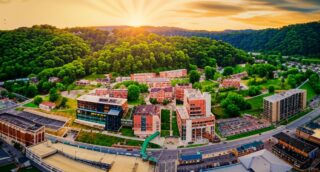

The Kentucky College of Osteopathic Medicine (KYCOM), part of the University of Pikeville (UPIKE), is a private, nonprofit osteopathic medical school in the mountains of Pikeville, Kentucky. It opened in 1997 to train primary care physicians for rural Eastern Kentucky, and it still measures itself by that promise. Seventy percent of its graduates practice a primary care specialty, and its more than 2,200 alumni practice across the country.
KYCOM grants the Doctor of Osteopathic Medicine (DO) degree on a single campus. Every class learns in the nine-story Coal Building in downtown Pikeville, then spreads out to community clinical sites in Kentucky and surrounding states for the third and fourth years. The school welcomed 171 first-year students into the Class of 2030 in September 2026, a larger class than in recent years.
This guide covers the 2026-2027 application cycle, for students who plan to start medical school in July 2027. It explains KYCOM’s mission and what it means for your application, accreditation, programs, the 2026-2027 curriculum, admission requirements and deadlines, 2026-2027 tuition and cost of attendance, campus life in Pikeville, clinical rotations and research, the people who lead and teach at the school, class statistics, the current secondary questions with full example answers, the interview and a long list of applicant questions. Figures were checked on October 29, 2026.
Purpose of This Guide
This guide gives prospective applicants a clear roadmap to KYCOM. It explains the school’s mission, programs, admission requirements, curriculum and student life, and it lays out practical strategies to strengthen your application at each step, from AACOMAS to the interview.
Topics Covered in This Guide
You will find the key numbers first, then the school’s mission and accreditation, its programs and curriculum, the admissions process with a timeline, costs and financial aid, facilities and student life, clinical training and research, notable people, class statistics, strategies for admission, the secondary application, the interview, frequently asked questions, related schools and support for building clinical experience.
Key Takeaways
- Who it is for: KYCOM gives preference to qualified Kentucky applicants and recruits students from Kentucky, Appalachia, the neighboring region and other rural and underserved areas. It accepts U.S. citizens and permanent residents; it does not accept international applicants or consider DACA recipients.
- Academic context: The school profile lists a mean MCAT of 498.6 and an average cumulative GPA of 3.51 for matriculants. These are averages, not cutoffs. Required courses must be completed with a C or better.
- Mission: KYCOM exists to produce primary care physicians for rural Kentucky and other Appalachian regions. Your application should show that you understand rural, underserved care and osteopathic medicine.
- Key dates: AACOMAS opened May 4, 2026. The KYCOM AACOMAS deadline is February 1, 2027, and the supplemental application and complete file are due March 1, 2027. Review is rolling, and interviews begin as early as summer.
- Secondary: The 2026-2027 secondary asks whether you have applied before and asks you to describe your experience with osteopathic medicine, including care from a DO and DO shadowing hours. The fee is $75.
- Costs: Tuition is $59,750 for 2026-2027 for every student. The first-year cost of attendance, including living costs and health insurance, is $94,168.
- Distinctive training: All students receive diagnostic equipment, an iPad and required textbooks, and KYCOM pays first-attempt fees for COMLEX Level 1 and Level 2-CE. A required Rural Medicine selective places fourth-year students in communities of fewer than 5,000 people.
- Next action: Shadow a DO now, log your hours, and submit AACOMAS early in the cycle so your secondary and interview come early in KYCOM’s rolling process.
Key Statistics About Kentucky College of Osteopathic Medicine
The snapshot below collects the numbers applicants ask about first. Mean MCAT and GPA come from KYCOM’s current admissions profile, which does not name the entering class it describes. Class size is from the Class of 2030 White Coat Ceremony in September 2026. Tuition and cost of attendance are for the 2026-2027 academic year, and residency placement is for the 2026 Match.

What Are KYCOM’s Average MCAT and GPA?
KYCOM’s Choose DO admissions profile lists a mean MCAT of 498.6 and an average cumulative undergraduate GPA of 3.51 for matriculants. KYCOM does not publish a minimum MCAT or GPA, and it reviews files on mission, MCAT, total GPA, science GPA, volunteer work, health care experience and shadowing hours. A mean is not a floor: many students in a class scored below it, and students with numbers above it are not guaranteed a seat.
Read these figures against KYCOM’s mission. The school states that it considers “the degree of difficulty of the program at which the applicant studied,” so a 3.5 in a rigorous science major reads differently from the same GPA in lighter coursework. A clear record of clinical and service work in rural or underserved settings, plus real exposure to osteopathic medicine, carries weight here. You can compare KYCOM with other schools in our list of medical school GPA and MCAT averages.
| Metric | Value | Year or cohort | Source and definition |
|---|---|---|---|
| School and degree | University of Pikeville – Kentucky College of Osteopathic Medicine (KYCOM); Doctor of Osteopathic Medicine (DO); Pikeville, Kentucky | Current | KYCOM; private, nonprofit; founded 1997 |
| Mean MCAT | 498.6 | Cohort not stated | AACOM Choose DO Explorer, KYCOM profile (2026-2027 cycle), “Mean MCAT Score” |
| Average cumulative GPA | 3.51 | Cohort not stated | AACOM Choose DO Explorer, KYCOM profile, “Avg. Cum. Undergrad GPA Score” |
| First-year class | 171 students | Class of 2030, entered 2026 | UPIKE news, White Coat Ceremony, September 28, 2026 |
| First-year class (prior year) | 145 students | Class of 2029, entered 2025 | UPIKE news, Class of 2029 White Coat Ceremony |
| First-year matriculants with residency split | 133 (57 in-state, 76 out-of-state; 60 male, 73 female) | 2024-2025 academic year | AACOM Choose DO Explorer, Student Demographics |
| Total DO enrollment | 581 (305 male, 271 female, 5 other) | 2024-2025 academic year | AACOM Choose DO Explorer, Student Demographics |
| Applicants, interviews, acceptances | Not published | Not applicable | KYCOM and Choose DO publish no applicant or offer counts |
| Acceptance rate | Not published | Not applicable | No verified acceptance rate exists for KYCOM |
| Minimum MCAT or GPA | None stated | 2026-2027 cycle | KYCOM Application and Selection; MCAT scores valid three years (2026-2027 catalog); no MCAT waiver |
| Tuition | $59,750 per year, residents and nonresidents | 2026-2027 academic year | UPIKE Cost of Attendance, KYCOM Direct Cost 26-27; KYCOM Catalog 2026-2027 |
| Health insurance | $5,660 per year (removable with proof of other coverage) | 2026-2027 academic year | UPIKE Cost of Attendance, KYCOM Direct Cost 26-27 |
| Cost of attendance, off campus | $94,168 (years 1, 2 and 3 each); $97,120 (year 4) | 2026-2027 academic year | UPIKE Cost of Attendance, 2026-2027 COA KYCOM Off Campus |
| Acceptance deposit | $1,000, nonrefundable, applied to tuition | 2026-2027 cycle | KYCOM Application and Selection; AACOM Choose DO Explorer |
| Mean graduate medical school debt | $163,164 (92% of graduates borrowed) | 2024 graduates | KYCOM Debt Load page |
| Residency placement | 100% (141 of 141 seeking first-time GME) | 2026 Match | KYCOM Residency Placements, Table 1 |
| COMLEX Level 1 first-time pass rate | 92.65% | 2024-2025 | KYCOM Outcomes (2025-2026 figure of 93.13% in progress) |
| Graduates practicing primary care | 70% | Current school statement | KYCOM home page; KYCOM Catalog 2026-2027 |
| Primary application service and deadline | AACOMAS; February 1, 2027 | 2026-2027 cycle | AACOM Choose DO Explorer |
| Supplemental application deadline and fee | March 1, 2027; $75, waiver for AACOMAS fee waiver recipients | 2026-2027 cycle | AACOM Choose DO Explorer; KYCOM Catalog 2026-2027 |
| Interview | One or two faculty members; virtual or in person | 2026-2027 catalog | KYCOM Catalog 2026-2027, Admission Interviews |
| Campus setting | Rural; closest city Lexington, Kentucky | Current | AACOM Choose DO Explorer |
Student Demographics
The table below shows KYCOM’s self-reported student race and ethnicity for the 2024-2025 academic year and the majors of first-year matriculants. It is the newest breakdown the school reports.
| Category | Percentage |
|---|---|
| White | 61.7% |
| Asian | 20.3% |
| Black or African American | 7.5% |
| Multiple races | 4.5% |
| Hispanic or Latino | 3.0% |
| Undisclosed | 2.3% |
| American Indian or Alaska Native | 0% |
| Native Hawaiian or Pacific Islander | 0% |
| Science majors (first-year matriculants) | 81.2% |
| Non-science majors (first-year matriculants) | 18.8% |
| Graduate degrees (first-year matriculants) | 9.0% |
About one in five first-year matriculants majored outside the sciences, so a humanities, social science or business major does not rule you out, as long as you complete the required science courses with strong grades.
Mission and Educational Priorities
Mission Statement
KYCOM’s mission is “to provide students with an osteopathic medical education that emphasizes primary care, encourages research, promotes lifelong scholarly activity and produces graduates who are committed to serving the healthcare needs of communities in rural Kentucky and other Appalachian regions.”
That mission is rooted in the physician shortage in rural Appalachia, a region with long-standing gaps in access to care. KYCOM’s founding dean, John A. Strosnider, D.O., described the school’s commitment to “providing the Appalachian region with highly trained, competent, confident and patient-friendly primary care osteopathic physicians.” The goals that guide the school follow from that promise: recruit students from Kentucky, Appalachia, the neighboring region and other rural and underserved areas; recruit students with a strong desire to practice patient-centered care in medically underserved communities; develop clinical education sites in rural and underserved Kentucky and Appalachia; and prepare graduates to succeed in residency.
The school’s focus on primary care (family medicine, internal medicine, pediatrics and women’s health) matches the needs of communities where access to care is limited. By training osteopathic physicians who treat the whole person, KYCOM prepares graduates to care for patients whose health is shaped by distance, income and work.
Historical Context
In September 1993, Chad Perry, an attorney from Paintsville, Kentucky, and his wife Judy Perry conceived the idea of an osteopathic medical school in Eastern Kentucky. They and other supporters believed an osteopathic school was the best way to ease the shortage of primary care physicians in the region, because osteopathic physicians, in Mr. Perry’s words, “tend to stay in rural areas and in family practice.”
The Pikeville College School of Osteopathic Medicine enrolled its first class of 60 students in 1997. The class grew to 75 in 2008. In 2011, Pikeville College became the University of Pikeville and the medical school became the Kentucky College of Osteopathic Medicine. The Commission on Osteopathic College Accreditation approved an entering class of 135 beginning with the class that entered July 30, 2012, the same year KYCOM moved into the newly built Coal Building. Today the founding dean’s line, “train physicians in the mountains so they will stay in the mountains,” still sums up the school’s purpose.
Osteopathic Philosophy
As an osteopathic medical school, KYCOM teaches a whole-person approach to health care. Osteopathic physicians are fully licensed to practice medicine, perform surgery and prescribe medications in all 50 states, and their training adds osteopathic manipulative treatment (OMT), hands-on techniques that aim to restore the body’s structure so it can function in a natural and healthy way. DOs make up about 10 percent of physicians nationally but care for more than 18 percent of the U.S. population, many of them in underserved areas. That philosophy fits rural patients, who often face complex problems shaped by work, distance and income.
Impact on Appalachia
KYCOM’s graduates have made a measurable mark on Kentucky and neighboring states. The school reports that 70 percent of its graduates practice a primary care specialty and about 40 percent practice within Appalachia, many in federally designated Health Professional Shortage Areas. In U.S. News and World Report’s 2026 medical school rankings, KYCOM placed No. 6 in the nation for graduates practicing in rural areas and No. 7 for graduates practicing in primary care, among both MD and DO schools, and it was placed in Tier 2 for primary care.
Students also serve the region while they train. The BEAR Healthcare Clinic, established in 2024 through KYCOM, is the first student-run free clinic in Eastern Kentucky, and the KYCOM Community OMT Clinic offers free osteopathic treatment to campus and community members.
Alignment with Global Health Values
KYCOM’s dedication to underserved populations mirrors a commitment to health equity that reaches beyond any one region. Students who want to see how resource-limited care works in practice can build that understanding through medical internships abroad, where pre-health students work alongside clinical teams in underserved communities. Experience like that gives you concrete patient stories to bring to your KYCOM application, though it never replaces exposure to osteopathic medicine and to care in rural America.
Looking Forward
KYCOM is growing. The Class of 2030 entered with 171 students, up from 145 in the Class of 2029, and a $400,000 Appalachian Regional Commission grant awarded in April 2026 is expanding and modernizing the simulation lab to support the school’s plans for a larger class. Applicants should see KYCOM as a chance to join a long record of service in osteopathic medicine, in a program that is adding capacity while keeping its rural focus.
What the Mission Means for Your Application
KYCOM’s admissions criteria translate the mission into four things the committee rates: academic excellence, commitment to osteopathic primary care, commitment to practice medicine in an underserved area and personal characteristics. In practice, that means:
- Show you understand rural or underserved care from the inside: work, volunteering or family ties that put you near patients who travel far or go without.
- Show real contact with osteopathic medicine. The secondary asks for DO shadowing hours and care you received from a DO, so build that record before you apply.
- If you are from Kentucky, Appalachia or a nearby rural area, say so clearly. KYCOM gives preference to qualified Kentucky applicants and recruits from the region.
- If you are not from the region, explain honestly why primary care in places like Eastern Kentucky fits your goals. Specific experience matters more than enthusiasm.
Accreditation and Institutional Identity
COCA Accreditation
KYCOM is accredited by the Commission on Osteopathic College Accreditation (COCA) of the American Osteopathic Association. COCA is the only agency recognized by the U.S. Department of Education to accredit predoctoral osteopathic medical education in the United States. COCA’s standards cover mission and governance, facilities and resources, faculty, admissions, curriculum, student performance and research. KYCOM also publishes a process for students, faculty or staff to report possible noncompliance with accreditation standards, with protection from retaliation.
Accreditation matters for you in a practical way: graduates of a COCA-accredited school are eligible to sit for the Comprehensive Osteopathic Medical Licensing Examination (COMLEX-USA), the licensing exam series for osteopathic physicians, and to enter accredited residency programs. KYCOM requires students to pass COMLEX Level 1 and Level 2-CE to graduate, and graduates take Level 3 during residency. If you want a refresher on the degree itself, see our explainer on what DO means after a doctor’s name.
Regional Accreditation
The University of Pikeville, KYCOM’s parent institution, is accredited by the Southern Association of Colleges and Schools Commission on Colleges (SACSCOC) to award associate, baccalaureate, master’s and professional (DO) degrees. UPIKE was founded in 1889 as a small Presbyterian college. Today it also houses the Kentucky College of Optometry, the Tanner College of Dental Medicine, the Elliott School of Nursing and other professional programs, which matters for the interprofessional work at the BEAR Healthcare Clinic.
Affiliations and Partnerships
KYCOM trains students at community-based clinical sites within Kentucky and in surrounding states and beyond, many in rural and underserved areas, including federally designated Health Professional Shortage Areas. The school also has partnerships with the region’s health care system for clinical research, and UPIKE-KYCOM is newly accredited by the Accreditation Council for Graduate Medical Education (ACGME) as a Sponsoring Institution for residency programs, an effort to grow training positions that keep graduates in the region.
Every KYCOM student receives membership in the American Osteopathic Association, the Student Osteopathic Medical Association (SOMA) and the Kentucky Osteopathic Medical Association as part of the KYCOM Advantage, which connects students to professional meetings, research presentations and the wider osteopathic community.
Why Accreditation Matters for Applicants
Choosing an accredited school means your education meets national standards and leads to licensure and residency. COCA and SACSCOC accreditation tell you that KYCOM’s degree is portable: KYCOM graduates match into residencies across the country, as the school’s placement lists show. Accreditation is a baseline, not a guarantee of fit. Your decision should rest on whether KYCOM’s mission, location and training model suit you. If you are building the experience that a mission like KYCOM’s rewards, healthcare internships abroad are one way to see care delivered with limited resources.
Institutional Identity at a Glance
- Full name: University of Pikeville – Kentucky College of Osteopathic Medicine (UP-KYCOM). Former name: Pikeville College School of Osteopathic Medicine (PCSOM), changed in 2011.
- Campus: One campus, Pikeville, Kentucky. Address: 147 Sycamore Street, Pikeville, KY 41501. Classes are held in the Coal Building.
- Leadership: Joe Kingery, D.O., Vice President for Health Affairs and Dean, a 2006 graduate of the school, has led KYCOM since July 1, 2021.
- Recent changes: larger entering classes (171 in 2026), the BEAR Healthcare Clinic (2024), ACGME Sponsoring Institution status and a 12-month online Master of Biomedical Science program.
Medical Programs and Affiliations
Osteopathic Medicine (DO) Program
KYCOM offers one professional degree: the four-year Doctor of Osteopathic Medicine. Its focus is primary care in rural and underserved settings, but students are free to pursue any specialty, and the school’s 2026 Match list runs from family medicine and internal medicine to anesthesiology, radiology, urology and orthopaedic surgery. KYCOM does not list DO/MBA, DO/MPH or DO/PhD dual degrees.
The program integrates biomedical science, clinical skills, osteopathic principles and practice, and community engagement. Years one and two take place in Pikeville; years three and four take place at clinical sites. Graduation requires completing the degree within six calendar years, passing COMLEX Level 1, Level 2-CE and a Capstone, being at least 21 years old and attending commencement in person.
The KYCOM Advantage
KYCOM’s founding dean wanted every student to start on a level playing field, regardless of financial resources. The KYCOM Advantage provides every student with:
- An OPP (osteopathic principles and practice) treatment table
- A white coat and scrubs
- Diagnostic equipment, such as a stethoscope and ophthalmoscope
- An iPad and all required textbooks in electronic format
- Membership in the AOA, SOMA and the Kentucky Osteopathic Medical Association
- Payment of first-attempt fees for COMLEX-USA Level 1 and Level 2-CE
- A COMLEX Level 1 preparation program and practice question banks for Level 1 and Level 2-CE
For applicants comparing costs, these items are real savings. Many schools leave board fees, question banks and equipment to the student.
Osteopathic Medical Scholars Program (OMSP)
UPIKE and KYCOM offer an eight-year (4+4) program that leads to a bachelor’s degree at UPIKE and a DO at KYCOM. Up to 10 scholars are selected each year. To be eligible, applicants must be:
- Residents of Kentucky, Virginia or West Virginia, and U.S. citizens or permanent residents
- Holders of a minimum 1200 SAT or 26 ACT
- In the top 10 percent of their high school class or holding a 3.5 GPA on a 4.0 scale
Scholars who finish the bachelor’s degree with a 3.4 cumulative and science GPA, score at least 498 on the MCAT, take full part in program activities and show proper ethical conduct are admitted to KYCOM without the usual interview, though they still apply through AACOMAS. The program accepts traditional students (high school seniors), transitional students already at UPIKE with four or more semesters left, and transfer students. Applications are due March 1, preference goes to Kentucky residents, and the application asks for a 300-to-400-word autobiographical essay and three letters. High school students thinking about this route can also build early experience through medical internships for high school students.
Professional Education Preparation Program (PEPP)
PEPP, created by the 1980 Kentucky General Assembly, brings 25 to 30 Kentucky high school students to Pikeville each summer for a one-week residential program. Participants attend lectures and anatomy lab sessions, volunteer at the local hospital and learn how medicine works in a rural setting. Students entering 12th grade are accepted first, then students entering 11th grade, and participants must be 16 to shadow at Pikeville Medical Center.
Master of Biomedical Science
UPIKE offers a 12-month, fully online Master of Biomedical Science through KYCOM. The curriculum mirrors foundational medical science, with advanced anatomy, biochemistry and physiology, research and biostatistics, applied genetics and electives. The program is optional and does not guarantee admission to the College of Osteopathic Medicine. It is an option for applicants who need to prove they can handle medical-level science after a weaker undergraduate record.
Predoctoral OPP and Anatomy Fellowship
KYCOM offers a 12-month predoctoral teaching fellowship in Osteopathic Principles and Practice and Anatomy. Fellows extend their program to five years, teach in the anatomy and OPP labs, tutor first- and second-year students, see patients in the KYCOM OMT clinic under supervision, and are encouraged to join research. Selection happens in the second year. Fellows receive a stipend and a tuition waiver for the fellowship year. Four students are selected from each class.
Clinical Affiliations
Third-year core rotations take place at KYCOM clinical sites within Kentucky and at sites in surrounding states and beyond. The school calls its core rotation hub sites “community-based” and notes that they may change yearly. Students choose sites in the second year through an application and lottery process, with a hardship application for students who need a specific location. Pikeville Medical Center, a regional hospital near campus, is part of the local health care landscape, and KYCOM partners with the region’s health care system on clinical research.
Separate Applications and Eligibility
| Program | How you apply | Who is eligible |
|---|---|---|
| DO program | AACOMAS, then KYCOM supplemental by invitation | U.S. citizens and permanent residents with a bachelor’s degree and prerequisites |
| OMSP (4+4) | UPIKE OMSP application by March 1 (high school senior, transitional or transfer) | Kentucky, Virginia or West Virginia residents meeting test and GPA thresholds |
| PEPP | Annual PEPP application | Kentucky high school students entering grades 11 or 12 |
| Master of Biomedical Science | UPIKE graduate application | Bachelor’s degree holders; no admission guarantee to KYCOM |
| OPP/Anatomy fellowship | Internal selection in second year | Current KYCOM students |
Curriculum Overview
KYCOM’s curriculum is built around integrated organ systems. The first year lays a foundation in biomedical science and physical examination; the second year moves to disease, diagnosis and treatment; the third and fourth years are clinical rotations. Throughout the first two years, students meet weekly in small groups to work through patient cases that align with the week’s lectures. The KYCOM 2026-2027 catalog lists 44 credit hours in year one and 41 in year two.
Year 1: Foundations of Biomedical Sciences
In the first year, students study the normal structure and function of the body through organ-system courses that combine anatomy, physiology, histology, biochemistry, immunology and microbiology. Clinical skills and osteopathic principles start right away. The 2026-2027 first-year courses are:
- Fall: Becoming an Osteopathic Physician (with a summer option), Special Topics in Medicine 1, Musculoskeletal System, Scientific Foundations of Medicine, Cardiopulmonary and Renal Systems, Osteopathic Patient Care 1, Biostatistics and Epidemiology, and Integrated Case Studies 1.
- Spring: Special Topics in Medicine 2, Osteopathic Patient Care 2, Infection and Immunity, Metabolism and Nutrition with the GI System, Integrated Case Studies 2, Genitourinary System and Reproduction, and Nervous System with Head and Neck.
Coursework: Anatomy is taught with cadaver dissection, bones, models and imaging, including radiographs, MRIs and CT scans. Scientific Foundations of Medicine covers cells and tissues, genetics, pathology and the basics of pharmacology.
Osteopathic Principles and Practice: The Osteopathic Patient Care courses teach osteopathic diagnosis and manipulative treatment of somatic dysfunction alongside history-taking, the physical examination and documentation in the SOAP note format, with simulation and diagnostic imaging built in.
Simulation-based learning: Communication, professionalism and clinical skills are assessed with standardized patients, human models and high-fidelity simulators in the Clinical Skills Training and Evaluation Center.
Professionalism and ethics: Becoming an Osteopathic Physician covers study strategies, wellness and resilience, professionalism, communication, nutrition, health systems science, health disparities, ethics and telemedicine, with a focus on professional identity formation. Special Topics lectures from osteopathic physicians run through both years.
Year 2: Advanced Pre-Clinical Training
The second year focuses on the pathology of disease, diagnosis and treatment, mostly through the lens of primary care. Courses in 2026-2027:
- Fall: Special Topics in Medicine 3, Foundations of Clinical Practice, Musculoskeletal Disease and Dermatology, Osteopathic Patient Care 3, Pulmonology and HEENT, Cardiovascular Disease and Hematology, Endocrinology, Integrated Case Studies 3, and Gastroenterology.
- Spring: Special Topics in Medicine 4, Osteopathic Patient Care 4, Integrated Case Studies 4, Renal and Urogenital Disease, Obstetrics and Human Development, Multisystem Disease, Psychiatry, and Neurology.
Deepened coursework: Each disease course combines pathology, microbiology and pharmacology with clinical management. Many are chaired by practicing physicians from the region, such as Rakesh Sachdeva, M.D., who chairs Gastroenterology, and Seema Sachdeva, M.D., vice chair of KYCOM pediatrics, who chairs Foundations of Clinical Practice.
Community encounters: During year two, students take part in clinical encounters with community physicians, an early look at practice in the region.
Interprofessional collaboration: The second-year Osteopathic Patient Care courses include interprofessional collaboration, and the BEAR Healthcare Clinic brings medical students together with social work, dental, pharmacy, nursing and counseling partners.
COMLEX preparation: At the end of year two, every student takes an institutional COMSAE practice exam. A score of 450 or higher qualifies a student to sit for COMLEX Level 1, which must be taken before third-year rotations begin. Students below 450 study further and retest, and students below 400 on a second attempt join an approved commercial board review program.
Years 3-4: Clinical Clerkships
During the third and fourth years, students complete 20 rotation blocks for at least 78 weeks of training:
- 36 weeks of required core rotations (9 blocks): Family Medicine I and II, General Internal Medicine I and II, Pediatrics, General Surgery, Women’s Health, Emergency Medicine and Psychiatry, each four weeks.
- At least 18 weeks of selectives (5 blocks): Clinical Osteopathic Medicine, a surgical subspecialty, Rural Medicine, a medicine subspecialty, and a Level 2 board preparation course or another selective.
- 24 weeks of electives (6 blocks): student choice, including an international elective of up to eight weeks in areas with a U.S. State Department travel advisory of Level 1 or 2.
The schedule also includes two weeks at the end of the third year for clinical skills evaluation and two weeks of winter break each year. Third-year students take companion online courses (Osteopathic Patient Care for Clinical Rotations I and II) that cover OMT, pain management, substance use, physician payment systems and Level 2 board study alongside their rotations.
Rural Medicine selective: This required four-week fourth-year rotation has strict criteria: a community of fewer than 5,000 people, a full-service hospital more than 50 miles away and a local hospital of fewer than 100 beds. Students work under a family medicine, internal medicine, pediatrics or women’s health preceptor and take part in care and medical decision-making for underserved patients.
Capstone and Level 2-CE: Level 2-CE is taken after the third year and its Capstone course, between the start of the fourth year and December 1. KYCOM encourages students to test by August or September so scores reach residency programs on time.
Unique Features
Rural health focus: The Rural Medicine selective, rural core sites and second-year community encounters keep rural practice in front of students. Fourth-year electives include Addiction Medicine, served mainly in an inpatient setting, which reflects one of the region’s most pressing health problems.
Interprofessional education: At the BEAR Healthcare Clinic, KYCOM students work with UPIKE social work, dental medicine, nursing, business and counseling programs and the Appalachian College of Pharmacy.
Global health opportunities: KYCOM’s focus is Appalachia, but the international rotation elective lets fourth-year students train abroad for up to eight weeks, and the school lists a Medical Mission student organization.
Assessment and Evaluation
Grading: In years one and two, 70 percent is the minimum passing grade for a course, and grading details appear in each syllabus. Clinical rotation grades follow the Clinical Rotations Manual for each class, and clinical faculty review student assessment forms every quarter.
Board exams: Students must take COMLEX Level 1 before third-year rotations and must pass Level 1 and Level 2-CE to graduate. Three failed attempts on any COMLEX-USA exam lead to dismissal. KYCOM’s first-time pass rate on Level 1 was 92.65 percent in 2024-2025, and the 2025-2026 figure stood at 93.13 percent with testing in progress.
Academic progress: The Academic Progress Committee reviews performance and certifies students for promotion and graduation.
Why This Matters for Applicants
KYCOM’s curriculum suits students who learn well through hands-on, case-based and community-oriented work. Applicants should highlight experiences that show commitment to primary care, rural health or osteopathic principles in the AACOMAS personal statement and the secondary. If you have shadowed a DO who uses OMT, or worked in a rural clinic, those experiences connect directly to Osteopathic Patient Care, the Rural Medicine selective and the BEAR clinic.
Research and Scholarly Activity
Research is part of the mission: KYCOM “encourages research” and “promotes lifelong scholarly activity.” The school has a 2,600-square-foot research laboratory and partnerships with the region’s health care system for clinical research. Faculty projects include Malgorzata Simm’s student-coauthored studies of the aging human thymus and Antoinette Justice’s work on OMT for pulmonary fibrosis. The Class of 2026 awards included an Excellence in Research Award for outstanding achievement in research.
Admissions Requirements and Application Process
KYCOM conducts a holistic review that weighs mission fit, academics, service, health care experience, shadowing and maturity. Applications are reviewed on a rolling basis once AACOMAS verification is complete and the KYCOM file is complete, so timing matters.
Premedical Coursework
Required
KYCOM requires a bachelor’s degree from a regionally accredited U.S. college or university, earned before matriculation, plus these courses with laboratory work:
| Course | Semester hours |
|---|---|
| English Composition and Literature | 6 |
| General (inorganic) Chemistry | 8 |
| Organic Chemistry (4 hours may be Biochemistry) | 8 |
| Physics | 8 |
| Biological Sciences | 12 |
Required courses must be completed with a final grade of C or better at an accredited college or university.
Recommended
| Course | Semester hours |
|---|---|
| Anatomy | 4 |
| Biochemistry | 4 |
| Genetics | 3 |
| Physiology | 4 |
| Math or Statistics | 3 |
Course policies: KYCOM accepts online coursework, online labs and pass/fail grades for prerequisites. Even so, letter grades in upper-level science help the committee judge your readiness, and the committee considers the difficulty of the program you studied in. The school also recommends good working knowledge of common computer applications, since coursework runs on the iPads and software it provides.
MCAT Requirements
The MCAT is required, with no waivers. Official scores must be sent to KYCOM, and scores are valid for three years. For the 2026-2027 cycle, the latest MCAT score KYCOM accepts is from January 30, 2027. KYCOM publishes no minimum score; the mean for matriculants is 498.6.
Residency, Citizenship and International Applicants
- KYCOM gives preference to qualified applicants from Kentucky and recruits from Appalachia and other rural and underserved areas. Out-of-state applicants are welcome: in 2024-2025, 76 of 133 first-year matriculants came from outside Kentucky.
- KYCOM does not accept international students.
- KYCOM does not consider applicants with Deferred Action for Childhood Arrivals (DACA) status.
- There is no early decision program.
Experience and Shadowing
The school reviews completed applications “on the basis of mission, MCAT, Total GPA, Science GPA, volunteer work, health care experience, and shadowing hours.” No minimum number of hours is published. Virtual and in-person shadowing both count. Because the secondary asks you to report your DO shadowing hours, shadowing an osteopathic physician is close to essential for a strong KYCOM file.
Letters of Recommendation
KYCOM requires:
- A letter from a physician, preferably a DO who is a member of the American Osteopathic Association. An MD letter is accepted.
- At least one of the following: a pre-med committee letter; a letter from a pre-med advisor plus a letter from a science faculty member who knows your academic work; or letters from two different science faculty members who know your academic work.
Letters must be written within the two years before you apply. KYCOM accepts letters through AACOMAS, Interfolio or email. Your file is not reviewed until all letters arrive.
Technical Standards and Other Assessments
Every applicant must affirm on the secondary that they meet KYCOM’s technical standards, which describe the observation, communication, motor, sensory, strength and mobility, intellectual and behavioral abilities needed to practice osteopathic medicine, and must affirm that they will meet immunization requirements if accepted. KYCOM supports applicants with disabilities who can meet the standards with reasonable assistance, and the UPIKE Disability Resource Center handles accommodation requests. KYCOM does not list Casper, PREview or another situational judgment test as a requirement.
Key Steps
| Step | What happens | 2026-2027 timing |
|---|---|---|
| Primary application (AACOMAS) | Submit transcripts, MCAT, personal statement, experiences and letters | Opened May 4, 2026; KYCOM deadline February 1, 2027 |
| Initial screening | KYCOM checks minimum requirements and mission fit | Rolling, beginning in summer |
| Supplemental application | Emailed to screened applicants; $75 fee | Earliest submission May 4, 2026; due March 1, 2027 |
| Complete file | AACOMAS, supplemental, MCAT, fee and all letters received | No later than March 1, 2027 |
| Interview | One or two faculty members, by invitation | Generally August through April, or until the class fills |
| Decision | Offer, hold list or denial | Usually within one week of the interview |
| Deposit | $1,000, nonrefundable, applied to tuition | Follows the AACOMAS traffic guidelines |
| Orientation | Class of 2031 begins | July 20, 2027 |
Step 1: Primary Application via AACOMAS
Timeline: AACOMAS opened May 4, 2026, and KYCOM’s deadline is February 1, 2027. Submitting in May or June gives you the best position in a rolling process.
Components:
- Official transcripts from every college you attended
- MCAT scores
- The AACOMAS personal statement, which explains your motivation for osteopathic medicine
- Experiences, achievements and activities, including clinical work, shadowing, volunteering, leadership and research
- Letters of recommendation, sent through AACOMAS, Interfolio or email
Tip: Use your personal statement to tell a specific story about your connection to rural or underserved care, such as volunteering in a community clinic or caring for a family member in a town far from specialists. Our AACOMAS application guide walks through each section.
Step 2: Initial Screening
Criteria: KYCOM reviews applications for academic readiness, mission fit and compliance with the technical standards. KYCOM does not publish minimum GPA or MCAT cutoffs. The committee looks at the MCAT, grades, GPA and the difficulty of your program.
Outcome: Applicants who meet KYCOM’s minimum requirements receive an email from the KYCOM Admissions Office with instructions to access the online supplemental application.
Step 3: Supplemental Application
Timeline: Available from May 4, 2026, and due March 1, 2027.
Components:
- The two current questions: whether you have previously applied to KYCOM, and an essay on your experience with osteopathic medicine, including care from a DO and DO shadowing hours (see the secondary section below)
- Affirmation of KYCOM’s technical standards
- Affirmation that you will meet immunization requirements if accepted
- The $75 nonrefundable fee, waived for applicants who meet AACOMAS fee waiver requirements
Tip: Speak to KYCOM’s mission with specific experiences, such as shadowing a DO in a rural setting or volunteering in a free clinic. Return the supplemental quickly; a two-week turnaround keeps your file moving.
Step 4: Letters of Recommendation
Requirements: A physician letter (preferably a DO and AOA member; MD accepted) plus a committee letter, an advisor and science faculty pair, or two science faculty letters, written within two years of applying.
Tip: Choose recommenders who know you well and can describe specific moments. A letter from a DO who practices primary care in a rural area speaks directly to the mission.
Step 5: Interview
Format: Interviews are offered virtually or in person with one or two faculty members. Plan for a visit to Pikeville and follow the format your invitation gives.
Topics: Expect questions about your motivation for osteopathic medicine, your understanding of KYCOM’s mission and your experiences in health care and service.
Tip: Prepare by learning KYCOM’s curriculum, the Coal Building facilities, the BEAR Healthcare Clinic and the Rural Medicine selective. Practice answering “Why do you want to serve rural Appalachia?” and “How do you handle stress in high-pressure situations?”
Step 6: Decision and Matriculation
Notification: Candidates are usually notified within one week of the interview. After interviews, the Admissions Committee reviews interviewers’ recommendations and offers admission, places applicants on a hold list or denies admission.
Deposit: Accepted students submit a $1,000 nonrefundable deposit, applied to tuition, on the AACOMAS traffic guideline schedule: those accepted before November 15 have until December 14; those accepted between November 15 and January 14 have 30 days; those accepted between January 15 and April 30 have 14 days; and those accepted on or after May 1 may be asked for an immediate deposit. KYCOM considers deferred entrance requests.
Orientation: The Class of 2031 begins on July 20, 2027.
Enrollment requirements: Before matriculation, admitted students complete a criminal background check and drug screen, document required immunizations with titers (including hepatitis B, varicella and rubella), and show proof of health insurance. Transcripts must be on file. Background checks and drug screens are repeated before third-year rotations.
Key Considerations
- Rolling admissions: Early applicants have more interview dates and seats to compete for.
- Mission fit: KYCOM prioritizes candidates who show commitment to rural primary care and underserved communities.
- Holistic review: Academics matter, and so do compassion, integrity, concern for others, interpersonal skills and motivation, the personal qualities KYCOM says it assesses.
- Integrity: Any misrepresentation or omission on your application is grounds for rejection or dismissal, and you must keep a good record of conduct between acceptance and matriculation.
Application Components
- AACOMAS application: transcripts, MCAT, personal statement, experiences
- Supplemental application: two questions, technical standards and immunization affirmations, $75 fee
- Letters of recommendation: a physician letter (MD or DO) plus a committee, advisor and faculty, or two-faculty option; through AACOMAS, Interfolio or email
- Shadowing: virtual or in-person accepted
- Prerequisite flexibility: online coursework, online labs and pass/fail grades accepted
Tuition, Cost of Attendance and Financial Aid
Tuition and Fees for 2026-2027
KYCOM charges one tuition rate for every student: $59,750 per year for 2026-2027. There is no in-state or out-of-state difference and no separate annual fee. UPIKE also bills a health insurance charge of $5,660 per year, divided over the fall and spring semesters, which students can have removed by showing proof of other coverage. KYCOM notes that tuition may rise each year, generally in the 2 to 6 percent range.
| Direct cost, 2026-2027 | Year 1 | Year 2 | Year 3 | Year 4 |
|---|---|---|---|---|
| Tuition | $59,750 | $59,750 | $59,750 | $59,750 |
| Health insurance | $5,660 | $5,660 | $5,660 | $5,660 |
| Potential UPIKE charges | $65,410 | $65,410 | $65,410 | $65,410 |
Total Cost of Attendance
UPIKE’s 2026-2027 cost of attendance budget for KYCOM students living off campus:
| Item, 2026-2027 | Years 1 to 3 (10 months each) | Year 4 (11 months) |
|---|---|---|
| Tuition | $59,750 | $59,750 |
| Food | $5,260 | $5,786 |
| Housing | $11,380 | $12,518 |
| Transportation | $3,580 | $3,580 |
| Miscellaneous | $7,800 | $8,850 |
| Supplies | $300 | $450 |
| Insurance | $5,660 | $5,660 |
| Loan fees | $438 | $438 |
| Total | $94,168 | $97,120 |
At 2026-2027 rates, four years add up to about $379,624. That is an estimate: tuition may rise, and the budget changes if your rotations change the months you are enrolled. Because textbooks, an iPad and diagnostic equipment are included through the KYCOM Advantage, you will not need a separate book budget, and the supplies line is small.
Living Costs in Pikeville
KYCOM does not offer on-campus housing for medical students, and the admissions office provides housing information on request. The cost of attendance budget allows $11,380 a year for housing for a 10-month year. Pikeville is a small town with a lower cost of living than most cities with medical schools, but you will likely need a car for rotations. Ask current students and the admissions office about apartments near the Coal Building, and plan your move early.
Financial Aid
Every student who wants financial aid must file the FAFSA (UPIKE’s code is 001980). Most students fund school with federal loans:
- Federal Direct Unsubsidized Loans: an annual limit of $40,500 to $47,167, with cumulative debt capped at $224,000.
- Federal Grad PLUS Loans: up to the cost of attendance minus other aid, credit-based.
- Private loans: listed by UPIKE as an alternative; the university does not rank or recommend lenders.
Federal loan rules can change from year to year, so confirm current limits with the UPIKE Office of Financial Aid before you plan your borrowing.
Scholarships
KYCOM lists outside scholarships by state, along with military and national programs. The most commonly awarded are service commitment scholarships and state scholarships based on residency. Highlights for KYCOM applicants:
- Kentucky Osteopathic Medicine Scholarship: available to Kentucky residents. It equalizes tuition between KYCOM and Kentucky’s state medical schools in exchange for one year of primary care practice in Kentucky for each year of support, with a penalty for not meeting the contract. Deadline: July 1 for entering students.
- Regional scholarships: the A. B. Morrill Fund for students from the Southern Mountain District who plan to return there to practice; the Pike County Rescue Squad Scholarship for students from Pike, Floyd, Knott, Letcher, Johnson, Martin or Lawrence counties; and the Pike County Medical Society Scholarship.
- Kentucky State Loan Repayment Program: loan repayment for two years of full-time primary care at an eligible site after training.
- Military and federal programs: the Army, Navy and Air Force Health Professions Scholarship Programs, the National Health Service Corps Scholarship and the Indian Health Service Scholarship. Four KYCOM students matched into Army and Air Force residencies in December 2025.
- National osteopathic awards: American Osteopathic Foundation and SOMA Foundation scholarships.
A warning from the school is worth repeating: if you sign a service commitment scholarship, you may not be able to join some state or federal loan repayment programs later, until you complete or repay the earlier commitment.
Debt and Repayment
KYCOM graduates borrow less than the national average for private DO schools. The mean cumulative medical school debt for 2024 graduates who began at UPIKE was $163,164, and 92 percent borrowed. The school’s comparison figure for private colleges of osteopathic medicine was $256,659 in 2022. KYCOM’s three-year cohort default rate was 0.0 percent for fiscal years 2018 through 2021.
Tips for Managing Costs
- Apply for the Kentucky Osteopathic Medicine Scholarship early if you are a Kentucky resident, and read the service contract before you sign.
- Use the KYCOM Advantage: you will not need to buy textbooks, an iPad, diagnostic equipment or first-attempt COMLEX Level 1 and Level 2-CE registrations.
- Keep living costs modest. Federal aid cannot exceed the KYCOM student budget.
- Waive the school health insurance charge only if you have comparable coverage.
Campus Facilities and Student Life
KYCOM is housed in the Coal Building, a nine-story, 84,000-square-foot building in downtown Pikeville that opened for KYCOM in 2012. The building serves the school’s mission of training primary care physicians for rural Kentucky and Central Appalachia, and it holds most of what a first- or second-year student needs.
The Coal Building
The Coal Building is KYCOM’s central hub. Its spaces include:
Clinical Skills Training and Evaluation Center: This center uses standardized patients, human models and high-fidelity robotic simulators so students can practice history-taking, physical examinations and procedures in a controlled setting before they see patients on rotations. In April 2026, KYCOM received a $400,000 Appalachian Regional Commission grant to expand and modernize the simulation lab with new equipment, and all eight clinical faculty members plus biomedical science faculty will use the upgraded resources. Danny Driskill, J.D., EMT-P, a paramedic and Professor of Primary Care, directs simulation, and the school runs a standardized patient and human model program.
Gross Anatomy Laboratory: Cadaver dissection anchors the first-year organ system courses, supported by bones, models and imaging.
Osteopathic Principles and Practice instructional space: Every student receives an OPP table through the KYCOM Advantage, and OPP labs are taught by faculty such as Laura Griffin, D.O., and Edward Stiles, D.O.
Technology-enhanced lecture halls and student study space: The building has lecture halls, study space with reservable study rooms and a student food pantry on the mezzanine.
Research facilities: A 2,600-square-foot research laboratory supports faculty and student research.
Community OMT Clinic: On the fourth floor, the KYCOM Community OMT Clinic offers free osteopathic manipulative treatment to campus and community members. Students and predoctoral teaching fellows perform treatments under the supervision of KYCOM faculty osteopathic physicians. Common problems include back, neck and joint pain and headaches.
Community Health Clinic
The BEAR Healthcare Clinic is a free, student-run clinic established in 2024 through KYCOM, and it is the first student-run free clinic in Eastern Kentucky. All clinical and non-clinical staff are volunteers. The clinic, at 8015 Millard Highway in Pikeville, is open one Saturday each month and offers:
- Medical care: general health screenings, osteopathic treatment for chronic back, muscle and joint pain, sports physicals, and glucose and blood pressure checks
- Pharmacy services: flu, COVID, hepatitis B, Tdap and MMR vaccines and medication consultations
- Behavioral health: therapy sessions for anxiety, depression and domestic partner abuse
- Social work: help with shelter, housing, food, identification documents, Medicare and Medicaid enrollment and insurance
- Support services: a free clothing closet and pantry, free taxi transportation and child supervision while parents receive care
- Oral medicine: planned to begin in fall 2027 with the Tanner College of Dental Medicine
The clinic runs on an interdisciplinary model with UPIKE’s School of Social Work, Tanner College of Dental Medicine, Appalachian College of Pharmacy, the UPIKE THRIVE Center, Coleman College of Business and Elliott School of Nursing. For applicants, it shows what KYCOM means by community service: students learn holistic, team-based care for patients who often have no other option.
Library and Study Spaces
UPIKE’s Frank M. Allara Library serves KYCOM with research databases, journals and electronic textbook links, along with dedicated KYCOM resources. Melinda Robertson, the assistant library director for health sciences and medical librarian, supports health sciences students, and Edna Fugate directs library services. Students can reserve study rooms in the Coal Building through the student affairs office.
Student Housing
KYCOM does not offer on-campus residence halls for medical students, but the admissions office provides housing information on request. Most students rent apartments or homes in and around Pikeville. Parking is available in the garage beside the Coal Building. Contact the admissions office early to plan your move to Pikeville’s close-knit community.
Why Facilities Matter for Applicants
KYCOM’s facilities, from the Clinical Skills Training and Evaluation Center to the student-run BEAR clinic, give students hands-on training, technology and community engagement in one place. For applicants, they show a school that teaches through practice and service. In your secondary and interview, connect your experiences to these resources, for example the OMT clinic if you have received OMT, or the BEAR clinic if you have volunteered at a free clinic.
Student Activities and Support Services
KYCOM offers dozens of student organizations, a student affairs office focused on academic success, and wellness and cultural programs, all designed to balance a demanding curriculum with personal growth and service.
Student Organizations
Every student is a member of SOMA, the student branch of the AOA, plus the Kentucky Osteopathic Medical Association and the Kentucky Medical Association, through the KYCOM Advantage. Officially recognized organizations include:
Professional and specialty organizations: the American College of Osteopathic Family Physicians (ACOFP), American College of Osteopathic Obstetricians and Gynecologists, American College of Osteopathic Pediatricians, Student Osteopathic Internal Medicine Association, Student Osteopathic Surgical Association, Student American Academy of Osteopathy, Student American Osteopathic Academy of Orthopedics, Student American Osteopathic Academy of Sports Medicine, Student Association of Military Osteopathic Physicians, and clubs for addiction medicine, anesthesiology, cardiology, emergency medicine, geriatrics, physical medicine and rehabilitation, radiology, and neurology and psychiatry.
Service and advocacy groups: DOCare, Medical Mission, Rotaract, Humanity First, Ethics and Public Health for Physicians, the Christian Medical Association, the American Medical Women’s Association, the Medical Spanish Club, the LGBTQ+ Medicine Club, the Lifestyle Medicine Club, and the Student National Medical Association.
Special interest and social clubs: Wilderness Medicine, KYCOM Athletics and the honor society Sigma Sigma Phi.
Student government: The KYCOM Student Government Association manages organizations and represents students, and the Interprofessional Council represents all UPIKE graduate and professional students and runs diversity and mental health committees.
Academic Support Services
Individualized advising and tutoring: The Office of Student Affairs and Academic Excellence, led by David Falletta, Ed.D., runs orientation, learning assessments, personalized advising and group or individual tutoring through its educational support team.
COMLEX preparation: KYCOM provides a COMLEX Level 1 preparation program and question banks for Level 1 and Level 2-CE, pays first-attempt fees, and uses institutional COMSAE benchmarks to decide when students are ready to test.
Career and residency advising: Career planning begins at orientation. Advisors help students choose specialties, build CVs, prepare personal statements and practice interviews, including through the Big Interview Medical platform. On average, about two-thirds of KYCOM graduates report matching at their first-choice residency, and 85 to 90 percent report receiving a top-three choice.
Diversity and Inclusion
KYCOM states a commitment to “nurturing an educational environment that values all persons, encourages cultural and ethnic diversity, and promotes equitable and fair treatment in every aspect of university life.” School traditions include:
Annual Diwali celebration: a long-standing November event led by Seema Sachdeva, M.D., vice chair of KYCOM pediatrics, with traditional dress, dancing and food.
Minorities in Medicine Conference: hosted each year by the KYCOM chapter of the Student National Medical Association, which is open to all students and supports underrepresented students and underserved communities.
Muslim Student Doctor Association Iftar and Eid: the association hosts meals and educational programs, including an Eid dinner for the KYCOM community.
Other supports include annual training for all students, faculty and staff, a lactation room on the Coal Building mezzanine, family restrooms on the second, fifth and seventh floors, and the Disability Resource Center.
Wellness and Student Life
Counseling: The UPIKE THRIVE Counseling Center provides free, confidential short-term counseling, group counseling and referrals for enrolled students, with offices in the Coal Building.
Food support: The KYCOM Food Pantry on the Coal Building mezzanine offers food and hygiene items at no cost.
Fitness: The UPIKE Fitness Center, open since spring 2021, is available to students seven days a week from 8 a.m. to 11:59 p.m.
Life in Pikeville: Pikeville is a growing town in the mountains of Eastern Kentucky. The academic calendar even gives first- and second-year students days off for Hillbilly Days, the city’s spring festival. KYCOM’s annual Primary Care CME and Alumni Weekend each fall brings graduates back to campus.
Why Student Activities and Support Services Matter for Applicants
KYCOM’s organizations, support services and community events create a full medical school experience that prepares students for rural practice. Student organizations build leadership and teamwork, and academic and wellness resources help students succeed in a demanding curriculum. If you have led a service project, worked in a free clinic or organized a health fair, describe it in your application; those are the same activities KYCOM students take on.
Clinical Rotations and Research Opportunities
Core Rotations and Sites
Third-year students complete core rotations at KYCOM clinical sites within Kentucky and at sites in surrounding states and beyond. Core rotations are four weeks each: Family Medicine I and II, General Internal Medicine I and II, Pediatrics, General Surgery, Women’s Health, Emergency Medicine and Psychiatry. Rotation descriptions stress active participation: in Family Medicine II, students are “actively engaged in both the care and the medical decision-making” under preceptor supervision, and in General Internal Medicine they join the team for admission, hospital care, discharge and outpatient follow-up.
Allocation and Travel
KYCOM’s Clinical Affairs Department, led by Associate Dean Maleshea Hopkins, D.O., runs the rotation selection process during the second year. Students apply for a third-year core site, with application and lottery sites and a hardship process for students who need a specific location. The school cannot guarantee a particular site, and core hub sites are community-based and may change yearly. Plan for the possibility of relocating for third year and for the cost of a car. Ask at your interview which core sites are active for your class and where recent students have trained.
Fourth-Year Selectives and Electives
Fourth-year students complete required selectives in Clinical Osteopathic Medicine, Rural Medicine, a surgical subspecialty and a medicine subspecialty, plus 24 weeks of electives. Options include Addiction Medicine, online Psychiatry and Radiology courses, surgical subspecialties such as colorectal, urologic, cardiovascular, thoracic and neurosurgery, and an international rotation of up to eight weeks.
Residency Outcomes
KYCOM reports strong placement. All 141 graduates seeking first-time graduate medical education in 2026 were placed, as were 133 of 134 in 2025, 120 of 120 in 2024 and 121 of 121 in 2023, measured as of June 30 of each Match year. The 2026 placement list includes 41 internal medicine positions, 31 family medicine, 21 emergency medicine, 9 pediatrics and 7 psychiatry, along with positions in anesthesiology, neurology, obstetrics and gynecology, general surgery, radiology, orthopaedic surgery, urology and radiation oncology. Programs on the list range from Indiana University School of Medicine and the University of Kentucky College of Medicine in Lexington to the University of Louisville, Geisinger, Penn State Hershey and George Washington University. Four students matched into Army and Air Force residencies in the December 2025 military match, including obstetrics and gynecology at Madigan Army Medical Center in Tacoma, Washington, and pediatrics at Walter Reed in Bethesda, Maryland.
KYCOM has been recognized for several years as a national leader for graduates entering primary care, and students remain free to pursue any specialty. If you want to understand how specialty competitiveness varies, see our guide to the least competitive medical specialties.
Board Performance
| COMLEX-USA first-time pass rate | 2021-22 | 2022-23 | 2023-24 | 2024-25 | 2025-26 |
|---|---|---|---|---|---|
| Level 1 | 84.4% | 83.5% | 80.82% | 92.65% | 93.13% (in progress) |
| Level 2-CE | 92.7% | 92.7% | 89.92% | 81.21% | 92.65% (in progress) |
| Level 3 | 98.6% | 91.87% | 93.04% | 89.06% | Not yet available |
Level 1 pass rates dipped in the middle of this period and rose again in 2024-2025 and 2025-2026. Ask at your interview how the school supports students who fall below the COMSAE benchmark.
Retention and Graduation
KYCOM’s outcomes data show it retained 99 percent of the cohort that matriculated in 2023-2024 (146 students; 2 withdrew or were dismissed). Of the 137 students who matriculated in 2020-2021, 103 (75 percent) graduated in four years; for the 2017-2018 cohort, 87 percent graduated in four years and more in five or six. These figures are useful when you compare schools: they show how many students finish on time.
Student Research Routes
KYCOM’s mission “encourages research” and “promotes lifelong scholarly activity.” Students can join faculty projects in the 2,600-square-foot research laboratory or clinical research with the region’s health care system. Biostatistics and Epidemiology in the first year teaches students to evaluate published studies. The predoctoral OPP and Anatomy fellows are encouraged to develop research during their fellowship year. There is no published research requirement for graduation, so research is an opportunity rather than a requirement.
Mentorship and Service Clinics
Students gain early, supervised patient contact through the BEAR Healthcare Clinic and the Community OMT Clinic, and through second-year encounters with community physicians. Clinical course chairs are practicing physicians from the region, which gives students early contact with doctors who practice where KYCOM hopes its graduates will stay.
Notable Alumni, Faculty, Leadership and Admissions Staff
KYCOM’s faculty includes physicians, scientists and educators who combine teaching with clinical practice and research, and many of its leaders are graduates of the school. Its alumni network now numbers more than 2,200 physicians. The profiles below use the school’s current directories, biographies and news releases, checked October 29, 2026. Several people appear under leadership but are also KYCOM alumni, which says a lot about how the school builds its own faculty.
School Leadership
Joe Kingery, D.O., MBA, FACOFP, FAAFP
Dr. Kingery is UPIKE’s Vice President for Health Affairs and Dean of KYCOM, and a professor in the Department of Family Medicine. He earned his DO at KYCOM in 2006 (then the Pikeville College School of Osteopathic Medicine), completed a family medicine residency at the University of Kentucky Chandler Medical Center and later earned an MBA in health care at UPIKE. He is board certified in family medicine by both the American Board of Family Medicine and the American Osteopathic Board of Family Physicians, including osteopathic manipulative treatment. Before becoming dean on July 1, 2021, the fourth in KYCOM’s history, he served as associate dean of osteopathic medical education and chair of family medicine. In his welcome to applicants, he credits KYCOM’s small classes, open-door faculty and individual attention for his own training. For applicants, he is a direct example of the school’s goal: a Kentucky graduate who stayed to lead.
Maleshea Hopkins, D.O., FACOFP
Dr. Hopkins is Associate Dean of Clinical Affairs and Associate Professor of Family Medicine. She earned a biology degree from Alice Lloyd College in Kentucky in 2000 and her DO from KYCOM in 2005, then completed family medicine residency at Pikeville Medical Center. She is board certified by the American Osteopathic Board of Family Physicians. Clinical Affairs runs the third- and fourth-year rotation selection process, so her office shapes where students train. Her path, from an Appalachian college to KYCOM to residency in Pikeville, mirrors the regional pipeline the school was founded to build.
Antoinette Justice, D.O.
Dr. Justice is Associate Dean of Osteopathic Medical Education and Professor of Family Medicine and Osteopathic Principles and Practices. A KYCOM graduate who earned her bachelor’s in biology at the University of Virginia’s College at Wise, she completed a residency in integrated family medicine and neuromusculoskeletal medicine at Pikeville Medical Center and an osteopathic manual medicine fellowship at KYCOM. She is board certified in pain medicine, neuromuscular medicine, and family medicine and OMT. She teaches the Osteopathic Patient Care series, OPP and nutrition, and her research interest is OMT for pulmonary fibrosis.
Laura Griffin, D.O., FAAO
Dr. Griffin is Associate Dean of Osteopathic Principles and Practices Integration and Professor and Chair of the Department of Osteopathic Principles and Practices. She earned her DO at the University of New England College of Osteopathic Medicine, where she completed residency in family medicine and neuromusculoskeletal medicine, and she is a Fellow of the American Academy of Osteopathy. She is board certified in neuromusculoskeletal medicine and family practice and teaches OPP I and II. Her department leads the OMT training that every student receives and that graduates are recognized for with the Ram’s Head Award each year.
Cathryn J. Caudill, Ph.D.
Dr. Caudill is Associate Dean for Academic Affairs and Professor of Pathology. Academic Affairs oversees academic progress, board readiness requirements and the rules for when students sit for COMLEX, so her office is central to how students move from the preclinical years to rotations.
Ayesha Ghayur, M.D., Ph.D.
Dr. Ghayur is Assistant Dean for Curriculum and Evaluation and Associate Professor of Pathology. She earned her MBBS at Aga Khan University in Karachi and a PhD in medical sciences at McMaster University, followed by research fellowships at McMaster, Drexel and University College London. Her research has focused on kidney injury and fibrosis, including the role of TGF-beta in proteinuria. She teaches pathology and oversees how the curriculum is evaluated.
Faculty and Researchers
Malgorzata Simm, Ph.D., MSc, FCM
Dr. Simm is Associate Dean of Biomedical Sciences and Professor of Microbiology and Immunology. She earned her PhD in Warsaw, Poland, and was a postdoctoral fellow in molecular virology at Columbia University. At KYCOM she teaches Infection and Immunity, Scientific Foundations of Medicine and second-year disease courses. Her recent papers, published with KYCOM coauthors, examine the aging human thymus using postmortem tissue from older adults, a good example of research that uses the anatomy program’s resources.
Shylah Napier, D.O.
Dr. Napier chairs the Department of Primary Care and is Assistant Professor of Pediatrics. She earned her bachelor’s in biology at Marshall University, her DO at KYCOM and completed a pediatric residency at Marshall University’s Joan C. Edwards School of Medicine. She is a board-certified pediatrician. As a KYCOM graduate who now leads primary care teaching, she is another example of alumni returning to train the next class.
Edward G. Stiles, D.O., FAAO
Dr. Stiles is Professor of Osteopathic Principles and Practices and teaches the OPP laboratory. A graduate of the Kirksville College of Osteopathic Medicine, he is board certified in neuromusculoskeletal medicine, and his research interest is clinical research using OMT. He is among the past recipients of KYCOM’s John A. Strosnider, D.O., Memorial Lectureship, which honors physicians and educators dedicated to medical education and service.
Danny Driskill, J.D., EMT-P
Professor Driskill is Professor of Primary Care and Director of Simulation. A certified flight paramedic who trained with the Los Angeles Fire Department and earned a law degree at the University of California, he teaches Basic Life Support, Advanced Cardiovascular Life Support, Pediatric Advanced Life Support and Stop the Bleed, along with surgery and OPP content. His role matters to applicants because simulation is where KYCOM students first practice emergencies, and the April 2026 ARC grant is expanding that program.
Admissions and Student Affairs Staff
David Osborne, M.A.
Mr. Osborne is KYCOM’s Admissions Program Manager and the school’s listed contact for prospective students. KYCOM Admissions answers questions about the application process, explains admissions policies and arranges campus visits by appointment. You can reach the office at [email protected] or (606) 218-5978.
David Falletta, Ed.D.
Dr. Falletta leads KYCOM’s Office of Student Affairs and Academic Excellence. The office runs orientation, learning assessments, advising and tutoring, and Dr. Falletta is the contact for diversity and inclusion programs. Once you enroll, his office is the first stop for academic support.
Notable Alumni
KYCOM’s alumni include more than 2,200 physicians, 70 percent of them in primary care. Beyond the faculty leaders above (Dr. Kingery, Dr. Hopkins, Dr. Justice and Dr. Napier), these graduates show the range of careers that start at KYCOM.
Chris Yonts, D.O.
Dr. Yonts graduated from the Pikeville College School of Osteopathic Medicine, now KYCOM, in 2006 and completed internship and family medicine residency at the University of Tennessee Graduate School of Medicine in Knoxville. He is board certified by both the American Osteopathic Board of Family Physicians and the American Board of Family Medicine. He is now associate dean of clinical medicine for the Harrogate campus of Lincoln Memorial University-DeBusk College of Osteopathic Medicine, where he oversees the first- and second-year clinical curriculum. KYCOM named him the 2026 John A. Strosnider, D.O., Memorial Lecturer. He credits the founding dean with shaping his decision to teach.
Syed Zain-Ahmed Ali, D.O.
Dr. Ali, Class of 2026, received the Dean’s Award, which recognizes the graduate whose leadership, humanity and loyalty to the profession exemplify KYCOM’s ideals, mission and goals.
Christina Joy Belcher, D.O.
Dr. Belcher, Class of 2026, received the John A. Strosnider, D.O., Memorial Scholarship Award, given to a graduate who shows commitment to family medicine and dedication to the osteopathic profession, and she was one of six graduates to receive the Ram’s Head Award for outstanding achievement in osteopathic principles and practice.
Other Class of 2026 Honorees
The 2026 awards banquet also recognized Andrew Charles AbiRagi, D.O. (President’s Award, highest average score on clinical rotations); Matthew Nicholas Biernat, D.O. (Board of Trustees’ Award, highest GPA in the first two years); Alex Charles Graham, D.O. (Stephen M. Payson Memorial Scholarship Award, a graduate from the Appalachian region committed to KYCOM’s mission); Alivia Grace Hansford, D.O. (James E. Campbell, D.O., Award, a graduate from the Appalachian region of Kentucky); and Olivia Ruth Vick, D.O. (Kentucky Academy of Family Physicians Outstanding Senior Student Award for a graduate entering family medicine).
Past Leadership
John A. Strosnider, D.O., was KYCOM’s founding dean. His goal of training physicians “in the mountains so they will stay in the mountains” still defines the school, and KYCOM’s memorial lectureship and a scholarship award carry his name.
Dana C. Shaffer, D.O., FACOFP dist., FAOGME, served as KYCOM’s third dean from July 1, 2018, until his retirement in June 2021. Before becoming dean he was senior associate dean of osteopathic medical education and professor of family medicine at KYCOM, and he succeeded Boyd R. Buser, D.O., whose name is on the school’s award for excellence in academics and service.
Why Faculty and Alumni Matter for Applicants
KYCOM’s leaders include several of its own graduates who trained in the region and came back. That tells you two things. First, the mission is not only a statement: the school hires people who practiced in Eastern Kentucky. Second, the faculty you will learn from know the region’s patients. When you write your secondary or prepare for an interview, you do not need to name faculty, but you should understand what they teach. The OPP department, the Rural Medicine selective and the BEAR clinic are the parts of KYCOM most tied to its mission, and those are the places where your own experiences can connect.
Admissions Statistics and Class Profile
What KYCOM Publishes
KYCOM and its admissions profile publish these class figures:
- Mean MCAT: 498.6 for matriculants (cohort not named).
- Average cumulative GPA: 3.51 for matriculants (cohort not named).
- Class of 2030: 171 first-year students at the White Coat Ceremony on September 26, 2026.
- Class of 2029: 145 first-year students in 2025.
- 2024-2025 first-year matriculants: 133, with 57 from Kentucky and 76 from other states, and 60 men and 73 women.
- Total enrollment, 2024-2025: 581 DO students.
- Retention: 146 matriculants in 2023-2024, 144 in 2022-2023, 144 in 2021-2022 and 137 in 2020-2021.
What KYCOM Does Not Publish
KYCOM does not publish the number of applicants, interviews or offers, and its admissions profile does not list them either. Without those counts, there is no valid acceptance rate for KYCOM. Be wary of any figure that divides matriculants by applicants and calls it an acceptance rate: matriculants are students who enrolled, not students who were offered a seat, so that ratio understates the real chance of an offer. KYCOM also does not publish MCAT or GPA ranges or percentiles, so you cannot tell how far below the mean admitted students go.
How to Read the Numbers
Class size is growing. From 133 first-year matriculants in 2024-2025 to 145 in 2025 and 171 in 2026, KYCOM is admitting more students each year. A larger class does not lower the bar on its own, but it does mean more seats in a rolling process.
Residency mix: In 2024-2025, about 43 percent of first-year matriculants were Kentucky residents (57 of 133). Kentucky applicants get preference, but out-of-state students made up the majority of that class.
Majors: 81.2 percent of first-year matriculants in 2024-2025 were science majors, 18.8 percent were non-science majors, and 9.0 percent held graduate degrees.
Averages versus fit: A mean MCAT just under 500 suggests KYCOM reads the MCAT alongside mission fit, science grades and clinical exposure rather than as a first filter. That gives applicants with a mid-range MCAT and a strong rural, primary care record a real path, but it also means mission fit and DO exposure carry more weight in your file.
Tips and Strategies for Admission
Getting into KYCOM takes an application that shows academic readiness, a real connection to the school’s mission and personal qualities such as resilience and empathy. With 171 seats in the newest class and rolling review, the applicants who do best are prepared early and specific about why KYCOM.
Demonstrate Mission Alignment
KYCOM’s mission, to train osteopathic physicians for rural and underserved communities in Kentucky and Appalachia, is at the center of its admissions process. The committee rates commitment to osteopathic primary care and commitment to practice in an underserved area alongside academics.
To show alignment, focus on experiences that connect you to rural or underserved communities in your AACOMAS personal statement and secondary. Describe a time you volunteered at a rural health fair, worked at a free clinic, or shadowed a DO in a small town. Show what you learned about the barriers rural patients face, such as distance, cost, work schedules or limited specialist access. If you have personal or family ties to Appalachia, such as growing up in a rural county or having relatives in Kentucky, say so plainly and explain how they shape your goals. Then connect your story to what KYCOM offers: the Rural Medicine selective, the BEAR Healthcare Clinic and the Kentucky Osteopathic Medicine Scholarship’s service commitment, which ties tuition support to practicing primary care in Kentucky.
Excel Academically
Academic excellence is still a core admissions criterion. The mean MCAT of 498.6 and average GPA of 3.51 give you a benchmark, but treat them as a floor to aim above, not a target. Aim for an MCAT at or above 500 and a strong science GPA.
Use a structured MCAT study plan with full-length practice tests, and focus on your weakest sections. For your GPA, take challenging upper-level science such as biochemistry, physiology and genetics, which KYCOM recommends. If your GPA is below average, consider post-baccalaureate coursework or a graduate program to show an upward trend; UPIKE’s 12-month online Master of Biomedical Science is one option, though it does not guarantee admission. KYCOM accepts online and pass/fail prerequisites, which gives flexibility, but letter grades in upper-level science give the committee clearer evidence of readiness.
Gain Clinical Exposure
KYCOM values hands-on clinical experience because it shows you understand health care delivery and can work with patients, especially in rural or underserved settings. That experience also prepares you for the school’s community-focused curriculum, from second-year encounters with community physicians to the Rural Medicine selective.
Shadow both DOs and MDs so you can compare the two approaches. In-person shadowing gives you the most to write about, but KYCOM accepts virtual shadowing too. Shadowing a DO who uses OMT in a rural clinic connects directly to KYCOM’s osteopathic focus and gives you material for the secondary’s question about your DO experience.
Beyond shadowing, build patient contact: work as a medical scribe, emergency medical technician or certified nursing assistant, or volunteer at hospitals, free clinics and health screenings. Clinical internships for pre-med students can add supervised patient care in underserved communities, where interns take vitals and help with intake, triage and direct care under licensed clinicians. Keep a log of your hours and write a few sentences after each experience about what you saw and learned, especially about chronic disease, addiction or access to care, the problems KYCOM graduates treat in Appalachia.
Secure Strong Letters of Recommendation
Letters give the committee third-party evidence of your academics, clinical exposure and character. KYCOM requires a physician letter, ideally from a DO who is an AOA member, plus a committee letter, an advisor and science faculty pair, or two science faculty letters.
Choose recommenders who know you well. A letter from a DO who practices primary care in a rural setting speaks directly to the mission. For academic letters, ask science professors who saw your work up close. Give each recommender your CV, personal statement and a short summary of why you are applying to KYCOM, and follow up politely so letters arrive through AACOMAS, Interfolio or email before your file is reviewed. Remember the two-year window: letters must be written within two years of your application.
Demonstrate Resilience and Growth
KYCOM’s technical standards ask students to “tolerate physically taxing workloads and to function effectively under stress” and to “adapt to changing environments.” Rural physicians often work with limited resources and long distances. Showing growth through a real challenge helps the committee see that you are ready.
In your personal statement or interview, share a specific story: balancing classes with caregiving, working long hours to pay for school, recovering from an academic setback or adjusting to a new community. Describe what you did, what changed and what you would do differently. Avoid general claims; focus on one moment and what it taught you about empathy and adaptability.
Prepare for the Interview
The interview with one or two faculty members is your chance to show fit with the mission and culture. Research the curriculum, the Coal Building facilities, the BEAR Healthcare Clinic and the Rural Medicine selective. Practice common questions such as “Why osteopathic medicine?” and “How will you contribute to KYCOM’s mission of serving rural Kentucky?” Be ready to discuss your experiences in rural or underserved settings and how they shaped your goals. Dress professionally, arrive early and be yourself. A mock interview with an advisor or mentor can help you refine your answers.
Apply Early
Because KYCOM admits on a rolling basis, early applicants have more interview dates and seats available. Submit AACOMAS as soon as you can after it opens in May, so it is verified quickly and your supplemental invitation arrives early. Return the supplemental with its $75 fee within about two weeks, and make sure transcripts, MCAT scores and all letters reach KYCOM well before the March 1 complete-file deadline. If you are planning your year, pre-med summer internships taken the summer before you apply can give you fresh clinical stories for AACOMAS.
Use a Plan That Fits Your Situation
- Kentucky and Appalachian applicants: Emphasize your roots and your plans to practice in the region. Look into the Kentucky Osteopathic Medicine Scholarship.
- Out-of-state applicants: Show specific experience with rural or underserved care and explain why Eastern Kentucky, not just any DO school, fits you.
- Career changers and non-science majors: Show recent science success and explain your path. Nearly one in five matriculants majored outside the sciences.
- Reapplicants: The secondary asks whether you have applied before, so expect the committee to compare files. Show what is new: more DO shadowing, more clinical hours, better grades or a higher MCAT. A year of pre-med gap year programs or full-time clinical work can make that difference visible.
Get Support Where You Need It
Personalized help with your school list, essays and interview practice can make each part of the process clearer. Look for advisors who will review your AACOMAS personal statement for mission fit, check your secondary for every part of the prompt and run a mock interview with KYCOM-style questions.
Secondary Application Questions, Example Responses and Analysis
KYCOM’s Secondary Application for the 2026-2027 Cycle
KYCOM emails its online supplemental application to applicants who meet its minimum requirements after the AACOMAS screen. For the 2026-2027 cycle it has two questions, plus the technical standards and immunization affirmations and the $75 fee:
- “Have you previously applied to KYCOM?”
- “Please describe your experience with osteopathic medicine, such as your care and treatment from a DO and your shadowing experience with a DO (including number of hours). Please describe how your experience has influenced your decision to apply to an osteopathic medical school.”
Both questions apply to every applicant who receives the supplemental. KYCOM has no track-specific, MD/PhD or dual-degree prompts. The essay question has carried a 500-word limit in recent cycles; write to 500 words or fewer and follow the limit shown in your portal. The supplemental is due March 1, 2027, but in a rolling process you should return it within about two weeks of receiving it.
How to Prepare for the Secondary
KYCOM’s secondary is short, so every sentence counts. Before you write:
- Count your hours. List each DO you shadowed, the setting (clinic, hospital, virtual), dates and hours. The prompt asks for the number of hours, so give exact totals.
- Note any care you received from a DO. If a DO treated you or a family member, write down what happened and what you noticed. If you have never been treated by a DO, that is fine; say so honestly and focus on shadowing.
- Pick two or three moments. One patient, one technique, one conversation. Specific scenes show understanding better than definitions.
- Decide what changed. The second half of the prompt asks how the experience influenced your decision. Write down the reason you chose osteopathic schools, in one sentence, before you draft.
- Know what KYCOM offers. The Osteopathic Patient Care courses, Community OMT Clinic, BEAR Healthcare Clinic and Rural Medicine selective connect DO training to rural practice. Use them only where they fit your story.
When writing your responses, remember that the committee rates academic excellence, commitment to osteopathic primary care, commitment to practice in an underserved area and personal characteristics. Answer every part of the prompt, be concise, write in your own voice and proofread carefully. If your DO exposure is thin, the best fix is more shadowing before you apply, and internships for pre-med students that include physician shadowing can add to it.
Question 1: “Have you previously applied to KYCOM?”
Limit: Not stated; answer the yes or no question directly. Who answers: every applicant.
What it asks: This is a factual question. KYCOM wants to know whether to compare your file with an earlier one.
How to approach it: Answer honestly. If your portal provides a text box, reapplicants should briefly state the cycle they applied in and the most important changes since then. Do not write an essay if the form only asks for yes or no.
Worked response pattern (Illustrative example, not an actual applicant essay):
First-time applicant: “No.”
Reapplicant, if a text box is provided: “Yes. I applied to KYCOM in the 2025-2026 cycle and was not invited to interview. Since then I have completed 45 more hours of shadowing with a DO in family medicine, bringing my total to 76, worked full time as a medical assistant in a rural health clinic, and retaken the MCAT, improving my score by 6 points.”
Why it works: The first-time answer is complete. The reapplicant answer names the cycle and lists concrete, verifiable changes that match what KYCOM reviews: shadowing hours, health care experience and the MCAT. It does not complain about the earlier result or repeat the old application.
Mistakes to avoid: Answering “no” when you applied before. KYCOM treats any misrepresentation on an application as grounds for rejection. Listing vague changes such as “I matured.” Using the space to argue with the earlier decision.
Question 2: Experience with Osteopathic Medicine
“Please describe your experience with osteopathic medicine, such as your care and treatment from a DO and your shadowing experience with a DO (including number of hours). Please describe how your experience has influenced your decision to apply to an osteopathic medical school.”
Limit: 500 words in recent cycles; write to 500 or fewer and follow your portal. Who answers: every applicant.
What it asks: The prompt has three parts:
- Your experience with osteopathic medicine, including care you received from a DO and your DO shadowing.
- The number of shadowing hours.
- How that experience influenced your decision to apply to osteopathic schools.
How to approach it: Open with a specific scene, then give your hours clearly in one sentence. Describe what you saw a DO do that differed from what you expected, then explain how it changed your plans. Close by connecting your goal to KYCOM’s training, briefly. The essay is about osteopathic medicine first and KYCOM second.
Example Response 1: Care from a DO and Shadowing
Illustrative example, not an actual applicant essay (479 words).
The first DO I met did not explain osteopathic medicine to me. She showed me. I was sixteen, three weeks into a lower back strain from stacking hay on my grandfather’s farm in Wise County, Virginia, when our family physician, Dr. M., asked me to lie on my side while she examined my pelvis and lumbar spine. She found a restriction on one side, treated it with muscle energy technique, and then spent ten minutes showing me how to lift with my legs. I walked out able to bend. What stayed with me was that she treated the cause, my posture and my work, not just the pain.
That memory brought me back to her clinic in college. Over two summers I shadowed Dr. M. for 64 hours, and I later shadowed a DO hospitalist at our regional hospital for 22 hours, for a total of 86 hours with osteopathic physicians. In the clinic, I watched her care for patients who drove forty minutes to see her: a retired miner managing COPD and chronic back pain, a young mother with migraines who could not afford to miss work, a teenager who needed a sports physical. She used OMT when it fit, usually for musculoskeletal pain, as one part of a plan that also included medications, referrals and frank talks about smoking and sleep. In the hospital, I saw another side of osteopathic training when the hospitalist used rib raising for a patient with pneumonia and explained how structure and function connect even in an acute illness.
Shadowing also showed me the limits of rural practice. When one patient needed a rheumatologist, the nearest appointment was three months out and two hours away. Dr. M. managed what she could and kept calling until the referral moved. I learned that a rural primary care physician has to be broad, practical and persistent, and that the relationships she had built over years were part of the treatment.
These experiences shaped my decision to apply to osteopathic medical schools in three ways. First, I want to treat patients the way Dr. M. treated me, by asking why a problem started. Second, I value OMT as one more tool in places where physical therapy and specialists are hard to reach. Third, I saw that osteopathic physicians choose primary care in towns like mine, and I want to be one of them.
KYCOM fits that goal. I want to learn OMT through the Osteopathic Patient Care courses, treat patients at the Community OMT Clinic, and volunteer at the BEAR Healthcare Clinic, where social work and pharmacy students care for patients alongside medical students, the way Dr. M. relied on her community. I also look forward to the Rural Medicine selective, because I hope to practice family medicine in a community much like the one where a DO first showed me what whole-person care looks like.
Analysis of Example Response 1
Care from a DO: The opening scene answers the first part of the prompt with a concrete treatment: an exam, a technique (muscle energy) and teaching about lifting. It shows the applicant understood what made the care osteopathic, treating the cause and not only the symptom.
Shadowing and hours: One sentence gives the hours for each physician and a total (64 + 22 = 86), exactly what the prompt asks for. The applicant then describes two settings, outpatient and inpatient, which shows a fuller picture of DO practice than a single clinic.
Influence on the decision: The “three ways” paragraph answers the final part directly. Each reason ties back to something observed in the essay, so the reasons feel earned.
Mission connection: The rural details (patients driving forty minutes, a three-month wait for a specialist) show the applicant understands rural care, which KYCOM rates. The closing names KYCOM programs that fit the story: Osteopathic Patient Care, the Community OMT Clinic, the BEAR Healthcare Clinic and the Rural Medicine selective. It stays short so the essay remains about osteopathic medicine.
Length: 479 words, under the 500-word limit used in recent cycles.
Example Response 2: Shadowing Only, In Person and Virtual
Illustrative example, not an actual applicant essay (442 words).
I have never been treated by a DO, so my experience with osteopathic medicine began as an observer. It began on an ambulance. As an EMT in rural southeastern Ohio, I transported many patients to a small hospital where the emergency physician on most night shifts was a DO. After one call, a farmer with a shoulder dislocation, I asked her why she spent so long examining his neck and upper back after the reduction. She told me that his pain pattern made her want to know what else was going on, and that her osteopathic training had taught her to look at how the whole region moved. That answer made me curious enough to shadow.
I have shadowed osteopathic physicians for 58 hours: 40 hours in person with a DO family physician in a county health clinic and 18 hours through a virtual shadowing program that included OMT demonstrations. In the clinic, I saw a typical day of rural primary care: diabetes visits, blood pressure checks, a child with asthma, and an older man who came in for a cough and left with a plan to see a cardiologist. The physician used OMT twice that day, once for a patient’s low back pain and once for a tension headache, and both times she asked the patient’s permission and explained what she was feeling with her hands. What I noticed most was how she listened. Patients told her about their jobs, their families and their worries, and she used those details in her plans.
The virtual program helped me understand the principles behind what I had seen in person. I learned the four tenets of osteopathic medicine and saw how a physician moves from a structural exam to a treatment choice. It also made me honest about what I do not yet know: watching a technique on a screen is very different from learning to feel tissue change.
These experiences influenced my decision to apply to osteopathic schools because they matched what I had learned on the ambulance. In rural areas, the physician is often the only option for miles, and patients need someone who will treat the person, not only the complaint. I want training that adds a hands-on tool to that kind of care.
KYCOM’s mission to train primary care physicians for rural Kentucky and Appalachia describes the career I want. I am especially drawn to the Osteopathic Patient Care courses, which teach OMT alongside the history and physical from the first semester, and to the Rural Medicine selective, which would put me back in a town like the ones I served as an EMT, this time as the physician.
Analysis of Example Response 2
No care from a DO: The applicant says plainly in the first sentence that they have not been treated by a DO. The prompt says “such as,” so care is an example, not a requirement. Honesty here is better than stretching a minor encounter.
Hours and settings: One sentence gives 58 total hours, split into 40 in person and 18 virtual. KYCOM accepts both kinds of shadowing, and naming them separately is accurate and clear.
Reflection: The essay shows what the applicant noticed (listening, asking permission, explaining OMT) and admits what virtual shadowing cannot teach. That self-awareness reads as maturity.
Influence on the decision: The applicant links osteopathic training to what they learned as a rural EMT: patients far from care need physicians who treat the whole person. The reason is personal and specific.
Mission connection: The last paragraph ties the goal to KYCOM’s mission and two verified parts of the curriculum.
Length: 442 words, within the limit.
Mistakes to Avoid on This Essay
- Leaving out the number of hours. The prompt asks for it in parentheses. Give a clear total.
- Defining osteopathic medicine instead of describing it. The committee knows the four tenets. Show a moment that made the philosophy real to you.
- Turning the essay into “why KYCOM.” One short closing paragraph on fit is enough.
- Overstating OMT. Describe what you saw without claiming it cures conditions. Accuracy signals maturity.
- Inventing or inflating experience. Your hours appear elsewhere in AACOMAS, and interviewers may ask about the physicians you shadowed.
- Ignoring the second half. Many essays describe shadowing well and never explain how it changed the applicant’s plans.
Earlier KYCOM Secondary Themes
KYCOM has asked about osteopathic experience in nearly every cycle since at least the 2015-2016 cycle. In some earlier cycles it also asked applicants to explain why they should be selected for training as a primary care, rural osteopathic physician, why KYCOM is the right choice for their osteopathic medical education, and why they would be an excellent osteopathic medical student at KYCOM. Those questions are not part of the 2026-2027 supplemental, but they are exactly the themes interviewers explore, so the interview section below uses them for practice.
Interview Format and Preparation
Format and Timing
KYCOM invites selected applicants to interview after its initial review. Interviews are conducted with one or two faculty members and may be offered virtually or in person; plan for an on-campus visit to Pikeville and follow the format your invitation gives. Interviews generally begin in August and run through April or until the class is full. The interview is a traditional conversation, not a multiple mini interview. Candidates are usually notified of a decision within one week.
The committee rates academic excellence, commitment to osteopathic primary care, commitment to practice in an underserved area and personal characteristics. KYCOM says it assesses “compassion, integrity, concern for others, interpersonal skills, interest, and motivation” during admissions. Expect your interviewer to explore all of these.
Logistics
Pikeville is in the mountains of Eastern Kentucky, and the closest larger city is Lexington. Allow extra travel time on mountain roads, and confirm the building and arrival time in your invitation. KYCOM encourages campus visits and arranges them by appointment, so ask the admissions office whether a tour of the Coal Building is part of your day.
What to Expect
Questions usually focus on three areas:
- Motivation for osteopathic medicine: why DO, what you learned shadowing, and your understanding of OMT.
- Mission fit: why rural primary care, why Appalachia, and your experiences with underserved patients.
- Personal qualities: how you handle stress, work on teams, recover from setbacks and treat people who disagree with you.
Practice Questions
Questions drawn from KYCOM’s mission:
- Why do you want to be an osteopathic physician rather than an MD?
- Tell me about a DO you shadowed. What did you learn?
- Why do you want to serve rural Appalachia?
- What health problems do you think matter most in Eastern Kentucky, and how would a primary care physician address them?
- How would you handle a patient who cannot afford the medication you prescribe?
- How do you handle stress in high-pressure situations?
- Tell me about a time you worked on a team that disagreed.
- Where do you see yourself practicing in ten years?
Earlier KYCOM secondary questions to practice aloud:
These questions appeared on KYCOM’s supplemental in earlier cycles and are not current essay prompts. They work well as interview practice.
- “Please explain why you should be selected for training as a primary care, rural osteopathic physician.”
- “Please explain why you believe KYCOM is the right choice for your osteopathic medical education.”
- “Please explain why you believe you are an excellent choice to be an osteopathic medical student at KYCOM.”
How to answer them:
- For question 1, give one or two concrete experiences with rural or underserved patients, the skill or insight each gave you, and a clear statement of the kind of practice you want. Mention family or community ties to the region if you have them.
- For question 2, connect two or three verified features to your goals: the Rural Medicine selective, the BEAR Healthcare Clinic, OMT training from the first semester, the KYCOM Advantage and the school’s primary care outcomes. Avoid listing facts without explaining why they matter to you.
- For question 3, name a strength and prove it with a story, then explain what you will contribute to classmates and patients, such as a language, a background in emergency care or experience leading a service project.
Preparation Steps
- Reread your AACOMAS application and secondary. Interviewers may ask about anything in them.
- Learn the basics of KYCOM’s curriculum, the Coal Building facilities, the BEAR clinic and the Community OMT Clinic.
- Practice answers out loud with a partner, and time them: two minutes is a good length.
- Prepare two or three questions of your own, such as which core sites are active for your class, how students are supported after a low COMSAE score, or how the expanding class affects rotation placement.
- Dress in business professional attire, arrive early and treat everyone you meet with courtesy.
If you need more patient-care experience to talk about before your interview season, pre-med internships abroad offer supervised clinical work you can describe in specific terms. For more practice prompts, see our list of medical school interview questions.
Frequently Asked Questions
Does KYCOM accept international or DACA students?
No. KYCOM does not accept international students, and it does not consider applicants with DACA status. Applicants should be U.S. citizens or permanent residents. Policies can change, so check with the admissions office before you apply if your status is affected.
Is early decision offered?
No. KYCOM does not offer an early decision program. All applicants follow the standard rolling process, so applying early in the cycle is the closest thing to an early advantage.
Are MCAT waivers available?
No. The MCAT is required for every applicant, and KYCOM does not waive it. Scores are valid for three years, and the latest score accepted for the 2026-2027 cycle is from January 30, 2027.
What is the supplemental fee waiver policy?
The supplemental application fee is $75 and nonrefundable. KYCOM waives it for applicants who meet AACOMAS fee waiver requirements. If you received an AACOMAS fee waiver, contact KYCOM Admissions to confirm how the waiver is applied to your supplemental.
When should I submit my AACOMAS application?
As early as you can. AACOMAS opened May 4, 2026, for the 2026-2027 cycle, and KYCOM’s deadline is February 1, 2027. Because KYCOM admits on a rolling basis and reviews files as early as summer, submitting in May or June gives you the most interview dates and seats to compete for. Your complete file, including the supplemental and all letters, must be in by March 1, 2027.
Can I submit online or pass/fail coursework?
Yes. KYCOM accepts online prerequisite coursework, online labs and pass/fail grades for prerequisites, as long as the courses come from an accredited institution and you earn credit. Required courses must be completed with a C or better, and letter grades in upper-level science give the committee clearer evidence of readiness.
How important is shadowing a DO?
Very important. KYCOM reviews shadowing hours as part of every file, and its secondary asks you to describe your shadowing with a DO and give the number of hours. KYCOM also requires a physician letter and prefers one from a DO who is an AOA member, although an MD letter is accepted. Building a relationship with a DO through shadowing helps with both. Virtual shadowing counts, but in-person time gives you more to write about. To add hands-on patient care to your shadowing, look at medical internships for undergraduates that include supervised clinical work.
What types of financial aid are available?
Most KYCOM students use Federal Direct Unsubsidized Loans and Grad PLUS Loans, plus outside scholarships. Kentucky residents can apply for the Kentucky Osteopathic Medicine Scholarship, which equalizes tuition with Kentucky’s state medical schools in exchange for practicing primary care in Kentucky. Regional, military and national scholarships are listed on the KYCOM scholarship page. The mean medical school debt for 2024 graduates was $163,164. File the FAFSA (code 001980) and talk with the UPIKE Office of Financial Aid.
How can I prepare for the COMLEX exams?
KYCOM builds COMLEX preparation into its curriculum. It provides a Level 1 preparation program and question banks for Level 1 and Level 2-CE, pays first-attempt fees for both, and uses institutional COMSAE practice exams with a 450 benchmark to decide when you are ready to test. Students who need more support get an individualized study plan or an approved commercial review program. KYCOM’s Level 1 first-time pass rate was 92.65 percent in 2024-2025.
What is student life like in Pikeville?
Pikeville is a small, growing town in the Appalachian mountains with a close community and a lower cost of living than most medical school cities. KYCOM does not offer on-campus housing, but the admissions office shares housing information, and most students rent nearby. Students take part in dozens of organizations, free clinic work at the BEAR Healthcare Clinic and community events such as Hillbilly Days, and they have access to free counseling, a fitness center and a food pantry.
What is KYCOM’s acceptance rate?
KYCOM does not publish an acceptance rate, and neither the school nor its admissions profile lists applicant, interview or offer counts. Any figure you see elsewhere is an estimate. What KYCOM does publish is the mean MCAT (498.6) and average GPA (3.51) of matriculants and the size of its newest class (171 students in the Class of 2030).
What are KYCOM’s secondary essay prompts for 2026-2027?
The 2026-2027 supplemental asks two questions: “Have you previously applied to KYCOM?” and “Please describe your experience with osteopathic medicine, such as your care and treatment from a DO and your shadowing experience with a DO (including number of hours). Please describe how your experience has influenced your decision to apply to an osteopathic medical school.” Write the essay to 500 words or fewer and follow the limit in your portal.
Does KYCOM interview in person or virtually?
Interviews are with one or two faculty members and may be offered virtually or in person. Plan for an in-person visit to Pikeville and follow the format your invitation gives. Interviews generally run from August through April, and decisions usually come within a week.
How many students does KYCOM admit each year?
KYCOM welcomed 171 first-year students in the Class of 2030 in 2026, up from 145 in 2025 and 133 matriculants in 2024-2025. The school is investing in its simulation lab to support a larger class.
Does KYCOM prefer Kentucky residents?
Yes. KYCOM gives preference to qualified applicants from Kentucky and recruits from Appalachia and other rural and underserved areas. Out-of-state applicants are still a large part of each class: in 2024-2025, 76 of 133 first-year matriculants were from outside Kentucky. Tuition is the same for every student.
How much does KYCOM cost?
Tuition for 2026-2027 is $59,750 for every student. With health insurance ($5,660) and living costs, the off-campus cost of attendance is $94,168 for each of the first three years and $97,120 for the fourth year, about $379,624 over four years at current rates.
What are KYCOM’s letter of recommendation requirements?
You need a physician letter (a DO who is an AOA member is preferred; an MD is accepted) plus one of these: a pre-med committee letter, a letter from a pre-med advisor and one from a science faculty member, or letters from two science faculty members. Letters must be written within two years of your application and can arrive through AACOMAS, Interfolio or email.
Does KYCOM have a BS/DO or early assurance program?
Yes. The Osteopathic Medical Scholars Program is a 4+4 program for residents of Kentucky, Virginia or West Virginia that combines a bachelor’s degree at UPIKE with admission to KYCOM for scholars who keep a 3.4 cumulative and science GPA, score at least 498 on the MCAT and meet program expectations. Up to 10 scholars are selected each year, and applications are due March 1.
Does KYCOM offer on-campus housing?
No. KYCOM does not offer on-campus housing for medical students. The admissions office provides housing information on request, and the 2026-2027 cost of attendance budget includes $11,380 a year for housing.
Where do KYCOM students complete clinical rotations?
Third-year core rotations take place at community-based KYCOM sites in Kentucky and in surrounding states and beyond. Students choose sites during the second year through an application and lottery process, with a hardship option. Sites can change from year to year, so ask which are active for your class.
How well do KYCOM graduates match?
All 141 KYCOM graduates seeking first-time residency placement in 2026 were placed, and 133 of 134 were placed in 2025. Internal medicine, family medicine, emergency medicine and pediatrics were the most common specialties in 2026, but graduates also matched in fields such as anesthesiology, radiology, orthopaedic surgery and urology.
Is KYCOM accredited?
Yes. KYCOM is accredited by the Commission on Osteopathic College Accreditation of the American Osteopathic Association, and the University of Pikeville is accredited by SACSCOC to award the DO degree.
Related Medical School Guides
Other Osteopathic Medical Schools to Compare
When you consider KYCOM, compare it with programs that share its degree or its regional and primary care focus. Look at class size, rural versus urban clinical sites, curriculum emphasis, support services and tuition.
- UIW School of Osteopathic Medicine: a mission-driven DO school in San Antonio focused on underserved communities, useful if you want KYCOM’s service focus in a large city.
- Meritus School of Osteopathic Medicine: a newer DO school in Hagerstown, Maryland, built with a regional health system, a useful comparison for students drawn to smaller-community training.
- NYITCOM: one of the largest DO schools, with a New York campus and a campus in Jonesboro, Arkansas, for applicants weighing a big program against KYCOM’s single campus.
- Alabama College of Osteopathic Medicine: a Southern DO school focused on primary care for rural and underserved communities, a natural comparison for KYCOM applicants.
- Burrell College of Osteopathic Medicine: a DO school serving the U.S.-Mexico border region, for students who want KYCOM’s underserved mission in a different setting.
- UNT Texas College of Osteopathic Medicine: a public DO school with a strong primary care tradition, useful for Texas residents comparing public tuition with KYCOM’s single rate.
For other DO programs, see our guide to osteopathic medical schools, and to compare every option in the state, read our guide to medical schools in Kentucky, which includes the University of Kentucky College of Medicine and the University of Louisville School of Medicine.
Other Medical Schools to Explore
It is wise to research other schools so you choose the program that best fits your goals, learning style and plans for service. Exploring both osteopathic and allopathic programs helps you compare primary care training, research opportunities and residency placement. Schools near KYCOM’s region include East Tennessee State University James H. Quillen College of Medicine, an MD school in Johnson City, Tennessee, in the same Central Appalachian region, and Marshall University Joan C. Edwards School of Medicine in West Virginia, where KYCOM graduate Shylah Napier, D.O., completed her pediatric residency. More guides:
- Thomas F. Frist, Jr. College of Medicine at Belmont University
- University of Texas at Tyler School of Medicine
- Ponce Health Sciences University School of Medicine
- San Juan Bautista School of Medicine
- Texas Tech University Health Sciences Center Paul L. Foster School of Medicine
- Spencer Fox Eccles School of Medicine at the University of Utah
- University of Virginia School of Medicine
- Eastern Virginia Medical School (EVMS)
- Virginia Commonwealth University School of Medicine
- Virginia Tech Carilion School of Medicine
- Medical College of Wisconsin
- Washington State University Elson S. Floyd College of Medicine
- Western Michigan University Homer Stryker M.D. School of Medicine
- Perelman School of Medicine at the University of Pennsylvania
- NYU Grossman School of Medicine (NYU Langone Health)
- Cleveland Clinic Lerner College of Medicine
- Uniformed Services University of the Health Sciences (USUHS)
- Creighton University School of Medicine
- University of Nebraska College of Medicine
- Washington University in St. Louis School of Medicine
- Oakland University William Beaumont School of Medicine
- Wayne State University School of Medicine
- NYU Grossman School of Medicine (NYU Manhattan)
- Touro University California College of Osteopathic Medicine
- University of Massachusetts T.H. Chan School of Medicine
- Columbia University Vagelos College of Physicians and Surgeons
- Idaho College of Osteopathic Medicine
- Tufts University School of Medicine
- Michigan State University College of Human Medicine
- University of South Dakota Sanford School of Medicine
- University of Chicago Pritzker School of Medicine
- Carle Illinois College of Medicine
- Northwestern University Feinberg School of Medicine
- Chicago Medical School at Rosalind Franklin University
- Southern Illinois University School of Medicine
- Rush Medical College of Rush University Medical Center
- Central Michigan University College of Medicine
- Geisel School of Medicine at Dartmouth
- University of Minnesota Medical School
- Johns Hopkins School of Medicine
- Oklahoma State University College of Osteopathic Medicine
- University of Oklahoma College of Medicine
- Warren Alpert Medical School of Brown University
- Georgetown University Medical School
- Yale School of Medicine
Browse the Full List of Medical School Guides for every school we cover.
How International Medical Aid Can Help
Healthcare and Pre-Med Internships
Clinical experience is a central part of a competitive KYCOM application, and it prepares you for the realities of medical school and practice in places with limited resources.
We run pre-med internships in Kenya and other sites where pre-health students join clinical teams in underserved communities. Our pre-health internships place you alongside licensed clinicians: you take vitals, do patient intake and triage, and help with direct patient care under supervision. Programs include physician shadowing, service-learning, mentorship and medical school admissions consulting.
For KYCOM applicants, this kind of work connects to what the school rates: health care experience, service to underserved people and personal qualities like compassion and adaptability. It also gives you specific patient stories for AACOMAS and your interview. It is not a substitute for DO shadowing or for experience with rural American patients, which KYCOM’s secondary asks about directly, and it creates no affiliation with KYCOM and no advantage in its admissions process. Its value is the care you provide and what you learn from it.
Admissions Advising
If you want help with your school list, AACOMAS personal statement, KYCOM secondary or interview preparation, our admissions consultants offer one-on-one guidance, from essay editing to mock interviews built around a school’s mission. Reach out at any stage of your application.
Additional Reading
To learn more about medical education, global health and career paths that fit KYCOM’s mission of serving rural and underserved communities, explore these articles:
- History and Development of Physician Assistants in Kenya: how health care roles evolved in an underserved region, a useful parallel to KYCOM’s work on access to care in Appalachia.
- Which Country Is Best for a Medical Internship?: a comparison of internship destinations for building clinical exposure.
- For Your Overseas Placement, Should You Go with an Organization or Go Solo?: the case for structured, supervised programs.
- Least Competitive Medical Specialities (2025): background on primary care and other specialties, many of which KYCOM graduates enter.
- Which Country Has the Highest Demand for Doctors?: a look at physician shortages worldwide, including the kinds of shortages KYCOM was founded to address at home.
Final Thoughts and Sources
Final Thoughts
KYCOM offers a mission-driven, hands-on osteopathic education with a strong community focus. It is a strong fit if you want to practice primary care in rural or underserved communities, especially in Kentucky and Appalachia, and if you learn well through cases, simulation and service. To stand out, submit AACOMAS early, meet every prerequisite with a C or better, line up a physician letter (ideally a DO) and science letters, shadow a DO and count your hours, and write a secondary that shows what osteopathic care looks like to you and why it shaped your decision. Then prepare for a conversation with one or two faculty members about your story and your fit with the mountains.
We hope this guide is a valuable resource as you prepare your application, and we wish you the best of luck on your path to becoming an osteopathic physician.
Sources
Figures and program details were checked on October 29, 2026.
- KYCOM Application and Selection (requirements, prerequisites, letters, technical standards, enrollment requirements): https://www.upike.edu/osteopathic-medicine/kycom-admissions/application-selection/
- KYCOM Admissions (Kentucky preference, KYCOM Advantage, contact): https://www.upike.edu/osteopathic-medicine/kycom-admissions/
- KYCOM Academic Catalog 2026-2027, revised August 31, 2026 (mission, history, interviews, decisions, tuition, curriculum, rotations, COMLEX rules, leadership): https://www.upike.edu/academics/registrars-office/catalog/kycom
- UPIKE Cost of Attendance, 2026-2027 (KYCOM direct cost and off-campus budget): https://www.upike.edu/undergraduate/financial-aid/cost-of-attendance/
- AACOM Choose DO Explorer, KYCOM profile (2026-2027 cycle dates, supplemental application, 2024-2025 enrollment and demographics, mean MCAT and GPA without cohort label, course policies, international and DACA policy): https://aacom.org/detail-pages/com/kentucky-college-of-osteopathic-medicine
- KYCOM Mission, Goals and Objectives; Accreditation; History; Dean’s Welcome; Curriculum (upike.edu/osteopathic-medicine)
- KYCOM Outcomes (COMLEX pass rates, retention, graduation): https://www.upike.edu/osteopathic-medicine/kycom-admissions/outcomes/
- KYCOM Residency Placements, Match 2023-2026: https://www.upike.edu/osteopathic-medicine/kycom-program/residency-placements/
- KYCOM Debt Load and Default Rates (upike.edu/osteopathic-medicine/kycom-admissions)
- KYCOM Scholarship Information and Loan Options (upike.edu financial aid)
- KYCOM Pre-Med Programs (OMSP and PEPP): https://www.upike.edu/osteopathic-medicine/kycom-admissions/premed-programs/
- BEAR Healthcare Clinic: https://www.upike.edu/osteopathic-medicine/clinic/
- KYCOM OMT Clinic and Fellowship; Community; Diversity and Inclusion; Student Organizations; Health and Wellness; Career and Residency Advising; Student Affairs (upike.edu/osteopathic-medicine)
- KYCOM Administration, Faculty and Staff directories and faculty biographies (Kingery, Hopkins, Justice, Griffin, Napier, Simm, Ghayur, Stiles, Driskill)
- UPIKE Master of Biomedical Science; Frank M. Allara Library Services (upike.edu)
- UPIKE news: Class of 2030 White Coat Ceremony (September 28, 2026); Class of 2029 White Coat Ceremony (2025); U.S. News 2026 rankings (April 9, 2026); ARC simulation lab grant (April 13, 2026); 2026 award recipients (May 6, 2026); Founders Dinner and Chris Yonts lectureship (September 29, 2026); military residency match (December 17, 2025); appointment of Dean Kingery (April 27, 2021)
- Q95FM, “Shaffer Named New Dean of KYCOM at UPIKE” (February 13, 2018)
- 2026-2027 secondary questions: Med School Insiders KYCOM secondary prompts database (2026-2027 tab) and the Student Doctor Network 2026-2027 KYCOM applicant thread (July 19, 2026); earlier-cycle questions from the same database and Savvy Pre-Med
- Appalachian Regional Commission, Health Disparities in Appalachia; HRSA Health Professional Shortage Areas