If you have searched for “best medical schools near me” from anywhere in North Carolina, the Campbell University Jerry M. Wallace School of Osteopathic Medicine (CUSOM) has almost certainly come up. It is the first and only osteopathic medical school in the state, and it grants the Doctor of Osteopathic Medicine (DO) degree. Campbell founded the school in 2011, welcomed its first class in 2013 and graduated its first doctors in 2017. Today it has a target enrollment of 150 students a year, and its two most recent entering classes each enrolled 162.
The school’s home is Leon Levine Hall of Medical Sciences, a 96,500-square-foot building at 4350 U.S. 421 South in Lillington, right next to Campbell University’s main campus in Buies Creek. It is about 30 miles from Raleigh and Durham. Campbell is a Christian university with Baptist roots, and the medical school’s mission speaks of educating physicians “in a Christian environment.” You do not need to be Christian to apply or to be admitted; the school states plainly that it welcomes all faiths.
This guide is written for the 2026-2027 AACOMAS cycle, which opened May 5, 2026, for students who will start medical school on July 21, 2027. CUSOM accepts AACOMAS applications through March 1, 2027, and secondary applications through March 15, 2027. Facts in this guide were checked on October 18, 2026.
What Is Osteopathic Medicine?
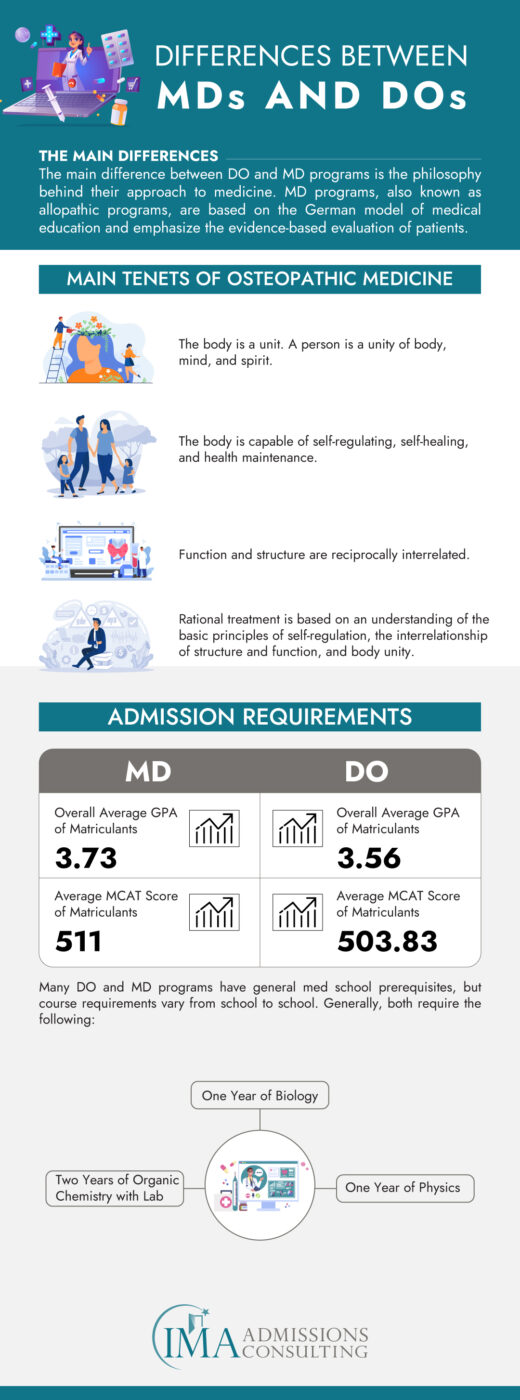
Osteopathic medicine treats the body as a single, connected unit. Each part works with the others for the good of the whole person, and the body has a built-in capacity to heal when it has the right conditions and support. Osteopathic physicians also pay close attention to how mind, body and spirit affect one another, so they treat the whole person and see each patient as an individual rather than a list of symptoms.
Doctors of Osteopathic Medicine (DOs) are fully licensed physicians. They complete the same kinds of residencies as MD graduates, prescribe medication, perform surgery and practice in every specialty. What sets DO training apart is osteopathic manipulative medicine (OMM), a hands-on approach to diagnosing and treating problems in the musculoskeletal system and to preventing illness and injury where possible. At CUSOM, OMM runs through the first two years in a dedicated lab and is reinforced on clinical rotations. If you are still deciding between degrees, our article on choosing an MD, DO or Caribbean path compares the options.
Be an Informed Applicant
Here at International Medical Aid (IMA), we understand that choosing, applying to and being accepted by a medical school is a long and demanding process. Our aim is to make it clearer for the applicants we work with and to help them present their strongest application. That is why we write these guides. The more you know about a school before you apply, the better you can judge your fit and the better your essays and Applicant Day conversations will be.
Read this guide to CUSOM carefully, and reach out if you have questions. Our medical school guides are free, and we publish them for many other MD and DO programs as well. If you are looking at schools close to home, search “medical schools near me” and then check our list to see whether we have a guide for each one. This guide was built for Campbell University School of Osteopathic Medicine alone and should not be used as a guide to any other school.
Topics covered in this guide include:
The sections below follow the order of a real application decision. First comes whether CUSOM fits you: its mission, accreditation, programs, curriculum and outcomes. Then come the practical steps: admissions requirements, deadlines, costs, the class profile and strategy. Last come the parts you will write and say: all three 2026-2027 secondary essay prompts with original example answers, the Applicant Day format and a detailed FAQ.
Personalized Help
There is no better way to prepare an application to Campbell than with some one-on-one coaching. Our medical school admissions consulting program was built to take some of the weight off your shoulders. Our advisors can help you plan your school list, review your personal statement and secondary essays and prepare you for interviews and Applicant Days with mock sessions. Contact us here if you have questions.
Key Takeaways
- Eligibility. CUSOM considers U.S. citizens and permanent residents (green card holders) only. It does not accept applicants who need an F-1 student visa, it does not consider DACA recipients, and it does not consider applicants with asylum status. You may apply once you have completed at least 75 percent of the credits for your bachelor’s degree, and the degree must be finished before you start.
- Academic context. The most recent entering class averaged a 505 MCAT, a 3.60 cumulative GPA and a 3.52 science GPA. The school says applicants should have at least a 3.2 science and overall GPA and that competitive applicants score at or above the 50th percentile on the MCAT, ideally including the Biological and Biochemical Foundations of Living Systems section.
- Mission. CUSOM exists to train community-based osteopathic physicians for rural and underserved North Carolina, the Southeast and the nation. Interest in serving rural and underserved populations is a named admissions factor, so your application should show it.
- Key dates. AACOMAS closes for CUSOM on March 1, 2027, and the secondary closes March 15, 2027. Admissions are rolling, and the school recommends having everything in at least four weeks before the secondary deadline. An Early Decision track had a June 1, 2026 deadline this cycle.
- Costs. Tuition for 2026-2027 is $61,180 a year for every student, with no in-state discount, plus $2,210 in annual fees. The estimated first-year cost of attendance is $98,361, and Years 3 and 4 are estimated at $110,076 each.
- Distinctive training. Students spend Years 3 and 4 at one of 12 regional clinical campuses across North Carolina and in Conway, South Carolina. Every student completes a four-week Rural/Underserved/International rotation. The Class of 2026 had a 100 percent residency placement rate.
- No traditional interview. Selected applicants attend a virtual Applicant Day built around conversational Interactive Dialogue Sessions with faculty, staff and current students, not one-on-one interviews.
- Next step. Line up a letter from a DO or MD and a letter from your pre-health committee, pre-health advisor or a faculty member with a doctoral degree, and start drafting the three secondary essays now.
Key Statistics About Campbell University School of Osteopathic Medicine
CUSOM’s key numbers give you a quick picture of the class, the cost and the outcomes. The graphic and the table below come from the same verified fact record, and each figure names its cohort or academic year.

| Measure | Value | Cohort, population and source |
|---|---|---|
| School and degree | Campbell University Jerry M. Wallace School of Osteopathic Medicine (CUSOM), DO | Private, nonprofit Christian university; Leon Levine Hall, Lillington, North Carolina (CUSOM pages) |
| Founded | 2011; first class entered 2013; first graduates 2017 | CUSOM About FAQ; Campbell News |
| Accreditation | COCA Accreditation with Exceptional Outcome (April 2024); next review 2034 | CUSOM accreditation page |
| Target class size | 150 | CUSOM About FAQ; Choose DO Explorer |
| Entering class size | 162 | Most recent matriculated class, entered 2026 (CUSOM Student Profile; Campbell News, July 22, 2026) |
| Average MCAT | 505 | Most recent matriculated class (CUSOM Student Profile) |
| Average cumulative GPA | 3.60 | Most recent matriculated class (CUSOM Student Profile) |
| Average science GPA | 3.52 | Most recent matriculated class (CUSOM Student Profile) |
| North Carolina residents | 53% | Most recent matriculated class (CUSOM Student Profile); 86 of 162 in the Class of 2030 (Campbell News) |
| Acceptance rate | Not published | CUSOM does not publish applicant, interview or offer counts |
| Recommended GPA | At least 3.2 science and overall | 2026-2027 cycle (CUSOM Admissions FAQ) |
| MCAT guidance | 50th percentile or higher; tests up to three years before matriculation | 2026-2027 cycle (CUSOM Admissions FAQ; 2026-2027 Academic Bulletin) |
| Deadlines | AACOMAS March 1, 2027; secondary March 15, 2027 | 2026-2027 cycle (CUSOM admissions page; Choose DO Explorer) |
| Secondary fee | $50, non-refundable; AACOMAS fee waivers accepted | 2026-2027 cycle (CUSOM admissions page) |
| Tuition | $61,180 per year | 2026-2027, all four years, in-state and out-of-state (CUSOM Cost of Attendance; Campbell Bursar) |
| Annual fees | $2,210 | 2026-2027 (CUSOM Cost of Attendance) |
| Health insurance | $4,390, waivable with proof of coverage | 2026-2027 (Choose DO Explorer; Campbell Bursar) |
| Cost of attendance | Year 1 $98,361; Year 2 $96,855; Years 3 and 4 $110,076 each | 2026-2027 estimated budgets (CUSOM Cost of Attendance) |
| Acceptance deposit | $1,500, non-refundable, applied to tuition | 2026-2027 cycle (CUSOM admissions page; Choose DO Explorer) |
| Average graduate debt | $243,401.12 | Class of 2025 (CUSOM Student Debt Outcomes) |
| Residency placement | 100%; 10-year average 99.74% | Class of 2026; Classes of 2017 to 2026 (CUSOM Residency Placement) |
| 2026 Match | 27 states; 54 graduates staying in North Carolina; 60% in primary care | Class of 2026, graduating class of 151 (Campbell News, March 23, 2026) |
| Total enrollment | 638 students | 2024-2025 academic year (Choose DO Explorer) |
Two notes help you read these numbers. First, CUSOM does not publish how many people apply, how many are invited to Applicant Day or how many receive offers, so no honest acceptance rate can be calculated. Dividing the number of enrolled students by the number of applicants gives a yield-style figure, not an acceptance rate, because many admitted applicants enroll elsewhere. Second, the GPA and MCAT figures are class averages, not cutoffs. Many admitted students sit below an average, and the 3.2 GPA figure is a recommended floor, not a guarantee. For comparisons with other schools, see our list of average GPA and MCAT scores by medical school.
The overall picture is a mission-driven school that draws just over half of each class from North Carolina, charges every student the same tuition and has placed nearly every graduate into residency for a decade.
Mission and Educational Priorities
There are many solid reasons to put CUSOM at the top of your list, and almost all of them trace back to its mission. Campbell built the school to meet a specific need: physicians for the rural and underserved parts of North Carolina. The atmosphere the school describes is one of teamwork, professionalism, honesty, diversity and ethical care for every person.
The CUSOM Mission
The school’s mission statement reads:
“The mission of the Campbell University School of Osteopathic Medicine (CUSOM) is to educate and prepare community–based osteopathic physicians in a Christian environment to care for the rural and underserved populations in North Carolina, the Southeastern United States and the nation.”
Its stated values are equally short: “Our faculty, staff and students value teamwork, leadership, professionalism, integrity, diversity, and the ethical treatment of all humanity.”
The School’s Goals
CUSOM lists ten goals that turn the mission into practice. In the school’s own words, they are:
- To recruit and graduate osteopathic medical students who are committed to serving in rural and underserved areas throughout North Carolina, Southeastern United States, and the nation.
- To recruit a diverse student body who have a desire to serve a rural and underserved population.
- To recruit students from North Carolina, Southeastern United States, and the nation.
- To educate osteopathic medical students in the art and science of osteopathic medicine using the most current research in clinical and basic science.
- To provide osteopathic medical education that is holistic in its approach, evidence based, community focused, and patient centered. Treating the patient as an integrated whole, mind, body and spirit.
- To contribute to the fund of osteopathic medical knowledge through educational, scientific and clinical research and other scholarly activity.
- To develop outreach sites in rural and underserved North Carolina to provide educational services and healthcare to our region.
- To develop a sustainable international medical missions program to train clinicians for underserved areas of North Carolina, the United States and the developing world.
- To collaborate with our hospitals and other partners to provide healthcare and other educational services to our region.
- To develop postgraduate training programs in collaboration with other institutions so that our medical students have training programs upon graduation.
What the Mission Looks Like in Practice
These goals are not just words on a page. Each one has a program behind it:
- Rural and underserved training. Every third-year student completes a four-week Rural/Underserved/International rotation, and the clinical curriculum requires all students to complete a clinical experience focused on rural or underserved care.
- Recruiting from the region. Just over half of each recent class comes from North Carolina. Of the 162 students in the Class of 2030, 86 are from North Carolina and 31 come from a federally designated Health Professional Shortage Area.
- Outreach sites. The student-led Campbell University Community Care Clinic offers free care on Tuesday evenings in Dunn, and the school’s Mobile Health and Education Clinics bring care to Harnett County, surrounding communities and migrant farmworkers and their families.
- International medical missions. The Department of Community and Global Health typically leads four short-term trips a year and offers month-long international rotations to third- and fourth-year students.
- Postgraduate training. Campbell partners with Sampson Regional Medical Center, Harnett Health and Conway Medical Center on residency and fellowship programs.
The results show up in national data. In the 2026 U.S. News rankings, CUSOM placed 11th for graduates practicing in rural areas (15 percent), 15th for graduates in primary care (38.4 percent) and 19th for graduates practicing in Health Professional Shortage Areas (59 percent), all within the group of schools U.S. News lists as unranked overall. Its 2026 graduating class sent 54 new doctors into North Carolina residencies.
What the Mission Means for Your Application
The school reviews each applicant “as a whole person: Mind, Body, and Spirit” and lists interest in serving rural and underserved populations as a formal admissions consideration. Two of the three secondary essays ask you to connect yourself to the mission by name. That means your application should show, with real experiences, why rural or underserved care matters to you and what you have already done about it. Applicants who grew up in small towns, worked in community clinics or served populations with limited access to care have natural material, but anyone can build it with steady, local service.
The Christian part of the mission is part of the school’s identity, not a test of faith. CUSOM describes its Christian environment as one of “diversity, mutual respect, and a safe environment where student’s ideas and beliefs are valued,” and it welcomes students of all faiths. You do not need to write about religion. You do need to show respect for the mind-body-spirit model of care the school teaches.
Accreditation and Institutional Identity
COCA Accreditation
The Commission on Osteopathic College Accreditation (COCA), the accrediting body for DO programs in the United States, granted CUSOM full accreditation in 2017, the year its first class graduated. At its April 11, 2024 meeting, COCA granted the school Accreditation with Exceptional Outcome status, which the school describes as the highest level COCA currently awards. The next accreditation review is scheduled for 2034.
For applicants, this matters in two ways. Graduates of a COCA-accredited school are eligible for the COMLEX-USA licensing exams and for ACGME residency programs, and a ten-year interval before the next review signals that the program is stable.
University Accreditation
Campbell University is accredited by the Southern Association of Colleges and Schools Commission on Colleges (SACSCOC) at Level VI, the highest level that body awards. The school notes that Campbell is one of only three private universities in North Carolina with Level VI status; the other two are Duke and Wake Forest.
Name, Campus and History
The school’s full name is the Campbell University Jerry M. Wallace School of Osteopathic Medicine. It honors Dr. Jerry M. Wallace, the former Campbell president who founded it and who still visits the school often. The building sits on about 20 acres next to the university’s golf course, and students use more than 10,000 square feet of research space in nearby Smith Hall and the main campus’s Oscar N. Harris Student Union.
A few milestones help place the school:
- 2011: Campbell establishes the School of Osteopathic Medicine.
- 2013: The inaugural class matriculates.
- 2017: The first class graduates, and COCA grants full accreditation.
- April 2024: COCA grants Accreditation with Exceptional Outcome status.
- March 2026: Dr. David L. Tolentino, previously interim dean, is appointed dean.
- May 2026: The school holds its 10th commencement, conferring DO degrees on 150 graduates.
Ranking Context
U.S. News does not rank CUSOM in its Best Medical Schools lists for research or primary care; it appears among unranked schools. As noted above, it does rank well in the 2026 U.S. News measures of where graduates practice, which fit the school’s mission more closely than research rankings do. Our guide to DO school rankings and accredited osteopathic medical schools explains how to read these lists.
Medical Programs and Affiliations
Faculty and committee members at CUSOM built the curriculum to bring classroom learning and clinical experience together. Graduates leave prepared to treat patients holistically, in the osteopathic manner that sets them apart.
Doctor of Osteopathic Medicine (DO)
The DO is a four-year program delivered in semesters and blocks at the Lillington campus, followed by two clinical years at regional campuses. As the first and only osteopathic medical school established in North Carolina, CUSOM sets out to prepare lifelong learners who are holistic in their approach to patient care. Students learn clinical skills in the Simulation Center, are introduced to osteopathic manipulative medicine in the OMM lab, train at regional clinical sites and can work with community health centers and serve on medical missions. CUSOM enrolls about 150 to 162 students a year, and its focus remains the underserved communities of North Carolina.
JD/DO Dual Degree
Campbell’s Norman Adrian Wiggins School of Law and the medical school offer a six-year JD/DO program, one year shorter than earning the two degrees separately. Students begin in law school with a summer term, complete a full year of law classes, then complete two years of medical school before returning to law school. You must apply to both programs separately in the same academic year, be admitted to both and accept both offers, and then request the dual degree in writing. The JD/DO application deadline is November 15. In May 2026, Dr. Nickolas Doscher became the first graduate to earn both a JD and a DO from Campbell.
DO/MSPH Dual Degree (Starting Fall 2027)
In September 2026, Campbell approved a dual Doctor of Osteopathic Medicine and Master of Science in Public Health program focused on rural health. It is scheduled to begin in fall 2027 and takes five years, with the first year made up of public health coursework. A fourth-year medical school elective, Moral Wisdom and Health of the Public, is part of the dual track, and both degrees are conferred together. If population health is part of your plan, ask the Office of Admissions how to apply for the first cohort.
Master of Science in Biomedical Sciences (MSBS)
For years the school offered a Master of Science in Biomedical Sciences, a graduate program designed to strengthen academic records and test scores for students headed to medical and other health professions school. It was built to be especially welcoming to candidates from rural regions and from lower-income and minority backgrounds, while open to applicants of every background. Highlights included one-on-one academic advising, peer tutoring, MCAT, GRE and DAT preparation, community service, mission trips, shadowing, faculty-guided research and professional development, with coursework in anatomy, neuroscience, biochemistry, immunology, microbiology, pathology, pharmacology and physiology plus a capstone. Twelve MSBS students graduated in May 2026. Campbell’s 2026-2027 tuition schedule marks the MSBS as paused for restructuring for the 2026-2027 academic year, and the program is not on the school’s current degree list. Contact the school directly if you are considering it.
Master of Health Professions Education (MHPE)
The school has also offered a Master of Health Professions Education for clinicians and educators who want to teach and lead in health professions education. It has served healthcare professionals interested in academia, clinicians building teaching and leadership skills, junior faculty and residents who want to teach. CUSOM faculty such as Dr. Tiffany Lowe Clayton hold the degree. The MHPE does not currently appear among the programs on the school’s degree page, so confirm its status with the school.
Doctor of Behavioral Health (DBH)
Campbell Medicine also runs a Doctor of Behavioral Health program for professionals who want to bring behavioral health into primary and specialty care settings. It is a separate application and is not a route into the DO program, but it reflects the school’s emphasis on integrated behavioral care, which DO students see through the CUSOM Department of Behavioral Health.
Pathways for Campbell Undergraduates
CUSOM runs two pathways for Campbell University undergraduates:
- Early Assurance Pathway (EAP). Selected incoming Campbell freshmen receive a guaranteed Applicant Day invitation if they keep a 3.5 cumulative and prerequisite GPA at the end of their sophomore and junior years, complete all requirements, earn competitive MCAT section scores and meet with their EAP advisor. EAP students may get priority shadowing, interprofessional events, simulation experiences, service at the Community Care Clinic and mentoring by CUSOM students and physicians. An invitation does not guarantee acceptance.
- Guaranteed Applicant Day Invitation. Campbell seniors who score at or above the 50th percentile on the MCAT (preferably including BBFLS), submit AACOMAS in September of senior year and receive a positive evaluation from their undergraduate dean are guaranteed an Applicant Day by October and a decision within two weeks of it.
High school students who already know they want Campbell for college and medical school should look at the EAP when they apply to the university. IMA also runs medical internships for high school students for students who want early clinical exposure.
Graduate Medical Education Partners
Campbell partners with three hospital systems on postgraduate training: Sampson Regional Medical Center, Harnett Health and Conway Medical Center. Campbell-affiliated programs include dermatology (Sampson Regional), transitional year (Conway, Harnett and Sampson), family medicine (Sampson, Harnett and Conway), internal medicine (Harnett Health), sports medicine (Campbell University and Conway) and micrographic surgery and dermatologic oncology (Atlantic Dermatology). Campbell Medicine counts more than 150 residents and fellows in eight clinical specialties. These programs matter to students because they put residents on the clinical teaching team, and some CUSOM graduates train in them and stay. In 2024, all four members of one Harnett Health family medicine residency class were Campbell graduates, and all four signed on to stay with Harnett Health.
Curriculum Overview
The DO curriculum is designed to prepare students for primary care or for medical and surgical subspecialties. Osteopathic principles are integrated throughout and taught in depth in a longitudinal Osteopathic Manipulative Medicine course. The curriculum mixes lectures with case-based learning, small-group clinical discussions, simulation and laboratory sessions and standardized patient encounters, and it moves the class through together.
Years 1 and 2: Integrated Blocks
The first two years build a strong core of biomedical science alongside clinical skills, osteopathic principles and professionalism. Each of the four semesters is divided into two blocks of about nine to eleven weeks, for eight blocks in all. The week between blocks gives students time for a vacation, a medical mission trip or remediation if needed.
| Semester | Block | Focus |
|---|---|---|
| Year 1, fall | Block 1 | Integrated basic science and clinical courses |
| Year 1, fall | Block 2 | Integrated basic science and clinical courses |
| Year 1, spring | Block 3 | Musculoskeletal system |
| Year 1, spring | Block 4 | Neuroscience and human behavior (psychiatry) |
| Year 2, fall | Block 5 | Cardiovascular and respiratory systems |
| Year 2, fall | Block 6 | Hematology, dermatology and renal systems |
| Year 2, spring | Block 7 | Endocrine and gastrointestinal systems |
| Year 2, spring | Block 8 | Reproductive system and Clinical Applications of Biomedical Sciences II |
Blocks 1 and 2 cover the foundational sciences: anatomy, biochemistry and cell biology, microbiology and immunology, pathology, pharmacology and physiology. Anatomy runs through all of Year 1. Blocks 3 through 8 shift to an organ-system approach, where basic and clinical sciences are taught together through clinical presentations, pathophysiology, diagnosis and management, and each block is co-taught by biomedical scientists, primary care physicians and specialists.
Four longitudinal course series run alongside the system blocks:
- Osteopathic Manipulative Medicine (OMM). Hands-on diagnosis and treatment in the OMM lab, built up step by step across both years.
- Clinical Skills. Interviewing, physical diagnosis, documentation and clinical reasoning, with simulation and standardized patients.
- Foundations of Medical Practice (FMP). Biostatistics, epidemiology, population health, research methods and evidence-based medicine, including how to design and complete a scholarly project.
- Professional Core Competencies (PCC). Medical humanities, cultural competence, ethics, medical law and jurisprudence, quality improvement and patient safety, global health and professionalism.
Mornings are usually lectures and discussion, and afternoons are labs, clinical skills and scheduled study time. Lecture attendance is not mandatory except for select sessions, but labs are required because they are collaborative. Students also take part in interprofessional education with pharmacy, physician assistant, physical therapy, nursing and other Campbell health sciences students.
Assessment
Each block includes three integrated exams, weekly quizzes and end-of-block and end-of-year evaluations. Team-based clinical case conferences help students keep up with each week’s material. Graduates must pass COMLEX-USA Level 2-CE and a fourth-year on-campus OSCE, part of CUSOM’s Clinical Skills Assessment Program. The school reports that its students have performed above the national first-time pass rate and national mean scores on every level of COMLEX each year.
Years 3 and 4: Clinical Training
In the second year, each student is placed at a regional clinical campus for Years 3 and 4. Rotations take place in hospitals, ambulatory practices and geriatric and long-term care facilities. Every student completes a clinical experience focused on rural or underserved care, works with ACGME residents before Year 4, completes at least one rotation supervised by an osteopathic physician and completes at least two rotations with inpatient care.
Year 3 rotations (eleven four-week rotations):
- Simulation Medicine
- Family Medicine
- Medicine I
- Medicine II
- Obstetrics/Gynecology
- Pediatrics
- Psychiatry/Behavioral Medicine
- Surgery
- Rural/Underserved/International
- Medical Selective
- Medical/Surgical Selective
Year 4 rotations:
- Residency Development (4 weeks)
- Emergency Medicine (4 weeks)
- Geriatrics (4 weeks)
- Electives I to V (20 weeks)
- Medical Selective (4 weeks)
- Primary Care Selective (4 weeks)
- Surgical Selective (4 weeks)
Fourth-year students must complete a sub-internship, a four-week inpatient or hospital-based rotation, during a selective, elective or emergency medicine rotation. The 20 weeks of electives can be done outside CUSOM’s campuses, which is how students do audition rotations at programs where they hope to match, and students may take one of the three required selectives at a site with an ACGME residency. Away electives and selectives need advance approval from the Associate Dean for Clinical Affairs.
Why the Curriculum Matters for Applicants
Three features stand out. The Rural/Underserved/International rotation is required for everyone, so the mission is built into the degree, not left to electives. The Simulation Medicine rotation that opens Year 3 gives students a structured bridge between classroom and wards. And the long elective block in Year 4 gives you room to audition in the specialty and region you want. When you write your secondary essays, these are the details that show you understand how CUSOM trains doctors.
Admissions Requirements and Application Process
The CUSOM Office of Admissions considers each applicant’s academic background, achievements and personal statement. Admission is competitive. Grades and MCAT scores are crucial, but the school also looks closely at letters of recommendation, health-related work or research experience, community involvement and promotion of diversity. It seeks compassionate, knowledgeable people whose professional goals align with the mission, who show potential to succeed as osteopathic physicians and who have an interest in caring for underserved populations.
Selection Factors: What CUSOM Looks For
The school’s guiding principles for admissions are to review each applicant holistically, evaluate potential for success in the DO curriculum, assess commitment and aptitude as a future osteopathic physician, consider demonstrated interest in serving rural and underserved populations and confirm alignment with the CUSOM mission, values and the osteopathic profession. In practice, the Admissions Committee weighs:
- Completed coursework and GPA
- MCAT results
- Interest in serving rural and underserved communities
- Health-related work, research and volunteer experience
- Letters of recommendation
- The personal statement and secondary essays
- Compassion, communication skills, teamwork, leadership, professionalism and integrity
- Community involvement and promotion of diversity
- Citizenship or permanent residency status
- Feedback from Applicant Day
While CUSOM is a Christian school, applicants do not need to be Christian to apply or be accepted. Applicants from all backgrounds are welcome, and the school’s non-discrimination policy covers religion, race, sex, sexual orientation, gender identity, disability and other protected characteristics.
Degree and Citizenship Requirements
To be considered for an Applicant Day, you must have completed at least 75 percent of the credits for a bachelor’s degree at a college or university accredited by an agency recognized by the U.S. Department of Education. You must earn the degree before matriculation. You do not need to be a science major; non-science majors who complete the prerequisites are eligible.
CUSOM accepts U.S.-born citizens, naturalized citizens and green card holders. A green card must remain valid through all of medical school, and permanent residents must provide a copy of their card before admission; pending permanent residency is not eligible. The school does not accept applicants who need an F-1 student visa, does not consider DACA recipients and does not consider applicants with asylum status. Coursework from outside the United States must be evaluated course by course by an AACOMAS-approved service (such as WES) and shown to be comparable to a regionally accredited U.S. college.
Prerequisite Coursework
You must complete the following courses with a grade of C or higher before matriculation. A C- will not be accepted, with no exceptions, and the same rule applies to courses taken online.
- English: 1 year (6 semester hours or 8 quarter hours). Other reading- or writing-intensive courses are accepted in place of English.
- Biological sciences: 1 year with lab (8 semester hours or 12 quarter hours).
- Physics: 1 year (6 to 8 semester hours or 9 to 12 quarter hours); lab optional.
- General/inorganic chemistry: 1 year with lab (8 semester hours or 12 quarter hours).
- Organic chemistry: 1 year with lab (8 semester hours or 12 quarter hours). One semester of biochemistry can replace one semester of organic chemistry.
Six additional upper-level (300-level and above) science hours are favorable.
Highly Recommended Additional Coursework
- Biochemistry
- Genetics
- Immunology
- Microbiology
- Anatomy and physiology
Molecular biology, behavioral sciences and math or statistics are also listed as recommended. CUSOM accepts AP credit for prerequisites and may ask for a letter from your registrar if it cannot tell which courses your AP credit covers. Online coursework, including online labs, and pass/fail prerequisite grades are accepted. You can apply with prerequisites in progress, but list every planned course on AACOMAS, because an offer can be withdrawn if any requirement is incomplete at matriculation.
Minimum GPA and MCAT Requirements
GPA. Applicants should have at least a 3.2 science GPA and a 3.2 overall cumulative GPA on a 4.0 scale. The most competitive applicants have higher GPAs, and a GPA of 3.5 or higher clearly strengthens your chances; the most recent entering class averaged a 3.60 cumulative and 3.52 science GPA. AACOMAS calculates your GPAs, and under the AACOMAS policy in place since May 1, 2017, every attempt of a repeated course counts in the calculation.
MCAT. Every applicant must submit valid MCAT scores; no substitute test is accepted, and the requirement is not waived. CUSOM accepts scores from tests taken up to three years before the year of matriculation; for 2027 entry, the latest accepted test date is January 31, 2027. Competitive applicants score at or above the 50th percentile overall, with a preferred score at or above the 50th percentile in Biological and Biochemical Foundations of Living Systems (BBFLS). The most recent class averaged 505.
Volunteer Service and Clinical Experience
CUSOM does not set a minimum number of hours for volunteering, clinical experience or shadowing, but the Admissions Committee puts real weight on health-related experience. Volunteering at a health clinic, working in a local doctor’s office, scribing, working as an EMT or CNA, or serving in a structured clinical program all count. If you are planning for medical school while still in college, now is the time to build this experience steadily, because the committee wants to see commitment over time.
Shadowing a DO is not required, but the school says applicants who have shadowed an osteopathic physician show commitment to the profession and an understanding of osteopathic practice. Both in-person and virtual shadowing are accepted.
Clinical experience abroad can add perspective as well, especially for an applicant drawn to CUSOM’s global health program. IMA runs pre-med internships in which interns take vitals, do patient intake and triage and help with direct care under the supervision of local clinicians, which gives you hands-on clinical hours and real cultural context. You can learn more about IMA’s healthcare internships abroad on our program overview.
CUSOM Letters of Recommendation
The secondary application requires two letters:
- A physician letter from a DO or an MD. A letter from an osteopathic physician is not required, but it is encouraged and strongly recommended.
- An academic letter from a pre-health committee, a pre-health advisor or a faculty member with a doctoral degree. A pre-health committee packet is accepted. If your school has no pre-health committee, use a faculty member with a doctoral degree who knows your academic work.
Letters may not be written by a relative, including relatives by marriage. Letters sent directly must be on official letterhead and signed; letters that arrive through AACOMAS, Interfolio or a committee packet are accepted without signature or letterhead. CUSOM prefers letters through AACOMAS but also accepts Interfolio, mail and email, at any point in the cycle. You may add up to five more letters from people who know your academic or professional ability, for a maximum of seven. If your school uses a letter service, it is your job to make sure CUSOM receives the physician letter.
Does CUSOM Require CASPer or PREview?
No. CUSOM does not list CASPer, PREview or any other situational judgment test among its admission requirements for the 2026-2027 cycle. Spend that preparation time on your secondary essays and Applicant Day instead.
AACOMAS Primary Application and CUSOM Secondary Application
CUSOM uses the American Association of Colleges of Osteopathic Medicine Application Service (AACOMAS), the centralized online application for U.S. osteopathic medical schools. You complete one application and send it to each DO school you choose. For the 2026-2027 cycle, AACOMAS opened May 5, 2026, and CUSOM accepts primary applications through March 1, 2027. Send official transcripts from every college you attended to AACOMAS and have your MCAT scores released to AACOMAS. Our guide to applying to medical school with AACOMAS walks through each section.

CUSOM reviews every primary application, but secondary applications are granted by invitation only, and you must meet the minimum admission requirements to receive one. The invitation arrives by email with instructions. The secondary consists of the application with three essays, a non-refundable $50 processing fee and the two required letters. If you have an AACOMAS fee waiver, email it to the Office of Admissions and the secondary fee is waived. You cannot change a secondary once it is submitted, so proofread before you send it. The last day to submit is March 15, 2027, but the school strongly encourages earlier submission and recommends having all materials in at least four weeks before the deadline. Because interview spots are limited and fill as the cycle goes on, aim to return the secondary within one to two weeks.
Application Processing and Applicant Day Invitations
Your file goes to review once the Office of Admissions has your secondary, the fee or waiver, both required letters, official MCAT scores and any other documents. To be invited to Applicant Day you must meet all admission requirements, including the technical standards and vaccination requirements, and have a complete file. Invitations arrive by email with available dates, and a confirmation email with an agenda follows once you schedule.
Early Decision Admissions Track
CUSOM offers an Early Decision track for applicants who see it as their clear first choice. Early Decision applicants agree to apply only to CUSOM until they receive a decision. For the 2026-2027 cycle, the requirements were:
- Submit AACOMAS, with all official transcripts and MCAT scores, by June 1.
- Send the Office of Admissions a letter of intent naming CUSOM as your first choice and requesting Early Decision review by June 1.
- Return the secondary, the fee or waiver and both letters within two weeks of the invitation.
- Qualified applicants are invited to an Applicant Day within one week of the secondary, and decisions usually come within five business days of it.
The most competitive Early Decision applicants have science and overall GPAs of at least 3.50 and MCAT scores at or above the 50th percentile, but the school encourages applicants slightly below those marks to apply if their experiences show a strong mission fit. Applicants not accepted through Early Decision can still be considered in the regular cycle. The June 1 date has passed for 2027 entry; keep it in mind if you are planning for a later cycle.
Admissions Decisions, Deposits and Waitlist
The Admissions Committee reviews each Applicant Day participant holistically and recommends acceptance or denial to the dean, who makes the final decision; the committee may also place applicants on a waitlist. Because admissions are rolling, decisions usually arrive within two to four weeks of Applicant Day. Decisions are final and cannot be appealed.
Accepted applicants pay a non-refundable $1,500 deposit, which is applied to tuition, on this schedule:
- Accepted before November 15: deposit due by December 14.
- Accepted November 15 to January 14: 30 days.
- Accepted January 15 to May 14: 14 days.
- Accepted after May 15: an immediate deposit (within 24 hours) may be required.
You must also sign the Offer of Admission, Technical Standards and Academic Bulletin electronically, meet every clinical and academic requirement in your acceptance letter, pass a national background check and controlled substance screening and confirm your intent to matriculate no later than 15 business days before orientation. Deferred entrance requests are considered.
Timeline and Key Dates for the 2026-2027 Cycle
| Date | Step |
|---|---|
| May 5, 2026 | AACOMAS opens |
| June 1, 2026 | Early Decision deadline for AACOMAS and letter of intent |
| Summer to winter 2026 | Secondary invitations sent on a rolling basis; Applicant Days typically run August through April |
| Before November 15, 2026 | Applicants accepted by this date have until December 14 to pay the deposit |
| January 31, 2027 | Latest MCAT test date accepted |
| February 15, 2027 (suggested) | All materials in, four weeks before the secondary deadline |
| March 1, 2027 | AACOMAS primary deadline for CUSOM |
| March 15, 2027 | Secondary application deadline |
| July 21, 2027 | Orientation and start for first-year students |
Why the Admissions Process Matters for Applicants
CUSOM’s process rewards applicants who are complete and early. The secondary is short in essay count but long in allowed characters, and the Applicant Day is a conversation, not a grilling. Rolling review means seats and merit scholarships both go to earlier, complete files. If you are a strong fit, submitting AACOMAS in early summer and turning the secondary around quickly is the most useful thing you can do.
Tuition, Cost of Attendance and Financial Aid
CUSOM is a private school, so tuition is the same for North Carolina residents and nonresidents. For 2026-2027, tuition is $61,180 a year in all four years ($30,590 per semester), and general fees are $2,210 a year ($1,105 per semester). Tuition and fees can change each year.
Estimated Cost of Attendance, 2026-2027
| Item | Year 1 | Year 2 | Year 3 | Year 4 |
|---|---|---|---|---|
| Tuition | $61,180 | $61,180 | $61,180 | $61,180 |
| Fees | $2,210 | $2,210 | $2,210 | $2,210 |
| Housing | $10,800 | $10,800 | $18,000 | $18,000 |
| Food | $4,920 | $4,920 | $6,560 | $6,560 |
| Books | $3,494 | $1,243 | $1,586 | $1,586 |
| Supplies, course material and equipment | $2,516 | $3,261 | $3,261 | $3,261 |
| Transportation | $3,294 | $3,294 | $4,598 | $4,598 |
| Personal expenses | $8,204 | $8,204 | $10,938 | $10,938 |
| Federal loan fees | $1,743 | $1,743 | $1,743 | $1,743 |
| Total | $98,361 | $96,855 | $110,076 | $110,076 |
Source: CUSOM Cost of Attendance page, 26/27 academic year. Over four years, the estimated cost of attendance adds up to about $415,368 at 2026-2027 rates.
A few points help you read the budget. Years 3 and 4 cost more because students live and travel near their regional campuses for longer academic years. Student health insurance is required: you either enroll in the university plan, listed at $4,390 for 2026-2027, or submit an approved waiver with proof of other coverage each year. The application fee is $50, and a one-time $100 graduation fee is charged when you apply to graduate. Campus housing for graduate and professional students is limited, so most students rent in Buies Creek, Lillington or nearby towns such as Fuquay-Varina, about 20 minutes from campus and 20 minutes from downtown Raleigh.
For a wider view of how these costs compare nationally, see our breakdown of the total cost of medical school and our Medical School Database of tuition at U.S. and Canadian schools.
Loans
Most CUSOM students borrow; 88.43 percent of enrolled students receive financial aid. The school’s financial aid pages list Federal Direct Unsubsidized Loans (up to $40,500 a year in Years 1 and 2 and up to $47,167 a year in Years 3 and 4 for health professions students), Federal Graduate PLUS Loans and private loans. Federal student loan rules for graduate and professional students changed for new borrowers in 2026, so confirm current federal limits with Campbell’s Student Financial Services and on studentaid.gov before you build your budget. Average indebtedness for the Class of 2025 was $243,401.12, up from $233,766.75 for the Class of 2023.
Scholarships
Campbell awards merit and endowed scholarships to a limited number of accepted students who commit to CUSOM. Merit scholarships are by invitation only and are awarded on a rolling basis as qualified students are identified, so applicants who are accepted and commit earlier in the cycle are better placed while funds remain.
- Presidential Scholarship: $20,000 a year, renewable. Considered with a cumulative and science GPA of 3.50 or higher and an MCAT above the 75th percentile.
- Dean’s Scholarship: $10,000 a year, renewable. Considered with a 3.50 GPA (cumulative and science) and MCAT above the 45th percentile, or a 3.30 GPA with MCAT above the 75th percentile.
- Campbell University Scholarship: $10,000 a year, renewable, for Campbell graduates with a 3.30 GPA and MCAT above the 45th percentile.
- Academic Excellence Award: up to $5,000 once, for a 3.750 GPA or higher after the first year.
- Jerry M. Wallace Scholar Award: up to $2,500 once, for a 3.500 to 3.749 GPA after the first year.
Endowed scholarships include awards with preferences for students from southeastern North Carolina counties, Harnett County graduates, students who plan to practice in North Carolina or the Southeast, students with financial need, OMM teaching assistants and students who lead in community service. Separate endowed funds help students pay for medical mission trips. The average scholarship or grant per student is $7,556 a year. Federal service programs, including the National Health Service Corps Scholarship and Loan Repayment programs and the Armed Forces Health Professions Scholarship Program (HPSP), are also open to CUSOM students and fit the school’s service mission well.
Why Financial Aid Matters for Applicants
Because the school’s scholarships are awarded on a rolling basis, applying early can affect your cost as well as your admission. If you are a strong fit for the Presidential or Dean’s Scholarship, an early application and an early commitment improve your odds of an invitation while money remains. Compare the full four-year cost, not just tuition, against any in-state public options before you decide.
Campus Facilities and Student Life
Leon Levine Hall of Medical Sciences
CUSOM students learn in Leon Levine Hall of Medical Sciences, a four-floor building of about 96,500 square feet designed for interactive, hands-on learning. It houses:
- A medical library
- An anatomy lab
- An OMM lab
- A Simulation Center
- Research facilities
- Multipurpose classrooms
- 24 small-group rooms
- Student study and interaction areas
- A full-service café
Simulation Center. The 9,000-square-foot center on the second floor has six high-fidelity simulation rooms (operating room, emergency room, intensive care unit, birthing suite, virtual ultrasound room and a multipurpose room) and twelve OSCE suites where students work with standardized patients. Its point-of-care ultrasound program includes 10 Sonosite machines, 10 Butterfly handheld devices and three ultrasound simulators. The center earned Society for Simulation in Healthcare accreditation in Teaching and Education in May 2024 (through December 2029) and accreditation in human simulation from the Association of Standardized Patient Educators in May 2025.
OMM/Clinical Skills Lab. The 3,635-square-foot lab on the third floor holds more than 80 students per session. It has 40 adjustable OMM tables, live broadcast technology that reaches the clinical campuses, high-definition screens and cameras and a faculty teaching station. Students spend many hours here developing the hands-on diagnostic and treatment skills that distinguish osteopathic physicians.
Anatomy Lab. The 5,300-square-foot lab on the fourth floor accommodates more than 150 students, with 28 downdraft dissection stations, each with its own computer, plus more than 100 anatomical models and 40 skeletons.
Location and Housing
CUSOM is next to Campbell’s main campus in Buies Creek and about 30 miles from Raleigh and Durham and the Research Triangle. The campus setting is rural, with Raleigh-Durham International Airport within driving distance. Most students live in nearby communities such as Buies Creek, Lillington or Fuquay-Varina, choosing between small-town, suburban and urban settings. Meal plans are optional for graduate students.
Student Organizations
CUSOM has more than 30 clubs and organizations:
- Aerospace Medicine Club
- American College of Osteopathic Surgeons
- Anesthesiology Interest Group
- Asian Pacific American Medical Student Association
- Behavioral Health Club
- Campbell Med PRIDE Club
- Campbell University Community Care Clinic
- Christian Medical and Dental Association
- Dermatology Club
- Emergency Medicine Club
- Exceptional Camels Club
- Family Medicine Club
- Global Health Club
- Internal Medicine Club
- Internal Medicine-Pediatrics Club
- Latino Medical Student Association
- Medical Students for Choice Club
- Neurology Club
- OB/GYN Club
- Pathology Club
- Pediatrics Club
- Physical Medicine and Rehabilitation Club
- Point of Care Ultrasound Club
- Preventive Medicine Club
- Psychiatry Club
- Research Club
- Sigma Sigma Phi
- Sports Medicine Club
- Student American Association of Osteopathy
- Student Association of Military Osteopathic Physicians and Surgeons
- Student Government Association
- Student National Medical Association
- Student Osteopathic Medical Association
- Wilderness Medicine Club
- Women in Medicine Club
Academic Support and Wellness
One benefit of attending CUSOM is the Academic Center for Excellence (ACE), which offers academic coaching and counseling, a peer tutoring program and board exam support. ACE helps students identify how they learn best, build study skills and use the resources available to them. The school’s Department of Behavioral Health provides confidential counseling for burnout, anxiety, depression, academic stress, family difficulties and adjustment to medical school. Dean Tolentino told the Class of 2030 at orientation that the behavioral health team “is here because your well-being matters.” Protected study time is built into the weekly schedule.
Community Care Clinic and Service
The Campbell University Community Care Clinic is a student-run, interprofessional free clinic that offers routine physicals, treatment for minor problems, smoking cessation counseling, basic labs, medication refills, pharmacy and nutrition counseling and vaccinations. It operates Tuesday evenings in Dunn, and it earned a 2024 Gold Rating from the National Association of Free and Charitable Clinics. Students also serve through weekly mobile clinics in Harnett County and surrounding communities, care for migrant workers and their families, Street Medicine outreach and Campbell’s Camels Care community service days.
Student Demographics
The Class of 2030, which entered in July 2026, has 162 students: 102 women and 60 men, with an average age of 24. Eighty-six are from North Carolina, 31 come from a federally designated Health Professional Shortage Area and 12 are Campbell graduates. The school’s current enrollment is about 600 students from more than 30 states.
Clinical Rotations and Research Opportunities
Regional Clinical Campuses
Years 3 and 4 take place at regional clinical campuses. Students are placed during the second year, complete all third-year rotations at their campus with CUSOM-appointed faculty and may be expected to drive up to 60 miles within their region for a rotation. If a student must be displaced for a required rotation because of limited capacity, CUSOM covers housing through its membership with the North Carolina Area Health Education Center (AHEC).
| Region | Campus | Main hospital partners |
|---|---|---|
| 1 | Lumberton (Robeson County) | Southeastern Regional Medical Center |
| 2 | Fayetteville (Cumberland County) | Cape Fear Valley Medical Center |
| 3A | Raleigh (Wake County) | WakeMed Hospital, Raleigh and Cary |
| 3B | Harnett (Harnett County) | Central Harnett Hospital, Lillington; Betsy Johnson Hospital, Dunn |
| 4 | Salisbury (Rowan and Mecklenburg Counties) | Novant Health Rowan Medical Center |
| 5 | Goldsboro (Sampson, Lenoir and Wayne Counties) | Wayne Memorial Hospital |
| 6 | Morehead City (Carteret, Onslow and Craven Counties) | Carteret Health Care |
| 7 | Smithfield (Johnston County) | UNC Smithfield; UNC Clayton |
| 8 | Conway, South Carolina (Horry County) | Conway Medical Center |
| 9 | Sanford (Lee and Moore Counties) | Central Carolina Hospital; FirstHealth Moore Regional Hospital |
| 10 | Morganton (Burke County) | UNC Health Blue Ridge |
| 11 | Whiteville (Columbus County) | Columbus Regional Healthcare |
| 12 | Laurinburg (Scotland County) | Scotland Health Care |
Clinical experiences take place in hospitals for inpatient care, in ambulatory practices and in acute and long-term care facilities. Students spend considerable time in rural settings, including small and critical access hospitals, caring for underserved populations. When possible, CUSOM partners with hospitals that have ACGME-accredited residencies, so students learn alongside residents. Training is overseen by the Office of Clinical Affairs and supported by a network of hospitals, clinics and community physicians, and students keep up with didactics and online learning while on rotation.
Electives, Away Rotations and Residency Outcomes
Year 4 includes 20 weeks of electives that can be done away from CUSOM’s campuses for audition rotations. CUSOM graduates have placed into residency programs across the United States. Residency placement was 100 percent for the Classes of 2023, 2024, 2025 and 2026, and the ten-year average for the Classes of 2017 to 2026 is 99.74 percent.
At the 2026 Match, the graduating class of 151 matched in 27 states, with 54 staying in North Carolina and 62 percent remaining in the Southeast. Sixty percent entered primary care, and 80 percent entered specialties the school targets as areas of need, such as family medicine, internal medicine, pediatrics, emergency medicine and OB/GYN. For example, one 2026 graduate matched into family medicine at Offutt Air Force Base, a classmate matched at Clarkson Family Medicine in Omaha after two years of clinical training at UNC Health Blue Ridge in Morganton, and another matched into family medicine at UMass Chan Medical School.
International Rotations and Medical Missions
CUSOM’s Department of Community and Global Health has built a sustainable international outreach program. It typically runs four short-term trips a year during block breaks and summer, and its proposed 2026-2027 trips are to Las Golondrinas, Ecuador (October 2026), Rio Dulce, Guatemala (December 2026), Santo Domingo, Dominican Republic (March 2027) and Getongoroma, Kenya (May to June 2027), all subject to university approval. Past and current destinations include Armenia, Ghana, Haiti, Honduras and Jamaica, and the department has long-standing relationships with partner sites in Togo, Ecuador, Ghana, Angola, Liberia, Kenya and Jamaica.
Third- and fourth-year students may apply for month-long international rotations at sites such as Universidad San Francisco de Quito in Ecuador, Annotto Bay Hospital in Jamaica, Hospital Integral of Chiquimula in Guatemala, the Emmanuel Hospital Association in India, Ganta United Methodist Hospital in Liberia and Bugando Medical Centre in Tanzania, with Queen Elizabeth Central Hospital in Malawi listed as coming soon. Endowed medical mission scholarships, funded with more than $1 million in gifts, help students cover travel costs.
If global health is part of what draws you to CUSOM, international clinical exposure before medical school helps you write about it with substance. IMA’s pre-med internships abroad place students in clinics in Kenya and other sites, and our medical internship in Peru suits applicants who want to build clinical Spanish for Latin American patient populations, a group CUSOM serves both abroad and through its migrant farmworker clinics at home.
Research Opportunities
Research at CUSOM spans biomedical, translational, clinical and educational work, led by the Office of Research under Associate Dean for Research Dr. Terri Hamrick. Students learn research methods in the Foundations of Medical Practice courses, and the Research Club gives interested students a home.
The Medical Student Summer Research Scholars (MSSRS) program is open to rising second-year students with at least a 3.0 GPA. Over seven weeks, scholars complete a biomedical lab, clinical or simulation project with a faculty mentor, attend weekly work-in-progress sessions and a research ethics session, write a final report and present a poster or talk at a meeting such as Campbell’s spring Interprofessional Education Symposium. Participants receive a $1,500 stipend. The school’s research environment is close to the Research Triangle, one of the country’s largest concentrations of research and technology.
Why Clinical Training and Research Matter for Applicants
CUSOM is a community-based school. You will learn medicine in community hospitals across North Carolina rather than at a single academic medical center, with a required rural or underserved rotation and many chances to practice in the communities that need doctors most. If you want that kind of training, say so in your essays and explain why. If you want an academic research career, plan to use the MSSRS program and Year 4 electives to build that record.
Notable Alumni, Faculty, Leadership and Admissions Staff
The people below hold current roles at CUSOM or are graduates whose work reflects the school’s mission. Knowing who they are helps you understand the school’s priorities, and several of them are the people you will meet, hear from or learn from if you enroll. Their roles were checked on October 18, 2026.
School Leadership
David L. Tolentino, DO, FACOI, FACP, Dean. Dr. Tolentino was appointed dean in March 2026 after serving as interim dean and, since 2016, as Associate Dean for Clinical Affairs. He earned his DO at the Ohio University Heritage College of Osteopathic Medicine in 2002, completed an internal medicine residency at St. John Medical Center in Westlake, Ohio, and remains board certified in internal medicine. Before Campbell he was Executive Assistant Dean for Clinical Education and a regional dean at Ohio University’s osteopathic college. He serves on the board of the American College of Osteopathic Internists, chairs the board of the Southern Regional AHEC and is a past president of the North Carolina Osteopathic Medical Association. Because he built CUSOM’s clinical rotation network for nearly a decade, his priorities shape what Years 3 and 4 look like. He describes himself as a primary care physician and tells each class, “be good to each other.”
James E. Powers, DO, FACEP, FAAEM, Vice Dean of Academic Affairs. Dr. Powers joined CUSOM in October 2015 as Associate Dean for Clinical Integration and is a professor of emergency medicine. A former paramedic and EMS instructor, he graduated as valedictorian of the Chicago College of Osteopathic Medicine at Midwestern University in 2002, was chief resident in emergency medicine at Eastern Virginia Medical School and later led emergency medicine at the Edward Via College of Osteopathic Medicine. He is also on the Academic Center for Excellence team, so applicants interested in how CUSOM supports students academically will see his influence.
Terri S. Hamrick, PhD, Associate Dean for Research. Dr. Hamrick is professor and chair of microbiology and immunology. She earned her PhD in microbiology and immunology at the University of North Carolina at Chapel Hill, did postdoctoral work at North Carolina State University’s College of Veterinary Medicine on the pathogenesis of Listeria monocytogenes and joined Campbell’s College of Pharmacy and Health Sciences in 2001 before moving to the medical school. She leads the research office that runs the Summer Research Scholars program.
Jerry M. Wallace, Founder. The school carries the name of Dr. Jerry M. Wallace, the former Campbell University president who founded it. He remains a regular presence; at the 2026 Match Day he told graduates that, after 55 years at Campbell, seeing them match was “worth every day.” His vision of physicians as “healers of body and mind and spirit” is still the language the school uses.
Admissions and Student Affairs Staff
Jennifer Patterson, Director of Admissions. Jenny Patterson is a North Carolina native and a Campbell graduate who spent 13 years as a senior scientist in the pharmaceutical industry before joining CUSOM in 2015. She has worked in admissions as coordinator and assistant director before becoming director. Applicant Day feedback goes to the Director of Admissions before it is presented to the Admissions Committee, so her office is the hub of your file. Address questions to the Office of Admissions at [email protected].
Debi Pipes, Director of Student Affairs. Debi Pipes joined CUSOM in 2017, in time for its first graduation, and works in the admissions and student affairs area. She spoke to the Class of 2030 at orientation about the school as “a supportive and close-knit community.” Student Affairs handles accommodations, student organizations and much of the support system you will rely on once enrolled.
Faculty
Joseph Cacioppo, DO, Chair of Community and Global Health. Dr. Cacioppo is an associate professor of emergency medicine who served in the U.S. Coast Guard before earning his DO at the Kirksville College of Osteopathic Medicine and completing residency at Grandview Hospital. He has been chief of staff at Seneca District Hospital in California and emergency department medical director at hospitals in Ohio and Nevada. He leads CUSOM’s medical missions and international rotations and rides along with students in the Street Medicine program, which brings care to people living without shelter near the school. If global health is part of your story, his department is where it continues.
Tiffany N. Lowe Clayton, DO, DABOM, MHPE, Vice-Chair of Family Medicine. Dr. Lowe Clayton is an assistant professor of family medicine and Director of Clinical Site Engagement and Development, the role that builds relationships with the clinical sites where students rotate. A family physician and obesity medicine specialist with more than 25 years of experience, she earned her DO and completed family medicine residency at Rowan University School of Osteopathic Medicine and earned her MHPE at CUSOM. She practices with WakeMed and helped provide more than 17,000 COVID-19 vaccines to historically marginalized communities in the Raleigh area. She was course director for the Class of 2026 in their first years and spoke to them again at Match Day 2026.
James J. Cappola III, MD, FACP, Chair of Internal Medicine. Dr. Cappola practiced primary care and hospital medicine at WakeMed for more than two decades and served as hospital medicine clerkship director for Campbell’s inaugural class in 2015 before joining the faculty in 2018. He precepts Harnett Health internal medicine residents and CUSOM students at Betsy Johnson Hospital, Central Harnett Hospital and Dunn Medical Services, volunteers at the Community Care Clinic and advises the Internal Medicine Club. At Match Day 2026 he presented the class results as interim assistant dean for Clinical Affairs. His work shows how faculty, residents and students learn together in Harnett County.
Notable Alumni
Melissa M. Davies, DO, Class of 2017. Dr. Davies was the first student ever accepted to CUSOM and a member of its first graduating class. She grew up in Fayetteville, earned her bachelor’s degree at Campbell in 2010, was certified by the American Board of Obstetrics and Gynecology in 2022 and in 2025 joined Novant Health WomanCare in Kernersville, where she serves patients through a small, rural community hospital. She now sits on the Campbell University Board of Trustees and spoke at both the Class of 2029 White Coat Ceremony and the 2026 commencement.
Sarah Lassiter, DO, Class of 2022. Dr. Lassiter grew up in nearby Benson and chose CUSOM to stay close to home while learning to care for her own community. After family medicine residency at Harnett Health, she was one of four Campbell graduates in the same residency class who all signed on to stay with Harnett Health, a first for that program. Her path is a clear example of the school’s mission: recruit from rural North Carolina, train locally and keep physicians in the region.
Nickolas Doscher, DO, JD, Class of 2026. Dr. Doscher earned his Juris Doctor from Campbell’s Wiggins School of Law in 2024 and his DO in May 2026, becoming the first graduate to complete both degrees at Campbell. His path shows the JD/DO program in action for applicants interested in health law, policy or leadership.
Why the People Matter for Applicants
You do not need to name any of these people in your application. What matters is what they show you. The school’s leaders are clinicians with long records in osteopathic education and community hospitals, its admissions office reads every file, and its graduates stay in North Carolina in large numbers. If you can describe how your goals fit that pattern, you will be writing to the school’s real priorities.
Admissions Statistics and Class Profile
CUSOM is a competitive program, and it keeps its class profile simple. The school publishes the size, MCAT and GPA averages and residency share of its most recent class, but not the number of applicants, Applicant Day invitations or offers.
Most Recent Class Profile
| Measure | Value | Cohort and source |
|---|---|---|
| Class size | 162 | Most recent matriculated class, entered July 2026 (CUSOM Student Profile; Campbell News) |
| Average MCAT | 505 | Most recent matriculated class (CUSOM Student Profile) |
| Average science GPA | 3.52 | Most recent matriculated class (CUSOM Student Profile) |
| Average cumulative GPA | 3.60 | Most recent matriculated class (CUSOM Student Profile) |
| North Carolina residents | 53% (86 students) | Most recent matriculated class (CUSOM Student Profile; Campbell News, July 22, 2026) |
| Women and men | 102 women, 60 men | Class of 2030 (Campbell News, July 22, 2026) |
| Average age | 24 | Class of 2030 (Campbell News, July 22, 2026) |
| From a Health Professional Shortage Area | 31 students | Class of 2030 (Campbell News, July 22, 2026) |
| Campbell graduates | 12 students | Class of 2030 (Campbell News, July 22, 2026) |
| Mean MCAT and GPA, school profile | 504.6 MCAT; 3.61 cumulative GPA | Cohort not stated (Choose DO Explorer) |
| First-year matriculants | 162 (82 in-state, 80 out-of-state) | 2024-2025 academic year (Choose DO Explorer) |
| Science majors | 85.2%; non-science majors 14.8% | First-year matriculants, 2024-2025 (Choose DO Explorer) |
| Graduate degree holders | 9.9% | First-year matriculants, 2024-2025 (Choose DO Explorer) |
| Self-reported race and ethnicity | White 56.2%; Asian 24.1%; multiple races 6.2%; Hispanic/Latino 4.9%; Black/African American 3.7%; undisclosed 4.9% | First-year matriculants, 2024-2025 (Choose DO Explorer) |
| Applicants, interviews and offers | Not published | No current figures from the school |
What the Numbers Show
Academics. An average MCAT of 505 and an average cumulative GPA of 3.60 place CUSOM close to the middle of osteopathic schools. The school’s guidance, a 3.2 GPA floor and an MCAT at or above the 50th percentile, describes a realistic range rather than a high bar. Applicants with numbers near or above the class averages are academically competitive; applicants below them need a strong mission story and solid recent coursework.
Geography. Just over half of each recent class is from North Carolina. The rest come from the Southeast and from more than 30 states in total. CUSOM states that it recruits from North Carolina and the Southeast but considers all qualified applicants, and its classes historically include students from across the country.
Background. The Class of 2030 included 31 students from Health Professional Shortage Areas, which lines up with the school’s goal of recruiting students who want to serve rural and underserved populations. Most students majored in science, but about one in seven did not.
Class size. The school’s target enrollment is 150, and recent entering classes have been slightly larger at 162. The Class of 2029 also had 162 students at its White Coat Ceremony.
Why There Is No Acceptance Rate Here
An acceptance rate is the number of applicants offered admission divided by the number who applied. CUSOM does not publish either number for recent cycles, so there is no valid acceptance rate to report. Figures you may see elsewhere that divide enrolled students by applicants measure something different and understate the real chance of an offer, because many applicants who receive offers enroll at another school. Judge your chances by comparing your GPA, MCAT and mission fit with the profile above.
Tips and Strategies for Admission
While scores and GPA matter, CUSOM’s Admissions Committee looks for much more. It wants bright, compassionate and dedicated people who share the school’s mission, goals and commitment to osteopathic care. The tips below translate what the school says it values into concrete steps.
Apply Early, and Apply Complete
CUSOM uses rolling admissions, and both seats and merit scholarships are given out as the cycle goes on. Submit AACOMAS in late May or June if you can, have both letters ready before your secondary invitation arrives and return the secondary within one to two weeks. If CUSOM is clearly your first choice and you are ready by June, consider the Early Decision track in a future cycle.
Make the Rural and Underserved Commitment Concrete
Interest in serving rural and underserved populations is a named admissions factor. General statements are not enough. Show it through what you have done: work in a rural clinic, a free clinic, a migrant health program, a federally qualified health center or a hospital in a small town. Explain what you learned about access, transportation, cost or trust. If you grew up in a rural area or a Health Professional Shortage Area, say so plainly and explain how it shaped your goals.
Build Real Clinical Hours
Because CUSOM sets no hour minimums, quality and consistency matter more than a number. Hands-on roles where you take vitals, room patients or assist clinicians teach you more than passive observation. Applicants who want to add international experience can look at clinical internships for pre-med students abroad, where interns help with intake, triage and direct care under supervision. Keep a journal of patients and moments that stay with you, because your secondary essays will need specific stories.
Shadow an Osteopathic Physician and Learn OMM
A DO letter is encouraged, and shadowing a DO shows that you understand the profession. Ask your DO mentor to show you how they use osteopathic principles and, if they use it, osteopathic manipulative treatment. Be ready to explain in your own words what makes osteopathic medicine distinct. Our article on osteopathic medical school interview questions covers how to talk about it.
Plan Your Letters Carefully
You need one physician letter (DO preferred) and one letter from a pre-health committee, pre-health advisor or a doctoral-level faculty member. Ask writers who know you well and give them your CV, a short summary of why you are applying to DO schools and a note on CUSOM’s mission. Add one or two supporting letters, such as from a clinical supervisor or service director, if they add something new.
Use Your Gap Year Well
Many CUSOM students are a year or more out of college; the average age of the Class of 2030 is 24. If you need a gap year, use it to deepen clinical work, raise your MCAT or complete upper-level science courses. IMA’s pre-med gap year programs can be one part of a structured year. Many applicants also use summers for clinical work; pre-med summer internships fit well between semesters.
Prepare for a Conversation, Not an Interrogation
Applicant Day uses Interactive Dialogue Sessions. Prepare questions that show you have read about the curriculum, regional campuses, the Community Care Clinic and the mission trips, and be ready to talk naturally about your experiences. See the interview section below for specifics.
Reapplying to CUSOM
If you were not admitted, ask the Office of Admissions what would strengthen your application, then fix the weakest part: MCAT, recent grades, clinical depth or mission fit. Show growth with new experiences rather than more of the same. Reapply early and make sure your new secondary essays reflect what has changed.
Secondary Application Questions, Example Responses and Analysis
CUSOM’s 2026-2027 secondary has three required essays. The prompts are below word for word, with their limits. The school sends the secondary only by invitation, so you will see the final wording and limits in your secondary application; write to the limits shown here and follow the portal if anything differs. The essays reward specific, mission-centered writing: two of the three ask you to tie yourself to the CUSOM Mission by name, so read the mission closely before you start.
A few rules apply to all three essays:
- Do not repeat your personal statement. The committee already has it. Use new stories or new angles.
- Count characters, not words, for Essays 2 and 3. Their limit is 4,000 characters, which most applications count including spaces. That is roughly 600 to 650 words.
- Name real CUSOM features accurately. The regional campuses, the Rural/Underserved/International rotation, the Community Care Clinic, the mobile clinics, the medical missions and OMM training are all real. Do not invent programs or use details from another school.
- You cannot edit after submitting. Proofread before you send.
Each example below is original and written for this guide. It shows one way to answer the prompt; it is not a template to copy, and your own experiences will look different.
Essay 1: The Person Who Influenced Your Choice of Medicine
Prompt: “Which person in your life has contributed most to your choice of a career in medicine and describe how that individual influenced your decision to be a physician?”
Limit: No word or character limit is stated. Required: Yes, for all invited applicants.
What it asks. This prompt has two parts: name one person, and explain how that person moved you toward becoming a physician. It is not asking for a biography or a tribute. The committee wants to see what you noticed, what you learned and what you did as a result.
How to approach it. Pick the person whose influence you can show with specific scenes. A physician mentor works, but so does a parent, a patient, a teacher or a coach, as long as you can explain the link to medicine. Show the influence through moments and actions, then show what you did afterward. Without a stated limit, aim for about 400 to 600 words; a focused essay reads better than a long one, and a later limit in the portal may apply.
Illustrative example, not an actual applicant essay
The person who did the most to point me toward medicine never treated me as a patient. She treated my grandfather.
Dr. R. was the only family physician in our part of Sampson County when I was growing up, a DO who worked out of a converted bank building next to the feed store. My grandfather farmed sweet potatoes until his knees gave out, and he had diabetes, high blood pressure and a deep suspicion of anyone in a white coat. I was eleven the first time I rode with him to an appointment, mostly because he needed someone to read the forms.
What I remember is how long she stayed in the room. She asked about his blood sugar, but she also asked about the harvest, the price of fertilizer and whether he was still driving at night. When he admitted he skipped his evening insulin because he fell asleep in his chair, she did not lecture him. She moved his dose to the morning and wrote the new time in large letters on a card he could tape to the refrigerator. Then she had him lie down and worked on his lower back with her hands for a few minutes, explaining that the way he was walking to protect his knees was pulling on everything above them. He walked out standing straighter than he walked in. On the drive home he said, “She listens.” From him, that was high praise.
Over the next six years I went to most of his appointments. I watched Dr. R. manage his kidney function, talk him into a podiatry referral he had refused twice and call our house herself when a lab result worried her. When he died at 81, she came to the funeral and told my mother she had learned a lot about farming from him. I realized then that she had been practicing medicine with the whole family, not just one patient.
She influenced my decision in three ways. First, she showed me that a rural physician is not a lesser version of a city specialist. She handled more problems, with fewer resources, than anyone I have met since. Second, she showed me what osteopathic medicine looks like in practice: hands-on, unhurried and focused on how a person actually lives. Third, she made the need visible. When she cut back her hours, the nearest new-patient appointment for many of her patients was more than 40 minutes away.
When I told her in my junior year of college that I wanted to be a physician, she did not tell me it would be easy. She told me to spend time in a clinic before I decided, and she let me shadow her for a summer. I took her advice further and have worked for two years as a certified nursing assistant at our county hospital, where I see the same pattern of late diagnoses and long drives that she fought against.
I want to be the kind of physician she was, in the kind of place she served.
Why this example works. It names one person and answers both halves of the prompt. The influence is shown through scenes (moving the insulin dose, the hands-on treatment, the funeral) rather than adjectives. It then states three clear lessons, and each one links to CUSOM without forcing the school’s name in: rural practice, osteopathic care and access to care in North Carolina. It ends with action, shadowing and two years as a CNA, which proves the influence changed the applicant’s choices.
Mistakes to avoid.
- Writing a tribute that never explains how the person changed your decision.
- Choosing a famous person you have never met; this prompt rewards real relationships.
- Telling the story of a family member’s illness without showing what you learned or did.
- Writing far beyond what the story needs because no limit is stated.
Essay 2: Your Career Goals and the CUSOM Mission
Prompt: “The MISSION of Campbell University School of Osteopathic Medicine (CUSOM) is to educate and prepare community–based osteopathic physicians in a Christian environment to care for the rural and under-served populations in North Carolina, the Southeastern United States, and the nation. Briefly describe how your career goals align with the CUSOM Mission”
Limit: 4,000 characters. Required: Yes, for all invited applicants.
What it asks. You need to state your career goals clearly and then explain how they match the specific parts of the mission: community-based, osteopathic, Christian environment, rural and underserved, and North Carolina, the Southeast and the nation. “Briefly” is a hint to be direct, even with a generous character limit.
How to approach it. Open with a concrete goal, not a general wish to help people. Back it with experience that proves you understand underserved care. Then connect it to two or three real CUSOM features and explain why each matters to your goal. Address the Christian environment honestly and respectfully, whatever your own faith. Close with where you see yourself practicing.
Illustrative example, not an actual applicant essay
My goal is to practice family medicine in a rural county in eastern North Carolina, with hospital privileges at a small community hospital and a clinic that sees patients regardless of their ability to pay. Over time I want to teach residents and medical students in that setting, because I have seen that the doctors who stay in rural communities are often the ones who trained there.
That goal comes from work, not just intention. For two years I have been a CNA on the medical-surgical floor of a 25-bed critical access hospital. Many of our patients are farmworkers, retired textile workers or people who drive an hour for a specialist and then cannot make the trip again. I have taken vitals on patients admitted for complications of diabetes that had not been checked in years. On weekends I volunteer as a Spanish interpreter at a free health fair run by a church in Clinton, where most patients work on nearby farms. The same problems repeat: no regular physician, no transportation and no time off work.
CUSOM’s mission names the people I want to serve: rural and under-served populations in North Carolina and the Southeast. I see that mission built into the program in three ways that fit my goals.
First, the clinical years are community-based. Students train at regional campuses from Lumberton and Whiteville to Goldsboro and Morganton, and every student completes a Rural/Underserved/International rotation. I want my clinical training to happen in hospitals like the one where I work now, not to see rural medicine only on a short elective. Training in a regional campus would let me learn the full scope of family medicine in the setting where I plan to practice.
Second, service is part of student life. I would like to volunteer at the Campbell University Community Care Clinic in Dunn and with the mobile clinics that serve migrant workers and their families. My interpreting experience would be useful there, and those clinics would teach me how to deliver continuity of care to patients who move with the harvest. I am also interested in the Kenya and Guatemala mission trips, because working in very low-resource settings would sharpen the physical exam and history skills a rural physician depends on.
Third, CUSOM’s graduates stay. More than a third of its 2026 graduates matched in North Carolina, and residency partners such as Harnett Health and Sampson Regional train family physicians who then practice locally. I want to follow that path: train in the region, complete a family medicine residency close to home and remain.
The osteopathic part of the mission matters to me too. The best rural physician I know is a DO who used her hands as much as her prescription pad. CUSOM teaches OMM throughout the first two years and expects students to bring osteopathic principles to every rotation. For patients with chronic back pain who cannot afford physical therapy or cannot drive to it, that skill can make a real difference in a primary care visit.
Finally, I respect that CUSOM educates physicians in a Christian environment. My own faith shaped my sense that caring for people who are overlooked is a duty, not a favor. But what I value most in the mission’s language is the commitment to treat each patient as a whole person, mind, body and spirit, whatever their beliefs.
In ten years I hope to be a board-certified family physician in a county like mine, precepting Campbell students on their rural rotation. CUSOM’s mission describes the doctor I want to become and the place I want to work.
Why this example works. The first paragraph gives a specific, believable career goal: rural family medicine, a small hospital, a safety-net clinic and teaching. The second paragraph proves it with current work as a CNA and as an interpreter. The middle section maps the goal to three accurate CUSOM features (regional campuses with the required Rural/Underserved/International rotation, the Community Care Clinic and mobile clinics, and graduate retention in North Carolina) and explains why each one matters. It addresses the osteopathic and Christian parts of the mission directly and respectfully, without assuming every reader shares the applicant’s faith. At about 3,500 characters, it stays well inside the limit.
Mistakes to avoid.
- Restating the mission back to the committee without connecting it to your own plans.
- Claiming a rural commitment with no experience to support it.
- Ignoring the osteopathic part of the mission or confusing CUSOM with another DO school.
- Writing about faith in a way that suggests patients of other beliefs matter less, or skipping the mission’s Christian environment entirely when it plainly matters to you.
Essay 3: Three Core Values and the CUSOM Mission
Prompt: “Identify three of your core values, and discuss how these values align with the CUSOM Mission”
Limit: 4,000 characters. Required: Yes, for all invited applicants.
What it asks. Name exactly three values, show each one through your own experience and connect each one to the mission. The word “discuss” means the committee wants reasoning, not a list.
How to approach it. Choose values that are true for you and that you can prove with a story. Avoid three near-synonyms such as compassion, empathy and kindness. Give each value its own short section: the experience, what the value means in practice and how it fits a specific part of the mission or the school’s stated values of teamwork, leadership, professionalism, integrity, diversity and ethical treatment of all humanity. A brief closing should tie the three together.
Illustrative example, not an actual applicant essay
My three core values are presence, humility and follow-through. Each one came from a specific experience, and each fits a part of the CUSOM Mission.
Presence
For three years I have worked as an EMT with a volunteer rescue squad in a rural county where the nearest hospital is 35 minutes away. Long transports taught me that being present is a clinical skill. On one call, an older man with chest pain refused to go to the hospital because his wife, who has dementia, would be alone. My partner and I stayed with him for ten extra minutes, called his daughter and arranged for a neighbor to come over. Only then did he agree to transport. His ECG showed an evolving inferior MI. If we had rushed him, he might have refused care entirely.
Presence means staying long enough to understand what is actually stopping a patient from getting better. That fits CUSOM’s call to prepare community-based physicians. In a small town, a physician is part of the community, and patients notice who takes time with them. CUSOM’s Applicant Day, built on conversation instead of formal interviews, suggests to me that the school values the same skill.
Humility
In college I volunteered at a free clinic, and I assumed my job was to bring knowledge to patients. A patient corrected me. When I explained how to take a new medication with meals, she told me she ate one meal a day because her food stamps ran out by the third week of the month. I had been giving advice that did not fit her life.
Since then I try to ask before I explain. Humility also means knowing when I need help, which I learned while struggling through organic chemistry before I found a study group and raised my grade from a C to an A-minus in the second semester.
Humility fits the Christian environment the CUSOM Mission describes. I understand that environment as one where service is the point and where every person is valued, including patients whose choices I do not understand at first. It also fits the osteopathic view of the patient as a whole person, which requires me to learn from patients about their lives instead of assuming.
Follow-through
The most important thing I do as an EMT is not always the dramatic part of a call. It is the handoff: making sure the emergency physician knows the details I learned at the scene, such as the medication bottles on the counter or the stairs the patient cannot climb. When follow-through fails, rural patients fall through gaps that are wider than in a city, because there may be no second chance to reach them.
I bring that habit to every commitment. I have served on the same rescue squad schedule every Thursday night for three years and trained four new members. I want to bring that consistency to the Campbell University Community Care Clinic and to the Street Medicine outreach, where trust is built by returning week after week.
Follow-through is what the mission’s focus on rural and under-served populations demands. Caring for these patients means managing chronic disease over years, coordinating care across long distances and returning to communities that others leave. CUSOM’s regional campuses and its record of graduates staying in North Carolina show a school that expects physicians to stay and finish the work.
Together, these values describe the physician I want to become: one who stays in the room, listens before advising and keeps showing up. I believe CUSOM is the place to grow them into clinical skill.
Why this example works. It names three distinct values and gives each one a concrete story: staying with a patient on an EMS call, being corrected by a free clinic patient and doing the handoff well. Each section then links the value to a specific part of the mission (community-based physicians, the Christian environment, rural and underserved care) and to real CUSOM features such as the Community Care Clinic, Street Medicine and the regional campuses. It includes a brief, honest academic setback that shows humility without becoming the focus. The closing ties the values into one picture of a future physician. It uses about 3,450 characters.
Mistakes to avoid.
- Listing three values with one sentence each and no evidence.
- Choosing values that overlap so much they become one idea.
- Forgetting the second half of the prompt, the link to the mission.
- Using patient details that could identify a real person; change or omit identifying facts.
What Happened to Earlier CUSOM Prompts?
Applicants who read older advice will see other CUSOM questions, such as “What three qualities will you bring to CUSOM which will enhance the overall climate of our school? How do these qualities align with the CUSOM mission?” and a question about which osteopathic principles and practices interest you most. Those are not part of the 2026-2027 secondary. The three-qualities question has been replaced by the core values essay above. The material you prepared for those topics still helps, though: your thinking about osteopathic principles belongs in Essay 2 and in your Applicant Day conversations, and your thinking about what you bring to a class fits naturally into Essay 3.
Interview Format and Preparation
CUSOM Applicant Day
CUSOM does not use formal one-on-one interviews. Instead, invited applicants attend an Applicant Day, which the school describes as a day dedicated entirely to the applicant and built around Interactive Dialogue Sessions (IDS). Applicant Days are conducted virtually and typically run from August through April. You will be notified by email if you are selected, and you will receive a confirmation email with details and an agenda once you schedule. Plan to spend most of the day with the school.
The 2026-2027 Academic Bulletin describes the day this way:
- Welcome session (about 60 minutes). Admissions staff give an overview of CUSOM and Campbell University by videoconference, such as Microsoft Teams, followed by an informal small-group question-and-answer session.
- Faculty and staff IDS (30 minutes). You meet with two CUSOM faculty or staff members in a small group. They do not see your application; they know only your name, hometown and colleges. The session is designed to be conversational rather than evaluative, and traditional interview questions are not asked.
- Student IDS (60 minutes). You talk with current first- and second-year students about the real student experience.
- Wrap-up. Admissions staff review matriculation requirements, answer remaining questions and explain chances to visit in person, such as Visitation Days, Accepted Students Day and campus tours.
After Applicant Day, available feedback from the faculty, staff and students in your sessions goes to the Director of Admissions and is presented to the Admissions Committee, which reviews your full file. Decisions usually arrive within two to four weeks, or within about five business days on the Early Decision track.
How to Prepare
A conversational format does not mean an unimportant one. The people you meet still share their impressions with the committee, and the day is part of the decision. Prepare in these ways:
- Know your application. Even though faculty have not read your file, you should be able to talk easily about every experience you listed.
- Prepare real questions. Ask about regional campus placement, the Rural/Underserved/International rotation, OMM teaching, the Community Care Clinic, mission trips, ACE support, board preparation or life in Buies Creek and Lillington. Thoughtful questions are the core of a dialogue session.
- Be ready to explain osteopathic medicine. Faculty may talk about the osteopathic approach. Be able to describe it in your own words and give an example from shadowing or clinical work.
- Show the qualities the committee values. Interpersonal ability, focus, confidence without arrogance, compassion, respect for diversity, knowledge of osteopathic medicine and a clear desire to help others all come through in conversation.
- Talk to the students honestly. The student session is your best source of information about the school, and respectful, curious engagement leaves a good impression.
- Treat the virtual setting professionally. Test your camera, microphone and connection, use a quiet room with good light and dress as you would for an in-person interview.
Practice still helps. Our guide to the most common medical school interview questions is useful for building comfortable answers about yourself, and many applicants find a mock session through our medical school admissions consulting services helpful before a first Applicant Day.
Frequently Asked Questions
What is osteopathic medicine?
Osteopathic medicine is a full system of medical practice that treats the body as an integrated unit and emphasizes the whole person: mind, body and spirit. DOs are fully licensed physicians who can practice in any specialty. They also learn osteopathic manipulative medicine, a hands-on method for diagnosing and treating problems in the musculoskeletal system. At CUSOM, OMM is taught in both preclinical years and applied on clinical rotations.
Is CUSOM the only osteopathic medical school in North Carolina?
Yes. CUSOM is the first and only osteopathic medical school established in North Carolina. It opened in 2013 and graduated its first class in 2017. The state’s other medical schools grant the MD degree.
Where is CUSOM located?
CUSOM is in Leon Levine Hall of Medical Sciences at 4350 U.S. 421 South in Lillington, directly next to Campbell University’s main campus in Buies Creek. It is about 30 miles from Raleigh and Durham. Years 3 and 4 take place at regional clinical campuses across North Carolina and in Conway, South Carolina.
What GPA and MCAT do I need for CUSOM?
The school says applicants should have at least a 3.2 science GPA and a 3.2 overall GPA, and that competitive applicants score at or above the 50th percentile on the MCAT, preferably including the Biological and Biochemical Foundations of Living Systems section. The most recent entering class averaged a 3.60 cumulative GPA, a 3.52 science GPA and a 505 MCAT. These are averages and guidance, not guarantees.
How old can my MCAT score be?
CUSOM accepts MCAT scores from tests taken up to three years before the year you would start. For the class entering in July 2027, the latest test date accepted is January 31, 2027. No other test can substitute for the MCAT.
What is CUSOM’s acceptance rate?
CUSOM does not publish the number of applicants or offers, so there is no official acceptance rate. Be wary of figures that divide the number of enrolled students by the number of applicants; that is not an acceptance rate. Compare your GPA, MCAT and mission fit with the class profile instead.
Does Campbell University School of Osteopathic Medicine require the CASPer exam?
No. CUSOM does not list CASPer, PREview or any other situational judgment test among its requirements for the 2026-2027 cycle.
Do I have to be Christian to attend CUSOM?
No. CUSOM educates physicians in a Christian environment, but it welcomes students of all faiths and backgrounds, and faith is not an admissions requirement. The school describes its environment as one of diversity, mutual respect and safety, where students’ ideas and beliefs are valued.
Does CUSOM accept international or DACA applicants?
No. CUSOM considers only U.S. citizens and permanent residents with a green card that stays valid through medical school. It does not accept applicants who need an F-1 visa, does not consider DACA recipients and does not consider applicants with asylum status.
Does CUSOM prefer North Carolina residents?
CUSOM recruits from North Carolina and the Southeast but considers all qualified applicants, and about 53 percent of the most recent class are North Carolina residents. Tuition is the same for residents and nonresidents. A real commitment to rural or underserved care matters more than your home state.
How many letters of recommendation does CUSOM require?
Two: one from a DO or MD (a DO letter is encouraged) and one from a pre-health committee, a pre-health advisor or a faculty member with a doctoral degree. A committee packet is accepted. You may add up to five more letters, and letters from relatives are not accepted.
How much clinical experience do I need?
CUSOM sets no minimum hours, but health-related work and volunteer experience are core parts of the review. Aim for steady, hands-on experience over time, such as work as a CNA, EMT or scribe, service in a free clinic or a structured program such as medical internships for undergraduates where you assist with patient care under supervision.
What is CUSOM’s secondary application deadline and fee?
The secondary deadline for the 2026-2027 cycle is March 15, 2027, and the AACOMAS deadline is March 1, 2027. The secondary fee is $50 and non-refundable, and it is waived if you have an AACOMAS fee waiver. Submit everything at least four weeks before the deadline.
What is a CUSOM Applicant Day like?
It is a virtual day built around Interactive Dialogue Sessions instead of traditional interviews: an admissions overview, a 30-minute conversation with two faculty or staff members who have not read your file, a 60-minute session with current students and a wrap-up. Decisions usually come within two to four weeks.
Does CUSOM have an early decision program?
Yes. Applicants who name CUSOM as their first choice can apply through the Early Decision Admissions Track by submitting AACOMAS and a letter of intent by June 1, then completing the secondary within two weeks. Decisions usually come within five business days of the Applicant Day. Early Decision applicants agree to apply only to CUSOM until they receive a decision.
How much does CUSOM cost?
For 2026-2027, tuition is $61,180 a year and fees are $2,210 a year for all students. The estimated cost of attendance, including living costs, is $98,361 for Year 1, $96,855 for Year 2 and $110,076 each for Years 3 and 4. Health insurance is required unless you waive it with proof of coverage.
Does CUSOM offer scholarships?
Yes. Merit scholarships are by invitation and include the Presidential Scholarship ($20,000 a year, renewable), the Dean’s Scholarship ($10,000 a year, renewable) and the Campbell University Scholarship for Campbell graduates ($10,000 a year, renewable). They are awarded on a rolling basis, so early acceptance helps. Endowed scholarships and mission trip scholarships are also available.
Where do CUSOM students do clinical rotations?
At one of 12 regional clinical campuses, including Lumberton, Fayetteville, Raleigh, Harnett County, Salisbury, Goldsboro, Morehead City, Smithfield, Sanford, Morganton, Whiteville, Laurinburg and Conway, South Carolina. Every student completes a Rural/Underserved/International rotation, and fourth-year electives can be done elsewhere for audition rotations.
Does CUSOM offer dual degrees?
Yes. A six-year JD/DO program is offered with Campbell’s law school, and a five-year DO/MSPH program in rural public health is scheduled to begin in fall 2027. Each requires separate admission steps.
How well do CUSOM graduates do in the residency Match?
Very well. Residency placement was 100 percent for the Class of 2026, and the ten-year average is 99.74 percent. In 2026, graduates matched in 27 states, with 54 staying in North Carolina and 60 percent entering primary care.
Can I apply before I finish my bachelor’s degree?
Yes. You must have completed at least 75 percent of your degree credits to be considered for an Applicant Day, and you must finish the degree and all prerequisites before you start. List planned courses on AACOMAS; an offer can be withdrawn if any requirement is incomplete at matriculation.
Related Medical School Guides
If CUSOM is on your list, these guides cover osteopathic schools that share its region, its mission focus or its applicant pool. They are useful comparisons, not claims of equal selectivity.
- Edward Via College of Osteopathic Medicine (VCOM): a private DO school with campuses in Virginia, South Carolina, Alabama and Louisiana and a similar focus on rural and underserved communities in Appalachia and the Southeast, including a Spartanburg campus close to CUSOM’s South Carolina rotation region.
- Philadelphia College of Osteopathic Medicine (PCOM): one of the oldest and largest DO schools, with a Georgia campus that draws many Southeastern applicants.
- Kentucky College of Osteopathic Medicine (KYCOM): a DO school in Pikeville, in Appalachian Kentucky, with a strong rural primary care mission.
- Arkansas College of Osteopathic Medicine (ARCOM): a newer DO school in Fort Smith built to train physicians for a rural, underserved region of the South.
- Oklahoma State University College of Osteopathic Medicine: a public DO school known for rural medicine tracks, a useful contrast with CUSOM’s private, regional-campus model.
- University of the Incarnate Word School of Osteopathic Medicine (UIWSOM): another faith-based private DO school with a community-focused mission to serve underserved patients.
For a statewide view, see our guide to medical schools in North Carolina. In-state applicants weighing MD options should also read our guides to the University of North Carolina Medical School, ECU Brody School of Medicine and Wake Forest University School of Medicine.
Explore Other Medical School Guides
Be sure to check out our other medical school guides. Our school guides include:
- University of South Carolina Medical School
- Lewis Katz School of Medicine at Temple University
- Geisinger Commonwealth School of Medicine (GCSOM)
- Penn State Medical School
- CUNY School of Medicine
- SUNY Downstate Medical School
- NYIT College of Osteopathic Medicine
- NYU Long Island School of Medicine
- Albany Medical College
- TOURO College of Osteopathic Medicine
- Norton College of Medicine at Upstate Medical University
- Jacobs School of Medicine at the University at Buffalo
- Hofstra Zucker School of Medicine
- Weill Medical College of Cornell University
- University of Rochester Medical School
- Icahn School of Medicine at Mount Sinai
- Renaissance School of Medicine at Stony Brook University
- Albert Einstein College of Medicine
- Ohio University Heritage College of Osteopathic Medicine
- Northeast Ohio Medical University (NEOMED)
- University of Cincinnati College of Medicine
- University of Toledo College of Medicine
- Wright State University Boonshoft School of Medicine
- Ohio State University College of Medicine
- Rowan University School of Osteopathic Medicine
- Hackensack Meridian School of Medicine (HMSOM)
- Rutgers New Jersey Medical School (NJMS)
- Rutgers Robert Wood Johnson Medical School
- Cooper Medical School of Rowan University (CMSRU)
- A.T. Still University Kirksville College of Osteopathic Medicine
- Saint Louis University School of Medicine
- University of Missouri Medical School
- Kansas City University (KCU)
- UMKC School of Medicine
- New York Medical College
- University of Pittsburgh School of Medicine
- University of Wisconsin Medical School
- VCU School of Medicine
- University of Maryland School of Medicine
- Case Western Medical School
- University of Florida Medical School
- Emory University School of Medicine
- Boston University College of Medicine
- California University of Science and Medicine
- UC San Diego Medical School
- California Northstate University College of Medicine
- Touro University of California
- CHSU College of Osteopathic Medicine
- UC Davis School of Medicine
- Harvard Medical School
- UC Riverside School of Medicine
- USC Keck School of Medicine
- UT Southwestern Medical School
- Long School of Medicine at UT Health San Antonio
- University of the Incarnate Word School of Osteopathic Medicine
- UT Austin’s Dell Medical School
- UTMB School of Medicine
- McGovern Medical School at UT Health
- Johns Hopkins School of Medicine
- The University of Texas Rio Grande Valley School of Medicine
- UNT Texas College of Osteopathic Medicine
- University of Houston College of Medicine
- Texas A&M College of Medicine
- Baylor College of Medicine
- George Washington University School of Medicine
- Vanderbilt University School of Medicine
- St. George’s University School of Medicine
- Lake Erie College of Osteopathic Medicine (in Pennsylvania)
- Sidney Kimmel Medical College at Thomas Jefferson University
- Western University of Health Sciences (in California)
- Drexel University College of Medicine
- Stritch School of Medicine at Loyola University Chicago
- Georgetown University School of Medicine
- Yale School of Medicine
- Perelman School of Medicine
- UCLA Medical School
- NYU Medical School
- Washington University School of Medicine
- Brown Medical School
How International Medical Aid Can Help
Medical School Admissions Consulting
There is no doubt that applying to medical school is stressful and demanding, whoever you are and wherever you come from. The process is long, from the first AACOMAS entry to the last Applicant Day. Earning a seat and, one day, practicing osteopathic medicine is worth it.
At International Medical Aid (IMA), we aim to make the process clearer and less stressful. Our medical school admissions consulting program can guide you from school selection to your final decision. For CUSOM specifically, our advisors can help you:
- Decide whether CUSOM’s mission and regional training model fit your goals.
- Plan your letters, including how to approach a DO for a physician letter.
- Draft and revise all three secondary essays within the 4,000-character limits.
- Practice for Applicant Day with mock Interactive Dialogue Sessions, so a conversational format feels natural.
Whether or not you interview well naturally, practice helps. You can schedule a free consultation with our team.
Voluntary Healthcare Internships Abroad
One of IMA’s most popular offerings is our clinical internship program, which brings pre-health and gap year students to underserved communities around the world, including Kenya and Peru. Students meet health problems shaped by local living conditions and learn how care is delivered with limited resources. The program was built for pre-medical and gap year students who want to prepare as compassionate, globally minded physicians.
IMA interns do much more than watch. Under the supervision of local physicians and nurses, they take vitals, conduct patient intake and triage and help with direct patient care. For a CUSOM applicant, that experience connects naturally to the school’s mission and to its own medical missions program, and it gives you specific stories for the secondary essays and Applicant Day. IMA programs are independent of Campbell University, and taking part does not give an admissions advantage at any school; what helps is what you learn and can explain.
You can explore our medical internships abroad on the IMA homepage, compare pre-health internships for future physicians and read about our international healthcare internships across all program areas. Reach out if you have questions about which program fits your timeline.
Final Thoughts and Sources
Best of Luck!
Campbell University Jerry M. Wallace School of Osteopathic Medicine is a strong choice if you want to become an osteopathic physician who practices in rural or underserved communities, especially in North Carolina. It is accredited at COCA’s highest current level, it trains students across 12 regional campuses, it places nearly every graduate into residency and it keeps a large share of them in the state. Its admissions process is holistic and conversational, and its secondary essays ask you, more than once, to show how your goals fit its mission.
Your next steps are simple: confirm you meet the citizenship and prerequisite requirements, line up your two letters, submit AACOMAS as early as you can and draft your three secondary essays before the invitation arrives. We at IMA wish you the best as you pursue a place at CUSOM. If you would like support, our medical school admissions consulting team is ready to help, and you can contact us with questions about the application process, our guides, our internships or consulting.
Sources and Verification Notes
Facts in this guide were checked on October 18, 2026, for the 2026-2027 application cycle. Class profile figures describe the most recent matriculated class (entered 2026) unless another cohort is named. Tuition and cost figures are for the 2026-2027 academic year. Secondary prompts are the 2026-2027 wording, collected from current-cycle prompt lists and checked against each other; the school sends the official prompts only to invited applicants.
- CUSOM Doctor of Osteopathic Medicine admissions: requirements, application process, secondary, letters, Applicant Day, deposit schedule, JD/DO.
- CUSOM admissions FAQ: GPA and MCAT guidance, deadlines, citizenship, Applicant Day timing.
- CUSOM student profile: most recent matriculated class.
- CUSOM cost of attendance, 2026-2027.
- Campbell University Bursar’s Office, School of Osteopathic Medicine tuition and fees, 2026-2027.
- CUSOM types of aid and scholarships and student debt outcomes.
- CUSOM DO Academic Bulletin 2026-2027: admissions policies, Early Decision, Early Assurance, JD/DO, curriculum and rotations.
- CUSOM mission, values and goals and accreditation.
- CUSOM regional clinical campuses and residency placement outcomes.
- CUSOM medical missions and outreach and Community Care Clinic.
- AACOM Choose DO Explorer profile for CUSOM: 2026-2027 cycle dates, health insurance fee, 2024-2025 enrollment and matriculant demographics.
- Campbell University News: Class of 2030 orientation (July 22, 2026), Match Day 2026 (March 23, 2026), 2026 U.S. News rankings (April 7, 2026), DO/MSPH dual degree (September 24, 2026) and 10th commencement (May 8, 2026).
- Faculty and staff roles: CUSOM administration directory and individual Campbell University directory profiles.
- Secondary prompts: 2026-2027 prompt lists from Shemmassian Academic Consulting, MedCoach and BeMo Academic Consulting, checked October 18, 2026. Prompt wording only; the example essays in this guide are original.