If you’re a Georgia resident looking into local medical schools and have searched online for “best medical schools near me,” there’s no doubt Mercer University School of Medicine (MUSM) has come up near the top of the results. There are many valid reasons for considering it as a school of choice. It has long been established as one of the leading medical schools in Georgia. Mercer University School of Medicine was established in 1982 to train physicians and health professionals who go on to serve the people of Georgia, especially those in rural and medically underserved regions. That focus still shapes the school, its faculty and its admissions committee.
MUSM grants the Doctor of Medicine (M.D.) degree and is fully accredited by the Liaison Committee on Medical Education (LCME). The full four-year M.D. program runs on three campuses, in Macon, Savannah and Columbus, and third- and fourth-year students can also train at clinical campuses in Valdosta and Carrollton. The curriculum is built around problem-based learning, so students learn to be problem-solvers rather than memorizers, and patient contact starts in the first weeks of medical school. MUSM considers only Georgia residents for its M.D. program.
This guide covers the 2026-2027 application cycle, which fills the M.D. class that begins orientation in August 2027 (the Class of 2031). It explains who is eligible, how the secondary screen works, what the 2026-2027 secondary essays ask, what the Class of 2030 looked like and what medical school at Mercer costs for the 2026-27 academic year. Every statistic carries its year and group, and sources are listed at the end. Facts were checked on October 18, 2026.
International Medical Aid (IMA) builds these guides to help aspiring physicians understand each school before they apply. The more prepared you are as an applicant, the better you can present yourself. This guide was built specifically for Mercer University School of Medicine and should not be used as a guide to any other medical school. If several Georgia schools are on your list, IMA publishes guides to those programs as well, linked near the end.
Key Takeaways
- Georgia residency is the gate. MUSM considers only U.S. citizens and permanent residents who have established Georgia domicile by the time they apply and who keep it for the 12 consecutive months before classes start. Residency alone is not enough: successful applicants generally have significant roots in Georgia.
- The secondary invitation follows a formula. You need an MCAT taken on or after April 1, 2023 with a percentile rank of at least 31, and your MCAT percentile multiplied by your cumulative undergraduate BCPM GPA must be greater than 93. Applicants with graduate degrees or 20 or more graduate hours need only the percentile rank of 31.
- The Class of 2030 averaged a 502 MCAT, a 3.55 BCPM GPA and a 3.65 overall GPA. These are class averages, not minimums. For the 2025 entering class, accepted applicants had a median MCAT of 504 and a median overall GPA of 3.77, and 400 of 1,246 verified applicants were interviewed for an entering class of 176.
- The mission is rural primary care in Georgia. MUSM exists “to educate physicians and health professionals to meet the primary care and health care needs of rural medically underserved areas in Georgia.” Every part of your application should show how you fit that mission.
- Timing matters. Review is rolling. Early Decision closes its AMCAS window on August 3, 2026 and its secondary on September 8, 2026. Regular Pool primaries are due November 2, 2026 and secondaries January 12, 2027.
- Costs are one rate. For 2026-27, M.D. tuition is $44,864 a year and the full-time Year 1 cost of attendance is $75,830. Rural service scholarships can cover most or all of tuition in exchange for practice in rural Georgia.
- Campus is assigned after acceptance. Accepted students rank campuses on a Campus Preference Request Form, and seats are assigned first-come, first-served without a guarantee.
- Next step: check your Georgia domicile dates, run the screen formula on your own numbers and start drafting the nine 2026-2027 secondary essays now.
Key Statistics About Mercer University School of Medicine

The table below collects the numbers applicants ask about most. Each row names the year and the group it describes. Where Mercer does not publish a figure, the table says so.
| Item | Value | Year and group | Source |
|---|---|---|---|
| School and degree | Mercer University School of Medicine, Doctor of Medicine (M.D.) | Current | MUSM Doctor of Medicine page |
| Campuses | Four-year M.D. in Macon, Savannah and Columbus; Years 3 and 4 also at Valdosta and Carrollton clinical campuses | Current (Carrollton from July 2026) | MUSM Campus Locations |
| Accreditation | LCME, full accreditation; next review in academic year 2028-2029 | Current | MUSM LCME Accreditation page; LCME directory (updated October 14, 2026) |
| Who may apply | U.S. citizens and permanent residents with Georgia domicile for 12 months before matriculation | 2026-2027 cycle | MUSM Admissions Process |
| Average MCAT | 502 | Class of 2030 (entered 2026), incoming class | MUSM MD Application Process (Class of 2030 Profile) |
| Average BCPM GPA | 3.55 | Class of 2030, incoming class | MUSM MD Application Process |
| Average overall GPA | 3.65 | Class of 2030, incoming class | MUSM MD Application Process |
| Secondary screen | MCAT percentile 31 or higher and MCAT percentile x cumulative undergraduate BCPM GPA greater than 93 | 2026-2027 cycle | MUSM Admissions Process |
| Median MCAT | 504 (mean 504.6); section medians 126 / 125 / 126 / 127 | 2025 entering class, accepted applicants | AAMC MSAR, 2026 edition |
| Median overall GPA | 3.77 (mean 3.71) | 2025 entering class, accepted applicants | AAMC MSAR, 2026 edition |
| Median science GPA | 3.70 (mean 3.62) | 2025 entering class, accepted applicants | AAMC MSAR, 2026 edition |
| Verified applications | 1,246 (1,243 in-state, 3 out-of-state) | 2025 entering class | AAMC MSAR, 2026 edition |
| Applicants interviewed | 400, all Georgia residents (400 of 1,246 verified applicants, 32%) | 2025 entering class | AAMC MSAR, 2026 edition |
| Matriculants (entering class size) | 176, all Georgia residents, including 73 through Early Decision | 2025 entering class | AAMC MSAR, 2026 edition |
| Acceptance rate | Not published (acceptance offers are not reported) | 2025 entering class | AAMC MSAR, 2026 edition; MUSM admissions pages |
| Estimated new entrants | 180 (M.D. 104, Early Decision 70, Early Assurance 6) | Class entering 2027 | AAMC MSAR, 2026 edition |
| Total M.D. enrollment | 689 | October 2025 | AAMC MSAR, 2026 edition |
| M.D. tuition | $44,864 per year ($22,432 per semester); one rate | 2026-27 | MUSM 2026-2027 Tuition, Fees and Other Estimated Costs |
| Accelerated Track (ACT) tuition | $53,492 per year | 2026-27 | MUSM 2026-2027 Tuition, Fees and Other Estimated Costs |
| Year 1 cost of attendance | $75,830 (full time, includes tuition and fees of $46,023) | 2026-27 | MUSM 2026-2027 Tuition, Fees and Other Estimated Costs |
| Secondary fee | $90; waived with an AMCAS Fee Assistance Program waiver | 2026-2027 cycle | MUSM Admissions Process |
| Enrollment deposit | $100, refundable and applied to tuition | 2026-2027 cycle | AAMC MSAR, 2026 edition |
| Average debt of indebted graduates | $186,974 | 2024-25 | AAMC MSAR, 2026 edition (LCME Part I-B) |
| Match 2026 | 98% matched; 79% matched into a core specialty; Georgia was the top residency destination | Class of 2026, Match Day March 20, 2026 | MUSM Class of 2026 page |
Two cautions apply to these numbers. First, the Class of 2030 figures are averages for the students who enrolled in 2026, while the medians describe everyone accepted for the 2025 entering class. Neither set is a cutoff, and Mercer’s real academic gate is the screen formula explained under Admissions Requirements below. Second, the number of acceptance offers is not published, so there is no true acceptance rate. Dividing the 176 matriculants by the 1,246 verified applicants gives a matriculation ratio of about 14%, which is not an acceptance rate because it leaves out applicants who were accepted and enrolled elsewhere. The clearest published signal is the interview step: 400 of 1,246 verified applicants, about 32%, were interviewed for the 2025 entering class.
Mission and Educational Priorities
Mercer’s mission is short and specific: “To educate physicians and health professionals to meet the primary care and health care needs of rural medically underserved areas in Georgia.” Its vision reads, “The grand challenges of rural health are resolved through education, research, and community engagement.” Both are posted on the school’s Vision, Mission and Values page.
There are many solid reasons for selecting Mercer as your top medical school choice, and almost all of them trace back to that mission. Mercer has made it its purpose to bring good, quality health care to the people of rural Georgia through medical education. A high share of Mercer graduates work in primary care fields and stay in Georgia to practice. The school reports that more than 60 percent of its graduates currently practice in Georgia, and that more than 80 percent of those practice in rural or medically underserved areas of the state. On Match Day 2026, 79% of the graduating class matched into a core specialty (family medicine, general internal medicine, pediatrics, OB/GYN, general surgery, psychiatry or emergency medicine), and Georgia was the top residency destination.
Core values
Mercer School of Medicine holds the following core values:
- Integrity: Honesty. Professionalism. Accountability.
- Respect: Empathy. Civility. Transparency.
- Excellence: Service. Quality. Commitment.
- Community: Welcoming. Belonging. Fair.
- Collaboration: Four Campuses. One School Community.
Strategic goals
Recognizing the challenges of meeting health care needs in the far reaches of Georgia, the school set four strategic goals. To read the objectives behind each one, follow the links to Mercer’s website.
- Goal 1: Lead the state in educating physicians and health professionals who practice in rural areas.
- Goal 2: Provide leadership to help find solutions to the grand challenges in rural health.
- Goal 3: Be a great place to work, learn and teach.
- Goal 4: Secure resources to enable investment in research, teaching and community engagement.
The objectives under these goals are concrete. Goal 1 sets targets of 720 medical students by 2028 and 35% of M.D. graduates practicing in rural Georgia by 2028, and it aims to increase the number of applicants from underserved, rural backgrounds. Goal 4 sets the aim of becoming, by 2030, a free-tuition medical school for graduates who practice in rural Georgia for at least four years after residency.
A word from the dean
Jean R. Sumner, M.D., M.A.C.P., dean of the School of Medicine and a member of its first graduating class, puts it this way on the school’s website: “In my opinion, there is no more meaningful, challenging or rewarding work. The opportunity to change health care in Georgia by becoming a physician or healthcare professional and serving in an area of need requires the best and brightest and those with courage, high intellect and a servant’s heart. This opportunity exists at Mercer University School of Medicine. If your goal is to make a difference, I hope you will consider joining our student body.”
What the mission means for you as an applicant
The mission is not decoration. It is written into the admissions rules. The school’s holistic review evaluates every applicant, in every admission path, on “their commitment to practice primary care medicine in underserved, rural areas of Georgia, academic metrics, attributes, and experiences.” In practice, that means:
- Your Georgia story matters. The admissions page says established residency “alone does not demonstrate a commitment to the School’s mission.” Applicants who succeed generally have significant residential, family, personal or professional roots in Georgia. Be ready to show yours.
- Primary care interest should be real and specific. You don’t have to promise a specialty at 22. But the committee will look for evidence that primary care, rural practice or service to underserved Georgians is a direction you have tested, not a slogan.
- Community engagement counts. Mercer trains students in community physicians’ offices from the first year, runs rural clinics through Mercer Medicine and funds scholarships with rural service commitments. Experiences that show you working with communities, not just for them, line up with how the school teaches.
- Teamwork is built into the curriculum. Problem-based learning puts you in small groups from day one. Evidence that you learn well with others and take responsibility for your own learning is a fit signal.
Accreditation and Institutional Identity
Mercer University School of Medicine is the medical school of Mercer University, whose main campus is in Macon. The M.D. program holds full accreditation from the LCME and will undergo LCME review for accreditation renewal in academic year 2028-2029. The LCME’s directory of accredited programs, updated October 14, 2026, lists Mercer in Macon with full accreditation and an initial accreditation year of 1982. LCME accreditation is what allows graduates to sit for U.S. licensing exams and enter accredited residencies. It is a baseline quality standard, not a ranking.
Some recent changes are worth knowing:
- Campuses have grown. Mercer opened four-year M.D. campuses in Savannah in 2008 and in Columbus in 2021, a clinical campus in Valdosta in 2024 and a clinical campus in Carrollton that begins hosting third- and fourth-year students in July 2026.
- The dean has led the school since 2016. Dr. Sumner, a third-generation Georgia physician, was named dean in 2016 after years of rural practice in Washington and Johnson counties.
- The MCAT floor changed. For Fall 2027 entry, the minimum MCAT percentile rank is 31, up from earlier cycles.
- No transfers right now. Mercer is not currently accepting third-year transfer applications.
One more distinction can trip applicants up. Mercer University runs other health programs that sit outside the School of Medicine. The School of Medicine’s own degrees are the M.D., the M.S. in Preclinical Sciences, the Master of Family Therapy and Ph.D. programs in Biomedical Sciences and Rural Health Sciences. When you research Mercer, make sure the page you are reading belongs to the School of Medicine.
Mercer Medical School rankings and outcomes
Applicants often ask about rankings. National ranking lists change their methods and categories from year to year, so check the current edition directly if a ranking matters to you. For a mission-driven school like Mercer, the more useful measures are the school’s own outcomes: more than 60% of graduates practicing in Georgia, more than 80% of those in rural or underserved areas, a 98% match rate in 2026 and 79% of the Class of 2026 entering a core specialty. Mercer’s alumni page adds that the M.D. program leads the state in the number of students who complete residency in Georgia and choose to practice in Georgia.
Medical Programs and Affiliations
MUSM’s Doctor of Medicine program prepares students for a wide range of medical specialties and career paths. The goal is to train physicians who become leaders, advance biomedical research and improve local, national and global health, while staying focused on the primary care and health care needs of rural Georgia. That is why MUSM accepts only Georgia residents to its M.D. program.
Doctor of Medicine (M.D.)
The M.D. is a four-year program. Students learn the core basic sciences in the first and second years, complete core clinical clerkships in the third year and spend the fourth year on scholarly work and elective rotations, exploring specialties and preparing for residency. Small-group, student-centered, problem-based learning has been the method since the school opened in 1982. Class sizes in tutorial groups are small, eight to nine students with one faculty facilitator, and evaluations in the preclinical years reflect group participation, interpersonal skills, problem-solving and information-gathering.
The full four-year program is offered on the Macon, Savannah and Columbus campuses. Valdosta and Carrollton host the third- and fourth-year curriculum. The dean’s message notes that the curriculum is “consistent and robust across all campuses.”
How campus selection works. You do not pick a campus on your AMCAS or secondary. After you are accepted, you complete the Campus Preference Request Form that comes in your acceptance packet. Campuses are assigned on a first-come, first-served basis and cannot be guaranteed. If you are not assigned to your first or second choice, you can join a campus wait list. Early Assurance applicants go through campus preference processing after final acceptance in June. The practical lesson: once you have an offer, return your deposit, signed acceptance and campus form quickly.
Primary Care Accelerated Track (ACT) Program
Mercer developed its Primary Care Accelerated Track (ACT) Program to address Georgia’s serious shortage of primary care doctors in medically underserved rural areas. Mercer describes it as one of the first two programs of its kind in the United States. Students complete their M.D. coursework in three years instead of four, compressing the four-year objectives into 130 weeks of instruction, then enter a traditional primary care residency in family medicine, internal medicine or pediatrics. Graduating a year sooner gets doctors into practice faster and cuts medical school debt.
- Who can apply: students already enrolled in year one of Mercer’s M.D. program, in good academic standing, with a strong desire to practice primary care in a rural area. Nathan Deal and Children’s Rural Pediatric Scholars are not eligible.
- Tracks and campuses: Family Medicine and Internal Medicine at Savannah, Macon and Columbus; Pediatrics at Savannah and Macon.
- Scholarship: the ACT scholarship covers tuition for the second and third years of medical school. ACT tuition for 2026-27 is $53,492 a year.
- Service commitment: after residency, ACT scholars live and practice full time in an approved medically underserved rural Georgia county for three continuous years, in a practice that accepts Medicaid. Fellowships are not permitted.
- Timing: the application cycle runs from January through early February of each year. The residency of choice reviews applications and conducts interviews, and MUSM notifies students in April.
Rural Critical Need Accelerated Track (RCN-ACT): Psychiatry
The newer RCN-ACT program applies the same three-year model to psychiatry and addiction medicine. It starts with a six-week summer experience after the first academic year, working closely with St. Francis Hospital’s psychiatry residency program, and it is currently offered only on the Columbus campus. The scholarship covers tuition for the second and third years, and graduates commit to three continuous years of full-time practice in an approved medically underserved rural Georgia county. Applications open in January, and students are notified in April. If psychiatry draws you, experience in behavioral health settings, including mental health internships abroad or local crisis-line and counseling-support work, can help you test that interest before you commit.
Rural health scholarships
Mercer’s scholarships are part of its mission strategy, so they function almost like tracks:
- Nathan Deal Scholarship (est. 2017): about seven new awards each year, covering 85-100% of tuition for up to four years, for students with strong ties to rural Georgia who are enrolled or accepted in the four-year M.D. program. Scholars commit to four continuous years of full-time practice in a primary care core specialty in an approved medically underserved rural Georgia county.
- Children’s Healthcare of Atlanta Rural Pediatric Scholarship (est. 2023): ten new awards each year, covering 100% of tuition and fees for up to four years, for students committed to becoming pediatricians. Scholars commit to four years of general pediatrics in an approved rural Georgia county.
These programs are mutually exclusive: an ACT scholar cannot also be a Nathan Deal or Children’s scholar, and so on. Terri Walker, M.P.A., Director of Special Programs, is the listed contact for all of them.
Ways into the M.D. program
Most applicants apply through Early Decision or the Regular Pool on AMCAS. Mercer also runs several structured routes:
- Early Assurance Program: a linkage with the Post-Baccalaureate Pre-Medical Program at Agnes Scott College in Decatur. Eligible post-bacc students apply through AMCAS as an Early Assurance program type after being pre-approved. They must take the AAMC PREview exam. Conditional acceptance depends on keeping a 3.50 cumulative GPA at Agnes Scott with no grade below C, finishing all prerequisites and earning an MCAT total percentile rank of 65 or better in a single attempt by June 30 of the matriculation year.
- Mercer Medical Scholars and Accelerated Mercer Medical Scholars: undergraduate pathways for high-achieving Georgia students admitted to Mercer’s Macon campus. The traditional version is four years of college plus four of medical school, with an Early Decision application after junior year. The accelerated version is three plus four, with an Early Decision application after sophomore year, no MCAT for students who meet all program requirements, and a B.S. in Biomedical Sciences awarded after the first year of medical school. Both waive the interview for students who complete every program requirement.
- MSPCS linkage: students in Mercer’s M.S. in Preclinical Sciences who earn at least a 3.5 GPA in their first semester (and meet all M.D. eligibility rules) receive an M.D. interview opportunity in the Regular Pool. It is not a guarantee of acceptance.
Biomedical Sciences programs
Mercer’s current degree list includes a Ph.D. in Biomedical Sciences, designed to be completed in five years, with research mentors on any of the three full-program campuses (Columbus, Macon or Savannah). Students can choose projects in biochemistry, neuroscience, microbiology, virology, cancer biology, cardiology, immunology, toxicology and physiology, and they gain teaching experience along the way. The school still posts a scholarship and stipend page for the Master of Science in Biomedical Sciences, which described a tuition scholarship for 55 of 75 credit hours and an $18,000-per-year research fellowship stipend. That page describes a two-year program, with the fellowship running through May of the second and final year. Check with the school before planning around the M.S., since it no longer appears on the main degree list.
Master of Family Therapy (M.F.T.)
If you feel called to help others through mental health care, the Master of Family Therapy program at the School of Medicine may be a strong fit. Students train at the Mercer Family Therapy Centers in Macon and Atlanta, which give Georgia residents a high-quality, low-cost option for dealing with adjustment, stress and mental health issues while giving students practical training with real clients. The program is offered in Atlanta, Macon and Savannah and is accredited by the Commission on Accreditation for Marriage and Family Therapy Education (COAMFTE). The first faculty member the School of Medicine ever hired was a family therapist, Dr. Mary Ann Armour, and family therapy has trained alongside medicine at Mercer ever since. A Children’s Family Therapy Scholarship supports students who complete autism training and then work two years in a pediatric or family medicine practice in an approved rural Georgia county.
Preclinical Sciences, M.S.
The Master of Science in Preclinical Sciences (MSPCS) is a 32-week program of 31 credit hours on the Macon campus. It prepares students for careers in science teaching, laboratory research, publishing or policymaking and for doctoral study in medicine, dentistry, PA practice or research. Graduates must show command of the scientific knowledge that underlies medicine and research and the critical thinking to apply it. Coursework covers anatomy, biochemistry, molecular and cellular biology, embryology, genetics, histology, immunology, microbiology, physiology and virology, and the program ends with a capstone experience. The same faculty teach medical and graduate students, and MSPCS students take part in M.D. social events, community service and interest groups. The linkage interview route described above makes the MSPCS a practical option for Georgia applicants who need to strengthen their academic record.
Rural Health Sciences, Ph.D.
The Ph.D. in Rural Health Sciences is a four-year, multidisciplinary program on the Macon campus that requires 64 credit hours: 40 hours of didactics and seminars, six hours of dissertation workshops and at least 18 hours of dissertation. It draws on medicine, psychology, sociology, epidemiology, statistics, communication, management, economics and political science. The program uses a blended format built for working adults, with online evening classes and occasional Saturday sessions in Macon. Its stated mission is “To conduct rigorous, multidisciplinary research to improve the health outcomes of rural communities, contributing to evidence-based practices and informed decision-making.” Courses include Rural Community Engagement, Rural Health Equity, Grantwriting and an Applied Rural Health Practicum. Eligible students may receive tuition support and paid research experience through the Georgia Rural Health Innovation Center and the Center for Rural Health and Health Disparities.
Clinical affiliations
Mercer students train through formal affiliations with Atrium Health Navicent and Piedmont Macon Medical Center in Macon, Memorial Health University Medical Center in Savannah, Piedmont Columbus Regional and St. Francis-Emory Healthcare in Columbus, SGMC Health (South Georgia Medical Center) in Valdosta and Tanner Medical Center in Carrollton. These partners also support residency programs in a variety of specialties, which matters for a school whose graduates largely complete residency in Georgia. Mercer Medicine, the school’s clinical faculty practice, is based in Macon and runs clinics in Sumter, Clay, Putnam, Harris, Glynn and Taylor counties.
M.D. technical standards
The M.D. is a broad, undifferentiated degree, so every student must meet the school’s technical standards for admission, promotion and graduation, with or without reasonable accommodations. These standards describe the minimum physical and cognitive abilities and the mental and emotional stability needed to complete the entire curriculum, enter residency and meet licensure requirements. A plan to practice only a narrow part of medicine does not change that. Mercer acknowledges Section 504 and the Americans with Disabilities Act, and disclosure of a disability is voluntary. Accepted students who want accommodations contact the school after acceptance, and the full standards are published in the School of Medicine catalog. Mercer’s goal is to graduate competent and compassionate physicians who see patients as individuals, and help is available to students with disabilities through the university’s Office of ACCESS and Accommodation Services.
Curriculum Overview
Mercer says it was the first medical school in the United States to fully adopt problem-based learning (PBL), and PBL still defines the first two years. Instead of learning mainly through lectures, students work through real patient cases in small groups. They identify what they need to learn, research the evidence and apply it to diagnosis and treatment. The approach is designed to build the clinical reasoning, communication and self-directed learning that physicians use every day, which is especially important for doctors in rural areas who may have fewer colleagues nearby.
Years 1 and 2: problem-based learning
The preclinical curriculum is arranged in four 16- to 17-week blocks made up of four- to six-week modules:
- Block 1, Foundations of Medicine: anatomy, the start of clinical skills, and foundational topics in biochemistry, cell biology, immunology, pharmacology, ethics and population health.
- Blocks 2 to 4, Organ Systems: neurology, behavior, musculoskeletal and dermatology; then cardiovascular, pulmonary and renal; then gastrointestinal, reproduction, endocrinology and hematology/oncology, with ethics and population health threaded throughout.
Tutorial groups have eight to nine students and one faculty facilitator. Mercer also uses large-group active learning, such as Team-Based Learning, and protects time for independent study. Credit loads run 18 hours in the first fall, 23 in the first spring, 20 in the second fall and 24 in the second spring. The second spring also includes an Emergency Medical Responders course and an Application of Preclinical Science course.
Early clinical experience
Students begin clinical experiences within the first few weeks of medical school. Two threads run through the first two years:
- Medical Practice (clinical skills): students learn to take histories and perform physical exams with standardized patients, people trained to portray specific problems and give feedback. Macon’s clinical skills wing has 16 exam rooms, Savannah’s has 13 and Columbus has 12. Students then practice these skills in the offices of primary care physicians in Georgia communities.
- Population Health and Medical Research (PHMR): students study non-biological determinants of health, health disparities, rural health care, cultural competence, research design, epidemiology, biostatistics and health systems. They apply it during two three-week Population Health immersions, at the midpoint of Year 1 and the end of Year 2, where each student is paired with a community primary care physician who mentors them for the whole program. During these visits students provide clinical care and carry out community health assessments.
Every campus has a simulation center where students practice procedures on lifelike manikins. Macon’s is 4,300 square feet.
Year 3: core clerkships
Year 3 is a 48-week program of clerkships in Mercer-affiliated community teaching hospitals, with additional rural sites throughout Georgia. The required clerkships are:
| Clerkship | Length |
|---|---|
| Internal Medicine | 12 weeks |
| Surgery | 8 weeks |
| Pediatrics | 8 weeks |
| Family Medicine | 8 weeks |
| Psychiatry | 6 weeks |
| Obstetrics and Gynecology | 6 weeks |
Three longitudinal experiences run alongside: a course on topics such as quality improvement and the U.S. health care system, a discussion-based ethics course and a radiology lecture series. Year 3 ends with a six-week post-clerkship intersession that includes a clinical years and telehealth experience plus a sub-internship or elective.
Year 4: electives and preparation for residency
Year 4 includes four required four-week experiences: a sub-internship, Community Medicine and two selectives chosen from critical care, emergency medicine, geriatric medicine and palliative care, or a sub-specialty. Students complete at least 16 weeks of electives in their areas of interest, with no more than eight weeks in any one sub-specialty, and get eight weeks of discretionary time for residency interviews and vacation. The year also includes a Medical Ethics Senior Paper, a Clinical Performance Exam (CPEX) and a one-credit Capstone course that refreshes skills for internship.
Assessment and scholarship
In the PBL years, evaluation reflects participation, interpersonal skills, problem-solving and information-gathering as well as knowledge. Scholarship is built in through PHMR and the Year 4 ethics paper, and students can add optional funded summer research described under Clinical Rotations and Research Opportunities. Accelerated Track students complete the same objectives in 130 weeks, with continuous experiences at their ACT site.
What the curriculum means for your application
PBL rewards a particular kind of student. If you have thrived in seminar courses, research groups, peer tutoring or any setting where you had to teach yourself and then teach others, say so in your secondary and interview. If you have only learned through lectures, think about how you will adapt. And because Population Health immersions place you with community physicians from the first year, clinical exposure in community and primary care settings before medical school helps you show you know what you are signing up for.
Admissions Requirements and Application Process
Mercer University School of Medicine takes a holistic approach to evaluating applicants. In the school’s words, the goal is to “identify, attract and enroll not only academically qualified students, but also those with a passion for the well-being of others and a commitment to the healthcare needs of rural and medically underserved areas in Georgia.” The rules below are taken from the MD Admissions Process page and the 2026-27 application timeline.
Eligibility: citizenship, residency and degree
To be eligible, you must:
- Be a U.S. citizen or U.S. permanent resident.
- Have established residency in Georgia for at least 12 months before matriculation.
- Have a bachelor’s degree or an advanced degree, or be on track to finish a bachelor’s degree, from an accredited college or university by June of the year you would start.
- Finish every degree program you are enrolled in (bachelor’s, graduate or professional) by June of the intended year of matriculation.
- Have taken the MCAT at least once on or after April 1, 2023, with a percentile rank of at least 31.
Mercer’s acceptance offers also require official final transcripts by June 30 before an August start, documentation of a bachelor’s or higher degree from an accredited institution in the United States, an acceptable criminal background check facilitated by the AAMC and the ability to meet the technical standards.
Georgia residency and domicile
Georgia residency is the requirement that removes the most applicants, so read it closely:
- You must have established domicile in Georgia at least by the time you submit your application and maintain it for the 12 consecutive months immediately before the first day of classes.
- If you cannot claim Georgia as your state of legal residence, AMCAS will not let you designate Mercer as a recipient of your primary application.
- Early Decision has an earlier cutoff. If you have not established residency before the Early Decision deadline, you cannot apply through Early Decision.
- Residency for medical school is not the same as residency for a driver’s license. Your secondary includes a notarized declaration of domicile, and after acceptance you complete a separate Documentation to Support Declaration of Domicile form with supporting documents.
- Meeting the legal minimum is not the same as showing mission fit. Mercer says successful applicants “will generally have significant roots (e.g., residential, family, personal, professional) in Georgia.”
If you moved to Georgia recently, gather your documents early (lease or deed, Georgia driver’s license, voter registration, vehicle registration, tax filings or employment records, whatever the form asks for) and make sure your dates work for your intended start.
MCAT and the secondary screen
Mercer does not publish a minimum GPA. It uses a two-part screen to decide who receives a secondary application:
- An MCAT taken at least once on or after April 1, 2023 (within the last three years), with a percentile rank of at least 31.
- Your MCAT percentile rank multiplied by your cumulative undergraduate BCPM GPA must be greater than 93.
Applicants with earned graduate degrees, or 20 or more hours of graduate coursework, receive a secondary invitation with a percentile rank of 31 or higher regardless of undergraduate BCPM GPA. The BCPM GPA used is the cumulative undergraduate BCPM GPA verified by AMCAS.
A few worked examples show how the formula behaves:
| MCAT percentile | BCPM GPA | Product | Secondary invitation? |
|---|---|---|---|
| 31 | 3.00 | 93.0 | No (must be greater than 93) |
| 31 | 3.10 | 96.1 | Yes |
| 40 | 2.40 | 96.0 | Yes |
| 55 | 3.40 | 187.0 | Yes |
| 28 | 3.90 | 109.2 | No (percentile below 31) |
Two more MCAT rules matter. Mercer uses only your highest MCAT score and does not average attempts. If you retake after applying, you can list future test dates on AMCAS, and new scores reach the committee through AMCAS updates. Mercer recommends taking the MCAT after completing prerequisites. If you are weighing a retake, IMA’s guide to retaking the MCAT covers the trade-offs.
Passing the screen is necessary but not sufficient. Mercer says a secondary invitation “does not constitute a guarantee of an invitation to interview” and that further screening of academics, experiences and attributes follows.
Required and recommended coursework
There are certain prerequisite courses an applicant must take to be considered for admission. Applicants need a minimum of one year, or two semesters, of laboratory courses in each of the following:
- General Biology
- General or Inorganic Chemistry
- Organic Chemistry
- Physics
A semester of Biochemistry with lab may replace the second semester of Organic Chemistry. AP credit may replace one semester of Physics. If you received AP credit for any of the other required courses, you must complete one year of advanced courses with lab in the same discipline. All required courses must include their corresponding labs.
Prerequisites do not have to be complete when you apply, but acceptance is contingent on official transcripts showing completion by June of the year you would start.
Do you need to be a science major? No. Mercer suggests majoring in an area that interests you and completing the prerequisites. About 70% of those accepted to the M.D. program majored in biology, biological sciences or a premedical track, and the rest came from a range of other disciplines.
Volunteer service and clinical experience
Mercer does not publish a minimum number of clinical or volunteer hours. Even so, the admissions committee puts a lot of weight on an applicant’s experience in medical settings and in community service, and the screening process looks at “experiences and attributes” before interview invitations go out. Volunteering at a health clinic, working in a local doctor’s office, scribing, working as a medical assistant or EMT, or joining structured pre-med internships are all ways to build this record.
What Mercer’s mission adds is a question of setting. Clinical time in primary care, community health centers, rural hospitals, free clinics or public health departments speaks directly to the school’s purpose. If you are still in college, this is the right time to start building medical experience. The more you can describe what you did, what you saw and what you learned, the better.
Letters of recommendation
Mercer participates in the AMCAS Letter Service, so all letters must come through AMCAS, as a committee letter, a letter packet or individual letters.
- Minimum: three letters, or one committee letter.
- Maximum: seven letters.
- Timing: if you are invited to submit a secondary, at least three letters must be on file through the AMCAS Letter Writers Service before an interview invitation is considered.
- Recommended writers: people who know you well as a student, coworker, colleague or employer. When possible, include at least one science faculty member who taught you and at least one physician, health care professional or health care manager with whom you had a mentoring, employment or volunteer relationship.
- No direct submissions: Mercer does not accept letters emailed or mailed directly to the Admissions Office, committee members or interviewers.
PREview, CASPer and other tests
The AAMC PREview Professional Readiness Exam is optional for regular applicants. It is required for Early Assurance applicants. Mercer’s admissions pages do not list CASPer (Acuity Insights) among its requirements, so Mercer applicants do not need to take it for this school.
AMCAS primary application and the Mercer secondary
Mercer requires all applicants to apply through AMCAS. The school code is GA-832. You may submit your primary as soon as AMCAS opens to submissions, and only primaries initiated and submitted through AMCAS by the deadline are considered. AMCAS verifies your application, and you are responsible for checking your status. If Mercer has not received your materials two to four weeks after AMCAS finishes processing, notify AMCAS.
Applicants who meet the screen receive an emailed invitation to the online secondary. A complete packet includes:
- The completed secondary application and essays.
- A nonrefundable $90 processing fee, automatically waived for applicants with a valid AMCAS Fee Assistance Program waiver.
- A copy of a notarized declaration of domicile in the state of Georgia.
- A copy of a state-issued photo ID.
- The required premedical course form and a photograph.
- At least three letters of recommendation, or one committee letter, through AMCAS.
Once the file is complete, the Admissions Office emails you an acknowledgment that it is eligible for review.
2026-2027 application timeline
Mercer reviews completed applications on a rolling basis, and interview spots are limited, so earlier is better within every track.
| Date | Early Decision | Early Assurance | Regular Pool |
|---|---|---|---|
| May 1, 2026 | AMCAS opens | AMCAS opens | AMCAS opens |
| May 31, 2026 | Primary submission begins | Primary submission begins | Primary submission begins |
| June 30, 2026 | AMCAS transmits to schools | AMCAS transmits to schools | AMCAS transmits to schools |
| August 3, 2026 | Primary AMCAS and transcripts due | ||
| August 14, 2026 | Primary AMCAS and components due | ||
| August 18, 2026 | Interviews begin | ||
| August 28, 2026 | All transcripts due | ||
| August 31, 2026 | GPA and official MCAT scores must reach MUSM by 5:00 p.m. for a secondary invitation | ||
| September 8, 2026 | All secondary components due by 5:00 p.m. | ||
| September 11, 2026 | Last day to be notified of an interview | ||
| September 17, 2026 | Interviews end | ||
| September 24, 2026 | Interviews begin | ||
| September 30, 2026 | Early Decision notification | ||
| October 1, 2026 | Applicants deferred to the Regular Pool | Secondary components due by 5:00 p.m. | |
| October 6, 2026 | Last day to be notified of an interview | ||
| October 8, 2026 | Interview day | ||
| November 2, 2026 | Primary AMCAS due | ||
| November 16, 2026 | Transcripts due to AMCAS | ||
| November 23, 2026 | Early Assurance notification | ||
| January 12, 2027 | All secondary components due by 5:00 p.m. | ||
| January 25, 2027 | Last day to be notified of an interview | ||
| February 11, 2027 | Interviews end |
Mercer notes that dates are subject to change and that admission criteria are reviewed each year.
Early Decision or Regular Pool? Early Decision makes sense if Mercer is clearly your first choice and your application is ready by early August. Under the AMCAS Early Decision Program, you apply to one school and wait for its decision before applying elsewhere. Early Decision applicants who are not accepted by September 30 may be deferred into the Regular Pool. The criteria for a secondary invitation are the same in both tracks.
Decisions, deposits and the wait list
Interview invitations, ranking of interviewed applicants and offers of acceptance all happen on a rolling basis. After an offer:
- Deposit: pay a non-binding $100 enrollment deposit within ten business days of the emailed offer to hold your seat. The deposit is refundable and is applied to tuition.
- Paperwork: sign and return the acceptance letter, submit the Campus Preference Request Form and the domicile documentation, and send official transcripts directly from each institution (Mercer cannot access AMCAS transcripts).
- Background check: authorize the AAMC-facilitated criminal background check, which you will be prompted to complete within two weeks of accepting.
- Campus wait list: if you do not receive your first or second campus choice, you can be added to that campus’s wait list.
- Class wait list: Mercer typically places about 100 applicants on its wait list each cycle, and 30 acceptance offers went to wait-listed applicants in the most recent reported cycle.
- Deferral: requests to defer matriculation by one year are considered case by case, in writing, with no guarantee. Two admitted applicants deferred entry for the 2025 entering class.
- Calendar: Accepted Students Day takes place in the spring, orientation is a week long on your home campus in early August, and the White Coat Ceremony is held in September at Hawkins Arena in Macon.
Tuition, Cost of Attendance and Financial Aid
Learning how the money side of medical school works is as important as the application itself. Mercer charges one M.D. tuition rate, since every student is a Georgia resident. The figures below come from the school’s 2026-2027 Tuition, Fees and Other Estimated Costs sheet, updated June 2026. Fees are subject to change.
2026-27 tuition and fees
- M.D. tuition: $22,432 per semester ($44,864 per year).
- M.D. Accelerated Track (ACT) tuition: $26,746 per semester ($53,492 per year).
- Facilities and technology fee: $250 per semester for 9 or more credit hours.
- UWorld software fee: $599, Year 1 spring semester only, with an option to opt out.
- Health insurance: required for all medical students. The Mercer plan is charged each fall and spring and can be waived with other coverage. Premiums depend on age on the first day of the semester: $1,402 per semester under 25; $1,606 for ages 25-34; $2,404 for 35-44; $3,608 for 45-54; $5,416 for 55-64.
2026-27 cost of attendance by year
The cost of attendance (COA) is the school’s full budget, including living costs that do not appear on your bill. It is also the most you can receive in financial aid from all sources.
| Budget item | Year 1 | Year 2 | Year 3 | Year 4 | ACT Year 2 | ACT Year 3 |
|---|---|---|---|---|---|---|
| Tuition and fees | $46,023 | $45,424 | $45,424 | $45,424 | $54,052 | $54,052 |
| Books, materials, supplies, equipment | $1,680 | $2,455 | $2,194 | $500 | $1,680 | $920 |
| Housing | $17,100 | $17,100 | $20,520 | $15,390 | $15,390 | $18,810 |
| Transportation | $2,900 | $2,900 | $3,480 | $2,610 | $2,610 | $3,190 |
| Food | $5,400 | $5,400 | $6,480 | $4,860 | $4,860 | $5,940 |
| Miscellaneous | $2,240 | $2,240 | $2,640 | $5,184 | $2,040 | $2,440 |
| Loan fees (Unsubsidized) | $487 | $408 | $408 | $408 | $408 | $408 |
| Loan fees (PLUS) | $0 | $966 | $966 | $966 | $0 | $0 |
| Total | $75,830 | $76,893 | $82,112 | $75,342 | $81,040 | $85,760 |
Full time means 9 or more hours in fall and spring and 6 or more in summer. COAs are adjusted for students enrolled less than full time, and loan fees are added only if you are eligible for that loan. Adding the four standard years gives a total budget of $310,177 for the 2026-27 rates. That sum is a simple estimate, since rates usually rise over four years.
Financial aid at Mercer
The Office of Student Financial Planning handles aid for all campuses. Useful details from the school’s financial planning pages:
- Borrowing: approximately 35% of students borrow up to the full cost of attendance. Others borrow only for tuition. Mercer encourages you to make a spending plan and borrow only what you need, since interest accrues from disbursement.
- Loan fees: about 1% of an Unsubsidized loan’s gross amount and 4% of a Graduate PLUS loan’s gross amount are deducted as processing fees.
- Refunds: if you borrow beyond tuition, refunds arrive around the start of each semester. Mercer suggests Year 1 and Year 2 students plan to pay February rent from their August refund.
- Enrollment rules: beginning in 2026-27, a Schedule of Reduction adjusts federal loans for students enrolled below full time.
- Timing: once you pay your deposit and enter the enrollment system, the office can provide aid estimates. Students accepted by the end of May receive award letters by mid-June. New students should finish the aid checklist, preferably before July 15.
- Payment plans are available through the Bursar for students not using aid for tuition.
- Aid and debt: 86% of enrolled and graduated students received financial aid in 2024-25, and the average medical school debt of indebted graduates was $186,974 for the same year. Most Mercer scholarships are based on need and mission fit.
Scholarships and what they leave you to pay
Mercer’s largest scholarships are tied to rural service (details under Medical Programs and Affiliations):
- Nathan Deal Scholarship: 85-100% of tuition for up to four years, about seven new awards a year.
- Children’s Healthcare of Atlanta Rural Pediatric Scholarship: 100% of tuition and fees for up to four years, ten new awards a year.
- Primary Care ACT and RCN-ACT scholarships: tuition for the second and third years of the three-year program.
Even a full-tuition award leaves living costs. In the 2026-27 Year 1 budget, everything other than tuition and fees (housing, food, transportation, books and miscellaneous costs, plus loan fees) comes to $29,807. Plan for that amount, or a share of it, through savings, family support or loans. Remember too that these awards carry service obligations of three or four continuous years in an approved rural Georgia county, and partial completion earns no credit under the Nathan Deal and Children’s programs. For a broader view of what medical school costs across the country, see IMA’s Medical School Database, where we collect tuition guidance and other helpful information.
Campus Facilities and Student Life
Mercer’s campuses share one curriculum but feel different, and since campus assignment happens after acceptance, it helps to know what each one offers before you fill out the preference form.
Macon campus
The historic Macon campus, at 1550 College Street, is the School of Medicine’s original home and primary administrative hub, set on Mercer University’s main campus. It hosts the M.D. program, both Ph.D. programs and the master’s programs in Preclinical Sciences and Family Therapy. Inside are a 4,300-square-foot simulation center, a clinical skills wing with 16 exam rooms, small-group tutorial rooms, a gross anatomy lab, a recently renovated auditorium for in-person and remote learning and a medical library open 24/7. Macon also offers the classic campus experience, with academics, student life and university athletics in one community. Clinical partners are Atrium Health Navicent and Piedmont Macon Medical Center. Macon is home to two rural health centers, the Center for Rural Health and Health Disparities and the Georgia Rural Health Innovation Center.
Savannah campus
The Savannah campus, at 1250 East 66th Street, sits on the grounds of Memorial Health University Medical Center, the region’s leading teaching hospital. What began as a clinical partnership with Memorial Health in 1996 became a full four-year M.D. campus in 2008. Students have high-tech classrooms, an anatomy lab, a simulation center, a clinical skills wing with 13 exam rooms, a 24/7 library and a bright central atrium. Savannah, Georgia’s oldest city, is full of charm, history and live oaks draped in Spanish moss, and Tybee Island’s beaches are a short drive away.
Columbus campus
Overlooking the Chattahoochee River, the Columbus campus grew from a clinical campus that Mercer established in 2012 in partnership with Piedmont Columbus Regional’s Midtown Campus and St. Francis Hospital. A new medical school building opened in 2021, and the M.D. program became a full four-year program. The 77,000-square-foot building on a six-acre site houses classrooms and offices, a medical library, a gross anatomy lab, a simulation center, a clinical skills space with 12 exam rooms, second-floor research laboratories and a vivarium. The expansion was planned to grow Columbus enrollment to 240 M.D. students over several years. Columbus is also the only campus that offers the RCN-ACT psychiatry track.
Valdosta and Carrollton clinical campuses
Third- and fourth-year students can complete their clinical training at two clinical campuses. Valdosta, located within South Georgia Medical Center’s hospital complex, is the hub for rotations in south Georgia and offers important exposure to rural medicine. Carrollton, located within Tanner Medical Center, begins serving third- and fourth-year students in July 2026 and combines a tertiary care setting with rural exposure.
Atlanta campus
Atlanta is a busy metropolitan area with a wide range of restaurants, theaters, shops and sports. The Cecil B. Day Graduate and Professional Campus sits on 200 wooded acres inside the Atlanta Perimeter and is home to the School of Medicine’s Master of Family Therapy program. Students there share many of the same amenities as Macon, including a wellness and recreation center. M.D. students are not based in Atlanta.
Housing
Mercer University School of Medicine does not provide on-campus graduate housing. Students find housing through online resources, and the 2026-27 budget includes $17,100 for housing in Year 1. Ask current students on your interview day about neighborhoods near your likely campus.
Libraries and study resources
The Skelton Medical Libraries support every campus with print and online resources, including more than 17,000 online journals, more than 300,000 online books and more than 140 databases, plus National Board study resources. Each campus branch is open 24/7 with a Mercer ID card. Distance-learning classrooms link the campuses.
Student support and wellness
The Office of Student Affairs and Services runs academic advising, career counseling and residency planning on every campus. As of October 2026, the deans of student affairs are Alice House, M.D. (senior associate dean, all campuses), Kathleen Hughes, Ph.D. (Columbus), Helen King, M.D. (Macon) and Jane Kirkpatrick, M.D. (Savannah). The Student Wellness Program, led by Director of Wellness Kim Meeks, addresses five aspects of wellness during orientation and “Bears Prepare Half Days”: physical, emotional, spiritual, professional and financial. Students have a 24-hour Crisis Support Line, an anonymous reporting line, Mercer Counseling and Psychological Services and campus-specific health and counseling resources. The Aid for the Impaired Medical School Student (AIMSS) program offers additional support.
Student organizations and service
Student interest groups are a large part of life at Mercer. The school describes them as educational, intellectual, interdisciplinary, cultural and social, and says they help students build leadership and workplace skills and meaningful connections with classmates who share their interests. MSPCS graduate students also join M.D. students in interest groups, social events and community service. Ask the student ambassadors on your interview day which groups are active on your campus, since group lists change from year to year.
Several service roles are documented on the school’s own pages:
- Bear Essentials: a three-part webinar series led by Student National Medical Association (SNMA) and Latino Medical Student Association (LMSA) students for rural and underrepresented high school and college students preparing to apply to medical school, plus an on-campus 1st Look Conference with mock interviews and suturing.
- Doctor for a Day: a one-day event led by Mercer M.D. students that introduces rural high school and college students to health care careers, held each fall in Macon and spring in Columbus.
- Med camps and health fairs: summer med camps in Randolph and Berrien counties, a virtual med camp and community health fairs with free screenings. Since 2021, more than 1,700 students across Georgia have taken part in Mercer’s pathway programs.
- Student Ambassadors: Year II students who lead tours, meet applicants on interview day and represent each campus.
If you are an undergraduate now, Mercer’s pathway events are also a low-cost way to see the school up close before you apply.
Clinical Rotations and Research Opportunities
Mercer trains its students in community settings from the start and keeps them there. That is the core of the school’s clinical model.
Required clinical training
- Years 1 and 2: clinical experiences in primary care physicians’ offices across Georgia, plus two three-week Population Health immersions with a community primary care mentor (mid-Year 1 and end of Year 2).
- Year 3: 48 weeks of core clerkships in internal medicine, surgery, pediatrics, family medicine, psychiatry and OB/GYN at Mercer-affiliated community teaching hospitals, with additional rural sites throughout Georgia. Clerkships blend ambulatory and hospital care.
- Year 4: a sub-internship, Community Medicine, two selectives and at least 16 weeks of electives.
Where rotations happen
After the second year, students complete core clerkships at the school’s primary teaching hospitals: Atrium Health Navicent and Piedmont Macon Medical Center in Macon; Memorial Health University Medical Center in Savannah; Piedmont Columbus Regional and St. Francis-Emory Healthcare in Columbus; and SGMC Health in Valdosta. Tanner Medical Center anchors the Carrollton clinical campus from July 2026. Mercer also relies on a statewide network of community physician preceptors.
Allocation and travel. Your campus assignment determines your home hospitals for clerkships, and Valdosta and Carrollton host students for Years 3 and 4. Rural sites can mean driving or temporary housing, which is one reason the Year 3 budget includes higher housing ($20,520) and transportation ($3,480) amounts than Year 1. Ask on interview day how rural rotation housing works on your campus.
Student research
Beyond the research and population health content built into PHMR, Mercer’s formal research programs are optional, and students “engage in research throughout their training program,” across clinical research, bench research, literature reviews, analysis of clinical study data, community health research and case reports. Formal programs include:
- Summer Scholars: open to M.D. students on all campuses in good academic standing, with six weeks of research plus one week of vacation in the summer after Year 1, weekly professional development sessions and a final research presentation. Some financial support is available, depending on funds.
- Landings Cancer Research Scholars: open to students on all campuses, with research performed on the Savannah campus. Projects are bench research on cancer, and stipends for supplies are funded by The Landings Women’s Golf Association Together for a Cure fundraiser. Students present at the Mercer Joint Research Conference.
- Maternal Health Observership: a six-week summer experience at the Georgia Rural Health Innovation Center for rising second-year students interested in rural, underserved practice, directed by Jennifer Barkin, Ph.D., professor and vice chair of Community Medicine. Students shadow providers and take part in a journal club.
- Volunteer Scholar: students assist a faculty mentor with ongoing research.
- External options: AAMC-listed opportunities, the Grady STaR Program and projects at other universities.
Students present their work at the Summer Research Enrichment Symposium, MU BEAR Day and the Georgia chapter of the American College of Physicians scientific meeting. Each campus has a Director of Student Research: Gretchen Bentz, Ph.D. (Macon), Raghavan Chinnadurai, Ph.D. (Savannah) and Emily McMackin, Ph.D. (Columbus). Third- and fourth-year students can also do research during rotations and electives.
Rural health centers, clinics and service sites
Mercer’s rural mission gives students places to learn that most schools do not have:
- Center for Rural Health and Health Disparities: community-based research and programs on issues such as maternal mortality, opioid misuse, chronic disease, autism and mental health.
- Georgia Rural Health Innovation Center: works with communities and health systems on solutions for all 120 of Georgia’s rural counties.
- Mercer Medicine: the school’s clinical practice, with clinics in Macon and rural counties. Its rural primary care clinics are led by an alumna, Loraine Sumner, M.D.
- Center for IDD Care: comprehensive care for adults with intellectual and developmental disabilities.
- Mercer Family Therapy Center: affordable mental health care that also trains family therapy students.
- Mason Center for Organ Donation and Transplant Education and Policy and the Early Autism Detection Program.
These are places where the school’s mission becomes daily work, and they give you concrete material to reference in your secondary essays.
Notable Alumni, Faculty, Leadership and Admissions Staff
Mercer University School of Medicine has an experienced faculty and administrative team, which is another good reason to consider it as a top choice. The profiles below are drawn from the school’s leadership roster, faculty directory, alumni pages and Mercer University news. Titles were checked on October 18, 2026. They are here to help you understand the school, not to suggest that you should contact anyone about your application.
School leadership
Jean R. Sumner, M.D., M.A.C.P., Dean. Dr. Sumner is a member of Mercer’s first graduating class (1986) and has led the school as dean since 2016. A third-generation Georgia physician, she practiced medicine in rural Washington and Johnson counties for most of her career. As dean she has overseen the opening of primary care clinics in six rural counties, the school’s expansion to Columbus, Valdosta and Carrollton, and new scholarship programs for rural students. In 2025 the Georgia Chapter of the American College of Physicians made her the first recipient of its Commitment to Rural Care Award and renamed the award in her honor. Her career is the mission in one person, and applicants should read her message to students before writing their secondary essays.
Stephanie Beavers, M.D., FACP, Senior Associate Dean for Academic Affairs and for the Macon campus. Dr. Beavers is a Mercer M.D. alumna who joined the faculty in 2018. She has served as senior associate dean of academic affairs and vice dean of academics and administration since 2023, leading the school’s educational programs, including undergraduate and graduate medical education, and took on leadership of the Macon campus effective July 1, 2026. Her clinical and teaching work centers on internal medicine, including inpatient service at Navicent and simulation and board review curricula for residents. She is a useful example of how Mercer graduates return to lead the school.
Admissions and student affairs
Alice House, M.D., FAAFP, Senior Associate Dean, Admissions and Student Affairs. Dr. House earned her M.D. at Mercer and completed a family medicine residency at The Medical Center Navicent Health. She oversees admissions and student affairs across all campuses, and in 2025 she was named the Joy McCann Professor for Women in Medicine, a professorship awarded every three years to a female physician faculty member for excellence in education, mentorship, research, patient care and community service. On receiving it, she spoke of students “from rural, underserved areas who have the passion and ability to succeed but not always the financial means.” Her career in family medicine reflects the school’s primary care priorities.
Rick McCann, Ph.D., Associate Dean for Admissions (Macon campus). Dr. McCann holds a B.S. and Ph.D. in biochemistry and molecular biology from the University of Georgia and completed a postdoctoral fellowship in molecular cell biology at Johns Hopkins. His research in evolutionary cell biology studies how cell adhesion complexes made multicellular life possible, work that may shed light on cancer progression. His role on the Macon campus places a basic scientist in the admissions office, a reminder that the committee includes scientists who will read your academic record closely.
Kathleen (Katey) Hughes, Ph.D., Associate Dean for Student Affairs and Director of Admissions (Columbus campus). Dr. Hughes earned a Ph.D. in biomedical sciences (physiology) at the University of Florida. Her publications include work on peer-assisted learning in anatomy and physiology, which fits a PBL school, and she serves on the board of the Three Rivers Area Health Education Center. She leads both admissions and student affairs for Columbus.
Jane Kirkpatrick, M.D., Associate Dean for Student Affairs and Director of Admissions (Savannah campus). Dr. Kirkpatrick is an internist who earned her M.D. at the Medical College of Georgia and completed residency at the Medical University of South Carolina. She is a diplomate of the American Board of Internal Medicine and leads admissions and student affairs on the Savannah campus.
Helen King, M.D., FIDSA, Associate Dean for Student Affairs (Macon campus). Dr. King earned her bachelor’s degree at Mercer and her M.D. from Mercer University School of Medicine in 2011, then trained in internal medicine and infectious diseases at the University of California San Diego. Her research focuses on preventing and treating HIV and sexually transmitted infections, and she led community HIV prevention efforts in Dallas before returning to Mercer in June 2026. She credits her Mercer mentors, Dr. Jeffrey Stephens and Dr. Harold Katner, with launching her career, and she also sees patients in Macon.
Terri Walker, M.P.A., Director of Special Programs. Ms. Walker is the listed contact for the Primary Care ACT, RCN-ACT, Nathan Deal and Children’s Rural Pediatric scholarship programs. If you are accepted and interested in a rural service track, her office is where those applications begin.
Faculty
Gretchen Bentz, Ph.D., Associate Dean for Preclinical Curriculum and Medical Student Research. Dr. Bentz trained in microbiology and immunology at LSU Health Sciences Center-Shreveport and in virology at UNC’s Lineberger Comprehensive Cancer Center. Her lab studies how a protein made by the Epstein-Barr virus drives cancers associated with the virus and explores therapies that target those changes. She also directs student research for the Macon campus, so she is a good name to know if you want to do summer research.
Pamela Cook, Ph.D. Dr. Cook studies LINE-1 retrotransposons, the “copy and paste” genetic elements that generated roughly a third of human nuclear DNA, and their role in disease. She earned her Ph.D. through the Brody School of Medicine at East Carolina University and did postdoctoral work at the NIH’s NIDDK. Her path also includes a nursing degree, which may interest applicants coming from clinical careers.
Brian Childs, Ph.D. Dr. Childs is an ethicist with degrees in philosophy and theology from Maryville College and Princeton Theological Seminary, a certificate in family therapy and a fellowship from the National Endowment for the Humanities’ Institute for Medicine and the Humanities. His work covers clinical ethics, organ transplantation ethics, professional ethics and literature and medicine, areas that connect to Mercer’s ethics courses and the Year 4 Medical Ethics Senior Paper.
Wanda S. Thomas, M.L.I.S., Senior Director and Chief of Student Engagement and Mission Compliance. Ms. Thomas focuses on health literacy, health disparities and health equity, with research in clinical information needs and interdisciplinary collaboration through librarianship. Her title, which includes mission compliance, ties student engagement directly to the school’s rural Georgia mission.
Raghavan Chinnadurai, Ph.D., Director of Student Research (Savannah campus). Dr. Chinnadurai’s lab studies the immunobiology of mesenchymal stem/stromal cells from bone marrow and their potential in cancer, inflammatory disorders and regenerative therapy. Savannah students interested in bench research, including the Landings Cancer Research Scholars program, will likely meet him early.
Notable alumni
Loraine Sumner, M.D. (2003). A Tifton native, Dr. Sumner practiced for 18 years in her home community before joining Mercer Medicine in 2024. In July 2024 she became medical director of Mercer Medicine’s rural primary care clinics, which in January 2025 included clinics in Clay County, Harris County, Jekyll Island, Plains, Putnam County and Taylor County, and she sees patients at the Plains clinic. She is not related to Dean Sumner.
Chris Kiker, M.D. (2014). Dr. Kiker is a full-scope family physician in rural Georgia and a former Nathan Deal Scholar. In Mercer’s alumni Q&A he describes handling procedures and chronic disease care in his own office so patients do not have to travel or pay specialist co-pays, and he credits the scholarship’s debt relief with giving him freedom to choose rural primary care.
Anna Spelts, M.D. (2018). A Lee County native and Nathan Deal Scholar, Dr. Spelts practices internal medicine at St. Joseph’s/Candler Primary Care in Richmond Hill. She credits Mercer’s clinical skills instructor with preparing her for rural practice and says that in a rural community, “when you’re the primary physician, you get to do it all.”
Daniel Gordon, M.D. (2014). Dr. Gordon was one of the first graduates of the Primary Care Accelerated Track, trained on the Savannah campus and completed residency at Memorial Health University Medical Center. He returned to his hometown of Hartwell to practice with MedLink Georgia, and in 2022 the Georgia Primary Care Association named him Georgia Primary Care Physician of the Year. Mercer’s 2022 profile describes a practice that spans pediatric, adult and geriatric patients, inpatient and intensive care, procedures and addiction and mental health treatment.
Allen Lee, M.D. (2005). Before medical school, Dr. Lee earned architecture degrees at Georgia Tech and worked as a clinical research coordinator in Macon. After an emergency medicine residency at the University of Florida in Jacksonville, he co-founded SouthlandMD in his hometown of Thomasville, a company that, as of 2023, provided emergency medicine services to health care facilities across the Southeast. His story is a good example of a nontraditional applicant whose Mercer training led straight back to rural Georgia.
Admissions Statistics and Class Profile
Class of 2030 profile
Mercer’s most recent published class profile describes the Class of 2030, the students who entered in 2026:
| Measure | Class of 2030 |
|---|---|
| Average MCAT | 502 |
| Average BCPM (science) GPA | 3.55 |
| Average overall GPA | 3.65 |
| Georgia residents | All students (Georgia residency is an eligibility requirement) |
| Majors | About 70% of accepted students majored in biology, biological sciences or a premedical track |
These are averages for enrolled students. Mercer does not publish a minimum GPA or a breakdown by campus.
2025 entering class: medians for accepted applicants
| Measure | Median | Mean |
|---|---|---|
| MCAT total | 504 | 504.6 |
| Chemical and Physical Foundations | 126 | 125.9 |
| Critical Analysis and Reasoning Skills | 125 | 125.4 |
| Biological and Biochemical Foundations | 126 | 126.3 |
| Psychological, Social, and Biological Foundations | 127 | 127.0 |
| Overall GPA | 3.77 | 3.71 |
| Science GPA | 3.70 | 3.62 |
These figures cover all accepted applicants for the 2025 entering class. The medians sit a little above the Class of 2030 averages because they describe a different group (everyone accepted, not only those who enrolled) and a different year.
Applications, interviews and acceptances
| Stage | Georgia residents | Out-of-state | Total |
|---|---|---|---|
| Verified applications | 1,243 | 3 | 1,246 |
| Interviewed | 400 | 0 | 400 |
| Matriculated | 176 | 0 | 176 |
| Deferred | 2 | 0 | 2 |
Of the 176 matriculants, 73 entered through Early Decision and 1 through Early Assurance. For the class entering in 2027, Mercer estimates 180 new entrants: 104 through the regular M.D. process, 70 through Early Decision and 6 through Early Assurance.
The number of acceptance offers is not published, so there is no true acceptance rate to quote. A figure built by dividing the 176 matriculants by the 1,246 applicants (about 14%) is a matriculation ratio, not an acceptance rate, because it ignores applicants who were accepted and chose another school. The interview ratio is more useful: about 32% of verified applicants were interviewed. Be cautious with any “Mercer acceptance rate” you see online, and check what it actually measures.
Who enrolled in the 2025 entering class
- Gender: 110 women and 66 men.
- Background: 57% said they grew up in an area not adequately served by health care professionals, and 30% reported disadvantaged status.
- Academic path: 70% were science or math majors, 16% already held a graduate degree and 2 entered from postbaccalaureate programs.
- Experience: shadowing is recommended with no set hour count, and “shadowing” is read broadly. Applicants are expected to have a significant record of service to others and their community.
- Residency: every matriculant was a Georgia resident.
What can be said with confidence is how the pool is narrowed. Only Georgia residents can designate Mercer in AMCAS. The secondary screen then removes applicants below the percentile and formula thresholds. Interview spots are limited, and the admissions process rewards completing your file early.
Reading the averages next to the screen
Mercer’s screen and its class averages tell different stories, and both matter. The screen (percentile 31 or higher and percentile x BCPM GPA greater than 93) is a floor for receiving a secondary. The Class of 2030 averages (502 MCAT, 3.55 BCPM GPA) describe where the enrolled class actually landed. If your numbers sit near the floor, the rest of your application, especially Georgia roots, rural or underserved service and primary care experience, has to carry more weight. If your numbers are well above the averages, mission fit still decides much of the outcome. For context on how Mercer’s averages compare nationally, see IMA’s list of the average GPA and MCAT score for every medical school.
Outcomes
- Match 2026: 98% of the graduating class matched into a residency program; 79% matched into a core specialty; Georgia was the top residency destination.
- Where graduates practice: more than 60% of graduates practice in Georgia, and of those, more than 80% practice in rural or medically underserved areas.
Tips and Strategies for Admission
While test scores and GPAs are important, the admissions committee at Mercer looks for much more. The school evaluates every applicant on four things: commitment to practicing primary care medicine in underserved, rural areas of Georgia; academic metrics; attributes; and experiences. Letters of recommendation, clinical and volunteer experience and community involvement all feed those judgments. The committee wants bright, compassionate and dedicated people who share the school’s mission, goals and commitment to medicine.
1. Make your Georgia roots visible
Residency is the legal requirement, but roots are the competitive one. Name the county where you grew up, worked, worshipped, coached, volunteered or cared for family. Explain what you know about that community’s health care and what you would want to change. A reader should finish your application knowing where in Georgia you come from and where you might go.
2. Test your interest in primary care and rural practice
You don’t need to be certain of your specialty, but you do need evidence that you have looked closely at primary care. Shadow or work in family medicine, internal medicine or pediatric offices, especially in small towns. Spend time in a federally qualified health center or free clinic. Talk with rural physicians about their days. Clinical internships for pre-med students that put you in resource-limited clinics can also give you direct experience with the access problems Mercer was built to address.
3. Show service with communities, not just hours
Mercer’s curriculum sends students into Georgia communities to do health assessments, and its students run outreach for rural high schoolers. Your best service stories show sustained involvement, a problem you noticed and something you did about it. One long commitment usually reads better than many short ones.
4. Prove you can learn in a PBL group
Problem-based learning asks you to identify what you don’t know, research it and teach your group. Describe experiences where you did exactly that: research labs, peer tutoring, study groups you organized or jobs where you had to learn on your own. The interviewers and the 35-member committee will look for evidence that you learn well with others.
5. Plan your letters around Mercer’s guidance
Mercer recommends at least one science faculty letter and at least one from a physician, health care professional or health care manager who supervised or mentored you. A primary care physician who watched you work with patients is especially valuable here. Ask early, because three letters must be on file before you can be considered for an interview.
6. Apply early, and choose your track on purpose
Review is rolling and interview spots are limited. If Mercer is your clear first choice and your application is ready in early summer, Early Decision gives you a decision by September 30, 2026. Otherwise, submit your Regular Pool primary as early as you can, well before the November 2 deadline, and turn your secondary around quickly.
7. Do the screen math before you apply
Multiply your MCAT percentile by your AMCAS-verified cumulative undergraduate BCPM GPA. If the product is close to 93, consider a retake, more upper-level science coursework or a graduate program. Remember that graduate degrees or 20 or more graduate hours change the rule to percentile 31 alone. Mercer’s MSPCS linkage and the Agnes Scott post-baccalaureate Early Assurance path were built for Georgia applicants who need to strengthen their academic record.
8. Use your timeline well
If you are a sophomore or junior, pre-med summer internships and summer clinical jobs can add hands-on experience before your application year. If you need more time, pre-med gap year programs and full-time clinical work can strengthen both your experience and your reflection. Reapplicants should be able to say exactly what has changed since the last cycle.
9. Prepare for a mission conversation
Expect the interview to come back to Georgia, rural health and primary care. Think through what you know about rural hospital closures, travel distance to care, insurance gaps, maternal health and the physician shortage in your part of the state. Admissions consulting can help you practice: IMA’s medical school admissions consulting team offers application review and mock interviews.
Secondary Application Questions, Example Responses and Analysis
A critical part of applying to medical school is the secondary application. Secondary prompts give you extra space to tell the admissions committee who you are: your motivations, your ambitions and your character. At Mercer, they also give you room to show how you will add to the student body and where you see your career in Georgia. The committee reviews secondary applications and sends interview invitations to a select number of candidates.
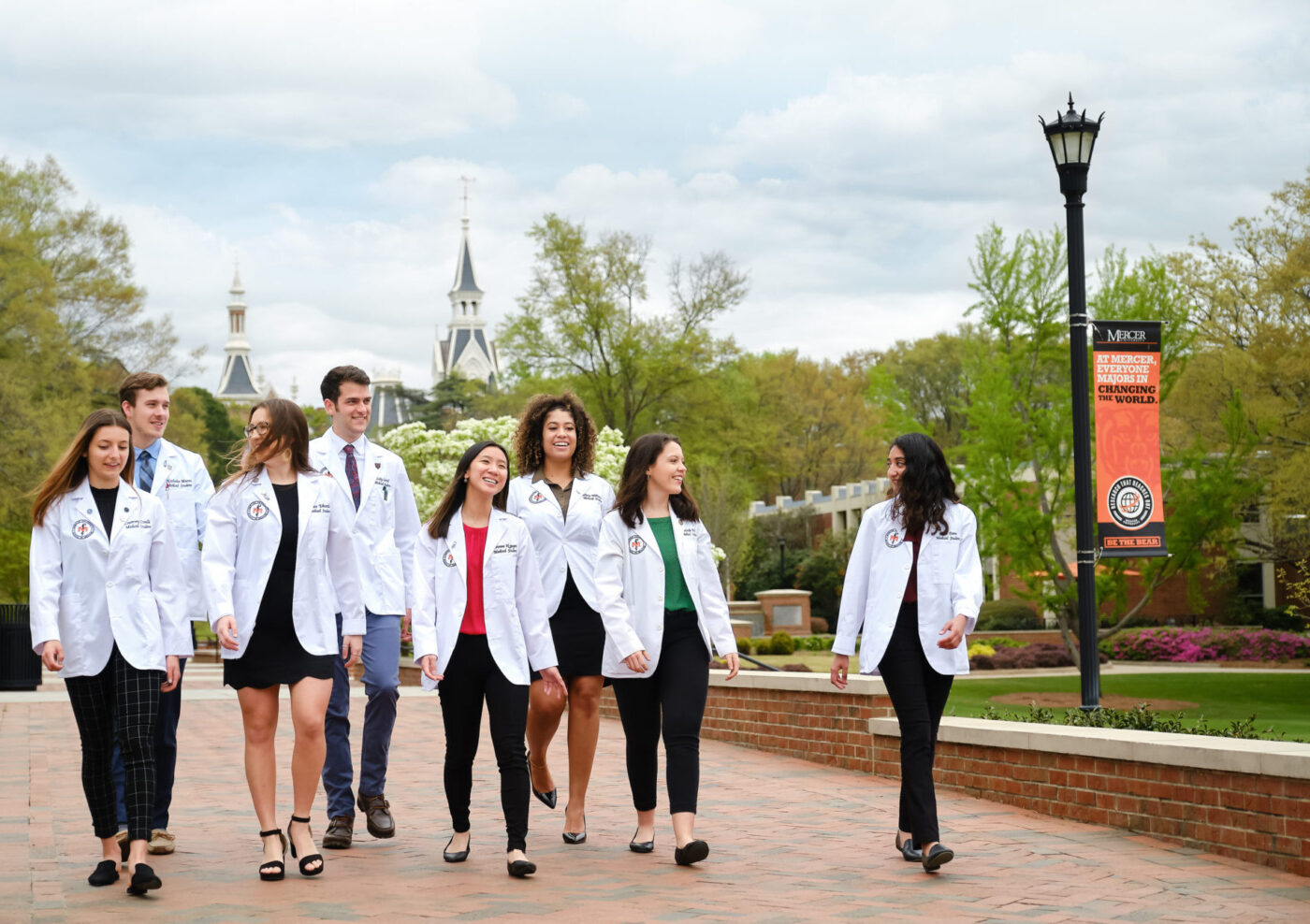
Mercer secondary at a glance (2026-2027 cycle)
- Who receives it: applicants whose AMCAS application is verified and who meet the screen (MCAT percentile rank of 31 or higher and MCAT percentile x cumulative undergraduate BCPM GPA greater than 93, or a percentile of 31 or higher for applicants with graduate degrees or 20 or more graduate hours).
- Deadlines: September 8, 2026 for Early Decision; October 1, 2026 for Early Assurance; January 12, 2027 for the Regular Pool, each by 5:00 p.m.
- Fee: $90, nonrefundable, automatically waived with a valid AMCAS Fee Assistance Program waiver.
- Also required with the secondary: a notarized declaration of Georgia domicile, a state-issued photo ID, the required premedical course form and a photograph.
- Prompts: nine items for 2026-2027: seven essays, one institutional action disclosure and one update field. The set opens with the statement that Mercer “was established in 1982 to educate physicians and health professionals to meet the primary care and health care needs of rural, medically underserved areas of Georgia.”
- Length: Mercer does not publish word limits for these prompts in advance. In recent cycles, each Mercer essay was limited to 230 words. Write to 230 words and follow the limit shown in your portal. Every example below is 230 words or fewer.
Unlike earlier Mercer sets, the 2026-2027 prompts split the old mission question into two essays, replace the question about growing up in a medically underserved area with a “distance traveled” essay and ask about your personal experience with rural medicine. If your portal shows a different version of any question, answer the version in your portal. For prompts at other schools, see IMA’s collection of medical school secondary essay prompts.
Top tips for a strong Mercer secondary
- Plan the set before you write. Nine items is a lot of space. Assign each story to one prompt so you don’t repeat yourself across essays.
- Answer every part. Several prompts have two or three parts (where, what and how; describe and reflect; distance and contribution).
- Make Georgia concrete. Name counties, towns, hospitals and patients’ circumstances (without identifying anyone).
- Use Mercer details accurately. Problem-based learning, community physician mentors, Population Health immersions, the Primary Care Accelerated Track, the rural service scholarships and Mercer Medicine’s rural clinics are all verified features. Explain what they mean to you, not just that they exist.
- Turn it around quickly. Review is rolling, and your file is not reviewed until every component, including the domicile declaration and letters, is in.
- Get a second reader. IMA’s admissions consulting team can review drafts for clarity and fit.
Every example below is labeled “Illustrative example, not an actual applicant essay.” They are teaching tools written for this guide. Do not copy them; your essays must describe your own experiences.
Essay 1: Mission congruence
Prompt: “Summarize your work and learning experiences that reflect congruence with our mission.”
Who answers: All applicants invited to the M.D. secondary (Early Decision, Regular Pool and Early Assurance). Length: no limit is posted in advance; write to 230 words and follow the portal.
What it asks. The prompt opens with Mercer’s founding statement, that the school “was established in 1982 to educate physicians and health professionals to meet the primary care and health care needs of rural, medically underserved areas of Georgia.” Then it asks for evidence. “Work and learning experiences” means jobs, clinical roles, service and coursework, not intentions. “Congruence” means each experience should line up with a part of the mission: primary care, rural communities, medically underserved Georgians.
Approach. Pick two or three experiences and give each one a sentence of action and a sentence of learning. Tie at least one directly to rural or underserved Georgia. Save your career plans for the next essay, which asks about them separately.
Example response (Illustrative example, not an actual applicant essay; 225 words):
For three years I worked night shifts as a certified nursing assistant at a 25-bed critical access hospital in Jeff Davis County, the hospital where I was born. I turned patients, recorded vital signs and learned which families had driven an hour for a visit. When a farmer with heart failure came back for the third time in two months, I asked him why. He could not afford two of his medicines and did not know a cheaper option existed. That conversation taught me that rural care fails most often between visits, not during them.
I took that lesson to a mobile health unit run by our county extension office. On Saturdays I checked blood pressures at feed stores and churches and helped people with readings above 160 get same-week appointments. Over a year we screened about 400 people, and I learned to explain numbers without making anyone feel judged.
In college, my public health capstone mapped primary care offices against travel time in eight south Georgia counties. Seeing families who lived 40 minutes from the nearest doctor on a map made the distances I already knew feel even larger.
These experiences point in one direction: toward primary care for people in places like Jeff Davis County. Mercer’s community physician mentors, Population Health immersions and rural clinics would teach me to do that work well.
Why this example works.
- It names real kinds of work (CNA shifts, a screening program, a capstone) and gives each one a specific lesson, which is what “work and learning experiences” asks for.
- Every experience maps onto the mission: a rural critical access hospital, an underserved population, primary care access.
- The patient story shows reflection, not just exposure: the writer noticed why care failed and drew a conclusion.
- The closing ties the experiences to verified Mercer features (community physician mentors, Population Health immersions, rural clinics) without listing them for show.
Mistakes to avoid.
- Restating the mission back to the committee instead of showing evidence.
- Listing every activity from AMCAS with no reflection.
- Answering the career-plans question here and leaving nothing for Essay 2.
Essay 2: Career vision and Georgia’s primary care need
Prompt: “Based on your understanding of our mission, where and what do you envision yourself doing after completion of medical school and residency, and how does this address the critical need for primary health providers in Georgia?”
Who answers: All applicants invited to the M.D. secondary. Length: no limit is posted in advance; write to 230 words and follow the portal.
What it asks. This question has three parts: where you see yourself, what you will be doing and how that answers Georgia’s shortage of primary care providers. The word “envision” gives you room to be honest about uncertainty, but the committee wants a concrete picture, not “I am open to anything.”
Approach. Name a region or kind of community, a specialty direction and a practice model. Then connect it to the need with something you have seen yourself. If you are considering the Primary Care Accelerated Track, a rural service scholarship or a specific core specialty, it is fine to say so, as long as you explain why.
Example response (Illustrative example, not an actual applicant essay; 222 words):
I see myself as a family physician in southwest Georgia, ideally in a town of five to fifteen thousand people within an hour of Albany. My practice would accept Medicaid, see children and adults, and handle procedures and chronic disease care in the office so that patients do not need to drive to a specialist for every problem. I would also like to spend part of each week precepting medical students, because the doctor who let me shadow him in high school is the reason I believe a small-town career is possible.
This plan addresses Georgia’s need in three ways. First, it puts a primary care physician where one is missing. When the pediatrician in my hometown retired, families started taking their children to the emergency department for ear infections. Second, family medicine covers the widest range of patients, so one physician can fill several gaps. Third, teaching students in rural offices is how the next doctor for that town gets trained.
Mercer’s Primary Care Accelerated Track interests me because it would let me start practice a year earlier with less debt, and its service commitment matches what I already plan to do. Whether or not I am selected, the four-year curriculum’s community physician mentors would prepare me for the same goal: staying in Georgia and practicing where the need is greatest.
Why this example works.
- It answers all three parts: where (southwest Georgia small town), what (family medicine, Medicaid, procedures, precepting) and how it meets the need (three explicit reasons).
- It uses a personal observation (the retired pediatrician) to show the shortage instead of quoting statistics.
- It mentions the ACT accurately (three years, less debt, service commitment) without assuming selection, since ACT applications happen during the first year.
- It shows a long-term commitment that mirrors Mercer’s own outcomes, graduates staying in Georgia and practicing in core specialties.
Mistakes to avoid.
- Naming a competitive subspecialty with no link to primary care or underserved Georgia; if that is your honest goal, explain how it serves the mission.
- Promising a rural career without any sign you know what rural practice involves.
- Overstating the ACT, which current Mercer students apply to in year one, as something you can choose on the secondary.
Essay 3: Service to the underserved
Prompt: “Describe your body of work in service to the underserved and reflect on its importance in preparing you for the practice medicine.”
Who answers: All applicants invited to the M.D. secondary. Length: no limit is posted in advance; write to 230 words and follow the portal.
What it asks. “Body of work” signals that the committee wants a pattern, not a single afternoon. The prompt has two parts: describe the service, then reflect on how it prepares you to practice medicine. The second part is where most applicants come up short.
Approach. Choose your most sustained service commitment and describe what you actually did. Then name two or three specific skills or habits it built and explain how each will matter in a clinic. Service does not have to be clinical, but it should involve people who face barriers to care, money, housing, food or opportunity.
Example response (Illustrative example, not an actual applicant essay; 212 words):
For two and a half years I volunteered at a free clinic in Tift County that serves uninsured adults, many of them seasonal farmworkers. I started at the front desk, then trained as an intake volunteer. I took blood pressures and weights, recorded medication lists and, because I grew up speaking Spanish at home, interpreted for patients who otherwise waited for the one bilingual nurse. On busy nights I handled 25 intakes.
Three lessons from that work will shape how I practice. The first is that a medication list is only accurate if you ask about the pills in a patient’s pocket and the remedies from home. The second is patience with paperwork. Many patients feared that any form might be shared with an employer or an agency, so I learned to explain why we asked each question and what we would do with the answer. The third is humility about language. Interpreting taught me that a correct translation can still miss what a patient means, and that checking understanding is part of care, not an extra step.
Practicing medicine in rural Georgia will mean seeing patients who arrive with the same fears and the same gaps. I want to be the physician who has already learned to ask the second question.
Why this example works.
- It shows a body of work: a long commitment with growing responsibility (front desk to intake to interpreting).
- The reflection is specific. Each lesson names a habit (asking about all medications, explaining forms, checking understanding) that transfers to practice.
- It connects the service to rural Georgia practice, which is the context of every Mercer prompt.
- It describes direct patient-facing tasks accurately and does not inflate a volunteer role into clinical decision-making.
Mistakes to avoid.
- Describing service in general terms (“I gave back to my community”) with no tasks or numbers.
- Writing only description and skipping the “reflect on its importance” half.
- Framing underserved patients as objects of charity rather than people you learned from.
Essay 4: Personal experience with rural medicine
Prompt: “Describe your personal experience with rural medicine.”
Who answers: All applicants invited to the M.D. secondary. Length: no limit is posted in advance; write to 230 words and follow the portal.
What it asks. The wording is “personal experience,” so this is not a research paper on rural health. The committee wants to know what you have seen, done or lived in rural health care settings. Applicants who grew up in rural Georgia can draw on family experience. Applicants from cities or suburbs should describe the rural exposure they have sought out, and be honest about its limits.
Approach. Tell one or two concrete stories, then show what you understand about rural practice because of them: distance, workforce shortages, hospital finances, the breadth of a rural physician’s work or the relationships that make it rewarding. End with what you still want to learn, which is where Mercer’s rural training comes in.
Example response (Illustrative example, not an actual applicant essay; 211 words):
When my grandfather had a stroke in Wheeler County, the ambulance drove seventy minutes to the nearest hospital with a stroke team. He survived, but the drive was part of every conversation that followed. My family learned to plan around distance: which pharmacy was open on Sunday, which specialist would see him by video, which cousin could take a day off for the trip to Dublin.
That year I asked our family doctor if I could shadow her. Over one summer I saw how wide rural practice is. In a single morning she sutured a laceration, adjusted insulin for a teacher, talked a teenager through anxiety and called a hospital two counties away to find a bed. She knew which patients could not read and which ones would not take a pill they could not pronounce. She also carried weight I had not expected. When a patient missed appointments, there was no one else to notice.
I came away with a realistic picture: rural medicine is broad, personal and short on backup. It is also the work I want. What I do not yet have is the training to carry that breadth safely. Mercer’s community physician mentors, Population Health immersions and rural rotation sites are where I hope to learn it.
Why this example works.
- It is personal, as the prompt asks: a family event and a shadowing summer, not statistics.
- It shows understanding of rural practice (distance, breadth of scope, no backup, knowing patients well) drawn from what the writer saw.
- It is honest about limits (“what I do not yet have”), which reads as maturity.
- The Mercer references (community physician mentors, Population Health immersions, rural rotation sites) are accurate and placed where they answer a need the essay set up.
Mistakes to avoid.
- Writing a policy summary about rural hospital closures with no personal experience in it.
- Romanticizing small-town life or describing rural patients as a monolith.
- Claiming deep rural experience you do not have; one honest summer is better than an inflated story.
Essay 5: Unique attributes
Prompt: “Explain to the Admissions Committee experiences, attributes, or qualifications you believe are unique to you that will strengthen the educational environment at MUSM.”
Who answers: All applicants invited to the M.D. secondary. Length: no limit is posted in advance; write to 230 words and follow the portal.
What it asks. The focus is on the educational environment, meaning what your classmates, tutorial groups and faculty would gain from having you there. “Unique” does not mean exotic. It means specific to you: a background, a skill, a perspective or a set of experiences most applicants will not bring.
Approach. Pick one or two attributes and show them in action. Then make the link to Mercer’s learning model, which is small-group problem-based learning in groups of eight or nine. Explain what you would do in that room.
Example response (Illustrative example, not an actual applicant essay; 217 words):
Before applying to medical school, I taught agriculture at a public high school in Emanuel County for four years. I ran the FFA chapter, managed a greenhouse and taught teenagers who often worked on family farms before the bus came. That job gave me two things I would bring to a Mercer tutorial group.
The first is the ability to teach. In a classroom of thirty students, half of whom did not want to be there, I learned to break a hard idea into pieces, check who was lost and try another approach without making anyone feel slow. Problem-based learning asks students to teach one another every week. I am comfortable doing that, and I know how to make room for the quietest person at the table.
The second is a working knowledge of farm life and the health risks that come with it: pesticide exposure, heat illness, injuries from equipment and the pressure to keep working when you are sick because the harvest will not wait. I have pulled a student out of a hot greenhouse who was close to heat exhaustion and spent many evenings with parents who could not leave the farm for appointments. When a case in our group involves a farmer, I can help my classmates understand the patient behind the chart.
Why this example works.
- It answers the prompt’s real question, how the writer would strengthen the educational environment, and keeps returning to it.
- It connects a nontraditional background to Mercer’s verified learning model (small-group PBL) in concrete terms.
- The second attribute adds content knowledge relevant to rural Georgia patients, which classmates from cities may lack.
- It uses specific details (FFA, greenhouse, heat illness) instead of adjectives like “passionate” or “diverse.”
Mistakes to avoid.
- Listing identity categories without saying what you would contribute to classmates.
- Choosing an attribute so common it does not distinguish you, such as “hard-working.”
- Repeating your personal statement; pick an angle the committee has not already read.
Essay 6: Academic readiness
Prompt: “Discuss your academic readiness for the rigors of our medical school curriculum. If necessary, explain how you overcame academic difficulties.”
Who answers: All applicants invited to the M.D. secondary. The second sentence applies only if you have academic difficulties to explain. Length: no limit is posted in advance; write to 230 words and follow the portal.
What it asks. Two parts: show you are ready for Mercer’s curriculum, and, only if needed, explain difficulties and how you overcame them. “Our medical school curriculum” means problem-based learning, so readiness includes self-directed study and group learning, not just grades.
Approach. If your record is strong, give evidence of readiness: upper-level science, a demanding course load while working, research or teaching. If you have a weak semester, low grade or MCAT retake, explain it briefly and factually, show what changed, and point to the evidence that it worked. Then connect your study habits to PBL.
Example response (Illustrative example, not an actual applicant essay; 220 words):
My transcript has one semester I would change. In my first fall at college I earned a D in General Chemistry I while working thirty hours a week at a grocery store to help my mother after my father’s injury. I did not ask for help, and I studied by rereading notes.
I retook the course the next spring, cut my hours to fifteen and changed how I learned. I started a study group of five students that met twice a week, and each of us was responsible for teaching one problem set. I earned an A, and my science GPA rose every semester after that, including A’s in Organic Chemistry II, Biochemistry and Physiology. In my final year I tutored general chemistry for the campus learning center.
I believe that change is the best evidence of my readiness for Mercer. Problem-based learning asks students to find their own learning issues, research them and explain them to a group. I learned to study that way out of necessity, and it works for me. I also learned to recognize early when I am falling behind and to ask for help before a small problem becomes a grade. I expect medical school to be harder than anything I have done, and I now have a method, not just effort, to meet it.
Why this example works.
- It answers both parts: it explains the difficulty in two plain sentences and spends most of its length on readiness.
- It gives verifiable evidence of change (a retake grade, an upward trend, upper-level courses, tutoring).
- It links the writer’s study method to Mercer’s PBL format, which is what “our medical school curriculum” invites.
- The tone is accountable, without blaming others or over-explaining personal hardship.
Mistakes to avoid.
- Spending most of the essay on the hardship and very little on what changed.
- Making excuses or blaming a professor.
- Ignoring the prompt’s first sentence when you have nothing to explain; a strong record still needs evidence of readiness for PBL.
Question 7: Institutional action
Prompt: “Address any institutional action, including honor code or conduct code violations, from your time as an undergraduate or graduate student. Applicants may answer ‘None’ to this question if the action was deleted, expunged, or otherwise removed from their record by the institution.”
Who answers: All applicants invited to the M.D. secondary. Answer “None” if you have no institutional action, or if the action was deleted, expunged or otherwise removed from your record by the institution. Length: no limit is posted in advance; write to 230 words and follow the portal.
What it asks. This is a disclosure question, not an essay prompt. If you have no institutional action, or your institution removed it from your record, write “None.” If you do have one, your answer must be consistent with what you reported on AMCAS and with what your school’s records will show in the background check.
Approach. Use a simple structure: what happened, when, the outcome or sanction, and what you learned and changed. Keep it factual and short. Take responsibility without minimizing or over-dramatizing.
Example response (Illustrative example, not an actual applicant essay; 106 words):
Pattern A (no action): None.
Pattern B (disclosure): In October of my first year, I was found responsible for violating my university’s residence hall alcohol policy when I was present at a gathering where alcohol was served to underage students. The sanction was a written warning, an alcohol education course and ten hours of community service, all completed by December of that year. I have had no further conduct issues. The experience taught me that being present is a choice with consequences. Since then I have held positions of responsibility, including resident assistant in my junior year, where I enforced the same policy I once broke.
Why this example works.
- Pattern A shows the correct answer when there is nothing to report or the action was removed, exactly as the prompt allows.
- Pattern B follows a clear structure: what, when, sanction, completion, reflection and changed behavior.
- It matches the kind of detail an institution’s records would show, which matters because Mercer’s offers depend on a criminal background check and consistent records.
- It ends with evidence of growth rather than a promise.
Mistakes to avoid.
- Leaving the field blank or writing “N/A” when “None” is the requested answer.
- Answering “None” when an action is still on your record.
- Giving a different account than your AMCAS institutional action answer.
Question 8: Application updates
Prompt: “Highlight any substantial updates to your application (e.g., volunteer experiences) that have occurred after you submitted your primary AMCAS Application.”
Who answers: All applicants invited to the M.D. secondary who have substantial updates since submitting AMCAS. Length: no limit is posted in advance; write to 230 words and follow the portal.
What it asks. This is a short update field. “Substantial” is the key word: new roles, significant hours, completed degrees, publications or presentations, awards or new grades. It is not a place for a new essay.
Approach. Use dated, factual bullets or short sentences. Lead with the update most relevant to Mercer’s mission. If you have no substantial updates, say so in one line rather than padding.
Example response (Illustrative example, not an actual applicant essay; 123 words):
Since submitting my AMCAS application on June 3, 2026:
1. Started work as a full-time medical assistant at a federally qualified health center in Baxley (July 2026 to present), rooming patients, recording vital signs and histories and supporting a family physician and a nurse practitioner, about 40 hours per week.
2. Completed 120 additional hours at the free clinic described in my application, for a total of 520 hours, and trained two new intake volunteers.
3. Presented my capstone, a travel-time map of primary care access in eight south Georgia counties, as a poster at my university’s undergraduate research symposium (April 2026, after my AMCAS activities were finalized).
4. Received final spring 2026 grades: A in Physiology, A in Biostatistics, B+ in Immunology.
Why this example works.
- Each update is dated, specific and substantial, which is what the prompt requests.
- The most mission-relevant update (a primary care job at a rural-area health center) comes first.
- Hours and responsibilities are concrete, so the committee can weigh them without guessing.
- It stays short and factual; there is no new essay hidden in the update field.
Mistakes to avoid.
- Repeating activities already on AMCAS with no new information.
- Listing minor updates (a single shadowing day) as substantial.
- Writing reflections here that belong in the essays.
Essay 9: Distance traveled
Prompt: “Highlight any experiences or attributes not covered above that would help the Admissions Committee better understand how your distance traveled to medical school and will contribute to our program or the practice of medicine in Georgia.”
Who answers: All applicants invited to the M.D. secondary. Length: no limit is posted in advance; write to 230 words and follow the portal.
What it asks. “Distance traveled” means the obstacles you overcame and the resources you lacked or built on the way to medical school. The prompt has two parts: help the committee understand that distance, and explain how it will contribute to Mercer’s program or to practicing medicine in Georgia. The phrase “not covered above” means you should not repeat earlier essays.
Approach. Choose a part of your story not yet told. Describe the circumstances briefly and concretely, focus on what you did in response and end with a clear contribution: to classmates, to patients or to the communities Mercer serves. Avoid turning this into a hardship list.
Example response (Illustrative example, not an actual applicant essay; 218 words):
I am the first person in my family to finish college. My parents run a small cattle operation in Montgomery County, and when I was fourteen the farm nearly went under after a drought year. For the next four years I worked mornings before school and weekends at a feed store, and I managed my two younger brothers’ schedules while my mother took a second job. I took dual-enrollment classes online at night because our high school had no AP sciences.
No one in my family knew how to apply to college, let alone medical school. I learned from a school counselor, a library computer and a Mercer Bear Essentials webinar I joined as a high school senior, where medical students from rural towns explained the steps I did not know existed. That night changed what I thought was possible.
This distance will shape what I contribute. In my class, I will be the student who can explain to a classmate why a farmer skips follow-up during calving season. In practice, I will understand patients who have to choose between a clinic visit and a day’s work. And I want to give back what that webinar gave me by helping with Mercer’s pathway programs, so rural high school students hear from someone who came from where they are.
Why this example works.
- It covers new ground (family economics, first-generation status, limited school resources) not used in the other essays.
- It shows action in response to obstacles, not just the obstacles.
- It answers the second part directly, with contributions to classmates, patients and Mercer’s verified pathway programs (Bear Essentials).
- The details are specific enough to be believable without asking for sympathy.
Mistakes to avoid.
- Repeating the academic-readiness or rural-medicine story.
- Writing a list of hardships with no account of how you responded.
- Forgetting the second half of the question: how your path contributes to Mercer or to practice in Georgia.
Program-specific questions
Mercer’s Early Assurance, Mercer Medical Scholars and MSPCS linkage applicants use the same AMCAS and secondary process as other applicants, and no separate essay prompts for those routes are published for the 2026-2027 cycle. The Primary Care Accelerated Track, RCN-ACT and rural scholarship programs have their own applications after you enroll or are accepted, not in the secondary. If your portal shows an additional question for your track, answer it in the same plain, specific style.
Interview Format and Preparation
At MUSM, interviews are held virtually over Zoom. The interview is a chance for faculty, students and admissions staff to learn about you, and for you to learn about Mercer and meet the people you would train with. The details below come from the school’s Interview Invitation page and its 2026-27 timeline.
What is confirmed about the format
- One interview, two interviewers. Each applicant has a 30-45 minute interview with two interviewers in a Zoom breakout room. One interviewer is an Admissions Committee member, who may be a basic science or clinical faculty member or a senior medical student.
- Open file. Both interviewers have access to your primary application, secondary application and letters of evaluation before the interview and for the rest of the application year. Each submits comments for the committee.
- The committee. The Admissions Committee has 35 voting members. Each member can see the interviewers’ comments, your primary and secondary applications, your letters and your declaration of Georgia domicile.
- Schedule. Interview days run on Tuesdays and Thursdays from about 10:00 a.m. to 12:15 p.m. and include an introduction, the interview and group time with students. About 400 applicants were interviewed for the 2025 entering class.
- Time with ambassadors. Applicants also spend one hour with MUSM Ambassadors, current Year II medical students. The school states plainly that ambassadors are assessing you during this time. They generally do not see your record, and they submit brief written comments that go into your packet for the committee to use when it rates and ranks applicants.
- Logistics. An email arrives within one week of your interview with specific information and your Zoom link. Questions go to the Admissions office at 478-301-5425.
- Feedback. After the interview, you are invited to complete an anonymous survey. If you have concerns about the fairness of an interview encounter, the school encourages you to tell the Admissions dean before the end of your interview day.
2026-2027 interview windows
| Track | Interviews | Last day to receive an invitation |
|---|---|---|
| Early Decision | August 18 to September 17, 2026 | September 11, 2026 |
| Early Assurance | October 8, 2026 (single interview day) | October 6, 2026 |
| Regular Pool | September 24, 2026 to February 11, 2027 | January 25, 2027 |
For Early Assurance applicants with a good undergraduate record, the interview focuses on work, volunteer and service experiences, personal characteristics, motivation, goals and long-term plans in relation to Mercer’s mission.
How to prepare (general guidance)
Mercer does not publish an interview scoring rubric, so the advice below is general practice guidance built around what the school does publish.
- Know your file cold. Your interviewers have read everything. Reread your AMCAS activities, personal statement and all nine secondary answers, and be ready to go deeper on any of them.
- Prepare your Georgia and mission answers. Expect questions about where you are from, why rural or underserved Georgia matters to you, what primary care means to you and where you see yourself practicing. Have specific examples, not general statements.
- Practice talking through a problem. Mercer’s curriculum is problem-based, and a faculty interviewer may want to see how you reason. Practice explaining your thinking out loud on ethics scenarios and health care access questions.
- Treat the ambassador hour as part of the interview. Be yourself, but remember that ambassadors submit comments. Ask good questions about campus life, PBL groups and rural rotations.
- Get the virtual setup right. Test your camera, microphone and connection. Use a quiet room with good lighting and a neutral background, and dress as you would for an in-person interview.
- Prepare questions for them. Good questions show you have done your research: how campus assignments usually work out, what Population Health immersions look like on each campus, how students find research mentors, or how many students apply to the ACT.
Preparing for an interview can be stressful and overwhelming. Many applicants find it helpful to practice with someone who knows how medical school interviews work. IMA’s medical school admissions consulting services include personalized coaching and mock interviews.
Frequently Asked Questions
Can out-of-state applicants apply to Mercer University School of Medicine?
No. MUSM considers only applicants who have established Georgia residency. You must have Georgia domicile by the time you submit your application and keep it for the 12 consecutive months before classes start. If you cannot claim Georgia as your legal residence, AMCAS will not let you send your application to Mercer at all. If you are moving to Georgia, plan your timeline so your domicile is established before you apply, and keep documents that prove the date. Remember that legal residency is only the minimum. The school says successful applicants generally have significant roots in Georgia.
Does Mercer accept international students or DACA recipients?
Mercer’s eligibility rules require applicants to be U.S. citizens or U.S. permanent residents. Applicants who are neither, including international students, are not eligible under the published criteria. Mercer’s pages do not describe a separate policy for DACA recipients, so contact the Admissions Office directly before applying if this applies to you.
What MCAT score do I need for Mercer?
You need an MCAT taken on or after April 1, 2023 with a percentile rank of at least 31, and your MCAT percentile multiplied by your cumulative undergraduate BCPM GPA must be greater than 93 to receive a secondary. The Class of 2030 averaged a 502, and accepted applicants for the 2025 entering class had a median of 504. Mercer uses only your highest score. Run the formula with your own numbers. For example, a 40th-percentile score needs a BCPM GPA above 2.325, while a 31st-percentile score needs a BCPM GPA above 3.0.
What GPA do I need for Mercer?
Mercer does not publish a minimum GPA. The BCPM GPA enters through the screen formula, and the Class of 2030 averaged a 3.55 BCPM GPA and a 3.65 overall GPA. Accepted applicants for the 2025 entering class had a median overall GPA of 3.77 and a median science GPA of 3.70. Those are averages and medians, so many admitted students were below them and many above. If your BCPM GPA is low, a higher MCAT percentile can carry you past the screen, and graduate coursework of 20 or more hours removes the GPA part of the formula. IMA’s medical school GPA calculator can help you estimate your BCPM GPA before AMCAS verifies it.
What is Mercer’s acceptance rate?
There is no official acceptance rate, because the number of acceptance offers is not published. For the 2025 entering class, Mercer received 1,246 verified applications, interviewed 400 applicants (about 32%) and enrolled 176. Be wary of numbers that divide the entering class size by the applicant total, such as 176 out of 1,246 (about 14%). That is a matriculation ratio, not an acceptance rate. The more useful questions are whether you meet the residency rule and the screen, and how strongly your application shows fit with the rural primary care mission.
Does Mercer require CASPer or PREview?
Mercer does not list CASPer among its requirements. The AAMC PREview exam is optional for Early Decision and Regular Pool applicants and required for Early Assurance applicants in the Agnes Scott linkage. If you take PREview anyway, a strong score can add information to your file, but it is not needed to apply.
How do I choose my campus?
You don’t choose a campus on your application. After acceptance, you submit a Campus Preference Request Form from your acceptance packet. Campuses are assigned first-come, first-served and are not guaranteed, and if you don’t get your first or second choice you can join a wait list. Early Assurance applicants go through campus preference after final acceptance in June. Because timing matters, return your deposit, acceptance letter and campus form promptly. All three full campuses teach the same curriculum.
Is Mercer’s Early Decision binding?
Under the AMCAS Early Decision Program, you apply to only one school by the Early Decision deadline and do not apply elsewhere until you receive a decision. Mercer’s 2026-2027 Early Decision applicants are notified by September 30, 2026. Applicants who are not accepted may be deferred to the Regular Pool. Choose Early Decision only if Mercer is your clear first choice and your application is ready by early August.
What is the Primary Care Accelerated Track, and when do I apply?
The ACT is a three-year M.D. path for students who want family medicine, internal medicine or pediatrics. You apply during your first year at Mercer, not on the secondary, in a window that runs from January to early February. Selected students receive a scholarship covering tuition for the second and third years and commit to three continuous years of full-time practice in an approved medically underserved rural Georgia county after residency. A separate psychiatry version, the RCN-ACT, is offered only in Columbus.
How much does Mercer medical school cost?
For 2026-27, M.D. tuition is $44,864 a year, and the full-time Year 1 cost of attendance is $75,830. The cost of attendance for the four standard years at 2026-27 rates adds up to $310,177, and the three-year ACT has higher annual tuition ($53,492) but one fewer year. Health insurance is required and is charged each semester unless you waive it with other coverage. Rural service scholarships, such as the Nathan Deal and Children’s Rural Pediatric scholarships, can cover most or all of tuition.
Does clinical experience abroad count for Mercer?
Mercer does not publish a minimum number of clinical hours or rules about where they must happen. What matters most is what you did, what you learned and how it connects to Mercer’s mission. Supervised, hands-on pre-health internships in resource-limited settings can show you understand care where doctors and supplies are scarce, but pair any experience abroad with clinical and service work in Georgia, especially in primary care or rural settings. The committee wants to see that your commitment extends to Georgia communities.
Can I apply to Mercer while I’m still in college?
Yes. You must finish your bachelor’s degree, and any other degree you are enrolled in, by June of the year you start. Prerequisites do not have to be finished when you apply, but acceptance depends on official transcripts showing completion by June. Many applicants build experience during college through campus clinical jobs, local volunteering and medical internships for undergraduates in the summers before their application year.
Does Mercer accept transfer students?
Not at this time. Mercer is not currently accepting third-year transfer applications. If you are already in another medical school, you would need to apply as a new applicant through AMCAS, subject to AMCAS and school policies.
How many letters of recommendation does Mercer want?
At least three letters or one committee letter, and no more than seven, all through the AMCAS Letter Service. Mercer recommends at least one letter from a science faculty member who taught you and at least one from a physician, health care professional or health care manager who supervised or mentored you. Three letters must be on file before you can be considered for an interview, so request them early.
How big is Mercer’s entering class?
The 2025 entering class had 176 students, all Georgia residents, and 73 of them entered through Early Decision. For the class entering in 2027, Mercer estimates 180 new students across its campuses. Total M.D. enrollment was 689 in October 2025.
Can I send a letter of intent or an update letter to Mercer?
Yes. Mercer accepts one letter of intent, one letter of interest and one notice of significant updates per applicant, and each must be a PDF. A letter of intent is for interviewed applicants who will attend if accepted. An update letter should report something substantial, such as a publication, a major honor or significant new health care or community service.
Is the Mercer interview in person?
No. Interviews are conducted virtually over Zoom. You will have one 30-45 minute interview with two interviewers and spend an hour with second-year student ambassadors, who also submit comments. You can still visit: each campus offers student-led tours, and accepted students can schedule a second look.
Does Mercer offer a BS/MD program?
Mercer offers undergraduate pathways called Mercer Medical Scholars (four years of college plus four of medical school) and Accelerated Mercer Medical Scholars (three plus four). Both are for high-achieving Georgia students admitted to Mercer’s Macon campus, and students apply to the School of Medicine through Early Decision after their junior or sophomore year. The accelerated pathway awards a B.S. in Biomedical Sciences after the first year of medical school and does not require the MCAT for students who meet every program requirement.
What if my numbers are below the screen?
Consider a structured path. Mercer’s M.S. in Preclinical Sciences offers an M.D. interview opportunity to students who earn at least a 3.5 GPA in their first semester, and the Agnes Scott College post-baccalaureate program offers an Early Assurance linkage for eligible students. A graduate degree or 20 or more graduate hours also changes the screen to MCAT percentile 31 alone. Each route has its own requirements, so read them closely before you commit.
Related Medical School Guides
If you want to know more about other medical schools in Georgia and the South, or you are comparing Mercer with other “medical schools near me,” these guides are the closest comparisons:
- Medical College of Georgia: Georgia’s public M.D. school, with a strong preference for Georgia residents and regional campuses across the state, a natural second option for Mercer applicants.
- University of Georgia School of Medicine: Georgia’s newest M.D. program in Athens, which welcomed its first class in 2026 and also emphasizes serving Georgia communities.
- Morehouse School of Medicine: an Atlanta M.D. school with a primary care and underserved-community mission and its own Columbus campus.
- Emory School of Medicine: a research-intensive Atlanta school with no state residency rule, a useful contrast to Mercer’s community model.
- Belmont Frist College of Medicine: a newer private M.D. program in Nashville for applicants comparing mission-driven schools in the region.
- University of Louisville School of Medicine: a Southern M.D. option for applicants widening their list beyond Georgia.
For a statewide comparison of all seven Georgia programs, see IMA’s guide to medical schools in Georgia. You can browse every school in IMA’s medical school guides.
More medical school guides
Whether you looked for medical schools outside of Georgia or searched for medical schools near me, IMA’s school guides cover programs across the country:
- Campbell University School of Osteopathic Medicine (CUSOM)
- ECU Brody School of Medicine
- Edward Via College of Osteopathic Medicine (VCOM)
- University of South Carolina Medical School
- Lewis Katz School of Medicine at Temple University
- Philadelphia College of Osteopathic Medicine (PCOM)
- Geisinger Commonwealth School of Medicine (GCSOM)
- Penn State Medical School
- CUNY School of Medicine
- SUNY Downstate Medical School
- NYIT College of Osteopathic Medicine
- NYU Long Island School of Medicine
- Albany Medical College
- TOURO College of Osteopathic Medicine
- Norton College of Medicine at Upstate Medical University
- Jacobs School of Medicine at the University at Buffalo
- Hofstra Zucker School of Medicine
- Weill Medical College of Cornell University
- University of Rochester Medical School
- Icahn School of Medicine at Mount Sinai
- Renaissance School of Medicine at Stony Brook University
- Albert Einstein College of Medicine
- Ohio University Heritage College of Osteopathic Medicine
- Northeast Ohio Medical University (NEOMED)
- University of Cincinnati College of Medicine
- University of Toledo College of Medicine
- Wright State University Boonshoft School of Medicine
- Ohio State University College of Medicine
- Rowan University School of Osteopathic Medicine
- Hackensack Meridian School of Medicine (HMSOM)
- Rutgers New Jersey Medical School (NJMS)
- Rutgers Robert Wood Johnson Medical School
- Cooper Medical School of Rowan University (CMSRU)
- A.T. Still University Kirksville College of Osteopathic Medicine
- Saint Louis University School of Medicine
- University of Missouri Medical School
- Kansas City University (KCU)
- UMKC School of Medicine
- New York Medical College
- University of Pittsburgh School of Medicine
- University of Wisconsin Medical School
- VCU School of Medicine
- University of Maryland School of Medicine
- Case Western Medical School
- University of North Carolina Medical School
- University of Florida Medical School
- Boston University College of Medicine
- California University of Science and Medicine
- UC San Diego Medical School
- California Northstate University College of Medicine
- Touro University of California
- CHSU College of Osteopathic Medicine
- UC Davis School of Medicine
- Harvard Medical School
- UC Riverside School of Medicine
- USC Keck School of Medicine
- UT Southwestern Medical School
- Long School of Medicine at UT Health San Antonio
- University of the Incarnate Word School of Osteopathic Medicine
- UT Austin’s Dell Medical School
- UTMB School of Medicine
- McGovern Medical School at UT Health
- Johns Hopkins School of Medicine
- The University of Texas Rio Grande Valley School of Medicine
- UNT Texas College of Osteopathic Medicine
- University of Houston College of Medicine
- Texas A&M College of Medicine
- Baylor College of Medicine
- George Washington University School of Medicine
- Vanderbilt University School of Medicine
- St. George’s University School of Medicine
- Lake Erie College of Osteopathic Medicine (in Pennsylvania)
- Sidney Kimmel Medical College at Thomas Jefferson University
- Wake Forest University School of Medicine
- Western University of Health Sciences (in California)
- Drexel University College of Medicine
- Stritch School of Medicine at Loyola University Chicago
- Georgetown University School of Medicine
- Yale School of Medicine
- Perelman School of Medicine
- UCLA Medical School
- NYU Medical School
- Washington University School of Medicine
- Brown Medical School
How International Medical Aid Can Help
At International Medical Aid (IMA), our goal is to help aspiring physicians understand the process and present their best application. There’s no doubt that applying to medical school is stressful and challenging, no matter who you are or where you come from. IMA has no affiliation with Mercer University School of Medicine, and nothing below affects admission decisions. These are services you can use alongside your own preparation.
Clinical internships abroad
One of IMA’s most popular programs is our clinical internship program for pre-medical and gap year students. IMA’s internships for pre-med students place interns in hospitals and clinics in Kenya and other sites, where they work under the supervision of local physicians and nurses. Interns take vital signs, do patient intake and triage and help with direct patient care under supervision. Because the sites serve communities with limited access to care, pre-med internships abroad can give you firsthand experience with the same kinds of barriers Mercer’s mission addresses in rural Georgia: distance, cost, staffing shortages and scarce resources. The experience works best when you reflect on it carefully and connect it to the work you want to do at home.
To compare IMA’s medical internships abroad and other healthcare internships abroad, explore the program pages on our website and reach out with any questions.
Admissions consulting and interview coaching
There’s no better way to prepare your application than with one-on-one, personalized coaching. IMA’s medical school admissions consulting program was developed to meet each applicant’s needs at every step. No two candidates are the same, so our experts take an individualized approach. They can advise on your essay responses, including Mercer’s nine secondary items, and prepare you for your interview with mock interviews. Whether you interview well naturally or not, practice helps.
Next step: contact us with questions about the application process, our medical school guides, our internships or our admissions consulting services.
Final Thoughts and Sources
We at IMA wish you the best of luck as you pursue your dream of studying medicine at Mercer University School of Medicine. Mercer is a clear choice for Georgia residents who want to practice primary care in the communities that need it most. Start by confirming your Georgia domicile dates, then run the screen formula on your own MCAT percentile and BCPM GPA. If both check out, decide between Early Decision and the Regular Pool, line up three letters through AMCAS and begin drafting the nine 2026-2027 secondary items before your invitation arrives. Throughout, show the committee where in Georgia you come from and where you hope to serve.
Source notes
Facts were checked on October 18, 2026. Class averages describe the Class of 2030 (entered 2026); medians, applications, interviews and matriculants describe the 2025 entering class. Costs are for the 2026-27 academic year. Secondary prompts are for the 2026-2027 application cycle.
- Mercer University School of Medicine, MD Application Process (Class of 2030 Profile).
- MUSM, Application Deadlines, 2026-27 Application Cycle Timeline.
- MUSM, Admissions Process; Interview Invitation; Next Steps for Accepted Students; Early Assurance Program; Alternate Path to Admission; Technical Standards (medicine.mercer.edu/admissions/doctor-of-medicine/).
- MUSM, 2026-2027 Tuition, Fees and Other Estimated Costs (PDF, updated June 2026); Financial Planning FAQ and New MD Students checklist.
- MUSM, Vision, Mission and Values; About the School; Message from the Dean; Strategic Plan and Goals 1-4; Leadership; Academic Clinical Partners; LCME Accreditation.
- LCME, Accredited U.S. Programs directory (updated October 14, 2026).
- MUSM, Campus Locations and Macon, Savannah and Columbus campus facilities pages; Columbus Expansion.
- MUSM, Doctor of Medicine academics; Year I and II PBL; Year I and II Clinical Skills; Year III Clinical; Year IV Clinical.
- MUSM, Rural Health Scholarships: Primary Care Accelerated Track; Rural Critical Need Accelerated Track (Psychiatry); Nathan Deal Scholarship; Children’s Rural Pediatric Scholarship.
- MUSM, Student Research; Rural Health Impact; Pathways to Medicine; MSPCS Linkage Agreement; graduate program pages (Preclinical Sciences M.S., Family Therapy M.F.T. and COAMFTE accreditation, Biomedical Sciences Ph.D., Rural Health Sciences Ph.D. curriculum).
- MUSM, Class of 2026 page (Match Day March 20, 2026); Alumni page and alumni spotlights (Chris Kiker, M.D. ’14; Anna Spelts, M.D. ’18); Student Affairs and Services; Student Wellness; Student Ambassadors; faculty directory profiles.
- AAMC, Medical School Admission Requirements (MSAR), Mercer University School of Medicine profile, 2026 edition (2025 entering class data; AAMC Data Warehouse as of October 29, 2025; TSF 2025-26; LCME Part I-B 2024-25), accessed October 18, 2026.
- Mercer University, Mercer Medical Scholars Program.
- Mercer University news (den.mercer.edu): Loraine Sumner named medical director of Mercer Medicine’s rural clinics (January 14, 2025); Helen King named associate dean for student affairs (July 15, 2026); Stephanie Beavers named senior associate dean of the Macon campus (July 27, 2026); Georgia ACP Jean Sumner Commitment to Rural Care Award (November 18, 2025); Daniel Gordon named Georgia Primary Care Physician of the Year (July 15, 2022); Allen Lee and SouthlandMD (October 6, 2023); Dr. Alice House named Joy McCann Professor (August 1, 2025).
- 2026-2027 Mercer secondary prompt wording: Med School Insiders, Mercer University School of Medicine secondary essay prompts, 2026-2027 listing (checked October 18, 2026). Mercer does not post its secondary prompts publicly.