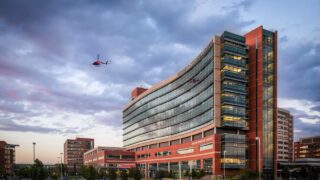

The University of Colorado Anschutz School of Medicine (CU SOM) is Colorado’s public MD school and one of the oldest medical schools in the Rocky Mountain West. It began in 1883 with two professors and two students, moved to Denver in 1924 and moved again in 2008 to the Anschutz Medical Campus in Aurora, where it shares a campus with the schools of nursing, dental medicine, pharmacy and public health, the University of Colorado Hospital and Children’s Hospital Colorado.
CU SOM is known for its primary care strength, a large research enterprise and a curriculum that puts every student into a year-long longitudinal integrated clerkship. Students can train on the main campus in Aurora, on a four-year regional campus in Fort Collins with Colorado State University, in Colorado Springs or in a rural Colorado community, and a new three-year MD option, the Peak-to-Peak Pathway, enrolls its first class in summer 2027.
This guide is for students applying in the 2026-2027 cycle to start medical school in July 2027 as the Class of 2031. It covers the school’s mission, accreditation, programs and tracks, the Trek Curriculum, current requirements and deadlines, 2026-27 tuition and cost of attendance, clinical training, notable people, admissions statistics, every 2026-2027 secondary essay prompt with an illustrative example and analysis, the interview and a long list of frequently asked questions. Facts were checked on October 18, 2026.
Key Takeaways
- Check the MCAT screen first. For the 2026-2027 cycle you need an MCAT score of 507 or higher to receive a secondary. Scores must date from January 2024 through October 2026, and the committee uses your best total score from a single test date.
- Mark your dates. The AMCAS deadline is October 15, 2026, secondaries begin in early July and are due November 30, 2026, interviews run from September 2026 through March 2027 and offers roll out from October 15, 2026.
- Casper is required. Your secondary file is not complete without Casper results, the secondary fee (or an AAMC FAP waiver) and three to five letters or a committee letter.
- Know the numbers. In the 2025-2026 cycle the school received 10,444 primary applications, interviewed 687 applicants and had accepted 325 by April 2, 2026. The Class of 2030 that started in July 2026 has 188 students, 91 of them Colorado residents. Accepted applicants in the 2025 entering class had a median MCAT of 516 and a median GPA of 3.91.
- Residents and non-residents both get in. Each class is roughly half Colorado residents and half non-residents, and there is no quota.
- Plan for the cost. 2026-27 first-year tuition is $48,904 for Colorado residents and $74,859 for non-residents, who pay a $25,955 accountable fee. The estimated first-year cost of attendance is $93,813 for residents and $119,768 for non-residents. Indebted graduates in 2024-2025 left with an average of $218,292 in medical school debt.
- No early decision. CU SOM does not offer an Early Decision Program, and it accepts out-of-state, Canadian, international and DACA applicants.
- Choose your program on the secondary. You can add one optional essay for Fort Collins, Colorado Springs or the Rural Program, one for a Peak-to-Peak accelerated pathway and essays for the MD-MS in Aerospace Engineering, MD-MBA or MD-MPH.
- Next step: draft the two required essays (500 and 300 words) before your secondary arrives, and decide early whether a branch or pathway fits your goals.
Key Statistics About the University of Colorado School of Medicine
The snapshot below collects the figures applicants ask about first. Application counts are from the school’s 2025-2026 admissions tracker (updated April 2, 2026), class size is for the Class of 2030 that matriculated in July 2026, and costs are for the 2026-27 academic year. Median MCAT and GPA are for all accepted applicants in the 2025 entering class.

| Metric | Value | Year or cohort | Source and definition |
|---|---|---|---|
| School and degree | University of Colorado Anschutz School of Medicine, MD. Anschutz Medical Campus, Aurora, with a Fort Collins regional campus and Colorado Springs and rural clinical programs | 2027 entry | CU SOM Admissions. Public; founded 1883 |
| Accreditation | LCME, full accreditation after the March 2025 survey; next full site visit in 2032-33; first accredited 1938 | Current | CU SOM LCME Accreditation page |
| Primary applications | 10,444 | 2025-2026 cycle (Class of 2030) | CU SOM Admissions Tracker, updated April 2, 2026 |
| Secondary applications | 7,508 | 2025-2026 cycle | CU SOM Admissions Tracker |
| Interviewed applicants | 687 (interviewed / primary applications: 6.6%) | 2025-2026 cycle | CU SOM Admissions Tracker. This is an interview ratio, not an acceptance rate |
| Accepted applicants | 325 as of April 2, 2026 (accepted / primary applications: about 3.1% at that date) | 2025-2026 cycle | CU SOM Admissions Tracker. Offers can continue from the alternate list after April 2 |
| Entering class | 188 students from 30 states and 19 countries; 91 Colorado residents | Class of 2030 (July 2026) | CU Anschutz news, July 24, 2026 |
| Positions in the entering class | 184 | Current FAQ | CU SOM Admissions FAQ |
| Median MCAT | 516 (mean 516.3); section medians 129 Chem/Phys, 128 CARS, 129 Bio/Biochem, 130 Psych/Soc | 2025 entering class | AAMC MSAR, all accepted applicants. Separate requirement: MCAT 507 or higher to receive a secondary (2026-2027 cycle, CU SOM Requirements page) |
| Median GPA | 3.91 overall | 2025 entering class | AAMC MSAR, all accepted applicants |
| Interviewed, by residency | 669: 160 in-state, 499 out-of-state, 10 international | 2025 entering class | AAMC MSAR, interview data provided by the school |
| Total MD enrollment | 811 students | October 2025 | AAMC MSAR (AAMC Data Warehouse) |
| Early Decision Program | Not offered | 2026-2027 cycle | AAMC MSAR |
| Year 1 tuition | $48,904 resident; $74,859 non-resident (resident rate plus $25,955 accountable fee) | 2026-27 | CU Anschutz Bursar, School of Medicine tuition and fees 2026-2027 |
| Year 1 cost of attendance | $93,813 resident; $119,768 non-resident | 2026-2027 (Fall 2026 to Summer 2027) | CU Anschutz 2026-2027 estimated cost of attendance, MD Class of 2030; includes tuition, fees, books, health insurance allowance, living expenses and loan fees |
| Secondary fee | $100, non-refundable; waived only for AAMC FAP approval | 2026-2027 cycle | CU SOM Apply page and FAQ |
| Enrollment deposit | $200, refundable and applied to tuition; due June 25, 2027 | 2026-2027 cycle | AAMC MSAR |
| Average graduate debt | $218,292 (indebted graduates); 83% of students receive financial aid | Academic year 2024-2025 | AAMC MSAR (LCME Part I-B) |
| Prior-year tuition and fees (TSF) | $47,856 in-state; $73,811 out-of-state; total cost of attendance $88,131 and $114,086 | 2025-2026 | AAMC MSAR (AAMC Tuition and Student Fees survey). Shown for comparison; the 2026-27 rows above are current |
| Deadlines | AMCAS October 15, 2026; secondary November 30, 2026 | 2026-2027 cycle (Class of 2031) | CU SOM Timeline |
| Match outcomes | 180 students matched in 34 states; 59 stayed in Colorado | Match 2026 | CU Anschutz news, March 20, 2026 |
| Primary care | 45% of graduates enter primary care residencies | Data used by U.S. News, 2026 | CU Anschutz news, April 7, 2026 |
Mission and Educational Priorities
The school’s mission is to “provide Colorado, the nation and the world with programs of excellence in” four areas. In the school’s words, they are “Education through the design, implementation and evaluation of educational programs for medical students, allied health students, graduate students, residents and fellows, practicing health professionals and the public-at-large”; “Research through the development of new knowledge in the basic and clinical sciences, as well as in public and community health, health policy and health sciences education”; “Clinical care through state-of-the-art clinical programs which reflect the unique educational and scholarly environment of the University, as well as the needs of the patients and communities it serves”; and “Community collaborations by forming partnerships with the broader community, learning from the experiences of community members and sharing the School’s expertise and knowledge, in order to promote healthier and more resilient communities, address the social, environmental and economic determinants of health, and advocate for health equity.”
Three themes run through that mission, and each one has practical meaning for applicants.
Colorado comes first, but not only Colorado. The mission names Colorado before the nation and the world, and the school’s admissions pages say Colorado residents are a high priority. Yet the school also says each class is “roughly half Colorado residents and half non-Colorado residents,” with no quota. Non-residents should show why they want to train in Colorado and what they would bring to its communities. Residents should not assume residency alone will carry an application.
Community collaboration is part of the mission, not an extra. The fourth mission area was written around partnerships, the social determinants of health and health equity. You can see it in the curriculum’s Health & Society pillar, in the required Service Learning Milestone and in clinical programs built with communities in Fort Collins, Colorado Springs, rural Colorado and Denver Health. Applicants with sustained service that involved listening to a community, not only serving it, fit this priority.
The curriculum is organized around three values. The Trek Curriculum is built on leadership, curiosity and commitment. These words appear in the first required secondary essay, in the Plains curriculum and in the school’s description of its graduates. The admissions committee also lists the personal attributes it considers: leadership; communication skills; empathy and altruism; curiosity, creativity and innovation; and resilience and work ethic. Use these as a checklist when you review your experiences. If an activity shows none of them, it probably does not belong at the center of your application.
What this means for your application:
- Show sustained, not occasional, engagement with patients and communities, ideally in settings like the safety-net clinics and rural sites where CU students train.
- Give evidence for each of the three values. One clear story per value is better than a list.
- Explain your Colorado connection if you have one, and your reasons for wanting Colorado if you do not.
- If you are drawn to a branch or pathway, make sure the rest of your application supports that interest.
Accreditation and Institutional Identity
The MD program is accredited by the Liaison Committee on Medical Education (LCME), the national accreditor for MD programs. The school was first accredited in 1938. Its most recent full LCME survey visit took place in March 2025, and the result was full accreditation. The next full site visit is scheduled for the 2032-33 academic year. LCME accreditation matters because graduates need it to be eligible for ACGME-accredited residency programs, for licensure in most states and for federal financial aid.
You will see the school under several names. Its current name is the University of Colorado Anschutz School of Medicine, often shortened to CU Anschutz School of Medicine, CU School of Medicine, CUSOM or CU SOM. Some systems still use University of Colorado Denver names, and you will see them in practical details: the FAFSA school code you use is the University of Colorado Denver code (004508), and the CU Denver College of Liberal Arts and Sciences runs the undergraduate half of the BA/BS-MD program.
The school is part of the University of Colorado system, and the regional campus in Fort Collins is formally called the University of Colorado Anschutz School of Medicine at Colorado State University. Students there earn the same CU MD degree, follow the same Trek Curriculum and meet the same graduation standard as students in Aurora.
The school is large too, with more than 5,000 full-time faculty and about 3,000 community volunteer faculty. The 2026-2027 CU Anschutz catalog describes a campus site of 256 acres with clinical, research and education zones, built as a redevelopment of a decommissioned US Army facility, with industry partners in the adjacent Fitzsimons Innovation Community. The history of the school also explains its research reputation: it is where Tom Starzl, MD, performed the world’s first liver transplant, where Ted Puck developed a classification system for human chromosomes and where Henry Swan pioneered cooling patients to slow the heart for open-heart surgery.
In U.S. News rankings, which no longer assign numerical ranks to medical schools, the 2026 edition placed the school in the top tier for research, one of 16 schools in that tier, and in the second tier for primary care. Rankings measure only part of what a school offers. Use them as one input, not a decision.
Medical Programs and Affiliations
The MD program and where you can train
Every MD student follows the Trek Curriculum, but the school offers several distinct training settings. You indicate interest in them on the secondary application, and all applicants are also considered for the main campus in Aurora.
- Anschutz Medical Campus, Aurora. The main campus, home to most of the class, the University of Colorado Hospital and Children’s Hospital Colorado.
- Fort Collins Regional Medical Campus (CU Anschutz School of Medicine at CSU). A four-year regional campus run with Colorado State University. It admits 14 students per year, teaches in small groups, works closely with CSU’s College of Veterinary Medicine and Biomedical Sciences and uses a One Health framework. It is housed on the fourth floor of the CSU Health and Medical Center. Because of visa rules, the branch cannot accept international applicants.
- Colorado Springs LIC Program. Students start and finish in Aurora and spend their second-year clerkship in Colorado Springs and Southern Colorado communities such as Pueblo, Monument, Woodland Park and Cañon City. The program began with 24 students in 2016 and now accepts 30 students per year.
- Rural Program. Founded as the Rural Track in 2005, the program places students in a rural Colorado community for the Foothills clinical year and adds rural-focused sessions during the Plains. It accepts up to 20 students per class. Students are typically selected before matriculation, and offers are made on a rolling basis until slots fill, usually by mid-April.
Applicants can apply to only one of the Fort Collins, Colorado Springs and Rural programs. The MD-MS in Aerospace Engineering Sciences is the exception: you can pair it with any other training program.
The Peak-to-Peak Pathway: a three-year MD
The Peak-to-Peak Pathway is a new accelerated, three-year MD with a direct path into a Colorado residency for students committed to one of five specialty tracks: pediatrics, family medicine, rural family medicine, internal medicine primary care and internal medicine/infectious diseases. The first class matriculates in summer 2027, and the school plans to enroll about eight students, one or two per pathway. The family medicine and internal medicine tracks are based at Denver Health, pediatrics at Children’s Hospital Colorado and rural family medicine in the community where the student has a directed residency match. Each pathway starts with a first-year preceptorship and includes a guaranteed placement in that setting’s longitudinal integrated clerkship.
Applicants follow the normal CU SOM application and indicate interest in an accelerated pathway on the secondary. If accepted to the school, selected students complete an additional interview day with the accelerated pathway committee and must confirm their intention to attend by April 9 of the application year. Jennifer Adams, MD, who directs the program, says the goal is to reduce debt and address shortages in these specialties; shortening four years of tuition to three is “one concrete way” to lower cost.
Combined and joint degrees
- MD/PhD (Medical Scientist Training Program). Established in 1983 and funded by the NIH MSTP since 1993, the program matriculates about 10 students a year. MSTP students complete an MSTP-specific curriculum alongside the core clerkship year and graduate core, then roughly four years of thesis work with more than 200 faculty in 17 graduate programs, then 12 to 16 months of advanced clinical work. Training sites include CU Anschutz, National Jewish Health, CU Boulder, the VA and Children’s Hospital Colorado. The MSTP is open to US citizens and permanent residents. MSTP applicants complete the MD interview day plus MSTP-specific interviews; 2026 MSTP interview days run from September 30 to November 12, 2026.
- MD/MPH. A joint program with the Colorado School of Public Health. Students generally take three semesters of MPH coursework between curriculum phases and can choose concentrations such as applied biostatistics, community and behavioral health, epidemiology, and health systems, management and policy.
- MD/MS in Biomedical Engineering. Usually three semesters, often a year taken between phases, ending with an oral defense.
- MD-MS in Aerospace Engineering Sciences. A five-year program with the Department of Aerospace Engineering Sciences at CU Boulder, including one year at Boulder with a focus on bioastronautics.
- MD/MBA. Students can earn an MBA in one calendar year after completing the Plains, Foothills and Alpine curriculum, through CU Denver’s downtown campus or CU Boulder’s Leeds School of Business. The MBA requires a separate application.
- BA/BS-MD. A partnership between the CU Denver College of Liberal Arts and Sciences and the School of Medicine for Colorado high school seniors who want to serve Colorado as primary care physicians. Students complete a bachelor’s degree at CU Denver’s downtown campus, meet program requirements, take the MCAT and complete a successful School of Medicine interview to enter the reserved seat. The program takes a minimum of eight years. Students who start planning in high school can learn more about clinical exposure through medical internships for high school students.
Clinical affiliates
CU SOM students train across a large network. The core partners named on the school’s own pages include the University of Colorado Hospital (UCHealth), Children’s Hospital Colorado, Denver Health, the VA and Kaiser Permanente, plus community sites in Northern Colorado, Longmont and Boulder, Colorado Springs and rural Colorado. Clerkship sites are described in detail in the curriculum and clinical sections below.
Other health professions programs on campus
The School of Medicine also runs programs outside the MD that share its faculty and campus. These include the Master of Physician Assistant Studies (the CHA/PA program), the Master of Science in Anesthesiology for future anesthesiologist assistants, the Master of Science in Genetic Counseling, the Master of Science in Modern Human Anatomy, the Doctor of Physical Therapy and PhD programs. If the anesthesiologist assistant career interests you, our guide to training, licensing and certification for anesthesiologist assistants explains the path. The CHA/PA program is described in the next subsection, and our Physician Assistant School Map Page lists every PA program in Colorado.
The broader Anschutz Medical Campus also houses the College of Nursing, the Colorado School of Public Health, the Graduate School, the School of Dental Medicine and the Skaggs School of Pharmacy and Pharmaceutical Sciences. The College of Nursing trains nurses for hospital, clinic and community settings; the Colorado School of Public Health trains public health leaders through research, policy and community work; the Graduate School offers PhD and master’s programs that feed the campus’s research enterprise; the School of Dental Medicine offers the DDS and advanced dental training; and the Skaggs School offers the PharmD and pharmaceutical sciences programs. The School of Medicine also runs continuing medical education for practicing clinicians. These schools matter to MD applicants because interprofessional teamwork is built into training: the Plains year includes an Interprofessional Healthcare Ethics and Health Equity course taken with students from other professions.
The CHA/PA program (Master of Physician Assistant Studies)
The School of Medicine’s physician assistant program, known as CHA/PA, is a separate program with its own application through CASPA. It is not part of the MD admissions process, but many pre-health students compare the two, and some applicants consider both careers. In 2025, U.S. News ranked the CU Anschutz PA program No. 3 in the country.
Curriculum. The three-year Colorado Curriculum, adopted in 2018, integrates clinical and basic sciences. It has two didactic years with clinical experiences built into both, and a third year of 10 one-month rotations. Learning is organized around clinical presentations (for example, a week built on “shortness of breath”) across seven system blocks: hematology, infection, inflammation and malignancy; gastrointestinal, genitourinary and renal; cardiovascular and pulmonary; dermatology and HEENT; musculoskeletal and neurology; endocrinology and reproduction; and psychiatry. Thread courses cover clinical skills, clinical experiences and prevention, advocacy and professional practice. The program begins in July with a summer immersion course. Its admissions preferences reflect a mission focused on primary and pediatric care and on underserved and rural populations.
Class size and statistics. The program offers 44 positions a year. For the class starting in summer 2026, it had 1,901 applicants and admitted 44. That class had an average cumulative GPA of 3.72 (range 3.24 to 4.00) and an average science GPA of 3.65, with median experience hours of 74 shadowing, 192 health-related, 162 volunteer and 2,112 patient care hours. Eighteen of the 44 were Colorado residents. Tuition for 2026-27 is $25,531 for residents and $55,281 for non-residents in the first year.
How to apply.
- CASPA application, with three letters of recommendation, complete (not necessarily verified) by September 1 at 11:59 p.m. Eastern Time.
- CHA/PA supplemental application and a non-refundable $55 fee, due September 1 at 11:59 p.m. Mountain Time. Applicants with a CASPA fee waiver may qualify for a supplemental fee waiver.
- Casper (US Casper) is required; results are valid for one cycle. The last test date accepted for the 2026-27 cycle was August 25, 2026.
- No GRE or PA-CAT is required.
Timeline. CASPA opens in late April, the supplemental application in mid-May and review in early June. Admissions are rolling. Interviews take place on campus in August, September and October, offers are made until the class is full and final decisions are sent in November. Applicants cannot be accepted without an in-person interview, and the program cannot guarantee special scheduling. Accepted applicants have about 10 business days to respond and pay a non-refundable $1,000 tuition deposit. The 2026-27 cycle is closed, so the next cycle is for the class starting in summer 2027 or later.
Prerequisites. You need a minimum cumulative and science GPA of 3.0 and a bachelor’s degree before matriculation. Required courses, each with a grade of C or higher, are:
- Chemistry: two courses, 7 semester credits, one with a lab (general chemistry or higher for science majors).
- Anatomy and physiology: two courses, 6 semester credits.
- Upper-division biology: two courses, 6 semester credits, completed within five years of the deadline.
- Psychology: two courses, 6 semester credits.
- Statistics: one course, 3 semester credits.
Pass/Fail grades are accepted only for courses taken in 2020, online courses and labs are accepted, and AP or IB credit does not count toward prerequisites. Courses for nursing, allied health, kinesiology, exercise science or nutrition majors are not accepted.
What the committee prefers. The program gives preference to high overall and science GPAs, no withdrawals or incompletes in chemistry and biology, chemistry and biology grades above C+, health care exposure, an understanding of the PA profession shown through shadowing and essays, extensive community and volunteer service, and experience with underserved or rural populations in primary or pediatric care. Medical experience is not required but strengthens an application.
Applicants with disabilities. CHA/PA is committed to equitable access for students who meet its technical standards with or without reasonable accommodations. Applicants can request a confidential consultation with the campus Office of Disability, Access and Inclusion.
Advice for PA applicants.
- For all applicants: apply early to benefit from rolling admissions, confirm every prerequisite against the program’s worksheet, choose letter writers who can speak to your clinical and academic abilities, prepare for Casper and use your essays to explain why the PA role specifically fits you.
- For applicants with lower GPAs: take additional upper-division science courses to show a recent upward trend, since a cumulative or science GPA below 3.0 is not considered.
- For applicants without much health experience: experience is not required, but patient care hours, shadowing and service with underserved groups all match what the committee prefers. Pre-PA internships are one way to add supervised patient contact.
Professional organizations and resources for future PAs include the American Academy of Physician Assistants, the Colorado Academy of Physician Assistants, the Journal of the American Academy of PAs, the National Commission on Certification of Physician Assistants, the Physician Assistant Education Association and the Physician Assistant History Society.
Residency programs at CU
Many applicants want to know about the residencies they would rotate alongside. Two examples:
- General Surgery Residency. A seven-year program approved for 80 resident positions that graduates 12 chief residents each year. Categorical residents spend two of the seven years in research or academic work. The internship offers 21 positions, 12 categorical and 9 preliminary. Residents rotate through the University of Colorado Hospital, the VA, Denver Health and other sites. Residency selection for programs like this weighs board performance heavily, so our guide to USMLE scores is useful background.
- Psychiatry Residency. A four-year program that builds from core physician skills in PGY-1 to complex diagnosis, psychopharmacology and consultation-liaison psychiatry in PGY-2, outpatient psychotherapy skills in PGY-3 and leadership, teaching and scholarship in PGY-4. Electives include emergency, forensic and addiction psychiatry at Denver Health and geriatric psychiatry, PTSD and interventional psychiatry at the VA. The program also has a Child Interest Track in PGY-1 for residents planning a child psychiatry fellowship.
Curriculum Overview
The Trek Curriculum
The Trek Curriculum launched in July 2021 with the Class of 2025, after a redesign that involved close to 600 faculty, staff and students. It uses a mountaineering theme and is organized around three pillars: Medical Sciences, Clinical Sciences and Health & Society. It focuses on the values of leadership, curiosity and commitment, integrates basic science with clinical training, requires leadership and teamwork training and replaces isolated clinical blocks with longitudinal patient care. The core is the same for every student on every campus.
Plains: the pre-clerkship year
The Plains is a 52-week year organized around body systems. It has 10 courses of three to six weeks each and five Traverse weeks. Each week is built around a chief concern presentation, so the Medical Sciences, Clinical Sciences and Health & Society content is framed by a patient’s experience. Time at the end of each week is set aside to assess what students learned. The sequence runs from a First Course and Foundational Principles through Hematologic and Lymphatic Systems; Gastrointestinal System; Pulmonary and Cardiovascular Systems; Renal and Urinary Systems; Nervous System; Musculoskeletal and Integumentary Systems; Mind and Behavior; Endocrine and Metabolic Systems; and Reproductive System and Life Cycle.
Alongside the system courses, students take Interprofessional Healthcare Ethics and Health Equity, the Traverse program of assessment and coaching, and Mentorship and Scholarly Activity, which launches each student’s four-year scholarly project. All Plains courses are graded Pass/Fail. Students take the NBME Comprehensive Basic Science Exam twice during the Plains, and there is a cut-off score on the final one before the Foothills.
Foothills: a year-long longitudinal integrated clerkship
In the second year, every student is placed in a longitudinal integrated clerkship (LIC) in a single health care setting and system. Instead of rotating through separate specialty blocks, students work with the same preceptor in each specialty all year and follow a cohort of patients through primary care, subspecialty clinics, inpatient and emergency settings. Short inpatient immersions cover surgery, medicine, labor and delivery, gynecology, pediatrics and psychiatry. Students also have unstructured time for independent learning and follow-up with their patients, plus weekly small-group sessions.
The LIC programs listed for the current year include CU Anschutz Equity; Children’s Hospital Colorado Advocacy; Colorado Springs Children’s; Colorado Springs Equity; Colorado Springs Quality and Safety; Denver Health Advocacy; Denver Health Equity; Northern Colorado Public and Population Health; Longmont/Boulder Public and Population Health; Kaiser Permanente Inquiry; Rural Public and Population Health; Community Health Advocacy; UCH Quality and Safety; UCH Inquiry Dissemination; UCH Inquiry Interpretation; and VA Quality and Safety. Each LIC carries a concentration: Inquiry, Health Equity, Quality and Patient Safety, Public and Population Health or Advocacy.
The school lists outcomes it has seen from the LIC model at CU, including improved student empathy scores, Step 2 scores that are equivalent or better and strong match results. For applicants, the practical point is that you will have an authentic role on a care team in your second year, so evidence that you work well on teams and build relationships with patients carries weight.
Alpine-Summit: the individualized post-clerkship phase
In the Alpine-Summit phase, students build an individualized learning plan with their COMPASS Guide and a specialty advisor. Components include Advanced Science Courses, a Leadership Trail, an Alpine Basecamp, a clinical concentration and the Summit Transition to Residency Basecamp. The required elements are a 4-week acting internship, a 2-week critical care course or 4-week ICU course and a 4-week integrated science selective, plus 28 weeks of additional coursework such as more acting internships, away rotations, research, electives and longitudinal courses. Students complete the Advanced Science Courses before taking USMLE Step 1, and they must pass all Plains and Foothills coursework before scheduling it.
Longitudinal threads
- COMPASS. Every student is paired with a faculty COMPASS Guide for coaching, mindful reflection, professional identity formation, assessment, self-care and self-directed learning.
- Basecamps. An 8-week curriculum spread across the clinical years that prepares students for clerkships, advanced rotations and the first day of residency, with specialty-specific Transition to Residency content in anesthesia, emergency medicine, family medicine, internal medicine, OB-GYN, pediatrics and surgery.
- Mentored Scholarly Activity (MSA). A four-year required project with a faculty mentor that ends with a Capstone presentation. The MSTP and the Research Track also satisfy the requirement.
- Service Learning Milestone. Every student must complete it to graduate.
Tracks
- Research Track. Open to first-year students by competitive application. Students work with a mentor on a four-year research plan, spend at least half a day per week on research during the Plains, complete four weeks of full-time summer research after the first year (with a stipend), take two or three research electives late in medical school, present at the Western Student Medical Research Forum and a national meeting and submit a first-author manuscript before residency. Marsha Anderson, MD, directs the track.
- Global Health Track. A four-year program with extra coursework and project planning. Students complete their MSA with one of the track’s international partners, on their own global health project or with underserved communities in the United States, such as refugee communities. Student projects from 2023 included HIV care for pregnant and postpartum women in southwestern Kenya, online midwifery education in Guatemala and refugee mental health in Colorado.
Grading and assessment
All Plains courses are Pass/Fail. In the clinical curriculum, the official transcript grades are Honors, High Pass, Pass, Pass with Remediation and Fail, and directors may choose not to use the full range. The Medical Student Performance Evaluation no longer sorts students into quartiles. To graduate, students must pass USMLE Step 1 and Step 2 Clinical Knowledge, pass all required courses and clerkships and complete the Service Learning Milestone and the Mentored Scholarly Activity. Students may take no more than six years of enrollment to finish the four-year program.
Admissions Requirements and Application Process
Degree and coursework
You need a bachelor’s degree from an accredited college or university before you matriculate. The only exception is a Doctor of Pharmacy earned without a prior bachelor’s degree. “Accredited” means accredited by the US Department of Education or the Council for Higher Education Accreditation, and international coursework can count if a credentials evaluator such as WES verifies it.
The school uses competencies rather than a fixed list of courses. Applicants should show competence, through coursework or other experience, in four areas:
- Biology: molecular and cellular biology, genetics and the structure, function and regulation of organ systems.
- Chemistry and biochemistry: the chemistry of living systems and how biomolecules shape cells and organs.
- Mathematics, statistics and physics: the physics and mathematics of living systems, quantitative reasoning and statistics. A basic understanding of statistics or biostatistics is required.
- Social sciences and communication: understanding patients as individuals and members of families and communities. Applicants must speak, read and write English fluently.
The school encourages extra coursework in biochemistry, computer science, genetics, the humanities and the social sciences. AP, CLEP and online courses count if your degree-granting US institution lists them on its transcript as meeting its requirements. If you have AP or CLEP credit in the basic sciences, the school encourages upper-level courses in those subjects.
MCAT
You must take the MCAT, and the oldest score accepted is no more than three years before matriculation. For July 2027 matriculation, your scores must be from January 2024 through October 2026. If you take the exam more than once, the committee uses your best total score from a single test date. A score of 507 or higher is required to receive a secondary application. The screen is a floor, not a target: accepted applicants in the 2025 entering class had a median MCAT of 516. There is no minimum GPA screen, and postbaccalaureate or graduate coursework is considered when an undergraduate GPA is lower.
Letters of recommendation
You need three to five letters, or a committee letter. A committee letter is preferred and fulfills the minimum on its own; letter packets and individual letters are also accepted. The school prefers writers who have known you over time and can speak to the competencies expected of entering medical students. Letters can come from faculty, clinical, research or work supervisors. A letter from your current employer during the application year is highly recommended, and evidence of a successful post-college experience is considered valuable. All letters go through AMCAS. Avoid letters from family friends or people who know you only slightly.
Casper
All applicants must complete Casper (part of Acuity Insights), an online situational judgment test. Register for the US Medicine (CSP-10111) test. Your Casper results are part of the complete secondary file.
Clinical, service and research experience
The school does not publish minimum hours. Shadowing is recommended rather than required. In the 2025 entering class, 97% of matriculants reported research or lab experience, 91% physician shadowing or clinical observation, 89% community service, 84% medical or clinical volunteering and 80% paid medical or clinical employment. It reviews applications holistically and says it looks for leadership, communication skills, empathy and altruism, curiosity, creativity and innovation, and resilience and work ethic, plus “a demonstrated commitment to service.” In practice, the strongest applicants show sustained patient contact, longitudinal service and at least some exposure to inquiry or research. Paid roles such as medical assistant, scribe, EMT or technician work well because they show reliability, and they often produce the employer letter the school recommends. Clinical internships for pre-med students can add hands-on patient experience, especially during a summer or gap year.
Residency, citizenship and international applicants
Colorado residents are a high priority, but the school encourages non-residents to apply and has no quota. The main campus program accepts both domestic and international applicants; the Fort Collins branch cannot accept international applicants because of visa rules. The MSTP is open only to US citizens and permanent residents. CU SOM accepts out-of-state, Canadian, international and DACA applicants, and it does not require any relationship to the school or state for non-resident applicants. Tuition residency is decided separately through the Anschutz Registrar’s Colorado residency process.
Primary and secondary applications
- AMCAS primary. The AMCAS application opens in May 2026, and the CU SOM deadline is October 15, 2026. Expect three to four weeks between submission and the school receiving your verified application.
- Secondary. If your MCAT is 507 or higher, the Office of Admissions emails you a link to the secondary after AMCAS verification, starting in early July 2026. The secondary is due November 30, 2026 (or the next business day if that date falls on a weekend or holiday).
- Complete file. A complete file includes the AMCAS application, the secondary, a valid MCAT, Casper results, three to five letters or a committee letter, and the $100 fee or an FAP waiver.
- Screening. The Screening Subcommittee reviews complete files with a holistic rubric that weighs metrics with experiences, interests and attributes. About 690 applicants are invited to interview. Invitations go out from roughly August through February.
- Interview. Interviews are virtual and run from September 2026 through March 2027.
- Decision. The Post Interview Review Subcommittee deliberates after each interview day and recommends decisions to the Admission Committee, which has final authority. Expect a decision about four to six weeks after your interview.
Updates are not accepted. The school says interview day is the best time to tell the committee about changes to your application.
No early decision. CU SOM does not offer an Early Decision Program, so every applicant applies through the regular cycle.
Offers, alternate list and commitments
Offers start on October 15, 2026, and continue on a rolling basis; the latest acceptance notices go out by March 31, 2027. You have up to two weeks to respond to an offer. Accepted applicants are invited to in-person and virtual preview days. Applicants placed on the alternate list are notified by email on a rolling basis and later told whether they are in the upper, middle or lower part of the list. The school expects applicants to follow the AAMC application and acceptance protocols and the Choose Your Medical School tool. Applicants holding multiple acceptances must name one school by April 30. In the 2025-2026 cycle, accepted students had to select “Commit to Enroll” by June 26, 2026, and return the deposit and transcripts by the same date; check your portal for the 2027 dates. The enrollment deposit is $200 for residents and non-residents, is refundable and is applied to tuition; for the class entering in 2027 it is due June 25, 2027. Deferral requests can be made in writing from acceptance until two weeks before the commit deadline.
Timeline for the 2026-2027 cycle
| Date | Step |
|---|---|
| May 2026 | Earliest AMCAS filing date |
| Early July 2026 | Secondaries begin for applicants with MCAT 507 or higher |
| August 2026 to February 2027 | Interview invitations sent |
| September 2026 to March 2027 | Virtual interview season |
| October 15, 2026 | AMCAS primary deadline; rolling offers begin |
| October 2026 | Latest MCAT test date accepted for 2027 matriculation |
| November 30, 2026 | Secondary deadline (Casper results due with the complete file) |
| April 30, 2027 | Applicants with several acceptances choose one school |
| Late June 2027 | Commit to Enroll deadline (2026 date was June 26) |
| March 31, 2027 | Latest date acceptance notices are sent |
| June 25, 2027 | $200 enrollment deposit due |
| July 26, 2027 | Classes begin for the Class of 2031 |
Our guide to applying to medical school with AMCAS explains each section of the primary application.
Other policies
- Technical standards. Applicants and students must be able to complete the entire curriculum and render a wide spectrum of patient care, with or without reasonable accommodations.
- Background check. A subcommittee reviews background checks of accepted students.
- Transfers. Transfers from other LCME schools are accepted only in very rare cases and never into the final year.
- Feedback. The school cannot give individual feedback, but it offers a general feedback session each year that any applicant can register for.
Contact
The Office of Admissions is in Building 500 (the Fitzsimons Building), first floor, 13001 E. 17th Place, Mailstop C292, Aurora, CO 80045. Phone: 303-724-6407. The admissions team includes Tyler Coyle, MD, MS, Assistant Dean of Admissions; Melanie Trinkwald, MA, Manager of Admissions and Student Affairs; Lamar Cherry, BA, Admissions Team Lead; and admissions coordinators Megan Schiltz, MS, and Nolan Brown, BS.
Tuition, Cost of Attendance and Financial Aid
Tuition for 2026-27
Tuition at CU SOM depends on your year and on whether you were a Colorado resident when you enrolled. The 2026-27 rates are:
| Year | Resident | Accountable (non-resident at enrollment) |
|---|---|---|
| Year 1 | $48,904 | $74,859 |
| Year 2 | $47,480 | $73,435 |
| Year 3 | $46,079 | $72,052 |
| Year 4 | $44,754 | $70,709 |
The yearly rates differ because each class was admitted under a different rate, so the table shows four classes in the same year, not one student’s path. Expect your own tuition to rise from year to year.
The Accountable Student Program
Students who are non-residents when they enroll join the Accountable Student Program. They pay the resident rate plus a $25,955 Accountable Student Service Support Fee, split between fall and spring. The program applies to non-residents and to residents who started the program as non-residents, so gaining Colorado residency later does not remove the fee. There is also a separate non-resident rate of $83,290 a year, which is charged only if a non-resident student voluntarily withdraws after the first year for a reason other than medical disability; the student then owes the difference between that rate and what they paid.
Fees and health insurance
Mandatory fees are modest: an Academic Support Services Fee, an activity fee, an RTD College Pass fee and a one-time $140 matriculation charge for new students. The student health insurance plan costs $7,756 for 2026-27 and now includes dental coverage. You can waive it if your own plan is comparable.
Cost of attendance
The 2026-2027 estimated cost of attendance (budget) for the MD Class of 2030 covers fall 2026, spring 2027 and summer 2027:
| Item | Resident | Non-resident (accountable) |
|---|---|---|
| Tuition | $48,904 | $74,859 |
| Fees | $376 | $376 |
| Books and supplies | $247 | $247 |
| Health insurance allowance (estimate) | $7,678 | $7,678 |
| Living expenses | $36,156 | $36,156 |
| Loan fees | $452 | $452 |
| Total | $93,813 | $119,768 |
The second-year budget for the Class of 2029 adds an academic travel allowance of $2,913 for the clerkship year and totals $95,474 for residents and $121,429 for accountable students. Budgets are reviewed every year, so the Class of 2031 figures will be different. You can see every class’s budget on the CU Anschutz cost of attendance page.
Scholarships
Incoming students are considered for School of Medicine scholarships automatically, based on their admissions application. Second- through fourth-year students can apply once a year for one-time scholarships in categories such as leadership and merit, research (third and fourth year), commitment to primary care and commitment to rural care (Rural Program students only). Awards typically range from $5,000 to $25,000 per academic year, can be applied only to tuition and are limited to one category. The school also points students to outside programs:
- Armed Forces Health Professions Scholarship Program (HPSP): full tuition, school-related expenses and a stipend in exchange for military service.
- National Health Service Corps: tuition, fees and a stipend for students who commit to serve in a health professional shortage area.
- Indian Health Service scholarships: for American Indian and Alaska Native students, with a service obligation.
Many Rural Program students qualify for school scholarships, and some rural communities offer scholarships or loan repayment to students who commit to practice there.
Financial aid and borrowing
File the 2026-27 FAFSA as early as possible, even before you are accepted, using the University of Colorado Denver school code 004508. Federal borrowing rules have changed: Jennifer Adams, MD, notes that federal student loan rules now cap the lifetime amount a student can borrow at $257,000, which puts more pressure on cost. That is one reason the school created the three-year Peak-to-Peak Pathway, which removes a year of tuition. Talk with the financial aid office about how the new limits apply to your situation.
In academic year 2024-2025, 83% of CU SOM students received financial aid, and graduates who borrowed left with an average of $218,292 in medical school debt. For a prior-year comparison, the 2025-2026 first-year tuition and fees were $47,856 in-state and $73,811 out-of-state, with a total cost of attendance of $88,131 and $114,086. Colorado student grant funds are available to Colorado residents, and financial aid questions go to 303-724-8039.
What a resident and a non-resident might expect
Here is a simple comparison using only the 2026-2027 first-year budget. A Colorado resident’s first-year budget is $93,813. A non-resident’s is $119,768, a gap of $25,955 that comes entirely from the accountable fee. Over four years the gap grows to roughly four times that amount, before any scholarship. For many non-residents, the real question is whether CU’s training, programs and location are worth that difference compared with their own state school. For some, especially those drawn to the Rural Program, the Colorado Springs LIC or a Peak-to-Peak pathway, the answer is yes.
Campus Facilities and Student Life
The Anschutz Medical Campus
The Anschutz Medical Campus in Aurora is a bioscience center built on a decommissioned US Army facility, next to the Fitzsimons Innovation Community. It includes three research towers, the University of Colorado Hospital, Children’s Hospital Colorado and a new Veterans Affairs hospital campus, along with the schools of medicine, nursing, dental medicine, pharmacy and public health. The 2026 Match Day was held in the atrium of the Anschutz Health Sciences Building, and the annual Matriculation Ceremony takes place on Boettcher Commons. The Strauss Health Sciences Library serves the campus.
Housing
CU Anschutz does not provide on-campus housing. Students use the university’s third-party Off-Campus Housing Website to search rentals, find roommates and list units in the Denver and Aurora area. The university suggests setting aside at least a four-day weekend before you enroll to find a place to live, and for short-term needs it points students to RotatingRoom, a third-party site with sublets near medical schools and hospitals. Landlords can post vacancies only through the Off-Campus Housing Website; posting flyers on campus is not allowed. International students and anyone new to the US rental market can use the campus’s housing resources guide, and questions go to the Off-Campus Partners team at 1-877-895-1234.
Transportation
Students are required to have a current driver’s license and a vehicle, because clinical placements are spread across Colorado; accommodations can be requested through the Office of Disability, Access and Inclusion. All degree-seeking students also receive an RTD College Pass at the start of each semester, funded by a student fee. It covers bus and light rail across the Denver metro area. Fort Collins students who travel to Aurora for orientation, basecamps, acting internships and electives receive an allowance each semester, and housing is provided at no additional cost when they attend Transition to Residency, acting internships and electives in Aurora.
Student support
- COMPASS Guides provide coaching, reflection and career counseling across all four years.
- The Office of Student Life supports students with academic, personal and career needs, and handles questions about deferrals and leaves.
- Prospective Student Representatives (Pro-Reps) are current students who host virtual pre-interview meet-and-greets, sit on the interview day student panel and lead campus tours.
- Professionalism and learning environment programs include a Medical Student Professionalism Committee and a process for reporting mistreatment.
- Disability access: applicants and students can request a confidential consultation through the campus Office of Disability, Access and Inclusion.
- Ombuds Office: the campus Ombuds Office is an informal, confidential resource that can mediate between parties, for example in a dispute with a roommate, though it has no formal decision-making authority.
Student organizations and honors
At matriculation, every student is sorted into one of six COMPASS Colleges named after Colorado fourteeners: Pikes Peak, Mount Shavano, Mount Antero, Quandary Peak, Torreys Peak and Grays Peak. Each college mixes students from all four years for camaraderie, support and peer mentorship. Students can also join groups tied to the Rural, Research and Global Health tracks, the Grover Surgical Society and the student Honor Council, and top students are elected to Alpha Omega Alpha, whose selection process the school revised in 2021. At the 2026 Matriculation Ceremony, 35 fourth-year students in the Class of 2027 were inducted into the Gold Humanism Honor Society.
Life in Colorado
Each campus has its own feel. Aurora gives students access to the Denver metro area and the mountains. Fort Collins describes itself as a highly bikeable city with about 300 days of sunshine a year. Colorado Springs students train across Southern Colorado, from Pueblo to Woodland Park. Rural Program students spend a year living in a rural community, often with one or two learners per site. Think about which of these settings you would thrive in, because the answer can shape which optional essay you write.
Clinical Rotations and Research Opportunities
Early clinical exposure
Patient contact starts in the first year. Each Plains week is framed around a chief concern, clinical skills are taught in the Clinical Sciences pillar and the Peak-to-Peak pathways add a first-year preceptorship. Students are expected to wear professional attire in clinical settings.
The LIC year
The second-year LIC is the center of clinical training. Students choose (or are placed in) one site and system for the full year:
- Aurora and Denver: CU Anschutz, University of Colorado Hospital, Children’s Hospital Colorado, Denver Health, the VA, Kaiser Permanente and Community Health Advocacy sites.
- Northern Colorado and Longmont/Boulder: Public and Population Health LICs, including the Fort Collins campus’s Northern Colorado LIC.
- Colorado Springs: Children’s, Equity and Quality and Safety LICs, with clinical sites across Southern Colorado.
- Rural Colorado: a dispersed Rural Public and Population Health LIC in one community or several neighboring towns.
Rural sites typically host one or two learners, so students get more hands-on procedures and one-on-one teaching. Rural Program students rank their site preferences, and placement depends on fit and availability. Fort Collins students describe preceptors who move them from shadowing to seeing patients on their own over the year, and students in the Colorado Springs program often mention first-assisting in surgery and having a lot of one-on-one time with attendings because there are fewer residents.
Post-clerkship rotations
In the Alpine-Summit phase, students complete a required acting internship, a critical care or ICU course, an integrated science selective and electives that can include away rotations. Colorado Springs students must complete a sub-internship in the Denver area and can take electives in Colorado Springs. Fort Collins students can complete many acting internships and some electives in Aurora.
Research
CU Anschutz is a major research campus. The MSTP describes the campus as having about $480 million in grants, and U.S. News placed the school in its top research tier in 2024 and again in 2026. In fiscal year 2024 the school reported $283,395,257 in direct federal research grants and contracts. For MD students, research happens through the Mentored Scholarly Activity, which every student completes; the Research Track for students who want deeper training; the MSTP; and dual degrees such as the MD/MS in Biomedical Engineering and the MD/MPH. MSA projects fall into five broad thematic areas, starting with laboratory (basic) science, and can bridge several areas.
Global health
The Global Health Track gives students a structured four-year path into global health, with international partners and domestic work with underserved communities. On the 2025 Graduation Questionnaire, 22% of graduating seniors reported a global health experience during medical school. Before medical school, structured clinical experience abroad can help you test that interest. Pre-med internships abroad give students supervised, hands-on patient care in international settings.
Where graduates match
On Match Day 2026, held March 20, 2026, 180 CU SOM students matched to residency programs in 34 states. Of the 59 who stayed in Colorado, 39 joined CU Anschutz programs. California was second with 22 students and Washington third with nine. The top specialties were internal medicine (42), general surgery (19), emergency medicine (18), family medicine (15) and anesthesiology (11). The Class of 2026 was the second class to train fully under the Trek Curriculum. In data used by U.S. News for 2026, 45% of graduates entered primary care residencies.
Notable Alumni, Faculty, Leadership and Admissions Staff
The people below were checked against current CU SOM pages on October 18, 2026. They are included to show the kind of work the school supports. None of them is a guaranteed mentor, and none of their views should be read as admissions preferences.
School leadership
John H. Sampson, MD, PhD, MHSc, MBA, Vice Chancellor for Health Affairs and Dean. Dr. Sampson is a practicing neurosurgeon who joined CU in July 2024 after serving as senior vice president for Duke University Health System and Duke Health Integrated Practice. At Duke he was the inaugural chair of the Department of Neurosurgery, and his research focuses on new therapies for brain tumors and other nervous system diseases. He is a member of the National Academy of Medicine and has authored nearly 300 peer-reviewed publications. He earned his medical degree in Canada, then a PhD in neuroimmunology, a master’s in clinical research and an MBA at Duke. At the 2026 Matriculation Ceremony he told the Class of 2030, “You have earned being here.”
Shanta Zimmer, MD, Executive Vice Dean for Education. Dr. Zimmer leads the school’s education mission. In an August 2026 town hall she joined Jennifer Adams, MD, and Geoffrey Connors, MD, to discuss the school’s approach to medical education, including the new three-year MD.
Suzanne Brandenburg, MD, FACP, Associate Dean for Medical Education, Fort Collins Regional Medical Campus. Dr. Brandenburg leads the four-year campus run with Colorado State University. Her team includes Karen Chacko, MD, FACP, the Fort Collins admissions director, and Ben Leon, MD, who directs the Northern Colorado LIC. Applicants considering the Fort Collins essay should know that this campus has its own leadership and admissions director.
Jaime Baker, MD, Assistant Dean for the Colorado Springs LIC Program. Dr. Baker leads the Colorado Springs program, which welcomed its first class of 24 students in 2016 and now accepts 30 per year. The program emphasizes physician leadership in quality improvement and community engagement and treats wellness and self-care as a core value.
Admissions staff
Tyler Coyle, MD, MS, Assistant Dean of Admissions. Dr. Coyle leads the Office of Admissions and supports the Admission Committee, where the Assistant Dean is a non-voting member of the committee and all its subcommittees. He works with Melanie Trinkwald, MA, Manager of Admissions and Student Affairs; Lamar Cherry, BA, Admissions Team Lead; and coordinators Megan Schiltz, MS, and Nolan Brown, BS. Questions about your file, deadlines or the secondary go to this office.
Faculty and program directors
Jennifer Adams, MD, Professor of Medicine, Associate Dean for Medical Education (clerkship phase) and Director of Accelerated Pathway Programs. Dr. Adams led the large-scale reform that moved the school from block rotations to longitudinal integrated clerkships for all students. She is a CU School of Medicine graduate, completed her internal medicine residency at the University of California, San Francisco, and maintains a clinical practice at the Colorado Coalition for the Homeless. She now directs the Peak-to-Peak Pathway. Her career shows how the school connects curriculum design with care for vulnerable populations.
Mark Deutchman, MD, Director of the Rural Program. Dr. Deutchman directs the program that grew out of the Rural Track, founded in 2005 as an elective for students interested in rural practice. The program’s goal is to increase the number of CU graduates who enter and remain in practice in rural Colorado. He writes that in rural medicine “you will be truly needed and appreciated.” Rural Program applicants who interview meet with a member of the program’s leadership team.
Madiha Abdel-Maksoud, MD, PhD, MSPH, Director of the Global Health Track. Dr. Abdel-Maksoud leads the four-year Global Health Track, with Reem Hanna, MD, as associate director. Track students complete their Mentored Scholarly Activity with international partners, on their own global health project or with underserved US communities.
Marsha Anderson, MD, Professor of Pediatrics and Director of the Research Track. Dr. Anderson directs the track that gives students long-term research exposure, from a mentored research plan in the first year to a first-author manuscript before residency.
Patrick Hu, MD, PhD, Program Director of the Medical Scientist Training Program. Dr. Hu leads the MD/PhD program, with Lauren Fishbein, MD, PhD, as clinical associate program director and Carmen “Kika” Sucharov, PhD, as thesis associate program director. MSTP inquiries go to the program office.
Notable alumni
Helen Morris, MD, Class of 1956. A Denver native and the child of Eastern European immigrants, Dr. Morris finished her undergraduate degree at CU Boulder a year early and used the rest of her scholarship for her first year at the School of Medicine. As a student she did lab research on starting cultures from single human cells. As a postdoctoral fellow she extracted growth hormone from human pituitaries years before it could be synthesized, which led to work on growth hormone and dwarfism and on the effects of corticosteroids in children with asthma. She was one of only five women in her class, later served on the School of Medicine faculty and held endocrinology and clinical pharmacology roles at Colorado General Hospital (now University of Colorado Hospital), Denver General (now Denver Health), the Denver VA and National Jewish. Her career also included NIH and FDA advisory panels and drug development in industry. She established the Helen G. Morris, MD, Endowed Scholarship Fund and received the alumni association’s Distinguished Achievement Award in 2019.
Hajar Ahmed Hajar Albinali, MD, Class of 1973. Dr. Albinali earned his bachelor’s degree at CU Boulder in 1969 and his MD from the School of Medicine in 1973. After training in Kansas City and Portland, he returned to Qatar in 1978 and built its cardiology service, including a coronary care unit, a catheterization lab, cardiac surgery and eventually a cardiac hospital. As Minister of Public Health, appointed in 1999, he led anti-smoking campaigns recognized by the World Health Organization in 1992 and 2003. He is also a poet who has written about the medical conditions of Arab poets. He received the Distinguished Achievement Award in 2022.
Debra Parsons, MD, Class of 1984. A Colorado native, Dr. Parsons was drawn to medicine through water safety courses as a competitive swimmer and a master’s degree in exercise physiology. She chose internal medicine for its continuity, once caring for four generations of one family. For two decades she taught in the Saint Joseph Hospital internal medicine residency, combining hospital medicine and outpatient primary care, and later served as president of the medical staff, focusing on performance improvement and patient safety. Through the Colorado Medical Society she worked on statewide health policy, including the opioid epidemic, professional review law, Medicaid and physician well-being. She now teaches medical students at Rocky Vista University. She received the Distinguished Achievement Award in 2020-21.
Eugene W. Pflum, MD, Class of 1969. A retired orthopedist from Golden, Dr. Pflum was drawn to orthopedics as a wrestler. After medical school he spent eight years in the Indian Health Service in Alaska, New Mexico and Arizona. He then became the first orthopedic specialist in Delta, Colorado, where he helped triple the local hospital’s beds, brought in 15 more specialists and started a county soccer program that grew to more than 400 players. On mission trips to countries including Peru, Kenya, Uganda, Cambodia and Tanzania he treated injuries and taught surgical techniques, and he volunteers with the Jail Ministry in Colorado. He received the Humanitarian Award in 2022.
Dan Smith, MD, Class of 1966. Dr. Smith decided on surgery as a teenager after watching an appendectomy at Porter Hospital. After medical school he served in the Navy, returned to CU for general surgery training in 1970 and trained in cardiothoracic surgery at the University of California, San Francisco. He practiced in Denver from 1976 until he retired in 2000. On a 2000 service trip to Cambodia with his friend Dr. Mark Sheehan, he saw the gaps in care there and went on to help found the Christian Medical Ministry to Cambodia, which provides care to poor communities and trains local health workers. He received the Humanitarian Award in 2020-21.
Theodore Ning, MD, urology residency, 1975. Dr. Ning earned his MD at Northwestern University and completed his urology residency at the CU School of Medicine in 1975. After serving in the US Army in Vietnam, he and his wife, Connie, adopted a daughter from Vietnam and helped found a Colorado adoption agency. During his chief residency year he helped organize 4,000 Denver volunteers to care for 600 Vietnamese orphans during Operation Babylift. In 1988 the Nings founded Friendship Bridge, which began with medical education programs and later turned to childhood malnutrition and microcredit for women. He rose to clinical professor at CU and received the Humanitarian Award in 2019. He is a residency alumnus, not an MD graduate of the school.
Michael Carius, MD, Class of 1973. Dr. Carius is president of the CU Anschutz Medical Alumni Association and presented stethoscopes to the Class of 2030 at the July 2026 Matriculation Ceremony.
Together these alumni show what the school’s mission looks like over a career: rural and Indian Health Service practice, global service, research, teaching and public health leadership.
Admissions Statistics and Class Profile
The 2025-2026 admissions funnel
The school posts a live Admissions Tracker. Its April 2, 2026 update for the 2025-2026 cycle (the Class of 2030) showed:
| Stage | Count | Share of primary applications |
|---|---|---|
| Primary applications | 10,444 | 100% |
| Secondary applications | 7,508 | 71.9% |
| Interviewed applicants | 687 | 6.6% (interviewed / primary applications) |
| Accepted applicants (as of April 2, 2026) | 325 | 3.1% (accepted / primary applications, at that date) |
Read these numbers carefully. The acceptance share is for offers made by April 2, 2026; the school can make more offers from the alternate list after that date, so the final share for the cycle may be a little higher. The school’s FAQ gives the same picture in round numbers: more than 10,000 applications and about 700 interviews each year for 184 positions. Its selection criteria page says less than 10% of applicants are invited to interview.
The Class of 2030
The class that matriculated in July 2026 has 188 students. They come from 30 states and 19 countries, and 91 are Colorado residents, close to half the class. More than 10,440 people applied for that year.
Academic profile
Accepted applicants in the 2025 entering class had a median MCAT total of 516 (mean 516.3, standard deviation 5) and a median overall GPA of 3.91. Their section medians were 129 in Chemical and Physical Foundations, 128 in Critical Analysis and Reasoning Skills, 129 in Biological and Biochemical Foundations and 130 in Psychological, Social and Biological Foundations.
| Measure | Median | Mean (SD) |
|---|---|---|
| MCAT total | 516 | 516.3 (5) |
| Chemical and Physical Foundations | 129 | 129.0 (1.9) |
| Critical Analysis and Reasoning Skills | 128 | 128.1 (2.2) |
| Biological and Biochemical Foundations | 129 | 129.3 (1.6) |
| Psychological, Social and Biological Foundations | 130 | 129.9 (1.6) |
| Overall GPA | 3.91 | n/a |
The school also sets a hard screen: you need an MCAT of 507 or higher to receive a secondary in the 2026-2027 cycle. Meeting that screen gets your secondary; it does not predict an interview. A 507 sits well below the 516 median, and because only about 6.6% of applicants interview, a competitive applicant should aim near or above the median and back it with a strong GPA trend.
Residency mix
The school describes each class as roughly half Colorado residents and half non-residents, with no quota. The Class of 2030’s 91 Colorado residents out of 188 matches that description. Most interview slots go to non-residents: for the 2025 entering class, the school interviewed 669 applicants, 160 in-state, 499 out-of-state and 10 international.
Enrollment and seats
The school plans for about 184 new entrants each year: about 164 through the MD program, 10 through the BA/BS-MD program and 10 through the MD/PhD program. Total MD enrollment was 811 students in October 2025.
What matriculants did before medical school
In the 2025 entering class, 97% of matriculants reported research or lab experience, 91% physician shadowing or clinical observation, 89% community service or volunteering, 84% medical or clinical volunteering, 80% paid medical or clinical employment and 2% military service. The high research share fits a campus with a large research enterprise, but paid clinical work at 80% shows that hands-on patient care is the norm, not the exception.
Program sizes inside the class
| Program | Size |
|---|---|
| Fort Collins Regional Medical Campus (four years) | 14 students per year |
| Colorado Springs LIC Program (clinical year) | 30 students per year |
| Rural Program | Up to 20 students per class |
| Peak-to-Peak Pathway (first class 2027) | About 8 students, one or two per pathway |
| MSTP (MD/PhD) | About 10 students per year |
Outcomes
On Match Day 2026, 180 students matched in 34 states, 59 stayed in Colorado and 39 joined CU Anschutz programs. In data used by U.S. News for 2026, 45% of graduates entered primary care residencies and 22% of graduates practice in primary care.
Tips and Strategies for Admission
1. Clear the MCAT screen with room to spare
A 507 gets you a secondary. It does not get you an interview. With about 10,400 applicants competing for fewer than 700 interview spots, plan your MCAT so that your score is a strength, and take it early enough that the score is in hand when secondaries begin in early July.
2. Apply in June and return the secondary quickly
Offers begin October 15 and continue on a rolling basis, and interview invitations start in August. Submit AMCAS in early June, allow three to four weeks for verification and return your secondary within about two weeks of receiving it. Pre-write the two required essays in the spring, because the wording of both is already published for this cycle.
3. Build evidence for leadership, curiosity and commitment
The committee lists five attributes it considers, and the curriculum is built on three values. For each value, identify one experience where you can show what you did and what changed. Leadership does not have to be a title. Noticing a problem and making it easy for others to fix it counts. Curiosity can be a research project or simply the habit of asking better questions of patients.
4. Show sustained, hands-on patient care
The LIC year puts students into an authentic role on a care team in their second year. The best preparation is sustained work with patients: medical assistant, EMT, scribe, technician, hospice volunteer or clinic volunteer roles. Many students build these hours during a gap year or through pre-med internships that include supervised direct care. Shadowing still matters, but it should support patient care hours, not replace them.
5. Make your service longitudinal and community-based
The mission’s fourth area is community collaboration, and every student completes a Service Learning Milestone. One long commitment to a community, where you listened and helped build something, reads better than a list of single-day events.
6. Choose your optional essays strategically
You can submit only one of the Fort Collins, Colorado Springs and Rural essays, plus optional pathway and dual-degree essays. Write a branch or pathway essay only if the rest of your application supports it. A Rural Program essay from an applicant with no rural experience, or a Peak-to-Peak pediatrics essay from someone with no work with children, raises questions instead of answering them.
7. Ask the right people for letters
The school requires three to five letters or a committee letter and highly recommends a letter from your current employer. If you are working during your application year, ask your supervisor early. Use our AMCAS work and activities tips to make sure your letters and activity descriptions tell a consistent story.
8. Prepare for Casper as seriously as for interviews
Casper is required of every applicant. Practice timed scenarios, aim for clear, kind and reasoned responses and schedule your test date so that results arrive before the November 30 secondary deadline.
9. Know that updates are not accepted
Because CU SOM does not accept application updates, everything you want the committee to see must be in your AMCAS application, secondary and letters, or saved for interview day. Do not plan to send a letter of interest or update after submitting.
10. Use the summer before you apply wisely
The summer before you submit AMCAS is your last chance to add substance to your application. Pre-med summer internships with real patient contact, a research position or a full-time clinical job can each strengthen the evidence you will cite in your essays. Choose the one that fills your biggest gap.
11. Look for structured clinical programs
If your clinical experience is thin, look for internships for pre-med students where you work under supervision with real patients, take vitals and help with intake. Medical internships for undergraduates can also help you test whether the specialty interests behind a Peak-to-Peak essay are real.
12. Follow the AAMC traffic rules
The school expects applicants to follow the AAMC application and acceptance protocols and the Choose Your Medical School tool, and it rescinds offers for accepted students who do not select Commit to Enroll by the deadline. Know the dates before you hold multiple offers.
Secondary Application Questions, Example Responses and Analysis
How the CU SOM secondary works
If your MCAT is 507 or higher, the Office of Admissions emails you a secondary link after your AMCAS application is verified, starting in early July 2026. The secondary is due November 30, 2026. It includes the $100 non-refundable fee (waived only for AAMC FAP approval), the required School of Medicine essays, optional essays for the Fort Collins, Colorado Springs, Rural and MD-MS Aerospace Engineering programs and your Casper results. The 2026-2027 secondary also includes optional essays for the Peak-to-Peak accelerated pathways and for the MD-MBA and MD-MPH dual degrees.

The school does not post its prompts on a public page; they appear in the secondary itself. The 2026-2027 wording below is the exact text applicants received this cycle. Before you submit, check each prompt and limit against your own portal.
The secondary opens with this instruction, which applies to every essay:
Please do not repeat content from your AMCAS personal statement in these essays. To the extent that there is overlap in the personal statement to what you want to write here, please choose a different approach to discussing the issue(s), such as influence on your values and beliefs, changes you made in your life, reflections that are from a different perspective. The committee utilizes this important information in the selection process.
Everyone answers the first two essays. The rest are written only if they apply to you. You may write one branch or pathway training program essay (Fort Collins, Colorado Springs or Rural), because applicants may apply to only one of those programs; the MD-MS in Aerospace Engineering can be combined with any of them. Character limits include spaces.
| # | Essay | Limit | Who writes it |
|---|---|---|---|
| 1 | Curriculum pillars: Leadership, Curiosity and Commitment | 500 words | Required of all applicants |
| 2 | Welcoming, respectful and collaborative environments | 300 words | Required of all applicants |
| 3 | Reapplicant: how you and your application have changed | 1,500 characters, including spaces | Optional; for reapplicants |
| 4 | Fort Collins Branch (CU Anschutz School of Medicine at CSU) | 1,500 characters, including spaces | Optional; one branch/pathway essay for the training program you choose |
| 5 | Colorado Springs LIC Program | 1,500 characters, including spaces | Optional; one branch/pathway essay for the training program you choose |
| 6 | Rural Program | 1,500 characters, including spaces | Optional; one branch/pathway essay for the training program you choose |
| 7 | Peak-to-Peak accelerated pathway: rural family medicine | 500 words | Optional; for applicants choosing an accelerated pathway |
| 8 | Peak-to-Peak accelerated pathway: urban primary care | 500 words | Optional; for applicants choosing an accelerated pathway |
| 9 | Peak-to-Peak accelerated pathway: infectious diseases and public health | 500 words | Optional; for applicants choosing an accelerated pathway |
| 10 | Peak-to-Peak accelerated pathway: pediatrics | 500 words | Optional; for applicants choosing an accelerated pathway |
| 11 | Combined MD-MS in Aerospace Engineering Sciences | 1,500 characters, including spaces | Optional; for MD-MS Aerospace applicants |
| 12 | Combined MD-MBA with the Leeds School of Business | 750 words | Optional; for MD-MBA (Leeds) applicants |
| 13 | Combined MD-MPH | 5,000 characters, including spaces | Optional; for MD-MPH applicants |
For every school’s current prompts in one place, see our medical school secondary essay prompts database.
No separate MD/PhD (MSTP) essay prompts have been published for the 2026-2027 cycle. MSTP applicants complete the School of Medicine secondary and the MSTP application steps, so check the MSTP portal instructions for any program-specific questions.
Each example below is an original teaching example written for this guide. It is labeled “Illustrative example, not an actual applicant essay.” Do not copy it. Your essays must describe your own experiences.
Prompt 1: Curriculum pillars: Leadership, Curiosity and Commitment
The pillars of our curriculum are Leadership, Curiosity, and Commitment. Tell us about how you have embodied one or more of these attributes in your path to medicine thus far. In which of these areas do you see the most opportunity for personal growth and why? (Limit this response to 500 words max.)
Limit: 500 words. Status: Required of all applicants. Who writes it: All MD applicants (all campuses, tracks and pathways).
What it asks and how to approach it. This is a two-part prompt. Part one asks for evidence that you have already shown leadership, curiosity or commitment. Part two asks which of the three gives you the most room to grow, and why. Pick one or two pillars you can prove with a specific story, then choose a growth area that is honest and believable. The strongest answers show the growth area through a moment where it was visibly missing, then describe what you are already doing about it and how the Trek Curriculum would help.
Illustrative example, not an actual applicant essay (498 words):
For three years I worked as an emergency department technician at a county hospital on the eastern plains, and the job taught me what commitment looks like when nobody is watching. Commitment was restocking the trauma bay at 4 a.m. so the next team would not search for a pelvic binder. It was learning enough Spanish to explain a splint to a ranch hand who would otherwise have gone home with no idea how to care for it. It was showing up for every shift during a winter when half the staff had the flu.
That commitment slowly turned into leadership. Our department had a problem with patients leaving before discharge teaching was finished, because the printed instructions came out after the nurse had moved on. I noticed the pattern, tracked it for a month on a sheet taped inside the supply closet and brought the numbers to our nurse manager. She asked me to help design a fix. We moved the printing step earlier in the workflow and made a short picture-based handout for wound care. It was a small change, but patients leaving without instructions dropped by about half over the next quarter. I learned that leading as a technician means seeing a problem clearly and making it easy for people with more authority to act on it.
Curiosity is the pillar where I see the most room to grow, and I can name the moment I realized it. A man in his fifties came in three times in two months with what everyone called anxiety. On the third visit, the physician I was assisting asked him a question nobody had asked before: what he did right before the symptoms started. The answer led to a workup that found a heart rhythm problem. I had been in the room for two of those visits and had never asked a single question beyond what my checklist required. I was efficient, but I was not curious.
Since then I have tried to build the habit on purpose. I keep a notebook of questions from each shift, look up one every day and bring my best ones to the physicians who are willing to teach. I also enrolled in a biostatistics course because I wanted to understand the studies my supervisors kept citing, not just repeat their conclusions.
The Trek Curriculum would let me keep growing in exactly this direction. The weekly chief concern presentations in the Plains would make me practice asking why a patient is in front of me, not only what to do next. A full year in a longitudinal integrated clerkship would let me follow the same patients long enough to see where my early assumptions were wrong. A Mentored Scholarly Activity would give me a structured way to turn questions into answers. My commitment and leadership got me this far. Curiosity is the skill I most want to build, and I want to build it at a school that treats it as a pillar.
Analysis. The example covers both parts of the prompt in order. It proves commitment and leadership with concrete actions (restocking, tracking discharge failures, building a handout) and a measured result stated modestly. It then names curiosity as the growth area through a specific, slightly uncomfortable moment, which reads as honest reflection rather than a humble-brag. The applicant shows what they are already doing (question notebook, biostatistics) so the growth claim is credible. The final paragraph ties growth to verified parts of the Trek Curriculum: chief concern weeks in the Plains, the LIC year and the Mentored Scholarly Activity. It stays under 500 words and does not retell a personal statement.
Mistakes to avoid:
- Claiming all three pillars equally and never answering the growth question.
- Choosing a fake weakness, such as “I care too much,” that admissions readers see through.
- Listing Trek features without connecting them to your own growth.
- Repeating your AMCAS personal statement story. The school asks you not to.
Prompt 2: Welcoming, respectful and collaborative environments
Please describe how your experiences have shaped your approach to creating welcoming, respectful, and collaborative environments for all your future patients. (Limit this response to 300 words max.)
Limit: 300 words. Status: Required of all applicants. Who writes it: All MD applicants.
What it asks and how to approach it. The 2026-2027 version of this prompt asks how your experiences shaped your approach to creating welcoming, respectful and collaborative environments for all your future patients. Focus on what you do, not on your identity alone. Show one experience, the specific habits it built and how those habits will look in a clinic.
Illustrative example, not an actual applicant essay (261 words):
My grandmother stopped going to her doctor after a receptionist corrected her English in front of a full waiting room. She was not refusing care; she was refusing to be embarrassed. Watching her skip appointments for two years taught me that people decide whether a place is safe for them in the first few minutes, often before a clinician says a word.
That lesson shaped how I volunteer at a free clinic in Aurora, where I check patients in on Saturday mornings. I learned to greet each person by name and ask how they would like to be addressed. When a patient seems unsure, I offer the interpreter line before they have to ask. I keep intake forms in four languages at the front desk instead of in a drawer. When an older man told me he could not read the form, I sat beside him and read it aloud quietly, so the people behind him would not hear his answers.
Collaboration matters just as much. Our clinic runs on volunteers who rotate weekly, so information gets lost. I started a short handoff note for the front desk that lists which patients need interpreters, rides or extra time. Nurses began adding to it, and the physicians now read it before clinic starts.
As a physician, I want every patient to feel what my grandmother never felt: that the clinic was built with them in mind. I will start with small habits, like learning names, asking before assuming and making room for questions, because those habits decide whether a patient comes back.
Analysis. The answer opens with a short family story but moves quickly to the applicant’s own actions, which is what the new wording rewards. Each habit is specific and checkable (asking preferred names, offering interpreters first, multilingual forms, reading a form quietly). The handoff note shows the collaborative half of the prompt. The close returns to future patients, which the prompt names directly. At under 300 words it uses one setting and avoids listing every diversity-related activity on the application.
Mistakes to avoid:
- Writing the 2024-2025 “inclusive excellence” essay instead of answering the 2026-2027 wording.
- Describing identity without explaining what you do differently because of it.
- Ignoring the word “collaborative.”
- Going over the 300-word limit; the portal enforces it.
Prompt 3: Reapplicant: how you and your application have changed
Please explain how you and your application has changed since your previous submission. Limit this response to 1500 Characters.
Limit: 1,500 characters, including spaces. Status: Optional; for reapplicants. Who writes it: Applicants who applied to CU SOM in a previous cycle.
What it asks and how to approach it. Use plain language and lead with the most important change. Show what you learned about your earlier application, what you did in response and the results. Keep the tone forward-looking. If you spent the time since your last application working in health care, volunteering or completing one of the pre-med gap year programs that offer supervised clinical work, this is where you explain what that time changed.
Illustrative example, not an actual applicant essay (1,090 characters including spaces):
When I applied last cycle, my application showed strong grades but thin clinical experience: about 120 hours, most of it shadowing. I also submitted late in September, which limited my chances. This year I addressed both problems.
I took a full-time job as a medical assistant in a federally qualified health center in Pueblo. In ten months I have logged more than 1,600 patient care hours, rooming patients, taking vitals, doing medication reconciliation and helping with diabetes education visits in English and Spanish. That work changed how I think about primary care. I now understand the time pressure, the social barriers and the satisfaction of seeing a patient’s A1c fall after months of small steps.
I also retook the MCAT after a structured study plan and raised my score by six points. I asked a physician who supervises me every day to write a letter, so my file now includes someone who has watched me work with patients.
Finally, I submitted my AMCAS application in June and prepared these essays early. I am a stronger and better-prepared applicant than I was a year ago.
Analysis. The response names the weaknesses directly (thin clinical hours, late submission) and then shows a concrete fix for each, with numbers that can be checked against the AMCAS application. It explains what the applicant learned, not just what they did. It stays within 1,500 characters including spaces and avoids blaming the school or apologizing at length.
Mistakes to avoid:
- Restating last year’s essays instead of describing change.
- Listing new activities without saying what they taught you.
- Exceeding 1,500 characters; character counts include spaces.
- Skipping this essay as a reapplicant. It is labeled optional, but the committee will see your earlier file.
Prompt 4: Fort Collins Branch (CU Anschutz School of Medicine at CSU)
Please tell us why you are interested in being a part of the 4-year CUSOM at CSU (Fort Collins Branch campus)? With the background that FCB’s smaller class sizes and unique structure lead to a highly interactive curriculum, please tell us how this campus matches your learning style and personal philosophy. Limit your statement to 1500 characters, including spaces (approximately 300 words).
Limit: 1,500 characters, including spaces. Status: Optional; one branch/pathway essay for the training program you choose. Who writes it: Applicants who want to be considered for the four-year Fort Collins Regional Medical Campus (domestic applicants only; the branch cannot accept international applicants because of visa rules).
What it asks and how to approach it. Answer both parts: why the four-year CU Anschutz School of Medicine at CSU, and how its smaller, interactive format fits how you learn. Mention verified features, such as the 14-student class, small-group teaching, the partnership with CSU’s College of Veterinary Medicine and Biomedical Sciences and the One Health framework, and connect each one to evidence about your own learning style.
Illustrative example, not an actual applicant essay (951 characters including spaces):
I learn best when I have to explain something out loud and someone can question me right away. In my undergraduate physiology lab, I chose a six-person study group over the 300-seat lecture recordings, and my scores and my understanding both improved. The Fort Collins campus, with 14 students in each class and small-group classroom learning, fits that habit.
I am also drawn to One Health. As a research assistant in a zoonotic disease lab, I spent two summers testing ticks from Larimer County trails, and I saw how animal health, land use and human illness connect. Training alongside CSU’s College of Veterinary Medicine and Biomedical Sciences would let me keep asking those questions in medical school.
Finally, I want a clinical year built on relationships. The Northern Colorado LIC would let me follow patients and preceptors across a full year in one community, which matches my belief that good care starts with knowing people over time.
Analysis. The example answers both questions in the prompt: interest in the campus and fit with a highly interactive curriculum. Each claim about the campus is verified (14 students per year, small-group format, CSU veterinary college partnership, One Health, the Northern Colorado LIC), and each one is paired with evidence about the applicant. It stays well under 1,500 characters including spaces.
Mistakes to avoid:
- Writing about Fort Collins as a town to live in rather than about the program.
- Ignoring the learning-style part of the prompt.
- Implying you will not consider Aurora; all applicants are also considered for the main campus.
- Applying as an international applicant; the branch cannot accept international students because of visa rules.
Prompt 5: Colorado Springs LIC Program
The CS LIC Program exists at the intersection of academic and community medicine. CS LIC students experience the myriad of academic, private, corporate, military, non-profit, and public service organizations that come together to care for a community. Clinical, didactic, and project-based learning emphasizes how physician leadership and community engagement can promote the health of communities. Didactic education is based in Colorado Springs with clinical sites spanning small cities along the Southern Front Range including Pueblo, Cañon City, Monument, and Woodland Park. Please describe how participation in the CS LIC would advance your career goals and how your life experiences align with an interest in our program. If applicable, you may also note any ties to Colorado Springs or the Southern Front Range. Limit your statement to 1500 characters, including spaces (approximately 300 words).
Limit: 1,500 characters, including spaces. Status: Optional; one branch/pathway essay for the training program you choose. Who writes it: Applicants who want to be considered for the Colorado Springs Longitudinal Integrated Clerkship Program.
What it asks and how to approach it. The prompt asks how the CS LIC would advance your career goals and how your life experiences align with it, and it invites ties to Colorado Springs or the Southern Front Range. Pick one career goal, connect it to community medicine and physician leadership, and mention a real tie if you have one.
Illustrative example, not an actual applicant essay (989 characters including spaces):
I grew up in Pueblo, where my mother worked as a home health aide and my father drove for a medical transport company. I learned early that care in Southern Colorado depends on many organizations working together, and that patients notice when they do not.
My goal is to practice family medicine in a mid-size Southern Colorado community and take on a leadership role in quality improvement. The CS LIC fits that goal. A full clinical year working one-on-one with attendings across academic, private, military and community settings would show me how those systems connect for a single patient. Its focus on physician leadership and community engagement matches work I have already started: as a volunteer coordinator at a Pueblo food bank, I helped launch a blood pressure screening table with a local clinic and tracked follow-up visits.
I want to train where I plan to serve, learn how health systems actually work together and return that knowledge to the communities that raised me.
Analysis. The answer gives a clear career goal, links it to the program’s stated emphasis on physician leadership and community engagement, and supports the fit with a specific project. The Pueblo tie is concrete and relevant, as the prompt invites. It stays under 1,500 characters including spaces.
Mistakes to avoid:
- Writing only about wanting to live in Colorado Springs.
- Forgetting that this is a clinical-year program: students start and finish in Aurora.
- Inventing ties to the region you do not have; the tie is optional.
- Submitting more than one branch essay; applicants may apply to only one branch or pathway program, apart from the Aerospace MD-MS.
Prompt 6: Rural Program
Why are you interested in being a rural physician? How will rural life and work fit your personal and professional goals? You may include your past experiences and ties or interest to rural Colorado. Limit your statement to 1500 characters, including spaces (approximately 300 words).
Limit: 1,500 characters, including spaces. Status: Optional; one branch/pathway essay for the training program you choose. Who writes it: Applicants who want to be considered for the Rural Program (up to 20 students per class).
What it asks and how to approach it. Answer all three questions: why rural medicine, how rural life fits your personal and professional goals, and your rural experiences or ties. The Rural Program places students in a rural Colorado community for the Foothills LIC year, so show you understand what living and working there means.
Illustrative example, not an actual applicant essay (964 characters including spaces):
I grew up on a wheat farm outside Burlington, two hours from the nearest specialist. When my father crushed his hand in a grain auger, the family physician in town stabilized him, called the hand surgeon in Denver and checked on him every week for months. She was the only doctor many of our neighbors ever saw, and she knew all of them by name.
I want that kind of practice. Rural medicine asks a physician to handle a wide range of problems with fewer resources, and I am drawn to that responsibility. In college I worked summers as an EMT with a volunteer ambulance service in Kit Carson County, where a call could mean a 40-minute drive and a long wait for a helicopter.
Rural life also fits my personal goals. I want my children to grow up knowing their neighbors, and I want my work to be visible in my community. The Rural Program’s year in a rural Colorado community, with hands-on training and one-on-one mentoring, is how I would prepare for that life.
Analysis. The example answers each question in the prompt in order and supports the answers with lived experience (farm family, rural EMT calls). It shows realistic understanding of rural practice, not a romantic view. It connects to verified features of the Rural Program (a Foothills year in a rural Colorado community, hands-on training, one-on-one teaching and mentorship) and fits within 1,500 characters including spaces.
Mistakes to avoid:
- Writing about rural medicine without any rural experience or concrete interest.
- Treating the program as a short rotation; it is a year-long placement.
- Ignoring the personal part of the question.
- Forgetting that only one branch or pathway essay can be submitted.
Prompt 7: Peak-to-Peak accelerated pathway: rural family medicine
What has led you to commit to a career in rural family medicine? Please describe any life experiences that have contributed to this commitment. As a rural family physician, describe the impact you will make on your community. Limit your statement to 500 words.
Limit: 500 words. Status: Optional; for applicants choosing an accelerated pathway. Who writes it: Applicants interested in the three-year Peak-to-Peak Rural Family Medicine pathway.
What it asks and how to approach it. The accelerated pathway prompts all follow one pattern: what led you to commit, which life experiences support the commitment and what impact you will make. Committees choose Peak-to-Peak students based on commitment to the specialty, so the essay must show that you have already tested the career and still want it.
Illustrative example, not an actual applicant essay (451 words):
My commitment to rural family medicine started in a pickup truck. For four summers I drove my aunt, a nurse practitioner, between two clinics in the San Luis Valley, about an hour apart. At first I was just the driver. By the second summer she let me take vitals, run the front desk and sit with patients while they waited. I saw her diagnose a child’s ear infection, adjust an older rancher’s heart medications and counsel a teenager about depression, all before lunch. That range is what drew me to family medicine.
What turned interest into commitment was seeing what happens when that range is missing. In the valley, a referral to a specialist can mean a full day of driving and a lost day of work. Patients delay care until it becomes an emergency. I watched a man with diabetes lose part of his foot because he could not take three days off for appointments in Denver. A family physician who could manage more of his care locally might have changed that outcome.
I have tested this commitment since then. I worked for a year as a medical assistant at a rural health clinic, where I learned how much of rural primary care is coordination: arranging transportation, tracking down records from three different hospitals and calling patients who missed follow-up visits. I also completed a wilderness first responder course, because in rural practice the physician is often the first and only help nearby. None of this made me less interested. It made me sure.
As a rural family physician, I want to make three kinds of impact. First, I want to keep more care close to home by building the skills to manage chronic disease, minor procedures, prenatal care and behavioral health without sending patients across the state. Second, I want to strengthen the local health workforce. Many rural clinics depend on a few people, and I plan to precept students and support medical assistants and nurses who want to grow, the way my aunt supported me. Third, I want to stay. Rural communities have watched many doctors leave after a few years, and trust is built by being there for the long term.
The Peak-to-Peak Rural Family Medicine pathway fits these goals. Early preceptorship in family medicine, a guaranteed rural longitudinal integrated clerkship in the community where I would train for residency, and a directed path into family medicine would let me put down roots sooner. Finishing in three years would also reduce my debt, which matters for a career where the rewards are not measured in salary. I am ready to commit to this path now, because I have already seen the work up close and chosen it.
Analysis. The example answers all three parts in order: what led to the commitment, which experiences support it and the impact the applicant will make. It shows the commitment has been tested over time (four summers, a year as a medical assistant), which is the core criterion the school names for pathway selection. The impact section is specific and realistic rather than grand. The last paragraph ties the goals to verified parts of the pathway (early family medicine preceptorship, a guaranteed rural LIC in the community of the directed residency match, three-year length) without implying a guaranteed residency outcome. It stays under 500 words.
Mistakes to avoid:
- Writing a general primary care essay without rural specifics.
- Treating the three-year pathway mainly as a way to save money.
- Promising a career you have not tested; the committee selects for proven commitment.
- Forgetting that pathway students must interview with the accelerated pathway committee after acceptance.
Prompt 8: Peak-to-Peak accelerated pathway: urban primary care
What has led you to commit to a career in urban primary care? Please describe any life experiences that have contributed to this commitment. As an urban primary care physician, describe the impact you will make on your community. Limit your statement to 500 words.
Limit: 500 words. Status: Optional; for applicants choosing an accelerated pathway. Who writes it: Applicants interested in a three-year Peak-to-Peak urban primary care pathway (Denver Health family medicine or internal medicine primary care).
What it asks and how to approach it. Show why urban primary care, with evidence from underserved city settings, and describe a realistic impact. The Denver Health pathways focus on primary care of vulnerable urban populations, so experiences with patients facing housing, language or insurance barriers are especially relevant.
Illustrative example, not an actual applicant essay (399 words):
I learned what urban primary care can do from a man named Mr. T., a patient at the street medicine outreach I volunteered with in downtown Denver for two years. He had uncontrolled hypertension, no stable housing and a deep distrust of emergency rooms. Every other week our team found him near the same bus shelter. The nurse practitioner checked his blood pressure, refilled his medication and asked about his life. After eight months, his pressure was close to normal and he had enrolled in Medicaid. Nothing dramatic happened. The care was consistent, and it worked.
That outreach led me to commit to urban primary care. I saw that in a city full of hospitals, many people still cannot get basic, continuous care. They are not short on emergency departments. They are short on someone who knows their history and follows up.
I have since tested that commitment in other settings. I worked as a patient support assistant at a community health center, helping patients enroll in insurance, schedule specialist visits and find food and housing resources. I learned how much of primary care happens outside the exam room, and how often a phone call or a bus pass decides whether a treatment plan succeeds. I also volunteered as a medical interpreter in Spanish, which showed me how language barriers can quietly erode trust.
As an urban primary care physician, I want to have impact in three ways. I want to provide continuity for patients who usually get fragmented care, especially people experiencing homelessness, immigrants and those living with several chronic conditions. I want to help build teams where physicians, nurses, community health workers and social workers share responsibility, because no single clinician can address housing, food and medicine alone. And I want to teach. Many of the best clinicians I worked with spent extra minutes explaining their thinking to students like me, and I want to do the same for the next group.
The Peak-to-Peak urban primary care pathways at Denver Health fit this commitment. A first-year preceptorship, a guaranteed placement in the Denver Health longitudinal integrated clerkship and a direct path into residency would let me spend medical school in the system where I hope to practice. I would rather spend my training years with the patients I plan to serve than spend them deciding whether I want to serve them. I already know that I do.
Analysis. This example follows the three-part structure of the prompt and uses one patient story (anonymized) to make urban primary care concrete. It distinguishes access to emergency care from access to continuous primary care, which shows understanding of the field. The supporting experiences (street medicine outreach, a community health center, interpreting) are realistic and show the commitment has lasted. The final paragraph connects to verified pathway features at Denver Health without overstating what the pathway guarantees. The example stays under 500 words.
Mistakes to avoid:
- Writing about urban medicine as exciting or fast-paced rather than about continuity.
- Using a patient’s real name or identifying details.
- Failing to describe a specific, realistic impact.
- Mixing in rural or pediatric goals that point to a different pathway.
Prompt 9: Peak-to-Peak accelerated pathway: infectious diseases and public health
What has led you to commit to a career in infectious diseases and public health? Please describe any life experiences that have contributed to this commitment. As an infectious diseases physician, describe the impact you will make on your community. Limit your statement to 500 words.
Limit: 500 words. Status: Optional; for applicants choosing an accelerated pathway. Who writes it: Applicants interested in the three-year Peak-to-Peak Internal Medicine/Infectious Diseases pathway.
What it asks and how to approach it. This prompt joins infectious diseases with public health, matching the Denver Health Internal Medicine-Infectious Diseases pathway. Show interest in both the clinical side (diagnosing and treating infections) and the population side (prevention, testing, outbreaks).
Illustrative example, not an actual applicant essay (416 words):
My commitment to infectious diseases began in a county public health lab during the 2022 mpox response, where I worked as a temporary lab assistant. I labeled specimens, entered results and sometimes called clinics with positive results. Many of the people behind those results were afraid of stigma as much as of the illness. The physicians who handled those calls well were calm, direct and kind, and they treated each result as both a patient and a piece of a public health picture. I wanted to do that work.
Since then I have tested the interest in clinical and public health settings. I volunteered for two years at an HIV testing and prevention program, where I did intake, offered rapid tests and helped clients start PrEP referrals. I saw how a single conversation could change a person’s risk, and how often people delayed testing because they did not know where to go or worried about cost. I also worked on a research project tracking antibiotic prescribing at an urgent care network. We found that patients with viral illnesses often received antibiotics they did not need. That project showed me the stewardship side of the field, where infectious diseases physicians protect future patients by protecting the drugs that work.
These experiences made me sure I want a career that joins clinical care and public health. Infectious diseases physicians treat the person in front of them and also think about who that person might infect, which tests are reaching the community and which policies make prevention easier. That combination fits how I think.
As an infectious diseases physician, I plan to make impact in three areas. I want to care for people living with HIV, hepatitis C and sexually transmitted infections, and to make that care feel routine rather than shameful. I want to work with public health departments on testing and outbreak response, because the clinic and the health department see different halves of the same problem. And I want to promote antibiotic stewardship in community settings, where most prescriptions are written.
The Peak-to-Peak Internal Medicine-Infectious Diseases pathway at Denver Health is a strong fit. Starting with an internal medicine preceptorship at Denver Health, continuing into the Denver Health longitudinal integrated clerkship and finishing with advanced training designed to prepare me for residency would let me learn inside a system that combines safety-net care and public health. I am committed to this field now, and I would like to start the work as soon as I can.
Analysis. The example covers both halves of the prompt, infectious diseases and public health, with experiences in each (lab response work, HIV testing and PrEP referrals, stewardship research). It shows reflection about stigma, access and antibiotic use rather than only listing activities. The impact paragraph is concrete and matches the pathway’s verified Denver Health setting. It does not invent faculty connections or promise a residency outcome. It stays under 500 words.
Mistakes to avoid:
- Writing only about pandemics or outbreaks without clinical patient care.
- Ignoring public health, which the prompt names directly.
- Describing lab work only, with no patient contact.
- Claiming expertise you do not have; show commitment and learning instead.
Prompt 10: Peak-to-Peak accelerated pathway: pediatrics
What has led you to commit to a career in pediatrics? Please describe any life experiences that have contributed to this commitment. As a pediatrician, describe the impact you will make on your community. Limit your statement to 500 words.
Limit: 500 words. Status: Optional; for applicants choosing an accelerated pathway. Who writes it: Applicants interested in the three-year Peak-to-Peak Pediatrics pathway (Children’s Hospital Colorado).
What it asks and how to approach it. Show sustained work with children and families, not only enjoyment of kids. Pediatric care involves parents, schools and development over time, so the best answers show you understand the family-centered nature of the specialty.
Illustrative example, not an actual applicant essay (401 words):
I knew I liked working with children long before I knew I wanted to be a pediatrician. What made the difference was a four-year-old named Ava, whom I met as a child life volunteer on a hospital oncology floor. Ava hated the blood pressure cuff. Each week I let her put it on her stuffed rabbit first, and each week she let the nurse put it on her a little faster. When she finished treatment, her mother told me those small rituals were the only part of the hospital Ava talked about without fear. I realized that pediatric care is technical medicine delivered in a way a child can accept.
That realization grew into commitment through several years of work. I spent three summers as a counselor at a camp for children with type 1 diabetes, where I checked glucose levels overnight and helped kids learn to count carbohydrates. I saw how chronic illness shapes a child’s confidence and a family’s daily life. I then worked as a research assistant on a study of developmental screening in community clinics, where I learned how early identification of delays changes a child’s path, and how often families never get the referral they need.
These experiences taught me that pediatrics is family medicine in the truest sense. A pediatrician treats the child but works with parents, siblings, teachers and sometimes social workers. Success often looks like a child who grows up healthy enough that the visits become boring. I find that kind of success deeply satisfying.
As a pediatrician, I plan to have impact in three ways. I want to provide continuous primary care that catches problems early, from developmental delays to anxiety to asthma. I want to support families managing chronic illness, because the hardest part of conditions like diabetes happens at home, not in the clinic. And I want to advocate for children in the systems around them, including schools and insurance programs, since children cannot speak for themselves in those places.
The Peak-to-Peak Pediatrics pathway at Children’s Hospital Colorado fits these goals. A first-year pediatrics preceptorship, a guaranteed placement in the Children’s Hospital Colorado longitudinal integrated clerkship and advanced pediatric training designed to prepare me for the CU Anschutz Pediatric Residency Program would let me focus my training on the patients I already know I want to serve. I am committed to pediatrics, and this pathway would let me start sooner.
Analysis. The example opens with a specific moment that shows insight into pediatric care, then demonstrates years of tested commitment (child life volunteering, a diabetes camp, developmental screening research). It explains what pediatrics really involves, families and long-term development, which shows maturity. The impact section is concrete. The last paragraph matches verified pathway features (CHCO preceptorship, CHCO LIC, preparation for the CU Anschutz Pediatric Residency Program) without claiming guaranteed placement beyond what the school describes. It stays under 500 words.
Mistakes to avoid:
- Writing that you love kids without showing clinical or family-centered work.
- Using a child’s full name or identifying details.
- Treating pediatrics as adult medicine for smaller patients.
- Ignoring the impact part of the prompt.
Prompt 11: Combined MD-MS in Aerospace Engineering Sciences
Combined MD-MS (Aerospace Engineering): CUSOM has joined with the Department of Aerospace Engineering Sciences at CU Boulder to offer a combined MD-MS degree program. The goal of this program is to prepare trainees to lead the next generation of human spaceflight in clinical, research, engineering, and programmatic positions. The 5-year curriculum includes spending one year at CU Boulder obtaining an MS in Aerospace Engineering with a focus on bioastronautics. Participants can also elect to complete an MS thesis or develop more hands-on engineering experience via Graduate Projects courses. Describe your career path up to this point and how that has led to your interest in human spaceflight. What is your motivation for seeking a dual degree in Aerospace Engineering and how does this fit into your vision for your career? (1500 characters)
Limit: 1,500 characters, including spaces. Status: Optional; for MD-MS Aerospace applicants. Who writes it: Applicants interested in the five-year MD-MS with CU Boulder Aerospace Engineering Sciences (may be combined with any other training program).
What it asks and how to approach it. Within 1,500 characters, explain your path so far, how it led to human spaceflight and why a dual MD-MS fits your career. Show technical grounding and a clinical reason to care about spaceflight.
Illustrative example, not an actual applicant essay (858 characters including spaces):
I studied mechanical engineering and spent two years on a student team designing a small satellite payload to measure radiation in low Earth orbit. While analyzing our data, I began reading about how radiation, fluid shifts and bone loss affect astronauts, and I realized the hardest problems in spaceflight are often medical.
That interest grew when I worked as an EMT. I learned how to assess and stabilize patients with limited tools, which is exactly the problem crews face far from Earth.
I want a career as a physician-engineer who designs medical systems for long-duration missions, from diagnostic tools a crew can use alone to countermeasures for bone and muscle loss. The MD gives me clinical judgment. A year at CU Boulder focused on bioastronautics, possibly with an MS thesis, would give me the engineering depth to build what crews will need.
Analysis. The answer covers each question in order: career path, how it led to spaceflight and why the dual degree fits. It links engineering experience and clinical experience to a specific career vision and references verified program features (a year at CU Boulder, bioastronautics focus, optional MS thesis). It stays under 1,500 characters.
Mistakes to avoid:
- Writing about loving space since childhood without technical or clinical evidence.
- Ignoring the dual-degree motivation question.
- Exceeding 1,500 characters.
- Assuming this essay replaces the required essays; it is in addition to them.
Prompt 12: Combined MD-MBA with the Leeds School of Business
CUSOM has partnered with the Leeds School of Business at CU Boulder to offer a combined MD-MBA degree program. The goal of this program is to prepare trainees to lead innovation and progress at the intersection of medicine and business. Please answer the following question with a limit of 750 words. What are your career aspirations and professional development goals for your studies in the MBA program, and why is Leeds your choice? How will your background, values, academics, and leadership skills enhance the experiences of your fellow MBA students during your studies? In what ways do your core values guide your approach to leadership?
Limit: 750 words. Status: Optional; for MD-MBA (Leeds) applicants. Who writes it: Applicants interested in the MD-MBA with CU Boulder’s Leeds School of Business.
What it asks and how to approach it. This is a three-question essay with a 750-word limit: career aspirations and MBA goals plus why Leeds; how your background will enhance classmates’ experience; and how your core values guide your leadership. Answer each in turn, ideally with a short heading or a clear paragraph break.
Illustrative example, not an actual applicant essay (621 words):
My career goal is to lead a regional health system’s efforts to bring specialty care to communities that now wait months or drive hours to get it. I came to that goal by way of a very practical job. Before medical school, I spent two years as an operations analyst for a group of rural clinics in western Colorado. My task was to figure out why patients referred to cardiology waited an average of eleven weeks. The answer was not a shortage of cardiologists alone. It was scheduling rules, missing records, insurance approvals and the lack of a telehealth agreement between our clinics and the nearest hospital. Fixing those problems cut the wait to about five weeks. I saw that many barriers to care are management problems, and that physicians who understand both the clinical and business sides can solve them.
That experience shapes my goals for the MBA. I want to learn operations management so I can redesign care processes with data, not guesswork. I want strong training in finance and health care economics, because every new service a health system launches has to be paid for, and physicians who cannot read a budget often lose the argument. I also want to develop negotiation and leadership skills for building partnerships between hospitals, clinics and payers.
Leeds is my choice for several reasons. Its location at CU Boulder means I can build the business training into my medical education without leaving Colorado, where I plan to practice. The combined MD-MBA was designed to prepare trainees to lead innovation at the intersection of medicine and business, which is exactly where my goals sit. And studying with classmates headed into many industries would expose me to ideas from outside health care, which is where some of the best solutions come from.
My background would add to my classmates’ experience in several ways. I bring a front-line view of health care operations that many business students have not seen. I can explain how a clinic actually runs: why a no-show rate matters, how a prior authorization can delay a surgery and what happens when a referral is lost. In group work, I tend to be the person who asks what a plan means for the people who will carry it out. My academic background in biology and statistics would help teams that take on health care cases, and my analyst work taught me to present data clearly to audiences who are skeptical of it. I also bring the habit of learning from failure. Our first scheduling fix at the clinics made waits longer before they got shorter, and I learned more from that mistake than from the success that followed.
My core values are honesty, service and shared ownership, and each one guides how I lead. Honesty means telling people what the data shows, even when it is unwelcome. When our analysis showed that one of our own clinics caused much of the referral delay, I presented it first to that clinic’s manager, privately, so she could help shape the fix instead of being surprised by it. Service means measuring success by what changes for patients, not by what looks good in a report. Shared ownership means that the people closest to a problem help design the solution. The schedulers, nurses and medical assistants at our clinics knew things no spreadsheet could show me, and the final plan worked because it was partly theirs.
I see the MD-MBA as preparation for a career where I care for patients and also improve the systems they depend on. Medicine taught me why access matters. The clinics taught me that access is often a management problem. The Leeds MBA would give me the tools to solve it.
Analysis. The example answers all three questions in the order asked, with clear paragraph breaks. Career goals are specific and grounded in a real-seeming operations role, and the MBA goals (operations, finance, negotiation) logically follow from it. The “why Leeds” answer uses verified facts (Leeds at CU Boulder, the stated goal of the combined MD-MBA) and personal reasons rather than flattery. The classmates paragraph offers concrete contributions, including learning from failure. The values paragraph names three values and proves each with an action. It stays under 750 words.
Mistakes to avoid:
- Answering only the career-goals question and skipping the classmates and values questions.
- Writing about money or profit without connecting to patients.
- Praising Leeds with generic claims you cannot support.
- Confusing this with the CU Denver MBA route; the essay names Leeds specifically.
Prompt 13: Combined MD-MPH
Public health is both a science and a calling, requiring practitioners to bridge the gap between clinical medicine and population-level health improvement. As a medical student applying to the Master of Public Health program, write a statement, reflecting on the following: What inspired you to pursue an MPH degree in addition to your medical training? What public health issue or field (e.g., epidemiology, health systems, management and policy, climate and environmental health, biostatistics, community and behavioral health, etc.) are you most passionate about? How does the chosen public health field align with your personal and professional goals? Your statement should be 5000 characters maximum in length.
Limit: 5,000 characters, including spaces. Status: Optional; for MD-MPH applicants. Who writes it: Applicants interested in the MD/MPH with the Colorado School of Public Health.
What it asks and how to approach it. This prompt asks three things within 5,000 characters: what inspired you to pursue an MPH with medicine, which public health issue or field you care about most and how that field fits your personal and professional goals. The MD/MPH at CU Anschutz is a joint program with the Colorado School of Public Health, usually completed as three semesters of MPH coursework between curriculum phases, with concentrations that include applied biostatistics, community and behavioral health, epidemiology, and health systems, management and policy. Name your field clearly and keep the three answers distinct.
Illustrative example, not an actual applicant essay (4,061 characters including spaces):
What inspired me to pursue an MPH
I decided to pursue an MPH during a summer working at a county health department in southern Colorado. My job was simple: call residents who had tested positive for a reportable disease and ask a list of questions. One afternoon I spoke with a woman whose son had been sick with diarrhea for a week. Her answers matched four other calls I had made that month, all from families who lived near the same irrigation canal. I flagged the pattern to the epidemiologist, who investigated and found a problem with a private well system. The families were treated, the wells were tested and the cases stopped.
No single doctor’s visit would have found that problem. Each family had seen a clinician, and each had received good individual care. The pattern only appeared when someone looked across all of them. That was the moment I understood that medicine and public health ask different questions. Medicine asks what is wrong with this patient. Public health asks why this keeps happening to people like this patient. I want to be able to ask both.
The public health field I am most passionate about
I am most passionate about epidemiology, especially the study of environmental and water-related disease in rural communities. Many rural households rely on private wells and small water systems that are not monitored as closely as city water. Farming, mining and changing weather patterns can all affect water quality. When something goes wrong, the first signs often show up as scattered illness that no one connects.
Epidemiology gives me the tools to connect those dots. I want to learn study design, surveillance methods and biostatistics well enough to detect clusters early, estimate risk and explain findings to communities and policymakers. I am also interested in how environmental exposures interact with access to care. A family that lives far from a clinic may wait longer to seek treatment, which makes outbreaks harder to detect and more harmful when they happen.
During college, I built on my health department experience by working with a professor on a project mapping nitrate levels in rural wells against county birth outcome data. The work was slow and messy. Records were incomplete, and some of our early maps were misleading because we had not adjusted for population size. Fixing those errors taught me humility about data and respect for careful methods. It also showed me that I enjoy this kind of work, even when it is tedious.
How epidemiology aligns with my personal and professional goals
Personally, I grew up in a small town where my family drank well water, and I have relatives who still farm. I care about these communities because they are mine. I want to spend my career serving people who often feel overlooked by large health systems, and I want to give them better information about the risks they face.
Professionally, I plan to become a family physician in rural Colorado who also works with local public health agencies. I see the two roles strengthening each other. As a clinician, I would be among the first to see unusual patterns of illness. With epidemiology training, I would know how to recognize those patterns, report them properly and help investigate. I also hope to contribute to research on rural environmental health, a field where small communities rarely have dedicated scientists of their own.
The MD/MPH at CU Anschutz fits this plan well. Completing MPH coursework through the Colorado School of Public Health between phases of medical school would let me apply what I learn in clinical training to population-level questions, and the reverse. A concentration in epidemiology would give me the methods I need, and the school’s focus on Colorado communities matches where I want to work.
My goal is simple to state and hard to do: I want to be the kind of doctor who treats the sick child and also asks why the child got sick, then helps make sure the next child does not. An MPH would give me the skills to do the second half of that job as well as the first.
Analysis. The example uses three headings that mirror the prompt’s three questions, which makes it easy to read and guarantees each part is answered. The inspiration story is specific and shows the difference between individual care and population thinking. The field is named clearly (epidemiology, with a focus on rural water and environmental disease) and supported with real work, including a mistake and what it taught. The alignment section covers both personal and professional goals and connects to verified features of the CU MD/MPH (Colorado School of Public Health, coursework between phases, an epidemiology concentration). It stays under 5,000 characters including spaces.
Mistakes to avoid:
- Treating the MPH as a résumé add-on with no clear field of interest.
- Answering only one of the three questions.
- Naming a field the Colorado School of Public Health concentration list does not support, without explaining.
- Going over 5,000 characters; headings and line breaks count.
Interview Format and Preparation
What the interview day looks like
Interviews are by invitation only and are selected through holistic review. Up to 30 applicants interview on a given day. The day uses a mixed format that includes an observed group activity and an individual interview, and the evaluations focus on the intrapersonal and interpersonal competencies needed to practice medicine. All interviews are conducted virtually. The school posts sample schedules for Wednesday and Friday interview days. The Interview Subcommittee uses structured questions in a competency-based process.
Before interview day, the Prospective Student Representatives host a virtual meet-and-greet the night before, where you can ask current students about their experience. On interview day, Pro-Reps run a student panel for questions. After the interview, the Post Interview Review Subcommittee deliberates and makes recommendations, and you can expect a decision in about four to six weeks. MSTP applicants complete the MD interview day plus MSTP-specific interviews, and Rural Program and Peak-to-Peak applicants may have additional conversations with program leaders.
Interviews run from September 2026 through March 2027, with invitations from roughly August through February.
How to prepare
Practice for the group activity. Because part of the day is an observed group exercise, practice working on a problem with people you have just met. Evaluators watch how you listen, include quieter members, share credit and help the group reach a decision. Talking the most is not the goal. Making the group better is.
Prepare structured stories. For the individual interview, prepare stories that show each of the attributes the committee lists: leadership; communication; empathy and altruism; curiosity, creativity and innovation; and resilience and work ethic. Use a simple structure: the situation, what you did, what happened and what you learned. Be ready to discuss experiences that show your clinical exposure, including the Shadowing Hours that you have acquired for medical school, and to explain what you took from them.
Know CU’s programs. Expect questions about why CU and which settings interest you. Be ready to talk about the Trek Curriculum, the year-long LIC and, if you wrote an optional essay, the Fort Collins, Colorado Springs, Rural or Peak-to-Peak program.
Practice common questions. Our list of 320 Common Medical School Interview Questions & Answers (2023) and our guide to the most common medical school interview questions cover the questions you are most likely to hear. Many schools use multiple mini interviews, and CU’s group and individual format draws on similar skills, so it also helps to get familiar with typical MMI questions and practice short, structured answers.
Bring your updates to the interview. CU does not accept application updates, so interview day is your chance to share new grades, publications, roles or awards. Prepare a short, natural way to mention them.
Treat the virtual setting as professional. Test your camera, microphone and connection, use a quiet, well-lit space and dress as you would in person. Keep answers concise yet complete, and keep your demeanor professional from login to logout.
Frequently Asked Questions
Is the University of Colorado School of Medicine hard to get into?
Yes. In the 2025-2026 cycle the school received 10,444 primary applications, interviewed 687 applicants and had accepted 325 by April 2, 2026, for a class of 188. Only about 6.6% of applicants interviewed. Competitive applicants pair strong academics with sustained patient care, longitudinal service and clear evidence of leadership, curiosity and commitment.
What is the acceptance rate for the University of Colorado School of Medicine?
As of April 2, 2026, the school had accepted 325 of 10,444 primary applicants in the 2025-2026 cycle, about 3.1%. More offers can come from the alternate list after that date, so the final rate for the cycle may be slightly higher. The interview rate (interviewed applicants divided by primary applications) was about 6.6%.
What GPA do I need for the University of Colorado School of Medicine?
There is no minimum GPA screen, but accepted applicants in the 2025 entering class had a median overall GPA of 3.91. Postbaccalaureate and graduate coursework is considered when an undergraduate GPA is lower, so a strong upward trend can help.
Does CU have an early decision program?
No. CU SOM does not offer an Early Decision Program. All applicants apply by the October 15, 2026, AMCAS deadline and the November 30, 2026, secondary deadline.
Is the University of Colorado School of Medicine a good school, and how does it compare with other Colorado medical schools?
It is Colorado’s only public MD school and its oldest. In the 2026 U.S. News rankings it was in the top tier for research and the second tier for primary care, and 45% of its graduates enter primary care residencies. Colorado’s other medical school, Rocky Vista University, is a private osteopathic (DO) school, so the two differ in degree, cost and training philosophy. CU’s distinctive features include the all-LIC clerkship year, regional and rural programs and a new three-year MD.
What MCAT score do I need?
You need an MCAT of 507 or higher to receive a secondary for the 2026-2027 cycle. Scores must be from January 2024 through October 2026, and the committee uses your best total from a single test date. Accepted applicants in the 2025 entering class had a median MCAT of 516, so aim well above 507.
Does CU prefer Colorado residents?
Colorado residents are a high priority, but there is no quota and non-residents are encouraged to apply. Each class is roughly half residents and half non-residents; the Class of 2030 has 91 Colorado residents out of 188 students.
Does CU accept international applicants?
Yes for the main campus program in Aurora, which accepts domestic and international applicants. The Fort Collins branch cannot accept international applicants because of visa rules, and the MSTP is limited to US citizens and permanent residents. CU SOM also accepts Canadian and DACA applicants.
What are the 2026-2027 secondary essay prompts?
There are two required essays: one on how you have embodied Leadership, Curiosity and Commitment and where you most need to grow (500 words), and one on how your experiences shaped your approach to welcoming, respectful and collaborative environments for future patients (300 words). Optional essays cover reapplicants, the Fort Collins, Colorado Springs and Rural programs, four Peak-to-Peak pathways and the MD-MS Aerospace, MD-MBA and MD-MPH degrees. Every prompt, with its exact limit and a worked example, is in the secondary section above.
How many optional essays can I write?
You can write one branch or pathway training program essay (Fort Collins, Colorado Springs or Rural), because you can apply to only one of those programs. You can also write the reapplicant essay if it applies, an accelerated pathway essay if you choose one of those pathways and dual-degree essays for programs you are interested in. The Aerospace MD-MS can be combined with any training program.
What is the secondary fee and is there a waiver?
The secondary fee is $100 and is non-refundable. The only fee waiver accepted is the AAMC Fee Assistance Program; if you have FAP approval, the waiver is applied automatically.
Is Casper required?
Yes. Every applicant must complete Casper, an online situational judgment test, and the results are part of your complete secondary file. Plan your test date so results arrive before the November 30 deadline.
What is the interview format?
Interviews are virtual and use a mixed format with an observed group activity and an individual interview. Up to 30 applicants interview per day. Expect a decision about four to six weeks after your interview day.
When does CU send acceptances?
Offers start on October 15, 2026, and continue on a rolling basis through the cycle. Applicants can also be accepted from the alternate list, and alternates are told whether they rank in the upper, middle or lower part of the list.
How much is the deposit, and can I defer?
The enrollment deposit is $200, refundable and applied to tuition; for the class entering in 2027 it is due June 25, 2027. You have up to two weeks to respond to an offer. Deferral requests are accepted in writing from acceptance until two weeks before the Commit to Enroll deadline.
How much debt do CU SOM graduates have?
In academic year 2024-2025, indebted graduates left with an average of $218,292 in medical school debt, and 83% of students received financial aid. The three-year Peak-to-Peak Pathway is one way the school is trying to lower that cost.
Do I need a car during medical school?
Yes. Students must have a current driver’s license and a vehicle, because clinical placements are spread across Colorado. Accommodations can be requested through the Office of Disability, Access and Inclusion.
Can I send updates or letters of intent?
No. Application updates are not accepted. If you are invited to interview, interview day is the best time to tell the committee about changes.
How much does CU SOM cost?
For 2026-27, first-year tuition is $48,904 for Colorado residents and $74,859 for non-residents, and the estimated first-year cost of attendance is $93,813 for residents and $119,768 for non-residents. The student health insurance plan is $7,756 a year unless you waive it with comparable coverage.
What is the Accountable Student Program?
Students who are non-residents when they enroll pay the resident tuition plus a $25,955 accountable fee each year. The fee applies for the whole program, even if the student later becomes a Colorado resident. A higher non-resident rate applies only if a non-resident student voluntarily withdraws after the first year.
What is the Trek Curriculum?
Trek is the school’s curriculum, launched in 2021. It has three phases: the Plains (a 52-week, Pass/Fail pre-clerkship year), the Foothills (a year-long longitudinal integrated clerkship) and the Alpine-Summit (an individualized post-clerkship phase). It is built on three pillars, Medical Sciences, Clinical Sciences and Health & Society, and three values, leadership, curiosity and commitment.
What is the Peak-to-Peak Pathway?
It is a three-year MD with a direct path into a Colorado residency for students committed to pediatrics, family medicine, rural family medicine, internal medicine primary care or internal medicine/infectious diseases. The first class of about eight students starts in summer 2027. You apply through the normal application and select your interest on the secondary; selected accepted students then interview with the pathway committee.
Does CU have an MD/PhD program?
Yes. The Medical Scientist Training Program enrolls about 10 students a year, is open to US citizens and permanent residents and has 2026 interview days from September 30 to November 12. MSTP applicants complete the School of Medicine secondary and an MSTP-specific interview in addition to the MD interview day.
Is there a BA/BS-MD program for high school students?
Yes. The BA/BS-MD program, a partnership with CU Denver’s College of Liberal Arts and Sciences, admits Colorado high school seniors who want to serve Colorado as primary care physicians. Students earn a bachelor’s degree at CU Denver, meet program requirements, take the MCAT and complete a successful School of Medicine interview before entering their reserved seat.
Does CU offer on-campus housing?
No. CU Anschutz does not provide on-campus housing. Students use the university’s Off-Campus Housing Website to find rentals and roommates, and the RTD College Pass covers buses and light rail across the Denver area.
How much clinical experience do I need?
The school does not set a minimum number of hours. It evaluates applicants holistically and looks for demonstrated commitment to service, empathy, communication and resilience. In practice, sustained hands-on patient care, such as paid clinical work or pre-health internships with supervised direct care, is far more convincing than a short list of shadowing days.
Does CU accept AP credit and online courses?
Yes, if your US degree-granting school lists the credits on its transcript as meeting its requirements. If you have AP or CLEP credit in the basic sciences, the school encourages you to take upper-level courses in those subjects. International coursework counts if a credentials evaluator verifies it.
Will CU tell me why I was not accepted?
The school cannot give individual feedback because of the size of its applicant pool, but it offers a general feedback session each year that any applicant can register for. Reapplicants can explain what changed in the optional reapplicant essay.
Can I transfer into CU SOM from another medical school?
Only in very rare cases, from another LCME-accredited school, and never into the final year. Because the Trek Curriculum rarely lines up with other schools, a transfer may require repeating parts of the curriculum.
Does the School of Medicine have a PA program?
Yes. The CHA/PA program offers a three-year Master of Physician Assistant Studies with 44 positions a year. It uses CASPA plus a $55 supplemental application, requires Casper, does not require the GRE or PA-CAT and has a September 1 deadline. Applicants need a minimum 3.0 cumulative and science GPA.
Is the Fort Collins campus a different degree?
No. Fort Collins students earn the same CU MD, follow the same Trek Curriculum and meet the same graduation standard. The difference is the setting: a class of 14, small-group teaching, a One Health framework with CSU and clinical training in Northern Colorado.
Related Medical School Guides
If you are applying to CU SOM, these guides cover schools with a useful connection to it. They are not ranked by selectivity, and none is a “safety” school.
- Rocky Vista University College of Osteopathic Medicine: Colorado’s other medical school, a private DO program, worth comparing if you want to train in Colorado.
- University of New Mexico School of Medicine: a public Mountain West MD school next door with a strong focus on rural and underserved care, similar to CU’s Rural Program.
- University of Utah School of Medicine: a neighboring public MD school with a large academic medical center, a natural comparison for applicants weighing Mountain West research schools.
- Kirk Kerkorian School of Medicine at UNLV: a newer public MD school in the West that, like CU, emphasizes community-based training.
- Oregon Health and Science University (OHSU): a Western public academic health center with strengths in research and primary care, useful for applicants interested in both.
- Washington State University Elson S. Floyd College of Medicine: a Western public MD school built around community-based clinical campuses, a useful comparison for CU’s regional programs.
- John A. Burns School of Medicine (JABSOM): a public Western MD school with a strong state-service mission, comparable to CU’s focus on Colorado communities.
More medical school guides to explore
Whether you are weighing schools close to home or across the country, these guides cover other medical schools worth comparing:
- Burrell College of Osteopathic Medicine (BCOM)
- The University of New Mexico School of Medicine
- Alabama College of Osteopathic Medicine (ACOM)
- University of South Alabama College of Medicine
- University of Alabama School of Medicine
- FIU College of Medicine
- UCF College of Medicine
- USF Morsani College of Medicine
- Florida State University College of Medicine
- Morehouse School of Medicine
- Medical College of Georgia at Augusta University
- Mercer University School of Medicine (MUSM)
- Campbell University School of Osteopathic Medicine (CUSOM)
- ECU Brody School of Medicine
- Edward Via College of Osteopathic Medicine (VCOM)
- University of South Carolina Medical School
- Lewis Katz School of Medicine at Temple University
- Philadelphia College of Osteopathic Medicine (PCOM)
- Geisinger Commonwealth School of Medicine (GCSOM)
- Penn State Medical School
- CUNY School of Medicine
- SUNY Downstate Medical School
- NYIT College of Osteopathic Medicine
- NYU Long Island School of Medicine
- Albany Medical College
- TOURO College of Osteopathic Medicine
- Norton College of Medicine at Upstate Medical University
- Jacobs School of Medicine at the University at Buffalo
- Hofstra Zucker School of Medicine
- Weill Medical College of Cornell University
- University of Rochester Medical School
- Icahn School of Medicine at Mount Sinai
- Renaissance School of Medicine at Stony Brook University
- Albert Einstein College of Medicine
- Ohio University Heritage College of Osteopathic Medicine
- Northeast Ohio Medical University (NEOMED)
- University of Cincinnati College of Medicine
- University of Toledo College of Medicine
- Wright State University Boonshoft School of Medicine
- Ohio State University College of Medicine
- Rowan University School of Osteopathic Medicine
- Hackensack Meridian School of Medicine (HMSOM)
- Rutgers New Jersey Medical School (NJMS)
- Rutgers Robert Wood Johnson Medical School
- Cooper Medical School of Rowan University (CMSRU)
- A.T. Still University Kirksville College of Osteopathic Medicine
- Saint Louis University School of Medicine
- University of Missouri Medical School
- Kansas City University (KCU)
- UMKC School of Medicine
- New York Medical College
- University of Pittsburgh School of Medicine
- University of Wisconsin Medical School
- VCU School of Medicine
- University of Maryland School of Medicine
- Case Western Medical School
- University of North Carolina Medical School
- University of Florida Medical School
- Emory University School of Medicine
- Boston University College of Medicine
- California University of Science and Medicine
- UC San Diego Medical School
- California Northstate University College of Medicine
- Touro University of California
- CHSU College of Osteopathic Medicine
- UC Davis School of Medicine
- Harvard Medical School
- UC Riverside School of Medicine
- USC Keck School of Medicine
- UT Southwestern Medical School
- Long School of Medicine at UT Health San Antonio
- University of the Incarnate Word School of Osteopathic Medicine
- UT Austin’s Dell Medical School
- UTMB School of Medicine
- McGovern Medical School at UT Health
- Johns Hopkins School of Medicine
- The University of Texas Rio Grande Valley School of Medicine
- UNT Texas College of Osteopathic Medicine
- University of Houston College of Medicine
- Texas A&M College of Medicine
- Baylor College of Medicine
- George Washington University School of Medicine
- Vanderbilt University School of Medicine
- St. George’s University School of Medicine
- Lake Erie College of Osteopathic Medicine (in Pennsylvania)
- Sidney Kimmel Medical College at Thomas Jefferson University
- Wake Forest University School of Medicine
- Western University of Health Sciences (in California)
- Drexel University College of Medicine
- Stritch School of Medicine at Loyola University Chicago
- Georgetown University School of Medicine
- Yale School of Medicine
- Perelman School of Medicine
- UCLA Medical School
- NYU Medical School
- Washington University School of Medicine
- Brown Medical School
How International Medical Aid Can Help
International Medical Aid (IMA) runs medical internships abroad for pre-health students, with clinical sites in Kenya and other countries. IMA interns work under the supervision of local clinicians. They take vitals, do patient intake and triage and help with direct patient care, which gives them real responsibility in settings where resources are limited. IMA is independent of the University of Colorado and has no role in its admissions.
For CU applicants, that experience can connect to several parts of the application:
- Clinical experience for the LIC year. CU’s second year places students in an authentic care-team role. Supervised, hands-on work with patients before medical school helps you show you are ready for that responsibility.
- Material for the required essays. Experiences abroad can provide specific stories for the Leadership, Curiosity and Commitment essay and for the welcoming-environments essay, as long as you describe what you did and learned, not only where you went.
- Global health interest. If the Global Health Track interests you, international clinical work helps you test that interest before you commit to a four-year track.
- A productive gap year. For reapplicants or anyone taking time before medical school, structured clinical work abroad can fill gaps in patient care hours.
To compare programs, see our overview of international healthcare internships and our Global Initiatives Overview, where you can learn more about IMA’s work and sites. If you would like help planning your application, schedule an appointment with IMA for expert advice.
Final Thoughts and Sources
The University of Colorado Anschutz School of Medicine offers a public MD with a strong primary care record, a top-tier research campus and a curriculum that gives every student a full year of longitudinal patient care. Its regional campus in Fort Collins, its Colorado Springs and Rural programs and the new three-year Peak-to-Peak Pathway let students choose a training setting that matches their goals.
For the 2026-2027 cycle, your next steps are clear: make sure your MCAT is 507 or higher (and ideally well above), submit AMCAS early, draft the two required essays now, decide whether a branch, pathway or dual-degree essay fits your record and schedule Casper so results arrive before November 30, 2026. Then prepare for a virtual interview day that includes a group activity. Best of luck with your application, and with the rewarding medical career that follows.
Sources and notes
Facts in this guide were checked on October 18, 2026. Statistics are labeled with their cycle or cohort where they appear.
- CU SOM MD Admissions: Admissions Tracker, 2025-2026 cycle, updated April 2, 2026 (primary applications, secondary applications, interviewed and accepted applicants).
- CU SOM Admissions Requirements: degree and competencies, MCAT window and 507 secondary screen, letters, Casper, secondary contents, admission committee process, alternate list and contacts.
- CU SOM Timeline, Application Cycle 2026-2027: AMCAS, secondary and interview dates.
- CU SOM Interview Process, Selection Criteria, Frequently Asked Questions, Apply, Costs and Financial Aid and Accepted Student Checklist pages (medschool.cuanschutz.edu).
- CU Anschutz Bursar, School of Medicine Tuition and Fees 2026-2027, and the CU Anschutz cost of attendance budgets for the MD Classes of 2030 and 2029 (2026-2027).
- CU SOM LCME Accreditation and About Us pages.
- CU SOM Dean’s Office (mission), Leadership and History pages; CU Anschutz 2026-2027 Academic Catalog (campus facts).
- Trek Curriculum pages (Plains, Foothills, Alpine-Summit, Basecamps, COMPASS, Mentored Scholarly Activity) and the AY 2026-27 Trek Policies and Procedures Handbook (grading, graduation requirements).
- Rural Program, Research Track, Global Health Track, Fort Collins Regional Medical Campus, Colorado Springs LIC Program, Peak-to-Peak Pathway, Joint Degree Programs and Medical Scientist Training Program pages.
- CU Anschutz news: Class of 2030 Matriculation (July 24, 2026), Match Day 2026 (March 20, 2026), the three-year MD program (May 11, 2026) and U.S. News rankings (July 23, 2024, and April 7, 2026).
- CU SOM Medical Alumni Association award pages and award program biographies (Morris, Albinali, Parsons, Pflum, Smith, Ning).
- CHA/PA program pages: overview, how to apply, prerequisites, timeline, admissions process, admissions statistics and FAQ.
- Department of Surgery General Surgery Residency and Department of Psychiatry residency pages; CU Anschutz Off-Campus Housing page; CU Denver BA/BS-MD program page.
- AAMC Medical School Admission Requirements (MSAR), University of Colorado School of Medicine profile, 2026 edition with 2025 entering class data, read October 18, 2026: median MCAT and GPA, MCAT section medians and means, interviewed applicants by residency, estimated new entrants, total enrollment, Early Decision Program, letter policy, DACA and Canadian applicants, deposit, offer response time, latest acceptance date, classes begin date, premedical experiences of matriculants, transportation requirements, faculty counts, TSF 2025-2026 tuition and cost of attendance, LCME Part I-B aid and debt (AY 2024-2025), GQ 2025 global health experience and LCME Part I-A federal research funding (FY 2024).
- Secondary prompts: 2026-2027 secondary wording as received by applicants this cycle, checked word for word across two current-cycle compilations (Med School Insiders 2026-2027 database and the Student Doctor Network 2026-2027 University of Colorado thread) on October 18, 2026. Confirm every prompt and limit in your own secondary portal.