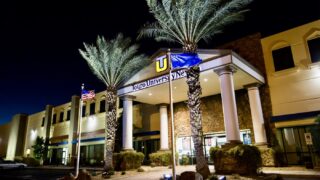

Touro University Nevada College of Osteopathic Medicine (TUNCOM) opened in 2004 as Southern Nevada’s first medical school. It grants the Doctor of Osteopathic Medicine (DO) degree on a single campus in Henderson, Nevada, a few minutes from Las Vegas, and it was built for a clear purpose: to train physicians for a fast-growing region that has never had enough of them. Two decades later, TUNCOM graduates are a large part of the answer. In 2026, a record 72 graduates matched into residencies in Nevada, and more than half of the class entered primary care.
TUNCOM is part of Touro University, a national system of private, nonprofit colleges, and it shares the osteopathic tradition of Touro University California. If you are specializing in osteopathic medicine or still deciding between a DO and an MD, this school deserves a careful look. Its classes are large, its mission is focused on primary care and community service, and its applicants come from across the West, especially California.
This guide covers the 2026-2027 application cycle, for students who want to start medical school in summer 2027. It explains TUNCOM’s newest class figures, admission requirements and deadlines, the 2026-2027 secondary essay prompts with full example answers, 2026-2027 tuition and cost of attendance, the curriculum and clinical years, residency outcomes, campus life, the interview and a long list of frequently asked questions. Figures were checked on November 12, 2026. If TUNCOM is on your list, bookmark this page and come back to it at each stage of your application.
Be an Informed Applicant
Every osteopathic medical school teaches the same core philosophy, but each one has its own mission, culture and way of training students. Knowing those differences helps you choose schools that fit you, and it helps you write secondary essays and interview answers that sound specific instead of generic. It also keeps you from missing practical details, such as a secondary deadline, a letter rule or an MCAT window.
Research is essential, but it is not the same as personal guidance. At International Medical Aid (IMA), we run clinical internships abroad for future physicians, and we also help students get into the medical school where they belong. If you want help building a school list, planning your timeline or polishing your essays, consider our Medical School Admissions Consulting.
Key Takeaways
- What it is: TUNCOM is a private, nonprofit osteopathic medical school in Henderson, Nevada, in the Las Vegas valley. It grants the DO degree and is accredited by the Commission on Osteopathic College Accreditation (COCA).
- Class profile: TUNCOM’s entering class averaged a 506.9 MCAT, a 3.54 cumulative GPA and a 3.47 science GPA. The class that entered in 2026 had 180 first-year students from 17 states, with 31 from Nevada and 119 from California.
- Minimums: You need at least a 500 MCAT and a 3.00 cumulative and science GPA, plus a bachelor’s degree before you start.
- Deadlines: AACOMAS opened May 4, 2026. TUNCOM’s primary deadline is April 30, 2027, and its secondary deadline is May 28, 2027. Admissions are rolling, so submitting four weeks or more before the deadline is the minimum; much earlier is better.
- Secondary: Six essay prompts in 2026-2027, each with a 500-word limit, plus a $100 fee and the DO Technical Standards form. Full examples are below.
- Cost: 2026-2027 tuition is $72,080 for every student. First-year cost of attendance is $107,609, and the estimated four-year cost of attendance is $465,299.
- Outcomes: 100% of the Class of 2026 (172 graduates) matched or placed into residency, 56% in primary care.
- Who it fits: Applicants who want strong primary care training, early simulation and patient-actor work, clinical rotations in Southern Nevada and a mission tied to serving underserved communities.
- Next step: Line up three letters (one science or committee letter and one from a DO or MD), document physician shadowing, and submit AACOMAS as early in the summer as you can.
Key Statistics About Touro University Nevada College of Osteopathic Medicine
The snapshot below collects the numbers applicants ask about first. The MCAT and GPA averages are the entering-class figures TUNCOM publishes on its admissions page. Class size comes from the school’s report on the class that entered in 2026, tuition and cost of attendance are for the 2026-2027 academic year, and the placement rate is for the Class of 2026.

What Are TUNCOM’s Average MCAT and GPA?
TUNCOM reports that its entering class averaged a 506.9 MCAT, a 3.54 cumulative GPA and a 3.47 science GPA (TUNCOM DO Application and Requirements). These are averages, not cutoffs. Half of the class sits below an average, so a 503 or a 3.4 does not rule you out if the rest of your application is strong.
The hard floors are lower. TUNCOM requires at least a 500 MCAT and at least a 3.00 cumulative and science GPA. Applicants near those minimums need a clear upward trend, strong recent coursework and a convincing clinical record. Recent applicants report that the school reviews files with higher MCAT scores first and considers lower scores later in the cycle, which is one more reason to apply early. You can compare TUNCOM with other schools in our list of medical school GPA and MCAT averages.
| Metric | Value | Year or cohort | Source and definition |
|---|---|---|---|
| School and degree | Touro University Nevada College of Osteopathic Medicine (TUNCOM); Doctor of Osteopathic Medicine (DO); Henderson, Nevada | Current | Touro University; private, nonprofit; opened 2004 |
| Average MCAT | 506.9 | Most recent entering class (year not stated) | TUNCOM DO Application and Requirements, FAQ “What makes me a competitive applicant?” |
| Average cumulative GPA | 3.54 | Most recent entering class (year not stated) | TUNCOM DO Application and Requirements, FAQ |
| Average science GPA | 3.47 | Most recent entering class (year not stated) | TUNCOM DO Application and Requirements, FAQ |
| Mean MCAT and average cumulative GPA (school-reported directory figure) | MCAT 505.6; GPA 3.63 | Cohort not stated | AACOM Choose DO Explorer, TUNCOM profile (2026-2027 cycle) |
| First-year class | 180 students from 17 states; 31 from Nevada, 119 from California; 53% women | Class entering 2026 | Touro University Nevada White Coat Ceremony report, August 31, 2026 |
| First-year matriculants | 200 (30 in-state, 170 out-of-state) | 2024-2025 academic year | AACOM Choose DO Explorer, TUNCOM profile |
| Total DO enrollment | 731 | 2024-2025 academic year | AACOM Choose DO Explorer, TUNCOM profile |
| Applicants, interviews, acceptances | Not published | Not applicable | TUNCOM publishes no applicant or offer counts |
| Acceptance rate | Not published | Not applicable | No verified acceptance rate exists for TUNCOM |
| Minimum MCAT and GPA | MCAT 500; cumulative and science GPA 3.00 | 2026-2027 cycle | TUNCOM DO Application and Requirements |
| Tuition | $72,080 per year, all students | 2026-2027 academic year | TUNCOM DO Tuition and Fees |
| Tuition and institutional fees | $72,800 (first year) | 2026-2027 academic year | TUNCOM DO Tuition and Fees; fees $720 |
| Cost of attendance | $107,609 (year 1); $107,276 (year 2); $123,145 (year 3); $126,838 (year 4) | 2026-2027 academic year | TUNCOM 2026-2027 Cost of Attendance |
| Estimated four-year cost of attendance | $465,299 | 2026-2027 rates | TUNCOM DO Tuition and Fees |
| Average graduate indebtedness | $308,370 | Graduating class not stated | AACOM Choose DO Explorer, TUNCOM profile |
| Residency match/placement | 100% of 172 graduates; 56% in primary care; 72 staying in Nevada | Class of 2026 | TUNCOM COMLEX and Residency Placement page; Match Day 2026 page; school placement figure |
| COMLEX Level 1 first-time pass rate | 98.7% (national 91.7%) | 2026-2027 to date, data as of October 6, 2026 | TUNCOM COMLEX and Residency Placement page |
| COMLEX Level 2-CE first-time pass rate | 98.7% (national 94.6%) | 2026-2027 to date, data as of October 6, 2026 | TUNCOM COMLEX and Residency Placement page |
Mission and Educational Priorities
TUNCOM states its mission this way:
“The Touro University Nevada College of Osteopathic Medicine prepares students to become outstanding osteopathic physicians who uphold the values, philosophy and practice of osteopathic medicine and who are committed to primary care and the holistic approach to the patient. The College advances the profession and serves its students and society through innovative pre-doctoral and post-doctoral education, research, community service, and multidisciplinary and osteopathic clinical services.”
Three priorities in that statement matter most to applicants.
Primary care. The mission names primary care directly, and the school’s results follow it. In 2026, 56% of TUNCOM graduates matched or placed into primary care fields, and internal medicine, family medicine, emergency medicine and psychiatry were the most common specialties. TUNCOM also lists “likelihood to practice in underserved primary care areas” among its selection factors. You do not have to commit to family medicine to apply, but you should be able to explain why primary care, prevention and continuity of care matter to you.
The whole patient. Osteopathic medicine treats the person as a unit of mind, body and spirit, and TUNCOM’s curriculum integrates the biological, psychological, social and spiritual sides of health. Applicants who can describe a time they noticed what was happening outside the exam room (a patient’s job, family, language or fears) show they already think this way.
Service to Southern Nevada. TUNCOM was founded to help close Nevada’s physician shortage, and service is part of daily life on campus. Students volunteer at free clinics, mobile health outreach and homeless outreach events, and the school tracks how many graduates stay in the state. In 2026, 72 graduates matched in Nevada, up from 55 the year before. If you have ties to the region, or a record of serving communities like it, say so.
Why Choose Touro University Nevada College of Osteopathic Medicine?
TUNCOM stands out among Nevada’s medical schools for several reasons:
- First in the region. It was Southern Nevada’s first medical school, and it has trained physicians for the region for more than two decades.
- Early hands-on learning. First-year students work with patient actors, simulation and osteopathic manipulative medicine from the first weeks.
- An accredited simulation center. The Michael Tang Regional Center for Clinical Simulation holds full accreditation from the Society for Simulation in Healthcare.
- Strong board and residency results. First-time COMLEX Level 1 and Level 2-CE pass rates of 98.7% so far in 2026-2027, and 100% match or placement for the Class of 2026.
- A supportive culture. Students are placed into one of six Houses for mentorship and community, and the campus includes a wellness center, studios and courts.
- More than one degree. Students can add a Master of Public Health through Touro University California, and Touro Nevada’s School of Physician Assistant Studies trains PAs on the same campus.
Touro Nevada Medical School in the Las Vegas Valley
TUNCOM sits in Henderson, part of the Las Vegas valley, and the location shapes the education. Clinical training draws on community and regional hospitals across Southern Nevada, and those relationships let students stay in the Las Vegas valley for their first year of clinical clerkships. Nevada continues to add graduate medical education positions, and many TUNCOM graduates stay to train and practice in the state.
The school’s graduates also match far beyond Nevada. In 2026, Touro Nevada students placed in 13 states, with California receiving 44 graduates and Arizona five. If you want to compare TUNCOM with major academic centers on the West Coast and beyond, our guides to UCLA, Stanford and Emory describe their admissions, though those are MD schools with very different missions and class profiles.
Accreditation and Institutional Identity
TUNCOM is accredited by the American Osteopathic Association Commission on Osteopathic College Accreditation (COCA) as a branch campus of Touro University College of Osteopathic Medicine in Vallejo, California. The school’s history explains that structure. In July 2003, Touro University Nevada received approval from the Nevada Commission on Postsecondary Education to grant the DO degree, and in January 2004, COCA approved including TUNCOM within the accreditation of the California college (TUNCOM COCA Accreditation).
TUNCOM’s most recent COCA accreditation was granted in 2022, and it received the longest possible term, ten years. Touro University Nevada is also accredited by the WASC Senior College and University Commission.
Touro Nevada School Accreditation and Affiliations
- COM accreditation: COCA, as a branch campus of Touro University College of Osteopathic Medicine (most recent accreditation 2022, ten-year term).
- Institutional accreditation: WASC Senior College and University Commission.
- Institutional affiliation: Touro University California and the Touro University system.
- Type: Private, nonprofit; suburban campus; founded 2004.
Is Touro University Nevada College of Osteopathic Medicine Accredited?
Yes. The branch-campus arrangement does not change what the degree means for you. TUNCOM graduates earn a fully accredited DO, take the same COMLEX-USA licensing exams as every osteopathic student, and enter the same residency pool as MD and DO graduates nationwide. If you are still weighing the two degrees, our comparison of DO vs MD explains the differences in philosophy, training and licensing.
Leadership in 2026
TUNCOM began a new chapter in 2026. Stacey Pierce-Talsma, DO, became dean of the College of Osteopathic Medicine on July 1, 2026, after serving as associate dean of academic affairs at the University of New England College of Osteopathic Medicine. Earlier in 2026, Touro University appointed Jacqueline Beato as chief executive officer of the Nevada campus. Patricia Salkin continues to lead academics as provost and chief academic officer.
Medical Programs and Affiliations
TUNCOM offers one medical degree, the four-year Doctor of Osteopathic Medicine, on one campus. Several related programs matter to applicants.
Doctor of Osteopathic Medicine at Touro University Nevada
The DO program combines two years of systems-based preclinical study with two years of clinical clerkships. You will learn osteopathic manipulative medicine (OMM), an extra tool for diagnosing and treating musculoskeletal problems, alongside the full toolkit of modern medicine. The school’s program pages highlight four features:
- Curriculum: lectures and labs that combine clinical knowledge with hands-on training, starting with patient-actor encounters in the first year.
- Clinicals and residency: personal attention during the clinical years and support for residency goals.
- Osteopathic manipulative medicine: training in the hands-on approach that helps the body heal itself.
- DO/MPH dual degree: an optional Master of Public Health (see below).
DO/MPH Dual Degree Opportunity
TUNCOM students can earn a Master of Public Health from Touro University California through a summer distance-learning program while completing the DO. The MPH suits students interested in community health, health policy, epidemiology or work with underserved populations. Ask about timing and cost during your interview, since the MPH adds tuition and summer coursework.
Preparatory Program: Master of Science in Medical Health Sciences
Touro Nevada offers a one-year Master of Science in Medical Health Sciences (MHS) for students who want to strengthen their academic record before medical school. The program includes 30 credits of graduate biomedical coursework with research experience, advanced study-skill development and MCAT preparation. Completing it does not guarantee admission to the DO program, but it is a structured option for applicants who need to show they can handle medical school science. At least one recent TUNCOM alumnus earned both the MHS and the DO at Touro Nevada.
Physician Assistant Studies at Touro Nevada
Touro University Nevada’s College of Health and Human Services runs a School of Physician Assistant Studies on the same campus. It offers a Master of Physician Assistant Studies and a Doctor of Physician Associate (DPA) for practicing PAs. The PA program describes its focus as serving the community and the underserved, and its students take part in outreach that brings acute care services to vulnerable residents of the Las Vegas valley. If you are deciding between medicine and PA school, see our list of Nevada PA Programs, and consider pre-PA internships to test the role in a clinical setting.
The College of Health and Human Services also trains nursing, physical therapy and occupational therapy students. That mix matters for DO students, because interprofessional education runs through the curriculum and many campus events.
Clinical Affiliations
TUNCOM does not own a hospital. Instead, it partners with community and regional hospitals and clinics in Southern Nevada for clerkships, and it supports students who complete fourth-year rotations at residency programs elsewhere. The school’s leadership has described these relationships as unique to Southern Nevada, and they are the reason most students can stay in the Las Vegas valley for their first clinical year.
Curriculum Overview
TUNCOM’s DO curriculum is organized by body system in the first two years and by clerkship in the last two. The school’s curriculum chart is approximate and course order can change, but the structure below reflects the current plan (TUNCOM DO Curriculum).
Year One: Begin Your Journey
The first year focuses on the systems of the human body and integrates clinical concepts through lectures, labs and an introduction to osteopathic principles and practice. The approximate sequence is:
- Musculoskeletal System 1 (weeks 1 to 5)
- Molecular and Cellular Mechanisms (weeks 6 to 10)
- Cardiopulmonary System (weeks 12 to 15)
- Integrated Mechanisms of Homeostasis (weeks 16 to 20)
- Gastrointestinal System 1, Reproductive Systems and Development 1, Head and Neck Anatomy (weeks 23 to 31)
- Neuroscience 1 (weeks 32 to 36)
- Host Defense Mechanisms (weeks 38 to 40)
Clinical Skills and Osteopathic Manipulative Medicine run alongside these blocks all year, and Interprofessional Competencies are covered throughout. From the first year, you will practice with patient actors and simulation technology and work in the gross anatomy lab, primary care lab and OMM lab.
Year Two: Evolving Your Skills
The second year moves from basic mechanisms to disease and clinical reasoning. Blocks include Fundamentals of Disease and Therapeutics, Neuroscience 2, Behavioral Medicine, Integument and Musculoskeletal System, Blood and Lymph, and system medicine courses in cardiovascular, respiratory, gastrointestinal, endocrine, renal and reproductive medicine. Clinical Skills and OMM continue through the year, along with Interprofessional Competencies 2. Most students take COMLEX Level 1 at the end of this year.
Years Three and Four: Clinical Training
Clinical training runs 22 consecutive months, starting in July of the third year, as 20 four-week clerkships. The details are in the clinical rotations section below. You will also complete two year-long OMM courses during these years.
What to Expect: Curriculum at TUNCOM
A few features of the curriculum stand out:
- Learning by doing. Patient-actor encounters, simulation and OMM labs start early and tie directly back to classroom content.
- Simulation. The Michael Tang Regional Center for Clinical Simulation holds full accreditation from the Society for Simulation in Healthcare,. Students practice procedures, clinical decision-making and team-based care in a high-fidelity setting.
- Technology. Students learn point-of-care ultrasound (POCUS) and discuss the role of artificial intelligence in medicine and medical education. In 2026, TUNCOM faculty presented work on AI-supported assessment and early academic support at an international medical education conference in Vienna.
- Whole-person care. The curriculum integrates biological, psychological, social and spiritual aspects of health, in line with osteopathic philosophy.
- Professional identity. Mentorship and professional identity formation activities run through all four years.
Admissions Requirements and Application Process
TUNCOM’s requirements are straightforward, but the rolling timeline means timing matters as much as the checklist. Everything below comes from the school’s DO Application and Requirements page for the 2026-2027 cycle.
Admission Requirements for Touro University Nevada College of Osteopathic Medicine
- AACOMAS: a completed and verified application through the American Association of Colleges of Osteopathic Medicine Application Service. Direct applications are not accepted. Designate Touro University Nevada in AACOMAS.
- MCAT: a composite score of at least 500, submitted through AACOMAS.
- GPA: a cumulative and science GPA of 3.00 or higher.
- Coursework: the prerequisites listed below, each with a grade of C or better.
- Degree: a bachelor’s degree or higher from a regionally accredited institution before you matriculate.
- Letters: three letters of recommendation (details below).
- Shadowing: documented physician shadowing experience. The school accepts only in-person shadowing.
- Technical standards: you must meet the DO Technical Standards and sign the form with your secondary.
- Status: U.S. citizenship or permanent residency at the time of application. TUNCOM does not accept international applicants or applicants with DACA status.
MCAT and GPA Information
For the class matriculating in 2027, MCAT scores must be no older than June 2024, and January 2027 is the last test month TUNCOM will use. The entering class averaged a 506.9 MCAT, a 3.54 cumulative GPA and a 3.47 science GPA. The school may waive the MCAT only in limited circumstances, so plan on taking it.
Additional resources about the MCAT:
- Best Classes to Take Before the MCAT
- MCAT Score Calculator: Predict and Convert Your Scores
- MCAT Sections Guide: Experts Explain the MCAT
- Medical Schools Accepting Low MCAT Scores
Touro Nevada School Premedical Coursework Requirements and Recommendations
TUNCOM requires the following coursework, each with a grade of C or better:
| Course | Semester credits | Notes |
|---|---|---|
| Biology or Zoology with lab | 8 | Required |
| Inorganic Chemistry | 8 | Required |
| Organic Chemistry with lab | 8 | Four semester units of Biochemistry may replace the second semester of Organic Chemistry |
| Physics | 8 | Required |
| English | 6 | Required |
| Behavioral Sciences | 6 | Required |
| Math or Statistics | 3 | Required |
Recommended science courses: Anatomy, Biochemistry, Genetics and Physiology. These are not required, but they make the first year of medical school much easier, and biochemistry helps on the MCAT.
Course policies: TUNCOM accepts pass/fail prerequisite grades. Online coursework and online labs are accepted only in certain circumstances and should be kept to a minimum. You may submit AACOMAS before finishing all prerequisites, but TUNCOM may wait until those courses are complete before inviting you to the secondary. If you finish courses after applying, update AACOMAS and ask TUNCOM to re-evaluate your file.
Letters of Recommendation
TUNCOM requires three letters of recommendation:
- At least one from a college science instructor, or one premedical or academic committee letter. A committee letter must list every contributor’s name and title and must include at least two science faculty.
- At least one from a physician (DO or MD).
- Letters should come directly from recommenders, on letterhead and signed.
TUNCOM accepts letters through AACOMAS and Interfolio. A DO letter is not required, but a letter from a DO you shadowed is the most direct way to show you understand osteopathic medicine.
Selection Factors
TUNCOM evaluates applicants on academic competence, personal and professional achievements, demonstrated leadership, creative abilities, experience in health care and the likelihood of practicing in underserved primary care areas. That last factor is unusual. It tells you the committee is looking for evidence that you will serve communities that need physicians most, which is exactly what Nevada needs.
When to Apply to TUNCOM
TUNCOM uses rolling admissions. Applications are reviewed as they arrive, and review ends once the class and waitlist are full, which can happen well before the published deadlines.
Primary Application
AACOMAS opened May 4, 2026, for the 2026-2027 cycle. TUNCOM’s primary deadline is April 30, 2027, and the school recommends submitting at least four weeks before the deadline for best consideration. In practice, submit in June or early July if you can.
Supplemental (Secondary) Application
After AACOMAS verifies your application, TUNCOM’s Office of Admissions pre-screens it. Screened applicants receive an email invitation to the secondary, typically starting in early August. You submit the secondary and the DO Technical Standards form through the link in that email and pay a non-refundable $100 fee (approved AACOMAS or AAMC fee waivers apply). The secondary deadline for the 2027 cohort is May 28, 2027. Do not submit the secondary unless you are invited. Once you receive it, return it within a week or two.
Interview
Interview invitations begin in late August or early September and continue on a rolling basis. Interviews run from September through May or until the class is filled, and you can choose a virtual or in-person date.
Decision and Deposit
Decisions are rolling. Admitted students must pay a $2,000 non-refundable deposit by the date in their admission letter, which is applied to first-year tuition. Before matriculation, you will also submit immunization records and a health and physical exam, pass a Level I criminal background check and show proof of health insurance. Deferral requests are considered.
Application Timeline Table
| Step | Date or timing | What to do |
|---|---|---|
| AACOMAS opens | May 4, 2026 | Request transcripts and letters; finish your personal statement |
| Best time to submit AACOMAS | June to early July 2026 | Rolling review rewards early files; the school’s minimum advice is four weeks before the deadline |
| Secondary invitations | Typically from early August | Submit the six essays, Technical Standards form and $100 fee within one to two weeks |
| Interview invitations | From late August or early September | Schedule virtual or in-person; virtual dates are released in batches |
| Interviews | September 2026 through May 2027 | Prepare for a faculty interview and school presentations |
| Last MCAT accepted | January 2027 test month | Scores must be no older than June 2024 |
| AACOMAS deadline | April 30, 2027 | Seats may be filled well before this date |
| Secondary deadline | May 28, 2027 | Only for invited applicants |
| Deposit | By the date in your admission letter | $2,000, non-refundable, applied to tuition |
Admissions Process at TUNCOM
Here is the full process in order:
- Submit AACOMAS and designate Touro University Nevada.
- Send official transcripts from every college attended to AACOMAS. Foreign transcripts must be evaluated by a service such as World Education Services.
- If invited, complete the secondary and DO Technical Standards form and pay the $100 fee.
- Mail any supporting documents to the Office of Admissions in Henderson, or confirm receipt by emailing the office or calling (702) 777-3240.
- The Admissions Committee reviews complete files and decides whether to invite you to interview.
- Interview virtually or in person.
- Receive a rolling decision, and if admitted, submit your deposit and matriculation documents.
TUNCOM also hosts a weekly “Apps and Answers” Zoom session on Wednesdays from noon to 1 p.m. Pacific time, where you can drop in with questions or check your status. You can also email your program manager to schedule a Zoom or in-person meeting. Using these sessions is a simple way to show interest and avoid mistakes.
Pre-med Clinical Experience
TUNCOM does not publish a minimum number of clinical hours, but it lists experience in health care as a selection factor and requires documented physician shadowing. The strongest applicants combine in-person shadowing of a DO with sustained patient contact, such as work as a medical assistant, scribe, EMT or certified nursing assistant. Clinical internships for pre-med students can add supervised patient contact to that record. If you want structured experience during a summer break, look for pre-med summer internships that put you in a clinic with real patients and supervising physicians.
Tuition, Cost of Attendance and Financial Aid
TUNCOM is a private school, so tuition is the same for Nevada residents and nonresidents. Tuition and fees are set annually by the Touro University Board of Trustees and can change without notice (TUNCOM DO Tuition and Fees).
Touro Nevada School Tuition and Fees (2026-2027)
| Item | Fall | Spring | Total |
|---|---|---|---|
| Tuition | $36,040 | $36,040 | $72,080 |
| Fees | $555 | $165 | $720 |
| Total institutional expenses | $36,595 | $36,205 | $72,800 |
Cost of Attendance
The cost of attendance (COA) adds indirect costs to tuition and fees: books and supplies, a computer, health insurance, living expenses, personal costs, transportation and loan fees. Student health insurance is not included in tuition and changes each year.
| Class year | Other education-related expenses | Grand total |
|---|---|---|
| First year | $34,809 | $107,609 |
| Second year | $34,476 | $107,276 |
| Third year | $50,345 | $123,145 |
| Fourth year | $54,038 | $126,838 |
In the first-year budget, the “other” expenses include about $22,930 for living expenses, $4,982 for health insurance, $2,320 for transportation, $1,820 for personal costs, $1,559 for a computer, $944 for books and supplies and $254 for loan fees. Third- and fourth-year budgets are higher because clinical years run longer and include more travel. TUNCOM estimates the total cost of attendance for the full DO program at $465,299 at 2026-2027 rates.
What Do Tuition Fees Cover?
TUNCOM’s tuition and fees include health service access and technology fees. Your own computer appears separately in the first-year budget. A $2,000 deposit is due after acceptance and is applied to the first term’s tuition.
Additional Costs and Financial Commitments
- Secondary application fee: $100, non-refundable (fee waivers available for approved AACOMAS or AAMC waiver recipients).
- Deposit: $2,000, non-refundable, applied to tuition.
- Housing: TUNCOM has no campus housing. Most students rent apartments, condos or houses within walking distance or about two miles of campus.
- Board exams and residency applications: COMLEX fees and residency application costs fall in the third and fourth years and are budgeted in the COA.
Touro Nevada School Financial Aid and Scholarships
Most TUNCOM students borrow federal loans, and the Office of Financial Aid helps with eligibility, scholarships and payment plans. Scholarships are offered. The average graduate indebtedness reported for TUNCOM is $308,370, so it is worth planning early: fill out the FAFSA as soon as it opens, apply for outside scholarships, and look at service-based programs such as the National Health Service Corps and military scholarships if they fit your goals.
Financial Aid and Scholarships at Touro University Nevada College of Osteopathic Medicine: How TUNCOM Compares
Tuition is only one part of the decision, but it helps to compare TUNCOM with other schools you are considering. Each of the medical school guides below includes that school’s tuition, cost of attendance and financial aid information, so you can compare them side by side with the TUNCOM figures above.
- University of Miami Miller School of Medicine
- Arkansas College of Osteopathic Medicine (ARCOM)
- University of Arkansas for Medical Sciences (UAMS)
- Tulane University School of Medicine
- LSU Health New Orleans School of Medicine
- LSU Shreveport Medical School
- University of Nevada Reno School of Medicine
- University of Arizona College of Medicine-Tucson
- University of Arizona College of Medicine-Phoenix
- Burrell College of Osteopathic Medicine (BCOM)
- The University of New Mexico School of Medicine
- Alabama College of Osteopathic Medicine (ACOM)
- University of South Alabama College of Medicine
- University of Alabama School of Medicine
- FIU College of Medicine
- UCF College of Medicine
- USF Morsani College of Medicine
- Florida State University College of Medicine
- Morehouse School of Medicine
- Medical College of Georgia at Augusta University
- Mercer University School of Medicine (MUSM)
- Campbell University School of Osteopathic Medicine (CUSOM)
- ECU Brody School of Medicine
- Edward Via College of Osteopathic Medicine (VCOM)
- University of South Carolina Medical School
- Lewis Katz School of Medicine at Temple University
- Philadelphia College of Osteopathic Medicine (PCOM))
- Geisinger Commonwealth School of Medicine (GCSOM)
- Penn State Medical School
- CUNY School of Medicine
- SUNY Downstate Medical School
- NYIT College of Osteopathic Medicine
- NYU Long Island School of Medicine
- Albany Medical College
- Norton College of Medicine at Upstate Medical University
- Jacobs School of Medicine at the University at Buffalo
- Hofstra Zucker School of Medicine
- Weill Medical College of Cornell University
- University of Rochester Medical School
- Icahn School of Medicine at Mount Sinai
- Renaissance School of Medicine at Stony Brook University
- Albert Einstein College of Medicine
- Ohio University Heritage College of Osteopathic Medicine
- Northeast Ohio Medical University (NEOMED)
- University of Cincinnati College of Medicine
- University of Toledo College of Medicine
- Wright State University Boonshoft School of Medicine
- Ohio State University College of Medicine
- Rowan University School of Osteopathic Medicine
- Hackensack Meridian School of Medicine (HMSOM)
- Rutgers New Jersey Medical School (NJMS)
- Rutgers Robert Wood Johnson Medical School
- Cooper Medical School of Rowan University (CMSRU)
- A.T. Still University Kirksville College of Osteopathic Medicine
- Saint Louis University School of Medicine
- University of Missouri Medical School
- Kansas City University (KCU)
- UMKC School of Medicine
- New York Medical College
- University of Pittsburgh School of Medicine
- University of Wisconsin Medical School
- VCU School of Medicine
- University of Maryland School of Medicine
- Case Western Medical School
- University of North Carolina Medical School
- University of Florida Medical School
- Boston University College of Medicine
- California University of Science and Medicine
- UC San Diego Medical School
- California Northstate University College of Medicine
- UC Davis School of Medicine
- Harvard Medical School
- UC Riverside School of Medicine
- USC Keck School of Medicine
- UT Southwestern Medical School
- Long School of Medicine at UT Health San Antonio
- University of the Incarnate Word School of Osteopathic Medicine
- UT Austin’s Dell Medical School
- UTMB School of Medicine
- McGovern Medical School at UT Health
- Johns Hopkins School of Medicine
- The University of Texas Rio Grande Valley School of Medicine
- UNT Texas College of Osteopathic Medicine
- University of Houston College of Medicine
- Texas A&M College of Medicine
- Baylor College of Medicine
- George Washington University School of Medicine
- Vanderbilt University School of Medicine
- St. George’s University School of Medicine
- Lake Erie College of Osteopathic Medicine (Pennsylvania)sylvania)
- Sidney Kimmel Medical College at Thomas Jefferson University
- Wake Forest University School of Medicine
- Drexel University College of Medicine
- Stritch School of Medicine at Loyola University Chicago
- Georgetown University School of Medicine
- Yale School of Medicine
- Perelman School of Medicine
- NYU Medical School
- Washington University School of Medicine
- Brown Medical School
Campus Facilities and Student Life
Campus and Facilities
TUNCOM is housed in a single education building of more than 200,000 square feet at 874 American Pacific Drive in Henderson. It includes learning labs, lecture halls and many small-group study spaces. Highlights include:
- The Michael Tang Regional Center for Clinical Simulation, with a two-tiered teaching theater, high-fidelity simulation rooms and a dedicated ultrasound lab.
- Three dedicated research labs where students can work on research with faculty.
- A Wellness Center with a fitness gym, dance and yoga studio, esports lounge and basketball and volleyball courts.
- Interprofessional space shared with the College of Health and Human Services (nursing, PA, physical therapy and occupational therapy).
Location
Henderson is a suburban city in the Las Vegas valley. Students have easy access to an international airport, major highways, national parks and year-round outdoor recreation, plus the entertainment and professional sports teams of Las Vegas.
Housing Options
TUNCOM has no campus housing. Most students rent nearby apartments, condos or single-family homes, usually within walking distance or a two-mile radius of campus. Budget about $22,930 for first-year living expenses, the figure in the 2026-2027 cost of attendance.
Student Support Services
Students can use Student Support Services (OASIS), the Student Counseling Center and the Wellness Center. The COM Dean’s Office includes a Director of Student Success who supports academic progress, and the House System places each student into one of six Houses for mentorship, leadership and community.
Community Involvement and Student Life at TUNCOM
Community service is part of Touro Nevada’s mission, and students start service activities from the first day. Students provide health care, counseling, meals and job help to Southern Nevada residents alongside faculty and staff, and they also speak to youth, raise funds and join environmental clean-ups. University initiatives where students volunteer include:
- The Mobile Healthcare Clinic, which takes care to residents of the Las Vegas valley.
- Project Homeless Connect.
- The Stallman Touro Clinic at the Shade Tree, where students provide free health care to homeless women and children who have experienced abuse.
- The Health Center at Touro Nevada, where students work with patients under physician supervision.
Student Organizations and Special Interest Groups
Touro Nevada has more than 40 student clubs and organizations. Medical interest groups include:
- ACOFP (American College of Osteopathic Family Physicians), ACOS-MSS (osteopathic surgeons, medical student section), AIG (anesthesiology), AMA-MSS, AMSA and AMWA
- AOASM (sports medicine and orthopedics), AOCPMR and PMRIG (physical medicine and rehabilitation), APAMSA, CIG (cardiovascular), CMDA and CLM (community and lifestyle medicine)
- DIG (dermatology), EMIG (emergency medicine), Exploring Medicine, GIG (geriatrics) and GHCO (Global Health and Community Outreach)
- HAPSIG (health administration and policy), LMSA and TUN-LMSA, Medical Students for Choice, MMIG and AMOPS (military medicine), NAHA (Native American Healthcare Ambassadors) and NPSIG (neurology and psychiatry)
- OIG (oncology), OMSGA (student government), OSMIG (orthopedics and sports medicine), PIG (pathology), PCCAII (pulmonary, critical care, allergy and immunology) and PEDS (pediatrics)
- PHPIG (public health and policy), RIG (radiology), Rainbow Health Coalition, SAMSA, SAOAO, SAOG (obstetrics and gynecology), SNMA, SNAC (nutrition), SOIMA (internal medicine), SOSA (surgery), Sigma Sigma Phi and WEM (wilderness emergency medicine)
Special interest groups include the Alcohol and Other Drug Committee, inTUN (a cappella), the Latter-day Saint Student Association, the Martial Arts and Boxing Interest Group, the Medical Journal Club, the Medical Spanish Club, the Muslim Student Association, the Nutrition Club, the TUN Jewish Student Association, TUN Student to Student Outreach, the Ultrasound Club and the Wilderness Medicine Interest Group.
Student Government
Students can join the Student Government Association as class officers, on student council or in the student senate, helping to set policies and plan campus events such as white coat ceremonies, pinning and commencement.
How to Get Involved
Start with a few groups that match your interests and one service commitment you can keep. Many students join a specialty interest group, a cultural or faith group and a free clinic. Students can also plan their own events with a faculty advisor and the Office of Student Involvement.
Clinical Rotations and Research Opportunities
Touro University Nevada College of Osteopathic Medicine’s Clinical Rotations and Post-Graduation Prospects
Clinical training runs 22 consecutive months, beginning in July of the third year, as 20 four-week clerkships (TUNCOM Clinical Education). Fourth-year students have one month, November or December, set aside for residency interviews.
| Year | Clerkship | Length |
|---|---|---|
| Third | Family Medicine | 1 month |
| Third | Internal Medicine | 2 months |
| Third | Obstetrics and Gynecology | 1 month |
| Third | Pediatrics | 1 month |
| Third | Psychiatry | 1 month |
| Third | Surgery | 2 months |
| Third | Electives | 2 months |
| Fourth | Clinical Management Review (June) | 1 month |
| Fourth | Emergency Medicine | 1 month |
| Fourth | Sub-internship | 2 months |
| Fourth | Medical Subspecialty Elective | 1 month |
| Fourth | Open Electives | 2 months |
Students have significant input into their fourth-year schedule, and the school strongly recommends completing electives as audition rotations or sub-internships at residency programs you hope to join. You will also complete two year-long OMM courses during the clinical years.
Residency Outcomes
TUNCOM publishes residency placement by class. The Class of 2026 had 172 graduates and a 100% match or placement rate. Recent years have been similar: 99.4% for the Class of 2025 (169 graduates), 100% for the Class of 2024 (157), 100% for the Class of 2023 (162) and 99.4% for the Class of 2022 (172).
In 2026, 56% of graduates entered primary care fields, students matched in 20 specialties, and 13 states welcomed TUNCOM graduates. The most common specialties were internal medicine, family medicine, emergency medicine and psychiatry. Seventy-two graduates stayed in Nevada (a record, up from 55 the year before), 44 went to California and five to Arizona. Among those staying in Nevada, 37% entered primary care and psychiatry was the top specialty.
Board Exam Performance
TUNCOM’s first-time COMLEX pass rates are strong. For the 2026-2027 academic year, with data as of October 6, 2026:
- COMLEX Level 1: 98.7% (national 91.7%)
- COMLEX Level 2-CE: 98.7% (national 94.6%)
In 2025-2026, the Level 1 rate was 96.4% and the Level 2-CE rate was 96.5%. For COMLEX Level 3, taken during residency, TUNCOM graduates passed at 99% in 2025.
Research Opportunities
TUNCOM students can join research in basic science, clinical research, medical education and health policy. The university has three dedicated research labs, and students can collaborate with faculty mentors and present at campus events. Research is encouraged rather than required, so it is a chance to explore a specialty interest and strengthen a residency application. Faculty research in medical education is active: in 2026, four COM faculty and staff presented studies on AI-supported assessment, exam-timing analytics and interprofessional education at an international medical education conference.
Service Clinics
Clinical service begins well before the third year. Students volunteer at the Stallman Touro Clinic at the Shade Tree, join the Mobile Healthcare Clinic and Project Homeless Connect, and work with patients under physician supervision at the Health Center at Touro Nevada.
Notable Alumni, Faculty, Leadership and Admissions Staff
The people below hold verified roles at TUNCOM or are verified graduates. Knowing who leads the school and who has come out of it helps you understand its priorities and write more specific essays.
School Leadership
Stacey Pierce-Talsma, DO, MS-MEdL, FNAOME, Dean. Dr. Pierce-Talsma became dean of the College of Osteopathic Medicine on July 1, 2026. She previously served as associate dean of academic affairs and clinical professor at the University of New England College of Osteopathic Medicine, where she led institutional accreditation, curriculum design and a move to a new health sciences campus. She graduated from Michigan State University College of Osteopathic Medicine, completed residency training in neuromusculoskeletal medicine and osteopathic manipulative medicine, and earned a master’s degree in medical education and leadership. She is a fellow of the AOA Health Policy Fellowship and the National Academy of Osteopathy. Her emphasis on competency-based education, coaching and learner wellbeing tells you a lot about the direction of the school.
Julie Zacharias-Simpson, DO, Vice Dean. Dr. Zacharias-Simpson is vice dean of the college and part of the executive team responsible for accreditation, clinical examination preparation and daily management of the COM.
Terrence Miller, MS, PhD, Senior Associate Dean for Academic Affairs. Dr. Miller leads academic affairs. In 2026, he presented work on AI-enabled assessment and behavioral analytics for early learner support at an international medical education conference.
Tisheena Lowe, MEd, Assistant Dean for Assessment, Analytics, and AI. Lowe leads the college’s work on assessment and analytics, including a 2026 study of AI-supported targeted remediation.
Patricia Salkin, Provost and Chief Academic Officer. Dr. Salkin leads academics at Touro University Nevada and serves as senior vice president for academic affairs for Touro University.
Mitchell D. Forman, DO, founding dean (late). Dr. Forman opened the College of Osteopathic Medicine in 2004 and led Touro Nevada for 14 years. He was the ACOI’s 2008 Physician of the Year, the first Nevada physician to receive a Mastership in the American College of Physicians, and president of the Nevada State Medical Association. The university published a tribute to him in January 2026, after his death. His focus on building graduate medical education in Nevada still shapes the school.
Current Faculty
Jutta Ward, PhD, Assistant Dean, Curriculum, and Professor. Dr. Ward helps lead the curriculum and presented work on AI-enabled remediation and large-scale interprofessional education events in 2026.
David Skyba, DC, PhD, Assistant Dean of Curriculum and Professor. Dr. Skyba teaches in the Department of Basic Sciences and helps oversee the preclinical curriculum.
TUNCOM’s faculty are organized into departments of Basic Sciences, Clinical Education, Osteopathic Manipulative Medicine, Primary Care and Specialty Care. The school describes an open-door policy, so it is worth asking interviewers about faculty mentoring and research.
Admissions Staff
Yvonne M. Randall, EdD, MHA, OTR/L, FAOTA, Assistant Dean of Admissions. Dr. Randall leads COM admissions.
Maricruz Rand, Director of Admissions and Recruitment. Rand directs recruitment and admissions operations. The admissions team also includes program manager Alexa Askey, and applicants can meet with the team through the weekly “Apps and Answers” Zoom sessions or by appointment.
Notable Alumni
Daniel Thomas Jones, DO, MBA, MHS (MHS and DO, 2025). Dr. Jones earned both the Master of Science in Medical Health Sciences and the DO at Touro Nevada. In 2026, he received a Conquer Cancer Merit Award from the ASCO Foundation for oncology research using national healthcare databases. He is an internal medicine resident with the Sunrise Health GME Consortium at MountainView Hospital in Las Vegas and is pursuing an MPH at the Harvard T.H. Chan School of Public Health, with plans for a career in hematology and oncology. His path shows what the MHS-to-DO route can lead to.
Elizabeth Klein, DO (Class of 2020). Dr. Klein gave the alumni address at the August 2026 White Coat Ceremony, welcoming the newest DO class to the profession.
Suzanne Roozendaal, DO (Class of 2009). Dr. Roozendaal was named Touro University Nevada’s Alumnus of the Year in 2019, an award for graduates who exemplify serving, leading and teaching.
Lloyd Del Mundo, DO (Class of 2009). Dr. Del Mundo received a 2019 alumni award honoring dedication to serving, leading and teaching in the community.
Ori DeVera, DO (Class of 2015). Dr. DeVera received the university’s Generosity Award in 2021 for giving back to the campus and students through teaching, mentorship and other support.
Admissions Statistics and Class Profile
Key Statistics About Touro University Nevada College of Osteopathic Medicine
TUNCOM’s published entering-class averages are a 506.9 MCAT, a 3.54 cumulative GPA and a 3.47 science GPA. The figures the school submits to the national osteopathic school directory for the 2026-2027 cycle are a mean MCAT of 505.6 and an average cumulative GPA of 3.63, with no cohort stated. Either way, a typical admitted student scores in the low-to-mid 500s and holds a GPA in the mid-3s.
Touro Nevada School Student Demographics
Class entering in 2026. The class welcomed at the August 31, 2026 White Coat Ceremony had 180 first-year DO students from 17 states. Thirty-one came from Nevada and 119 from California, the largest group, and women made up 53% of the class.
2024-2025 enrollment. In 2024-2025, TUNCOM enrolled 731 DO students in total (388 men and 343 women) and 200 first-year matriculants (101 men and 99 women). Thirty of the 200 first-year students were Nevada residents and 170 came from out of state.
Self-Reported Race and Ethnicity (2024-2025 First-Year Matriculants)
- Asian: 44.5%
- White: 33.0%
- Hispanic or Latino: 8.5%
- Multiple races: 7.0%
- Undisclosed: 5.5%
- Native Hawaiian or Pacific Islander: 1.0%
- Black or African American: 0.5%
- American Indian or Alaska Native: 0%
Academic Background
Among 2024-2025 first-year matriculants, 87.5% were science majors and 12.5% non-science majors, and 11.0% already held a graduate degree.
Acceptance Rate
TUNCOM does not publish its number of applications, interviews or acceptances, so there is no verified acceptance rate. Be wary of websites that list one. A real acceptance rate requires the number of offers divided by the number of applicants for the same cycle, and TUNCOM has not released those figures.
How to Read These Numbers
Three things stand out. First, TUNCOM draws heavily from outside Nevada, especially California, so out-of-state applicants are the norm, not the exception. Second, class size has changed from year to year (200 matriculants in 2024-2025 and 180 first-year students in 2026), so do not assume a fixed number of seats. Third, the averages are modest compared with many MD schools, but TUNCOM’s minimums (500 MCAT, 3.00 GPA) are firm, and recent applicants report that files with higher MCAT scores move faster early in the cycle.
Tips and Strategies for Admission to the Touro University College of Osteopathic Medicine
1. Apply early in a rolling cycle
Rolling admissions reward early, complete files. Submit AACOMAS in June or early July, have your letters ready when you submit, and return the secondary within a week or two of receiving it. Waiting until the four-week “best consideration” window before April 30 is risky, because seats and interview dates fill long before then.
2. Clear the minimums with room to spare
TUNCOM’s 500 MCAT and 3.00 GPA floors are firm. If you are close to either, raise the number before you apply. Recent applicants report that the school reviews higher MCAT scores first and that applicants below a 3.0 GPA are not invited to interview, even with a strong graduate record. A retake or a year of strong upper-level science is often the best investment you can make.
3. Show that you understand osteopathic medicine
Shadow a DO in person, ask about the role OMM plays in their practice, and request a letter if you can. In your secondary, describe a specific moment that showed you how osteopathic physicians think about the whole person. TUNCOM accepts only in-person shadowing.
4. Build real patient contact
TUNCOM values experience in health care, and patient contact is the best evidence that you know what medicine involves. Paid work as a medical assistant, scribe, EMT or CNA counts, and so do well-supervised internships for pre-med students where you take vitals, help with intake and work alongside clinicians. What matters is that you can describe what you did and what you learned.
5. Connect your service to underserved communities
The selection factor “likelihood to practice in underserved primary care areas” is a direct invitation. Long-term service at a free clinic, a food bank or a community health program, especially in Nevada, the rural West or a community like the one you grew up in, speaks directly to TUNCOM’s mission.
6. Know Southern Nevada
TUNCOM wants physicians who will stay and serve. If you have ties to Nevada, make them clear. If you do not, explain why the region’s physician shortage and the school’s community focus matter to you, and mention specific programs such as the Stallman Touro Clinic at the Shade Tree or the Mobile Healthcare Clinic only if you understand what they do.
7. Use the secondary to tell a complete story
Six 500-word prompts give you room. Use them to show different parts of your record rather than repeating the same story. The awards and research prompts invite plain, factual answers; the “Why Touro Nevada” and “anything else” prompts are where your voice matters most.
8. Use a gap year wisely
If you need another year, use it to fix the weakest part of your file: a retake, upper-level science, Touro Nevada’s MHS program or a full-time clinical job. Pre-med gap year programs that add supervised clinical work can help too, as long as you can explain what you learned. Reapplicants should show clear progress since the last application.
Additional Information and Contacts
- Office of Admissions: [email protected], (702) 777-3240
- Address: Touro University Nevada, Office of Admissions, Attn: College of Osteopathic Medicine, 874 American Pacific Drive, Henderson, NV 89014
- Weekly Q&A: “Apps and Answers” Zoom sessions, Wednesdays, noon to 1 p.m. Pacific (not offered on December 24 or during holidays and campus closures)
Secondary Application Questions, Example Responses and Analysis
Touro University College of Osteopathic Medicine Nevada Secondary Essay Prompts (2026-2027)

TUNCOM’s secondary for the 2026-2027 cycle has six essay prompts, each with a 500-word limit. The secondary goes to applicants who pass the school’s screen after AACOMAS verification, usually beginning in early August. You submit it with the DO Technical Standards form and a non-refundable $100 fee, and the deadline is May 28, 2027. In earlier cycles, TUNCOM used a 1,500-character limit and slightly different prompts, so do not reuse old answers without checking the wording in your portal.
The six prompts are:
- Why are you interested in pursuing this degree at Touro Nevada?
- Is there anything not on the AACOMAS application that you would like the admissions committee to know about you?
- Please explain any award and accolades you have listed on your AACOMAS application.
- What award(s) or recognition(s) have you received within the last five years?
- What volunteer experience have you had during the last three years?
- What research experience have you had during the last three years?
How to Approach TUNCOM’s Secondary
- Return it quickly. Aim for one to two weeks after you receive the invitation. Rolling review means delays cost you.
- Do not use all 500 words on every answer. The awards, volunteer and research prompts can be shorter and more factual. Save your best writing for prompts 1 and 2.
- Avoid repetition. Prompts 3 and 4 overlap. Use prompt 3 to explain what is already on AACOMAS and prompt 4 to give a complete, dated list.
- Be specific to Touro Nevada. Mention real features, such as the primary care mission, early simulation and patient-actor work, Las Vegas valley clerkships, the House System or community clinics, and tie each to your own experience.
- Stay honest. Every hour, award and role must match your AACOMAS entries.
The examples below are original and written for this guide. Each is an illustrative example, not an actual applicant essay, and each stays within the 500-word limit. Use them to understand structure and approach, not as text to copy.
Prompt 1: Why are you interested in pursuing this degree at Touro Nevada? (500 words)
What it asks: Why you want a DO, why at Touro Nevada, and what connects you to the school’s mission and region.
Approach: Start with a real experience that drew you to osteopathic medicine. Then connect two or three verified school features to things you have actually done. End with what you will contribute.
Illustrative example, not an actual applicant essay:
I grew up in North Las Vegas, where a six-week wait for a primary care appointment was normal and the urgent care line was where my family went instead. When my grandmother’s diabetes slipped out of control, the person who finally helped her was a DO in Henderson who spent forty minutes with her, asked about her diet, her walking and her loneliness, and then examined her painful shoulder with his hands before ordering anything. She left with a plan she could follow. That visit is the reason I want to be an osteopathic physician, and it is the reason I want to train in Southern Nevada.
Touro Nevada’s mission speaks directly to that experience. The college asks its students to commit to primary care and the holistic approach to the patient, and its graduates are doing that here: in 2026, 72 graduates stayed in Nevada for residency and more than half of the class entered primary care. I want to be part of a school whose results match what it says it values.
The structure of the curriculum also fits how I learn. I work best when I can practice a skill soon after I study it. At Touro Nevada, first-year students work with patient actors, simulation and osteopathic manipulative medicine from the first weeks, and the Michael Tang Regional Center for Clinical Simulation lets students rehearse team-based care before they face it on the wards. As a medical assistant at a community clinic, I learned that I freeze less when I have rehearsed. A school that builds rehearsal into every year is the right place for me.
I am also drawn to the way clinical training is organized. Touro Nevada’s relationships with regional hospitals keep students in the Las Vegas valley for their first clinical year, with clerkships across family medicine, internal medicine, surgery, pediatrics, psychiatry and obstetrics and gynecology. I want to learn medicine in the same communities I hope to serve, and to build relationships with local physicians early.
Finally, Touro Nevada’s House System and its interprofessional campus matter to me. I have seen how much better patient care becomes when a nurse, a physical therapist and a physician talk to each other. Training under one roof with nursing, PA, physical therapy and occupational therapy students would help me learn that habit from the start, and the Houses would give me mentors and classmates to lean on through four hard years.
I want to earn a DO at Touro Nevada because it trains doctors for the patients I grew up beside, and because I intend to stay and care for them.
Why this works: This answer covers the three things the question asks for without saying so: why a DO, why this school, and why this place. The opening story about a DO who examined a grandmother’s shoulder by hand shows an understanding of osteopathic care without using jargon. Each middle paragraph ties a verified Touro Nevada feature (the primary care mission, the 72 graduates who stayed in Nevada in 2026, early work with patient actors and simulation, the first clinical year in the Las Vegas valley, the House System and the interprofessional campus) to something the applicant has actually done. The ending returns to the patients of Southern Nevada. Mistakes to avoid: listing the school’s features like a brochure, writing a generic ‘why medicine’ essay with the school’s name pasted in, and claiming ties to Nevada you cannot show elsewhere in your application.
Prompt 2: Is there anything not on the AACOMAS application that you would like the admissions committee to know about you? (500 words)
What it asks: Context the committee cannot see elsewhere: a family role, a hardship, an explanation for a dip in grades, or an experience that shaped you but does not fit an activity entry.
Approach: Choose one thing that changes how a reader understands your application. Explain it briefly, connect it to what is on your application, and end with what you will bring to medicine. If there is truly nothing to add, a short, sincere answer is better than padding.
Illustrative example, not an actual applicant essay:
The AACOMAS application shows my hours, but it cannot show the shift I worked every Sunday for three years: translating for my father at his dialysis appointments.
My father came to the United States from the Philippines in his forties and speaks English well in daily life, but medical conversations moved too fast for him. From the time I was sixteen, I sat beside him in the dialysis chair and repeated the nurse’s questions in Tagalog, then repeated his answers in English. At first I thought my job was only to translate words. Over time I learned that my real job was to slow the conversation down until he understood it. I asked the nurse to explain why his potassium mattered. I wrote his fluid limits on a card he kept in his wallet. When he was embarrassed to admit he had skipped a session, I helped him say it.
This experience is not an activity, so it has no line in my application, but it shaped almost everything that is there. It is why I chose to volunteer at a free clinic that serves many Filipino and Spanish-speaking families. It is why my research question in college was about language access in kidney care. It is why I became a medical assistant instead of taking a higher-paying job after graduation.
It also explains a dip in my sophomore grades. That year, my father was hospitalized twice, and I spent many nights in the hospital instead of studying. I did not use it as an excuse then, and I do not now. I retook organic chemistry, earned an A, and learned to plan my study time around the unexpected.
What I learned in that dialysis unit is the thing I most want to bring to medical school: the habit of checking whether the patient has understood, not just whether the doctor has spoken. Osteopathic medicine asks physicians to treat the whole person, and for many patients, the whole person includes a language, a family role and a fear they will not say out loud. I learned to listen for those things by sitting beside my father. I want to keep listening for them as a physician in Southern Nevada, where so many families are finding their way through care the way mine did.
Why this works: This is an open invitation, so the example uses it for something the AACOMAS application cannot show: a long family caregiving role. The essay links that role to the activities that are on the application, briefly and honestly explains a weaker semester, and shows what the applicant would bring to medicine. It stays well under 500 words and avoids self-pity. Mistakes to avoid: repeating your personal statement, listing more activities, writing about something with no connection to your path to medicine, or leaving the field blank when you have context the committee needs.
Prompt 3: Please explain any award and accolades you have listed on your AACOMAS application. (500 words)
What it asks: For each award already listed on AACOMAS, what it is, what it recognized and why it matters.
Approach: Take each award in turn with a short paragraph: name, year, what it recognized, and one sentence on what it shows about you. If you listed no awards, say so in one sentence and describe any informal recognition instead.
Illustrative example, not an actual applicant essay:
I listed three awards on my AACOMAS application. Each one reflects work I care about, so I will explain what each award recognized and what it taught me.
Dean’s List, University of Nevada, Las Vegas (five semesters). I earned Dean’s List status in five of my eight semesters while working twenty hours a week as a pharmacy technician. The semesters I missed were my first and the semester my father was hospitalized. Earning the honor again after that difficult year meant more to me than the first time, because it showed me I could rebuild my study habits under pressure.
Outstanding Volunteer Award, Henderson community free clinic (2025). The clinic gives this award to one volunteer each year. I received it after I reorganized the intake process for Spanish-speaking patients. Patients had been waiting up to an hour because forms were only in English. I translated the intake forms with the clinic manager’s approval, trained four other bilingual volunteers to help with check-in, and tracked wait times for three months. Average waits dropped to about twenty minutes. The award was nice, but the real reward was watching patients spend less time in the waiting room and more time with the physician.
Undergraduate Research Poster Award, campus research symposium (2026). I presented a poster on missed dialysis sessions among patients with limited English proficiency. Judges recognized the project for its clear methods and community relevance. The work taught me how much effort goes into a single good question, and how important it is to share results with the people who helped collect them. After the symposium, I presented a short version of the poster to the clinic staff whose patients we studied.
Taken together, these awards tell a consistent story: I work hard, I pay attention to patients who are easy to overlook, and I try to turn what I notice into a practical change. Those are the habits I hope to keep building as a medical student at Touro Nevada.
Why this works: The prompt asks you to explain awards you already listed, so the answer takes each one in turn: what it is, what it recognized and what it taught. Concrete detail (five semesters, an hour wait reduced to about twenty minutes, a poster topic) makes each award believable. The closing paragraph connects the awards into one story about the applicant. Mistakes to avoid: inflating minor honors, adding awards that are not on your AACOMAS application, or giving a bare list with no explanation.
Prompt 4: What award(s) or recognition(s) have you received within the last five years? (500 words)
What it asks: A complete picture of formal awards and other recognition from the last five years.
Approach: Give a dated list first, then explain the one recognition that says the most about you. Include workplace recognition and credentials if they are real, but label them accurately.
Illustrative example, not an actual applicant essay:
Within the last five years, I have received the following awards and recognition:
Outstanding Volunteer Award, Henderson community free clinic (2025). Given to one volunteer each year. Recognized for redesigning bilingual intake, training four volunteers and reducing average wait times from about an hour to about twenty minutes.
Undergraduate Research Poster Award, campus research symposium (2026). Recognized for a poster on missed dialysis sessions among patients with limited English proficiency.
Dean’s List, University of Nevada, Las Vegas (five semesters, 2022 to 2026). Earned while working twenty hours a week.
Employee Recognition Award, retail pharmacy (2024). Selected by the pharmacy manager after I caught a duplicate prescription for a blood thinner during a busy weekend shift and alerted the pharmacist before the medication was dispensed.
Certified Medical Assistant credential (2026). Not an award, but a recognition I worked toward for a year while working full time.
The award I value most is the Employee Recognition Award. On a busy Saturday, I noticed that an older patient had two active prescriptions for the same blood thinner from two different doctors. I stopped, checked the profile again and asked the pharmacist to review it before the medicine went out. The pharmacist called both prescribers, and one prescription was canceled. Nothing dramatic happened, and that was the point. The recognition reminded me that safety in medicine often depends on someone being willing to slow down and say, “Wait, can we check this?”
That habit matters in every setting I have worked in, and I expect it to matter even more in clinical training. I want to bring it to Touro Nevada’s simulation center, to my clerkships and eventually to my patients.
Why this works: This prompt is broader than the previous one: it asks for any award or recognition in the last five years. The example gives a clean, dated list first so a reader can scan it, then chooses one recognition to explain in depth and links it to patient safety. It labels a credential honestly as a credential, not an award. Mistakes to avoid: including honors older than five years, copying the previous answer word for word, or padding the list with routine items like ‘perfect attendance.’
Prompt 5: What volunteer experience have you had during the last three years? (500 words)
What it asks: Your volunteer roles in the last three years, with enough detail to show commitment and what you learned.
Approach: Start with your main commitments (organization, role, dates and approximate hours), then tell one short story that shows what the work taught you. Connect it to TUNCOM’s service mission.
Illustrative example, not an actual applicant essay:
During the last three years, my main volunteer commitment has been a community free clinic in Henderson, Nevada (about 320 hours, 2023 to present). I started at the front desk, checking patients in and scheduling follow-up visits. After a year, I became the lead bilingual intake volunteer. I translated intake forms into Spanish with the clinic manager’s approval, trained four other volunteers and helped track wait times. I also sit with patients during visits when they want help understanding instructions, and I make reminder calls before follow-up appointments.
I have also volunteered with a food bank’s mobile pantry (about 90 hours, 2024 to 2026). Once a month, I helped set up distribution in apartment complexes in East Las Vegas. I usually staffed the table for families who needed diabetic-friendly options, and I learned to ask simple questions about what people could actually cook at home.
Finally, I volunteer as a tutor for first-generation college students in chemistry (about 60 hours, 2025 to present), meeting weekly with two students during the semester.
The free clinic taught me the most. One afternoon, a man in his sixties came in for a blood pressure check and seemed annoyed by every question. When I asked in Spanish whether he had trouble getting his medication, he paused and admitted that he had been cutting his pills in half to make them last. The physician adjusted his prescription to a lower-cost option and connected him with a pharmacy assistance program. I realized that he had not been difficult; he had been embarrassed. Since then, I have tried to treat frustration as information rather than an obstacle.
These experiences have shown me that health is shaped long before a patient reaches an exam room: by language, food, money and trust. Touro Nevada’s commitment to community service and outreach in Southern Nevada is a major reason I am applying. I hope to keep serving at free clinics and community events as a medical student, and to bring what I have learned about listening and follow-through into every patient encounter.
Why this works: The answer gives the committee what it asked for, the volunteer roles of the last three years with dates and hours, then spends most of its words on one moment that shows what the applicant learned. It connects service to the social factors that shape health and to Touro Nevada’s verified emphasis on community service and outreach in Southern Nevada. Mistakes to avoid: listing every one-day event, describing clinical work as ‘treating’ patients when you were a volunteer, or claiming hours that do not match your AACOMAS entries.
Prompt 6: What research experience have you had during the last three years? (500 words)
What it asks: Your research roles, what you did, what you found and what you learned.
Approach: Describe the question, your specific tasks, the results and any presentations or publications, honestly labeled. If you have no research experience, say so briefly and mention any data, quality-improvement or independent project work.
Illustrative example, not an actual applicant essay:
For the past two years, I have worked as an undergraduate research assistant in a health services research group at my university (about 400 hours, 2024 to 2026). Our project asked why some patients on dialysis miss treatment sessions, and whether language barriers play a role.
My role grew over time. I began by cleaning de-identified data from a regional dialysis network and learning basic statistical software. Later, I helped design a short survey with my mentor, translated it into Spanish with a certified translator’s review, and helped recruit participants at two dialysis centers under our approved study protocol. I also coded open-ended responses with a second research assistant and resolved disagreements with our mentor.
Our main finding was that patients with limited English proficiency missed more sessions, but the difference shrank when clinics used a professional interpreter at the first visit. Patients also told us that transportation and work schedules mattered as much as language. I presented the results as a poster at our campus research symposium, where it received a poster award, and our mentor is preparing a manuscript. I am not yet an author on a published paper.
Research taught me three lessons. First, a good question is narrow enough to answer. Our first version tried to study everything about missed sessions, and we had to cut it down. Second, data are only as good as the trust behind them. Recruitment improved when we spent time explaining the study in each patient’s preferred language. Third, research should return to the people it studies. Presenting our results to the clinic staff led to a small change: one clinic now schedules an interpreter for every new patient’s first session.
At Touro Nevada, I would like to continue clinical or health services research with faculty mentors, especially work connected to access to care in Southern Nevada. The university’s research labs and its emphasis on scholarly activity would let me keep asking practical questions and turning the answers into better care.
Why this works: The example explains the project, the applicant’s specific tasks, the results and what the applicant learned, and it states plainly that there is no publication yet. It shows research skills (narrowing a question, translation with review, coding with a second rater) and ties the work back to patients. It closes by naming verified Touro Nevada research opportunities without overstating them. Mistakes to avoid: claiming authorship you do not have, describing a lab you only shadowed as your own project, or writing only about lab technique without explaining the question and why it matters. If you have no research experience, say so in one or two sentences and briefly describe any data or quality-improvement work you have done.
Earlier TUNCOM Prompts
In the 2025-2026 cycle, TUNCOM’s secondary had five prompts at 1,500 characters each: why Touro Nevada, awards in the last five years, volunteer experience, research experience and extracurricular activities or hobbies. The 2026-2027 secondary dropped the hobbies prompt, added the “anything not on AACOMAS” and “explain your awards” prompts, and moved to a 500-word limit. If you are a reapplicant, rewrite your answers for the new format.
Interview Format and Preparation
Interview Format
TUNCOM interviews by invitation only. Interviews run from September through May, and you can choose a virtual or an in-person date. Applicants report that the admissions office weighs virtual and in-person interviews equally. In-person interview days include a campus tour, and applicants who interview virtually can arrange a tour separately with about two weeks’ notice. Virtual dates are released in batches and fill on a first-come, first-served basis, so check your scheduling link often.
The school lists multiple mini interview (MMI), traditional and group formats among its interview options. Applicants who interviewed in person in fall 2026 describe a day organized in small rotating groups: a one-on-one interview of about 30 minutes with a faculty member, a presentation about the school, a break, a session on the curriculum timeline and a student panel. They describe the interview as conversational, with an occasional scenario-style question.
What We Know and What Is General Advice
Confirmed by the school: interviews are by invitation, virtual and in-person options exist, interviews run September through May, and decisions are rolling. Reported by recent applicants: the one-on-one faculty interview, its length and the group rotations. Formats can change during a cycle, so read your invitation carefully and ask the admissions office if anything is unclear.
How to Prepare
- Know your application. Reread your AACOMAS application and all six secondary answers. Interviewers often start there.
- Have a clear “Why DO” and “Why Touro Nevada.” Connect them to the primary care mission, service in Southern Nevada and specific features of the curriculum.
- Practice ethical and situational questions. Even in a traditional interview, you may get a short scenario. Practice reasoning out loud: identify the issue, consider each person involved, choose a course and explain why.
- Prepare questions. Ask about the House System, Las Vegas valley clerkship sites, research mentoring, the DO/MPH or how the school supports students during board preparation.
- Choose your format strategically. If an earlier date is virtual and the next in-person date is weeks later, the earlier date is usually the better choice in a rolling cycle.
Common Questions to Prepare For
- Why do you want to be an osteopathic physician?
- Why Touro Nevada, and why Southern Nevada?
- Tell me about a patient interaction that changed how you think about medicine.
- What does primary care mean to you?
- Describe a time you worked on a team that disagreed. What did you do?
- How do you handle stress, and what will you do differently in medical school?
- What would you do if you saw a classmate cheating on an exam?
Frequently Asked Questions
Is Touro Nevada a good medical school?
Yes, by the measures applicants can check. TUNCOM holds full COCA accreditation with the longest possible ten-year term granted in 2022, its first-time COMLEX Level 1 and Level 2-CE pass rates were 98.7% so far in 2026-2027, and 100% of its 172 graduates in 2026 matched or placed into residency. It is especially strong for students interested in primary care and in practicing in Nevada or the West. Whether it is the right school for you depends on your goals, budget and interest in its mission.
What is the average GPA for TUNCOM?
TUNCOM reports an average cumulative GPA of 3.54 and an average science GPA of 3.47 for its entering class. The figure the school submits to the national DO directory is a 3.63 average cumulative GPA. The minimum is a 3.00 cumulative and science GPA. A GPA in the mid-3s or higher, with a strong science record, makes you competitive, but grades are one factor among several.
What is the minimum MCAT score for Touro Nevada?
The minimum is a 500 composite. The entering class averaged 506.9. For summer 2027 entry, your score must be from June 2024 or later, and January 2027 is the last test month TUNCOM will accept.
What is TUNCOM’s acceptance rate?
TUNCOM does not publish its number of applications, interviews or offers, so there is no verified acceptance rate. Any figure you see online is an estimate.
Is Touro Nevada hard to get into?
It is competitive, like every medical school, but its averages are within reach for many applicants. The keys are clearing the 500 MCAT and 3.00 GPA minimums with room to spare, applying early in the rolling cycle, documenting in-person physician shadowing and showing a commitment to service and primary care.
Does Touro Nevada have a secondary application in 2026-2027?
Yes. Screened applicants receive a secondary with six essay prompts, each limited to 500 words, plus the DO Technical Standards form and a $100 fee. The secondary deadline is May 28, 2027.
What are the TUNCOM application deadlines for 2026-2027?
The AACOMAS deadline is April 30, 2027, and the secondary deadline is May 28, 2027. Because admissions are rolling and seats can fill early, submit AACOMAS in the summer of 2026 if you can.
Does TUNCOM accept international or DACA applicants?
No. TUNCOM requires U.S. citizenship or permanent residency at the time of application, and it does not consider DACA applicants.
How much does Touro Nevada cost?
Tuition for 2026-2027 is $72,080 for every student, with $720 in fees. The first-year cost of attendance, including living expenses and insurance, is $107,609, and TUNCOM estimates the total cost of attendance for the four-year program at $465,299.
What is the interview format at TUNCOM?
Interviews are by invitation, virtual or in person, from September through May. Recent applicants describe a one-on-one faculty interview of about 30 minutes plus school presentations and a student panel. Applicants report that virtual and in-person interviews are weighed equally.
Does TUNCOM require a letter from a DO?
No. TUNCOM requires a letter from a physician, either a DO or an MD, plus a science or committee letter, for three letters total. A DO letter is still a strong way to show you understand osteopathic medicine.
Does TUNCOM accept pass/fail or online prerequisites?
TUNCOM accepts pass/fail prerequisite grades. Online coursework and online labs are accepted only in certain circumstances and should be kept to a minimum.
Is there campus housing at Touro Nevada?
No. Most students rent apartments, condos or houses within walking distance or about two miles of campus.
Can I earn a dual degree at TUNCOM?
Yes. TUNCOM students can earn a Master of Public Health from Touro University California through a summer distance-learning program while completing the DO.
What is TUNCOM’s residency match rate?
TUNCOM reported 100% match or placement for the Class of 2026 (172 graduates), with 56% entering primary care and 72 graduates staying in Nevada. Recent classes have placed between 99.4% and 100%.
How can I gain clinical experience before applying to TUNCOM?
Shadow a DO in person, then build steady patient contact through work as a medical assistant, scribe, EMT or CNA, volunteering at a free clinic, or a supervised clinical internship. Choose experiences you can describe in detail in your secondary and interview.
Related Medical School Guides
If TUNCOM is on your list, these guides cover schools with similar missions, locations or applicant pools:
- Touro University California College of Osteopathic Medicine: TUNCOM’s parent college for accreditation and the home of the DO/MPH program.
- Western University of Health Sciences (COMP): A large Southern California DO school that draws from the same applicant pool.
- CHSU College of Osteopathic Medicine: A newer California DO school focused on the underserved Central Valley.
- Noorda College of Osteopathic Medicine: A Utah DO school serving the Mountain West.
- Idaho College of Osteopathic Medicine: A Western DO school with a rural and primary care focus.
- Touro College of Osteopathic Medicine: Touro’s New York DO school, for applicants who want to compare the Touro system.
- Kirk Kerkorian School of Medicine at UNLV: Las Vegas’s public MD school, for applicants applying to both DO and MD programs.
For a full picture of your in-state options, see our guide to medical schools in Nevada.
How International Medical Aid Can Help
Improve Your Medical Career in Nevada with International Medical Aid
TUNCOM looks for applicants with real experience in health care and a commitment to underserved communities. International Medical Aid runs medical internships abroad that give you both. Our pre-med internships place you in hospitals and clinics in Kenya and other sites, where you take vitals, help with intake and triage and assist with direct patient care under the supervision of local physicians and nurses.
These pre-med internships abroad are open to students at different stages, including medical internships for undergraduates, and we offer other pre-health internships for students considering PA, nursing and other careers. You can see the full range of healthcare internships abroad on our programs page. The experience gives you specific patient stories, a clearer sense of why you want to practice medicine, and material for your “Why Touro Nevada” essay and interview.
Our programs do not guarantee admission to TUNCOM or any medical school, and they are not affiliated with Touro University. What they offer is supervised clinical experience and the reflection that comes with it.
We also help with every stage of the application through Medical School Admissions Consulting: school lists, personal statements, secondaries and interview preparation. If you are deciding between degree paths, our guide to DO vs MD is a good place to start.
Final Thoughts and Sources
Conclusion and Words of Encouragement
Touro University Nevada College of Osteopathic Medicine offers a focused path into osteopathic medicine: early hands-on learning, an accredited simulation center, clinical training in Southern Nevada, strong board results and a mission built around primary care and community service. Its minimums are clear, its averages are within reach for many applicants, and its rolling timeline rewards students who plan ahead.
Your next steps are simple. Check that you meet the 500 MCAT and 3.00 GPA minimums, line up your three letters, document in-person shadowing with a physician, and submit AACOMAS early. When the secondary arrives, use the six prompts to show who you are and why Southern Nevada needs you. Good luck.
Sources
All figures were checked on November 12, 2026. Statistics come from these sources, with cohorts labeled in the tables above:
- Touro University Nevada, Degree in Osteopathic Medicine (DO) (mission statement, 2026 outcomes).
- Touro University Nevada, DO Application and Requirements (requirements, 2026-2027 deadlines, entering-class averages, FAQs).
- Touro University Nevada, DO Tuition and Fees, Doctor of Osteopathic Medicine 2026-2027 Cost of Attendance.
- Touro University Nevada, COCA Accreditation; Clinical Education; DO Curriculum; COMLEX and Residency Placements (data as of October 6, 2026); Match Day 2026.
- Touro University Nevada, Osteopathic Medicine Faculty and Staff; Student Involvement; Community Health and Service; Physician Assistant Programs; Alumni/ae Awards.
- Touro University news: new COM dean (April 17, 2026); Match Day (March 25, 2026); White Coat Ceremony (August 31, 2026); alumnus research award (September 10, 2026); founding dean tribute (January 6, 2026); faculty at AMEE 2026 (September 3, 2026).
- AACOM Choose DO Explorer, Touro University Nevada College of Osteopathic Medicine profile, 2026-2027 cycle (school-submitted enrollment, demographics, directory MCAT and GPA, application dates, debt).
- 2026-2027 secondary prompts: Med School Insiders secondary prompts database (2026-2027 entry) and the Student Doctor Network 2026-2027 TUNCOM applicant thread, checked against each other. Interview-day descriptions come from applicant reports in the same thread.
See more of our guides in your Google results: add International Medical Aid as a preferred source on Google.