The Geisel School of Medicine at Dartmouth is a private MD school in Hanover, New Hampshire. Founded in 1797 by Nathan Smith, it is the fourth oldest medical school in the United States, and it is one of the few highly selective MD programs set in a truly rural region. Geisel enrolls 96 students a year, trains them first at Dartmouth Hitchcock Medical Center in nearby Lebanon and the Veterans Affairs Medical Center in White River Junction, Vermont, and then sends them to clerkship sites that stretch from northern New England to Indian Health Service hospitals in Arizona and New Mexico and to medical centers in California.
This guide covers the 2026-2027 application cycle for students who plan to start medical school in 2027. For this cycle, AMCAS submissions for Geisel close on November 2, 2026, and the Geisel secondary application is due November 16, 2026, at 11:59 PM Eastern. Facts in this guide were checked on November 4, 2026.
At a glance
- Location: Hanover, New Hampshire (rural Upper Valley, on the Connecticut River)
- Type: private; part of Dartmouth
- Founded: 1797 (fourth oldest US medical school)
- Degree: Doctor of Medicine (MD), with MD/PhD, MD/MBA, MD/MHA, MD/MPH, MD/MS and MD/MEng options
- Class size: 96 (MD Class of 2030, which entered in 2026)
- Median MCAT and GPA of the incoming class: 515 and 3.82 (school fast facts)
- Median MCAT and GPA of accepted applicants: 517 and 3.90 (2025 entering class)
- 2026-27 tuition: $75,110 for every student, regardless of state of residence
- Primary application: AMCAS
- Who may apply: US citizens, permanent residents, DACA recipients and international applicants who have completed at least three years of study at US or Canadian colleges
- Distinctive features: a small class with close faculty contact; a curriculum that begins with two months of clinical training with simulated patients; health care delivery science taught across all four years; four learning collaborative houses; clerkships in rural New England, Indian Health Service sites and California
Geisel is known for a long tradition of medical education, research and service to the communities around it. The school describes its goal as graduating “the complete physician”: a doctor who excels in the basic sciences, delivers outstanding clinical care, discovers and shares new knowledge and works to improve systems of health care delivery. That last part matters. Dartmouth is home to The Dartmouth Institute for Health Policy and Clinical Practice and the Dartmouth Atlas Project, and their way of asking how well care actually works runs through the curriculum.
The admissions committee looks for applicants who are strong students and who also show a real commitment to patients and to the people around them. In its own words, it wants intellectual curiosity, integrity, empathy, compassion, the ability to overcome obstacles, resilience, distance traveled, coachability and a commitment to lifelong learning. The curriculum combines medical science with early clinical practice, and students are encouraged to take part in research and community health work so they grow into well-rounded, caring physicians.
Hanover’s rural setting shapes daily life. Students learn in small groups, use simulation and clinical skills facilities at Dartmouth Hitchcock Medical Center and work in research buildings shared with Dartmouth Health. The Upper Valley offers hiking, skiing and river sports minutes from campus, and Dartmouth’s Hopkins Center for the Arts brings hundreds of performances to town each year.
Purpose of This Guide
This guide gives you a complete overview of Geisel, from its mission and curriculum to costs, the class profile, the 2026-2027 secondary essays and the interview. It is meant to help you decide whether Geisel fits your goals and, if it does, to help you prepare an application that shows you understand what makes the school different. Applying to Geisel brings real challenges, including a competitive pool and a rural location that is a clear draw for some students and a poor fit for others, and real rewards. Read it in order or jump to the section you need from the table of contents.
Key Takeaways
- Eligibility is broad. Geisel considers US citizens, permanent residents, DACA recipients and international applicants in the same pool. Everyone needs a bachelor’s degree and at least three years of study at US or Canadian colleges or universities.
- The MCAT has a hard floor. You need an MCAT of 503 or higher to receive a secondary, and for 2027 entry the test must have been taken between January 2024 and September 2026. The incoming class had a median MCAT of 515 and a median GPA of 3.82; accepted applicants average 516 and 3.77. For the 2025 entering class, the median accepted applicant had a 517 MCAT and a 3.90 GPA. Treat these as context, not cutoffs.
- Mission in one phrase: the complete physician. Geisel wants doctors who are strong in science and clinical care, who add to knowledge and who improve how health care is delivered. Your application should show interest in all four, not only in patient care.
- Key dates for 2026-2027. AMCAS opened May 5, 2026; submissions close November 2, 2026. The $130 secondary is due November 16, 2026, at 11:59 PM Eastern. Interviews are virtual, held on Thursdays from August 2026 through March 2027. Acceptance notices go out from October 15, 2026 to June 1, 2027, and no deposit is required. Geisel does not take part in Early Decision and does not extend deadlines.
- Costs are the same for everyone. Tuition for 2026-27 is $75,110. With fees, living costs and health insurance, the school’s budget for Year 1 is $105,580, rising to about $110,000 in Years 3 and 4.
- Distinctive training. Students start with two months of clinical training with simulated patients, finish required clerkships by April of the third year and then have five to six months to explore before residency applications. Clerkship sites include the White River Junction VA, Indian Health Service hospitals and California Pacific Medical Center.
- Next step. If you are applying now, return the secondary well before November 16 and prepare for a virtual interview with a group exercise. If you are a year or more out, build steady clinical and service experience and keep notes you can turn into specific essays.
Key Statistics About Geisel School of Medicine at Dartmouth
The snapshot and table below gather Geisel’s key numbers. Each figure carries its own cohort or academic year. The school’s fast facts describe the incoming MD class and were last updated in March 2026; accepted-applicant medians and the residency breakdown are for the 2025 entering class; the newest class size comes from the Class of 2030, which entered in August 2026; costs are the school’s 2026-27 budget.

| Measure | Value | Cohort, population and source |
|---|---|---|
| School and degree | Geisel School of Medicine at Dartmouth; Doctor of Medicine (MD) | Geisel MD Admissions |
| Location and type | Hanover, New Hampshire; private; founded 1797 | Geisel Medical Education overview |
| Accreditation | LCME, full accreditation for the maximum eight-year term; next full survey visit 2028-29 | Geisel MD Accreditation by LCME page |
| Class size | 96 | MD Class of 2030, entered 2026 (Geisel News, September 2026); also 96 on the Why Geisel fast facts |
| Median MCAT | 515 (range 503-526) | Incoming MD class (Geisel Why Geisel fast facts, updated March 2026) |
| Median GPA | 3.82 (undergraduate cumulative) | Incoming MD class (Geisel Why Geisel fast facts) |
| Average MCAT and GPA | 516 and 3.77 | Accepted applicants; cohort not stated (Geisel Admissions Requirements and FAQ pages) |
| Median MCAT and GPA, accepted applicants | 517 and 3.90 (science GPA 3.88) | All accepted applicants, 2025 entering class (AAMC MSAR school profile, 2026 edition) |
| MCAT section medians, accepted applicants | CPBS 129; CARS 128; BBLS 130; PSBB 130 | 2025 entering class (AAMC MSAR school profile) |
| Complete applications | 8,374 | Applicants who submitted all required materials, incoming class (Geisel fast facts) |
| Verified AMCAS applications | 10,330 (97 New Hampshire, 9,430 out-of-state, 803 international) | Verified applications, 2025 entering class (AAMC MSAR school profile) |
| Interviewed | 661 | Incoming class (Geisel fast facts) |
| Interviewed / complete applications | 661 of 8,374 (7.9%) | Incoming class; an interview ratio, not an acceptance rate |
| Matriculants by residency | 96: 4 New Hampshire, 82 out-of-state, 10 international | 2025 entering class (AAMC MSAR school profile) |
| Acceptance rate | Not published | Neither Geisel nor its AAMC profile reports the number of offers |
| Geographic and age mix | 28 states, 6 countries, 51 colleges; ages 21-41, average 24 | Incoming class (Geisel fast facts) |
| Gender; graduate degrees; science majors | 41 men, 55 women; 17% with a graduate degree; 67% science or math majors | Matriculants, 2025 entering class, self-reported (AAMC MSAR school profile) |
| Acceptance notices | October 15, 2026 to June 1, 2027; two weeks to respond; no deposit | 2026-2027 cycle (AAMC MSAR school profile) |
| MCAT minimum for a secondary | 503 | 2026-2027 cycle (Geisel Admissions Requirements; AAMC MSAR Secondary Application Policies, 2027 edition) |
| Tuition | $75,110 per year, all students | 2026-27 (Geisel Cost of Attendance) |
| Total cost of attendance | Year 1 $105,580; Year 2 $104,915; Year 3 $110,765; Year 4 $110,370 | 2026-27, includes $5,216 health insurance unless waived (Geisel Cost of Attendance) |
| Students receiving aid; average graduate debt | 75%; $206,863 | LCME Part I-B, AY 2024-2025 (AAMC MSAR school profile) |
| Institutional scholarships | About $7 million a year | Geisel Why Geisel fast facts |
| Match 2026 | 94 graduates; 22 states; 21 specialties; 30% in primary care | Class of 2026 (Geisel News, March 2026) |
| Secondary fee and deadline | $130; November 16, 2026, 11:59 PM Eastern | 2026-2027 cycle (Geisel How to Apply and Important Dates) |
| Interview format | Virtual; Thursdays; group exercise and two 30-minute interviews | 2026-2027 cycle (Geisel FAQ; AAMC MSAR Interview Procedures, 2027 edition) |
Three notes on reading these numbers. First, a median is the middle value of the class, not a minimum. Half of the incoming class scored below 515, and the range ran from 503 to 526. Second, the 661 of 8,374 figure tells you how many complete applicants reached the interview stage. It is not an acceptance rate, because the number of offers is not published. Third, the accepted-applicant medians of 517 and 3.90 describe everyone who was offered a place in the 2025 entering class, while 515 and 3.82 describe the students who enrolled, so the two sets of numbers measure different groups. Earlier figures you may see elsewhere, such as an acceptance rate of 1 to 4 percent, mix different years and denominators and should not be used to judge your chances.
Mission and Educational Priorities
Geisel states its mission plainly: “The mission of the Geisel School of Medicine is to graduate the ‘complete physician.’ One who excels in the basic sciences, delivers outstanding clinical care, discovers and shares new knowledge and works to improve systems of healthcare delivery.” The school also describes itself as striving “to improve the lives of the communities it serves through excellence in learning, discovery, and healing.”
Each part of that mission shows up in a concrete program, which is what makes it useful to applicants.
- Basic science. Phase 1 is built around integrated organ-system blocks with problem-based learning cases that tie science to clinical problems. Geisel describes basic science as the foundation for advanced clinical decision-making.
- Clinical care. First-year students spend their first two months in a clinical clerkship seeing simulated patients before they receive their white coats. The On Doctoring course then runs through the first two years.
- Discovery. A Research and Scholarship thread runs through the curriculum, and the Office of Medical Student Research funds summer projects, an Academic Scholar Year and named research scholarships.
- Improving systems of care. Health care delivery science is integrated throughout the curriculum. The redesigned Population Health course connects research and health sciences across all four years and teaches improvement science.
Inclusion and community
Geisel’s Office of Diversity, Inclusion and Community Engagement (DICE) frames inclusion as part of the same mission. Its statement says that a diverse and inclusive community “enhances our mission to address the world’s health problems through research and discovery, the evaluation and improvement of systems of healthcare, and the education of the best future physicians and scientists.” Geisel recognizes diversity in many forms, including race, religion, sex, age, national origin, sexual orientation, gender identity, disability, veteran status and socioeconomic background.
The Admissions Committee applies the mission directly. It uses holistic review that “places value on applicants who possess a strong academic foundation, diversity in all forms, a broad range of life experiences, and traits known to promote success in the field of medicine,” and it aims to select students “who are reflective of our nation.”
What the mission means for your application
- Show all four parts. Many applicants write only about patient care. Geisel also wants evidence that you think about knowledge and systems: a research project, a quality improvement effort at your job, or a careful question about why patients miss care.
- Rural and underserved care is real here. Geisel’s clinical network covers a large rural region, and its clerkships include Indian Health Service hospitals and community practices across several states. If rural medicine or care for underserved groups matters to you, say so with examples.
- Character and teamwork count. The admissions team says that “character development is at the heart of our mission” and that collaboration and teamwork are as crucial as knowledge. The interview day includes a group exercise for a reason.
- Coachability is named. Few schools list coachability among the qualities they want. Geisel does, and it supports students with longitudinal coaching. Essays that show you took feedback and changed fit this value well.
Accreditation and Institutional Identity
Geisel’s MD program is accredited by the Liaison Committee on Medical Education (LCME), the accrediting body for MD programs in the United States and Canada. The school reports that the program received full accreditation for the maximum eight-year term after its last review, and the next full survey visit will take place in the 2028-29 academic year. LCME accreditation is what allows graduates to take the USMLE and enter ACGME-accredited residency programs. It is a basic standard, not a ranking.
Some names and facts that confuse applicants:
- Geisel and Dartmouth. The medical school is part of Dartmouth (Dartmouth College). It was named in 2012 in honor of Audrey and Theodor Geisel. Theodor Geisel, known worldwide as Dr. Seuss, graduated from Dartmouth College in 1925, and the Geisel family is the most significant philanthropist in Dartmouth’s history. You will still see the older name, Dartmouth Medical School, in alumni class years such as “DMS’51.”
- Dartmouth Health and Dartmouth Hitchcock Medical Center. Geisel’s main clinical partner is Dartmouth Health, New Hampshire’s only academic health system. Its flagship hospital, Dartmouth Hitchcock Medical Center (DHMC), is in Lebanon, New Hampshire, a few miles from campus. Older materials call the system Dartmouth-Hitchcock.
- The D-Plan is not Geisel’s calendar. The “D-Plan” is the quarter-based calendar of Dartmouth College’s undergraduate program. Geisel’s MD program uses its own three-phase curriculum, described below.
- One campus. Geisel has one MD program based in Hanover. Students travel for clerkships, but there are no separate regional campuses with different admissions tracks.
- The leadership is new. Jennifer Hunt, MD, MEd, became dean in 2026. She is the school’s 17th dean and the first woman to lead Geisel in its history.
Geisel’s main research and teaching facilities are in Hanover and Lebanon. The Dartmouth Institute, which runs the Dartmouth Atlas Project, and Dartmouth Cancer Center, one of 57 National Cancer Institute-designated Comprehensive Cancer Centers and the only one in northern New England, are part of the same academic setting.
Medical Programs and Affiliations
Doctor of Medicine (MD)
Geisel’s MD program builds physicians who can handle complex health needs. The curriculum blends medical science with clinical training and pays attention to the physical, mental and social parts of health. The school sums up its approach as “the Geisel difference”: a strong science foundation, outstanding clinical skills and patient-centered care, health care delivery science, learning collaboratives, research and community service. Students explore social determinants of health, take part in research and gain experience in a wide range of settings, including rural and underserved areas. Leadership development, health systems science, teamwork with other health professions and global health experience are all part of the program.
All applicants apply to the MD program through AMCAS. There is one standard admissions route; Geisel does not take part in the AMCAS Early Decision Program, and it does not accept transfer students. The school explains that its highly integrated curriculum and fixed class size make transfers impractical.
Dual degree programs
Dartmouth offers six degrees you can combine with the MD. Several are applied to after you enroll at Geisel, so most applicants only need to know which ones exist and when the application happens.
| Program | Partner | Typical length | When you apply |
|---|---|---|---|
| MD/PhD | Geisel with Dartmouth graduate programs, including engineering | About 7 to 8 years | With your AMCAS combined MD/PhD application, plus an MD-PhD Statement of Interest Form and the Geisel secondary |
| MD/MBA | Tuck School of Business | Five years (option for six) | During the second year of medical school; up to 6 students a year |
| MD/MHA | Dartmouth Master of Health Administration (Tuck) | Hybrid, cohort-based | Separate application; contact admissions for timing |
| MD/MPH | Geisel health sciences programs | One added year, often after clerkships | After enrolling in the MD program |
| MD/MS (Health Care Research) | Geisel health sciences programs | One added year | After enrolling in the MD program |
| MD/MEng | Thayer School of Engineering | MD finished in year five | During the first, second or third year |
MD/PhD. The program trains physician-scientists who provide patient care, lead disease-oriented research and take leadership roles in research and health care. Students usually complete Geisel years 1 and 2 with summer research rotations, then the PhD phase, then Geisel years 3 and 4. Doctoral options span the whole campus, including chemistry, computer science, engineering sciences, health policy and clinical practice, integrative neuroscience, molecular and cellular biology, biochemistry, genetics, microbiology and immunology, cancer biology, quantitative biomedical sciences and psychological and brain sciences. Dual-degree students receive substantial support: medical school tuition is deferred and then waived on completion of the program, students receive stipends in medical school, and graduate departments provide tuition scholarships and stipends in the PhD phase. MD-PhD candidates with complete files are considered for both the dual degree and the MD-only program. Additional MD-PhD materials are described in the Geisel secondary.
MD/MBA. Run with Dartmouth’s Tuck School of Business, this program prepares students for leadership in clinical care, health operations, biotech, consulting and entrepreneurship. Students apply to Tuck in their second year of medical school and complete the MBA year between MD phases.
MD/MPH and MD/MS. These one-year degrees are offered with Geisel’s health sciences programs and build skills in population health, health policy, quality improvement, outcomes research and study design. They draw on faculty from The Dartmouth Institute for Health Policy and Clinical Practice, which has studied questions such as why some regions spend far more on health care than others since its founding in 1988.
MD/MEng. With Dartmouth’s Thayer School of Engineering, this option suits students drawn to medical devices, imaging, digital health and clinical engineering. Students apply in their first three years, carry out most MEng work in year four and finish the MD in year five.
Graduate programs and other education
Geisel also offers graduate study in the biomedical sciences through Dartmouth’s PhD programs, and master’s programs in public health (residential and hybrid MPH) and health care research (MS). These students share parts of campus life with MD students; in August 2026 the school welcomed new MD, MPH and MS students together. Geisel also runs continuing medical education, postdoctoral training and research fellowships for physicians and scientists after medical school.
Clinical affiliations
The primary teaching sites are Dartmouth Hitchcock Medical Center in Lebanon, New Hampshire, and the White River Junction Veterans Affairs Medical Center in Vermont, 15 minutes from campus. Both are academic medical centers with strong research programs. Geisel describes its clinical teaching network as the most extensive in northern New England, and off-campus clerkships add sites in Alaska, Arizona, California, Maine, Minnesota, Montana, New Mexico and several New England states. Clinical sites are covered in detail in the rotations section below. If you are comparing Geisel with programs built around a large city health system, the difference in setting is the main point to weigh.
Curriculum Overview
Geisel’s integrated four-year curriculum provides a strong foundation in the basic sciences, offers broad clinical experience and emphasizes teamwork across health professions. The school says it continually refreshes the curriculum to keep pace with medicine and to prepare students for current problems in health care. Students develop competencies in eight areas: medical science; clinical care; population health; communication skills; personal, professional and leadership development; evaluation and improvement in medicine; professionalism; and collaboration and teamwork. The small class size creates a close learning community where students build strong relationships with faculty and classmates.
The curriculum has three phases: Foundations of Medicine, Clinical Immersion, and Exploration and Differentiation.
Before the white coat: two months of clinical training
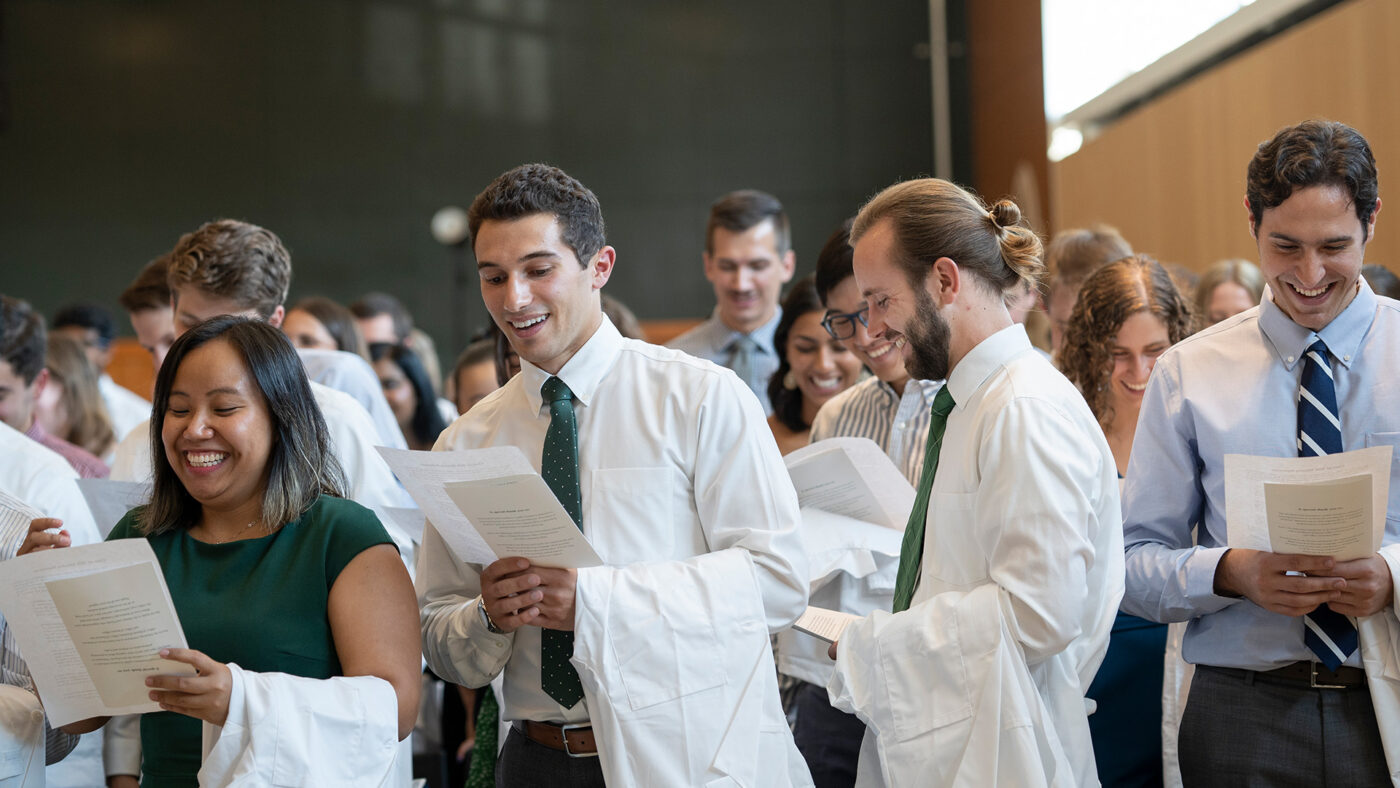
Unlike many schools, Geisel does not hand out white coats at orientation. New students spend their first two months in a clinical clerkship seeing simulated patients, where they gain hands-on experience with the art and science of medicine, humanism, professionalism and patient care. The White Coat Ceremony comes afterward, in late September. For the Class of 2030 it was held on September 25, 2026.
Phase 1: Foundations of Medicine
Phase 1 is organized into blocks and longitudinal courses that run all year. Every course includes integrated longitudinal topics and problem-based learning (PBL) cases that emphasize clinical relevance. An 8.5-week summer break between Blocks 4 and 5 lets students pursue research, quality improvement, clinical experience or other interests.
| Block | Content |
|---|---|
| Block 1 | Foundations of Medical Science and Practice |
| Block 2 | Infection, Inflammation and Immunity; Hematology |
| Block 3 | Cardiovascular Medicine; Respiratory Medicine |
| Block 4 | GI, Metabolism and Nutrition; Endocrinology; Reproductive Medicine |
| Block 5 | Renal Medicine; Dermatology, Rheumatology and Orthopedics |
| Block 6 | Neuroscience and Neurology; Psychiatry |
| Block 7 | Medical Science Integrations |
Longitudinal courses
- On Doctoring. Geisel’s clinical skills course, directed by Roshini Pinto-Powell, MD. Its programs include a simulation clinic for clinical skills, a Patient Bank and a Community Partner Program.
- Population Health. Launched about ten years ago as Patients and Populations and redesigned in 2026, the course is now a longitudinal research and health sciences curriculum that connects across all four years. Its five modules cover foundational research skills; structural forces in the US health care system; tools of improvement science; teamwork and networking with students from other health professions across New Hampshire; and longitudinal projects on complex topics.
- Medical Learning Science. The third longitudinal course that runs through Phase 1.
Curricular threads. Anatomy and embryology; child and adolescent health; ethics and human values; health equity; histology; imaging; nutrition; pathology; pharmacology; and research and scholarship.
Interprofessional learning. First-year students shadow nurses and allied health professionals at Dartmouth Hitchcock Medical Center. In the second year, they work through clinical scenarios with physician assistant students from Franklin Pierce University and nursing students from Colby-Sawyer College. If you are interested in how teams of nurses, PAs and physicians share care, experience with other professions, such as time spent alongside nurses in nursing internships abroad, gives you something specific to discuss.
Phase 2: Clinical Immersion
Phase 2 begins in April of the second academic year. It includes required clerkships in six clinical disciplines: internal medicine, surgery, obstetrics and gynecology, pediatrics, psychiatry and family medicine. Each lasts six to eight weeks. Clerkships take place at Dartmouth Hitchcock Medical Center and the White River Junction VA, at regional teaching hospitals and office practices, and at more distant sites, including Indian Health Service medical centers in Arizona and New Mexico and, in California, Santa Clara Valley Medical Center, California Pacific Medical Center and Children’s Hospital of Orange County. The schedule leaves room for up to six weeks of clinical electives alongside the required clerkships.
Phase 3: Exploration and Differentiation
Phase 3 starts in April of the third academic year. It includes one required four-week clerkship in Advanced Ambulatory Medicine and at least one advanced four-week sub-internship in the student’s chosen field. Because required clerkships end by April of the third year, Geisel students have five to six months to explore careers through electives and sub-internships before they apply to residency. Students can choose from opportunities on campus, across the country and around the world, and they can design their own elective with a faculty sponsor.
Grading. Phase 1 is graded pass/fail. Core clerkships in Phase 2 are graded honors, pass or fail, and Phase 3 sub-internships and electives are graded honors, high pass, pass or fail. Students are not formally ranked in any phase. Lectures make up less than 40% of the curriculum; most teaching happens in small groups, labs and team-based, case-based and problem-based sessions.
In the second half of the fourth year, every student returns to campus for a capstone course focused on skills important in residency: advanced clinical skills, applying foundational science to patient care and quality improvement.
Learning collaboratives and coaching
Geisel’s learning collaboratives are small, student-centered communities. Each new student is assigned to one of four houses at orientation, and the houses support personal and professional development, team-based learning and a sense of belonging. The curriculum is supported by what the school calls an intensive and personalized longitudinal coaching program.
How Geisel’s model differs from a traditional one
Geisel moves students into clerkships in April of the second year, about a year earlier than a traditional 2+2 model, and front-loads clinical exposure with the simulated-patient clerkship. The payoff is a long exploration window in the fourth year. The trade-off is pace: Phase 1 compresses the basic sciences into about 20 months, and you need to be ready for steady, integrated work from the first week. Students who learn well in small groups and with PBL cases tend to do well in this structure.
Admissions Requirements and Application Process
Geisel’s admissions process is built to find people who are strong students and who have the qualities that make compassionate, capable physicians. Every file is read in full. The committee reviews “personal, academic, scientific, and community engagement considerations” and looks for intellectual curiosity, integrity, empathy, compassion, the ability to overcome obstacles, resilience, distance traveled, coachability and a commitment to lifelong learning. The school receives about 8,000 completed applications a year for 96 places, and its student body is national in scope.
Academic background and degree
Candidates need a bachelor’s degree and at least three years of study at a US or Canadian college or university. Geisel wants a broad range of study in the sciences and humanities that builds a foundation in the science of medicine and in human behavior and society. Students are encouraged to major in a field that interests them and, if possible, to pursue independent investigation in that field. There is no required major and no published minimum GPA.
Prerequisite courses
Prerequisites do not all need to be finished when you apply, but they must be completed before you matriculate.
| Subject | Requirement |
|---|---|
| Physics | One year (8 credit hours or equivalent); any completed physics coursework counts |
| Biology | One year (8 credit hours or equivalent); general through advanced biology all count |
| Organic chemistry | One semester (4 credit hours or equivalent) |
| Biochemistry | One semester (4 credit hours or equivalent) |
| Chemistry | One more year (8 credit hours or equivalent), from general to advanced chemistry, in addition to organic chemistry and biochemistry |
| Mathematics | One half-year (3 credit hours or equivalent) of college-level math, including calculus or statistics |
Students on a quarter or trimester system can meet the organic chemistry or biochemistry requirement with one quarter or trimester if they have 16 credit hours (or the equivalent) of chemistry overall. List credit hours in AMCAS as they appear on your transcript; Geisel adjusts its requirement to how your school awards credit. Complete any lab section offered with your science courses.
Course policies
- Online courses count if the program is properly accredited in the US or Canada, though the committee prefers that most prerequisites be taken in a classroom. You can email a syllabus to ask whether a course qualifies.
- Community college courses are accepted.
- AP credit counts if it appears on an official college or university transcript.
- Courses taken outside the US or Canada can count, but AMCAS will not verify them, so you must send an official course-by-course evaluation from a credentialing service.
- Pass/fail and audited courses do not count toward prerequisites, except for courses affected by COVID-19 in 2020 to 2022. Pass/fail is fine for non-prerequisites if your school’s policies allow it.
MCAT
All applicants must submit MCAT scores and score 503 or higher. Applicants with scores of 502 or below are not sent a secondary. For 2027 entry, the MCAT must have been taken between January 2024 and September 2026. If you have more than one score, Geisel considers your most recent test most closely but also looks at the others. The average MCAT of accepted applicants is 516, and the incoming class median was 515. For the 2025 entering class, accepted applicants had a median of 517, with section medians of 129 (Chemical and Physical Foundations), 128 (CARS), 130 (Biological and Biochemical Foundations) and 130 (Psychological, Social and Biological Foundations). The committee sees your last three years of scores and reads them in the context of your other academic measures. To see how those numbers compare with other schools, our table of the average GPA and MCAT score for every medical school is a useful benchmark.
Citizenship, international and DACA applicants
Geisel admits and enrolls international students and calls them an important part of the student body’s diversity. Any applicant who meets the premedical requirements, including three years of study at US or Canadian colleges or universities, may apply. International applicants are considered in the same pool as US citizens, permanent residents and DACA applicants. DACA-eligible candidates are reviewed the same way as everyone else, and if admitted, both international and DACA students may apply for need-based institutional scholarships and loans.
Clinical, service and research experience
Geisel does not publish a required number of clinical or volunteer hours. Its stated priorities, though, make clinical exposure close to essential. Letters are encouraged from “someone who can speak to your clinical experience,” the curriculum puts you in front of patients in your first week, and the mission asks for physicians who improve how care is delivered. The strongest files show steady, hands-on patient contact over time, community service that responds to real local needs and, ideally, some research or quality improvement work. If you are still building that record, clinical internships for pre-med students are one way to add supervised patient contact; work in a local clinic, hospital or hospice is another.
Letters of recommendation
- If your school has a premedical committee, Geisel requires the committee letter or a committee letter packet.
- Otherwise, submit at least three and no more than five individual letters.
- Letters from a science faculty member and from someone who can speak to your clinical experience are encouraged. Others may come from supervisors, employers and colleagues who know you well.
- Graduate students should include a letter from their thesis advisor as one of the three.
- Geisel uses the AMCAS Letter of Recommendation Service and the AMCAS Criminal Background Check Program.
- Additional letters sent during the cycle are not considered during initial review, interview selection or committee deliberation. They are considered only if you are on the waitlist.
Situational judgment tests
Geisel does not use PREview scores in admissions and requires no additional assessments, such as CASPer, for 2026-2027. Check your secondary instructions to confirm, and do not pay for a test the school has not requested.
Background check and shadowing
A criminal background check is required through the AMCAS program. Shadowing is recommended rather than required: Geisel wants applicants to show a reasonable understanding of the American health care system, and it values direct patient care, whether through shadowing or work as a medical assistant, EMT, scribe, CNA or similar role. In the 2025 entering class, 97% of matriculants reported research or lab experience, 92% physician shadowing, 89% clinical volunteering, 88% community service and 72% paid clinical work.
The application, step by step
- AMCAS. File your primary application through AMCAS. You could begin the 2026 AMCAS application on May 5, 2026, and submit it from May 28, 2026. Geisel’s AMCAS deadline is November 2, 2026. Geisel recommends filing early, even if your MCAT score is still pending, because AMCAS forwards scores automatically. A detailed medical school application timeline guide can help you plan each step from spring through the interview season.
- Secondary. Once AMCAS sends Geisel your preliminary information, the school emails secondary access instructions to applicants with an MCAT of 503 or higher. You may submit the secondary before or after AMCAS verifies your application. The fee is $130 and nonrefundable; AMCAS fee-waiver recipients receive a Geisel fee waiver automatically, and others may request one by emailing the admissions office. The deadline is November 16, 2026, at 11:59 PM Eastern. If you withdraw from AMCAS or are not verified by the deadline, the fee is not refunded.
- Letters. Send letters through AMCAS.
- Review and interview invitations. Secondaries can be submitted from July 1, 2026, and application review begins July 8, 2026. Files are reviewed from July through February, and you are notified by email when an interview decision is made.
- Interview. Virtual, on Thursdays, from August 2026 through March 2027.
- Decision. Decisions are posted in the online portal once the committee decides. Geisel does not track or report status in the meantime, and review can take time because each file is read carefully. For 2026-2027, acceptance notices go out from October 15, 2026 through June 1, 2027, and admitted applicants have up to two weeks to respond to an offer. No deposit is required. Plan to Enroll and Commit to Enroll fall around May 1 and June 1 each year (April 1 and May 1 for MD/PhD), with dates moved to the next business day when they fall on a weekend or holiday. Deferral requests are considered case by case; four students in the 2025 entering class deferred.
- Waitlist. Interviewed applicants who are waitlisted are told so. The list is reviewed periodically, and the school notes that historically a number of waitlisted applicants are offered places. After May 1, Geisel asks waitlisted applicants whether they want to remain on the list and admits from it through a committee process. The number of waitlist offers changes each year; the five-year average is 30, and 40 acceptance offers went to waitlisted applicants in the most recent cycle reported.
You can upload updates, such as new grades, a new experience, a publication or a letter of interest or intent, through the “Documents Upload” section of the portal. For advice on writing one, see our guide to the medical school letter of intent or letter of interest.
2026-2027 timeline
| Date | Step |
|---|---|
| January to June 2026 | Monthly virtual information sessions for prospective applicants |
| May 5, 2026 | AMCAS application opens |
| May 28, 2026 | Applications may be submitted to AMCAS |
| July 1, 2026 | Secondary applications can be submitted |
| July 8, 2026 | Geisel begins reviewing files (review continues through February) |
| August 2026 | Interviews begin (Thursdays, virtual) |
| October 15, 2026 | Earliest acceptance notices |
| November 2, 2026 | AMCAS submissions close for Geisel |
| November 16, 2026, 11:59 PM ET | Final deadline for the secondary application and all materials |
| March 2027 | Interviews end |
| About May 1 and June 1, 2027 | Plan to Enroll and Commit to Enroll dates (May 1 and June 1 in the 2026 cycle; similar each year, moved to the next business day if they fall on a weekend or holiday) |
| June 1, 2027 | Latest acceptance notices |
| August 2027 | Entering class begins medical school (the Class of 2030 started in August 2026) |
Geisel says plainly that it does not extend deadlines, out of fairness to all applicants. There is no Early Decision option.
Visiting and contacting the school
Geisel does not offer campus tours, but you may visit Hanover on your own, and Dartmouth’s undergraduate admissions office runs tours open to anyone. Admissions staff do not meet individually with applicants in the current cycle. Prospective applicants can attend monthly virtual information sessions from January to June, and interviewees can connect with current students and faculty. You can reach the Office of Admissions, MD Program, at 3 Rope Ferry Road, Hanover, NH 03755-1404; (603) 646-5800; [email protected]. Full instructions are on Geisel’s How to Apply and Admissions Requirements pages.
Tuition, Cost of Attendance and Financial Aid
Geisel is a private school, so tuition is the same for every student regardless of state of residence. The school’s 2026-27 budget below shows what a student should plan for in each year. Indirect costs are based on what enrolled students report and may differ depending on where and how you live.
2026-27 cost of attendance
| Item | Year 1 (10 months) | Year 2 (10 months) | Year 3 (12 months) | Year 4 (12 months) |
|---|---|---|---|---|
| Tuition | $75,110 | $75,110 | $75,110 | $75,110 |
| Student activity fee | $125 | $125 | $125 | $125 |
| Health access fee | $284 | $284 | $284 | $284 |
| Document fee | $110 | $0 | $0 | $0 |
| Student services fee | $2,000 | $2,000 | $2,000 | $2,000 |
| Clinical access fee | $100 | $100 | $100 | $100 |
| Disability insurance | $55 | $55 | $55 | $55 |
| Total direct costs | $77,784 | $77,674 | $77,674 | $77,674 |
| Housing | $12,500 | $12,500 | $14,900 | $14,900 |
| Food | $4,000 | $4,000 | $4,800 | $5,100 |
| Books, supplies and equipment | $1,500 | $800 | $1,100 | $700 |
| National Board/USMLE exam | $0 | $695 | $695 | $0 |
| Local, elective, USMLE and On Doctoring travel | $1,250 | $1,000 | $2,100 | $2,100 |
| Miscellaneous | $3,330 | $3,030 | $4,280 | $4,680 |
| Total indirect costs | $22,580 | $22,025 | $27,875 | $27,480 |
| Health insurance (charged in fall) | $5,216 | $5,216 | $5,216 | $5,216 |
| Total cost of attendance | $105,580 | $104,915 | $110,765 | $110,370 |
Source: Geisel Financial Aid, Cost of Attendance, M.D. Program 2026-2027.
A few points to notice:
- Tuition versus total cost. Tuition is $75,110, but the realistic four-year total is about $431,600 before any aid, because housing, food, travel and insurance add roughly $27,000 to $33,000 a year.
- Health insurance is a real charge. Students pay $5,216 for the student health plan unless they have comparable coverage and an approved waiver. All students must have health insurance.
- Travel is built in. The budget includes money for local, elective and On Doctoring travel because clerkships happen at sites across the region and beyond.
- Summer earnings are expected. Students entering Year 1 are expected to contribute $5,000 of summer income (plus relocation costs). Students entering Years 2, 3 and 4 are expected to contribute $1,000.
- For comparison. For 2025-26, Geisel’s first-year tuition and fees were $74,868, other expenses $21,580, health insurance $4,556 and total cost $101,004, the same for every residency category. The school’s own 2026-27 budget above is newer and is the figure to plan with.
- Admissions are need-blind. Financial need does not affect the admissions decision, and every accepted student with documented need is offered an aid package.
How Geisel awards aid
Geisel awards need-based aid to as many students with demonstrated need as its resources allow. Key rules from the school’s financial aid policy:
- Base loan first. Each aid package starts with a base loan of $42,700, made up of federal unsubsidized loans or, for students not eligible for federal aid, Dartmouth and Geisel loan funds.
- Scholarship above the base loan. A Geisel scholarship is awarded when financial need exceeds the base loan, and Geisel will award aid up to the full cost of attendance.
- Parent information is required. Like most US medical schools, Geisel requires parental income information from every applicant for institutional need-based aid, regardless of age, marital status or family status.
- International and DACA students can receive institutional need-based scholarships and loans. International students should complete the CSS Profile and the school’s application.
- Outside awards reduce the loan part of the package first. Large service-commitment scholarships, such as Armed Forces, National Health Service Corps and Indian Health Service scholarships, replace any Geisel scholarship.
- Married students. A spouse’s net earnings can reduce the loan portion of the package; scholarship eligibility is determined as if the student were single.
Geisel reports about $7 million in scholarships each year. In 2024-25, 75% of Geisel students received financial aid, and indebted graduates left with an average medical school debt of $206,863.
How to apply for aid
For the 2027-2028 academic year, submit these as soon as possible after October 1 and before April 1, 2027:
- Geisel School of Medicine Financial Aid Application, completed every year on the Geisel Financial Aid website.
- FAFSA, every year, for federal Direct Loans. Use the FAFSA website; school code 002573 (Dartmouth College, Hanover, NH).
- CSS Profile and IDOC, the first time you apply for institutional need-based aid. Use the CSS Profile website and select Geisel School of Medicine at Dartmouth (CSS code 2314).
- Signed 2025 federal tax returns for the student, and for the parents if you are applying for institutional aid, through the College Board IDOC portal. Non-filers submit the non-filer statement.
- Direct Loan entrance counseling and Master Promissory Note, about 30 days before matriculation, at StudentAid.gov.
Geisel supports equal opportunity, and no student is denied aid because of age, disability, race, color, sexual orientation, religion, sex or national or ethnic origin. Federal aid requires US citizenship or permanent residency.
Financial aid office
The Financial Aid Office is at 7021 Remsen, Suite 321, Hanover, NH 03755 (mailing address: 66 College Street, 7021 Remsen Building, Hanover, NH 03755). Checks go to the Dartmouth College Cashiers Office, 6132 McNutt Hall, Room 103, Hanover, NH 03755, with “Attn: Geisel School of Medicine,” the student’s full name and student ID if known. The team includes G. Dino Koff, Assistant Vice President and Executive Director; Michelle Chamley, Assistant Director of Financial Aid; and Margot Gueldenzoph, Financial Aid Assistant. Phone: (603) 646-5564. Email: [email protected]. The office offers group and individual financial counseling, and scholarship decisions can come shortly after admission, so apply for aid promptly.
Campus Facilities and Student Life
Hanover and the Upper Valley
Hanover is a small New England college town of about 11,870 residents (2020 Census) in the Connecticut River valley, between the White Mountains of New Hampshire and the Green Mountains of Vermont. Geisel describes the area as quintessential New England: students hike nearby trails between classes, ski at the college’s ski area and kayak on the Connecticut River. Dartmouth’s Hopkins Center for the Arts presents about 500 film, dance, music and theater events a year, and the Hood Museum of Art holds works by Monet, Rodin and Rembrandt. You avoid big-city traffic and parking, but you also give up big-city size: if you want an urban medical school life, Geisel will feel quiet, and you should be honest with yourself about that before you apply.
Study and clinical facilities
Plan on a car. Geisel requires students to have a current driver’s license and a vehicle. Clinical preceptor sites begin in Phase 1 and can be up to an hour away, and free public transportation is limited. Housing is provided for required Phase 2 clerkships at sites more than an hour from campus.
Teaching takes place in Hanover and at Dartmouth Hitchcock Medical Center in Lebanon. Students practice clinical skills at the Dartmouth-Hitchcock Simulation Center, study anatomy in the anatomy laboratory and use Dartmouth’s biomedical libraries. Research takes place in Geisel’s Hanover laboratories and in the Borwell, Rubin and Williamson Translational Research buildings at the medical center, plus the Yasinski Research Building at the White River Junction VA.
Support for students
- Learning collaboratives. Every student belongs to one of four houses that build community, support wellbeing and anchor team-based learning.
- Coaching and advising. A longitudinal coaching program supports students through the curriculum, and academic, career and financial counseling are available.
- Student life and wellbeing. The associate dean of student life and the student wellbeing staff run orientation programs that build wellness and social activities into the first week. Learning and accessibility services support students with disabilities.
- Financial counseling. Group and individual counseling from the Financial Aid Office.
Service and community engagement
Geisel’s student-run Community Service Committee links students with organizations across the Upper Valley and funds new projects through the Fran Field Fund and the #MLKFoodisMedicine initiative. Current service programs include:
- Good Neighbor Health Clinic and its vision screening clinic
- Claremont Soup Kitchen
- Migrant Health Program
- Upper Valley Human Rights Clinic and Physicians for Human Rights
- The Haven and David’s House
- Flu clinics, a Diabetes Clinic and the Mascoma Clinic
- Active for Life, Cooking for Life and Memory Cafe
- Dartmouth EARS and the Student Needs and Assistance Program (SNAP)
- Lifelines and The Dermatones, the student a cappella group that performs in the community
- Rural Health Scholars and Urban Health Scholars
Each year a new class of Geisel students also joins the Albert Schweitzer Fellowship to run community health projects; the latest class began its projects in July 2026.
Student organizations
Geisel students run many specialty interest groups, affinity groups, scholar groups and wellness, arts and sports clubs. The student government keeps the current list of groups and leaders. Interest groups are organized around community health, health policy, human rights, sustainability, climate change, disability advocacy and medical education, alongside more than 25 others, and PrideMD is Geisel’s LGBTQ+ student group. Groups you can confirm on public school pages include the Student National Medical Association (SNMA) and Latino Medical Student Association (LMSA) chapters, both of which partner with the DICE office, the Rural, Urban and Global Health Scholars programs and the service groups above. Student government pages also list an AAMC Organization of Student Representatives delegate and honor societies. If a specific interest group matters to you, ask current students during your interview day.
Diversity, inclusion and community engagement partnerships
Geisel’s DICE office works with national and regional organizations to build a diverse and supported community. Its current partners are the Society for the Advancement of Chicanos/Hispanics and Native Americans in Science (SACNAS); the AAMC Group on Diversity and Inclusion (GDI); Building the Next Generation of Academic Physicians (BNGAP); the Indigenous New Hampshire Collaborative Collective; the Association of American Indian Physicians (AAIP); the Student National Medical Association (SNMA); the Latino Medical Student Association (LMSA); Executive Leadership in Academic Medicine (ELAM); and the National Institutes of Health Biomedical Sciences Recruitment Fair. The DICE team also gives a short welcome at each interview day.
Through the AAMC Group on Diversity and Inclusion, DICE staff take part in national conferences and recruitment events, and Geisel’s presence at the NIH Biomedical Sciences Recruitment Fair helps it reach students from a wide range of backgrounds who are interested in medicine and research careers.
Clinical Rotations and Research Opportunities
Primary teaching hospitals
Dartmouth Hitchcock Medical Center (DHMC), Lebanon, NH. DHMC is the flagship hospital of Dartmouth Health, New Hampshire’s only academic health system and the state’s largest private employer. Dartmouth Health provides access to more than 2,000 providers across almost every specialty, and DHMC is regularly named the top hospital in New Hampshire by U.S. News & World Report. The system includes Dartmouth Cancer Center, one of 57 NCI-designated Comprehensive Cancer Centers and the only one in northern New England, and Dartmouth Health Children’s, which includes the state’s only children’s hospital. Important centers at DHMC include the Spine Center, the Heart and Vascular Center and an ALS Center. Dartmouth Health’s own research grew sharply in recent years; it passed $20 million in NIH funding in 2025.
White River Junction VA Medical Center, Vermont. Fifteen minutes from campus, this VA hospital supports many Dartmouth-Hitchcock residency programs and Geisel clerkships. It is home to the National Center for Post-Traumatic Stress Disorder, the VA Outcomes Group (part of The Dartmouth Institute) and the Yasinski Research Building. Its Women’s Comprehensive Care Center serves more than 1,000 women veterans, and it is one of eight VA centers for the National Quality Scholars Program.
Clerkship sites by discipline
Geisel’s clerkship page lists established sites well beyond the Upper Valley. Many students do part of their training far from Hanover, which is one of the school’s most distinctive features.
| Clerkship | Established sites (beyond DHMC) |
|---|---|
| Family medicine | Sites across New England and the US, including Valdez, Alaska; Fort Defiance, Arizona; California Pacific Medical Center, San Francisco; Missoula, Montana; and Shiprock, New Mexico |
| Internal medicine | California Pacific Medical Center, San Francisco; Santa Clara, California; White River Junction VA |
| Advanced ambulatory medicine | White River Junction VA; Manchester VA, New Hampshire; community practices including Watertown, New York, Midland, Michigan, and Columbus, Mississippi |
| Neurology (listed on the clerkship sites page) | California Pacific Medical Center; Dartmouth-Hitchcock Manchester; White River Junction VA |
| Obstetrics and gynecology | California Pacific Medical Center; Anchorage, Alaska; Brattleboro, Vermont; Concord Hospital; Southern New Hampshire Regional Medical Center, Nashua; Cheshire Medical Center, Keene; Monadnock Community Hospital, Peterborough |
| Pediatrics | Fort Defiance Indian Hospital, Arizona; Sanford Bemidji Medical Center, Minnesota; Children’s Hospital of Orange County, California; California Pacific Medical Center; practices in the Upper Connecticut River Valley and New England |
| Psychiatry | California Pacific Medical Center; Brattleboro Retreat, Vermont; Dorothea Dix Psychiatric Center, Bangor, Maine; New Hampshire Hospital, Concord; White River Junction VA |
| Surgery | Concord Hospital, New Hampshire; White River Junction VA |
California Pacific Medical Center in San Francisco is a popular clerkship site for Geisel students, and the Indian Health Service sites in Fort Defiance and Shiprock give students experience in Navajo Nation communities. Think about travel and housing when you plan: the school’s budget includes elective and clerkship travel for this reason.
Global health
Geisel’s Center for Global Health Equity, directed by Lisa V. Adams, MD (MED’90), focuses on medically underserved populations. Its student programs include Geisel Global Health Scholars, the Geisel Global Health Pathway, community-based internships, the DarDar global health clinical elective in Tanzania and the James Strickler Clinical Elective in Global Health, a bilateral exchange with Muhimbili University of Health and Allied Sciences in Dar es Salaam. A partnership between the Dartmouth International Health Group and Dartmouth’s John Sloan Dickey Center for International Understanding has funded student fellowships in countries including Cameroon, Cuba, Ecuador, Ghana, Guatemala, India, Kenya, Nicaragua, Thailand and Zambia. If global health draws you to Geisel, hands-on clinical work before medical school, such as pre-med internships abroad with supervised patient care, can help you write about it concretely rather than in general terms.
Research
Geisel describes itself as a research-intensive school despite its size. In the 2025 Blue Ridge Institute for Medical Research rankings, Geisel brought in more than $80 million in NIH grant funding, a $22 million increase over the previous year, and rose six spots overall. It is the smallest medical school by enrollment in the top 70. Its Department of Microbiology and Immunology ranked 9th in the nation for NIH funding in its field, with $19.3 million.
Research strengths students can join include cancer research through Dartmouth Cancer Center; microbiology and immunology; neuroscience and psychological and brain sciences; quantitative biomedical sciences and computational biology; and health policy and health care delivery science through The Dartmouth Institute and the Dartmouth Atlas Project, which has long studied why health care spending and practice vary across the United States.
Student research support. The Office of Medical Student Research supports MD students with mentorship, IRB guidance, grant writing help and manuscript support. Its programs include:
- Summer research projects with Geisel and DHMC faculty and summer research work-study grants, timed for the 8.5-week break after Block 4
- Named summer scholarships, such as the Young Summer Research Scholarship in Pancreas Disease and the Richard W. Dow Student Research Scholarship in Surgery, and the TOPS cancer summer research program
- MD Student Research Scholars and an Academic Scholar Year for students who want a dedicated research year
- The Olive M. and Joseph F. Swigart Ethics Fellowship and the Robert McCollum Medical Student Scholarship in Epidemiology
- Conference, grant and manuscript funding, plus an M2 student poster night
Research and scholarship is also one of the curriculum’s longitudinal threads, and the Population Health course builds research skills and a longitudinal project into the first two years. Students who want more can add an MPH, MS or PhD.
Residency match
On Match Day 2026, the 94 members of the Class of 2026 matched into residency programs in 22 states and 21 specialties. Thirty percent matched into primary care (family medicine, internal medicine and pediatrics), and anesthesiology and psychiatry were the next most popular choices. California, Massachusetts and New York were the most common destinations, and eight graduates matched at Dartmouth Hitchcock Medical Center. The school’s 2026 match list includes programs such as Massachusetts General Brigham, Boston Children’s Hospital, Beth Israel Deaconess Medical Center, NewYork-Presbyterian/Weill Cornell, Cleveland Clinic, Northwestern McGaw, the University of Washington and UT Southwestern, as well as Dartmouth-Hitchcock. Geisel posts match lists by program for every year since 2013.
Notable Alumni, Faculty, Leadership and Admissions Staff
The people below hold verified roles at Geisel or earned their MD at Dartmouth’s medical school. Knowing who leads the school and its programs helps you understand its priorities. It does not imply that any of them will mentor you or decide your application.
Leadership
Jennifer Hunt, MD, MEd, Dean. Dr. Hunt became dean in 2026, the school’s 17th dean and the first woman to lead Geisel. She is an internationally known head-and-neck and molecular pathologist with more than 160 peer-reviewed publications. Before Dartmouth she was interim dean of the University of Florida College of Medicine, where she also chaired the Department of Pathology, Immunology and Laboratory Medicine and served as chief of the hospital medical staff at UF Health Shands. She earned her MD and a concurrent master’s degree in education at the University of Pennsylvania and spent nearly a decade as chair of pathology at the University of Arkansas for Medical Sciences. Her education degree matters for applicants: she welcomed the Class of 2030 by describing medicine as a continuing “journey of becoming,” and she told new students to own mistakes early and act to correct them.
Sonia Chimienti, MD, Dean of Educational Affairs. Dr. Chimienti, an infectious diseases physician, leads Geisel’s educational programs and serves as the faculty lead for LCME accreditation. She spoke to the Class of 2026 at Match Day about the dedication and hard work behind their results. Her office oversees the curriculum you would follow, including the redesign work described above.
Tara K. Cunningham, EdD, MS, Associate Dean of Student Life. Dr. Cunningham leads student life programs and led the countdown at Match Day 2026. Student life at Geisel includes the learning collaborative houses, wellbeing staff and the orientation program that builds wellness into the first week.
Admissions leadership and staff
Roshini Pinto-Powell, MD, Associate Dean of Admissions. Dr. Pinto-Powell is a professor of medicine and medical education, an active clinician and the director of On Doctoring, Geisel’s clinical skills course. She built parts of that course, including a simulation clinic for teaching clinical skills, a Patient Bank and a Community Partner Program, and she created a web-based case series for the inpatient medicine clerkship that is used nationally. On interview day she gives the opening welcome and closing remarks. At the Class of 2030 orientation she said that “character development is at the heart of our mission” and that collaboration and teamwork are as crucial in medicine as knowledge. Applicants should read that as a clear statement of what the school values.
Aileen Panitz, Admissions Director. Ms. Panitz directs the MD admissions office and is the listed contact for the Admissions Committee, which runs Geisel’s holistic review. Her office manages secondary applications, interview days and applicant communication through the online portal.
Faculty
Virginia Lyons, PhD, Associate Dean for Pre-clerkship Education. Dr. Lyons oversees the preclinical phase and leads anatomy and embryology across the curriculum. She earned her PhD in cell biology and anatomy at the University of North Carolina at Chapel Hill and was an inaugural member of two teaching academies. In 2026 she supported the redesign of Patients and Populations into the current Population Health course, using years of student feedback.
Julie Taylor, MD, MSc, Associate Dean for Medical Education. Dr. Taylor, interim chair of the Department of Community and Family Medicine, led the Population Health redesign. Her goal, in the school’s words, is to prepare students to be “effective, collaborative problem solvers and change agents” who improve the health of communities and the value of health care. If health care delivery interests you, her course is where you will spend much of that time.
David Leib, PhD, Chair of Microbiology and Immunology. Dr. Leib leads a department that ranked 9th nationally for NIH funding in microbiology and immunology in 2025, with $19.3 million in support. He has mentored MD-PhD students in his laboratory, and his department is a natural home for students interested in infectious disease and immunology research.
Alexander Fuld, Assistant Professor of Medicine and of Medical Education. A hematology and oncology physician for 25 years, Dr. Fuld gave the keynote at the Class of 2030 White Coat Ceremony and urged students to find a “north star,” which for him is the patient and the commitment to helping them.
Alumni
Lisa V. Adams, MD (MED’90). Dr. Adams studied medicine at Dartmouth before formal global health programs existed and now directs Geisel’s Center for Global Health Equity. She helps students arrange international service-learning and global health electives, including the James Strickler Clinical Elective in Global Health in Tanzania. Her path shows how Geisel alumni often come back to build the programs they wished they had.
Matthew Mackwood, MD, MPH (MED’14). Dr. Mackwood holds three Dartmouth degrees: a BA from the College (2008), an MPH from The Dartmouth Institute (2013) and his MD from Geisel (2014). After residency at Kaiser Permanente in Seattle he returned in 2018. He practices family medicine at a Dartmouth-Hitchcock primary care clinic, studies telemedicine, coaches students in On Doctoring and serves as a module leader in Population Health.
Anne Schuchat, MD (MED’84). Dr. Schuchat joined the CDC in 1988 as an Epidemic Intelligence Service officer. She went on to direct the National Center for Immunization and Respiratory Diseases from 2006 to 2015, served as acting CDC director in 2017 and again in 2018 and served as the agency’s principal deputy director. She retired as a rear admiral from the US Public Health Service and returned to give Geisel’s Class Day address in 2019.
James C. Strickler, MD (Dartmouth College 1950, Dartmouth Medical School 1951). Dr. Strickler returned to Dartmouth in 1967 to help build the school’s clinical departments and served as dean from 1973 to 1981, when the school completed its move from a two-year basic science program to a full MD degree and introduced a clinical curriculum. He later became a leader in global health, including work with refugees from Kosovo and a partnership with the University of Prishtina. A Geisel global health elective in Tanzania carries his name. He died on June 27, 2026, at age 99, as dean emeritus.
Geisel’s alumni also include many physicians, researchers and public servants beyond those listed here. Because lists of famous graduates found online often mix up Dartmouth College and medical school alumni, rely on school records such as class years (“MED” or “DMS”) when you mention an alumnus in an essay or interview.
Admissions Statistics and Class Profile
Geisel publishes its class profile as “fast facts” on its admissions site. The figures describe the incoming MD class; the page was last updated in March 2026 and does not print the entering year.
| Measure | Value | Notes |
|---|---|---|
| Total complete applications | 8,374 | Applicants who submitted all required materials |
| Interviewed | 661 | Each interviewee has two 30-minute interviews with the committee |
| Interviewed / complete applications | 661 of 8,374 (7.9%) | Interview ratio; not an acceptance rate |
| Matriculants (class size) | 96 | The MD Class of 2030 also has 96 students |
| Median MCAT | 515 | Range 503-526 |
| Median undergraduate GPA | 3.82 | Cumulative |
| Average MCAT, accepted applicants | 516 | From admissions requirements and FAQ pages |
| Average GPA, accepted applicants | 3.77 | Same pages |
| Geographic makeup | 28 states, 6 countries | Students from 51 colleges |
| Age | 21 to 41 | Average age 24 |
How to read the profile
- Interviews are the real filter. Fewer than 1 in 12 complete applicants reach the interview. Your file has to show fit and readiness on paper first, which is why the secondary essays matter so much.
- Scores cluster but vary. The MCAT range of 503 to 526 means applicants near the 503 floor have been admitted, but the middle of the class sits at 515. A score near 503 needs a strong upward trend, compelling experience and excellent essays to compete.
- Older applicants are common. An average age of 24 and a range up to 41 tell you that many students took time between college and medical school. Gap years spent in clinical work, research or service are normal here, not a weakness.
- The class is national. Students come from 28 states and six countries, and Geisel’s published policies do not mention a preference for New Hampshire residents. International and DACA applicants are reviewed in the same pool.
- No acceptance rate is published. You can compare the number of interviews with the number of seats, but without the number of offers, any acceptance rate you see is an estimate.
Detailed admissions data
The figures below are for the 2025 entering class. Use the school’s own fast facts above for the overall picture and these for detail the fast facts do not cover.
| Measure | 2025 entering class | Notes |
|---|---|---|
| Median MCAT, accepted applicants | 517 | Mean 516.8 |
| MCAT section medians, accepted applicants | CPBS 129; CARS 128; BBLS 130; PSBB 130 | Means 129.2, 128.1, 129.3 and 130.2 |
| Median overall GPA, accepted applicants | 3.90 | Mean 3.85 |
| Median science GPA, accepted applicants | 3.88 | Mean 3.82 |
| Verified applications | 10,330 | 97 New Hampshire residents, 9,430 out-of-state, 803 international |
| Matriculants | 96 | 4 New Hampshire residents, 82 out-of-state, 10 international |
| Deferred entrance | 4 | 3 out-of-state, 1 international |
| Entered through Early Assurance; MD/PhD | 7; 2 | No Early Decision or BS/MD entrants |
| Gender | 41 men, 55 women | Self-reported |
| Age | 43 aged 19-23; 49 aged 24-29; 3 aged 30-39; 1 aged 40 or older | Self-reported |
| Graduate degree; science or math majors | 17%; 67% | Self-reported |
| Entered from postbaccalaureate programs | 20 students | Self-reported |
| Self-reported disadvantaged status | 34% | 18% grew up in an area they considered medically underserved |
| States and countries | 28 states and DC; 6 countries | Countries: Canada, China, Nigeria, Poland, Thailand, United States |
What this adds to the picture:
- Residency barely matters. Only 97 of the 10,330 verified applicants were New Hampshire residents, and 4 of the 96 matriculants were. Geisel reviews in-state, out-of-state, Canadian and international applicants the same way, with no required tie to the state.
- International applicants do enroll. 803 international applicants applied and 10 matriculated, about one in ten seats.
- Science GPA tracks overall GPA. The accepted-applicant science median of 3.88 sits close to the overall 3.90, so a weak science record is hard to offset with other coursework.
- Not every student is a science major. One-third of the class majored outside the sciences and math, and 17% already held a graduate degree.
- Many paths in. Twenty students came through postbaccalaureate programs, and the age spread shows that gap years are common.
The number of offers is not published, so no acceptance rate can be calculated from these figures.
Specialty intentions and global health
Among recent Geisel graduating classes, the most common specialty intentions at graduation were internal medicine (14% to 26% of respondents, depending on the year), anesthesiology (9% to 13%), general surgery (4% to 17%) and family medicine (6% to 11%). In 2025, 21% of graduating seniors reported a global health experience during medical school, about 70% of students take part in community service projects and 80% to 90% complete a research experience.
Before you decide whether to apply, compare your own numbers with Geisel’s and with similar schools, then decide based on mission fit as much as statistics. A strong AMCAS personal statement that shows reflection and real patient contact helps any applicant, but it matters most when your numbers sit near or below the medians.
Tips and Strategies for Admission
Geisel’s priorities are unusually clear: the complete physician, health care delivery, character and teamwork, rural and underserved care, and coachability. The tips below turn those priorities into practical steps.
1. Explain your motivation with specific moments
Clearly explain why you want to be a physician, using a few personal experiences that led you to the decision. Geisel reads for reflection, so the best stories show what you noticed, what you did and how it changed your thinking. Connect those experiences to what Geisel actually offers, such as early clinical training, health care delivery science or rural clerkships, rather than to general praise.
2. Build steady, hands-on clinical experience
Geisel’s curriculum puts you with patients in your first weeks, so the committee wants proof that you know what patient care involves. Choose roles where you work directly with patients over months: medical assistant, scribe, EMT, hospice volunteer or clinic volunteer. Supervised pre-med internships can add intensive patient contact, especially if they give you responsibility for vitals, intake or triage. Quality matters more than the number of hours, but steady involvement over time tells the committee you have tested your choice.
3. Show that you think about systems, not only patients
The fourth part of Geisel’s mission, improving systems of care, is where many applicants are silent. If you have noticed a problem at work, such as missed appointments, long waits or confusing discharge instructions, and you tried to measure or fix it, write about it. Research in health services, public health or quality improvement fits Geisel well, and so does careful thinking about cost, access and outcomes. The Dartmouth Institute and the Population Health course make this a natural topic in an interview.
4. Demonstrate academic readiness, and explain dips honestly
Keep your GPA and MCAT competitive: the median MCAT was 515, and the floor for a secondary is 503. If you had an academic setback, explain it briefly and show what changed. Geisel names resilience, distance traveled and coachability as qualities it wants, so a clear account of how you recovered can strengthen your file. The second secondary essay is the natural place for that explanation.
5. Take rural medicine seriously if you mention it
Geisel’s clinical network covers rural New England, and its clerkships include Indian Health Service hospitals in Arizona and New Mexico and sites in Alaska, Montana and Minnesota. If you say you want rural practice, back it up with evidence: time spent working in a small town, care for agricultural workers, a rural EMS role or community health work. If rural medicine is not your goal, do not pretend; there are many other reasons to choose Geisel.
6. Prepare for teamwork and character to be evaluated
The interview day includes a 20-minute group exercise, and the admissions dean has said that character development is at the heart of the mission. Choose activities where you worked on a team toward a shared result, and be ready to describe a time you helped a group work better, handled disagreement or took feedback.
7. Use your undergraduate and gap years well
The average Geisel student starts at 24, and the oldest recent students were in their 40s. Time between college and medical school is normal. Plan it with purpose: full-time clinical work, a research position, service or a structured program. For students still in college, medical internships for undergraduates and campus research positions are good options. If you have only summers, plan them early; pre-med summer internships and summer research programs fill quickly.
8. Choose letter writers who can speak to your clinical work
Geisel encourages a letter from a science faculty member and one from someone who can describe your clinical experience. Ask a supervising physician, nurse manager or clinic director who has seen you with patients, not someone who only knows your title. If you are in graduate school, include your thesis advisor.
9. Write a specific secondary, and return it early
Use the secondary essays to show who you are and how you fit Geisel’s mission. Name verified programs and connect each one to something you have done. Geisel reviews files from July through February and does not extend its November 16 deadline, so aim to submit within two to three weeks of receiving the secondary.
10. Get the details right
Small errors stand out in a careful review. Confirm your MCAT date falls in the January 2024 to September 2026 window, list prerequisite credit hours exactly as they appear on your transcript and plan to finish any remaining prerequisite for a grade before matriculation. Keep your AMCAS email current; Geisel communicates through its portal and by email.
Helpful resources
- Medical school admissions consulting can provide personal guidance on your school list, personal statement, secondary essays and interview preparation.
- Real AMCAS personal statement examples show what a strong narrative looks like; use these examples for inspiration, not as templates.
- For ways to stand out in a competitive pool, our list of practical advice on making your application stand out covers experiences, personal attributes and how to describe achievements.
Secondary Application Questions, Example Responses and Analysis
Geisel’s secondary gives you four short essays for the 2026-2027 cycle. Together they let you add what your primary application missed, explain your plans for the year and show why Geisel fits you. Strong answers complement your AMCAS application rather than repeating it.
Who receives it and the logistics
- Who: every applicant with an MCAT of 503 or higher, after AMCAS sends Geisel your preliminary information.
- Fee: $130, nonrefundable. AMCAS fee-waiver recipients receive a Geisel fee waiver automatically; others may request one by emailing [email protected].
- Deadline: November 16, 2026, at 11:59 PM Eastern. All application materials must be in by then, and Geisel does not extend deadlines.
- Timing: you may submit before or after AMCAS verification. Geisel does not set a turnaround time, but it reviews files from July through February, so earlier is better.
- Limits: 250, 300, 300 and 250 words. Write to these limits and follow the limit shown in your portal if it differs.
- MD-PhD applicants: submit the MD-PhD Statement of Interest Form and the additional MD-PhD materials described with the secondary. The text of any separate MD-PhD questions for 2026-2027 has not been published.
What changed from last cycle
The 2026-2027 essays are shorter than last year’s, and two prompts have new wording. The “why Geisel” prompt now asks about “specific aspects” of the school, and the fourth prompt replaces last cycle’s question about being “the other” with a question about inquiry, respect and differing perspectives. If you have drafts from an older cycle, rewrite them for the new wording and limits.
Essay 1: Plans for 2026-2027 (250 words)
“Please indicate your plans for 2026-2027. If in school, list the courses you will be taking. If working, tell us about your job. If your plans or courses change, subsequently, please inform the Admissions Office by email at [email protected]. For course changes, we only need to be notified about changes related to prerequisite courses.” (250 words)
What it asks. A factual update on your year: courses if you are in school, the job if you are working, and a commitment to tell the school about changes to prerequisite courses.
How to approach it. Treat this as a short logistics answer. Name the role, the hours and what you actually do. If you are in school, list your courses and mark any prerequisite still in progress. A bullet-like structure is fine. If you are in a gap year, add one or two sentences on what the work is teaching you, but do not pad the answer to reach 250 words.
Illustrative example, not an actual applicant essay
From July 2026 through June 2027 I am working full time (40 hours a week) as a medical assistant at a federally qualified health center in Springfield, Vermont. I room patients, take vital signs, run point-of-care glucose and strep tests, update medication lists and call patients with normal lab results under a physician’s direction. About a third of our patients are on Medicaid, and many drive more than 30 minutes to reach us, so I also help the care coordinator schedule rides and refill reminders.
One prerequisite remains. In spring 2027 (January to May) I am taking Biochemistry (4 credit hours, letter grade) through the Community College of Vermont, an accredited institution. The course meets in person on Tuesday and Thursday evenings so I can keep my clinic schedule. I will finish it before matriculation, and I will email the Admissions Office if the course or term changes.
Outside of work, I volunteer four hours a week as a reader for a weekly medication-safety class at our local senior center and continue as a weekend kitchen volunteer at a regional food shelf, where I have served since my second year of college.
I chose a full year in primary care before medical school because I wanted to see what happens between visits: the missed rides, the pharmacy calls, the patients who skip care when money is tight. I expect to keep this job until I start medical school in summer 2027.
Why this example works. It gives exact dates, hours and duties for the job, so the committee can picture the applicant’s year. It names the one remaining prerequisite with credit hours, letter grading, an accredited community college and the term, which matches Geisel’s rules that prerequisites be graded and finished before matriculation. It commits to emailing the office if the prerequisite changes, which is the only change the prompt asks about. The last paragraph adds a single sentence of purpose without turning a logistics question into a second personal statement.
Mistakes to avoid. Listing every course you have taken; leaving out a prerequisite still in progress; describing a “gap year” with no hours or duties; padding to the limit; forgetting to say you will report prerequisite changes.
Essay 2: Something not addressed in your experiences or personal statement (300 words)
“Please reflect on your primary application and share something not addressed in your experiences or personal statement that would be helpful to the Admissions Committee as we review your file.” (300 words)
What it asks. Context that would help the committee understand your file and that you have not already given in your experiences section or personal statement.
How to approach it. Reread your AMCAS application as a stranger would. Where would a careful reader have a question? Common answers include a grade dip or gap, a family responsibility, a job that took time from activities, a meaningful experience that did not fit the experiences format, or an important part of your identity or background. This is also the best place for a challenge or growth story, since the 2026-2027 secondary has no separate challenge prompt. Choose a moment of real difficulty, keep the hardship brief and put most of your words on what you did and what changed in you.
Illustrative example, not an actual applicant essay
My transcript shows a C in Organic Chemistry II in spring of my second year and a jump in grades after that. My activities list shows a steady 15 hours a week at a hardware store. Neither entry explains the other.
That spring my younger brother, then 12, was diagnosed with type 1 diabetes. My mother works overnight shifts at a nursing home, and my father had left the year before. I was the adult at home most evenings. I learned to count carbohydrates, check his overnight glucose alarms and call the endocrinology nurse line when his numbers would not come down. I kept the hardware job because our family needed the paycheck. I did not tell my professors anything. I thought asking for help would look like an excuse.
The C was the result. What changed afterward was not that life got easier, but that I got better at asking. I met with my academic advisor, moved my hardest course to a summer term, and set up a shared calendar with my mother so his insulin refills and my exams never landed on the same night. Over the next five semesters my science GPA was 3.86.
I share this because it shaped how I think about patients. My brother’s care depended on a parent who was not home and a 20-year-old reading a dosing chart at midnight. Now, when I room a patient at the clinic who says they “forgot” a medication, I ask who else is in the house and what their night looks like. Usually the answer explains more than the chart does.
I would bring that question to Geisel’s small learning collaboratives and to the families I meet in rural clinics, where the person managing care is often not the patient.
Why this example works. It points to two items already in the file, a grade and a long-running job, and explains how they connect, giving the committee context it could not see. It shows reflection through evidence of change (an advisor meeting, a schedule change, a later science GPA) rather than asking for sympathy. It closes by linking the experience to patient care and, in one sentence, to Geisel’s learning collaboratives and rural clinical sites, without becoming a second “why Geisel” essay.
Mistakes to avoid. Repeating your personal statement; listing new activities with no explanation of why they matter; blaming others; sharing private medical details about family members beyond what the point needs; spending all 300 words on the hardship with no account of what you did next.
Essay 3: Specific aspects of Geisel, your strengths and your contribution (300 words)
“Are there specific aspects of the Geisel School of Medicine that draw you to apply? What are the characteristics and strengths you will bring to our program, and how will you contribute to our community?” (300 words)
What it asks. Three things: the specific parts of Geisel that draw you, the characteristics and strengths you will bring, and how you will contribute to the community.
How to approach it. Anchor your answer in three specifics, each tied to your own experience:
- A clinical element: the White River Junction VA, an Indian Health Service site such as Fort Defiance or Shiprock, California Pacific Medical Center, or rural New Hampshire clerkships.
- A curricular element: the two-month clinical clerkship with simulated patients, On Doctoring, Population Health, PBL cases, the learning collaboratives or the long Phase 3 exploration window.
- A research or service home: The Dartmouth Institute, the Center for Global Health Equity, the Good Neighbor Health Clinic, the Migrant Health Program, Rural Health Scholars or the Schweitzer Fellowship.
Then name strengths with their source (what experience built them) and a believable way you would contribute. Avoid generic praise of the small class or the scenery unless you can give an example.
Illustrative example, not an actual applicant essay
Three parts of Geisel match how I learn and where I want to practice.
First, Geisel starts with patients. Spending the first two months in a clinical clerkship with simulated patients, before the white coat, tells me the school treats clinical skill as something built from day one. As a medical assistant I learned more from one bad rooming interview than from any lecture; On Doctoring would structure that feedback.
Second, Geisel teaches how care is delivered, not only what care is. The Population Health course, with its longitudinal research thread and work in improvement science, fits questions I already ask at my clinic: why our diabetic patients miss eye exams, and whether a ride program changes that. Learning next to faculty from The Dartmouth Institute would teach me to answer those questions with data.
Third, the clinical map. Rotations at the White River Junction VA, pediatrics at Fort Defiance in Arizona and family medicine sites from Shiprock to rural New Hampshire would show me rural care in very different systems. I hope to practice family medicine in a small town in northern New England.
What I bring: steadiness under pressure, learned while managing my brother’s diabetes and a job at the same time; working Spanish from three summers on Vermont dairy farms; and comfort with the unglamorous logistics of primary care, from prior authorizations to ride scheduling.
How I would contribute: I would join the Migrant Health Program and help at the Good Neighbor Health Clinic, where I could put my Spanish and clinic experience to use from my first year. In my learning collaborative house, I would be the classmate who organizes study groups and checks in when someone goes quiet. Small classes depend on people who show up for each other.
Why this example works. Part one names three verified features and ties each to the applicant’s own experience: the opening clinical clerkship and On Doctoring, the redesigned Population Health course with The Dartmouth Institute, and named clerkship sites. Part two lists strengths with their origins instead of adjectives. Part three names real service programs from Geisel’s Community Service Committee and a realistic role in the learning collaborative houses. Clear signposts (“First,” “What I bring,” “How I would contribute”) let a reader see every part answered within 300 words.
Mistakes to avoid. Generic praise of class size or New Hampshire; naming programs you cannot connect to anything you have done; promising to found a club in your first week; answering only the “why Geisel” part and skipping strengths and contribution.
Essay 4: A time you felt different, or your perspective differed (250 words)
“Dartmouth values a culture of inquiry and respect and encourages dialogues that harness diversity and openness of thought. Reflect on a situation where you felt different from those around you, or one where your perspective differed from others.” (250 words)
What it asks. A reflection on one of two situations: a time you felt different from the people around you, or a time your view differed from others’. The framing, inquiry, respect and openness of thought, tells you what the school hopes to see in how you handled it.
How to approach it. Pick one concrete situation. Describe what made you different or what you disagreed about, what you did, and what you learned about listening and dialogue. Show curiosity about the other view and respect for the people who held it. Geisel’s mission statement and admissions committee both value diversity in all forms, and this essay is a chance to show how your background or perspective would help your classmates learn and how you would care for patients unlike yourself, including the rural and underserved patients Geisel serves.
Illustrative example, not an actual applicant essay
At our clinic’s monthly staff meeting, the group agreed to start discharging patients who missed three appointments in a year. Missed visits cost us slots, and everyone in the room, from physicians to front desk staff, supported the change. I was the newest and youngest person there, and I disagreed.
I had called many of those patients myself. One woman missed visits because her car only started in warm weather. A man worked a dairy shift that changed weekly. I was not sure my view counted, and I worried that speaking up would look naive.
I asked if I could bring numbers to the next meeting instead of an opinion. Over two weeks I reviewed 40 charts of patients with three or more missed visits and found that 24 lived more than 25 miles away and 11 had no listed phone. At the next meeting I shared the data and suggested we try reminder calls and ride referrals for three months first.
The practice manager pushed back on staff time, and she had a point. We agreed on a smaller trial: I would make the calls myself during slow hours. After three months, missed visits in that group fell by about a third, and the discharge rule was paused.
I learned that respect in a disagreement means taking the other side’s concern seriously, here, the cost of empty slots, while still asking the question no one else was asking.
Why this example works. It chooses the “perspective differed” option and shows both parts of the framing: inquiry, by gathering chart data instead of simply arguing, and respect, by crediting the practice manager’s concern about cost and accepting a smaller trial. It gives numbers and actions, admits the applicant’s discomfort as the youngest voice without dwelling on it and ends with a lesson that grows out of the story. Applicants who choose the “felt different” option can follow the same shape: the situation, what made you different, what you did and what you learned about dialogue.
Mistakes to avoid. Choosing a story where you were simply right and everyone else was wrong; turning the essay into a political argument; describing identity in the abstract with no situation; reusing an old essay about being “the other” without addressing inquiry and openness of thought.
Last cycle’s wording, for reference
For the 2025-2026 cycle, Geisel’s third prompt read “What aspects of the Geisel School of Medicine draw you to apply? Please include the characteristics and strengths you will bring to our program and how you hope to contribute to our community,” and the fourth read “Geisel School of Medicine values social justice and diversity in all its forms. Reflect on a situation where you were the ‘other’.” (250 words). Use the 2026-2027 wording above for this cycle.
General tips for Geisel’s secondary
- Draft early. These prompts are now confirmed for 2026-2027, so you can draft before your secondary arrives and spend the waiting time revising.
- Count words exactly. The limits are short; every sentence should do work.
- Keep the four essays distinct. Use Essay 2 for context or a challenge, Essay 3 for fit and contribution and Essay 4 for difference and dialogue. Do not tell the same story twice.
- Be accurate about Geisel. Use current program names, such as Population Health, Dartmouth Cancer Center and Dartmouth Health, and verify any site or program you mention.
Interview Format and Preparation
Format for 2026-2027
Geisel’s interviews run from August 2026 through March 2027. They take place on Thursdays, by invitation only, and are conducted virtually for the 2026-2027 cycle. Regional interviews are not offered. The interview day is designed for the school to get to know you and for you to learn about Geisel and the Upper Valley. A typical day runs like this:
- A welcome from the Associate Dean of Admissions.
- An information session with the admissions team and a brief welcome from the Office of Diversity, Inclusion and Community Engagement.
- A 20-minute group exercise.
- In the afternoon, two 30-minute one-on-one interviews with members of the Admissions Committee.
- Brief closing remarks from the Associate Dean.
Chances to talk with current students happen separately from the scheduled interview day. Accepted students are invited to visit campus and are paired with a current student.
What is confirmed and what is general advice
The format above is what Geisel publishes. The school does not publish its interview questions, whether interviewers read your full file, or how the group exercise is scored. The preparation advice below is general guidance based on the format and Geisel’s stated priorities, not knowledge of a private rubric.
Preparing for the one-on-one interviews
Thirty minutes is long enough for real conversation. Expect questions that test whether you understand medicine and whether you understand Geisel.
- Know your own file. Be ready to discuss any experience, gap or grade on your application and your secondary essays.
- Have a specific “why Geisel.” Connect two or three verified features, such as the opening clinical clerkship, Population Health, the White River Junction VA or Indian Health Service clerkships, to things you have done.
- Think about systems. Given Geisel’s health care delivery focus, be ready to talk about a problem in health care you have seen and how you would study or improve it.
- Reflect on the rural setting. Interviewers may ask how you feel about living and training in a small town and traveling for clerkships. Answer honestly.
- Prepare a few questions. Ask about the learning collaborative houses, coaching, the Phase 3 exploration window or a clerkship site that interests you.
Preparing for the group exercise
A 20-minute group exercise rewards teamwork more than winning. In practice:
- Listen first, and build on other people’s ideas by name.
- Invite quieter members into the discussion.
- Keep track of time and help the group reach a decision.
- If you disagree, say why and offer an alternative, then let the group decide.
This matches what the admissions dean says the school values: collaboration and teamwork as crucial as knowledge.
Virtual interview logistics
- Test your camera, microphone and internet connection the day before, and have a phone backup.
- Use a quiet, well-lit space with a plain background.
- Look at the camera when you speak, and keep notes brief and out of view.
- Dress as you would for an in-person interview.
- Plan for a full day; the morning sessions and afternoon interviews are spread across the schedule.
After the interview
Geisel does not track or report application status. You will hear through the online portal once the committee decides; for 2026-2027, acceptance notices go out between October 15, 2026 and June 1, 2027, and you have up to two weeks to respond to an offer. You may upload updates and a letter of continued interest or intent through “Documents Upload,” and if you are waitlisted, additional letters of recommendation will be considered along with your other updates.
Frequently Asked Questions
Can Dartmouth undergrads do research at Geisel?
Yes. Dartmouth College students can join research labs led by Geisel faculty, and Geisel’s research programs span biochemistry, genetics, microbiology and immunology, cancer biology, neuroscience and health policy. These experiences give undergraduates hands-on learning and mentorship. Contact faculty directly about openings, since positions are arranged lab by lab.
Did Theodor Seuss Geisel know Robert L. May at Dartmouth?
Theodor Geisel (Dr. Seuss) graduated from Dartmouth College in 1925, and Robert L. May, who created Rudolph the Red-Nosed Reindeer, was a member of the Class of 1926, so they were on campus during overlapping years. No record shows whether they knew each other. Both are celebrated in Dartmouth’s history; May later gave his original Rudolph manuscript to Dartmouth’s library.
What is the Dartmouth Geisel School of Medicine acceptance rate?
No acceptance rate is published, because the number of offers is not reported. What is published: for the incoming class, 661 of 8,374 complete applicants were interviewed (7.9%) for 96 seats, and for the 2025 entering class there were 10,330 verified applications. Admission is clearly very competitive, but any acceptance rate you see elsewhere is an estimate.
How is the Geisel School of Medicine at Dartmouth ranked?
Geisel is consistently recognized among strong US medical schools for research and medical education, and specific rankings change from year to year, so check the current edition of any ranking you rely on. One objective measure: in the 2025 Blue Ridge rankings of NIH funding, Geisel received more than $80 million and was the smallest school by enrollment in the top 70. Choose schools by mission fit, training and cost rather than rank alone.
Can you provide information on the 2024 Match Day list for Geisel School of Medicine at Dartmouth?
Geisel posts its residency match lists by program for every year since 2013, including 2024, on its residency matches page. The newest results are from Match Day 2026: the 94 graduates of the Class of 2026 matched in 22 states and 21 specialties, 30% entered primary care, and eight matched at Dartmouth Hitchcock Medical Center. Programs on the 2026 list include Massachusetts General Brigham, Boston Children’s Hospital and Cleveland Clinic.
What are the admission requirements to Geisel from Dartmouth?
Dartmouth College graduates apply the same way as everyone else: through AMCAS, with the Geisel secondary, an MCAT of 503 or higher, the required prerequisites, a bachelor’s degree and three to five letters (or a committee letter). There is no separate early or guaranteed admission route for Dartmouth undergraduates. Familiarity with Geisel and the Upper Valley can help you write specific essays.
Who is Alexandra Fields at Dartmouth Geisel?
Geisel’s public leadership, admissions and faculty pages do not list an Alexandra Fields among the school’s current leaders, admissions staff or profiled faculty. If you are trying to reach a specific person, use the Dartmouth directory (“Find People”) or contact the admissions office at (603) 646-5800.
What contributions did Audrey and Theodor Geisel make to Dartmouth?
Dartmouth named its medical school for Audrey and Theodor Geisel in April 2012. Their gifts to Dartmouth during their lifetimes and through their estate plan make the Geisel family the most significant philanthropist in the college’s history. Audrey Geisel, a former nurse, said at the naming that the gesture joined Ted’s love of his alma mater with her passion for caring for others through medicine.
What is the role of Chao Cheng at Geisel School of Medicine at Dartmouth?
Chao Cheng, a computational biologist, started an independent research group in cancer systems biology at Geisel and the Dartmouth cancer center in 2012. He is now a professor at Baylor College of Medicine in Houston, where his work focuses on computational biology, cancer genomics and precision medicine.
What does the clinical clerkship program at Dartmouth Geisel involve?
Phase 2 begins in April of the second year with six required clerkships of six to eight weeks each: internal medicine, surgery, obstetrics and gynecology, pediatrics, psychiatry and family medicine, plus up to six weeks of electives. Phase 3 adds Advanced Ambulatory Medicine and at least one sub-internship. Clerkships take place at Dartmouth Hitchcock Medical Center, the White River Junction VA, regional hospitals and practices, Indian Health Service sites in Arizona and New Mexico and California sites such as California Pacific Medical Center.
What graduate programs does the Dartmouth Geisel School of Medicine offer?
Besides the MD, Geisel students can earn an MD/PhD, MD/MBA (with Tuck), MD/MHA, MD/MPH, MD/MS in health care research or MD/MEng (with Thayer). Geisel also offers PhD study through Dartmouth’s biomedical graduate programs and residential and hybrid MPH and MS programs for students outside the MD program.
How is Dartmouth Geisel involved in autoimmune disease research?
Immunology is one of Geisel’s research strengths. Its Department of Microbiology and Immunology ranked 9th in the nation for NIH funding in its field in 2025, with $19.3 million in support, and immunology is one of the doctoral options for MD-PhD students. Students interested in autoimmune disease can look for faculty in microbiology and immunology, rheumatology and related clinical departments at Dartmouth Health.
Where is the Dartmouth College Geisel School of Medicine located?
Geisel is in Hanover, New Hampshire, on the Dartmouth campus in the Connecticut River valley. The school’s mailing address is 1 Rope Ferry Road, Hanover, NH 03755-1404, and the MD admissions office is at 3 Rope Ferry Road. Its main teaching hospital, Dartmouth Hitchcock Medical Center, is in nearby Lebanon, and the White River Junction VA is about 15 minutes away in Vermont.
What is the Dartmouth Geisel School of Medicine academic calendar?
Geisel’s MD year starts in August with orientation and two months of clinical training with simulated patients. Phase 1 runs through blocks with an 8.5-week summer break between Blocks 4 and 5. Clerkships begin in April of the second year, Phase 3 begins in April of the third year, and fourth-year students return to campus for a capstone course before graduation. The registrar publishes exact term dates each year.
How can I contact Dartmouth Geisel admissions?
Office of Admissions, MD Program, Geisel School of Medicine at Dartmouth, 3 Rope Ferry Road, Hanover, NH 03755-1404. Phone: (603) 646-5800. Fax: (603) 646-5767. Email: [email protected]. Current applicants communicate through the online application portal.
What are the admission stats for Dartmouth Geisel School of Medicine?
The incoming class had a median MCAT of 515 (range 503-526), a median GPA of 3.82, 8,374 complete applications, 661 interviews and a class of 96. Accepted applicants average an MCAT of 516 and a GPA of 3.77. For the 2025 entering class, accepted applicants had a median MCAT of 517, a median GPA of 3.90 and a median science GPA of 3.88, and 4 of the 96 matriculants were New Hampshire residents.
Does Geisel use AMCAS?
Yes. Geisel uses AMCAS, along with the AMCAS Letter of Recommendation Service and the AMCAS Criminal Background Check Program. For 2026-2027, AMCAS opened May 5, 2026, the earliest submission date was May 28, 2026, and Geisel’s AMCAS deadline is November 2, 2026. Geisel reviews files from July through February.
What is the median MCAT and GPA at Geisel?
The incoming class had a median MCAT of 515 and a median GPA of 3.82. Accepted applicants in the 2025 entering class had a median MCAT of 517 and a median GPA of 3.90. Geisel sends secondaries only to applicants with an MCAT of 503 or higher.
Does Geisel accept international applicants? DACA?
Yes to both. International and DACA applicants are considered in the same pool as US citizens and permanent residents, provided they have completed at least three years of study at US or Canadian colleges or universities. Both groups may apply for need-based institutional scholarships and loans.
How rural is Hanover really?
Hanover is a small town: about 11,870 people lived there in the 2020 Census. It sits in the rural Upper Valley between the White and Green Mountains, and the nearest larger cities are a long drive away. For many students the setting is a major draw, with outdoor life and a close community; for others it is a deal breaker. The rural setting is part of Geisel’s clinical training and culture.
Does Geisel offer Early Decision?
No. Geisel does not take part in the AMCAS Early Decision Program. All applicants apply through the regular process.
Is there a minimum GPA?
No. Geisel has no minimum GPA for screening, and it will consider postbaccalaureate or graduate coursework when an undergraduate GPA is lower. It does require an MCAT of 503 or higher to receive a secondary. The median GPA of the incoming class was 3.82, so applicants well below that need strong evidence of academic readiness, such as an upward trend or graduate coursework.
What is the Geisel interview like?
Interviews are virtual and held on Thursdays from August through March. The day includes a welcome from the Associate Dean of Admissions, an information session, a 20-minute group exercise and two 30-minute one-on-one interviews with Admissions Committee members.
Can I send updates or extra letters after I apply?
You can upload updates such as new grades, a new experience, a publication or a letter of interest through the portal’s “Documents Upload” section. Extra letters of recommendation are not considered during initial review, interview selection or committee deliberation; they are considered only if you are on the waitlist.
Does Geisel accept transfer students?
No. Geisel says its integrated, competency-based curriculum and fixed class size make it difficult to judge educational equivalency for transfer students, so it does not accept transfers.
Is tuition different for New Hampshire residents?
No. Geisel is a private school, and 2026-27 tuition is $75,110 for every MD student. Residency also plays little role in admissions: 4 of the 96 students in the 2025 entering class were New Hampshire residents. The total budget for Year 1, including living costs and health insurance, is $105,580.
I am reapplying. What should I change?
Geisel does not publish separate reapplicant instructions. Show clear growth since your last application: stronger clinical experience, new responsibility, better scores or grades, or research. If you need a full year to build experience, structured pre-med gap year programs with supervised clinical work, or a full-time clinical job, give you new material for every essay.
Does Geisel require CASPer or PREview?
No. Geisel does not use PREview scores in admissions and requires no additional assessments, such as CASPer, for 2026-2027. Follow the instructions in your secondary.
Does Geisel require a deposit, and can I defer?
No deposit is required to hold a seat. Admitted applicants have up to two weeks to respond to an offer, and Plan to Enroll and Commit to Enroll dates fall around May 1 and June 1. Deferral requests are decided case by case; four students deferred entry in the 2025 entering class.
When does Geisel send acceptances?
For 2026-2027, acceptance notices go out from October 15, 2026 through June 1, 2027. After May 1, Geisel contacts waitlisted applicants about staying on the list, and in the most recent cycle reported 40 acceptance offers went to waitlisted applicants.
Do Geisel students need a car?
Yes. Students must have a current driver’s license and a vehicle, because clinical preceptor sites begin in the first phase of the curriculum and can be up to an hour from campus, and free public transportation is limited.
Is Geisel pass/fail?
Phase 1 is pass/fail. Core clerkships are graded honors, pass or fail, and Phase 3 sub-internships and electives are graded honors, high pass, pass or fail. Students are not formally ranked.
Related Medical School Guides
If Geisel is on your list, these guides cover schools with a related geography, mission or applicant consideration. They are not ranked by difficulty.
- Tufts University School of Medicine: a private New England MD school with a public health focus, useful for applicants weighing Geisel’s rural mission against a Boston base.
- Brown Warren Alpert Medical School: another small Ivy League MD program in New England; under Dean James Strickler, Dartmouth and Brown ran a partnership in which 20 students in each class did their preclinical training at Dartmouth and their clinical training at Brown.
- UMass Chan Medical School: a public MD school in Massachusetts, a useful comparison on cost for applicants who want to stay in New England.
- Boston University Chobanian and Avedisian School of Medicine: an urban Boston school, the opposite setting to Hanover, for applicants deciding between city and rural training.
- Penn Perelman School of Medicine: a large Ivy League research school, useful if you are comparing Geisel’s small-class model with a much larger research environment. Geisel’s dean trained at Penn.
- Geisinger Commonwealth School of Medicine: a Northeast MD school based in Scranton, Pennsylvania, outside a major metro area, a comparison for applicants drawn to Geisel’s regional clinical model.
- Harvard Medical School and Yale School of Medicine: other highly selective New England schools many Geisel applicants also consider, both with very different urban settings.
For broader strategy, our guide to Ivy League medical schools compares Geisel with its Ivy peers.
More Medical School Guides to Compare
Researching what makes each school different will help you find programs that match your goals. Here are more of our school guides.
- University of Minnesota Medical School
- Johns Hopkins School of Medicine
- Oklahoma State University College of Osteopathic Medicine
- University of Oklahoma College of Medicine
- Marshall University Joan C. Edwards School of Medicine
- Georgetown University Medical School
- West Virginia University School of Medicine
- West Virginia School of Osteopathic Medicine
- Indiana University School of Medicine
- Des Moines University College of Osteopathic Medicine
- University of Iowa Roy J. and Lucille A. Carver College of Medicine
- Marian University College of Osteopathic Medicine
- Meharry Medical College
- Howard University College of Medicine
- University of Kansas School of Medicine (KUMC)
- Charles R. Drew University of Medicine and Science College of Medicine
- Loma Linda University School of Medicine
- John A. Burns School of Medicine (JABSOM)
- Kansas College of Osteopathic Medicine (KansasCOM)
- UC Irvine School of Medicine
- Nova Southeastern University College of Allopathic Medicine
- Touro University Nevada College of Osteopathic Medicine
- University of Miami Miller School of Medicine
- Arkansas College of Osteopathic Medicine (ARCOM)
- University of Arkansas for Medical Sciences (UAMS)
- Tulane University School of Medicine
- LSU Health New Orleans School of Medicine
- LSU Shreveport Medical School
- Kirk Kerkorian School of Medicine at UNLV
- University of Nevada Reno School of Medicine
- University of Arizona College of Medicine-Tucson
- University of Arizona College of Medicine-Phoenix
- Burrell College of Osteopathic Medicine (BCOM)
- The University of New Mexico School of Medicine
- Alabama College of Osteopathic Medicine (ACOM)
- University of South Alabama College of Medicine
- University of Alabama School of Medicine
- FIU College of Medicine
- UCF College of Medicine
- USF Morsani College of Medicine
- Florida State University College of Medicine
- Morehouse School of Medicine
- Medical College of Georgia at Augusta University
- Mercer University School of Medicine (MUSM)
- Campbell University School of Osteopathic Medicine (CUSOM)
- ECU Brody School of Medicine
- Edward Via College of Osteopathic Medicine (VCOM)
- University of South Carolina Medical School
- Lewis Katz School of Medicine at Temple University
- Philadelphia College of Osteopathic Medicine (PCOM)
- Penn State Medical School
- CUNY School of Medicine
- SUNY Downstate Medical School
- NYIT College of Osteopathic Medicine
- NYU Long Island School of Medicine
- Albany Medical College
- TOURO College of Osteopathic Medicine
- Norton College of Medicine at Upstate Medical University
- Jacobs School of Medicine at the University at Buffalo
- Hofstra Zucker School of Medicine
- Weill Medical College of Cornell University
- University of Rochester Medical School
- Icahn School of Medicine at Mount Sinai
- Renaissance School of Medicine at Stony Brook University
- Albert Einstein College of Medicine
- Ohio University Heritage College of Osteopathic Medicine
- Northeast Ohio Medical University (NEOMED)
- University of Cincinnati College of Medicine
- University of Toledo College of Medicine
- Wright State University Boonshoft School of Medicine
- Ohio State University College of Medicine
- Rowan University School of Osteopathic Medicine
- Hackensack Meridian School of Medicine (HMSOM)
- Rutgers New Jersey Medical School (NJMS)
- Rutgers Robert Wood Johnson Medical School
- Cooper Medical School of Rowan University (CMSRU)
- A.T. Still University Kirksville College of Osteopathic Medicine
- Saint Louis University School of Medicine
- University of Missouri Medical School
- Kansas City University (KCU)
- UMKC School of Medicine
- New York Medical College
- University of Pittsburgh School of Medicine
- University of Wisconsin Medical School
- VCU School of Medicine
- University of Maryland School of Medicine
- Case Western Medical School
- University of North Carolina Medical School
- University of Florida Medical School
- Emory University School of Medicine
- California University of Science and Medicine
- UC San Diego Medical School
- California Northstate University College of Medicine
- Touro University of California
- CHSU College of Osteopathic Medicine
- UC Davis School of Medicine
- UC Riverside School of Medicine
- USC Keck School of Medicine
- UT Southwestern Medical School
- Long School of Medicine at UT Health San Antonio
- University of the Incarnate Word School of Osteopathic Medicine
- UT Austin’s Dell Medical School
- UTMB School of Medicine
- McGovern Medical School at UT Health
- The University of Texas Rio Grande Valley School of Medicine
- UNT Texas College of Osteopathic Medicine
- University of Houston College of Medicine
- Texas A&M College of Medicine
- Baylor College of Medicine
- George Washington University School of Medicine
- Vanderbilt University School of Medicine
- St. George’s University School of Medicine
- Lake Erie College of Osteopathic Medicine (in Pennsylvania)
- Sidney Kimmel Medical College at Thomas Jefferson University
- Wake Forest University School of Medicine
- Western University of Health Sciences (in California)
- Drexel University College of Medicine
- Stritch School of Medicine at Loyola University Chicago
- UCLA Medical School
- NYU Medical School
- Washington University School of Medicine
How International Medical Aid Can Help
International Medical Aid (IMA) runs clinical internships abroad for pre-health students in Kenya and at other sites. Interns work under the supervision of local health professionals: they take vitals, help with patient intake and triage and help with direct patient care. IMA programs are independent of Geisel; taking part does not imply any connection to the school or any advantage in its admissions process.
Global internships and experiences
IMA’s healthcare internships abroad place students in clinics and hospitals where resources are limited and patients often travel long distances for care. That setting connects naturally to questions Geisel cares about: how access, distance and cost shape health, and how systems of care can work better. Our internships for pre-med students focus on supervised clinical work for future physicians, and IMA’s pre-health internships also serve students heading toward other health careers. You can learn about all of IMA’s medical internships abroad on our homepage.
Experience in low-resource settings can sharpen your thinking for Geisel’s secondary essays. A student might see how a rural clinic handles patients who cannot return for follow-up, or how a nurse adapts care when a test is not available. Those observations, written honestly, can support Essay 3 (what you bring and how you will contribute) or Essay 4 (a time your perspective differed or you felt different). Write about what you did and learned, not about the trip itself.
Fostering global perspective
Working with patients and health workers from other cultures challenges students to think creatively and adapt. Those skills match Geisel’s emphasis on teamwork, coachability and care for underserved communities, from rural New England to Indian Health Service sites. The goal is not a line on your application, but experience that helps you understand patients whose lives differ from yours.
Admissions consulting
Our medical school admissions consulting helps applicants build a school list, write personal statements and secondary essays and prepare for interviews, including Geisel’s virtual group exercise. Advisors help you describe your experiences clearly and connect them to each school’s mission, including Geisel’s “complete physician” and its health care delivery focus.
Your next step
If you are applying this cycle, focus on returning a specific, carefully counted secondary before November 16 and on preparing for a virtual interview. If you are a year or more away, plan a stretch of steady, hands-on clinical work, at home or abroad, and keep notes you can turn into strong essays later.
Final Thoughts and Sources
Final thoughts
The Geisel School of Medicine at Dartmouth offers a small-class MD education in a rural New England setting, with early clinical training, health care delivery science taught throughout, clerkships that reach from northern New England to Indian Health Service hospitals and California, and a research program that punches above its size. It costs the same for every student, about $105,000 a year all in, and it reviews applicants for character, teamwork and coachability as well as scores.
If you are applying in 2026-2027, submit AMCAS by November 2, 2026, return your secondary well before November 16, 2026, and prepare for a virtual interview day with a group exercise. If you are planning for a later cycle, build steady clinical experience, look for a chance to study or improve a system of care and think honestly about whether the Upper Valley is a place you would thrive. International Medical Aid is here to help whenever you need us. Medical school is within reach, and with the right preparation you can make a strong case to Geisel.
Sources
Facts in this guide were checked against these sources on November 4, 2026. Cohort and academic year labels appear with each figure above.
- Geisel MD Admissions: Why Geisel? (fast facts for the incoming MD class: class size, complete applications, interviews, median MCAT and GPA, geography, age, scholarships); Admissions Requirements; How to Apply; FAQ (course policies, international and DACA policy, Early Decision, interview format, letters, 2026-2027 important dates); Dual Degree Programs; Clinical Learning Sites; Clerkship Opportunities; Residency Matches and the 2026 match list; MD-PhD Program; MD-MBA Program; Health Policy and Clinical Practice; Life in Hanover; Meet the Faculty; Contact Us.
- Geisel MD Program: Curriculum Overview; Medical Education overview (founding and history).
- Geisel Financial Aid: Cost of Attendance, M.D. Program 2026-2027; Financial Aid Policy; Financial Aid Instructions (2027-2028); Contact Us; MD Student Aid Application.
- Geisel Dean’s Office: About Dean Hunt; Senior Leadership; Admissions Committee (mission). Geisel MD Accreditation by LCME.
- Geisel DICE: Our Mission and Vision; Partnerships for Community Impact. Geisel Student Government: Community Service Committee. Center for Global Health Equity. Office of Medical Student Research.
- Geisel News: Match Day 2026 (March 23, 2026); Population Health course redesign (March 16, 2026); 2025 NIH funding rankings (April 14, 2026); Jennifer Hunt named dean (April 2, 2026); new students begin (August 12, 2026); White Coat Ceremony for the Class of 2030 (September 29, 2026); James C. Strickler obituary (July 7, 2026); Anne Schuchat Class Day speaker (2019); naming of the school for Audrey and Theodor Geisel (April 4, 2012).
- AAMC Medical School Admission Requirements (MSAR) school profile for Geisel, 2026 edition, read November 4, 2026: Important Dates and Deadlines; Application Information and Requirements; Premedical Experience and Coursework; Post-Submission Information (acceptance notices, deposit, deferral, waitlist); Acceptance Data of First Year Class (MCAT and GPA of accepted applicants, verified applications and matriculants by residency, demographics, specialty intentions; 2025 entering class, AAMC Applicant Matriculant File as of October 29, 2025); Education and Research (grading); Tuition, Aid and Debt (TSF AY 2025-2026; LCME Part I-B AY 2024-2025); Campus Life (transportation, student groups).
- AAMC Medical School Admission Requirements (MSAR) public reports for applicants and advisors, 2027 edition: Admission Policies and Information; Secondary Application Policies; DACA; Premed Course Requirements; Interview Procedures; Tuition, Fees and Insurance; Debt Information.
- Secondary prompts: 2026-2027 wording from current-cycle compilations (Shemmassian Academic Consulting, MedCoach and Med School Insiders), checked November 4, 2026. Geisel does not publish its secondary prompts.
- Other: Dartmouth Library archives record for Robert L. May (Class of 1926); Baylor College of Medicine faculty directory and CPRIT Scholars profile for Chao Cheng; US Census 2020 population for the town of Hanover, New Hampshire.